
Olefins Market Size, Competitive Landscape Analysis Report 2035
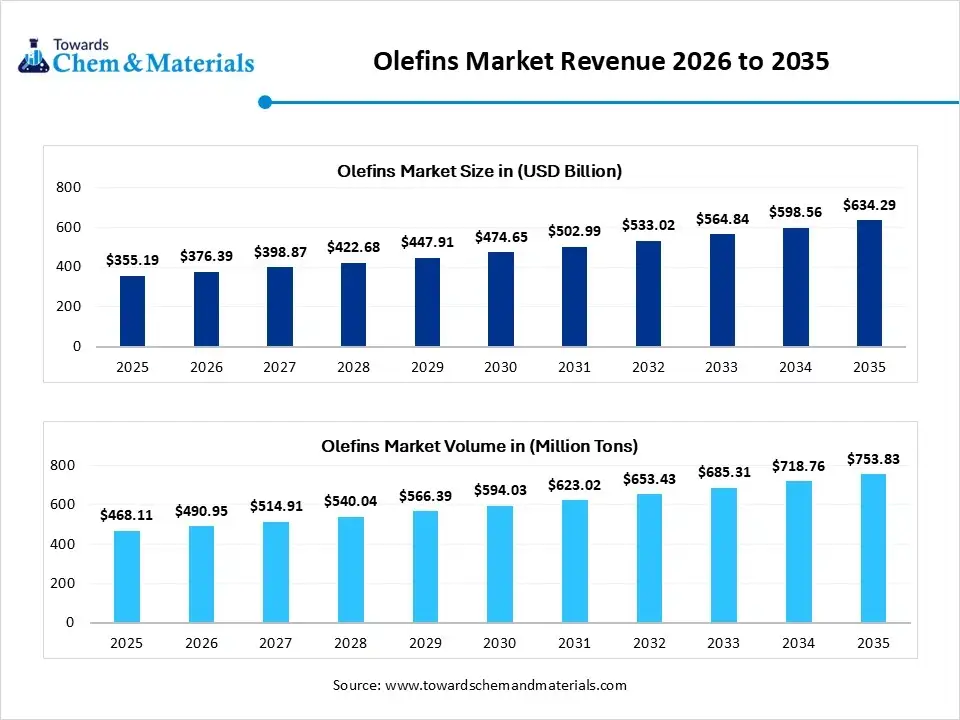
The global olefins market was valued at USD 355.19 billion in 2025, is estimated to reach USD 398.87 billion in 2026, and is projected to reach USD 634.29 billion by 2035, growing at a CAGR of 5.97% from 2026 to 2035. In terms of volume, the olefins market is projected to grow from 468.11 million tons in 2025 to 753.83 million tons by 2035. growing at a CAGR of 4.88% from 2026 to 2035. The olefins are unsaturated aliphatic hydrocarbons that represent carbon-to-carbon double bonds that act as key precursors for synthetic and petrochemical derivatives, which offer superior chemical reactivity. The olefins are categorized as ethylene, propylene, and butylene, which are necessary for the synthesis of upstream chemical intermediates and high-volume polymers. The industry emphasizes vertical integration of these gases into the manufacturing of key resins, functional fluids, and elastomers. As the manufacturers demand a mass-balance chain-of-custody model that allows tracking of bio-attributed and recycled olefins to meet sustainability standards, fueling the market growth.
The government support for circular feedstock and low-carbon pathways drives the adoption of bio-based feedstock and resource efficiency. The rising focus on molecular conversion efficiency into polymeric chains for the production of high-performance plastics, functional additives, and synthetic rubbers. The high-demand sectors like packaging, automotive, aerospace, and textiles are adopting olefins promoted by green chemistry. The shift towards decarbonization enables the integration of carbon capture and the implementation of crude-to-chemicals technologies into well-established infrastructure, boosting the market expansion.
The modern industrial framework is transitioning towards circularity-driven manufacturing that is accelerating monomeric units life cycle assessments. The leading players are increasingly integrating catalytic cracking and gas separation technologies to enhance overall olefins yield and purity by providing process optimization, which is reshaping market growth. The emerging trend is a focus on transition towards functionalized olefins, which have the ability to support the next generation of high-performance lightweight materials and biodegradable polymers in the automotive sector.
Key Takeaways
- By region, Asia Pacific dominated the olefins market by holding 47% share in 2025 driven by its petrochemical manufacturing infrastructure and rising domestic demand.
- By region, the Middle East & Africa held the 6% market share in 2025 and is expected to grow at the fastest with a CAGR of 7.00% during the forecast period due to feedstock versatility and investment in economic diversification strategies.
- By product type, the ethylene segment dominated the market with the largest share of 42% in 2025 due to efficiency and diversified industrial demand.
- By product type, the alpha olefins segment held 12% market share in 2025 and is expected to grow at the fastest CAGR of 7.20% over the forecast period, driven by demand for linear low-density polyethylene and its performance enhancement ability.
- By feedstock, the naphtha segment dominated the market with the largest share of 46% in 2025, driven by demand in the integrated refinery-petrochemical complex and large-scale demand in flexible downstream chemical manufacturing.
- By feedstock, the bio-based feedstock segment held 4% market share in 2025 and is expected to grow at the fastest CAGR of 9.40% over the forecast period due to rising investment in renewable olefin manufacturing and consumer demand for low-carbon plastics.
- By production technology, the steam cracking segment dominated the market with the largest share of 61% in 2025, driven by its operational performance and technological flexibility, especially in large-scale petrochemical facilities.
- By production technology, the methanol-to-olefins (MTO) segment held 15% market share in 2025 and is expected to grow at the fastest CAGR of 7.10% over the forecast period due to its supply-chain resilience and its conversion efficiency by providing lower operational cost.
- By application, the polyethylene production segment dominated the market with the largest share of 39% in 2025 due to its demand in packaging, construction, and e-commerce in emerging economies.
- By application, the detergent alcohols segment held 4% market share in 2025 and is expected to grow at the fastest CAGR of 6.90% over the forecast period, fueled by urban demand from surfactant manufacturers and personal hygiene products.
- By end-use industry, the packaging segment dominated the market with the largest share of 34% in 2025, driven by consumer demand for recyclable packaging and flexible packaging.
- By end-use industry, the healthcare segment held 7% market share in 2025 and is expected to grow at the fastest CAGR of 7.30% over the forecast period due to pharmaceutical sector expansion and investment in healthcare and disposable devices.
- By distribution channel, the direct sales segment dominated the market with the largest share of 48% in 2025, driven by long-term supply agreements and an integrated logistics network
- By distribution channel, the online commodity platforms segment held 6% market share in 2025 and is expected to grow at the fastest CAGR of 8.40% over the forecast period due to digital procurement platforms and automated logistics.
Olefins Market Trends
- Rising Focus on Process and Yield Enhancement: The R&D program on catalytic technologies that offers the development of proprietary catalyst systems and specialized olefins for propane dehydrogenation for precision olefin output.
- Transition Towards Decarbonization: The shift towards carbon-neutral crackers and integration of biogenic feedstock associated with renewable propylene and bio-ethylene to lower scope 3 emissions is driving the market expansion.
Key Technological Shifts and AI in the Olefins Market
The technological advancement enables higher monomer purity and optimized yield of olefins. The combination of computational chemistry and autonomous industrial processing is driving the utilization of generative AI for novel olefins discovery. The reinforcement learning system is integrated into the furnace control system, which lowers fuel consumption and enhances yield stability.
The execution of blockchain-driven IoT sensors ensures bio-attributed and recycled olefins in the global supply chain. The emerging transition towards AI-orchestrated manufacturing allows manufacturers to move from basic olefins into high-tech, data-driven assets with net-zero targets. Additionally, technological shifts optimized yield by ensuring higher profitability and lowered environmental impact.
Supply Chain Analysis of the Olefins Market
Feedstock Procurement: The procurement and logistics of hydrocarbon raw materials, including ethane, propane, and naphtha, through crackers to oil refineries and natural gas liquid facilities. The feedstock involves pipeline networks and specialized shipping for gas transport.
- Key Players: ExxonMobil, Cheniere Energy, Enterprise Products Partners, and Saudi Aramco
Conversion and Molecular Cracking:The stage of feedstock conversion into high-purity ethylene, propylene, and butadiene through thermal and catalytic cracking processes. The stage involves integration of AI-driven process control to maintain energy-intensive furnace operations.
- Key Players: BASF SE, Dow Inc., SABIC, and LyondellBasell
Olefin Derivatives and Polymerization: The stage of olefin gas is transformed into polyethylene, polypropylene, and specialized functional fluids. The olefin, with adjusting molecular weight and density, utilized in EV manufacturing, sustainable packaging, and medical sectors meet mass balance certifications.
Key Players: Borealis, Ineos, Chevron Phillips Chemical, and Formosa Plastics
Regulatory Framework: Olefins Market
| Region | Key Regulations | Regulatory Focus |
| European Union | CBAM, REACH Standards, PPWR, and Green Deal | Focus on chemical safety and carbon neutrality. Mandates high recycled content in olefin derivatives. Imposes a carbon price for imported ethylene and propylene |
| North America | EPA Section 111, TSCA, Inflation Reduction Act, and Clean Air Act | Targets fugitive emissions from crackers units for 1,3- Butadiene. Emphasize emission monitoring and air quality for green hydrogen and carbon capture. |
| Asia Pacific | GB Standards, Plastic Waste Management Rules, China National Sword | Strictly limits the expansion of coal-to-olefins plants for cleaner ethane-based cracking. Targets import restrictions on waste and self-sufficiency. |
| Middle East | Sustainability Vision 2030 and Circular Carbon Economy Act | Regulation for fuel exports to high-value petrochemicals with integrated carbon reduction technologies |
| Global | ISCC PLUS Certification, Basel Convention/ IMO Standards | Focus on hazardous waste and shipping emissions for bio-based olefin. Focus on the maritime logistics of olefins and the life cycles of plastics feedstock. |
Olefins Market Dynamics
Driver
Trend Towards Resource Circularity and Margin Optimization
The market growth is driven by the rising focus on commercial scaling of chemical recycling to optimize resource recovery during the manufacturing process. The manufacturers combination of a closed-loop system where waste-based hydrocarbons, pyrolysis oil, are redevelop into the cracker to make recycled-content olefins to reach sustainability certifications. The shift towards green premium enables a shift between liquid-fed naphtha and gas -fed ethane, which offer optimized yield of high-value co-products by maintaining superior precision, reduced waste-gas generation, and lowered energy use.
Restraints
Stringent Regulatory Framework
The olefins market is focused on the reduction of carbon footprint and lowering of plastic waste, where regulatory pressure acts as a heavy operational restraint. The government policies, like plastic taxes and demand lifecycle assessment forces producers to absorb higher compliance cost which is a key restraining factor for the global olefins market.
Opportunity
Strategic Growth in Specialized Olefin Derivatives
The key opportunity in specialty olefins for high-tech applications enables the manufacturing of linear alpha olefins, metallocene-based polyolefins, elastomeric olefin derivatives, cyclic olefin copolymers, and functionalized polyolefins. The specialty olefins are integrated into automotive transition, medical-grade packaging, consumer electronics, advanced optics, aerospace composites, and renewable energy infrastructure. Overall, this strategic opportunity allowing transition of high-growth specialized derivatives that offer material longevity, superior impact resistance, and optical clarity by meeting sustainability-driven industrial compliances.
Segmental Insights
Product Type Insights
Ethylene Segment Dominated the Olefins Market with 42% of Market Share in 2025
The ethylene segment dominated the market with the largest share of 42% in 2025, driven by its versatility, reactivity, and high-utility in the petrochemical industry. The ethylene is derived from thermal cracking to accelerate the manufacturing of polyethylene, polyester resins, and PVC. Ethylene is a crucial derivative for ethylbenzene, ethylene oxide, and vinyl acetate that is utilized in industrial manufacturing processes. The segment growth is supported by circular economy targets and advancements in bio-based ethylene production.
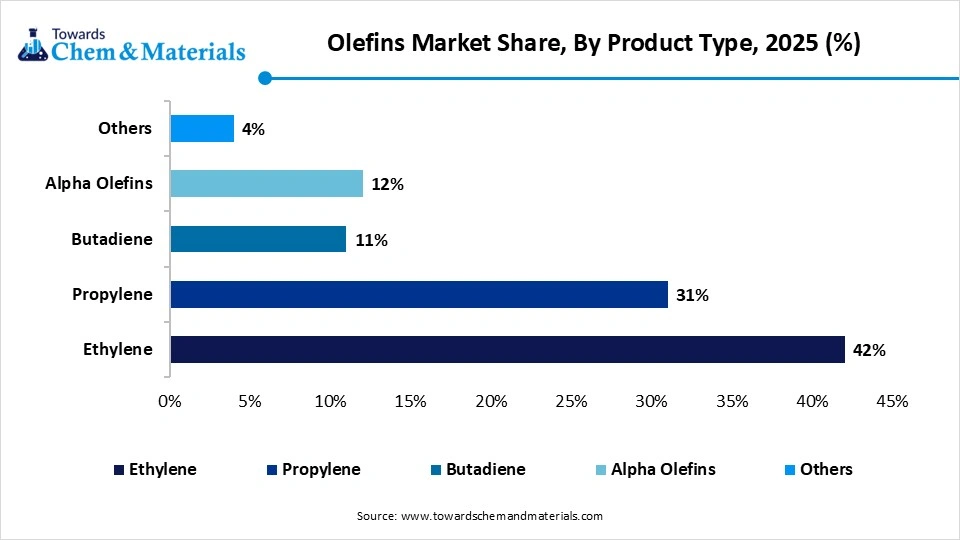
The propylene segment held the 31% market share in 2025 due to its demand in medical, automotive, and textile applications as a versatile co-product with superior chemical inertness. The propylene is sourced using catalytic cracking and on-purpose PDH technology. This segment prefers feedstock resilience and advanced recovery to promote resource efficiency and a sustainable supply chain essential for polypropylene manufacturing.
The alpha olefins segment held the 12% market share in 2025 and is expected to grow at the fastest CAGR of 7.20% over the forecast period. It represents their terminal double bond and superior chemical reactivity, crucial for precision-driven industry. alpha olefins like 1-Butene, 1-Hexene, and 1-Octene are synthesized through ethylene oligomerization, which is a key comonomer for offering higher strength and superior stress resistance. It is used in synthetic lubricants, high-performance additives, and biodegradable detergents that make them key for low-friction industrial applications and advanced engineering.
The butadiene segment held 11% market share in 2025. It acts as a cross-linking agent and elastomeric component. Butadiene captured as a C4 co-product during steam cracking as a monomer for SBR and PBR by offering resilience and durability. This segment is crucial for nylon precursors and ABS engineering plastics, essential for electronics and the automotive industry. Butadiene is evolving through bio-ethanol conversion and on-purpose dehydrogenation, utilized as a synthetic rubber grade and industrial chemical grade.
Feedstock Insights
Naphtha Segment Dominated the Olefins Market with 46% of Market Share in 2025
The naphtha segment dominated the market with the largest share of 46% in 2025. It represents a crucial liquid feedstock derived from thermal cracking and crude oil refining that offers operational yield for steam crackers and a co-product in high-value propylene, aromatics, and butadiene. Naphtha is utilized in construction, automotive, and consumer goods due to its operational flexibility by maintaining higher chemical output and supply chain stability.
The ethane segment held the 28% market share in 2025, driven by its superior selectivity and highest conversion rates with lower byproduct complexity. Ethane acts as an ultra-efficient gas feedstock and ethylene precursor extracted from natural gas liquids. The segment growth is fueled by shale gas versatility, streamlined supply chain, and lowered processing intensity, key to large-scale production of packaging and plastics.
Olefins Market Share, By Feedstock, 2025 (%)
| By Feedstock | Revenue Share, 2025 (%) |
| Naphtha | 46% |
| Ethane | 28% |
| Propane | 9% |
| Butane | 5% |
| Coal-to-Olefins | 8% |
| Bio-based Feedstock | 4% |
The propane segment held 9% market share in 2025. It offers high input for propane dehydrogenation and a key on-purpose precursor. Propane offers flexibility that enables manufacturers to overcome byproduct complexity by providing high-purity yield for specialty resins and polypropylene. The segment expansion is critical for stabilizing the value chain and a superior efficiency pathway for industrial manufacturing.
The bio-based feedstock segment held the 4% market share in 2025 and is expected to grow at the fastest CAGR of 9.40% over the forecast period, due to its ability to provide a decarbonized and renewable pathway. The bio-based feedstock is derived from agricultural residue, non-food biomass, and organic waste for the manufacturing of sustainable hydrocarbons. The sustainable hydrocarbons. The segment adopts biomass gasification and alcohol-to-olefin technologies for fossil-fuel-free chemical production. Bio-based feedstock focuses on net-zero emissions and eco-conscious manufacturing.
The coal-to-olefins segment held 8% market share in 2025. It represents the conversion of solid coal into syngas and methanol by maintaining energy security and an on-purpose pathway of ethylene and propylene. The segment emphasizes vertical integration to ensure a stable supply for industrial polymers. Additionally coal-to-olefins segment focuses on carbon capture and storage and efficiency optimization by providing high output and lower environmental impact.
Production Technology Insights
The Steam Cracking Segment Dominated the Olefins Market with 61% of Market Share in 2025
The steam cracking segment dominated the market with the largest share of 61% in 2025, due to its superior scalability and feedstock resilience. The steam cracking utilizes thermal pyrolysis to break hydrocarbons for the production of high-volume ethylene and propylene as an industrial route. The technology focuses on furnace electrification and waste-heat recovery to ensure energy efficiency and carbon-neutral petrochemicals manufacturing.
The methanol-to-olefins (MTO) segment held the 15% market share in 2025 and is expected to grow at the fastest CAGR of 7.10% over the forecast period. This technology converts methanol into an ethylene and propylene stream by maintaining selectivity through advanced catalytic conversion. MTO allows coal, captured carbon, and natural gas as a non-petroleum pathway for the manufacturing of high-purity polymers. Additionally, MTO integrates with renewable green methanol, that make them key for resourceful and sustainable high-performance chemical infrastructure.
Olefins Market Share, By Production Technology, 2025 (%)
| By Production Technology | Revenue Share, 2025 (%) |
| Steam Cracking | 61% |
| Fluid Catalytic Cracking (FCC) | 12% |
| Methanol-to-Olefins (MTO) | 15% |
| Oxidative Dehydrogenation | 5% |
| On-purpose Propylene Production | 7% |
The fluid catalytic cracking (FCC) segment held the 12% market share in 2025, driven by its ability to transform heavy oil fractions to high-value light olefins for fuel-to-chemical conversion by ensuring superior reliability and maximizing monomer yields. The modern automotive and packaging demand for olefins that boost advancement in ZSM-5 additives and high-severity FCC. Overall, FCC is a key pillar of dynamic refinery-integrated hubs.
The on-purpose propylene production segment held 7% market share in 2025 due to demand for a high-selectivity alternative where propane dehydrogenation and olefin metathesis ensure a stable supply stream of high-purity monomer. The on-purpose propylene production functions as enhanced catalyst performance and feedstock optimization by stabilizing the chemical supply chain in healthcare and advanced engineering.
Application Insights
Polyethylene Production Segment Dominated the Olefins Market with 39% of Market Share in 2025
The polyethylene production segment dominated the market with the largest share of 39% in 2025, driven by massive manufacturing of HDPE, LDPE, and LLDPE resins for high ethylene output and supply chain. Polyethylene is crucial for construction infrastructure, flexible packaging, and healthcare applications by ensuring durability and cost-effectiveness. The segment is shifting towards sustainable transition and advancement of mechanically recycled and bio-based olefins to meet circular economy commitments.
The polypropylene production segment held the 27% market share in 2025, due to its higher heat resistance and structural integrity. The segment is crucial for polymer innovation, driving the shift towards renewable-based olefins and advancement in recycling. Polypropylene production, like homo-polymer and co-polymer PP, is key for medical equipment, automotive lightweighting, and durable consumer goods. Its adoption in utility and industrial manufacturing makes it a cost-effective and resilient solution.
Olefins Market Share, By Application, 2025 (%)
| By Application | Revenue Share, 2025 (%) |
| Polyethylene Production | 39% |
| Polypropylene Production | 27% |
| Synthetic Rubber | 12% |
| Chemical Intermediates | 16% |
| Fuel Additives | 2% |
| Detergent Alcohols | 4% |
The chemical intermediates segment held 16% market share in 2025. Its high-value conversion catalyst is a crucial precursor for the textile, cosmetic, and construction sectors as chemicals, performance additives, and solvents. The chemical intermediates include ethylene oxide, oxo alcohols, cumene, and acrylonitrile, which offer molecular precision and a low-emission pathway to promote a modern, sustainable specialty chemical framework.
The detergent alcohols segment held the 4% market share in 2025 and is expected to grow at the fastest CAGR of 6.90% over the forecast period. It functions as a high-performance, specialized surfactant that is produced from linear alpha olefin using hydroformylation by ensuring superior surface activity and molecular stability. Detergent alcohols are key for biodegradable cleaning agents, personal care formulation, and the household sector. This segment transitions towards low-toxicity alternative and bio-source fatty alcohols to meet consumer safety and environmental compliance.
End-Use Industry Insights
The Packaging Segment Dominated the Olefins Market with 34% of Market Share in 2025
The packaging segment dominated the market with the largest share of 34% in 2025 due to demand for sterile medical containers, tamper-evident food wraps, and logistical protection. The packaging segment focuses on lightweight and resource efficiency to lower the transport emissions and maintain product integrity. As this sector is shifting towards compostable olefins solutions and high-purity recycled content to meet consumer hygiene and environmental safety.
The construction segment held the 18% market share in 2025, driven by olefins high-strength resilience in piping systems, geomembranes, wires & cables, and insulation panels. The urban population focuses on lightweight polymers and corrosion-resistance that accelerates the shift towards carbon-neutral construction materials and energy-efficient building envelopes by ensuring structural longevity. Additionally, the construction sector focuses on green certification standards and sustainable building infrastructure.
Olefins Market Share, By End-use Industry, 2025 (%)
| By End-use Industry | Revenue Share, 2025 (%) |
| Packaging | 34% |
| Automotive | 16% |
| Construction | 18% |
| Consumer Goods | 11% |
| Healthcare | 7% |
| Agriculture | 8% |
| Textile | 6% |
The automotive segment held the 16% market share in 2025 due to rising demand for lightweighting and high-performance efficiency. The rising consumption of butadiene-based elastomers and polypropylene in exterior, interior, and under-the-hood components is due to their superior impact resistance and higher durability. Olefin composites are used in electric vehicles, and integrating mechanical recycled resins to meet net-zero manufacturing targets.
The consumer goods segment held 11% market share in 2025 because of consumer-driven sustainability that integrates post-consumer recycled resins to meet safety and circular economy commitments. The olefins utilized in durable electronics, daily essentials, and household products provide aesthetic versatility and shatter resistance. The major players are investing in an olefin framework that boosts mass-market affordability and product safety.
The healthcare segment held the 7% market share in 2025 and is expected to grow at the fastest CAGR of 7.30% over the forecast period. The demand for sterilization flexibility and biocompatibility requires the use of specialized polypropylene and polyethylene. The healthcare sector focuses on advanced material safety and medical-grade precision to manufacture sterile IV bags, life-saving syringes, and diagnostic equipment.
Distribution Channel Insights
Direct Sales Segment Dominated the Olefins Market with 48% of Market Share in 2025
The direct sales segment dominated the market with the largest share of 48% in 2025. The market expansion is promoted by establishing direct-to-manufacturers collaboration to achieve supply chain resilience and optimized profit margins. Direct sales provide customized technical support and pricing agility in logistical infrastructure. The segment focuses on its integration of digital procurement platforms that boost partnership innovation on sustainable materials directly with industrial end-users.
The distributor & traders segment held the 29% market share in 2025, driven by its ability to maintain risk mitigation and domestic flexibility for primary producers and buyers. Distributors and traders offer localized storage, flexible financing, and instant delivery. Additionally, this segment navigates price volatility and provides stable supply chain continuity.
Olefins Market Share, By Distribution Channel, 2025 (%)
| By Distribution Channel | Revenue Share, 2025 (%) |
| Direct Sales | 48% |
| Distributors & Traders | 29% |
| Contract Supply Agreements | 17% |
| Online Commodity Platforms | 6% |
The contract supply agreements segment held the 17% market share in 2025, due to its long-term predictability and high-volume commitment for capital-intensive operations and petrochemical manufacturing infrastructure. This segment utilizes formula-based pricing that makes it key for risk management. This agreement drives sustainable transition by ensuring stable logistics of circular and bio-based monomers.
The online commodity platforms segment held the 6% market share in 2025 and is expected to grow at the fastest CAGR of 8.40% over the forecast period, driven by rising focus towards real-time pricing data and automated procurement for faster transaction speed and market democratisation. This platform focuses on supply chain traceability and the integration of blockchain technology, enabling smaller buyers and sellers to access liquidity by verifying low-carbon olefins and circularity for modern sustainability.
Regional Insights
How Did the Asia Pacific Dominate the Olefins Market in 2025?
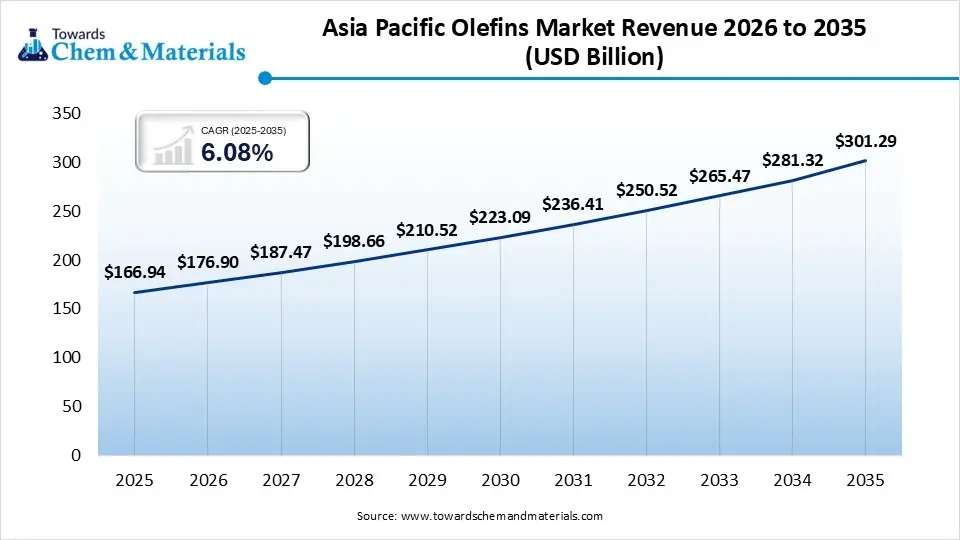
The Asia Pacific olefins market size was estimated at USD 166.94 billion in 2025 and is projected to reach USD 301.29 billion by 2035, growing at a CAGR of 6.08% from 2026 to 2035. The regional diversified feedstock strategy and its expansion of an integrated mega-complex are driving the domestic expansion. The government support for the olefin’s framework boosts the technological transition and advanced material innovation. Asia Pacific focuses on the coal-to-olefins pathway and resource optimization that positions them as key for high-performance infrastructure.
China Olefins Market Growth Trends
Chinas market is transforming towards self-sufficiency and the implementation of a multi-feedstock model. China mega-complex integrated CTO. MTO and naphtha cracking that drives the regional industrial resilience. The region focuses on high-end olefins innovation and advancement in carbon-reduction technologies through substantial investment, which makes China a key catalyst for advanced polymer development.
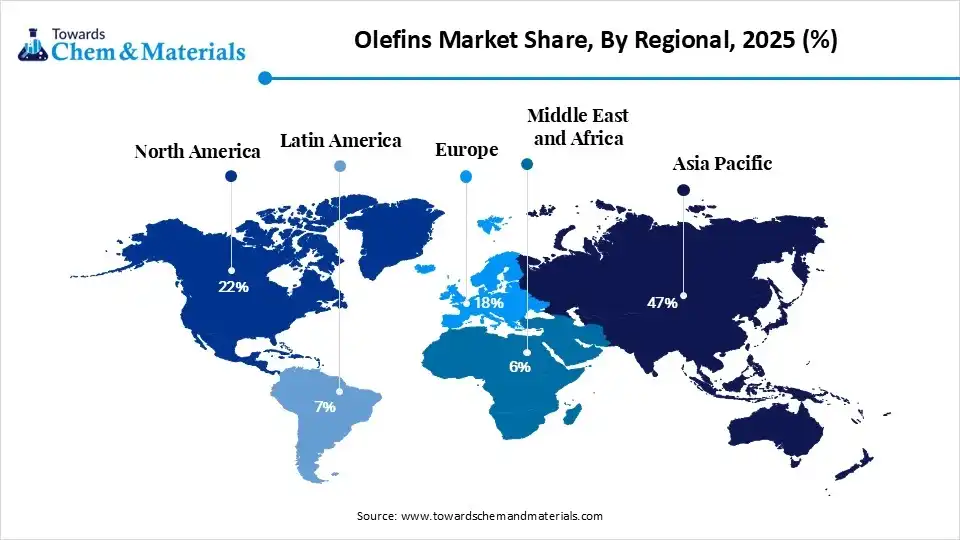
The Middle East & Africa held 6% market share in 2025 and is expected to grow at the fastest, with a CAGR of 7.00% during the forecast period, witnessing continuous growth in the adoption of olefins by utilizing low-cost ethane. MEA is a key hub for efficient manufacturing of high-purity ethylene and specialized polymers due to its superior profit margins. The region is a key source exporter of next-generation energy and chemicals. MEA has focused on crude-to-chemical integration and renewable energy capacity expansion that accelerating the growth.
Saudi Arabia Olefins Market Growth Trends
Saudi Arabia market is known for its cost-efficiency and its strategic competitive advantage. The regional growth is fueled by their low-cost ethane feedstock and crude-to-chemical revolution. The domestic combined petrochemical complexes and major export companies focus on carbon-neutral olefins. Saudi Arabia is integrating a circular economy and green hydrogen infrastructure that is accelerating the domestic expansion.
Top Companies in the Olefins Market
- BASF SE
- Chevron Phillips Chemical Company LLC
- China Petroleum & Chemical Corporation
- Dow Inc.
- ExxonMobil Chemical Company
- Formosa Plastics Corporation
- INEOS Group Holdings S.A.
- LyondellBasell Industries N.V.
- Royal Dutch Shell plc
- Saudi Basic Industries Corporation
- Sumitomo Chemical Co., Ltd.
Olefins Market Segment List
By Product Type
- Ethylene
- Polymer Grade Ethylene
- Chemical Grade Ethylene
- Propylene
- Polymer Grade Propylene
- Chemical Grade Propylene
- Butadiene
- Synthetic Rubber Grade
- Industrial Chemical Grade
- Alpha Olefins
- 1-Butene
- 1-Hexene
- 1-Octene
- Higher Alpha Olefins
- Others
- Isobutylene
- Acetylene
- Mixed Olefins
By Feedstock
- Naphtha
- Ethane
- Propane
- Butane
- Coal-to-Olefins
- Bio-based Feedstock
By Production Technology
- Steam Cracking
- Fluid Catalytic Cracking (FCC)
- Methanol-to-Olefins (MTO)
- Oxidative Dehydrogenation
- On-purpose Propylene Production
By Application
- Polyethylene Production
- HDPE
- LDPE
- LLDPE
- Polypropylene Production
- Homo-polymer PP
- Co-polymer PP
- Synthetic Rubber
- SBR
- Polybutadiene Rubber
- Chemical Intermediates
- Ethylene Oxide
- Acrylonitrile
- Cumene
- Oxo Alcohols
- Fuel Additives
- Detergent Alcohols
By End-Use Industry
- Packaging
- Flexible Packaging
- Rigid Packaging
- Automotive
- Interior Components
- Exterior Components
- Under-the-Hood Applications
- Construction
- Pipes & Fittings
- Insulation
- Wires & Cables
- Consumer Goods
- Household Products
- Electronics
- Healthcare
- Medical Packaging
- Medical Devices
- Agriculture
- Greenhouse Films
- Irrigation Systems
- Textile
By Distribution Channel
- Direct Sales
- Distributors & Traders
- Contract Supply Agreements
- Online Commodity Platforms
By Regions
- North America
- U.S.
- Canada
- Mexico
- Europe
- Germany
- UK
- France
- Italy
- Spain
- Asia Pacific
- China
- India
- Japan
- South Korea
- Latin America
- Brazil
- Argentina
- Middle East & Africa
- Saudi Arabia
- South Africa
A Seven-Phase Framework
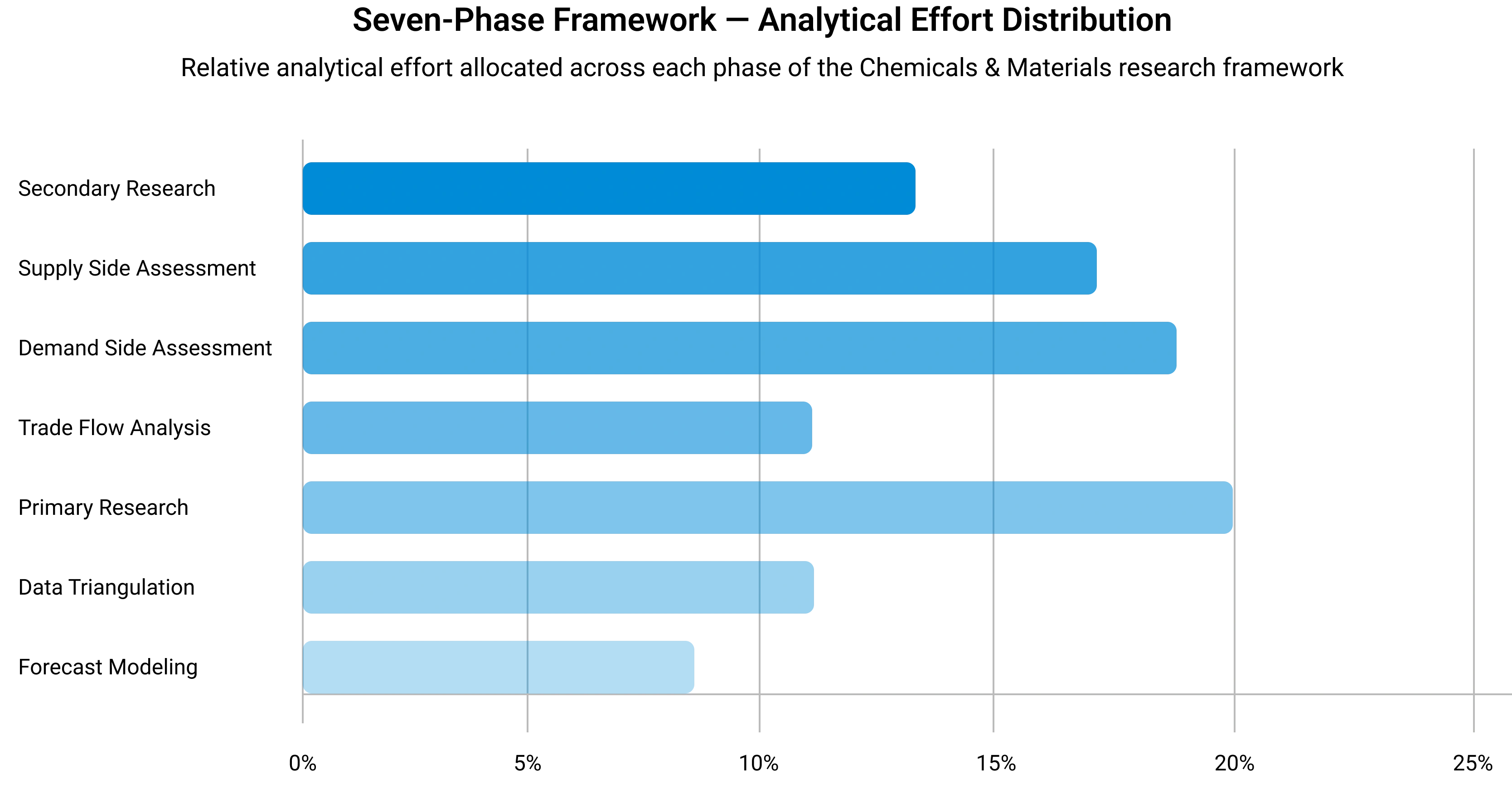
Our methodology is designed to be universally applicable across commodity chemicals, specialty chemicals, petrochemicals, construction chemicals, coatings, electronic chemicals, industrial gases, agrochemicals, water treatment chemicals, and performance materials. Each phase builds upon the last, creating a layered validation structure that minimizes estimation error and maximizes analytical confidence.
The framework ensures comprehensive market coverage, robust cross-validation, and reliable long-term forecasting — producing market estimates that withstand scrutiny from investors, regulators, and corporate strategy teams.

Seven-Phase Framework — Analytical Effort Distribution
Relative analytical effort allocated across each phase of the Chemicals & Materials research framework
Phase 1 - Secondary Research: Establishing the Foundation
Secondary research collects and evaluates publicly available information from authoritative sources, establishing the foundational understanding of market structure, value chain dynamics, competitive landscape, and end-use demand patterns. Every source is evaluated for credibility, recency, geographic relevance, and methodological soundness before inclusion.
Industry Associations
Sources include ACC, CEFIC, ICCA, JCIA, CPCIF, and SOCMA providing production volumes, consumption trends, capacity developments, and sustainability initiatives.
Company Disclosures
Annual reports, investor presentations, earnings transcripts, and regulatory filings reveal product portfolios, manufacturing footprints, capacity expansions, and revenue segmentation.
Government Databases
National statistical offices, customs authorities, environmental agencies, and industrial production databases provide verified statistics on output, trade flows, and regulatory compliance.
Trade Databases
UN Comtrade, ITC, Eurostat, and national customs authorities enable assessment of global product movement, import dependency, and export competitiveness across regions.
Our Secondary Research Sources
- Ministry of Chemicals and Fertilizers
- European Chemicals Agency
- United States Department of Energy
- Ministry of Industry and Information Technology
- Ministry of Economy Trade and Industry
- Ministry of Trade Industry and Energy
- National Institute of Standards and Technology
- Council of Scientific and Industrial Research
- Fraunhofer Society
- National Institute for Materials Science
Phase 2 — Supply-Side Assessment: Mapping Production Capabilities
Production Capacity Analysis
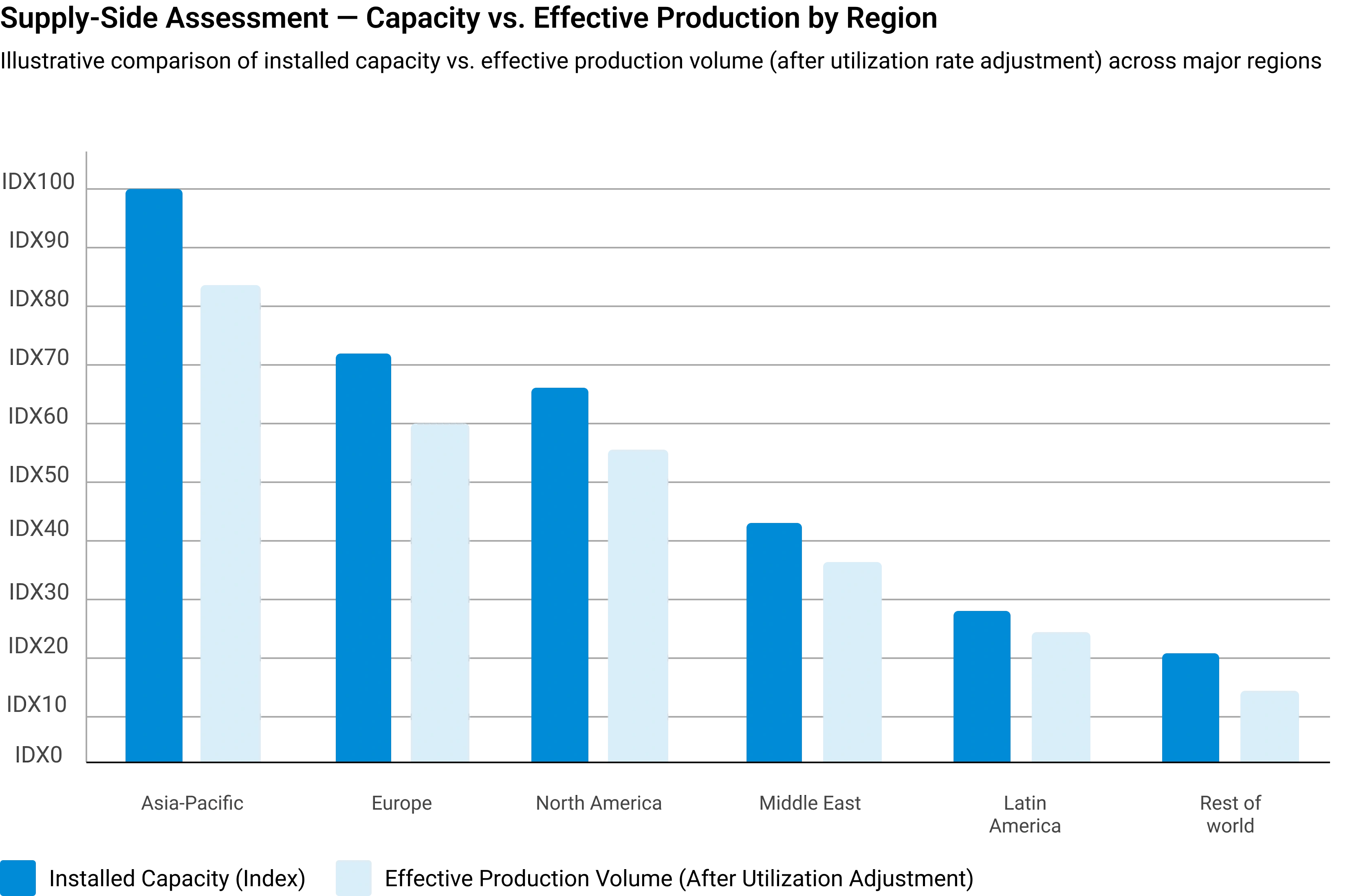
All major manufacturers are assessed for existing installed capacity, planned additions, expansions, new plant announcements, and technology adoption — mapped at global, regional, and country levels.
Capacity Utilization Adjustment
Installed capacity is adjusted using utilization rates based on demand conditions, feedstock availability, plant operating rates, maintenance schedules, and regulatory restrictions.
Manufacturer Revenue Analysis
Product-specific revenues, segment-level performance, regional distribution, average selling prices, and margin trends are evaluated to establish market value estimates.
Supply-Side Assessment — Capacity vs. Effective Production by Region
Illustrative comparison of installed capacity vs. effective production volume (after utilization rate adjustment) across major regions
Phase 3 — Demand-Side Assessment: Quantifying Chemical Consumption
Demand-side analysis quantifies chemical consumption across industries, applications, and geographies — identifying where and how chemicals are consumed throughout the value chain with precision.
End-Use Industry Analysis
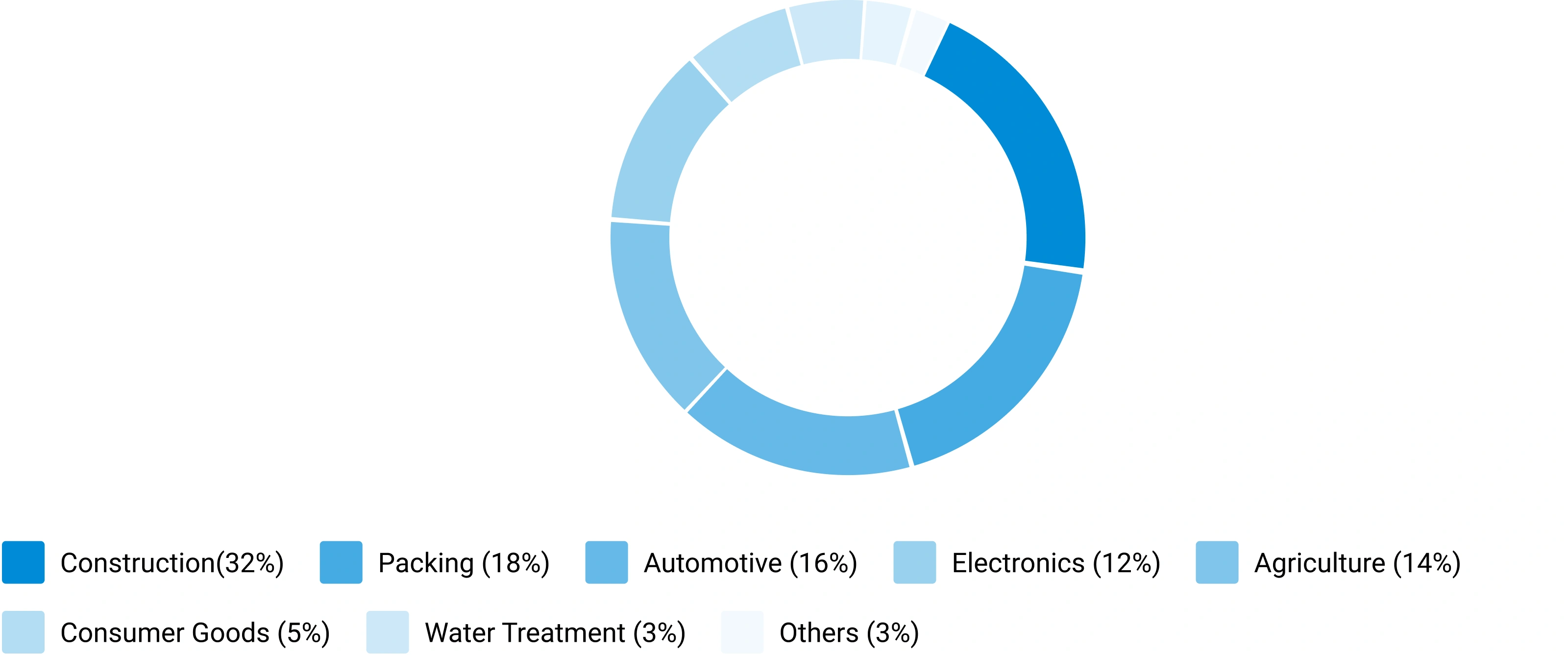
Chemical demand is evaluated across automotive, construction, packaging, electronics, agriculture, healthcare, consumer goods, industrial manufacturing, energy and utilities, and water treatment. Industry output, production trends, and consumption intensity are analyzed to determine demand patterns.
Consumption Modeling
Demand is estimated using measurable indicators: kilograms per vehicle, kilograms per square meter of construction, dosage per cubic meter of water treated, kilograms per hectare of agricultural land, and kilograms per ton of manufactured products. Consumption factors are validated through industry publications and primary interviews.
Application Analysis
The market is segmented by application area to understand product performance requirements, formulation trends, technology adoption, customer preferences, and regulatory requirements improving demand accuracy and segmentation granularity.
Demand-Side Assessment — End-Use Industry Demand Distribution
Illustrative distribution of chemical & materials demand across key end-use industries
Phase 4 - Trade Flow Analysis: Balancing Regional Supply and Demand
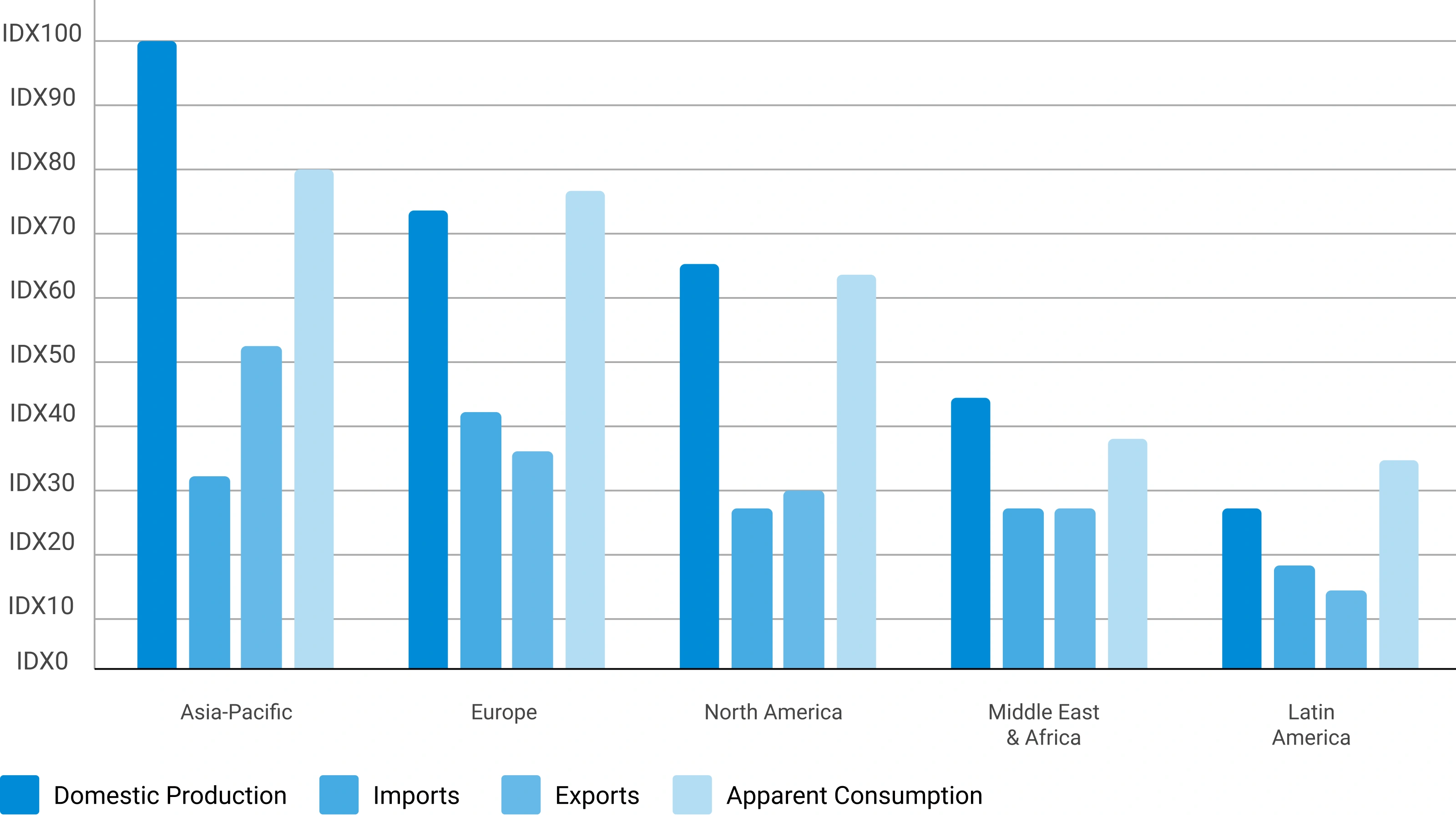
Trade flow analysis reconciles regional supply and demand estimates through import and export data, identifying net supply positions, regional dependencies, and market imbalances. It serves as an independent validation layer that tests the consistency of supply-side and demand-side estimates.
Import Analysis
Import data is evaluated to determine volumes, source countries, product dependency, regional supply gaps, and pricing trends — identifying markets that rely heavily on external supply and where domestic production is insufficient to meet demand.
Export Analysis
Export assessments reveal production surplus, export competitiveness, regional manufacturing strength, and global market participation. Export patterns also help validate domestic production estimates and identify net exporting regions.
Apparent Consumption Model
Regional consumption is assessed using the standard apparent consumption formula:
Results identify net importing regions, net exporting regions, regional deficits, and surpluses — serving as an independent validation of supply and demand estimates.
Trade Flow Analysis — Net Supply Position by Region
Illustrative apparent consumption vs. domestic production across major regions — positive gap indicates net import dependency
Phase 5 — Primary Research: The Critical Validation Layer
Primary research tests and refines findings from secondary research through direct engagement with industry participants across the supply chain, demand side, and expert community. It captures intelligence that no database or published report can provide — the real-world experience of manufacturers, buyers, and specialists operating in the market.

Supply-Side Interviews
Conversations with chemical manufacturers, raw material suppliers, contract manufacturers, technology providers, and plant operators cover production trends, capacity utilization, pricing developments, technology shifts, and competitive dynamics.

Demand-Side Interviews
Engagement with OEMs, industrial consumers, procurement managers, distributors, formulators, and end-use manufacturers focuses on consumption trends, purchasing behavior, product substitution, demand outlook, and emerging applications.

Industry Expert Consultations
Additional interviews with industry consultants, independent experts, regulatory specialists, technical professionals, and research institutions provide deeper market context and validate key analytical assumptions.
Focus Areas of Primary Research:
Market Size & Forecast Validation
Revenue estimates, volume consumption, growth rates, forecast assumptions, regional demand.Supply Chain & Value Chain Assessment
Raw material sourcing, supply chain challenges, distribution networks, procurement practices.Production & Capacity Analysis
Manufacturing capacity, utilization rates, expansion projects, plant investments.Pricing & Cost Structure Analysis
Product pricing trends, feedstock costs, energy costs, margin pressures, pricing outlook.Competitive Landscape Assessment
Volume and value estimates confirmed to be fully consistent with one another before publicationInterview Volume by Market Scope
| Study Scope | Number of Interviews |
|---|---|
| Niche Market | 20 – 30 |
| Mid-Sized Market | 30 – 50 |
| Global Market | 50 – 80 |
| Highly Fragmented Market | 80 – 120 |
Interview Details:
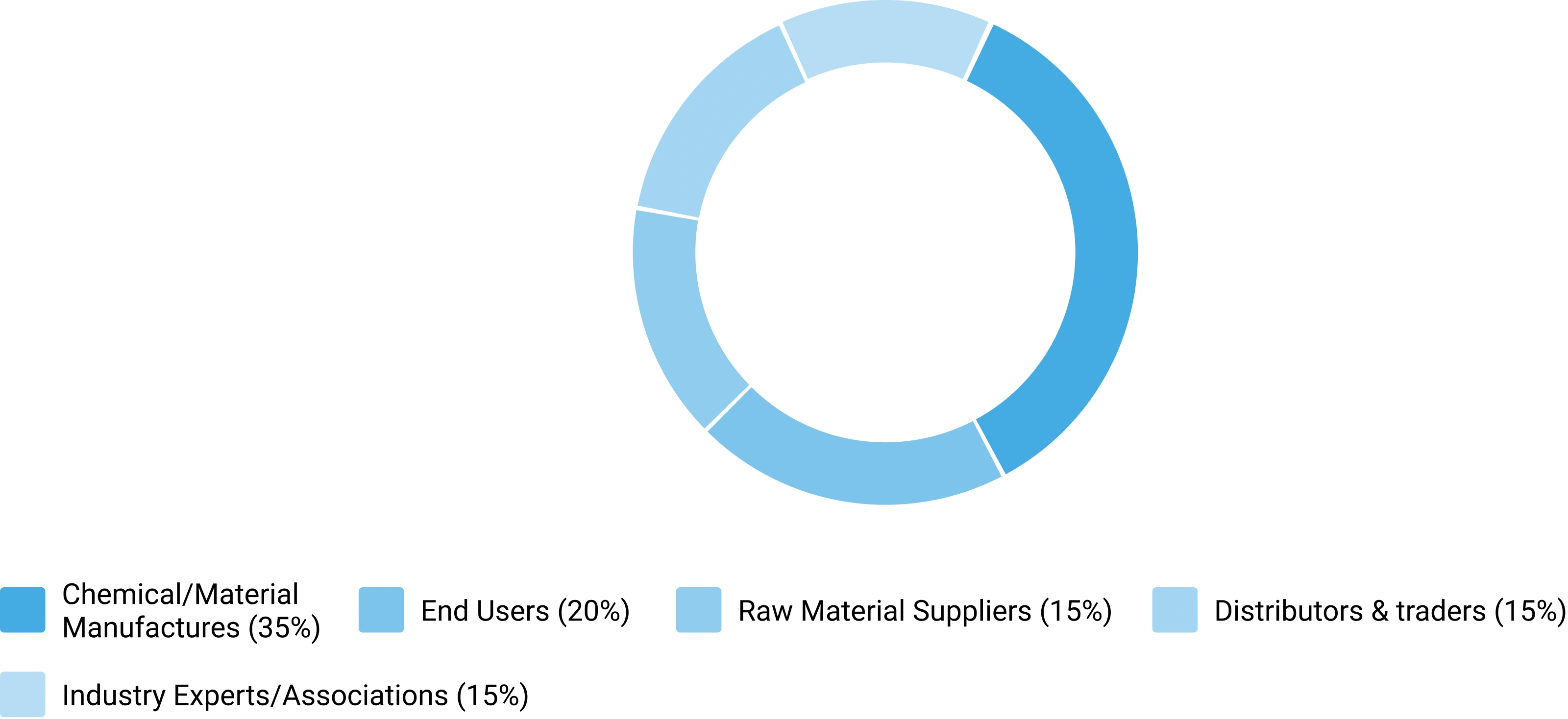
Category : Manufacturers, Suppliers, Distributors, End Users, Experts/Associations
Average Duration : 30–60 Minutes
Interview Mode : Video calls, telephonic interviews, expert consultations
Interview Format : Structured / Semi-Structured questionnaire
Focus Areas of Primary Research:
Market Size & Forecast Validation :
Revenue estimates, volume consumption, growth rates, forecast assumptions, regional demand.
Supply Chain & Value Chain Assessment :
Raw material sourcing, supply chain challenges, distribution networks, procurement practices.
Production & Capacity Analysis :
Manufacturing capacity, utilization rates, expansion projects, plant investments.
Pricing & Cost Structure Analysis :
Product pricing trends, feedstock costs, energy costs, margin pressures, pricing outlook.
Competitive Landscape Assessment :
Market share, competitor positioning, strategic initiatives, partnerships, acquisitions.
Primary Research — Stakeholder Coverage by Category
Distribution of interview respondents across stakeholder categories (% share from PPT data)
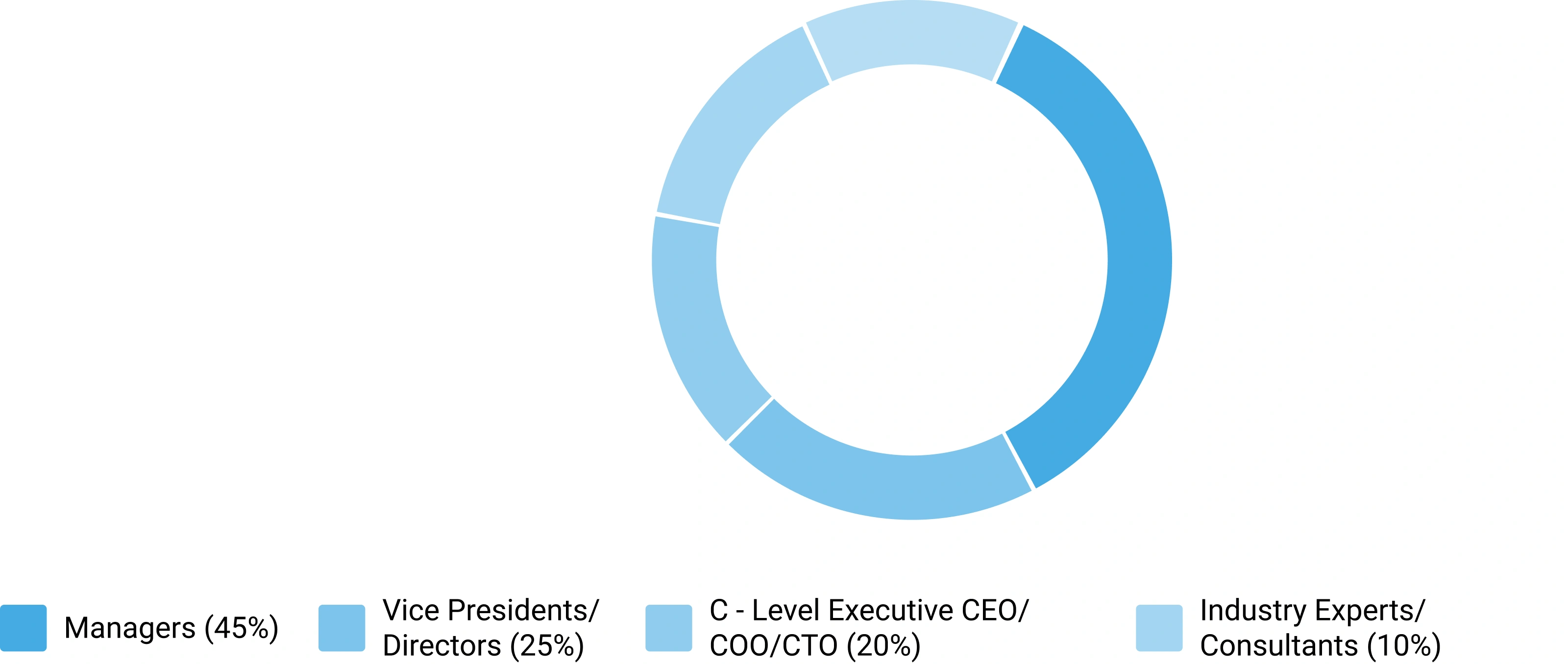
Primary Research — Respondent Designation Profile
Seniority breakdown of interview respondents (% share from PPT data)
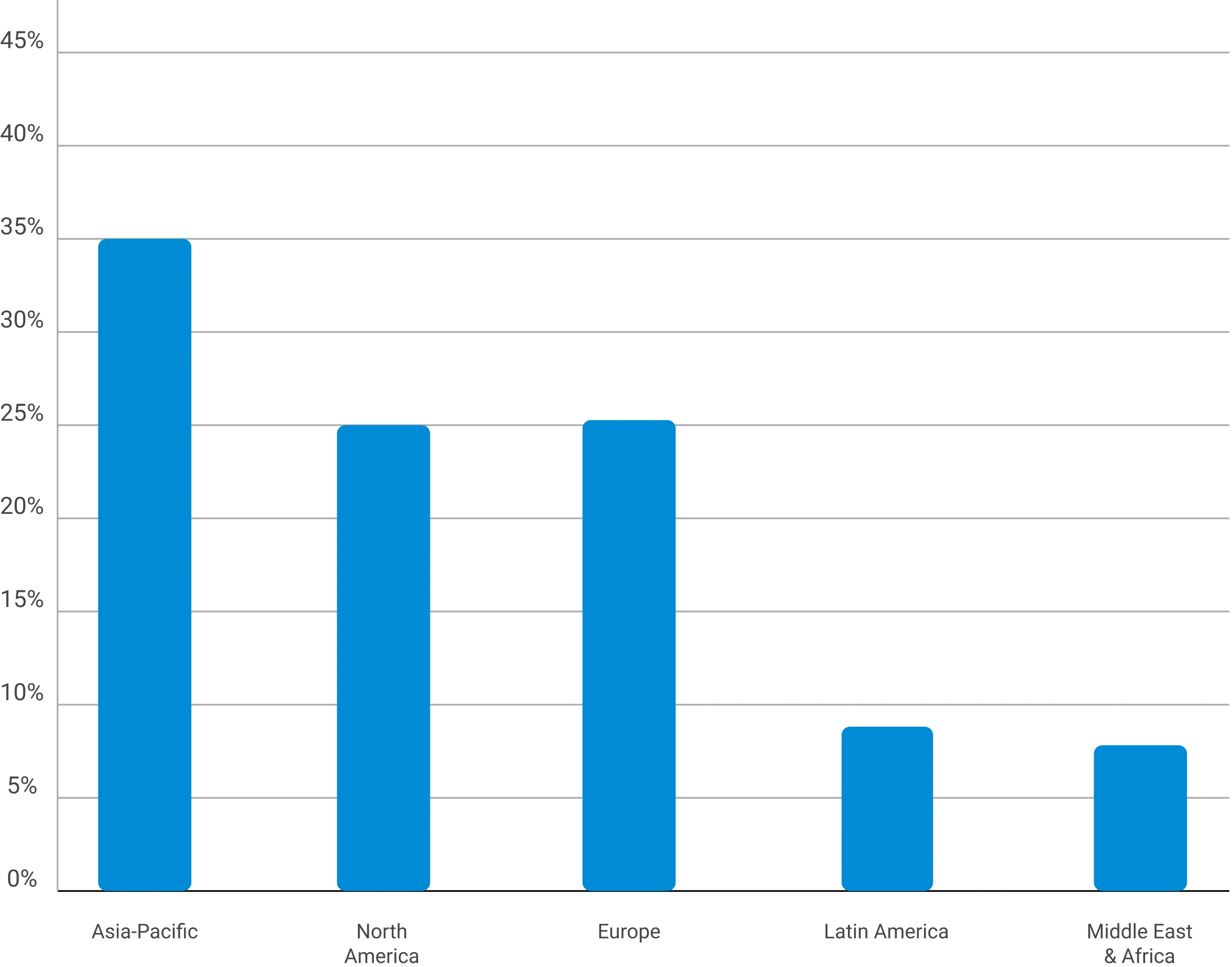
Primary Research — Geographic Coverage of Interviews
Regional distribution of primary research engagement (% share from PPT data)
Phase 6 — Data Triangulation and Market Validation
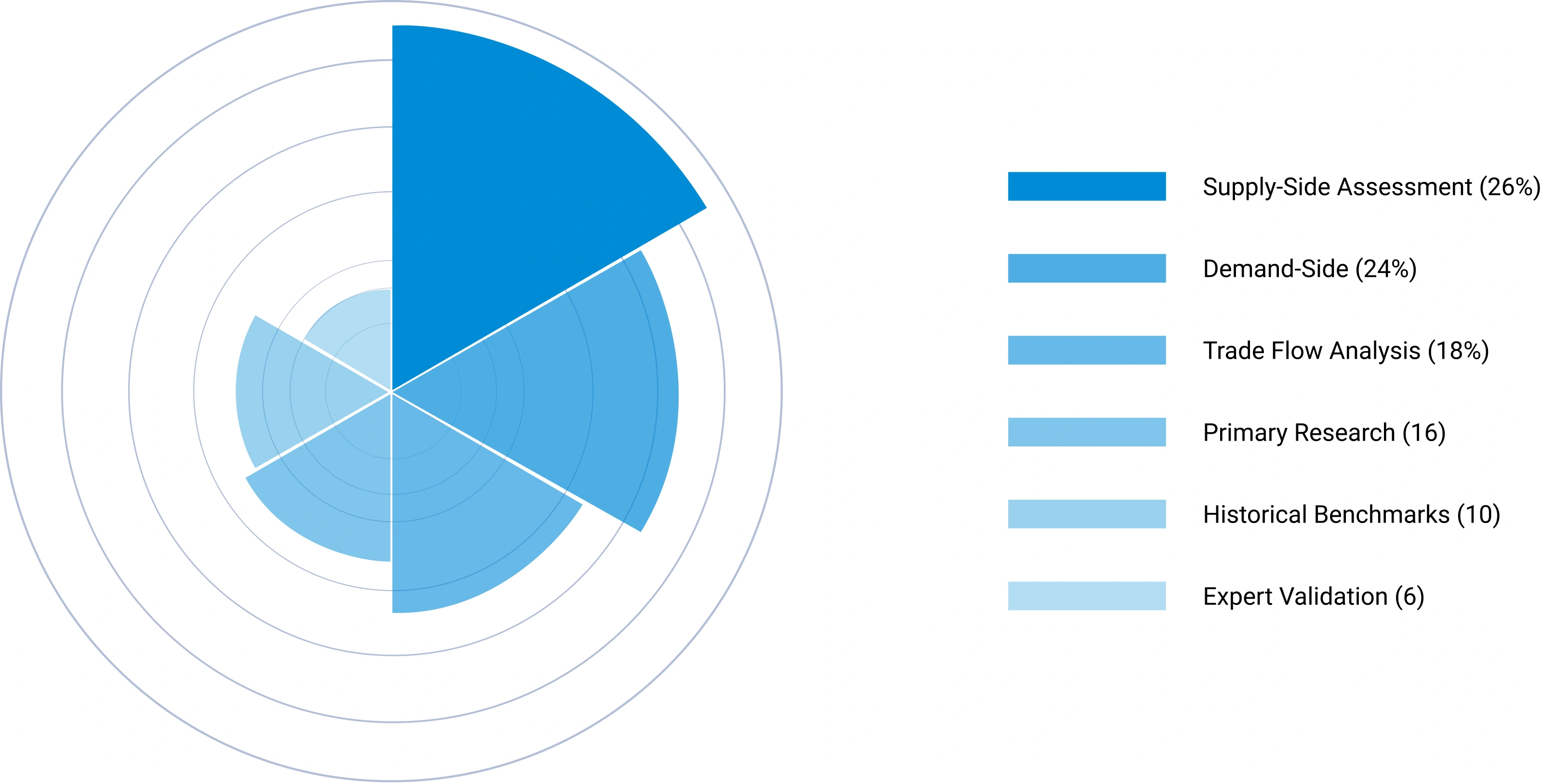
No single methodology is relied upon in isolation. Multiple independent estimation approaches are combined and reconciled to ensure consistency, accuracy, and analytical defensibility. Any material deviations between approaches are investigated and adjusted through additional validation cycles.
The final market size is derived through weighted triangulation of all validated methodologies. Any material deviations between approaches are investigated and adjusted through additional validation cycles. The outcome represents the most realistic assessment of the market based on available evidence and expert confirmation ensuring that volume and value estimates are fully consistent with one another.
Triangulation Framework — Input Contribution Weight
Relative weight each sizing input contributes to the final reconciled market estimate
Phase 7 — Forecast Modeling: Projecting Future Market Evolution
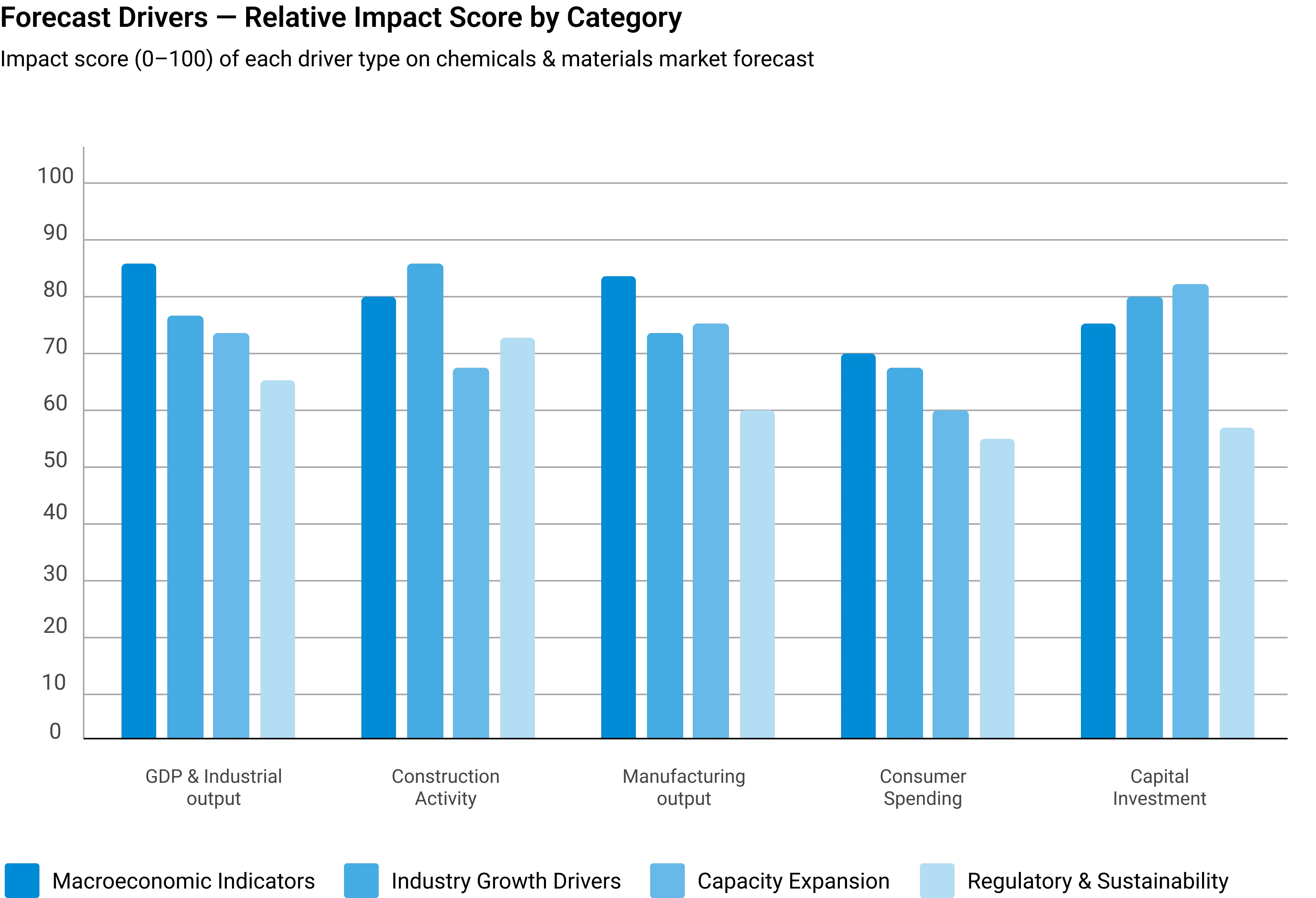
Forecasting evaluates the future trajectory of the market using a combination of quantitative indicators and qualitative assessments across economic, industry, and regulatory dimensions. Rather than simple extrapolation, each driver is independently modeled and integrated into a composite forecast.
Macroeconomic Indicators
GDP growth, industrial production, manufacturing output, construction activity, consumer spending, and capital investment form the quantitative foundation of long-term demand projections. These are applied at country, regional, and global levels.
Industry Growth Drivers
Urbanization, infrastructure development, industrialization, technological innovation, sustainability initiatives, and evolving product performance requirements are assessed at regional and industry levels — capturing both structural and cyclical demand drivers.
Capacity Expansion Analysis
Announced plant expansions, new manufacturing facilities, technology upgrades, and strategic investments are evaluated to determine future supply-demand dynamics and potential market tightness or oversupply situations.
Regulatory & Sustainability
Environmental regulations, chemical safety standards, emission reduction targets, circular economy initiatives, and sustainability requirements are incorporated as they often influence product adoption rates and market growth trajectories.
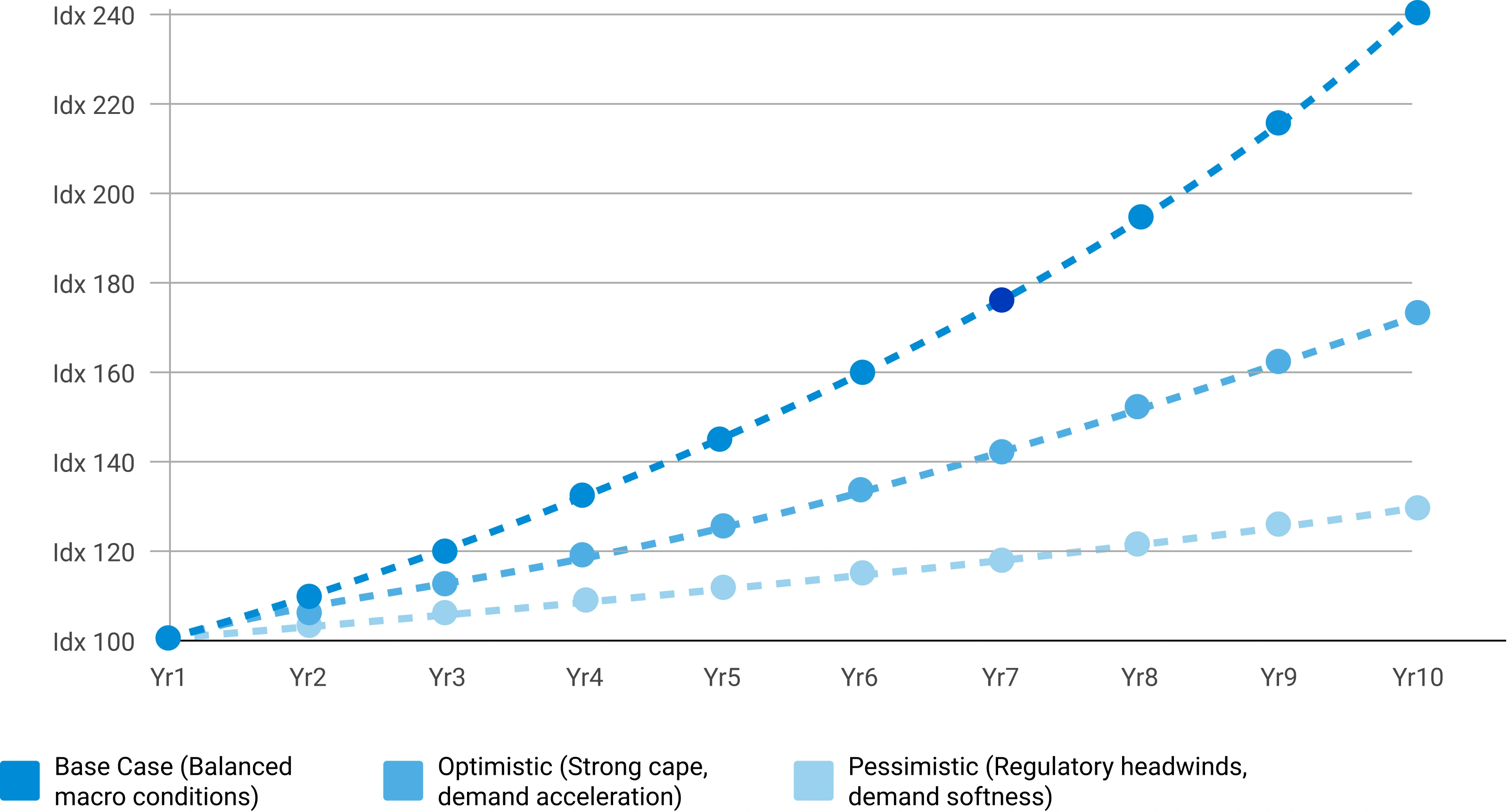
Scenario Forecast Range — Indexed Market Growth (Year 1–10)
Illustrative indexed growth trajectories across Base, Optimistic, and Pessimistic scenarios over a 10-year forecast horizon
Forecast Drivers — Relative Impact Score by Category
Impact score (0–100) of each driver type on chemicals & materials market forecast



Comments
Share your thoughts, ask a question, or provide feedback about this report.