
Fiber-Reinforced Plastics Market Size, Competitive Landscape Analysis Report 2035
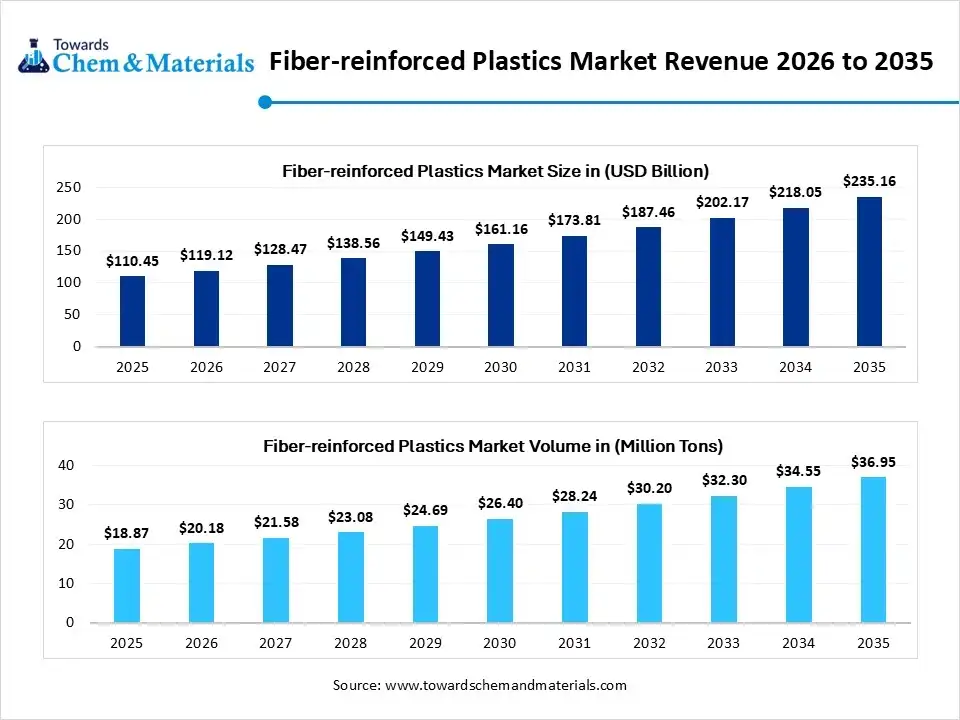
The fiber-reinforced plastics market size was valued at USD 110.45 billion in 2025, is estimated to reach USD 119.12 billion in 2026, and is projected to reach USD 235.16 billion by 2035, exhibiting a compound annual growth rate (CAGR) of 7.85% over the forecast period from 2026 to 2035. In terms of volume, the fiber-reinforced plastics market is projected to grow from 18.87 million tons in 2025 to 36.95 million tons by 2035. growing at a CAGR of 6.95% from 2026 to 2035.The growth is propelled by decarbonization commitments, rising focus on hybrid FRP, a surge in renewable energy, and advanced manufacturing.
Market Highlights
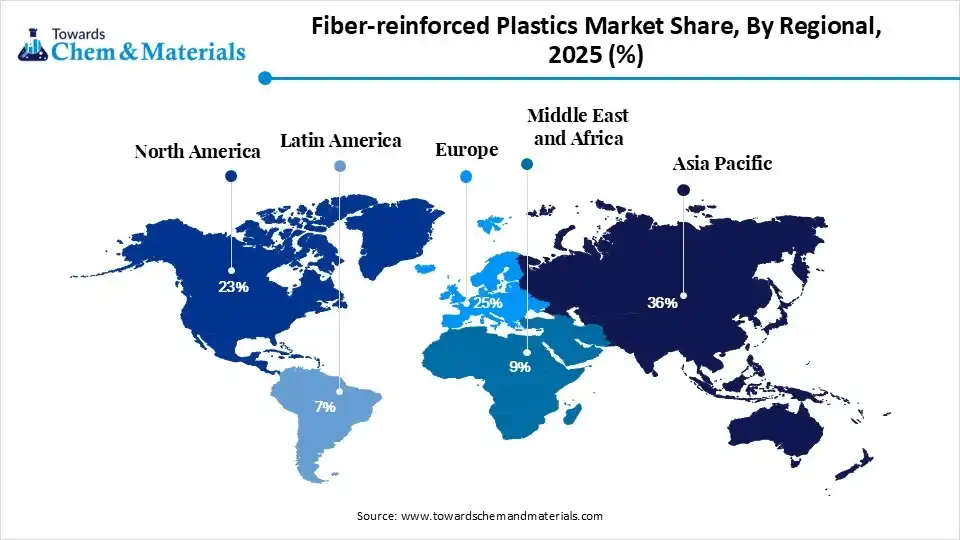
- By region, Asia Pacific dominated the fiber-reinforced plastics market by holding 36% share in 2025 and is expected to grow at the fastest, with a CAGR of 8% during the forecast period, driven by rapid industrialization and manufacturing expansion.
- By region, Europe held the 25% market share in 2025 and expects notable growth in the market with 7.60% CAGR during the forecast period due to stringent environmental regulations and innovation in automotive and wind energy infrastructure.
- By fiber type, the glass fiber reinforced plastics (GFRP) segment dominated the market with the largest share of 62% in 2025, driven by its cost-effectiveness and demand from construction and automotive sectors.
- By fiber type, the carbon fiber reinforced plastics (CFRP) segment held 21% market share in 2025 and is expected to grow at the fastest CAGR of 9.4% over the forecast period due to a superior strength-to-weight ratio and demand from aerospace and electric vehicles.
- By resin type, the thermoset resins segment dominated the market with the largest share of 64% in 2025, driven by its use in high-performance composites and strong bonding with cost-effectiveness.
- By resin type, the thermoplastic resins segment held 36% market share in 2025 and is expected to grow at the fastest CAGR of 8.9% over the forecast period due to its recyclability and faster processing in the automotive sector.
- By manufacturing process, the lay-up process segment dominated the market with the largest share of 28% in 2025, driven by its low-cost and ease of operation for marine and construction
- By manufacturing process, the resin transfer molding (RTM) segment held 15% market share in 2025 and is expected to grow at the fastest CAGR of 8.7% over the forecast period due to its high-quality surface finish and enhanced consistency.
- By application, the automotive segment dominated the market with the largest share of 27% in 2025 due to regulatory support and its ability to improve fuel efficiency and lightness.
- By application, the wind energy segment held 18% market share in 2025 and is expected to grow at the fastest CAGR of 9.2% over the forecast period, driven by its expansion of renewable energy and government push for high-strength composites.
- By end-use industry, the transportation segment dominated the market with the largest share of 31% in 2025, driven by EV adoption and FRP demand in aerospace and automotive.
- By end-use industry, the energy (wind & power) segment held 17% market share in 2025 and is expected to grow at the fastest CAGR of 9.1% over the forecast period due to wind turbine installation and policy support for renewable energy.
- By distribution channel, the direct sales segment dominated the market with the largest share of 46% in 2025due to rising support for customization and long-term contracts for direct procurement.
- By distribution channel, the OEM supply segment held 25% market share in 2025 and is expected to grow at the fastest CAGR of 8.4% over the forecast period, driven by innovation partnership and scaling in aerospace and automotive production.
Market Overview
The fiber-reinforced plastics are represented as a high-performance composite system that is engineered by integrating reinforcing fibers within a polymer matrix to attain superior mechanical integrity. The fiber-reinforced plastics offer superior fatigue resistance, specific strength, and chemical protection for industrial lightweighting by enhancing fuel economy and payload capacity. The recent trend focuses on interfacial bonding optimization to improve the chemical bond between fiber and polymer matrix to improve impact toughness and prevent delamination. The manufacturers focus on thermoplastic transition for melt-processable and reusable plastic, that boosting the integration of fiber-reinforcement.
The FRP functions as a key technological platform for advancement in glass, carbon, and aramid fiber optimization. The government supports industrial subsidies and green tax credits, especially for fiber-reinforced plastics, driving the material standardization and supply chain resilience. The rising consumer emphasis for circular economy compatibility and material recyclability is accelerating the innovation of bio-based materials in industrial infrastructure includes transportation, energy, and construction sectors.
Emerging economies focus on strategic resourcing, where domestic players focus on self-sufficiency, which enables scaling of high-modulus fibers for defense and aerospace. The digital transformation in fiber-reinforced plastics enables a transition towards advanced thermoplastics and automated manufacturing, such as pultrusion and automated fiber placement, by ensuring stable quality and scalability. The major leading recyclers invest in solvolysis and pyrolysis innovations to reclaim high-value fibers from end-of-life component align with the aftermarket distribution framework.
Recent Market Trends
- Shift Towards Hybrid FRP: The market expansion is driven by continuous demand for hybrid FRP, which merges different fiber types that equalize cost-effectiveness and mechanical performance.
- Rising Integration of FRP in Wind Infrastructure: The new offshore wind turbine blades support the manufacturing of blades that exceed 120 meters to enable higher energy capture. This ensures integration of high-modulus systems and hybrid FRP.
Key Technological Shifts and AI in the Fiber-Reinforced Plastics Market
The artificial intelligent align with Industry 4.0 technologies shaping the fiber-reinforced plastics market. The shift towards a data-centric manufacturing model enables implementation of generative design AI in the design stage to identify the anisotropic properties by maintaining structural configuration. The automated fiber placement system integrated with computer vision enables real-time monitoring, in situ inspection, and microscopic delamination.
The digital twin simulation ensures thermochemical kinetics of the curing process, which allows engineering of fiber-reinforced plastics more precisely. The advancement in additive manufacturing has led to the continuous use of carbon fibers, transforming fiber-reinforced plastics into a scalable and smart composite solution embedded with fiber optic sensors and piezoelectric elements.
Supply Chain Analysis of the Fiber-Reinforced Plastics Market
- Feedstock Synthesis and Chemical Precursors: The stage of reinforcement manufacturing and polymer matrix that is derived from PAN, and key chemical components. The stage involves the production of thermoset and thermoplastic resins.
- Key Players: Toray Industries, Owens Corning, Hexcel, Olin Corporation, BASF SE, SGL Carbon, and Teijin Limited.
- Intermediate Processing and Conversion: the stage of raw material integration into intermediate production using high-precision manufacturing technologies like pultrusion, resin transfer molding, and filament winding in prepreg and semi-finished goods.
- Key Players: Mitsubishi Chemical, TPI Composites, Kineco Limited, Gurit Holding, Exel Composites, Strongwell Corporation, and Spirit AeroSystems.
- End-Use Integration and Lifecycle Management: The final stage of integration of FRP components into aerospace, automotive, and renewable energy systems. The stage involves structural health and maintenance by utilizing AI-based sensors to meet circular economy targets.
- Key Players: Airbus, Tesla, American Fiberglass Rebar, Tata Motors, Gen 2 Carbon, and GE Renewable Energy
Regulatory Framework: Fiber-Reinforced Plastics Market
| Region | Key Regulations | Regulatory Focus |
| European Union | End-of-Life Vehicle Directive and REACH | Mandates recyclability targets and strict monitoring of resins and hardeners for automotive FRP to meet environmental safety. |
| North America | EPA Standards, TSCA, ASTM Standards, and FAA | Focus on structural airworthiness and flame-retardant properties of carbon fiber air flames. regulation for the manufacturing and disposal of fibers. |
| Asia Pacific | GB Standards and National Green Hydrogen Mission | Standard for FRP pressure vessels, Type IV composites tanks, and retrofitted pipelines. |
| Global | ISO 14001, MARPOL, and Polar Code | Standardized environmental management and quality in composite manufacturing. Regulation for the use of FRP in marine hulls. |
Fiber-Reinforced Plastics Market Dynamics
Driver
Rising Focus on Corrosion-Resistant and Fuel Efficiency
The manufacturers focus on structural integrity and optimization of energy use in industrial applications. The fiber-reinforced plastics offer oxidation resistance and chloride-based corrosion by balancing cost and extended lifespan.
The industry focuses on lowering fuel consumption in internal combustion engines, as well as enhancing the chemical stability and stable strength-to-weight ratio of carbon and glass fiber composites, which fosters innovation in FRP frameworks. The FRP offers zero conductivity and infrastructure durability, making it key for construction, medical, and electrical infrastructure. Additionally, the R&D addresses global carbon-neutrality targets and performance standards.
Restraints
Higher Capital Investment
The manufacturing of hybrid, carbon, and glass-based fibers required higher capital investment in advanced processing like resin transfer molding and pultrusion, that demand for more expensive framework.
Opportunity
FRP Integration in Hydrogen Retrofitting Ecosystem
The convergence of fiber-reinforced plastics and the hydrogen retrofitting ecosystem creates a high-growth opportunity that solves hydrogen storage and transportation challenges. The FRP is key for the production of high-pressure type IV storage tanks that offer lightweight reliability, which is necessary for retrofitting heavy-duty infrastructure. The specialized FRP liners and composite is key solution for retrofitting aging natural gas grids by preventing hydrogen embrittlement. Additionally, this opportunity enables the manufacturing of high-pressure components, which are suitable for the hydrogen economy by ensuring safety and green energy standardization.
Segmental Insights
Fiber Type Insights
The Glass Fiber Reinforced Plastics (GFRP) Segment Dominated the Fiber-Reinforced Plastics Market with 62% of Market Share in 2025
The glass fiber reinforced plastics (GFRP) segment dominated the market with the largest share of 62% in 2025, due to its superior cost-to-performance solution that offers electromagnetic neutrality and electrical insulation for high-tech industrial infrastructure. The GFRP is crucial for liquid storage, pipeline, and marine applications due to its hydrolytic stability and chemical inertness. Their advancement of e-glass fiber and s-glass fiber in processing flexibility makes them key for high-speed mass-production cycles of structural components.
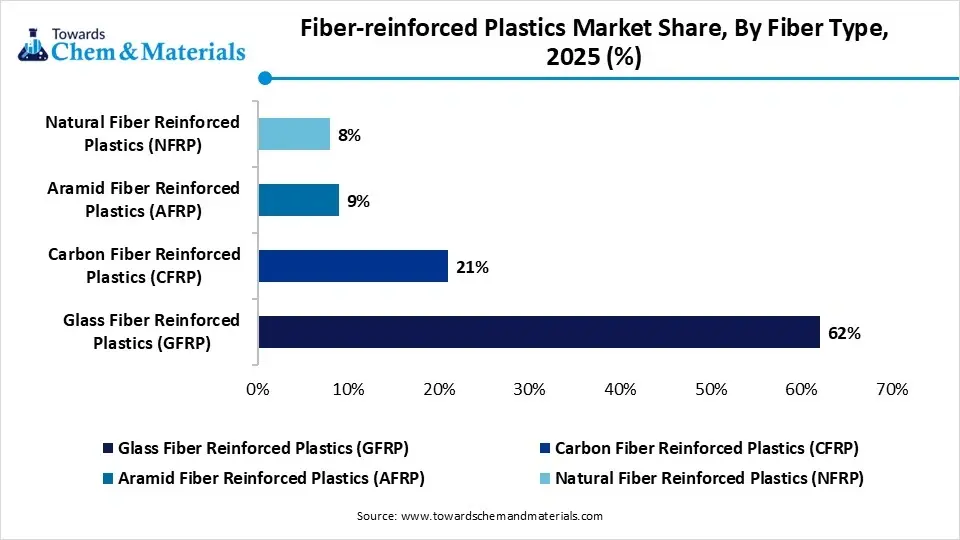
The carbon fiber reinforced plastics (CFRP) segment held the 21% market share in 2025 and is expected to grow at the fastest CAGR of 9.4% over the forecast period, serving as an ultra-high-performance solution. CFRP offers high structural rigidity and weight minimization for the engineering of thin-walled, high-stiffness components. The rising demand for standard modulus and high modulus carbon fiber allows a near-zero coefficient of thermal expansion by maintaining dimensional precision. The industrial transition towards energy-efficient mobility makes it essential for aerospace, precision optics, and high-speed rotating machinery.
The aramid fiber reinforced plastics (AFRP) segment held the 9% market share in 2025, due to its superior ductility and higher impact toughness, crucial for extreme energy absorption and ballistic stability. The AFRP is distinguished by its superior flame retardancy and strength-to-weight ratio as para-aramid and meta-aramid for life-safety and mission-critical infrastructure. Their ability to provide non-conductive advantage and resistance to abrasive wear boosts their demand in protective wear and aerospace.
Fiber-reinforced Plastics Market Share, By Fiber Type, 2025 (%)
| By Fiber Type | Revenue Share, 2025 (%) |
| Glass Fiber Reinforced Plastics (GFRP) | 62% |
| Carbon Fiber Reinforced Plastics (CFRP) | 21% |
| Aramid Fiber Reinforced Plastics (AFRP) | 9% |
| Natural Fiber Reinforced Plastics (NFRP) | 8% |
The natural fiber reinforced plastics (NFRP) segment held 8% market share in 2025, driven by their biocompatibility, that combining agricultural feedstock with polymer resins and reinforcement to reduce environmental impact. The NFRP offers superior stiffness, vibration isolation, and low embodied energy by maintain sustainable pathway for noise-sensitive and passenger cabin interiors. NFRP is derived from wood, flax, and hemp that make them key for circular economy practices and renewable resource infrastructure.
Resin Type Insights
Thermoset Resins Segment Dominated the Fiber-Reinforced Plastics Market with 64% of Market Share in 2025
The thermoset resins segment dominated the market with the largest share of 64% in 2025, serving as an irreversible cross-linking solution that is engineered for heavy-duty structural component manufacturing. Thermoset resins offer superior thermal resistance, flawless fiber saturation, and optimal resin flow by maintaining dimensional integrity and chemical inertness. The categorized into polyester resin, epoxy resin, and vinyl ester resins essential for large-scale processing in wind energy, marine, and aerospace sectors.
The thermoplastic resins segment held the 36% market share in 2025 and is expected to grow at the fastest CAGR of 8.9% over the forecast period. The growth is fueled by their combination of manufacturing agility and environmental sustainability. Thermoplastic resins consist of a reversible molecular structure that ensures rapid cycle times and automated mass production in electronic and automotive applications. The rising demand for polypropylene, PA, PEEK, and polycarbonate makes them key for recyclability innovation and the circular material economy.
Fiber-reinforced Plastics Market Share, By Resin Type, 2025 (%)
| By Resin Type | Revenue Share, 2025 (%) |
| Thermoset Resins | 64% |
| Thermoplastic Resins | 36% |
Manufacturing Process Insights
Lay-Up Process Segment Dominated the Fiber-Reinforced Plastics Market with 28% of Market Share in 2025
The lay-up process segment dominated the market with the largest share of 28% in 2025. The expansion is driven by its adaptability in the open-molding process in the composite manufacturing sector. It is distinguished into hand lay-up and spray-up techniques that are utilized in high-volume manufacturing. The process involves precise mold cavity preparation, mechanized fiber lamination, and uniform liquid resin impregnation. The lay-up process operation resilience makes them leaders in high-strength-to-weight ratio components in specialized industrial infrastructure.
The injection molding segment held the 16% market share in 2025. It is a highly demanded, automated, high-pressure manufacturing process that melts fiber-reinforced thermoplastic pellets through a screw barrel. The shift towards thermal solidification offers ultra-fast cycle times and superior dimensional tolerances. The injection molding enables molten compound into a precision-engineered multi-cavity mold. This process maintains dominance in a mass-scale supply chain, offering a near-net shape component with minimal waste.
The resin transfer molding (RTM) segment held the 15% market share in 2025 and is expected to grow at the fastest CAGR of 8.7% over the forecast period. Its closed-molding techniques are crucial for advanced composite infrastructure. The process involves dry, dimensional fiber preforms into low-viscosity thermosetting resins in the sealed cavity under regulated hydraulic pressure. The RTM ensures superior dimensional integrity and a high-gloss finish in the structural component.
The filament winding segment held 14% market share in 2025, representing automated manufacturing techniques for the fabrication of high-performance axisymmetric composite structures. It is a precise process that pulls multi-end fiber roving through a tension-regulated resin impregnation bath. The rising focus on multi-axis delivery carriage deposits into wet fiber bands on a rotating cylindrical mandrel using polar orientation and precise hoop. The segment shift towards thermal cross-linking that ensures filament winding as mechanized orientation yields to achieve burst strength and hoop-stress resistance.
The compression molding segment held 14% market share in 2025, defined by its high-pressure closed-die processing for mass-production of complex composite manufacturing. It utilizes heat and pressure to shape fiber-reinforced plastics involves bulk molding compound and sheet molding compound. The compression molding is essential in the automotive and aerospace sectors due to its ability to maintain dimensional stability and finish for cost-effective production.
Fiber-reinforced Plastics Market Share, By Manufacturing Process, 2025 (%)
| By Manufacturing Process | Revenue Share, 2025 (%) |
| Lay-Up Process | 28% |
| Filament Winding | 14% |
| Pultrusion | 13% |
| Injection Molding | 16% |
| Resin Transfer Molding (RTM) | 15% |
| Compression Molding | 14% |
Application Insights
The Automotive Segment Dominated the Fiber-Reinforced Plastics Market with 27% of Market Share in 2025
The automotive segment dominated the market with the largest share of 27% in 2025, driven by automakers demand for vehicle lightweighting and decarbonization. The transition towards advanced polymer composites to meet growing demand for fleet emission standards and electrification is accelerating the adoption of lithium-ion powertrains to extend driving range. Fiber-reinforced plastics are utilized in aerodynamic exterior body panels, impact-absorbing bumpers, and chassis structures, offering superior energy absorption and a strength-to-weight ratio that optimizes crash safety.
The construction segment held the 22% market share in 2025, driven by demand to replace heavy construction material with corrosion-resistant and superior tensile strength composites. The developers utilize fiber-reinforced plastics that drive modular construction for pultruded structural profiles, FRP rebar, bridge decks, and composite grating. The construction sector focuses on rehabilitating aging civil infrastructure and extending asset longevity, where fiber-reinforced plastics slash onsite installation times and logistical costs.
The wind energy segment held the 18% market share in 2025 and is expected to grow at the fastest CAGR of 9.2% over the forecast period. The global shift towards the scalability of renewable utility turbines. The energy manufacturers utilized advanced fiber-reinforced plastics to engineer turbine blades by offering superior tensile strength and fatigue resistance. The emerging lightweight FRP lower rotating mass of rotor assemblies by maintaining energy capture efficiency for the offshore wind installation framework.
The aerospace segment held 13% market share in 2025 because fiber-reinforced plastics minimized fuel consumption and lower carbon emissions by offering a strength-to-weight ratio and superior fatigue resistance. The shift towards aircraft lightweighting allows commercial and military aerospace manufacturers to adopt carbon-fiber composites to create fuselage sections and wing assemblies.
Fiber-reinforced Plastics Market Share, By Application, 2025 (%)
| By Application | Revenue Share, 2025 (%) |
| Automotive | 27% |
| Construction | 22% |
| Wind Energy | 18% |
| Aerospace | 13% |
| Marine | 9% |
| Electrical & Electronics | 11% |
End-Use Industry Insights
Transportation Segment Dominated the Fiber-Reinforced Plastics Market with 31% of Market Share in 2025
The transportation segment dominated the market with the largest share of 31% in 2025, driven by modernization and commercialization of fleet efficiency. The transit infrastructure and logistical operators are increasing investment in advanced structural composites to enhance fuel economy and expansion of legal cargo margins, mass transit, and railway fleets. Fiber-reinforced plastics enable multi-part metal assemblies and long-term maintenance overhead.
The energy (wind & power) segment held the 17% market share in 2025 and is expected to grow at the fastest CAGR of 9.1% over the forecast period, serving as a key for capacity expansion of renewable infrastructure and grid modernization. Fiber-reinforced plastics offer superior tensile strength and dielectric strength that make them key for high-voltage power distribution. The energy sectors emphasis on advanced polymer composites allows their utilization in heavy-duty structural cross arms and non-conductive utility poles.
The construction & infrastructure segment held the 24% market share in 2025, driven by rising urbanization and green building infrastructure, where fiber-reinforced plastics function as a sustainable alternative. The contractor utilizes high-performance architectural framing, composite reinforcing bars, and lightweight pultruded profiles to prevent structural degradation and maximize seismic flexibility. The government support associated with standard metal reinforcement for infrastructure accelerates project timelines and lifecycle maintenance.
The aerospace & defense segment held 12% market share in 2025, driven by a rising focus on component performance and weight reduction in battlefield and flight infrastructure. The aerospace & defense sectors are adopting ultra-high modulus composites to phase out heavy alloys. fiber-reinforced plastics creating a protective and safety profile for tactical airframes, satellite housing, and ballistic shielding by balancing durability and long-term radar-evading profile for covert operations.
Fiber-reinforced Plastics Market Share, By End-Use Industry, 2025 (%)
| By End-Use Industry | Revenue Share, 2025 (%) |
| Transportation | 31% |
| Construction & Infrastructure | 24% |
| Energy (Wind & Power) | 17% |
| Aerospace & Defense | 12% |
| Marine Industry | 9% |
| Electrical & Electronics | 7% |
Distribution Channel Insights
Direct Sales Segment Dominated the Fiber-Reinforced Plastics Market with 46% of Market Share in 2025
The direct sales segment dominated the market with the largest share of 46% in 2025, driven by its ability to secure bulk pricing and custom-formulated resins in automotive, energy, and aerospace OEMS. The direct sales connect fiber-reinforced plastics manufacturers with high-volume industrial manufacturers through direct engineering partnerships. This distribution channel offers complete supply chain clarity for multi-year manufacturing cycles.
The distributors segment held the 29% market share in 2025 represent key pillar for servicing domestic fabricators and medium-scale manufacturers. The distributor offers durable and low-minimum order quantities of fiber-reinforced plastics. This localized framework secures standard delivery of resins, glass fibers, and composite materials as a supply lifeline for marine, automotive and construction repair and maintenance practices.
The OEM supply segment held the 25% market share in 2025 and is expected to grow at the fastest CAGR of 8.4% over the forecast period. This distribution channel ensures composite fabricators collaboration directly with logistics and energy corporations through an integrated industrial contract. OEM supply provides custom-molded and production-ready structural components by achieving total material traceability to meet stringent global safety compliance.
Fiber-reinforced Plastics Market Share, By Distribution Channel, 2025 (%)
| By Distribution Channel | Revenue Share, 2025 (%) |
| Direct Sales | 46% |
| Distributors | 29% |
| OEM Supply | 25% |
Regional Insights
How Did the Asia Pacific Dominated the Fiber-Reinforced Plastics Market in 2025?
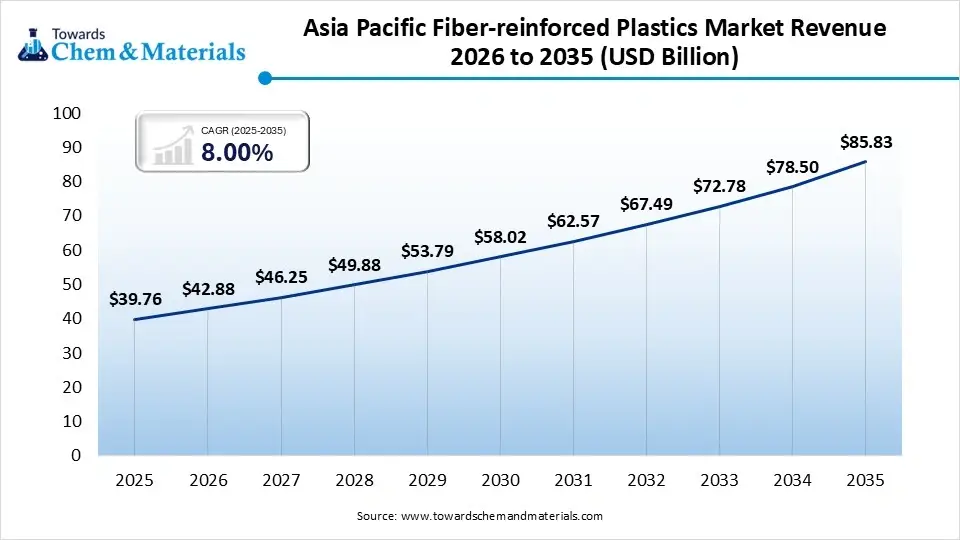
The Asia Pacific Fiber-Reinforced Plastics Market size was estimated at USD 39.76 billion in 2025 and is projected to reach USD 85.83 billion by 2035, growing at a CAGR of 8.00% from 2026 to 2035. Asia Pacific dominated the market by holding 36% share in 2025. The regional expansion is supported by their hyper-automated mass production and abundance of raw material. Asia Pacific governmental support for smart city grids and the shift towards electric mobility are boosting the adoption of fiber-reinforced plastics. The regulatory mandates for corrosion-proof FRP and its manufacturing hub for thermoset and thermoplastic processing are driving the domestic expansion. Additionally, the region focuses on the emerging trend of automated ecosystems that are fueling their continuous dominance in the market.
India Fiber-Reinforced Plastics Market Growth Trends
India market is an emerging region that is supported by green energy infrastructure aligned with industrial modernization. The region is shifting toward advancement in the aerospace and defense sectors. The regulatory compliance for decarbonization and green hydrogen mission is boosting the domestic carbon fiber and glass fiber production for coastal and railway coaches. Additionally, India is a key hub in high-speed pultrusion technology and corrosion-resistant construction.
Europe Fiber-Reinforced Plastics Market Growth Trends
Europe held the 25% market share in 2025 and expects notable growth in the market with 7.60% CAGR during the forecast period. The region expansion is accelerated by the transition towards circularity and high-value engineering. Europe is maintaining its dominance in thermoplastic innovation and sustainable recycling infrastructure promoted by the circular economy act. The regional strategic partnership is fostering the demand for advanced carbon-fiber wind blades and Type IV storage tanks through technological advancement. The domestic leader integrating smart composites and low-carbon aerospace solutions.
Germany Fiber-Reinforced Plastics Market Growth Trends
Germanys market is represented as a key hub for high-precision engineering and lightweight innovation. In Germany, advancing in Type IV pressure vessels and retrofitting gas infrastructure with FRP liners. The domestic leaders shift towards the adoption of thermoplastic composites and the recycling of FRP. Germany remains key for sustainable composite lifecycle management promoted by the national hydrogen strategy.
Recent Developments
- In April 2026, SHD Composites announced the launch of MTC521FR, a new clear resin, flame retardant epoxy prepreg engineered for high-end exposed-carbon applications and cosmetic components.(Source: www.cambium-usa.com)
- In May 2026, Baker Hughes and Strohms strategic partnership to develop ultra-deepwater hybrid flexible pipe technology engineered for ultra-deepwater flowline and riser applications. The collaboration focuses on developing and qualify hybrid flexible pipe that combining thermoplastic composite pipe (TCP) with a conventional flexible pipe design.(Source: www.worldoil.com)
- In October 2025, Hyundai Motor Group and Toray Industries entered a strategic partnership across the entire value chain in the field of high-performance composites. This joint development agreement focuses on the transition from R&D to production and commercialization to develop advanced materials for future mobility.(Source: www.hyundai.com)
Top Companies in the Fiber-Reinforced Plastics Market
- Alta Performance Materials Holdings (UK) Limited
- AOC, LLC
- BÜFA Composite Systems GmbH & Co. KG
- Hexion Inc
- Huntsman International LLC
- Interplastic Corporation
- Kukdo Chemical Co., Ltd
- Olin Corporation
- Polynt Group
- Scott Bader Company Limited
Segment List
By Fiber Type
- Glass Fiber-Reinforced Plastics (GFRP)
- E-Glass Fiber
- S-Glass Fiber
- Carbon Fiber-Reinforced Plastics (CFRP)
- Standard Modulus Carbon Fiber
- High Modulus Carbon Fiber
- Aramid Fiber-Reinforced Plastics (AFRP)
- Para-Aramid
- Meta-Aramid
- Natural Fiber-Reinforced Plastics (NFRP)
- Wood Fiber
- Flax Fiber
- Hemp Fiber
By Resin Type
- Thermoset Resins
- Polyester Resin
- Vinyl Ester Resin
- Epoxy Resin
- Thermoplastic Resins
- Polypropylene (PP)
- Polyamide (PA)
- Polyether Ether Ketone (PEEK)
- Polycarbonate (PC)
By Manufacturing Process
- Lay-Up Process
- Hand Lay-Up
- Spray-Up
- Filament Winding
- Pultrusion
- Injection Molding
- Resin Transfer Molding (RTM)
- Compression Molding
By Application
- Automotive
- Structural Components
- Interior Components
- Construction
- Panels & Cladding
- Reinforcements
- Wind Energy
- Turbine Blades
- Nacelle Components
- Aerospace
- Aircraft Structures
- Interior Components
- Marine
- Hulls
- Decks
- Electrical & Electronics
- Insulation Components
- Enclosures
By End-Use Industry
- Transportation
- Construction & Infrastructure
- Energy (Wind & Power)
- Aerospace & Defense
- Marine Industry
- Electrical & Electronics
By Distribution Channel
- Direct Sales
- Distributors
- OEM Supply
By Region
- North America
- U.S.
- Canada
- Mexico
- Europe
- Germany
- UK
- France
- Italy
- Spain
- Asia Pacific
- China
- India
- Japan
- South Korea
- Latin America
- Brazil
- Argentina
- Middle East & Africa
- Saudi Arabia
- South Africa
A Seven-Phase Framework
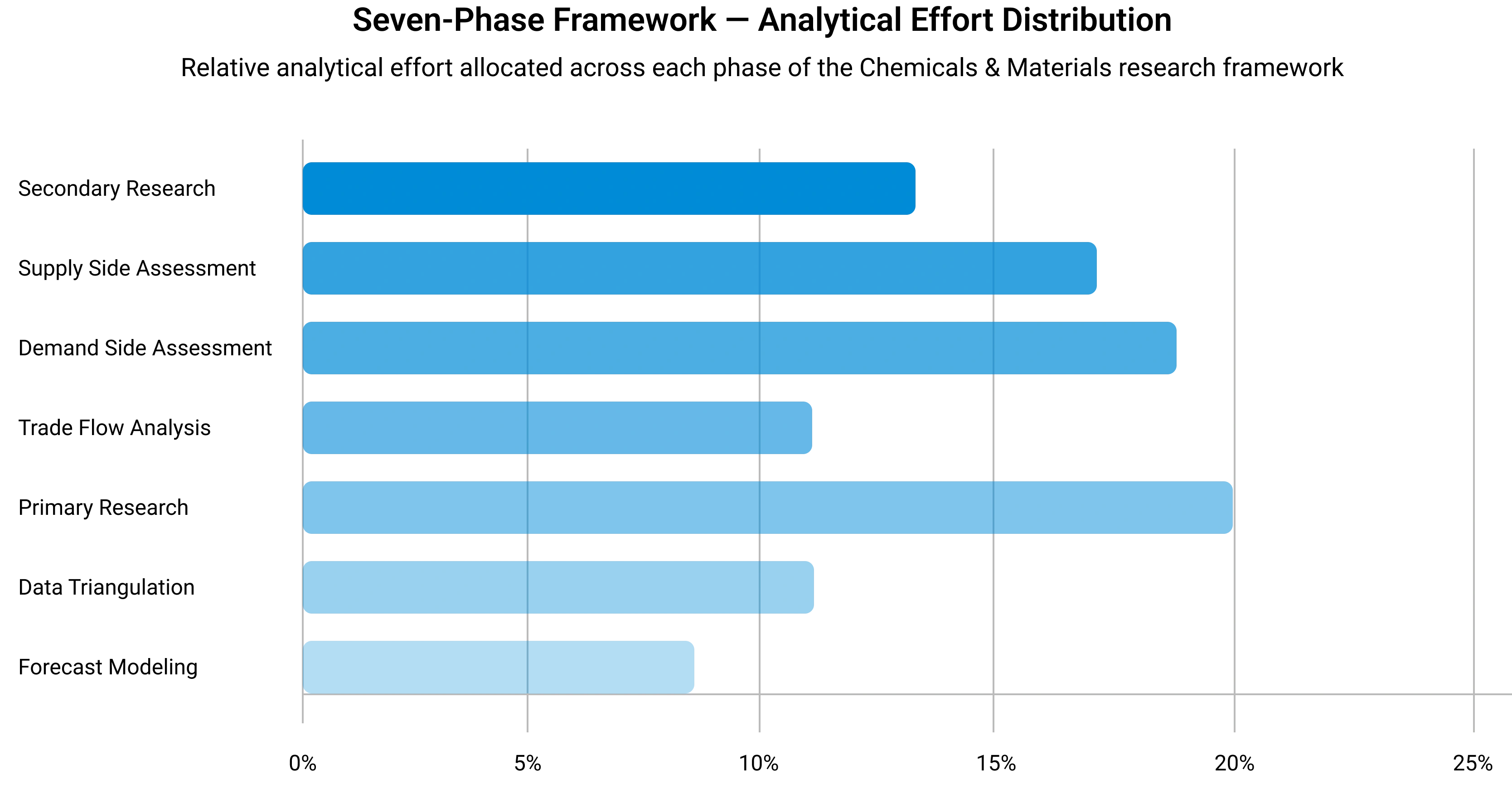
Our methodology is designed to be universally applicable across commodity chemicals, specialty chemicals, petrochemicals, construction chemicals, coatings, electronic chemicals, industrial gases, agrochemicals, water treatment chemicals, and performance materials. Each phase builds upon the last, creating a layered validation structure that minimizes estimation error and maximizes analytical confidence.
The framework ensures comprehensive market coverage, robust cross-validation, and reliable long-term forecasting — producing market estimates that withstand scrutiny from investors, regulators, and corporate strategy teams.

Seven-Phase Framework — Analytical Effort Distribution
Relative analytical effort allocated across each phase of the Chemicals & Materials research framework
Phase 1 - Secondary Research: Establishing the Foundation
Secondary research collects and evaluates publicly available information from authoritative sources, establishing the foundational understanding of market structure, value chain dynamics, competitive landscape, and end-use demand patterns. Every source is evaluated for credibility, recency, geographic relevance, and methodological soundness before inclusion.
Industry Associations
Sources include ACC, CEFIC, ICCA, JCIA, CPCIF, and SOCMA providing production volumes, consumption trends, capacity developments, and sustainability initiatives.
Company Disclosures
Annual reports, investor presentations, earnings transcripts, and regulatory filings reveal product portfolios, manufacturing footprints, capacity expansions, and revenue segmentation.
Government Databases
National statistical offices, customs authorities, environmental agencies, and industrial production databases provide verified statistics on output, trade flows, and regulatory compliance.
Trade Databases
UN Comtrade, ITC, Eurostat, and national customs authorities enable assessment of global product movement, import dependency, and export competitiveness across regions.
Our Secondary Research Sources
- Ministry of Chemicals and Fertilizers
- European Chemicals Agency
- United States Department of Energy
- Ministry of Industry and Information Technology
- Ministry of Economy Trade and Industry
- Ministry of Trade Industry and Energy
- National Institute of Standards and Technology
- Council of Scientific and Industrial Research
- Fraunhofer Society
- National Institute for Materials Science
Phase 2 — Supply-Side Assessment: Mapping Production Capabilities
Production Capacity Analysis
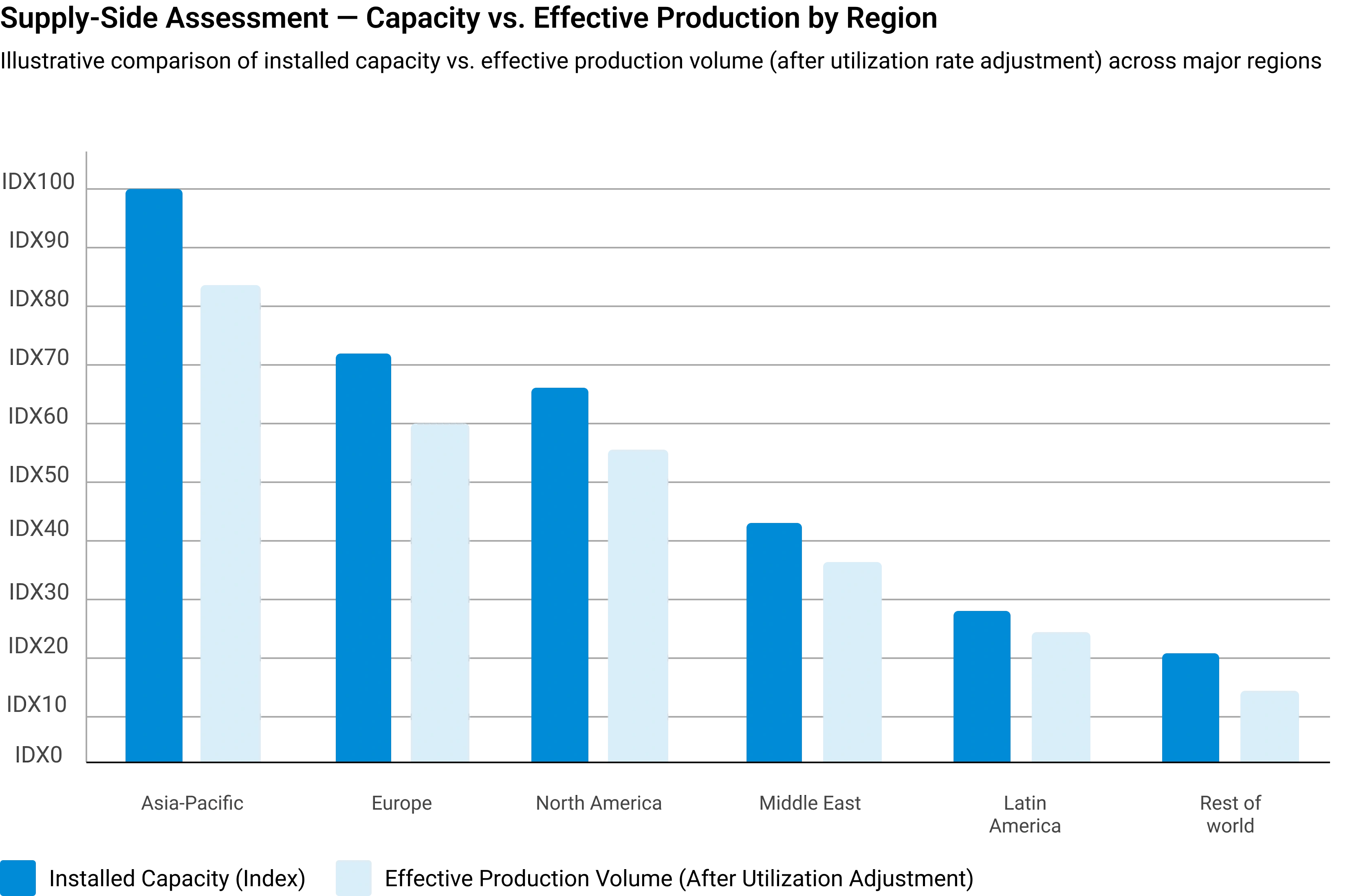
All major manufacturers are assessed for existing installed capacity, planned additions, expansions, new plant announcements, and technology adoption — mapped at global, regional, and country levels.
Capacity Utilization Adjustment
Installed capacity is adjusted using utilization rates based on demand conditions, feedstock availability, plant operating rates, maintenance schedules, and regulatory restrictions.
Manufacturer Revenue Analysis
Product-specific revenues, segment-level performance, regional distribution, average selling prices, and margin trends are evaluated to establish market value estimates.
Supply-Side Assessment — Capacity vs. Effective Production by Region
Illustrative comparison of installed capacity vs. effective production volume (after utilization rate adjustment) across major regions
Phase 3 — Demand-Side Assessment: Quantifying Chemical Consumption
Demand-side analysis quantifies chemical consumption across industries, applications, and geographies — identifying where and how chemicals are consumed throughout the value chain with precision.
End-Use Industry Analysis
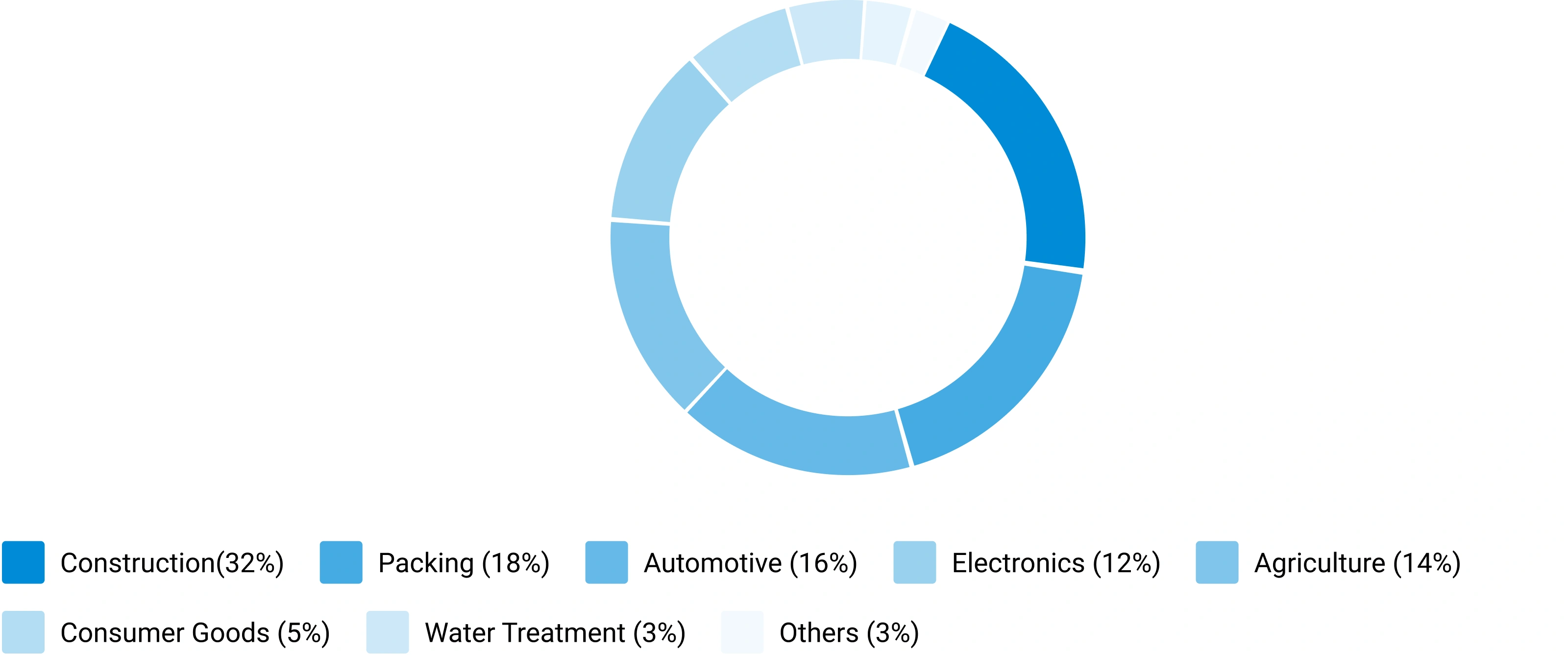
Chemical demand is evaluated across automotive, construction, packaging, electronics, agriculture, healthcare, consumer goods, industrial manufacturing, energy and utilities, and water treatment. Industry output, production trends, and consumption intensity are analyzed to determine demand patterns.
Consumption Modeling
Demand is estimated using measurable indicators: kilograms per vehicle, kilograms per square meter of construction, dosage per cubic meter of water treated, kilograms per hectare of agricultural land, and kilograms per ton of manufactured products. Consumption factors are validated through industry publications and primary interviews.
Application Analysis
The market is segmented by application area to understand product performance requirements, formulation trends, technology adoption, customer preferences, and regulatory requirements improving demand accuracy and segmentation granularity.
Demand-Side Assessment — End-Use Industry Demand Distribution
Illustrative distribution of chemical & materials demand across key end-use industries
Phase 4 - Trade Flow Analysis: Balancing Regional Supply and Demand
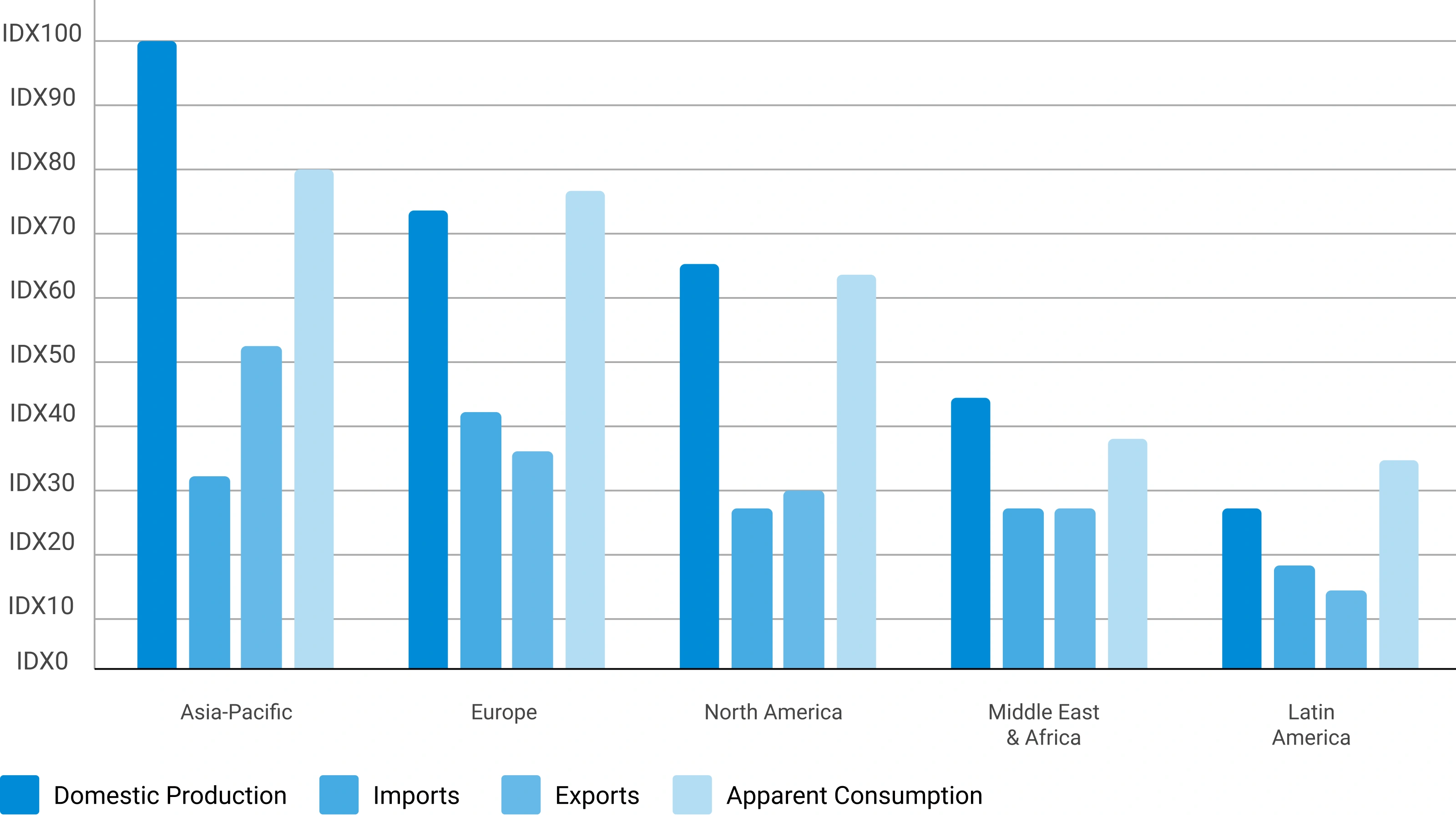
Trade flow analysis reconciles regional supply and demand estimates through import and export data, identifying net supply positions, regional dependencies, and market imbalances. It serves as an independent validation layer that tests the consistency of supply-side and demand-side estimates.
Import Analysis
Import data is evaluated to determine volumes, source countries, product dependency, regional supply gaps, and pricing trends — identifying markets that rely heavily on external supply and where domestic production is insufficient to meet demand.
Export Analysis
Export assessments reveal production surplus, export competitiveness, regional manufacturing strength, and global market participation. Export patterns also help validate domestic production estimates and identify net exporting regions.
Apparent Consumption Model
Regional consumption is assessed using the standard apparent consumption formula:
Results identify net importing regions, net exporting regions, regional deficits, and surpluses — serving as an independent validation of supply and demand estimates.
Trade Flow Analysis — Net Supply Position by Region
Illustrative apparent consumption vs. domestic production across major regions — positive gap indicates net import dependency
Phase 5 — Primary Research: The Critical Validation Layer
Primary research tests and refines findings from secondary research through direct engagement with industry participants across the supply chain, demand side, and expert community. It captures intelligence that no database or published report can provide — the real-world experience of manufacturers, buyers, and specialists operating in the market.

Supply-Side Interviews
Conversations with chemical manufacturers, raw material suppliers, contract manufacturers, technology providers, and plant operators cover production trends, capacity utilization, pricing developments, technology shifts, and competitive dynamics.

Demand-Side Interviews
Engagement with OEMs, industrial consumers, procurement managers, distributors, formulators, and end-use manufacturers focuses on consumption trends, purchasing behavior, product substitution, demand outlook, and emerging applications.

Industry Expert Consultations
Additional interviews with industry consultants, independent experts, regulatory specialists, technical professionals, and research institutions provide deeper market context and validate key analytical assumptions.
Focus Areas of Primary Research:
Market Size & Forecast Validation
Revenue estimates, volume consumption, growth rates, forecast assumptions, regional demand.Supply Chain & Value Chain Assessment
Raw material sourcing, supply chain challenges, distribution networks, procurement practices.Production & Capacity Analysis
Manufacturing capacity, utilization rates, expansion projects, plant investments.Pricing & Cost Structure Analysis
Product pricing trends, feedstock costs, energy costs, margin pressures, pricing outlook.Competitive Landscape Assessment
Volume and value estimates confirmed to be fully consistent with one another before publicationInterview Volume by Market Scope
| Study Scope | Number of Interviews |
|---|---|
| Niche Market | 20 – 30 |
| Mid-Sized Market | 30 – 50 |
| Global Market | 50 – 80 |
| Highly Fragmented Market | 80 – 120 |
Interview Details:
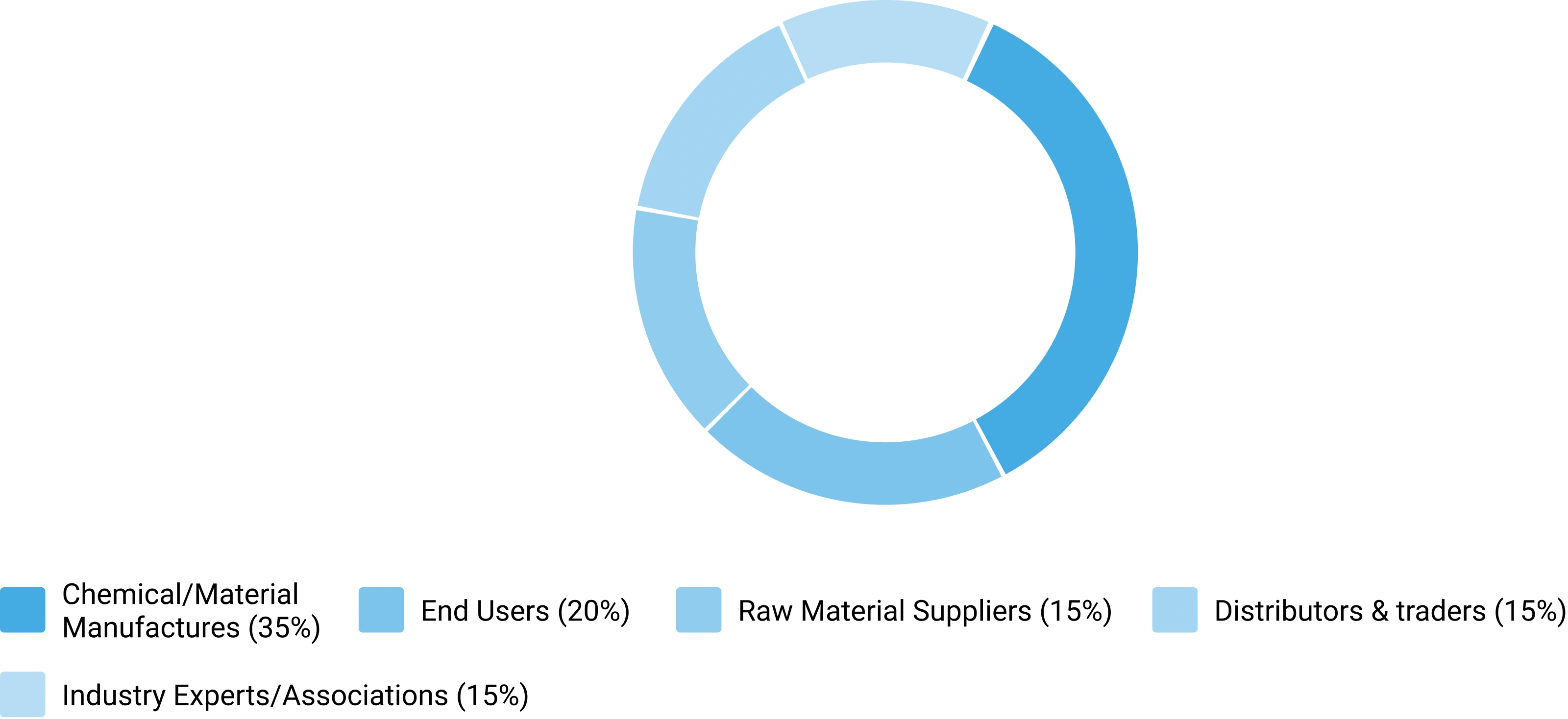
Category : Manufacturers, Suppliers, Distributors, End Users, Experts/Associations
Average Duration : 30–60 Minutes
Interview Mode : Video calls, telephonic interviews, expert consultations
Interview Format : Structured / Semi-Structured questionnaire
Focus Areas of Primary Research:
Market Size & Forecast Validation :
Revenue estimates, volume consumption, growth rates, forecast assumptions, regional demand.
Supply Chain & Value Chain Assessment :
Raw material sourcing, supply chain challenges, distribution networks, procurement practices.
Production & Capacity Analysis :
Manufacturing capacity, utilization rates, expansion projects, plant investments.
Pricing & Cost Structure Analysis :
Product pricing trends, feedstock costs, energy costs, margin pressures, pricing outlook.
Competitive Landscape Assessment :
Market share, competitor positioning, strategic initiatives, partnerships, acquisitions.
Primary Research — Stakeholder Coverage by Category
Distribution of interview respondents across stakeholder categories (% share from PPT data)
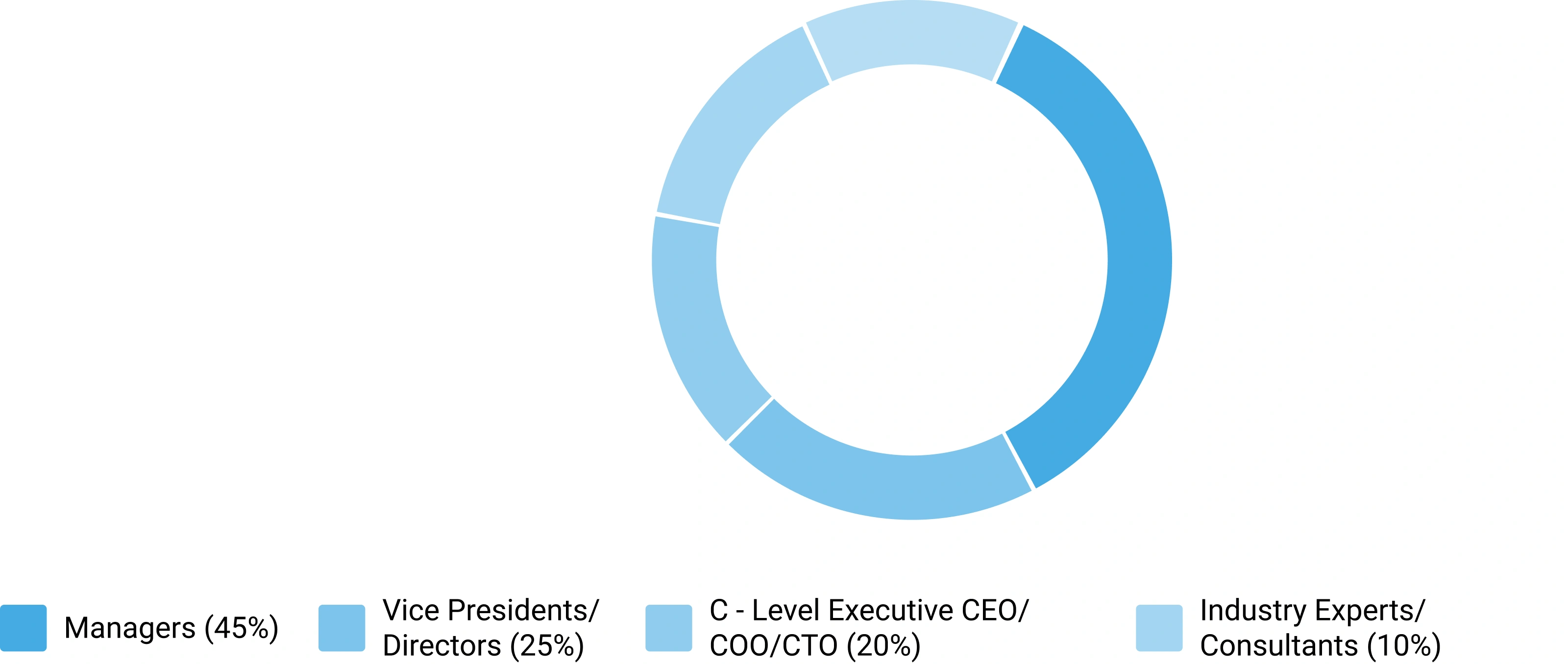
Primary Research — Respondent Designation Profile
Seniority breakdown of interview respondents (% share from PPT data)
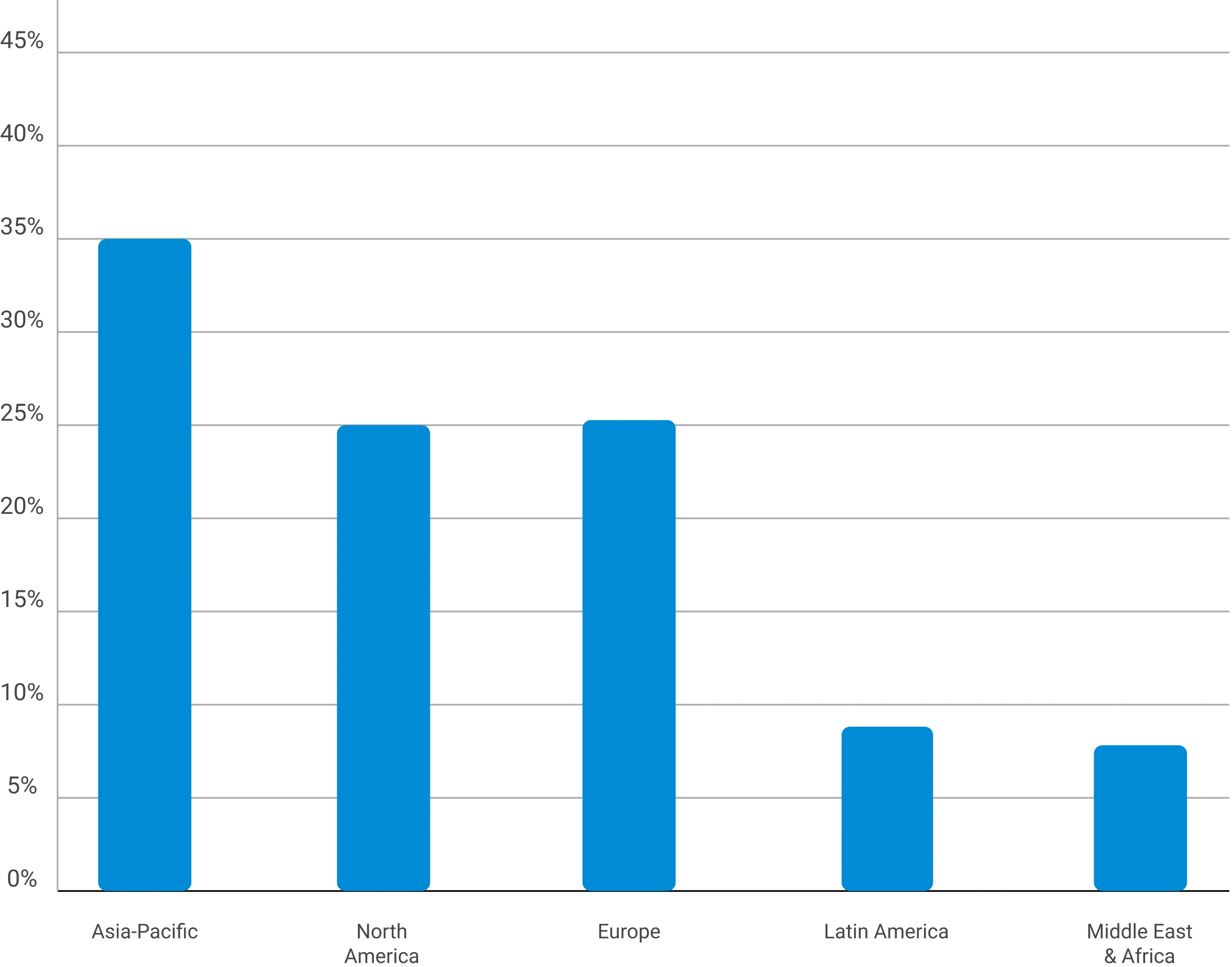
Primary Research — Geographic Coverage of Interviews
Regional distribution of primary research engagement (% share from PPT data)
Phase 6 — Data Triangulation and Market Validation
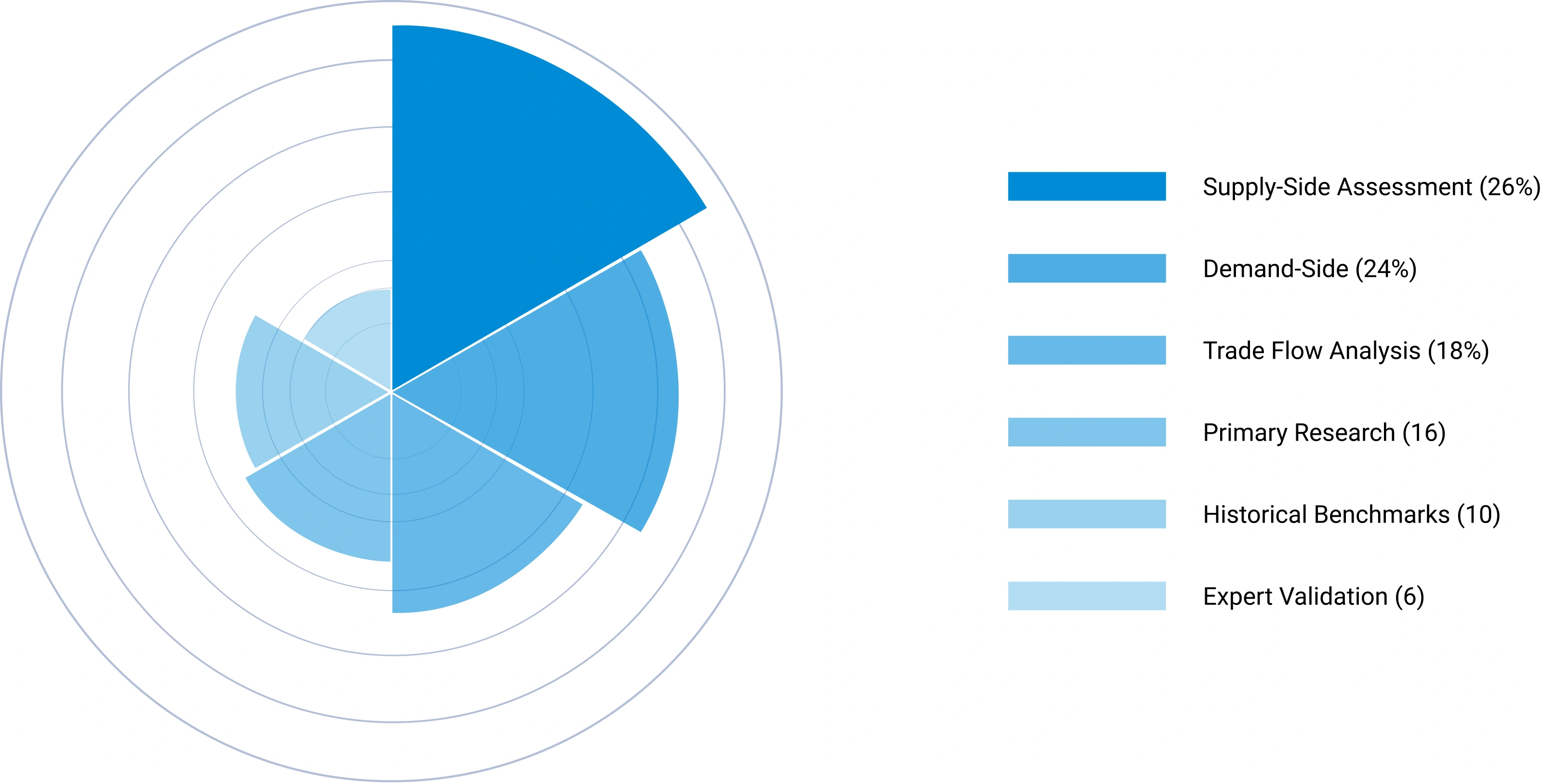
No single methodology is relied upon in isolation. Multiple independent estimation approaches are combined and reconciled to ensure consistency, accuracy, and analytical defensibility. Any material deviations between approaches are investigated and adjusted through additional validation cycles.
The final market size is derived through weighted triangulation of all validated methodologies. Any material deviations between approaches are investigated and adjusted through additional validation cycles. The outcome represents the most realistic assessment of the market based on available evidence and expert confirmation ensuring that volume and value estimates are fully consistent with one another.
Triangulation Framework — Input Contribution Weight
Relative weight each sizing input contributes to the final reconciled market estimate
Phase 7 — Forecast Modeling: Projecting Future Market Evolution
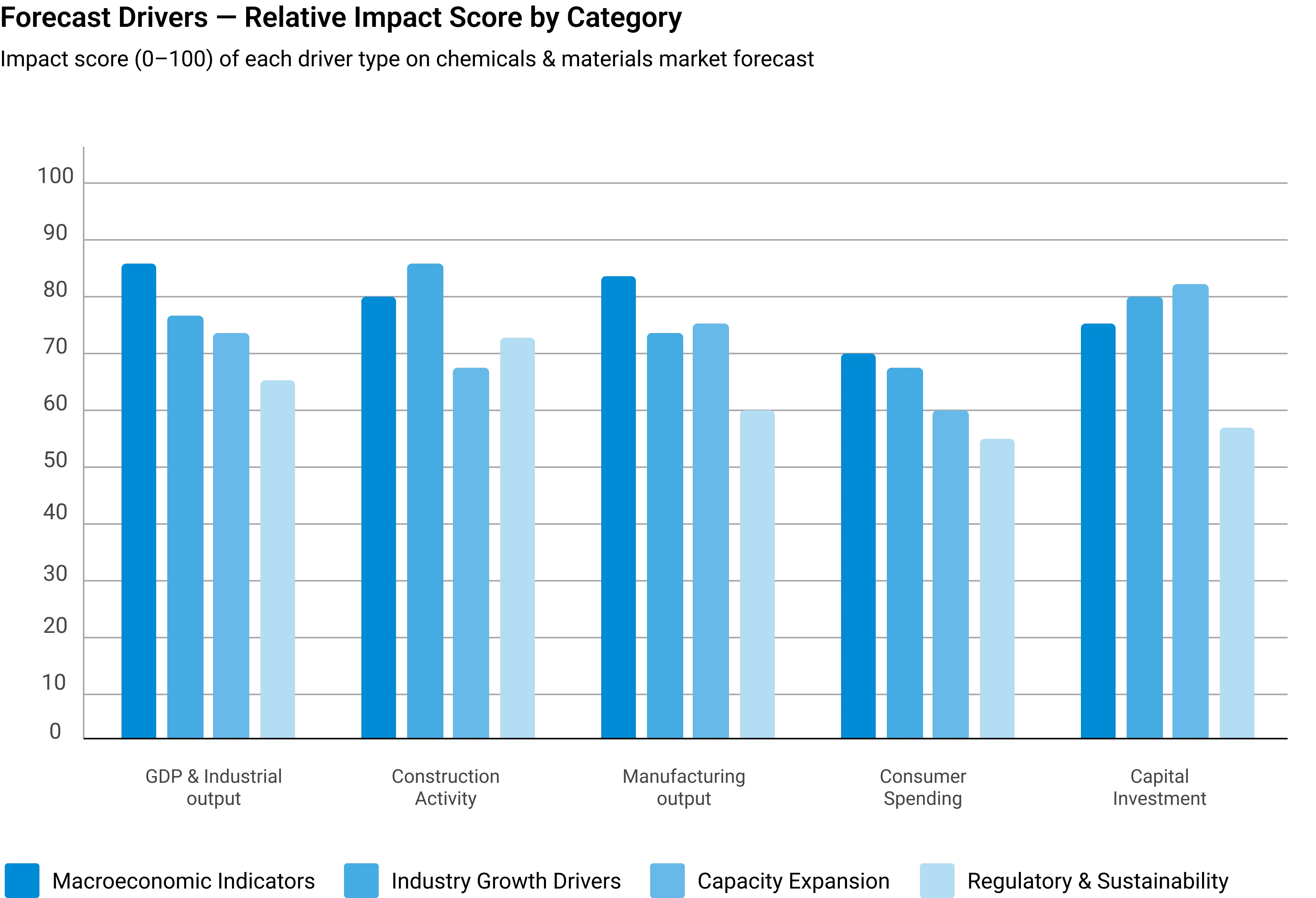
Forecasting evaluates the future trajectory of the market using a combination of quantitative indicators and qualitative assessments across economic, industry, and regulatory dimensions. Rather than simple extrapolation, each driver is independently modeled and integrated into a composite forecast.
Macroeconomic Indicators
GDP growth, industrial production, manufacturing output, construction activity, consumer spending, and capital investment form the quantitative foundation of long-term demand projections. These are applied at country, regional, and global levels.
Industry Growth Drivers
Urbanization, infrastructure development, industrialization, technological innovation, sustainability initiatives, and evolving product performance requirements are assessed at regional and industry levels — capturing both structural and cyclical demand drivers.
Capacity Expansion Analysis
Announced plant expansions, new manufacturing facilities, technology upgrades, and strategic investments are evaluated to determine future supply-demand dynamics and potential market tightness or oversupply situations.
Regulatory & Sustainability
Environmental regulations, chemical safety standards, emission reduction targets, circular economy initiatives, and sustainability requirements are incorporated as they often influence product adoption rates and market growth trajectories.
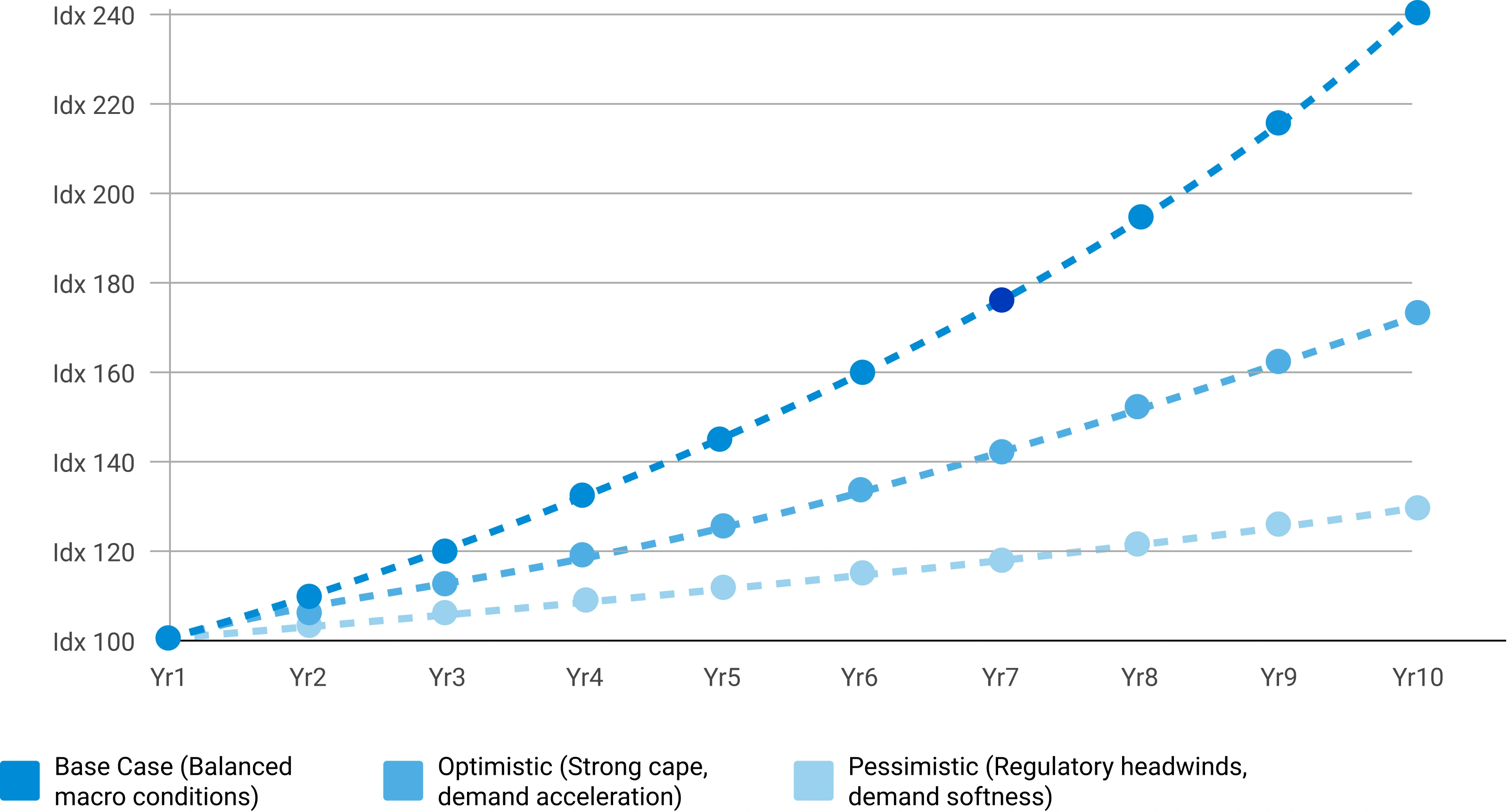
Scenario Forecast Range — Indexed Market Growth (Year 1–10)
Illustrative indexed growth trajectories across Base, Optimistic, and Pessimistic scenarios over a 10-year forecast horizon
Forecast Drivers — Relative Impact Score by Category
Impact score (0–100) of each driver type on chemicals & materials market forecast



Comments
Share your thoughts, ask a question, or provide feedback about this report.