Content
Renewable Chemicals Market Size, Competitive Landscape Analysis Report 2035
The global renewable chemicals market size was estimated at USD 147.01 billion in 2025 and is expected to increase from USD 163.99 billion in 2026 to USD 438.57 billion by 2035, growing at a CAGR of 11.55% from 2026 to 2035. Asia Pacific dominated the renewable chemicals market with the largest revenue share of 56% in 2025.The greater shift towards manufacturing sustainability has fueled the industry's growth in recent years. the chemicals that are made up of more natural and renewable sources, instead of using coal and oil is called renewable chemicals. Moreover, several manufacturers are seen using raw materials such as waste, plants, and other natural sources, which translates into favourable financial prospects for producers in the coming years. Furthermore, the implementation of the global green mandates is seen as a high-margin opportunity for the manufacturers during the forecast period.
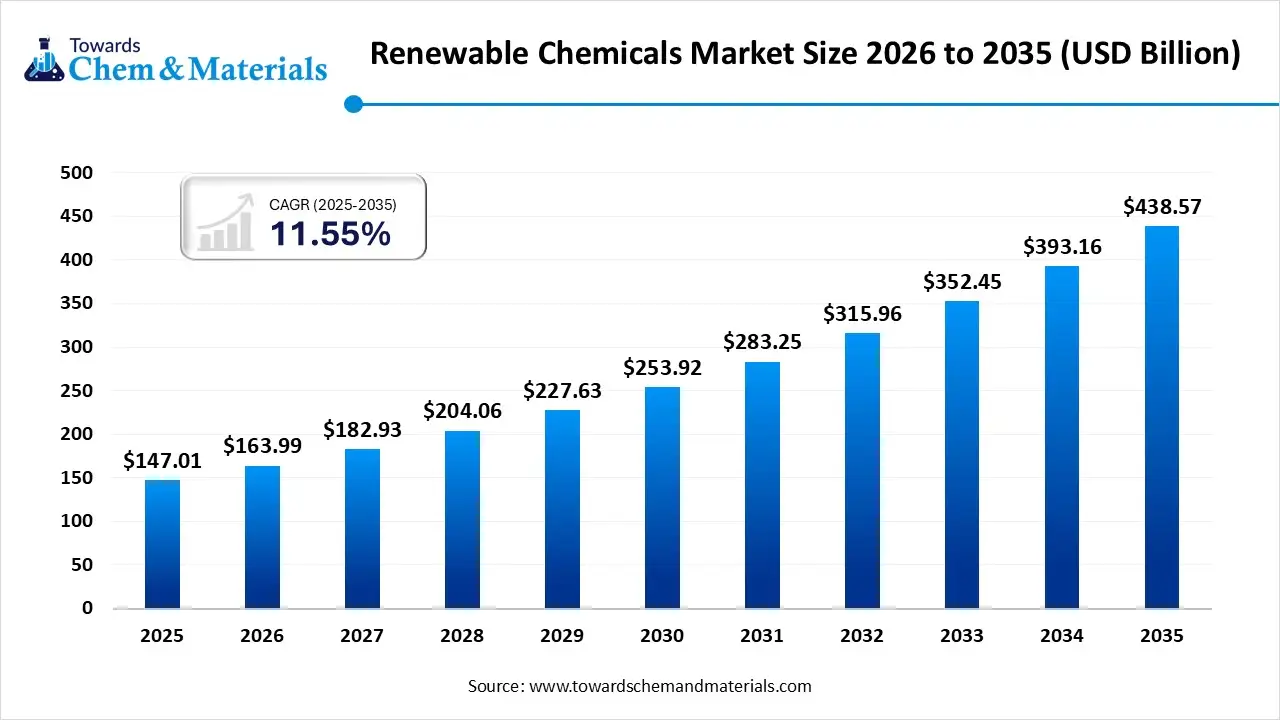
Market Highlights
- Asia Pacific dominated renewable chemicals market with the largest revenue share of 56% in 2025. due to the stricter environmental policies and their systematic implementation in manufacturing infrastructure.
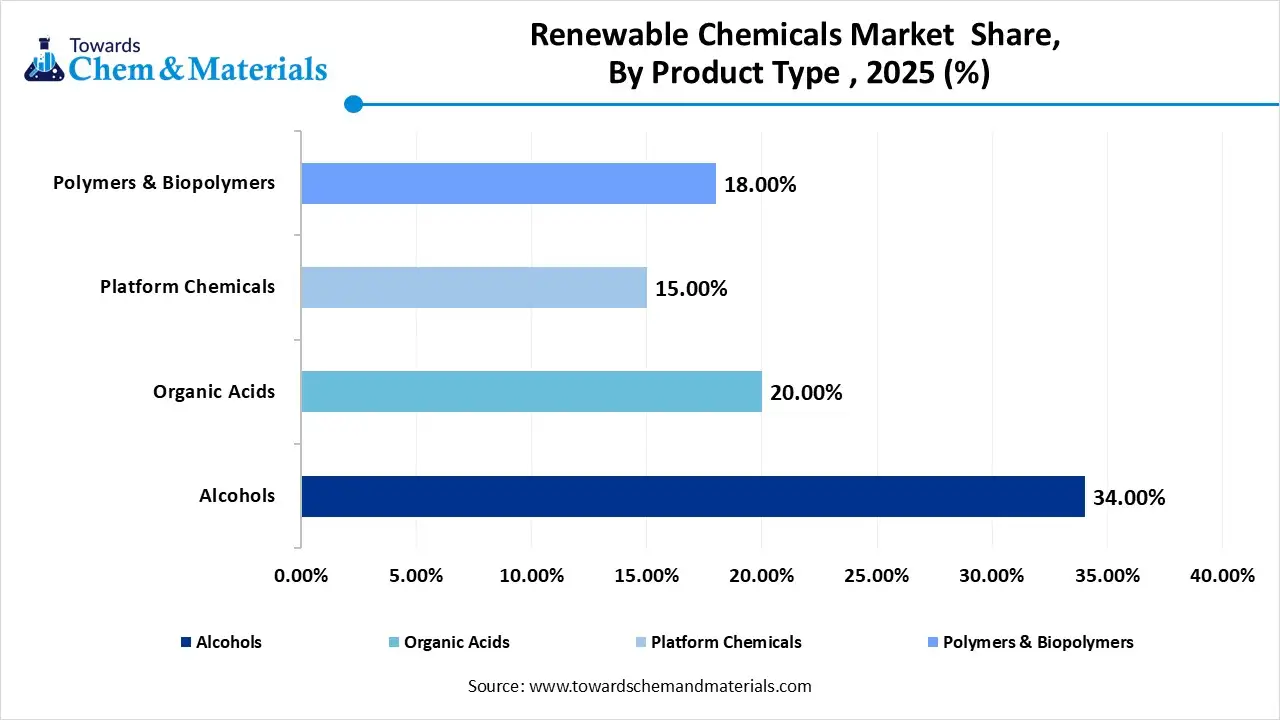
- By product type, the alcohols segment dominated the market and accounted for the largest revenue share of 34% in 2025,owing to its heavy industrial usage.
- By feedstock, the sugar and starch segment led the market with the largest revenue share of 38% in 2025, akin to they are easy to use and already available everywhere.
- By end-use, the Petrochemical segment dominated the market and accounted for the largest revenue share of 31% in 2025, owing to food, drinks, cosmetics, and medicines all depending on it.
Renewable Chemicals Market Trends
- The demand for custom biobased chemicals is expected to result in high yield outcomes for the industrial participants in the coming years. Moreover, the companies are seen in offering different blends for the various manufacturers, which results in better than regular.
- The shift and implementation of real-time carbon impact labelling have led to robust revenue growth across the sector in recent years. In developing countries, consumers are more aware of the environmental impact of substances, where these labels emerge as an ideal option for manufacturers.
- The emergence of breakthroughs in sustainable manufacturing methods is anticipated to support stronger cash flows for manufacturing enterprises during the forecast period.
Market Report Scope
| Report Attribute | Details |
| Market Size in 2026 | USD 163.99 Billion |
| Revenue Forecast in 2035 | USD 438.57 Billion |
| Growth Rate | CAGR 11.55% |
| Forecast Period | 2026 - 2035 |
| Base Year | 2025 |
| Dominant Region | Europe |
| Segment Covered | By Product Type, By Feedstock, By End-User Industry, By Region |
| Key companies profiled | BASF SE, Dow Inc., DuPont de Nemours, Inc., DSM-Firmenich, Braskem, Novamont, Arkema, Evonik, Corbion, NatureWorks, Cargill, Neste |
Value Chain Analysis of the Renewable Chemicals Market
Distribution to Industrial Users
- The distribution of renewable chemicals to industrial users is characterized by a significant shift toward specialty bio-based segments and the integration of digitalized supply chains.
- Key Players: BASF SE and Dow Inc.
Chemical Synthesis and Processing
- The chemical synthesis and processing of renewable chemicals have transitioned from pilot stages to industrial-scale commercialization, driven by breakthroughs in white biotechnology and AI-driven catalyst design.
- Key Players: Corbion N.V. and Genomatica
Regulatory Compliance and Safety Monitoring
- The regulatory compliance and safety monitoring of the renewable chemicals market is defined by a global transition toward harmonized digital tracking and stricter bio-based material safety standards.
- Safety Standards- United States (OSHA) and Hazardous Chemicals Safety Law (China)
Where Waste, Crops, and Data Converge
The industry is moving from single-purpose bio processing to flexible, multi-input systems, which is projected to drive substantial financial gains in the manufacturing sector during the forecast period. Earlier plants depended on one feedstock and produced one product. New systems can process mixed raw materials like crops, waste, and residues in the same facility. Digital control, real time sensors, and data-based optimization reduce energy use and production costs.
Renewable Chemicals Market Regulatory Landscape: Global Regulations
| Country / Region | Regulatory Body | Key Regulations | Focus Areas |
| United States | Environmental Protection Agency (EPA) | TSCA (Toxic Substances Control Act) | Streamlining the review of bio-based drop-in chemicals to replace legacy petrochemicals. |
| European Union | European Chemicals Agency (ECHA) | REACH(Annex XIV & XVII) | Restricting CMR substances; mandates for digital product passports for bio-based polymers. |
| China | Ministry of Emergency Management (MEM) | Hazardous Chemicals Safety Law | National-level regulation replacing the 2011 Decree; focuses on production safety and supply chain tracking |
Segmental Insights
Product Type Insights
How did the Alcohols Segment Dominate the Renewable Chemicals Market in 2025?
The alcohols segment dominated the market with approximately 34% share in 2025, due to its heavy industrial usage. Moreover, the alcohols like biobutanol and bioethanol have seen in heavy usage as solvents, fuel additives, and disinfectants in recent years provided the heavy industrial consumer base to the segment.
The polymer and biopolymers segment is expected to grow with a rapid CAGR, owing to the global shift towards environmentally sustainable practices, such as plastic bans and eco-friendly manufacturing. Moreover, by offering better recyclability, durability, and flexibility, the segment has created a greater demand in sectors such as electronics, automotive, and packaging in recent years.
Renewable Chemicals Market Share, By Product Type , 2025 (%)
| By Product Type | Revenue Share, 2025 (%) |
| Alcohols | 34.00% |
| Organic Acids | 20.00% |
| Platform Chemicals | 15.00% |
| Polymers & Biopolymers | 18.00% |
| Others | 13.00% |
Feedstock Type Insights
How did the Sugar & Starch Crops Segment Dominate the Renewable Chemicals Market in 2025?
The sugar & starch crops segment dominated the market with approximately 38% share in 2025, due to they are easy to use and already available everywhere. Crops like corn, sugarcane, and wheat are simple to process and give high output. Farmers already grow them in large volumes, so companies didn't need new supply chains.
The organic waste & residues segment is expected to grow due to the fact that food waste, crop residue, and industrial leftovers are now seen as free raw materials. Governments are pushing zero-waste rules, and companies want cheaper inputs. Using waste also avoids food vs fuel debates, which helps public image.
Renewable Chemicals Market Share, By Feedstock , 2025 (%)
| By Feedstock | Revenue Share, 2025 (%) |
| Sugar & Starch Crops | 38.00% |
| Lignocellulosic Biomass | 26.00% |
| Plant Oils & Fats | 21.00% |
| Organic Waste & Residues | 15.00% |
End Use Insights
The Petrochemicals segment dominated the market with approximately 31% share in 2025 Petrochemicals are chemicals derived from petroleum and natural gas. However, the renewable chemicals market is focusing on replacing traditional petrochemicals with bio-based alternatives that come from renewable sources like plants, agricultural waste, or algae. The Petrochemical segment is dominant because the chemical industry has historically been heavily reliant on fossil fuels. Many industries—such as automotive, construction, and consumer goods—still use a large amount of petrochemicals. However, there’s growing demand to shift towards renewable alternatives to reduce dependency on oil and gas and to lower environmental impact. The shift from petrochemicals to bio-based renewable chemicals is crucial for achieving a more sustainable chemical production process. This transformation helps reduce carbon emissions, supports a circular economy, and enables industries to reduce their reliance on fossil fuels. The development of renewable chemicals in this segment is driving significant changes in how everyday products (from plastics to fertilizers) are made.
The Packaging & Plastics segment is projected to register the second-fastest CAGR of 5.75% during 2026-2035.The Packaging & Plastics segment focuses on the use of renewable chemicals to produce packaging materials and plastics that are more environmentally friendly than traditional petroleum-based products. This segment is growing rapidly because of the increasing global focus on sustainability and reducing plastic waste. Traditional plastics, made from petroleum, are not biodegradable and contribute to environmental pollution. The demand for bio-based plastics and biodegradable packaging is rising, especially as consumers, companies, and governments look for solutions to combat plastic pollution and reduce the carbon footprint. The Biodegradable Plastics Renewable chemicals are used to create plastics that break down naturally in the environment, such as polylactic acid (PLA) plastics, which are derived from plants like corn. Plant-based Packaging: Instead of traditional petroleum-based packaging, renewable chemicals are used to create materials like plant-based films, bottles, and containers, which are compostable and more sustainable.
Renewable Chemicals Market Share, By End-User Industry , 2025 (%)
| By End-User Industry | Revenue Share, 2025 (%) |
| Petrochemical | 31.00% |
| Packaging & Plastics | 16.00% |
| Automotive & Transportation | 10.00% |
| Consumer Goods & Personal Care | 8.00% |
| Construction & Building Materials | 7.00% |
| Agriculture | 11.00% |
| Pharmaceuticals & Others | 17.00% |
Regional Insights
Asia Pacific Renewable Chemicals Market Evaluation
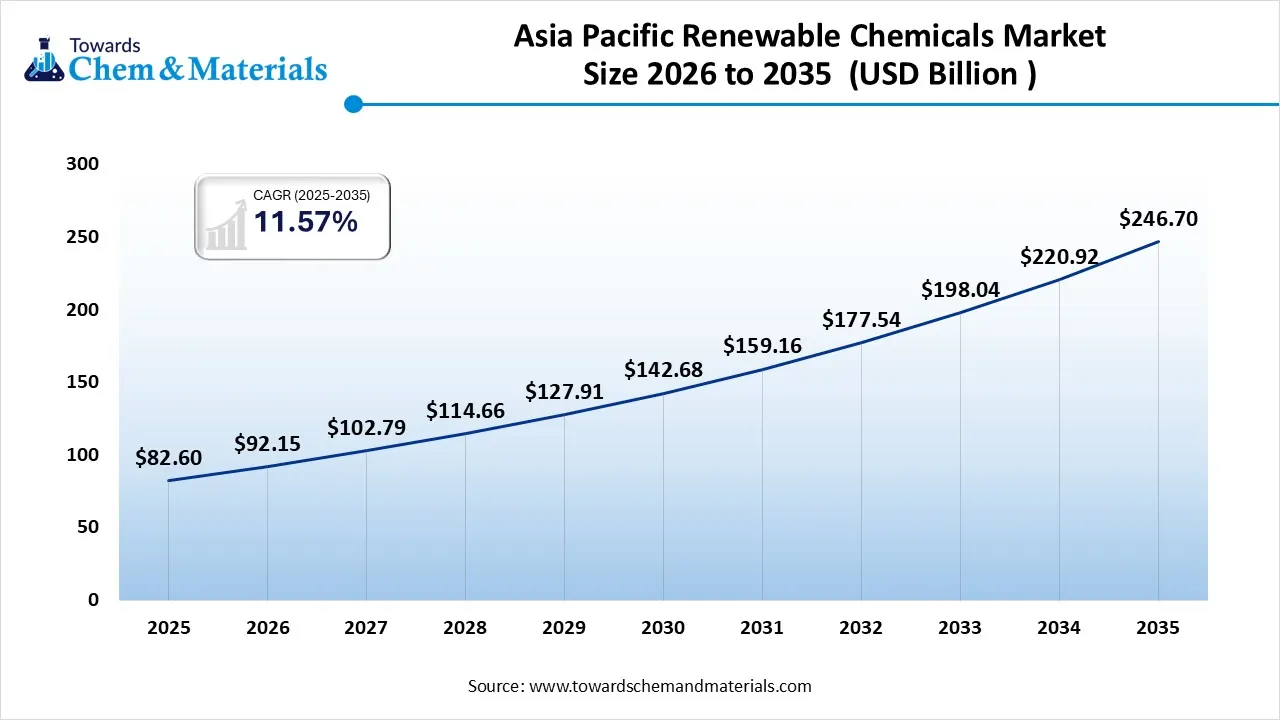
Asia Pacific renewable chemicals market size was valued at USD 82.60 billion in 2025 and is expected to be worth around USD 246.70 billion by 2035, exhibiting at a compound annual growth rate (CAGR) of 11.57% over the forecast period from 2026 to 2035. Asia Pacific dominated the Renewable Chemicals market with the largest revenue share of 56.00% in 2025. Asia Pacific is expected to capture a major share of the market with a rapid CAGR, owing to the rapid industrial scaling and demand expansion. The region prioritizes production capacity growth and cost efficiency, enabling faster commercialization in the current period. Also, large consumer markets increase material turnover, supporting high-volume adoption. Governments are promoting domestic chemical manufacturing to reduce import dependence.
The renewable chemicals market in the Europe is projected to grow at the fastest CAGR during the forecast period, Europe the renewable chemicals market with approximately 15.00% share in 2025, due to the stricter environmental policies and their systematic implementation in manufacturing infrastructure. Moreover, the region has seen in under the development of advanced recycling systems, close cooperation between industries and governments, and technology integrated laboratory’s in recent years.
Germany Sets Global Green Standards
Germany maintained its dominance in the market, owing to the increasing focused towards the green chemical development and industrial fermentation. Also, by focusing on quality, efficiency, and longer product life, the German manufacturers have created their own space in the global market in the past few years. Furthermore, the government has seen in releasing attractive benefits like subsidies and tax reduction to the manufacturers who implement maximum sustainable manufacturing practices.
Execution Speed Fuels China’s Leadership
China is expected to emerge as a prominent country for the market in the coming years due to coordinated industrial planning and execution speed. Central and local governments support renewable chemical production through infrastructure access and operational incentives. Integrated supply chains reduce delays in raw material sourcing and distribution in the country.
North America Renewable Chemicals Market Examination
North America was second second-largest market with the revenue share of 18.00% in 2025. North America is notably growing in market, owing to strong private investment and commercialization focus. Moreover, the companies prioritize technologies with clear performance and profitability advantages in the region. Moreover, mature capital markets support scaling of proven solutions rather than extended pilot phases. Brand-driven sustainability commitments create downstream demand certainty.
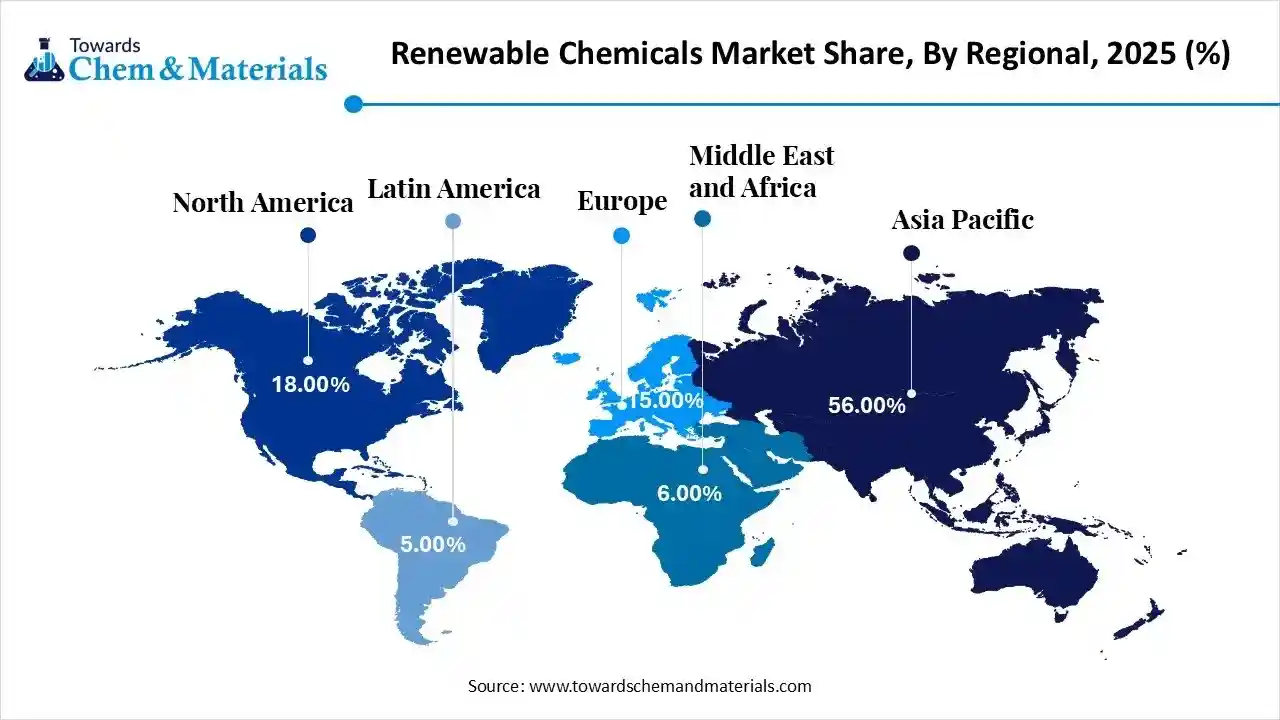
Renewable Chemicals Market Share, By Regional, 2025 (%)
| Regional | Revenue Share, 2025 (%) |
| North America | 18.00% |
| Europe | 15.00% |
| Asia Pacific | 56.00% |
| Latin America | 5.00% |
| Middle East & Africa | 6.00% |
Innovation Secures United States Industry Share
The United States is expected to gain a major industry share due to the trend towards innovation to market efficiency. Moreover, the research institutions generate advanced renewable chemical technologies that transition rapidly into commercial production. Strong venture funding supports scale-up and risk management in the country. Large agricultural resources ensure a stable feedstock supply.
Recent Developments
- In November 2025, Solvay and Sapio established a collaboration, and the main motive of the partnership is to develop renewable hydrogen. Also, both manufacturers are likely to build advance production setup where 756 tons of hydrogen will be produced in a year, as per a published report by the company(Source:www.indianchemicalnews.com )
Top Vendors in the Renewable Chemicals Market & Their Offerings:
- BASF SE: A global leader in "Verbund" integration, BASF is currently scaling its ChemCycling technology and biomass balance approach to provide mass-balanced renewable building blocks for industrial users.
Dow Inc.: Focused on the circular economy, Dow is a major producer of bio-based polyethylene (Bio-PE) and is heavily investing in advanced recycling partnerships to decarbonize its materials portfolio by 2026.
DuPont de Nemours, Inc.: Specializes in high-performance materials and bio-based specialty chemicals, particularly through its Sorona® brand and sustainable polymers used in the automotive and textile industries.
DSM-Firmenich: Following its strategic merger, the company is a dominant force in white biotechnology, utilizing advanced fermentation to produce bio-based ingredients, vitamins, and specialized renewable materials. - Braskem
- Novamont
- Arkema
- Evonik
- Corbion
- NatureWorks
- Cargill
- Neste
Segments Covered in the Report
By Product Type
- Alcohols
- Organic Acids
- Platform Chemicals
- Polymers & Biopolymers
- Others
By Feedstock
- Sugar & Starch Crops
- Lignocellulosic Biomass
- Plant Oils & Fats
- Organic Waste & Residues
By End-User Industry
- Packaging & Plastics
- Petrochemical
- Automotive & Transportation
- Consumer Goods & Personal Care
- Construction & Building Materials
- Agriculture
- Pharmaceuticals & Others
By Region
- North America
- U.S.
- Canada
- Mexico
- Europe
- Germany
- UK
- France
- Italy
- Spain
- Asia Pacific
- China
- India
- Japan
- South Korea
- Latin America
- Brazil
- Argentina
- Middle East & Africa
- Saudi Arabia
- South Africa
FAQ's




Select User License to Buy
Figures (4)








 sales@towardschemandmaterials.com
 Download Sample
 Schedule a Meeting