Content


What is the U.S. polylactic acid market size and share?
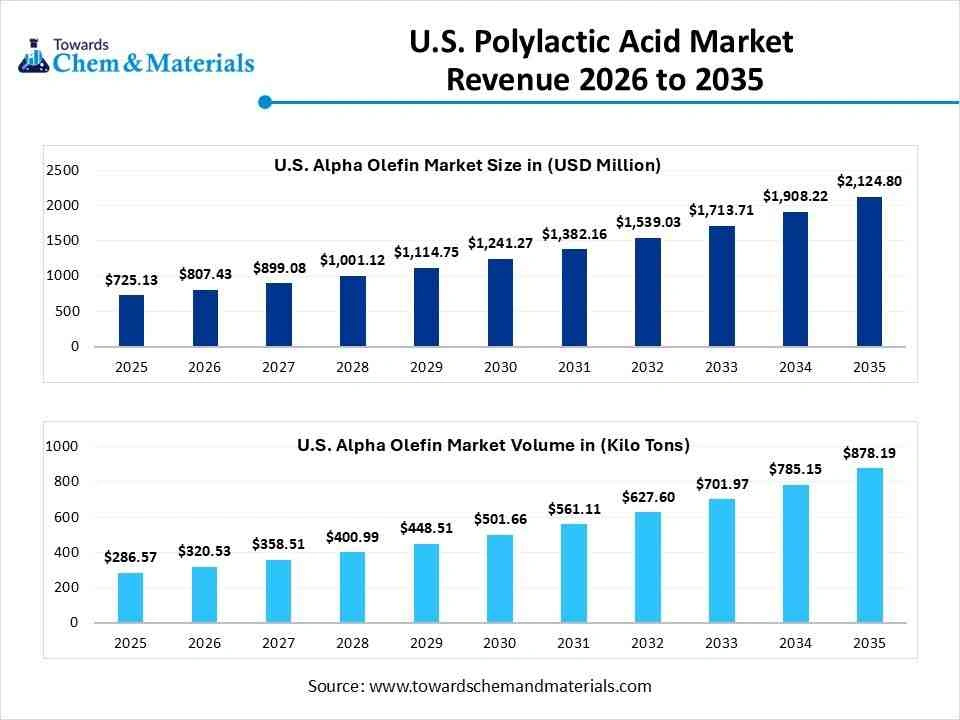
The U.S. polylactic acid market size was estimated at USD 725.13 million in 2025 and is predicted to increase from USD 807.43 million in 2026 to approximately USD 2,124.80 million by 2035 and is expected to grow at a CAGR of 6.25% during 2025-2035, driven by the growing demand for eco-friendly and consumers preference for compostable alternative packaging solutions. The increasing and established industrial composting infrastructure further boosts growth, and key player collaborations make it a major growth factor in the market.
U.S. Polylactic Acid: Sustainable Packaging Demand
According to Towards Chemicals and Materials Analytics and Consulting, the U.S. polylactic acid market volume was valued at 286.57 kilotons in 2025 and is expected to surpass around 878.19 kilotons by 2035, accelerating a compound annual growth rate (CAGR) of 11.85% over the forecast period from 2026 to 2035.
Polylactic acid is a bio-based, renewable resource material that is in increased demand for sustainable packaging solutions from major sectors like food and beverage packaging, which is extensively supported by the e-commerce shift towards eco-friendly delivery materials. Consumer awareness and growing public concerns about waste generated and carbon footprints drive the use of plant-based polymers, which are derived from renewable resources. The innovation and technological advancements in processing methods like fermentation and polymerization increase processing efficiency and compound enhancement, which make them more cost-competitive and adaptable, supporting growth of the market.
Industrial collaborations and partnerships between major players help build strategic partnerships across the supply chain to expand into higher-value sectors like automotive, electronics, and molded foams, which are major growth factors. Joint ventures such as TotalEnergies Corbion collaborating with Benvic for specialized compounds and Useon for expanded PLA foam accelerate go-to-market progress. Producers align with international certifiers such as TÜV and BPI to streamline cross-border compliance and validate industrial compostability standards.
- For instance, a leading chemical company, LG Chem, has partnered and formed a joint venture with ADM for the production of lactic acid and polylactic acid in the U.S. (Source: www.adm.com)
Market Highlights
- By grade, the thermoforming segment dominated the market with a 41% share in 2025 and is expected to grow at a CAGR of 10.90% over the forecast period.
- By grade, the extrusion segment held a 22% market share in 2025 and is expected to have the fastest growth with a CAGR of 12.4% in the forecast period.
- By raw materials, the corn starch segment dominated the market with a 68% share in 2025 and is expected to grow at a CAGR of 10.80% over the forecast period.
- By raw materials, the sugarcane segment held a 17% market share in 2025 and is expected to have the fastest growth with a CAGR of 13.2% in the forecast period.
- By application, the rigid thermoforms segment dominated the market with a 46% share in 2025 and is expected to grow at a CAGR of 10.90% over the forecast period.
- By application, the films and sheets segment held 31% market share in 2025 and is expected to have the fastest growth with a CAGR of 12.6% in the forecast period.
Investment Flow for U.S. Polylactic Acid Market 2026
The U.S. polylactic acid (PLA) market is expanding rapidly, with major corporate investments and federal support driving production capacity to meet growing sustainability demands. NatureWorks LLC, jointly owned by Cargill and PTT Global Chemical, and Cargill & Dow Chemically, these corporate giants have historically provided foundational commercial investments to scale up bio-based polymer technologies. Agencies like the Department of Energy and the National Institute of Standards and Technology have historically provided critical early-stage R&D funding for bio-based polymer synthesis.
State and federal legislative frameworks, tax incentives, and single-use plastic bans continue to incentivize enterprises to build out large-scale bio-refineries.
- Amazon and the US Department of Energy-backed BOTTLE consortium formed a partnership and collaborated to overcome plastic waste by joining forces to advance next-generation recycling technologies, which aim to reduce pollution and accelerate net-zero economy and circular economy mandates through large-scale investment. (Source: www.northamericaoutlookmag.com)
- The U.S. Department of Energy, through initiatives like the Plastics Innovation Challenge and the BOTTLE Consortium, has issued multiple tranches of funding, frequently spanning $23 million to $27 million per opportunity announcement. (Source: www.energy.gov/articles)
Market Growth Trends:
- Growing awareness of plastic pollution from petroleum-based products is leading consumers and companies to seek biodegradable alternatives like PLA. Policies such as bans on single-use plastics, landfill taxes, and funding for green technologies are encouraging the adoption of PLA.
- A significant portion of consumers are willing to pay more for products with sustainable packaging, and a growing number of companies are adopting eco-friendly solutions to meet this demand.
- Continuous research and development are leading to improved PLA production techniques and higher-performance grades of the material, which expand its potential applications in more demanding industries. The expansion of e-commerce has increased the need for packaging, and PLA is a major beneficiary of this trend as companies shift to sustainable options.
Key Technological Shifts in the U.S. Polylactic Acid Market: High-Throughput Inverse Design & Material Customization
The shift towards technologically advanced processing through AI integration and ML helps in integrating high-performance processing and supports utilizing AI to move towards automated and high-precision and circular bio-manufacturing, which is a major shift. The high-throughput inverse and material customization through inverse molecular design and smart nanocomposite formulations. Other major growth shifts are intelligent fermentation and process intensification, AI-guided biodegradation and enzyme engineering, smart quality control, polymer synthesis automation, and AI-driven circular economy integration, which help in major growth shifts.
Supply Chain Analysis of U.S. Polylactic Acid Market:
Chemical Synthesis and Processing
- Polylactic acid is produced from renewable feedstocks such as corn starch, sugarcane, and cassava through fermentation of sugars into lactic acid, followed by ring-opening polymerization to form PLA resin. The polymer is then processed via extrusion, injection molding, thermoforming, and blow molding into films, fibers, and packaging products.
- Key players: NatureWorks LLC, TotalEnergies Corbion, Hisun Biomaterials, Futerro, Danimer Scientific
Quality Testing and Certification
- PLA products are tested for biodegradability, compostability, mechanical strength, and thermal performance under standards such as ASTM D6400, EN 13432, and ISO 17088. These certifications ensure compliance with industrial and home composting requirements.
- Key players: TÜV Austria, SGS, UL Solutions, Intertek
Distribution to Industrial Users
- PLA materials are supplied to packaging, textile, agriculture, medical device, and 3D printing industries through polymer distributors, converters, and OEM supply contracts.
- Key players: NatureWorks LLC, TotalEnergies Corbion, Futerro, and Hisun Biomaterials.
Sustainability Analysis in Polylactic Acid
Polylactic acid is made from renewable resources and is a bio-based polymer from corn starch and sugarcane, which has a lower carbon footprint and also reduces energy use in comparison to conventional petroleum plastic. The environmental benefits and production, like renewable feedstock, lower emissions, and applications in sustainable food packaging and 3D printing, are major factors in sustainability analysis. Recycling innovations like mechanical recycling, chemical depolymerization, and modification strategies are major factors.
What is polylactic acid?
Polylactic acid is a plant-based and biodegradable plastic that is made from renewable resources such as corn starch and sugarcane. This is made through a process of fermentation and polymerization in which long chains called polymers are created. In fermentation, starches are broken down to simple sugars and then fermented into lactic acid. The common uses of polylactic acid are 3D printing, packaging, medical packaging, and tissue engineering scaffolds. The major benefits, such as low heat resistance, compostability, and eco-friendly nature, make it a preferred choice.
U.S. Polylactic Acid Premium Pricing Analysis
The premium price of polylactic acid is due to feedstock availability and fluctuations in raw material prices, which are major factors in the final price of the product. PLA costs two to three times more to produce than traditional fossil-based plastics like polyethylene or polypropylene. Softness in corn-derived feedstocks and lower natural gas costs helped support producer profit margins. Increased import competition and weaker conventional plastic resin premiums kept overall price growth small and range-bound.
Market Carbon Tax Analysis
Polylactic acid emits comparatively fewer and lower greenhouse gases during production than conventional fossil-based polymers, yielding a roughly lower carbon footprint. Traditional petrochemical-based plastics emit a large amount of carbon, which applies regulatory penalties on competitors by federal and state-level carbon taxes. The high initial product costs remain a structural hurdle for PLA adoption compared to cheap virgin fossil plastics; a carbon tax acts as a market-correcting mechanism, narrowing the price gap, which is a major tax bracket.
U.S. Polylactic Acid Regulatory Landscape
| Country / Region | Regulatory Body | Key Regulations | Focus Areas | Notable Notes |
| North America (USA, Canada) | US FDA, US EPA, Environment and Climate Change Canada | FDA 21 CFR for food contact materials, EPA Sustainable Materials Management Program, Canada Environmental Protection Act | Biodegradability standards, food-contact safety, life-cycle emissions | PLA used in food packaging must comply with FDA food-contact clearance; compostability claims require ASTM D6400 certification. |
Market Dynamics
Drivers
U.S. Polylactic Acid: Sustainable Packaging Demand
The market is experiencing growth driven by strict government bans on single-use plastics, which increases the adoption of renewable materials, supporting further growth. Public and consumer awareness of the use of bio-based alternatives to petroleum-based plastic, which creates landfills, leads to consumption of PLA for its clarity and compostability, further aligning with sustainable packaging demand. The innovation and technological shift in high-heat rad and impact-modified blends are highly utilizing it in automotive and electronic components, further accelerating growth and expansion of the market.
Challenges
U.S. Polylactic Acid: High Production Costs
The market faces several challenges that limit the growth, such as the high production costs of polylactic acid, as it is higher than that of conventional plastics. This high cost is due to complex and energy-intensive processing and fluctuating biomass feedstock, which contributes to the cost of the product. The other key growth challenges are feedstock constraints, lack of processing infrastructure, and inferior thermal and mechanical performance restricting the growth of the market.
Opportunities
U.S. Polylactic Acid: Regulatory & Industry Support
The key growth opportunity that supports growth is regulatory and industry support, like FDA approvals for food contact and medical applications, which are sure to boost consumer goods and healthcare adoption, propelling further growth. The other major growth opportunities are raw materials shifts due to supply chain diversification. The other major growth factors are sustainable packaging demand and adoption, along with emerging sectors that demand innovation in PLA used in medical devices, automotive, and 3D printing filaments, further boosting growth.
Segmental Insights
Grade Insights
The thermoforming segment dominated the market with a 41% share in 2025 and is expected to grow at a CAGR of 10.90% over the forecast period due to high demand for rigid and eco-friendly packaging material across domains for safety purposes, supporting rising adoption. The dominance is attributed to its properties and application, like how they offer high clarity and rigidity to the consumer, and its fast-processing time helps in manufacturing large volumes, supporting increased demand. Its low weight, commercial compatibility, and durability also help in meeting the corporate ESG goals, further supporting the growth and adoption of the market.
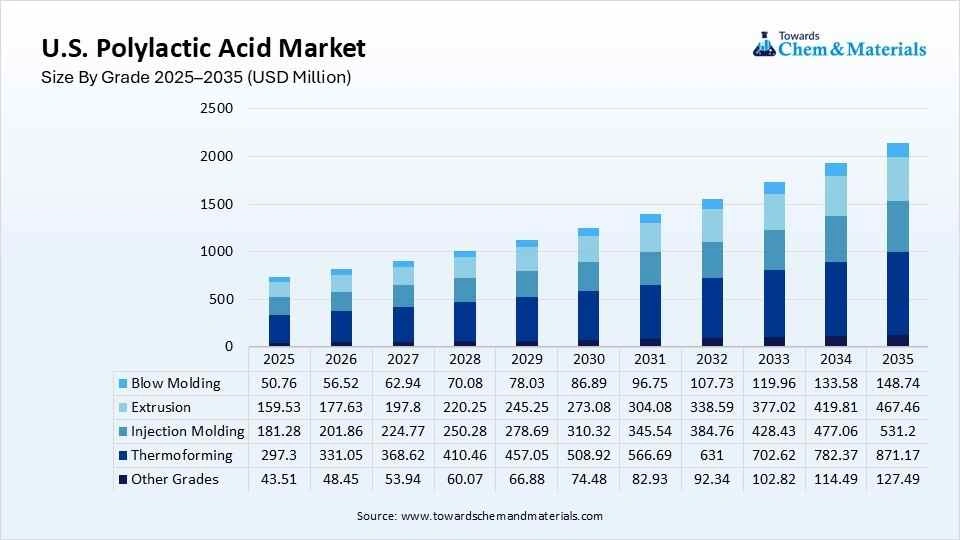
The extrusion segment held a 22% market share in 2025 and is expected to have the fastest growth with a CAGR of 12.4% in the forecast period, driven by the growing demand for continuous shape products, which are rigid and durable and can be used for flexible packaging, especially food. The demand for films, coatings, and sheets from processing facilities produced by extrusion-based conversion systems is largely adopted, which also contributes to the growth of the industry. Replacement of conventional petrochemical plastics and a shift towards bio-based and specialized processing methods aligning with the sustainability mandates further heavily support the demand for extruded bioplastics.
U.S. Polylactic Acid Market Share, By Grade, 2025 (%)
| By Grade | Market Share (%) |
| Thermoforming | 41% |
| Injection Molding | 25% |
| Extrusion | 22% |
| Blow Molding | 7% |
| Other Grades | 6% |
Raw Material Insights
The corn starch segment dominated the market with a 68% share in 2025 and is expected to grow at a CAGR of 10.80% over the forecast period, driven by its wide use and high production volume, as it is available at a large scale, which makes it easily accessible to producers. The cost-effectiveness and established supply chain in the country make it an affordable option for most of the manufacturers, supporting growth of the industry. The increased use of corn starch also contributes to and supports large-scale commercial production of the material, supporting expansion of the market significantly and increasing the demand.
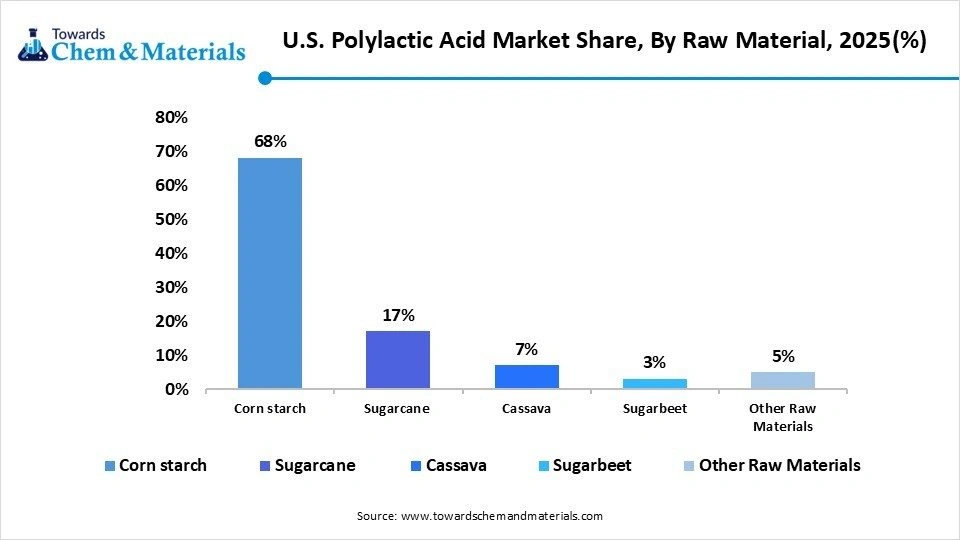
The sugarcane segment held a 17% market share in 2025 and is expected to have the fastest growth with a CAGR of 13.2% in the forecast period, driven by the growing and strong attraction of consumers to high sugar yield, which makes it a key raw material available for use in high amounts across the region. Its lower greenhouse gas emissions during cultivation, which aligns with environmental sustainability, further contributes largely to the growth of the market. The high carbon absorption during crop growth of the sugarcane-based PLA makes it a better carbon footprint performer, further increasing the demand. There is an increase in adoption of sugarcane as a raw material for its expansion bioeconomy and circular economy incentives across the region, which increases the growth of the industry.
U.S. Polylactic Acid Market Share, By Raw Material, 2025 (%)
| By Raw Material | Market Share (%) |
| Corn starch | 68% |
| Sugarcane | 17% |
| Cassava | 7% |
| Sugarbeet | 3% |
| Other Raw Materials | 5% |
Application Insights
The rigid thermoforms segment dominated the market with a 46% share in 2025 and is expected to grow at a CAGR of 10.90% over the forecast period, driven by its growing applications in food packaging, especially in trays, containers, and disposable cutlery, which increases the demand and supply of the products. The increased shift towards ready-to-eat food, packaged food, and quick-service restaurants due to a fast-moving audience and consumers, with rising urbanization, contributes largely to the supply and demand for the product, further driving growth and expansion of the market.
The films and sheets segment held a 31% market share in 2025 and is expected to have the fastest growth with a CAGR of 12.6% in the forecast period. Polylactic acid films and sheets are used extensively for agricultural mulch films, flexible packaging, and protective packaging, as there is high demand for export and import of materials, which drives demand for food-grade and ideal packaging of the product, with safety precautions supporting growth of the market. The key properties of the product, like good printability, transparency, and biodegradability, which are effectively used for food packaging and industrial protective uses, support further growth and expansion of the market in the industry.
U.S. Polylactic Acid Market Share, By Application, 2025 (%)
| By Application | Market Share (%) |
| Rigid Thermoforms | 46% |
| Films & Sheets | 31% |
| Bottles | 13% |
| Other Applications | 10% |
Recent Developments
- In April 2025, TotalEnergies Corbion and Useon partnered to advance EPLA foam technology, offering an industrially compostable, plant-based substitute for expanded polystyrene. This technology utilizes TotalEnergies Corbions Luminy PLA bioplastics, made from non-GMO sugarcane, processed via the Useons direct bead foaming method. (Source: www.chemanalyst.com)
- In July 2026, TotalEnergies Corbion launched Luminy FOAM 50F, a high-melt-strength polylactic acid grade designed for extrusion-foamed food packaging applications. The material is positioned as a drop-in alternative to extruded polystyrene, targeting fresh meat and fish trays as well as food-service formats such as clamshells and bowls. It can be processed on existing XPS extrusion lines with minimal modifications. (Source: worldbiomarketinsights.com)
Competitive Analysis
- The landscape of polylactic acid production and commercialization in the United States is anchored heavily by strategic partnerships, as high production costs and infrastructure demands necessitate shared corporate expertise.
- Yuhan Kimberly is a joint venture that was formed between the major corporations, which are Koreas Yuhan Corporation and U.S.-based Kimberly-Clark, who joined to launch the worlds first biodegradable and reusable nonwoven paper towel, which is made with PHA. The aim is to develop eco-friendly and sustainable materials. (Source: www.nonwovens-industry.com)
- NatureWorks partnered with South Korean PHA manufacturer CJ Bio to create a masterbatch bioplastic. By blending NatureWorks’ PLA with CJ Bio’s polyhydroxyalkanoate, the collaboration aims to create a material that satisfies the functional demands of packaging while being significantly easier to biodegrade in industrial composters. (Source: natureworksllc.com)
Top players in the U.S. polylactic acid market & their offerings:
| Company | Company Type/Position | Major Headquarters | Geographic Presence | PLA Offerings | Key Offering/Strength |
| NatureWorks LLC | Leading PLA biopolymer manufacturer | Plymouth, Minnesota, USA | North America, Europe, Asia Pacific, Latin America | Ingeo PLA resins, biopolymer grades for packaging, fibers, 3D printing, and consumer products | Strong US market presence and broad Ingeo PLA portfolio with established application expertise |
| Total Energies Corbion | Global PLA producer | Gorinchem, Netherlands | North America, Europe, Asia Pacific, Latin America | Luminy PLA, high-heat PLA, standard PLA, PDLA, recycled PLA | Advanced PLA grades for packaging, food service, serveware, fibers, automotive, and 3D printing applications |
| BASF SE | Global chemicals and bioplastics producer | Ludwigshafen, Germany | North America, Europe, Asia Pacific, Latin America | Biodegradable polymer solutions and PLA-related bioplastic materials | Strong polymer R&D capabilities and sustainable materials portfolio |
| Danimer Scientific | US bioplastics manufacturer | Bainbridge, Georgia, USA | North America, Europe, and selected global markets | Biodegradable and compostable biopolymer resins, films, and packaging materials | US-based bioplastics manufacturing and focus on compostable packaging solutions |
| Mitsubishi Chemical Group | Global specialty chemicals and materials producer | Tokyo, Japan | North America, Europe, Asia Pacific | Bio-based and biodegradable polymer materials, PLA-related solutions and compounds | Advanced polymer technology and broad specialty materials capabilities |
Other Top Players Are
- NatureWorks LLC (Blaine, Minnesota)
- Danimer Scientific (Bainbridge, Georgia)
- TotalEnergies Corbion USA (Houston, Texas)
- Futerro USA Inc. (U.S. Division)
- BASF Corporation (Florham Park, New Jersey)
- DuPont de Nemours, Inc. (Wilmington, Delaware)
- Evonik Corporation (Parsippany, New Jersey)
- Dow Chemical Company (Midland, Michigan)
- Eastman Chemical Company (Kingsport, Tennessee)
- Mitsubishi Chemical America, Inc. (Chesapeake, Virginia)
- Genpak LLC (Charlotte, North Carolina) –
- Sonoco Products Company (Hartsville, South Carolina)
- WestRock Company (Atlanta, Georgia)
- Advanced Extrusion, Inc. (Rogers, Minnesota)
- Nature Film / Plastic Suppliers, Inc. (Columbus, Ohio)
- Atomic Filament (Kendallville, Indiana)
- Push Plastic (Springdale, Arkansas)
- Hatchbox 3D (Pomona, California)
- FilaCube LLC (Houston, Texas)
- Protopasta (ProtoPlant Inc.) (Vancouver, Washington)
Segments Covered
By Grade
- Thermoforming
- Food Trays
- Cups & Containers
- Clamshell Packaging
- Blister Packaging
- Other Thermoformed Products
- Injection Molding
- Disposable Tableware
- Consumer Goods
- Medical Components
- Electronic Components
- Other Injection-Molded Products
- Extrusion
- Films
- Sheets
- 3D-Printing Filaments
- Extruded Profiles
- Other Extruded Products
- Blow Molding
- Bottles
- Jars
- Containers
- Other Blow-Molded Products
- Other Grades
- Fiber-Grade PLA
- Medical-Grade PLA
- High-Heat PLA
- Compounded PLA
- Specialty PLA
By Raw Material
- Sugarcane
- Sugarcane Juice
- Sugarcane Molasses
- Corn Starch
- Corn Grain
- Corn Processing Starch
- Fermentable Corn Sugars
- Cassava
- Cassava Starch
- Modified Cassava Starch
- Sugarbeet
- Beet Sugar
- Beet Molasses
- Other Raw Materials
- Potato Starch
- Wheat Starch
- Rice Starch
- Agricultural Residues
- Cellulosic Biomass
By Application
- Rigid Thermoforms
- Food Trays
- Cups
- Clamshells
- Food Containers
- Blister Packs
- Films & Sheets
- Food Packaging Films
- Agricultural Films
- Industrial Films
- Lamination Films
- Thermoforming Sheets
- Bottles
- Beverage Bottles
- Water Bottles
- Cosmetic Bottles
- Pharmaceutical Bottles
- Household Containers
- Other Applications
- 3D-Printing Filaments
- Fibers & Textiles
- Medical Products
- Agricultural Products
- Consumer Products
- Disposable Tableware
Tags
FAQ's




Select User License to Buy
Figures (3)







 sales@towardschemandmaterials.com
 Download Sample
 Schedule a Meeting