
What is the Current Anti-fingerprint Coating Market Size and Share?
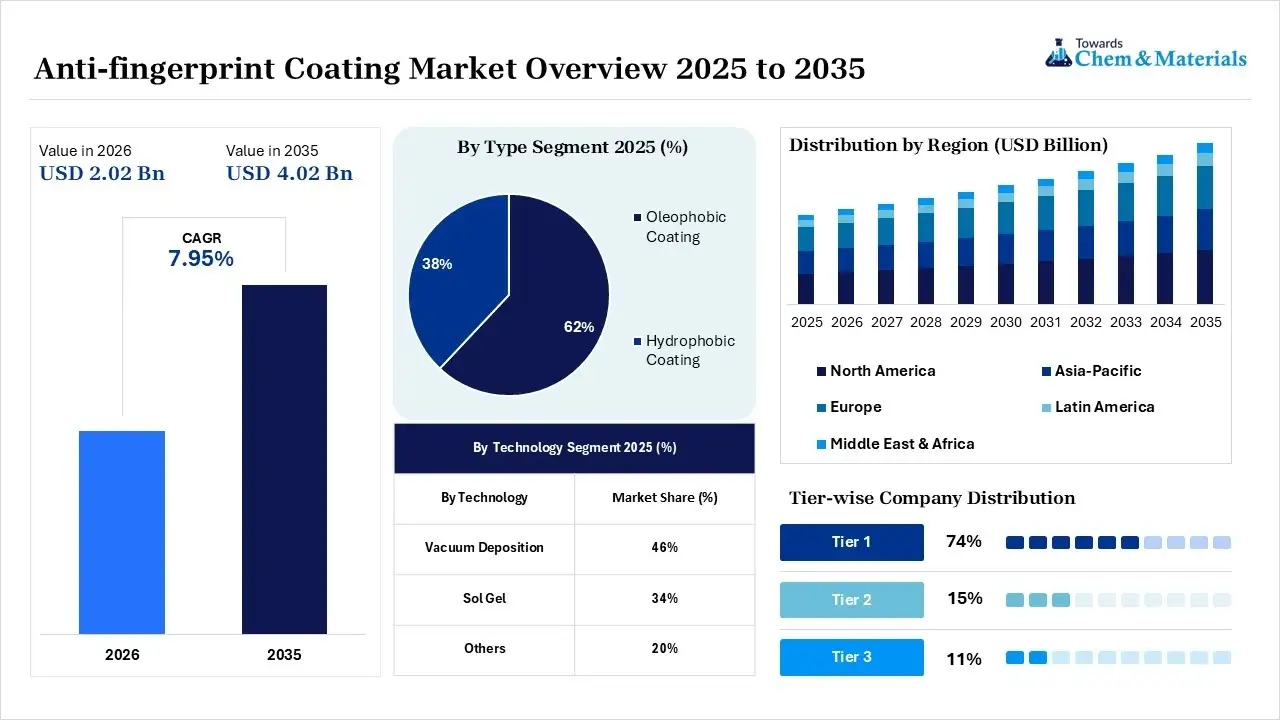
The anti-fingerprint coating market size was valued at USD 1.87 billion in 2025, is estimated to reach USD 2.02 billion in 2026, and is projected to reach USD 4.02 billion by 2035, exhibiting a compound annual growth rate (CAGR) of 7.95% over the forecast period from 2026 to 2035.Asia Pacific dominated the anti-fingerprint coating market with the largest revenue share of 43.0% in 2025 and is expected to grow at the fastest CAGR of 8.14% during the forecast period. The rise of touchscreen technology in consumer electronics, the use of digital displays in the automotive industry, and the growth of the premium appliances and architectural glass sectors are expected to significantly spur the market. The use of oleophobic and omniphobic technologies, together with the trend for more environmentally-friendly low-VOC formulations, is driving market expansion.
Market Highlights
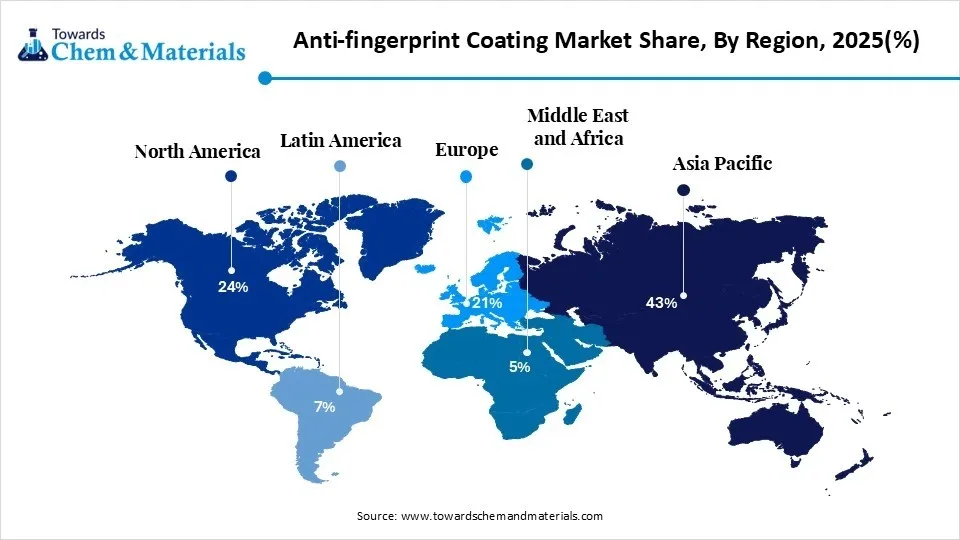
- By region, Asia Pacific dominated the anti-fingerprint coating market by holding 43% share in 2025, driven by strong smartphone production, which supports demand.
- By region, Middle East & Africa held 6% market share in 2025 and is expected to grow at the fastest with a CAGR of 9% during the forecast period as solar energy projects expand rapidly across the region.
- By type, the oleophobic coating segment dominated the market with the largest share of 62% in 2025, as smartphone and tablet manufacturers increasingly adopt fingerprint-resistant surfaces.
- By type, the hydrophobic coating segment held 38% market share in 2025 and is expected to grow at the fastest CAGR of 8.5% over the forecast period due to self-cleaning performance, which improves maintenance efficiency.
- By technology, the vacuum deposition segment dominated the market with the largest share of 46% in 2025, as electronics manufacturers favor precision coating methods.
- By technology, the other segment held 20% market share in 2025 and is expected to grow at the fastest CAGR of 8.6% over the forecast period, driven by emerging industrial applications.
- By application, the consumer goods segment dominated the market with the largest share of 39% in 2025, as rising sales of smartphones and wearable devices fuel demand.
- By application, the automotive segment held 16% market share in 2025 and is expected to grow at the fastest CAGR of 9.1% over the forecast period, driven by EV adoption, which boosts advanced interior technologies.
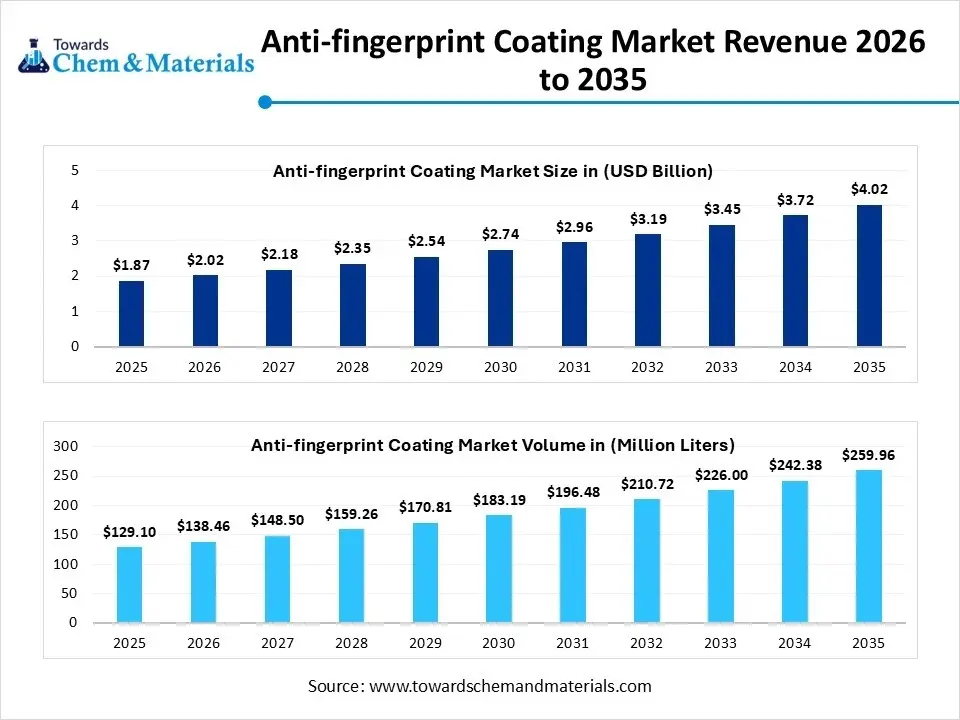
The anti-fingerprint coating market is moving ahead, kind of steadily, because people keep wanting smudge-resistant, easy-to-clean surfaces. You see this a lot across consumer gadgets, automotive displays, architectural glass, and even premium appliances. And with phones, tablets, laptops, plus interactive screens everywhere, the need is rising for clear coatings that don’t mess up visibility, and that improve the whole user experience overall. In cars, manufacturers are not waiting around either.
They are increasingly adding anti-fingerprint solutions onto infotainment panels, digital dashboards, and even that glossy interior look, so the appearance stays crisp while cleaning becomes less of a chore. Meanwhile, progress in omniphobic, UV-curable, and PFAS-free coating technologies opens the door to sustainability in product development. The increasingly strict environmental laws are also prompting manufacturers to switch from fluorine to alternatives.
- For instance, in January 2026, Amazfit launched the Active Max smartwatch with strengthened glass that has an anti-fingerprint coating, marking the growing incorporation of anti-fingerprint technologies into high-end smart electronics.(Source: www.fonearena.com)
Market Trends
- Low Maintenance: The anti-fingerprint coatings are easy to clean, and they minimize the need for frequent cleaning of dirt and moisture. They are very easy to maintain.
- Wide application: Rising demand from various industries such as home appliances, automotive, architectural, retail, and electronics demands anti-fingerprint coating to enhance aesthetics.
- Enhance durability & improved touch sensitivity: Anti-fingerprint coating enhances durability by providing protection from water, dirt, dust, and scratches. It also improves touch sensitivity and makes them more responsive.
- Rising hygiene awareness: Growing awareness regarding hygiene in consumer demands products that are easy to clean due to this anti-fingerprint coating is growing.
- Smudge and fingerprint reduction: The key advantage of anti-fingerprint coating is to minimize fingerprints and smudges from surfaces and give products a professional look.
Report Scope
| Report Attributes | Details |
| Market size value in 2026 | USD 2.02 Billion |
| Expected size in 2035 | USD 4.02 Billion |
| Growth Rate | CAGR of 7.95% |
| Base year of estimation | 2025 |
| Forecast Period | 2025-2035 |
| Segment Covered | By Type,Technology,Application,Region |
| Dominant Region | Asia Pacific |
| Key Companies Profile | AGC Chemicals Europe, Ltd., CYTONIX, DAIKIN INDUSTRIES, Ltd., ESSILOR OF AMERICA, INC., HARVES Co., Ltd., Izovac, Leader Optronics Technology Co.,LTD, NAGASE & CO., LTD., Nanokote; NanoSlic Smart Coatings, Natoco Co.,Ltd., Nippon Paint Surf Chemicals Co., Ltd., PPG Industries, Inc., Sumitomo Chemical Co., Ltd., Taiwanfluoro Technology, Plasmatreat GmbH, Kriya Materials, Janos Tech., Carl Zeiss Limited, and Bühler AG |
Supply Chain Analysis of the Anti-fingerprint Coating Market
Feedstock Procurement
- It includes the procurement of specialty raw materials like silica nanoparticles, fluoropolymers, silicone compounds, solvents, and other sophisticated chemical precursors in anti-fingerprint coatings.
- Solvay: a major supplier of specialty fluoropolymers and advanced materials for coatings formulations that require high performance, oleophobic and hydrophobic characteristics, and that meet a variety of specifications.
- Other Key Players: Chemours, AGC Inc.
Chemical synthesis and processing
- At this stage, the raw materials are chemically synthesized to become functional polymers, fluorinated compounds, silicone resin, and nano-hybrid coating agent. The materials produced are low surface energy, transparent, durable, and resistant to oils, water, and other contaminants, without compromising the optical functionality.
- Daikin's OPTOOL: Advanced fluorinated coating materials, such as series for display panels, touch screens, and optical surfaces.
- Other Key Players: Sumitomo Chemical Co. Ltd., Natoco Co. Ltd.
Compound Formulation and Blending
- It applies to mixing man-made polymers with solvents, curing agents, binders, and performance additives to develop coating formulations for specific applications. The exact formulation improves scratch resistance, fingerprint resistance, transparency, adhesion, and electronics display compatibility, automotive surfaces, and architectural glass.
- Henkel: Formulates new next-generation anti-fingerprint coating formulations using advanced PFAS-free chemistry that perform at an advanced level while complying with new environmental regulations.
- Other Key Players: PPG Industries Inc., Nippon Paint Surf Chemicals Co. Ltd.
Market Opportunity
Automotive industry shaping the future of anti-fingerprint coating.
The anti-fingerprint coating is used in the automotive industry to maintain a clean and high-quality appearance. They are widely used in touchscreens and displays of cars to improve clarity and minimize driver distraction. Anti-fingerprint coatings are used in door panels, console surfaces, and other parts to create a pleasant environment. The anti-fingerprint coating material is used to enhance the durability of exterior components such as metallic or glass material.
Manufacturers use these materials on wheels and trims to make them easier to clean. Applying these materials on cars reduces maintenance costs, saves car owners time, and extends the lifespan of the coated surface. This keeps the vehicle well-maintained for a long time due to this higher resale value that can get to the consumer or company. The growing urbanization and busy lifestyle increase the demand for premium vehicles that require less time for maintenance, creating a strong opportunity for anti-fingerprint coatings market.
Market Challenge
Fluctuating prices impact the anti-fingerprint coating market
Despite several advantages of anti-fingerprint coatings in various sectors, fluctuating prices restrict the growth of the market. The requirement of specialized materials and complex processes increases the cost of manufacturing. The use of advanced materials like nanomaterials and fluoropolymers is expensive.
On complex shapes, applying anti-fingerprint coatings needs specific equipment and skilled labor that increases cost. Checking the durability and performance of coatings requires extensive testing that adds to the overall cost. The limited availability and rising demand from various industries like electronics, automotive, and many more increases the prices. Due to all these factors, manufacturing costs increase, and this is the leading factor to restrain the growth of the market.
Market Segmental Insights
By Type
The oleophobic segment dominated the anti-fingerprint coating market share 62.0% in 2025. The property of repelling oil and grease and lower need of frequent cleaning drive the growth of the market. They prevent scratches and damage by lowering friction between surfaces and oil. Additionally, it prevents fingerprints from smearing & smudging, and its self-cleaning ability drives the market's growth.
The hydrophobic segment expects a significant growth in the market during the forecast period.
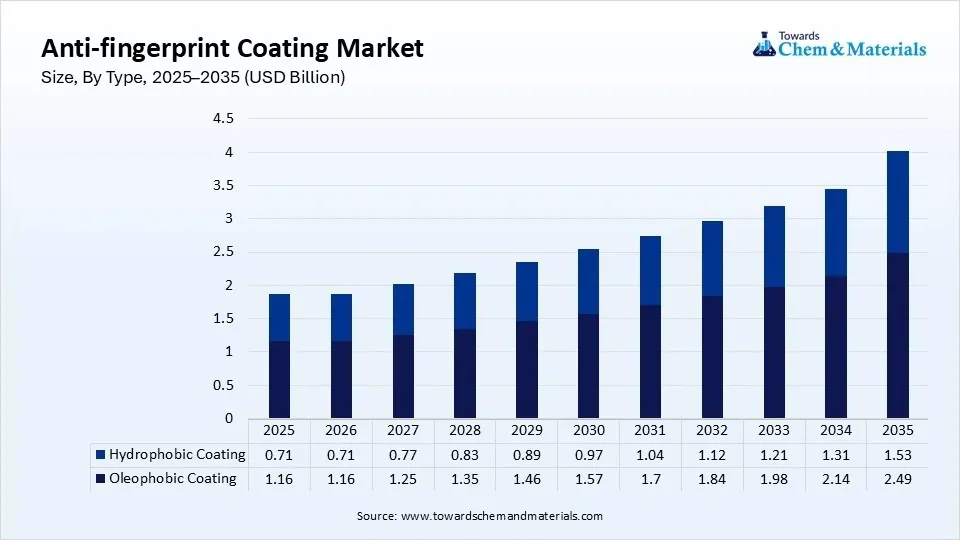 The rising application of hydrophobic coatings in electronics, automotive, and optical industries to enhance durability and performance drives the growth of the market. These coatings are useful in touchscreen devices like smartphones, tablets, and smart watches to reduce adhesion of dirt, oil, and other contaminants. Furthermore, growing applications of the hydrophobic segment in building & construction, medical devices, the textile industry, and consumer goods propel the growth of the market.
Anti-fingerprint Coating Market Share, By Type, 2025(%)
| By Type | Market Share (%) |
| Oleophobic Coating | 62.0% |
| Hydrophobic Coating | 38.0% |
By Technology
The vacuum deposition segment dominated the anti-fingerprint coating market share 46.0% in 2025. The ability to create a very thin, uniform, and durable layer to minimize fingerprint smudging and easy cleaning methods drives the growth of the market. To acquire specific anti-fingerprint properties, precise control of thickness and composition is required. The oleophobic and hydrophobic coatings are applied on glass through a vacuum deposition process that drives the growth of the market.
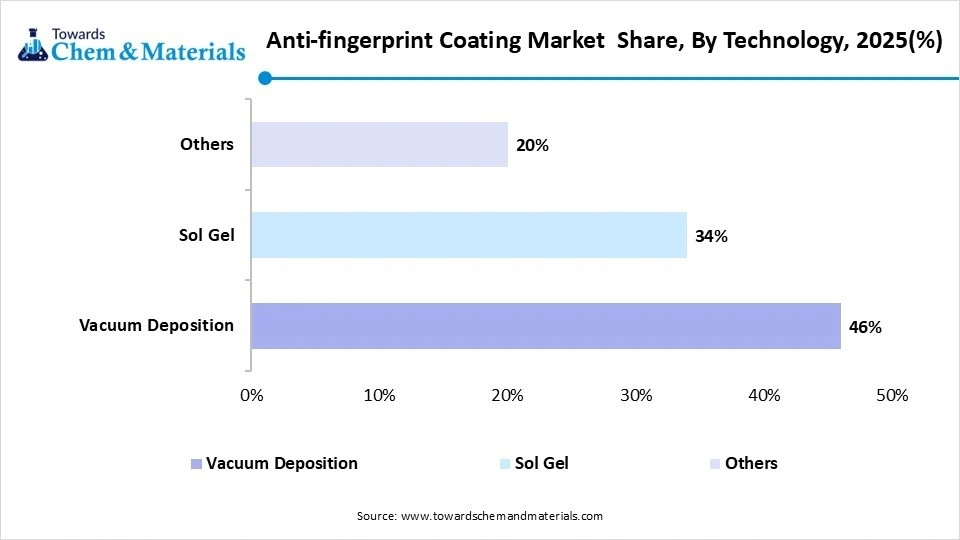 The sol-gel segment is the significantly growing market during the forecast period. The simplicity, versatility, and cost-effectiveness help in the growth of the market. This process allows synthesis of inorganic & organic hybrid material that helps in manufacturing anti-fingerprint coatings. High durability, scratch-resistance, and aesthetic appeal drive the growth of the market.
Anti-fingerprint Coating Market Share, By Technology, 2025(%)
| By Technology | Market Share (%) |
| Vacuum Deposition | 46.0% |
| Sol Gel | 34% |
| Others | 20.0% |
By Application
The consumer goods segment dominated the anti-fingerprint coating market in 2025. Growing awareness regarding hygiene and cleanliness demands for products that are easy to clean drives growth of the market. The growing demand for touch-enabled devices and surfaces in various sectors fuels the market growth. It helps to create and maintain an aesthetic and professional look on consumer goods products. Rising demand to enhance aesthetics, improve touch sensitivity, reduce maintenance cost, improve optical performance, and enhance visibility drives the growth of the market.
Building and construction expects a significant growth in the market during the forecast period. The growing urbanization raises demand for glass buildings, and aesthetic appeals drive the growth of the market. It is widely used in windows, doors, and facades to maintain cleanliness. Construction materials like stainless steel, polymers, and glass use anti-fingerprint coating to enhance durability and longevity, driving the growth of the market.
Regional Insights
The Asia Pacific anti-fingerprint coating market size was estimated at USD 0.80 billion in 2025 and is projected to reach USD 1.75 billion by 2035, growing at a CAGR of 8.14% from 2026 to 2035.Asia Pacific dominated the market with the largest share of 43% in 2025, as it features a robust base of consumer electronics manufacturing facilities and a considerable smartphone, tablet, laptop, and display panel manufacturing base. Anti-fingerprint coatings continued to see rising demand due to the increased use of premium appliances, improved integration of touchscreens, and the expanding automotive electronics manufacturing. The area is also home to several leading electronics companies and coating technology providers.
China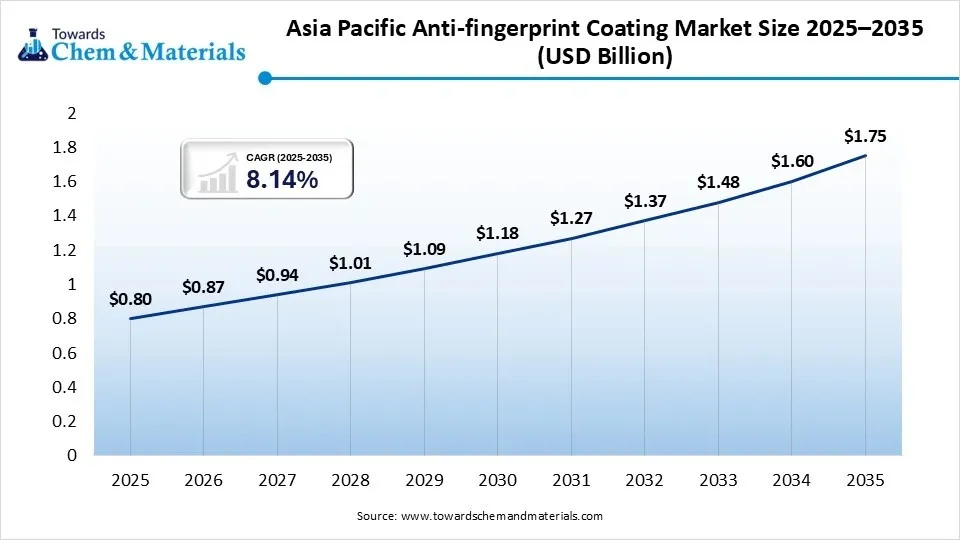
China continued to be the largest cellphone, tablet, and display panel maker in the world, as well as the biggest consumer electronics producer, which used to protect against fingerprints.
Demand for advanced coating technologies picked up as investments in OLED displays, smart devices, and automotive touchscreens increased.
As more domestic manufacturers switched to oleophobic and PFAS-free coatings to enhance product quality and export competitiveness, that trend continued.
India
- Consumption of anti-fingerprint coated display components increased due to the swift growth in smartphone manufacturing and electronics assembly.
- Domestic electronics production was promoted by government incentives, which led to investments in high-tech surface treatments.
- Coatings were also growing in consumer markets as consumers wanted high-quality appliances, wearables, and touchscreen devices.
The Middle East & Africa held 6% market share in 2025 and is expected to grow at the fastest CAGR of 9% during the forecast period. Premium construction projects, luxury automotive application and consumer electronics were the drivers for rising demand in the region. The market grew as a result of the rising use of smart technologies, digital displays, and premium appliances. The area is also projected to grow at a quick pace, as there are increasing investments in smart infrastructure and building developments.
Saudi Arabia
- The volume of coated architectural glass and interactive digital displays grew as a result of large-scale smart city construction projects.
- Anti-fingerprint coatings for infotainment systems were promoted by the increasing use of luxury vehicles
Advances in modern commercial infrastructure speed up the rollout of high-quality coated surfaces in high-use facilities.
South Africa
- With the growing consumption of consumer electronics, the demand for fingerprint-resistant screens and display parts grew.
- The use of coated glass and quality interior finishes was driven by the growth of commercial construction.
- The use of anti-smudge coating technologies was stimulated by an increase in the number of high-end appliances being sold in retail stores.
North America held 24% market share in 2025, driven by the demand for high-end consumer electronics, sophisticated automotive displays, and smart household appliances. The technological innovation and early adoption of high-performance coatings in the region contributed to the market growth. The industry continued to grow with investments in coating technologies that are free from the use of PFAS and are eco-friendly.
United States
- The market expanded due to robust demand for high-quality smartphones, high-end laptop and automotive digital cockpit systems.
- The largest coating companies were interested in the development of sustainable and multifunctional anti-fingerprint technologies, which are free of PFAS.
- As more smart home devices were adopted, there was a growing demand for protective coatings on surfaces with advanced properties.
Canada
- Strong demand for coatings held up despite the growing use of connected devices and touchscreen electronics.
- The demand for fingerprint-resistant surface treatments grew with the rising use of premium household appliances.
- The manufacturers were encouraged by environmental regulations to use low-VOC and no-fluorine coating formulations.
Europe held 21% market share in 2025, due to a rise in automotive manufacturers, high-end appliance manufacturers, and the architectural glass market. Rising environmental standards pushed the development and use of coating technologies that were free from or low in VOCs. Advanced anti-fingerprint coatings were also being used more as digital cockpit systems and touch screen displays grew in popularity in vehicles.
Germany
- Anti-fingerprint coatings for vehicle display interfaces were driven by demand in Germany by the automotive industry.
- Coatings were used by top appliance brands in order to preserve the appearance and ease the cleaning demands.
- The strict sustainability standards drove the progress of eco-friendly coating technologies.
France
- High-performance anti-fingerprint coatings became more popular with increasing demand for luxury consumer products.
- The investments in modern commercial and residential buildings drove the architectural glass applications.
- This growing demand for digital displays has been driven by the need for durable and transparent coating options.
Latin America held 6% market share in 2025, with the penetration of smartphones, consumer electronics, and modern household appliances. As urbanization increased and consumers' demand for high-end products increased, anti-fingerprint surface treatments were adopted. Regional demand was also bolstered by a rise in the sale of electronics and the modernization of the infrastructure.
Brazil
- The increased penetration of smartphones and sales of consumer electronics helped boost coating consumption.
With the rising demand for high-quality products, new surface technologies were adopted that resisted fingerprints. - The large-scale construction projects in the cities facilitated the application of coated glass in modern buildings.
Chile
Coated display and touchscreen parts were affected by the growth of electronics imports.
Anti-fingerprint architectural glass applications came about during commercial construction projects.
The higher demand for premium home appliances helped to sustain the market for advanced surface coatings.
Market Recent Developments
- In April 2026, Henkel introduced two anti-fingerprint coatings, Loctite AF 8810 and Loctite AF 8812, specifically developed for automotive displays, which are now PFAS-free. The development of these products used silicone-based low-surface-energy technology, which replaces fluorinated products with high performance, and meets the changing environmental regulations in the world.(Source:www.automotiveworld.com)
- In March 2026, Kingston Technology unveiled IronKey Locker+ 50 G2, a hardware-encrypted USB flash drive in March 2026. The coating helped to reduce visible wear, smudges, and surface marks, and also added to the premium look and durability of the device.(Source:betanews.com)
Anti-fingerprint Coating Market Top Companies List
- CYTONIX
- Daikin Industries Ltd.
- AGC Chemicals Europe, Ltd.
- Harves Co., Ltd.
- Essilor Of America
- Leader Optronics Technology Co., Ltd.
- Nanokote
- NanoSlic Smart Coatings
- Natoco Co., Ltd.
- NAGASE & CO., LTD
- PPG Industries, Inc.
- Nippon Paint Surf Chemicals Co., Ltd.
- Sumitomo Chemical Co., Ltd.
- Taiwanfluoro Technology
- Kriya Materials
- Janos Tech.
- Carl Zesis Ltd.
- Buhler AG
Segments Covered In The Report
By Type
- Oleophobic Coating
- Hydrophobic Coating
By Technology
- Vaccum Deposition
- Sol Gel
- Others
By Application
- Consumer Goods
- Building and Electronics
- Automotive
- Stainless Steel
- Solar Panels
- Others
By Regional
- North America
- Asia Pacific
- Europe
- Latin America
- Middle East & Africa



Comments
Share your thoughts, ask a question, or provide feedback about this report.