Content
Enzymes Market Size and Forecast 2026 to 2035
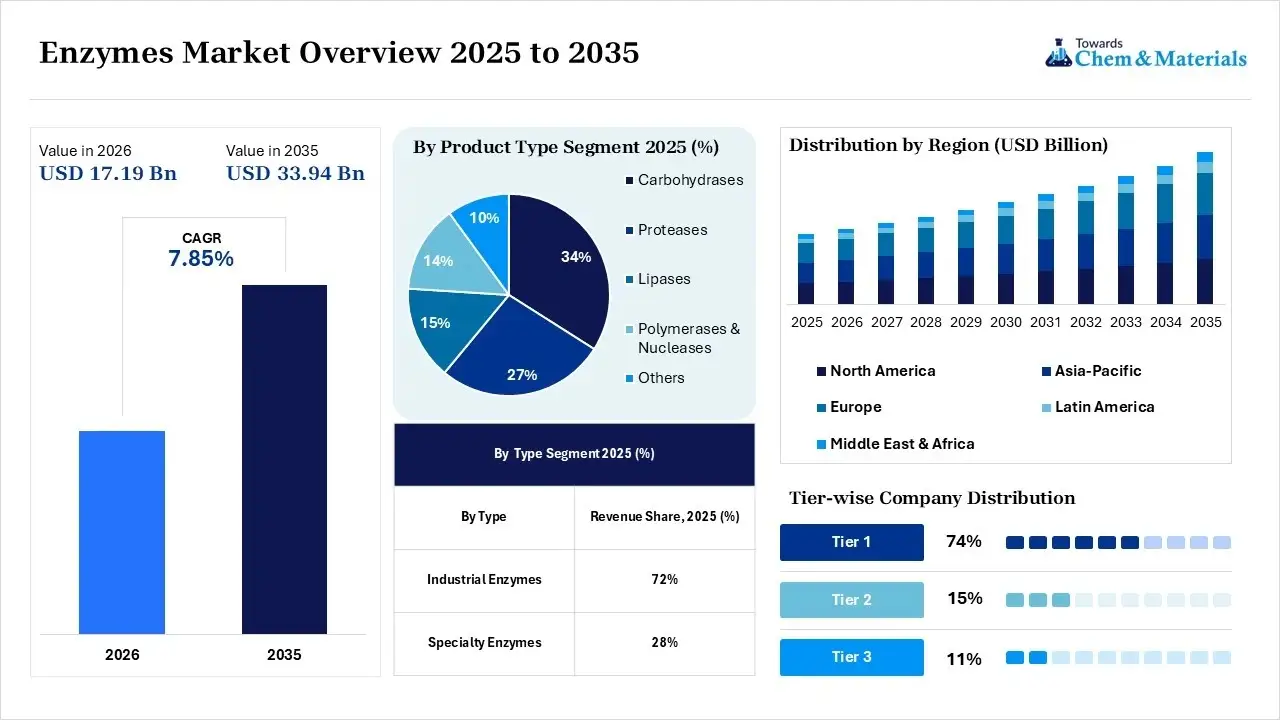
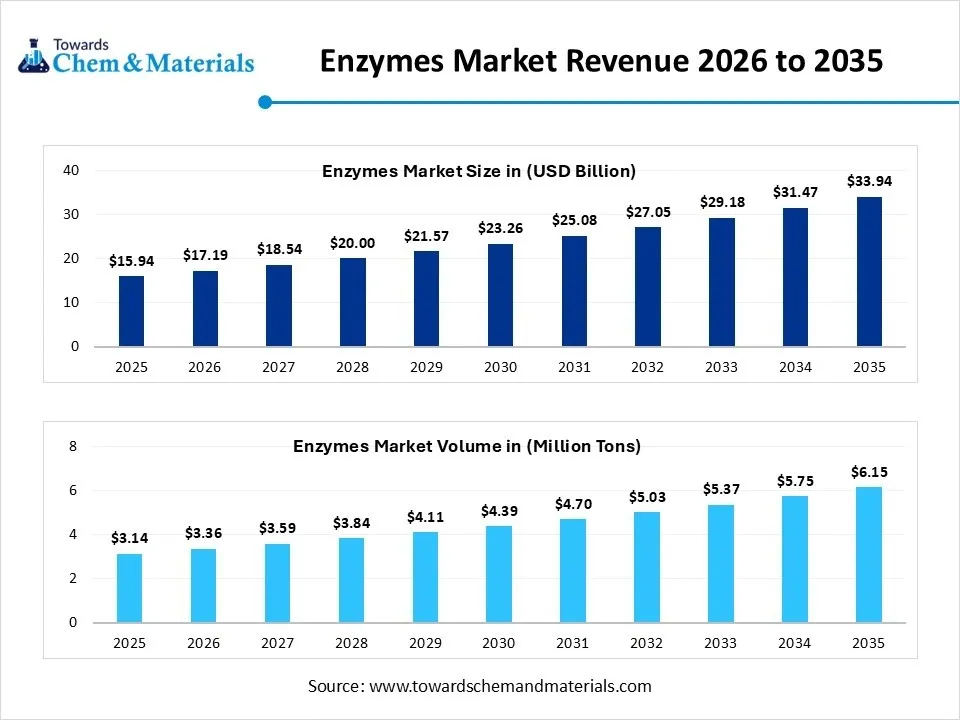
The global enzymes market size was valued at USD 15.94 billion in 2025, is estimated to reach USD 17.19 billion in 2026, and is projected to reach USD 33.94 billion by 2035, exhibiting a compound annual growth rate (CAGR) of 7.85% over the forecast period from 2026 to 2035. North America dominated the enzymes market with the largest revenue share of 30% in 2025 and is expected to grow at the fastest CAGR of 8.03% during the forecast period. In terms of volume, the enzymes market is projected to grow from 3.14 million tons in 2025 to 6.15 million tons by 2035, growing at a CAGR of 6.95% from 2026 to 2035. With the greeter approaches of sustainability implementation and multiple application usages, the enzyme industry has been choosing a brighter future ahead. Also, major industries like pharmaceuticals and food and beverage will play a major role during the industry expansion as per the industry expectations.
Market Highlights
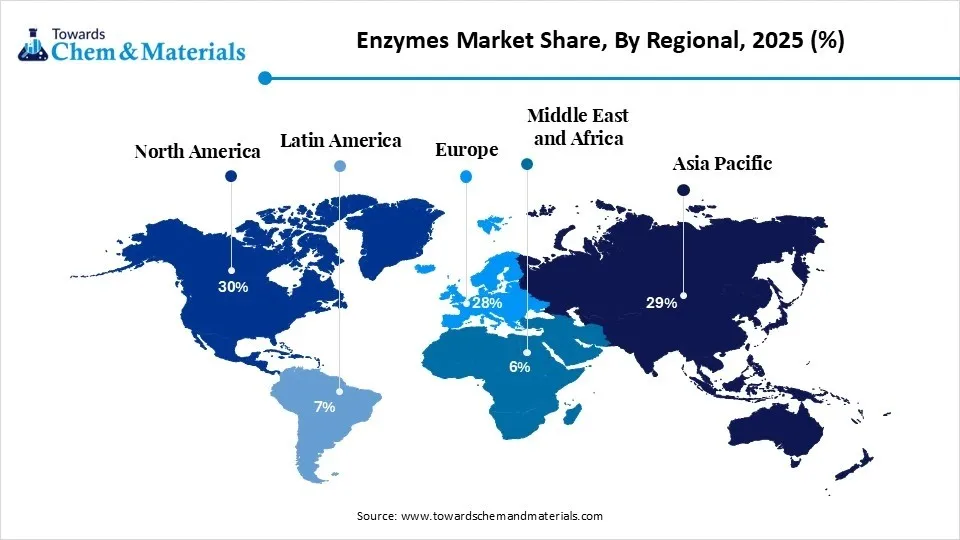
- By region, North America dominated the market with a share of 30% in 2025, due to they can produce enzymes more efficiently on a commercial scale.
- By region, Asia Pacific held the 29% market share in 2025 and is expected to be the fastest-growing region in the market, with a CAGR of 9.04% in the forecast period, owing to manufacturing industries across the region expanding at a rapid pace.
- By type, the industrial enzymes segment dominated the market with 72% share in 2025, as they are used continuously in industries that produce everyday consumer products.
- By type, the specialty enzymes segment held the 28% market share in 2025 and is expected to be the fastest-growing in the market, with a CAGR of 8.96% in the forecast period, owing to industries increasingly focusing on high-value products rather than high-volume production alone.
- By product, the carbohydrase segment dominated the market with 34% share in 2025, owing is widely used in industries that produce everyday products.
- By product, the polymerases & nucleases segment held a 14% market share in 2025 and is expected to be the fastest-growing in the market, with a CAGR of 9.45% in the forecast period, owing to modern biotechnology expanding rapidly around the world.
- By source, the microorganisms segment dominated the market with 74% share in 2025, owing to they can produce enzymes more efficiently on a commercial scale.
- By source, the plants segment held the 11% market share in 2025 and is expected to be the fastest-growing in the market, with a CAGR of 8.34% in the forecast period, owing to they are widely accepted in food processing and natural ingredient applications.
Quick Stats at a Glance
- Market in Size 2025: USD 15.94 Billion | CAGR (2026–2035): 7.85%
- Market Estimated Size in 2026: USD 17.19 Billion
- Market Projected Size by 2035: USD 33.94 Billion
- North America: largest Regional Market Revenue Share of 30% in 2025 | USD 4.78 Billion
- Asia Pacific: Fastest-growing Regional Market Revenue Share of 29% in 2025 | USD 4.62 Billion
- By country: The United States held the largest Market share of 78% in 2025
- Market Volume in 2025: 3.14 Million Tons | Volume CAGR (2026–2035): 6.95%
- Market Estimated Volume in 2026: 3.36 Million Tons
- Market Projected Volume by 2035: 6.15 Million Tons
- Market Pricing (2025):
- Average Manufacturing Price: USD 2,190/Metric Ton
- Average Selling Price: USD 2,750/Metric Ton
- Pricing CAGR (2026–2035): 2.15%
The global food and pharmaceutical revolution has become a major pillar of the enzymes industry in recent years. Another industry, such as agriculture and biofuels, is actively supporting industry trends as per the recent industry survey. Moreover, several major industries and companies are seen as heavily replacing traditional chemical processes with modern enzyme-based solutions, which is creating greater opportunities in the industry. Also, the establishment of advanced manufacturing facilities has been detected.
- For instance, in October 2025, IFF and BASF created a partnership. Also, the motive of the collaboration is to develop next generation enzyme as per the companys claim.(Source: www.basf.com)
The industry is now also benefiting from continuous innovation in biotechnology and enzyme development. In addition, the companies are investing in research to create enzymes that perform better under different manufacturing conditions and meet the needs of specialized applications. New production technologies are making enzyme manufacturing more reliable, allowing suppliers to serve a wider range of industries with customized solutions.
Global Investment Flow for the Enzymes Market 2026
The companies focus on expanding production, strengthening research, and developing sustainable enzyme solutions. Also, companies are investing in new manufacturing facilities to increase enzyme production capacity and meet growing global demand.
The major producers are increasing research spending to develop high-performance enzymes for food, healthcare, agriculture, and industrial applications.
Strategic partnerships and expansion projects are helping companies improve global supply chains while introducing advanced enzyme technologies into new regional markets.
- For instance, in 2026, Agrizy has established their latest phytochemistry research and development laboratory, and the main motive of the establishment is to produce high-performance botanical ingredients as per the published report.(Source: www.thehindu.com)
Enzymes Market Trends
- The shift towards natural processing solutions has enabled high-return ventures for the manufacturers in recent years. Also, several food companies are using enzyme-based solutions instead of their regular chemicals such as artificial additives.
- The sudden expansion of industrial enzyme applications has enhanced industry participation of producers. The enzymes are becoming more common in industries such as detergents, textile production, and animal nutrition.
- The trend towards sustainable biotechnology is expected to open profitable pathways for the manufacturers in the coming years. Also, several global governments are actively implementing sustainable standards in industrial and commercial areas.
Report Scope
| Report Attributes | Details |
| Market Volume in 2026 | USD 17.19 Billion/ 3.36 Million Tons |
| Market Volume by 2035 | USD 33.94 Billion/ 6.15 Million Tons |
| Growth Rate from 2025 to 2035 | CAGR 7.85% |
| Base Year of Estimation | 2025 |
| Forecast Period | 2025 - 2035 |
| High Impact Region | North America |
| Segment Covered | By Type, By Product, By Source, By Region |
| Key Companies Profiled | Novonesis, IFF, Codexis, BASF, Associated British Foods, DSM-Firmenich, Kerry Group, Amano Enzyme, Advanced Enzyme Technologies, Codexis, IFF, Novonesis |
Heavy Biotechnology Advancements Through System Intelligence
The industry is quickly moving from conventional enzyme production toward advanced biotechnology and precision fermentation techniques. Also, companies are using genetic engineering, microbial fermentation, and artificial intelligence-supported research to develop enzymes with higher activity, better stability, and improved performance. Furthermore, modern manufacturing technologies are reducing production time while improving product consistency and quality.
Supply Chain Analysis of the Enzymes Market
Production & Processing
- Making industrial enzymes looks a lot like running a high-tech brewery. Scientists feed specialized, natural microbes a rich soup of sugars and nutrients inside giant, temperature-controlled metal vats so they multiply rapidly.
- As these tiny organisms grow, they naturally pump out the specific enzymes, which are then carefully spun, filtered, and dried into usable powders or liquids.
- Novonesis: Novonesis is a massive biological powerhouse formed by joining two legendary enzyme giants, Novozymes and Chr. Hansen.
- Key players: BASF, IFF, Associated British Foods, and DSM-Firmenich.
Quality Testing and Certification
- Before bottle versions hit the market, labs rigorously check enzyme batches to ensure they are highly potent and completely free of toxic contaminants.
- Experts measure exactly how fast the proteins break down target materials under various temperatures and acidity levels. Passing these independent trials earns an official stamp of safety, proving the batch is safe for commercial use.
- Intertek: Intertek, a leading international inspection giant providing extensive quality assurance testing for industrial bio-products.
- Key agencies: SGS, Eurofins Scientific, Bureau Veritas, and TÜV SÜD
Distribution to Industrial Users
- Moving enzymes to factories requires climate-controlled shipping setups to keep the sensitive proteins from degrading.
- Distributors pack the bulk liquids or stabilized powders in specialized, temperature-regulated drums and tanks.
These logistics providers work closely with factory managers to ensure just-in-time delivery so production lines never run out of active ingredients. - Univor Solutions: Univor Solutions is a massive global chemical and ingredient distributor with an extensive cold-chain network.
- Key players: Brenntag, Barentz, IMCD Group, and Azelis
Enzymes Market Regulatory Landscape: Regulations
| Country Region | Regulatory Body | Key Regulations | Focus Areas |
| United States | U.S. Food and Drug Administration (FDA) | Federal Food, Drug, and Cosmetic Act (FD&C Act) [Section 409]: Oversees enzymes added directly to human food. | Food Quality Innovation: Approving specialized enzymes that extend bread shelf-life, clarify fruit juices, and improve the texture of plant-based meats. |
| Europe | European Food Safety Authority (EFSA) | Food Enzyme Regulation [(EC) No 1332/2008] Article 4: Mandates a strict, centralized EU evaluation system. | Consumer Safety Lists: Creating a completely transparent, legally binding Master List that logs the exact microbial origin and safety boundaries of every single food-grade enzyme used across the continent. |
| China | National Health Commission (NHC) | Food Safety Law of the Peoples Republic of China Article 34: Governs processing aids and food ingredients. | Microbial Strain Approval: Restricting enzyme production to tightly audited, highly stable bacterial and fungal strains to prevent any accidental toxic byproducts from entering consumer food lines. |
Enzymes Market Dynamics
Driver
Faster and More Efficient Production Need
The increasing need for faster and more efficient production across different industries has generated value-added opportunities for industry participants in recent years. Many manufacturers are choosing enzymes because they help complete production processes using less energy and fewer processing steps. This improves productivity while reducing unnecessary material loss. At the same time, businesses are under pressure to produce high-quality products without increasing manufacturing costs. Enzymes help achieve this balance by improving process performance naturally.
Restraint
Specific Processing Condition Stability
Some enzymes perform well only under specific processing conditions is expected to create growth barriers for the industry during the forecast period. Changes in temperature, acidity, or storage conditions can reduce their effectiveness, making production more difficult for manufacturers. Because of this, companies often need carefully controlled environments, which increases operating complexity.
Opportunity
Tailored Solution Emergence
The growing demand for products designed for specific industrial needs is anticipated to offer substantial growth prospects for manufacturing firms in the coming years. Instead of using one standard enzyme for every process, manufacturers are looking for solutions that match their own production requirements. This is encouraging enzyme developers to create customized products that improve efficiency, product quality, and process reliability. Food companies, pharmaceutical manufacturers, and agricultural businesses are all seeking enzymes that deliver better performance for individual applications.
Segmental Insights
Type Insights
The industrial enzymes segment dominated the market with 72% share in 2025, as they are used continuously in industries that produce everyday consumer products. Food manufacturers use them during processing, detergent companies include them in cleaning products, while textile and paper manufacturers use them to improve production quality. Since these industries operate throughout the year and produce goods in large volumes, enzyme demand remains consistently strong.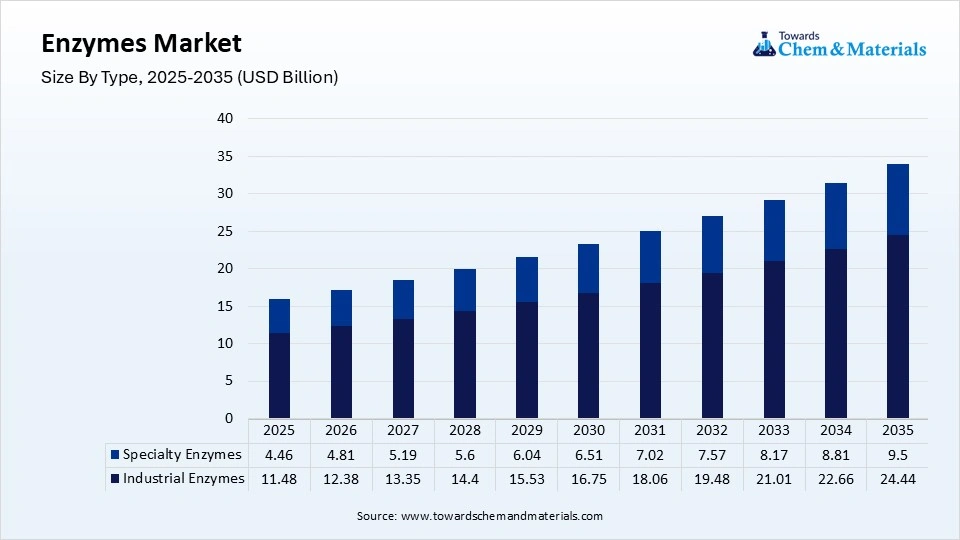 The specialty enzymes segment held the 28% market share in 2025 and is expected to be the fastest-growing in the market, with a CAGR of 8.96% in the forecast period, owing to industries increasingly focusing on high-value products rather than high-volume production alone. Modern healthcare, biotechnology, and advanced diagnostics require enzymes that perform very specific functions with high accuracy. Companies are also investing more in research activities where specialized enzymes play an important role. Unlike traditional industrial enzymes, these products are developed for unique applications that require greater precision.
Product Insights
The carbohydrase segment dominated the market with 34% share in 2025, owing is widely used in industries that produce everyday products. It plays an important role in baking, brewing, dairy processing, fruit juice production, animal feed, and detergents. Since these industries manufacture products on a large scale every day, the need for carbohydrases remains consistently high. Another reason for its leadership is that it helps manufacturers improve production speed while increasing product consistency.
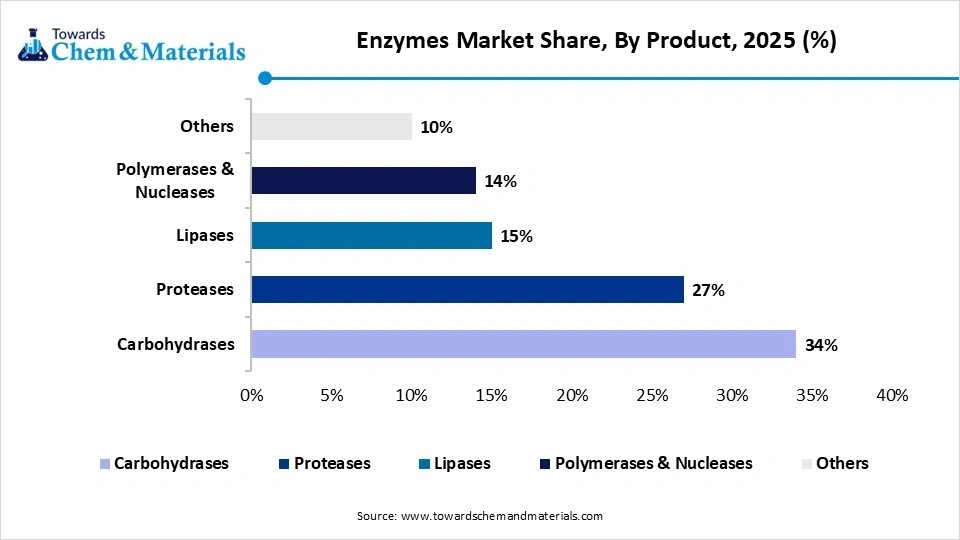
The polymerases & nucleases segment held a 14% market share in 2025 and is expected to be the fastest-growing in the market, with a CAGR of 9.45% in the forecast period, owing to modern biotechnology expanding rapidly around the world. These enzymes are becoming increasingly important in genetic research, molecular diagnostics, precision medicine, and advanced laboratory testing. Healthcare companies and research organizations are increasing investment in technologies that require highly accurate biological analysis.
Source Insights
The microorganisms segment dominated the market with 74% share in 2025, owing to they can produce enzymes more efficiently on a commercial scale. Bacteria, yeast, and fungi can be cultivated under controlled conditions throughout the year, allowing manufacturers to achieve stable production regardless of seasonal changes. They also provide greater flexibility for developing enzymes with specific industrial properties.
The plants segment held the 11% market share in 2025 and is expected to be the fastest-growing in the market, with a CAGR of 8.34% in the forecast period, owing to they are widely accepted in food processing and natural ingredient applications. Many manufacturers prefer plant-derived enzymes as they meet the growing demand for naturally sourced products and support clean-label product development. These enzymes are also commonly used in dietary supplements, fruit processing, and beverage manufacturing.
Regional Analysis
How did North America Dominate the Enzymes Market in 2025?
The North America enzymes market size was estimated at USD 4.78 billion in 2025 and is projected to reach USD 10.35 billion by 2035, growing at a CAGR of 8.03% from 2026 to 2035.North America dominated the market with a share of 30% in 2025, due to the greater shift towards advanced botanical activities. Also, research organizations and universities are actively establishing strategic partnerships with R&D activities, which are leading industry sales in the region nowadays. Furthermore, stronger food industries have created huge opportunities for the enzyme manufacturers as they are switching from traditional chemical processes to enzyme-based solutions as per the recent industry observation. 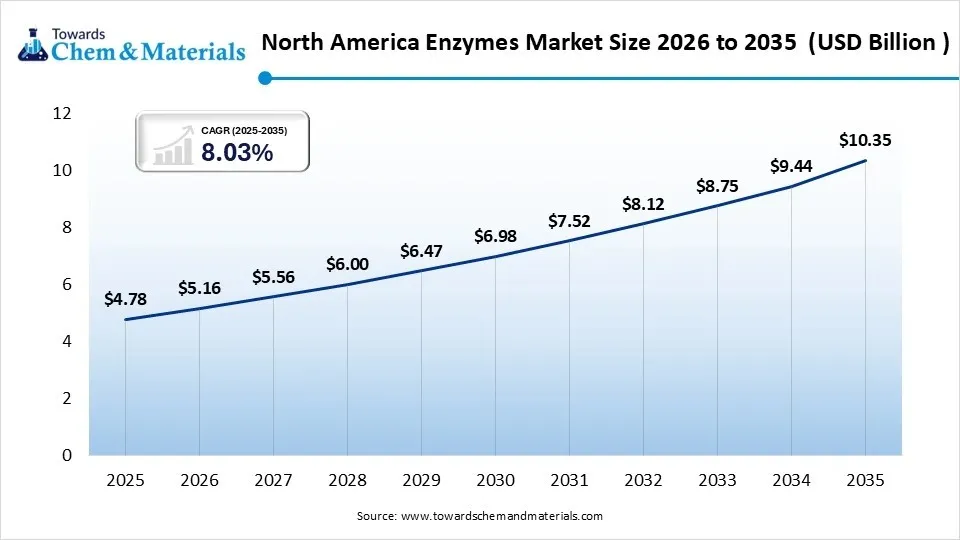
United States
- Enzyme innovation is becoming an important part of the countrys biotechnology and pharmaceutical industries, while companies are expanding research programs to develop enzymes for healthcare, diagnostics, food production, and industrial manufacturing.
- The food companies are increasing the use of enzyme solutions to improve production efficiency and support clean-label products.
Canada
- Food manufacturers in Canada are introducing enzyme-based production methods to improve product quality while reducing processing waste, and the country is also supporting biotechnology research through partnerships between universities and industrial companies, encouraging the development of innovative enzyme applications.
- The increasing use of enzymes in animal nutrition to improve feed efficiency and livestock productivity.
Enzymes Market Evaluation in Asia Pacific
The Asia Pacific enzymes market size was estimated at USD 4.62 billion in 2025 and is projected to reach USD 10.01 billion by 2035, growing at a CAGR of 8.04% from 2026 to 2035.Asia Pacific held a 29% market share in 2025 and is expected to be the fastest-growing region in the market, with a CAGR of 9.04% in the forecast period, owing to manufacturing industries across the region expanding at a rapid pace. Food processing, pharmaceuticals, animal nutrition, and bio-based industries are increasing production capacity, creating greater demand for enzyme products. At the same time, rising income levels are encouraging consumers to purchase higher-quality processed foods and healthcare products that rely on enzyme technologies.
China
- The domestic manufacturers in China are investing heavily in modern biotechnology and large-scale industrial production while the country is increasing enzyme use in food manufacturing, animal nutrition, and pharmaceutical production to improve product quality and manufacturing efficiency.
- Also, biotechnology companies in China are developing new enzyme products to reduce dependence on imported technologies.
Japan
- The country is focusing on high-value innovation instead of mass production, while the companies are developing advanced enzyme solutions for healthcare, functional foods, and precision biotechnology applications where product quality is a key priority.
- The country is also investing in research to improve enzyme performance for specialized industrial processes.
Europe Enzyme Industry Conditions
The Europe enzymes market size was estimated at USD 4.46 billion in 2025 and is projected to reach USD 9.67 billion by 2035, growing at a CAGR of 8.05% from 2026 to 2035.Europe held the 28% market share in 2025, owing to manufacturers across the region giving greater importance to sustainable production and resource efficiency. Many industries are choosing enzyme-based processes to lower energy use and improve manufacturing performance without affecting product quality. Another important reason is the strong demand for natural food ingredients and environmentally responsible industrial solutions. Companies are also introducing new enzyme products to support changing consumer preferences.
Germany
- Many companies are introducing advanced production technologies that use enzymes to improve efficiency and reduce raw material consumption, while the countrys strong pharmaceutical and food processing industries are also increasing enzyme use to develop high-quality products.
- Also, research organizations and manufacturers are working together to create new enzyme applications for industrial production.
Italy
- The countrys food and beverage industry continues to introduce products with improved quality and natural ingredients, while enzymes are increasingly used to improve processing efficiency while maintaining the traditional characteristics of many Italian food products.
- Also, the pharmaceutical and biotechnology companies are investing in research to develop advanced enzyme applications.
Enzymes Market Survey in Latin America
The Latin American enzyme market size was estimated at USD 1.12 billion in 2025 and is projected to reach USD 2.55 billion by 2035, growing at a CAGR of 8.58% from 2026 to 2035. Latin America held a 7% market share in 2025 as increasing use of enzymes in food production, agriculture, and animal nutrition industries continues to expand. Manufacturers are looking for practical solutions that improve production efficiency without increasing operational costs. Enzymes are helping companies achieve better product quality while supporting more efficient manufacturing processes. At the same time, growing investment in processed food production is creating additional demand for enzyme products.
Brazi
- Its large agriculture and food processing industries create strong demand for enzyme products, while animal feed manufacturers are increasingly using enzymes to improve feed performance and food producers are applying enzyme solutions to improve production efficiency. The countrys expanding biofuel industry is also supporting enzyme demand for industrial processing applications.
Argentina
- Agricultural processing and food manufacturing remain important parts of the countrys economy, while companies are gradually adopting enzyme technologies to improve production quality and reduce unnecessary processing losses. Also, biotechnology research activities are creating new opportunities for enzyme applications in agriculture and food production.
Middle East and Africa Enzyme Sector Observation
The Middle East and Africa enzyme market size was estimated at USD 0.96 billion in 2025 and is projected to reach USD 2.21 billion by 2035, growing at a CAGR of 9.71% from 2026 to 2035. The Middle East and Africa held a 6% market share in 2025, as industries are increasingly looking for technologies that improve production while using fewer natural resources. Enzymes are helping manufacturers increase efficiency across food production, animal nutrition, and industrial processing. Another important factor is the growing investment in local food manufacturing to reduce dependence on imports.
Saudi Arabia
- Companies in Saudi Arabia are increasing production of processed foods and nutritional products, creating additional demand for enzyme ingredients, while the country is also encouraging biotechnology development as part of its long-term industrial transformation plans.
- Many manufacturers are adopting enzyme technologies to improve production efficiency while supporting sustainable industrial practices.
UAE
The country is encouraging companies to introduce advanced manufacturing technologies that improve product quality and operational efficiency, while the demand for enzyme-based ingredients is also increasing as food manufacturers develop premium and health-focused products for local and international markets.
Also, investment in research, innovation, and modern food production facilities is supporting wider enzyme adoption.
Recent Development
- In February 2025, Thyssenkrupp Uhde and Novonesis introduced their latest technology for the enzymatic esterification. For this development, the company created a collaboration recently. Moreover, this technology is specifically designed for operating at lower temperatures as per the company report. (Source : ofimagazine)
- In April 2025, eXoZymes unveiled their latest innovation called BioClik. This innovation can support the enhancement of enzyme engineering and advanced chemical reactions in the coming years as per the report published by the company. (Source : globenewswire)
- In September 2024, TriLink Bio Technologies and Alphazyme created a partnership and introduced new CleanScribeTM RNA Polymerase. This is the newly introduced enzyme that can reduce dsRNA in mRna production, as per the companys claim.
(Source : businesswire)
Competitive Analysis
The industry is highly competitive because companies are continuously investing in research, production expansion, and product innovation. Instead of competing only through pricing, leading manufacturers are focusing on developing enzymes with better efficiency, higher stability, and improved performance for different industries.
- Novonesis announced innovation initiatives and expanded enzyme solutions for food, biosolutions, and agriculture following the integration of its business operations with the aim of 2030. The company continues investing in biological solutions that improve industrial efficiency and sustainability.(Source: novonesis)
- IFF, which expanded its biotechnology and health-focused ingredient pet portfolio during 2025 by introducing new enzyme-based solutions designed for food and health applications.(Source: www.iff.com)
Top Vendors in the Enzymes Market & Their Offerings
| Company | Company Type/Position | Major Headquarters | Geographic Presence | Offerings | Key Strength |
| Novonesis | Unrivalled Biosolutions Giant | Kongens Lyngby, Denmark | Global dominance with specialized production plants and labs stretching across Europe, the Americas, and Asia. | Hundreds of specialized enzymes tailored for bread baking, cold-water laundry detergents, animal feed, and bioethanol brewing. | Unmatched scale, deep patent catalog, and immense manufacturing capacity to supply entire global consumer sectors. |
| IFF | Food & Industrial Biotechnology Leader | New York, USA | Heavy operational footprint across North America, Europe, and rapidly expanding industrial hubs in Asia-Pacific. | High-performance enzymes used to perfect texture in plant-based dairy, optimize beer brewing, and clean textiles. | Excellent integration of biological enzyme technology directly with commercial food flavor, scent, and ingredient formulation. |
| Codexis | Custom Engineering & Pharma Specialist | California, USA | Centred primarily in North America with strategic pharmaceutical partnerships across Europe and Japan | Highly modified, tailor-made biocatalysts used to synthesize complex pharmaceutical ingredients and diagnostic tools. | World-class predictive AI and directed evolution platforms that engineer enzymes to survive harsh industrial chemicals. |
Other Key Players
- Novonesis
- IFF
- Codexis
- BASF
- Associated British Foods
- DSM-Firmenich
- Kerry Group
- Amano Enzyme
- Advanced Enzyme Technologies
Segment Covered in the Report
By Type
- Industrial Enzymes
- Food & Beverage Enzymes
- Detergent Enzymes
- Biofuel Enzymes
- Textile & Leather Enzymes
- Pulp & Paper Enzymes
- Animal Feed Enzymes
- Wastewater Treatment Enzymes
- Other Industrial Enzymes
- Specialty Enzymes
- Diagnostic Enzymes
- Research Enzymes
- Pharmaceutical Enzymes
- Biocatalysts
- Molecular Biology Enzymes
By Product
- Carbohydrases
- Amylases
- Cellulases
- Xylanases
- Lactases
- Pectinases
- Proteases
- Acid Proteases
- Neutral Proteases
- Alkaline Proteases
- Lipases
- Microbial Lipases
- Animal Lipases
- Plant Lipases
- Polymerases & Nucleases
- DNA Polymerases
- RNA Polymerases
- Restriction Nucleases
- Exonucleases
- Others
- Oxidoreductases
- Catalases
- Phytases
- Transglutaminases
By Source
- Plants
- Animals
- Microorganisms
- Bacteria
- Fungi
- Yeast
By Region
- North America
- U.S.
- Canada
- Mexico
- Europe
- UK
- Germany
- France
- Italy
- Spain
- Sweden
- Denmark
- Norway
- Asia Pacific
- Japan
- China
- India
- Australia
- South Korea
- Thailand
- Latin America
- Brazil
- Argentina
- The Middle East and Africa
- South Africa
- Saudi Arabia
- UAE
- Kuwait
FAQ's




Select User License to Buy
Figures (7)











 sales@towardschemandmaterials.com
 Download Sample
 Schedule a Meeting