
Polymer Coated Fabrics Market Size, Competitive Landscape Analysis Report 2035
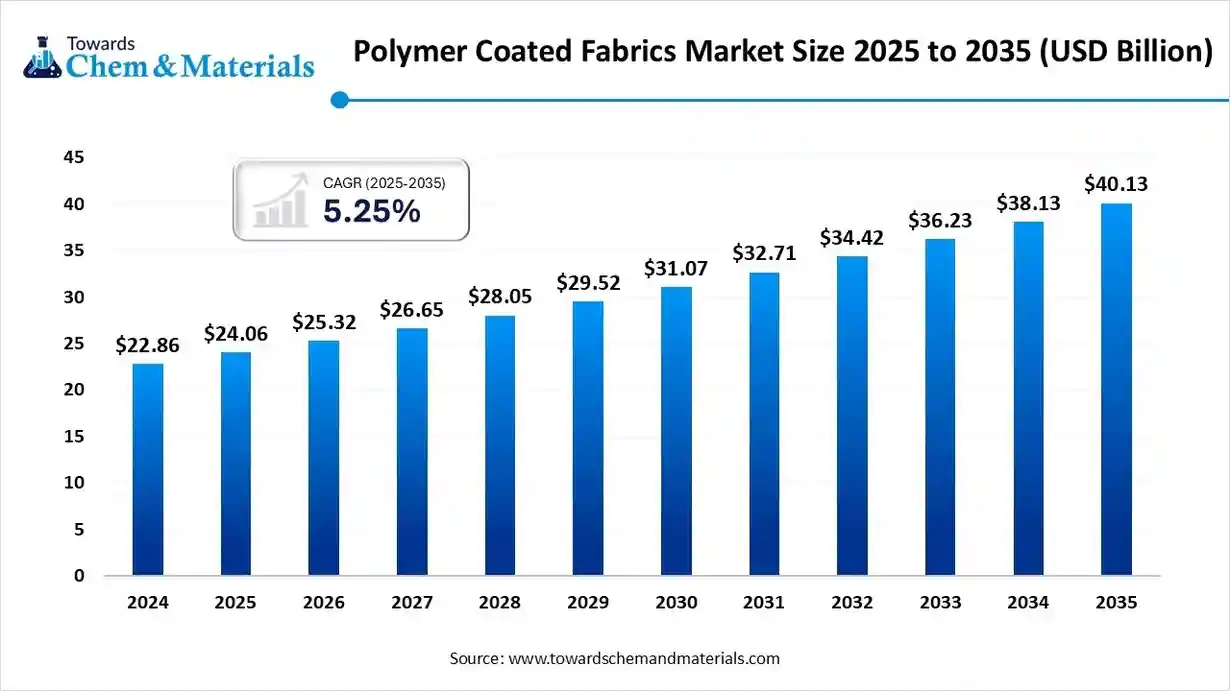
The global polymer coated fabrics market size is calculated at USD 24.06 billion in 2025 and is predicted to increase from USD 25.32 billion in 2026 and is projected to reach around USD 40.13 billion by 2035, The market is expanding at a CAGR of 5.25% between 2025 and 2035. Asia Pacific dominated the polymer coated fabrics market with a market share of 44.06% the global market in 2025.The market is driven by rapid industrialization, a shift towards smart fabrics and sustainability goals.
Key Takeaways
- The Asia Pacific dominated the polymer coated fabrics market with the largest revenue share of 46.01% in 2025.
- By coating material, the polyvinyl chloride (PVC) segment dominated the market and accounted for the largest volume share of 41.5% in 2025.
- By fabric base type, the polyester segment led the market with the largest revenue volume share of 45% in 2025.
- By textile type, the woven segment dominated the market and accounted for the largest volume share of 48% in 2025.
- By end-use industry, the automotive segment led the market with the largest revenue volume share of 35% in 2025.
Technological Advancements are Expanding Market Growth
The Polymer Coated Fabrics Market consists of textile substrates coated or impregnated with polymer materials to enhance performance characteristics such as waterproofing, chemical resistance, abrasion resistance, UV stability, and durability. These fabrics are used across industries, including transportation, protective clothing, building & construction, industrial equipment, and furniture. Common polymer coatings include PVC, PU, PE, PTFE, and others. Ongoing innovations in coating technologies, such as nano coatings, are expected to impact positive market growth soon.
Polymer Coated Fabrics Market Trends
- Sustainability and Eco-Friendly Solutions: The increasing focus on reducing environmental impact and strict regulations is driving the adoption of green chemistry and bio-based materials in coatings.
- Innovation and Advancement: The industry focuses on the development of self-cleaning, antimicrobial, temperature-oriented and functional coatings for diversified applications.
- Stringent Regulation and Investment: The stricter regulations on the production and use of NGL are due to their carbon footprint. And demand for eco-friendly products, pushing manufacturers to invest in R&D to ensure innovative formulation and advanced technologies in coating.
Market Opportunity
Rising Demand for Protective Clothing
A surge in the application of coated fabrics in protective clothing is creating lucrative opportunities in the market. Industries such as chemical, healthcare, oil & gas, and construction are rapidly increasing their dependence on coated fabrics for protective gear because of their resistance to abrasions, chemicals, and flames. Furthermore, organizations such as OSHA are implementing regulations that necessitate the use of protective clothing, propelling market growth soon.
- In October 2024, Fenner Precision Polymers announced the launch of its latest strategic initiatives emphasizing global product families. The companys transformation is created to benefit consumers by improving their experience. The global family of brands can be categorized into three product families.(Source: www.textileworld.com)
Trade Analysis of the Polymer Coated Fabrics Market: Import and Export Statistics
- China exported 5,585 shipments of polymer coated fabrics.
- Vietnam exported 1,646 shipments of polymer coated fabrics.
- Myanmar exported 495 shipments of polymer coated fabrics.
- From July 2024 to June 2025, the world exported 4,082 shipments of polymer coated fabrics.
Report Scope
| Report Attributes | Details |
| Market Size in 2026 | USD 25.32 Billion |
| Expected Size by 2035 | USD 40.13 Billion |
| Growth Rate from 2025 to 2034 | CAGR 5.25% |
| Base Year of Estimation | 2024 |
| Forecast Period | 2025 - 2034 |
| Leading Region | Asia Pacific |
| Fastest Growing Region | Europe |
| Segment Covered | By Polymer Type, By Fabric Substrate, By Coating Process, By Application, By Region |
| Key Companies Profiled | BASF, Covestro, Dow, DuPont, Eastman, Evonik, Huntsman, Solvay |
Market Challenges
Lack of Awareness Among Emerging Markets
Limited awareness regarding the use of polymer-coated fibers in the emerging countries is the major factor hindering the market growth. In developing economies, industries still heavily depend on traditional or less durable materials or fabrics. Moreover, the strong presence of various international and regional players in the market leads to pricing pressure and decreased profit margins for market players.
Polymer Coated Fabrics Market: Value Chain Analysis
- Feedstock Procurement: The initial production stage where suppliers provide raw polymers, pigments, stabilizers, and reinforcement fibers required for coated textiles.
- Key Players: Dow Inc., Wacker Chemie AG, BASF SE, Covestro AG.
- Manufacturing and Coating:The stage where conversion of polymer or base fabrics using technologies such as coating and calendaring to create high-performance textiles with enhanced properties like waterproofing, resistance, and flame retardancy.
- Key Players: Sege Ferrari Group, Sioen Industries NV, Seaman Corporation, Continental AG.
- End-User Industry: The final stage involves the incorporation of coated fabrics into finished products for diversified industries like protective clothing, transportation, and construction.
- Key Players: Tesla, Toyota, automotive manufacturers, construction company and aerospace firms.
Regulatory Framework: Polymer Coated Fabrics Market
| Region | Key Regulation | Regulatory Focus |
| Global | ISO, Oeko-Tex Standard 100, ASTM D751 | Standards focus on the mechanical properties of coated fabrics(protective clothing) used in applications and ensuring final product safety across the textile supply chain. |
| European Union | REACH, EU Textiles Strategy & Circular Economy Action Plan, POPs Regulation | The focus on strict phthalate limits, restrictions on hazardous chemicals, dyes, and finishes, and the focus on the phase-out of microplastics from synthetic textiles. |
| North America | TSCA, EPA Standards, OSHA | The focus on controlling VOC emissions from polymer manufacturing and standards for protective clothing in safety and industrial operations. |
| Asia Pacific | National Environmental Policies, GB standards | Focus on VOC emissions limit and waste disposal support sustainability, standards for food-contact coatings, and industrial coatings |
Segmental Insight
Coating Material Insights
Why the Polyvinyl Chloride (PVC)Segment Dominates the Polymer Coated Fabrics Market?
The polyvinyl chloride (PVC) segment dominated the market with approximately 41.5% share in 2025 due to its toughness and cost- efficiency. It withstands harsh environmental stressors like UV radiation, extreme weather, and abrasion, making it ideal for architectural, industrial protective gear and heavy-duty tarpaulins. Its ease of processing and customization with additives for flame retardancy and flexibility contribute to its expansion. PVC offers a durable, low- maintenance surface that enables structural integrity under stress and provides versatile, cost- effective solutions for global infrastructure.
The polyurethane (PU) segment is the fastest-growing in the market during the forecast period. It is preferred for high- performance textiles demanding flexibility and premium demand. Its cellular structure makes fabrics lighter and more breathable, ideal for technical apparel and medical upholstery. The polyurethane resists hydrolysis and microbial growth, maintaining the integrity of coated materials in moist environments. Additionally, the shift toward sustainable chemistry, water- based and bio- based formulations enhances PUs role as an adaptable, eco- friendly, durable fabric solution.
Fabric Base Insights
How did the Polyester Segment hold the Largest Share in the Polymer Coated Fabrics Market?
The polyester segment held the largest revenue share of approximately 45% in the market in 2025, driven by its dimensional stability and high strength- to- weight ratio utilised as base fabric. Its low- stretch, robust foundation maintains shape under loads, suitable for architectural membranes and heavy-duty sheets. The polyester is resistant to shrinking, stretching, and wrinkling, that enable superior bonding with polymer resins. Its cost- effectiveness and durability make it a key pillar for long- lasting textiles across construction, transportation, and industrial sectors.
The nylon segment is experiencing the fastest growth in the market during the forecast period. The expansion is due to its flexibility and impact resistance. Its fibers stretch under tension and recover without deformation, vital for high- stress applications like maritime gear. The nylon shows superior elastic recovery, high strength- to- weight ratio, and chemical receptivity ensure excellent interfacial bonding with advanced polymer coatings, creating lightweight composites that resist punctures and abrasions in demanding environment.
Textile Type Insights
Which Textile Type Dominated the Polymer Coated Fabrics Market?
The woven segment dominated the market with approximately 48% share in 2025. The significance is driven by their interlaced yarn architecture that offers superior load- bearing and structural stability. By interweaving Warp and weft yarn, a low- stretch matrix is created which is resistant to deformation under tension and high-velocity wind loads. Their dimensional stability maintains a precise shape and rigidity essential for high-performance applications. The woven surface facilitates strong bonding with resins, resulting in durable and resistant composites suitable for demanding industrial and architectural uses.
The knitted segment is anticipated to grow fastest in the market during the forecast period. It is characterized by high multi- directional stretch and elasticity through an interlocking loop structure. Knitted substrates adapt to complex shapes, ideal for automotive interiors, medical upholstery, and protective apparel. Their flexibility allows repeated compression and expansion without delamination of the polymer layer and structural exhaustion. The porous knit ensures deep resin penetration, creating a resilient, comfortable, and aesthetically fluid composite.
End-Use Industry Insights
How did the Automotive Segment hold the Largest Share in the Polymer Coated Fabrics Market?
The automotive segment held the largest revenue share of approximately 35% in the market in 2025. The growth is driven by an industrial shift to safety, durability, and luxury standards that foster innovation and growth in the market. These coated textiles are vital for airbags and seatbelts, by offering high tensile strength and heat resistance. They also dominate premium vehicle interiors as a durable, eco- friendly alternative to natural leather. As demand for electric and autonomous vehicles rises, the focus is on lightweighting and bio- based coatings to improve fuel efficiency and meet environmental standards, driving its expansion.
The healthcare/medical segment is experiencing the fastest growth in the market during the forecast period. As consumer concern for strict hygiene, safety and biocompatibility. These are used for antimicrobial hospital upholstery, pressure- relief mattresses, and specialized surgical gowns as barriers against chemical contamination and blood-borne pathogens. Polyurethane coatings are common for breathability, moisture resistance, and ease of sterilization. As healthcare transforms to smart medical textiles and modernization with demand for advanced flame-retardant and fluid-resistant textiles growing, this segment is a key tool of technical textile innovation
Regional Insight
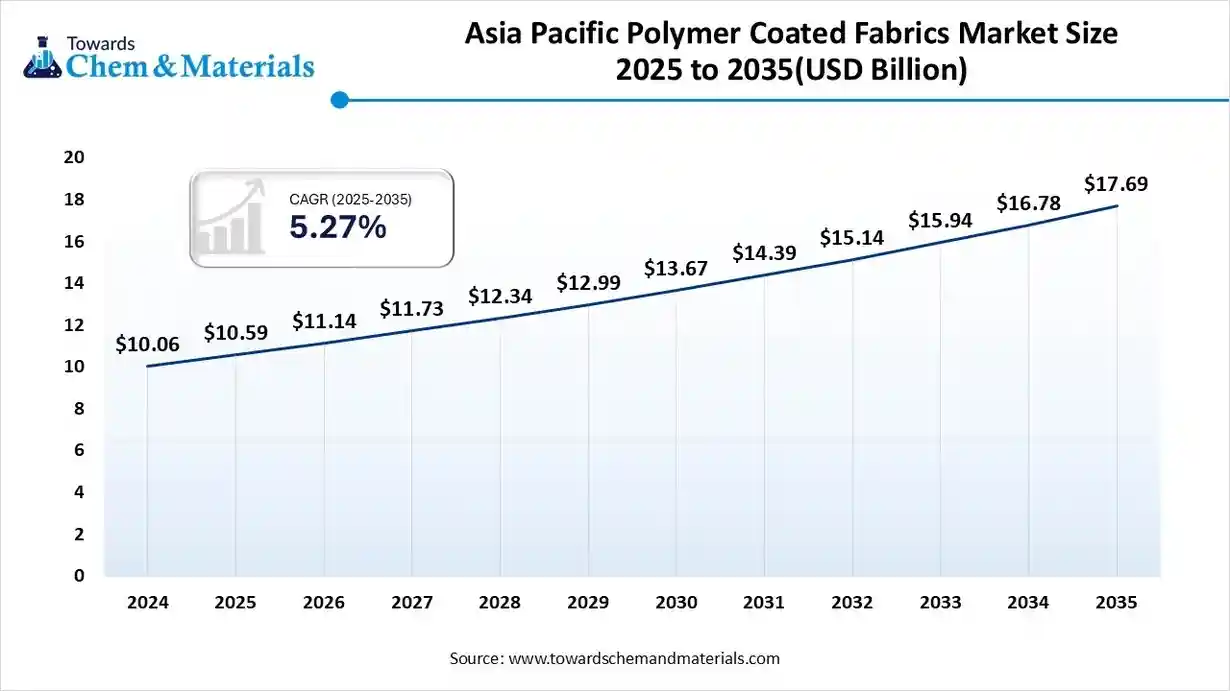
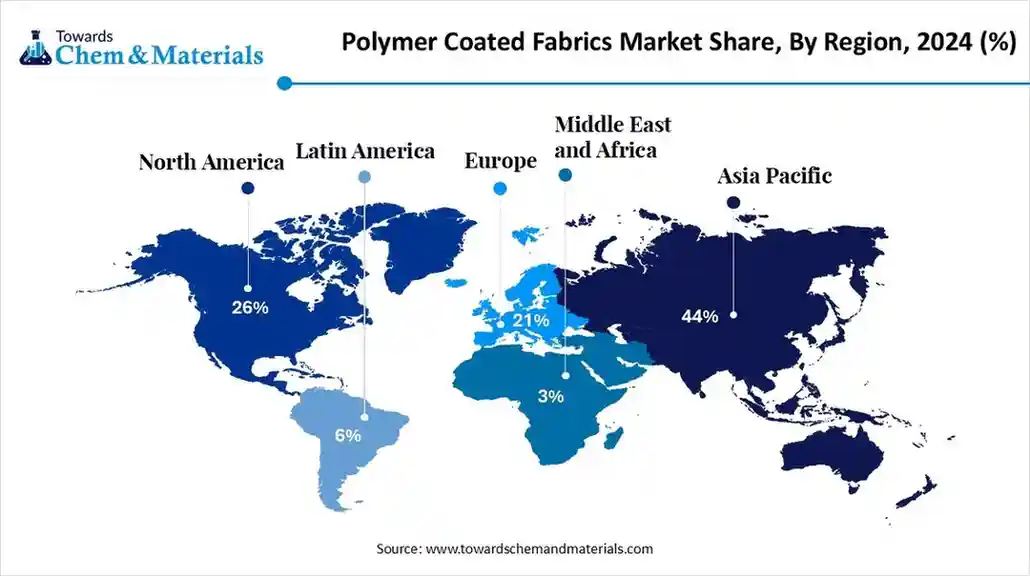
The Asia Pacific polymer coated fabrics market size was valued at USD 10.59 billion in 2025 and is expected to reach USD 17.69 billion by 2035, growing at a CAGR of 5.27% from 2025 to 2035. Asia Pacific dominated the polymer coated fabrics market with a 44% share in 2024. The dominance of the region can be attributed to the ongoing expansion of automotive production, along with rapid industrialization. Moreover, the expanding construction industry in regions such as China and India is leading to increased use of coated fabrics in awnings, architectural membranes, and roofing materials, driving market growth shortly.
China Polymer Coated Fabrics Market
In the Asia Pacific, China led the market due to the rapid infrastructure development and surging sectors such as construction and automotive. Also, China is a major consumer and producer of coated fabrics, especially coated fabrics, and is anticipated to retain its position during the forecast period.
Europe Polymer Coated Fabrics Market Trends
Europe is expected to grow at the fastest CAGR over the forecast period. The growth of the segment can be credited to the strong presence of established market players like BMW, Volkswagen, and Renault in the developed countries in Europe. Additionally, there is increasing emphasis on recyclable coated fabrics, especially in response to environmental shifts and regulations towards eco-friendly materials.
Germany Polymer Coated Fabrics Market
In Europe, Germany dominated the market by holding the largest market share due to ongoing advancements, a strong manufacturing base, and stringent regulations implemented by the government. Furthermore, Germanys strong focus on R&D leads to continuous innovations in polymer coating technologies, enhancing product functionality and quality.
Recent Developments
- In January 2026, Sioen Industries Group successfully completes its acquisition of ISL-Chemie. The acquisition strengthened Sioen position in the pigment paste sector and expands opportunities for sustainable innovation. (Source: sioen.com)
- In September 2025, TripleW and Sulzer successfully launched the first commercial-scale production of PLA derived from food waste. This launch support waste-to-fiber breakthrough is a crucial step towards sustainable manufacturing for the circular economy.(Source: www.sulzer.com)
Top Market Players and Their Offerings
- Continental AG: The global leader offering safety clothing, elastomer-coated fabrics and the conti-barrier system in automotive, apparel and construction sectors.
- Saint-Gobain S.A.: The global player offers high-performance PTFE and silicone-coated fabrics in aerospace, electronics and food processing sectors.
- Sioen Industries NV: The major company provide waterproof and windproof textiles by offering high-performance fabrics, especially in maritime safety.
- Trelleborg AB
- Serge Ferrari Group
- Freudenberg Performance Materials
- DuPont de Nemours, Inc.
- BASF SE
- Dow Inc.
- Seaman Corporation
- Spradling International Inc.
- SRF Limited
- Low & Bonar (Freudenberg)
- Huntsman International LLC
- Mehler Technologies (Freudenberg)
Segments Covered
By Polymer Type
- Polyvinyl Chloride (PVC) Coated Fabrics
- Standard PVC Coating
- Low-Phthalate/Phthalate-Free PVC
- Polyurethane (PU) Coated Fabrics
- Solvent-Based PU
- Water-Based PU
- Polyethylene (PE) Coated Fabrics
- Polytetrafluoroethylene (PTFE) Coated Fabrics
- Others
- Silicone-Coated Fabrics
- Acrylic-Coated Fabrics
By Fabric Substrate
- Polyester
- Nylon
- Cotton
- Fiberglass
- Blends & Specialty Fabrics
By Coating Process
- Direct/Knife Over Roll Coating
- Calender Coating
- Hot Melt Coating
- Extrusion Coating
- Transfer Coating
By Application
- Transportation
- Automotive Seating & Interiors
- Truck Tarpaulins & Covers
- Marine Upholstery
- Protective Clothing
- Industrial Safety Apparel
- Military & Tactical Gear
- Building & Construction
- Roofing Membranes
- Awnings & Canopies
- Industrial
- Conveyor Belts
- Machine Covers
- Furniture & Upholstery
- Indoor Furniture
- Outdoor Furniture
- Others
- Inflatable Structures
- Tents & Recreational Equipment
By Region
- North America
- U.S.
- Canada
- Europe
- Germany
- UK
- France
- Italy
- Spain
- Sweden
- Denmark
- Norway
- Asia Pacific
- China
- Japan
- India
- South Korea
- Thailand
- Latin America
- Brazil
- Mexico
- Argentina
- Middle East and Africa (MEA)
- South Africa
- UAE
- Saudi Arabia
- Kuwait



Comments
Share your thoughts, ask a question, or provide feedback about this report.