
Fischer Tropsch Wax Market Size Analysis Report 2035
The global fischer tropsch wax market size was estimated at USD 895.90 million in 2025 and is expected to increase from USD 954.58 million in 2026 to USD 1,689.64 million by 2035, growing at a CAGR of 6.55% from 2026 to 2035. Asia Pacific dominated the fischer tropsch wax market with the largest revenue share of 48.00% in 2025.The growth of the market is driven by the superior thermal stability, increasing substitution of paraffin wax, and expanding automotive/industrial applications, fueling growth. The Fischer-Tropsch (FT) wax market is highly significant for providing high-purity, synthetic paraffinic waxes with superior technical properties, low viscosity, high melting points, and low odor, essential for coatings, plastics, adhesives, and lubricants. It is transitioning from petroleum-based alternatives to eco-friendly, sustainable applications, driven by demand in the packaging and automotive industries.
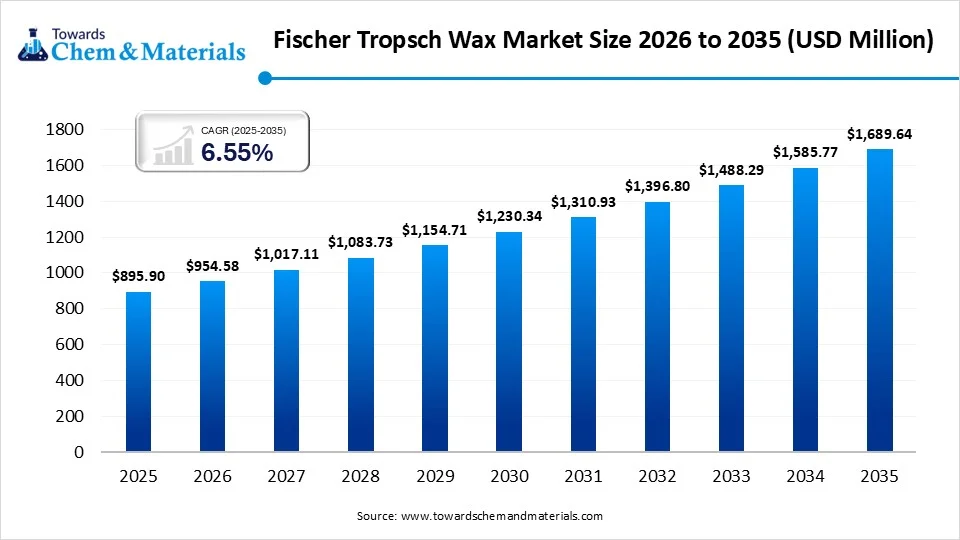
Market Highlights
- By region, Asia Pacific dominated the market share 48.00% in 2025. The growing demand and government-backed infrastructure development fuel the growth.
- By product, the FT hard wax segment dominated the market revenue share 48.00% in 2025. The growth is driven by the sustainability and recyclability, fueling growth.
- By product, the FT medium wax segment is projected to grow at the fastest CAGR between 2026 and 2035. Growing use in various sectors fuels the growth of the market.
- By application, the adhesives & sealants segment dominated the market revenue share 35.00% in 2025. The demand fir high performance adhesives drives the growth of the market.
- By application, the paints and coatings segment is projected to grow at the fastest CAGR between 2026 and 2035. The growing use of automotive and construction fuels the growth of the market.
Key Technological Shifts in The Fischer-Tropsch Wax Market:
Key technological shifts in the Fischer-Tropsch wax market focus on enhancing purity, consistency, and customization through advanced catalysts (cobalt, iron) and optimized reactor designs like fluidized-bed and slurry bubble columns. Key advancements include the production of ultra-high melting point waxes, increased adoption of melt crystallization for refining, and the development of specialized modified waxes for coatings, adhesives, and polymer processing.
Trade Analysis of Fischer-Tropsch Wax Market: Import & Export Statistics
- According to Global Export Data, the world exported 2,387 Synthetic Wax shipments via 523 exporters and 447 buyers.
- Between July 2024 and June 2025 (TTM), there were 60 Synthetic Wax shipments exported globally by 14 verified exporters and 10 buyers.
- Kenya, India, and the United States are the leading importers of Synthetic Wax, while China (659 shipments), the United States (328), and South Africa (165) are the top exporters worldwide.
- Additionally, during the same period, 532 Synthetic Wax shipments were exported globally through 189 verified exporters and 164 buyers.
Recent Market Trends:
- High-Performance Demand: FT wax is preferred for its high melting point, low viscosity, and high crystallinity. Its linear structure makes it an excellent lubricant for PVC processing, with applications also in hot-melt adhesives, inks, and coatings.
- Declining Petroleum Supply: Due to rising crude oil prices and reduced refinery production, the industry is shifting toward synthetic alternatives like FT wax.
- Growth in Emerging Applications: The polymer and rubber processing sector is a major consumer, with high growth expected in specialized applications like textile processing.
Report Scope
| Report Attribute | Details |
| Market Size in 2026 | USD 954.58 Million |
| Revenue Forecast in 2035 | USD 1,689.64 Million |
| Growth Rate | CAGR 6.55% |
| Forecast Period | 2026 - 2035 |
| Base Year | 2025 |
| Dominant Region | Asia Pacific |
| Segment Covered | By Product, By Application, By Regions |
| Key companies profiled | Sasol Limited, Shell plc, Nippon Seiro Co., Ltd., Evonik Industries AG, Clariant AG, Honeywell International Inc., Eastman Chemical Company, Lu’an Group, Nanyang Saier, Deurex AG, Paramelt B.V.,King Honor International Ltd. & Bio Greenware Ltd, Hywax GmbH, Carmel Industries, Mitsui Chemicals, Inc., Bio Greenware Ltd |
Fischer-Tropsch Wax - Value Chain Analysis
Synthesis & Refining
- Fischer–Tropsch wax is produced via gas-to-liquids or coal/biomass-to-liquids processes, where synthesis gas is catalytically converted into long-chain hydrocarbons, followed by hydrocracking, fractionation, and purification to obtain high-purity wax grades.
- Key players: Sasol Limited, Shell, Chevron, PetroSA
Quality Testing and Certification
- Fischer–Tropsch wax requires certifications ensuring melting point consistency, viscosity control, purity, and suitability for downstream formulations. Key certifications include ISO quality standards, REACH compliance, and ASTM wax specifications.
- Key players: ISO (International Organization for Standardization), ECHA (REACH), ASTM International, TÜV SÜD
Distribution to Industrial Users
- Fischer–Tropsch wax is supplied to adhesive manufacturers, coatings and ink formulators, PVC processors, rubber producers, hot-melt formulators, and specialty chemical industries.
- Key players: Sasol Limited, Shell, Chevron.
Speciality Chemicals’ Regulatory Landscape: Global Regulations
| Country / Region | Regulatory Body | Key Regulations / Policies | Focus Areas |
| United States | EPA (Environmental Protection Agency) FDA (Food and Drug Administration) OSHA (Occupational Safety and Health Administration) |
TSCA (Toxic Substances Control Act) – chemical inventory & compliance Clean Air/Water Acts – emissions, waste management FDA food/contact material safety (for cosmetic/packaging applications) Hazard Communication & SDS Requirements |
Chemical safety reporting & compliance Environmental emissions & pollution control Worker safety & hazard communication Product safety for food/cosmetics uses |
| European Union | European Chemicals Agency (ECHA) European Commission |
REACH (EC 1907/2006) – registration, evaluation & chemical safety documentation CLP (EC 1272/2008) – classification and hazard labeling EU Circular Economy & sustainability frameworks Carbon pricing & CBAM (Carbon Border Adjustment Mechanism) |
Chemical registration & hazard assessment Environmental compliance & sustainability Product traceability & documentation Emissionsâ€based import levies |
| China | Ministry of Ecology and Environment (MEE) Ministry of Commerce / Industry regulators |
Environmental Protection Law & air/water pollution controls Chemical product standards & quality benchmarks Carbon peaking/emissions commitments for industrial processes |
Emissions & waste discharge limits Product quality standards Regulatory support for domestic specialty chemicals |
Segmental Insights
Product Insights
How did FT Hard Wax Segment Dominate the Fischer-Tropsch Wax Market in 2025?
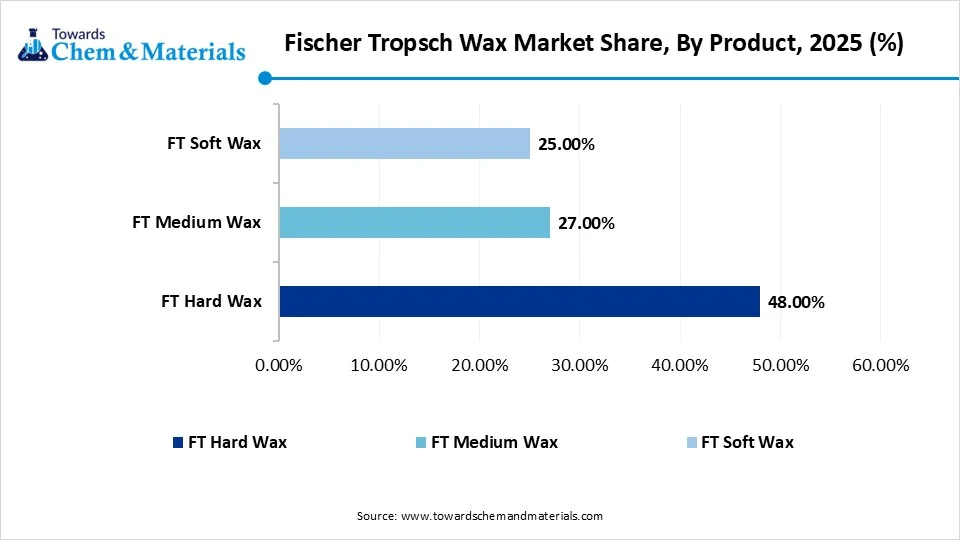
The FT hard wax segment dominated the market share 48.00% in 2025, due to its superior high melting point, low viscosity, and high crystallinity, making it essential for hot-melt adhesives, polymer processing, and coatings. Its ability to improve industrial efficiency, heat resistance, and structural integrity drives adoption over alternatives. FT hard waxes offer exceptional hardness, low oil content, and high purity, providing better thermal stability and lubrication in demanding applications.
The FT medium wax segment is projected to grow at the fastest CAGR between 2026 and 2035 in the market, driven by its superior performance in adhesives, coatings, and plastic processing, which fuels the growth of the market. FT wax's high thermal stability and low viscosity make it essential for high-end applications, particularly in automotive coatings for improved scratch resistance.
Fischer Tropsch Wax Market Share, By Product , 2025 (%)
| By Product | Revenue Share, 2025 (%) |
| FT Hard Wax | 48.00% |
| FT Medium Wax | 27.00% |
| FT Soft Wax | 25.00% |
Application Insights
Which Application Segment Dominates the Fischer-Tropsch Wax Market in 2025?
The adhesives and sealants segment dominated the market share 35.00% in 2025, driven by high demand for hot-melt adhesives in packaging, automotive, and construction industries. This dominance stems from superior performance, including high melting points, low viscosity, and thermal stability that enhance bond strength and processing efficiency. The shift towards eco-friendly and high-performance adhesives, combined with the technical advantages of FT wax in rheology modification, fuels the growth of the market.
The paints and coatings segment is projected to grow at the fastest CAGR between 2026 and 2035 in the market, driven by its use as a high-performance additive to enhance scratch resistance, surface gloss, and water repellency in architectural and automotive applications. FT wax outperforms traditional waxes in durability and sustainability, meeting rising demand for advanced coatings. The increasing need for eco-friendly and high-durability coatings in the automotive and construction sectors is fueling the rapid adoption of FT wax in this segment.
Fischer Tropsch Wax Market Share, By Application , 2025 (%)
| By Application | Revenue Share, 2025 (%) |
| Adhesives & Sealants | 35.00% |
| Paints & Coatings | 25.00% |
| Plastics & Rubber Processing | 18.00% |
| Printing Inks | 10.00% |
| Other Applications | 12.00% |
Regional Insights
The Asia Pacific fischer tropsch wax market size was valued at USD 430.03 million in 2025 and is expected to be worth around USD 819.48 million by 2035, exhibiting at a compound annual growth rate (CAGR) of 6.66% over the forecast period from 2026 to 2035. Asia Pacific dominated the market share 48.00% in 2025, driven by massive industrialization, high-volume production in China and India, and surging demand for applications in coatings, adhesives, and polymers, which supports the growth of the market. Other key growth factors that support the growth included rapid expansion of the packaging and automotive sectors, increasing Coal-to-Liquid (CTL) production for a stable supply, and government-backed infrastructure development, further supporting growth and expansion of the market.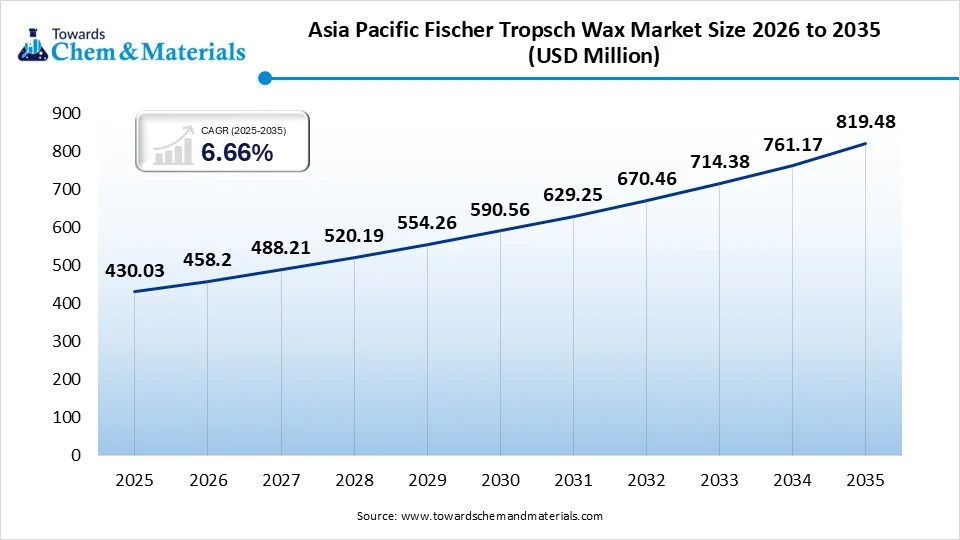
China Fischer-Tropsch Wax Market Growth Trends
The China Fischer-Tropsch wax market is experiencing strong growth, driven by rapid industrialization and high demand for specialized coatings, adhesives, and polymer processing, driving the growth of the market. The growing manufacturing sector and the growing need for high-performance and advanced product developments in the country fuel the growth of the market. China's growing investments in infrastructure and projects for domestic production fuel the growth and expansion of the market.
North America Fischer-Tropsch Wax Market Growth Analysis
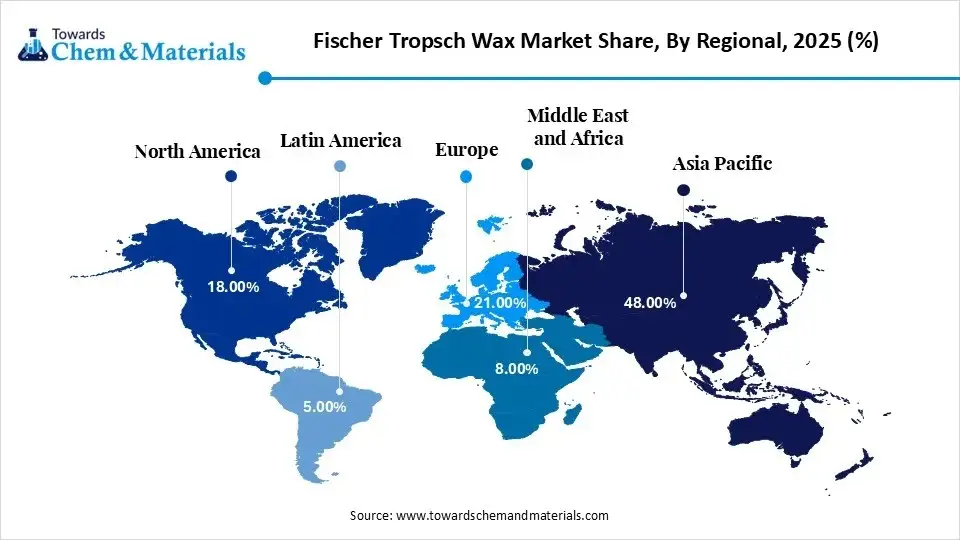
North America fischer-tropsch wax market segment accounted for the major revenue share of 18.00% in 2025. North America is expected to have fastest growth in the market in the forecast period between 2026 and 2035, due to high demand in the automotive, adhesive, and coating industries, industrialization, and the need for specialized chemical products, alongside a shift toward synthetic waxes due to rising crude oil prices, which fuel the growth of the market. Major market players include Sasol, Shell, Evonik Industries AG, and Michelman plays significant role in the growth and innovation in the market.
U.S. Fischer-Tropsch Wax Market Growth Trends
The U.S. Fischer-Tropsch wax market is experiencing strong growth, driven by high demand in plastics, coatings, and adhesives. The market is shifting toward synthetic, high-performance waxes, which further fuels the growth of the market. Increased demand for high-performance, synthetic alternatives to paraffin wax, specifically for improved thermal stability and low oil content, further fuels the growth and expansion of the market.
Europe Fischer-Tropsch Wax Market Growth Analysis
Europe fischer-tropsch wax market segment accounted for the major revenue share of 21.00% in 2025. The European Fischer-Tropsch Wax Market is witnessing robust growth, driven by high demand in the automotive, packaging, and chemical industries. Other key growth factors include the need for high-performance additives in coatings and adhesives, with Germany, France, and the UK acting as major consumption hubs, which fuel the growth of the market. The market is expected to maintain a steady upward trajectory due to increasing requirements for specialized applications like printing inks and adhesives.
Fischer Tropsch Wax Market Share, By Regional, 2025 (%)
| Regional | Revenue Share, 2025 (%) |
| North America | 18.00% |
| Europe | 21.00% |
| Asia Pacific | 48.00% |
| Latin America | 5.00% |
| Middle East & Africa | 8.00% |
Germany Fischer-Tropsch Wax Market Growth Trends
The German Fischer-Tropsch wax market is experiencing robust growth, driven by high demand for superior, high-quality, synthetic waxes in plastics, coatings, and adhesives. The market is bolstered by Germany's strong industrial base and adoption of high-performance materials. Key players, such as DEUREX AG and Evonik Industries AG, are active in the country, fueling the growth and expansion of the market. The shift towards premium, durable products in the automotive and packaging industries also supports market expansion.
Recent Developments
- In February 2025, Sasol expanded its micronized waxes range with the introduction of SASOLWAX LC Spray 30 G and LC Spray 30 G-EF. These products feature a 32% lower Product Carbon Footprint compared to standard grades, achieved by optimizing the Gas-to-Liquid (GTL) production process for coatings, inks, and packaging applications.(Source: chemicals.sasol.com)
- In April 2024, ExxonMobil launched a new wax product brand named 'Prowaxx' in April 2024. This initiative reflects ongoing efforts to brand and market its wax products for various industrial applications(Source:www.exxonmobil.com)
Top players in the Fischer-Tropsch Wax Market & Their Offerings:
- Sasol Limited: Sasol is widely regarded as the leading global Fischer-Tropsch (FT) wax producer, holding a significant market share due to its vertically integrated Gas-to-Liquids (GTL) technology and extensive range of FT wax grades (C35–C100+), including high-melt and specialty waxes used in adhesives, coatings, plastics processing, and lubricants.
- Shell plc: Shell leverages its proprietary GTL technology to produce high-purity Fischer-Tropsch waxes, focusing on consistent global supply and broad melt-range portfolios. Its waxes serve major applications such as hot-melt adhesives, coatings, and packaging formulations.
- Nippon Seiro Co., Ltd.: Nippon Seiro specializes in high-purity FT waxes, particularly C80-C100 grades, used in precision applications like electronics manufacturing, cosmetics, and fine polymer processing, where narrow molecular weight distribution and performance consistency are critical.
- Evonik Industries AG: Evonik supplies specialized synthetic waxes, including FT-based grades tailored for adhesives, coatings, and performance additives.
- Clariant AG: Clariant offers FT wax products widely used as processing aids in hot-melt adhesives, polymer modification, and printing ink formulations. The company emphasizes high purity and tailored melt profiles to enhance processing performance.
- Honeywell International Inc.
- Eastman Chemical Company
- Lu’an Group
- Nanyang Saier
- Deurex AG
- Paramelt B.V.
- King Honor International Ltd. & Bio Greenware Ltd
- Hywax GmbH
- Carmel Industries
- Mitsui Chemicals, Inc.
- Bio Greenware Ltd
Segments Covered:
By Product
- FT Hard Wax
- FT Medium Wax
- FT Soft Wax
By Application
- Adhesives & Sealants
- Paints & Coatings
- Plastics & Rubber Processing
- Printing Inks
- Other Applications
By Regions
- North America
- U.S.
- Canada
- Mexico
- Europe
- Germany
- UK
- France
- Italy
- Spain
- Asia Pacific
- China
- India
- Japan
- South Korea
- Latin America
- Brazil
- Argentina
- Middle East & Africa
- Saudi Arabia
- South Africa



Comments
Share your thoughts, ask a question, or provide feedback about this report.