Search thousands of industry reports, market insights, and research studies in one place.
Not sure where to start? Try one of these:
Europe Plastic Distribution Market Size, Share and Industry Analysis by 2026-2035
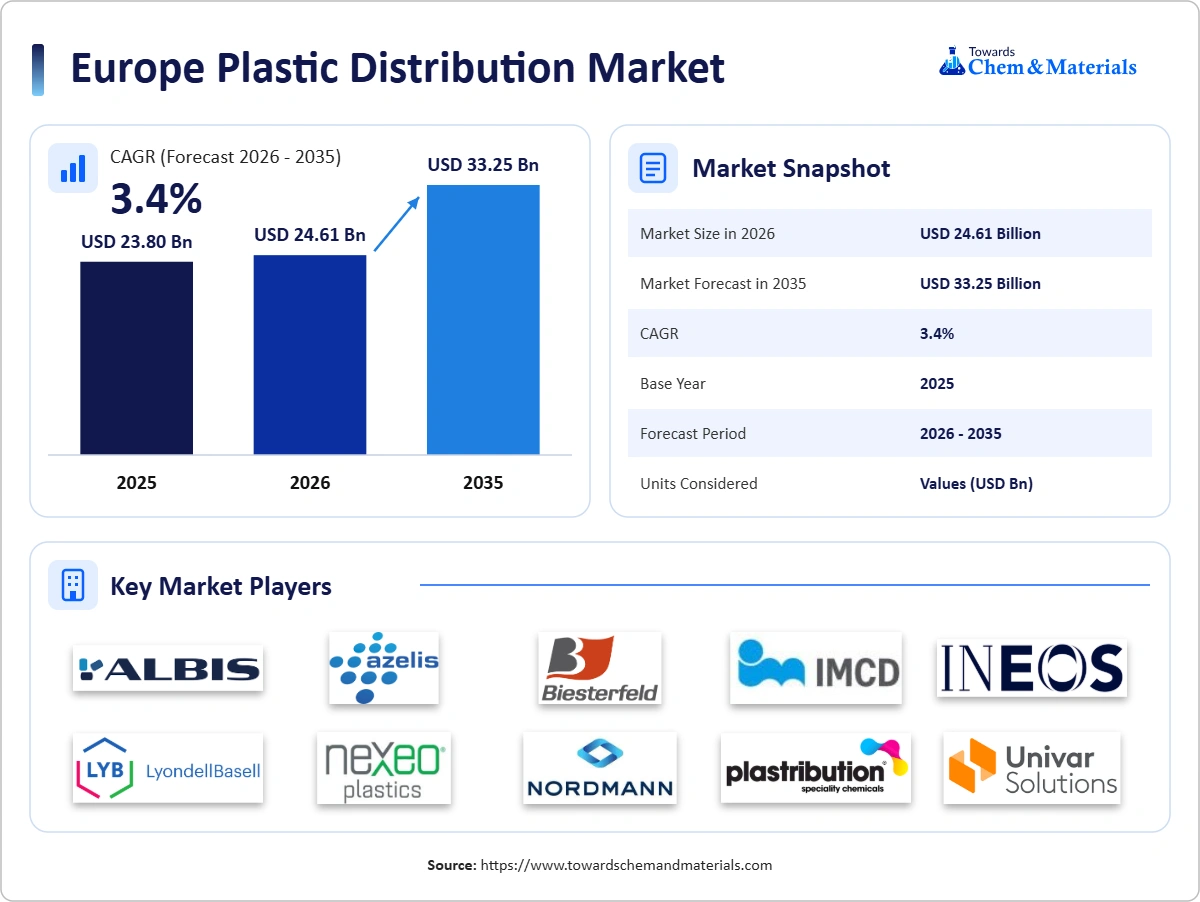
The Europe plastic distribution market size was estimated at USD 23.8 billion in 2025 and is projected to grow from USD 24.61 billion in 2026 to USD 33.25 billion by 2035, growing at a CAGR of 3.4% from 2026 to 2035. The key players are Ravago, Biesterfeld, Albis (Otto Krahn Group), Nexeo Plastics, Univar Solutions (Distrupol), K.D. Feddersen, Azelis, IMCD, Plastribution, Nordmann, Borealis, LyondellBasell, SABIC, INEOS, Biesterfeld Polybass, Biesterfeld Polychem.
Last updated
25 November 2026 ·
Report Code
6640 ·
Fact checked
·
Source:
Germany led the market in 2025, capturing 26% of European revenue.
In 2025, the rest of Europe accounted for 21% of the market.
Italy represented a market share of 14% in 2025.
Poland captured 9% of the market in 2025 and is projected to be the fastest-growing country, with a CAGR of 4.59% from 2026 to 2035.
Commodity Resins accounted for the largest share of the product segment, representing 54% of the market in 2025.
Packaging dominated the end-use segment, accounting for 37% of the market in 2025.
Europe Plastic Distribution Market Size and Forecast 2026 to 2035
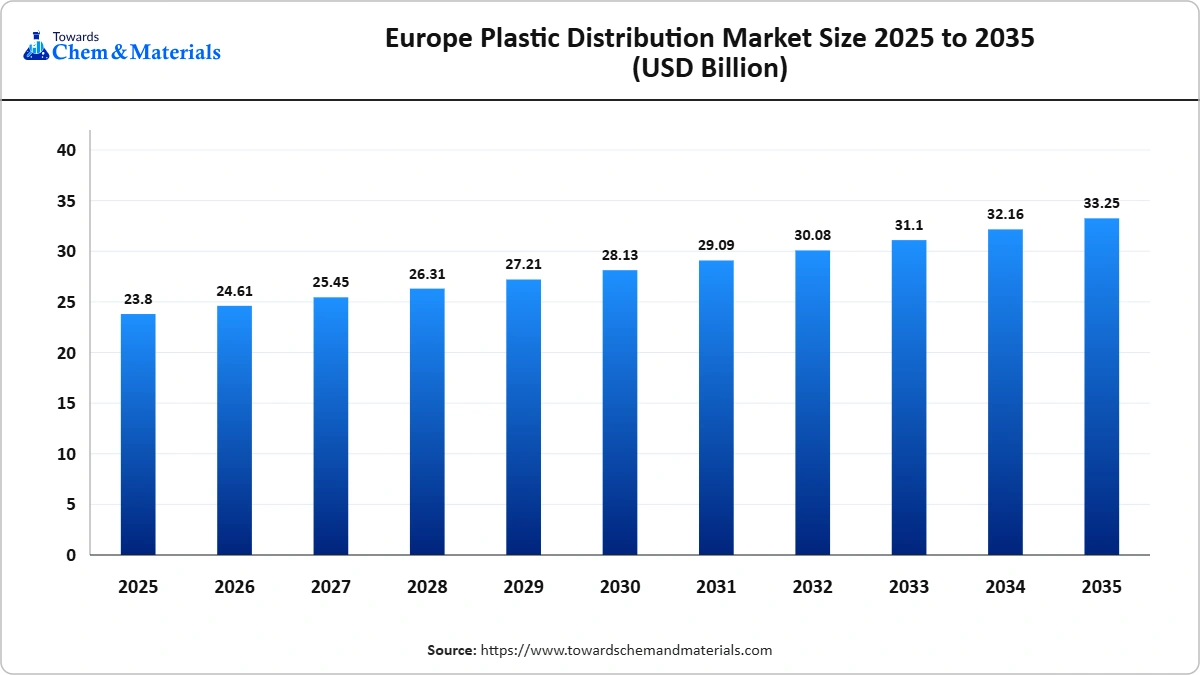
The Europe plastic distribution market size is valued at USD 24.61 billion in 2026 and is projected to reach USD 33.25 billion by 2035, expanding at a CAGR of 3.4% from 2026 to 2035. The market covers the distribution of commodity resins, including polyethylene, polypropylene, PVC and polystyrene, engineering plastics, high-performance polymers, compounds and recycled resins. These materials are supplied to packaging, automotive, construction, electrical and electronics, medical and consumer goods processors across Europe.
Note: 2025 is the base year; 2026-2035 values are forecasts.
Sources: Expert interviews, secondary sources, Towards Chemical and Materials database, and Towards Chemical and Materials analysts.
In 2025, Commodity Resins held the largest market share at 54%, driven by high-volume demand for polyolefins from European packaging and moulding companies. Packaging dominated the end-use segment with a 37% revenue share. Germany led the European market with a 26% revenue share, supported by its large plastics processing industry and established distribution network.
Market growth is supported by packaging demand, recycled-content regulations, use of engineering plastics in automotive and machinery applications, and manufacturing expansion in Central Europe. Distributors are strengthening their regional positions through acquisitions and strategic consolidation. For instance, in July 2026, Biesterfeld acquired full ownership of its Italian joint ventures, Biesterfeld Polybass and Biesterfeld Polychem, to strengthen its plastics and specialty chemicals distribution activities in Italy.
The Europe plastic distribution market is projected to expand from USD 23.80 billion in 2025 to USD 33.25 billion by 2035, with a CAGR of 3.4% from 2026 to 2035. This growth is driven by sustained packaging demand, adoption of recycled resins, and the critical role of distributors in providing materials and technical services to European processors. By 2030, the market is forecast to reach USD 28.13 billion, supported by demand for commodity polymers, engineering plastics, and specialty materials. Additionally, recycled-content requirements and manufacturing expansion in Central Europe are creating new opportunities for distributors to expand their product portfolios and regional supply networks.
Analyst View: Our market forecast is based on an assessment of European resin consumption by product and end use, the proportion of materials supplied through distribution channels, and average selling prices. These estimates are cross-checked against distributor revenues and industry data to provide a comprehensive market outlook.
Europe Plastic Distribution Market Trends
Recycled resin sourcing: Distributors are expanding their recycled polymer portfolios and qualifying PCR resins to meet processors' material requirements and recycled-content targets.
Producer plant closures: European resin production capacity is facing pressure from plant closures, increasing reliance on imports from the U.S. and the Middle East.
Consolidation: Distributors are acquiring regional businesses and ownership of joint ventures to strengthen their geographic presence and product portfolios.
Central European growth: Manufacturing expansion and industrial relocation toward Poland and Czechia are supporting regional demand for commodity and engineering plastics.
Digital services: Online ordering platforms, inventory visibility, and digital customer services are becoming important for improving distributor efficiency and customer relationships.
Europe Plastic Distribution Market Dynamics
The Europe plastic distribution market is influenced by demand from packaging, automotive, construction, and industrial processors. European resin producers are facing pressure from high energy costs, weak industrial demand, and plant closures, while imports from the U.S. and the Middle East are increasing price competition. At the same time, recycled-content requirements under the PPWR are creating opportunities for distributors to source, qualify, and supply recycled resins. Market consolidation and manufacturing expansion in Central Europe are also influencing competitive dynamics.
Market Drivers
Recycled-content rules: The European Union's Packaging and Packaging Waste Regulation establishes recycled-content requirements for plastic packaging and demand for recycled polymer materials. Distributors are crucial for identifying recycled resin suppliers, ensuring material quality, and linking processors to reliable sources of recycled polymers.
Packaging demand: The packaging industry remains a major consumer of plastic resins across Europe. Food packaging, consumer goods packaging, and flexible packaging applications support consistent demand for polyethylene, polypropylene, and other commodity polymers. Distributors help packaging manufacturers maintain access to materials through inventory management, logistics, and supply agreements.
Central European manufacturing: The expansion of automotive, appliance, electronics, and packaging manufacturing in Poland and Czechia is increasing demand for commodity and engineering plastics. Manufacturing relocation and investment in Central Europe are creating opportunities for distributors to expand warehousing, logistics, and technical support capabilities.
Small processor base: Europe has a large number of small and medium-sized plastics processors that rely on distributors for material sourcing, smaller order quantities, technical assistance, and logistics. Distributors provide access to multiple resin producers and reduce procurement complexity for smaller manufacturers.
Note: Contributions are indicative estimates of each factor's effect on annual growth.
Sources: Expert interviews, secondary sources, Towards Chemical and Materials database and Towards Chemical and Materials analysts.
Recycled-content regulations, packaging demand, and Central European manufacturing expansion are the major drivers of the Europe plastic distribution market. The need for qualified recycled materials is strengthening the role of distributors in connecting resin producers with downstream processors.
Market Restraints
Weak industrial demand: High energy costs, economic uncertainty, and subdued manufacturing activity across Europe are limiting demand for plastic materials. Reduced production volumes in automotive, construction, and other industrial sectors can affect resin procurement and distributor revenues.
Price pressure from imports: Imports of plastic resins from the U.S., the Middle East, and Asia are increasing competitive pressure on European suppliers. Lower-priced imported materials can reduce distributor margins and pose challenges for companies depending on established European sourcing networks.
Plastic regulation: Restrictions on certain single-use plastic products and increasing regulatory requirements are affecting demand across selected packaging applications. These regulations are encouraging material substitution, product redesign, and the development of alternative packaging solutions, which can constrain demand for some conventional plastic resins.
Note: Contributions are indicative estimates of each factor's effect on annual growth.
Sources: Expert interviews, secondary sources, Towards Chemical and Materials database and Towards Chemical and Materials analysts.
Weak industrial demand represents the primary restraint on the Europe plastic distribution market, followed by import-driven price competition and regulatory restrictions on selected plastic applications.
Market Opportunities
Recycled resin services: The rise in demand for recycled polymers creates opportunities for distributors to offer material qualification, quality control, blending, and technical support services. Distributors capable of maintaining consistent recycled resin quality can strengthen relationships with packaging and industrial processors.
Medical and specialty grades: Medical-grade and high-performance polymers offer opportunities for distributors to expand into higher-value applications. Medical device manufacturers require materials with specific performance characteristics, regulatory compliance, and traceability, creating demand for specialized distribution services.
Eastern expansion: Manufacturing expansion in Poland, Czechia, and other Central and Eastern European markets is creating opportunities for distributors to establish additional warehouses, improve logistics networks, and strengthen customer relationships. Regional expansion can help distributors serve growing automotive, packaging, appliance, and electronics manufacturing clusters.
Europe Plastic Distribution Market Segmentation Analysis
By Product
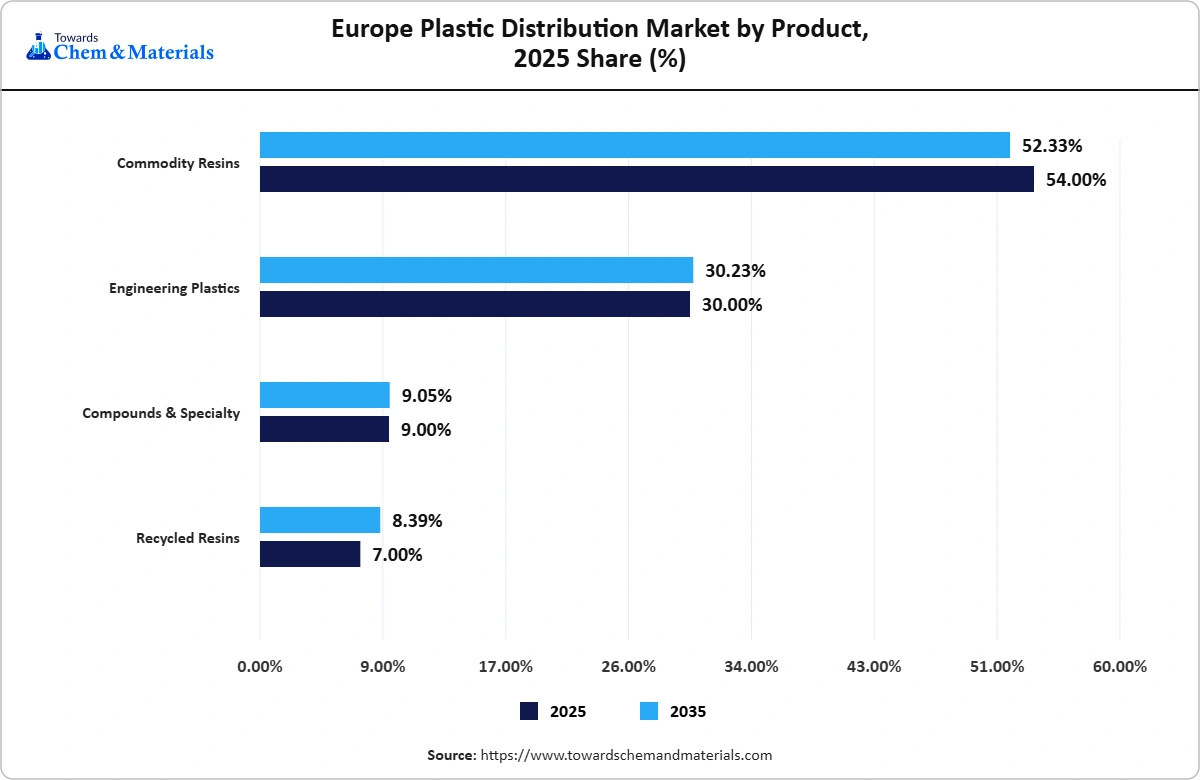
Europe Plastic Distribution Market by Product, 2025 Share (%)
Note: 2025 is the base year; 2035 shares and CAGRs are forecasts.
Sources: Expert interviews, secondary sources, Towards Chemical and Materials database, and Towards Chemical and Materials analysts.
Commodity Resins dominated the Europe plastic distribution market, accounting for 54% of revenue in 2025, owing to high-volume consumption of polyolefins across packaging, construction, and industrial applications. Engineering Plastics represented the second-largest product category, supported by automotive and machinery manufacturing. Recycled Resins are projected to record the fastest growth during the forecast period, driven by recycled-content requirements and the expansion of circular material supply chains.
Commodity Resins held 54% of the market in 2025. The segment is projected to grow at a CAGR of 3.08% through 2035. Polyethylene and polypropylene are used in packaging and moulding applications, while PVC and polystyrene serve construction and industrial markets. Producers such as Borealis, LyondellBasell, SABIC, and Ineos use distributors to reach small and medium-sized processors.
Engineering Plastics represented 30% of the market in 2025 and are expected to register a CAGR of 3.48% from 2026 to 2035. These materials are used in automotive components, machinery, electrical equipment, and industrial applications. Germany's and Italy's automotive and machinery industries support demand for engineering polymers distributed through specialized suppliers.
Compounds and Specialty accounted for 9% of the market in 2025 and are anticipated to grow at a CAGR of 3.48% through 2035. These materials include customized compounds and specialty polymers designed to meet specific processing and performance requirements. Their distribution often involves technical support, material selection, and application-specific services.
Recycled Resins captured 7% of the market in 2025. The segment is projected to register the fastest CAGR of 5.28% during the forecast period. The segment is supported by increasing recycled-content requirements under the EU Packaging and Packaging Waste Regulation. Distributors are expanding their recycled polymer sourcing networks and helping processors qualify recycled materials for manufacturing applications.
By End Use
Europe Plastic Distribution Market by End Use, 2025 Share (%)
Segments
2025 Share
2035 Share
CAGR 2026-2035
Packaging
37.00%
35.85%
3.07%
Automotive
19.00%
19.13%
3.47%
Construction
16.00%
16.12%
3.47%
Electrical & Electronics
11.00%
11.07%
3.47%
Medical
6.00%
6.77%
4.67%
Consumer & Others
11.00%
11.07%
3.47%
Note: 2025 is the base year; 2035 shares and CAGRs are forecasts.
Sources: Expert interviews, secondary sources, Towards Chemical and Materials database and Towards Chemical and Materials analysts.
Based on the end use, Packaging dominated the plastic distribution market in Europe, accounting for 37% of revenue in 2025. The segment is supported by demand for flexible packaging, food containers, consumer packaging, and other plastic packaging products. Automotive represented the second-largest application, followed by construction. Medical applications are projected to record the fastest growth, supported by demand for specialized polymers used in medical devices and healthcare products.
Packaging accounted for 37% of the market in 2025. The segment is projected to grow at a CAGR of 3.07% through 2035. Demand is supported by food and beverage packaging, flexible packaging, consumer goods, and industrial packaging applications.
Automotive represented 19% of the market in 2025 and is expected to grow at a CAGR of 3.47% from 2026 to 2035. Plastic materials are used in interior components, exterior parts, under-the-hood applications, and lightweight automotive structures. The transition toward electric vehicles is influencing the material requirements of automotive manufacturers.
Construction captured 16% of the market in 2025. Through 2035, the segment is projected to register a CAGR of 3.47%. PVC pipes, insulation materials, profiles, fittings, and other polymer-based construction products support demand across residential, commercial, and infrastructure projects.
Electrical and Electronics held 11% of the market in 2025 and is expected to grow at a CAGR of 3.47% during the forecast period. Engineering plastics and specialty polymers are used in electrical components, connectors, insulation, housings, and electronic equipment.
Medical accounted for 6% of the market in 2025 and is expected to record the fastest CAGR of 4.67% from 2026 to 2035. Demand is supported by medical device manufacturing and the need for specialized polymers with defined performance characteristics, regulatory compliance, and material traceability.
Consumer and Others accounted for the remaining 11% of the 2025 market and are expected to grow at a CAGR of 3.47% through 2035. This category includes consumer goods, household products, and other industrial applications that utilize commodity and engineering polymers.
Analyst View: Based on our analysis, recycled resins and medical applications are expected to gain market share at the fastest rates. Meanwhile, Commodity Resins and Packaging will continue to represent the largest segments of the Europe plastic distribution market, supported by their extensive use across manufacturing and consumer industries.
Country Analysis of the Europe Plastic Distribution Market
By Country
Europe Plastic Distribution Market by Country, 2025 Share (%)
Country
2025 Share
2035 Share
CAGR 2026-2035
Germany
26.00%
24.99%
2.99%
Rest of Europe
21.00%
20.96%
3.39%
Italy
14.00%
13.98%
3.39%
France
12.00%
12.00%
3.39%
U.K.
10.00%
9.98%
3.39%
Poland
9.00%
10.08%
4.59%
Spain
8.00%
8.00%
3.39%
Note: 2025 is the base year; 2035 shares and CAGRs are forecasts.
Sources: Expert interviews, secondary sources, Towards Chemical and Materials database, and Towards Chemical and Materials analysts.
In 2025, Germany dominated the Europe plastic distribution market, accounting for 26% of regional revenue. This lead is supported by Europe's largest plastics processing industry, extensive automotive and industrial manufacturing activities, and established polymer distribution networks. Poland is projected to record the fastest growth during the forecast period, supported by manufacturing expansion and demand for plastic materials across the automotive, appliance, and packaging industries.
Country Insights
Germany dominated the Europe plastic distribution market, accounting for 26% of revenue in 2025. The country is projected to register a CAGR of 2.99% through 2035. Its leading position is supported by a large plastics processing industry, strong automotive and machinery manufacturing sectors, and the presence of established distributors, including Biesterfeld and Albis.
The rest of Europe accounted for 21% of the market in 2025 and is anticipated to grow at a CAGR of 3.39% from 2026 to 2035. This region includes Benelux, the Nordic countries, and other Central and Eastern European markets, where packaging, industrial, and manufacturing activities support polymer distribution demand.
Italy represented 14% of the plastic distribution market in Europe in 2025 and is forecast to register a CAGR of 3.39% through 2035. The country's market is supported by a substantial base of small and medium-sized moulders, packaging manufacturers, and industrial processors. In July 2026, Biesterfeld acquired full ownership of its Italian joint ventures, Biesterfeld Polybass and Biesterfeld Polychem, strengthening its regional distribution operations.
France captured 12% of the market in 2025. The country is projected to grow at a CAGR of 3.39% during the forecast period. Packaging, automotive, cosmetics packaging, and industrial manufacturing support demand for commodity and specialty polymers.
The U.K. held 10% of the European plastic distribution market in 2025 and is expected to register a CAGR of 3.39% through 2035. The market is supported by packaging manufacturers, medical device processors, and industrial users that rely on distributors for polymer sourcing and technical services.
Poland accounted for 9% of the market in 2025 and is projected to record the fastest CAGR of 4.59% from 2026 to 2035. Increasing automotive, appliance, packaging, and electronics manufacturing activities are supporting demand for commodity and engineering plastics. Manufacturing expansion toward Central and Eastern Europe is strengthening the country's position as a growing regional distribution market.
Spain represented 8% of the market in 2025. The country is expected to register a CAGR of 3.39% during the forecast period. Food packaging, automotive manufacturing, and industrial processing support demand for plastic resins across the country.
Analyst View: Our analysis indicates that Germany will maintain its leading position in the Europe plastic distribution market throughout the forecast period, supported by its established processing and manufacturing base. Poland is expected to expand at the fastest rate as manufacturing investment and industrial activity continue to shift toward Central and Eastern Europe.
Competitive Landscape
Top 10 Companies in the Europe Plastic Distribution Market, 2025
Rank
Company Name
2025 Share (%)
Key Products / Business
Headquarters
1
Ravago
14.00%
resin distribution and recycling
Belgium
2
Biesterfeld
5.00%
polymers, rubber and additives
Germany
3
Albis (Otto Krahn Group)
5.00%
engineering plastics distribution
Germany
4
Nexeo Plastics
4.00%
commodity and engineering resins
United States
5
Univar Solutions (Distrupol)
3.00%
engineering plastics distribution in Europe
United States
6
K.D. Feddersen
3.00%
engineering plastics
Germany
7
Azelis
2.00%
specialty polymer additives
Belgium
8
IMCD
2.00%
specialty chemicals and polymers
Netherlands
9
Plastribution
2.00%
U.K. polymer distribution
United Kingdom
10
Nordmann
2.00%
polymers and additives
Germany
Note: Company shares are 2025 estimates.
Sources: Company press releases, expert interviews, secondary sources, Towards Chemical and Materials database and Towards Chemical and Materials analysts.
Ravago led the Europe plastic distribution market in 2025 with an estimated revenue share of 14%, followed by Biesterfeld and Albis (Otto Krahn Group), each accounting for approximately 5%. These companies benefit from established polymer distribution networks, extensive product portfolios, and strong relationships with resin producers and downstream processors.
Ravago competes through resin distribution and recycling, while Biesterfeld focuses on polymers, rubber, and additives. Albis (Otto Krahn Group) maintains its market position through engineering plastics distribution. Nexeo Plastics and Univar Solutions (Distrupol) participate through commodity and engineering resins and specialized polymer distribution services. K.D. Feddersen focuses on engineering plastics, while Azelis and IMCD compete through specialty polymer additives, chemicals, and polymers. Plastribution and Nordmann strengthen the competitive landscape through polymer distribution and specialty material portfolios.
The top 10 listed companies accounted for an estimated 42.02% of market revenue in 2025, while the remaining 57.98% was distributed among regional distributors and independent traders. The plastic distribution market in Europe is moderately concentrated, with competition driven by supplier mandates, local warehousing, technical support, recycled resin offerings, and the ability to serve a large base of small and medium-sized processors.
Company Snapshots
Ravago: Ravago held the largest estimated share of the Europe plastic distribution market, accounting for approximately 14% in 2025. Headquartered in Belgium, the company focuses on resin distribution and recycling. Its extensive distribution network and established recycling activities position it as a Leader in the Towards Chemical and Materials Companies Quadrant.
Biesterfeld: Accounting for an estimated 5% share of the European market in 2025, Germany-based Biesterfeld competes through its polymers, rubber, and additives portfolio. Its established distribution operations and regional expansion activities position it as a Leader in the Towards Chemical and Materials Companies Quadrant.
Albis (Otto Krahn Group): In 2025, Albis accounted for approximately 5% of the plastic distribution market in Europe. The German company focuses on engineering plastics distribution. Its established customer relationships and specialized product portfolio place it in the Leader category of the Towards Chemical and Materials Companies Quadrant.
Nexeo Plastics: The U.S.-based company accounted for an estimated 4% share of the European market in 2025. Its commodity and engineering resin portfolio supports its position in the regional distribution industry, placing it in the Leader category of the Towards Chemical and Materials Companies Quadrant.
Univar Solutions (Distrupol): Through engineering plastics distribution, Univar Solutions (Distrupol) holds an estimated 3% share of the European plastic distribution market in 2025. The company is headquartered in the United States and is positioned as a Leader in the Towards Chemical and Materials Companies Quadrant.
K.D. Feddersen: In 2025, K.D. Feddersen accounted for approximately 3% of the European market. The German company focuses on engineering plastics distribution and maintains an established position in the European polymer supply chain. Its portfolio and market presence place it in the Leader category of the Towards Chemical and Materials Companies Quadrant.
Azelis: Azelis held an estimated 2% share of the plastic distribution market in Europe in 2025. Headquartered in Belgium, the company participates through specialty polymer additives and related products. Its specialized portfolio positions it as an Innovator in the Towards Chemical and Materials Companies Quadrant.
IMCD: The Netherlands-based company accounted for approximately 2% of the European market in 2025. Its business includes specialty chemicals and polymers, supporting its participation in specialized distribution markets. IMCD is positioned as an Innovator in the Towards Chemical and Materials Companies Quadrant.
Plastribution: Headquartered in the United Kingdom, Plastribution accounted for an estimated 2% share of the Europe plastic distribution market in 2025. Its business focuses on polymer distribution in the U.K. market, placing it in the Innovator category of the Towards Chemical and Materials Companies Quadrant.
Nordmann: Nordmann held approximately 2% of the Europe plastic distribution market in 2025. Headquartered in Germany, the company specializes in polymers and additives and is recognized as an Innovator in the Towards Chemical and Materials Companies Quadrant due to its distinctive distribution activities.
Companies Ecosystem
The Europe plastic distribution market ecosystem connects resin producers, distributors, compounders and recyclers, processors, and regulatory authorities. Each participant contributes to material production, processing, distribution, recycling, or regulation before plastic materials reach downstream end users.
Europe Plastic Distribution Market Ecosystem
Ecosystem Stage
Role in the Market
Key Companies
Resin Producers
Make resins
Borealis, LyondellBasell, SABIC, Ineos
Distributors
Stock, break bulk and deliver
Ravago, Biesterfeld, Albis
Compounders & Recyclers
Make compounds and recycled resin
Ravago recycling, independent recyclers
Processors
Mould and extrude
Packaging, automotive and medical processors
Regulators
Set rules
EU, REACH, PPWR
Sources: Company press releases, expert interviews, secondary sources, Towards Chemical and Materials database and Towards Chemical and Materials analysts.
Resin Producers: Resin producers manufacture commodity and engineering polymers, leveraging distribution partners for small to medium-sized processors. Major upstream supply chain players include Borealis, LyondellBasell, SABIC, and Ineos.
Compounders & Recyclers: Compounders manufacture customized polymer materials, while recyclers process plastic waste into recycled resins. Material quality and consistency are important factors influencing the adoption of recycled polymers.
Processors: Packaging, automotive, construction, electrical, electronics, and medical manufacturers process plastic materials into finished and intermediate products. Many small and medium-sized processors depend on distributors for reliable material sourcing.
Regulators: Regulatory authorities establish requirements related to recycled content, chemical safety, packaging, and material compliance. EU regulations, including REACH and PPWR, influence product selection and the distribution of plastic materials.
The Europe plastic distribution market value chain begins with resin production and continues through distribution, compounding, recycling, and downstream processing. Regulatory requirements influence material sourcing, recycled resin adoption, and product development. Companies that integrate multiple stages or establish long-term relationships with end users can strengthen their competitive positions.
Towards Chemical and Materials Companies Quadrant
The Towards Chemical and Materials Companies Quadrant positions key participants in the Europe plastic distribution market by market strength, reflecting revenue scale, market share, and geographic reach, and by innovation and growth strategy, reflecting product portfolio breadth, R&D intensity, and partnerships. Positions reflect each company's estimated 2025 share of the Europe plastic distribution market and our assessment of its product innovation, portfolio breadth, and partnerships.
Sources: Company press releases, expert interviews, secondary sources, Towards Chemical and Materials database and Towards Chemical and Materials analysts.
Leaders: Ravago, Biesterfeld, Albis (Otto Krahn Group), Nexeo Plastics, Univar Solutions (Distrupol), and K.D. Feddersen combine high market share with broad portfolios and strong innovation.
Innovators: Azelis, IMCD, Plastribution, and Nordmann bring newer technologies and specialised products.
Recent Developments
July 2026: Biesterfeld acquired 100% of the shares in its Italian joint ventures Biesterfeld Polybass and Biesterfeld Polychem to strengthen its plastics and specialty chemicals distribution in Italy.
Europe Plastic Distribution Market Segments Covered
By Product
Commodity Resins
Engineering Plastics
Compounds & Specialty
Recycled Resins
By End Use
Packaging
Automotive
Construction
Electrical & Electronics
Medical
Consumer & Others
By Country
Germany
Italy
France
U.K.
Spain
Poland
Rest of Europe
Research Methodology
The Europe plastic distribution market was evaluated using a bottom-up assessment of resin consumption volumes, distribution channel penetration, and average selling prices across major product, end-use, and country categories. The market includes the distribution of commodity resins, including polyethylene, polypropylene, PVC, and polystyrene, engineering plastics, high-performance polymers, compounds, and recycled resins supplied to packaging, automotive, construction, electrical and electronics, medical, and consumer goods processors. The 2025 base-year estimate was developed by analyzing demand volumes and average prices across product categories and end-use industries in major European countries. It was validated against market-specific revenues of leading distributors, public industry information, and relevant company disclosures. Market estimates were segmented by product and end use, with country-level values allocated according to regional consumption patterns and distribution activities. Company market shares were determined using estimated revenues attributable to plastic distribution activities in Europe. Key assumptions were cross-checked against company disclosures, industry information, expert interviews, and third-party estimates. Estimates that could not be reconciled were excluded from the final assessment. All segment, country, and company estimates were reconciled to the same 2025 base year. The 2026-2035 forecast incorporates expected changes in packaging demand, recycled-content requirements, engineering plastics consumption, European resin production capacity, imports, manufacturing activity in Central Europe, and distributor consolidation.
Analyst View: Overall Market
In our assessment, the Europe plastic distribution market is positioned for steady but moderate growth as packaging demand, recycled-content regulations, and manufacturing requirements continue to support polymer consumption. We expect Commodity Resins to maintain their leading position, supported by extensive use across packaging and moulding applications. Engineering Plastics will remain vital, influenced by automotive and industrial manufacturing. Recycled Resins are anticipated to grow rapidly as European manufacturers adopt recycled materials due to regulations. Packaging will dominate the market, with Medical applications are projected to expand at a faster rate than the overall market. Germany will lead the market, while Poland is projected to experience the fastest growth. Distributors enhancing recycled material sourcing and strategic initiatives will improve their competitive edge.
References
Biesterfeld. "Biesterfeld SE acquires 100 percent of the shares in the joint venture in Italy". July 2026. Press release. (Source: biesterfeld.com)
FAQ
Finding : The market is driven by sustained demand for plastic packaging, increasing adoption of recycled resins, expansion of automotive and industrial manufacturing, and the need for reliable polymer sourcing. EU recycled-content requirements are also encouraging distributors to expand their recycled polymer portfolios.
Finding : Commodity Resins dominate the market, accounting for 54% of revenue in 2025. Their leading position is supported by high-volume demand for polyethylene, polypropylene, PVC, and polystyrene across packaging, construction, and industrial applications.
Finding : Recycled Resins are expected to register the fastest growth, with a projected CAGR of 5.28% from 2026 to 2035. Increasing recycled-content requirements and the development of circular plastic supply chains are supporting segment growth.
Meet the Team
Vidyesh Swar
Principal Consultant
Vidyesh Charudatta Swar is a Senior Research Analyst with more than six years of experience in market research and strategic consulting, specializing in the Chemicals & Materials domain.
Aditi Shivarkar is a seasoned professional with over 14 years
of experience in healthcare market research. As a content
reviewer, Aditi ensures the quality and accuracy of all market
insights and data presented by the research team.
Anticipated market trends show that, the global monochloroacetic acid market volume was estimated at…
Powering Smarter
Business Decisions
Reliable market intelligence and data-driven insights across the global chemicals and materials industry,
helping businesses understand trends, competition, pricing, and emerging opportunities.