Content
What is the Ethyl Acetate Market Size and Share?
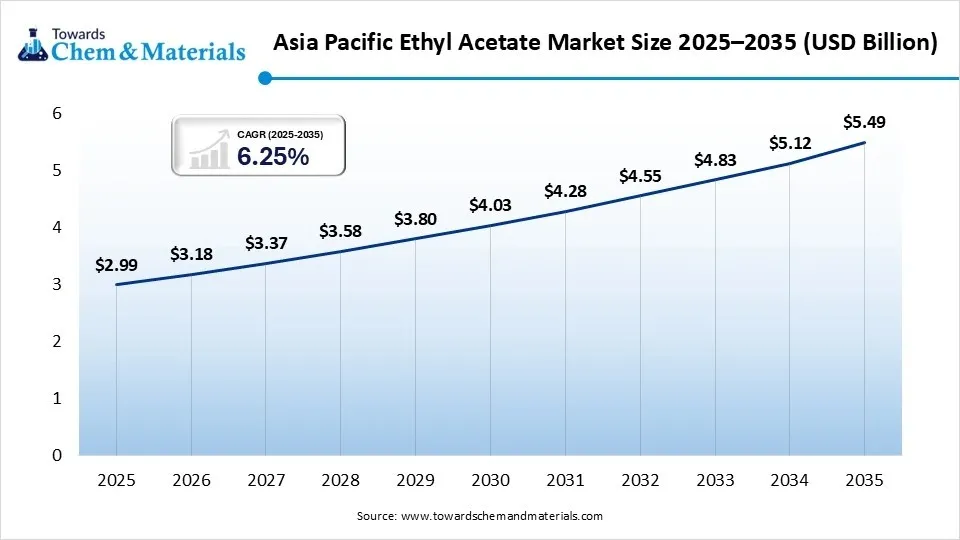
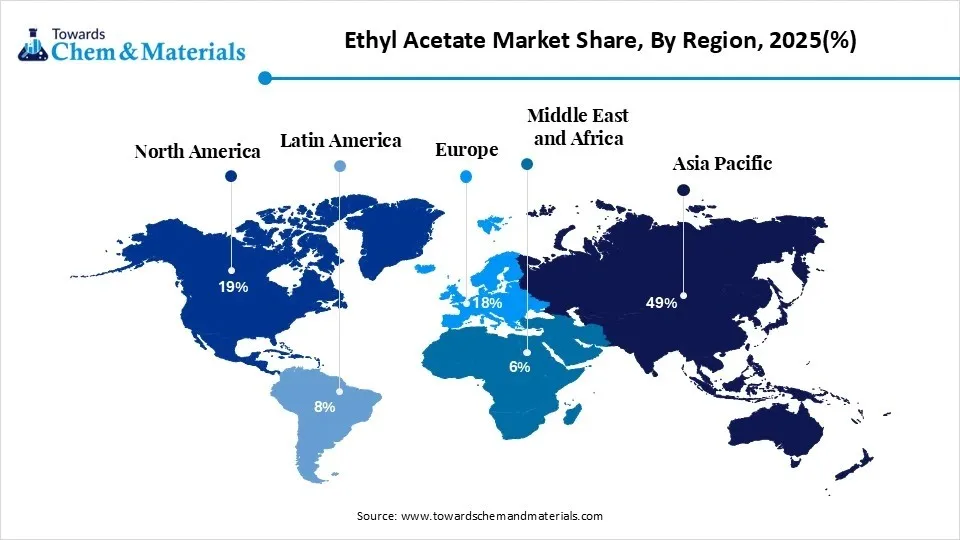
The global ethyl acetate market size was valued at USD 6.1 billion in 2025, is estimated to reach USD 6.5 billion in 2026, and is projected to reach USD 11.1 billion by 2035, exhibiting a compound annual growth rate (CAGR) of 6.15% over the forecast period from 2026 to 2035.Asia Pacific dominated the ethyl acetate market with the largest revenue share of 49% in 2025 and is expected to grow at the fastest CAGR of 6.25% during the forecast period.
The low toxicity and strong solvency make it a versatile solvent and are used in a variety of industries, like paints and coatings, packaging and adhesives, pharmaceuticals, and cosmetics. This is due to its high sustainability and the green chemistry shift in industry. The key collaborations between industries and government organisations, such as INEOS and GNFC, have enabled partners to develop a world-scale acetic acid plant in India. These partnerships boost the market and also play a major role in growth in the coming years.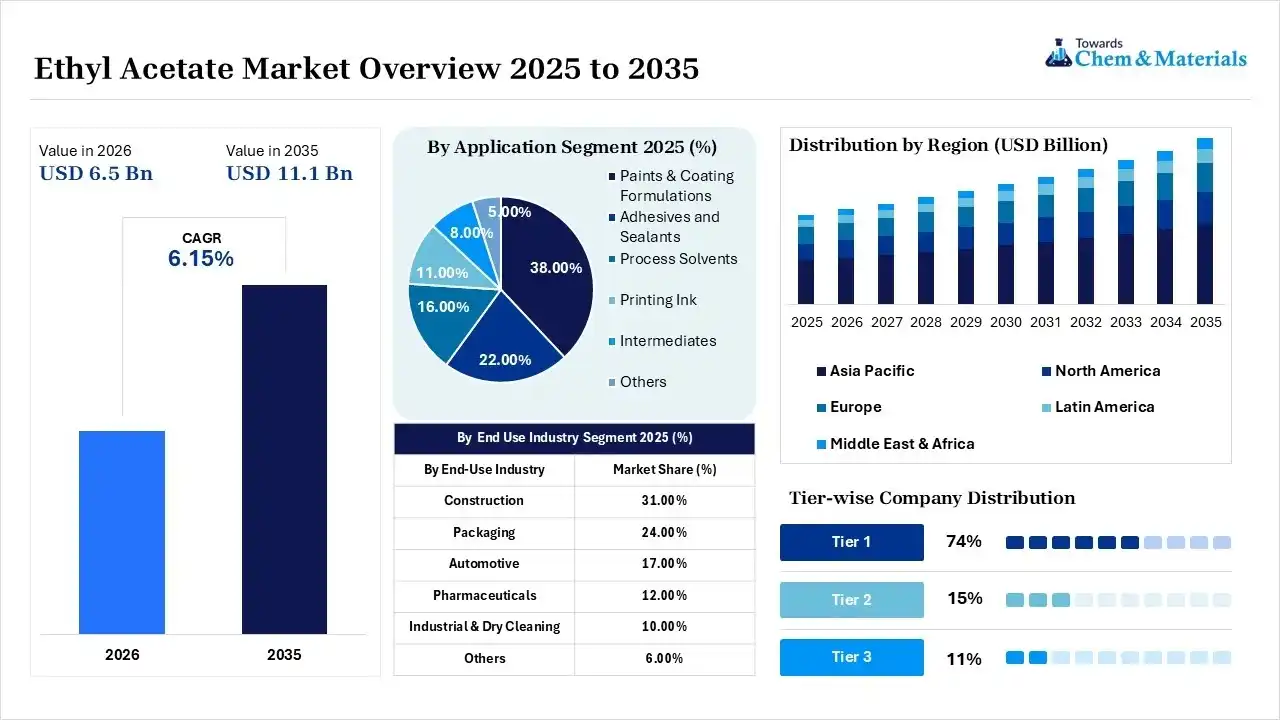
Market Highlights
- By region, Asia Pacific dominated the ethyl acetate market with a share of 49% in 2025 and is expected to grow at a CAGR of 6.25% over the forecast period.
- By application, the paints and coatings formulations segment dominated the ethyl acetate market with a 38% share in 2025 and is growing at a CAGR of 5.90% in the forecast period.
- By application, the adhesives and sealants segment held 22% market share in 2025 and is expected to have the fastest growth with a CAGR of 6.80% in the forecast period.
- By end-use industry, the construction segment dominated the ethyl acetate market with a 31% share in 2025 and is growing at a CAGR of 5.80% in the forecast period.
- By end-use industry, the packaging segment held 24% market share in 2025 and is expected to have the fastest growth with a CAGR of 6.90% in the forecast period.
According to Towards Chemicals and Materials Analytics and Consulting, the global ethyl acetate market volume was valued at 5.88 million metric tons in 2025 and is expected to surpass around 10.00 million metric tons by 2035, accelerating a compound annual growth rate (CAGR) of 5.45% over the forecast period from 2026 to 2035.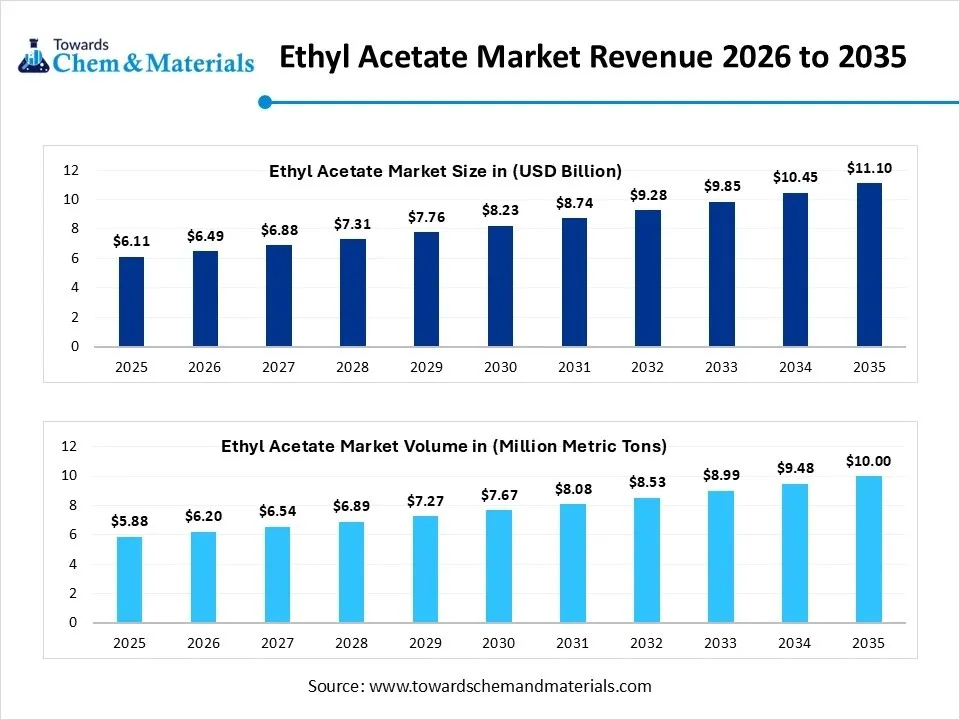
Ethyl acetate is an organic ester used extensively as a volatile solvent for its sweet, fruity smell and for its properties in glues, nail polish removers, printing inks, and the decaffeination of tea and coffee. Ethyl acetate is synthesised by the Fischer esterification process and is produced at an industrial level, where ethanol and acetic acid are catalysed in the presence of sulphuric acid. They are commonly used for its low toxicity and cost-effectiveness in solvent and coating applications, as it serves a good purpose for enamels, lacquers, adhesives, and varnishes. Use for extraction to remove caffeine from coffee beans and tea leaves. Due to its fruity smell used in food and fragrance.
In the chemical industry, ethyl acetate is used for the formulation of drugs due to its low toxicity, which makes it a suitable choice of solvent in the pharmaceutical industry as an API. In recent years, ethyl acetate has been used for electronic industry for the manufacturing of semiconductor components and circuit boards, due to its rapid evaporation rate and minimal residue, making its best choice for cleaning and degreasing electronic parts. This expanding use in the high-tech industry is boosting the growth of the market.
Several companies are collaborating and launching ethyl acetate, expanding production and product lines to meet the growing demand globally. Industries like Celanese Corporation, INEOS USA's capacity expansion, and Eastman Chemical Co. partnered with LanzaTech to scale circular ethyl acetate. These collaborations and initiatives help in the expansion of production facilities due to growing demand for pharmaceutical drug formulation and as solvents, boosting growth and expansion of the market.
- For instance, Celanese and Siegwerk have officially launched a commercial collaboration to integrate bio-based ethyl acetate into the printing ink supply chain. Celanese is supplying ethyl acetate made with 50% bio-based content. The initiative forms a core part of Siegwerk’s SustainUP procurement program and its broader HorizonNOW 2030 strategy.(Source: www.indianchemicalnews.com)
Global Investment Flow for Ethyl Acetate Market 2026
The steady opportunities and growing demand from industries push the investors and major players to invest heavily in the market for expanding the business by players like NEOS, Sasol, Eastman Chemical Company, Solvay, Jubilant Ingrevia, and IOL Chemicals and Pharmaceuticals.
- Sinopec Capital, the private equity division of China's state-owned Sinopec, revealed it will secure ¥1.99bn ($273m) from its parent company to fund investments of ¥2.235bn in clean energy and emerging strategic industries this year.
(Source: www.hydrogeninsight.com) - Viridis Chemical is relocating its renewable ethyl acetate plant from Nebraska to Peoria, Illinois, aiming to leverage direct pipeline integration with BioUrja Renewables and improved logistical access to the Illinois River(Source: www.specialchem.com)
Market Growth Trends:
- The growing use of ethyl acetate in the pharmaceutical industry due to its characteristics like low toxicity and efficient processing capabilities, which also help in purification and extraction, is a growing trend in the market, which boosts the production demand.
- The industrial use, especially in paints and coatings, is driven by growing e-commerce and increased infrastructural development projects and construction booms, which are major trends in the market.
The sustainability shift driven by green chemistry programs, net zero initiatives, and the transition to low-volatile organic compound solvents boosts the growth of the market. - The regional expansion is due to expanding demand, to expand the production capacity to fulfil global demand due to extensive use in various sectors.
Report Scope
| Report Attributes | Details |
| Market Size in 2026 | USD 6.5 Billion/ 6.20 Million Metric Tons |
| Expected Size in 2035 | USD 11.1 Billion/ 10.00 Million Metric Tons |
| Growth Rate | CAGR of 6.15% |
| Base Year of Estimation | 2025 |
| Forecast Period | 2025-2035 |
| Dominant Region | Asia Pacific |
| Segment Covered | By Application, By End-Use Industry, By Region |
| Key Companies Profiled | Sasol Ltd, Solvay S.A., Wacker Chemie AG, Daicel Corporation, Jiangsu Sopo (Group) Co., Ltd., Sipchem (Saudi International Petrochemical Co.), Solventis Limited, Laxmi Organic Industries Ltd, IOL Chemicals and Pharmaceuticals Limited, Godavari Biorefineries Limited, Grasim Industries Ltd (Chemicals Division), GNFC (Gujarat Narmada Valley Fertilizers & Chemicals Ltd), Ashok Alco-Chem Ltd, Maharashtra Aldehydes & Chemicals Ltd, Saanvi Corp |
Ethyl Acetate Market: AI Integration and Industrial Digitization
The industry is shifting towards cleaner and greener chemistry use, aligning with sustainable bio-based production and Industry 4.0 digitization, as manufacturers are replacing fossil-derived processes through process intensification. AI and digital integration through process optimization by integrating AI and machine learning for real-time monitoring and precisely controlling the reaction conditions to minimize errors. It is also necessary for a production facility to use predictive maintenance to analyse the working of equipment, which also helps in optimizing logistics and supply chain analysis. The high-tech downstream applications, especially in electronics, aerospace, and medical devices, and focusing on sustainability through advancements, boost global growth.
Supply Chain Analysis of the Ethyl Acetate Market
Chemical Synthesis and Processing
- Ethyl acetate is synthesised and processed through a reaction called Fischer esterification, where ethanol and acetic acid are synthesised to form ethyl acetate in the presence of sulfuric acid for industrial production.
It is also synthesized by the Tishchenko reaction and then processed and purified by neutralization, washing, dehydration, and fractional distillation. - Celanese Corporation: Celanese Corporation is a leading global producer of acetyl products; it also manufactures acetyl chains. It also supports sustainable and green production due to growing environmental awareness, which shifts the market. The company, being the world's largest producer, also ensures supply chain management and production.
- Key players: Celanese Corporation, INEOS Group Holdings, Eastman Chemical Company, Sasol Ltd, and Solvay S.A.
Quality Testing and Certification
- The ethyl acetate production requires all quality testing, including gas chromatography and Karl Fischer titration for moisture testing.
- The company and the manufacturers are supposed to comply with standards such as USP, EP, and ACS, and also certifications like SO 9001, GMP, Halal, and Kosher, and USDA BioPreferred Certification or EU Ecolabel.
- Solvay S.A: Solvay S.A is a major producer of sustainable and traditional bio-based ethyl acetate, which supplies the chemicals to major industries that require ethyl acetate, such as pharmaceutical, packaging, and cosmetics.They produce high-purity and environmentally friendly solvents.
- Key players: REACH (Registration, Evaluation, Authorization and Restriction of Chemicals), FDA (Food and Drug Administration), BIS (Bureau of Indian Standards), OSHA, CPCB, ASTM International, and UL Solutions
Distribution to Industrial Users
- Ethyl acetate is distributed to end uses like paints, coatings, and inks, adhesives and sealants, pharmaceuticals, food and beverages, cosmetics and personal care, electronics, and specialty chemicals.
- Wacker Chemie AG is a producer of ethyl acetate, which processes and has expanded its bio-based production by fermentation-based ethanol. In this company, ethyl acetate acts as a main intermediate in the production of its integrated acetic acid.
- Key players: Wacker Chemie AG, Daicel Corporation, Jiangsu Sopo (Group) Co., Ltd., Sipchem (Saudi International Petrochemical Co.), and Jiangsu Baichuan High-Tech New Materials Co., Ltd.
Ethyl Acetate Regulatory Landscape
| Country / Region | Regulatory Body | Key Regulations | Focus Areas |
| United States | FDA (Food and Drug Administration), EPA (Environmental Protection Agency), OSHA (Occupational Safety and Health Administration) | REACH Regulation (EC) No 1907/2006, CLP Regulation (EC) No 1272/2008, Directive 2009/32/EC | Flexible Packaging & Adhesives, Cosmetics & Personal Care |
| European Union | European Chemicals Agency (ECHA) via REACH and CLP regulations. | REACH Regulation (EC) No 1907/2006, CLP Regulation (EC) No 1272/2008, Directive 2009/32/EC | Biodegradable and low-toxicity substitute for hazardous solvents |
| China | Ministry of Industry and Information Technology; State Administration for Market Regulation, Ministry of Ecology and Environment (MEE), GACC, MOFCOM, NHC, and NMPA | GB 30000.1, catalog of Hazardous Chemicals (2015 Edition), GB/T 3728-2023 | Pharmaceuticals and Bio-Solvents, Global Export Operation |
| India | Bureau of Indian Standards, Central Drugs Standard Control Organisation, Food Safety and Standards Authority of India, Central Pollution Control Board, PRSO, MoEFCC | IS 229:2021 Standard, IS 10283 (1982) | paints and coatings, flexible packaging, and pharmaceutical sectors |
| Japan | Ministry of Health, Labour and Welfare (MHLW), Ministry of Economy, Trade and Industry (METI), and the Ministry of the Environment (MOE). | Industrial Safety and Health Act (ISHA/ISHL), Chemical Substances Control Law (CSCL) | electronics cleaning solvents, pharmaceutical-grade APIs, and eco-friendly bio-based derivatives |
| Germany | German Institute for Standardization; Federal Ministry for Economic Affairs and Energy, Federal Institute for Occupational Safety and Health, Federal Institute for Risk Assessment | EC) No 1272/2008, H225, H336, | sustainable, bio-based production and high-purity applications |
What are the Key Product Types of the Ethyl Acetate Product?
Ethyl acetate is a nontoxic formulation that is used by many sectors as a base agent, API, and many more applications due to its purity and properties, which boost the demand for the product.
The ethyl acetate products are categorized into 3 major types on the basis of purity, manufacturing process, and application grades. They are characterised on the basis of their acceptable purity level and specific regulatory standards based on industries.
Key Product Types by Grade:
The grade products are further categorized into technical grade, pharmaceutical grade, food grade, and laboratory/reagent grade products. Technical Grade is a high-purity industrial solvent with a purity of >99%. They are generally noted for bulk production and industrial processes, having a range of cost efficiency, and they also have use in heavy-duty chemicals. They are widely used for applications like adhesives, paints and coatings, varnishes and lacquers. Pharmaceutical grade is an ultra-pure and under-regulated formulation that is widely used to process solvent and extract material in drug manufacturing and drug formulation. Food-grade products are suitable for human consumption and processing and extraction of natural solvents, such as the decaffeination of tea and coffee. Laboratory grade is used for scientific and analytical chemistry and for the synthesis of organic products.
Key Product Types by Manufacturing Process:
The products are further categorized into bio-based ethyl acetate and synthetic/ petrochemical ethyl acetate. Biobased ethyl acetate is produced through fermentation and esterification and is also derived from crops like sugarcane and corn in the form of biobased ethanol in place of fossil fuels using renewable sources. Synthetic/petrochemical ethyl acetate is produced through the conventional route by esterification of ethanol and acetic acid or by the Tischenko reaction and is used for large-scale manufacturing.
Key Product Types by Purity / Form
The products are categorized into two main types that is pure ethyl acetate and denatured ethyl acetate. Pure ethyl acetate is used for standard commercial formulations, and denatured ethyl acetate is used for the synthesis of pharmaceuticals, in cosmetics, and as a solvent for food-grade candy glazes.
Market Dynamics
What are the Key Growth Drivers in the Ethyl Acetate Market?
The key growth drivers responsible for the ethyl acetate market are the growing applications due to its cost-effective and low toxicity profile, with fast evaporation of solvent. They are extensively used in packaging. The other key growth drivers or factors that boost the market are flexible packaging and printing inks demand, pharmaceutical and cosmetics growth, eco-friendly bio-based solvents due to strict regulatory standards and environmental awareness, paints and coatings demand, cost-effectiveness, and efficacy, which contribute to the growth and expansion of the market.
What are the Key Growth Challenges in the Ethyl Acetate Market?
The key challenges responsible for hindering market growth are the raw material price volatility, stringent environmental regulations curbing traditional solvent use, and intense competition from alternative solvents. The competition from alternative solvents like bio-based solvents, water-based coatings, and emerging technologies is a challenge in the market. Pressure from governments worldwide is leading to the implementation of low VOC emissions, which also impacts the industry for early adoption by companies.
What are the Key Growth Opportunities in the Ethyl Acetate Market?
The key growth opportunities responsible for creating growth opportunities in the ethyl acetate market are the low toxicity, high evaporation rate, and its strong solvency, making the product a preferred choice by many sectors, creating growth opportunities. Other major growth factors responsible for the growth are bio-based ethyl acetate demand with growing environmental regulations, flexible packaging and inks, functional and smart coatings, use in pharmaceutical and food processing, and emerging geographic markets, which are the major growth opportunities for the market growth.
Segmental Insights
Application Insights
The paints and coating formulation segment dominated the market with a 38% share in 2025 and is expected to grow at a CAGR of 5.90% in the forecast period, due to its properties like fast evaporation, high solvency, and low toxicity, which increase the demand from various industries like architectural, construction, and industrial coatings. Its superior performance and regulatory compliance make it a preferred choice for the paints and coatings industry, as it is a greener alternative, further boosting the growth.
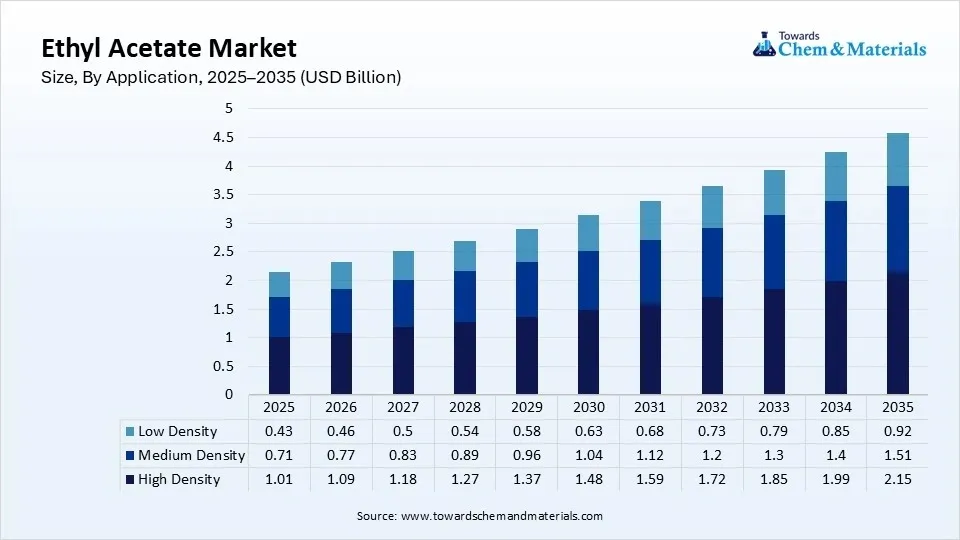
The adhesives and sealants segment held 22% market share in 2025 and is expected to have the fastest growth with a CAGR of 6.80% in the forecast period. Its uses include carrier and dissolving agents, which help in formulating acrylics, vinyl, and polyurethanes for adhesives and sealants. The ability to improve flow, spreadability, and penetration into substrate is also a key factor in the growth. The extensive use in flexible packaging, automotive, and construction sectors and the sustainable shift to meet the VOC emission regulations propel the growth and expansion of the market.
Ethyl Acetate Market Share, By Application, 2025(%)
| By Application | Market Share (%) |
| Paints & Coating Formulations | 38.00% |
| Adhesives and Sealants | 22.00% |
| Process Solvents | 16.00% |
| Printing Ink | 11.00% |
| Intermediates | 8.00% |
| Others | 5.00% |
End Use Industry Insights
The construction segment dominated the market with a 31% share in 2025 and is expected to grow at a CAGR of 5.80% in the forecast period, as it is an active solvent, cleaning agent, and viscosity adjuster, makes its a first choice by the industry. It is critical in the manufacturing of high-performance architectural coatings, heavy-duty industrial adhesives, and waterproofing membranes, which increases the demand for the market. Its properties include excellent greasing and dissolving properties, makes is a preferred application in the construction sector.
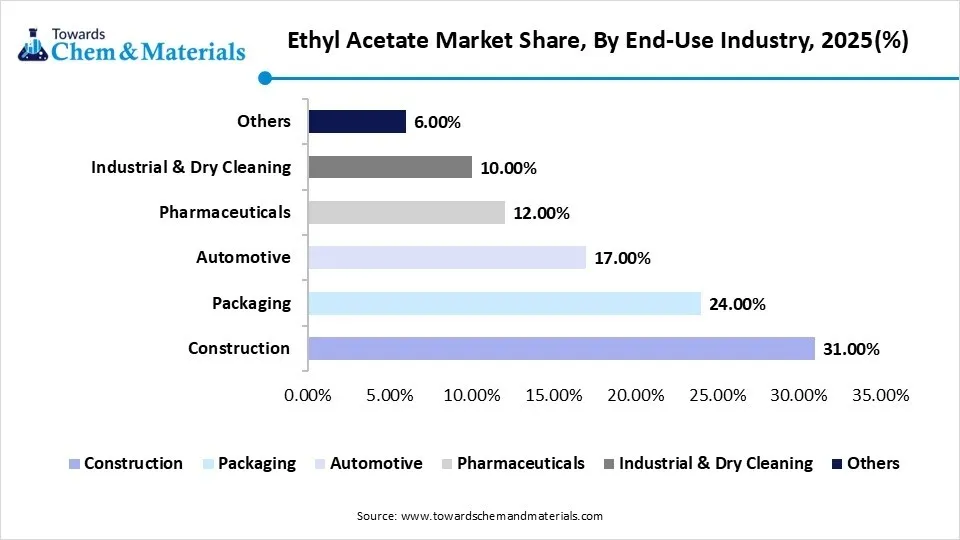
The packaging segment held 24% market share in 2025 and is expected to have the fastest growth with a CAGR of 6.90% in the forecast period. It is used because of its applications such as printing inks for dissolving resins, adhesives, and coatings, and substrate treatment as a printing base. Due to its excellent solvency, it is used for equipment maintenance, which boosts the growth and expansion of the market. Its ability to help form a protective layer and glossy coatings on films and foils is also responsible for the growth of the segment.
Ethyl Acetate Market Share, By End-Use Industry, 2025(%)
| By End-Use Industry | Market Share (%) |
| Construction | 31.00% |
| Packaging | 24.00% |
| Automotive | 17.00% |
| Pharmaceuticals | 12.00% |
| Industrial & Dry Cleaning | 10.00% |
| Others | 6.00% |
What are the Key Benefits of the Ethyl Acetate Product?
The key benefits responsible for the exclusive demand for ethyl acetate products are due to its low toxicity, excellent solvency, and rapid evaporation rate; its use across multiple industries increases the production of the product. The key benefits of the product are high solvency power, which helps dissolve a wide range of polymers and resins. Fast evaporation, which is an advantage in the manufacturing processes of many key products. Low toxicity and environmental friendliness, as it is relatively safer for workers and the environment. Pleasant and fruity odor makes it a preferred choice of carrier for perfumes, artificial flavoring, and cosmetic industries. Safe extraction and purification due to its low toxicity profile for the extraction of active pharmaceutical ingredients and for decaffeinating coffee and tea.
Key Benefits of Ethyl Acetate Include:
- Efficient Formulation & Coating:It lowers the viscosity and improves the flow of paints, varnishes, and lacquers, ensuring smooth application and strong adhesion.
- Sustainable Alternatives: It can be synthesized from renewable, bio-based resources like biomass-derived ethanol, aligning with green chemistry principles.
- Clean & Sharp Printing: Its rapid evaporation rate without residual odor makes it ideal for flexographic and gravure printing inks.
- Safe Botanical Extraction: It is a preferred Class 3 extraction solvent used in the pharmaceutical industry for isolating active ingredients, as well as in the botanical, tea, and coffee decaffeination processes.
Regional Analysis
How did Asia Pacific dominate the Ethyl Acetate Market in 2025?
The Asia Pacific ethyl acetate market size was estimated at USD 3.0 billion in 2025 and is projected to reach USD 5.5 billion by 2035, growing at a CAGR of 6.25% from 2026 to 2035. Asia Pacific dominated the market with a 49% share in 2025 and is expected to experience the fastest growth, with a CAGR of 6.90% over the forecast period. The growth in the region is due to the massive manufacturing hub presence, especially in China and India, where the presence of domestic production capacities is rapidly supporting the growth of product development. The regions are booming in flexible packaging due to the region's exclusive growth in e-retail and packaged food/beverages, which increases the region’s requirement for the product, supporting the growth and expansion of the market.
India Ethyl Acetate Market Growth Factor
The ethyl acetate market in India is also experiencing rapid growth due to the presence of domestic manufacturers in the country. The presence of key players like Jubilant Ingrevial Limited, having a large capacity for the production of ethyl acetate, also plays a major role in the growth. This presence also supports the export of chemicals across the regions. India is a massive exporter of chemicals across the globe due to growing manufacturing hubs. One of the key factors is the presence of a large-scale pharmaceutical industry in India, which relies on ethyl acetate for extraction and processing, increasing demand for the market and contributing to its growth.
China Ethyl Acetate Market Growth Factor
China is the largest producer and consumer of ethyl acetate due to expanding demand from the paint, coatings, pharmaceutical, and adhesives industries due to its extensive use and applications. The presence of domestic players like Shandong Hualu Hengsheng Chemical and Jiangsu Zhongneng Chemical plays a major role in the fulfilment of growing demand from international as well as domestic demand. Chinese manufacturers are increasingly interested in the bio-based and eco-friendly ethyl acetate, maintaining the solvent performance, which supports the growth of the market.
Europe Ethyl Acetate Market Growth Factor
The Europe ethyl acetate market size was estimated at USD 1.1 billion in 2025 and is projected to reach USD 2.1 billion by 2035, growing at a CAGR of 6.68% from 2026 to 2035.Europe held the market share of 18% in 2025 and is expected to grow at a CAGR of 5.100% in the forecast period, due to the robust pharmaceutical and food and beverages sectors and strict EU regulations propelling the growth of the market. The presence of major producing companies like the UK, Germany, and France also contributes to the growth of the market. The supply chain efficiency, which caters to the growing needs of the regional manufacturing hubs, expands the market growth.
United Kingdom Ethyl Acetate Market Growth Factor
The ethyl acetate market in the United Kingdom is fueled by the shift towards green solvents due to strict environmental regulations regarding VOCs, which has increased the demand for low-toxicity and bio-based ethyl acetate which is supported by sustainable ethanol, lowering carbon footprints. The extensive use of pharmaceutical and cosmetic products in the region, which use safe and purified solvents for manufacturing driving the region's growth. This growth is supported by the presence of major players in the market, like INEOS, which are the large manufacturing hubs of the region.
Factors Influencing Italy Ethyl Acetate Market
Italy's ethyl acetate market is driven by the stringent EU regulations on VOC, the flexible packaging boom, advanced coatings in the construction and manufacturing sectors, and the expanding pharmaceutical sector, driving support for the market. Italy is home to prominent commercial bio-based chemical producers like Green Chemicals S.p.A. The growing automotive sector's high demand for materials for coating films with a glossy finish, which tailors to the growing need from the industry, is driving the growth of the market.
North America Ethyl Acetate Market Growth Factor
The North America ethyl acetate market size was estimated at USD 1.2 billion in 2025 and is projected to reach USD 2.2 billion by 2035, growing at a CAGR of 6.25% from 2026 to 2035.North America held the market share of 19% in 2025 and is expected to grow at a CAGR of 5.20% in the forecast period, as it relies heavily on the established petrochemical facilities, which require large and cost-effective feedstocks, such as acetic acid and ethanol. The key factors responsible for growth are flexible packaging and coatings, pharmaceutical manufacturing, regulatory and sustainability shifts, and automotive refining and construction, which propel the growth and expansion of the market. Key players like Eastman chemical company Celanese Corporation play important roles in the market.
Factors Influencing United States Ethyl Acetate Market
The United States is the world's second-largest producer of ethyl acetate, with chemical facilities presence like Viridis Chemical and Celanese Corporation manufacturing ethyl acetate, which is used for coatings, adhesives, and epoxies. The booming demand for pharmaceutical manufacturing and demand for eco-friendly packaging influences the growth of the market. The presence of the automotive industry, which pushes the sector towards sustainable manufacturing and green chemistry, drives the local consumption of the market.
- For instance, Kemvera (formerly New Iridium) partnered with domestic agricultural suppliers to develop commercial-scale bio-ethyl acetate plants. Their proprietary technology uses domestic corn ethanol as a feedstock to produce renewable acetic acid and ethyl acetate.(Source:ethanolproducer.com)
Factors Influencing Canada Ethyl Acetate Market
In Canada, the ethyl acetate market is expanding rapidly due to the expanding automotive and industrial manufacturing sectors in the country. The Canadian commercial sector is driving the demand for flexible food packaging materials. High demand stems from Canadian manufacturing in pharmaceuticals, food processing, adhesives, and cosmetics, fueling the growth and expansion of the market. Strict government regulations regarding Volatile Organic Compounds (VOCs) are encouraging Canadian manufacturers to invest in sustainable, bio-based ethyl acetate production.
Latin America Ethyl Acetate Market Growth Factor
The Latin America ethyl acetate market size was estimated at USD 0.5 billion in 2025 and is projected to reach USD 0.94 billion by 2035, growing at a CAGR of 6.52% from 2026 to 2035.Latin America held the market share of 8% in 2025 and is expected to grow at a CAGR of 5.70% in the forecast period, driven by the booming food and beverage industry, surging demand for flexible packaging, and growing agro-industrial and pharmaceutical manufacturing in countries like Brazil and Argentina. Rapid urbanization and changing consumer habits have spiked the demand for flexible packaging and packaged goods. Ethyl acetate is a vital solvent in the production of high-performance printing inks and lamination adhesives used in these packaging materials.
Factors Influencing Brazil Ethyl Acetate Market
Brazil's ethyl acetate market is rapidly expanding, driven by rising demand in paints and coatings, flexible packaging, and the booming pharmaceutical sector. The shift toward sustainable, bio-based production utilizing the country's vast sugarcane resources is a major catalyst for regional growth. Brazil is uniquely positioned in the bio-based ethyl acetate sector because of its abundant sugarcane and ethanol infrastructure. Companies like Solvay operate sustainable facilities like those in Paulinia, São Paulo, that efficiently convert domestic ethanol into green ethyl acetate, meeting regulatory demands for eco-friendly, low-toxicity solvents.
Factors Influencing Argentina Ethyl Acetate Market
The Argentina Ethyl Acetate market is driven by expanding flexible packaging and printing ink applications, rising pharmaceutical processing needs, and growing demand for eco-friendly, low-toxicity solvents in paints and coatings. Argentina’s robust pharmaceutical sector relies on ethyl acetate as an extraction and process solvent for active pharmaceutical ingredients (APIs) and antibiotics. A regional shift toward low-toxicity and bio-based solvents is encouraging the adoption of environmentally friendly alternatives, stimulating long-term market growth.
Middle East and Africa Ethyl Acetate Market Growth Factor
The Middle East and Africa ethyl acetate market size was estimated at USD 0.4 billion in 2025 and is projected to reach USD 0.72 billion by 2035, growing at a CAGR of 6.05% from 2026 to 2035.The Middle East and Africa held a market share of 6% in 2025 and are expected to grow at a CAGR of 5.90% in the forecast period, driven by the presence of large construction and infrastructure development projects in the region, further driving the growth. The growing demand from the middle-class population accelerated the demand for consumer goods, which in turn boosted the ethyl acetate demand. The region benefits from strong petrochemical integration, ensuring a steady, cost-competitive supply of base raw materials for local manufacturing and regional distribution.
Factors Influencing Saudi Arabia Ethyl Acetate Market
Saudi Arabia's ethyl acetate market is driven by the expanding construction sector, domestic petrochemical investments, and a growing flexible packaging industry. The country's strong manufacturing capabilities, anchored by major producers like Sipchem, are further strengthening regional supply chain resilience. Saudi Arabia has significantly shifted to boosting its domestic chemical production capacity to reduce reliance on imports. Major players like the Saudi International Petrochemical Company produce ethyl acetate locally, providing a stable, cost-effective supply to the broader Middle East and Africa regions.
Factors Influencing UAE Ethyl Acetate Market
The UAE ethyl acetate market is expanding at a robust double-digit rate, driven by rising construction activities, the expansion of the pharmaceutical sector, and growth in flexible packaging. As a versatile, low-toxicity solvent, it serves as a core ingredient in regional manufacturing. Rapid urbanization and infrastructure investments across Dubai and Abu Dhabi drive high regional consumption of paints, coatings, and adhesives, where ethyl acetate serves as an essential solvent.
Competitive Analysis
- The collaborations and expansion of the market by the presence of key players, which support pharmaceutical, packaging, and cosmetic sectors, accelerate growth. The competition between the key players also supports the expansion and the start of new manufacturing hubs.
- The strategic partnership between Henkel Adhesive Technologies and Sekab focuses on accelerating the transition from fossil-based to renewable raw materials in industrial adhesive production. The collaboration targets the substitution of conventional ethyl acetate with Sekab’s 100% bio-based alternative.(Source:www.henkel.com)
- Eastman Chemical restructured its global ethyl acetate business in late 2025 by shifting it into its Circular Solutions division. The industrial strategy focuses on a closed-loop production model utilizing bio-based ethanol feedstock to hit specific environmental targets.
- PPG & SAIC-GM launched a closed-loop automotive solvent recycling program in Suzhou. Using advanced distillation technology, the project targets recovering over 430 tons of waste solvents annually with an 80% reuse rate, avoiding 430 tons of emissions per year.
- Chinese Ionic Liquid Scaling: Academician Zhang Suojiang’s team industrialised a kiloton-level regenerated cellulose fiber project in Henan. It replaces traditional corrosive chemicals with stable ionic liquids, achieving a 99% solvent recovery rate and slashing 5,000 tons per ton of product.(Source: www.incheechem.com)
Recent Developments
- In May 2026, Laxmi Organic Industries Ltd's successful commissioning of its new Ethyl Acetate Plant at Manufacturing Site-III in Lote, Maharashtra, alongside the commencement of commercial dispatches. It has initiated commercial market dispatches to boost local and export capabilities.(Source: scanx.trade)
Top players in the Ethyl Acetate Market & Their Offerings:
| Company | Company Type/Position | Major Headquarters | Geographic Presence | Ethyl Acetate Offerings | Key Offering/Strength |
| Celanese Corporation | Global producer of acetyl chain chemicals | Irving | North America, Europe, Asia Pacific | Ethyl acetate for paints, coatings, adhesives, pharmaceuticals, and packaging applications | Integrated acetyl chain production with consistent product quality and global supply |
| INEOS Group Holdings | Leading acetyl chemicals manufacturer | London | Europe, North America, Asia Pacific | High-purity ethyl acetate for coatings, printing inks, adhesives, and industrial solvents | Strong global manufacturing network and integrated acetyl value chain |
| Eastman Chemical Company | Specialty chemicals and solvents producer | Kingsport | North America, Europe, Asia Pacific | Ethyl acetate for coatings, flexible packaging, pharmaceuticals, and specialty chemicals | High-performance solvent portfolio supported by advanced manufacturing capabilities |
| Jubilant Ingrevia Limited | Integrated manufacturer of specialty chemicals and solvents | Noida | Asia Pacific, Europe, North America | Ethyl acetate for pharmaceuticals, food packaging, paints, coatings, and inks | Large-scale production with strong export presence and integrated manufacturing |
| Jiangsu Baichuan High-Tech New Materials Co., Ltd. | Major producer of acetyl chemicals | Zhenjiang | China, Asia Pacific, International export markets | Ethyl acetate for industrial solvents, coatings, adhesives, and chemical intermediates | Large production capacity and strong presence in the Asia-Pacific acetyl chemicals market |
Other Top Players Are
- Sasol Ltd
- Solvay S.A.
- Wacker Chemie AG
- Daicel Corporation
- Jiangsu Sopo (Group) Co., Ltd.
- Sipchem (Saudi International Petrochemical Co.)
- Solventis Limited
- Laxmi Organic Industries Ltd
- IOL Chemicals and Pharmaceuticals Limited
- Godavari Biorefineries Limited
- Grasim Industries Ltd (Chemicals Division)
- GNFC (Gujarat Narmada Valley Fertilizers & Chemicals Ltd)
- Ashok Alco-Chem Ltd
- Maharashtra Aldehydes & Chemicals Ltd
- Saanvi Corp
Segments Covered
By Application
- Paints & Coating Formulations
- Architectural Coatings
- Industrial Coatings
- Automotive Coatings
- Wood Coatings
- Adhesives and Sealants
- Water-Based Adhesives
- Solvent-Based Adhesives
- Pressure-Sensitive Adhesives
- Industrial Sealants
- Process Solvents
- Chemical Processing
- Electronics Cleaning
- Metal Cleaning
- Printing Ink
- Flexographic Inks
- Gravure Inks
- Packaging Inks
- Intermediates
- Pharmaceutical Intermediates
- Agrochemical Intermediates
- Specialty Chemical Intermediates
- Others
- Laboratory Chemicals
- Personal Care
- Flavor & Fragrance
By End-Use Industry
- Construction
- Residential
- Commercial
- Infrastructure
- Packaging
- Flexible Packaging
- Rigid Packaging
- Labels & Laminates
- Automotive
- OEM
- Aftermarket
- Pharmaceuticals
- Drug Manufacturing
- API Production
- Industrial & Dry Cleaning
- Industrial Cleaning
- Textile Processing
- Dry Cleaning Services
- Others
- Electronics
- Consumer Goods
- Agriculture
By Regions
- North America
- Europe
- Asia Pacific
- Middle East & Africa
- Latin America
Tags




Select User License to Buy
Figures (6)










 sales@towardschemandmaterials.com
 Download Sample
 Schedule a Meeting