
What is the Asia Pacific Textile Chemicals Market Size and Share?
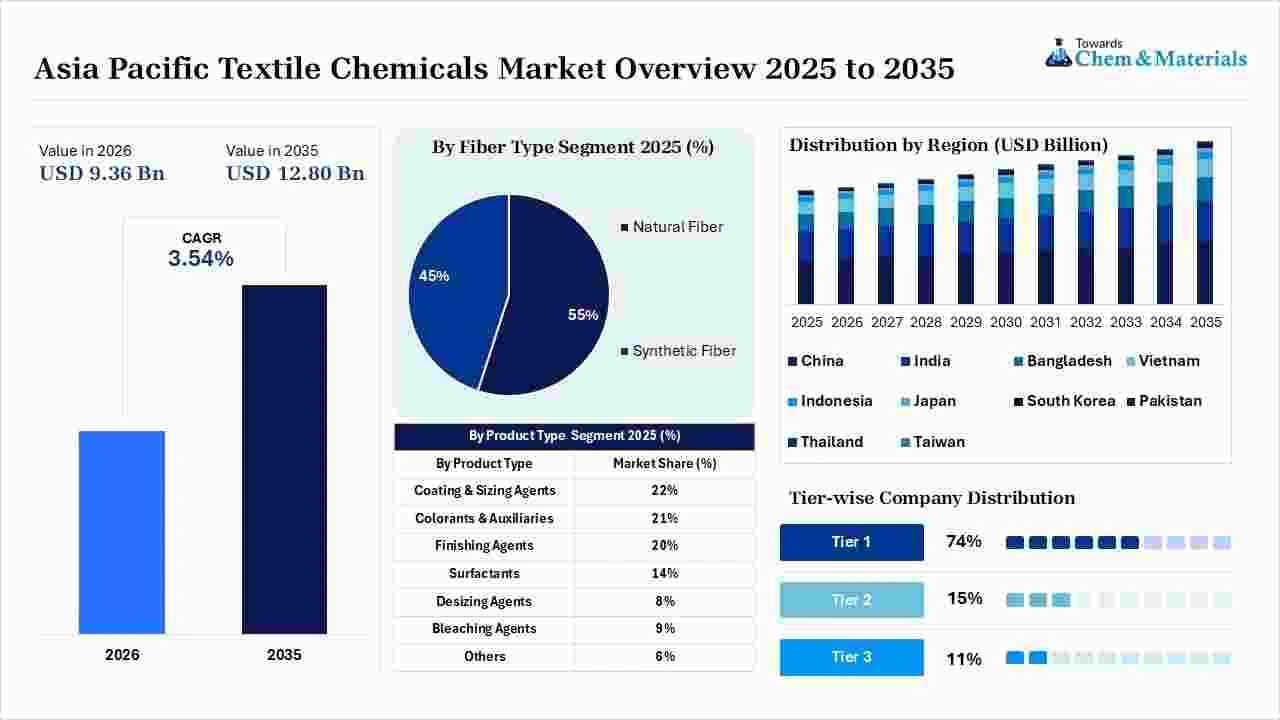
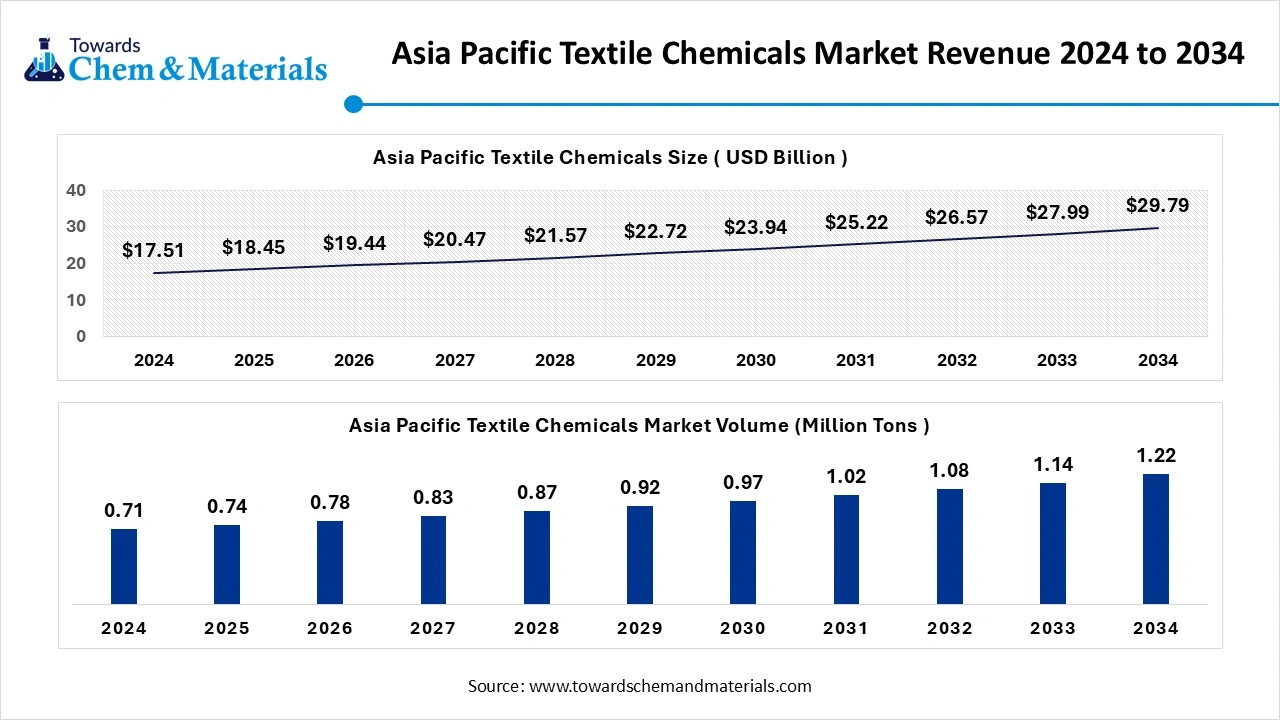
The Asia Pacific textile chemicals market size was valued at USD 9.04 billion in 2025, is estimated to reach USD 9.36 billion in 2026, and is projected to reach USD 12.80 billion by 2035, exhibiting a compound annual growth rate (CAGR) of 3.54% over the forecast period from 2026 to 2035. The market is backed by ongoing development of textile production facilities in key economies of the region and growing demand for performance-based fabrics. Technical textile applications are another boost to the demand for chemicals in various applications such as apparel, industrial, healthcare, and automotive applications. The use of sustainable formulations, digital textile printing, zero-liquid-discharge systems, and smart factory automation is increasingly shaping industry development.
Market Highlights
- China dominated the Asia Pacific textile chemicals market by holding a 38.5% share in 2025 and is expected to grow at a CAGR of 5.6% during the forecast period.
- India held a 25.7% market share in 2025 and is expected to grow the fastest with a CAGR of 5.9% during the forecast period.
- By fiber type, the natural fiber segment held 55% market share in 2025 and is expected to grow at the fastest CAGR of 3.18% over the forecast period.
- By fiber type, the synthetic fiber segment held 45% market share in 2025 and is expected to grow at the fastest CAGR of 4.02% over the forecast period.
- By product type, the coating & sizing agents segment dominated the market with the largest share of 22% in 2025 and is expected to grow at a CAGR of 3.46% during the forecast period.
- By product type, the colorants & auxiliaries segment dominated the market with the largest share of 21% in 2025 and is expected to grow at a CAGR of 4.28% during the forecast period.
- By application, the apparel segment dominated the market with the largest share of 54% in 2025 and is expected to grow at the fastest CAGR of 3.76% over the forecast period.
- By application, the home textile segment held 24% market share in 2025 and is expected to grow at a CAGR of 3.21% during the forecast period.
According to Towards Chemicals and Materials Analytics and Consulting, the Asia Pacific textile chemicals market volume was valued at 3.10 million tons in 2025 and is expected to surpass around 4.13 million tons by 2035, accelerating a compound annual growth rate (CAGR) of 2.90% over the forecast period from 2026 to 2035.
Market Overview
Asia Pacific textile chemicals market is gaining considerable advantages from the presence of ample manufacturing facilities in China, India, Bangladesh, and Vietnam. Water repellency, UV protection, wrinkle resistance, and antimicrobial protection are all desired physical characteristics of performance apparel that are increasing in demand. Specialized chemical uses are being aided by technical textiles in industrial, medical, automotive, and filtration fields. Emerging opportunities include eco-friendly formulations, as chemical manufacturers strive to replace toxic and chemical-based products with biodegradable and bio-based alternatives.
Global Investment Movement for the Asia Pacific Textile Chemicals Market
Chemical companies are increasingly putting their resources into biodegradable auxiliaries, non-toxic formulations, water-repellents without fluorine, and colorants of vegetable origin. Strategic partnerships between polymer producers and recycling specialists are helping to boost spinning capacity from recycled PET and help reduce the carbon footprint of synthetic alternatives. The partnerships are helping to build circularity in the textile value chain and enhance resource use in the manufacturing of textile products in the region.Indian and Chinese textile mills and chemical suppliers are investing in zero liquid discharge systems, wastewater management, and process automation. These efforts focus on reducing water and energy usage and increasing manufacturing efficiency.
Report Scope
| Report Attributes | Details |
| Market Size in 2026 | USD 9.36 Billion/ 3.19 Million Tons |
| Expected Size in 2035 | USD 12.80 Billion/ 4.13 Million Tons |
| Growth Rate | CAGR of 3.54% |
| Base Year of Estimation | 2025 |
| Forecast Period | 2025-2035 |
| Segment Covered | By Fiber Type, By Product Type, By Application |
| Key Companies Profiled | Huntsman Corporation, Archroma, DyStar Group, BASF SE, Clariant AG, Fineotex Chemical Limited, Rossari Biotech Limited, Sarex Chemicals, Kiri Industries Ltd., Bodal Chemicals, Atul Ltd., CHT Group, Rudolf GmbH |
Market Trends
- As for environmentally friendly requirements, the manufacturers are increasingly using biodegradable processing agents, low-impact dyes, and waterless dyeing systems.
- Demand for industrial and technical textiles is growing in the automotive, medical, and protection sectors.
- Indias National Technical Textiles Mission and its investments in China are leading to the manufacture of superior quality fabrics in the country.
- Digital print technologies are increasingly being integrated with smart functional finishes, enhancing properties such as UV resistance, antimicrobial properties, and moisture-wicking properties in textile facilities.
Key Technological Shifts and AI in the Asia Pacific Textile Chemicals Market
The development of artificial intelligence technologies has been aiding in the automation of textile chemical application, which has led to greater precision and consistency in the process, improving the overall work experience. AI systems can optimize the pH, water temperature, and chemical composition in the dyeing process, thereby reducing the risk of uneven dyeing. Absorption rates of dyes can be predicted using machine learning models, which can help reduce the use of chemicals and water. Smart factory systems are also incorporating predictive maintenance features by utilizing sensors on chemical mixing and treatment equipment.
Supply Chain Analysis of the Asia Pacific Textile Chemicals Market
Feedstock Procurement
- Supplies of basic raw materials, crude derivatives and base blocks for the production of chemical solutions used in the textile manufacturing processes throughout the region.
- The process of ensuring that the necessary industrial inputs and chemical building blocks are available for consistent chemical manufacturing is of critical importance.
- Tata Chemicals Limited is one of the key players that provide the industrial chemical feedstocks to textile markets directly in India.
- Other Key Players: Sumitomo Chemical Co., Ltd., Reliance Industries Limited, and China Petroleum & Chemical Corporation.
Chemical Synthesis and Processing
- Reactive processing, polymerization, and advanced chemical synthesis of core specialty compounds from raw chemical feedstocks.
- Chemical synthesis is used to convert basic raw materials into functional chemicals used in dyes and pigments, auxiliaries, coatings, and specialized uses in the textiles industry.
- Zhejiang Longsheng Group Co., Ltd. is a company that produces high-volume organic pigments and basic dye chemical blocks in special-purpose factories.
- Other Key Players: BASF SE, Kiri Industries Limited and Transfar Chemicals Group.
Compound Formulation and Blending
- Produce standard core chemicals with special additives to form customised finishing agents, functional softeners and performance auxiliaries.
- The importance of formulation and blending is that they enable the manufacturer to tailor the chemical properties to the requirements of the textile processing and the desired performance.
- NICCA Chemical Co., Ltd. develops special performance fabric finishings and water repellents tailored to specific applications.
- Other Key Players: Archroma, DyStar Group and Fineotex Chemical Limited.
Sustainability Analysis
As manufacturers strive to adopt production methods with reduced environmental impact, sustainability is gaining importance in the Asia Pacific textile chemicals market. More and more, eco-friendly formulations, biodegradable chemicals, low-impact dyes, and waterless dyeing technologies are being highlighted. A zero-liquid-discharge system is enabling the reuse of wastewater, alongside the reduction of resource use, in manufacturing processes. In addition to chemical recycling partnerships, recycled PET spinning is also promoted to encourage circular textile production. Sustainability goals are also being achieved through smart automation, digital monitoring, and processing with a minimal amount of resources.
What are Textile Chemicals?
Textile Chemicals refer to the chemicals that are applied during various textile production stages to assist in dyeing, printing, softening, sizing, coating, bleaching, textile performance, and other special applications. These products enhance the appearance, processability, durability, functionality, and application-specific properties of textiles in regional manufacturing processes.
Uses of Asia Pacific Textile Chemicals
- Textile chemicals are used to assist with dyeing, printing, and finishing to achieve better coloration, surface effect, shade uniformity, and visual performance in both apparel and home and technical textile products.
- In modern textile applications, functional chemicals are used to impart various characteristics like water-repellency, UV protection, antimicrobial properties, wrinkle resistance, moisture management, and so on, to meet the performance criteria.
- These special chemical formulations allow textiles to fulfill functions in automotive, medical, filtration, protective, industrial, and other technically demanding applications with different and special material properties.
Pricing Analysis for the Asia Pacific Textile Chemicals Market
The raw materials, environmental regulations, sustainability demand, and regional production competition all play a part in the pricing of textile chemicals. Changes in basic chemical and petroleum feedstocks can impact production costs, and fluctuations in oil prices can impact input costs. More stringent environmental standards may lead to higher operating expenses by introducing cleaner wastewater systems. Eco-certified products, natural products, may cost more than conventional products, and competition in the region can keep the price of the basic chemical products competitive.
Asia Pacific Textile Chemicals Market: Global Trade Analysis
The Asia Pacific textile chemicals market is tightly coupled with the regional textile production concentration and shifting production base. China, India, Bangladesh, Vietnam, and Indonesia are significant manufacturing sites for chemicals. Focus on diversifying the supply chain and promoting a more even distribution of regional production. Environmental compliance and specific chemical needs are also impacting sourcing, supplier relationships, and regional manufacturing practices in textile processing facilities.
Segmental Insights
Fibre Insights
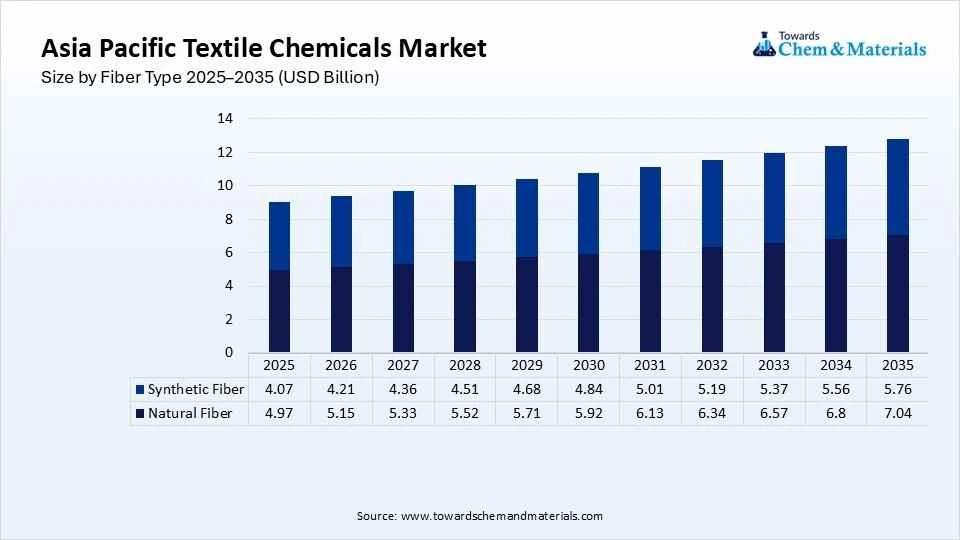
The natural fiber segment dominated the market with the largest share of 55% in 2025 and is expected to grow at a CAGR of 3.18% over the forecast period, as its presence was high in cotton, wool, silk, linen, and viscose fibers. These materials are effectively dyed, finished, bleached, sized, and softened using textile chemicals. Increased sustainability demands have led to the creation of specialised products to help the processing of natural fibres, performance of fabrics, and sustainable textile manufacturing practices within regional production sites.
- For instance, in February 2026, Grasim Industries Limited presented to Première Vision in Paris sustainable innovations based on natural fibers, such as linen, wool, traceability, and the evolving preferences of the world for sustainable textile solutions.(Source: www.indiantextilemagazine.in)
The synthetic fiber segment held a 45% market share in 2025 and is expected to grow at the fastest CAGR of 4.02% over the forecast period, as polyester, nylon, acrylic, polypropylene, and elastane are increasingly being used. Chemicals used in textiles enhance colouring, finishing, durability, softness, moisture management and functionality in synthetic textiles. The development of performance apparel and technical textile applications is driving the need for special chemical formulations based on the various properties of synthetic fibers and processing conditions.
Asia Pacific Textile Chemicals Market Share, By Fiber Type, 2025(%)
| By Fiber Type | Market Share (%) |
| Natural Fiber | 55% |
| Synthetic Fiber | 45% |
Product Insights
The coating & sizing agents segment dominated the market with the largest share of 22% in 2025 and is expected to grow at a CAGR of 3.46% over the forecast period, owing to their significance in the textile preparation and processing phase. These chemicals enhance surface qualities, handling, dimensional stability, and processing. As manufacturing of functional and performance fabrics grows, specialized sizing and coating formulations are helping to ensure fabric quality and enable greater efficiency in downstream textile manufacturing throughout the regions.
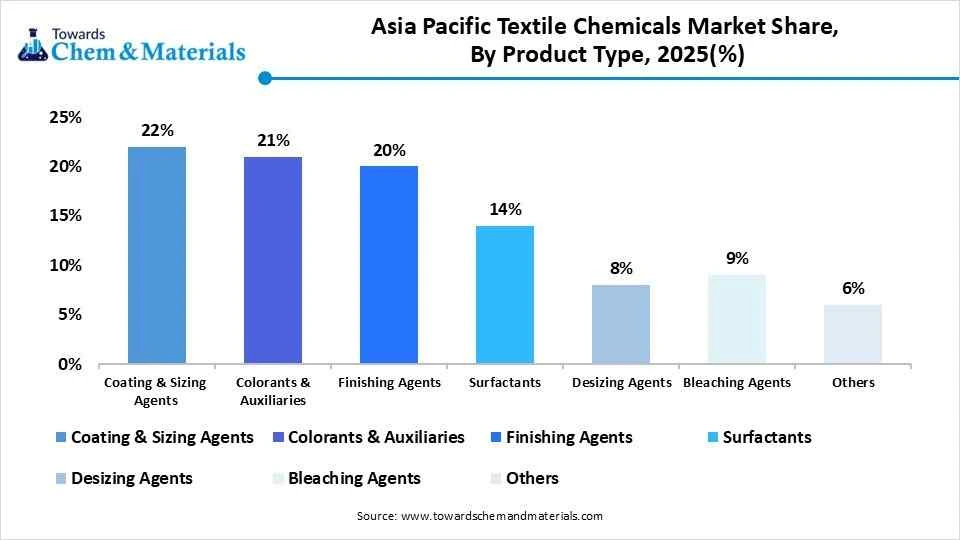
The colorants & auxiliaries segment held a 21% market share in 2025 and is expected to grow at the fastest CAGR of 4.28% over the forecast period, due to growing demand for efficient dyeing and colouring processes. The products enhance shade consistency, color fastness, dye absorption, textile processing efficiency, and the overall quality of the textile. In addition, increased sustainability demands are pushing the development of sophisticated auxiliaries with reduced processing needs and that are geared towards enhancing performance in a variety of textile manufacturing processes.
- For instance, in August 2025, Archroma launched CYCLANON® XC-W, an auxiliary product for washing-off to enhance colour fastness and efficient cellulosic dyeing in extreme processing conditions.
(Source: www.textileworld.com )
Asia Pacific Textile Chemicals Market Share, By Product Type, 2025(%)
| By Product Type | Market Share (%) |
| Coating & Sizing Agents | 22% |
| Colorants & Auxiliaries | 21% |
| Finishing Agents | 20% |
| Surfactants | 14% |
| Desizing Agents | 8% |
| Bleaching Agents | 9% |
| Others | 6% |
Source Insights
The apparel segment dominated the market with the largest share of 54% in 2025 and is expected to grow at the fastest CAGR of 3.76% over the forecast period, owing to the well-established clothing manufacturing industry and the rising demand for functional clothing. Textile chemicals are used to give colour, softness, durability, moisture management, wrinkle resistance, etc. to the textiles. The production of sportswear, activewear, casualwear, formalwear, and innerwear keeps on expanding, generating demand for specialised formulations for appearance, comfort, function, and manufacturing efficiency.
- For instance, in February 2026, the State of Odisha in February 2026, launched the construction of a textile park in Keonjhar; Hindalco Industries became an anchor investor and started to enter the garment manufacturing space through this project.(Source: www.fibre2fashion.com)
The home textile segment held a 24% market share in 2025 and is expected to grow at a CAGR of 3.21% over the forecast period. The home textile market is significant, and it includes bed linen, towels, curtains, carpets, rugs, and upholstery. These products are supported by textile chemicals in the areas of colour, finishing, softness, water resistance, wrinkle resistance, durability, and surface characteristics. As consumer preferences increasingly become functional and aesthetic, manufacturers are responding by using special chemical treatments across the regional textile manufacturing process.
Asia Pacific Textile Chemicals Market Share, By Application, 2025(%)
| By Application | Market Share (%) |
| Apparel | 54% |
| Home Textile | 24% |
| Technical Textile | 18% |
| Others | 4% |
Regional Insights
How Did China Dominate the Asia Pacific Textile Chemicals Market in 2025?
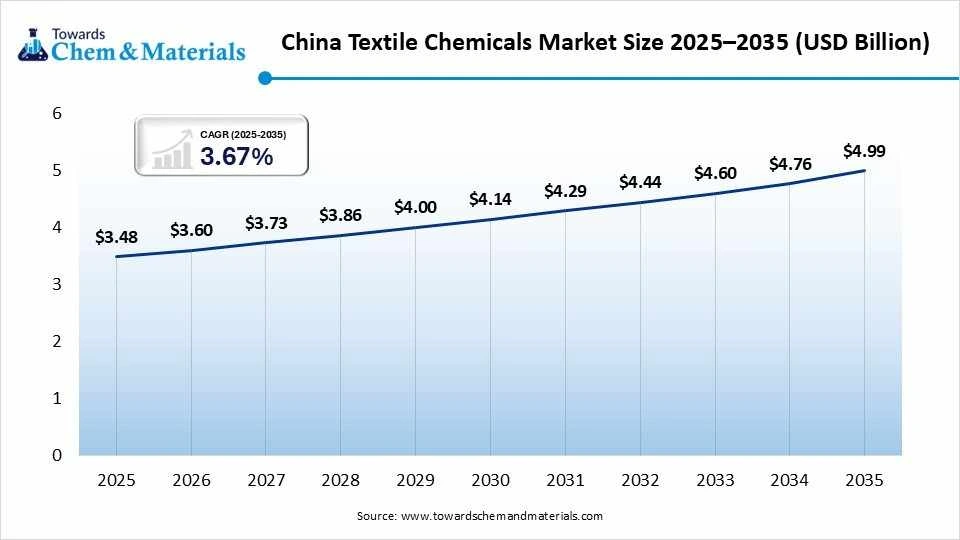
China Textile Chemicals market size was estimated at USD 3.48 billion in 2025 and is projected to reach USD 4.99 billion by 2035, growing at a CAGR of 3.67% from 2026 to 2035. China dominated the market with the largest share of 38.5% in 2025 and is expected to grow at a CAGR of 5.6% during the forecast period. There is a vast infrastructure of textile manufacturing in the Asia Pacific region and high demand for processing chemicals, which helps China to hold the largest share of the Asia Pacific textile chemicals market. It also has chemical manufacturing capabilities in dyes, pigments, auxiliaries, coatings, and special blends. The growing focus on sustainable textile production, water treatment, and innovative processing methods remains a key driver of market growth throughout the textile production value chain in China.
India
India Textile Chemicals market size was estimated at USD 2.36 billion in 2025 and is projected to reach USD 3.29 billion by 2035, growing at a CAGR of 3.37% from 2026 to 2035. India held a 25.7% market share in 2025 and is expected to grow at the fastest CAGR of 5.9% during the forecast period due to increasing textile manufacturing and technical textile applications. There are government-promoted manufacturing programmes and greater investments in performance-based textiles driving local manufacturing capabilities. As Indias textile industry continues to evolve, opportunities for chemical suppliers to the textile industry are gaining significant traction due to sustainable processing, advanced Japanese textile technologies, and growing apparel manufacturing.
- For instance, in July 2026, Ecolink Solutions showcased Japanese functional textile technologies at Bharat Tex 2026 for heat stress, comfort, sustainability, and premium apparel applications.
(Source: www.textileexcellence.com )
Bangladesh
Bangladesh Textile Chemicals market size was estimated at USD 1.34 billion in 2025 and is projected to reach USD 1.92 billion by 2035, growing at a CAGR of 3.69% from 2026 to 2035. Bangladesh held 14.8% market share in 2025 and is expected to grow at a CAGR of 5.5% over the forecast period. Bangladesh is an important textile manufacturing hub in Asia Pacific and is expected to continue to be a major contributor to the demand for textile processing chemicals in apparel manufacturing. The manufacturing segment provides opportunities for dyestuffs, auxiliary chemicals, finishing chemicals, sizing agents and special formulations. Greater strides toward sustainable requirements throughout the textile manufacturing process are driving more focus on the efficient management of chemicals and water waste.
Vietnam
Vietnam Textile Chemicals market size was estimated at USD 0.99 billion in 2025 and is projected to reach USD 1.41 billion by 2035, growing at a CAGR of 3.59% from 2026 to 2035. Vietnam held 11% market share in 2025 and is expected to grow at a CAGR of 5.3% over the forecast period. As supply chains spread to other countries in Asia Pacific, Vietnam keeps expanding as a key textile production site. Apparel production, dyeing and finishing, and the demand for textile chemicals for sustainability are all drivers for textile chemical demand. However, an increasing focus on sustainable dyeing methods is opening up opportunities for specialty chemical suppliers for Vietnams textile manufacturers and exporters.
- For instance, in August 2025, Archromas leadership talked about sustainable dyeing solutions and directions for strategic development of the textile chemical dye industry in Vietnam during business expansion activities in Vietnam. (Source: vinatex.com )
Indonesia
Indonesia Textile Chemicals market size was estimated at USD 0.36 billion in 2025 and is projected to reach USD 0.58 billion by 2035, growing at a CAGR of 4.77% from 2026 to 2035. Indonesia held a 4% market share in 2025 and is expected to grow at a CAGR of 5.1% over the forecast period. Indonesia is becoming a key manufacturing hub in the multi-faceted Asia Pacific textile supply chain. The textile industry provides a base for the chemical industry in various aspects like dyeing, finishing, garments, home textiles, and technical applications. The demand for diversifying the supply chain and sustainability in the Indonesian manufacturing industry can also drive the use of efficient chemical processing technologies.
Japan
Japan Textile Chemicals market size was estimated at USD 0.20 billion in 2025 and is projected to reach USD 0.28 billion by 2035, growing at a CAGR of 3.63% from 2026 to 2035. Japan held a 2.2% market share in 2025 and is expected to grow at a CAGR of 2.8% over the forecast period. Japan has a well-developed regional textile chemical ecosystem and possesses sophisticated chemical technologies and special textile processing skills. Japanese companies invest throughout the chemical synthesis and formulation stages and in other functional finishes and performance-based textile applications. Specialized and high-performance textile chemical solutions continue to be supported by advanced manufacturing practices.
Taiwan
Taiwan Textile Chemicals market size was estimated at USD 0.05 billion in 2025 and is projected to reach USD 0.09 billion by 2035, growing at a CAGR of 5.00% from 2026 to 2035. Taiwan held 0.6% market share in 2025 and is expected to grow at a CAGR of 2.9% over the forecast period. The textile industry in Taiwan continually prioritizes technology-driven eco-friendly production, resource efficiency, and innovative dyeing methods. Water- and energy-saving processes are being developed for textile technology companies, and the functional performance of textiles is being supported. The developments provide opportunities for specialised chemical technologies to fit textile manufacturing to increasingly challenging environmental goals.
- For instance, in July 2026, WILEYTEX Technology Co., Ltd introduced the ecoloration technology, which is a salt-free and steam-free dyeing process to minimize water and energy consumption.
(Source: www.fibre2fashion.com)
Thailand
Thailand Textile Chemicals market size was estimated at USD 0.07 billion in 2025 and is projected to reach USD 0.11 billion by 2035, growing at a CAGR of 4.30% from 2026 to 2035. Thailand held 0.8% market share in 2025 and is expected to grow at a CAGR of 3.7% over the forecast period. Thailand is in a developing status in the Asia Pacific textile chemicals market owing to its textile manufacturing industry and integration of the regions supply chain. The processing of chemicals is related to appliqués, home textiles, and specialty textile applications. The use of advanced chemical formulations could still be encouraged in textile manufacturing.
Recent Developments
- In January 2026, the Government of India extended the deadline for fresh applications for the Production Linked Incentive Scheme (PLI) for Textiles to 31st March 2026. The extension is to encourage more investment proposals in textile manufacturing in identified priority zones. (Source: www.pib.gov.in)
Competitive Analysis
Asia Pacific textile chemicals market is competitive, with companies focusing on sustainable formulation, functional finishes, chemical recycling, strategic partnerships, and regional expansion. Chemical synthesis, formulation, dyes, auxiliaries, coatings, and performance-oriented solutions for textiles are among the fields in which major participants are active. Sustainability requirements and advanced functional properties of textiles are increasing competition.
- For instance, in November 2025, Indorama Ventures Fibers business and Jiaren Chemical Recycling entered into a joint venture to focus on the spinning capacity for textile recycled PET.(Source: www.indoramaventures.com)
- In December 2025, Asahi Kasei and Teijin signed an agreement to absorb each others businesses. The above arrangement of the joint venture promotes cooperation in the business activities of textiles and facilitates strategic integration of operational activities.(Source: www.asahi-kasei.com)
- In January 2026, Archroma and HeiQ came together to co-market a range of products backed by complementary strengths across the areas of sustainable anti-odor and antimicrobial technology.(Source: www.archroma.com)
Top Players in the Market & Their Offerings
| Company | Company Type/Position | Major Headquarters | Geographic Presence | Asia Pacific Textile Chemicals Offerings | Key Strength |
| Kiri Industries Ltd. | Dye Manufacturer | Ahmedabad, Gujarat, India | India, Asia Pacific | Direct, reactive, and dispersion dyes | Cost-effective production base and robust presence in the Indian textile hub |
| Jay Chemical Industries Ltd. | Chemical Producer | Ahmedabad, Gujarat, India | Asia Pacific, International | Reactive dyes, textile auxiliaries, inkjet inks | Extensive local expertise and customized dyeing solutions |
Other Key Players
- Huntsman Corporation
- Archroma
- DyStar Group
- BASF SE
- Clariant AG
- Fineotex Chemical Limited
- Rossari Biotech Limited
- Sarex Chemicals
- Kiri Industries Ltd.
- Bodal Chemicals
- Atul Ltd.
- CHT Group
- Rudolf GmbH
Segment Covered in the Report
By Fiber Type
- Natural Fiber
- Cotton
- Wool
- Silk
- Linen
- Rayon/Viscose
- Synthetic Fiber
- Polyester
- Nylon
- Acrylic
- Polypropylene
- Elastane/Spandex
By Product Type
- Coating & Sizing Agents
- Starch-Based Sizing Agents
- Synthetic Sizing Agents
- Film-Forming Agents
- Polymer Coatings
- Colorants & Auxiliaries
- Dyes
- Pigments
- Dispersing Agents
- Leveling Agents
- Fixing Agents
- Finishing Agents
- Softening Agents
- Water-Repellent Agents
- Flame-Retardant Agents
- Anti-Wrinkle Agents
- Antimicrobial Agents
- Surfactants
- Nonionic Surfactants
- Anionic Surfactants
- Cationic Surfactants
- Amphoteric Surfactants
- Desizing Agents
- Enzymatic Desizing Agents
- Oxidative Desizing Agents
- Acid Desizing Agents
- Bleaching Agents
- Hydrogen Peroxide
- Sodium Hypochlorite
- Peracetic Acid
- Optical Brighteners
- Others
- Sequestering Agents
- pH Regulators
- Anti-Static Agents
- Lubricants
- Specialty Textile Chemicals
By Application
- Apparel
- Sportswear
- Casualwear
- Formalwear
- Activewear
- Innerwear
- Home Textile
- Bed Linen
- Towels
- Curtains
- Carpets & Rugs
- Upholstery
- Technical Textile
- Automotive Textiles
- Medical Textiles
- Geotextiles
- Protective Textiles
- Industrial Textiles
- Others
- Footwear Textiles
- Filtration Textiles
- Agricultural Textiles
- Packaging Textiles
A Seven-Phase Framework
Our methodology is designed to be universally applicable across commodity chemicals, specialty chemicals, petrochemicals, construction chemicals, coatings, electronic chemicals, industrial gases, agrochemicals, water treatment chemicals, and performance materials. Each phase builds upon the last, creating a layered validation structure that minimizes estimation error and maximizes analytical confidence.
The framework ensures comprehensive market coverage, robust cross-validation, and reliable long-term forecasting — producing market estimates that withstand scrutiny from investors, regulators, and corporate strategy teams.

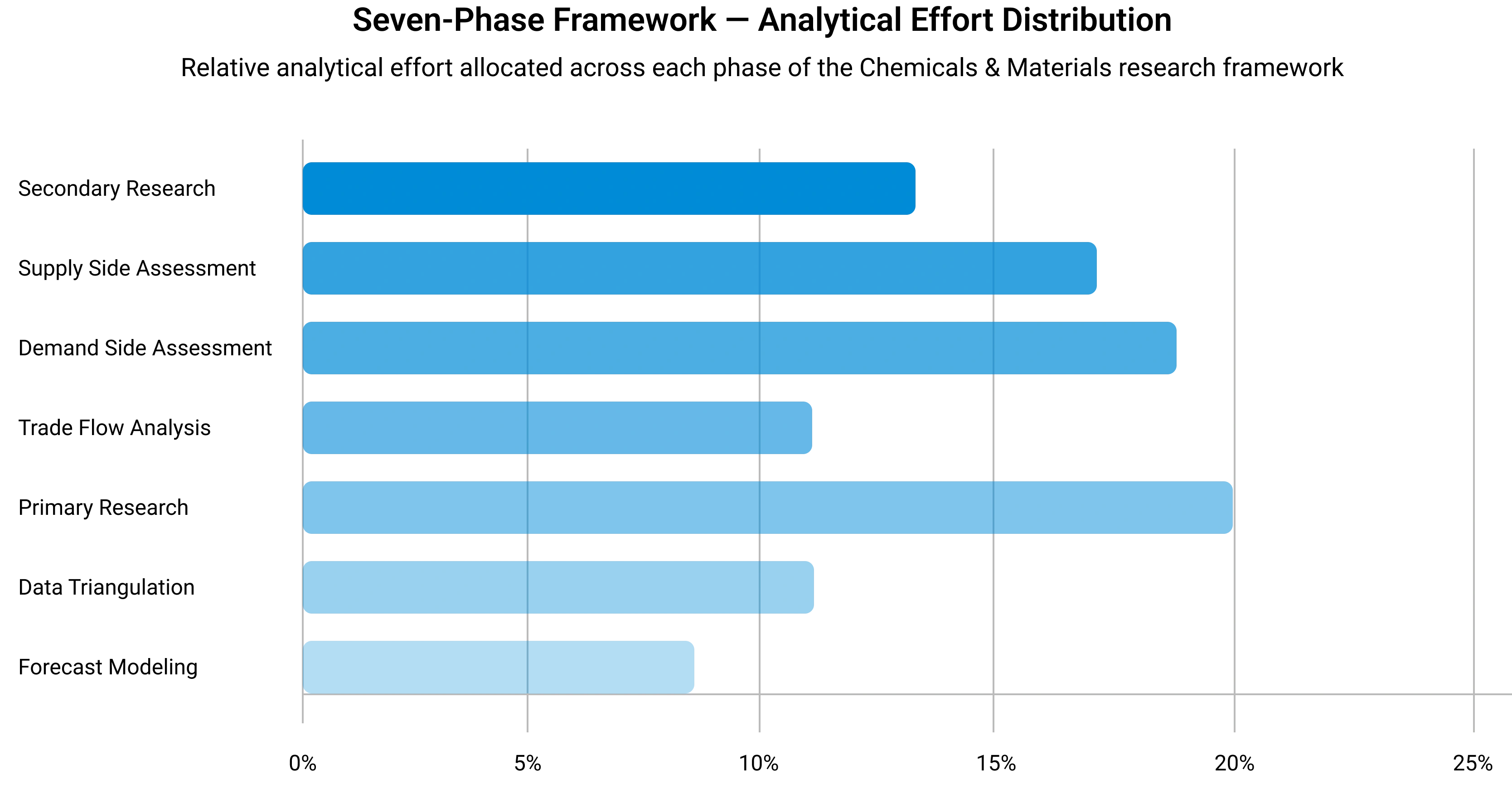
Seven-Phase Framework — Analytical Effort Distribution
Relative analytical effort allocated across each phase of the Chemicals & Materials research framework
Phase 1 - Secondary Research: Establishing the Foundation
Secondary research collects and evaluates publicly available information from authoritative sources, establishing the foundational understanding of market structure, value chain dynamics, competitive landscape, and end-use demand patterns. Every source is evaluated for credibility, recency, geographic relevance, and methodological soundness before inclusion.
Industry Associations
Sources include ACC, CEFIC, ICCA, JCIA, CPCIF, and SOCMA providing production volumes, consumption trends, capacity developments, and sustainability initiatives.
Company Disclosures
Annual reports, investor presentations, earnings transcripts, and regulatory filings reveal product portfolios, manufacturing footprints, capacity expansions, and revenue segmentation.
Government Databases
National statistical offices, customs authorities, environmental agencies, and industrial production databases provide verified statistics on output, trade flows, and regulatory compliance.
Trade Databases
UN Comtrade, ITC, Eurostat, and national customs authorities enable assessment of global product movement, import dependency, and export competitiveness across regions.
Our Secondary Research Sources
- Ministry of Chemicals and Fertilizers
- European Chemicals Agency
- United States Department of Energy
- Ministry of Industry and Information Technology
- Ministry of Economy Trade and Industry
- Ministry of Trade Industry and Energy
- National Institute of Standards and Technology
- Council of Scientific and Industrial Research
- Fraunhofer Society
- National Institute for Materials Science
Phase 2 — Supply-Side Assessment: Mapping Production Capabilities
Production Capacity Analysis
All major manufacturers are assessed for existing installed capacity, planned additions, expansions, new plant announcements, and technology adoption — mapped at global, regional, and country levels.
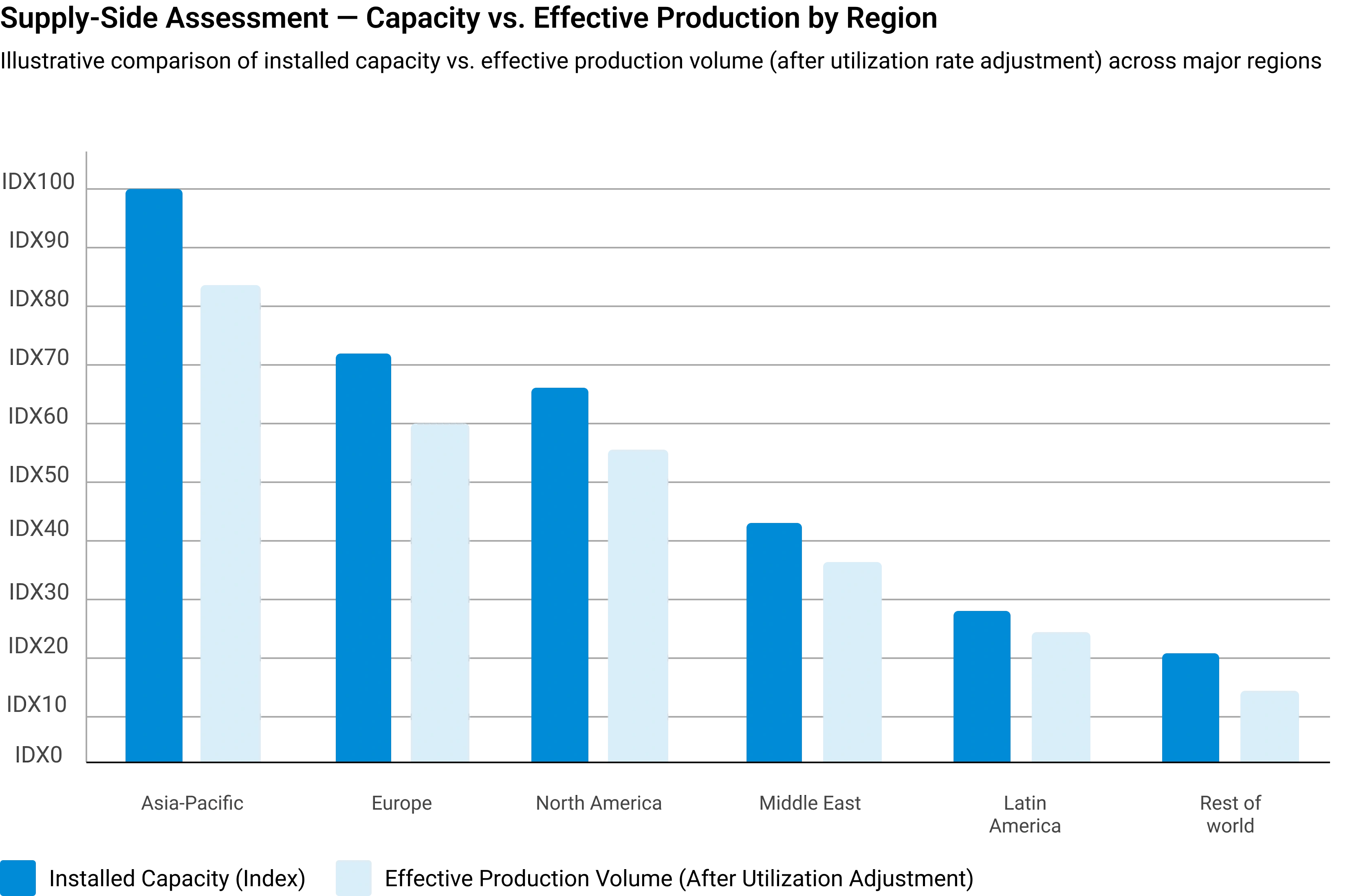
Capacity Utilization Adjustment
Installed capacity is adjusted using utilization rates based on demand conditions, feedstock availability, plant operating rates, maintenance schedules, and regulatory restrictions.
Manufacturer Revenue Analysis
Product-specific revenues, segment-level performance, regional distribution, average selling prices, and margin trends are evaluated to establish market value estimates.
Supply-Side Assessment — Capacity vs. Effective Production by Region
Illustrative comparison of installed capacity vs. effective production volume (after utilization rate adjustment) across major regions
Phase 3 — Demand-Side Assessment: Quantifying Chemical Consumption
Demand-side analysis quantifies chemical consumption across industries, applications, and geographies — identifying where and how chemicals are consumed throughout the value chain with precision.
End-Use Industry Analysis
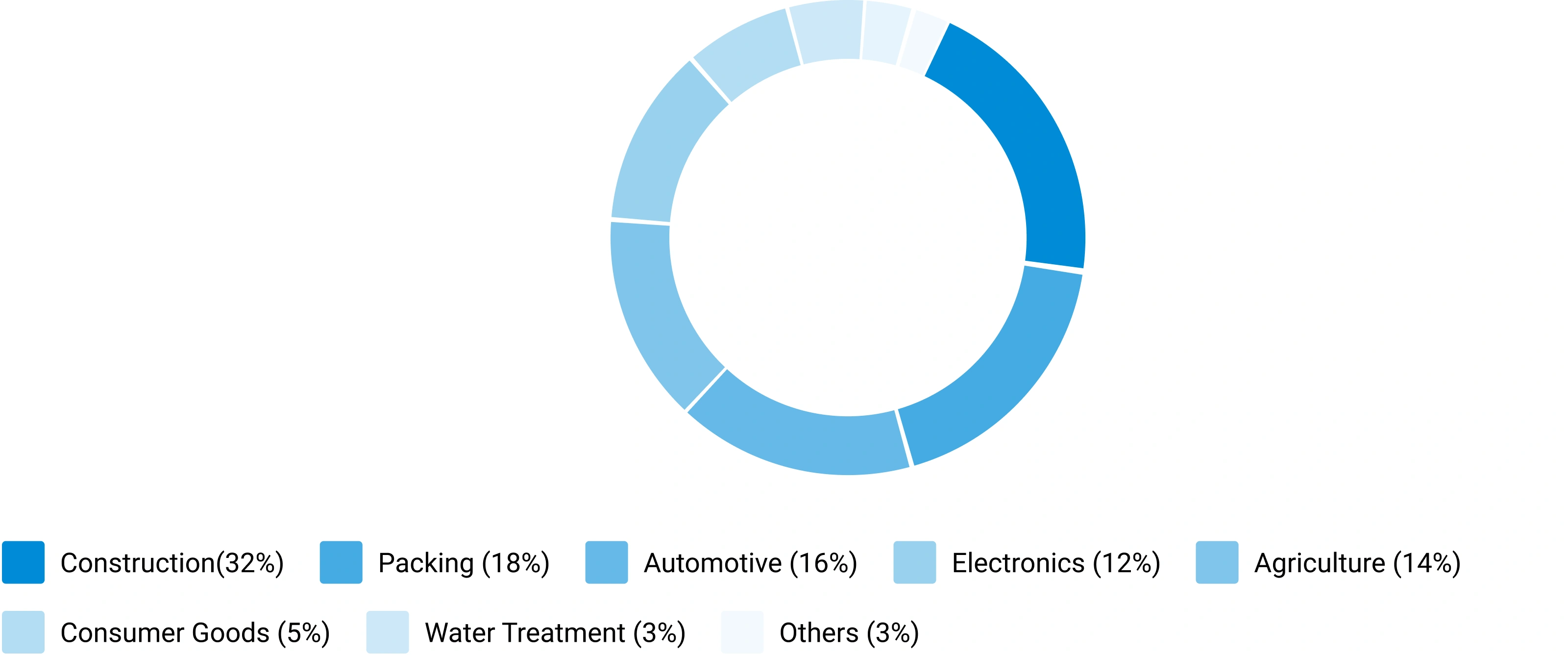
Chemical demand is evaluated across automotive, construction, packaging, electronics, agriculture, healthcare, consumer goods, industrial manufacturing, energy and utilities, and water treatment. Industry output, production trends, and consumption intensity are analyzed to determine demand patterns.
Consumption Modeling
Demand is estimated using measurable indicators: kilograms per vehicle, kilograms per square meter of construction, dosage per cubic meter of water treated, kilograms per hectare of agricultural land, and kilograms per ton of manufactured products. Consumption factors are validated through industry publications and primary interviews.
Application Analysis
The market is segmented by application area to understand product performance requirements, formulation trends, technology adoption, customer preferences, and regulatory requirements improving demand accuracy and segmentation granularity.
Demand-Side Assessment — End-Use Industry Demand Distribution
Illustrative distribution of chemical & materials demand across key end-use industries
Phase 4 - Trade Flow Analysis: Balancing Regional Supply and Demand
Trade flow analysis reconciles regional supply and demand estimates through import and export data, identifying net supply positions, regional dependencies, and market imbalances. It serves as an independent validation layer that tests the consistency of supply-side and demand-side estimates.
Import Analysis
Import data is evaluated to determine volumes, source countries, product dependency, regional supply gaps, and pricing trends — identifying markets that rely heavily on external supply and where domestic production is insufficient to meet demand.
Export Analysis
Export assessments reveal production surplus, export competitiveness, regional manufacturing strength, and global market participation. Export patterns also help validate domestic production estimates and identify net exporting regions.
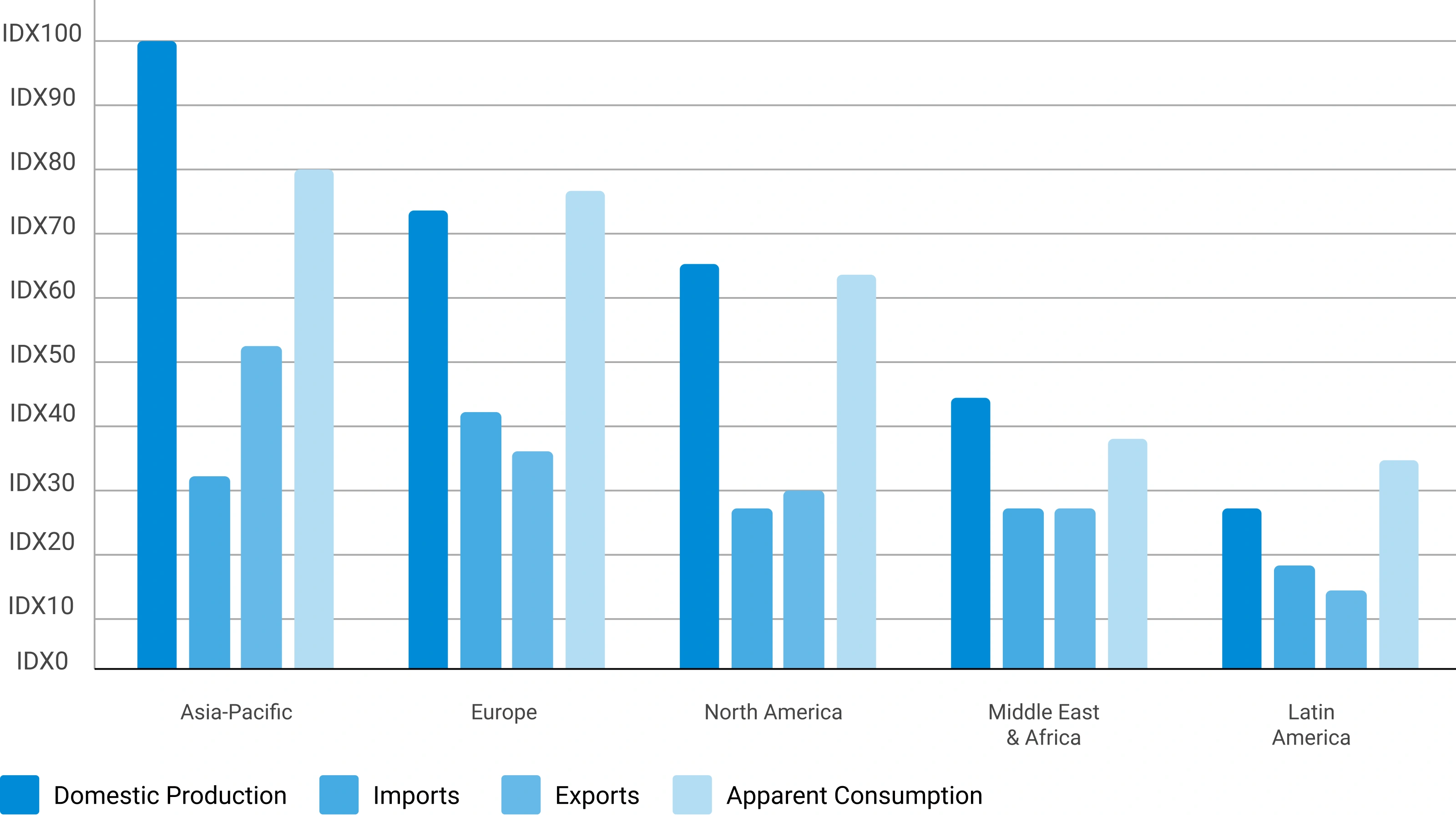
Apparent Consumption Model
Regional consumption is assessed using the standard apparent consumption formula:
Results identify net importing regions, net exporting regions, regional deficits, and surpluses — serving as an independent validation of supply and demand estimates.
Trade Flow Analysis — Net Supply Position by Region
Illustrative apparent consumption vs. domestic production across major regions — positive gap indicates net import dependency
Phase 5 — Primary Research: The Critical Validation Layer
Primary research tests and refines findings from secondary research through direct engagement with industry participants across the supply chain, demand side, and expert community. It captures intelligence that no database or published report can provide — the real-world experience of manufacturers, buyers, and specialists operating in the market.

Supply-Side Interviews
Conversations with chemical manufacturers, raw material suppliers, contract manufacturers, technology providers, and plant operators cover production trends, capacity utilization, pricing developments, technology shifts, and competitive dynamics.

Demand-Side Interviews
Engagement with OEMs, industrial consumers, procurement managers, distributors, formulators, and end-use manufacturers focuses on consumption trends, purchasing behavior, product substitution, demand outlook, and emerging applications.

Industry Expert Consultations
Additional interviews with industry consultants, independent experts, regulatory specialists, technical professionals, and research institutions provide deeper market context and validate key analytical assumptions.
Focus Areas of Primary Research:
Market Size & Forecast Validation
Revenue estimates, volume consumption, growth rates, forecast assumptions, regional demand.Supply Chain & Value Chain Assessment
Raw material sourcing, supply chain challenges, distribution networks, procurement practices.Production & Capacity Analysis
Manufacturing capacity, utilization rates, expansion projects, plant investments.Pricing & Cost Structure Analysis
Product pricing trends, feedstock costs, energy costs, margin pressures, pricing outlook.Competitive Landscape Assessment
Volume and value estimates confirmed to be fully consistent with one another before publicationInterview Volume by Market Scope
| Study Scope | Number of Interviews |
|---|---|
| Niche Market | 20 – 30 |
| Mid-Sized Market | 30 – 50 |
| Global Market | 50 – 80 |
| Highly Fragmented Market | 80 – 120 |
Interview Details:
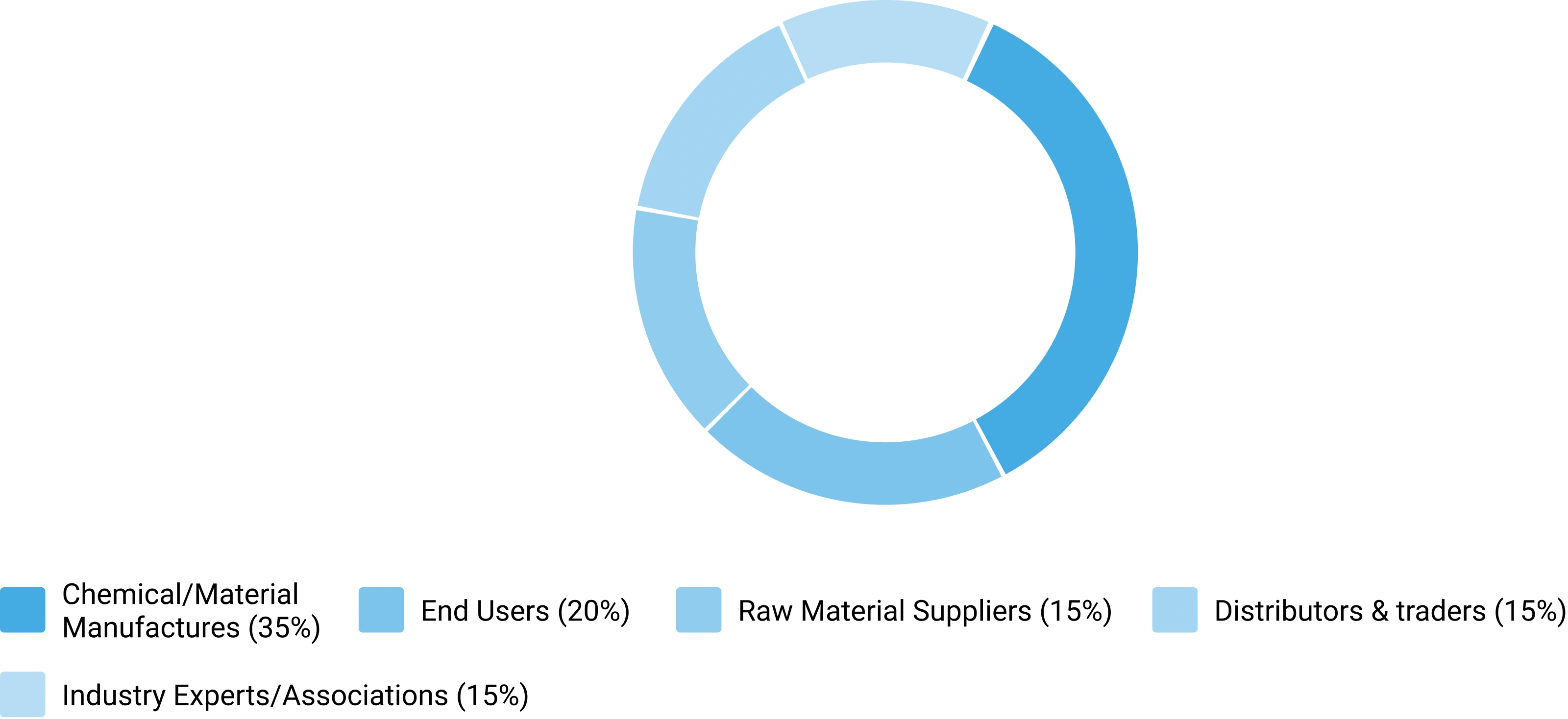
Category : Manufacturers, Suppliers, Distributors, End Users, Experts/Associations
Average Duration : 30–60 Minutes
Interview Mode : Video calls, telephonic interviews, expert consultations
Interview Format : Structured / Semi-Structured questionnaire
Focus Areas of Primary Research:
Market Size & Forecast Validation :
Revenue estimates, volume consumption, growth rates, forecast assumptions, regional demand.
Supply Chain & Value Chain Assessment :
Raw material sourcing, supply chain challenges, distribution networks, procurement practices.
Production & Capacity Analysis :
Manufacturing capacity, utilization rates, expansion projects, plant investments.
Pricing & Cost Structure Analysis :
Product pricing trends, feedstock costs, energy costs, margin pressures, pricing outlook.
Competitive Landscape Assessment :
Market share, competitor positioning, strategic initiatives, partnerships, acquisitions.
Primary Research — Stakeholder Coverage by Category
Distribution of interview respondents across stakeholder categories (% share from PPT data)
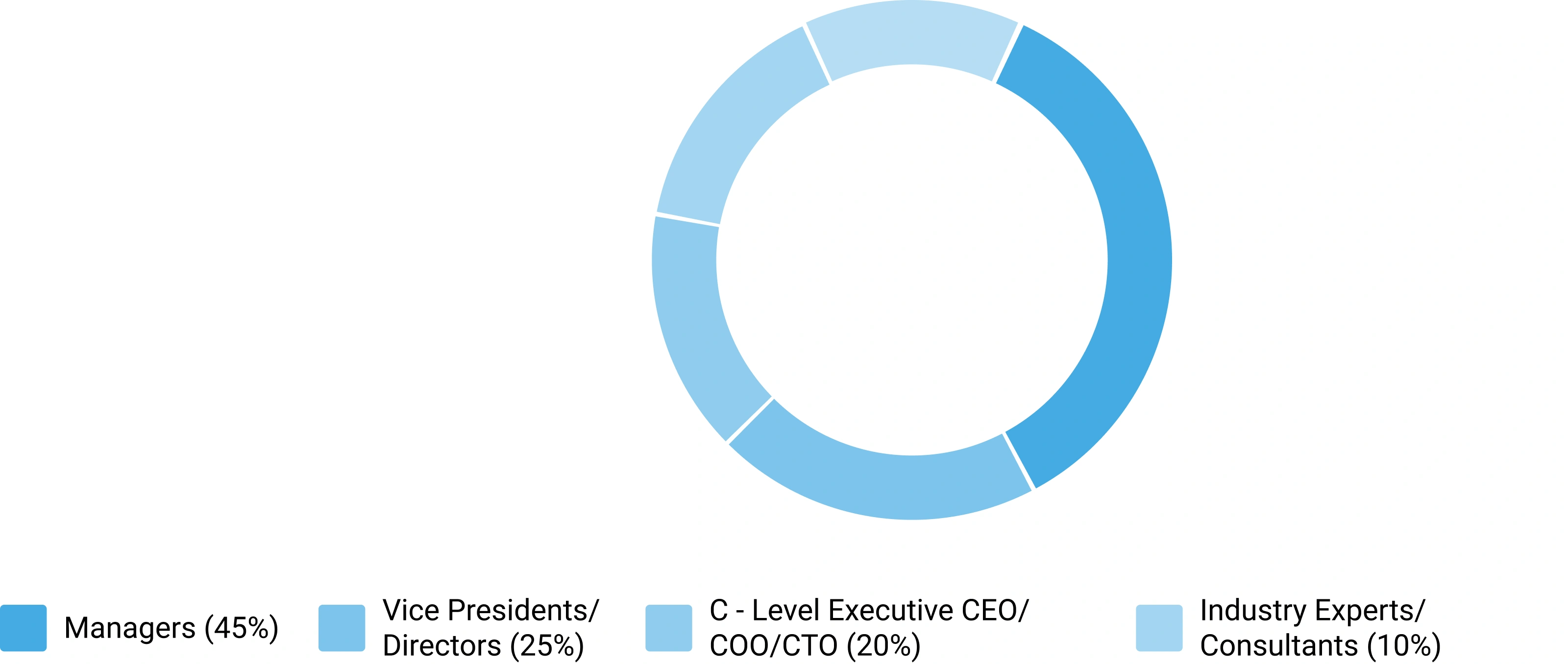
Primary Research — Respondent Designation Profile
Seniority breakdown of interview respondents (% share from PPT data)
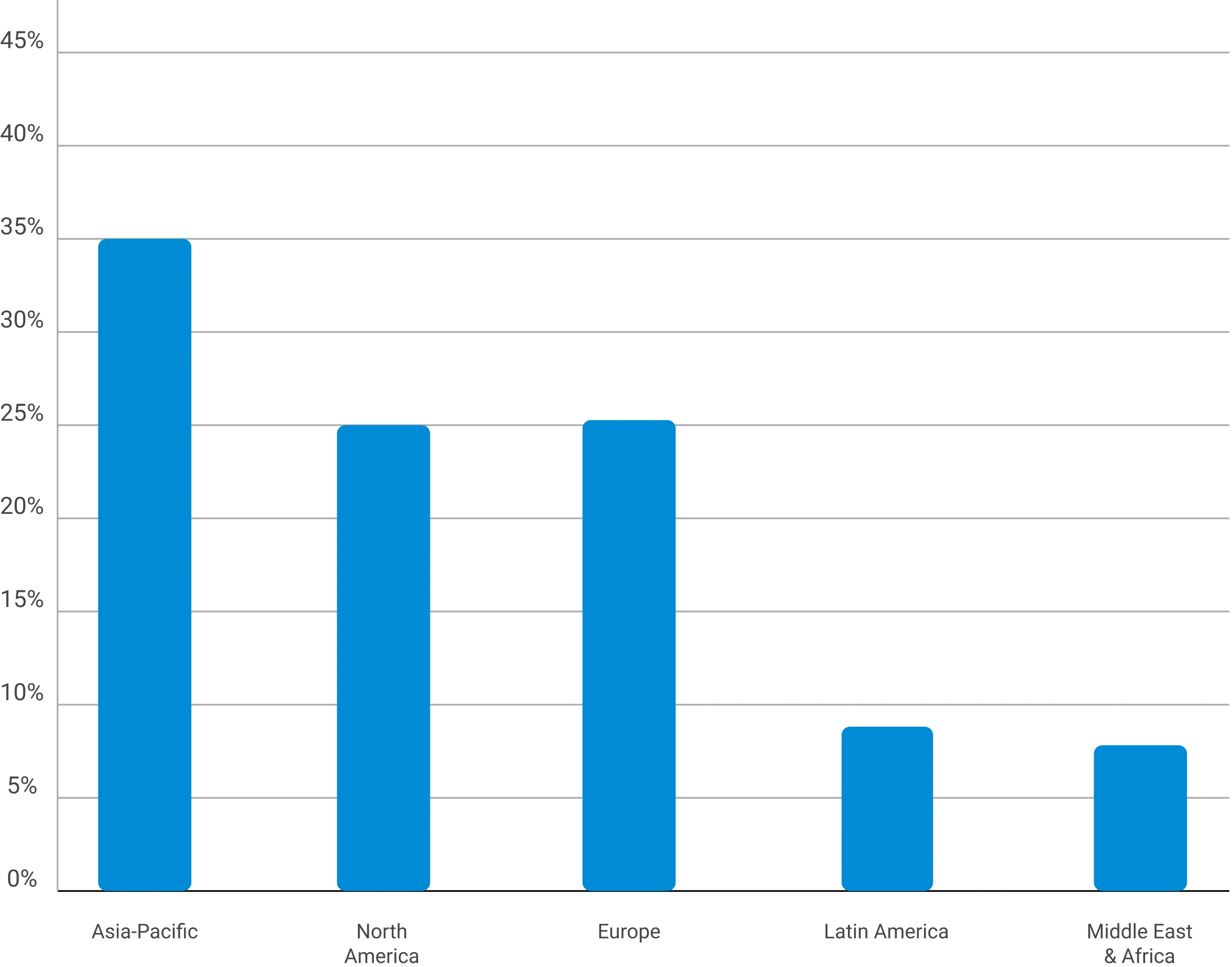
Primary Research — Geographic Coverage of Interviews
Regional distribution of primary research engagement (% share from PPT data)
Phase 6 — Data Triangulation and Market Validation
No single methodology is relied upon in isolation. Multiple independent estimation approaches are combined and reconciled to ensure consistency, accuracy, and analytical defensibility. Any material deviations between approaches are investigated and adjusted through additional validation cycles.
The final market size is derived through weighted triangulation of all validated methodologies. Any material deviations between approaches are investigated and adjusted through additional validation cycles. The outcome represents the most realistic assessment of the market based on available evidence and expert confirmation ensuring that volume and value estimates are fully consistent with one another.
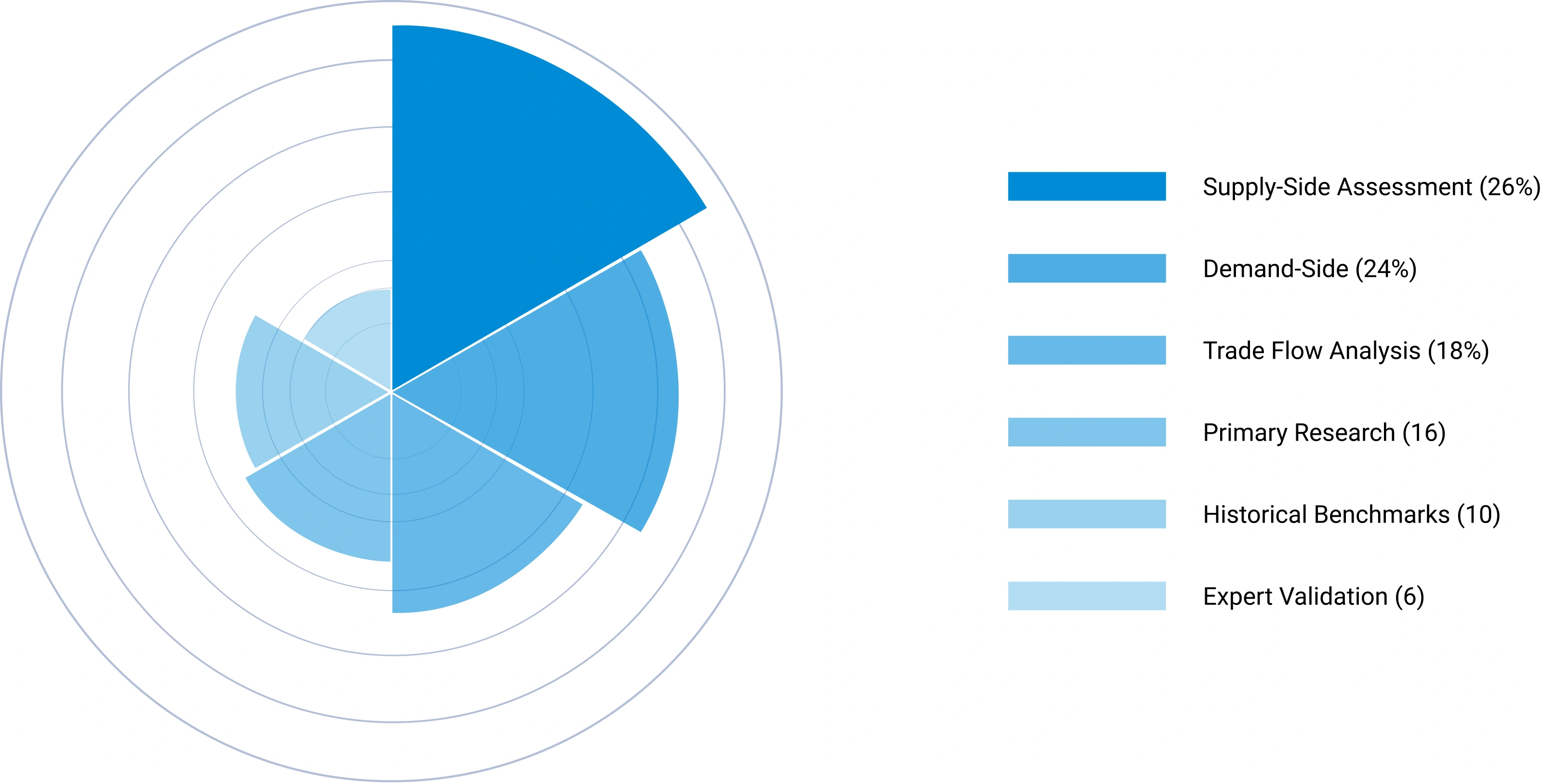
Triangulation Framework — Input Contribution Weight
Relative weight each sizing input contributes to the final reconciled market estimate
Phase 7 — Forecast Modeling: Projecting Future Market Evolution
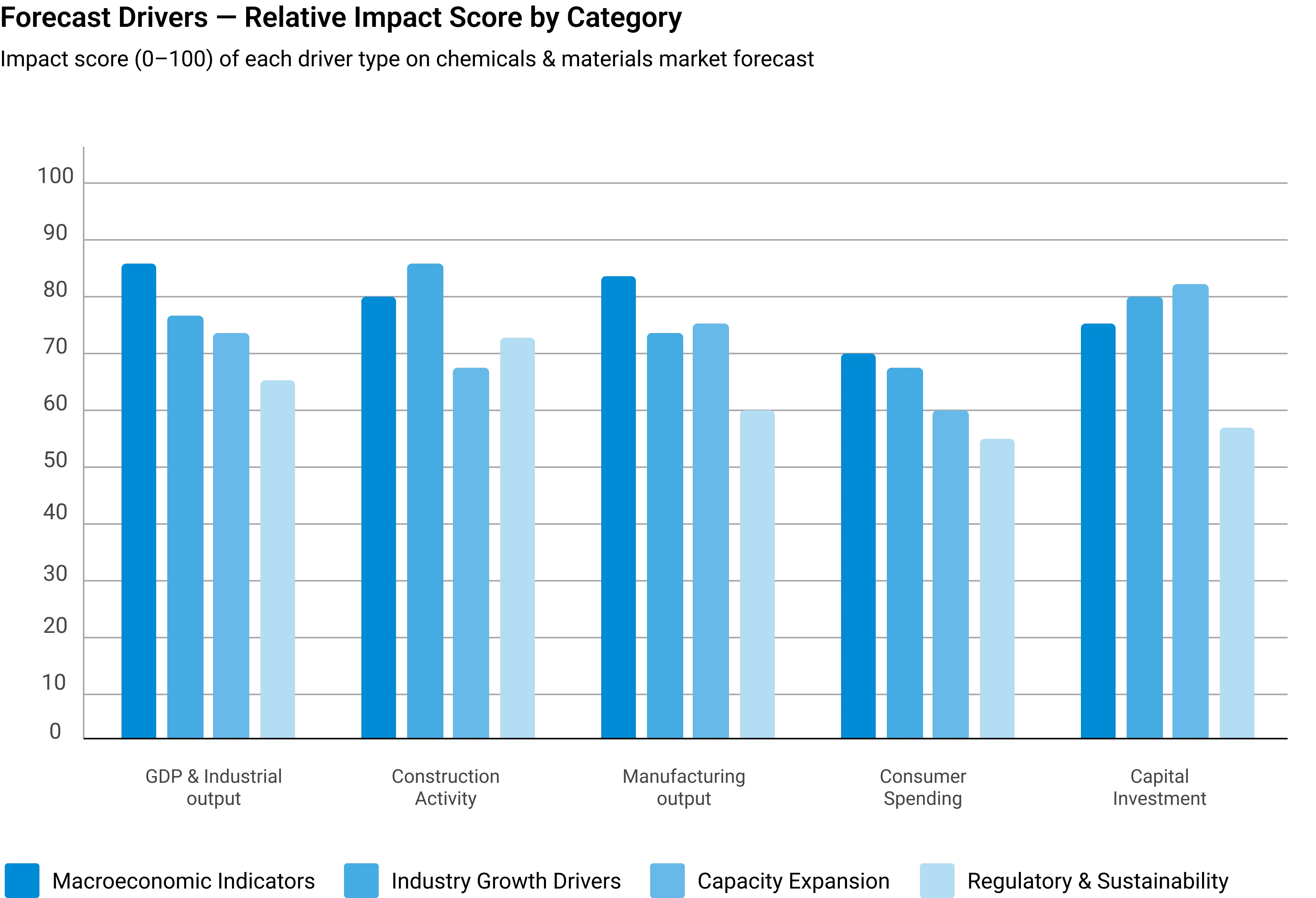
Forecasting evaluates the future trajectory of the market using a combination of quantitative indicators and qualitative assessments across economic, industry, and regulatory dimensions. Rather than simple extrapolation, each driver is independently modeled and integrated into a composite forecast.
Macroeconomic Indicators
GDP growth, industrial production, manufacturing output, construction activity, consumer spending, and capital investment form the quantitative foundation of long-term demand projections. These are applied at country, regional, and global levels.
Industry Growth Drivers
Urbanization, infrastructure development, industrialization, technological innovation, sustainability initiatives, and evolving product performance requirements are assessed at regional and industry levels — capturing both structural and cyclical demand drivers.
Capacity Expansion Analysis
Announced plant expansions, new manufacturing facilities, technology upgrades, and strategic investments are evaluated to determine future supply-demand dynamics and potential market tightness or oversupply situations.
Regulatory & Sustainability
Environmental regulations, chemical safety standards, emission reduction targets, circular economy initiatives, and sustainability requirements are incorporated as they often influence product adoption rates and market growth trajectories.
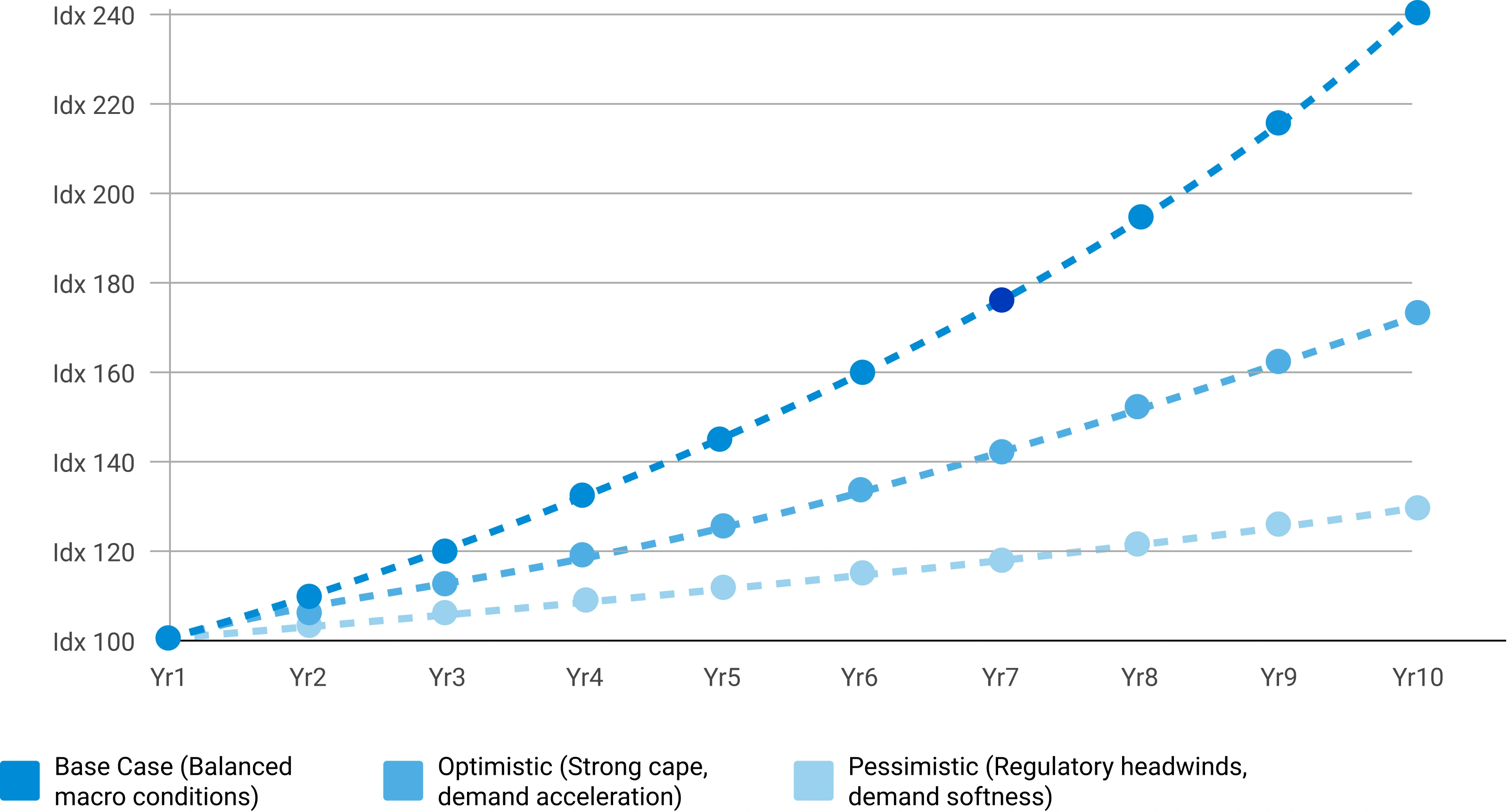
Scenario Forecast Range — Indexed Market Growth (Year 1–10)
Illustrative indexed growth trajectories across Base, Optimistic, and Pessimistic scenarios over a 10-year forecast horizon
Forecast Drivers — Relative Impact Score by Category
Impact score (0–100) of each driver type on chemicals & materials market forecast



Comments
Share your thoughts, ask a question, or provide feedback about this report.