
Agriculture Fertilizers Market Size and Forecast 2026 to 2035
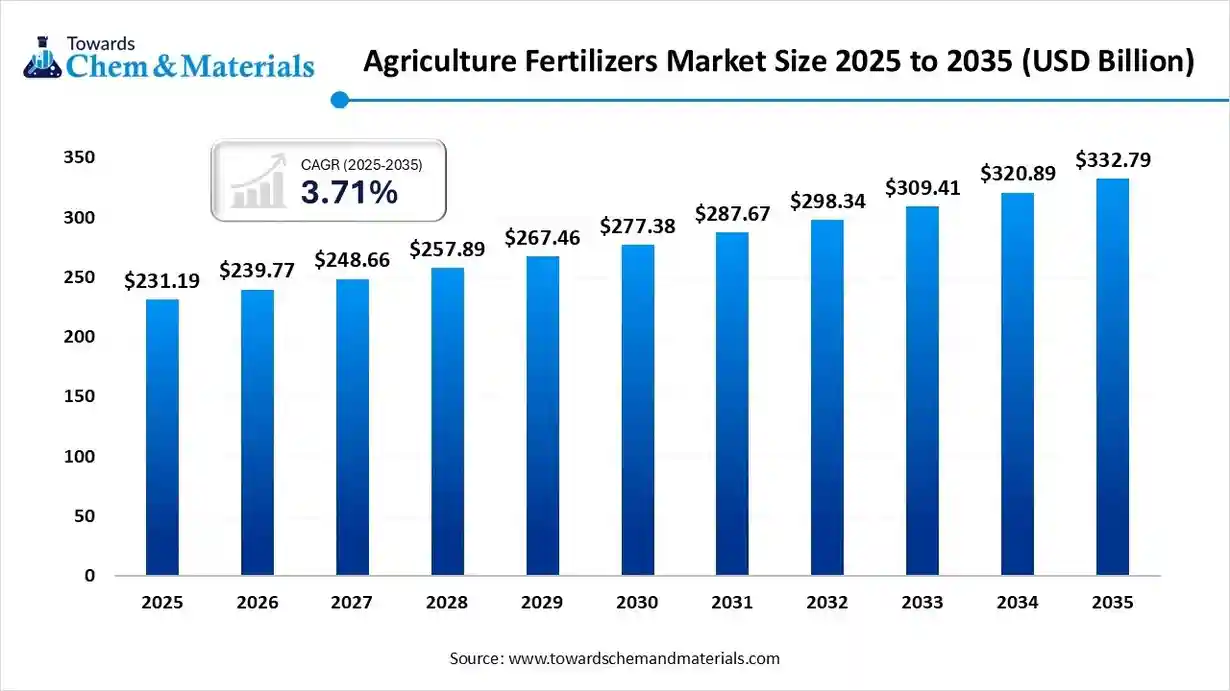
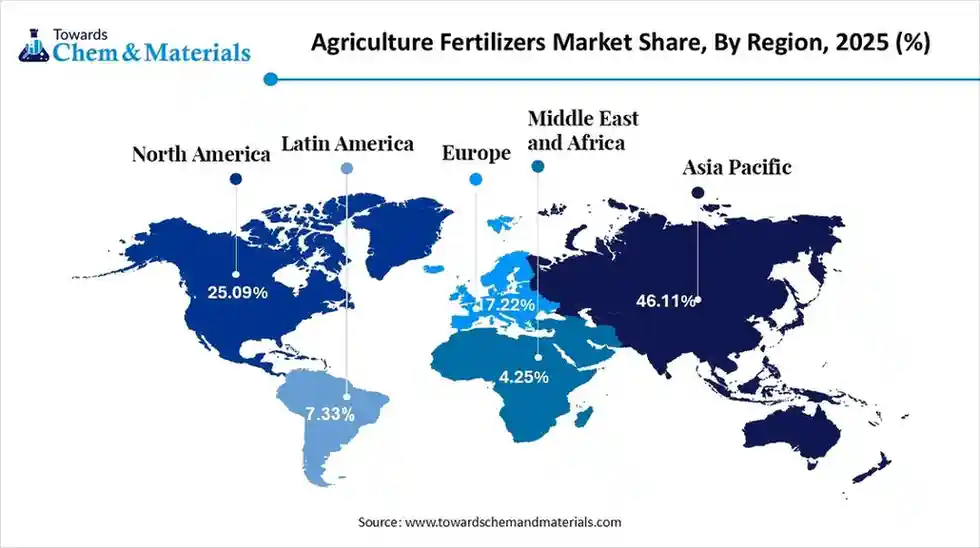
The global agriculture fertilizers market size was estimated at USD 231.19 billion in 2025 and is predicted to increase from USD 239.77 billion in 2026 and is projected to reach around USD 332.79 billion by 2035, The market is expanding at a CAGR of 3.71% between 2026 and 2035. Asia Pacific dominated the agriculture fertilizers market with a market share of 46.33% the global market in 2025. The soil nutrient depletion and growing food demand drive the market growth.
Key Takeaways
- By region, Asia Pacific led the agriculture fertilizers market with the largest revenue share of over 46.33% in 2025.
- By product type, the nitrogenous fertilizers segment led the market with the largest revenue share of 58.11% in 2025.
- By nature, the inorganic fertilizers segment led the market with the largest revenue share of 91.10% in 2025.
- By form, the dry/solid segment accounted for the largest revenue share of 81.28% in 2025.
- By application method, the soil application segment dominated with the largest revenue share of 88.21% in 2025.
- By crop type, the field crops segment dominated the market and accounted for the largest revenue share of 63.17% in 2025.
- By release mechanism, the conventional (fast-release) fertilizers segment accounted for the largest market revenue share of 85.15% in 2025.
What Drives the Agriculture Fertilizers Market Growth?
The agriculture fertilizers market growth is driven by a strong focus on higher agricultural productivity, a rise in precision agriculture, a shrinkage of arable land, a shift towards sustainable agriculture, the depletion of soil nutrients, and the growing cultivation of high-value crops.
The strong government focus on lowering import dependency and expanding domestic production of crops increases demand for agriculture fertilizers. The increasing need for nutrients like potassium, nitrogen, and phosphorus for plant growth increases demand for agriculture fertilizers.
What are Agriculture Fertilizers?
Agriculture fertilizers are natural or synthetic products applied to plants, leaves, soil, to offering essential nutrients. They enhance soil properties, improve soil fertility, and increase crop yields. Fertilizers are classified into types like inorganic fertilizers, biofertilizers, and organic fertilizers.
Organic fertilizers are made up of animal waste, compost, manure, & decomposed plant whereas synthetic fertilizers are made from the chemical compounds. They improve water retention in plants and support the healthy development of plants. Some examples of agricultural fertilizers are potassium fertilizers, nitrogenous fertilizers, blended fertilizers, and others.
Agriculture Fertilizers Market Trends:
- Growing Agriculture Sector: The growing agriculture sector in regions like Africa, Asia Pacific, and South America increases demand for fertilizers to enhance plant growth. The production of higher crop yields and the depletion of nutrients in the soil require agriculture fertilizers.
- Growing Population: The growing population in regions like Asia, Africa, and others increases demand for higher agricultural yields. The growing population increases demand for food, which increases the adoption of agriculture fertilizers to enhance crop productivity and maintain the fertility of the soil.
- Government Support: The government support helps to lower import dependency, boost domestic production capacity, and develop new plants.
- Focus on Improving Soil Fertility: The growing depletion of nutrients like potassium, nitrogen, and phosphorus in soil and the less arable land increases demand for agriculture fertilizers. Farmers are heavily investing in fertilizers to improve soil fertility.
Report Scope
| Report Attribute | Details |
| Market Size Value in 2026 | USD 239.77 Billion |
| Revenue Forecast in 2035 | USD 332.79 Billion |
| Growth Rate | CAGR 3.71% |
| Forecast Period | 2026 - 2035 |
| Base Year | 2025 |
| Dominant Region | Asia Pacific |
| Fastest Growing Region | Middle East & Africa |
| Segments covered | By Product Type, By Nature/Origin, By Form, By Application Method, By Crop Type, By Release Mechanism (Specialty Fertilizers), By Region |
| Key companies profiled | Yara International ASA, The Mosaic Company, CF Industries Holdings, Inc.,EuroChem Group AG, OCP Group S.A., Sinopec (China Petroleum & Chemical Corporation), ICL Group Ltd., K+S AG, Koch Industries (Koch Fertilizer, LLC), Sociedad Química y Minera de Chile S.A. (SQM), Indian Farmers Fertiliser Cooperative Limited (IFFCO), Coromandel International Limited, BASF SE, Paradeep Phosphates Limited (PPL), PhosAgro PJSC, Rashtriya Chemicals & Fertilizers Ltd. (RCF), Fertilizers and Chemicals Travancore Ltd. (FACT), Kingenta Ecological Engineering Co., Ltd., Sumitomo Chemical Co., Ltd. |
Key Technological Shifts in the Agriculture Fertilizers Market:
The agriculture fertilizers market is undergoing key technological shifts driven by the demand for nutrient management, lower environmental impact, and performance efficiency. The technological innovations like nano-fertilizers, GIS, data analysis, biodegradable coatings, and automation enhance crop yields, optimize the delivery of nutrients, and reduce waste. One of the major shifts is the integration of artificial intelligence (AI) minimizes cost, increases efficiency, and develops higher crop yields.
AI collects data like the temperature, nutrient content, soil moisture, and pH levels, and provides recommendations for the exact application of fertilizer. AI manages quality control and optimizes the production process. AI predicts equipment failures and weather events. AI helps farmers manage resources and plan planting schedules. Overall, AI is transforming traditional agricultural methods into a proactive way that helps the environment and farmers.
Trade Analysis of the Agriculture Fertilizers Market: Import & Export Statistics
- Russia exported $15.3B of fertilizers in 2023.
- In 2023, China exported $5.05B of nitrogenous fertilizers.
- Brazil imported $4.35B of nitrogenous fertilizers in 2023.
- Morocco exported $713M of phosphatic fertilizers in 2023.
- Canada exported $9.44B of potassic fertilizers in 2023.
- Brazil imported $5.65B of potassic fertilizers in 2023.
Agriculture Fertilizers Market Value Chain Analysis
- Feedstock Procurement: The feedstock procurement is the sourcing of raw materials like natural gas, naphtha, raw phosphate rock, potash, aquatic plants, agricultural waste, phosphoric acid, and organic municipal waste.
- Key Players:- Yara International ASA, The Mosaic Company, IFFCO, Nutrien Ltd, ICL Group Ltd.
- Chemical Synthesis and Processing: The chemical synthesis and processing involve the haber-bosch process, granulation, drying, cooling, coating, bagging, sealing, and packaging.
- Key Players:- OCP Group S.A., Nutrien Ltd, The Mosaic Company, ICL Group Ltd., CF Industries Holdings, Inc.
- Quality Testing and Certifications: The quality testing involves evaluation of properties like nutrient, moisture content, harmful contaminants, physical form, composition, & safety, and certifications like ISO, Ecocert, USDA organic, and AGMARK.
- Key Players:- CAAE, Alfa Chemistry Testing Lab, CFQCTI, NFL, SOHISCERT
From Mines to Markets: How Nations Map the Fertilizer Sector
| Country | Key Regulations | Major Fertilizer Produced | Key Companies |
| China |
|
|
|
| United States |
|
|
|
| Saudi Arabia |
|
|
|
| Germany |
|
|
|
Segmental Insights
Product Type Insights
Why Nitrogenous Fertilizers Segment Dominates the Agriculture Fertilizers Market?
The nitrogenous fertilizers segment dominated the agriculture fertilizers market with a 58.11% share in 2025. The emphasis on increasing crop yields and focus on the overall development of the plant increases the adoption of nitrogenous fertilizers. The rise in development of staple crops like grains & cereals and increasing production of cotton, fruits, & vegetables requires nitrogenous fertilizers.
The micronutrient fertilizers segment is the fastest-growing in the market during the forecast period. The growing global food demand and focus on correcting soil deficiencies increase the adoption of micronutrient fertilizers. The focus on improving crop qualities like color, nutritional value, size, and taste increases the adoption of micronutrient fertilizers. The increasing need to enhance crop resilience and the shift towards sustainable agriculture practices require micronutrient fertilizers, supporting the overall market growth.
The potassic fertilizers segment is significantly growing in the market. The growing cultivation of high-quality crops and the presence of limited arable land increase the adoption of potassic fertilizers. The strong focus on enhancing nitrogen efficiency and increasing demand for organic food requires potassic fertilizers. The growing expansion of high-value crops like fruits, cereals, vegetables, and others requires potassic fertilizers, supporting the overall market growth.
Nature Insights
How did the Inorganic Fertilizers Segment hold the Largest Share in the Agriculture Fertilizers Market?
The inorganic fertilizers segment held the largest revenue share of 91.10% in the agriculture fertilizers market in 2025. The growing demand for nutrients like potassium, nitrogen, and phosphorus for rapid plant growth increases demand for inorganic fertilizers. The focus on maximizing crop yields and the increasing need for food security increase the adoption of inorganic fertilizers. The inorganic fertilizers' cost-effectiveness, ease of handling, and availability in convenient forms like liquids & dry granules drive the overall market growth.
The bio-fertilizers segment is experiencing the fastest growth in the market during the forecast period. The strong focus on enhancing soil texture and increasing microbial activity of plants increases the adoption of bio-fertilizers. The increasing consumer preference for organic food and the rise in sustainable agriculture practices require bio-fertilizers. The diverse application ways, like foliar, broadcasting, and fertigation of bio-fertilizers, support the overall market growth.
The organic fertilizers segment is growing at a significant rate in the market. The growing shift towards organic food and the growing synthetic fertilizers environmental concerns increase demand for organic fertilizers. The strong focus on enhancing the fertility of the soil and growth in eco-friendly agriculture practices requires organic fertilizers that support the overall market growth.
Form Insights
Why the Dry or Solid Segment is Dominating the Agriculture Fertilizers Market?
The dry/solid segment accounted for the largest revenue share of 81.28% in 2025. The longer shelf life, cost-effectiveness, and ease of handling of the dry form help market growth. The growing production of crops like grains and cereals, vegetables, and others increases the adoption of dry or solid forms. The compatibility with large-scale & traditional farming and the slow-release properties of the dry form drive the overall market growth.
The liquid segment expects the fastest growth in the market during the forecast period. The strong focus on faster absorption of nutrients and lower loss of nutrients increases demand for the liquid form. The growth in precision farming and focus on lowering environmental impact increases the adoption of the liquid form. The ease of handling, high effectiveness, and compatibility with other crop protection solutions of liquid form support the overall market growth.
Application Method Insights
Why Soil Application Segment held the Largest Share in the Agriculture Fertilizers Market?
The the soil application segment dominated with the largest revenue share of 88.21% in 2025. The growing cultivation of crops like cereals & grains and the increasing need for direct nutrient absorption increase demand for soil application. The strong focus on absorption of nutrients like potassium, nitrogen, and phosphorus requires soil application. The increasing need for building long-term soil health and focus on correcting deficiencies in soil requires soil application, driving the overall market growth.
The fertigation segment is experiencing the fastest growth in the market during the forecast period. The strong focus on lowering nutrient loss and reducing contamination of groundwater increases the adoption of fertigation. The increasing need to enhance plant growth and improve the quality of crops requires fertigation methods. The rise in modern agriculture practices and growing sustainable farming practices increases demand for fertigation, supporting the overall market growth.
The foliar application segment is significantly growing in the market. The focus on delivering nutrients directly to leaves and the need for correcting deficiencies increase the adoption of foliar application. The growing production of high-quality crops and the rise in sustainable agriculture increase demand for foliar application. The increasing development of foliar products like water-based formulas & controlled-release technology supports the overall market growth.
Crop Type Insights
Which Crop Type Dominated the Agriculture Fertilizers Market?
The field crops segment dominated the market and accounted for the largest revenue share of 63.17% in 2025. The presence of a large cultivation area for field crops like wheat, soybeans, rice, cotton, and corn helps market growth. The increased consumption of staple foods and the rise in demand for high-nutrient-intensity food increase the adoption of field crops. The field crop nutrient consistency, ease of transport, and cost-effectiveness drive the overall market growth.
The horticulture crops segment is the fastest-growing in the market during the forecast period. The growing consumption of horticulture crops like vegetables, spices, fruits, and flowers helps market growth. The increasing awareness about the consumption of fresh vegetables and fruits requires agriculture fertilizer. The shifting dietary preferences and increased consumption of high-nutrient foods increase the adoption of horticulture, supporting the overall market growth.
The pulses and oilseeds segment is growing at a significant rate in the market. The growing demand for protein and a strong focus on food security increase demand for pulses & oilseeds. The growth in global population and changing dietary preferences increases the consumption of pulses & oilseeds. The increased consumption of canola & soybeans and the rise in cultivation of pulses & oilseeds support the overall market growth.
Release Mechanism Insights
How did the Conventional Fertilizers Segment hold the Largest Share in the Agriculture Fertilizers Market?
The conventional fertilizers segment held the largest revenue share of 85.15% in the market in 2025. The increasing need for nutrients like potassium, nitrogen, & phosphorus, and focus on boosting crop yields requires conventional fertilizers. The properties like ease of application, ease of storage, and cost-effectiveness of conventional fertilizers help market growth. The precise nutrient delivery and wide availability of conventional fertilizers drive the overall market growth.
The enhanced efficiency fertilizers (EEF) segment is experiencing the fastest growth in the market during the forecast period. The strong focus on lowering volatilization and nutrient runoff increases adoption of EEF. The growing demand for higher crop yields and the need to lower environmental pollution require EEF. The focus on minimizing application frequency and enhancing the growth of the plant requires EEF, supporting the overall market growth.
The water-soluble fertilizers segment is significantly growing in the market. The well-established high-yield farming and the rise in horticulture increase demand for water-soluble fertilizers. The rise in greenhouse farming and the adoption of modern farming practices require water-soluble fertilizers. The fast nutrient uptake and less waste generation of water-soluble fertilizers support the overall market growth.
Regional Insights
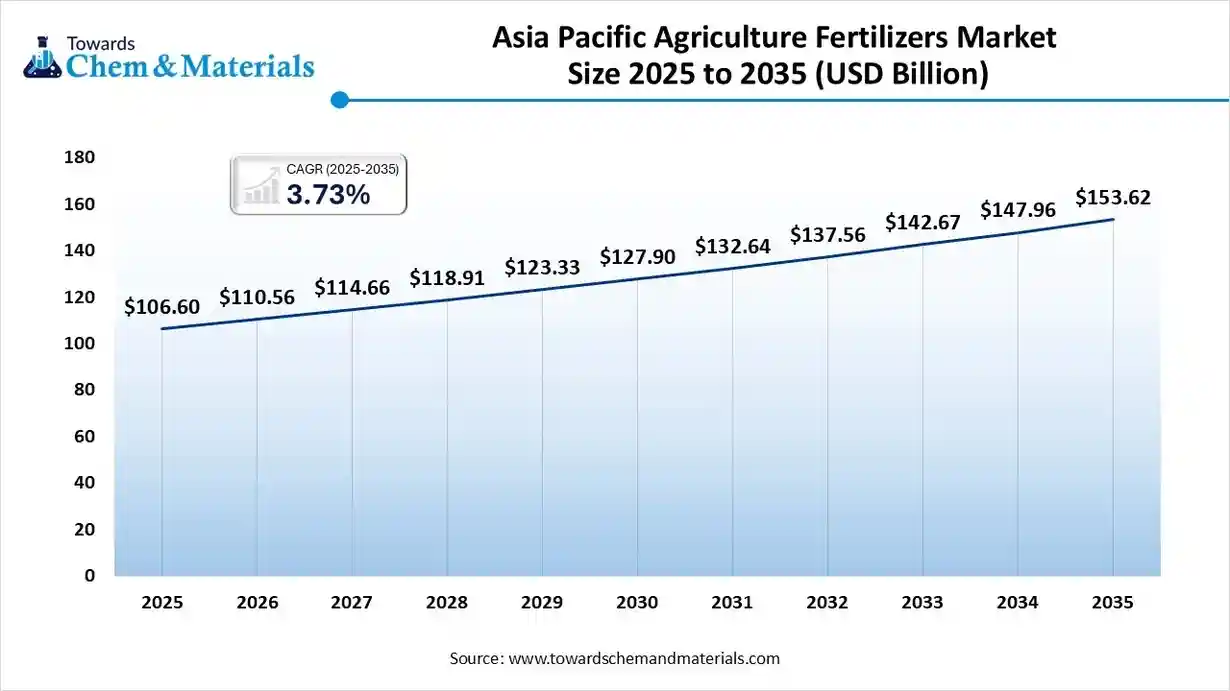
The Asia Pacific agriculture fertilizers market size was valued at USD 106.60 billion in 2025 and is expected to surpass around USD 153.62 billion by 2035, expanding at a compound annual growth rate (CAGR) of 3.73% over the forecast period from 2026 to 2035. Asia Pacific dominated the market with a 46.11% share in 2025. The rapid growth in population and increasing need for production increases the adoption of agriculture fertilizers. The decline in arable land and growing adoption of precision agriculture require agriculture fertilizers. The increasing cultivation of crops like fruits, rice, oilseeds, and wheat requires agriculture fertilizers. The well-established agricultural base and growing awareness about soil health require agriculture fertilizers, driving the overall market growth.
From Factory to Field: China’s Contribution to the Agriculture Fertilizers
China is a major contributor to the market. The strong focus on food security and increasing need for maximizing crop yields requires agriculture fertilizers. The presence of a large agricultural base and increasing use of fertigation & smart fertilizers help market growth. The vast reserves of phosphate rock and abundance of coal increase production of nitrogenous & phosphate-based fertilizers, supporting the overall market growth.
- China exported $10.9B of fertilizers in 2023.
Middle East & Africa Agriculture Fertilizers Market Trends
The Middle East & Africa are experiencing the fastest growth in the market during the forecast period. The strong focus on improving crop yields and the presence of intensive agricultural methods increase the adoption of agriculture fertilizers. The increasing micronutrient like iron & zinc deficiencies in soil and rising food security concerns increase demand for agriculture fertilizers. The increased consumption of high-value crops like vegetables & fruits and the rise in production of staple crops increase demand for agriculture fertilizers, driving the overall market growth.
Nurturing Harvests: Saudi Arabia Shaping the Agriculture Fertilizers Landscape
Saudi Arabia is a key contributor to the market. The strong government focus on minimizing import reliance and enhancing food security increases demand for agriculture fertilizers. The increasing domestic food demand and emphasis on sustainable farming practices require fertilizers. The abundance of natural gas increases the production of fertilizers like ammonia, supporting the overall market growth.
- Saudi Arabia exported $4.8B of fertilizers in 2023.
North America Agriculture Fertilizers Market Trends
North America expects the significant growth in the market during the predicted period. The growing population and strong focus on enhancing crop yields require agriculture fertilizers. The increasing adoption of precision agriculture and emphasis on soil health management increases demand for agriculture fertilizers. The rapid growth in hydroponic systems and the expansion of urban agriculture require fertilizers. The increasing use of controlled-release, organic, and slow-release fertilizers drives the overall market growth.
From Industry to Agriculture: Rise of Agriculture Fertilizers in the United States
The United States is growing notably in the market. The presence of a robust agricultural landscape and a shift towards organic food increases demand for agriculture fertilizers. The strong government support for sustainable farming and the strong government support for the agriculture sector increase the adoption of agricultural fertilizers. The innovations, like bio-fertilizers and controlled-release fertilizers, support the overall market growth.
Europe Agriculture Fertilizers Market Trends
Europe is growing substantially in the market. The presence of limited arable land and focus on maximizing the production of crops increases demand for agriculture fertilizers. The growing consumption of organic food and the rise in sustainable farming practices require agriculture fertilizers. The increasing production of high-quality ornamental plants, fruits, and vegetables requires agriculture fertilizers, driving the overall market growth.
Feeding the Fields: Germany’s Role in Agriculture Fertilizers Expansion
Germany is growing significantly in the market. The growing production of food and a strong focus on ensuring food security increase demand for agriculture fertilizers. The rise in precision farming and government support for sustainable agricultural practices requires agriculture fertilizers. The presence of a vast agricultural land area and the growing cultivation of field crops like rapeseed, wheat, & barley increases demand for agriculture fertilizers, supporting the overall market growth.
South America Agriculture Fertilizers Market Trends
South America is growing in the market. The growing expansion of cultivation area and presence of critical agricultural hubs increases demand for agriculture fertilizers. The increasing production of crops in countries like Argentina and Brazil increases demand for agriculture fertilizer. The innovations like precision farming and growing adoption of bio-fertilizers & specialty fertilizers drive the overall market growth.
Modern Agriculture: Brazil’s Footprint in the Agriculture Fertilizers
Brazil is seen a notable growth in the market. The presence of a robust agricultural landscape and focus on enhancing crop yields increases demand for agriculture fertilizers. The increasing interest in controlled-environment agriculture and organic fertilizers helps market growth. The growing export of agricultural products like soybeans requires fertilizers, supporting the overall market growth.
Recent Developments
- In January 2025, Super Crop Safe launched bio-fertilizer Super Gold WP+. The bio-fertilizer absorbs water efficiently, enhances root development, and absorbs nutrients. The bio-fertilizer is available in states like Rajasthan, Haryana, Uttarakhand, Chhattisgarh, Karnataka, Gujarat, Punjab, Uttar Pradesh, Maharashtra, Kerala, and Madhya Pradesh. (Source: www.indianchemicalnews.com)
- In February 2025, Wilbur-Ellis launched a liquid organic nitrogen fertilizer, BenVireo TerraLux 10-0-0. The fertilizer lowers greenhouse gas emissions, and its pH is neutral. The fertilizer is available in 27-gallon totes and is easy to handle.(Source: www.growingproduce.com)
- In September 2024, KRIBHCO collaborated with Novonesis to launch KRIBHCO Rhizosuper, biofertilizer. The fertilizer improves soil quality and supports robust plant growth.(Source: www.indianchemicalnews.com)
Top Companies List
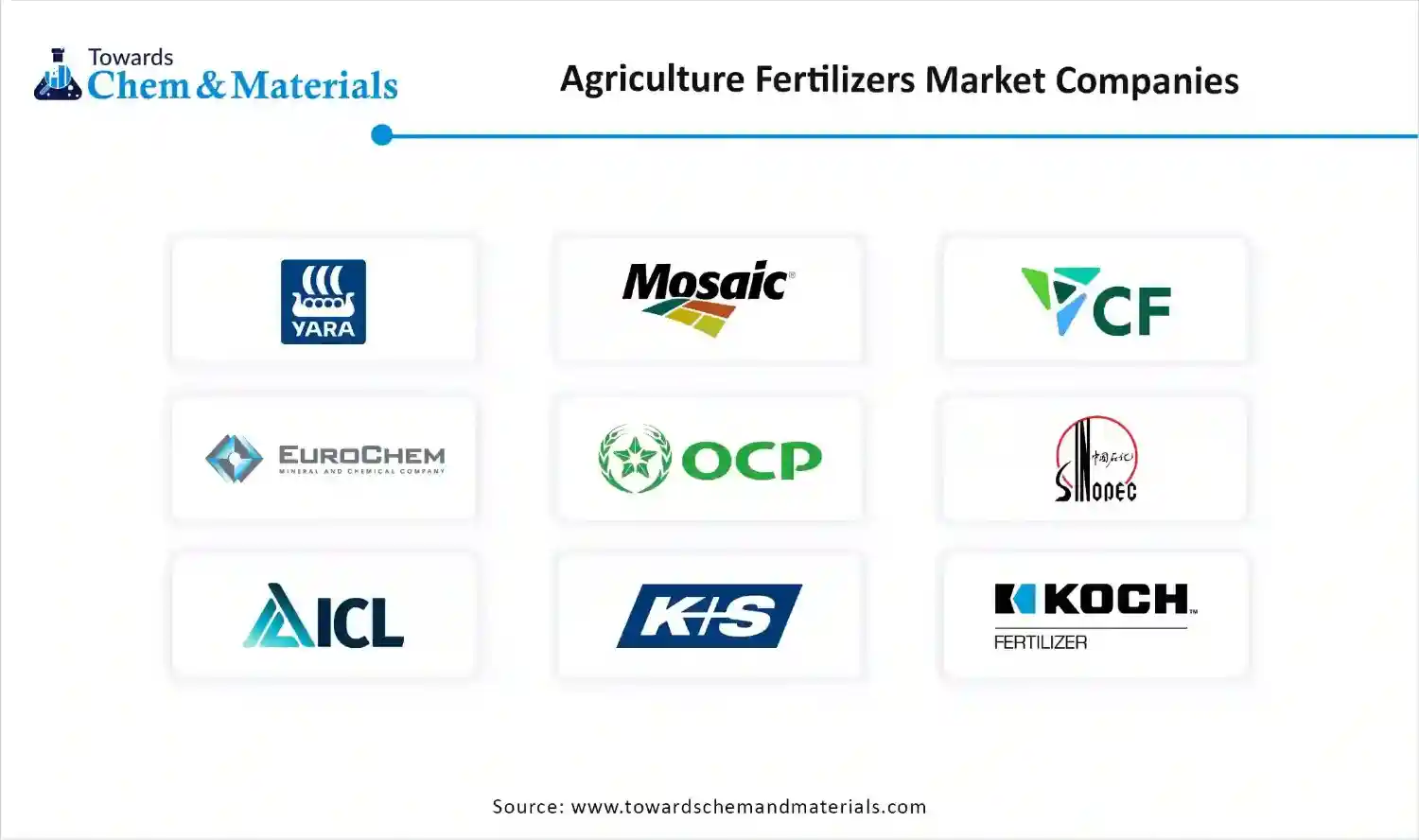
- Yara International ASA: The Norway-based company manufactures biological & mineral fertilizers like biostimulants, urea, and compound fertilizer for agricultural practices.
- The Mosaic Company: The company is the leading distributor and producer of concentrated potash, phosphate, and other crop nutrients like K-Mag, MicroEssentials, & Aspire for the agriculture industry.
- CF Industries Holdings, Inc.: The company manufactures diverse products like granular urea, nitric acid, ammonia, DEF, and UAN, especially for fertilizer to enhance crop yields.
- EuroChem Group AG: The company is the leading producer of diverse fertilizers like potash, nitrogen, complex, phosphate, and specialty fertilizers to support crop nutrition.
Top Key Players in the Agriculture Fertilizers Market
- OCP Group S.A.
- Sinopec (China Petroleum & Chemical Corporation)
- ICL Group Ltd.
- K+S AG
- Koch Industries (Koch Fertilizer, LLC)
- Sociedad Química y Minera de Chile S.A. (SQM)
- Indian Farmers Fertiliser Cooperative Limited (IFFCO)
- Coromandel International Limited
- BASF SE
- Paradeep Phosphates Limited (PPL)
- PhosAgro PJSC
- Rashtriya Chemicals & Fertilizers Ltd. (RCF)
- Fertilizers and Chemicals Travancore Ltd. (FACT)
- Kingenta Ecological Engineering Co., Ltd.
- Sumitomo Chemical Co., Ltd.
Segments Covered
By Product Type
- Nitrogenous Fertilizers
- Urea
- Ammonium Nitrate (AN) / Calcium Ammonium Nitrate (CAN)
- Urea Ammonium Nitrate (UAN) Solution
- Ammonium Sulfate
- Anhydrous Ammonia
- Other Nitrogen Forms
- Phosphatic Fertilizers
- Di-Ammonium Phosphate (DAP)
- Mono-Ammonium Phosphate (MAP)
- Single Super Phosphate (SSP)
- Triple Super Phosphate (TSP)
- Other Phosphates
- Potassic Fertilizers
- Muriate of Potash (MOP) / Potassium Chloride (KCl)
- Sulfate of Potash (SOP) / Potassium Sulfate ($K_2SO_4$)
- Potassium Nitrate
- Other Potash Forms
- Secondary Macronutrient Fertilizers
- Sulfur
- Calcium
- Magnesium
- Micronutrient Fertilizers
- Zinc
- Boron
- Iron
- Manganese
- Copper
- Molybdenum
- Other Micronutrients
By Nature/Origin
- Inorganic (Mineral/Chemical) Fertilizers
- Straight Fertilizers (Single Nutrient)
- Complex/Compound Fertilizers (Multiple Nutrients, e.g., NPK, DAP)
- Organic Fertilizers
- Manure-Based
- Compost-Based
- Crop Residue-Based
- Bio-solids
- Bio-Fertilizers (Microbial)
- Nitrogen-Fixing (e.g., Rhizobium, Azotobacter)
- Phosphate-Solubilizing (PSB)
- Potassium-Mobilizing (KMB)
- Mycorrhizal
By Form
- Dry/Solid
- Granular/Prilled
- Powdered/Crystalline
- Liquid
- Solution
- Suspension
By Application Method
- Soil Application (Broadcasting, Banding, Placement)
- Conventional Soil Application
- Precision Soil Application
- Fertigation (Application via Irrigation Systems)
- Drip Fertigation
- Sprinkler Fertigation
- Foliar Application (Direct Spray on Leaves)
- Seed Treatment
By Crop Type
- Field Crops (Grains and Cereals)
- Rice
- Wheat
- Maize/Corn
- Others (Barley, Oats)
- Pulses and Oilseeds
- Soybeans
- Groundnut
- Canola/Rapeseed
- Lentils
- Horticultural Crops
- Fruits and Vegetables
- Plantation Crops (Tea, Coffee, Rubber)
- Flowers and Ornamentals
- Turf and Lawns
By Release Mechanism (Specialty Fertilizers)
- Conventional (Fast-Release) Fertilizers
- Enhanced Efficiency Fertilizers (EEF)
- Slow-Release Fertilizers (SRF)
- Controlled-Release Fertilizers (CRF)
- Stabilized Fertilizers (with Inhibitors)
- Water-Soluble Fertilizers (WSF)
By Region
- North America
- U.S.
- Canada
- Mexico
- Europe
- Germany
- UK
- France
- Italy
- Spain
- Asia Pacific
- China
- India
- Japan
- South Korea
- Latin America
- Brazil
- Argentina
- Middle East & Africa
- Saudi Arabia
- South Africa
A Seven-Phase Framework
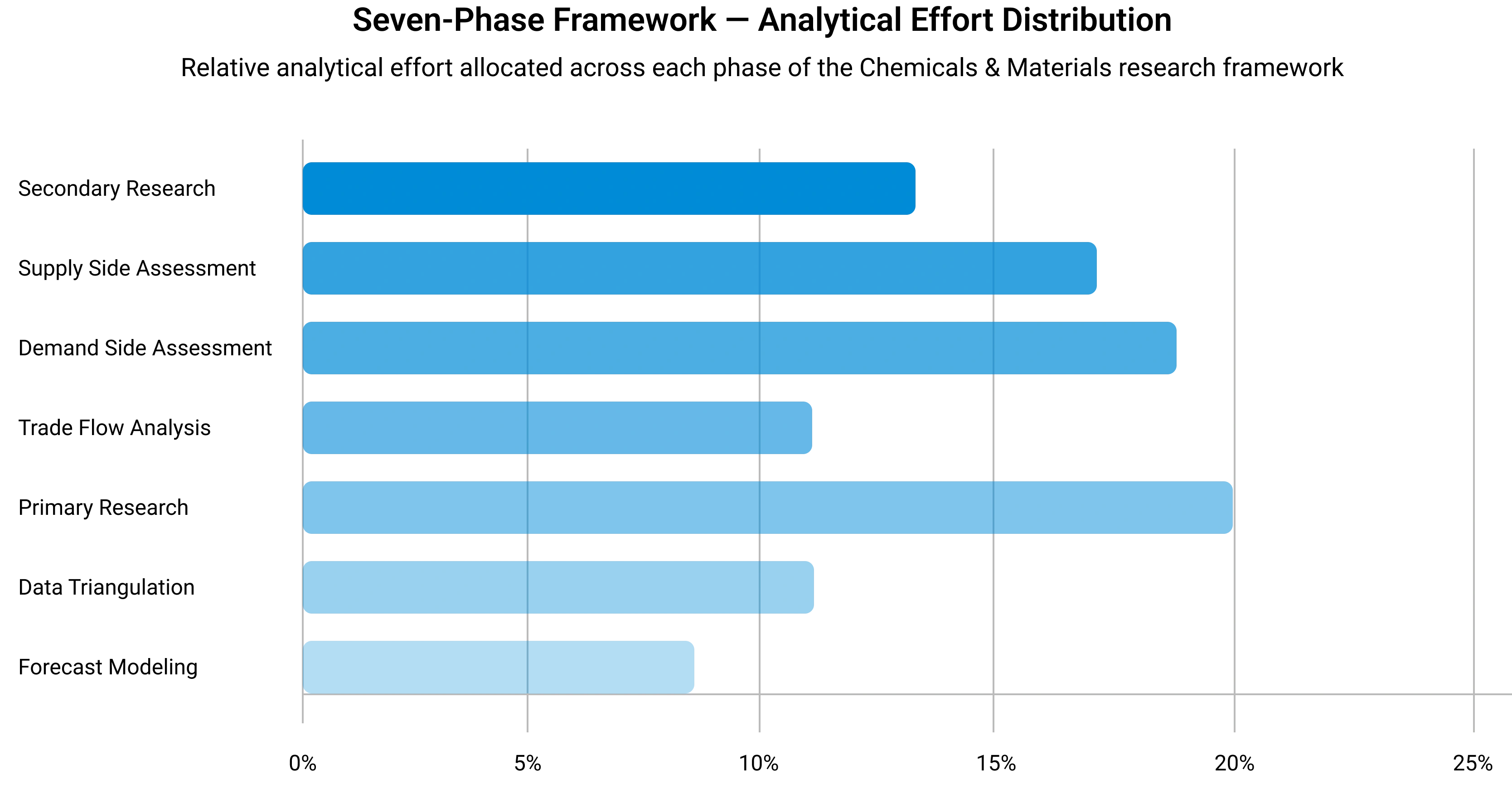
Our methodology is designed to be universally applicable across commodity chemicals, specialty chemicals, petrochemicals, construction chemicals, coatings, electronic chemicals, industrial gases, agrochemicals, water treatment chemicals, and performance materials. Each phase builds upon the last, creating a layered validation structure that minimizes estimation error and maximizes analytical confidence.
The framework ensures comprehensive market coverage, robust cross-validation, and reliable long-term forecasting — producing market estimates that withstand scrutiny from investors, regulators, and corporate strategy teams.

Seven-Phase Framework — Analytical Effort Distribution
Relative analytical effort allocated across each phase of the Chemicals & Materials research framework
Phase 1 - Secondary Research: Establishing the Foundation
Secondary research collects and evaluates publicly available information from authoritative sources, establishing the foundational understanding of market structure, value chain dynamics, competitive landscape, and end-use demand patterns. Every source is evaluated for credibility, recency, geographic relevance, and methodological soundness before inclusion.
Industry Associations
Sources include ACC, CEFIC, ICCA, JCIA, CPCIF, and SOCMA providing production volumes, consumption trends, capacity developments, and sustainability initiatives.
Company Disclosures
Annual reports, investor presentations, earnings transcripts, and regulatory filings reveal product portfolios, manufacturing footprints, capacity expansions, and revenue segmentation.
Government Databases
National statistical offices, customs authorities, environmental agencies, and industrial production databases provide verified statistics on output, trade flows, and regulatory compliance.
Trade Databases
UN Comtrade, ITC, Eurostat, and national customs authorities enable assessment of global product movement, import dependency, and export competitiveness across regions.
Our Secondary Research Sources
- Ministry of Chemicals and Fertilizers
- European Chemicals Agency
- United States Department of Energy
- Ministry of Industry and Information Technology
- Ministry of Economy Trade and Industry
- Ministry of Trade Industry and Energy
- National Institute of Standards and Technology
- Council of Scientific and Industrial Research
- Fraunhofer Society
- National Institute for Materials Science
Phase 2 — Supply-Side Assessment: Mapping Production Capabilities
Production Capacity Analysis
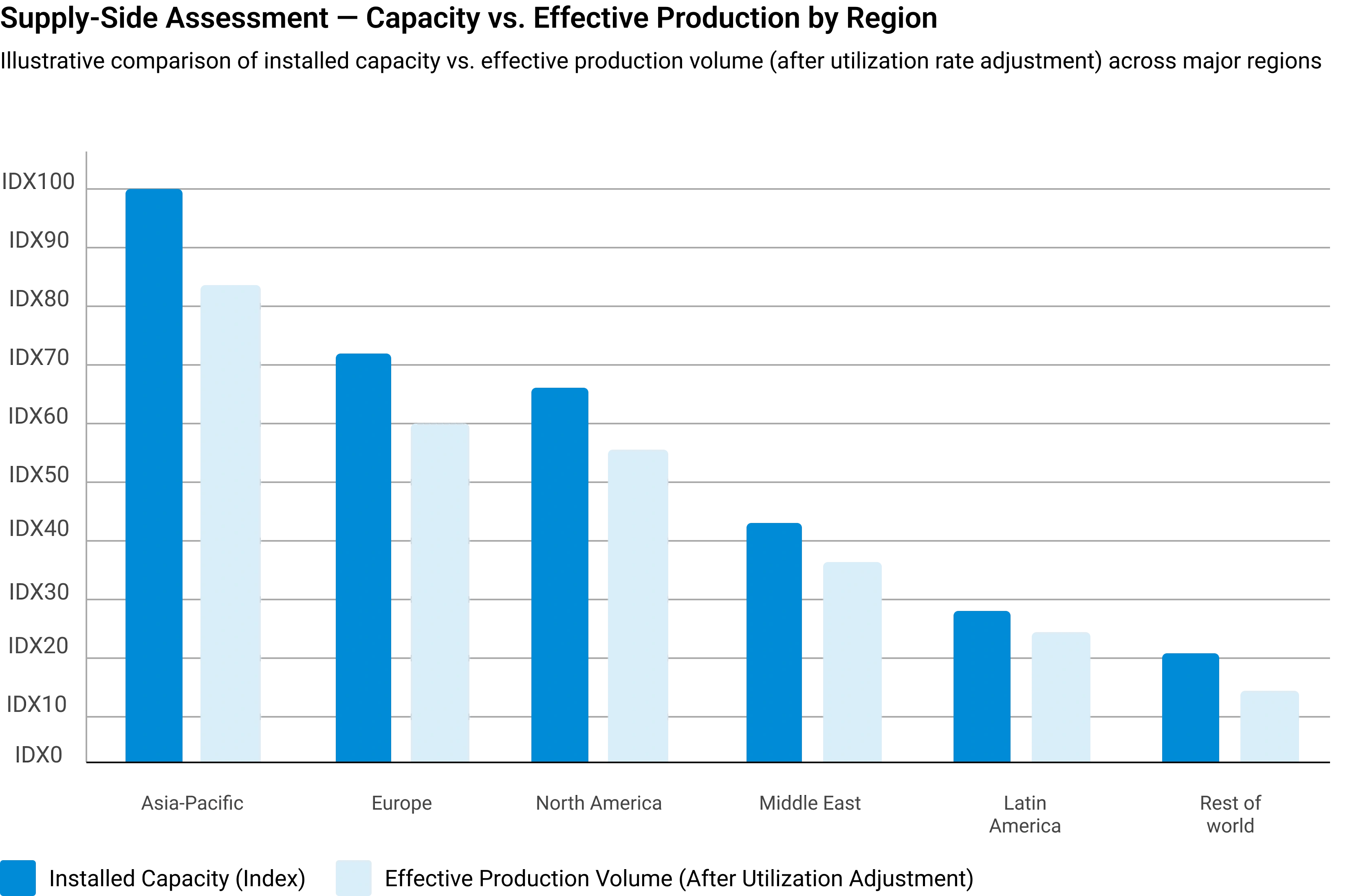
All major manufacturers are assessed for existing installed capacity, planned additions, expansions, new plant announcements, and technology adoption — mapped at global, regional, and country levels.
Capacity Utilization Adjustment
Installed capacity is adjusted using utilization rates based on demand conditions, feedstock availability, plant operating rates, maintenance schedules, and regulatory restrictions.
Manufacturer Revenue Analysis
Product-specific revenues, segment-level performance, regional distribution, average selling prices, and margin trends are evaluated to establish market value estimates.
Supply-Side Assessment — Capacity vs. Effective Production by Region
Illustrative comparison of installed capacity vs. effective production volume (after utilization rate adjustment) across major regions
Phase 3 — Demand-Side Assessment: Quantifying Chemical Consumption
Demand-side analysis quantifies chemical consumption across industries, applications, and geographies — identifying where and how chemicals are consumed throughout the value chain with precision.
End-Use Industry Analysis
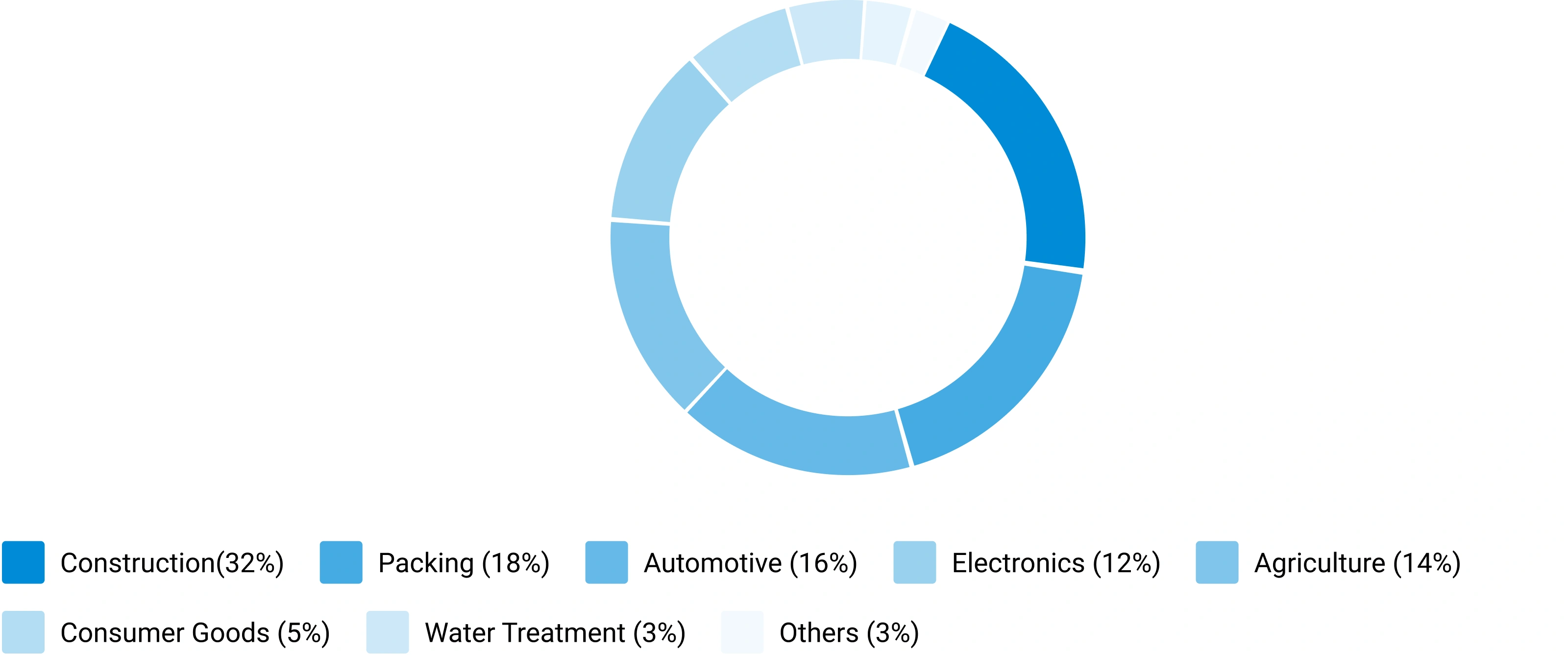
Chemical demand is evaluated across automotive, construction, packaging, electronics, agriculture, healthcare, consumer goods, industrial manufacturing, energy and utilities, and water treatment. Industry output, production trends, and consumption intensity are analyzed to determine demand patterns.
Consumption Modeling
Demand is estimated using measurable indicators: kilograms per vehicle, kilograms per square meter of construction, dosage per cubic meter of water treated, kilograms per hectare of agricultural land, and kilograms per ton of manufactured products. Consumption factors are validated through industry publications and primary interviews.
Application Analysis
The market is segmented by application area to understand product performance requirements, formulation trends, technology adoption, customer preferences, and regulatory requirements improving demand accuracy and segmentation granularity.
Demand-Side Assessment — End-Use Industry Demand Distribution
Illustrative distribution of chemical & materials demand across key end-use industries
Phase 4 - Trade Flow Analysis: Balancing Regional Supply and Demand
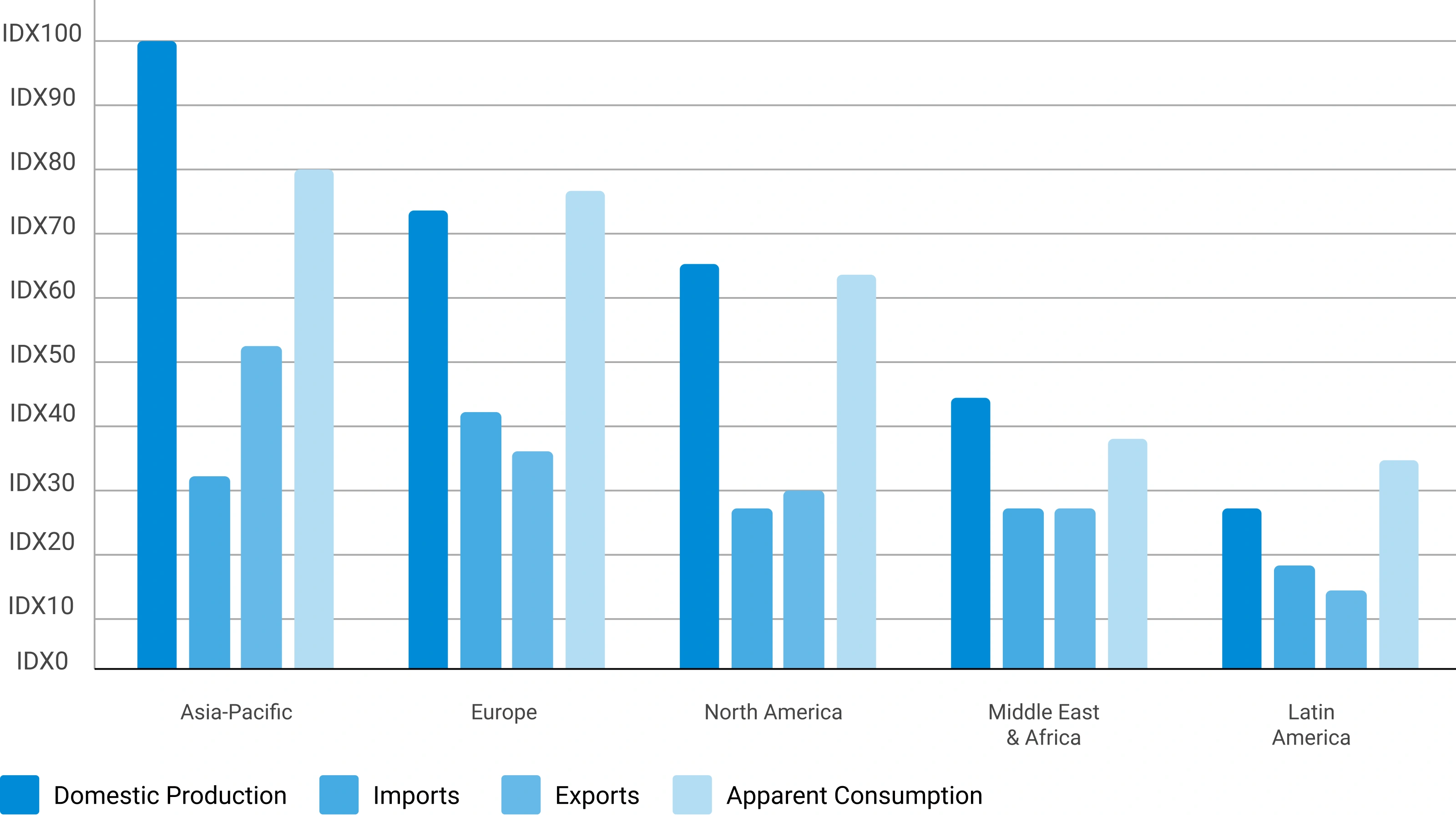
Trade flow analysis reconciles regional supply and demand estimates through import and export data, identifying net supply positions, regional dependencies, and market imbalances. It serves as an independent validation layer that tests the consistency of supply-side and demand-side estimates.
Import Analysis
Import data is evaluated to determine volumes, source countries, product dependency, regional supply gaps, and pricing trends — identifying markets that rely heavily on external supply and where domestic production is insufficient to meet demand.
Export Analysis
Export assessments reveal production surplus, export competitiveness, regional manufacturing strength, and global market participation. Export patterns also help validate domestic production estimates and identify net exporting regions.
Apparent Consumption Model
Regional consumption is assessed using the standard apparent consumption formula:
Results identify net importing regions, net exporting regions, regional deficits, and surpluses — serving as an independent validation of supply and demand estimates.
Trade Flow Analysis — Net Supply Position by Region
Illustrative apparent consumption vs. domestic production across major regions — positive gap indicates net import dependency
Phase 5 — Primary Research: The Critical Validation Layer
Primary research tests and refines findings from secondary research through direct engagement with industry participants across the supply chain, demand side, and expert community. It captures intelligence that no database or published report can provide — the real-world experience of manufacturers, buyers, and specialists operating in the market.

Supply-Side Interviews
Conversations with chemical manufacturers, raw material suppliers, contract manufacturers, technology providers, and plant operators cover production trends, capacity utilization, pricing developments, technology shifts, and competitive dynamics.

Demand-Side Interviews
Engagement with OEMs, industrial consumers, procurement managers, distributors, formulators, and end-use manufacturers focuses on consumption trends, purchasing behavior, product substitution, demand outlook, and emerging applications.

Industry Expert Consultations
Additional interviews with industry consultants, independent experts, regulatory specialists, technical professionals, and research institutions provide deeper market context and validate key analytical assumptions.
Focus Areas of Primary Research:
Market Size & Forecast Validation
Revenue estimates, volume consumption, growth rates, forecast assumptions, regional demand.Supply Chain & Value Chain Assessment
Raw material sourcing, supply chain challenges, distribution networks, procurement practices.Production & Capacity Analysis
Manufacturing capacity, utilization rates, expansion projects, plant investments.Pricing & Cost Structure Analysis
Product pricing trends, feedstock costs, energy costs, margin pressures, pricing outlook.Competitive Landscape Assessment
Volume and value estimates confirmed to be fully consistent with one another before publicationInterview Volume by Market Scope
| Study Scope | Number of Interviews |
|---|---|
| Niche Market | 20 – 30 |
| Mid-Sized Market | 30 – 50 |
| Global Market | 50 – 80 |
| Highly Fragmented Market | 80 – 120 |
Interview Details:
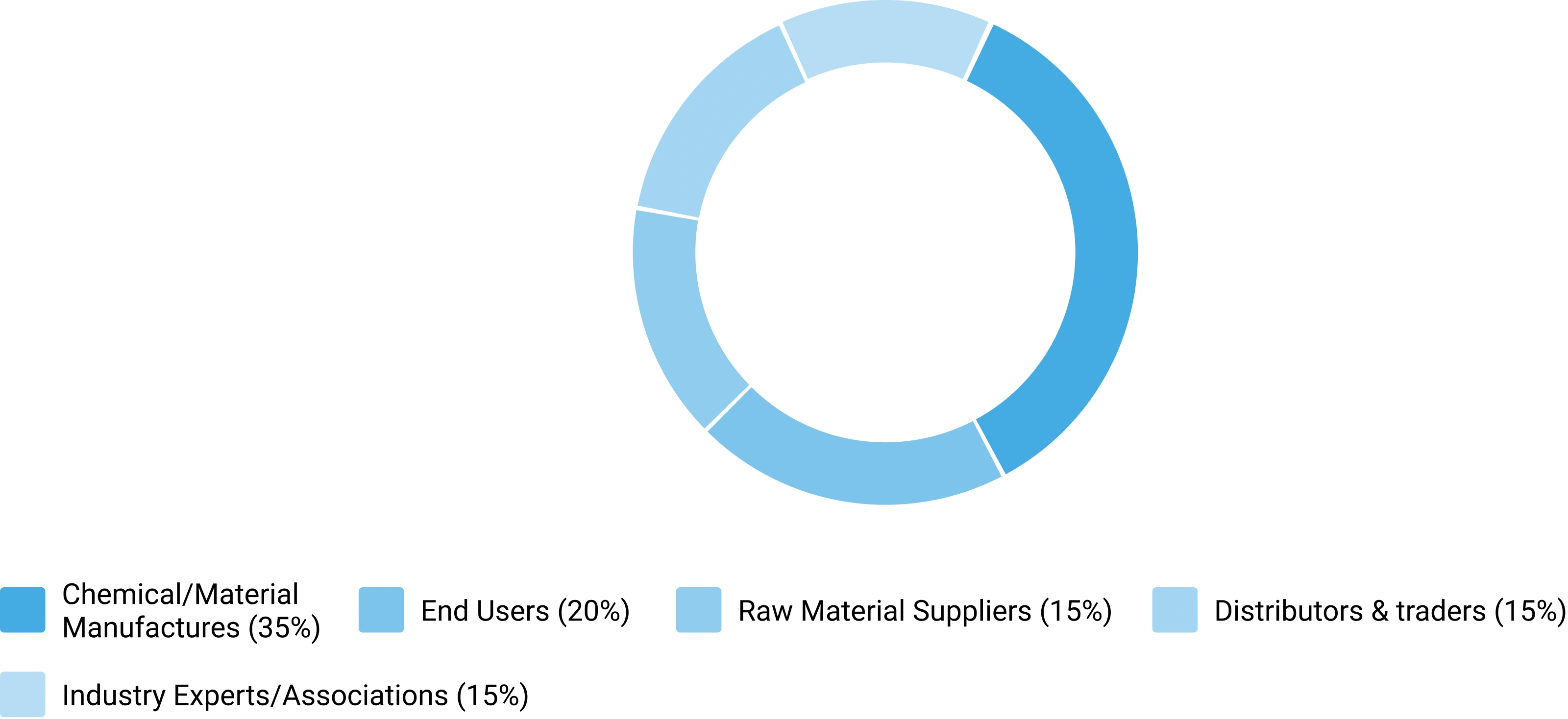
Category : Manufacturers, Suppliers, Distributors, End Users, Experts/Associations
Average Duration : 30–60 Minutes
Interview Mode : Video calls, telephonic interviews, expert consultations
Interview Format : Structured / Semi-Structured questionnaire
Focus Areas of Primary Research:
Market Size & Forecast Validation :
Revenue estimates, volume consumption, growth rates, forecast assumptions, regional demand.
Supply Chain & Value Chain Assessment :
Raw material sourcing, supply chain challenges, distribution networks, procurement practices.
Production & Capacity Analysis :
Manufacturing capacity, utilization rates, expansion projects, plant investments.
Pricing & Cost Structure Analysis :
Product pricing trends, feedstock costs, energy costs, margin pressures, pricing outlook.
Competitive Landscape Assessment :
Market share, competitor positioning, strategic initiatives, partnerships, acquisitions.
Primary Research — Stakeholder Coverage by Category
Distribution of interview respondents across stakeholder categories (% share from PPT data)
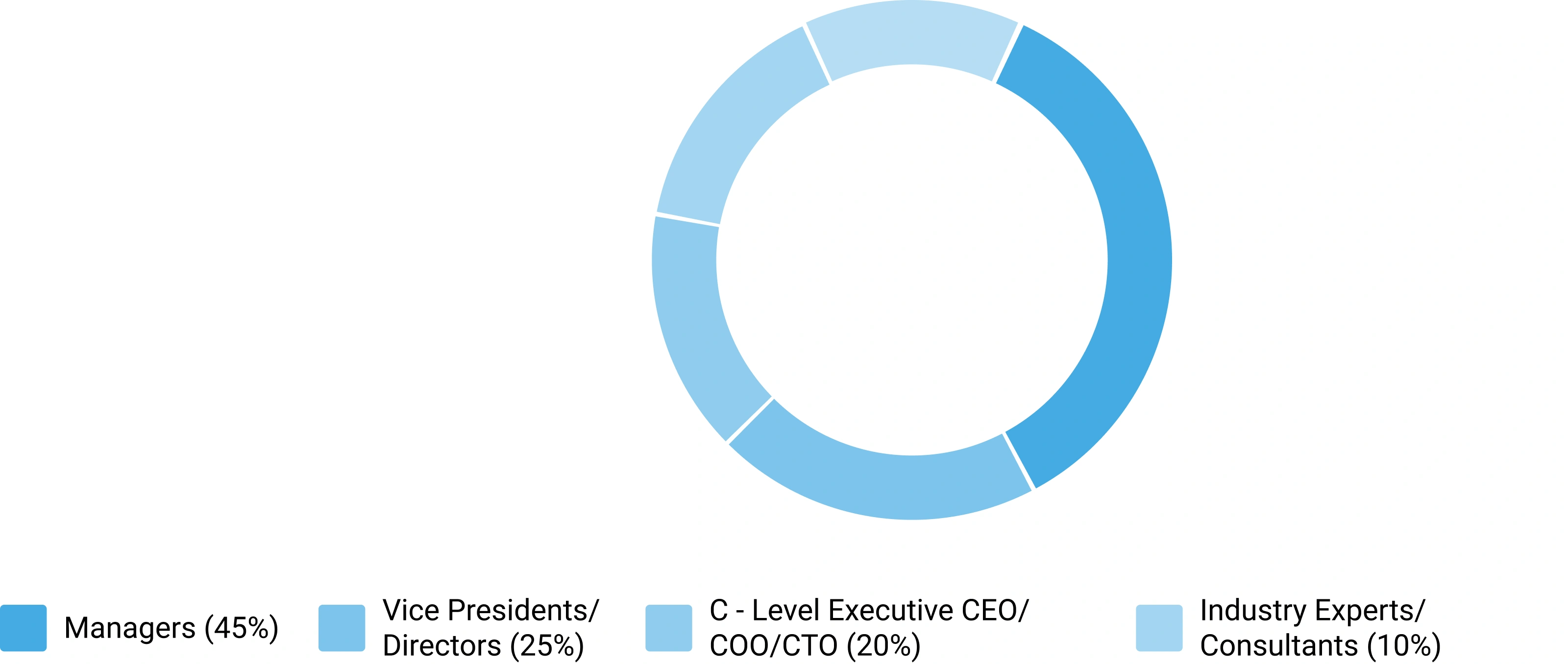
Primary Research — Respondent Designation Profile
Seniority breakdown of interview respondents (% share from PPT data)
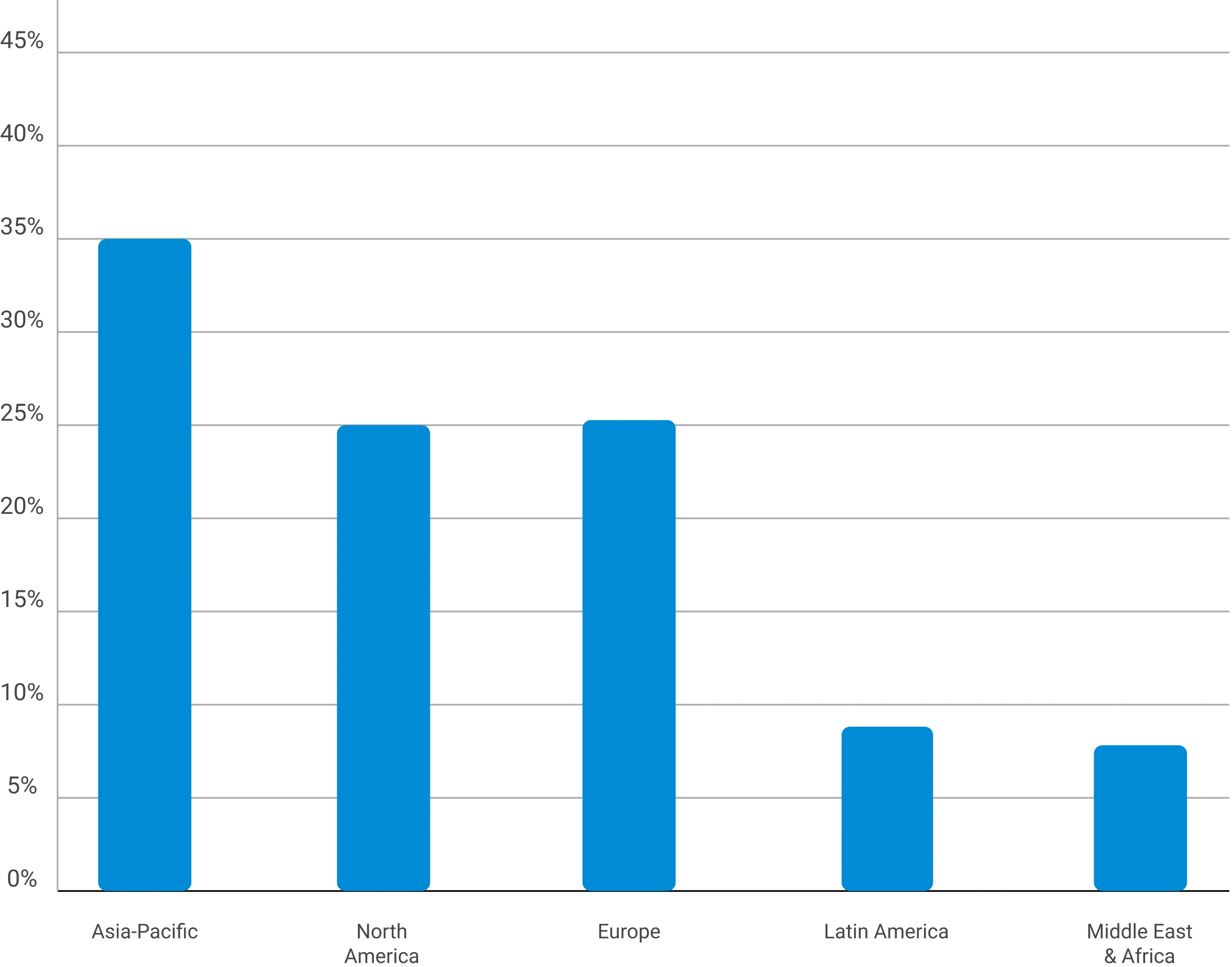
Primary Research — Geographic Coverage of Interviews
Regional distribution of primary research engagement (% share from PPT data)
Phase 6 — Data Triangulation and Market Validation
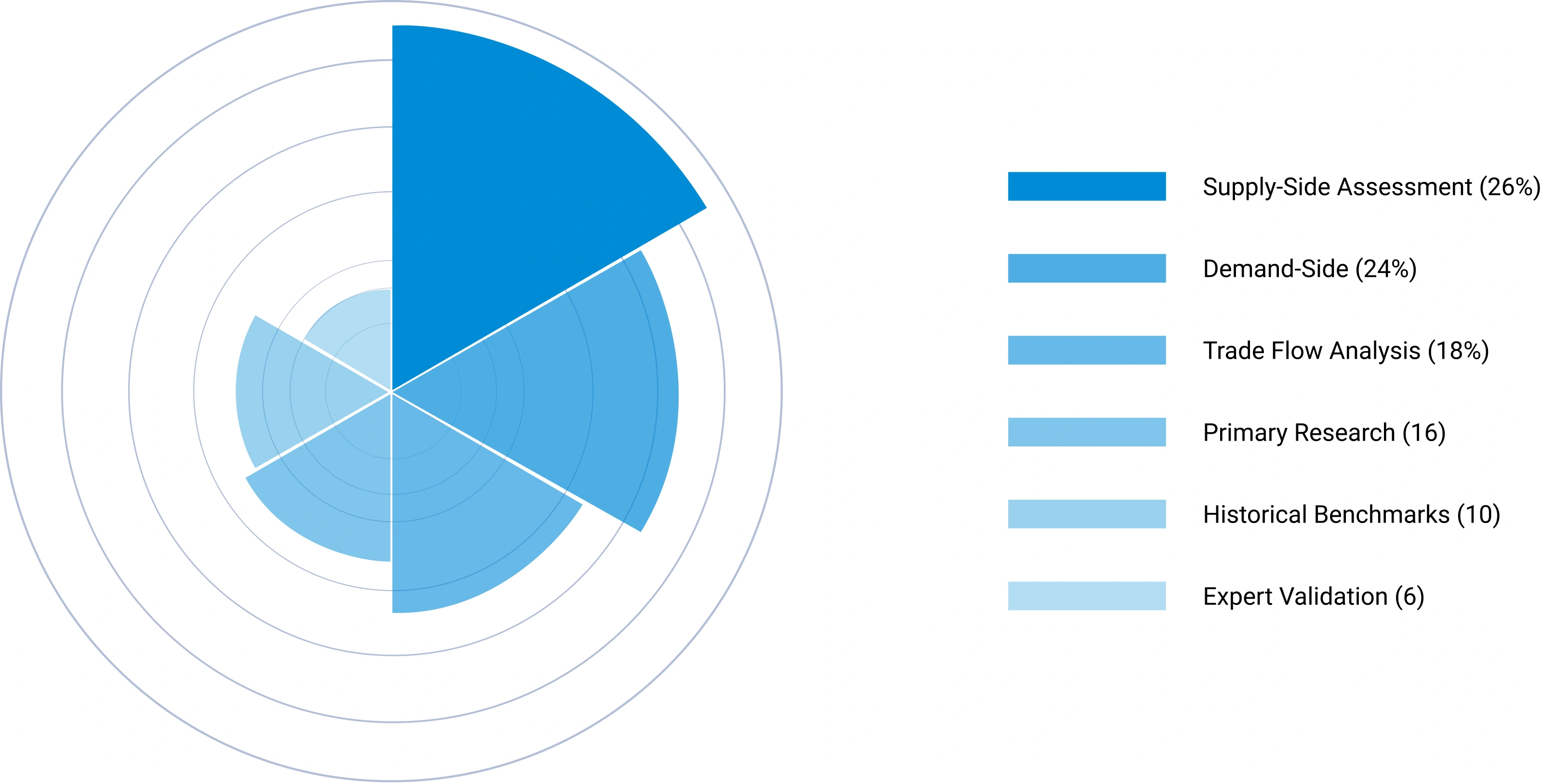
No single methodology is relied upon in isolation. Multiple independent estimation approaches are combined and reconciled to ensure consistency, accuracy, and analytical defensibility. Any material deviations between approaches are investigated and adjusted through additional validation cycles.
The final market size is derived through weighted triangulation of all validated methodologies. Any material deviations between approaches are investigated and adjusted through additional validation cycles. The outcome represents the most realistic assessment of the market based on available evidence and expert confirmation ensuring that volume and value estimates are fully consistent with one another.
Triangulation Framework — Input Contribution Weight
Relative weight each sizing input contributes to the final reconciled market estimate
Phase 7 — Forecast Modeling: Projecting Future Market Evolution
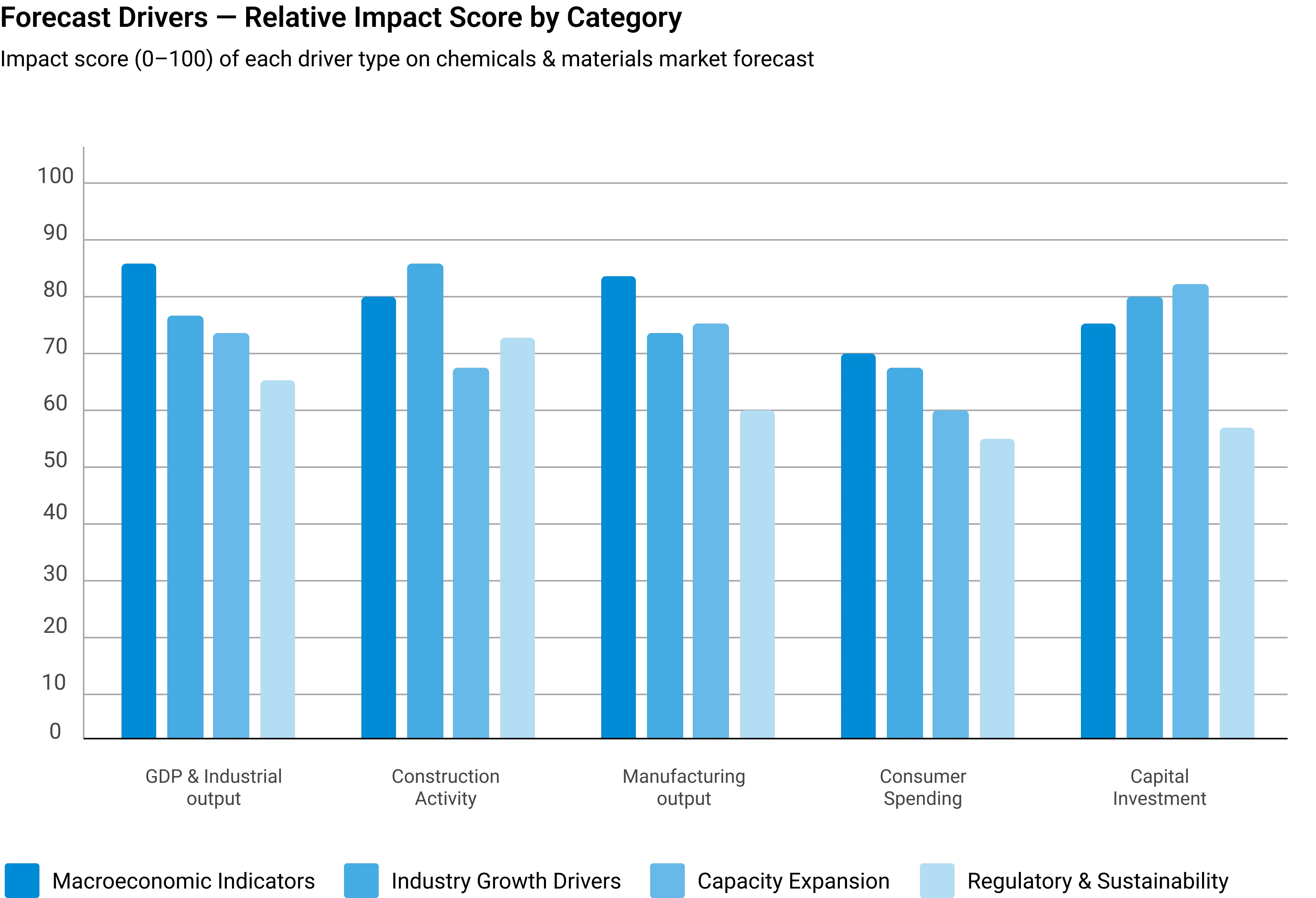
Forecasting evaluates the future trajectory of the market using a combination of quantitative indicators and qualitative assessments across economic, industry, and regulatory dimensions. Rather than simple extrapolation, each driver is independently modeled and integrated into a composite forecast.
Macroeconomic Indicators
GDP growth, industrial production, manufacturing output, construction activity, consumer spending, and capital investment form the quantitative foundation of long-term demand projections. These are applied at country, regional, and global levels.
Industry Growth Drivers
Urbanization, infrastructure development, industrialization, technological innovation, sustainability initiatives, and evolving product performance requirements are assessed at regional and industry levels — capturing both structural and cyclical demand drivers.
Capacity Expansion Analysis
Announced plant expansions, new manufacturing facilities, technology upgrades, and strategic investments are evaluated to determine future supply-demand dynamics and potential market tightness or oversupply situations.
Regulatory & Sustainability
Environmental regulations, chemical safety standards, emission reduction targets, circular economy initiatives, and sustainability requirements are incorporated as they often influence product adoption rates and market growth trajectories.
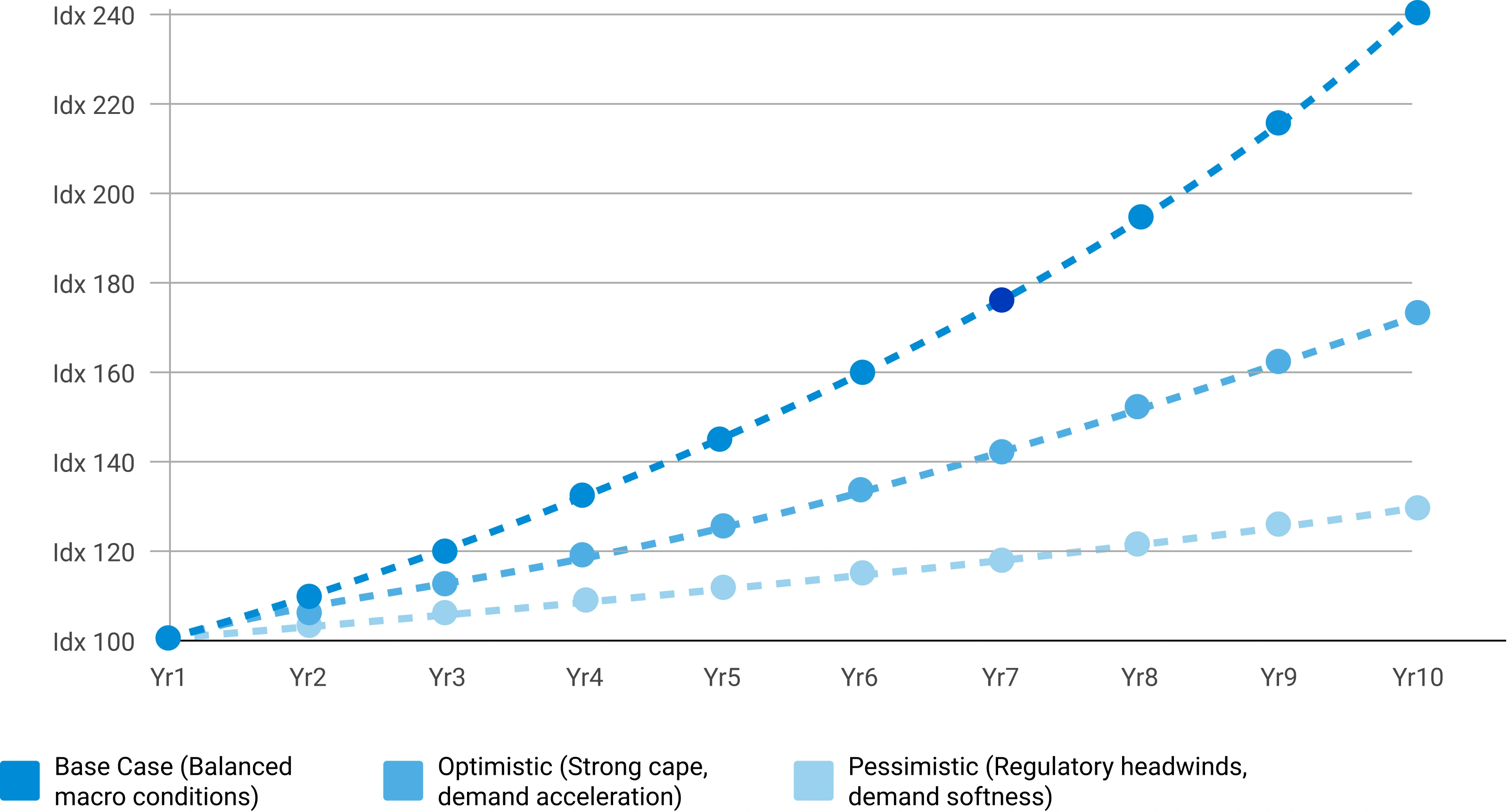
Scenario Forecast Range — Indexed Market Growth (Year 1–10)
Illustrative indexed growth trajectories across Base, Optimistic, and Pessimistic scenarios over a 10-year forecast horizon
Forecast Drivers — Relative Impact Score by Category
Impact score (0–100) of each driver type on chemicals & materials market forecast



Comments
Share your thoughts, ask a question, or provide feedback about this report.