
Kaolin Market Size and Forecast 2026 to 2035
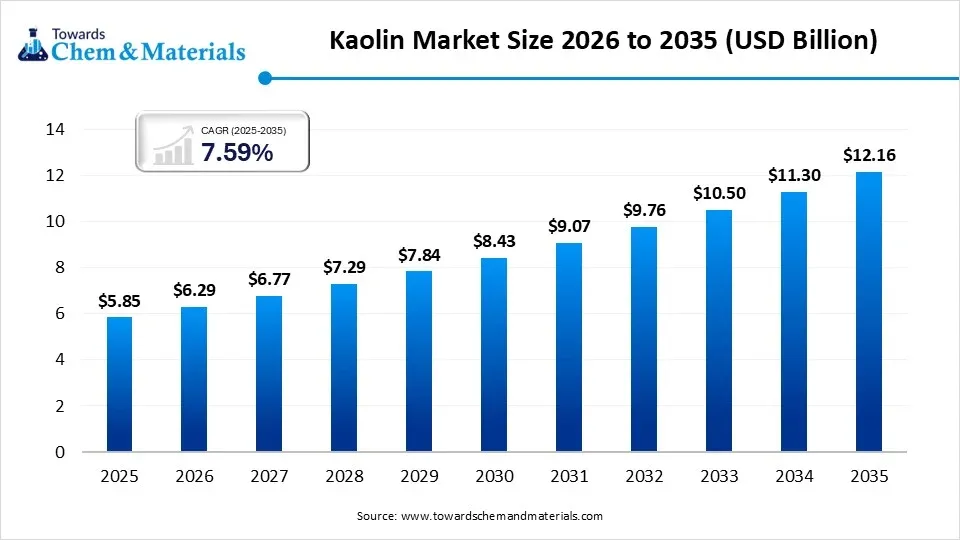
The global kaolin market size was estimated at USD 5.85 billion in 2025 and is expected to increase from USD 6.29 billion in 2026 to USD 12.16 billion by 2035, growing at a CAGR of 7.59% from 2026 to 2035. Asia Pacific dominated the Kaolin market with the largest revenue share of 49.00% in 2025. The greater demand for stronger and more advanced coatings accelerated the industry's growth in recent years. The kaolin refers to the natural white clay mineral, which is fine, chemically stable, and soft. Moreover, by improving the brightness, strength, and smoothness, the kaolin has attracted greater attention from many industries in recent years. Also, the kaolin has been seen used to improve the strength of ceramics, smoother paper, and paint to make it opaque.
Market Highlights
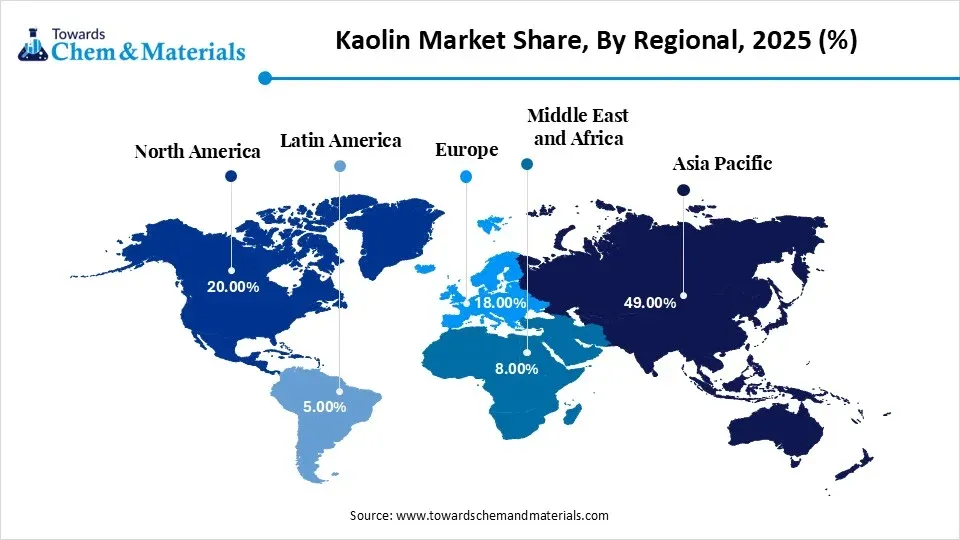
- By region, Asia Pacific dominated the kaolin market share 49.00% in 2025, due to its large paper, ceramics, and manual ring industries, while rapid urbanization and rising living standards increase demand for packaged goods, construction materials, and consumer products, all of which use kaolin.
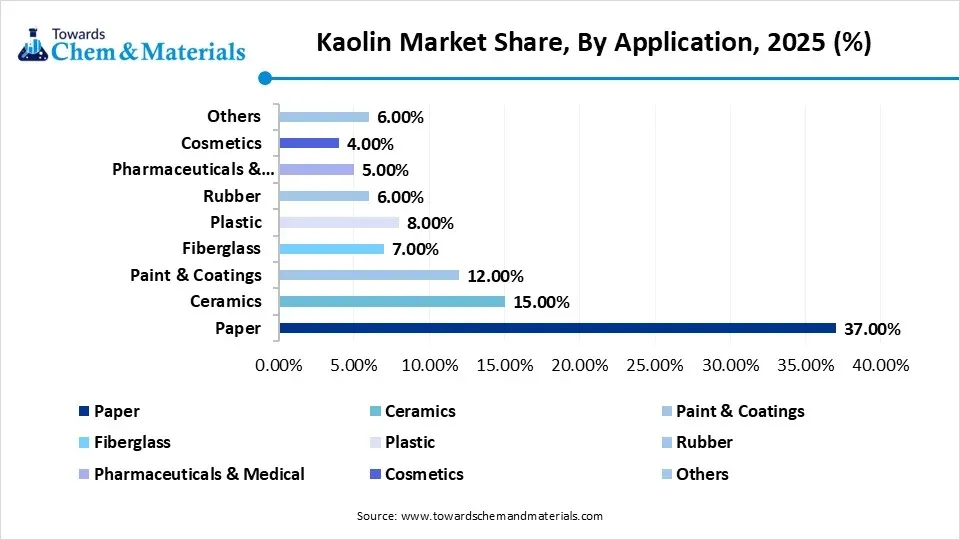
- By application, the paper segment dominated the market revenue share 37.00%in 2025, owing to kaolin's improving surface properties needed for printing and packaging.
Nano Kaolin Enhancing Coatings and Composites
The industry is actively shifting towards the development of nano-kaolin and engineered surface treatments. Also, the traditional kaolin is being processed into ultrafine particles with controlled surface chemistry. Nano-kaolin improves dispersion, bonding, and performance in coatings, composites, and plastics. It also enhances barrier properties in packaging and improves heat resistance in ceramics. Surface-engineered kaolin is even being used to create water-repellent and anti-scratch finishes.
Trade Analysis of the Kaolin Market:
Import, Export, Consumption, and Production Statistics
- The world has observed the sophisticated export of kaolin via 6,394 exporters and 9,401 buyers with 183,959 shipments as per published reports.
- Also, kaolin has seen greater imports between Jun 2024 and May 2025, buyers globally imported 2,674 shipments via 2,674 exporters and 3,840 buyers.
Kaolin Market Trends:
- The greater shift towards the speciality ceramics has stimulated the demand-led growth in the manufacturing sector nowadays. Also, the kaolin has observed to provide smoothness, stability, and strength to these speciality ceramics in the right amount.
- The demand for sustainable coatings and packaging is presenting new business models for forward-thinking manufacturers in the current period. Also, the companies are seeking materials that improve the strength of paper and board, while plastic is losing market share due to environmental concerns.
- The emergence of advanced inks and digital printing is likely to strengthen the foundation for the future sector growth during the projected period. Moreover, demand for coated paper has increased, which improves colour accuracy and ink absorption, while kaolin has emerged as an ideal material by helping to control surface texture and ink flow.
Report Scope
| Report Attribute | Details |
| Market Size in 2026 | USD 6.29 Billion |
| Revenue Forecast in 2035 | USD 12.16 Billion |
| Growth Rate | CAGR 7.59% |
| Forecast Period | 2026 - 2035 |
| Base Year | 2025 |
| Dominant Region | Asia Pacific |
| Segment Covered | By Application, By Region |
| Key companies profiled | BASF SE, EICL Ltd., Imerys S.A., I-Minerals Inc., KaMin LLC, LB Minerals Ltd., Maoming Xingli Kaolin Co. Ltd., Quazwerke GmbH, Sibelco, Thiele Kaolin Company |
Supply Chain Analysis of the Kaolin Market:
Distribution to Industrial Users
- Kaolin is distributed as a critical raw material across diverse manufacturing sectors.
- It serves as a vital filler and coating agent in paper production, a primary component in ceramic glazes, and a reinforcing agent in rubber and plastics. Additionally, it acts as a pigment extender in paints and coatings.
Chemical Synthesis and Processing
- Chemical synthesis of kaolin involves hydrothermal processing, where alumina and silica precursors react under high pressure and temperature to mimic natural formation.
- Industrial processing focuses on refining, utilizing water-washing, centrifugation, and bleaching to remove impurities. Calcination further enhances the mineral by heating it to alter its structural properties for specialized applications.
Regulatory Compliance and Safety Monitoring
- Regulatory compliance for kaolin centers on managing airborne dust exposure to prevent respiratory issues like pneumoconiosis. Safety monitoring involves rigorous purity testing for heavy metals and microbes, especially for pharmaceutical and food-grade applications.
- Facilities must adhere to OSHA and NIOSH exposure limits through ventilation and mandatory personal protective equipment.
Kaolin Market Regulatory Landscape: Global Regulations
| Country Region | Regulatory Body | Key Regulations | Focus Areas |
| United States | Environmental Protection Agency (EPA) | 21 CFR § 186.1256: Specifically identifies kaolin (clay) as Generally Recognized as Safe (GRAS) for use as an indirect food ingredient, primarily in paper and paperboard | Mining Sustainability: Increasing financial assurance requirements (e.g., $2,500 per acre in Georgia as of July 2024) to ensure land restoration. |
| European Union | ECHA | REACH Regulation (EC 1907/2006): Requires registration of kaolin; notably, certain dispersants like nonylphenol ethoxylates used in processing are restricted, increasing production costs | Eco-friendly Packaging: Shifting demand toward kaolin as a sustainable coating for plastic-free packaging |
| China | Ministry of Natural Resources (MNR) | GB Standards (e.g., GB 31604): National standards governing food-grade materials and chemical purity. | High-Purity Transition: Moving from traditional paper fillers to high-brightness grades for advanced ceramics and sanitaryware. |
Segmental Insights
Application Insights
How did the Paper Segment Dominate the Kaolin Market in 2025?
The paper segment dominated the market share 37.00% in 2025, due to kaolin improves surface properties needed for printing and packaging. Also, when kaolin is added to paper coatings, it makes the surface smoother, whiter, and better for high-quality printing. It also enhances opacity and brightness, improving product appearance. Packaging papers use kaolin to increase strength and moisture resistance.
The ceramics segment is expected to grow with a rapid CAGR, owing to increasing demand for advanced and specialty ceramics. Kaolin is a key ingredient in ceramic bodies, helping them fire smoothly and gain strength. New uses include ceramic components for electronics, automotive parts, and medical implants, areas that need very high performance. Architects and designers are also using innovative ceramic materials for modern interiors, as per the recent industry observation.
Kaolin Market Share, By Application, 2025 (%)
| By Application | Revenue Share, 2025 (%) |
| Paper | 37.00% |
| Ceramics | 15.00% |
| Paint & Coatings | 12.00% |
| Fiberglass | 7.00% |
| Plastic | 8.00% |
| Rubber | 6.00% |
| Pharmaceuticals & Medical | 5.00% |
| Cosmetics | 4.00% |
| Others | 6.00% |
By Type
Natural kaolin remains the dominant force in the marketshare 30.00% in 2025, largely because it is abundant, versatile, and environmentally friendly. Found primarily in sedimentary rocks formed under ambient conditions, it is both easily accessible and cost-effective for large-scale operations. Its unique physical properties—including a fine particle size, exceptional whiteness, chemical stability, and high plasticity—make it indispensable for a wide range of sectors, from ceramics and cosmetics to paints and coatings. Within this landscape, the paper industry stands out, relying heavily on natural kaolin as a filler and coating to achieve the brightness, printability, and smooth finish necessary for premium packaging and media.
Kaolin Market Share, By Type, 2025 (%)
| By Type | Revenue Share, 2025 (%) |
| Synthetic | 30.00% |
| Natural | 70.00% |
By Process
The water-washed process segment is on track for the fastest growth, as it has become a primary method for refining raw kaolin. Often referred to as wet processing, this method involves the extensive use of water through stages like screening, grinding, and chemical treatment to purify the material. This approach results in a stable chemical profile and superior adsorption capabilities, making the finished product ideal for specialized, high-performance applications. Driven by increasing demand from the building and construction sectors, this process is particularly vital for producing hydrous kaolin, as it effectively maintains a specific moisture content of approximately 12–14% within the clay.
Kaolin Market Share, By Process, 2025 (%)
| By Process | Revenue Share, 2025 (%) |
| Water-Washed | 39.00% |
| Airfloat | 15.00% |
| Calcined | 12.00% |
| Delaminated | 11.00% |
| and Surface-Modified & Unprocessed | 23.00% |
Regional Insights
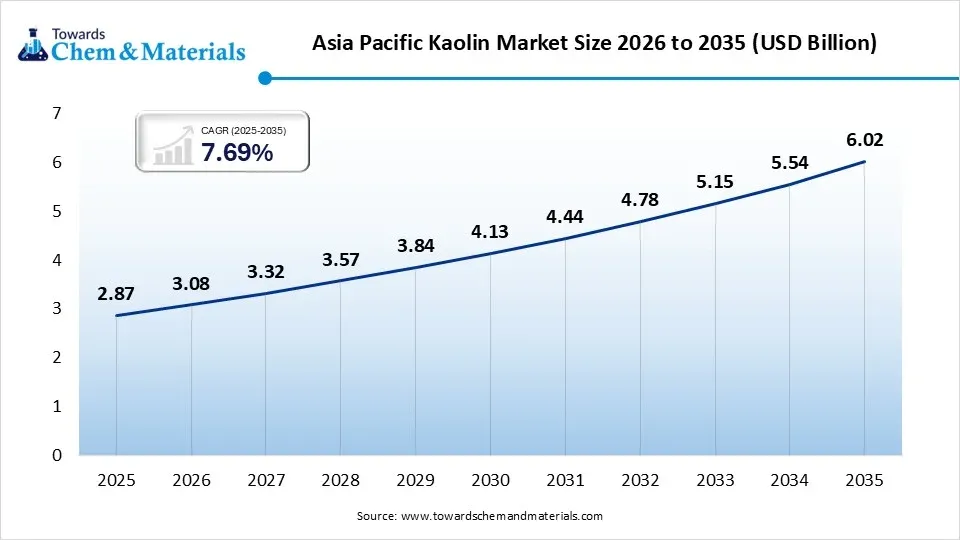
The Asia Pacific kaolin market size was valued at USD 2.87 billion in 2025 and is expected to be worth around USD 6.02 billion by 2035, exhibiting at a compound annual growth rate (CAGR) of 7.69% over the forecast period from 2026 to 2035. Asia Pacific dominated the kaolin market share 49.00% in 2025, due to its large paper, ceramics, and manual ring industries. Moreover, rapid urbanization and rising living standards increase demand for packaged goods, construction materials, and consumer products, all of which use kaolin. Lower production costs and abundant clay deposits also support local industry growth. Many global companies set up plants in this region due to cost efficiency and strong demand.
China Driving Global Kaolin Industry Expansion
China maintained its dominance in the market, owing to its heavy clay reserves and strong downstream industries. Furthermore, it is one of the largest producers and consumers of paper and ceramics worldwide. Rapid industrialization and growing domestic demand for packaging, tiles, and household products increase kaolin use. China is also improving refining technologies to produce high-purity and specialty grades. Government support for infrastructure, construction, and manufacturing further boosts demand.
Europe Kaolin Market Examination
The Europe kaolin market segment accounted for the major revenue share of 18.00% in 2025. Europe is expected to capture a major share of the kaolin market with a rapid CAGR, owing to rising sustainable packaging and advanced coating applications. Moreover, the European manufacturers are focused on reducing plastic waste, and clay-enhanced coatings help produce recyclable paper and board. The shift toward circular economy principles increases interest in natural minerals like kaolin. Demand in specialty ceramics and engineering materials is also rising, supported by advanced manufacturing sectors.
Germany Expanding Demand for Refined Kaolin
Germany is expected to emerge as a prominent country for the kaolin market in the coming years, owing to its strong manufacturing and engineering base. Also, from automotive ceramics to high-end industrial coatings, German industries use kaolin to improve material performance and sustainability. The country's stricter environmental and quality standards also favor natural and engineered clay products. Germany's focus on innovation in material science, especially in composites and functional coatings, creates demand for refined kaolin grades.
Kaolin Market Evaluation in North America
The North America kaolin market segment accounted for the major revenue share of 20.00% in 2025. North America is growing in industry, owing to increasing demand in specialty applications like high-performance ceramics, advanced coatings, and sustainable packaging. Also, the region has strong industrial innovation and investment in material science research. As paper demand stabilizes, high-value uses are growing faster. Growth in automotive ceramics, digital printing, and specialty composites supports rising kaolin use. Additionally, companies in the United States are investing in refined and engineered kaolin products.
Kaolin Market Share, By Regional, 2025 (%)
| Regional | Revenue Share, 2025 (%) |
| North America | 20.00% |
| Europe | 18.00% |
| Asia Pacific | 49.00% |
| Latin America | 5.00% |
| Middle East & Africa | 8.00% |
Growing Kaolin Applications in the United States
The United States is expected to gain a significant industry share, due to innovation in advanced materials and increasing use in premium applications. Also, the manufacturers in the United States are integrating kaolin into engineered coatings, high-end ceramics, and advanced packaging solutions. Environmental standards also encourage the use of clay-based, eco-friendly materials. Kaolin supports better ink performance, stronger ceramic components, and lighter packaging structures. Research institutions in the United States are exploring nano-clay technologies for improved performance
Recent Developments
- In June 2025, Green360 unveiled its latest product line of low-carbon cement. Also, this cement includes kaolin and red mud. Also, this cement is likely to important role in mine operation as per the company's claim.(Source: www.cemnet.com)
- In May 2025, the Shanghai Panshi unveiled specialized kaolin. Also, the newly launched kaolin is specifically designed for the onboard honeycomb ceramics. Moreover, it will play a major role by helping with the localization and substitution of key materials as per the published report by the company.(Source: www.panshiminerals.com)
Top Vendors in the Kaolin Market & Their Offerings:
- BASF SE: This German chemical giant is a global leader in kaolin production, specializing in high-performance calcined and hydrous grades. Its portfolio focuses on high-end surface coatings, plastics, and catalysis. By leveraging advanced chemical engineering, BASF optimizes kaolin for specialized industrial applications, emphasizing functional additives that improve product durability and finish.
- EICL Ltd.: Headquartered in India, EICL is a premier producer of processed kaolin and starch. The company operates extensive mining and processing facilities, catering primarily to the paper, paint, and fiberglass industries. EICL is known for its value-added products, utilizing indigenous technology to provide high-brightness fillers and coating clays.
- Imerys S.A.: Based in France, Imerys is the world leader in mineral-based specialty solutions. It manages a diverse global portfolio of kaolin deposits, providing tailored minerals for ceramics, paper, and cosmetics. Imerys focuses on sustainable extraction and innovative mineral processing to enhance brightness, opacity, and rheological properties for its clients.
- I-Minerals Inc.: A Canadian exploration and development company, I-Minerals focuses on high-purity mineral deposits in the United States. Its primary project targets the extraction of halloysite-kaolin, quartz, and potassium feldspar. The company aims to supply high-value markets, including advanced ceramics, catalysts, and technical applications requiring exceptional mineral purity and structure.
- KaMin LLC
- LB Minerals Ltd.
- Maoming Xingli Kaolin Co. Ltd.
- Quazwerke GmbH
- Sibelco
- Thiele Kaolin Company
Segments Covered in the Report
By Type
- Synthetic
- Natural
By Process
- Water-Washed
- Airfloat
- Calcined
- Delaminated
- and Surface-Modified & Unprocessed
By Application
- Paper
- Ceramics
- Paint & Coatings
- Fiberglass
- Plastic
- Rubber
- Pharmaceuticals & Medical
- Cosmetics
- Others
By Region
- North America
- U.S.
- Canada
- Mexico
- Europe
- Germany
- UK
- France
- Italy
- Spain
- Asia Pacific
- China
- India
- Japan
- South Korea
- Latin America
- Brazil
- Argentina
- Middle East & Africa
- Saudi Arabia
- South Africa



Comments
Share your thoughts, ask a question, or provide feedback about this report.