
What is the Propylene Market Size and Share?
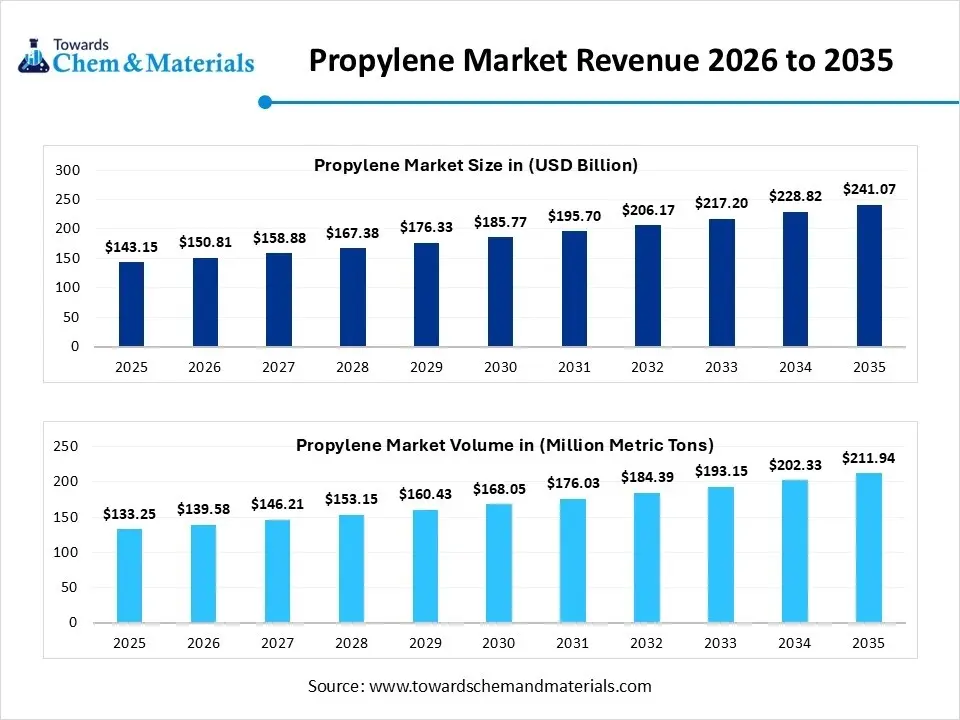
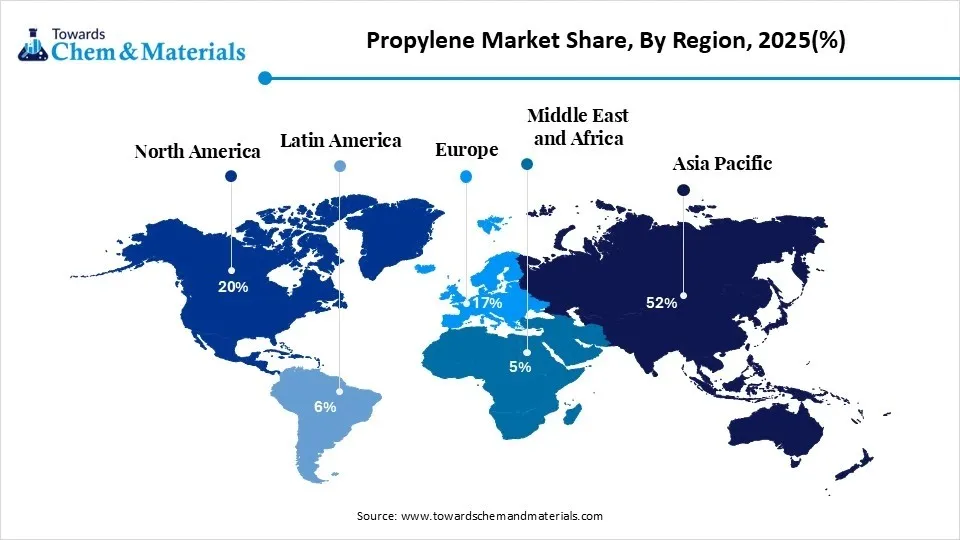
The global propylene market size was valued at USD 143.15 billion in 2025, is estimated to reach USD 150.81 billion in 2026, and is projected to reach USD 241.07billion by 2035, exhibiting a compound annual growth rate (CAGR) of 5.35% over the forecast period from 2026 to 2035.Asia Pacific dominated the propylene market with the largest revenue share of 52% in 2025 and is expected to grow at the fastest CAGR of 5.45% during the forecast period.
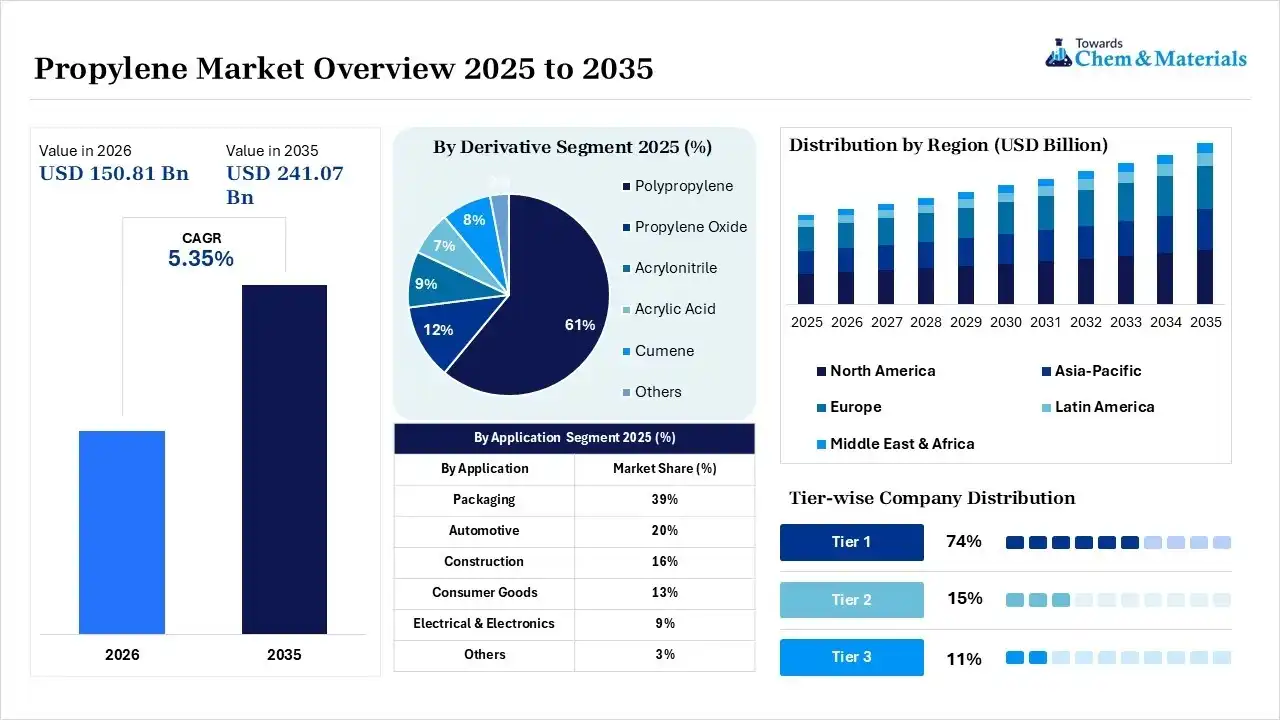
The Propylene-based materials are becoming increasingly common in various applications, further solidifying the global consumption trends. The market growth is attributable to rising polypropylene demand, usage in the automotive market, packaging market, and growing downstream derivatives. Further driving market development are the investments made in on-purpose production technologies, sustainability measures, and industrial expansion in the Asia Pacific.
Market Highlights
- By region, Asia Pacific dominated the propylene market by holding a 52% share in 2025 and is expected to grow at the fastest CAGR of 6.2% during the forecast period.
- By region, North America held 20% market share in 2025 and is expected to grow at a CAGR of 4.8% during the forecast period.
- By derivative, the polypropylene segment dominated the market with the largest share of 61% in 2025 and is expected to grow at a CAGR of 5.1% during the forecast period.
- By derivative, the acrylic acid segment held 7% market share in 2025 and is expected to grow at the fastest CAGR of 6.4% over the forecast period.
- By application, the packaging segment dominated the market with the largest share of 39% in 2025 and is expected to grow at a CAGR of 5.2% during the forecast period.
- By application, the electrical & electronics segment held 9% market share in 2025 and is expected to grow at the fastest CAGR of 6.3% over the forecast period.
According to Towards Chemicals and Materials Analytics and Consulting, the global propylene market volume was valued at 133.25 million metric tons in 2025 and is expected to surpass around 211.94 million metric tons by 2035, accelerating a compound annual growth rate (CAGR) of 4.75% over the forecast period from 2026 to 2035.
Market Overview
Expanding Propylene Application Through Industrial Growth and Sustainable Production
Polypropylenes lightweight, durable, and economical properties make it a popular choice in the packaging industry. Propylene-based plastics and polyurethanes are being used by automakers for a variety of interior parts, bumpers, and seating uses to enhance vehicle efficiency. The construction and consumer goods industries also participate, with the use of propylene oxide-based polyurethanes.
The technological advances for propane dehydrogenation (PDH) processes are bolstering the production capacity, with higher yields and lower manufacturing costs. The value of the additional catalyst development is in increased operational efficiency and the ability to use flexible feedstocks. Bio-based propylene and chemical recycling offer opportunities in the context of sustainability initiatives.
- For instance, in May 2026, Nouryon released its organic peroxide technology, Perkadox PM-60ST-GR, to restore the performance of recycled polypropylene, allowing for a higher recycled content across packaging, automotive, and consumer goods applications.(Source: www.alchempro.com)
Report Scope
| Report Attributes | Details |
| Market Size in 2026 | USD 150.81 Billion/ 139.58 Million Metric Tons |
| Expected Size in 2035 | USD 241.07 Billion/ 211.94 Million Metric Tons |
| Growth Rate | CAGR of 5.35% |
| Base Year of Estimation | 2025 |
| Forecast Period | 2025-2035 |
| Dominant Region | Asia Pacific |
| Segment Covered | By Derivative, By Application, By Region |
| Key Companies Profiled | Sinopec Group, ExxonMobil, Dow, LyondellBasell Industries, SABIC, BASF, Reliance Industries, Braskem, TotalEnergies, INEOS, Borealis AG, Formosa Plastics, Mitsui Chemicals, Sumitomo Chemical, Repsol |
Global Investment Movement for the Propylene Market
Propane dehydrogenation (PDH) facilities are increasingly being targeted for investment as an alternative way to create a propylene production unit. These investments will decrease reliance on steam cracker by-product supply and give manufacturers greater control over production volumes. The growth of the polypropylene and other downstream derivative industries is the reason for the expansion of PDH.The industry is investigating renewable feedstocks and biosynthetic production processes to support sustainability goals. The investment in bio-based propylene is in line with the companys decarbonisation targets and rising demand for sustainable materials in packaging and in the automotive sector.
- For instance, in August, ABB teamed up with Citroniq to deliver automation and digitalization solutions for an industrial-scale biogenic polypropylene plant in Nebraska, enabling sustainable packaging, automotive, consumer goods, and medical applications.(Source: new.abb.com/news )
Large enterprises are integrating the upstream resources of feedstocks with the downstream resources of derivatives manufacturing to ensure the operability of their production line. This helps to minimize crude oil volatility exposure and improves the security of supplies in propylene value chains.
Market Trends
- Investments are also targeted at upgrading production units, replacing the older, energy-consuming ones with more advanced technologies. Businesses are moving to optimise their manufacturing systems to boost productivity, minimize environmental pollution, and ensure sustainability.
- Feedstock availability, planned PDH maintenance activities, and geopolitical disruptions are impacting propylene supply dynamics. Naphtha and propane price changes are impacting the economics of production. Businesses are increasingly turning to flexible production technologies to cope with supply uncertainty and maintain availability.
- Advanced catalysts, systems for optimizing processes, and digital technologies are being incorporated by manufacturers to improve production efficiency. Various improvements in the PDH processes and development of catalysts have been introduced to enhance yield, energy efficiency, and more consistent operation of propylene manufacturing.
Key Technological Shifts and AI in the Propylene Market
AI & Innovation: Transforming Propylene Production Through Digitalization and Advanced Process
AI and advanced technologies are making the propylene value chain more efficient, reliable, and sustainable. Optimization systems based on artificial intelligence (AI) analyze the sensor information of the plant to automatically optimize the conditions inside the reactors, such as temperature, pressure, and hydrogen ratio. These are used to enhance conversions in energy-intensive processes like propane dehydrogenation and steam cracking. Advanced process control platforms are helping achieve stable operations by minimizing raw material waste and enhancing production consistency.
AI technologies are also used by manufacturers to make their production of specialty-grade materials more efficient, as they are able to forecast optimum operating conditions when transitioning from one material to another, minimizing off-specification production. Petrochemical facilities are getting better at detecting performance problems in equipment before they can happen, thanks to predictive maintenance solutions. Compressors, reactors, and other critical assets are monitored by AI algorithms to minimize unexpected downtime.
Supply Chain Analysis of the Propylene Market
Feedstock Procurement
- Feedstock procurement includes the supply of key hydrocarbon feedstocks, such as naphtha, propane, and refinery off-gases, to feed propylene production. A constant supply of reliable feedstock is vital to continuous manufacturing.
- Firm procurement linkages enable manufacturers to control their production efficiency, ensure their operational costs, and avoid the impact of raw material fluctuations on their production.
- ExxonMobil: To meet the demand for olefins, ExxonMobil acquires natural gas and petroleum resources globally for its highly integrated steam cracker operations.
- Other Key Players: SABIC, Shell Chemical, TotalEnergies.
Chemical Synthesis and Processing
- Chemical synthesis and processing refer to the production of propylene monomers from raw materials, such as steam cracking, propane dehydrogenation (PDH), and fluid catalytic cracking (FCC).
This stage will result in production capacity and product quality, and will also enable high-purity propylene supply to downstream applications, improving operational efficiency. - Dow: Dow has significant, energy-efficient steam crackers and PDH units to generate high-purity propylene for a range of industrial uses.
- Other Key Players: LyondellBasell, BASF, Reliance Industries.
Compound Formulation and Blending
- Compounds and Blending uses propylene monomers along with catalysts, additives, and modifiers to produce value-added products such as polypropylene, propylene oxide, acrylic acid, etc.
Develops specialized products for packaging, automotive, construction, and consumer applications. This stage enhances material performance. - LyondellBasell: LyondellBasell has a strong portfolio of quality polypropylene polymers produced by integrating propylene with proprietary catalysts and additives.
- Other Key Players: SABIC, Braskem, Borealis.
Applications of Propylene
- Improving the Production of Lightweight Materials: Propylene is an intermediate for making lightweight materials, particularly polypropylene, which is used in packaging, automotive, and consumer goods applications. It is low-density and durable, which enables manufacturers to create efficient products and use less material. Continued preference for transportation and packaging solutions using lightweight materials will continue to drive propylene usage in the industry.
- To Help Provide Durable Packaging Solutions: The polypropylene derived from propylene has very good strength, flexibility, and barrier properties, which are suitable for flexible and rigid packaging. It can be used in food packaging, retail products, and e-commerce materials, providing cost-effective and durable solutions. Propylene derivatives are still being used in greater quantities due to their increasing demand for convenient packaging formats.
- Making Automotive Manufacturing More Efficient: Automotive lightweighting of interiors, instrument panels, bumpers, and seating components is an example of applications that use propylene derivatives. These materials allow manufacturers to lower vehicle weight without sacrificing performance and durability. The rise in electric vehicle production and transport solutions is also driving demand for automotive parts made from propylene.
- To Enable Advanced Chemical Applications : Propylene is used as an important raw material for the manufacture of a variety of valuable chemical products, such as propylene oxide, acrylic acid, and acrylonitrile. These chemicals can be used in construction, electronics, textiles, and consumer products. Propylene can be processed to become a number of different materials, making it useful for many industrial applications.
Benefits and Integrated Uses of Propylene
- Enabling Growth in Healthcare Applications : Propylene-based materials are used in medical and pharmaceutical applications, such as medical-grade plastics, healthcare products, and specialty materials. They are durable, chemically resistant, and processable, which are important for healthcare manufacturing needs. With more investment in healthcare infrastructure, new opportunities are opening up for propylene derivative applications.
- Advancements in Electronic Material Performance : Propylene products are used for their electronic applications in electronic housings, insulation materials, and special-purpose components. PP and like copolymers are used to impart both durability and functional performance to todays electronic products. The amount of electronics being produced is also helping to drive the growth of propylene-based materials.
- Enhance CE initiatives: Chemical recycling and the development of bio-based production are key contributions of propylene for sustainability. Both advanced recycling technologies and renewable feedstocks are helping to establish circular pathways for polypropylene materials and to enable lower-carbon production methods. The innovations are making propylene products more environmentally friendly.
Types of Propylene
- Polymer Grade Propylene : Propylene grade polymers are highly pure materials, mainly used for polypropylene production. It is used to make materials for packaging, automotive parts, consumer goods, and industrial products. The quality features make it appropriate for making various grades of polypropylene plastics having superior performance and durability.
- Chemical Grade Propylene : Chemical-grade propylene is used for the production of many chemical intermediates and derivatives. It is used as a raw material for the production of propylene oxide, acrylic acid, acrylonitrile, and other chemicals as downstream products for various industrial applications.
- Refinery Grade Propylene : Propylene from refinery processes is called refinery grade and is not as pure as polymer grade propylene. It is widely applied for chemical manufacturing and blending processes, but is not used for processes that demand extremely high purity.
- Bio-Based Propylene : Propylene is made from bio sources and new sustainable technologies. It is getting prominence as carbon emission reduction goals are rising within companies in the plastic product and related sectors, as well as increasing sustainability mandates.
Regulatory Framework: Propylene Market
| Country Region | Regulatory Body | Key Regulations | Focus Areas |
| Asia Pacific | Ministry of Ecology and Environment MEE |
Decree No. 12 (China REACH) | Environmental permits and emission controls |
| North America | EPA | Clean Air Act (CAA) | VOC emission limits & leak detection |
| European Union | ECHA | REACH (EC 1907/2006) | Mandatory chemical registration and safety dossiers |
Propylene Market Dynamics
Driver : Increasing Consumption of Polypropylene
Demand for polypropylene has been the largest contributor to the propylene market, with over 70% of global propylene consumption from this end use. The material is extensively employed in flexible and rigid food packaging applications, medical plastics, consumer goods, and industrial applications. The growing requirement for lightweight and durable materials in the manufacturing of automobiles is also driving the consumption of polypropylene. The growing trend of packaging needs across the retail and e-commerce space further reinforces the demand for propylene around the world.
Restraint : Impact of Feedstock Price Volatility on Production
Crude oil and natural gas prices, as naphtha and propane feedstocks, have a significant impact on propylene production costs. The geopolitical environment, energy market volatility, and the varying prices of raw materials generate uncertainty for producers. These changes can lead to lower profitability and influence investments. The industry is turning to integrated production methods and alternative technologies to lessen reliance on fluctuating raw material markets and increase business stability.
Opportunity: Bio-Based Propylene Emergence
As sustainability becomes a greater priority, more bio-based propylene development and advanced chemical recycling technologies are becoming available. Renewable feedstocks and circular solutions are a key focus of investments by industry players supporting global decarbonisation goals. Increasing demand for sustainable polypropylene in packaging and automotive applications is pushing innovation in production processes. Businesses can gain an edge in the market and meet environmental needs with low-carbon propylene solutions.
Segmental Insights
Derivative Insights
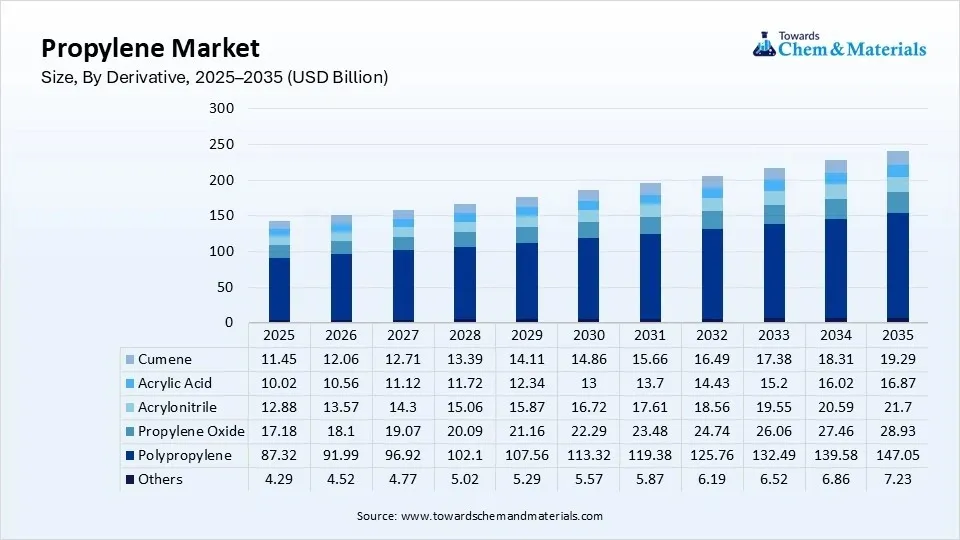
The polypropylene segment dominated the market with the largest share of 61% in 2025 and is expected to grow at a CAGR of 5.1% over the forecast period. Growth is backed by the high demand for polypropylene in packaging, automotive, consumer goods, and industrial applications. Its low weight, low cost, and durability continue to make it a preferred choice for manufacturers. The demand for flexible packaging, rigid plastic, and automotive parts is all strong, keeping polypropylene as the top propylene derivative.
- For instance, in January 2026, LCY and Milliken & Company released the high-performance 737U grade of polypropylene for injection-molded automotive components, furniture, containers, and outdoor equipment applications, which is enhanced by the addition of DeltaMax™ technology.(Source: www.prnewswire.com)
The acrylic acid segment held a 7% market share in 2025 and is expected to grow at the fastest CAGR of 6.4% over the forecast period, as the demand for acrylic acid derivatives such as acrylic esters and superabsorbent polymers is rising. They are used in different industrial and domestic applications because of their functional properties. The segment is expanding due to the increased usage of specialty chemical solutions and the increasing number of downstream applications. The growing demand for advanced materials in various industries is likely to propel the growth of the acrylic acid market in the coming years.
Application Insights
The packaging segment dominated the market with the largest share of 39% in 2025 and is expected to grow at a CAGR of 5.2% over the forecast period, fueled by growing usage of PP-based materials across flexible packaging, rigid packaging, and industrial packaging applications. Polypropylene polymers are superior because they have lightweight properties, barrier properties, cost-effectiveness, and durability. The demand for packaging continues to grow across food, retail, and e-commerce markets. The growing demand for sustainable and efficient packaging solutions further bolsters the growth of the segment.
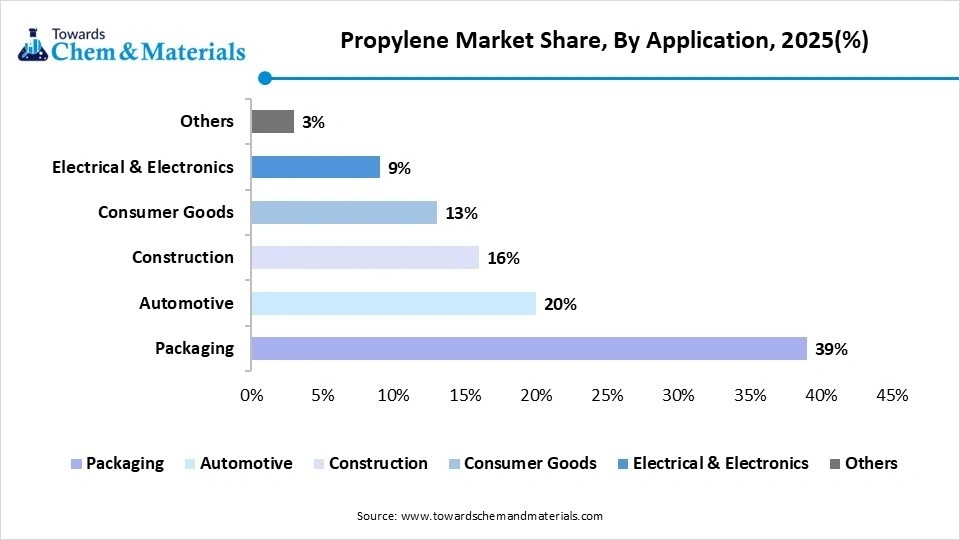
The electrical & electronics segment held a 9% market share in 2025 and is expected to grow at the fastest CAGR of 6.3% over the forecast period, driven by the growing use of polypropylene and specialty copolymers in the electronic components, wire and cable, and consumer electronics markets, respectively. Electronic products have a need for durability, insulation characteristics, and functional performance that can be met with propylene-based materials. The electronics manufacturing industry and the demand for advanced materials are helping to drive growth in the segment. High-performance polymer solutions still open new possibilities in the electrical and electronics field.
Regional Insights
How Did the Asia Pacific Dominate the Propylene Market In 2025?
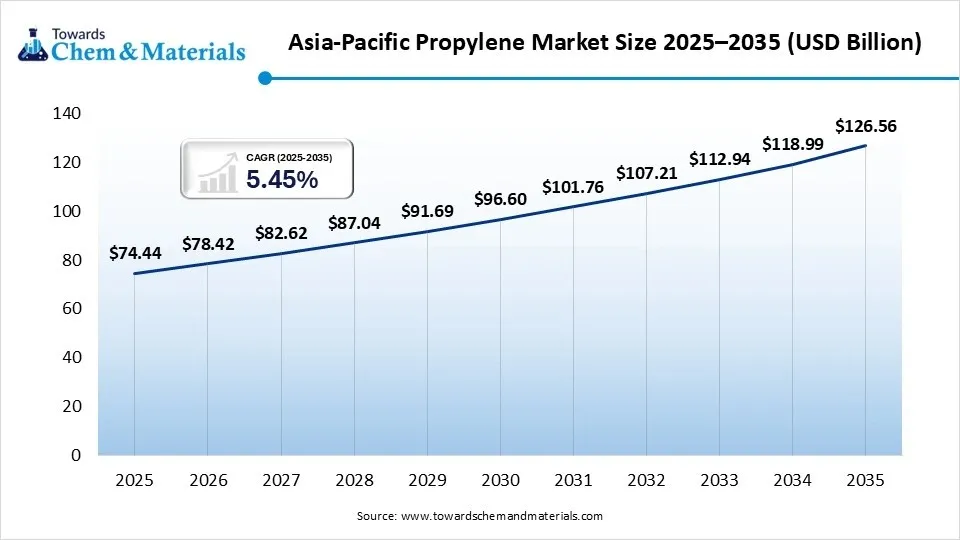
The Asia Pacific propylene market size was estimated at USD 74.44 billion in 2025 and is projected to reach USD 126.56 billion by 2035, growing at a CAGR of 5.45% from 2026 to 2035. Asia Pacific dominated the market with the largest share of 52% in 2025 and is expected to grow at the fastest CAGR of 6.2% during the forecast period. Rapid industrialization, expanding manufacturing, and the rising demand for propylene derivatives in packaging, automotive, and consumer goods drive the growth in the region. China and India are playing a big role in their own production development and investments in petrochemicals in the downstream segment. Expansion of the market for polypropylene-based materials and the focus on strengthening the supply chain are other factors that are driving the market in the region. Asia Pacific will continue to be the top region for propylene consumption in the world.
China is another significant player in the Asia Pacific propylene market, as investments in domestic production capacities are increasing. The country has turned to building the capacity for propane dehydrogenation (PDH) and enhancing local propylene availability to drive self-sufficiency. The market is gaining momentum due to increasing demand for polypropylene in packaging, automotive, and industrial applications. Propylene derivatives are also being utilized in various industries due to the spread of new petrochemical industries toward the downstream. China is paying more attention to improving its self-sufficiency in manufacturing and reducing reliance on imports, which continues to benefit the development of the propylene industry.
The demand for propylene is fast rising in India, as more and more investments are made in the downstream petrochemical sector and industrial activity is expanding. The nation is carving a niche for itself as a global manufacturing powerhouse with the development of its petrochemical production capacity. The increasing demand for packaging, automotive, and consumer goods sectors is promoting the usage of propylene derivatives. Large-scale petrochemical projects, such as the crude-to-chemicals refinery projects undertaken by Reliance Industries, are driving future market opportunities. India is expected to play an increasingly important role in the regional propylene landscape with the expected growth of the demand for polypropylene and industrial activities.
North American Propylene Market Trend Analysis
The North America propylene market size was estimated at USD 28.63 billion in 2025 and is projected to reach USD 49.42 billion by 2035, growing at a CAGR of 5.61% from 2026 to 2035.North America held 20% market share in 2025 and is expected to grow at a CAGR of 5.8% during the forecast period. The infrastructure of petrochemicals, advanced production capacities, and the growing activities for the production of polypropylene support the regional market growth. The United States and Canada are sharing technology and capacity-building programmes. Rapid growth in consumption for propylene derivatives in packaging, automotive, and industrial applications is driving growth in the region. North America is becoming more competitive in the global propylene market, thanks to investments in advanced production facilities and in manufacturing efficiency.
Enhancing United States Propylene Production Through New Facilities
The North American propylene market is dominated by the U.S. thanks to the solid petrochemical infrastructure and growing production capacity. There is a trend of investment in the country in polypropylene and propylene-based manufacturing facilities to fulfil the increasing demand in industries.
- For instance, in September 2025, Formosa Plastics Corporation USA installed the largest horizontal polypropylene reactor in the USA at its Point Comfort, Texas plant. The production line will be able to produce 550 million pounds of product per year and will be able to provide high-quality polypropylene products for a variety of customer needs.(Source: www.businesswire.com)
Canadas contribution to the North American propylene market consists of industrial use and the demand for polymer-based products. The country has the advantage of the chemical industry in the region and growing consumption of propylene derivatives. Market opportunities are being driven by growth in packaging, industrial products, and consumer goods applications. Advanced materials and manufacturing solutions are the growing focus, which present potential for propylene developments. Canada continues to play a role in the North American petrochemical market that helps to keep the market stable and ensures the growth of downstream applications.
Europe Propylene Market Trend Analysis
The Europe propylene market size was estimated at USD 24.34 billion in 2025 and is projected to reach USD 42.19 billion by 2035, growing at a CAGR of 5.65% from 2026 to 2035.Europe held 17% market share in 2025 and is expected to grow at a CAGR of 3.9% over the forecast period, due to its dedication to sustainable methods of chemical production, recycling technologies, and advanced material solutions. As a result of the growing environmental focus, enterprises are promoting the shift towards the circular economy and the creation of new applications for polypropylene. Germany and France are supporting innovation-driven chemical industries and sustainable material development. The transition towards recycled polypropylene solutions in the packaging, automotive, and consumer goods sectors is driving future regional opportunities.
Advancing Germany’s Sustainable Chemical Manufacturing
Germany is a key player in Europes propylene market, with a long history of chemical production and expertise in developing advanced materials solutions. The country is promoting market development by boosting sustainable production methods and circular economy projects. The increase in demand for applications in packaging, automotive, and industrial applications is driving propylene consumption. New industries of propylene are emerging with the advancement of recycling technologies and specialty chemical solutions. Germanys thriving industry is leading the way in innovation and market development.
Developing France’s Circular Plastic Application
Frances contribution to the European propylene market is raising awareness of sustainable materials and circular economy solutions. The recycling of polypropylene has become more popular in the country for packaging, automotive, consumer goods, etc. applications. Innovative material solutions are being used to enhance material properties and meet sustainability goals. The rise in demand for environmentally friendly polymer solutions is providing a chance for the development of propylene derivatives. The regional propylene market is continuing to grow due to Frances focus on sustainable chemical use and innovative applications of materials.
Latin America Propylene Market Trend Analysis
The Latin America propylene market size was estimated at USD 8.59 billion in 2025 and is projected to reach USD 15.67 billion by 2035, growing at a CAGR of 6.20% from 2026 to 2035.Latin America held 6% market share in 2025 and is expected to grow at a CAGR of 4.7% over the forecast period, due to the petrochemical manufacturing sector and the consumption of propylene and its derivatives in automotive and industrial applications in packaging. Two main markets are playing a growing role in the region, supplying Brazil and Chile. Polypropylene-based materials are on the rise, and demand for advanced chemical solutions is increasing, presenting new market opportunities. Future propylene growth in the region is expected to be facilitated by improving manufacturing capabilities and expanding applications in the downstream.
Strengthening Brazil’s Propylene-Based Manufacturing
Brazil is one of the major markets in the Latin America region because of the rising demand for polymer-based materials and industrial applications. Growth in the countrys packaging industry, consumer goods, and auto industry is helping the consumption of polypropylene and propylene derivatives. As industrial activities grow, there are more opportunities for chemical uses downstream. Regional propylene demand continues to grow as Brazils expanding manufacturing base also drives demand. There is increasing demand for durable and economical materials, which further drives the use of propylene-based solutions in different industries.
Developing Chile’s Chemical Application
Industrial use and rising demand for polymer-based products are the contributions that Chile brings to the market for propylene in Latin America. The market for packaging and consumer products is promoting the use of polypropylene and other products derived from propylene. There is an increasing demand for materials that are both efficient and durable, which is creating opportunities for market expansion. Chiles growing industrialization is sustaining regional consumption trends. The use of advanced material solutions is likely to drive future growth in propylene-related opportunities in the country.
Middle East & Africa Propylene Market Trend Analysis
The Middle East & Africa propylene market size was estimated at USD 7.16 billion in 2025 and is projected to reach USD 13.26 billion by 2035, growing at a CAGR of 6.36% from 2026 to 2035.The Middle East & Africa held 5% market share in 2025 and is expected to grow at a CAGR of 5.5% over the forecast period. The area has good upstream industrial investments, expanding manufacturing downstream, and good petrochemical resources. Saudi Arabia and South Africa are major backers of applications using propylene and propylene production. Increased demand for polypropylene, packaging material, and industrial chemicals is providing new opportunities. The regional market for propylene is expected to witness positive growth owing to increasing emphasis on petrochemical development and value-added manufacturing.
Advancing Saudi Arabias Propylene Industry Through Petrochemical Investments
Saudi Arabia has an important presence in the Middle East & Africa propylene market because of its excellent petrochemical production capacity and hydrocarbon reserves. The nation is promoting investments downstream in chemicals in addition to the growth of industries. Increasing demand for polypropylene and other derivatives is strengthening market opportunities. The regional growth is being driven by the development of value-added petrochemicals. Saudi Arabias existing chemical facilities remain part of the worlds propylene supply chain and provide the country with an advantage in the global petrochemical sector.
Supporting South Africas Propylene Application Through Industrial Demand
South Africa is a part of the Middle East & Africa propylene market, as the countrys industrial demand and the use of polymer-based products are projected to be high. Packaging, consumer goods, and industrial applications are driving the use of propylene derivatives in the country. As demand for durable, long-lasting materials grows, there are opportunities for polypropylene applications. However, South Africas nascent manufacturing sector is also driving the growth of the regional markets. More opportunities in the country are anticipated to develop in the future, primarily due to advanced materials and industrial applications.
Recent Developments
- In May 2026, S&P Global Energys Platts announced new daily month-to-date contract price indicators for the polymer-grade propylene and ethylene markets in the US Gulf Coast. The development gives market participants greater transparency on price fluctuations on a daily basis.(Source: www.spglobal.com)
- In April 2026, Clariant introduced a new generation propane dehydrogenation catalyst, called CATOFIN 1000. The technology enhances selectivity, productivity, and catalyst life and decreases tar precursors, facilitating more efficient propylene production.(Source: www.clariant.com)
Competitive Analysis
The propylene market is very competitive, and major players are actively engaged in capacity additions, new production technologies, environmental sustainability, and downstream integration. The top companies are investing in PDH production facilities, PP production, and alternative feedstock technologies to improve their market positions.
- For instance, in March 2025, LyondellBasell made a commitment to increase its production capacity for propylene at its Channelview Complex, which is near Houston. Construction of the project is scheduled for the 3rd quarter of 2025, and startup is planned for the end of 2028. Total propylene production capacity in the unit is about 400 thousand metric tons/year.(Source: investors.lyondellbasell.com)
- In August 2025, Sumitomo Chemical built and began operating a test facility for its proprietary process that converts ethanol directly to propylene at its Sodegaura facility in Japan. The technology will seek to enable the adoption of alternative feedstock and future commercialization via licensing opportunities.(Source: www.sumitomo-chem.co.jp)
Top Players in the Market & Their Offerings
| Company | Company Type/Position | Major Headquarters | Geographic Presence | Propylene Offerings | Key Strength |
| LyondellBasell | Multinational Chemical & Refining Company | Houston, USA | Global | Propylene, Polypropylene (PP), Propylene Oxide (PO) | Largest global PP technology licensor |
| SABIC | Multinational Chemical Manufacturing | Riyadh, Saudi Arabia | Global | Propylene, Polypropylene, Propylene Glycol | Advanced TRUCIRCLE circular polymer portfolios |
| Borealis AG | Polyolefin & Base Chemicals Solutions | Vienna, Austria | Europe, the Middle East, Asia | Polypropylene (PP), Borcycle recycled compounds | durable polymer compounds |
Other Key Players
- Sinopec Group
- ExxonMobil
- Dow
- LyondellBasell Industries
- SABIC
- BASF
- Reliance Industries
- Braskem
- TotalEnergies
- INEOS
- Borealis AG
- Formosa Plastics
- Mitsui Chemicals
- Sumitomo Chemical
- Repsol
Segment Covered in the Report
By Derivative
- Polypropylene
- Homopolymer Polypropylene
- Random Copolymer Polypropylene
- Impact Copolymer Polypropylene
- Propylene Oxide
- Polyether Polyols
- Propylene Glycol
- Acrylonitrile
- Acrylic Fiber
- ABS & SAN Resins
- Nitrile Rubber
- Acrylic Acid
- Superabsorbent Polymers
- Acrylic Esters
- Cumene
- Phenol
- Acetone
- Others
- Oxo Alcohols
- Isopropyl Alcohol
- Propylene Glycol Ethers
- Epichlorohydrin
By Application
- Packaging
- Flexible Packaging
- Rigid Packaging
- Industrial Packaging
- Automotive
- Interior Components
- Exterior Components
- Under-the-Hood Components
- Construction
- Pipes & Fittings
- Insulation Materials
- Coatings & Adhesives
- Consumer Goods
- Household Products
- Furniture
- Appliances
- Electrical & Electronics
- Electronic Components
- Wire & Cable
- Consumer Electronics
- Others
- Medical
- Agriculture
- Textiles
- Industrial Equipment
By Regions
- North America
- Europe
- Asia Pacific
- Middle East & Africa
- Latin America



Comments
Share your thoughts, ask a question, or provide feedback about this report.