
Chemical Recycling Of Plastics Market Size and Forecast 2026 to 2035
The chemical recycling of plastics market size was valued at USD 13.10 billion in 2025, is estimated to reach USD 14.91 billion in 2026, and is projected to reach USD 47.93 billion by 2035, exhibiting a compound annual growth rate (CAGR) of 13.85% over the forecast period from 2026 to 2035.Asia Pacific dominated the chemical recycling of plastics market with the largest revenue share of 43% in 2025 and is expected to grow at the fastest CAGR of 13.99% during the forecast period. The market is growing because it turns hard-to-recycle plastic waste back into fresh, virgin-quality building blocks. Major industry players like BASF SE, SABIC, and Agilyx work together to build recycling plants, test materials, and lower waste, which increases the demand for the market.
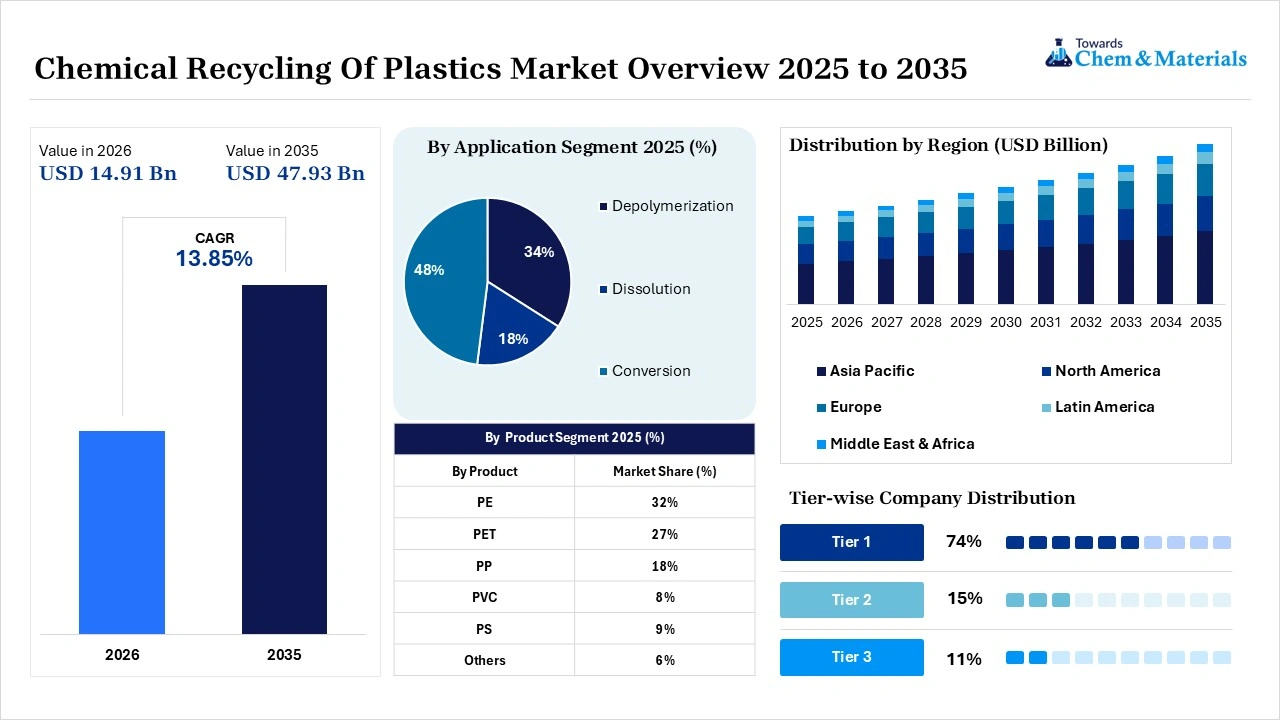
The chemical recycling of plastics market represents a key to the circular economy targets. The global transition towards plastics management aligns with recycling infrastructure for the massive volumes of post-consumer and post-industrial plastics. Chemical recycling is a method of breaking down plastic waste into long polymer chains by providing high-purity and performance driven materials. The stringent regulatory compliance for sustainability and consumer preference for recycled content are fueling the market expansion. The government support for taxing virgin plastic use, extended producer responsibility laws, and mandated recycled content commitment provide stable supply of high-value recycled plastics.
The chemical recycling utilized advancement processes like gasification, pyrolysis, and solvolytic depolymerization that make low-value plastics into high-value monomers, petrochemical feedstock, and synthetic analysis. The manufacturers focus on virgin-quality recycled resin for food-based and medical devices. The manufacturers are increasingly investing in recycling infrastructure and strategic joint agreements for processing scaling. The strategic partnership to integrate chemical output into a highly optimized chemical manufacturing chain through refinery cooperation that boosts the global and domestic growth.
The shift towards automated industrial commercialization necessitates massive capital expenditure, which is accelerating the development of advanced chemical reactors and conversion infrastructure. The mass balance accounting protocols are driving the chemical recycling of plastics as a clean alternative. The technology provider is focused on catalyst innovation, automated pre-sorting by ensuring optimized operational efficiency, and lowering feedstock contamination by balancing production cost and long-term economic viability.
Market Highlights
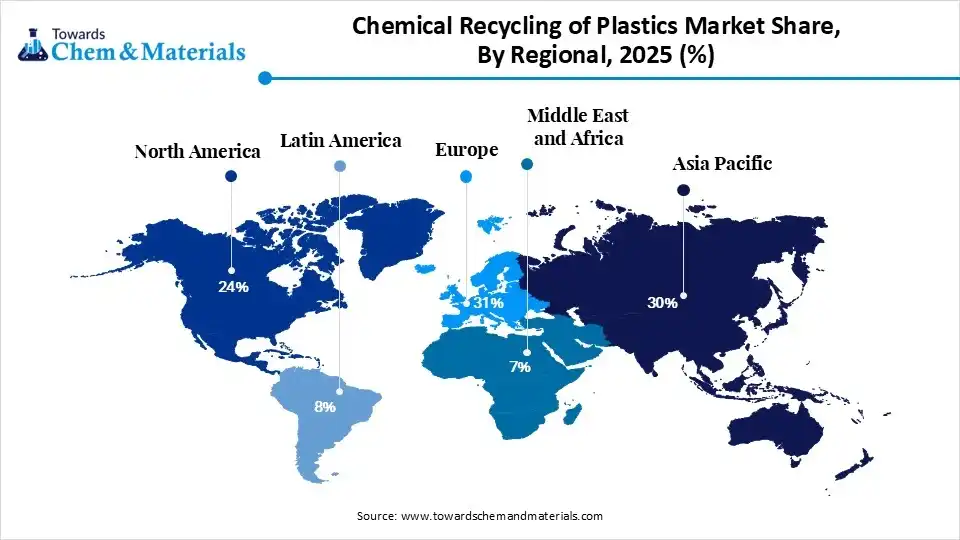
- By region, Asia Pacific dominated the market with a share of 43% in 2025. A strong manufacturing base supports recycled polymer demand.
- By region, North America held 19% market share in 2025 and is expected to experience the fastest growth with a CAGR of 15.6% in the forecast period. Major petrochemical companies expand chemical recycling facilities.
- By type, the conversion segment dominated the market with a 48% share in 2025. Handles mixed and contaminated plastic waste efficiently.
- By type, the depolymerization segment held 34% market share in 2025 and is expected to have the fastest growth with a CAGR of 15.40% in the forecast period. Expands production of virgin-quality recycled monomers.
- By product, the PE segment dominated the market with a 32% share in 2025. Large volumes of polyethylene waste support recycling demand.
- By product, the PET segment held 27% market share in 2025 and is expected to have the fastest growth with a CAGR of 15.8% in the forecast period. Food-grade recycled resin demand accelerates depolymerization adoption.
- By end-use, the packaging segment dominated the market with a 46% share in 2025. Brand owners increase recycled-content commitments.
- By end-use, the automotive segment held 16% market share in 2025 and is expected to have the fastest growth with a CAGR of 15.2% in the forecast period. Automakers integrate recycled plastics into lightweight components.
According to Towards Chemicals and Materials Analytics and Consulting, the global chemical recycling of plastics market volume was valued at 9.23 million tons in 2025 and is expected to surpass around 31.19 million tons by 2035, accelerating a compound annual growth rate (CAGR) of 12.95% over the forecast period from 2026 to 2035.
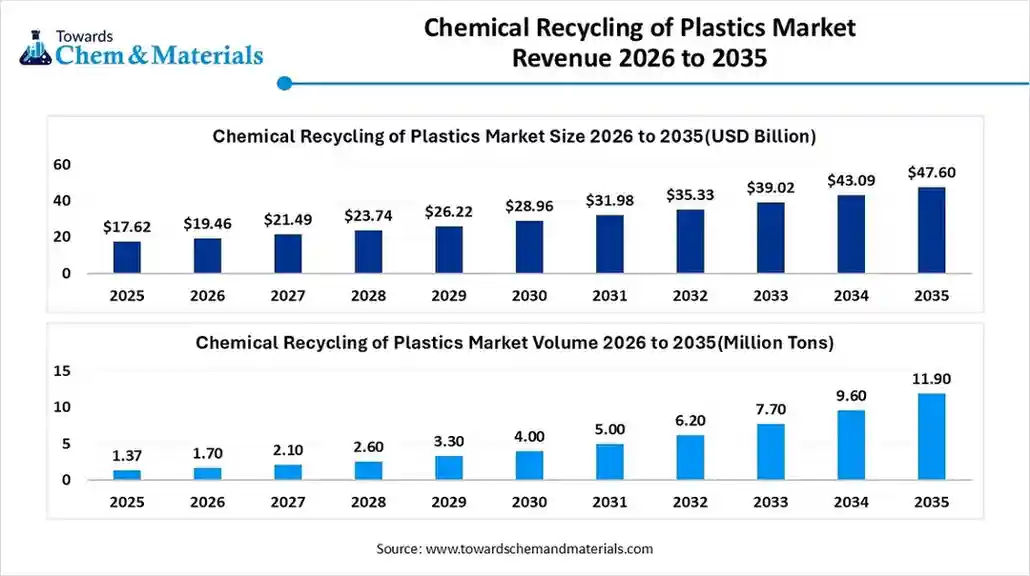
How Does Chemical Recycling of Plastics Work?
The chemical recycling of plastics market converts plastic waste into raw chemical materials feedstocks using processes like pyrolysis and depolymerization. The traditional mechanical recycling shreds and melts old plastic. However, this degrades the plastic over time and cannot handle heavily mixed or dirty plastics. Chemical recycling solves this by using heat or chemical reactions to break plastics down to their original molecular building blocks, monomers.
The key technologies used are pyrolysis and depolymerization, which are used to recycle plastic waste. Pyrolysis heats plastic waste in an oxygen-free environment to convert it into liquid or gas oils. These recycled plastics are then used as fuel or raw materials for new plastics. In depolymerization, it breaks down specific plastics like PET in bottles or textiles using chemicals or enzymes into pure monomers. These can also be converted into fresh virgin quality plastics.
The key and major consumer brands are demanding high-purity recycled plastics to meet sustainability goals through brand commitments. Other factors, like government mandates and strict laws in Europe and other regions, require a higher percentage of recycled content in packaging and aim to reduce landfill waste, which supports the growth of the market. The corporate investments and European policy initiatives further push billions into scaling these technologies, due to industry investments fueling growth.
- For instance, Alterra, Technip Energies, and Neste announced the launch of Nerea, a new and advanced design to accelerate the chemical recycling projects for plastic recycling of waste. Nerea has a standardized, modular design that minimizes pre-investment and reduces project complexity, while providing greater certainty in terms of cost and schedule.(Source: www.prnewswire.com)
Chemical Recycling of Plastics Market Trends
- Technological Shift Towards Decarbonization:The technological shift to decarbonization acts like resetting a plastic LEGO set, recovering highly pure raw materials directly for new plastics, which increases the use of this technology for the conversion of plastics to plastic raw materials.
- Strategic Partnership:Waste collection companies and plastic manufacturers are teaming up to secure steady supplies of plastic waste. This ensures factories have enough raw materials to run efficiently.
- Petrochemical Integration: Major chemical companies are building recycling facilities directly inside existing petrochemical plants. This streamlines how "recycled" molecules are turned into everyday consumer products.
Report Scope
| Report Attribute | Details |
| Market Size Value in 2026 | USD 14.91 Billion / 10.43 Million tons |
| Revenue Forecast in 2035 | USD 47.93 Billion/ 31.19 Million Tons |
| Growth Rate | CAGR 13.85% |
| Forecast Period | 2026 - 2035 |
| Base Year | 2025 |
| Dominant Region | Asia Pacific |
| Segment Covered | By Type, By Product, By End-Use, By Region |
| Key companies profiled | Agilyx, BASF SE, MaireTecnimont S.p.A., INEOS AG, Recycling Technologies, Veolia Environnement SA, JEPLAN, INC., Eastman Chemical Company, SABIC, LyondellBasell Industries Holdings B.V. |
Chemical Recycling of Plastics Market Shift Towards Smart Sorting
The market is shifting from basic mechanical growing to molecular recycling, breaking down plastics into original raw materials, which is a major driver of the market growth. The major and advanced technologies include advanced catalysis, enzymatic degradation, plasma-based recycling, pyrolysis and gasification, and AI sorting, which helps in advancing the processing. The AI-driven transformation, which is a major technological shift, includes smarter sorting,
AI-designed enzymes and digital tracking, which result in high-purity recycled plastics. AI algorithms scan proteins and design custom enzymes that "eat" or break down complex plastics like PET into harmless base components.
Chemical Recycling of Plastics Regulatory Landscape
| Country / Region | Regulatory Body | Key Regulations | Focus Areas | Notable Notes |
| United States | Environmental Protection Agency; Department of Energy | Resource Conservation and Recovery Act; Clean Air Act | Advanced recycling, waste reduction, circular economy | The U.S. supports chemical recycling technologies to convert plastic waste into feedstocks for new plastics and chemicals. |
| European Union | European Commission; European Chemicals Agency | EU Circular Economy Action Plan; Packaging and Packaging Waste Regulation; REACH Regulation | Plastic circularity, recycled content, sustainability | Europe promotes chemical recycling to achieve recycled content targets and reduce plastic waste. |
| China | Ministry of Ecology and Environment; National Development and Reform Commission | Plastic Pollution Control Action Plan; Circular Economy Promotion Law | Plastic waste management, resource recovery | China is expanding chemical recycling capacity to support sustainable plastics management. |
| India | Ministry of Environment, Forest and Climate Change; Central Pollution Control Board | Plastic Waste Management Rules; Extended Producer Responsibility (EPR) Guidelines | Plastic waste recycling, circular economy | India is encouraging chemical recycling technologies to improve plastic waste recovery and recycling rates. |
| Japan | Ministry of Economy, Trade and Industry; Ministry of the Environment | Plastic Resource Circulation Act | Feedstock recycling, resource efficiency | Japan promotes chemical recycling as part of its national plastic resource circulation strategy. |
| Germany | Federal Ministry for the Environment; German Environment Agency (UBA) | Circular Economy Act; Packaging Act (VerpackG) | Advanced recycling, sustainable plastics | Germany is investing in chemical recycling technologies to strengthen circular plastics manufacturing and reduce landfill waste. |
Supply Chain Analysis of the Chemical Recycling of Plastics Market
- Chemical Synthesis and Processing:Chemical recycling breaks down plastic waste into basic molecules, turning complex plastics into raw materials for plastics. The three =main processing methods are depolymerization, conversion, and purification.
- Eastman uses molecular recycling technologies to break down difficult-to-recycle plastic waste into its molecular building blocks, enabling the production of high-quality recycled materials for packaging, automotive, and consumer products.
- Key players: Eastman, BASF, LyondellBasell, Plastic Energy
- Quality Testing and Certification:Quality testing and certification of chemical recycling ensure that recycled materials are as safe and strong as new (virgin) plastics. Industry standards and certifications required are certification standards for responsible chemical recycling (SCS-004) and OECD Chemical Content Validation for global chemical validation.
- BASF manufactures chemically recycled polymers using certified mass balance approaches, helping customers meet recycled content targets while complying with global sustainability and quality standards.
- Key players: International Organization for Standardization, International Sustainability and Carbon Certification, U.S. Food and Drug Administration, European Chemicals Agency
- Distribution to Industrial Users:Chemically recycled plastics are supplied to packaging manufacturers, consumer food manufacturers, automotive companies, healthcare companies, electronics producers, and construction material manufacturers for sustainable plastic applications.
- Plastic energy converts end-of-life plastic waste into recycled feedstock oils that are supplied to petrochemical manufacturers for the production of new food-grade and high-performance plastics, supporting a circular plastics economy.
- Key players: Eastman, LyondellBasell, Plastic Energy.
Chemical Recycling of Plastics Market Dynamics
| Drivers | Restrains | Opportunities |
| Strict Environmental Regulation:Governments worldwide are passing laws to limit single-use plastics and force companies to recycle. For example, the European Commission has set aggressive recycling targets. In places like India, extended producer responsibility (EPR) laws penalize companies that do not process their own plastic waste. | High Costs:Setting up advanced chemical recycling facilities requires massive amounts of money. The process also consumes a lot of energy, leading to high daily operating costs. | Food-Grade Packaging Demand:Mechanical recycling cannot always meet food-safety standards. Chemical recycling breaks down polymers into fundamental monomers, producing plastics that are safe for direct food contact. |
| Corporate Circular Economy Commitments:Major brands are adopting "circular economy" models. This means designing products so they can be reused or fully recycled rather than thrown away. Companies like Coca-Cola or Unilever pledge to use high amounts of recycled plastics in their packaging. Chemical recycling is the only way to make heavily used, flexible, or food-grade plastics clean enough for these corporate goals. | Contamination And Poor Sorting:Many chemical processes need very clean and uniform plastic waste. Contaminants like food, pigments, and the chemical chlorine can ruin equipment and lower product quality. Inadequate local waste sorting limits the supply of good materials. | Hard-To-Recycle Plastics:Technologies like pyrolysis (using high heat without oxygen) and depolymerization (breaking plastics apart with chemical reactions) can process mixed, contaminated, or multi-layered plastics. This opens up new waste streams that were previously sent to landfills. |
| High Purity Applications:Because chemical recycling creates "virgin-quality" materials, the resulting polymers meet strict health and safety standards. This allows chemically recycled plastics to be used directly in sensitive sectors like food-contact packaging, beverage bottles, and medical-grade plastics. | Cheap And New Plastic Completions:Recycled polymers must compete with virgin resins. When crude oil prices drop, making new plastic from fossil fuels becomes cheaper than processing old plastic. This makes it hard for recycling companies to make a profit. | Circular Economy Commitments:Major consumer brands have public goals to use recycled content. Chemical recycling allows brands to meet these goals without sacrificing material performance. |
Segmental Insights
Type Insights
The conversion segment dominated the market with a 48% share in 2025, as it breaks down the plastic waste into valuable oils or gases from mixed, hard-to-recycle plastic waste and dirty waste. They are extensively used as raw materials in chemical plants to form new products. Packaging giants and global brands face strict laws on using recycled materials. They need these converted materials to create virgin-quality plastics for items like food containers and bottles, which drives the growth and expansion of the market.
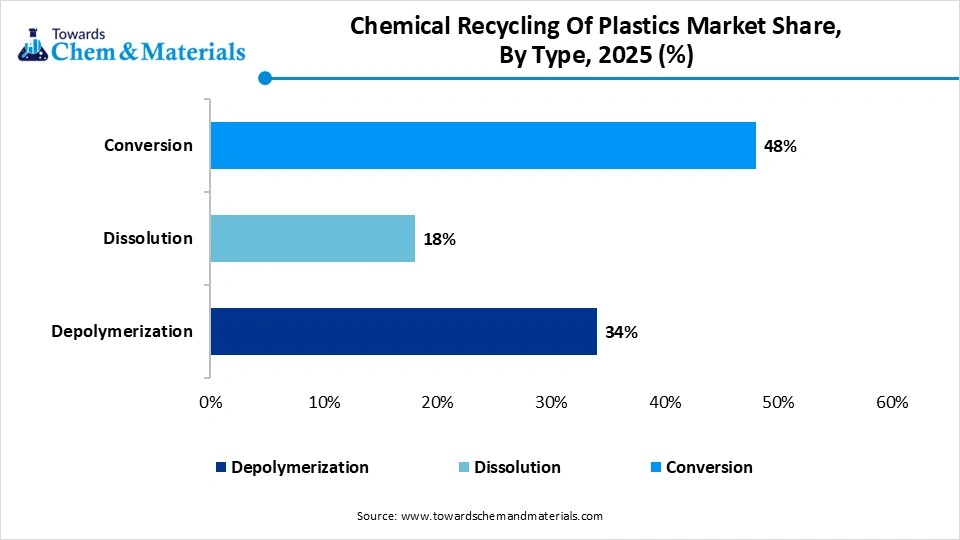 The depolymerization segment held 34% market share in 2025 and is expected to grow at the fastest rate, with a CAGR of 15.40% over the forecast period, as it produces high-quality and virgin-equivalent plastics, driving demand. By the process, the plastic waste is broken down into basic chemical building blocks, that is, monomers. The monomers are remade into new and high-performance plastics without losing quality, driving the growth and expansion of the market. The technique is used to process a specific polymer, even if it is mixed with other trash.
Product Insights
The PE segment dominated the market with a 32% share in 2025, due to its massive use in packaging, flexible films, and rigid containers, which drives the growth of the market. Unlike old mechanical recycling, chemical recycling breaks PE down into basic monomers and hydrocarbons. This allows companies to recycle dirty and mixed plastics. Governments worldwide enforce strict laws mandating the use of recycled plastics. Major consumer brands are adopting these recycled PE streams to meet corporate net-zero targets.
The PET segment held 27% market share in 2025 and is expected to grow at the fastest rate, with a CAGR of 15.8% over the forecast period. market. PET (polyethylene terephthalate) is highly durable and hard to break down. Chemical recycling breaks PET down into its basic chemical building blocks (monomers). This yields "virgin-quality" resin perfect for new bottles, food containers, and textiles. Large companies like Coca-Cola and PepsiCo pledged to use a high percentage of recycled materials in their packaging. This creates steady demand.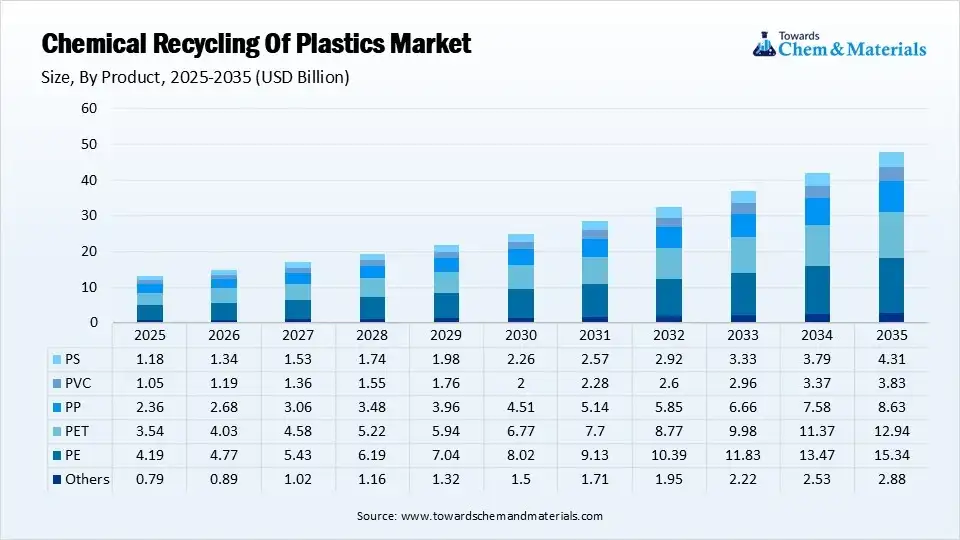
End-use Insights
The packaging segment dominated the market with a 46% share in 2025. This growth happens because brands must meet sustainability goals and use recycled food-grade plastics. Chemical recycling turns used plastic back into raw materials. This makes it perfect for packaging. Normal (mechanical) recycling often damages plastic and cannot be used for food. Chemical recycling melts plastic down to its basic building blocks, or monomers (tiny parts of a molecule). This creates pure, new plastic that is safe for food and drinks. Governments require new packaging to use recycled plastic. Chemical recycling helps brands obey these laws without hurting quality.
The automotive segment held 16% market share in 2025 and is expected to grow at the fastest rate, with a CAGR of 15.2% over the forecast period. This method breaks tough, mixed-plastic auto parts down to basic chemicals. These chemicals are made into brand-new plastics. It helps automakers cut carbon emissions and hit climate goals. Governments in the EU and North America require automakers to use recycled plastics. Chemical recycling is the best way to get enough high-quality material.
Regional Analysis
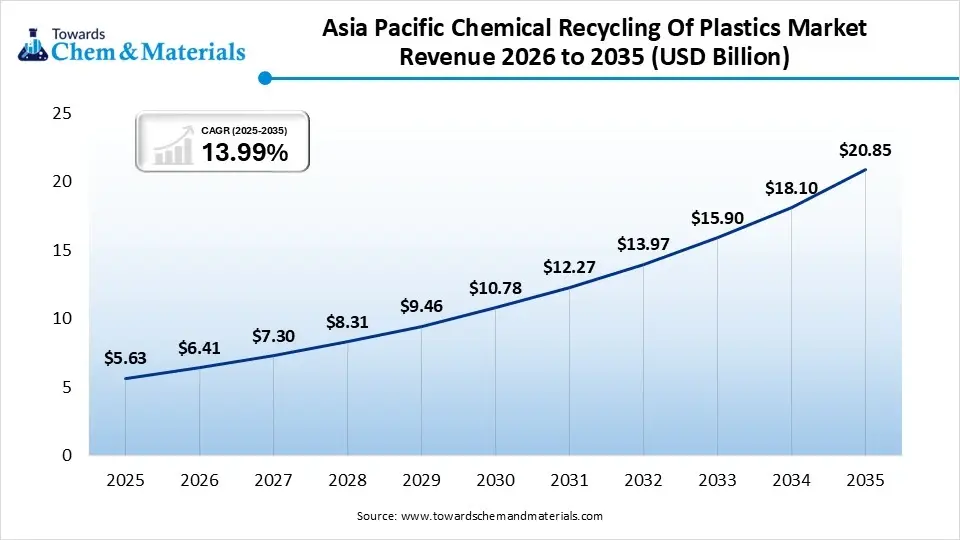
The Asia Pacific chemical recycling of plastics market size was estimated at USD 5.63 billion in 2025 and is projected to reach USD 20.85 billion by 2035, growing at a CAGR of 13.99% from 2026 to 2035.Asia Pacific dominated the market with a 43% share in 2025, due to rapid urbanization, along with awareness of environmental degradation, huge plastic waste generation, and new government rules forces brands to use recycled packaging, which drives the growth of the market in the region. The region’s leading countries, like China with a massive and huge manufacturing base and new recycling plants, drive further growth, supported by India, Japan, and South Korea's strong presence in automotive and packaging industries. Governments in countries like China, India, and Japan have Extended Producer Responsibility (EPR) laws. These rules force big brands to use recycled packaging.
India
- Major FMCG giants like Hindustan Unilever and Coca-Cola India require thousands of tons of high-grade recycled plastic. They need this to meet government Extended Producer Responsibility (EPR) mandates and sustainability goals.
- State governments provide financial incentives. For example, Gujarat offers a 50% capital expenditure subsidy, and Tamil Nadu offers a 25% subsidy.
China
- China recently opened the world's first industrial-scale plant in Jieyang city that can process 200,000 tons of mixed plastics each year. This plant uses a "one-step" method. This means it turns unsorted trash directly into chemical raw materials without needing to clean and sort it first.
- Big international companies are building plants here. For example, SK Chemicals is partnering with local businesses in Shaanxi to turn old clothes and plastic bottles into new materials.
North America Chemical Recycling of Plastics Market Growth Factor
North America held 19% market share in 2025 and is expected to experience the fastest growth with a CAGR of 15.6% in the forecast period. Chemical recycling is a process that melts or breaks down used plastic into basic chemical building blocks. These blocks are used to make new, high-quality plastics. Driven by corporate green targets and government rules, this market breaks plastic trash down into raw chemicals to make "virgin-quality" new plastics. Many leading chemical companies are building large-scale processing facilities in the U.S. and Canada to convert hard-to-recycle waste plastic into fresh, usable materials.
U.S.
- The U.S. chemical recycling market is growing rapidly. This growth is driven by brand sustainability goals and the need for food-grade recycled packaging. However, it faces environmental concerns over hazardous byproducts.
- Large companies in the U.S. are using chemical recycling to meet circular economy targets like using 50% recycled material in packaging.
Canada
- Canadian chemical companies are actively investing in these advanced processes. For example, NOVA Chemicals launched a Centre of Excellence for Plastics Circularity to research and advance scalable chemical recycling solutions.
- Pilot and smaller demonstration plants make up a large portion of Canada's new chemical recycling infrastructure. The packaging industry accounts for the largest share of demand for these recycled materials.
Europe Chemical Recycling of Plastics Market Growth Factor
Europe held the market share of 29% in 2025. The primary growth factors are strict EU environmental regulations, brand sustainability targets, and billions in industry investments. This advanced process turns hard-to-recycle plastic back into raw building blocks. The EU Circular Economy Action Plan mandates high levels of recycled plastic in new packaging by 2030. Countries also enforce landfill bans and taxes on unrecycled plastic. European plastics manufacturers are committing massive funding to build commercial-scale facilities. For example, Plastics Europe members plan to invest 8 billion euros into the sector.
Germany
- Laws like the Packaging Act force companies to use recycled materials. Germany has a strict plastic recycling quota that pushes companies to find advanced recycling solutions
- The European Union wants to stop sending plastic waste to landfills. Countries aim to recycle more than half of all plastic packaging, which chemical recycling makes possible.
UK
The UK government pushes for a circular economy. For example, the Plastic Packaging Tax adds a financial penalty for packaging with less than 30% recycled plastic. This forces brands to buy recycled polymers.
Major consumer brands are pledging to use only recycled or renewable plastics. To hit these goals, they rely heavily on chemical recycling to get virgin-quality (brand new, high-purity) plastic for food and medical packaging.
Latin America Chemical Recycling of Plastics Market Growth Factor
Latin America held a market share of 5% in 2025. The growth is driven by new government rules, the need to manage massive plastic waste, and demand for high-quality, food-grade packaging. Local governments are pushing for a "circular economy". This means they want all plastics reused. For example, countries like Chile are passing strict laws to force companies to reduce waste. This forces brands to look into advanced chemical recycling.
Brazil
- Brazil’s chemical recycling of plastics market is growing rapidly due to the rising volume of hard-to-recycle plastic waste and strict corporate sustainability goals.
- Brazil's National Solid Waste Policy (PNRS) makes manufacturers responsible for the waste their products create. This pushes companies to invest in new recycling methods to meet legal targets.
- Major consumer brands are committing to using only recycled plastics in their packaging. Chemical recycling helps them meet these goals.
Argentina
Leading global automakers with a presence in Argentina like Ford, Volkswagen, and Toyota are demanding green materials to build eco-friendly cars.
Argentina’s domestic clothing industry consumes a large portion of recycled PET (polyester) to produce fibers and yarns, driving the closed-loop circular economy forward.
Middle East and Africa Chemical Recycling of Plastics Market Growth Factor
The Middle East and Africa held a market share of 4% in 2025. The growth of the market is driven by the strict sustainability mandates, a booming packaging industry, and major government investments in waste infrastructure in countries like the UAE and Saudi Arabia. The region is adopting robotic sorting and AI to clean plastic waste. This makes chemical recycling, melting, and breaking down polymers into base chemicals more efficient. Governments are forcing industries to reduce landfill waste. Policies push companies to reuse plastics rather than make new ones from oil.
Saudi Arabia
- Saudi Arabia aims to divert more than 90% of its waste from landfills. To do this, it is investing heavily in advanced waste management technologies.
- Giants like SABIC are funding advanced chemical recycling plants. These plants convert hard-to-recycle plastic waste into valuable polymer feedstock.
- International brands want sustainable, recycled plastics for their packaging. Chemical recycling allows Saudi manufacturers to export these high-demand "circular polymers" to global markets.
UAE
- The UAE aims to divert 75% of waste away from landfills. Enforcing single-use plastic bans and penalizing rule-breakers with heavy fines (up to AED 50,000) forces businesses to seek alternative materials.
- The government has invested heavily in modern waste management plants. Funding helps build advanced, tech-forward recycling facilities in the region. This makes the supply of recycled plastics reliable and local.
Competitive Analysis
The leading global chemical producers partner together to secure plastic waste. For example, consumer brands work directly with chemical manufacturers to guarantee a steady supply of raw materials for their products.
The major giants like SABIC, BASF SE, Agilyx, Veolia, Jeplan, Inc., and local Indian players like Banyan Nation and Lucro Plastecycle are investing and collaborating with players for advanced circular processes to support brand goals, driving the growth in the market.
- European plastics manufacturers are investing heavily to build commercial-scale facilities, with Plastics Europe members planning to invest up to €8 billion by 2030. These funds will primarily scale up breakthrough chemical recycling technologies to tackle plastic waste.(Source:plasticseurope.org)
- Neste, Borealis, Uponor, and the Wastewise Group collaborated to turn post-industrial plastic waste into plastic pipes for construction.(Source:plasticseurope.org)
Recent Developments
- In June 2026, SCS standards and Assurance Systems launched the certification Standard for Responsible Chemical Recycling (SCS-004). A certification program underpinned by the standard, allowing chemical recycling facilities that process hard-to-recycle plastics to “transparently communicate their responsible practices” to the marketplace.(Source:recyclingtoday.com )
- In March 2026, TotalEnergies launched its first advanced plastic recycling plant in France. It has an annual capacity of 15,000 tonss at the Grandpuits site. This start-up aims to convert the refinery into a zero-crude platform.(Source:totalenergies.com)
- In July 2025, China launched an advanced plastics cracking plant, which is the first large-scale industrial facility in China for the chemical recycling of mixed plastic waste in Jieyang, Guangdong province(Source:recyclinginternational.com)
- In October 2025, Eni launched the authorisation process for the Environmental Impact Assessment (VIA), transforming its Priolo industrial site by building a new biorefinery and a chemical recycling plant for plastics. The project involves gradually decommissioning Versalis' existing ethylene plant to make space for the new facilities.(www.eni.com)
Top players in the Chemical Recycling of Plastics Market & Their Offerings
| Company | Company Type/Position | Major Headquarters | Geographic Presence | Ethylene Carbonate Offerings | Key Offering/Strength |
| BASF SE | Global chemical recycling and circular economy leader | Ludwigshafen | Europe, Asia Pacific, North America | ChemCycling technology, pyrolysis oil integration, recycled feedstock for plastics production | Strong mass balance approach and integrated chemical manufacturing capabilities |
| Eastman Chemical Company | Advanced molecular recycling technology provider | Kingsport | North America, Europe, Asia Pacific | Polyester renewal technology (PRT), carbon renewal technology (CRT), recycled polymers | Leadership in molecular recycling for hard-to-recycle plastic waste |
| LyondellBasell Industries | Polyolefins and advanced recycling solutions provider | Houston | Asia Pacific, Europe, North America, Middle East | Advanced recycling through pyrolysis, circular polymers, recycled polyolefin feedstocks | Proprietary MoReTec technology for chemical recycling of mixed plastic waste |
| SABIC | Circular polymers and advanced recycling manufacturer | Riyadh | Asia Pacific, North America, Europe, Middle East | Certified circular polymers, pyrolysis-based recycled feedstocks, sustainable plastics. | Global circular polymer portfolio supported by strategic recycling partnerships |
| Dow Inc. | Advanced materials and circular plastics solutions provider | Midland | Europe, Asia Pacific, North America, Latin America | Pyrolysis-based recycled feedstocks, circular polyethylene products, advanced recycling collaborations | Strong partnerships and scalable circular plastics solutions for packaging and industrial applications |
Other Top Players Are
- ExxonMobil (USA)
- Veolia Environnement SA (France)
- Plastic Energy (UK)
- Agilyx ASA (USA)
- Mura Technology (UK)
- Loop Industries (Canada)
- Carbios (France)
- Indorama Ventures (Thailand)
- PureCycle Technologies (USA)
- INEOS (UK)
- Neste Oyj (Finland)
- OMV AG (Austria)
- Brightmark (USA)
- Shell plc (UK)
- Maire Tecnimont (Italy)
Segment Covered in the Report
By Type
- Depolymerization
- Glycolysis
- Methanolysis
- Hydrolysis
- Enzymatic Depolymerization
- Dissolution
- Selective Dissolution
- Solvent-Based Purification
- Precipitation & Recovery Processes
- Conversion
- Pyrolysis
- Gasification
- Catalytic Cracking
- Hydrothermal Processing
By Product
- PE
- HDPE
- LDPE
- LLDPE
- PET
- Bottle-Grade PET
- Fibre-Grade PET
- Food-Grade Recycled PET
- PP
- Homopolymer PP
- Copolymer PP
- PVC
- Rigid PVC
- Flexible PVC
- PS
- General Purpose PS
- Expanded PS
- High Impact PS
- Others
- Polycarbonate
- Polyamide
- ABS
- Multi-layer Plastics
By End-Use
- Packaging
- Food Packaging
- Beverage Packaging
- Flexible Packaging
- Industrial Packaging
- Automotive
- Interior Components
- Exterior Components
- Under-the-Hood Applications
- Building & Construction
- Pipes & Fittings
- Insulation Materials
- Flooring & Panels
- Electrical & Electronics
- Consumer Electronics
- Wiring Components
- Electrical Housings
- Textiles
- Recycled Fibers
- Industrial Fabrics
- Apparel Textiles
- Others
- Agriculture
- Consumer Goods
- Healthcare
By Region
- North America
- U.S.
- Canada
- Mexico
- Europe
- Germany
- UK
- France
- Italy
- Spain
- Asia Pacific
- China
- India
- Japan
- South Korea
- Latin America
- Brazil
- Argentina
- Middle East & Africa
- Saudi Arabia
- South Africa
A Seven-Phase Framework
Our methodology is designed to be universally applicable across commodity chemicals, specialty chemicals, petrochemicals, construction chemicals, coatings, electronic chemicals, industrial gases, agrochemicals, water treatment chemicals, and performance materials. Each phase builds upon the last, creating a layered validation structure that minimizes estimation error and maximizes analytical confidence.
The framework ensures comprehensive market coverage, robust cross-validation, and reliable long-term forecasting — producing market estimates that withstand scrutiny from investors, regulators, and corporate strategy teams.

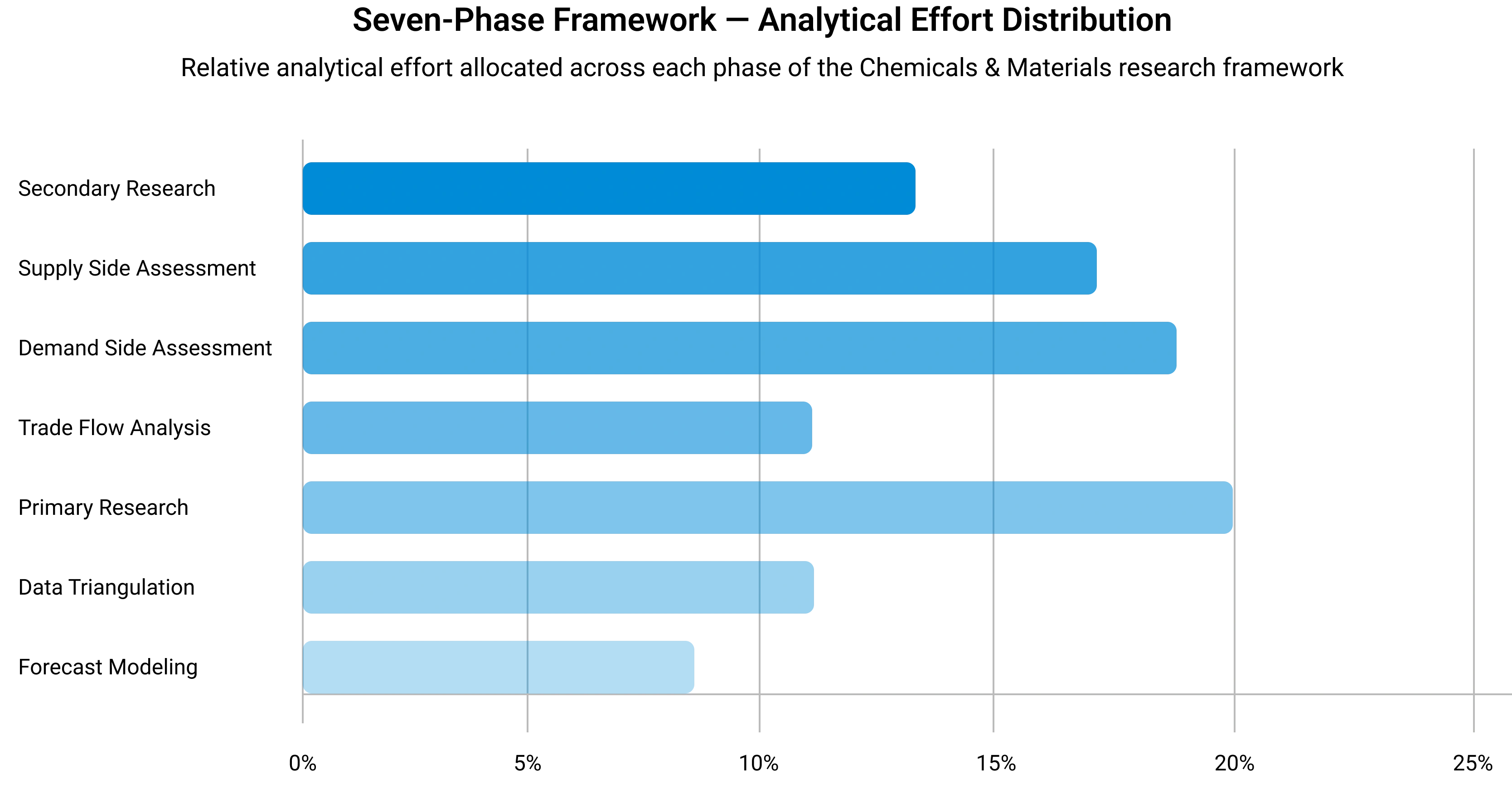
Seven-Phase Framework — Analytical Effort Distribution
Relative analytical effort allocated across each phase of the Chemicals & Materials research framework
Phase 1 - Secondary Research: Establishing the Foundation
Secondary research collects and evaluates publicly available information from authoritative sources, establishing the foundational understanding of market structure, value chain dynamics, competitive landscape, and end-use demand patterns. Every source is evaluated for credibility, recency, geographic relevance, and methodological soundness before inclusion.
Industry Associations
Sources include ACC, CEFIC, ICCA, JCIA, CPCIF, and SOCMA providing production volumes, consumption trends, capacity developments, and sustainability initiatives.
Company Disclosures
Annual reports, investor presentations, earnings transcripts, and regulatory filings reveal product portfolios, manufacturing footprints, capacity expansions, and revenue segmentation.
Government Databases
National statistical offices, customs authorities, environmental agencies, and industrial production databases provide verified statistics on output, trade flows, and regulatory compliance.
Trade Databases
UN Comtrade, ITC, Eurostat, and national customs authorities enable assessment of global product movement, import dependency, and export competitiveness across regions.
Our Secondary Research Sources
- Ministry of Chemicals and Fertilizers
- European Chemicals Agency
- United States Department of Energy
- Ministry of Industry and Information Technology
- Ministry of Economy Trade and Industry
- Ministry of Trade Industry and Energy
- National Institute of Standards and Technology
- Council of Scientific and Industrial Research
- Fraunhofer Society
- National Institute for Materials Science
Phase 2 — Supply-Side Assessment: Mapping Production Capabilities
Production Capacity Analysis
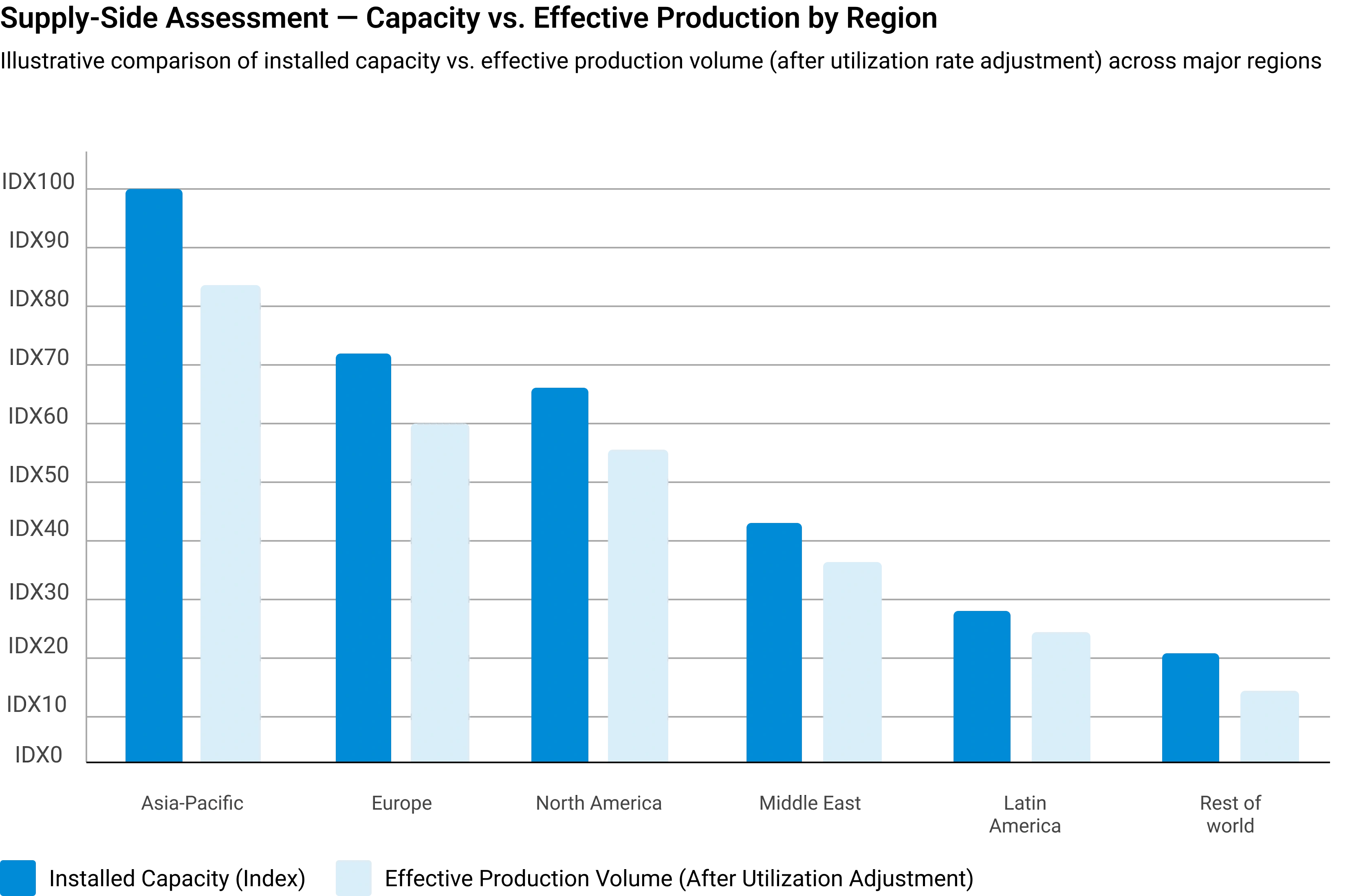
All major manufacturers are assessed for existing installed capacity, planned additions, expansions, new plant announcements, and technology adoption — mapped at global, regional, and country levels.
Capacity Utilization Adjustment
Installed capacity is adjusted using utilization rates based on demand conditions, feedstock availability, plant operating rates, maintenance schedules, and regulatory restrictions.
Manufacturer Revenue Analysis
Product-specific revenues, segment-level performance, regional distribution, average selling prices, and margin trends are evaluated to establish market value estimates.
Supply-Side Assessment — Capacity vs. Effective Production by Region
Illustrative comparison of installed capacity vs. effective production volume (after utilization rate adjustment) across major regions
Phase 3 — Demand-Side Assessment: Quantifying Chemical Consumption
Demand-side analysis quantifies chemical consumption across industries, applications, and geographies — identifying where and how chemicals are consumed throughout the value chain with precision.
End-Use Industry Analysis
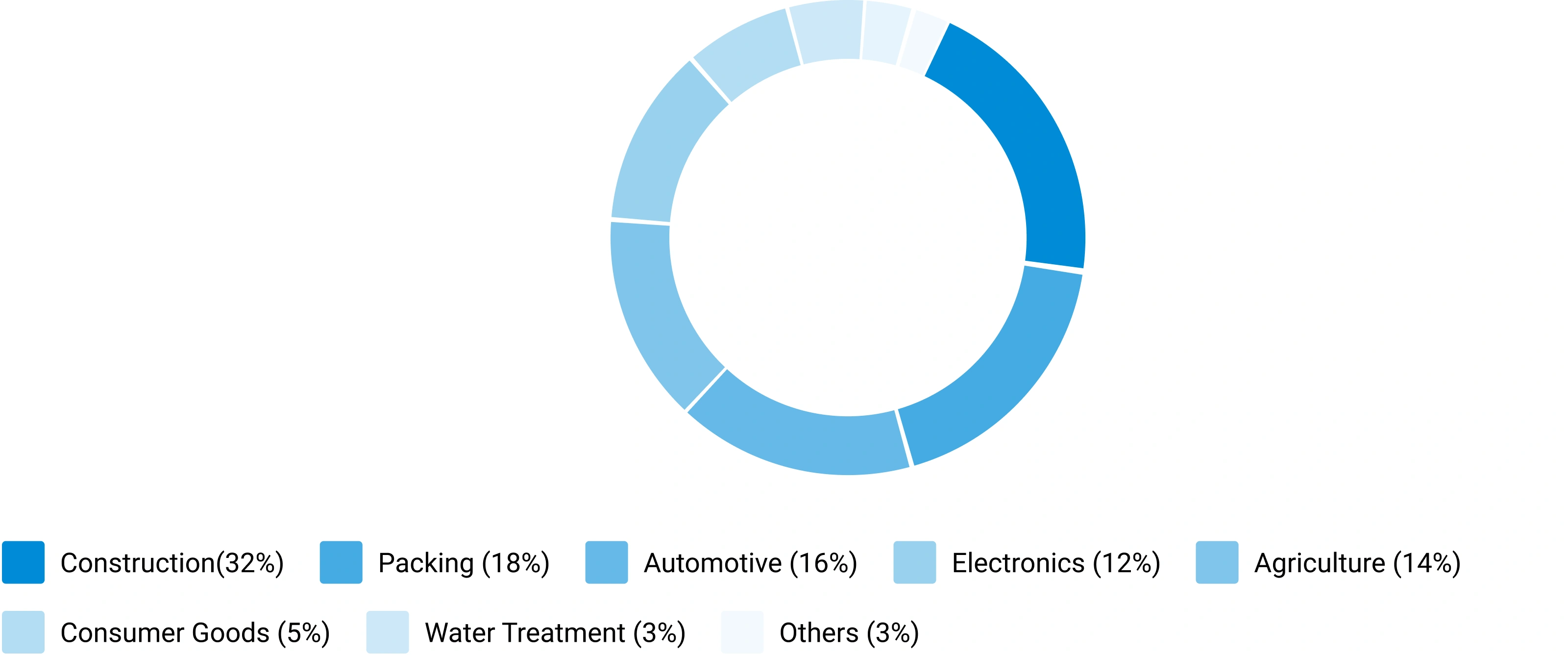
Chemical demand is evaluated across automotive, construction, packaging, electronics, agriculture, healthcare, consumer goods, industrial manufacturing, energy and utilities, and water treatment. Industry output, production trends, and consumption intensity are analyzed to determine demand patterns.
Consumption Modeling
Demand is estimated using measurable indicators: kilograms per vehicle, kilograms per square meter of construction, dosage per cubic meter of water treated, kilograms per hectare of agricultural land, and kilograms per ton of manufactured products. Consumption factors are validated through industry publications and primary interviews.
Application Analysis
The market is segmented by application area to understand product performance requirements, formulation trends, technology adoption, customer preferences, and regulatory requirements improving demand accuracy and segmentation granularity.
Demand-Side Assessment — End-Use Industry Demand Distribution
Illustrative distribution of chemical & materials demand across key end-use industries
Phase 4 - Trade Flow Analysis: Balancing Regional Supply and Demand
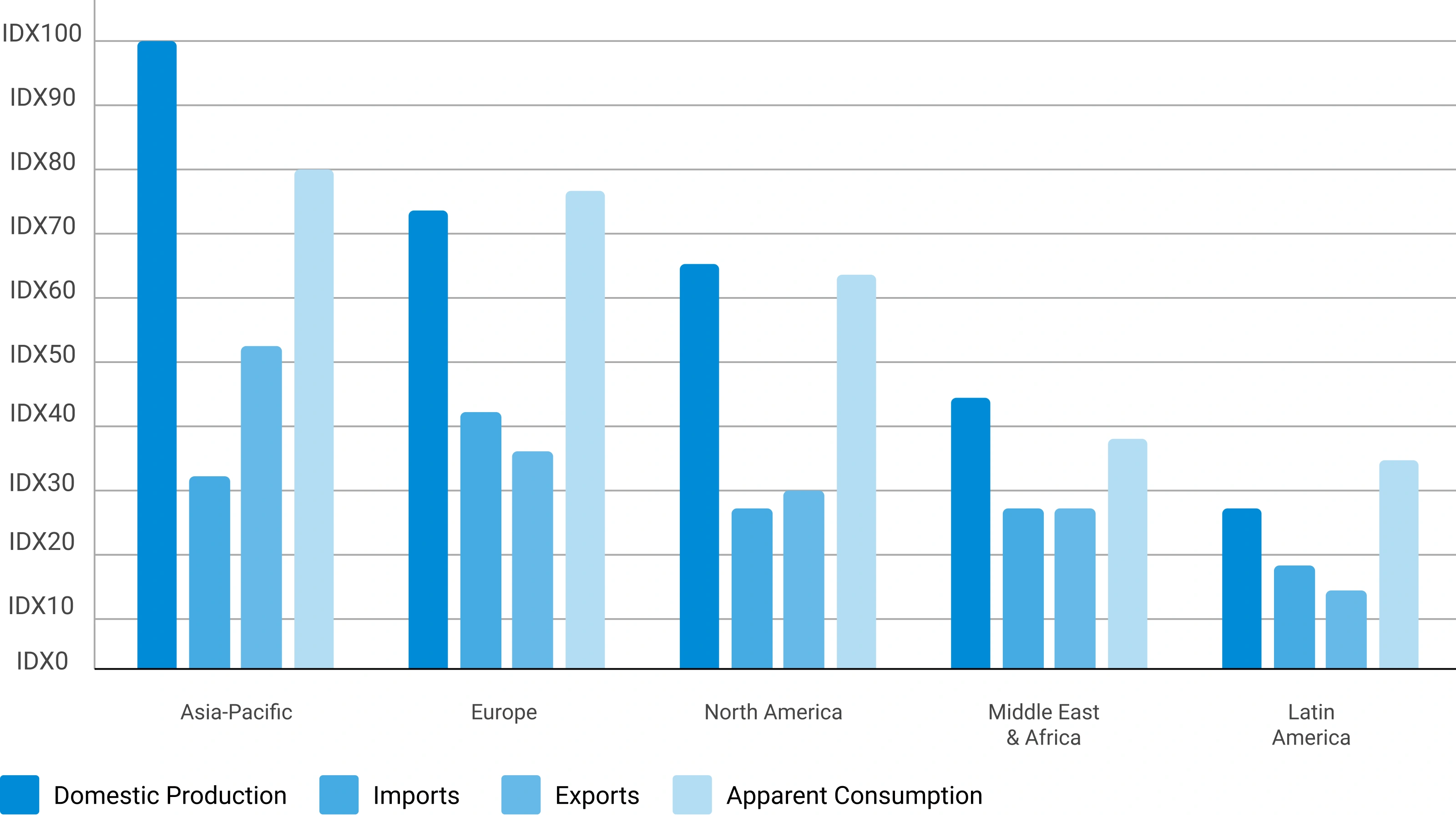
Trade flow analysis reconciles regional supply and demand estimates through import and export data, identifying net supply positions, regional dependencies, and market imbalances. It serves as an independent validation layer that tests the consistency of supply-side and demand-side estimates.
Import Analysis
Import data is evaluated to determine volumes, source countries, product dependency, regional supply gaps, and pricing trends — identifying markets that rely heavily on external supply and where domestic production is insufficient to meet demand.
Export Analysis
Export assessments reveal production surplus, export competitiveness, regional manufacturing strength, and global market participation. Export patterns also help validate domestic production estimates and identify net exporting regions.
Apparent Consumption Model
Regional consumption is assessed using the standard apparent consumption formula:
Results identify net importing regions, net exporting regions, regional deficits, and surpluses — serving as an independent validation of supply and demand estimates.
Trade Flow Analysis — Net Supply Position by Region
Illustrative apparent consumption vs. domestic production across major regions — positive gap indicates net import dependency
Phase 5 — Primary Research: The Critical Validation Layer
Primary research tests and refines findings from secondary research through direct engagement with industry participants across the supply chain, demand side, and expert community. It captures intelligence that no database or published report can provide — the real-world experience of manufacturers, buyers, and specialists operating in the market.

Supply-Side Interviews
Conversations with chemical manufacturers, raw material suppliers, contract manufacturers, technology providers, and plant operators cover production trends, capacity utilization, pricing developments, technology shifts, and competitive dynamics.

Demand-Side Interviews
Engagement with OEMs, industrial consumers, procurement managers, distributors, formulators, and end-use manufacturers focuses on consumption trends, purchasing behavior, product substitution, demand outlook, and emerging applications.

Industry Expert Consultations
Additional interviews with industry consultants, independent experts, regulatory specialists, technical professionals, and research institutions provide deeper market context and validate key analytical assumptions.
Focus Areas of Primary Research:
Market Size & Forecast Validation
Revenue estimates, volume consumption, growth rates, forecast assumptions, regional demand.Supply Chain & Value Chain Assessment
Raw material sourcing, supply chain challenges, distribution networks, procurement practices.Production & Capacity Analysis
Manufacturing capacity, utilization rates, expansion projects, plant investments.Pricing & Cost Structure Analysis
Product pricing trends, feedstock costs, energy costs, margin pressures, pricing outlook.Competitive Landscape Assessment
Volume and value estimates confirmed to be fully consistent with one another before publicationInterview Volume by Market Scope
| Study Scope | Number of Interviews |
|---|---|
| Niche Market | 20 – 30 |
| Mid-Sized Market | 30 – 50 |
| Global Market | 50 – 80 |
| Highly Fragmented Market | 80 – 120 |
Interview Details:
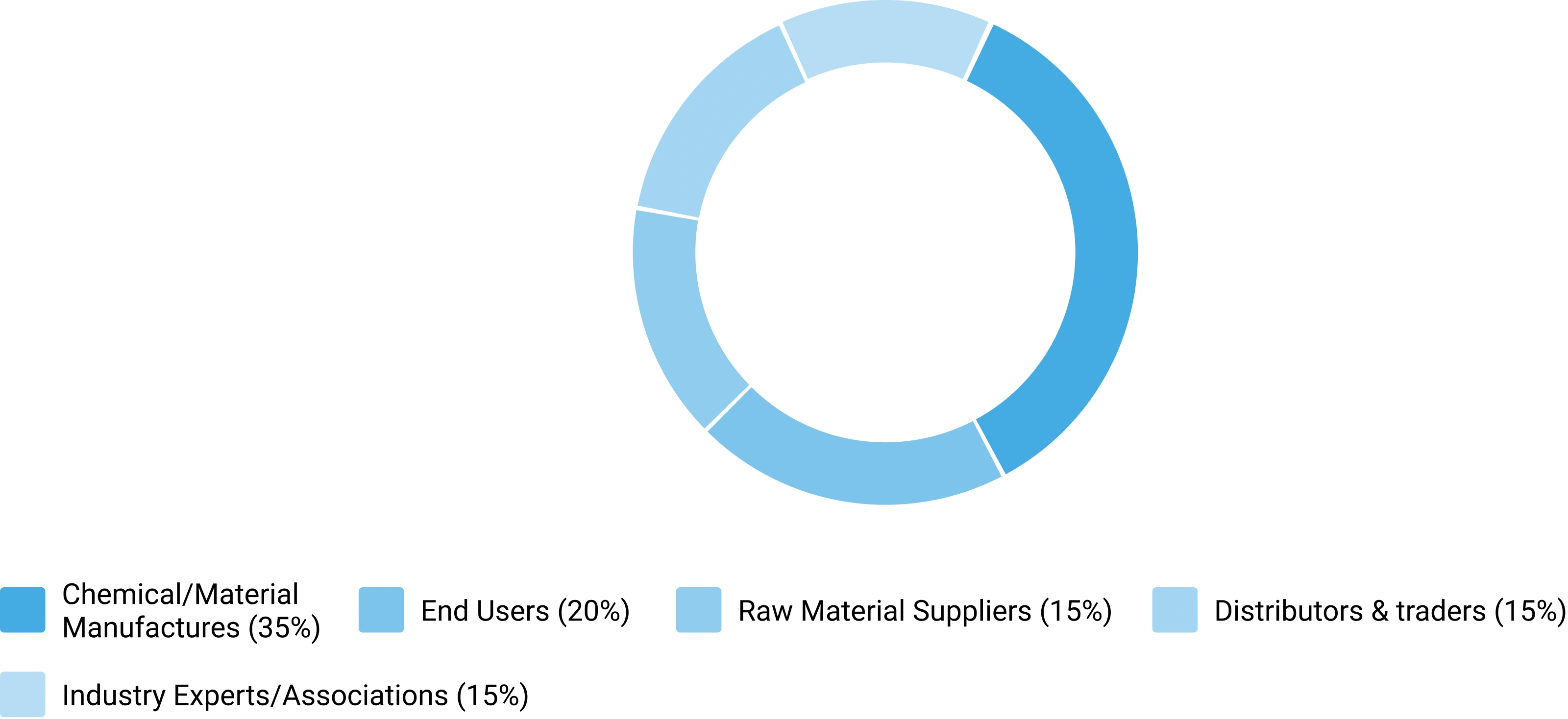
Category : Manufacturers, Suppliers, Distributors, End Users, Experts/Associations
Average Duration : 30–60 Minutes
Interview Mode : Video calls, telephonic interviews, expert consultations
Interview Format : Structured / Semi-Structured questionnaire
Focus Areas of Primary Research:
Market Size & Forecast Validation :
Revenue estimates, volume consumption, growth rates, forecast assumptions, regional demand.
Supply Chain & Value Chain Assessment :
Raw material sourcing, supply chain challenges, distribution networks, procurement practices.
Production & Capacity Analysis :
Manufacturing capacity, utilization rates, expansion projects, plant investments.
Pricing & Cost Structure Analysis :
Product pricing trends, feedstock costs, energy costs, margin pressures, pricing outlook.
Competitive Landscape Assessment :
Market share, competitor positioning, strategic initiatives, partnerships, acquisitions.
Primary Research — Stakeholder Coverage by Category
Distribution of interview respondents across stakeholder categories (% share from PPT data)
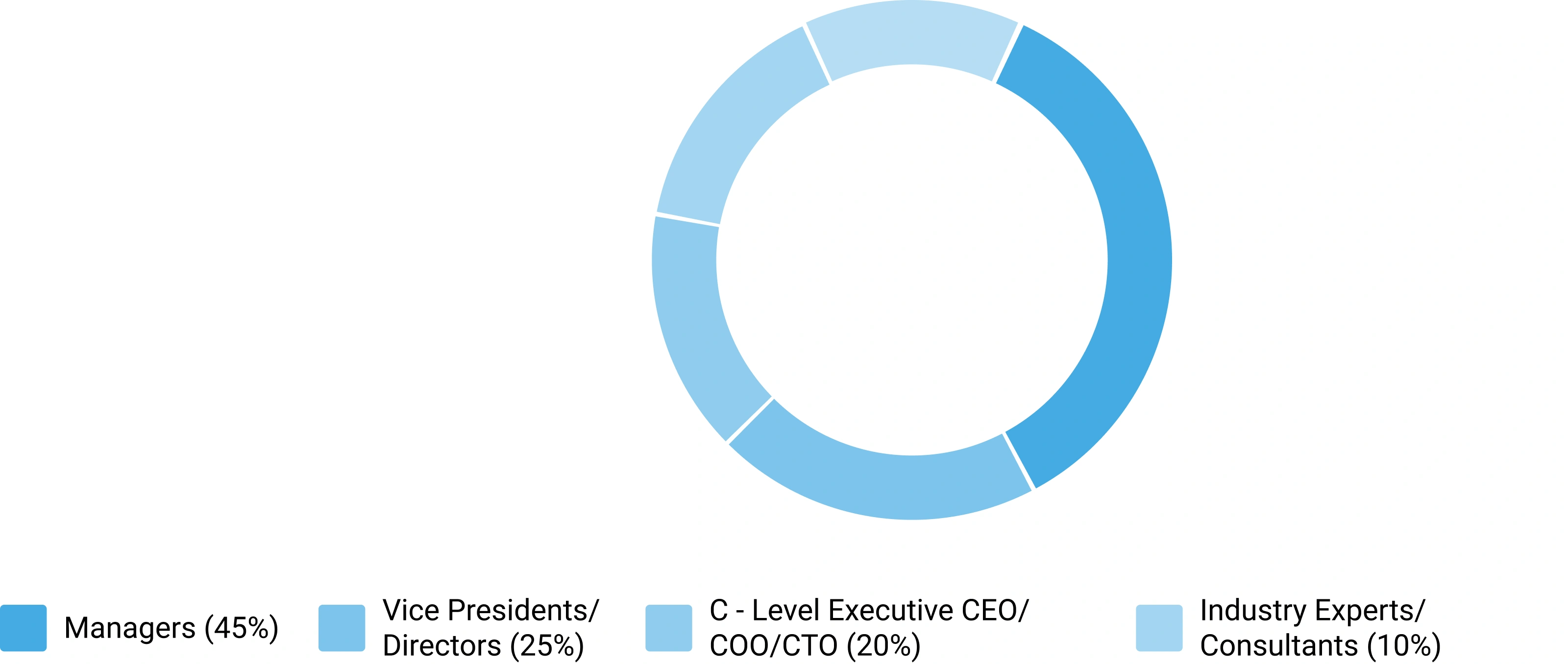
Primary Research — Respondent Designation Profile
Seniority breakdown of interview respondents (% share from PPT data)
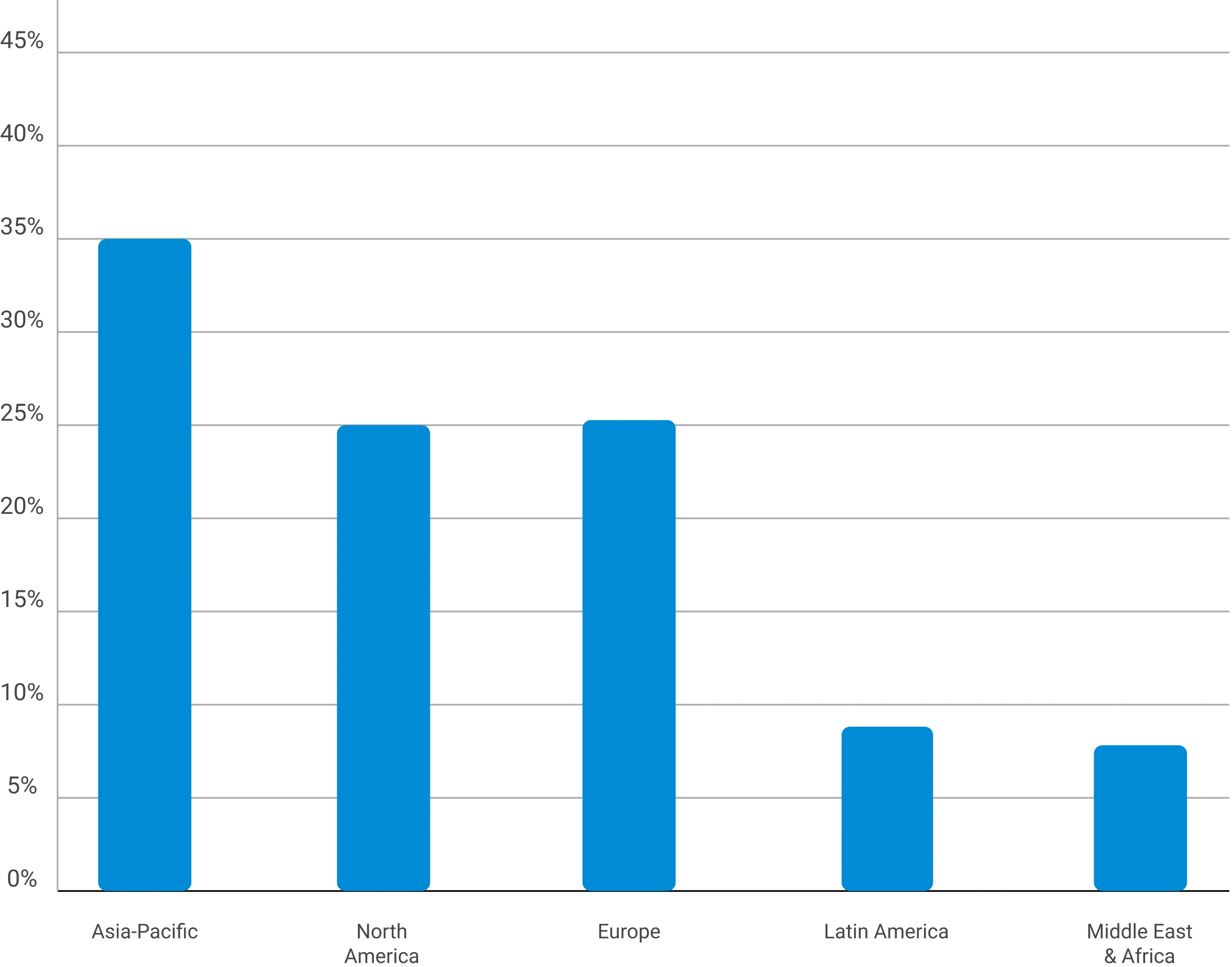
Primary Research — Geographic Coverage of Interviews
Regional distribution of primary research engagement (% share from PPT data)
Phase 6 — Data Triangulation and Market Validation
No single methodology is relied upon in isolation. Multiple independent estimation approaches are combined and reconciled to ensure consistency, accuracy, and analytical defensibility. Any material deviations between approaches are investigated and adjusted through additional validation cycles.
The final market size is derived through weighted triangulation of all validated methodologies. Any material deviations between approaches are investigated and adjusted through additional validation cycles. The outcome represents the most realistic assessment of the market based on available evidence and expert confirmation ensuring that volume and value estimates are fully consistent with one another.
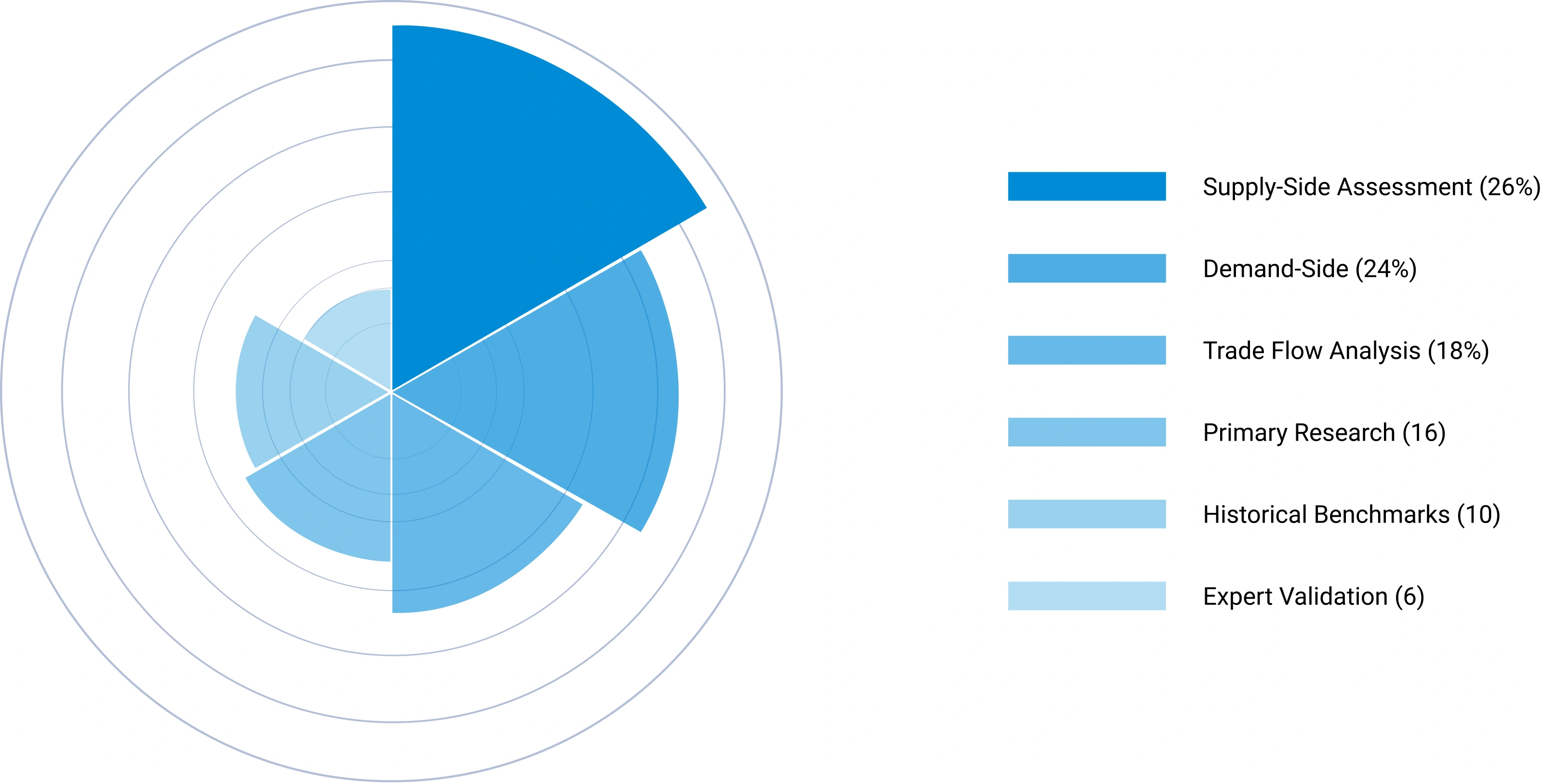
Triangulation Framework — Input Contribution Weight
Relative weight each sizing input contributes to the final reconciled market estimate
Phase 7 — Forecast Modeling: Projecting Future Market Evolution
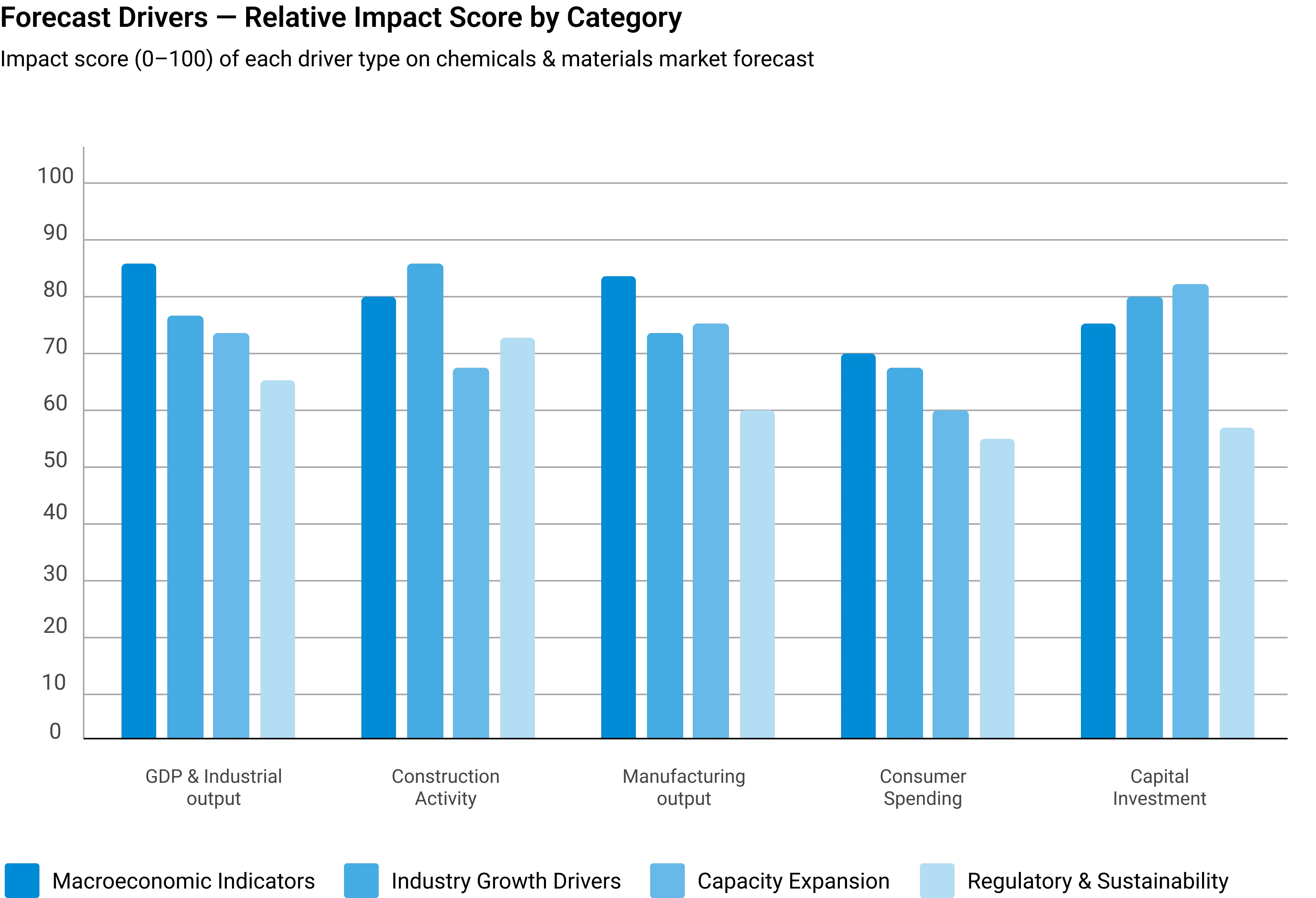
Forecasting evaluates the future trajectory of the market using a combination of quantitative indicators and qualitative assessments across economic, industry, and regulatory dimensions. Rather than simple extrapolation, each driver is independently modeled and integrated into a composite forecast.
Macroeconomic Indicators
GDP growth, industrial production, manufacturing output, construction activity, consumer spending, and capital investment form the quantitative foundation of long-term demand projections. These are applied at country, regional, and global levels.
Industry Growth Drivers
Urbanization, infrastructure development, industrialization, technological innovation, sustainability initiatives, and evolving product performance requirements are assessed at regional and industry levels — capturing both structural and cyclical demand drivers.
Capacity Expansion Analysis
Announced plant expansions, new manufacturing facilities, technology upgrades, and strategic investments are evaluated to determine future supply-demand dynamics and potential market tightness or oversupply situations.
Regulatory & Sustainability
Environmental regulations, chemical safety standards, emission reduction targets, circular economy initiatives, and sustainability requirements are incorporated as they often influence product adoption rates and market growth trajectories.
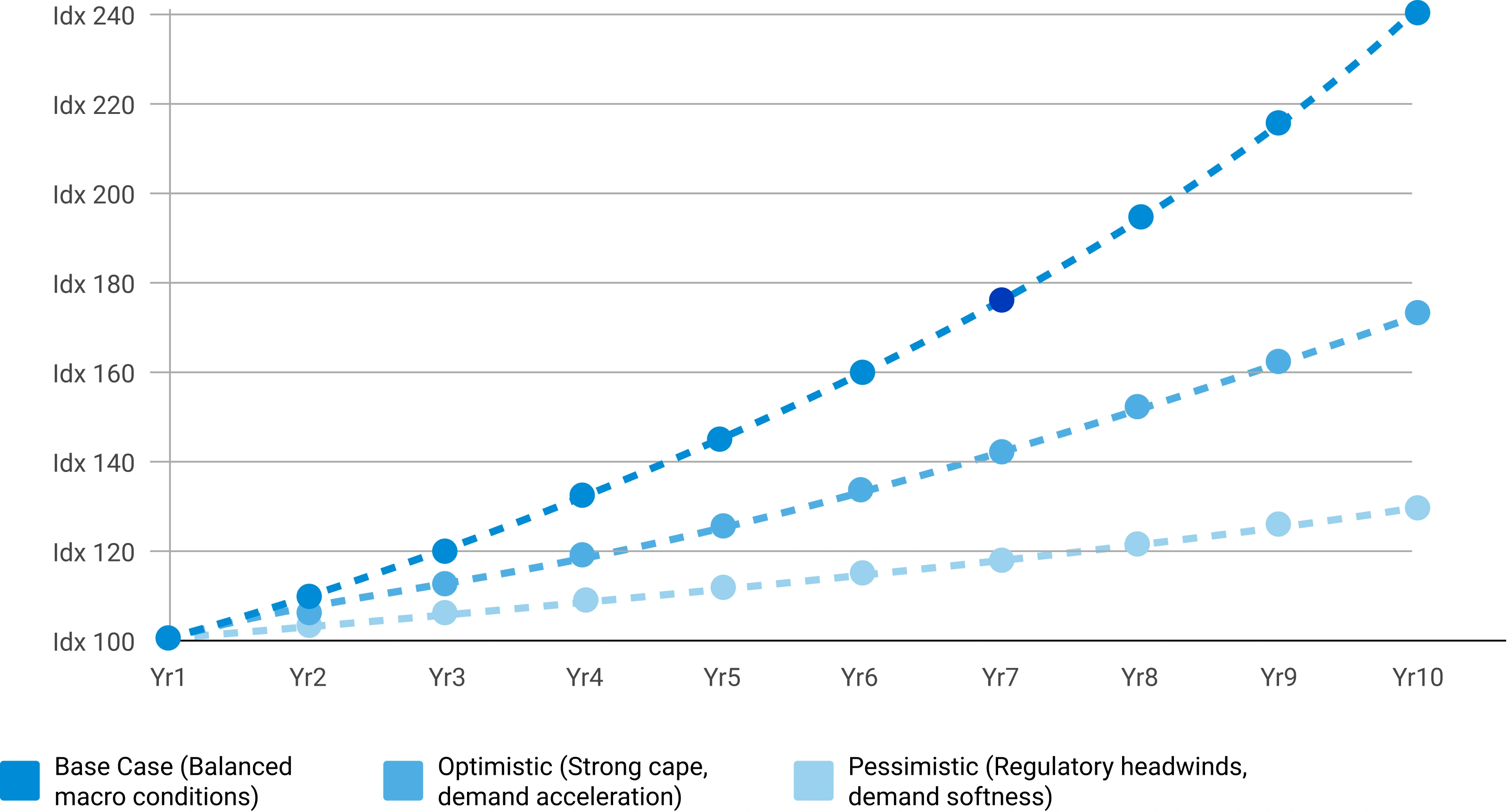
Scenario Forecast Range — Indexed Market Growth (Year 1–10)
Illustrative indexed growth trajectories across Base, Optimistic, and Pessimistic scenarios over a 10-year forecast horizon
Forecast Drivers — Relative Impact Score by Category
Impact score (0–100) of each driver type on chemicals & materials market forecast



Comments
Share your thoughts, ask a question, or provide feedback about this report.