Content


What is the Asia Pacific Propylene Market Size and Share?
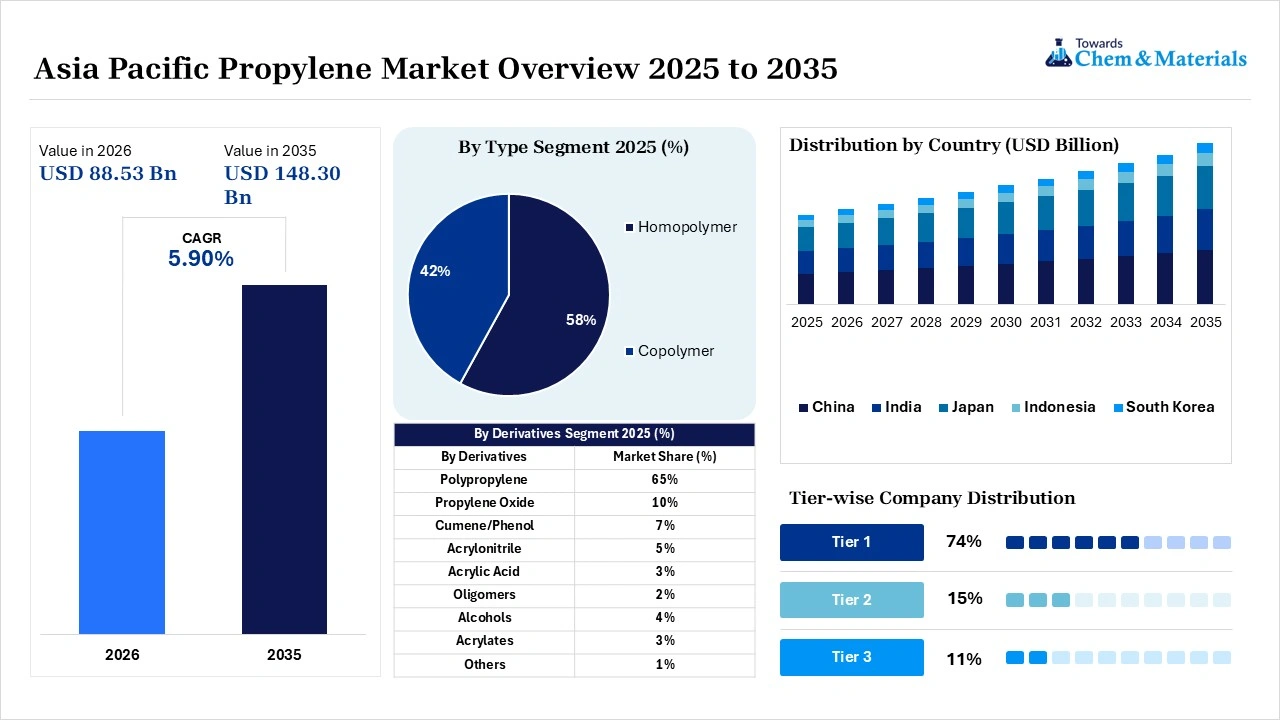
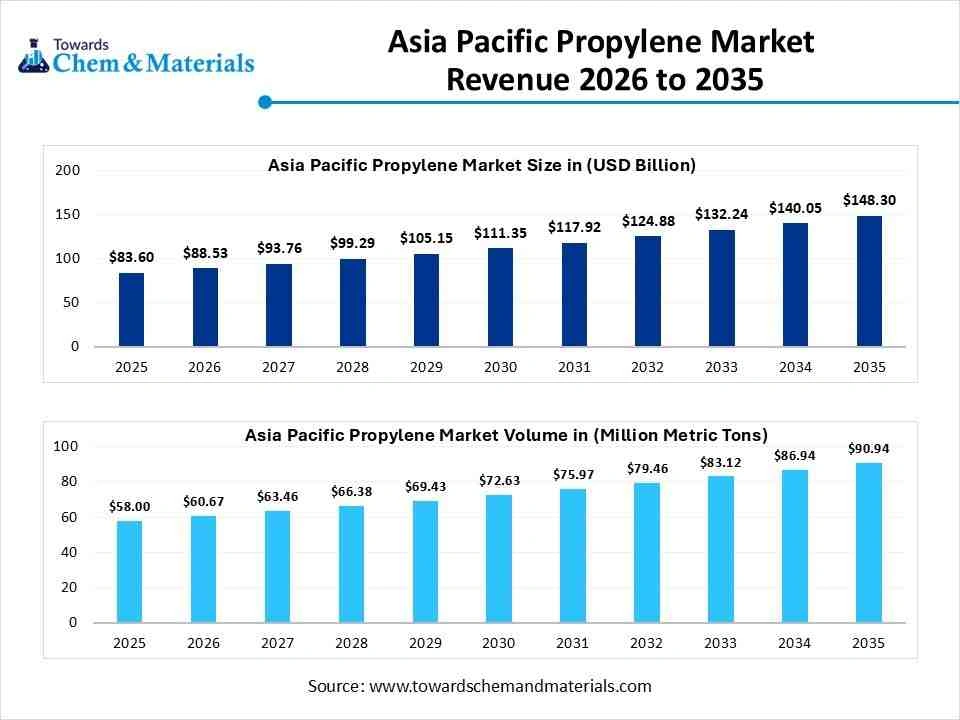
The Asia Pacific propylene market size was valued at USD 83.60 billion in 2025 and is projected to grow from USD 88.53 billion in 2026 to USD 148.30 billion by 2035, exhibiting a CAGR of 5.90% during the forecast period. China dominated the propylene industry with a 6.02% share in 2025. Polypropylene demand in the automotive industry, demand for packaging in the region, and the growth of infrastructure projects are driving market expansion in Asia Pacific. China, India, Japan, and South Korea are key production and consumption hubs. More and more technological advances point towards propane dehydrogenation, advanced catalysts, processing of hydrogen peroxide to propylene oxide, Industry 4.0 automation, and artificial intelligence.
Market Highlights
- China dominated the Asia Pacific propylene market by holding a 45% share in 2025.
- India held a 17.6% market share in 2025.
- By derivatives, the polypropylene segment dominated the market with the largest share of 65% in 2025 and is expected to grow at a CAGR of 5.8% during the forecast period.
- By derivatives, the propylene oxide segment held a 10% market share in 2025 and is expected to grow at the fastest CAGR of .7% over the forecast period.
- By type, the homopolymer segment dominated the market with the largest share of 58% in 2025 and is expected to grow at a CAGR of 5.5% during the forecast period.
- By type, the copolymer segment held 42% market share in 2025 and is expected to grow at the fastest CAGR of 6.4% over the forecast period.
- By application, the injection molding segment dominated the market with the largest share of 40% in 2025 and is expected to grow at a CAGR of 5.8% during the forecast period.
- By application, the fiber segment held a 14% market share in 2025 and is expected to grow at the fastest CAGR of 6.6% over the forecast period.
- By end-user, the packaging segment dominated the market with the largest share of 36% in 2025 and is expected to grow at a CAGR of 5.9% during the forecast period.
- By end-user, the medical segment held 7% market share in 2025 and is expected to grow at the fastest CAGR of 7.2% over the forecast period.
According to Towards Chemicals and Materials Analytics and Consulting, the Asia Pacific propylene market volume was valued at 58.00 million metric tons in 2025 and is expected to surpass around 90.94 million metric tons by 2035, accelerating a compound annual growth rate (CAGR) of 4.60% over the forecast period from 2026 to 2035.
The demand for polypropylene derivatives and specialized materials is rising due to automotive lightweighting and the manufacture of electric vehicles. E-commerce and consumer packaging also drive consumer demand for polymers, which will help grow polymer sales in growing urban markets. Propylene glycol and medical-grade plastics are used in pharmaceutical applications, supporting demand. Meanwhile, the opportunities for advanced derivatives, specialty grades, and vertically integrated production arise with infrastructure development, electronics manufacturing, and integrated chemical hubs.
Global Investment Movement for the Asia Pacific Propylene Market
China and India are building integrated complexes to link refining, propylene production, and derivative manufacturing to ensure greater supply-chain resiliency within their own borders.Singapore, Indonesia, and Malaysia are also seeing investment in asset debottlenecking, polyolefin growth, and growing manufacturing needs in the region.Capital is being increasingly directed towards mechanical recycling, chemical recycling, and high-performance polymer grade options to produce lower-carbon polymer as well as changing customer needs.
Market Trends
- As manufacturers seek to ensure a dedicated supply of propylene and to minimize risk of exposure to conventional steam cracker coproduct availability, PDH technology is becoming more widely used.
- Mechanical and chemical recycling are becoming more popular among regional producers to drive recycled polypropylene and the overall circular economy agenda.
- Polypropylene grades with high thermal properties, enhanced mechanical strength, lightweighting, and specific functionality are increasingly demanded by electronics and automotive manufacturers.
Report Scope
| Report Attributes | Details |
| Market Size in 2026 | USD 88.53 Billion/60.67 Million Metric Tons |
| Expected Size in 2035 | USD 148.30 Billion/90.94 Million Metric Tons |
| Growth Rate | CAGR of 5.90% |
| Base Year of Estimation | 2025 |
| Forecast Period | 2025-2035 |
| Segment Covered | By Derivatives, By Type, By Application, By End User |
| Key Companies Profiled | China Petrochemical Corporation (Sinopec), PetroChina Company Limited (CNPC), Reliance Industries Limited, Formosa Plastics Corporation, Mitsui Chemicals, Inc., Sumitomo Chemical Co., Ltd., Mitsubishi Chemical Group, LG Chem Ltd., SK Geo Centric Co., Ltd., Borouge |
Key Technological Shifts and AI in the Asia Pacific Propylene Market
Asia Pacific propylene production is seeing a rise in AI's role in process optimization, predictive maintenance, catalyst development, and operational efficiency. Advanced process control systems using artificial intelligence interpret the sensor data to optimise the operating conditions of the PDH reactor, the ratio of hydrogen to propane, and the efficiency of the catalyst and energy usage. High-throughput computational screening and molecular property prediction also help machine-learning models to speed catalyst research.
Supply Chain Analysis of the Asia Pacific Propylene Market
Feedstock Procurement
- Feedstock procurement entails the acquisition and purification of the hydrocarbon feedstocks needed for propylene production, including naphtha, propane, crude oil, and other hydrocarbons.
- Availability of reliable feedstock has a direct impact on production economics, operating continuity, supply security, and regional pricing conditions.
- China Petroleum & Chemical Corporation has a wide range of refining facilities to facilitate bulk naphtha procurement and processing throughout China.
- Other Key Players: PetroChina, Reliance Industries Limited, and Formosa Plastics Corporation.
Chemical Synthesis and Processing
- Chemical Processing technologies, such as steam cracking, FCC, or PDH, are used to process hydrocarbon feedstocks to produce refined, high-purity propylene.
- Propylene production, quality, economics, and manufacturing of downstream derivatives depend on the availability of efficient processing technologies.
- ExxonMobil Chemical has advanced facilities for high-volume production of chemicals and steam cracking in Singapore
- Other Key Players: LG Chem, SK Innovation and Sumitomo Chemical.
Compound Formulation and Blending
- The formulation/blending units combine and blend propylene into polypropylene resins and specialized materials for subsequent use in a variety of downstream applications.
- Advanced formulation provides manufacturers with the ability to produce special materials that meet the needs and performance specifications for the automotive, packaging, electronics, consumer, and industrial sectors.
- LyondellBasell Industries' Asia Pacific Business provides polypropylene grades for the automotive and packaging industries that are tailored using advanced catalyst technologies.
- Other Key Players: Borouge, Borealis AG, and Lotte Chemical.
Sustainability Analysis:
Decarbonization, environmental regulations, and circular economy goals are driving the Asia Pacific propylene market. Crackers and FCC units are being upgraded, and renewable energy and advanced catalysts are being introduced. The emissions and resource demands of coal-to-propylene pathways make them a subject of greater environmental scrutiny. While more selective propylene production is offered by PDH, sustainability will rely on energy sources and the use of hydrogen.
What is Propylene?
Propylene is an important petrochemical olefin used as a feedstock for producing polypropylene and numerous chemical derivatives. Products derived from its downstream uses are propylene oxide, propylene glycol, acrylonitrile, cumene, acrylic compounds, and specialty polymer materials for a wide range of industries.
Uses of Propylene
- Propylene is mainly used to produce polypropylene, which is used in flexible packaging, rigid packaging, automotive parts, consumer goods, appliances, films, sheets, fibres, and many other industrial applications.
- Propylene products like polypropylene offer lightweight materials for automotive interior/exterior components, under-the-hood parts, automotive structures, and specific uses that need to be lightweight yet durable.
- Polypropylene is used for packaging applications such as BOPP films, woven sacks, FIBC bags, packaging sheets, bottles, containers, flexible packaging, and rigid packaging products.
- Propylene is used as a feedstock for propylene oxide, propylene glycol, cumene, phenol, acetone, acrylonitrile, acrylic acid, acrylates, alcohols, oligomers, and specialty chemicals.
Pricing Analysis for the Asia Pacific Propylene Market
The pricing of propylene in Asia Pacific is influenced by crude oil, naphtha, propane prices, supply-demand dynamics in the region, and demand for derivatives. Steam-cracker operations and PDH economics affect the production costs and availability. The impact of PP demand is significant on buyers' willingness to pay in downstream markets. Import-export arbitrage also affects prices in the area. In the case of contract pricing, there is stability with a formula that is based on feedstocks, and for spot transactions, there is a quicker response to supply disruption, maintenance, freight conditions, and market sentiment.
Asia Pacific Propylene Market: Global Trade Analysis
Polypropylene production, vehicle manufacturing, construction activity, and derivative expansion are the key drivers of trade in Asia Pacific. China, South Korea, Japan, and India are still significant production and trading centres. Regional availability and pricing are closely in line with crude oil and naphtha movements. Concurrently, effective processing technologies are growing in use by producers, and import-export volumes react to the regional supply balances, freight economics, and evolving derivative needs.
Segmental Insights
Derivatives Insights
The polypropylene segment dominated the market with the largest share of 65% in 2025 and is expected to grow at a CAGR of 5.8% over the forecast period, with extensive applications in packaging, automotive components, consumer products and films, fibres, appliances and industrial materials. The utilization is widespread along the stream, giving additional support to the demand of the already established manufacturing countries.
- In April 2026, Syensqo launched its Cyasorb Cyxtra V9800 and V9100 stabilizers, which can be used in polypropylene-based translucent automotive parts that demand durability and up-to-date aesthetic features. (Source: www.plasticstoday.com)
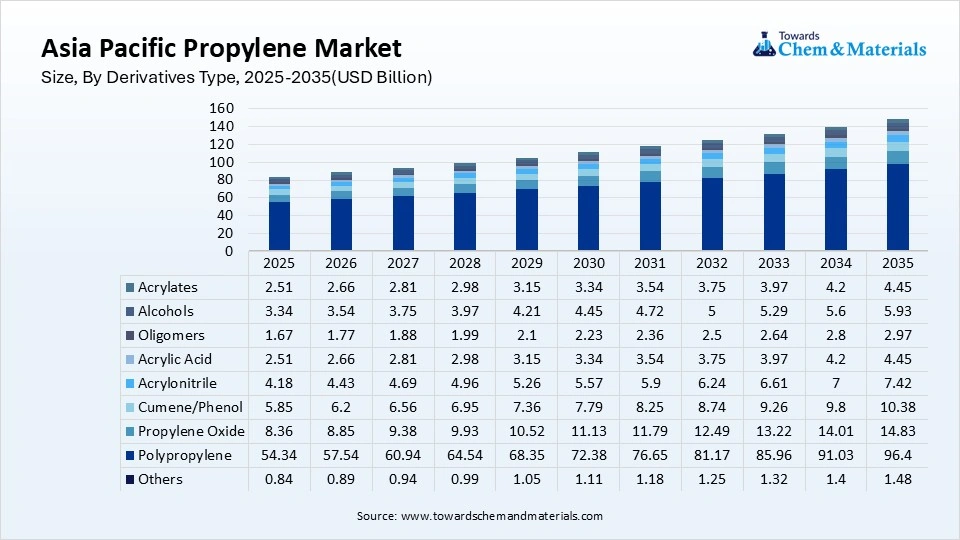
The propylene oxide segment held a 10% market share in 2025 and is expected to grow at the fastest CAGR of 6.7% over the forecast period, with growing use in propylene glycol, polyether polyols, appliances, medical formulations, and building materials. Derivative producers are increasingly getting rid of less efficient production processes, including HPPO technology that produces propylene oxide and water instead of polluting emissions in the conventional production process.
Asia Pacific Propylene Market Share, By Derivatives, 2025(%)
| By Derivatives | Market Share (%) |
| Polypropylene | 65% |
| Propylene Oxide | 10% |
| Cumene/Phenol | 7% |
| Acrylonitrile | 5% |
| Acrylic Acid | 3% |
| Oligomers | 2% |
| Alcohols | 4% |
| Acrylates | 3% |
| Others | 1% |
Type Insights
The homopolymer segment dominated the market with the largest share of 58% in 2025 and is expected to grow at a CAGR of 5.5% over the forecast period, as it is used extensively in packaging, automotive, consumer, appliance products, films, fibers, and industrial applications. The homopolymer grades offer known process properties to facilitate high-volume processing for regional manufacturing industries.
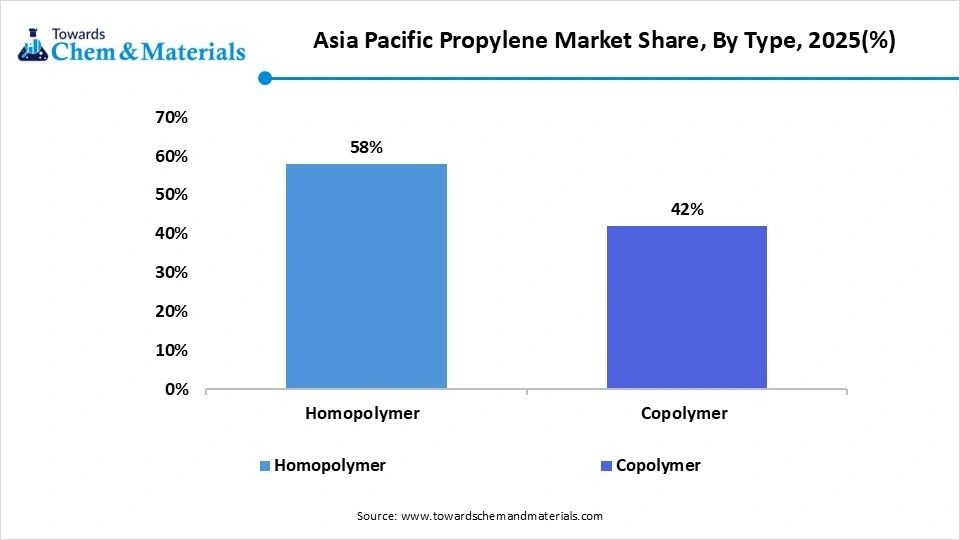 The copolymer segment held a 42% market share in 2025 and is expected to grow at the fastest CAGR of 6.4% over the forecast period. The growing demand for enhanced impact resistance, flexibility, durability, and specialised performance is driving the growth of the copolymer segment. Random and impact and block copolymers are used in applications that demand properties that are not obtained from homopolymers.
- In December 2025, Arkema also announced plans to sell certain impact modifiers and processing aids businesses to Praana, encompassing its worldwide MBS copolymer business.(Source: www.indianchemicalnews.com)
Asia Pacific Propylene Market Share, By Type, 2025(%)
| By Type | Market Share (%) |
| Homopolymer | 58% |
| Copolymer | 42% |
Application Insights
The injection molding segment dominated the market with the largest share of 40% in 2025 and is expected to grow at a CAGR of 5.8% over the forecast period. As regional manufacturing expands, so does the demand for efficient molded products that have lightweight and long-lasting properties. Internal, exterior, and under-the-hood parts are among the automotive applications that help advance polypropylene.
- In July 2026, OptiMIM established its global manufacturing plant in India, thereby augmenting the engineering and advanced metal injection molding capabilities in the country.(Source: www.newswire.ca)
The fiber segment held a 13% market share in 2025 and is expected to grow at the fastest CAGR of 4.8% over the forecast period, due to the rising demand for polypropylene in non-woven fibers, spunbond fibers, and staple fibers. Expanding requirements are underpinned by growing applications in hygiene, medical, textile, industrial, and consumer products. Lightweight and functional fiber materials with processing efficiency and performance are more in demand by manufacturers.
Asia Pacific Propylene Market Share, By Application, 2025(%)
| By Application | Market Share (%) |
| Injection Molding | 40% |
| Film & Sheet | 27% |
| Raffia | 13% |
| Fiber | 14% |
End-User Insights
The packaging segment dominated the market with the largest share of 36% in 2025 and is expected to grow at a CAGR of 5.9% over the forecast period, aided by the increasing application of polypropylene in flexible packaging, rigid packaging, BOPP films, woven sacks, containers, and industrial packaging. E-commerce growth and the needs of consumers further increase the demand for durable, lightweight, and moisture-resistant packaging.
- In June 2026, the development of white, cavitated BOPP film produced from recycled polypropylene by PureCycle Technologies and Innovia Films was a step towards sustainable flexible packaging applications. (Source: www.indianchemicalnews.com)
The medical segment held a 7% market share in 2025 and is expected to grow at the fastest CAGR of 7.2% over the forecast period, as a result of rising applications of polypropylene in medical devices, syringes, containers and nonwoven medical products. Increased healthcare infrastructure and pharmaceutical production contribute to the need for specialized polymer materials. There is a growing trend in material performance, processing efficiency and sustainability in healthcare applications.
Asia Pacific Propylene Market Share, By End User, 2025(%)
| By End User | Market Share (%) |
| Packaging | 36% |
| Electronics | 8% |
| Medical | 7% |
| Consumer Goods | 14% |
| Automotive | 13% |
| Construction | 7% |
| Textile | 9% |
| Agriculture | 4% |
| Other | 2% |
Regional Insights
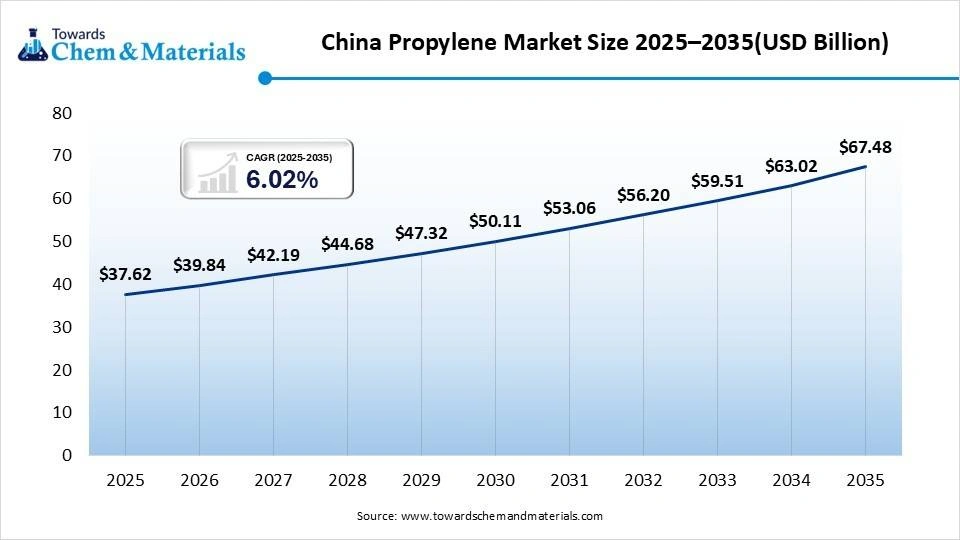
China propylene market size was estimated at USD 37.62 billion in 2025 and is projected to reach USD 67.48 billion by 2035, growing at a CAGR of 6.02% from 2026 to 2035.China dominated the market with the largest share of 45% in 2025. China is still the biggest market for propylene in the region with abundant refining capacity, downstream polypropylene production, petrochemical integration, and high domestic demand. The broad derivative demand comes from applications such as automotive, packaging, electronics, healthcare, and infrastructure.
- In January 2026, BASF commissioned its Zhanjiang steam cracker, providing propylene and other chemicals and providing renewable energy to the main compressor eDrives.(Source: www.basf.com)
India
India propylene market size was estimated at USD 14.71 billion in 2025 and is projected to reach USD 26.29 billion by 2035, growing at a CAGR of 5.98% from 2026 to 2035. India held a 17.6% market share in 2025. The expansion of petrochemical infrastructure, manufacturing, packaging consumption, automotive manufacturing, healthcare applications, and infrastructure development are beneficial for India. Investment in the refinery-to-chemical integration projects boosts domestic propylene supply and derivatives production capacity.
- In August 2026, Haldia Petrochemicals is making ready for a ₹6,000 crore project with India's first on-purpose propylene unit using Olefin conversion technology.(Source: chemicals.economictimes.indiatimes.com)
Japan
Japan propylene market size was estimated at USD 7.36 billion in 2025 and is projected to reach USD 13.23 billion by 2035, growing at a CAGR of 6.04% from 2026 to 2035.Japan held an 8.8% market share in 2025. Japan has a long-standing chemical industry base with high processing technology and advanced downstream industries, as well as a high demand for automotive and electronics applications. As the competition intensifies, manufacturers are focusing more and more on materials with high performance, efficient processing, and sustainability.
South Korea
South Korea propylene market size was estimated at USD 5.43 billion in 2025 and is projected to reach USD 9.12 billion by 2035, growing at a CAGR of 5.32% from 2026 to 2035.South Korea held a 6.5% market share in 2025. South Korea has an advanced petrochemical industry and solid automotive, electronics, and advanced materials sectors. Polypropylene, made from propylene, is used for lightweight components in the automotive industry, packaging, appliances, and specialized industrial uses.
- In May 2026, Hanwha Azdel introduced SuperLite S25, a polypropylene/long chopped fiber/recycled content composite for automotive.(Source: www.plasticstoday.com)
Taiwan
Taiwan's propylene industry takes advantage of existing petrochemical resources and advanced manufacturing industries. Demand for propylene-derived materials comes from electronics, consumer products, packaging, and industrial applications. Increasingly, manufacturers are focusing on specialized polymer performance, production efficiency, and sustainability.
Indonesia
Indonesia will increase its propylene supply by optimizing refinery facilities and developing downstream chemical production. PP consumption is supported by packaging, consumer products, automotive applications, and infrastructure development.
- In August 2025, Pertamina's Balikpapan RFCC facility was to start operations to help with refinery output growth, including propylene production. (Source: tanahair.net)
Malaysia
Malaysia held a 3.2% market share in 2025. Malaysia has developed petrochemical and regional manufacturing tie-ups to meet applications for propylene and its derivatives. Downstream demand comes from packaging, consumer goods, automotive parts, and industrial materials. The chemical facilities are integrated and offer the opportunity for efficient use of feedstocks and the production of derivatives.
Singapore
Singapore held a 2.3% market share in 2025. As the centre of petrochemical and chemical processing in the region, Singapore is bolstered by a comprehensive industrial infrastructure and advanced processing capabilities in the Asia Pacific region. Propylene is used to make downstream polymers and chemical derivatives for local customers.
Asia Pacific Propylene Market Share, By Country, 2025(%)
| By Country | Market Share (%) |
| China | 45% |
| India | 18% |
| Japan | 9% |
| South Korea | 7% |
| Taiwan | 5% |
| Indonesia | 4% |
| Malaysia | 3% |
| Singapore | 2.30% |
| Thailand | 2.10% |
| Australia | 1.90% |
| Vietnam | 1.4% |
| Philippines | 1% |
Thailand
Thailand held a 2.1% market share in 2025. Thailand has a proven petrochemical supply chain and a wide range of end-user industries that contribute to propylene requirements. Additionally, Propylene Glycol facilities are increasingly taking a sustainable approach, bolstering circular and bio-circular product opportunities in the Asia Pacific market.
- In March 2025, Dow's propylene glycol plant in Map Ta Phut became ISCC PLUS certified for sustainable production and circular product development. (Source: www.chemengonline.com)
Australia
Australia's area of development is around recycled polypropylene, circular plastics, and sustainable packaging applications. There are opportunities for local recycling to be developed and to turn soft plastics into recycled polypropylene for packaging.
- In September 2026, Viva Energy has finished a proof-of-concept using the soft plastics pyrolysis oil for the production of recycled polypropylene for food-grade packaging. (Source: www.ti-films.com )
Vietnam
Vietnam held a 1.4% market share in 2025. Vietnam's fast-growing manufacturing industry creates a growing demand for polypropylene packaging, consumer goods, textiles, automotive parts, and industrial materials. More integration of manufacturing leads to an increased share of imported and locally produced propylene derivatives. Packaging and consumer-oriented applications are still relevant as industrial activity is expanding.
Philippines
Philippines held a 1.1% market share in 2025. The Philippines is an emerging regional market for consumption, with packaging, consumer goods, construction, healthcare, and industrial applications driving the market. As manufacturing grows, so do opportunities for polypropylene-based products and other propylene derivatives.
Competitive Analysis
The propylene market in the Asia Pacific region is becoming more competitive with a focus on production capacity, feedstock integration, technology efficiency, catalyst performance, and downstream capacity. The key players are boosting on-purpose production and creating more integrated petrochemical facilities. Competitive aspects of sustainability and circularity are growing in importance. Businesses are also seeking higher grades of polypropylene, recycling methods, and AI-driven process optimization. Local players compete using supply reliability, specialised products, technological development, and strategic capacity expansion.
- In April 2026, Clariant introduced CATOFIN 1000, which provides increased selectivity, productivity, catalyst life, and reduced tar precursors for PDH applications.(Source: www.alchempro.com )
- In April 2026, Dangote has selected Honeywell UOP's Oleflex technology for its expanded packaging, consumer goods, and industrial materials-based propylene production. (Source: energynews.pro )
Recent Developments
- In November 2025, Datang Group officially started commercial operations of China's first green hydrogen integrated coal-to-chemicals (C2C) complex, which will use renewable hydrogen to produce chemicals instead of coal-derived hydrogen. (Source: fuelcellsworks.com)
Top Players in the Market & Their Offerings
| Company | Company Type/Position | Major Headquarters | Geographic Presence | Asia Pacific Propylene Offerings | Key Strength |
| Sinopec Group | State-owned National Oil & petrochemicals | Beijing, China | Extensive network across China | Polymer-grade Propylene, Homopolymer Polypropylene | Massive upstream refining integration |
| Reliance Industries Limited (RIL) | Private-sector Energy and Petrochemical Major | Mumbai, India | Strong domestic dominance in India | Polymer Grade Propylene, Polypropylene (PP) Resins | World-scale integration via the Jamnagar mega-refinery complex |
Other Key Players
- China Petrochemical Corporation (Sinopec)
- PetroChina Company Limited (CNPC)
- Reliance Industries Limited
- Formosa Plastics Corporation
- Mitsui Chemicals, Inc.
- Sumitomo Chemical Co., Ltd.
- Mitsubishi Chemical Group
- LG Chem Ltd.
- SK Geo Centric Co., Ltd.
- Borouge
Segment Covered in the Report
By Derivatives
- Polypropylene
- Homopolymer
- Copolymer
- Propylene Oxide
- Polyether Polyols
- Propylene Glycol
- Glycol Ethers
- Cumene/Phenol
- Phenol
- Acetone
- Acrylonitrile
- Acrylic Fibers
- ABS/SAN Resins
- Acrylic Acid
- Glacial Acrylic Acid
- Acrylic Acid Esters
- Oligomers
- Propylene Tetramer
- Propylene Hexamer
- Alcohols
- Isopropanol
- Oxo Alcohols
- Acrylates
- Methyl Acrylate
- Ethyl Acrylate
- Butyl Acrylate
- Others
- Specialty Chemicals
- Other Propylene Derivatives
By Type
- Homopolymer
- Isotactic Homopolymer
- High-Melt-Flow Homopolymer
- Copolymer
- Random Copolymer
- Impact Copolymer
- Block Copolymer
By Application
- Injection Molding
- Automotive Components
- Consumer Products
- Appliances
- Film & Sheet
- BOPP Films
- Cast Films
- Packaging Sheets
- Raffia
- Woven Sacks
- FIBC Bags
- Industrial Packaging
- Fiber
- Nonwoven Fibers
- Spunbond Fibers
- Staple Fibers
- Blow Molding
- Bottles
- Containers
- Automotive Parts
By End User
- Packaging
- Flexible Packaging
- Rigid Packaging
- Electronics
- Electrical Components
- Appliance Components
- Medical
- Medical Devices
- Syringes & Containers
- Nonwoven Medical Products
- Consumer Goods
- Household Products
- Appliances
- Personal Products
- Automotive
- Interior Components
- Exterior Components
- Under-the-Hood Components
- Construction
- Pipes
- Sheets
- Building Components
- Textile
- Fibers
- Nonwovens
- Woven Products
- Agriculture
- Agricultural Films
- Irrigation Components
- Crop Protection Packaging
- Other
- Industrial
- Energy
- Specialty Applications
FAQ's




Select User License to Buy
Figures (5)









 sales@towardschemandmaterials.com
 Download Sample
 Schedule a Meeting