Content
Advanced Functional Materials Market Size Analysis Report 2035
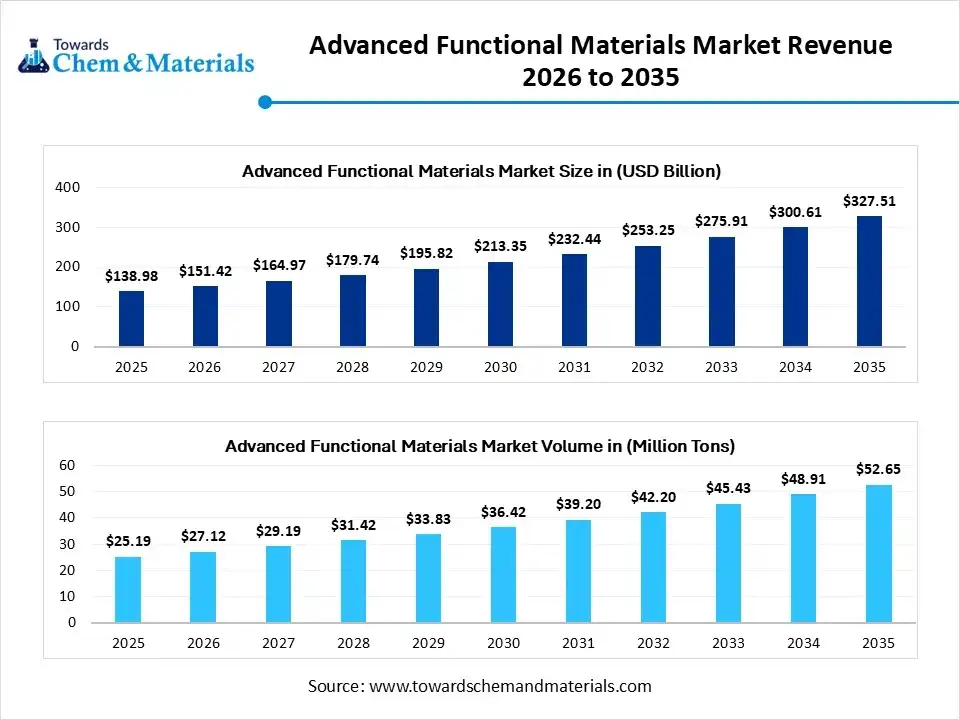
The advanced functional materials market size was valued at USD 138.98 billion in 2025, is estimated to reach USD 151.42 billion in 2026, and is projected to reach USD 327.51 billion by 2035, exhibiting a compound annual growth rate (CAGR) of 8.95% over the forecast period from 2026 to 2035. Asia Pacific dominated the advanced functional materials market with the largest revenue share of 41% in 2025 and is expected to grow at the fastest CAGR of 9.08% during the forecast period. In terms of volume, the advanced functional materials industry is projected to grow from 25.19 million tons in 2025 to 52.65 million tons by 2035. growing at a CAGR of 7.65% from 2026 to 2035.The growth of the market is driven by the intense demand for high-performance components, alongside innovations in nanotechnology and a strong focus on sustainability.
The market for advanced functional materials is vital because it supplies specialized, high-performance materials like nanomaterials, composites, and smart materials that fuel innovation, sustainability, and efficiency in rapidly growing sectors such as electronics, aerospace, and energy. It supports the creation of lighter, stronger, and more energy-efficient products, including miniaturized electronics, 5G technology, and advanced renewable energy components.
This market is essential for advancing low-carbon solutions, such as innovative battery materials for electric vehicles (EVs) and materials for efficient wind and solar power generation, while aligning with environmental regulations. These materials help manufacturers enhance product durability and performance, for example, by using lightweight composites to boost fuel efficiency in transportation. Additionally, advanced materials are key to developing next-generation technologies, including high-performance semiconductors, sensors, and quantum dots.
Market Highlights
- By region, Asia Pacific dominated the market with a share of 41% in 2025 and is expected to sustain its position while growing with a CAGR of 10.2% in the forecast period. Rapid industrialization accelerates advanced material consumption.
- By region, North America held the market share of 25% in 2025. Advanced semiconductor manufacturing, aerospace innovation, and EV production continue driving demand for functional materials.
- By material type, the advanced polymers segment dominated the market with 24% share in 2025. Electronics, automotive, and healthcare industries increasingly adopt high-performance polymers for lightweight and durable applications.
- By material type, the nanomaterials segment held 18% market share in 2025 and is expected to have the fastest growth with a CAGR of 10.2% in the forecast period. Semiconductor miniaturization and advanced energy storage technologies significantly increase demand for graphene and nanotube materials.
- By functionality, the electrical conductivity segment dominated the market with 22% share in 2025. Semiconductor packaging and flexible electronics industries increasingly require conductive advanced materials.
- By functionality, the self-healing functionality segment held 4% market share in 2025 and is expected to have the fastest growth with a CAGR of 10.4% in the forecast period. Aerospace, electronics, and automotive industries invest in self-healing materials to improve durability and reduce maintenance costs.
- By application, the electronics and semiconductors segment dominated the market with 27% share in 2025. Semiconductor miniaturization and flexible electronics manufacturing significantly increase demand for conductive and thermal management materials.
- By application, the energy & power segment held 15% market share in 2025 and is expected to have the fastest growth with a CAGR of 10.1% in the forecast period. Renewable energy storage systems and battery technologies rapidly expand demand for advanced functional materials.
- By processing technology, the injection molding segment dominated the market with 26% share in 2025. Large-scale electronics and automotive manufacturing continue to rely on injection molding for advanced polymer component production.
- By processing technology, the additive manufacturing segment held 17% market share in 2025 and is expected to have the fastest growth with a CAGR of 10.1% in the forecast period. Aerospace, healthcare, and automotive industries are increasingly adopting 3D printing.
- By distribution channel, the direct sales segment dominated the market with 47% share in 2025. Major advanced material manufacturers maintain direct partnerships with automotive, semiconductor, and aerospace companies.
- By distribution channel, the OEM partnerships segment held 17% market share in 2025 and is expected to have the fastest growth with a CAGR of 9.2% in the forecast period. Electronics and automotive OEMs increasingly collaborate with material suppliers to co-develop customized functional materials.
Quick Stats at a Glance
- Market Estimated Size (2025): USD 138.98 Billion | CAGR (2026–2035): 8.95%
- Market Projected Size (2035): USD 327.51 Billion
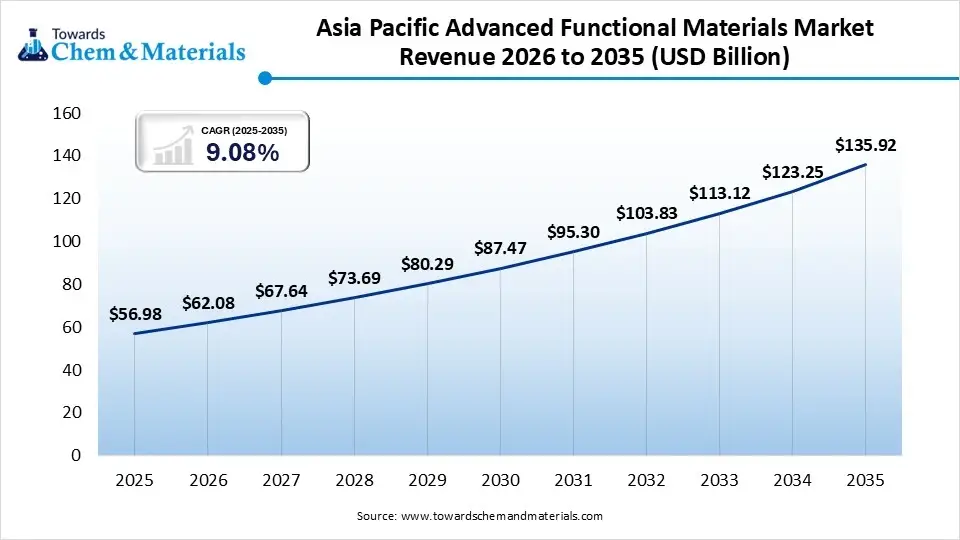
- Asia-Pacific: Revenue Share of 36% in 2025 | USD 56.98 Billion
- Market Estimated Volume (2025): 25.19 Million Tons | Volume CAGR (2026–2035): 7.65%
- Market Projected Volume (2035): 52.65 Million Tons
- Market Pricing (2025):
- Average Manufacturing Price (2025): USD 4,990/Ton
- Average Selling Price (2025): USD 6,430/Ton
- Pricing CAGR (2026–2035): 3.19%
Market Growth Trends:
- E-Mobility Driving Demand: The shift toward electric vehicles is driving massive demand for advanced ceramics, conductive polymers, and battery materials that offer high-energy density and better performance.
- Nanotechnology Integration: The utilization of carbon nanotubes, graphene, and quantum dots is skyrocketing to improve material properties like electrical conductivity, optical characteristics, and structural strength.
- Focus on Sustainability: Stringent environmental regulations are boosting demand for eco-friendly, energy-efficient materials, such as those used in renewable energy storage and low-carbon emission applications.
Report Scope
| Report Attributes | Details |
| Market Size and Volume in 2026 | USD 151.42 Billion/ 27.12 Million Tons |
| Revenue Forecast in 2035 | USD 327.51 Billion/ 52.65 Million Tons |
| Growth Rate | CAGR 8.95% |
| Base Year of Estimation | 2025 |
| Forecast Period | 2025 - 2035 |
| High Impact Region | Asia Pacific |
| Segment Covered | By Material Type, By Functionality, By Application, By Processing Technology, By Distribution Channel, By Regions |
| Key Companies Profiled | Toray Industries, Inc, Sumitomo Chemical Co., Ltd., LG Chem Ltd, Cabot Corporation, Huntsman Corporation, Arkema Group, BASF SE, 3M, Covestro AG, Hexcel Corporation, Evonik Industries AG, KYOCERA Corporation, Dow Inc., SHOWA DENKO K.K., DuPont de Nemours Inc., CeramTec GmbH, Momentive. |
Key Technological Shifts in The Advanced Functional Materials Market
The advanced functional materials market is undergoing rapid transformation, with 2026 trends focusing on nanotechnology, sustainable energy storage, and 5G integration. Key shifts include the adoption of nanomaterials for semiconductor miniaturization, high-performance battery components, smart composites for manufacturing, and AI-driven materials discovery. The demand for smaller, more efficient electronics (AI, IoT) is driving massive investment in nanotechnology and nanopowders, enabling advanced semiconductor packaging and circuit miniaturization.
Supply Chain Analysis of the Advanced Functional Materials Market:
- Material Production & Functionalization:Advanced functional materials are produced through synthesis, nanostructuring, and surface modification processes to achieve enhanced electrical, optical, thermal, magnetic, and mechanical properties for high-performance applications.
- Key players: 3M, DuPont, BASF, Toray Industries.
- Quality Testing and Certification:Advanced functional materials must comply with standards for material performance, durability, conductivity, safety, and environmental regulations across industrial applications.
- Key players: International Organization for Standardization, ASTM International, International Electrotechnical Commission, European Chemicals Agency
- Distribution to Industrial Users:Advanced functional materials are supplied to electronics manufacturers, automotive companies, aerospace industries, healthcare device producers, renewable energy projects, and industrial equipment sectors.
- Key players: 3M, DuPont, Toray Industries.
Advanced Functional Materials Regulatory Landscape: Global Regulations
| Country / Region | Regulatory Body | Key Regulations | Focus Areas | Notable Notes |
| United States | National Institute of Standards and Technology (NIST); Environmental Protection Agency (EPA); Department of Energy (DOE) | Toxic Substances Control Act (TSCA); Advanced Manufacturing Initiatives; DOE Clean Energy Programs | Material safety, advanced manufacturing, and clean energy innovation | The U.S. promotes advanced functional materials through strong R&D funding in semiconductors, energy storage, aerospace, and defense applications. |
| European Union | European Commission; European Chemicals Agency (ECHA) | REACH Regulation; EU Green Deal; Critical Raw Materials Act | Sustainable materials, chemical compliance, circular economy | The EU emphasizes sustainable and high-performance materials for electronics, renewable energy, and industrial decarbonization. |
| China | Ministry of Industry and Information Technology (MIIT); Ministry of Science and Technology (MOST) | Made in China 2025; New Materials Industry Development Guidelines | Advanced manufacturing, semiconductor materials, and industrial innovation | China is investing heavily in advanced functional materials to strengthen its domestic semiconductor, EV battery, and aerospace industries. |
| Japan | Ministry of Economy, Trade and Industry (METI); New Energy and Industrial Technology Development Organization (NEDO) | Green Innovation Fund; Industrial Technology Policies | Nanomaterials, energy materials, and electronics innovation | Japan supports advanced materials for high-performance electronics, robotics, and energy-efficient technologies. |
| South Korea | Ministry of Trade, Industry and Energy (MOTIE); Korea Institute of Industrial Technology (KITECH) | Materials, Parts, and Equipment (MPE) Strategy | Semiconductor materials, battery technologies | South Korea focuses on strategic materials independence for semiconductors, EV batteries, and display technologies. |
| India | Department of Science and Technology (DST); Ministry of Electronics and Information Technology (MeitY) | National Semiconductor Mission; Advanced Materials Research Programs | Electronics manufacturing, sustainable materials | India is expanding investments in specialty materials and semiconductor manufacturing under industrial self-reliance initiatives. |
Market Dynamics
Drivers
What are the Key Growth Drivers of the Advanced Functional Materials Market?
The advanced functional materials market is primarily driven by rising demand for lightweight components in electric vehicles and aerospace, high-performance electronics miniaturization, and sustainable, energy-efficient solutions. Stringent emissions regulations, advancements in nanotechnology, and increased R&D for superior materials like ceramics and composites are further accelerating market growth. The demand for smaller, faster, and more efficient electronic devices drives the need for sophisticated nanomaterials and conductive polymers, particularly in semiconductors, sensors, and flexible electronics. Regulations aiming for lower carbon footprints encourage the use of functional materials in solar panels, wind turbines, and energy storage systems to improve efficiency and durability.
Restrains
What are the Key Growth Restraints of the Advanced Functional Materials Market?
Key growth restraints in the advanced functional materials market include high production costs, raw material price volatility, complex, energy-intensive manufacturing processes, and significant R&D expenses. These factors, combined with challenges in scaling up production and, at times, limited availability of skilled labor, hinder widespread commercial adoption, particularly for smaller firms. Reliance on rare-earth elements and high-purity inputs makes the industry vulnerable to supply chain disruptions and price fluctuations. Many materials are difficult to produce at industrial scales, which restricts their adoption in large-scale applications such as automotive or electronics manufacturing.
Opportunities
What are the Key Growth Opportunities of the Advanced Functional Materials Market?
The advanced functional materials market is driven by rapid innovation in electronics, renewable energy, and electric vehicles. Key growth opportunities include the increasing demand for high-performance battery materials, advanced ceramics/composites for manufacturing, smart electronics, and, in healthcare, biocompatible materials for medical devices. The rapid adoption of electric vehicles is creating intense demand for advanced materials in batteries, such as cathodes, anodes, and solid-state electrolytes. Development of materials for solar panels and wind turbines is a major growth area.
Segmental Insights
Material Type Insights
The advanced polymers segment dominated the market with 24% share in 2025, driven by intense demand for lightweighting, high-performance electronics, and renewable energy technologies. This segment is transitioning from basic plastics to high-margin, specialized materials, with the global polymers industry expanding as it pivots toward circularity, chemical recycling, and enhanced sustainability.
The advanced composites segment held 20% market share in 2025, driven by intense demand for lightweighting in aerospace and wind energy. High-performance carbon fiber and thermoplastic composites are replacing traditional materials to enhance fuel efficiency and durability. The shift toward electric vehicles (EVs) requires lightweight materials to offset battery weight. Rising demand for lightweight aircraft components to boost fuel efficiency is a primary driver.
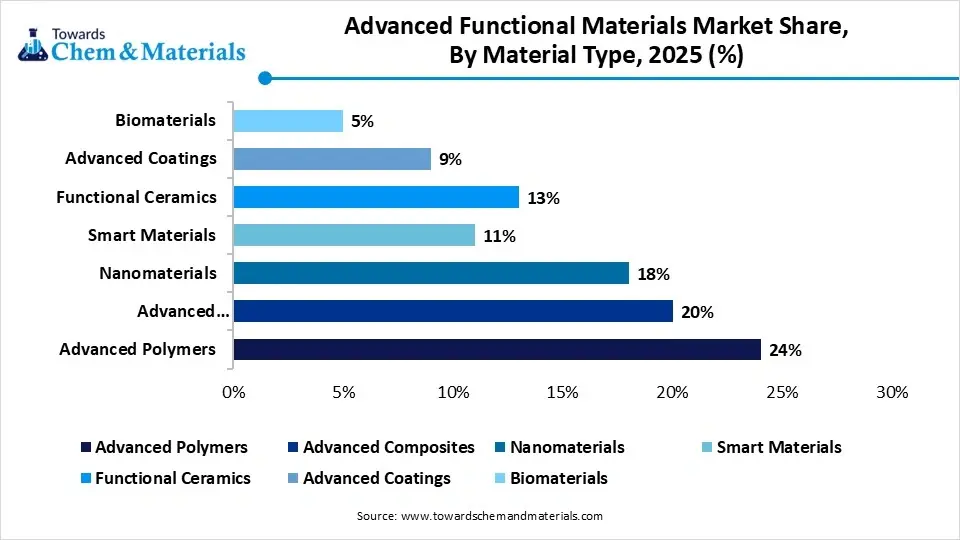
The nanomaterials segment held 18% market share in 2025 and is expected to have the fastest growth with a CAGR of 10.2% in the forecast period. Its rapid adoption is fueled by superior properties such as high strength-to-weight ratios and conductivity, making it essential for high-performance applications in electronics, energy storage, and smart coatings. Nanomaterials are widely used in advanced electronic components, batteries, and sensors due to their exceptional electrical and thermal properties.
Advanced Functional Materials Market Share,By Material Type, 2025 (%)
| By Material Type | Revenue Share, 2025 (%) |
| Advanced Polymers | 24% |
| Advanced Composites | 20% |
| Nanomaterials | 18% |
| Smart Materials | 11% |
| Functional Ceramics | 13% |
| Advanced Coatings | 9% |
| Biomaterials | 5% |
Functionality Insights
The electrical conductivity segment dominated the market with 22% share in 2025, driven by rising demand in electronics, 5G infrastructure, and electric vehicles. The electrical and electronics sector, a dominant user of these materials, demands materials for components like flexible circuits, sensors, and semiconductors. Increasing demand for lightweight, flexible, and high-performance materials in smartphones and wearables fuels the sector.
The mechanical reinforcement segment held 19% market share in 2025, driven by the intense demand for high-strength, lightweight, and durable materials in industries such as automotive, aerospace, and electronics. the advanced functional materials market is expanding rapidly, with projections showing strong growth fueled by the need for superior mechanical performance. The aerospace sector is accelerating the use of composites for better fuel efficiency and structural integrity.
The self-healing functionality segment held 4% market share in 2025 and is expected to have the fastest growth with a CAGR of 10.4% in the forecast period, emerging as a critical, high-growth area within the advanced functional materials market. This growth is driven by the urgent need for durable, sustainable, and low-maintenance materials across various industries. sectors are major contributors to demand, utilizing self-healing materials to improve the durability and safety of components.
Advanced Functional Materials Market Share, By Functionality, 2025 (%)
| By Functionality | Revenue Share, 2025 (%) |
| Electrical Conductivity | 22% |
| Thermal Management | 17% |
| Optical Functionality | 13% |
| Magnetic Functionality | 10% |
| Mechanical Reinforcement | 19% |
| Chemical Resistance | 8% |
| Self-healing Functionality | 4% |
| Energy Storage Functionality | 7% |
Application Insights
The electronics and semiconductors segment dominated the market with 27% share in 2025, driven by accelerating demand for AI, 5G, and high-performance computing. This segment is experiencing significant growth, with advanced materials increasingly essential to enhance chip performance, thermal management, and energy efficiency. The shift toward Silicon Carbide and Gallium Nitride is crucial for power electronics, EVs, and renewable energy, allowing for higher efficiency and faster charging.
The automotive segment held 18% market share in 2025, driven by the shift toward electric vehicles (EVs), lightweighting needs, and environmental regulations. The industry is adopting nanomaterials, composites, and advanced ceramics to improve efficiency, durability, and safety. High-performance composites and nanomaterials like carbon nanotubes, nanofibers. They are heavily used to reduce vehicle weight, improving fuel efficiency and driving range.
The energy & power segment held 15% market share in 2025 and is expected to have the fastest growth with a CAGR of 10.1% in the forecast period, driven by the global transition to renewable energy and demand for high-efficiency storage. Increased emphasis on low-carbon solutions and government environmental regulations drives the adoption of advanced functional ceramics and materials that improve efficiency. Advanced functional materials are crucial in reducing carbon footprints and enhancing energy efficiency in both generation and storage applications.
Advanced Functional Materials Market Share, By Application, 2025 (%)
| By Application | Revenue Share, 2025 (%) |
| Electronics & Semiconductors | 27% |
| Automotive | 18% |
| Aerospace & Defense | 14% |
| Energy & Power | 15% |
| Healthcare & Biomedical | 10% |
| Industrial Manufacturing | 7% |
| Construction | 4% |
| Consumer Goods | 3% |
| Others | 2% |
Processing Technology Insights
The injection molding segment dominated the market with 26% share in 2025, driven by the need for high-performance, lightweight, and complex components. There is surging demand for advanced materials such as Liquid Crystal Polymer, Polyamide-imide, and Polyaryletherketone for applications requiring exceptional strength, thermal stability, and low weight. The integration of IoT-enabled sensors, AI, and robotics in molding machines allows for real-time monitoring and predictive maintenance, enhancing quality and reducing downtime.
The additive manufacturing segment held 17% market share in 2025 and is expected to have the fastest growth with a CAGR of 10.1% in the forecast period, driven by the demand for complex, high-performance, and customized parts. The integration of 3D printing with AI, simulation software, and automation is enhancing efficiency and part quality, allowing for smarter production workflows. The market is witnessing a shift from rapid prototyping to manufacturing functional, end-use parts, particularly in the aerospace and healthcare sectors.
The extrusion processing segment held 15% market share in 2025, driven by the need for high-performance, complex, and sustainable material solutions. This growth is fueled by advancements in material technology, such as the development of smart polymers, conductive materials, and biodegradable composites, which require specialized, precise extrusion techniques.
Advanced Functional Materials Market Share, By Processing Technology, 2025 (%)
| By Processing Technology | Revenue Share, 2025 (%) |
| Additive Manufacturing | 17% |
| Injection Molding | 26% |
| Extrusion Processing | 15% |
| Chemical Vapor Deposition | 14% |
| Sol-Gel Processing | 9% |
| Nanofabrication Techniques | 10% |
| Thin Film Deposition | 9% |
Distribution Channel Insights
The direct sales segment dominated the market with 47% share in 2025, driven by the need for close technical collaboration between manufacturers and end-users in specialized sectors. As materials become more specialized, particularly in nanomaterials, composites, and conductive polymers, producers are increasingly bypassing traditional distributors to offer direct technical support, customized solutions, and to secure supply chain stability for high-performance applications in aerospace, automotive, and electronics.
The specialized material distribution segment held 28% market share in 2025. As advanced functional materials become essential across industries like electronics, renewable energy, and mobility, the need for specialized distribution, logistics, and technical support has become a critical driver of this expansion. Specialized distributors are crucial for handling these precise, sensitive materials. The transition to electric mobility and renewable energy storage drives massive demand for advanced composites and functional coatings.
The OEM partnership segment held 17% market share in 2025 and is expected to have the fastest growth with a CAGR of 9.2% in the forecast period, as companies seek to integrate specialized materials such as nanomaterials, conductive polymers, and advanced ceramics directly into next-generation products, particularly in the automotive, electronics, and aerospace sectors. Strict regulatory requirements for lower emissions are accelerating OEM adoption of advanced composites and high-strength, lightweight materials.
Advanced Functional Materials Market Share, By Distribution Channel, 2025 (%)
| By Distribution Channel | Revenue Share, 2025 (%) |
| Direct Sales | 47% |
| Specialized Material Distributors | 28% |
| OEM Partnerships | 17% |
| Online B2B Platforms | 8% |
Regional Insights
How did Asia Pacific Dominate the Advanced Functional Materials Market in 2025?
Asia Pacific advanced functional materials market size was estimated at USD 56.98 billion in 2025 and is projected to reach USD 135.92 billion by 2035, growing at a CAGR of 9.08% from 2026 to 2035.Asia Pacific dominated the market with a 41% share in 2025 and is expected to sustain its position, growing at a CAGR of 10.2% over the forecast period, driven by its massive electronics manufacturing base, rapid industrialization, and strong government support. China, Japan, and South Korea served as primary hubs, with significant investments in semiconductor, battery, and electric vehicle technologies, alongside high-volume production of nanomaterials and functional ceramics. Growing manufacturing capacities for electric vehicle batteries and renewable energy, such as solar power, drove substantial consumption of advanced functional composites.
India Advanced Functional Materials Market Growth Factor
The Indian advanced functional materials market is expanding rapidly, driven by localized manufacturing in electronics and stringent automotive regulations favoring lightweight composites. Key growth factors include rising demand for high-performance nanomaterials in defense, healthcare, and infrastructure, alongside rapid urbanization. Stringent emission norms and the shift towards electric mobility are boosting the adoption of advanced composites and high-strength alloys to minimize vehicle weight and increase battery efficiency.
North America Advanced Functional Materials Market Growth Factor
The North America advanced functional materials market size was estimated at USD 34.75 billion in 2025 and is projected to reach USD 83.52 billion by 2035, growing at a CAGR of 9.17% from 2026 to 2035.North America held the market share of 25% in 2025, driven by high-demand applications in electronics, aerospace, and clean energy, with significant growth projected through 2035. Key growth factors include the demand for high-performance components with superior mechanical strength and corrosion resistance, alongside increasing AI-driven material design and a transition toward sustainable, intelligent materials. Heavy investment in R&D, coupled with AI-driven material discovery and the push for sustainable, bio-inspired composites, is driving market evolution.
India Advanced Functional Materials Market Growth Factor
- The Indian advanced functional materials market is rapidly expanding, driven by explosive growth in electronics manufacturing, robust automotive production, and government initiatives favoring indigenization. Key drivers include high demand for nanomaterials, conductive polymers, and composites in electric vehicles and consumer electronics.
- The surge in local manufacturing of electronics, including semiconductors, displays, and batteries, creates high demand for advanced materials to enhance performance and reduce power consumption.
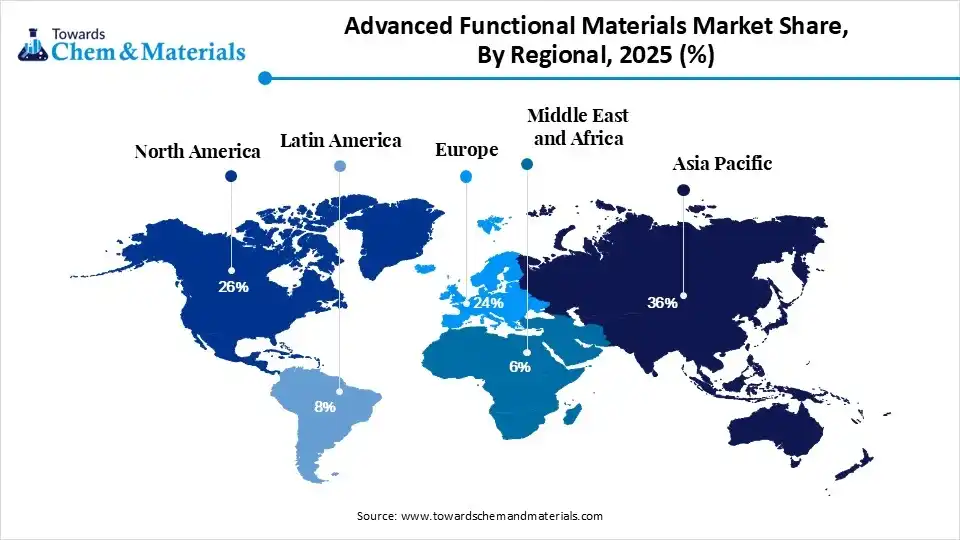
Advanced Functional Materials Market Share, By Regional, 2025 (%)
| Regional | Revenue Share, 2025 (%) |
| North America | 26% |
| Europe | 24% |
| Asia-Pacific | 36% |
| Latin America | 8% |
| Middle East & Africa | 6% |
Recent Developments
- In May 2026, Osaka Soda Co., Ltd. announced its medium-term management plan "Transform Our Future 2030", aimed at driving growth via high-value-added functional chemicals in electronics materials and healthcare. The company will leverage proprietary technologies in electronic and life science materials, targeting the commercialization of next-generation battery and QoL-focused products.(Source: www.tipranks.com)
- In April 2026, Texas Christian University (TCU) and Advanced Functional Fabrics of America (AFFOA) partnered to launch the Texas Advanced Certificate in Textiles for Innovation and Composites (TACTIC) program. The initiative focuses on training for high-demand fields like aerospace and defense, capitalizing on TCUs recent achievements in advanced manufacturing research.(Source: fortworthinc.com)
Top players in the Advanced Functional Materials Market & Their Offerings
- Toray Industries, Inc.: Toray is a global leader in carbon fibers, films, resins, and advanced composite materials for aerospace, automotive, electronics, and energy sectors.
- Sumitomo Chemical Co., Ltd.: Sumitomo Chemical develops functional materials for semiconductors, display technologies, batteries, and sustainable energy systems.
- LG Chem Ltd.: LG Chem supplies battery materials, engineering plastics, and advanced functional materials for EVs, electronics, and renewable energy applications.
- Cabot Corporation: Cabot manufactures conductive carbons, aerogels, and specialty compounds used in lithium-ion batteries, electronics, and industrial applications.
- Huntsman Corporation: Huntsman develops advanced polyurethane systems, electronic materials, and performance products for industrial and consumer markets.
Other Top Players Are
- Arkema Group
- BASF SE
- 3M
- Covestro AG
- Hexcel Corporation
- Evonik Industries AG
- KYOCERA Corporation
- Dow Inc.
- SHOWA DENKO K.K.
- DuPont de Nemours Inc.,
- CeramTec GmbH
- Momentive.
Segments Covered:
By Material Type
- Advanced Polymers
- Conductive Polymers
- High-performance Thermoplastics
- Shape Memory Polymers
- Advanced Composites
- Carbon Fiber Composites
- Glass Fiber Composites
- Ceramic Matrix Composites
- Nanomaterials
- Carbon Nanotubes
- Graphene Materials
- Nanoclays
- Metal Oxide Nanoparticles
- Smart Materials
- Piezoelectric Materials
- Magnetostrictive Materials
- Electrochromic Materials
- Functional Ceramics
- Electronic Ceramics
- Structural Ceramics
- Bioceramics
- Advanced Coatings
- Anti-corrosion Coatings
- Self-cleaning Coatings
- Thermal Barrier Coatings
- Biomaterials
- Bio-resorbable Materials
- Implantable Materials
- Tissue Engineering Materials
By Functionality
- Electrical Conductivity
- Thermal Management
- Optical Functionality
- Magnetic Functionality
- Mechanical Reinforcement
- Chemical Resistance
- Self-healing Functionality
- Energy Storage Functionality
By Application
- Electronics & Semiconductors
- Semiconductor Packaging
- Printed Electronics
- Flexible Electronics
- Automotive
- EV Batteries
- Lightweight Structural Components
- Sensor Systems
- Aerospace & Defense
- Thermal Protection Systems
- Lightweight Composites
- Radar Absorbing Materials
- Energy & Power
- Battery Materials
- Solar Materials
- Fuel Cell Components
- Healthcare & Biomedical
- Implants
- Drug Delivery Systems
- Diagnostic Devices
- Industrial Manufacturing
- Industrial Coatings
- High-performance Machinery Components
- Construction
- Smart Glass
- Structural Reinforcement Materials
- Consumer Goods
- Wearable Electronics
- High-performance Sporting Goods
- Others
- Marine Applications
- Agricultural Technologies
By Processing Technology
- Additive Manufacturing
- Injection Molding
- Extrusion Processing
- Chemical Vapor Deposition
- Sol-Gel Processing
- Nanofabrication Techniques
- Thin Film Deposition
By Distribution Channel
- Direct Sales
- Specialized Material Distributors
- OEM Partnerships
- Online B2B Platforms
By Region
- North America
- U.S.
- Canada
- Europe
- Germany
- UK
- France
- Italy
- Spain
- Sweden
- Denmark
- Norway
- Asia Pacific
- China
- Japan
- India
- South Korea
- Thailand
- Latin America
- Brazil
- Mexico
- Argentina
- Middle East and Africa (MEA)
- South Africa
- UAE
- Saudi Arabia
- Kuwait
Tags
FAQ's




Select User License to Buy
Figures (5)









 sales@towardschemandmaterials.com
 Download Sample
 Schedule a Meeting