 Request Consultation
How Grafted Polyolefins are driving a Sustainable Polymer Revolution
The global demand for high-performance plastics is growing rapidly, driven by an urgent need for lightweight industrial solutions and sustainability. This shift is transforming specialized materials into critical strategic assets. Grafted polyolefins, such as maleic anhydride-functionalized polyethylene (PE) and polypropylene (PP), are at the forefront of this transformation, evolving from niche additives into essential components for promoting circularity. By serving as superior compatibilizers and adhesion promoters, these materials are bridging the gap between performance and sustainability, attracting significant attention from major industry players and policymakers.
As countries strive to achieve their decarbonization goals, these advanced polymers are revolutionizing the automotive, packaging, and construction sectors by enhancing the bonding of dissimilar materials and improving recyclability. However, the future of this rapidly growing sector depends on scaling up production. Continued success necessitates urgent, coordinated investments in reactive extrusion technologies, robust recycling infrastructure, and a long-term commitment to a genuine circular economy.
What is the Current Value of The Grafted Polyolefins Market?
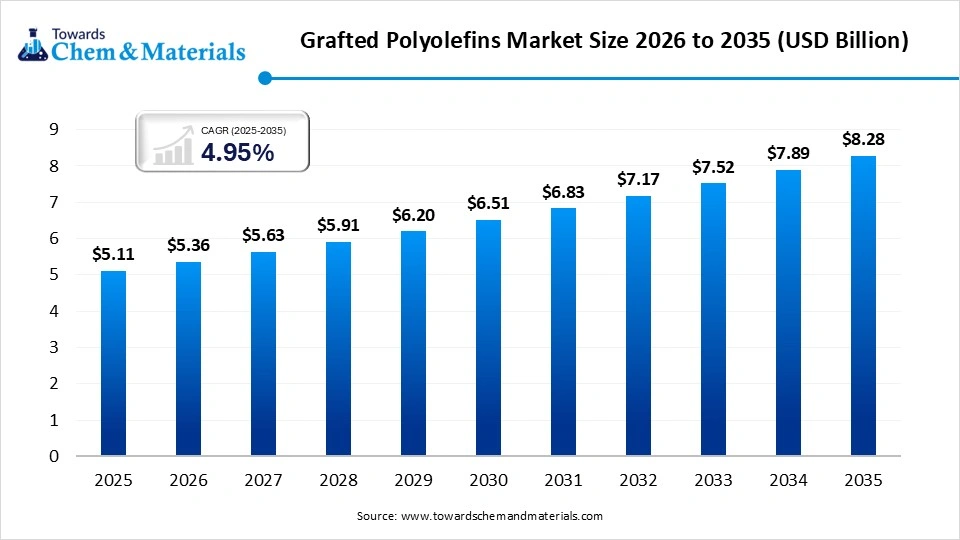
The global grafted polyolefins market size is expected to grow from USD 5.36 billion in 2026 to USD 8.28 billion in 2035, growing at a CAGR of 4.95% from 2026 to 2035. Asia Pacific dominated the grafted polyolefins market with the largest revenue share of 45.00% in 2025. the Rising demand for strong, lightweight, and cost-effective plastic materials is driving the use of grafted polyolefins, especially in packaging and automotive applications. At the same time, increasing focus on recycling and blending different plastics is boosting their role as compatibilizers in sustainable material solutions.
How Grafted Polyolefins are Transforming Modern Materials
- Compatibilizers in Polymer Blends : Grafted polyolefins serve as essential molecular adhesives for creating stable blends of otherwise incompatible plastics, such as PP/PA or PE/PET. By bridging distinct polymer phases, they prevent separation under stress, significantly enhancing the mechanical strength, durability, and impact resistance of composite materials.
- Molecular Bridges for Packaging : Functioning as critical interlayers, these additives act as bridges between polar and non-polar substrates. In multi-layer food packaging, this technology is vital for ensuring high film clarity, superior seal integrity, and advanced barrier properties, helping keep food safe and fresh.
- Automotive Light weighting : Grafted polyolefins are empowering the automotive industry move towards lightweighting by improving adhesion between polymers and reinforcements. They enable the production of stronger, lighter car parts, including bumpers and under-the-hood components, directly contributing to enhanced fuel efficiency and performance.
- Improving Recycling Efficiency: Grafted polyolefins represent a game-changer for recycling, acting as compatibilizers that facilitate the efficient reuse of mixed, contaminated, or post-consumer waste streams. By enabling high-performance recycling, they convert plastic waste into valuable materials, supporting sustainable circular economy goals.
Key Challenges Grafted Polymers Facing Rising Costs and Regulatory Pressures
Manufacturers of grafted polyolefins are encountering a dual challenge, as surging raw material costs for specialized monomers and initiators collide with complex, energy-intensive reactive extrusion processes. This situation complicates the balance between high grafting levels and processability, potentially limiting the use of these materials in cost-sensitive applications.
At the same time, the industry is contending with stringent and varied international regulations that require a shift toward low-residue, eco-friendly formulations. To align with global circular economy goals, manufacturers must innovate to meet these environmental standards, turning compliance into a critical race for technological advancement.
Advanced Grafting Techniques Enhancing Grafted Polyolefins Performance
- Maleic Anhydride Grafting: This grafting is a transformative technology for improving polymer compatibility. It converts non-polar materials such as PE and PP into versatile grafted copolymers like maleic anhydride modified PE (MAPE) and maleic anhydride modified PP (MAPP). By introducing polar functional groups, this method enhances adhesion between polymers and inorganic fillers, effectively addressing inherent compatibility issues, and is essential in high-performance composite manufacturing and multi-layer packaging films.
- Reactive Extrusion Technology: This technology is the fastest-growing method for processing polymers, revolutionizing the modification process. It enables in-situ grafting of polyolefins during compounding, combining mixing and chemical modification in one continuous, solvent-free step. This innovation offers high throughput and consistent product quality, leading to significantly reduced manufacturing costs for specialized materials.
- Advanced Catalytic Systems: These systems, which include traditional Ziegler-Natta catalysts and the increasingly popular single-site metallocene catalysts, allow for precise engineering of graft copolymers. These systems provide enhanced control over molecular weight, distribution, and the degree of functional grafting. This level of precision enables manufacturers to design polymer architectures tailored to specialized, high-performance applications.
- Circular Economy through Advanced Recycling: Sustainability is a primary focus in current development, with advanced grafting playing a vital role in circular economy initiatives. Grafted polymers serve as effective compatibilizers for recycling mixed and incompatible polyolefin waste. When paired with advanced mechanical techniques and chemical recycling methods like pyrolysis, these innovations facilitate the recovery of high-quality materials from unrecyclable waste.
- Functional and Smart Materials: The leading edge of polymer research is in functional and smart materials. By incorporating functional additives such as carbon nanotubes or graphene into grafted polyolefin matrices, scientists are developing specialized materials with enhanced intelligent properties. These materials offer improved electrical conductivity and tailored mechanical properties for high-tech applications, blending traditional polymer strengths with advanced electronics.
Industrial Significance of Grafted Polyolefins
| Industry | Primary Use | Key Benefit | Main Applications |
| Automotive | Lightweighting and Compounding | Improves adhesion between plastics and metals/fibers; acts as an impact modifier. | Bumpers, interior trim, under-the-hood parts, fuel tanks. |
| Packaging | Multilayer Films | Enhances bonding between dissimilar polymer layers. | Food packaging, barrier films, adhesive layers for flexible packaging. |
| Construction | Polymer Modification | Improves adhesion to fillers, moisture barriers, and thermal stability. | Pipes, fittings, insulation materials, geomembranes. |
| Wire and Cable | Coupling Agent | Enhances interfacial adhesion between the polymer matrix and filler. | Insulation, cladding, halogen-free flame retardant cables. |
| Polymer Processing | Compatibilizers | Enables blending of incompatible polymers, improving toughness and recyclability. | Recycled plastic compounding, wood-plastic composites. |
The New Backbone of the U.S. Grafted Polyolefin Revolution
The U.S. is leading a revolution in grafted polyolefins by combining high-performance, maleic anhydride-grafted solutions with critical advancements in automotive lightweighting, EVs, and circular economy initiatives. Amid shifting supply chains and stringent sustainability mandates, this industrial activity is driving demand for high-performance compatibilizers that enhance recycled plastics and facilitate advanced packaging. This solidifies the region's position as both a market leader and a hub for technical innovation. Key initiatives and funding include:
- DOE Plastics Innovation Challenge Investment: This initiative has allocated over $25 million into fundamental research projects that focus on advanced polymer upcycling and deconstruction, transforming waste plastics into high-value, recyclable-by-design materials.
- Chemical Upcycling of Polymers Funding: Approximately $25 million has been earmarked to accelerate the development of energy-efficient technologies aimed at improving the properties of recycled polyolefins, specifically targeting maleic anhydride-grafted types.
- BOTTLE Consortium Collaboration: U.S. national laboratories, including the National Renewable Energy Laboratory (NREL), are leveraging the BOTTLE consortium to advance technologies that recover both polymers and fibers, reducing the industry's reliance on virgin plastic materials.
India Becomes the New Global Hotspot for Next-Gen Material Solutions
India is quickly emerging as a global hub for grafted polyolefins, driven by the Make in India initiative and other government programs that are transforming the automotive and packaging sectors. With a critical demand for lightweight materials in EVs and advanced, sustainable packaging solutions, the country is poised for massive growth. Companies are leveraging high-tech research and development to enhance material performance, boost sustainability, and revolutionize local manufacturing in the world’s fastest-growing market. Key initiatives and funding to support this transformation include:
- Production-Linked Incentive (PLI) Schemes: The government's PLI scheme, with an allocation of ₹1.97 lakh crore, targets 14 key sectors, including textiles and automobile components, which are significant users of advanced polyolefins.
- Plastic Parks Infrastructure: The government provides up to 50% funding for project costs, capped at ₹40 crore per project, to enhance infrastructure and increase manufacturing capacity for specialized polymer products.
- Innovation and Research and Development Support: The Anusandhan National Research Foundation (ANRF) and a ₹1 lakh crore fund aim to strengthen research and development initiatives focusing on advanced polymer technologies.
- Foreign Direct Investment (FDI): India permits 100% FDI under the automatic route in the manufacturing sector to encourage technology transfer and investment in high-tech material manufacturing.
Germany Accelerates Sustainable Industrial Materials
Germany is leading the charge toward a circular economy through the development of high-performance, eco-friendly materials, driven by stringent EU regulations and a significant share of European plastics FDI projects. Supported by substantial research and investment, the country is fostering innovation in recycling compatibilization to meet the high demand for lightweight, high-adhesion solutions in the automotive and packaging sectors. Key programs and initiatives driving this adoption include:
- Foreign Direct Investment (FDI): Germany has become a primary hub for plastics and rubber investment, securing over 20% of all EU-27 FDI projects, reflecting strong investor confidence and high activity levels.
- Corporate Research and Development: Leading German chemical firms such as BASF and Evonik are investing heavily in sustainable polymer technologies, with a focus on bio-based feedstocks and advanced recycling techniques.
- Made for Germany Initiative: A new initiative set for July 2025 will provide significant funding to bolster the nation’s industrial future, strengthening its global manufacturing position and reinforcing its commitment to sustainable production.
Key Global Government Initiatives for Grafted Polyolefins
| Country | Initiative | Focus Area and Impact on Grafted Polyolefins |
| India | Single-Use Plastic Ban and Circular Economy Rules | Encourages recycling of polyolefins, increasing the need for grafted polymers to compatibilize mixed plastics. |
| EU | EU Green Deal and Circular Economy Action Plan | Imposes strict recycling targets, fostering the use of grafted polyolefins for recycling and downgauging packaging. |
| China | Electric Vehicle and Lightweighting Mandates | Driving high demand for Maleic Anhydride grafted PP/PE for composite adhesion in battery housing and automotive components. |
| U.S. | EPA/Sustainability Regulations | Promotes eco-friendly materials and advanced recycling methods, supporting the demand for compatibilizers. |
| Brazil | Bio-based Material Mandates | Policies favoring bio-feedstock are encouraging the development of bio-grafted polyolefins. |
How Grafted Polyolefins Bridge the Gap to a Sustainable Future
Grafted polyolefins are at a pivotal point, transitioning from niche technical applications to becoming foundational components of modern material science. The demand for lightweight automotive parts and functionalized packaging has driven the need for these high-performance materials. Advanced maleic anhydride technology is rapidly closing the gap between non-polar polymers and polar surfaces, meeting contemporary engineering demands. Furthermore, these materials are essential for enabling a circular economy by significantly enhancing the mechanical properties of recycled plastics.
The next few years are crucial for turning grafted polyolefins from an innovative material into a global force for sustainability. This transformation will require increased investment, efficient reactive extrusion practices, and strong public-private partnerships to advance mixed-plastic recycling. If industry leaders act decisively to address cost challenges, these high-performance materials could revolutionize sustainability, create new circular markets, and secure manufacturing independence, and they represent a definitive blueprint for the next era of smart, circular, and lightweight design.
About the Experts

Aditi Shivarkar
Aditi serves as Vice President at Towards Chemical and Material and brings over 15 years of experience in research, strategy, and industry analysis. She focuses on sectors such as specialty chemicals, advanced materials, and sustainable solutions. She studies how regulations, raw materials, and industrial demand shape the market, and she uses that understanding to guide businesses in the right direction. Aditi helps companies stay prepared for change, improve their market position, and make well-informed decisions.



Aman Singh
Aman Singh has more than 13 years of experience in research and consulting, with a strong focus on the global chemicals and materials space. He tracks developments in areas like green chemistry, high-performance materials, and industrial innovation. At Towards Chemical and Material, he leads the research team and ensures every report is clear, accurate, and useful. Aman breaks down complex industry changes and helps businesses understand what they mean in practical terms.