Find the Right Market Report
Search thousands of industry reports, market insights, and research studies in one place.
Not sure where to start? Try one of these:
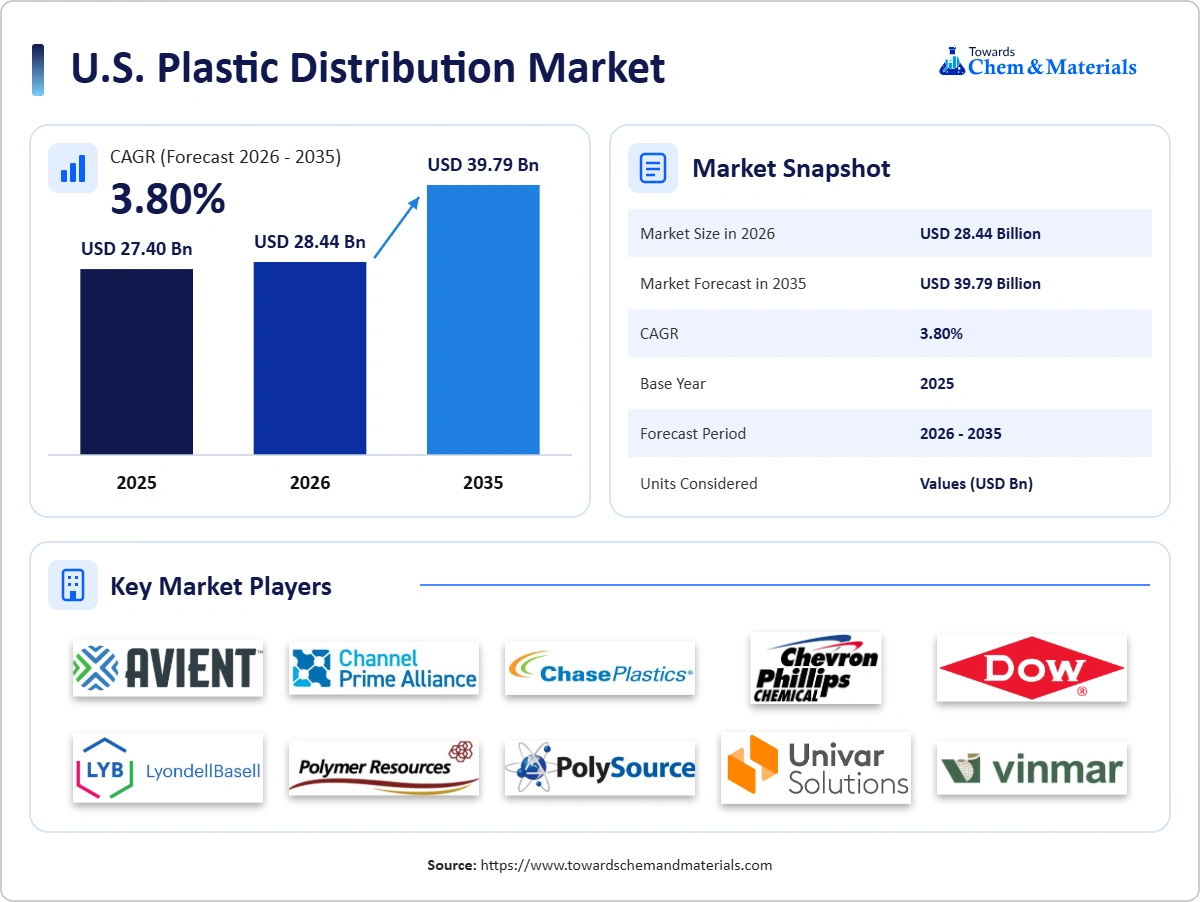
The U.S. plastic distribution market size is valued at USD 28.44 billion in 2026 and is projected to reach USD 39.79 billion by 2035, expanding at a CAGR of 3.80% from 2026 to 2035. The market comprises the distribution of plastic resins and related materials in the United States through distributors and resellers. It covers commodity resins (polyethylene, polypropylene, PVC and polystyrene), engineering plastics (ABS, polycarbonate, nylon and others), high-performance polymers, compounds and colour concentrates, and recycled resins supplied to packaging, automotive, construction, healthcare, electrical and consumer goods processors.
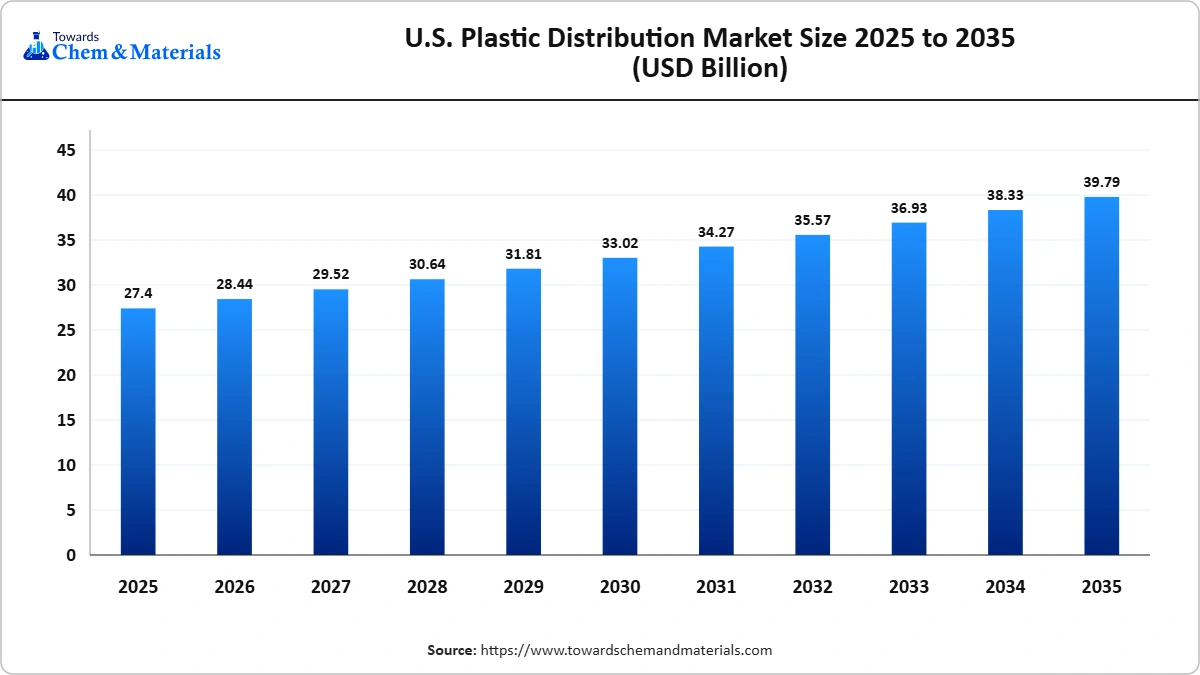
Note: 2025 is the base year; 2026-2035 values are forecasts.
Sources: Expert interviews, secondary sources, Towards Chemical and Materials database, and Towards Chemical and Materials analysts.
Commodity Resins held the largest product share at 58.00% in 2025, driven by high-volume purchases of polyethylene and polypropylene by film, molding and packaging processors. In 2025, the South accounted for 37.00% of market revenue, supported by Gulf Coast cracker capacity in Texas and Louisiana, along with established processor clusters across Georgia, Tennessee, and the Carolinas. The market demand is being fueled by rising U.S. resin production, growing packaging requirements, manufacturing reshoring, and recycled-content regulations. The distribution landscape is also undergoing consolidation, as seen in Univar Solutions' acquisition of H.M. Royal in August 2026.
The U.S. plastic distribution market is projected to reach USD 39.79 billion by 2035, up from USD 27.40 billion in 2025. Rising resin production, increased manufacturing activity in the country, and the growing need for recycled-content materials are supporting this growth. Small processors' dependence on distributors for reliable material supplies and credit is another contributing factor.
Analyst View: We have developed the estimate based on U.S. resin consumption by type and end use, the share sold through distribution and average resin prices, cross-checked against distributor revenue.
The market connects large Gulf Coast resin producers with thousands of small processors. Resin prices have been weak due to the establishment of new capacity, while reshoring and recycled-content laws are creating new demand. Distributors are consolidating and adding specialty and recycled lines.
Market Drivers - Impact & CAGR Contribution (2026-2035)
| Driver | Impact | ≈ CAGR Contribution | Time Horizon | Key Regions |
| Growing U.S. resin output | High | +1.48 pp | Short to long term | U.S.-wide, strongest in South |
| Packaging demand | Medium | +1.25 pp | Medium to long term | U.S.-wide, fastest uptake in West |
| Reshoring manufacturing | Medium | +1.07 pp | Short to medium term | U.S.-wide |
| Recycled-content laws | Low | +0.83 pp | Long term | South and West |
Note: Contributions are indicative estimates of each factor's effect on annual growth.
Sources: Expert interviews, secondary sources, Towards Chemical and Materials database, and Towards Chemical and Materials analysts.
Resin output growth, packaging demand, and reshoring are projected to be the strongest market growth drivers during 2026-2035.
Market Restraints - Impact & Negative CAGR Contribution (2026-2035)
| Restraint | Impact | ≈ Negative CAGR Contribution | Time Horizon | Key Regions |
| Resin price volatility | High | -0.38 pp | Short to medium term | U.S.-wide |
| Direct sales by producers | High | -0.28 pp | Medium term | Smaller and price-sensitive markets |
| Plastic regulation | Medium | -0.18 pp | Short term | South and other mature markets |
Note: Contributions are indicative estimates of each factor's effect on annual growth.
Sources: Expert interviews, secondary sources, Towards Chemical and Materials database and Towards Chemical and Materials analysts.
Resin price volatility is the main restraint, followed by direct sales and regulation.
U.S. Plastic Distribution Market by Product, 2025 Share (%)
| Segments | 2025 Share | 2035 Share | CAGR 2026-2035 |
| Commodity Resins | 58.00% | 56.50% | 3.53% |
| Engineering Plastics | 27.00% | 27.32% | 3.93% |
| Compounds & Specialty | 9.00% | 9.10% | 3.93% |
| Recycled Resins | 6.00% | 7.09% | 5.53% |
Note: 2025 is the base year; 2035 shares and CAGRs are forecasts.
Sources: Expert interviews, secondary sources, Towards Chemical and Materials database, and Towards Chemical and Materials analysts.
Commodity resins led the market in 2025 because polyethylene and polypropylene are bought in the largest volumes by film, molding, and packaging processors. Recycled resins are growing at the fastest rate as brands have set recycled plastic usage targets.
U.S. Plastic Distribution Market by End Use, 2025 Share (%)
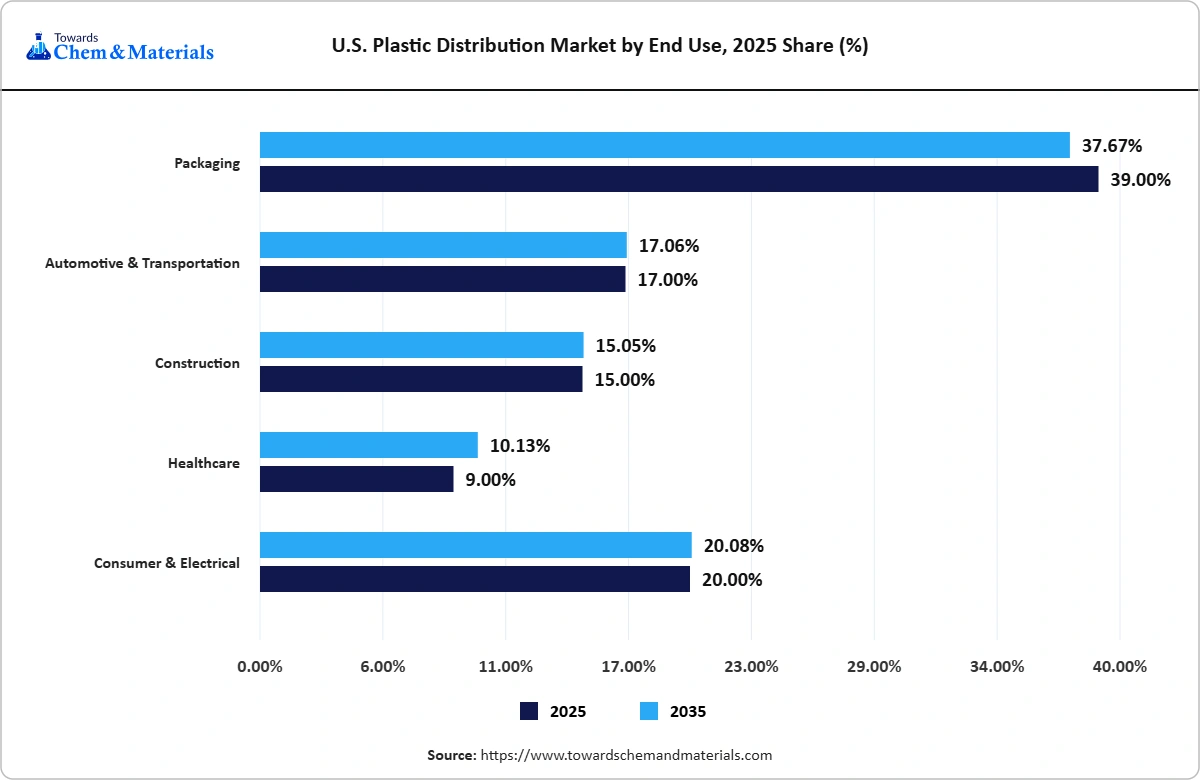
Note: 2025 is the base year; 2035 shares and CAGRs are forecasts.
Sources: Expert interviews, secondary sources, Towards Chemical and Materials database, and Towards Chemical and Materials analysts.
Packaging represented the largest end-user base in 2025 because thousands of small film, bottle, and container makers buy through distributors. Healthcare is expected to exhibit the highest rate of growth from 2026 to 2035 owing to significant demand from medical device manufacturers for traceable resins that meet regulatory requirements.
Analyst View: Recycled resins and healthcare gain share fastest, while commodity resins and packaging continue to lead the market.
U.S. Plastic Distribution Market by Region, 2025 Share (%)
| Region | 2025 Share | 2035 Share | CAGR 2026-2035 |
| South | 37.00% | 35.36% | 3.33% |
| Midwest | 29.00% | 28.80% | 3.73% |
| West | 17.00% | 18.95% | 4.93% |
| Northeast | 17.00% | 16.89% | 3.73% |
Note: 2025 is the base year; 2035 shares and CAGRs are forecasts.
Sources: Expert interviews, secondary sources, Towards Chemical and Materials database, and Towards Chemical and Materials analysts.
The South held the largest market share in 2025, as it accounts for a significant proportion of U.S. resin production and benefits from the presence of major packaging and automotive manufacturing facilities. The West is expected to grow at the fastest rate over the forecast period, driven by recycled-content regulations and rising demand from new manufacturing facilities.
Analyst View: The South continues to be the largest regional market, while the West is expected to record the fastest growth, supported by regulations requiring recycled content in plastic products.
| Rank | Company Name | 2025 Share (%) | Key Products / Business | Headquarters |
| 1 | Ravago (Muehlstein, M. Holland) | 16.00% | resin distribution through Muehlstein, M. Holland and other units | Belgium |
| 2 | Nexeo Plastics | 9.00% | commodity and engineering resins | United States |
| 3 | Formerra | 5.00% | engineering and specialty resin distribution | United States |
| 4 | Univar Solutions | 4.00% | plastics additives and resins | United States |
| 5 | Chase Plastics | 4.00% | engineering resins | United States |
| 6 | Vinmar International | 4.00% | resin trading and distribution | United States |
| 7 | Channel Prime Alliance | 3.00% | commodity resin distribution | United States |
| 8 | PolySource | 2.00% | engineering resin distribution | United States |
| 9 | Polymer Resources | 2.00% | engineering compounds | United States |
| 10 | Bamberger Polymers | 2.00% | commodity resins | United States |
Note: Company shares are 2025 estimates.
Sources: Company press releases, expert interviews, secondary sources, Towards Chemical and Materials database, and Towards Chemical and Materials analysts.
Ravago (Muehlstein, M. Holland) led the market with a 16.00% share in 2025, followed by Nexeo Plastics at 9.00% share and Formerra at 5.00% share. Ravago (Muehlstein, M. Holland) leads with resin distribution through Muehlstein, M. Holland and other units; Nexeo Plastics competes with commodity and engineering resins; and Formerra offers engineering and specialty resin distribution. Univar Solutions, Chase Plastics, Vinmar International, Channel Prime Alliance, PolySource, Polymer Resources and Bamberger Polymers compete through plastics additives and resins, engineering resins, resin trading and distribution, commodity resin distribution, engineering resin distribution, engineering compounds and commodity resins.
In 2025, the top 10 companies held 51% of revenue, while the remaining 49% was shared among hundreds of regional distributors, resellers and traders. The market is moderately concentrated, and competition centres on supplier line cards, inventory and logistics, credit terms for small processors, technical support and access to recycled and specialty grades.
The U.S. plastic distribution ecosystem connects resin producers, distributors, compounders & recyclers, processors and regulators, with each stage adding value before products reach end users. Distributors sell polyolefin resins and polypropylene compounds made from ethylene and alpha-olefin comonomers.
| Ecosystem Stage | Role in the Market | Key Companies |
| Resin Producers | Make resins | Dow, ExxonMobil, LyondellBasell, Chevron Phillips |
| Distributors | Stock, break bulk and deliver | Ravago, Nexeo, Univar |
| Compounders & Recyclers | Make compounds and recycled resins | Avient, recyclers |
| Processors | Mould, extrude and film | Packaging, automotive and medical moulders |
| Regulators | Set rules | EPA, state recycled-content laws |
Sources: Company press releases, expert interviews, secondary sources, Towards Chemical and Materials database and Towards Chemical and Materials analysts.
The Towards Chemical and Materials Companies Quadrant assesses key participants in the market-by-market strength, reflecting revenue scale, market share, and geographic reach, and by innovation and growth strategy, reflecting product portfolio breadth, research and development intensity, and partnerships. Positions reflect each company's market share in 2025 and our evaluation of its product innovation, portfolio breadth, and partnerships.
Sources: Company press releases, expert interviews, secondary sources, Towards Chemical and Materials database, and Towards Chemical and Materials analysts.
Leaders: Ravago (Muehlstein, M. Holland), Nexeo Plastics, Formerra, Univar Solutions, Chase Plastics and Vinmar International combine high market share with broad portfolios and strong innovation.
Innovators: Channel Prime Alliance, PolySource, Polymer Resources and Bamberger Polymers provide newer technologies and specialised products.
By Product
By End Use
The market covers the distribution of plastic resins and related materials through distributors and resellers. It includes commodity resins such as polyethylene, polypropylene, PVC and polystyrene; engineering plastics such as ABS, polycarbonate and nylon; high-performance polymers; compounds and colour concentrates; and recycled resins. These materials are supplied to processors across the packaging, automotive, construction, healthcare, electrical and consumer goods industries. The 2025 market size was calculated using a bottom-up approach based on demand volumes and average prices across product categories, end uses and regions. The estimates were cross-checked using a top-down approach based on market-specific revenues of leading companies and publicly available industry data. Segment, regional and company-level values were allocated according to product, end-use and regional demand. Key estimates were validated against company disclosures, regulatory records, industry data and published third-party estimates. Inputs that could not be reliably reconciled were excluded. All segment, regional and company estimates were aligned with the same 2025 base year. The 2026-2035 forecast was developed using a constant CAGR from the 2025 base, followed by recalculation and validation to ensure consistency across the market estimates.
We expect the market to grow modestly in value, tracking resin prices and manufacturing activity. Recycled and specialty grades offer better margins than commodity resin, and distributors that build these lines will outperform.
Reliable market intelligence and data-driven insights across the global chemicals and materials industry, helping businesses understand trends, competition, pricing, and emerging opportunities.
Schedule a Demo