
What is the Petroleum Fuel Dyes and Markers Market Size and Share?
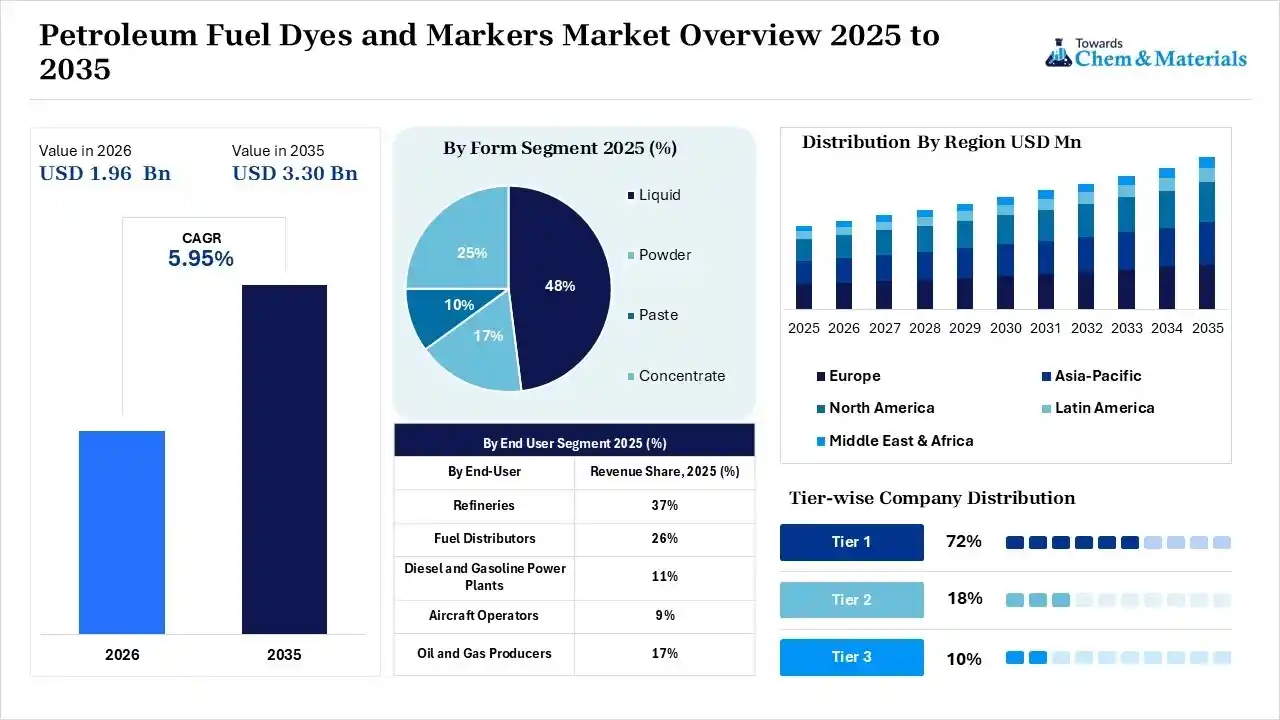
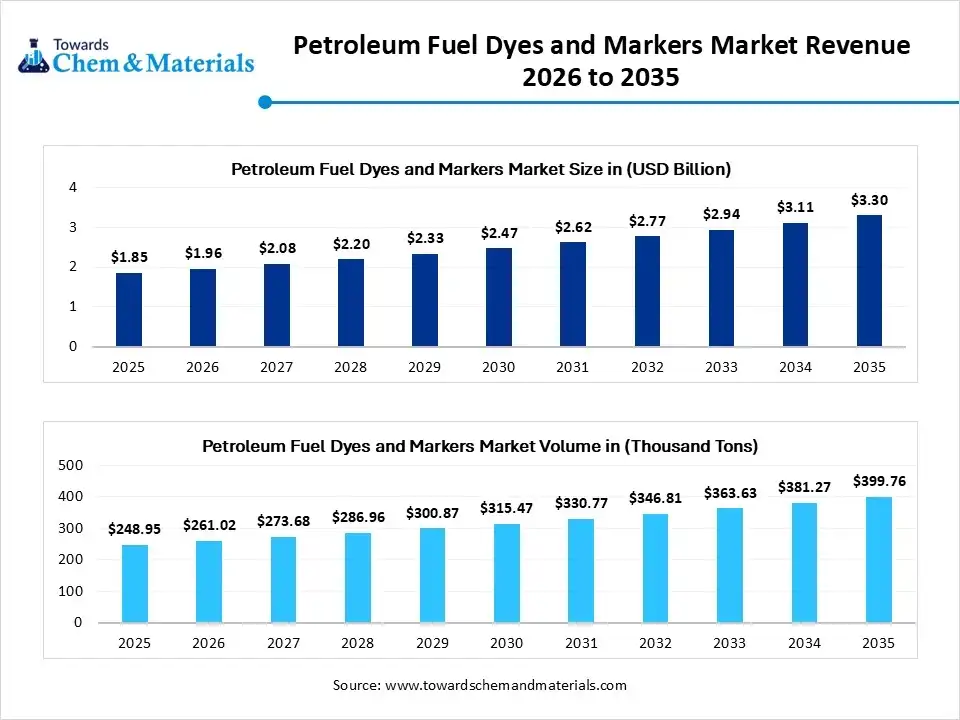
The petroleum fuel dyes and markers market size was valued at USD 1.85 billion in 2025, is estimated to reach USD 1.96 billion in 2026, and is projected to reach USD 3.30 billion by 2035, exhibiting a compound annual growth rate (CAGR) of 5.95% over the forecast period from 2026 to 2035.Europe dominated the petroleum fuel dyes and markers market with the largest revenue share of 30% in 2025 and is expected to grow at the fastest CAGR of 6.64% during the forecast period. In terms of volume, the petroleum fuel dyes and markers market is projected to grow from 248.95 thousand tons in 2025 to 399.76 thousand tons by 2035. growing at a CAGR of 4.85% from 2026 to 2035.The growth of the market is driven by strict government regulations against tax evasion, rising fuel adulteration, and expanding global energy consumption across automotive, aviation, and industrial sectors. Increased government investments and efforts across the global fuel supply chain support growth, according to the report.
Market Highlights
- By region, Europe dominated the market with a share of 30% in 2025. Stringent anti-fraud regulations increase market consumption.
- By region, Asia Pacific held 28% market share in 2025 and is expected to experience the fastest growth with a CAGR of 6.80% in the forecast period. Expanding fuel consumption drives market demand.
- By form, the liquid segment dominated the market with 48% share in 2025. Refineries prefer liquid formulations for operational efficiency.
- By form, the concentrate segment held 25% market share in 2025 and is expected to have the fastest growth with a CAGR of 6.8% in the forecast period. High-performance formulations improve detection accuracy.
- By end-user, the refineries segment dominated the market with 37% share in 2025. Fuel marking is integrated into refining operations.
- By end-user, the oil and gas producers segment held 17% market share in 2025 and is expected to have the fastest growth with a CAGR of 6.5% in the forecast period. Upstream fuel monitoring requirements expand.
- By application, the diesel segment dominated the market with 41% share in 2025. Off-road and subsidized diesel monitoring expands globally.
- By application, the gasoline segment held 34% market share in 2025 and is expected to have the fastest growth with a CAGR of 6.30% in the forecast period. Governments use dyes for taxation compliance.
- By marker type, the fluorescent markers segment dominated the market with 46% share in 2025. Rapid field detection enhances enforcement efficiency.
- By marker type, the chemical markers segment held 46% market share in 2025 and is expected to have the fastest growth with a CAGR of 6.9% in the forecast period. Advanced molecular authentication improves security.
- By dye chemistry, the solvent dyes segment dominated the market with 52% share in 2025. Excellent fuel compatibility supports widespread use.
- By dye chemistry, the oil-soluble dyes segment held 35% market share in 2025 and is expected to have the fastest growth with a CAGR of 6.40% in the forecast period. Superior hydrocarbon solubility enhances performance.
Quick Stats at a Glance
- Market in Size (2025): USD 1.85 Billion | CAGR (2026–2035): 5.95%
- Market Estimated size in 2026: USD 1.96 Billion
- Market Projected Size (2035): USD 3.30 Billion
- Europe: largest Regional Market Revenue Share of 30% in 2025| USD 555 Million
- Asia Pacific: Fastest-growing Regional Market Revenue Share of 28% in 2025| USD 518 Million
- By country: The Germany held the largest market share of 22.0% in 2025
- Market in Volume (2025): 248.95 Thousand Tons| Volume CAGR (2026–2035): 8.75%
- Market Estimated Volume (2026): 261.02 Thousand Tons
- Market Projected Volume (2035): 399.76 Thousand Tons
- Market Pricing (2025):
- Average Manufacturing Price: USD 4,120/Ton
- Average Selling Price: USD 5,380/Ton
- Pricing CAGR (2026–2035): 3.20%
Market Overview
What Is the Significance of the Petroleum Fuel Dyes and Markers Market?
The petroleum and fuel dyes and markers market is essential for preventing tax evasion, reducing fuel theft, and ensuring regulatory compliance. These chemical additives enable refineries, distributors, and governments to securely trace, verify, and differentiate various petroleum and biofuel grades throughout the global supply chain.
Dyes offer quick visual classification by color, such as telling gasoline from jet fuel or kerosene, while invisible forensic markers can be lab-verified to confirm authenticity. As the use of sustainable energy blends increases, specific markers help companies monitor complex supply chains to meet environmental standards and ultra-low sulfur diesel regulations. Governments use specific markers to distinguish subsidized fuels such as agricultural or heating oil from heavily taxed commercial fuels, preventing illegal diversion.
- For instance, Authentix provides fuel markers and dyes for detecting fuel adulteration and illegal dilution. These marker systems help governments and fuel suppliers prevent tax fraud and unauthorized fuel blending.(Source:authentix.com)
About 55% of suppliers depend on these additives to fight illegal trade, theft, and fuel dilution, protecting engine performance and consumer trust. Industry leaders like Johnson Matthey, BASF, and Innospec are driving innovations in forensic tracking technology. The market mainly relies on heat-stable, hydrocarbon-soluble unsaturated substances such as azo dyes and alkyl dyes.
- For instance, Innospec supplies fuel dyes used to distinguish taxed and untaxed diesel fuels. Colored fuel markers support regulatory enforcement and reduce illegal resale of subsidized fuels..(Source: innospec.com)
Global Investment Flow for Petroleum Fuel Dyes and Markers Market 2026
- The petroleum fuel dyes and markers market is witnessing growing investments due to increasing government efforts to prevent fuel adulteration, smuggling, and tax evasion across global fuel supply chains.
- Europe and North America are attracting significant investments in advanced fuel marking technologies supported by stringent fuel quality regulations and rising enforcement against illegal fuel trading activities.
- Asia-Pacific is emerging as a major investment hub because of expanding fuel consumption, rapid industrialization, and increasing adoption of fuel authentication systems in countries such as China and India.
- Investments are increasingly focused on advanced molecular markers and digital fuel tracing technologies that provide high-security identification and improve supply chain transparency.
- Major companies are investing in research and development to create environmentally safe, highly stable, and tamper-resistant fuel dyes compatible with evolving fuel formulations and biofuel blends.
- Strategic collaborations between petroleum companies, regulatory authorities, and specialty chemical manufacturers are driving innovation and expanding the adoption of fuel dyes and marker solutions globally.
Market Growth Trends
- Nanotechnology Integration:The adoption of nanomaterials is a major growth driver due to their properties, such as increased sensitivity, stability, and longevity, enabling highly accurate fuel traceability, which is a growing trend in the market.
- Anti-Smuggling & Tax Enforcement: Governments increasingly mandate fiscal marking to differentiate subsidized fuels like heating oil or agricultural diesel from standard road fuels.
- Biofuel Blending Compliance: Rising blending mandates require tracking mechanisms to ensure quality control across middle distillates, which are seeing the highest growth in application.
Report Scope
| Report Attributes | Details |
| Market Size and Volume in 2026 | USD 1.96 Billion / 261.02 Thousand Tons |
| Revenue Forecast in 2035 | USD 3.30 Billion / 399.76 Thousand Tons |
| Growth Rate | CAGR 5.95% |
| Base Year of Estimation | 2025 |
| Forecast Period | 2025 - 2035 |
| High Impact Region | Asia Pacific |
| Segment Covered | By Form, By End-User, By Application, By Marker Type, By Dye Chemistry, By Regions |
| Key Companies Profiled | Innospec Inc., BASF SE, Authentix, Inc., John Hogg & Co Ltd., United Colour Manufacturing, Inc., Clariant, DyStar, Evonik Industries, Solvay, The Dow Chemical Company, Orient Chemical Industries Co., Ltd., A.S. Harrison & Co Pty Ltd, Huntsman Corporation, Tronox Holdings, Sun Chemical, Merck KGaA, Ciba Specialty Chemicals, Cabot Corporation, DIC Corporation, Heubach, Lanxess |
Petroleum Fuel Dyes and Markers Market shift towards advanced technology through the integration of AI
The petroleum fuel dyes and markers market is rapidly modernizing through AI integration, shifting from simple visual identification to automated, highly traceable supply chains. This technological leap prevents fuel theft, optimizes chemical dosing, and ensures strict regulatory compliance in the energy sector. Advanced research integrates AI and Machine Learning to optimize the production and combustion performance of nanoparticle-infused dyed fuels. Emerging digital ecosystems combine chemical markers with blockchain, IoT sensors, and automated AI agents to track fuel integrity from the refinery to the pump.
Petroleum Fuel Dyes and Markers Regulatory Landscape
| Country / Region | Regulatory Body | Key Regulations | Focus Areas | Notable Notes |
| United States | Environmental Protection Agency (EPA); Internal Revenue Service (IRS) | EPA Fuel Regulations; IRS Dyed Fuel Regulations | Fuel identification, tax enforcement, and anti-fraud measures | The U.S. mandates red dye usage in untaxed diesel fuels to prevent illegal fuel usage and tax evasion. |
| European Union | European Commission; European Chemicals Agency (ECHA) | EU Fuel Marking Directive; REACH Regulation | Fuel traceability, environmental compliance | Europe emphasizes standardized fuel marking systems to combat fuel fraud and improve supply chain monitoring. |
| United Kingdom | HM Revenue & Customs (HMRC) | Hydrocarbon Oil Duties Act | Rebated fuel identification, tax compliance | The UK uses fuel dyes and markers extensively for identifying rebated fuels and preventing misuse. |
| India | Ministry of Petroleum and Natural Gas; Oil Marketing Companies (OMCs) | Fuel Quality Monitoring Programs | Fuel adulteration prevention, supply chain monitoring | India increasingly utilizes chemical markers to reduce fuel adulteration and improve fuel quality control. |
| China | State Administration for Market Regulation (SAMR); Ministry of Ecology and Environment (MEE) | Fuel Quality Regulations | Fuel authenticity, environmental monitoring | China is strengthening fuel quality monitoring and anti-counterfeiting measures using fuel markers. |
| Brazil | National Agency of Petroleum, Natural Gas and Biofuels (ANP) | Fuel Monitoring and Quality Standards | Fuel authentication, anti-smuggling measures | Brazil employs fuel markers to reduce illegal fuel trade and maintain fuel quality standards. |
Supply Chain Analysis of Petroleum Fuel Dyes and Markers Market
- Chemical Production & Fuel Additive Formulation:Petroleum fuel dyes and markers are produced through the synthesis of soluble colorants and tracer chemicals that are blended into fuels for identification, taxation control, anti-counterfeiting, and regulatory compliance purposes.
- Petroleum fuel dyes and invisible chemical markers are specialized additives synthesized from complex unsaturated aromatic compounds like Innospec Dyes & Markers and Dow molecular markers. They are formulated to be completely hydrocarbon-soluble to prevent fuel laundering, track tax-related products, and prevent fiscal fraud without altering base fuel performance.
- Key players: Innospec, BASF, Dow, John Hogg Technical Solutions
- Quality Testing and Certification:Fuel dyes and markers must comply with standards for chemical stability, solubility, traceability, combustion compatibility, and environmental safety before use in petroleum fuels.
- Quality testing and certification of markers & dyes ensure regulatory compliance, prevent tax evasion, and maintain fuel batch integrity. Laboratories rely on precise analytical chemistry and molecular marking technology to verify marker concentrations.
- Key players: American Petroleum Institute, International Organization for Standardization, U.S. Environmental Protection Agency, European Chemicals Agency
- Distribution to Industrial Users:Petroleum fuel dyes and markers are supplied to oil refineries, fuel distributors, government taxation authorities, transportation fuel suppliers, and petrochemical companies.
- The distribution of petroleum and fuel dyes and markers to industrial users involves moving specialized molecular tags and fluorescent colorants from refineries to B2B clients. This supply chain prevents tax evasion, deters fuel adulteration, and ensures regulatory compliance.
- Key players: Innospec, BASF, John Hogg Technical Solutions.
Petroleum Fuel Dyes and Markers Market Dynamics
| Drivers | Restrains | Opportunities |
| Tax Evasion & Subsidy Fraud Prevention:Governments heavily mandate dyes like Azo dyes and chemical markers to distinguish between subsidized fuels (such as agricultural or heating diesel) and standard taxed automotive fuels. | Fluctuating Raw Material Costs:The production of chemical markers and fluorescent dyes depends heavily on upstream petrochemical feedstocks. Volatility in crude oil prices directly impacts manufacturing margins. | Anti-Adulteration & Tax Enforcement:Governments increasingly mandate invisible markers and visible dyes to differentiate subsidized fuels like agricultural or heating oil from standard automotive diesel to prevent tax evasion and smuggling. |
| Fluorescent & Digital Tracking Tech:Continuous R&D by major players like Innospec Inc, John Hogg & Co. Ltd., and Authentix Inc into fluorescent markers simplifies authentication and integrates with supply chain tracking | Environmental Concerns & Transition to Biofuels:As global environmental regulations push for decarbonization and increased biofuel blending, traditional petroleum additives face scrutiny | Eco-Friendly Formulations:R&D investments are shifting toward sustainable, non-toxic, and biodegradable dye alternatives to comply with tightening environmental regulations in Europe and North America. |
| Ultra-Low Sulfur Diesel (ULSD) Compliance:Enforcement of strict environmental emission norms and sulfur caps globally has accelerated the deployment of invisible molecular markers to verify compliance at retail pumps. | Supply Chain & Counterfeiting Challenges:The risk of marker tampering and supply chain theft requires companies to constantly pivot to advanced nanotechnology or digital tracking, which raises the barrier to entry for smaller firms. | Digital Traceability Integration:Opportunities exist in combining chemical markers with digital tracking, blockchain, and supply chain transparency tools to combat fuel theft and counterfeiting. |
Segmental Insights
Form Insights
The liquid segment dominated the market with 48% share in 2025, due to its seamless ease of application, cost-effective bulk handling, and perfect compatibility with high-volume fuel processing operations. Ideal for major refineries and large-scale fuel distributors seeking highly efficient, cost-effective continuous dosing solutions. Manufacturers are developing advanced liquid dye formulations that maintain high stability and visibility across extreme temperature fluctuations.
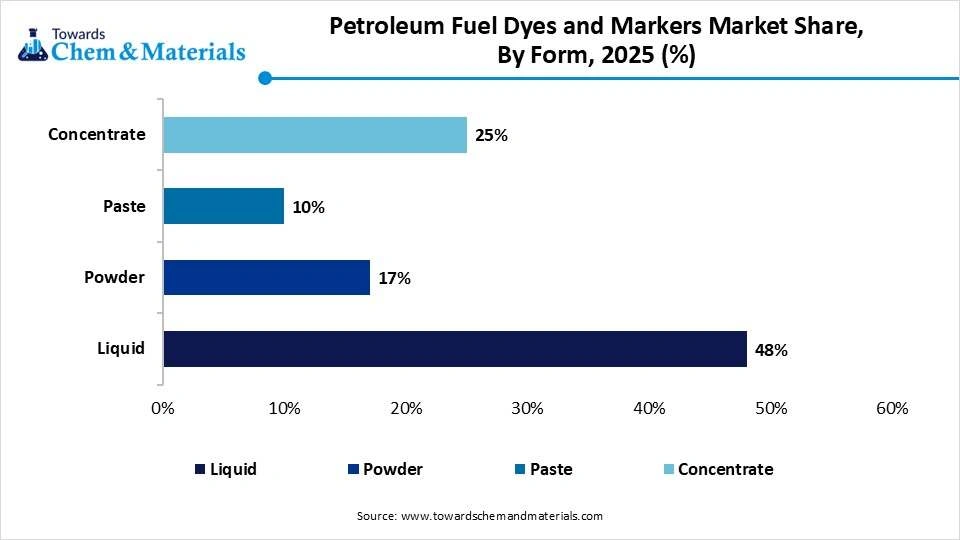
The concentrate segment held 25% market share in 2025 and is expected to have the fastest growth with a CAGR of 6.8% in the forecast period, due to its superior versatility, cost-efficiency, and ease of handling during large-scale refinery blending and fuel distribution operations. Concentrated formulations are significantly easier to store, transport, and apply compared to bulky standard mixtures. Their high-potency composition means smaller quantities are needed to achieve the required coloration or chemical marking.
Petroleum Fuel Dyes and Markers Market Share, By Form, 2025 (%)
| By Form | Revenue Share, 2025 (%) |
| Liquid | 48% |
| Powder | 17% |
| Paste | 10% |
| Concentrate | 25% |
End-User Insights
The refineries segment dominated the market with 37% share in 2025, primarily driven by an industry-wide push to prevent fuel adulteration, ensure traceability, and comply with strict tax enforcement regulations. Refineries inject specialized markers directly into bulk streams to authenticate fuel grades before distribution. Local facilities such as the expanding refining and petrochemical operations in India are scaling up to meet global supply demands, necessitating robust quality monitoring and tracking markers.
The oil and gas producers segment held 17% market share in 2025 and is expected to have the fastest growth with a CAGR of 6.5% in the forecast period, by scaling up exploration, expanding refinery capacity like HMEL's facilities in India, and enforcing stringent supply chain quality control amidst global energy transitions. Rising investments in exploration, production, and digital adoption by key players like Innospec Inc. ensure precise fuel grading and anti-counterfeiting measures.
Petroleum Fuel Dyes and Markers Market Share, By End-User, 2025 (%)
| By End-User | Revenue Share, 2025 (%) |
| Refineries | 37% |
| Fuel Distributors | 26% |
| Diesel and Gasoline Power Plants | 11% |
| Aircraft Operators | 9% |
| Oil and Gas Producers | 17% |
Application Insights
The diesel segment dominated the market with 41% share in 2025, due to strict government regulations against tax evasion and a surge in off-road industrial and agricultural applications. The expanding construction, agriculture, logistics, and mining sectors heavily rely on diesel. This necessitates strict fuel traceability and authentication to prevent adulteration. The expanding construction, agriculture, logistics, and mining sectors heavily rely on diesel. This necessitates strict fuel traceability and authentication to prevent adulteration.
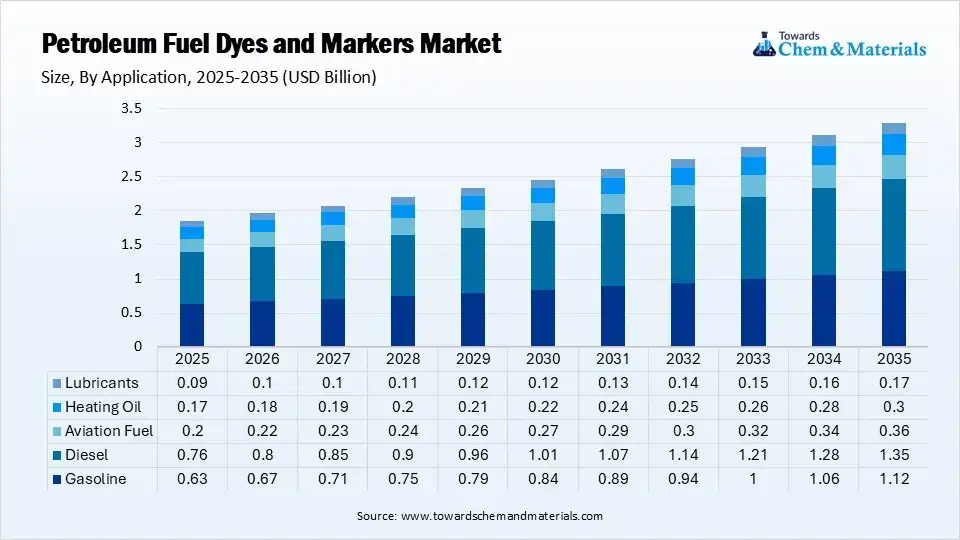 The gasoline segment held 34% market share in 2025 and is expected to have the fastest growth with a CAGR of 6.30% in the forecast period. It experiences significant growth due to soaring vehicle production, urbanization, and strict government regulations mandating chemical markers to prevent tax evasion and illegal fuel adulteration. Advanced solvent-soluble dyes are highly sought after because they integrate seamlessly into hydrocarbons without degrading engine performance.
Petroleum Fuel Dyes and Markers Market Share, By Application, 2025 (%)
| By Application | Revenue Share, 2025 (%) |
| Gasoline | 34% |
| Diesel | 41% |
| Aviation Fuel | 11% |
| Heating Oil | 9% |
| Lubricants | 5% |
Marker Type Insights
The fluorescent markers segment dominated the market with 46% share in 2025, due to its high detection sensitivity, tamper resistance, and ability to prevent fuel adulteration with success rates exceedingly significant. Next-gen smart marker systems pair fluorescent dyes with nanotechnology and molecular tracers. They require lower concentrations than traditional dyes while maintaining high tamper resistance.
The chemical markers segment held 46% market share in 2025 and is expected to have the fastest growth with a CAGR of 6.9% in the forecast period, experiencing robust growth driven by mandatory government tax compliance, strict anti-adulteration policies, and major technological advancements in covert supply chain security. Chemical markers are colorless substances added to fuels that remain invisible until a specific reagent or advanced detection technology is used. This discreet nature makes them highly effective against fuel smuggling and tax evasion.
Petroleum Fuel Dyes and Markers Market Share, By Marker Type, 2025 (%)
| By Marker Type | Revenue Share, 2025 (%) |
| Fluorescent Markers | 46% |
| Radioactive Isotopes | 14% |
| Chemical Markers | 40% |
Dye Chemistry Insights
The solvent dyes segment dominated the market with 52% share in 2025 and is expanding rapidly due to its chemical compatibility, strict government taxation policies, and technological innovations in formulation. Chemical leaders like BASF and Dow are engineering advanced dye formulations. These Market additives maintain colorfastness and stability even under extreme temperature fluctuations.
The oil-soluble dyes segment held 35% market share in 2025 and is expected to have the fastest growth with a CAGR of 6.40% in the forecast period. This growth is fueled by high hydrocarbon solubility, enabling uniform coloration in lubricants, heating oils, and greases without altering their physical properties. They are highly concentrated and heat-stable, and they are perfect for engine oils, lubricants, and transmission fluids.
Petroleum Fuel Dyes and Markers Market Share, By Dye Chemistry, 2025 (%)
| By Dye Chemistry | Revenue Share, 2025 (%) |
| Solvent Dyes | 52% |
| Oil-Soluble Dyes | 35% |
| Water-Soluble Dyes | 13% |
Regional Analysis
How did Europe dominate the Petroleum Fuel Dyes and Markers Market in 2025?
The Europe petroleum fuel dyes and markers market size was estimated at USD 555 million in 2025 and is projected to reach USD 990.00 million by 2035, growing at a CAGR of 6.64% from 2026 to 2035.Europe dominated the market with a share of 30% in 2025, through stringent tax-compliance mandates, advanced chemical tracking, and proactive integration of biofuels. This robust regulatory framework effectively combats fuel fraud, smuggling, and tax evasion across major economies like the UK, Germany, and France. European enforcement agencies extensively utilized high-performance liquid chromatography (HPLC), spectrophotometric, and electrochemical analytical techniques to catch altered or diluted fuels.
Germany
Germany's electric vehicle (EV) surge and sustainability commitments require distinct markers to trace biofuels and prevent misfueling during the transition to the global petroleum-fueled dyes and markers market
Markers help combat widespread fuel fraud, smuggling, and tax evasion. Rising demand for fuel authentication to combat adulteration drives market growth.
Italy
- Italy's conventional platforms shift toward bio-processing, strict quality control requires precise tagging for new biofuels and hydrogen-ready energy streams.
- Rising energy consumption in the automotive, marine, and aviation sectors necessitates robust product differentiation and tracking.
France
- European Union and French mandates require specific fiscal marking, such as Euro-marker programs, to differentiate between heavily taxed road fuels and lower-taxed heating oils or agricultural diesels.
- Oil exploration, logistics, and major petroleum companies like Innospec Inc. and John Hogg deploy advanced chemical markers to trace fuel theft and stop the illegal laundering or smuggling of subsidised crude and refined products.
Asia Pacific Petroleum Fuel Dyes and Markers Market Growth Factor
The Asia Pacific petroleum fuel dyes and markers market size was estimated at USD 518.00 million in 2025 and is projected to reach USD 940.50 million by 2035, growing at a CAGR of 6.15% from 2026 to 2035.Asia Pacific held the market share of 28% in 2025 and is expected to have the fastest growth with a CAGR of 6.80% in the forecast period, driven heavily by rising industrial modernization, strict government tax compliance, and the critical need to prevent fuel adulteration. Countries like South Korea, China, India, and Japan anchor this high-growth regional demand. Enterprises across the region are upgrading operational systems, deploying smart technologies for better fuel quality monitoring, and optimizing costs.
India
- India's petroleum fuel dyes and markers market is expanding rapidly, driven by strict government mandates against fuel adulteration, massive domestic consumption of 213.2 MMT of petroleum products, and the need to prevent tax evasion on subsidized fuels.
- Rising foreign investments in the domestic petroleum refining sector are elevating the demand for market tracing systems.
China
- Government mandates requiring markers in subsidized or untaxed fuels to prevent tax evasion, fraud, and illegal blending.
- Rising demand to distinguish fuel grades and monitor petroleum quality across China's extensive distribution and logistics infrastructure.
Japan
- Japan's petroleum fuel dyes and markers market is expanding steadily, driven by strict government quality regulations, the need to prevent fuel fraud, and industrial modernization.
- As a major energy importer with extensive maritime transport, Japan relies on these solutions to ensure regulatory compliance, taxation accuracy, and petrochemical authenticity
North America Petroleum Fuel Dyes and Markers Market Growth Factor
The North America petroleum fuel dyes and markers market size was estimated at USD 481.00 million in 2025 and is projected to reach USD 874.50 million by 2035, growing at a CAGR of 6.16% from 2026 to 2035.North America held the market share of 26% in 2025. The market is driven by strict government regulations, massive crude oil production, and the need to prevent fuel tax fraud, theft, and adulteration. The integration of nanotechnology and fluorescent markers enables greater precision, traceability, and longer-lasting detection, boosting market penetration. Emerging trends show a strong emphasis on eco-friendly, biodegradable dyes as companies push to minimize their carbon footprint.
U.S.
- With U.S. petroleum and distillate exports hitting record highs to offset global supply disruptions, tracking bulk fuel integrity across borders has become essential.
- Dyes are increasingly utilized in automotive, aviation, and refinery operations for fast leak detection and quality assurance.
Canada
- Canadian federal and provincial tax agencies mandate specific markers and dyes to differentiate between untaxed, like heating oil, agricultural, and taxed road fuels.
- The industry is seeing a shift toward specialized fluorescent markers, eco-friendly biodegradable dyes, and markers that withstand advanced criminal extraction methods
Latin America Petroleum Fuel Dyes and Markers Market Growth Factor
The Latin America petroleum fuel dyes and markers market size was estimated at USD166.50 million in 2025 and is projected to reach USD 313.50 million by 2035, growing at a CAGR of 6.53% from 2026 to 2035.Latin America held the market share of 9% in 2025, driven by strict government mandates to curb tax evasion, fuel fraud, and smuggling. Regulatory enforcement by state-owned regulators in key economies like Brazil and Argentina creates a consistent baseline demand for marking tax-exempt diesel and categorizing fuel grades. Governments utilize mandatory marking programs to track subsidized or tax-exempt fuels such as agricultural diesel and prevent them from being sold illegally on standard commercial markets.
Brazil
- Brazil’s petroleum fuel dyes and markers market is driven by strict government mandates, anti-adulteration laws, and the need for fiscal traceability.
- Rising fuel smuggling and tax evasion push regional refineries to adopt chemical markers, with distillate and gasoline segments dominating local demand.
Argentina
- Argentina's petroleum fuel dyes and markers market is primarily driven by strict government regulations to prevent tax evasion, combat fuel adulteration, and differentiate fuel grades.
- Rising incidences of fuel blending require chemical markers to identify unauthorized tampering and maintain baseline quality standards.
Middle East and Africa Petroleum Fuel Dyes and Markers Market Growth Factor
The Middle East and Africa petroleum fuel dyes and markers market size was estimated at USD 129.50 million in 2025 and is projected to reach USD 247.50 million by 2035, growing at a CAGR of 6.69% from 2026 to 2035.The Middle East and Africa held the market share of 7% in 2025, propelled by strict government regulations against fuel smuggling, the need to prevent tax-exempt fuel misuse, and rising concerns over automotive fuel adulteration. Across many African nations, government-led fuel marking schemes are vital to prevent the theft and illegal dilution of crude oil and transit fuels.
Saudi Arabia
- Rapid infrastructure projects and expanding transportation sectors across the Middle East elevate domestic consumption of refined products like gasoline and diesel.
- Growing regional industrialization, infrastructure projects, and automotive fuel consumption directly increase the volume of refined products like gasoline and diesel, requiring proper chemical marking.
UAE
- The UAE petroleum fuel dyes and markers market is primarily driven by stringent government regulations to prevent fuel tax fraud, smuggling, and adulteration.
- Rapid industrialization, expanding automotive and aviation sectors, and regional oil and gas investments further amplify the demand for chemical markers and functionality branding.
Competitive Landscape Analysis
Tier 1 Companies
| Rank | Company Name | Headquarters | Country | Why Relevant to This Market | Key Products / Material Portfolio |
| 1 | Authentix, Inc. | Addison, Texas | United States | Global leader in fuel authentication, tax enforcement, and molecular fuel marker technologies used by governments and oil companies | Fuel markers, molecular tracers, authentication technologies, fuel integrity solutions |
| 2 | Innospec Inc. | Englewood, Colorado | United States | One of the largest global suppliers of fuel additives, dyes, and markers for refined petroleum products | Fuel dyes, marker systems, refinery additives, diesel and gasoline markers |
| 3 | John Hogg Technical Solutions Ltd. | Aberdeen, Scotland | United Kingdom | Leading specialist in fuel marking and anti-fraud technologies with extensive government contracts | Petrochemical markers, fuel tracers, tax-rebate identification systems |
| 4 | Spectronics Corporation | Westbury, New York | United States | Major supplier of fluorescent tracer dyes used in petroleum product identification and leak detection | Fluorescent fuel dyes, UV tracers, petroleum marking dyes |
| 5 | United Color Manufacturing, Inc. | Hollister, Missouri | United States | Established global manufacturer focused on fuel-soluble dyes and petroleum colorants | Solvent dyes, fuel markers, refinery dyes, diesel and gasoline colorants |
Tier 2 Companies
| Rank | Company Name | Headquarters | Country | Why Relevant to This Market | Key Products / Material Portfolio |
| 1 | Aarti Industries Limited | Mumbai, Maharashtra | India | Significant producer of specialty dyes and intermediates supplying fuel-soluble dye applications | Solvent dyes, specialty colorants, industrial dye intermediates |
| 2 | Orient Chemical Industries Co., Ltd. | Osaka, Osaka Prefecture | Japan | Established manufacturer of solvent dyes and specialty colorants used in petroleum applications | Solvent dyes, oil-soluble dyes, industrial markers |
| 3 | DayGlo Color Corp. | Cleveland, Ohio | United States | Supplier of fluorescent color technologies used in industrial and fuel identification applications | Fluorescent dyes, tracer colorants, specialty pigments |
| 4 | Sunbelt Corporation | Houston, Texas | United States | Specialized supplier focused on petroleum dyes and markers for fuel compliance markets | Fuel dyes, aviation fuel markers, tax-exempt fuel identification products |
| 5 | Organic Dyes and Pigments LLC | East Rutherford, New Jersey | United States | Specialty manufacturer of solvent dyes used in petroleum and lubricant applications | Solvent Red, Solvent Blue, Solvent Yellow fuel dyes |
Tier 3 Companies
| Rank | Company Name | Headquarters | Country | Why Relevant to This Market | Key Products / Material Portfolio |
| 1 | Keystone Aniline Corporation | Chicago, Illinois | United States | Niche supplier of industrial solvent dyes used in petroleum products | Solvent dyes, fuel colorants, oil-soluble dyes |
| 2 | Pylam Products Company, Inc. | Tempe, Arizona | United States | Specialty dye manufacturer serving fuel and lubricant coloration applications | Solvent dyes, tracer dyes, petroleum colorants |
| 3 | Abbey Color Incorporated | Philadelphia, Pennsylvania | United States | Producer of specialty colorants and custom fuel dye formulations | Fuel dyes, solvent colorants, industrial markers |
| 4 | Risk Reactor Inc. | Cape Town, Western Cape | South Africa | Emerging provider of advanced fuel authentication and anti-counterfeiting technologies | Molecular fuel markers, authentication systems, forensic tracers |
| 5 | Tracerco Limited | Billingham, England | United Kingdom | Specialist in tracer and detection technologies with applications in fuel integrity and petroleum monitoring | Tracer technologies, fuel monitoring markers, detection systems |
- Major players in the petroleum fuel dyes and markers market include Innospec, Authentix, BASF SE, Dow, and John Hogg, which compete through advanced fuel identification technologies.
- Companies are focusing on highly secure fuel dyes and molecular marker systems to help governments and oil companies reduce fuel fraud, smuggling, and tax losses.
- Innovation in invisible and traceable marker technologies has become a key competitive strategy, especially for players such as Authentix and Innospec.
- Strategic partnerships with refineries, fuel distributors, and regulatory agencies are helping companies expand their long-term contracts and strengthen regional market presence.
- BASF SE and Dow are investing in specialty chemical innovation to improve dye stability, fuel compatibility, and environmental compliance.
Recent Development
- In May 2026, Anar Chemicals expanded its operations as a prominent manufacturer of Solvent Red 164, a vital dye heavily relied upon by the fuel and petroleum industries for tax compliance and product tracking. The global market for petroleum fuel dyes and markers is experiencing a period of significant growth and regulatory transition.(Source: easternherald.com)
Top players in the Petroleum Fuel Dyes and Markers Market & Their Offerings
- Innospec Inc.: Leading global supplier of specialized fuel markers, dyes, and performance additives with an established regional footprint.
- BASF SE: German multinational providing a highly diverse portfolio of chemical intermediates and compliant petroleum dyes.
- Authentix, Inc.: Global leader specializing in covert marking solutions, fuel authentication, and supply-chain integrity programs.
- John Hogg & Co Ltd: UK-based technical solutions provider heavily focused on customized covert markers and dyes for fiscal marking.
- United Colour Manufacturing, Inc.: Major supplier of liquid and powder colorants specifically formulated for petroleum applications.
Other Top Players Are
- Clariant
- DyStar
- Evonik Industries
- Solvay
- The Dow Chemical Company
- Orient Chemical Industries Co., Ltd.
- A.S. Harrison & Co Pty Ltd
- Huntsman Corporation
- Tronox Holdings
- Sun Chemical
- Merck KGaA
- Ciba Specialty Chemicals
- Cabot Corporation
- DIC Corporation
- Heubach
- Lanxess
Segments Covered:
By Form
- Liquid
- Fuel-Soluble Liquid Dyes
- Marker Concentrate Liquids
- Powder
- Synthetic Dye Powders
- High-Concentration Marker Powders
- Paste
- Industrial Dye Pastes
- Fuel Marker Pastes
- Concentrate
- High-Purity Concentrates
- Multi-Purpose Fuel Marker Concentrates
By End-User
- Refineries
- Crude Oil Refineries
- Integrated Refining Complexes
- Fuel Distributors
- Wholesale Fuel Suppliers
- Retail Fuel Distribution Networks
- Diesel and Gasoline Power Plants
- Utility Power Plants
- Backup Power Facilities
- Aircraft Operators
- Commercial Airlines
- Military Aviation Operators
- Private Aviation Fleets
- Oil and Gas Producers
- Upstream Operations
- Midstream Storage & Transportation
By Application
- Gasoline
- Retail Gasoline
- Taxed and Untaxed Fuel Grades
- Diesel
- On-Road Diesel
- Off-Road Diesel
- Marine Diesel
- Aviation Fuel
- Jet A/A-1 Fuel
- Military Aviation Fuel
- Heating Oil
- Residential Heating Oil
- Commercial Heating Oil
- Lubricants
- Industrial Lubricants
- Automotive Lubricants
By Marker Type
- Fluorescent Markers
- UV-Detectable Markers
- Multi-Spectral Markers
- Radioactive Isotopes
- Trace-Level Isotope Markers
- Specialty Monitoring Isotopes
- Chemical Markers
- Molecular Markers
- Forensic Fuel Authentication Markers
By Dye Chemistry
- Solvent Dyes
- Azo Solvent Dyes
- Anthraquinone Solvent Dyes
- Oil-Soluble Dyes
- Hydrocarbon-Soluble Dyes
- Specialty Fuel Dyes
- Water-Soluble Dyes
- Fluorescent Water-Soluble Dyes
- Tracer Water-Soluble Dye
By Region
- North America
- U.S.
- Canada
- Europe
- Germany
- UK
- France
- Italy
- Spain
- Sweden
- Denmark
- Norway
- Asia Pacific
- China
- Japan
- India
- South Korea
- Thailand
- Latin America
- Brazil
- Mexico
- Argentina
- Middle East & Africa
- South Africa
- UAE
- Saudi Arabia
- Kuwait



Comments
Share your thoughts, ask a question, or provide feedback about this report.