
AI-Designed Materials for High-Performance Computing (HPC) Market Size Analysis Report 2034
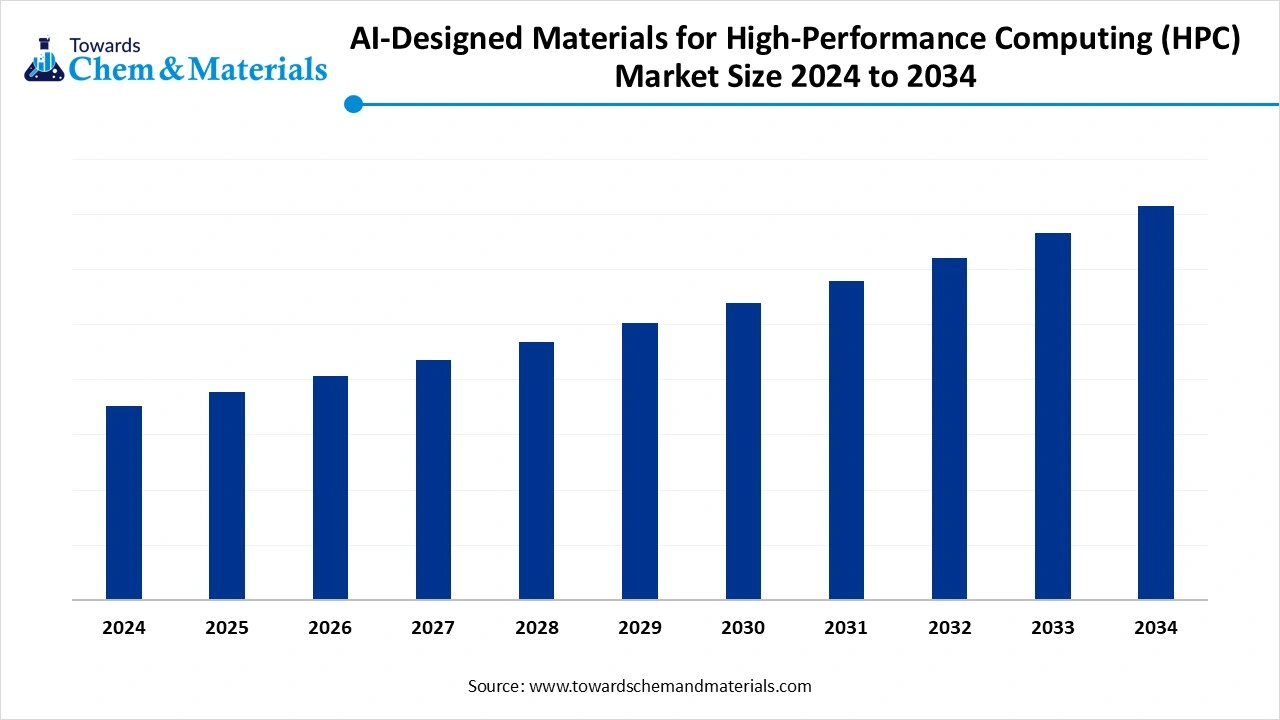
AI-Designed Materials for High-Performance Computing (HPC) is witnessing strong momentum as industries seek AI-driven solutions for real-time data processing, big data analytics, and advanced simulations. Innovations in logic processors, 2.5D/3D IC packaging, and generative AI for functional materials are transforming the HPC landscape . The growing and significant applications and increasing demand for advanced computing capabilities from various industries, with the integration of AI and the rising adoption of cloud computing and data-intensive applications, drive the growth of the market.
Key Takeaways
- By region, North America dominated the market in 2024. The growth is driven by the technological advancements in the region.
- By region, Asia Pacific is expected to have significant growth in the market in the forecast period. The integration and demand for AI based solutions drives the growth.
- By material type, the AI-designed compound semiconductors segment dominated the market in 2024. The growth of the market is driven by the benefits associated with it, like enhanced performance like faster delivery processing speed, and greater energy efficiency
- By material type, the AI-formulated phase change materials segment is expected to grow significantly in the market during the forecast period. The phase change materials are substances that absorb and release thermal energy during a phase transition.
- By technology approach, the supervised learning-based discovery segment dominated the market in 2024. The growing use of generative materials for designing new functional materials by creating and predicting material structure, optimizing material synthesis processes, and creating movable material structures.
- By technology approach, the generative AI for functional materials segment is expected to grow in the forecast period. The growth of the market is driven by the demand for powerful tools for uncovering hidden patterns, exploring data, and generating new knowledge in various fields.
- By application area, the logic processors segment dominated the market in 2024. Logic processors play a critical role in the AI-designed materials for high-performance computing (HPC) market, as they are fundamental to executing complex instructions at remarkable speed and precision.
- By application area, the 2.5D/3d IC packaging segment is expected to grow in the forecast period. AI-designed materials improve thermal management, interconnect density, and mechanical reliability of these advanced packaging solutions.
- By end use, the hyperscale data centres segment dominated the market in 2024. The growth of the market is driven by the key characteristics of hyperscale data centres, like massive and large-scale data centres, high density, scalability, and efficiency.
- By end use, the AI & deep learning model training segment is expected to grow in the forecast period. This training process allows the model to learn from data and improve its performance on specific tasks.
Market Overview
Rising Demand for Durable Materials: AI-Designed Materials for High-Performance Computing (HPC) Market to Expand
The AI-designed materials for high-performance computing (HPC) are using Artificial Intelligence and ML techniques to accelerate the discovery, design, and optimization of materials, especially for the use and integration in high-performance computing systems. The growing application of is in data storage material, advanced packaging materials, cooling materials, and semiconductor materials, with the integration of AI for the development of materials. Benefits associated with AI-designed materials for HPC are faster time to market, improved performance, reduced development costs, and emerging new applications for the development of new HPC applications n
What Are the Key Drivers Responsible for The Growth of The Market?
The growth of the market is driven by the growing and increasing demand for advanced computing capabilities across various sectors, especially in areas like AI, machine learning, and big data analytics fuels the growth of the market. The growing demand for faster and real-time data processing for accurate and efficient data management and processing fuels the growth of the market. Growth of Artificial Intelligence and ML for enabling advancements in areas like natural language processing, image recognition are the factors that fuel the growth of the market. The big data analytics and simulations for analysis and processing of data faster due to the presence of vast data generation from many industries, such as healthcare, finance, and manufacturing, drive the growth of the market.
Market Trends
- The growth in AI-based models and the growing adoption of AI and machine learning to enhance the applications in various industries like pharmaceutical, finance, and energy management drives the growth.
- The rising demand for cloud-based HPC adoption for more accessibility and cost effectiveness fuels the growth of the market.
- Emerging applications in a wide range of fields, including genomics research, cybersecurity, social network analysis, and transportation modelling, fuel the growth of the market.
- A wide range of applications of AI-enhanced HPC, like drug discovery, predictive analytics, climate modelling, and autonomous vehicles, is a growing trend.
Market Opportunity
What Are the Key Growth Opportunities Responsible for The Growth of The Market?
The key growth opportunities responsible for the growth of the market are the increasing demand for AI-driven solutions due to the increasing demand from various fields like drug discovery, genomics, and autonomous systems, which fuels the demand for AI-enhanced HPC fuels the growth of the market. The advancements in AI algorithms and HPC architectures, including the integration of GPUs and FPGAs, are accelerating the adoption of AI in HPC systems, further creating growth opportunity that fuels the growth and expansion of AI-designed materials for high-performance computing (HPC) market.
Market Challenge
What Are the Key Challenges Responsible for The Hindrance of The Market Growth?
The lack of security and trust of Ai driven materials design processes is crucial and is a challenge, along with computational cost for training of complex AI models for materials design which makes computational expensively and also requires significant HPC resources and potentially limiting the accessibility which also limits the growth of the market and is a challenge which hinders the growth of the AI-designed materials for high-performance computing (HPC) market.
Regional Insights
How Did North America Dominate The AI-designed materials for high-performance computing (HPC) market In 2024?
North America dominated the AI-designed materials for high-performance computing (HPC) market in 2024. The growing industrial focus, like healthcare, manufacturing, and finance, is the key growth sector in North America, which demands AI AI-enhanced HPC solution that drives the growth of the market in the region. The key players like NVIDIA, Intel, AMD, IBM, and HPE are major players in the North American HPC market who play a crucial role in the growth and expansion of the market through investment and rising innovation.
The U.S. Has Seen Significant Growth in The Market, Driven by Emerging Technologies.
The U.S. has seen a significant growth in the market, the growth of the market is driven by the emerging technologies in computing and for revolution of AI and HPC, which drives the growth of the market in the country. The growing focus on energy efficiency to enhance the system and for software advancements with AI framework, machine learning libraries, and data analytics tools plays a crucial role in the growth of the market in the country. The key players also play a crucial role in the growth and expansion of the market in the country.
- The United States shipped out 2,788 Computer Equipment shipments from October 2023 to September 2024 (TTM). These exports were handled by 766 Indian exporters to 654 buyers.
Globally, China, Taiwan, and the United States are the top three exporters of Computer Equipment. China is the global leader in Digital Computer exports with 174,876 shipments, followed closely by Taiwan with 25,355 shipments, and the United States in third place with 20,758 shipments.(Source: www.volza.com)
The Growing Focus on Energy Efficiency with The Development Of AI-enhanced HPC Drives the Growth in The Asia Pacific.
Asia Pacific is expected to experience significant growth in AI-designed materials for high-performance computing (HPC) market in the forecast period. The region is experiencing rapid growth, which is driven by the increasing digitization and adoption of cloud computing, and increased AI integration into HPC systems fuels the demand and growth of the market in the region. The growth is also seen due to increasing industries and growing sectors that demand AI-enhanced systems in healthcare, pharmaceutical, and manufacturing units, which supports the growth of the market and supports expansion.
India is Seen Growth Due To a Vertically Integrated Ecosystem, Which Drives the Growth.
India has seen a significant growth in the market, driven by the country's building of a vertically integrated ecosystem, with initiatives like the PARAM Rudra installations and the development of the Krutrim AI chip. These types of initiatives fuel the demand, which supports the growth. The growing technological advancements, like the integration of AI for accelerating innovation and specific needs for driving demand from sectors such as healthcare, financial services, manufacturing, and research and development, drive the demand due to rapid industrialization. These factors drive the growth and expansion of the market.
- India shipped out 107 Digital Computer shipments from September 2023 to August 2024 (TTM). These exports were handled by 39 Indian exporters to 44 buyers.(Source: www.volza.com)
- Globally, China, Thailand, and Taiwan are the top three exporters of Digital computers. China is the global leader in Digital Computer exports with 76,076 shipments, followed closely by Thailand with 6,475 shipments, and Taiwan in third place with 5,933 shipments.(Source: www.volza.com )
Segmental Insights
Material Type Insights
Which Material Type Segment Dominated The AI-Designed Materials for High-Performance Computing (HPC) Market In 2024?
The AI-designed compound semiconductors segment dominated the AI-designed materials for high-performance computing (HPC) in 2024. The growth of the market is driven by the benefits associated with it, like enhanced performance like faster delivery processing speed, and greater energy efficiency. Other benefits are increased reliability and faster time to market of complex chips, and proper function assurance, which fuels the demand for the market. AI-designed compound semiconductors represent a convergence of advanced materials and cutting-edge design techniques, leading to the development of more powerful and efficient chips for the future of AI, which drives the growth of the market and also supports the expansion.
The AI-formulated phase change materials segment expects significant growth in the AI-designed materials for high-performance computing (HPC) during the forecast period. The phase change materials are substances that absorb and release thermal energy during a phase transition. This makes them ideal for thermal energy storage and temperature regulation, which fuels the demand. The growing applications of AI-formulated PCM, like thermal energy storage, building energy efficiency, and electronics cooling, to improve performance and prevent overheating, which driving the growth and expansion of the market.
Technology Approach Insights
How Did Supervised Learning Based Discovery Segment Dominate The AI-Designed Materials for High-Performance Computing (HPC) Market In 2024?
The supervised learning-based discovery segment dominated the AI-designed materials for high-performance computing (HPC) in 2024. The growth of the market is driven by the demand for powerful tools for uncovering hidden patterns, exploring data, and generating new knowledge in various fields, which fuels the growth and demand for the market. The growing application in pattern identification, feature importance, hypothesis generation, and anomaly detection further fuels the growth of the market.
The rising adoption of technology helps the expansion of the market.
The generative AI for functional materials segment expects significant growth in the AI-designed materials for high-performance computing (HPC) during the forecast period. The growing use of generative materials for designing new functional materials by creating and predicting material structure, optimizing material synthesis processes, and creating movable material structures drives the growth. The demand for superior property and functionality materials increases the growth and expansion of the market.
Application Area Insights
How Did Logic Processors Dominate The AI-Designed Materials for High-Performance Computing (HPC) Market In 2024?
The logic processors segment dominated the AI-designed materials for high-performance computing (HPC) in 2024. Logic processors play a critical role in the AI-designed materials for high-performance computing (HPC) market, as they are fundamental to executing complex instructions at remarkable speed and precision. AI-designed materials enhance the thermal conductivity, energy efficiency, and miniaturization of logic processors, enabling faster computation and reduced power consumption, which fuels the growth of the market. These advancements support demanding workloads such as AI model training, scientific simulations, and big data analytics, driving innovations across sectors like autonomous systems, advanced research, and next-generation data centres, further fueling the growth of the market.
The 2.5D/3d IC packaging segment expects significant growth in the AI-designed materials for high-performance computing (HPC) during the forecast period. 2.5D/3D IC packaging is a crucial application in the AI-designed materials for high-performance computing (HPC) market, enabling greater integration and performance in compact form factors. AI-designed materials improve thermal management, interconnect density, and mechanical reliability of these advanced packaging solutions. This allows for stacking multiple chips or dies vertically or side-by-side, which helps boost data transfer speeds and computational efficiency. Such packaging is essential for supercomputers, AI accelerators, and data centre processors, supporting the growing demand for higher bandwidth and energy efficiency, which helps in the growth of the market.
End Use Insights
Which End-Use Segment Dominated The AI-Designed Materials for High-Performance Computing (HPC) Market In 2024?
The hyperscale data centres segment dominated the AI-designed materials for high-performance computing (HPC) in 2024. The growth of the market is driven by the key characteristics of hyperscale data centres, like massive and large-scale data centres, high density, scalability, efficiency for optimal energy consumption and cooling to handle the heat, distributed systems, and cloud focus, which drives the growth of the market. The hyperscale data centres are playing a crucial role in the support of modern digital platforms and systems like cloud computing, big data analytics, artificial intelligence, Internet of Things, and E-commerce and social media, which fuels the growth of the market and also supports the expansion of the market.
The AI & deep learning model training segment expects significant growth in the AI-designed materials for high-performance computing (HPC) during the forecast period. The growth of the market is driven by the deep learning model training, this training process allows the model to learn from data and improve its performance on specific tasks like natural language processing, speech recognition, and image recognition, which drives the growth of the market. Key aspects of AI and deep learning model training, like data preparation, model architecture, training process, evaluation, and inference for making predictions and decisions on new and unseen data, which fuels the growth of the market.
Recent Developments
- In June 2025, The U.S. Department of Energy (DOE) announced Doudna as the next flagship supercomputer at the National Energy Research Scientific Computing Center (NERSC) at Berkeley Lab. The DOE is making a major national investment to strengthen U.S. leadership in high-performance computing (HPC). Doudna will empower researchers with advanced tools to accelerate scientific breakthroughs and tackle global challenges in energy, science, climate, and national security.(Source: www.hpcwire.com)
- In January 2025, A celebration held at the High-Performance Computing Center of the University of Stuttgart (HLRS) marked the start of operations for its newest supercomputer, with the name of Hunter. Designed and built by Hewlett-Packard Enterprise (HPE), Hunter provides a cutting-edge infrastructure to support artificial intelligence, large-scale simulation, and data analytics.(Source: www.hpcwire.com)
Top Companies List
- IBM Research
- NVIDIA Corporation
- Intel Corporation
- TSMC (Taiwan Semiconductor Manufacturing Company)
- Applied Materials, Inc.
- Synopsys, Inc.
- Schrödinger, Inc.
- Citrine Informatics
- Google DeepMind
- BASF SE (AI-assisted Materials R&D)
- Samsung Advanced Institute of Technology (SAIT)
- Microsoft Research (AI for Material Discovery)
- Exabyte.io
- Alpiq InTec AG (AI in energy-efficient materials)
- Quantum Machines
- Enthought, Inc.
- Kyulux, Inc.
- QunaSys Inc.
- Hitachi High-Technologies
- NTT Research, Inc.
Segments Covered
By Material Type
- Semiconductors
- AI-designed Compound Semiconductors
- Traditional AI-optimized Silicon
- Thermal Interface Materials
- AI-formulated Phase Change Materials (PCM)
- AI-optimized Carbon-Based TIMs
- Dielectric Materials
- AI-tuned High-k Dielectrics
- AI-assisted Flexible Dielectrics
- Conductive & Interconnect Materials
- AI-enhanced Copper Alloys
- AI-designed Graphene-based Conductors
- Substrate Materials
- AI-optimized Silicon Carbide Substrates
- AI-designed Glass Substrates
- Packaging Materials
- AI-optimized Organic Substrates
- AI-derived Underfills and Mold Compounds
By Technology Approach
- Machine Learning Materials Discovery
- Supervised Learning-based Discovery
- Reinforcement Learning for Adaptive Materials
- Generative AI for New Material Design
- GANs for Functional Materials
- Transformer Models for Molecular Structure Prediction
- Physics-informed Neural Networks (PINNs)
- AI-augmented Simulation of Material Behavior
- AI-assisted Quantum Mechanics Modeling
By Application Area
- HPC Semiconductor Fabrication
- Logic Processors
- Memory Devices
- Cooling & Thermal Management
- Thermal Interface Layers for Data Centers
- Liquid and Vapor Phase Materials
- Interconnects and Substrates
- On-chip and Off-chip Interconnects
- Organic and Ceramic Substrates
- Advanced Packaging
- 2.5D/3D IC Packaging
- Wafer-level Packaging Materials
By End-use Industry
- Data Centers
- Hyperscale Data Centers
- Enterprise-grade Data Centers
- Supercomputing Facilities
- Government Labs and Defense
- University/Academic Clusters
- Cloud Computing Providers
- Public Cloud Infrastructure
- Hybrid Cloud Models
- AI & Deep Learning Model Training
- Foundation Model Training Hardware
- Simulation-driven AI Applications
By Region
- North America
- U.S.
- Canada
- Europe
- Germany
- UK
- France
- Italy
- Spain
- Sweden
- Denmark
- Norway
- Asia Pacific
- China
- Japan
- India
- South Korea
- Thailand
- Latin America
- Brazil
- Mexico
- Argentina
- Middle East and Africa (MEA)
- South Africa
- UAE
- Saudi Arabia
- Kuwait
A Seven-Phase Framework
Our methodology is designed to be universally applicable across commodity chemicals, specialty chemicals, petrochemicals, construction chemicals, coatings, electronic chemicals, industrial gases, agrochemicals, water treatment chemicals, and performance materials. Each phase builds upon the last, creating a layered validation structure that minimizes estimation error and maximizes analytical confidence.
The framework ensures comprehensive market coverage, robust cross-validation, and reliable long-term forecasting — producing market estimates that withstand scrutiny from investors, regulators, and corporate strategy teams.

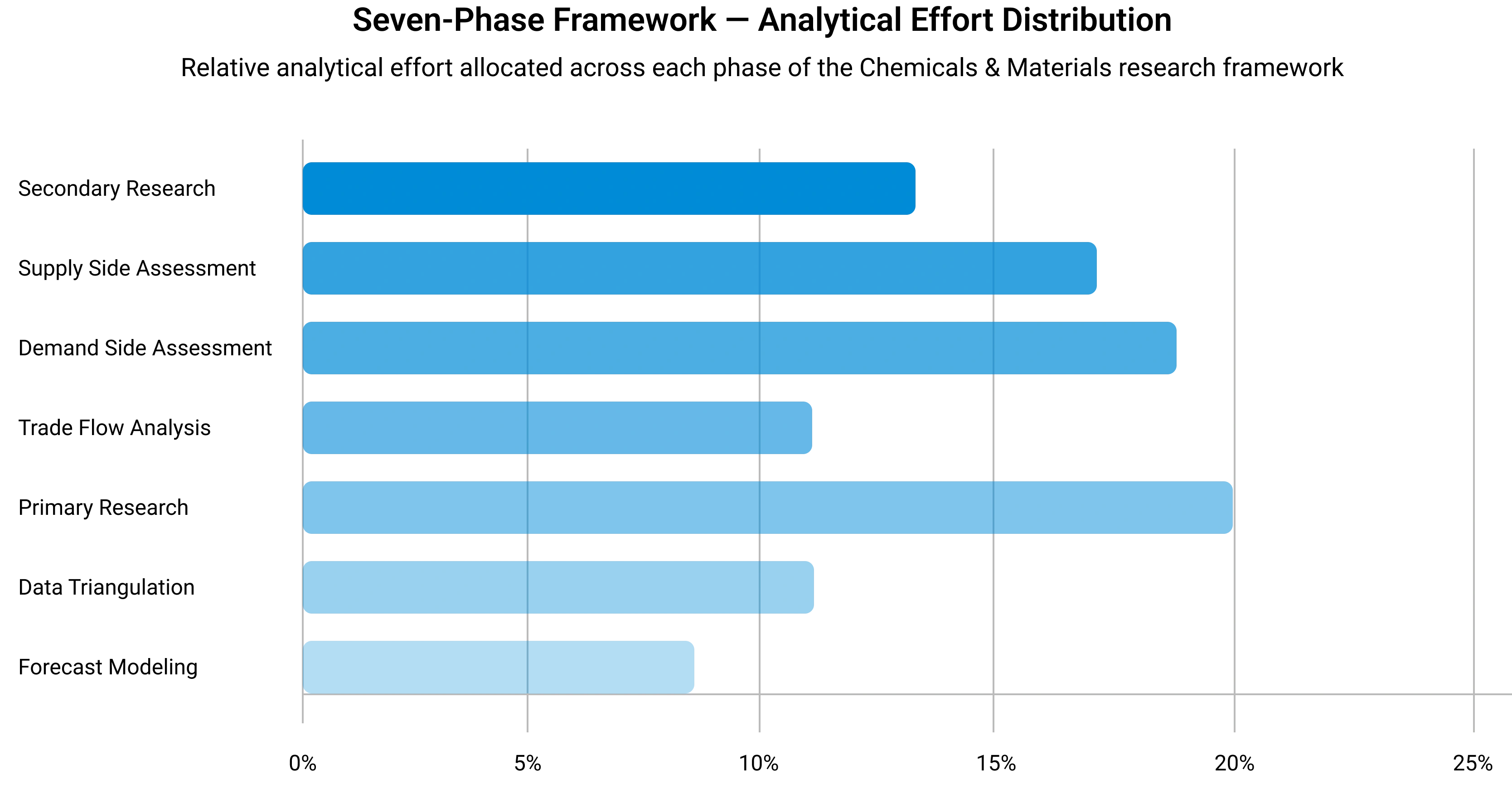
Seven-Phase Framework — Analytical Effort Distribution
Relative analytical effort allocated across each phase of the Chemicals & Materials research framework
Phase 1 - Secondary Research: Establishing the Foundation
Secondary research collects and evaluates publicly available information from authoritative sources, establishing the foundational understanding of market structure, value chain dynamics, competitive landscape, and end-use demand patterns. Every source is evaluated for credibility, recency, geographic relevance, and methodological soundness before inclusion.
Industry Associations
Sources include ACC, CEFIC, ICCA, JCIA, CPCIF, and SOCMA providing production volumes, consumption trends, capacity developments, and sustainability initiatives.
Company Disclosures
Annual reports, investor presentations, earnings transcripts, and regulatory filings reveal product portfolios, manufacturing footprints, capacity expansions, and revenue segmentation.
Government Databases
National statistical offices, customs authorities, environmental agencies, and industrial production databases provide verified statistics on output, trade flows, and regulatory compliance.
Trade Databases
UN Comtrade, ITC, Eurostat, and national customs authorities enable assessment of global product movement, import dependency, and export competitiveness across regions.
Our Secondary Research Sources
- Ministry of Chemicals and Fertilizers
- European Chemicals Agency
- United States Department of Energy
- Ministry of Industry and Information Technology
- Ministry of Economy Trade and Industry
- Ministry of Trade Industry and Energy
- National Institute of Standards and Technology
- Council of Scientific and Industrial Research
- Fraunhofer Society
- National Institute for Materials Science
Phase 2 — Supply-Side Assessment: Mapping Production Capabilities
Production Capacity Analysis
All major manufacturers are assessed for existing installed capacity, planned additions, expansions, new plant announcements, and technology adoption — mapped at global, regional, and country levels.
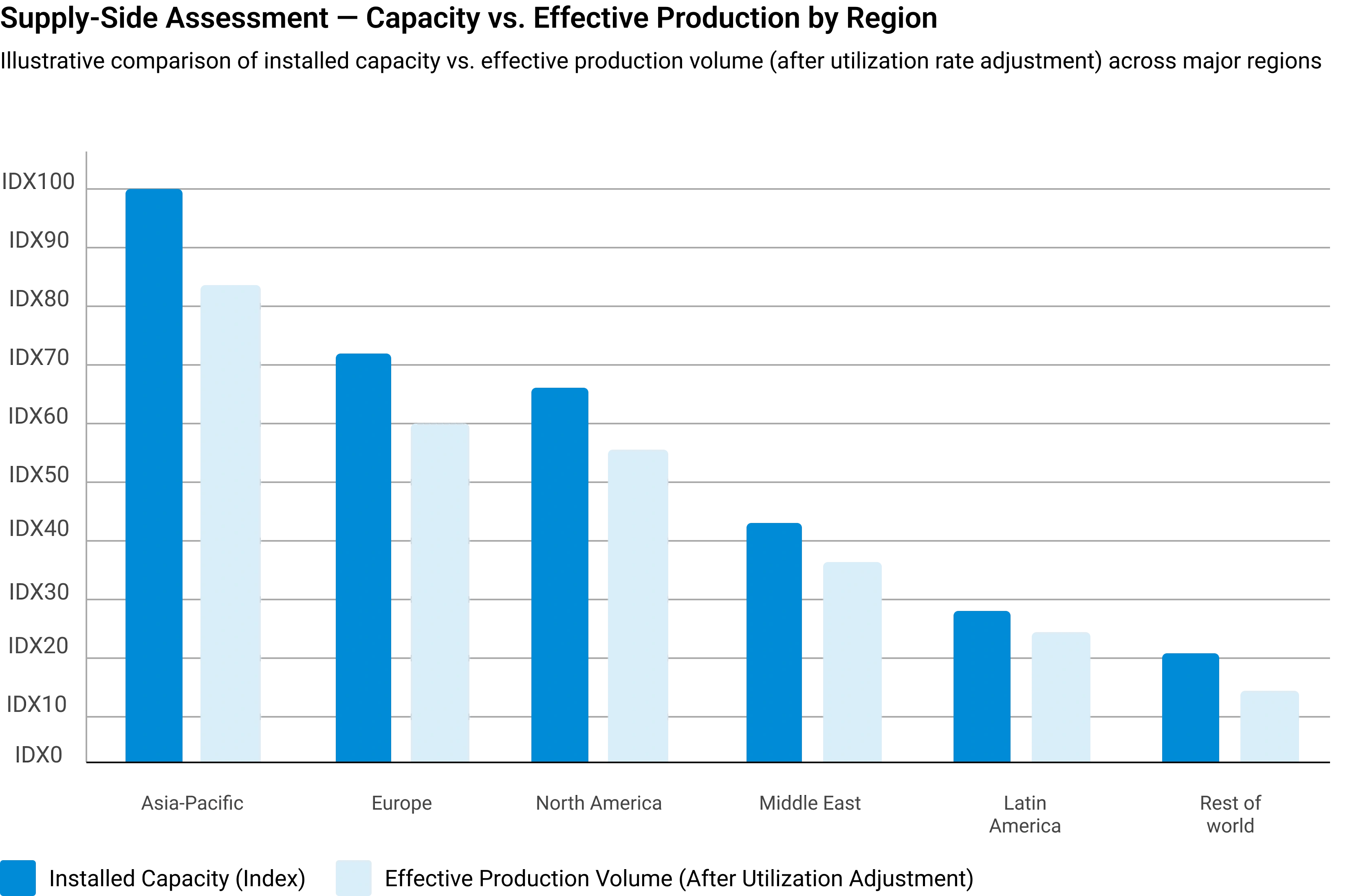
Capacity Utilization Adjustment
Installed capacity is adjusted using utilization rates based on demand conditions, feedstock availability, plant operating rates, maintenance schedules, and regulatory restrictions.
Manufacturer Revenue Analysis
Product-specific revenues, segment-level performance, regional distribution, average selling prices, and margin trends are evaluated to establish market value estimates.
Supply-Side Assessment — Capacity vs. Effective Production by Region
Illustrative comparison of installed capacity vs. effective production volume (after utilization rate adjustment) across major regions
Phase 3 — Demand-Side Assessment: Quantifying Chemical Consumption
Demand-side analysis quantifies chemical consumption across industries, applications, and geographies — identifying where and how chemicals are consumed throughout the value chain with precision.
End-Use Industry Analysis
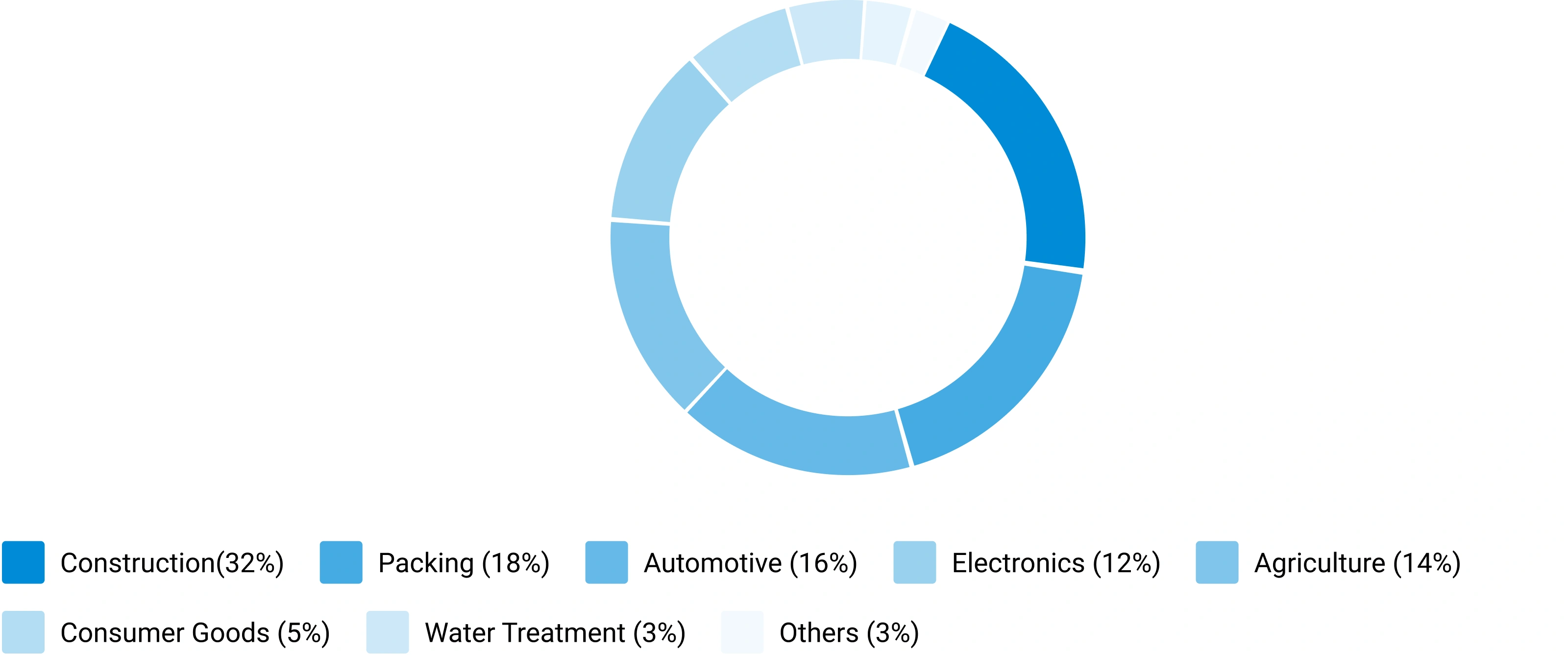
Chemical demand is evaluated across automotive, construction, packaging, electronics, agriculture, healthcare, consumer goods, industrial manufacturing, energy and utilities, and water treatment. Industry output, production trends, and consumption intensity are analyzed to determine demand patterns.
Consumption Modeling
Demand is estimated using measurable indicators: kilograms per vehicle, kilograms per square meter of construction, dosage per cubic meter of water treated, kilograms per hectare of agricultural land, and kilograms per ton of manufactured products. Consumption factors are validated through industry publications and primary interviews.
Application Analysis
The market is segmented by application area to understand product performance requirements, formulation trends, technology adoption, customer preferences, and regulatory requirements improving demand accuracy and segmentation granularity.
Demand-Side Assessment — End-Use Industry Demand Distribution
Illustrative distribution of chemical & materials demand across key end-use industries
Phase 4 - Trade Flow Analysis: Balancing Regional Supply and Demand
Trade flow analysis reconciles regional supply and demand estimates through import and export data, identifying net supply positions, regional dependencies, and market imbalances. It serves as an independent validation layer that tests the consistency of supply-side and demand-side estimates.
Import Analysis
Import data is evaluated to determine volumes, source countries, product dependency, regional supply gaps, and pricing trends — identifying markets that rely heavily on external supply and where domestic production is insufficient to meet demand.
Export Analysis
Export assessments reveal production surplus, export competitiveness, regional manufacturing strength, and global market participation. Export patterns also help validate domestic production estimates and identify net exporting regions.
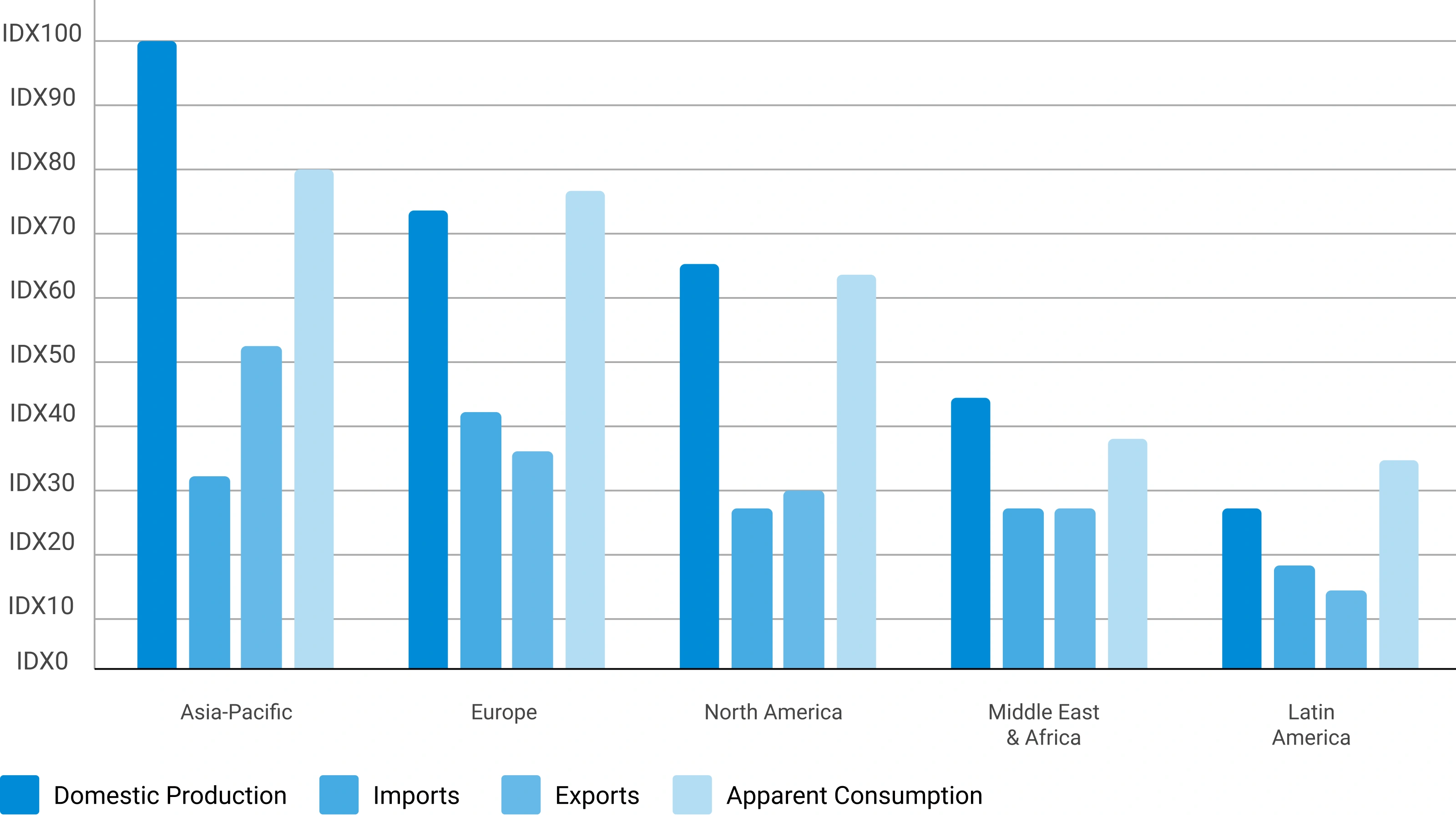
Apparent Consumption Model
Regional consumption is assessed using the standard apparent consumption formula:
Results identify net importing regions, net exporting regions, regional deficits, and surpluses — serving as an independent validation of supply and demand estimates.
Trade Flow Analysis — Net Supply Position by Region
Illustrative apparent consumption vs. domestic production across major regions — positive gap indicates net import dependency
Phase 5 — Primary Research: The Critical Validation Layer
Primary research tests and refines findings from secondary research through direct engagement with industry participants across the supply chain, demand side, and expert community. It captures intelligence that no database or published report can provide — the real-world experience of manufacturers, buyers, and specialists operating in the market.

Supply-Side Interviews
Conversations with chemical manufacturers, raw material suppliers, contract manufacturers, technology providers, and plant operators cover production trends, capacity utilization, pricing developments, technology shifts, and competitive dynamics.

Demand-Side Interviews
Engagement with OEMs, industrial consumers, procurement managers, distributors, formulators, and end-use manufacturers focuses on consumption trends, purchasing behavior, product substitution, demand outlook, and emerging applications.

Industry Expert Consultations
Additional interviews with industry consultants, independent experts, regulatory specialists, technical professionals, and research institutions provide deeper market context and validate key analytical assumptions.
Focus Areas of Primary Research:
Market Size & Forecast Validation
Revenue estimates, volume consumption, growth rates, forecast assumptions, regional demand.Supply Chain & Value Chain Assessment
Raw material sourcing, supply chain challenges, distribution networks, procurement practices.Production & Capacity Analysis
Manufacturing capacity, utilization rates, expansion projects, plant investments.Pricing & Cost Structure Analysis
Product pricing trends, feedstock costs, energy costs, margin pressures, pricing outlook.Competitive Landscape Assessment
Volume and value estimates confirmed to be fully consistent with one another before publicationInterview Volume by Market Scope
| Study Scope | Number of Interviews |
|---|---|
| Niche Market | 20 – 30 |
| Mid-Sized Market | 30 – 50 |
| Global Market | 50 – 80 |
| Highly Fragmented Market | 80 – 120 |
Interview Details:
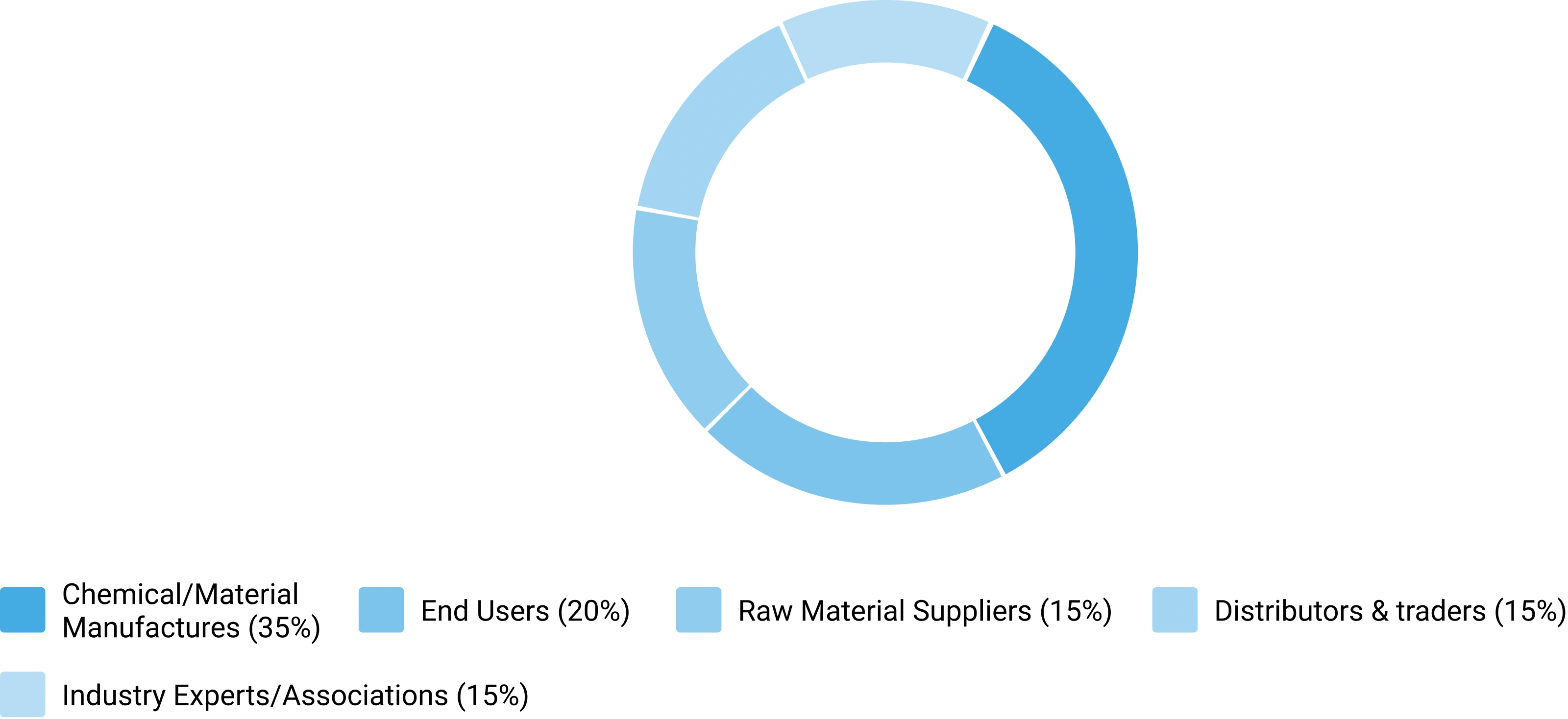
Category : Manufacturers, Suppliers, Distributors, End Users, Experts/Associations
Average Duration : 30–60 Minutes
Interview Mode : Video calls, telephonic interviews, expert consultations
Interview Format : Structured / Semi-Structured questionnaire
Focus Areas of Primary Research:
Market Size & Forecast Validation :
Revenue estimates, volume consumption, growth rates, forecast assumptions, regional demand.
Supply Chain & Value Chain Assessment :
Raw material sourcing, supply chain challenges, distribution networks, procurement practices.
Production & Capacity Analysis :
Manufacturing capacity, utilization rates, expansion projects, plant investments.
Pricing & Cost Structure Analysis :
Product pricing trends, feedstock costs, energy costs, margin pressures, pricing outlook.
Competitive Landscape Assessment :
Market share, competitor positioning, strategic initiatives, partnerships, acquisitions.
Primary Research — Stakeholder Coverage by Category
Distribution of interview respondents across stakeholder categories (% share from PPT data)
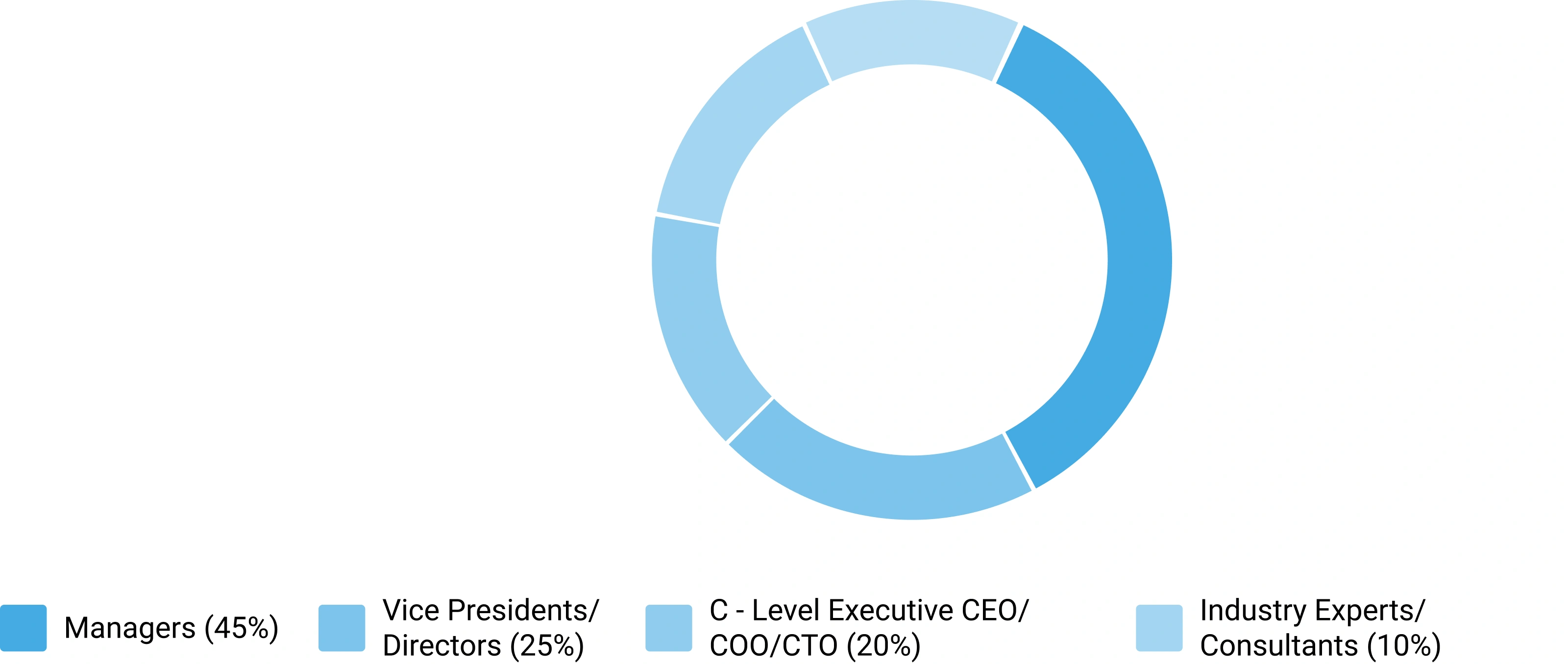
Primary Research — Respondent Designation Profile
Seniority breakdown of interview respondents (% share from PPT data)
Primary Research — Geographic Coverage of Interviews
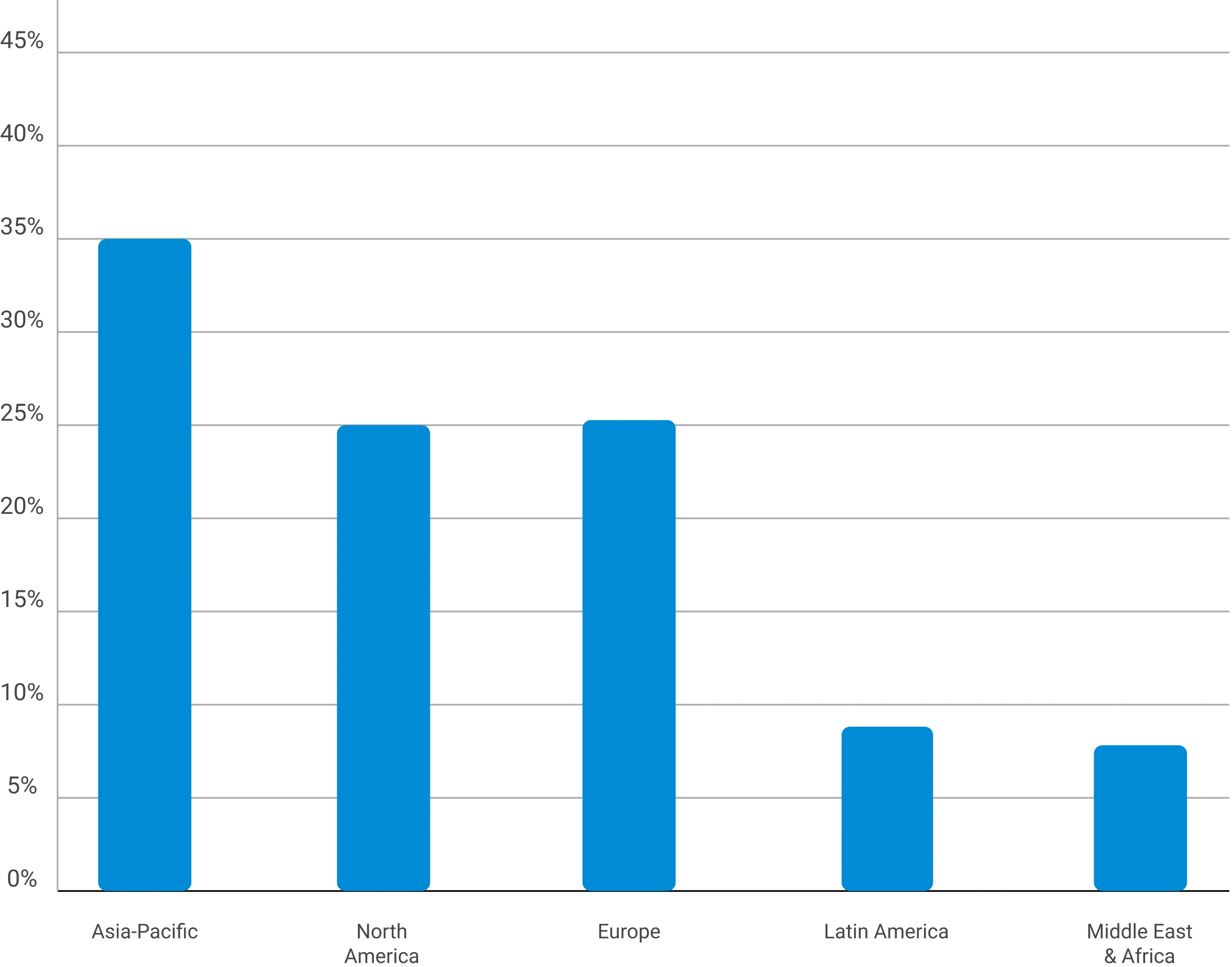
Regional distribution of primary research engagement (% share from PPT data)
Phase 6 — Data Triangulation and Market Validation
No single methodology is relied upon in isolation. Multiple independent estimation approaches are combined and reconciled to ensure consistency, accuracy, and analytical defensibility. Any material deviations between approaches are investigated and adjusted through additional validation cycles.
The final market size is derived through weighted triangulation of all validated methodologies. Any material deviations between approaches are investigated and adjusted through additional validation cycles. The outcome represents the most realistic assessment of the market based on available evidence and expert confirmation ensuring that volume and value estimates are fully consistent with one another.
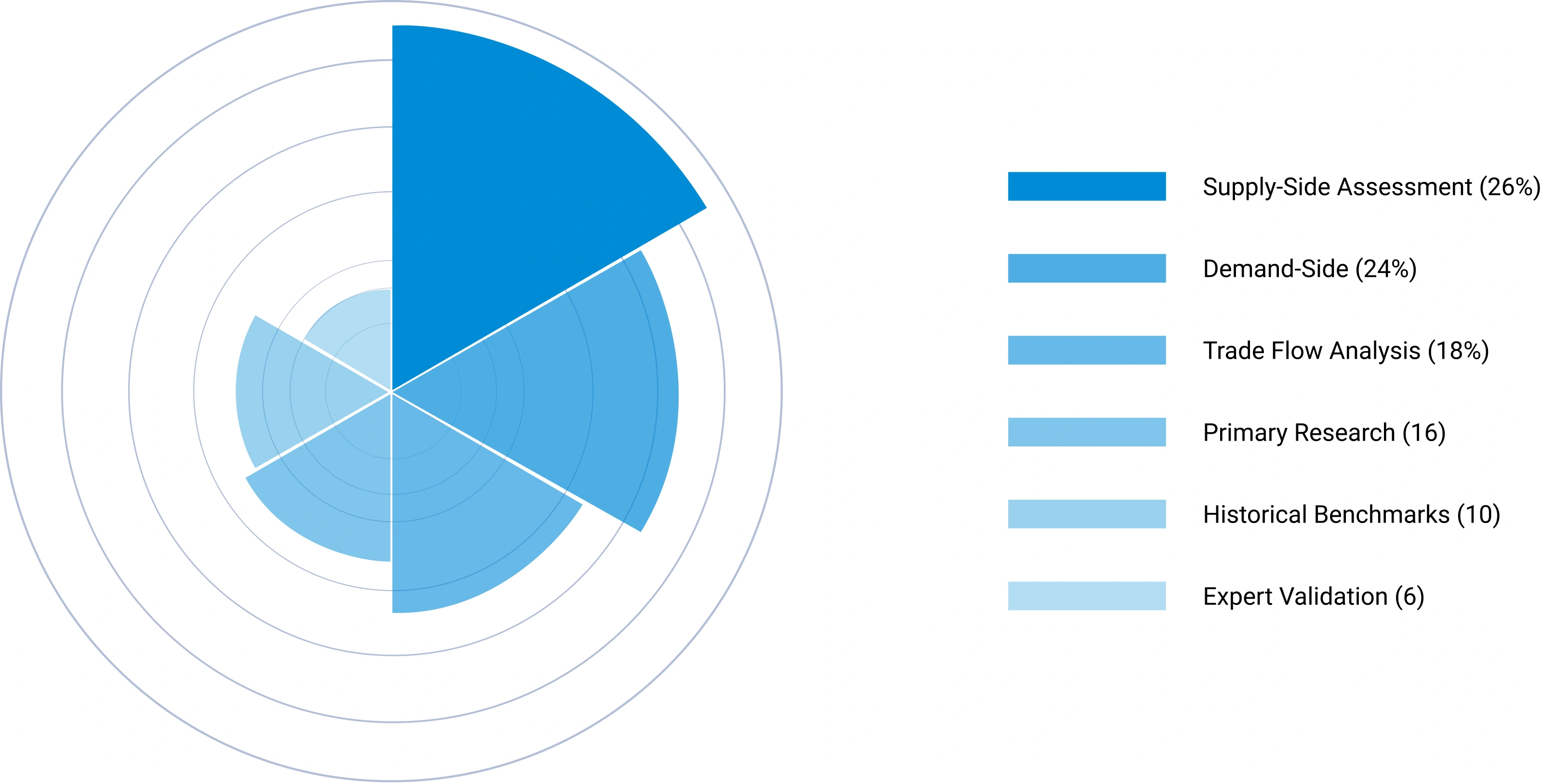
Triangulation Framework — Input Contribution Weight
Relative weight each sizing input contributes to the final reconciled market estimate
Phase 7 — Forecast Modeling: Projecting Future Market Evolution
Forecasting evaluates the future trajectory of the market using a combination of quantitative indicators and qualitative assessments across economic, industry, and regulatory dimensions. Rather than simple extrapolation, each driver is independently modeled and integrated into a composite forecast.
Macroeconomic Indicators
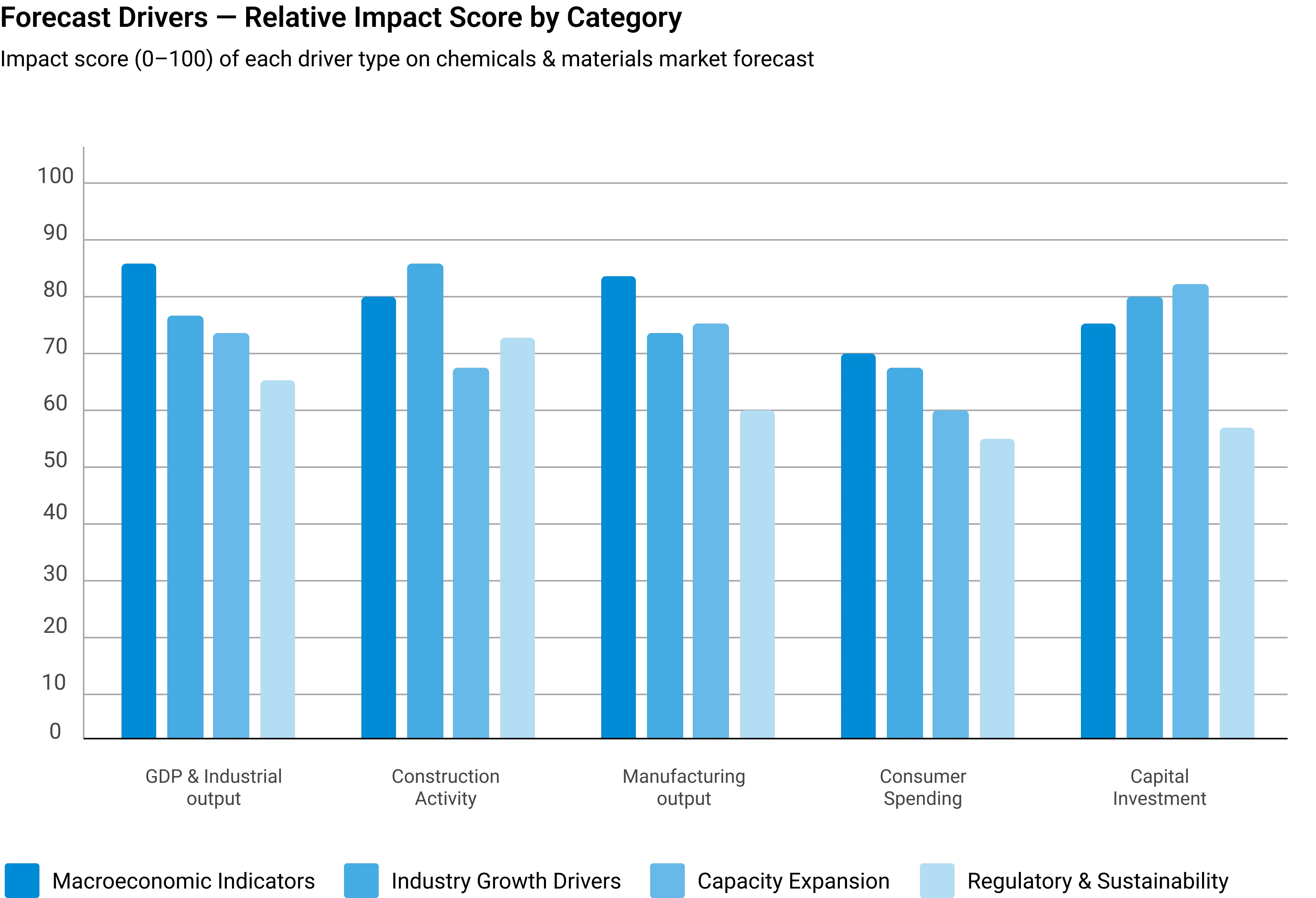
GDP growth, industrial production, manufacturing output, construction activity, consumer spending, and capital investment form the quantitative foundation of long-term demand projections. These are applied at country, regional, and global levels.
Industry Growth Drivers
Urbanization, infrastructure development, industrialization, technological innovation, sustainability initiatives, and evolving product performance requirements are assessed at regional and industry levels — capturing both structural and cyclical demand drivers.
Capacity Expansion Analysis
Announced plant expansions, new manufacturing facilities, technology upgrades, and strategic investments are evaluated to determine future supply-demand dynamics and potential market tightness or oversupply situations.
Regulatory & Sustainability
Environmental regulations, chemical safety standards, emission reduction targets, circular economy initiatives, and sustainability requirements are incorporated as they often influence product adoption rates and market growth trajectories.
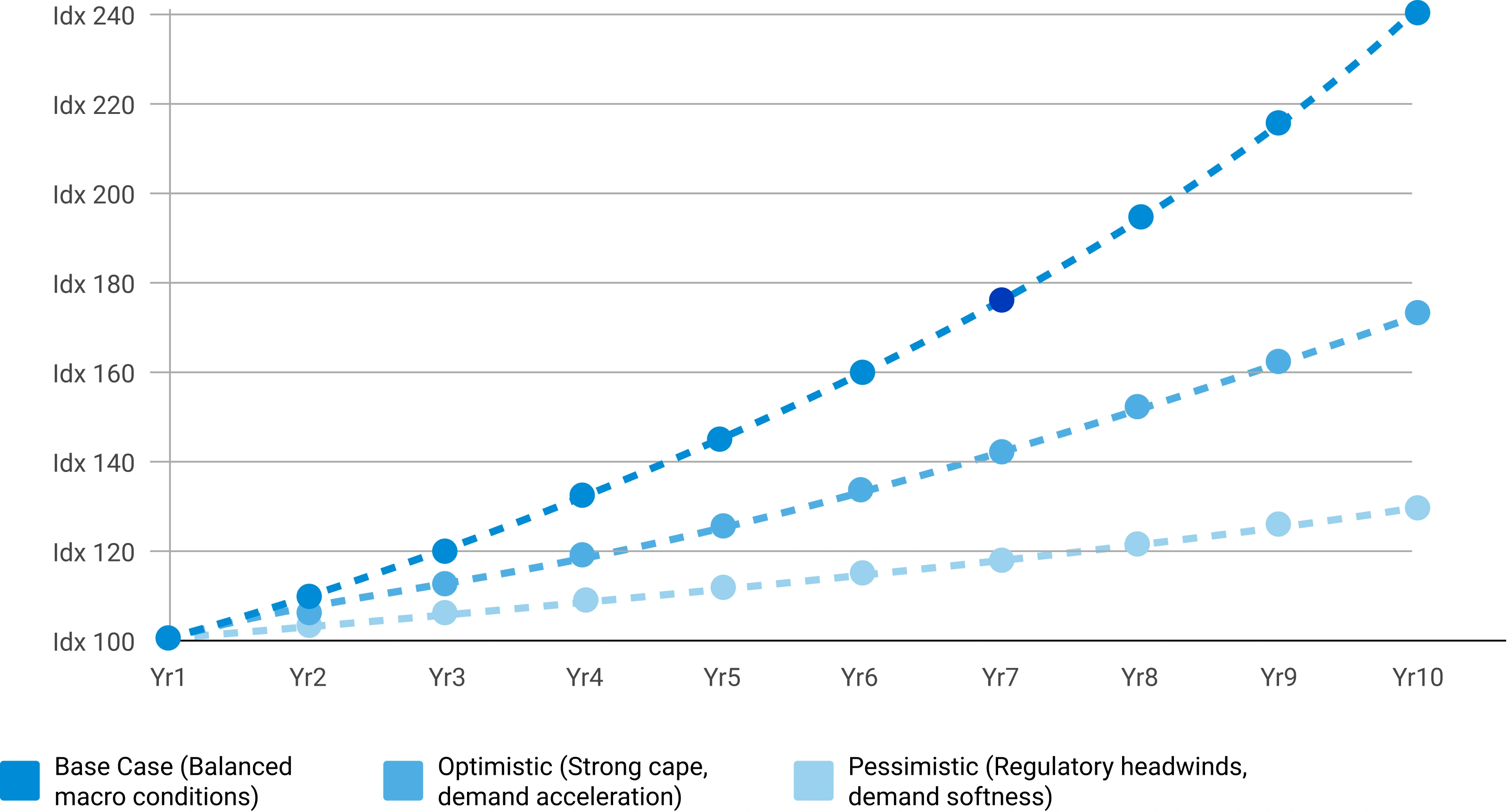
Scenario Forecast Range — Indexed Market Growth (Year 1–10)
Illustrative indexed growth trajectories across Base, Optimistic, and Pessimistic scenarios over a 10-year forecast horizon
Forecast Drivers — Relative Impact Score by Category
Impact score (0–100) of each driver type on chemicals & materials market forecast



Comments
Share your thoughts, ask a question, or provide feedback about this report.