Find the Right Market Report
Search thousands of industry reports, market insights, and research studies in one place.
Not sure where to start? Try one of these:
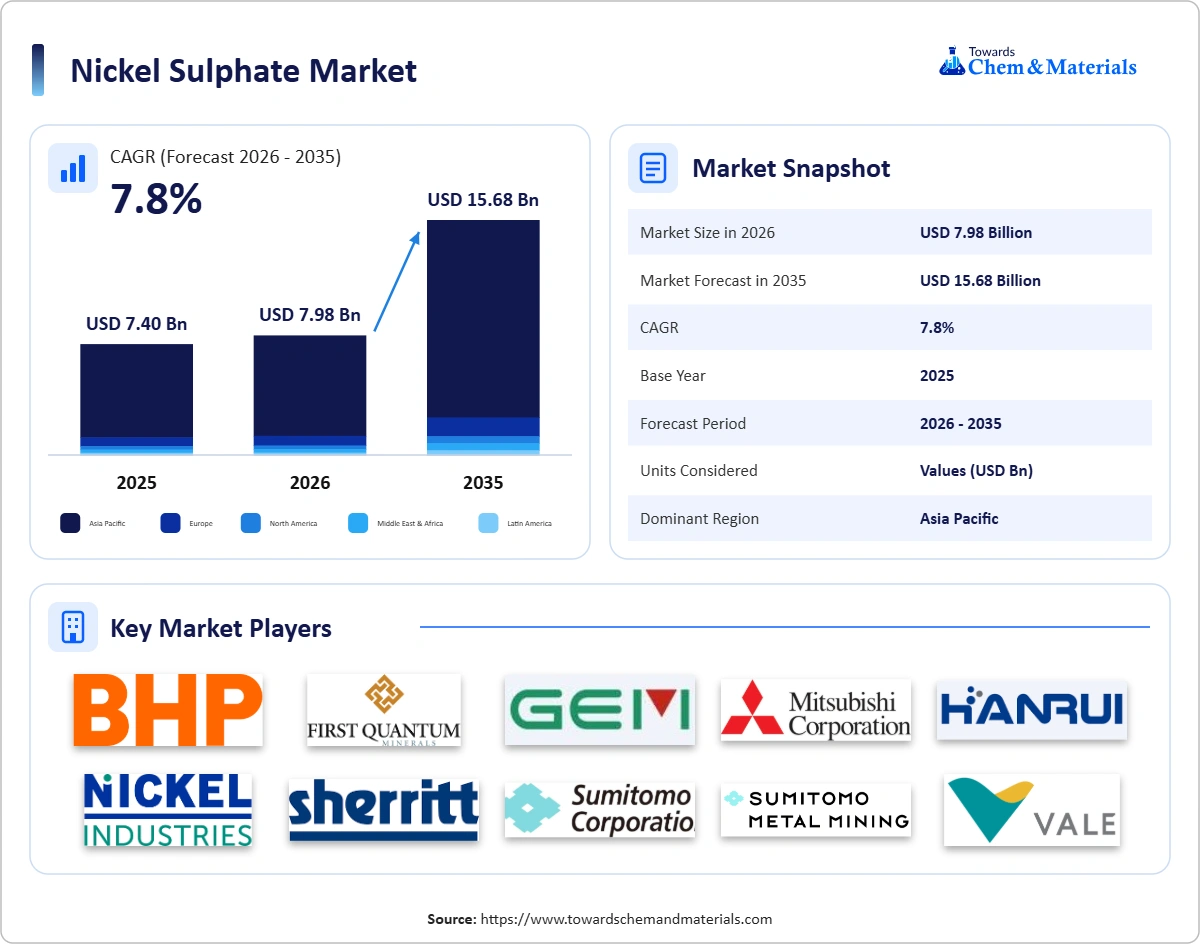
The global nickel sulfate market size is valued at USD 7.98 billion in 2026 and is projected to reach USD 15.68 billion by 2035, expanding at a CAGR of 7.8% from 2026 to 2035. The market covers battery-grade and industrial-grade nickel(II) sulfate hexahydrate produced using nickel matte, mixed hydroxide precipitate (MHP), nickel metal, and recycled battery materials. These products are utilized in lithium-ion battery cathode precursors (NCM and NCA), electroplating, catalysts, and other chemical applications. In 2025, Battery Grade held the largest market share at 82%, driven by its role as the primary nickel input for NCM and NCA cathodes in EV batteries. Asia Pacific dominated the global market with an 84% revenue share, supported by Chinese refiners, Indonesian HPAL plants, and Korean and Japanese cathode manufacturers.
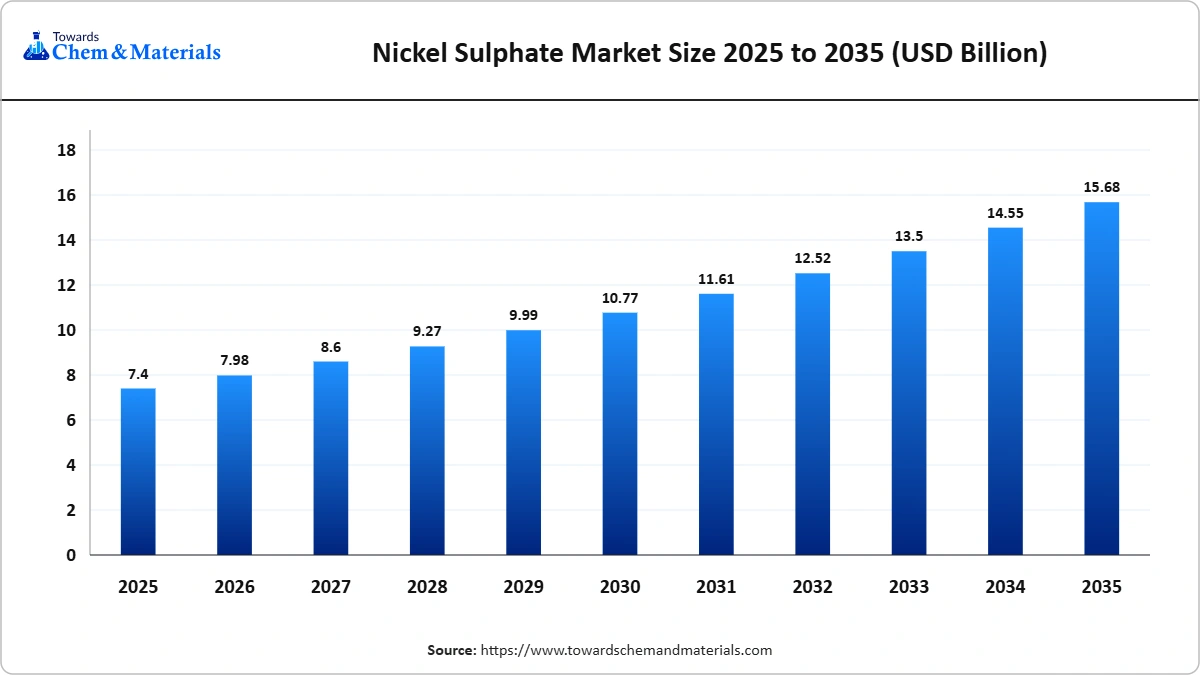
Note: 2025 is the base year; 2026-2035 values are forecasts.
Sources: Expert interviews, secondary sources, the Towards Chemical and Materials database, and Towards Chemical and Materials analysts.
Market growth is supported by increasing adoption of EVs, demand for high-nickel cathode chemistries, expanding Indonesian feedstock supply, and battery recycling. Refining capacity continues to expand to address growing demand for battery-grade nickel sulfate. For instance, in June 2026, Hanrui Cobalt announced plans to invest approximately CNY 2.0 billion in a Ganzhou, Jiangxi project with annual production capacities of 40,000 tonnes per year of electrolytic nickel and 40,000 tonnes per year of battery-grade nickel sulphate on a nickel metal-content basis.
Analyst View: Our market forecast is based on an assessment of nickel sulfate production volumes by feedstock and region, alongside nickel-linked prices. These estimates are cross-checked against refiner production data and cathode precursor demand to provide a comprehensive market outlook.
The global nickel sulfate market is primarily driven by the demand from EV battery production. Indonesia's HPAL projects have increased MHP feedstock availability, reducing production costs and shifting nickel refining activities to Chinese firms in Indonesia. Market growth is also affected by nickel price volatility and the rising use of nickel-free lithium iron phosphate (LFP) batteries.
Electric vehicle growth
The expansion of the global electric vehicle market is driving demand for nickel sulfate, especially from manufacturers utilizing nickel-rich cathode chemistries. Many long-range and high-performance EV models use nickel-containing NCM and NCA batteries, which require significant amounts of nickel. Nickel sulfate serves as a primary nickel input for the production of these battery cathode precursors.
Low-cost Indonesian feedstock
The expansion of Indonesian HPAL plants is increasing the availability of mixed hydroxide precipitate, a major feedstock for battery-grade nickel sulfate production. Lower-cost MHP supply is improving production economics and encouraging refiners to expand processing capacity.
Battery recycling
Battery recycling is enhancing supply possibilities for nickel sulfate producers by recovering nickel from old EV batteries and manufacturing waste, offering an alternative feedstock and aiding recycled-content goals in Europe.
Energy storage and other uses
Stationary energy storage batteries and industrial applications, including electroplating and chemical manufacturing, contribute to nickel sulfate demand beyond EVs. These applications provide additional outlets for producers and support a more diversified demand base.
| Driver | Impact | ≈ CAGR Contribution | Time Horizon | Key Regions |
| Electric vehicle growth | High | +3.05 pp | Short- to long-term | Global, strongest in Asia Pacific |
| Low-cost Indonesian feedstock | Medium | +2.57 pp | Medium- to long-term | Global, the fastest uptake in Asia Pacific |
| Battery recycling | Medium | +2.19 pp | Short- to medium-term | Global |
| Energy storage and other uses | Low | +1.71 pp | Long-term | Developed and emerging markets |
Note: Contributions are indicative estimates of each factor's effect on annual growth.
Sources: Expert interviews, secondary sources, the Towards Chemical and Materials database, and Towards Chemical and Materials analysts.
EV adoption and the availability of low-cost Indonesian feedstock are the major drivers of nickel sulfate market growth. Battery recycling supports the market by introducing additional feedstock sources and strengthening the availability of recycled nickel sulfate.
Shift to LFP batteries.
Lithium iron phosphate (LFP) batteries provide cost and safety benefits by omitting nickel, leading to their increasing use in electric vehicles and energy storage, especially in China. This shift curtails the growth of nickel sulfate demand despite rising EV sales.
Nickel price volatility
Nickel prices are influenced by Indonesian supply policies, Chinese demand, and speculative market activity. Significant price fluctuations can affect refining margins, production economics, and long-term supply agreements, creating uncertainty for nickel sulfate manufacturers and buyers.
ESG concerns
HPAL processing generates substantial volumes of tailings and can rely on coal-based energy sources. These environmental considerations are creating concerns among automotive manufacturers and regulators in Europe and the U.S. regarding the carbon footprint and sustainability of nickel supply chains.
| Restraint | Impact | ≈ Negative CAGR Contribution | Time Horizon | Key Regions |
| Shift to LFP batteries. | High | -0.77 pp | Short- to medium-term | Global |
| Nickel price volatility | High | -0.57 pp | Medium term | Price-sensitive and emerging markets |
| ESG concerns | Medium | -0.38 pp | Short term | Asia Pacific and other mature markets |
Note: Contributions are indicative estimates of each factor's effect on annual growth.
Sources: Expert interviews, secondary sources, the Towards Chemical and Materials database, and Towards Chemical and Materials analysts.
The adoption of LFP batteries represents the largest structural restraint on the nickel sulfate market, as these batteries eliminate the need for nickel. Nickel price fluctuations and environmental concerns associated with HPAL processing influence production economics and market expansion.
Western refining
The expansion of battery manufacturing in the U.S. and Europe is driving demand for locally sourced nickel sulfate and battery materials. New refining facilities in Finland and North America can meet these supply chain needs and present opportunities for producers.
Recycled content
European battery regulations establish minimum recycled material requirements for new batteries, creating opportunities for companies capable of recovering nickel and producing battery-grade nickel sulfate. Recycling companies can benefit from demand for recycled battery materials.
High-purity grades
Advanced high-nickel cathode chemistries require nickel sulfate with strict impurity specifications. Manufacturers capable of consistently producing high-purity battery-grade material can differentiate their offerings and target specialized cathode precursor applications.
| Segments | 2025 Share | 2035 Share | CAGR 2026-2035 |
| Battery Grade | 82.00% | 83.10% | 7.94% |
| Industrial Grade | 18.00% | 16.90% | 7.14% |
Battery grade dominated the global nickel sulfate market, accounting for a share of 82% in 2025. Its leading position is supported by its importance as the primary nickel input for NCM and NCA cathode production used in electric vehicle batteries. Industrial grade serves electroplating and chemical applications, representing a smaller but established portion of the market.
Battery Grade accounted for 82% of the market in 2025. The segment is projected to grow at a CAGR of 7.94% through 2035. The segment's growth is supported by increasing EV production, expanding cathode precursor manufacturing, and demand for high-nickel battery chemistries. Battery-grade nickel sulfate must meet strict limits on magnetic impurities and other metals and is supplied to precursor manufacturers in China, South Korea, and Japan.
In 2025, Industrial Grade represented 18% of the market and is expected to register a CAGR of 7.14% from 2026 to 2035. This grade is primarily used in Watts nickel plating baths for decorative and engineering coatings, supporting applications across the automotive and electronics industries.
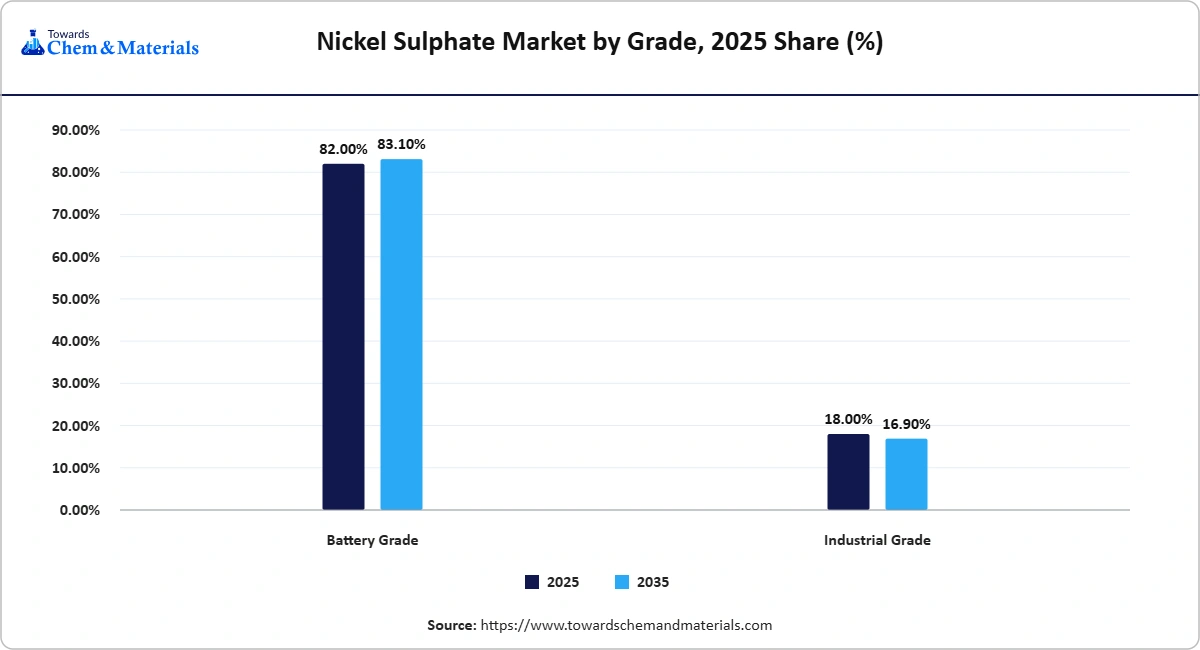
Note: 2025 is the base year; 2035 shares and CAGRs are forecasts.
Sources: Expert interviews, secondary sources, the Towards Chemical and Materials database, and Towards Chemical and Materials analysts.
| Segments | 2025 Share | 2035 Share | CAGR 2026-2035 |
| MHP | 46.00% | 43.37% | 7.17% |
| Matte & Nickel Metal | 42.00% | 41.14% | 7.57% |
| Recycled Material | 12.00% | 15.50% | 10.57% |
Note: 2025 is the base year; 2035 shares and CAGRs are forecasts.
Sources: Expert interviews, secondary sources, Towards Chemical and Materials database and Towards Chemical and Materials analysts.
MHP dominated the feedstock segment of the nickel sulphate market, accounting for 46% of the market in 2025. Its lead reflects the expansion of Indonesian HPAL plants, which supply mixed hydroxide precipitate to battery-grade nickel refiners. Matte and nickel metal remain important feedstock sources, while recycled material is projected to register the fastest growth during the forecast period.
MHP accounted for 46% of the market in 2025. The segment is projected to grow at a CAGR of 7.17% through 2035. Indonesian HPAL projects are supporting MHP-based nickel sulphate production by supplying feedstock to Chinese refiners. Its cost advantages and growing availability have strengthened its position in battery material supply chains.
In 2025, Matte and Nickel Metal represented 42% of the market and are expected to grow at a CAGR of 7.57% from 2026 to 2035. These feedstock routes include nickel matte from Indonesian converters and nickel metal, including briquettes, which refiners can process into nickel sulphate. Their established processing routes provide additional flexibility in feedstock sourcing.
Recycled Material captured 12% of the market in 2025 and is projected to register the fastest CAGR of 10.57% during the forecast period. The segment is supported by the recovery of nickel from spent batteries and manufacturing scrap. Companies such as Brunp and GEM are expanding nickel recovery activities to supply recycled nickel sulphate.
| Segments | 2025 Share | 2035 Share | CAGR 2026-2035 |
| Battery Precursors | 80.00% | 81.19% | 7.96% |
| Electroplating | 12.00% | 11.29% | 7.16% |
| Catalysts & Others | 8.00% | 7.53% | 7.16% |
Note: 2025 is the base year; 2035 shares and CAGRs are forecasts.
Sources: Expert interviews, secondary sources, Towards Chemical and Materials database and Towards Chemical and Materials analysts.
In 2025, Battery Precursors held 80% of the global nickel sulphate market revenue, driven by rising EV battery production and their use in NCM and NCA cathode precursor manufacturing. Electroplating and other chemical applications provide additional demand across industrial markets.
Battery Precursors captured 80% of the market in 2025. The segment is projected to expand at a CAGR of 7.96% through 2035. Precursor manufacturers combine nickel, cobalt, and manganese sulphates to produce precursor cathode active materials or pCAM used in NCM and NCA cathodes. Increasing EV production and demand for nickel-rich battery chemistries support the segment's expansion.
Electroplating represented 12% of the market in 2025 and is projected to record a CAGR of 7.16% from 2026 to 2035. Nickel sulphate is a primary nickel source in Watts plating baths and is used for decorative and engineering coatings across automotive, electronics, and other industrial applications.
In 2025, Catalysts and Others accounted for the remaining 8% of the market and are expected to register a CAGR of 7.16% through 2035. This segment includes nickel sulphate applications in catalysts and other chemical manufacturing processes.
Analyst View: Based on our analysis, recycled material is expected to gain market share at the fastest rate as battery recycling expands. Meanwhile, Battery Grade and Battery Precursors will continue to represent the largest segments of the nickel sulphate market, supported by demand from electric vehicle battery manufacturing.
| Region | 2025 Share | 2035 Share | CAGR 2026-2035 |
| Asia Pacific | 84.00% | 85.40% | 7.98% |
| Europe | 8.00% | 7.27% | 6.78% |
| North America | 3.00% | 2.74% | 6.78% |
| Middle East & Africa | 3.00% | 2.74% | 6.78% |
| Latin America | 2.00% | 1.85% | 6.78% |
Note: 2025 is the base year; 2035 shares and CAGRs are forecasts.
Sources: Expert interviews, secondary sources, Towards Chemical and Materials database and Towards Chemical and Materials analysts.
In 2025, the Asia Pacific region captured 84% of the global nickel sulphate market, fueled by Chinese refining, Indonesian HPAL supply, and robust cathode manufacturing in South Korea and Japan. It is anticipated to experience the fastest growth during the forecast period, due to rising demand for nickel sulphate and expanding battery material production.
Asia Pacific dominated the global nickel sulphate market, accounting for 84% of revenue in 2025. The region is projected to register a CAGR of 7.98% through 2035. Its lead is driven by China's extensive nickel sulphate refining capacity, Indonesia's growing HPAL operations, and the presence of major cathode manufacturers in South Korea and Japan. The integration of feedstock production, refining, and battery material manufacturing strengthens the region's market position.
In 2025, Europe accounted for 8% of the global nickel sulphate market. The region's market is bolstered by refining in Finland and battery manufacturing in Germany, Poland, and Hungary, with an anticipated CAGR of 6.78% from 2026 to 2035. Increased development of regional battery supply chains is driving demand for locally produced battery-grade nickel sulphate.
North America represented 3% of the global market in 2025 and is projected to register a CAGR of 6.78% through 2035. The region is developing nickel refining and cathode precursor manufacturing capacities to support domestic electric vehicle supply chains. New projects are also linked to sourcing requirements under U.S. Inflation Reduction Act rules.
The Middle East and Africa captured 3% of the nickel sulphate market in 2025. Regional activity includes emerging battery materials projects in Morocco, supporting the development of regional participation in the battery materials supply chain. The region is anticipated to record a CAGR of 6.78% during the forecast period.
Latin America held the remaining 2% of the nickel sulphate market in 2025. The region is projected to achieve a CAGR of 6.78% from 2026 to 2035, highlighting its relatively low levels of refining and manufacturing activities in these sectors.
Analyst View: Our analysis indicates that Asia Pacific will maintain its dominant position in the nickel sulphate market throughout the forecast period, supported by China's refining capacity, Indonesian feedstock availability, and established battery manufacturing industries. Europe and North America are expected to develop their market presence as regional battery supply chains expand.
| Rank | Company Name | 2025 Share (%) | Key Products / Business | Headquarters |
| 1 | Zhejiang Huayou Cobalt | 12.00% | Nickel sulphate and precursors | China |
| 2 | GEM Co. | 10.00% | Battery-grade nickel sulphate and recycling | China |
| 3 | Jinchuan Group | 8.00% | Nickel salts | China |
| 4 | Sumitomo Metal Mining | 5.00% | Battery nickel | Japan |
| 5 | Brunp Recycling (CATL) | 5.00% | Recycled nickel sulphate | China |
| 6 | Tsingshan (Huayue/Lygend partners) | 4.00% | Indonesian nickel intermediates | China |
| 7 | Umicore | 3.00% | Battery materials | Belgium |
| 8 | Nanjing Hanrui Cobalt | 3.00% | Nickel sulphate | China |
| 9 | Jilin Ji En Nickel | 3.00% | Nickel sulphate | China |
| 10 | Terrafame | 2.00% | Battery-grade nickel sulphate | Finland |
Note: Company shares are 2025 estimates.
Sources: Company press releases, expert interviews, secondary sources, Towards Chemical and Materials database and Towards Chemical and Materials analysts.
Zhejiang Huayou Cobalt led the global nickel sulphate market in 2025 with an estimated 12% revenue share, followed by GEM Co. at 10% and Jinchuan Group at 8%. These companies benefit from their nickel sulphate production capabilities, established battery material portfolios, and positions in the global nickel supply chain.
Zhejiang Huayou Cobalt competes through nickel sulphate and precursor production, while GEM Co. focuses on battery-grade nickel sulphate and recycling. Jinchuan Group maintains its position through nickel salts, and Sumitomo Metal Mining participates through battery nickel. Brunp Recycling (CATL) competes through recycled nickel sulphate, while Tsingshan (Huayue/Lygend partners) focuses on Indonesian nickel intermediates. Umicore, Nanjing Hanrui Cobalt, Jilin Ji En Nickel, and Terrafame participate through battery materials, nickel sulphate, and battery-grade nickel sulphate offerings.
The top 10 listed companies accounted for an estimated 55% of global market revenue in 2025, while the remaining market was distributed among other nickel sulphate producers and integrated battery-material companies. The market is concentrated in China, with competition driven by feedstock security, production costs, impurity control, integration with precursor manufacturing, and access to Indonesian nickel supply.
The nickel sulphate market ecosystem connects miners and HPAL plants, refiners, precursor manufacturers, battery cell manufacturers and automotive OEMs, and recyclers and regulators. Each participant contributes to the production, processing, conversion, recovery, or regulation of nickel materials before they reach end users.
| Ecosystem Stage | Role in the Market | Key Companies |
| Miners & HPAL Plants | Produce ore, MHP and matte | Indonesian HPAL projects, Vale, Nickel Industries |
| Refiners | Make nickel sulphate | Huayou, GEM, Jinchuan, Terrafame |
| Precursor Makers | Make pCAM | CNGR, GEM, Huayou |
| Cell Makers & OEMs | Make batteries | CATL, LG, Samsung SDI |
| Recyclers & Regulators | Recover metals and set rules | Brunp, Indonesian government, EU |
Sources: Company press releases, expert interviews, secondary sources, Towards Chemical and Materials database and Towards Chemical and Materials analysts.
Miners & HPAL Plants: Mining companies and HPAL operators provide nickel ore, mixed hydroxide precipitate, and matte for refining, with Indonesian laterite processing impacting the sourcing of battery nickel feedstock.
Refiners: Refiners process nickel intermediates and purify them into battery-grade nickel sulphate crystals. Companies like Huayou, GEM, Jinchuan, and Terrafame participate in this stage of the value chain.
Precursor Makers: Precursor manufacturers combine nickel, cobalt, and manganese sulphates to produce pCAM used in NCM and NCA battery cathodes.
Cell Makers & OEMs: Battery cell manufacturers and automotive OEMs determine nickel sulphate demand through their battery production volumes and choices of cathode chemistry.
Recyclers & Regulators: Recycling companies extract nickel from used batteries and production scrap, with government authorities influencing feedstock availability, export policies, mining quotas, and material requirements for batteries.
The nickel sulphate market value chain begins with upstream nickel mining and intermediate production and continues through refining, precursor manufacturing, and battery production. Recycling and regulatory frameworks influence material availability and supply chain development. Companies that integrate multiple stages or establish long-term relationships with end users can strengthen their competitive positions.
The Towards Chemical and Materials Companies Quadrant positions key participants in the nickel sulphate market by market strength, reflecting revenue scale, market share, and geographic reach, and by innovation and growth strategy, reflecting product portfolio breadth, R&D intensity, and partnerships. Positions reflect each company's estimated 2025 share of the nickel sulphate market and our assessment of its product innovation, portfolio breadth, and partnerships.
Sources: Company press releases, expert interviews, secondary sources, Towards Chemical and Materials database and Towards Chemical and Materials analysts.
Leaders: Zhejiang Huayou Cobalt, GEM Co., Jinchuan Group, Sumitomo Metal Mining, Brunp Recycling (CATL), and Tsingshan (Huayue/Lygend partners) combine high market share with broad portfolios and strong innovation.
Innovators: Umicore, Nanjing Hanrui Cobalt, Jilin Ji En Nickel, and Terrafame participate through specialized nickel sulphate and battery material offerings, supported by their product development capabilities and market specialization.
The global nickel sulphate market was evaluated using a bottom-up assessment of production volumes and nickel-linked prices across major feedstock, grade, application, and regional categories. The market includes nickel(II) sulphate hexahydrate in battery and industrial (plating) grades, produced from nickel matte, mixed hydroxide precipitate, nickel metal, and recycled battery material. These products are used in lithium-ion battery cathode precursors (NCM and NCA), electroplating, catalysts, and other chemical applications. The 2025 base-year estimate for nickel sulphate was created by analyzing demand volumes and average prices across various grades, feedstock sources, applications, and regions. It was validated against market revenues of leading companies, production data from refiners, and industry information. Estimates were segmented regionally based on demand across grades and applications. Company market shares were determined from revenues related to nickel sulphate, while key assumptions were cross-referenced with disclosures, regulatory data, expert interviews, and third-party estimates. All segment, regional, and company estimates were reconciled to the same 2025 base year. The 2026-2035 forecast incorporates expected changes in electric vehicle production, high-nickel cathode adoption, Indonesian feedstock availability, battery recycling, nickel price movements, and the development of regional battery supply chains.
In our assessment, the nickel sulphate market is positioned for strong growth as electric vehicle production and demand for nickel-rich cathode chemistries increase. We expect Battery Grade to maintain its leading position, supported by its importance in NCM and NCA cathode production. MHP will remain the largest feedstock segment, while recycled material is projected to gain market share at the fastest rate. Battery Precursors will continue to represent the dominant application segment. Asia Pacific is expected to maintain its leading position, supported by China's refining capacity, Indonesian HPAL operations, and established battery manufacturing industries in South Korea and Japan. Europe and North America will continue developing local refining and precursor production capabilities. Manufacturers focusing on feedstock security, high-purity production, recycling, and integration with battery precursor supply chains are expected to strengthen their competitive positions.
Reliable market intelligence and data-driven insights across the global chemicals and materials industry, helping businesses understand trends, competition, pricing, and emerging opportunities.
Schedule a Demo