Content
Natural Polymers Market Size, Competitive Landscape Analysis Report 2035
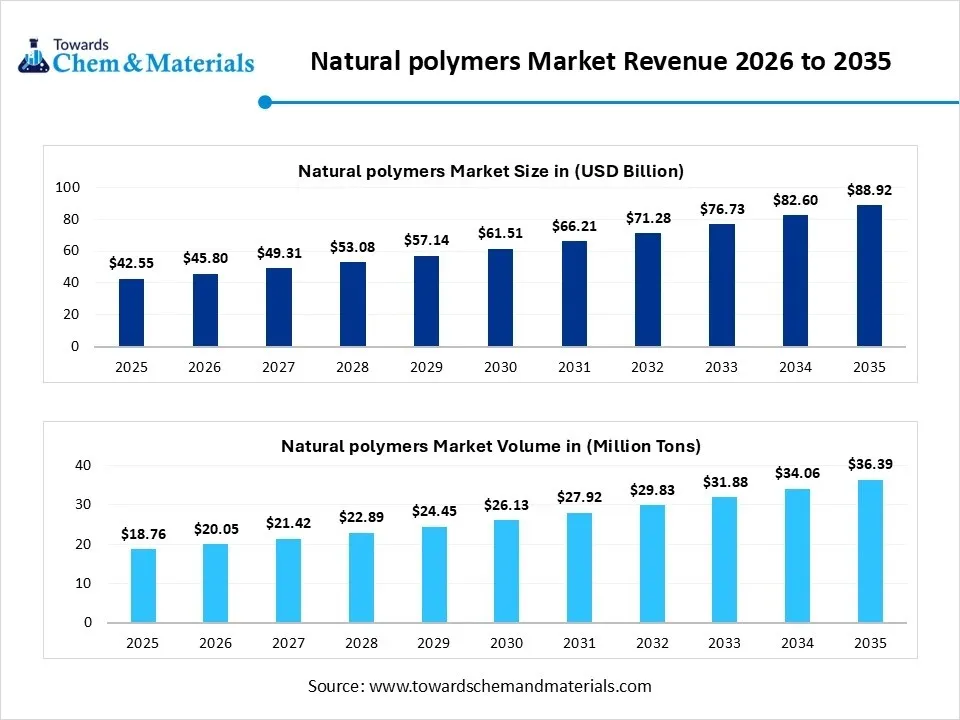
The global Natural Polymers market was valued at USD 42.55 billion in 2025, is estimated to reach USD 45.8 billion in 2026, and is projected to reach USD 88.92 billion by 2035, growing at a CAGR of 7.65% from 2026 to 2035. In terms of volume, the Natural Polymers market is projected to grow from 18.76 million tons in 2025 to 36.39 million tons by 2035. growing at a CAGR of 6.85% from 2026 to 2035. Growing demand for biodegradable and sustainable alternatives to plastics is the key factor driving market growth. Also, technological innovations in manufacturing coupled with the increasing applications in medical technology can fuel market growth further.
Market Highlights
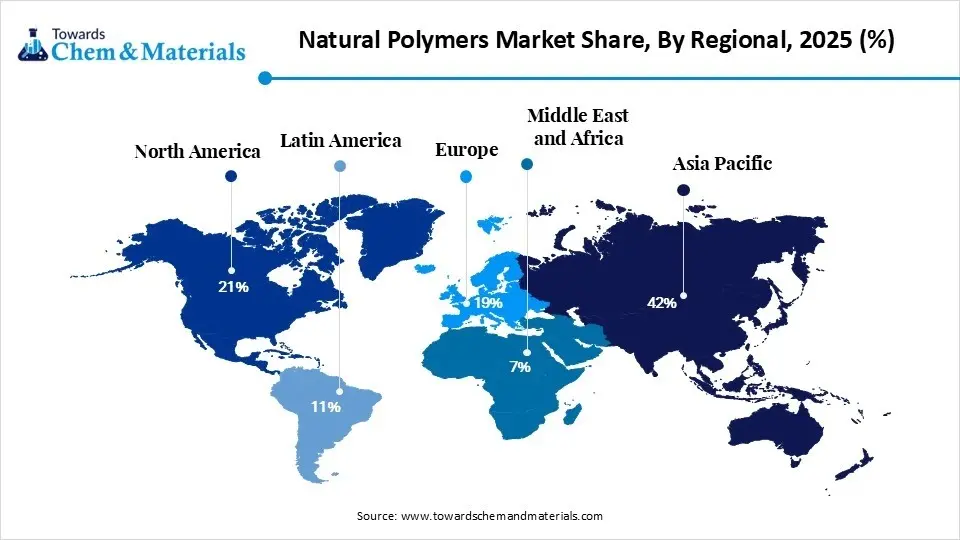
- By region, Asia Pacific dominated the market with the largest share of 42% in 2025 and is expected to grow at the fastest CAGR of 8.2% over the forecast period.
- By region, North America held the market share of 21% in 2025.
- By type, the polysaccharides segment dominated the market with the largest share of 48% in 2025.
- By type, the nucleic acids & derivatives segment is expected to grow at the fastest CAGR of 8.5% over the forecast period.
- By source, the plant-based segment dominated the market with the largest share of 55% in 2025.
- By source, the microbial-based segment is expected to grow at the fastest CAGR of 8.6% over the forecast period.
- By form, the powder segment dominated the market with the largest share of 37% in 2025.
- By form, the liquid segment is expected to grow at the fastest CAGR of 7.9% during the projected period.
- By application, the food & beverages segment held the largest market share of 28% in 2025.
- By application, the packaging segment is expected to grow at the fastest CAGR of 8.7% during the study period.
Market Size and Volume Forecast
- Market Size (2025): USD 42.55 Billion
- CAGR (2025–2035): 7.65%
- Market Projected Size (2035): USD 88.92 Billion
- Market Volume (2025): 18.76 Million Tons
- Volume CAGR (2025–2035): 6.85%
- Market Projected Volume (2035): 36.39 Million Tons
- Pricing Data (2025):
- Average Manufacturing Price: USD 2,100/ton
- Average Selling Price: USD 2,750/ton
- Pricing CAGR (2025–2035): 4.1%
What Are Natural Polymers Market?
The market encompasses materials derived from renewable sources such as animals, plants, and microorganisms, including starch, cellulose, natural rubber, and proteins. The industry is currently an evolving sector fuelled by a global transition from fossil-based materials to carbon-neutral, sustainable alternatives that promote the circular economy. Companies are often focused on qualitative criteria such as strategic initiatives to expand market reach.
Recent Market Trends
- The increasing trend towards wellness and health is the latest trend in the market, shaping positive market growth. Consumers are rapidly seeking products that are effective and safe and derived from natural sources. This trend is mainly evident in the food and beverage sector.
- The rising awareness and education regarding the benefits of natural products is another major trend driving market expansion. Marketing strategies and educational campaigns highlighting the benefits of natural polymers are contributing to a transition in consumer preferences.
- The surge in the packaging sector is expected to impact the growth of the market. High investments in research and development initiatives have resulted in several commercial applications for natural polymers in pharmaceuticals, packaging, and agriculture.
Report Scope
| Report Attribute | Details |
| Market Size and Volume in 2026 | USD 45.80 Billion / 20.05 Million Tons |
| Expected Size and Volume by 2035 | USD 88.92 Billion / 36.39 Million Tons |
| Growth Rate from 2026 to 2035 | CAGR 7.65% |
| Forecast Period | 2026 - 2035 |
| Dominant Region | Asia-Pacific |
| Segment Covered | By Type, By Source, By Form, By Application, Regions |
| Key companies profiled | Cargill, Incorporated, Archer Daniels Midland Company (ADM), DuPont de Nemours, Inc., BASF SE, Novozymes A/S, Tate & Lyle PLC, Gelita AG, CP Kelco U.S., Inc., Ingredion Incorporated, Mitsubishi Chemical Corporation, Ashland Global Holdings Inc., Evonik Industries AG, FMC Corporation, Roquette Frères, ani Eastman Chemical Company. |
How Cutting-Edge Technologies Are Revolutionizing the Natural Polymers Market?
Advanced technologies are transforming the market by improving the versatility and performance of sustainable materials, shifting them beyond niche applications into general industrial use. Furthermore, the integration of nanoparticles like cellulose nanocrystals or graphene into natural polymer matrices improves their overall thermal stability, mechanical strength, and electrical conductivity.
Supply Chain Analysis of the Natural Polymers Market
Feedstock Procurement
- It refers to the strategic acquisition of organic, renewable, or waste-based raw materials like cellulose, starch, lignin, or vegetable oils used to produce biopolymers.
- Major Players: NatureWorks LLC, BASF SE
Chemical Synthesis and Processing
- It refers to the engineering and modification of naturally derived polymers to improve their chemical, mechanical, and physical properties.
- Major Players: Cargill, Incorporated, Dow Chemical Company
Packaging and Labelling
- It involves using materials derived from renewable sources like animals, plants, or microorganisms to create sustainable packaging films, coatings, and labels that are compostable, biodegradable, and edible.
- Major Players: Mondi Group, Amcor plc:
Regulatory Compliance and Safety Monitoring
- It refers to the mandatory frameworks that ensure biobased materials fulfil stringent standards for environmental protection, human health, and application-specific safety.
- Major Players: Novamont, Ashland
Natural Polymers Market’s Regulatory Landscape: Global Regulations
| Country/Region | Key Regulations |
| European Union (EU) | Microplastics Restriction (Regulation 2023/2055): Natural polymers that have not been chemically modified are excluded from this restriction on intentionally added microplastics. To qualify for exclusion, manufacturers may be required to prove the polymer is degradable or soluble per specific OECD guidelines. |
| United States | Toxic Substances Control Act (TSCA): Most natural polymers are exempt from Premanufacture Notification (PMN) requirements under the Polymer Exemption Rule (40 CFR 723.250). However, specific exclusions apply, such as for polymers containing certain perfluoroalkyl (PFAS) moieties. |
| China | Chemical Management: China's chemical landscape is governed by Decree 591 (Safe Management of Hazardous Chemicals). While many natural polymers are non-hazardous, any classified as hazardous must comply with China GHS (Globally Harmonized System) for labeling and Safety Data Sheets (SDS). |
Market Dynamics
Driver
Increasing Consumer Awareness
The rising awareness and education regarding the benefits of natural products are the major factors driving the growth of the market. As consumers are increasingly becoming informed regarding the health and environmental benefits of natural polymers, their purchasing decisions are heavily impacted by these factors.
Restraints
Stringent Environmental Regulations
Strict environmental regulations and norms that regulate the market are the major factors hindering market growth. Moreover, it is anticipated that increasing public awareness of animal conservation and deforestation would act as a small market barrier. The smooth accessibility of natural polymer substitutes, such as natural rubber and cotton, can negatively impact growth.
Opportunity
Government Initiatives and Policies
Regulations supporting the use of sustainable materials are encouraging industries to adopt natural polymers, which is the key factor creating lucrative opportunities in the market. Furthermore, natural polymers are utilized in seed coatings, controlled-release fertilizers, and soil conditioners, allowing eco-friendly agricultural practices.
Segmental Insights
Type Insights
The Polysaccharides Segment Dominated the Market with 48% of Market Share in 2025
The polysaccharides segment dominated the market with the largest share of 48% in 2025. The dominance of the segment can be attributed to the growing product demand from the food, pharma, and packaging sectors due to its biodegradability, along with its functional versatility. Market players are expanding their cellulose and starch production capacities globally.
The nucleic acids & derivatives segment held the market share of 6% in 2025 and is expected to grow at the fastest CAGR of 8.5% over the forecast period. The growth of the segment can be credited to the innovations in biotechnology and gene therapies, coupled with the surges in R&D investments. Precision medicine trends fuel usage significantly.
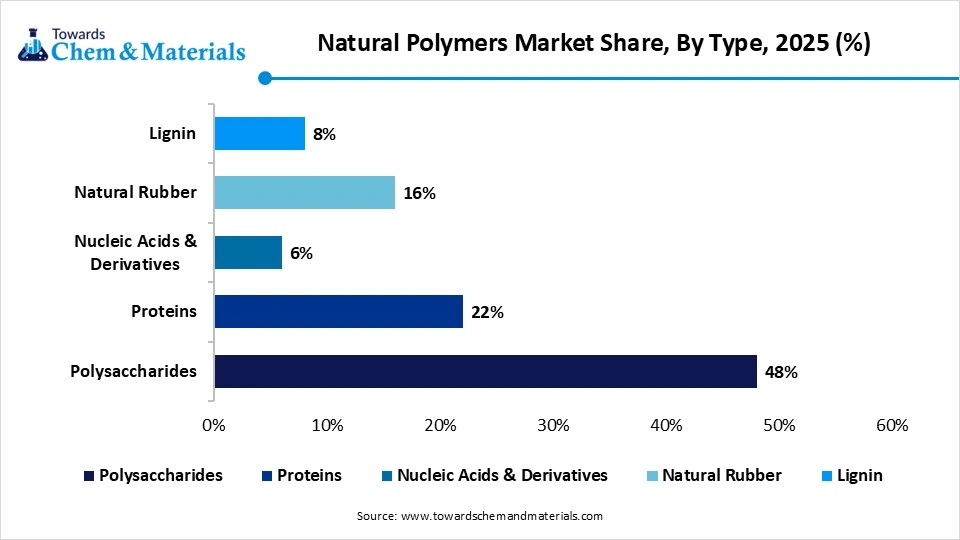
The protein segment held the market share of 22% in 2025. The growth of the segment can be linked to its rising use in nutraceutical and biomedical applications and is sure to be in demand for collagen and gelatin in the healthcare sector. Functional and nutritional properties improve adoption further.
Source Insights
The Plant-Based Segment Dominated the Market with 55% of Market Share in 2025
The plant-based segment dominated the market with the largest share of 55% in 2025. The dominance of the segment can be driven by the abundant availability of raw materials such as wood and corn, along with the cost-effective processing technology. Growing demand for sustainable materials will fuel usage soon.
The microbial-based segment held the market share of 20% in 2025 and is expected to grow at the fastest CAGR of 8.6% over the forecast period. The growth of the segment is due to rapid innovations in fermentation technology and increasing demand for high-purity polymers in the pharma and biotech sectors. Sustainable production method also supports segment growth.
The animal-based segment held the market share of 25% in 2025. The growth of the segment is owing to the growing demand for gelatin and collagen from the healthcare sector and established supply chains in emerging regions. Protein-rich polymers support biomedical applications.
Form Insights
The Powder Segment Dominated the Market with 37% of Market Share in 2025
The powder segment dominated the market with the largest share of 37% in 2025. The dominance of the segment can be attributed to its extensive use in food and pharmaceutical formulations due to ease of handling. Moreover, a long shelf life supports large-scale distribution. Processing flexibility enhances industrial adoption further.
The liquid segment held the market share of 25% in 2025 and is expected to grow at the fastest CAGR of 7.9% during the projected period. The growth of the segment can be credited to its increasing use in cosmetics and coatings, coupled with the ease of blending and formulations, which improve usability. Growth in liquid-based applications supports expansion.
The fibers segment held the market share of 20% in 2025. The growth of the segment can be linked to the growing demand from the textile and biomedical sectors, along with the ongoing sustainability trends. Biodegradable fiber applications are increasingly gaining traction.
Application Insights
The Food & Beverages Segment Dominated the Natural Polymers Market with 28% of Market Share in 2025
The food & beverages segment held the largest market share of 28% in 2025. The dominance of the segment can be driven by rising demand for natural additives and clean-label products, along with the growth of the processed food industry. Its functional properties, such as thickening and stabilization, boost usage further.
The packaging segment held the market share of 16% in 2025 and is expected to grow at the fastest CAGR of 8.7% during the study period. The growth of the segment is owing to a shift towards biodegradable packaging and regulatory pressure to reduce plastic usage. Innovations in sustainable packaging will drive segment growth shortly.
The pharmaceuticals segment held the market share of 18% in 2025. The growth of the segment is due to the integration of drug delivery and encapsulation technologies to increase polymer demand and rapid R&D investment to enhance innovation. Biocompatibility supports pharmaceutical applications.
Regional Insights
How did Asia Pacific Dominate the Natural Polymers Market in 2025?
Asia Pacific dominated the natural polymers market with the largest share of 42% in 2025 and is expected to grow at the fastest CAGR of 8.2% over the forecast period. The dominance and growth of the region can be attributed to the increasing population growth, which drives demand for food and healthcare applications. In addition, a strong agricultural base and production base, along with government support for bio-based materials, are leading to further market growth.
China Natural Polymers Market Trends
In the Asia Pacific, China dominated the market owing to the increase in demand for sustainable packaging and the expansion of the construction and automotive sectors. Also, ongoing investment in materials science allows enhancements in biopolymer processing techniques, which leads to higher performance and cost-effective production.
 North America Natural Polymers Market Trends
North America held the market share of 21% in 2025. The growth of the region can be credited to the strong presence of advanced biotech and pharmaceutical sectors, coupled with the robust R&D investments in new infrastructure projects, stringent government policies regarding plastic waste reduction, and a surge in consumer preference for sustainable products, which can fuel regional expansion shortly.
U.S. Natural Polymers Market Trends
The growth of the market in the country is due to the surge in the use of renewable natural-oil polyols and the increasing adoption of biopolymers in tissue engineering. Moreover, a rise in research and development investment by major market players, emphasis on sustainable production techniques, and specialized applications will boost market growth shortly.
Recent Development
- In March 2026, the South Korean femtech company Inertia officially launched its line of feminine hygiene pads in the United States. This introduction marks the debut of a patented, bio-based absorbent technology designed to replace the synthetic superabsorbent polymers (SAP) traditionally found in conventional pad cores.(Source : www.nonwovens-industry.com )
Natural Polymers Market Companies
- Cargill, Incorporated: Cargill, Incorporated is a major player in bio industrial markets, focusing on developing high-performance natural polymers and additives derived from renewable feedstocks like corn, soy, seaweed, and rapeseed.
- Archer Daniels Midland Company (ADM): Archer Daniels Midland Company (ADM) is a major player in the natural polymer and bio-based materials market, leveraging its position as a global leader in agricultural processing to convert crops into renewable, sustainable industrial products.
Other Companies in the Market
- DuPont de Nemours, Inc.
- BASF SE
- Novozymes A/S
- Tate & Lyle PLC
- Gelita AG
- CP Kelco U.S., Inc.
- Ingredion Incorporated
- Mitsubishi Chemical Corporation
- Ashland Global Holdings Inc.
- Evonik Industries AG
- FMC Corporation
- Roquette Frères
- Eastman Chemical Company
Segments Covered in the Report
By Type
- Polysaccharides
- Cellulose
- Microcrystalline Cellulose
- Cellulose Ethers
- Starch
- Native Starch
- Modified Starch
- Chitin & Chitosan
- Alginates
- Pectin
- Cellulose
- Proteins
- Gelatin
- Collagen
- Casein
- Soy Protein
- Nucleic Acids & Derivatives
- Natural Rubber
- Lignin
By Source
- Plant-based
- Wood
- Cotton
- Corn
- Potato
- Animal-based
- Marine Sources
- Livestock-derived
- Microbial-based
- Bacterial Cellulose
- Fermentation-derived Polymers
By Form
- Powder
- Liquid
- Granules
- Fibers
By Application
- Packaging
- Biodegradable Films
- Edible Packaging
- Pharmaceuticals
- Drug Delivery Systems
- Capsules & Coatings
- Food & Beverages
- Thickening Agents
- Stabilizers
- Emulsifiers
- Cosmetics & Personal Care
- Skincare
- Haircare
- Agriculture
- Soil Conditioning
- Controlled Release Fertilizers
- Textiles
- Fibers & Fabrics
- Biomedical
- Tissue Engineering
- Wound Care
By Regions
- North America
- U.S.
- Canada
- Mexico
- Europe
- Germany
- UK
- France
- Italy
- Spain
- Asia Pacific
- China
- India
- Japan
- South Korea
- Latin America
- Brazil
- Argentina
- Middle East & Africa
- Saudi Arabia
- South Africa
FAQ's




Select User License to Buy
Figures (3)







 sales@towardschemandmaterials.com
 Download Sample
 Schedule a Meeting