Content


What is the Recycled Refractories Market Size and Share?
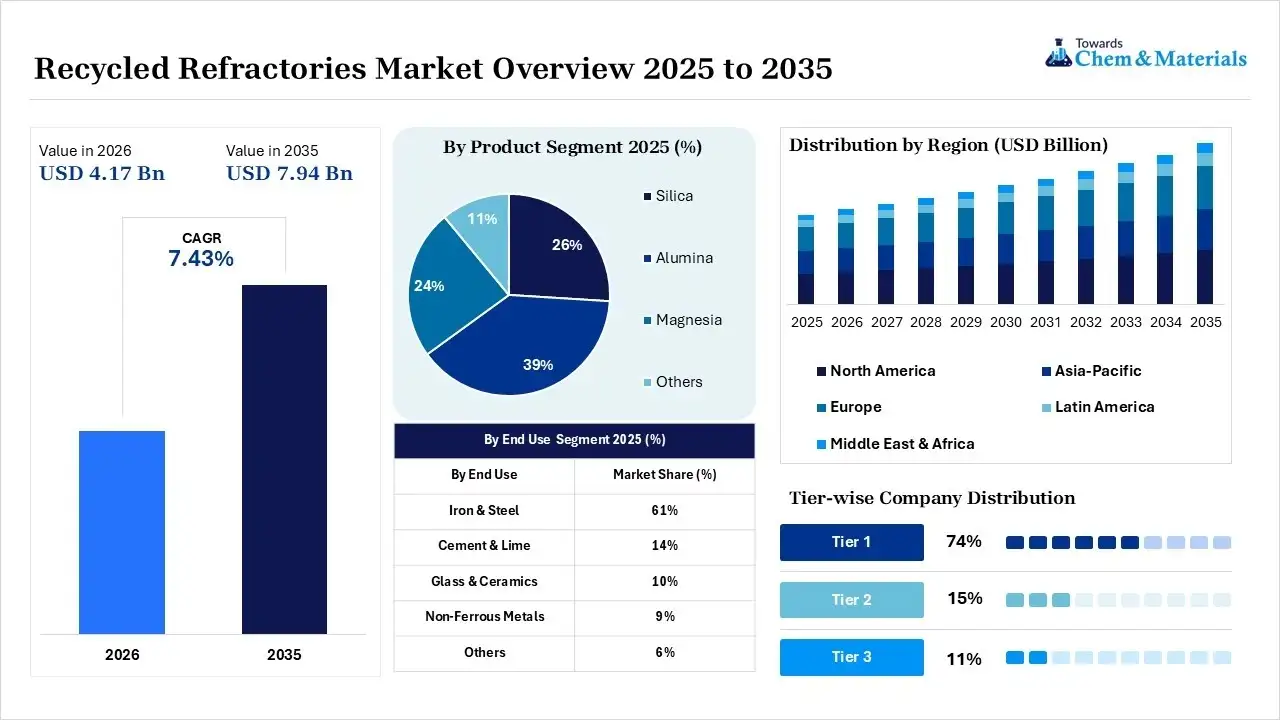
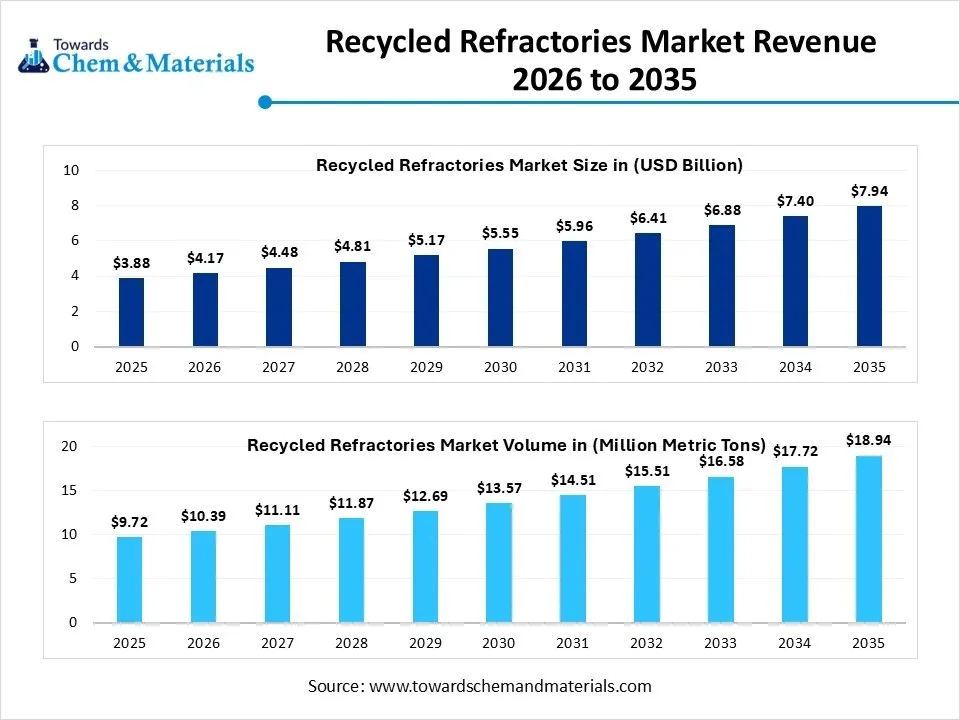
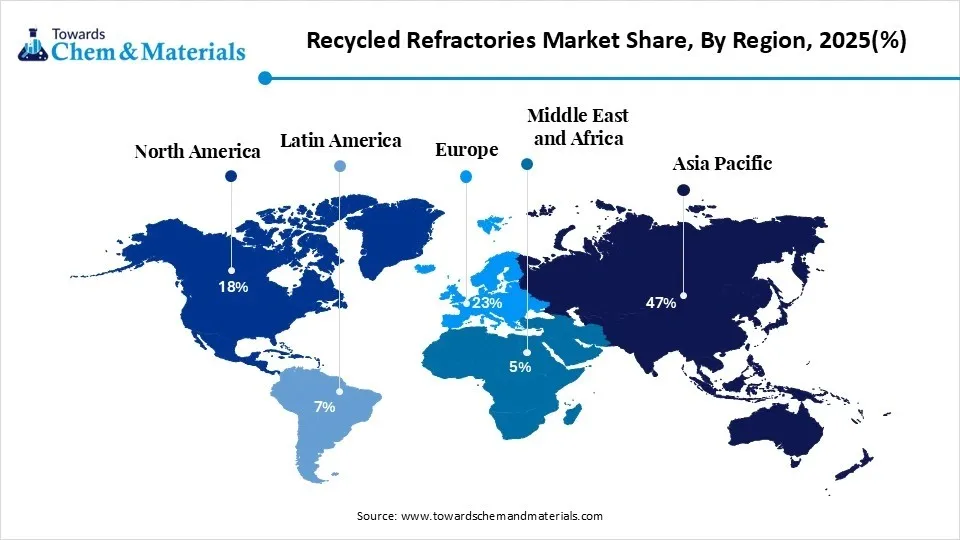
The global recycled refractories market size was valued at USD 3.88 billion in 2025, is estimated to reach USD 4.17 billion in 2026, and is projected to reach USD 7.94 billion by 2035, exhibiting a compound annual growth rate (CAGR) of 7.43% over the forecast period from 2026 to 2035.Asia Pacific dominated the recycled refractories market with the largest revenue share of 47% in 2025 and is expected to grow at the fastest CAGR of 7.55% during the forecast period.
The growing demand for circular manufacturing due to stricter global emissions regulations and adoption of low-carbon practices, and increased use of recycled products from many sectors to shift towards sustainable practices boosts the growth of the market. Sustainability and industrial trends aim to avoid substantial CO2 emissions for major producers like RHI Magnesita and also help reduce landfill waste, aligning with environmental regulations amid growing concerns. The key collaborations between regional joint ventures and research partnerships like RHI Magnesita & GECCO / ReSoURCE / MIRECO are gaining attention, which support the growth of the market in the coming years.
Market Highlights
- By region, Asia Pacific dominated the recycled refractories market with a share of 47% in 2025 and is expected to grow at a CAGR of 7.55% over the forecast period.
- By region, the Middle East and Africa held 6% market share in the recycled refractories market in 2025 and is expected to experience the fastest growth with a CAGR of 8.20% in the forecast period.
- By product, the alumina segment dominated the market with a 39% share in 2025 and is expected to grow at a CAGR of 7.20% over the forecast period.
- By product, the magnesia segment held 24% market share in 2025 and is expected to have the fastest growth with a CAGR of 8.10% in the forecast period.
- By end use, the iron and steel segment dominated the market with a 61% share in 2025 and is expected to grow at a CAGR of 7.20% over the forecast period.
- By end use, the non-ferrous metals segment held 9% market share in 2025 and is expected to have the fastest growth with a CAGR of 7.60% in the forecast period.
According to Towards Chemicals and Materials Analytics and Consulting, the global recycled refractories market volume was valued at 9.72 million metric tons in 2025 and is expected to surpass around 18.94 million metric tons by 2035, accelerating a compound annual growth rate (CAGR) of 6.90% over the forecast period from 2026 to 2035.
Recycled Refractories: Industrial
Decarbonization and Sustainability
The recycled refractories market is experiencing growth due to greater adoption of circular manufacturing models, which helps in lowering the carbon footprint and also helps in minimizing landfill waste due to the industrial shift towards sustainability and decarbonization initiatives, which boosts growth. Supply chain security and reduced dependency on the import of materials and raw material price volatility for critical refractory minerals propel growth and demand for the market. Governmental and sustainable regulations for enforcing tighter emission control and waste management mandates increase and push industries to adopt the use of recycled materials.
- For instance, in June 2026, N.A.N. GreenMet and Belgiums Silox Group established a 50:50 joint venture to build a 40,000 tonnes per annum battery recycling and critical minerals recovery hub in Andhra Pradesh. The facility will focus on extracting high-purity lithium, cobalt, nickel, and manganese from end-of-life electric vehicle batteries using advanced hydrometallurgical technology.(Source: www.manufacturingtodayindia.com)
The use of cost-effective and cost efficiency as recycling of spent refractories, which recovers most valuable raw materials like silica, alumina, and magnesia, is cost-efficient and also helps significantly cut the cost of expensive virgin raw materials. The joint ventures and circular economy initiatives through strategic collaboration and partnership to process spent materials, like Saint-Gobain and Shinagawa Refractories, partnered to advance sustainable recycling processes. RHI Magnesita also participates in research projects like ReSoURCE and collaborates on waste-based geopolymer construction materials. These initiatives and collaborations accelerate the growth of the market in the coming decades.
- For instance, in January 2026, MaxVolt Energy launched a subsidiary, MaxVolt ReEarth, to enter Indias lithium battery recycling market with a focus on creating a circular economy for spent EV and telecom batteries. The new venture aims to process multiple chemistry profiles to recover critical minerals.(Source: www.manufacturingtodayindia.com)
What are Recycled Refractories?
Recycled refractories are processed spent heat-resistant ceramic materials that are reclaimed from high-temperature industrial equipment like ladles, kilns, and furnaces, and then they are treated for reuse through recycling. They are generally made of alumina, silica, and chrominte, and dolomite. They are sourced from spent linings from steelmaking, cement kilns, glass furnaces, and petroleum reactors. They are commonly used in slag conditioners and raw material feedstocks.
What are the key uses of recycled refractories?
The recycled refractories are processed and repurposed from industrial waste and scrap, and they are primarily used in metallurgical operations, cement manufacturing, and secondary refractory production.
- Slag Conditioning: Spent magnesia-carbon (MgO-C) refractories are crushed and added to Electric Arc Furnaces (EAF) as a substitute for dolomitic lime, helping achieve MgO saturation in the slag, reducing furnace lining wear, and saving on flux costs.
- Raw Material for New Refractories: Processed alumino-silicate materials are reused in medium-range castables and precast shapes, while recycled alumina-magnesia and mag-carbon are repurposed into tundish sprays and furnace gunning repair products.
- Cement Feedstock: Crushed and graded spent refractory fragments serve as alternative raw material inputs or iron/alumina additives for clinker fabrication in cement kilns.
- Bauxite Replacement: Alumino-silicate secondary raw materials (SRM) act as functional bauxite substitutes during secondary ladle metallurgical treatments.
- Niche Industrial Uses: Spent dolomite bricks are utilized as soil neutralizers, and processed refractory powders find applications in industrial powder coatings and other metallurgical additives.
Recycled Refractories Premium Pricing Analysis
Recycled refractories command premium pricing when they incorporate high-purity sorted aggregates, advanced composite bonding, and certified carbon-reduction metrics that lower overall operational costs for heavy industries. The value drivers for premium pricing are carbon footprint mitigation, enhanced durability composites, and total cost of ownership. The recycling adoption and new product launch, which reduced virgin raw material use, will help with product pricing in the coming decades.
Global Investment Flow for Recycled Refractories Market 2026
The growing investments by global companies and governments in recycled refractories are accelerating rapidly as heavy industries drive toward decarbonization and circular economy practices. Companies are collaborating on EU-backed circular projects like ReSoURCE and the Christian Doppler Laboratory (GECCO2) to turn refractory waste into alternative streams like geopolymer construction materials.
- In January 2026, RHI Magnesita partnered with clean-tech startup MCi Carbon for the CCUpScale project, securing €3.8 million in initial funding to advance the worlds first Carbon Capture and Utilization (CCU) plant in the refractory industry.(Source: www.rhimagnesita.com)
Report Scope
| Report Attributes | Details |
| Market Size in 2026 | USD 4.17 Billion/ 10.39 Million Metric Tons |
| Expected Size in 2035 | USD 7.94 Billion/ 18.94 Million Metric Tons |
| Growth Rate | CAGR of 7.43% |
| Base Year of Estimation | 2025 |
| Forecast Period | 2025-2035 |
| Dominant Region | Asia Pacific |
| Segment Covered | By Product, By End Use, By Region |
| Key Companies Profiled | Krosaki Harima Corporation, Harsco Corporation, Horn & Company Group (HORN & CO. GROUP), Refratechnik Group, LKAB Minerals, Global Recycling, Imerys (Calderys), Deref S.p.A., REF Minerals, Mineralen Kollée, Jai Balajee Trading Co., Shinagawa Refractories Co., Ltd., Morgan Advanced Materials, Magnezit Group, Veolia, Chosun Refractories |
Market Growth Trends
- The growing sustainability and industrial trends due to strict environmental emission and lowering carbon emission and decarbonization initiatives, which push manufacturers to recycle the major metals and materials for reuse.
- The growing dominance of iron and steel increases demand due to high-temperature operational demand, and due to its application in industries driving growth.
- Process evolution and mechanical recycling are the most efficient volume processes, and increased adoption of chemical and thermal recovery methodologies is a growing trend in the market.
Technological Shifts in the Recycled Refractories Market: Through AI Integration
The key technological shift for manufacturing and recycling refractories is automated sensor-based sorting, where, through ML, the components are identified and separated down according to size, which helps limit manual sorting, fueling growth. The raw material optimization through ML also helps in chemical impurity and phase compositions without sacrificing strength. Predictive process control through real-time sensors for data monitoring helps detect structural defects and contamination in recycled fractions and helps ensure uniform quality and lower energy consumption, driving and boosting growth.
Supply Chain Analysis of Recycled Refractories Market
Refractory Recycling & Processing
- Recycled refractories are produced by collecting spent refractory materials from industrial furnaces and kilns, followed by sorting, crushing, screening, purification, and reprocessing to manufacture high-quality refractory raw materials for reuse in high-temperature applications.
- Key Players: RHI Magnesita, Calderys, Refratechnik, Saint-Gobain.
- RHI Magnesita operates refractory recycling facilities that recover and process spent refractory materials into high-quality raw materials for steel, cement, non-ferrous metals, and glass industries, supporting circular economy initiatives.
Quality Testing & Certification
- Recycled refractories must comply with standards for chemical composition, thermal stability, mechanical strength, impurity levels, and product consistency before reuse in industrial furnaces and high-temperature processes.
- Key Authorities & Standards: International Organization for Standardization, ASTM International, European Committee for Standardization, European Chemicals Agency.
- Calderys manufactures recycled refractory products that meet stringent quality and performance standards for high-temperature industrial applications, helping customers improve resource efficiency and reduce environmental impact.
Distribution to End-Use Industries
- Recycled refractories are supplied to steel manufacturers, cement producers, glass manufacturers, non-ferrous metal processors, petrochemical plants, and power generation facilities for furnace lining and thermal insulation applications.
- Key Suppliers: RHI Magnesita, Refratechnik, Saint-Gobain.
- Refratechnik supplies recycled refractory materials and engineered refractory solutions for steel, cement, lime, and non-ferrous metal industries, enabling customers to enhance furnace performance while supporting sustainable resource utilization.
Sustainability Analysis in Recycled Refractories
The sustainability analysis of recycled refractories is significant in reducing carbon footprints and also helps in reducing landfill waste for high-temperature industrial sectors, which aligns with sustainability initiatives and regulations that drive growth. The raw material depletion, logistics, and processing impacts overall depend on minimizing transport distance and also optimizing recycling and sorting efficiency.
Recycled Refractories Market Carbon Tax Analysis
Carbon taxes and carbon-border adjustment tariffs are accelerating demand for secondary raw materials in the recycled refractories market. Leading suppliers are scaling up circular recipes such as magnesia-carbon bricks containing up to 30% recycled raw material content to maintain performance while minimizing regulatory tax burdens. Traditional production methods for primary raw materials and standard magnesia-carbon bricks release high levels of CO₂, exposing manufacturers to rising carbon taxes and border tariffs such as the European Unions carbon pricing mechanisms.
Recycled Refractories Market Regulatory Landscape
| Country / Region | Regulatory Body | Key Regulations | Focus Areas | Notable Notes |
| United States | Environmental Protection Agency, Occupational Safety and Health Administration | Resource Conservation and Recovery Act, Toxic Substances Control Act | Refractory recycling, industrial waste management | The U.S. promotes recycling of spent refractories to reduce landfill waste, conserve raw materials, and support circular manufacturing. |
| European Union | European Commission; European Chemicals Agency | Waste Framework Directive; REACH Regulation; Circular Economy Action Plan | Circular economy, secondary raw materials | Europe encourages refractory recycling to improve resource efficiency and reduce carbon emissions in steel, cement, and glass industries. |
| China | Ministry of Ecology and Environment, Ministry of Industry and Information Technology | Solid Waste Pollution Prevention and Control Law; Circular Economy Promotion Law | Industrial waste recycling, resource recovery | China is expanding refractory recycling to support sustainable steel production and reduce dependence on virgin raw materials. |
| India | Ministry of Steel; Central Pollution Control Board | Hazardous and Other Wastes (Management and Transboundary Movement) Rules; Environmental Protection Act | Industrial waste utilization, sustainable manufacturing | India is promoting refractory recycling to improve resource efficiency and support the steel and cement industries. |
| Japan | Ministry of Economy, Trade and Industry, Ministry of the Environment | Act on the Promotion of Effective Utilization of Resources | Resource conservation, industrial recycling | Japan focuses on high-value recycling of spent refractories to enhance material recovery and reduce industrial waste. |
| Germany | Federal Ministry for the Environment, German Environment Agency | Circular Economy Act, REACH Compliance | Recycled refractories, sustainable industrial production | Germany is a leading adopter of refractory recycling technologies, driven by strong environmental regulations and advanced manufacturing practices. |
Market Dynamics
Drivers: The Circular Economy Adoption
The growth of the recycled refractories market is driven by the growing adoption and push towards industrial sustainability and the adoption of zero waste and circular economy frameworks due to strict environmental regulations. Recycling decreases the dependency on virgin raw materials and also helps in cutting down the cost of mining, extraction, and energy consumption, which is a major growth driver in the market. Technological advancements in improving material sorting and processing technologies make it easier for extraction and recovery, which boosts the growth of the market.
Challenges: Quality Variability and Contamination
The key growth challenges that hinder the growth of the market are the quality variability and contamination. Used refractories may often contain mixed chemical compositions with industrial scrap, which may be a challenge to growth. The high processing and energy costs of separation and breaking them down, and energy use, raise operational expenses, which creases hinderance in the growth. Other key challenges are the strict industrial safety standards, logistical and collection hurdles, and price sensitivity of the end users, which hinder the growth of the market.
Opportunities : Technological Advancements in Recycling
The growth of the market is driven by growing opportunities created by the technological advancements in recycling of materials, like improvements in material recovery sorting and granulometry control, which allow processing plants to reprocess breakout materials that were previously deemed non-reusable. The other key growth opportunities are circular economy adoption, raw material and energy cost stability, decarbonization, and emission regulation boosts the growth and expansion of the market.
Segmental Insights
Product Insights
The alumina segment dominated the market with a 39% share in 2025 and is expected to grow at a CAGR of 7.20% over the forecast period, driven by the dominant use in core high-temperature industries like iron, steel, cement, and glass due to its application and widespread demand for the materials. Spent high alumina refractories are heavily recovered and recycled into secondary raw materials due to their high resistance to thermal shocks and corrosive slag, which boosts growth. The rapid industrialization and localized recycling aggressively increase the use of spent alumina, driven further by cost and supply volatility mitigation.
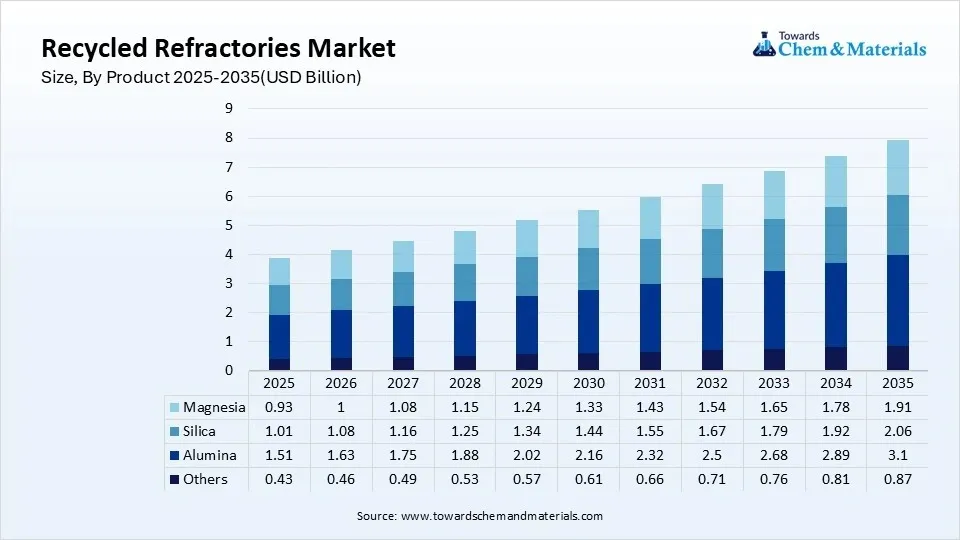
The magnesia segment held 24% market share in 2025 and is expected to have the fastest growth with a CAGR of 8.10% in the forecast period, driven by the rising industrial demand and circular economy mandates, which influence the growth. The heavy reliance of basic oxygen and electric arc furnaces on alkaline linings ensures a steady, high-volume stream of spent magnesia scrap ready for processing. Using recycled magnesia aggregates significantly cuts embodied carbon and CO₂ emissions during high-temperature manufacturing, which fuels the growth.
Recycled Refractories Market Share, By Product, 2025(%)
| By Product | Market Share (%) |
| Silica | 26% |
| Alumina | 39% |
| Magnesia | 24% |
| Others | 11% |
End Use Insights
The iron and steel segment dominated the market with a 61% share in 2025 and is expected to grow at a CAGR of 7.20% over the forecast period, driven by generating massive volumes of spent lining materials and facing strict pressure to adopt circular economy practices, which drives the growth of the market. Major refractory original equipment manufacturers (OEMs) and recyclers increasingly partner with steel mini-mills and integrated plants to manage take-back programs and secure consistent, high-quality secondary raw material streams, further boosting the growth of the market.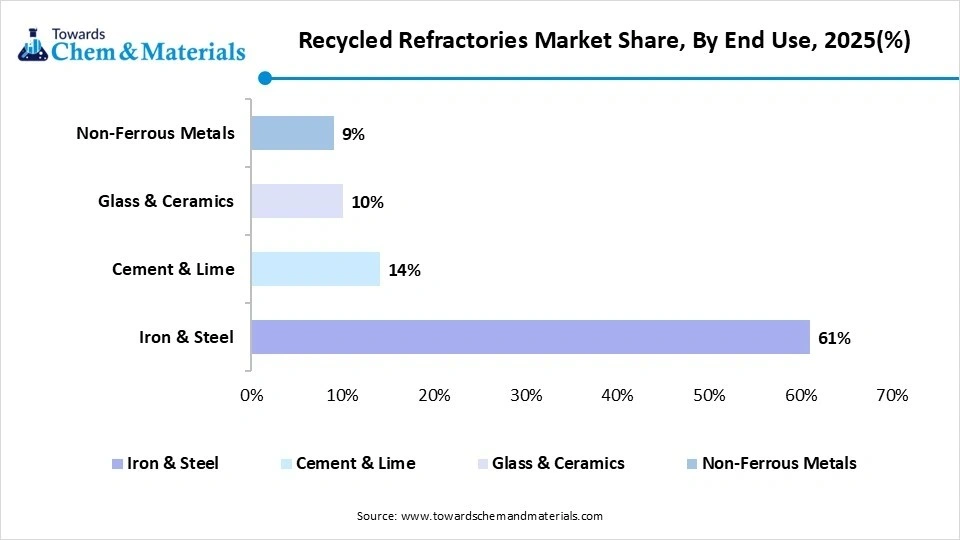
The non-ferrous metals segment held 9% market share in 2025 and is expected to have the fastest growth with a CAGR of 7.60% in the forecast period, by adopting circular-economy practices to enhance resource efficiency, lower production costs, and reduce industrial waste, driving growth. Non-ferrous metal producers such as those processing aluminum, copper, zinc, and lead are increasingly integrating recycling initiatives to meet environmental regulations and corporate carbon-reduction goals. Advancements in sorting, processing automation, and customized refractory formulations allow plants to utilize recycled linings safely in harsh molten-metal environments without sacrificing thermal performance.
Recycled Refractories Market Share, By End Use, 2025(%)
| By End Use | Market Share (%) |
| Iron & Steel (Dominating) | 61% |
| Cement & Lime | 14% |
| Glass & Ceramics | 10% |
| Non-Ferrous Metals (Fastest Growing) | 9% |
| Others | 6% |
Regional Analysis
How did Asia Pacific dominate the Recycled Refractories Market in 2025?
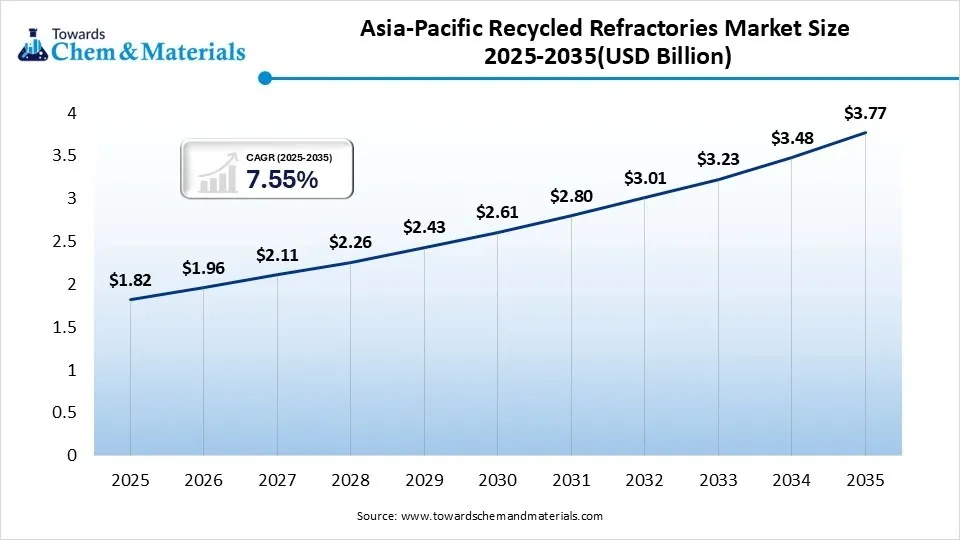
The Asia Pacific recycled refractories market size was estimated at USD 1.82 billion in 2025 and is projected to reach USD 3.77 billion by 2035, growing at a CAGR of 7.55% from 2026 to 2035. Asia Pacific dominated the market with a share of 47% in 2025 and is expected to grow at a CAGR of 7.80% over the forecast period, driven by massive industrial activity and cement manufacturing in China and India, which drive growth of the market. Rapid urbanization and infrastructure development projects across the growing economies drive growth. Cost efficiency and sustainability push due to surging raw material expenses and tightening regional environmental expectations encourage local manufacturers to adopt cost-effective recycled refractory alternative and, which helps lower the overall operational cost, boosting the growth of the market.
India Recycled Refractories Large-Scale Facilities
The India recycled refractories market is driven by industrial sustainability goals and a growing push towards a circular economy, which boosts growth. Local recycling and supply chain vulnerability reduce carbon intensity, which boosts the growth of the market. Odisha serves as a major hub due to its close proximity to large steel producers like Tata Steel and JSPL, ensuring a steady supply of spent refractories, supporting the growth of the market.
China Recycled Refractories Supply Chain Shifts
The China recycled refractories market is driven by tightening environmental regulations and rising primary mineral extraction costs inside China; secondary raw material recovery from spent refractories has become an integral part of the industrial supply chain. Producers face continuous pressure from emission reduction mandates and carbon pricing mechanisms, pushing domestic Chinese manufacturers to rely more heavily on circular processing and recycling verticals, which drives growth.
Middle East and Africa Recycled Refractories Government-Backed Programs
The Middle East and Africa recycled refractories market size was estimated at USD 0.19 billion in 2025 and is projected to reach USD 0.44 billion by 2035, growing at a CAGR of 8.76% from 2026 to 2035. The Middle East and Africa held a market share of 6% in 2025 and are expected to have the fastest growth with a CAGR of 8.20% in the forecast period, driven by large-scale development and industrial megaprojects and greenfield investments like Saudi Arabia’s Vision 2030, including NEOM, which boosts growth in the region. The strict environmental guidelines and corporate net zero targets encourage industries in the region to adopt recycling practices and lower the carbon footprints per production cycle, which drives the growth of the market. Government-backed industrial programs in countries like Saudi Arabia, the UAE, and South Africa promote localized material recycling and efficient resource management, boosting the growth.
Saudi Arabia Recycled Refractories Industry Drivers
The Saudi Arabia recycled refractories market is driven by Saudi Vision 2030, industrial sectors like steel, aluminum, cement, and glass generate significant refractory waste from furnace maintenance and relining. Specialized local providers such as Power Zone Contracting Co. crush, screen, and segregate refractory waste into powders and aggregates. These are reused as steelmaking additives or supplied to local refractory manufacturers, reducing landfill waste and material costs support8ing growth of the market.
UAE Recycled Refractories Environmental Value
The UAE recycled refractories market is driven by sustainability through local support and circular economy initiatives, which fuel the growth. Companies like Gremlog Trading DMCC supply processed, recycled/spent refractory bricks in Dubai and the wider UAE to help lower industrial costs and reduce landfill waste. Recycling high-temperature ceramic and brick materials conserves raw resources, cuts down carbon footprints, and aligns with the UAEs broader industrial waste-reduction strategies, fueling growth.
Europe Recycled Refractories Market Environmental Regulations
The Europe recycled refractories market size was estimated at USD xx billion in 2025 and is projected to reach USD xx billion by 2035, growing at a CAGR of xx% from 2026 to 2035. Europe held a market share of 23% in 2025, driven by industrial expansion in sectors and increased regulatory pressure, which helps to reduce carbon emissions and lower raw material costs, driving growth. The European Union environmental rules and carbon pricing mechanisms, which increase adoption of waste reduction and increased recycled content maintenance contracts in the region, boost the growth. High regional heavy industrial output generation, ensuring a consistent supply of raw materials for recycling hubs with advancement in capabilities, propels the growth of the market.
United Kingdom Recycled Refractories Major Producers
The United Kingdom recycled refractories market involves the collection, sorting, and processing of spent high-temperature ceramic linings from industries like steel, cement, and foundry operations. Specialized UK providers such as Refractory Recycling, run via Richmond Reclamation in Sheffield, offer dedicated industrial waste collection, roll-on/roll-off skip services, toll processing, and recycled aggregate or sorted brick products. These innovative and advanced services propel growth.
Germany Recycled Refractories Key Players and Facilities
Germany is a leader in Europes recycled refractories sector, driven by major industrial initiatives, specialized processing plants, and advanced sorting technologies aimed at cutting carbon emissions. Europes first dedicated refractory recycling platform, founded by RHI Magnesita and the Horn & Co. Group, operates recycling and processing infrastructure with facilities spanning across Europe, including Germany, which drives the growth of the market.
North America Recycled Refractories Market Cost-Saving Measures
The North America recycled refractories market size was estimated at USD 0.70 billion in 2025 and is projected to reach USD 1.47 billion by 2035, growing at a CAGR of 7.70% from 2026 to 2035. North America held a market share of 18% in 2025, driven by corporate sustainability targets and rising landfill disposal costs, and high-end adoption of closed-loop recycling programs in steel due to growing demand fuels the growth. Partnerships between independent processors and refractory Original Equipment Manufacturers ensure that recycled materials meet exact chemistry and sizing standards. The cost-saving measures and corporate decarbonization goals in heavy industries further boost the growth of the market.
United States Recycled Refractories: Presence of Independent Operators
The United States recycled refractories market is driven by the presence of key players like Glenn Hunter & Associates, which leads specialized processing with zero-landfill policies, operating plants in Delta, Ohio, and Kendallville, Indiana, while major producers like RHI Magnesita increasingly offer on-site crushing and closed-loop solutions for industrial clients, which contributes largely to the growth of the market.
Canada Recycled Refractories Industrial Demand in Heavy Sectors
The Canadian recycled refractories market is driven by industrial sustainability mandates, rising costs of virgin raw materials, and circular economy adoption. Ongoing activity in Canadian steelmaking, non-ferrous metals, mining, and petrochemical processing maintains a steady baseline requirement for high-temperature lining materials, creating a constant stream of spent refractories available for reprocessing. This boosts the growth and expansion of the market.
Latin America Recycled Refractories Market Operational Efficiency
The Latin America recycled refractories market size was estimated at USD 0.27 billion in 2025 and is projected to reach USD 0.60 billion by 2035, growing at a CAGR of 8.31% from 2026 to 2035. Latin America held a market share of 6% in 2025, driven by the modernizing furnaces and adoption of EAF production, which require high-performance refractory management and encourage local recycling and relining efficiencies, boosting the growth of the market. The growth in end users in regions like Brazil and Argentina is creating a steady stream of refractory waste that feeds the recycling loop, driving growth. Regional manufacturers are increasingly adopting circular manufacturing and recycling to meet internal and regulatory green targets, which boosts the growth and expansion of the market.
Brazil Recycled Refractories Expanding Steel and Metal Production
The Brazil recycled refractories market is driven primarily by heavy industry demand and sustainability mandates. Ongoing investments in infrastructure projects, cement, and mining operations foster technological upgrades and the integration of eco-friendly refractory technologies. Other factors are cost efficiency, raw material availability, sustainability, and environmental compliance. Brazil is Latin America’s largest industrial base due to expanding steel and metal production, which boosts growth.
Argentina Recycled Refractories Sustainability and Regulations
Argentinas recycled refractories market grows as heavy industries adopt circular economy principles and cost-saving waste management, boosting the growth of the market. High-temperature operations in Argentinas core steel, cement, mining, and glass sectors generate steady requirements for durable lining materials. Local environmental compliance mandates and corporate carbon-reduction initiatives encourage plants to lower emissions and adopt eco-friendly material cycles in the region, boosting the growth of the market.
Recent Developments
- In June 2026, Holcim introduced its ECOPlanet low-carbon cement and ECOCycle circular construction platform in the UAE as part of its initiative to lessen the environmental footprint of the countrys construction industry. ECOPlanet cement has approximately 30% lower carbon emissions than traditional cement, while still providing similar performance. Additionally, the company launched ECOCycle, a technology platform that reclaims and recycles construction and demolition waste into new building materials.(Source: www.cemnet.com)
- In March 2026, Asahi Kasei, Nippon Steel, and Nippon Steel Trading partnered together to launch closed-loop titanium recycling, which is done from electrolysis cell production. Here, the pure titanium scrap is converted to reusable raw materials. The aim is to reduce material waste and improve efficiency across the chlor alkali industry supply chain.(Source: www.manufacturingtodayindia.com)
Competitive Analysis
The key collaborations and joint ventures between companies and even through research organizations to develop and launch advanced and innovative materials, aligning with sustainability regulations, increase growth across regions.
The collaboration aims to align closely with national goals for a circular economy and industrial waste reduction.
- In June 2026, RHI Magnesita and Khemka Refractories Pvt. Ltd. announced a partnership to establish a greenfield refractory recycling unit in Odisha, India. This initiative aims to align with the sustainability and circular business models in the Indian refractory market. This step is taken to advance the circular economy, reduce carbon emissions, and meet reduction goals.(Source: www.manufacturingtodayindia.com)
- In April 2026, Calderys inaugurated its CAPES manufacturing hub in Khurda, Odisha; the facility stands as the worlds largest single-site greenfield refractory plant, incorporating automated lines designed around strict resource efficiency, circular economy principles, and zero-water-discharge standards.(Source: calderys.com)
Top players in the Recycled Refractories Market & Their Offerings
| Company | Company Type/Position | Major Headquarters | Geographic Presence | Recycled Refractories Offerings | Key Offering/Strength |
| RHI Magnesita N.V. | Global refractory products manufacturer | Vienna, Austria | Europe, North America, Asia Pacific, Latin America | Recycled magnesia and dolomite refractories, refractory recycling services, and circular refractory solutions | Industry leader in refractory recycling with integrated collection, processing, and reuse capabilities |
| Calderys | Refractory solutions and recycling provider | Issy-les-Moulineaux, France | Europe, North America, Asia Pacific, Middle East | Recycled refractory raw materials, monolithic refractories, and sustainable lining solutions | Strong expertise in circular refractory technologies and customized recycling services |
| Saint-Gobain | Advanced materials and refractory manufacturer | Courbevoie, France | Europe, North America, Asia Pacific, Middle East | Recycled refractory materials, high-performance refractory products, and ceramic solutions | Broad advanced materials portfolio with a strong focus on sustainable manufacturing |
| HarbisonWalker International | Refractory products manufacturer | Moon Township, Pennsylvania, USA | North America, Europe, Asia Pacific | Recycled refractory aggregates, monolithic refractories, bricks, and refractory recycling programs | Comprehensive refractory recycling and waste reduction solutions for heavy industries |
| Vesuvius plc | Molten metal flow engineering and refractory solutions provider | London, United Kingdom | Europe, North America, Asia Pacific, Latin America | Recycled refractory products, refractory linings, and recycling services for steel and foundry industries | Advanced refractory technologies with a strong emphasis on sustainability and resource efficiency |
Other Top Players Are
- Krosaki Harima Corporation
- Harsco Corporation
- Horn & Company Group (HORN & CO. GROUP)
- Refratechnik Group
- LKAB Minerals
- Global Recycling
- Imerys (Calderys)
- Deref S.p.A.
- REF Minerals
- Mineralen Kollée
- Jai Balajee Trading Co.
- Shinagawa Refractories Co., Ltd.
- Morgan Advanced Materials
- Magnezit Group
- Veolia
- Chosun Refractories
Segments Covered
By Product
- Silica
- Recycled Silica Bricks
- Silica Ramming Mass
- Silica Aggregate
- Alumina
- High Alumina Refractories
- Calcined Alumina Refractories
- Alumina Castables
- Magnesia
- Dead Burned Magnesia
- Fused Magnesia
- Magnesia-Carbon Refractories
- Others
- Zircon-Based
- Chrome-Based
- Dolomite
- Mullite
- Spinel
- Silicon Carbide
By End Use
- Iron & Steel
- Blast Furnaces
- Basic Oxygen Furnaces
- Electric Arc Furnaces
- Ladles
- Tundishes
- Cement & Lime
- Rotary Kilns
- Clinker Coolers
- Preheaters
- Glass & Ceramics
- Glass Furnaces
- Ceramic Kilns
- Float Glass Production
- Non-Ferrous Metals
- Aluminum
- Copper
- Nickel
- Zinc
- Others
- Petrochemical
- Power Generation
- Waste Incineration
- Foundries
By Regions
- North America
- Europe
- Asia Pacific
- Middle East & Africa
- Latin America
FAQ's




Select User License to Buy
Figures (6)










 sales@towardschemandmaterials.com
 Download Sample
 Schedule a Meeting