
OLED Emitter Materials Market Size, Competitive Landscape Analysis Report 2035
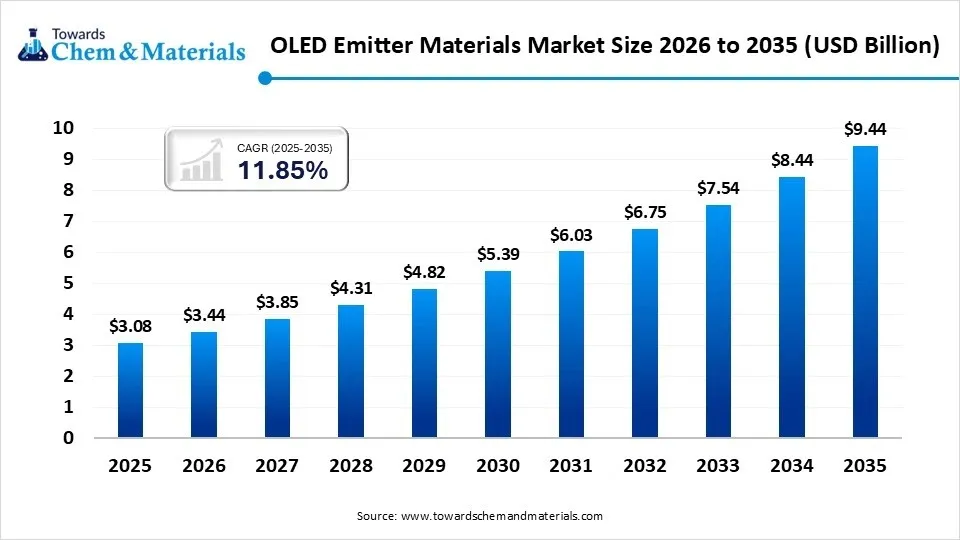
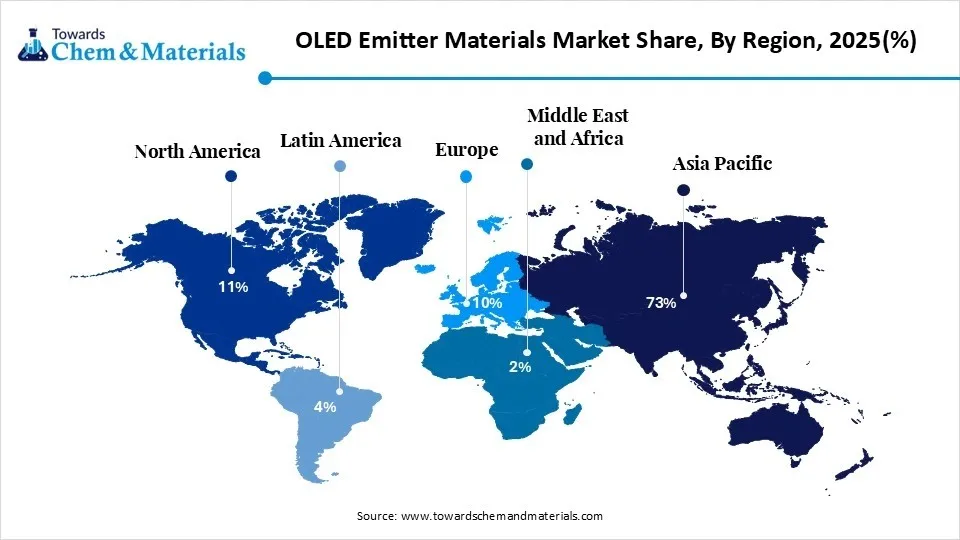
The global OLED emitter materials market size was valued at USD 3.08 billion in 2025, is estimated to reach USD 3.44 billion in 2026, and is projected to reach USD 9.44 billion by 2035, exhibiting a compound annual growth rate (CAGR) of 11.85%over the forecast period from 2026 to 2035.Asia Pacific dominated the OLED emitter materials market with the largest revenue share of 73% in 2025 and is expected to grow at the fastest CAGR of 11.92% during the forecast period. 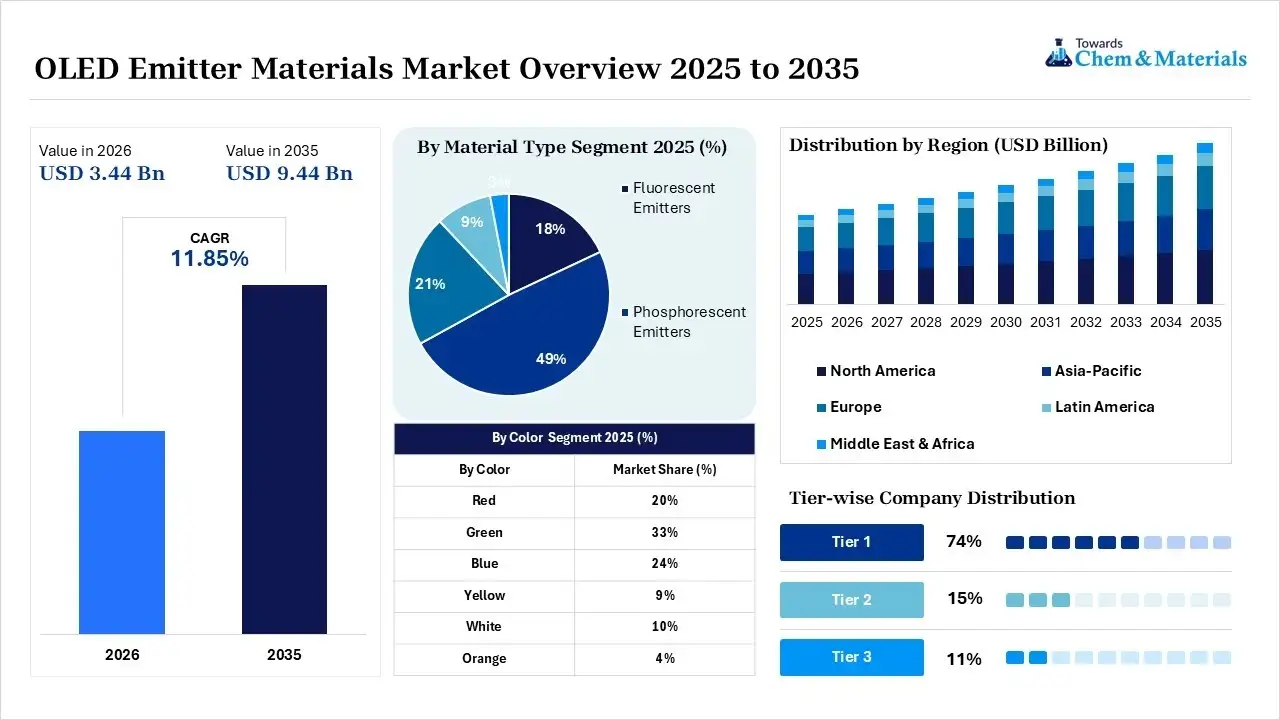
The Ongoing material development, continued interest in high-performance emitter technologies, and increasing commercialization of next-generation OLED architectures will further drive industry growth in the forecast period. The market is expected to grow with the rising use of OLED displays in consumer electronics, automotive displays, and high-end visualization systems.
Market Highlights
- By region, Asia Pacific dominated the OLED Emitter Materials market by holding 73% share in 2025 and is expected to grow at a CAGR of 11.92% during the forecast period.
- By region, North America held 11% market share in 2025 and is expected to grow at the fastest CAGR of 12.8% during the forecast period.
- By material type, the phosphorescent emitters segment dominated the market with the largest share of 49% in 2025 and is expected to grow at a CAGR of 11.2% during the forecast period.
- By material type, the thermally activated delayed fluorescence (TADF) emitters segment held 21% market share in 2025 and is expected to grow at the fastest CAGR of 15.9% over the forecast period.
- By color, the green segment dominated the market with the largest share of 33% in 2025 and is expected to grow at a CAGR of 9.6% during the forecast period.
- By color, the blue segment held 24% market share in 2025 and is expected to grow at the fastest CAGR of 15.8% over the forecast period.
- By deposition technology, the vacuum thermal evaporation (VTE) segment dominated the market with the largest share of 71% in 2025 and is expected to grow at a CAGR of 9.8% during the forecast period.
- By deposition technology, the inkjet printing segment held 14% market share in 2025 and is expected to grow at the fastest CAGR of 16.2% over the forecast period.
- By application, the smartphones segment dominated the market with the largest share of 41% in 2025 and is expected to grow at a CAGR of 10.9% during the forecast period.
- By application, the automotive displays segment held 9% market share in 2025 and is expected to grow at the fastest CAGR of 16.5% over the forecast period.
- By end-use, the consumer electronics segment dominated the market with the largest share of 76% in 2025 and is expected to grow at a CAGR of 11.1% during the forecast period.
- By end-use, the automotive segment held 12% market share in 2025 and is expected to grow at the fastest CAGR of 15.7% over the forecast period.
Expanding High-Performance Display Technologies Supporting the OLED Emitter Materials Market
The OLED emitter materials market is gaining momentum and experiencing steady growth due to the rising need for high-performance display technologies in various end-use industries. Research into advanced emitter materials for OLED displays continues to increase the efficiency, color performance, brightness, and reliability of operation, further driving the adoption of OLED displays. There is ongoing product innovation through growing commercialization of phosphorescent emitters, thermally activated delayed fluorescence (TADF) materials, and emerging hyperfluorescence technologies. Market demand is further bolstered by the growing penetration of various end devices, such as smartphones, automotive displays, television sets, wearable devices, tablets, laptops, and AR/VR devices.
Global Investment Movement for the OLED Emitter Materials Market
Advanced blue emitter technology remains an attractive investment choice for manufacturers, given the technical difficulties of operating the devices for longer periods of time and greater stability. The research programs focus more and more on phosphorescent blue emitters, on thermally activated delayed fluorescent materials, and on hyperfluorescent architectures, which will facilitate commercialization in the future.Investment is increasingly focused on the next generation of molecular engineering platforms to improve emitter efficiency, durability, and manufacturing efficiencies.
OLED material architectures are still being developed, supported by research from companies, which can be used to commercialise the technology in a variety of high-value display applications.Investment momentum is still focused in Asia-Pacific, where display manufacturing capacity is growing, driving up demand for advanced OLED emitter materials. Regional supply chain integration will foster greater involvement of the domestic chemical industry in developing specialised emitter materials for commercial production.
Report Scope
| Report Attributes | Details |
| Market Size in 2026 | USD 3.44 Billion |
| Expected Size in 2035 | USD 9.44 Billion |
| Growth Rate | CAGR of 11.85% |
| Base Year of Estimation | 2025 |
| Forecast Period | 2025-2035 |
| Dominant Region | Asia Pacific |
| Segment Covered | By Material Type, By Color,By Deposition Technology, By Application, By End-use Industry, By Region |
| Key Companies Profiled | Universal Display Corporation, Idemitsu Kosan Co. Ltd., Merck KGaA, LG Chem Ltd., Samsung SDI Co. Ltd., DuPont de Nemours Inc., Sumitomo Chemical Co. Ltd., Hodogaya Chemical Co. Ltd., Kyulux, Solus Advanced Materials, Duksan Neolux, SFC Co., Ltd. |
Recent Market Trends
- The more efficient phosphorescent emitter technologies are being favoured by manufacturers and are being used on a growing number of high-quality smartphones, televisions, wearable devices, automotive displays, and a number of sophisticated consumer electronic applications, making them viable for use in more products.
- As the industry focuses more on thermally activated delayed fluorescent technologies, there will be ongoing material innovation to enhance the performance of OLED materials and minimize reliance on conventional emitter technologies in future display products.
- The increasing performance of inkjet printing technologies is leading to growing interest by display manufacturers in such printing technologies for the following: the ability to manufacture with greater flexibility; better use of material; and commercial scalability for next-generation OLED panel manufacturing across a variety of application segments.
Key Technological Shifts and AI in the OLED Emitter Materials Market
Enhancing AI and Material Innovation in the OLED Emitter Materials Market
In the realm of advanced display technology programs, molecular design and material optimization, along with the entire research workflow, are enhanced by the application of artificial intelligence, which speeds up the development of OLED emitter materials. AI simulation helps to develop complex chemical structures in a more efficient way and cuts down on experiments in material development. AI also plays a key role in manufacturing optimization by ensuring consistency and quality in material synthesis and deposition processes. This is complemented by continued investment in cutting-edge display technology, along with AI-driven research to enhance business value creation and help optimize business activities.
Supply Chain Analysis of the OLED Emitter Materials Market
Raw Material Procurement
- The first step in the supply chain is to obtain specialty chemicals, organic intermediates, solvents, dopants, and high-purity compounds used in the synthesis of OLED emitter materials.
- A stable and high-purity raw material supply guarantees the production quality and reduces the risk of contamination, which enables future molecular design of new generations of emitters for OLED devices.
- Merck KGaA: Secures and supplies ultra-pure basic chemical building blocks and custom halogenated intermediates.
- Other Key Players: Arubedo, Baynoe Chem, Leapchem.
Chemical Synthesis and Processing
- Advanced chemical engineering techniques are used by research groups and material developers to design, synthesize, and optimize OLED emitter molecules in order to achieve higher efficiency, longer lifetime, better color purity, and higher manufacturing compatibility.
- To overcome the challenges of scalability in manufacturing and changing needs in display performance, continuous innovation is required to enable the commercialization of advanced emitter technologies.
- Universal Display Corporation: Synthesizes proprietary high-efficiency phosphorescent emitter architectures and molecular dopants.
- Other Key Players: SFC (Sun Fine Chem), Kyulux
Compound Formulation and Blending:
- Manufacturers produce OLED emitter materials in highly controlled processing conditions, and then carry out purification methods to achieve exceptional chemical purity while ensuring the quality of the commercial grades of material.
- The production of high purity is more likely to reduce defects, increase deposition efficiency, enhance OLED performance, and ensure reliable large-scale production operations.
- Qnity Electronics: produces advanced, tailor-made multi-component emitter and host material systems.
- Other Key Players: LG Chem, Novaled
Sustainability Analysis of the OLED Emitter Materials
In the OLED emitter materials market, sustainability efforts have become more focused on increasing material efficiency, reducing manufacturing waste, and optimizing manufacturing processes across the supply chain. Advanced deposition technologies enable both improved use of materials and minimize the needless use of resources during the fabrication of OLED panels. Research on high-efficiency phosphorescent emitters, thermally activated delayed fluorescence, and hyperfluorescent technologies helps to improve energy efficiency across product life cycles. Improved production yield, longer emitter operational lifetime, and minimization of material loss are other successful chemical engineering achievements that manufacturers aim for.
What is the OLED Emitter Material?
The OLED emitter materials are particular organic compounds that emit light in various colors when excited by an electrical current in an OLED display. These materials are used in a multitude of electronic displays and determine display brightness, efficiency, colour quality, operational lifetime, and overall performance of electronic applications based on OLED technologies.
Uses of the OLED Emitter Materials
- The OLED emitter materials are used for high-quality displays in smartphones that offer better brightness, better colour quality, energy efficiency, and excellent visual performance, creating high-quality user experiences.
- The advanced emitter materials provide superior TV display performance through rich color reproduction, superior contrast, enhanced resolutions, and long-term stable operation in high-quality entertainment applications.
- OLED emitter materials enable high-quality visualization, enhanced viewing performance, and reliable operation for modern digital cockpit and infotainment applications, in advanced automotive displays.
- OLED emitter materials are used in wearable devices, tablets, laptops, and small consumer electronics to give the products a lightweight design, high-color-purity displays, and better visual performance with lower power consumption.
- The use of advanced OLED emitter materials can enable high-performance displays in AR/VR systems, with applications that include enhanced image quality, efficient light emission, and immersive visual experiences.
Pricing Analysis for the OLED Emitter Materials Market
The complexity of manufacturing, rising chemical efficiencies, scaling up, and constant innovation in the technology of the OLED emitter materials are impacting the pricing dynamics in the market. The prices of mature red emitters and green emitters are fairly stable due to the known synthesis routes and consistent commercial production. Premium pricing still prevails for blue emitters due to ongoing limitations on lifetime and material degradation problems. The development of advanced phosphorescent blue emitters, thermally activated delayed fluorescence materials, and hyperfluorescence technologies still involves high costs and complex molecular engineering and design.
OLED Emitter Materials Market: Global Trade Analysis
OLED emitter materials trade is mainly global commerce of high-purity specialty chemicals from advanced research laboratories to major display manufacturing hubs. Asia-Pacific provides strong consumption with display production infrastructure, while North America and Europe supply specialized IP and material innovation. International collaboration and technology transfer, along with specialized cross-border supply chain partnerships, are being reinforced by the increasing demand for phosphorescent emitters, thermally activated delayed fluorescence materials, hyperfluorescence technologies, and advanced blue emitters.
Regulatory Framework: OLED Emitter Materials Market
| Country Region | Regulatory Body | Key Regulations | Focus Areas |
| Asia Pacific | Ministry of Environment | K-REACH | Controlling new chemical substance registrations |
| North America | U.S. Environmental Protection Agency | TSCA (Toxic Substances Control Act) | Pre-manufacture notification for novel organic semiconductor molecules |
| European Union | European Chemicals Agency | REACH (Registration, Evaluation, Authorisation and Restriction of Chemicals) | Restricting hazardous chemicals |
Market Dynamics
Drivers: Rising Adoption of OLED Displays Across Consumer Electronics and Emerging Applications
The demand for OLED displays in smartphones, TV screens, wearable devices, tablets and laptops, automotive displays, and AR/VR devices keeps rising, further driving the demand for advanced emitter materials. High-performance phosphorescent emitters and next-generation TADF technologies are becoming more popular among manufacturers as they seek to enhance the efficiency of displays, color range, and operational reliability. Ongoing investment in new deposition technologies continues to provide material innovation and commercial scalability. Long-term demand for OLED emitter materials is anticipated to be sustained by growth in applications from consumer electronics and the automotive industry over the forecast period.
Restraints :Manufacturing Costs and Material Development Complexity are Hindering Commercial Expansion
There are challenges to the OLED emitter materials market as advanced emitter technologies involve complicated molecule engineering, extremely high chemical purity, and complex manufacturing processes. The operational lifetime and the degradation issues of the material still pose challenges for the development of a blue emitter. Costs are also increased by advanced deposition techniques due to material losses and often strict fabrication specifications. These technical challenges add to the cost of commercialization and to the slow rate of commercialization of several next-generation emitter technologies in various display applications.
Opportunities :Commercialization of Next-Generation OLED Technologies
The growth of commercialization of phosphorescent emitters, thermally activated delayed fluorescence materials, hyperfluorescence technologies, and advanced deposition processes offers opportunities in the OLED emitter materials market. The growing number of new applications in automotive digital cockpits, high-end consumer electronics, and immersive AR/VR devices is driving ongoing investments into research and increasing production. Ongoing innovation to increase emitter efficiency, operational stability, and scalable production further enhances the long-term commercial prospects for the OLED display manufacturing industries globally.
Segmental Insights
Material Type Insights
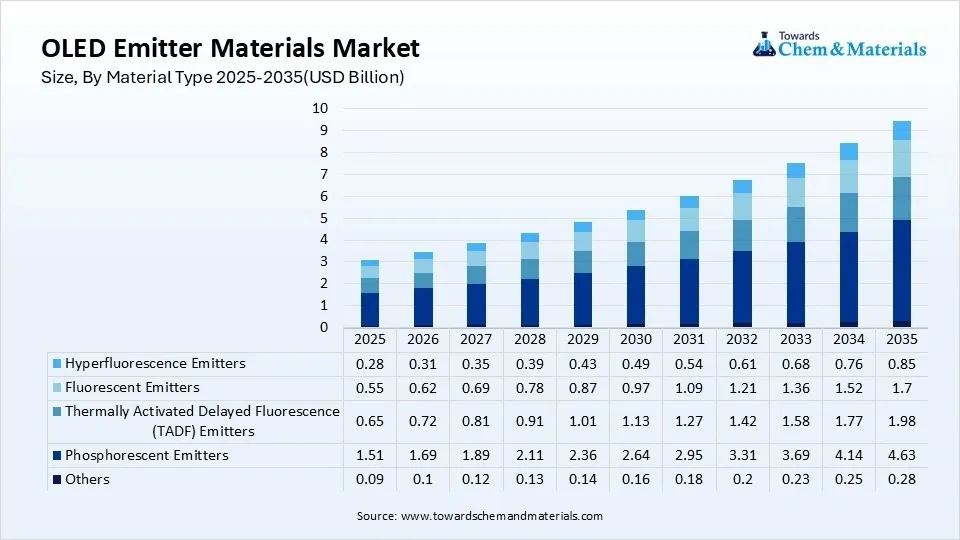
The phosphorescent emitters segment dominated the market with the largest share of 49% in 2025 and is expected to grow at a CAGR of 11.2% over the forecast period, as they are highly effective in generating light and are suitable for high-performance display applications. The proliferation of the highest-end smartphones, TVs, wearable devices, and auto-infotainment has further cemented their commercial momentum. Manufacturers invest continuously in enhancing the operational lifetime and color quality of the OLED, while also working towards greater manufacturing compatibility and opening up the market for advanced OLED technologies.
- For instance, in December 2025, OLED material developer LORDIN announced the commercial viability of high-efficiency blue phosphorescence OLED emitter technology in December 2025, which marks considerable steps towards the market introduction of state-of-the-art phosphorescent materials for the blue.(Source: www.oled-info.com )
The thermally activated delayed fluorescence (TADF) emitters segment held a 21% market share in 2025 and is expected to grow at the fastest CAGR of 15.4% over the forecast period, as manufacturers seek highly efficient next-generation emitter technologies. Continuous molecular engineering is aiding better energy use, better display performance, and more widespread commercialization in high-end electronic devices. Ongoing research and development in advanced materials further stimulate innovation and increase the future commercialization potential of various OLED emitter technologies in the display manufacturing value chain.
OLED Emitter Materials Market Share, By Material Type, 2025(%)
| By Material Type | Market Share (%) |
| Fluorescent Emitters | 18% |
| Phosphorescent Emitters | 49% |
| Thermally Activated Delayed Fluorescence (TADF) Emitters | 21% |
| Hyperfluorescence Emitters | 9% |
| Others | 3% |
Color Insights
The green segment dominated the market with the largest share of 33% in 2025 and is expected to grow at a CAGR of 9.6% over the forecast period, as it has the highest efficiencies, low variability, and ready commercial production. They also have a wide-ranging integration into OLED (Organic Light-Emitting Diode) smartphones, televisions, wearable electronics, and display panels, which helps to sustain demand from manufacturers. As the OLED display sector continues to expand and evolve, the commercial significance of green emitter technologies is further solidified by ongoing performance and production improvements.
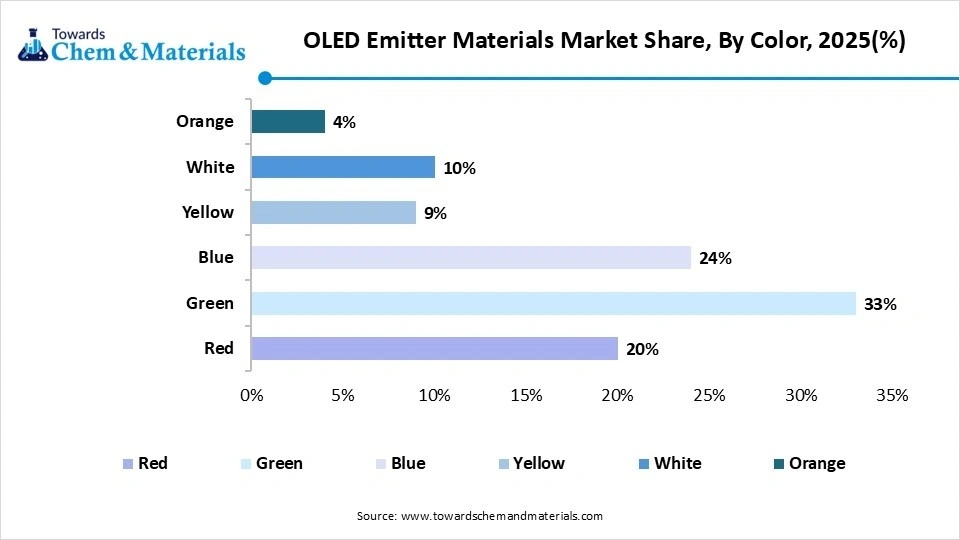
The blue segment held a 24% market share in 2025 and is expected to grow at the fastest CAGR of 15.8% over the forecast period. Improving the operational lifetime is one of the main technological goals for various efforts in the OLED industry, which is why the growth of blue emitters is expected to be the largest. While seeking to address performance constraints, manufacturers are still working to improve molecular engineering, phosphorescent blue emitters, and TADF technologies. If durable blue emitter materials could be commercialized, their performance would be greatly improved in next-generation OLED display applications in various industries.
OLED Emitter Materials Market Share, By Color,2025(%)
| By Color | Market Share (%) |
| Red | 20% |
| Green | 33% |
| Blue | 24% |
| Yellow | 9% |
| White | 10% |
| Orange | 4% |
Deposition Technology Insights
The vacuum thermal evaporation (VTE) segment dominated the market with the largest share of 71% in 2025 and is expected to grow at a CAGR of 9.8% over the forecast period. The most important deposition technology was still vacuum thermal evaporation, which allows for a very precise deposition of materials and therefore very good film quality and device performance. The technology can be used for commercial production of OLED panels in consumer electronics, televisions, automotive displays, and wearable devices. Its proven and established manufacturing infrastructure and reliable production have continued to drive widespread adoption across the OLED display industry.
The inkjet printing segment held a 14% market share in 2025 and is expected to grow at the fastest CAGR of 16.2% over the forecast period, as it offers the greatest manufacturing flexibility and can support efficient material use and scalable production of OLED panels. The growth of commercial applications reflects confidence in next-generation printing technologies for display manufacturing. Further advances in technology will likely drive up the commercialization of various OLED application areas.
- For instance, in July 2026, the Legion R9000P, with an inkjet-printed OLED display, was introduced by Lenovo, the first commercial laptop with an inkjet-printed OLED display after years of development.(Source: www.techrepublic.com )
OLED Emitter Materials Market Share, By Deposition Technology, 2025(%)
| By Deposition Technology | Market Share (%) |
| Vacuum Thermal Evaporation (VTE) | 71% |
| Inkjet Printing | 14% |
| Organic Vapor Phase Deposition (OVPD) | 8% |
| Organic Vapor Jet Printing (OVJP) | 4% |
| Others | 3% |
Application Insights
The smartphones segment dominated the market with the largest share of 41% in 2025 and is expected to grow at a CAGR of 10.9% over the forecast period, since premium high-end mobile devices are now equipped with OLED displays, making them far more colourful, with good contrast and energy efficiency, and offering an improved visual experience. As consumers keep on demanding ever more powerful smartphones, manufacturers are being encouraged to add OLED display production to their manufacturing lines, as well as sustain the demand for high-performing emitter materials in global electronics manufacturing.
The automotive displays segment held a 9% market share in 2025 and is expected to grow at the fastest CAGR of 16.5% over the forecast period. As digital cockpits, infotainment systems, and advanced vehicle interfaces proliferate throughout the automotive industry with high-end OLED display capabilities, automotive displays are expected to become a fast-growing market. Manufacturers keep stressing better display image quality, flexible panel integration, and better visualization, which provide excellent potential for advanced OLED emitter materials in the automotive industry.
OLED Emitter Materials Market Share, By Application, 2025(%)
| By Application | Market Share (%) |
| Smartphones | 41% |
| Television Displays | 22% |
| Wearable Devices | 11% |
| Tablets & Laptops | 8% |
| Automotive Displays | 9% |
| Lighting | 4% |
| AR/VR Devices | 3% |
| Other Consumer Electronics | 2% |
End-Use Insights
The consumer electronics segment dominated the market with the largest share of 76% in 2025 and is expected to grow at a CAGR of 11.1% over the forecast period, as OLED displays are widely used in smartphones, televisions, tablets, laptops, wearable electronics, and other high-end consumer electronics products. Manufacturers are always seeking to employ the highest-performing emitter material to create the brightest displays, best colour reproduction, greater energy efficiency, and greater durability. As consumer demand for increasingly complex display technologies grows, there is continued investment in material innovation and manufacturing capabilities.
The automotive segment held a 12% market share in 2025 and is expected to grow at the fastest CAGR of 15.7% over the forecast period, as the incorporation of OLED displays in digital cockpits, infotainment systems, instrument clusters, and advanced driver interfaces is expected to grow in modern vehicles. Automakers are still building in the finest (and most expensive) display technologies that offer outstanding visual quality, design options, and superior operational characteristics. The rise of connected vehicles and smart mobility solutions continues to drive the use of OLED integration.
OLED Emitter Materials Market Share, By End-use Industry, 2025(%)
| By End-use Industry | Market Share (%) |
| Consumer Electronics | 76% |
| Automotive | 12% |
| Healthcare | 4% |
| Industrial | 3% |
| Aerospace & Defense | 2% |
| Others | 3% |
Regional Insights
How Did the Asia Pacific Dominate the OLED Emitter Materials Market In 2025?
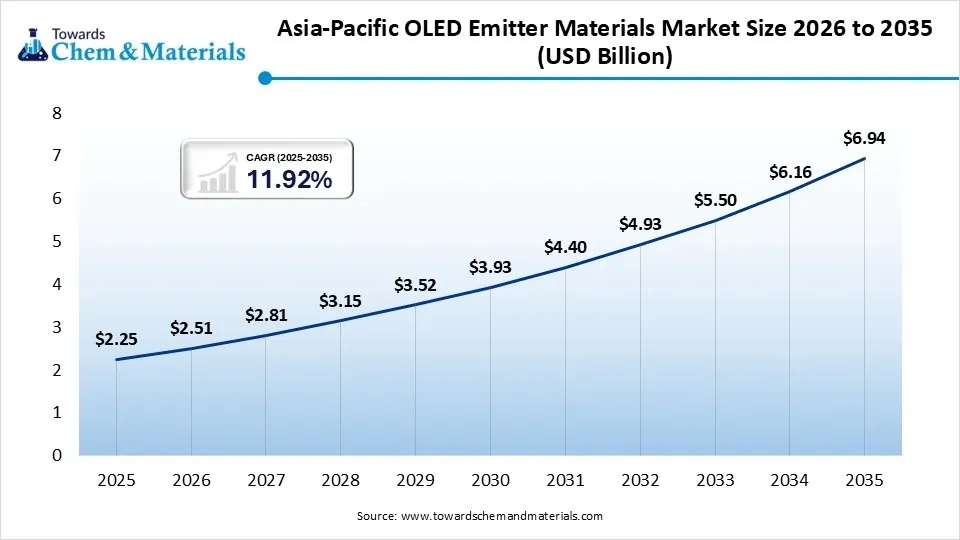
The Asia Pacific OLED emitter materials market size was estimated at USD 2.25 billion in 2025 and is projected to reach USD 6.94 billion by 2035, growing at a CAGR of 11.92% from 2026 to 2035. Asia Pacific dominated the market with the largest share of 73% in 2025 and is expected to grow at a CAGR of 10.2% during the forecast period, due to the presence of a large number of OLED display manufacturing units and a well-established emitter material supply chain. Inherent linkage between chemical suppliers, material developers, and display manufacturers facilitates continuous technological advancement. Companies are actively investing in the enhancement of their emitters and the expansion of their manufacturing capacity at the regional level. Advanced OLED technology is further spurring regional leadership through its commercialization in consumer electronics and automotive products.
Advancing Chinas OLED Material Manufacturing Capabilities
Chinas contribution to the regional market is considerable, both in terms of the expansion of its display manufacturing capacity and in its ability to build its local production capabilities for materials. The participation of local manufacturers in the development of advanced OLED emitter materials for commercial display production is growing. Increased investment throughout the supply chain promotes a greater degree of material integration and manufacturing effectiveness. Constant technology improvements make China more competitive and support more products and applications of advanced OLED display technologies.
Growing Indias electronics manufacturing ecosystem
India is further developing its electronics manufacturing capabilities by boosting demand for advanced display technologies in consumer electronics and automotive applications. With increasing industrial development, the use of OLED products with high-performance emitter materials is increasing. The expansion of manufacturing capacity, along with supportive industrial activities, provides better opportunities to develop the future OLED industry. Indias role in the changing display manufacturing dynamics in the region has increased with the continual growth in electronics production.
North America OLED Emitter Materials Market Trend Analysis
The North America OLED emitter materials market size was estimated at USD 0.34 billion in 2025 and is projected to reach USD 1.09 billion by 2035, growing at a CAGR of 12.36% from 2026 to 2035.North America held 11% market share in 2025 and is expected to grow at the fastest CAGR of 12.8% during the forecast period, with its high R&D prowess and robust IP development. The regional organisations are making ongoing investments in new-generation emitter technologies for enhanced efficiency, durability, and market performance. Research institutions and technology developers work closely together to speed up material innovations. As more advanced display applications are added, the likelihood of future commercialization is further enhanced, and North Americas role in global OLED technology development is further solidified.
Advancing the United States Through Material Innovation
It is important to mention the contributions that the United States makes, including in the realm of advanced chemical research, IP development, and commercialization of innovative OLED emitter technologies. Leading organizations are still enhancing the performance of materials and continue to help drive next-generation display manufacturing around the globe. Good research skills foster the further advancement of phosphorescent emitters and new material technologies for OLEDs. Constantly innovating further solidifies the nations footprint in the global OLED materials landscape.
Improving Canadas Advanced Research Capabilities
Canada promotes regional market development through scientific research, advanced material innovation, and technology development partnerships. Research organizations offer special technological expertise and help to advance the performance and efficiency of OLED materials. Ongoing innovation boosts partnerships for advanced display technologies and future commercialization opportunities. Canada is increasingly playing a part in the regional OLED materials value chain through collaborative research efforts.
Europe OLED Emitter Materials Market Trend Analysis
The Europe OLED emitter materials market size was estimated at USD 0.31 billion in 2025 and is projected to reach USD 0.99 billion by 2035, growing at a CAGR of 12.31% from 2026 to 2035.Europe held 10% market share in 2025 and is expected to grow at a CAGR of 9.7% over the forecast period, due to advanced material research, specialized chemical knowledge, and constant innovation in OLED display technologies. Materials that can be developed to be efficient, with operational stability, and manufacturing compatibility are emphasized by regional companies. As a result, technology progresses well due to the strong collaboration between research institutes and industrial manufacturers. Investment in further advances in material development enhances Europes competitive edge and drives the commercialisation of next-generation OLED display technologies worldwide.
Skilling Germanys Advanced Chemical Expertise
Germanys specialty chemical industry is well established and is contributing to Germanys ongoing investments in advanced OLED material innovation. Manufacturers highlight their work on the formulation of high-performance emitter materials for various applications according to the needs of the display technology. The strong industrial capabilities foster efficient commercialization of innovative material technologies. Continuous research increases the global influence of the OLED emitter materials supply chain in Germany.
Pushing forward Frances Collaborative Innovation Landscape
France encourages the development of OLED materials by means of collaborative research and continuous innovation in the field of advanced electronic materials. Research organisations assist in optimizing the performance of materials, manufacturing compatibility, and long-term display performance. Academic-industrial collaboration boosts technology development. Ongoing development efforts further position France to compete in European OLED materials.
Latin America OLED Emitter Materials Market Trend Analysis
The Latin America OLED emitter materials market size was estimated at USD 0.12 billion in 2025 and is projected to reach USD 0.42 billion by 2035, growing at a CAGR of 13.35% from 2026 to 2035.Latin America held 4% market share in 2025 and is expected to grow at a CAGR of 8.4% over the forecast period, due to the adoption of electronics and industrial development. Advanced display technologies foster future consumption of high-performance OLED materials in several application industries. Improvements in the manufacturing sector at the regional level make it easier to adopt and expand the use of technologies. Sustaining industrial modernization enhances the long-term growth potential of the regional OLED display industry.
Expanding Brazils Consumer Electronics Market
The growth in consumer electronics usage and the discovery of new display technologies help meet regional demand from Brazil. Wider availability of products that need special emitter materials, such as OLED displays, will be promoted by the expansion of industrial activity. Technology adoption is increasing; opportunities for material suppliers and display manufacturers are expected to continue to grow in the future. Brazil is a key player in the regional electronics market because of the continuous development of its electronics industry.
Assisting Chile in the adoption of technology
Chiles contribution is based on the rising market share in advanced electronic products using high-quality OLED display technologies in various consumer applications. A growing digital transformation spurs the need for new display products for future market growth. Enhanced opportunities for wider participation in the OLED ecosystem through growing investments in technology. The continuous modernization reinforces Chiles position in the regional electronics industry.
Middle East & Africa OLED Emitter Materials Market Trend Analysis
The Middle East & Africa OLED emitter materials market size was estimated at USD 0.06 billion in 2025 and is projected to reach USD 0.24 billion by 2035, growing at a CAGR of 14.87% from 2026 to 2035.The Middle East & Africa held 2% market share in 2025 and is expected to grow at a CAGR of 8.1% over the forecast period, as the demand for electronics is growing and the region is witnessing the growth of advanced display technologies. Premium electronic devices with OLED displays are gaining traction across a variety of industries, enabling the growth of digital transformation. Continuous technological development allows the broader introduction of technology and future market expansion. Enhanced technological attributes enhance regional contribution to the changing global OLED materials market.
Advancing Saudi Arabias Technology Transformation
As a way to increase opportunities in the region, Saudi Arabia promotes the adoption of technologies and investments in advanced electronics applications. As demand for high-end display products increases, more and more fields are using OLED technologies. The prospect of advanced material suppliers is bright for long-term development as the industry is continuously growing. The continuous modernization further strengthens Saudi Arabias role in the expansion of regional markets.
Strengthening South Africas Electronics Development
The country will contribute to the growth of the region by promoting more electronics uptake and higher demand for sophisticated display technologies in consumer products. Expansion of digital infrastructure facilitates wider use of OLED-based devices that need materials with unique emitting properties. Industry development is continuous, which will pave the way for future technology integration opportunities. A robust electronics market will help support South Africas position in the regional OLED value chain.
Recent Developments
- In February 2026, Samsung Display launched the brand of high-tech, premium material products called QD-OLED Penta Tandem™, which is based on the 5-layer organic light-emitting structure developed by Samsung Display. This innovation further enhances the differentiation of premium QD-OLED panels and demonstrates the companys technological leadership in high-power monitor and TV display markets.(Source: global.samsungdisplay.com)
- In February 2026, beeOLED went through a new development stage with the beeUP project, funded by the European Innovation Council. The project contributes to sustainable blue-light OLED materials, enabling technology scale-up, commercialization readiness, and environmentally friendly OLED material innovation. (Source: beeoled.com)
Competitive Analysis
The OLED emitter materials market is an ever-evolving market with a number of established chemical manufacturers and OLED technology developers competing for a piece of the market with a strong focus on R&D of new material types and specialization. Enhancing emitter efficiency, operational lifetime, color purity, and the commercialization of advanced phosphorescent, thermally activated delayed fluorescence, and hyperfluorescence materials are the main areas of competition for companies. A strategic partnership between the material suppliers and display manufacturers keeps progressing product development and the integration of the supply chain.
- For instance, in May 2025, LG Display successfully validated the production performance of blue phosphorescent OLED panels for the first time in the world in a mass production line. The milestone was the first step to blue phosphorescent OLED commercialization and boosted the development of next-generation display technology. (Source: www.koreatimes.co.kr)
- In December 2025, two new light-emitting materials, fourth-generation OLED light-emitting materials pTSF, were successfully mass-produced by Tsinghua University and Visionox. The milestone was the commercialization of an advanced emitter technology, which was previously confined to academic research and thus helped increase Chinas self-reliance in OLED materials.(Source: en.ubiresearchnet.com)
Top Players in the Market & Their Offerings
| Company | Company Type/Position | Major Headquarters | Geographic Presence | OLED Emitter Materials Offerings | Key Strength |
| LG Chem | Conglomerate Chemical Division | Seoul, South Korea | Asia, North America, South America | EML (Emissive Layer) compounds | Deep vertical integration within the local electronic manufacturing |
| Merck KGaA | Chemical & Material Specialist | Darmstadt, Germany | Global | licristal®, OLED Sublimation Materials | Extensive chemical R&D infrastructure |
| Universal Display Corporation | Technology & Material Developer | Ewing, New Jersey, USA | Global | UniversalPHOLED | Dominant patent portfolio |
Other Key Players
- Universal Display Corporation
- Idemitsu Kosan Co. Ltd.
- Merck KGaA
- LG Chem Ltd.
- Samsung SDI Co. Ltd.
- DuPont de Nemours Inc.
- Sumitomo Chemical Co. Ltd.
- Hodogaya Chemical Co. Ltd.
- Kyulux
- Solus Advanced Materials
- Duksan Neolux
- SFC Co., Ltd.
Segment Covered in the Report
By Material Type
- Fluorescent Emitters
- Blue Fluorescent
- Green Fluorescent
- Red Fluorescent
- Phosphorescent Emitters
- Red Phosphorescent
- Green Phosphorescent
- Yellow Phosphorescent
- Thermally Activated Delayed Fluorescence (TADF) Emitters
- Blue TADF
- Green TADF
- Red TADF
- Hyperfluorescence Emitters
- Blue Hyperfluorescence
- Green Hyperfluorescence
- Others
- Polymer OLED Emitters
- Quantum Hybrid Emitters
By Color
- Red
- Green
- Blue
- Yellow
- White
- Orange
By Deposition Technology
- Vacuum Thermal Evaporation (VTE)
- Inkjet Printing
- Organic Vapor Phase Deposition (OVPD)
- Organic Vapor Jet Printing (OVJP)
- Others
By Application
- Smartphones
- Television Displays
- Wearable Devices
- Tablets & Laptops
- Automotive Displays
- Lighting
- AR/VR Devices
- Other Consumer Electronics
By End-use Industry
- Consumer Electronics
- Automotive
- Healthcare
- Industrial
- Aerospace & Defense
- Others
By Regions
- North America
- Europe
- Asia Pacific
- Middle East & Africa
- Latin America



Comments
Share your thoughts, ask a question, or provide feedback about this report.