Content


What is Hydrogen Fuel Market Size and Share?
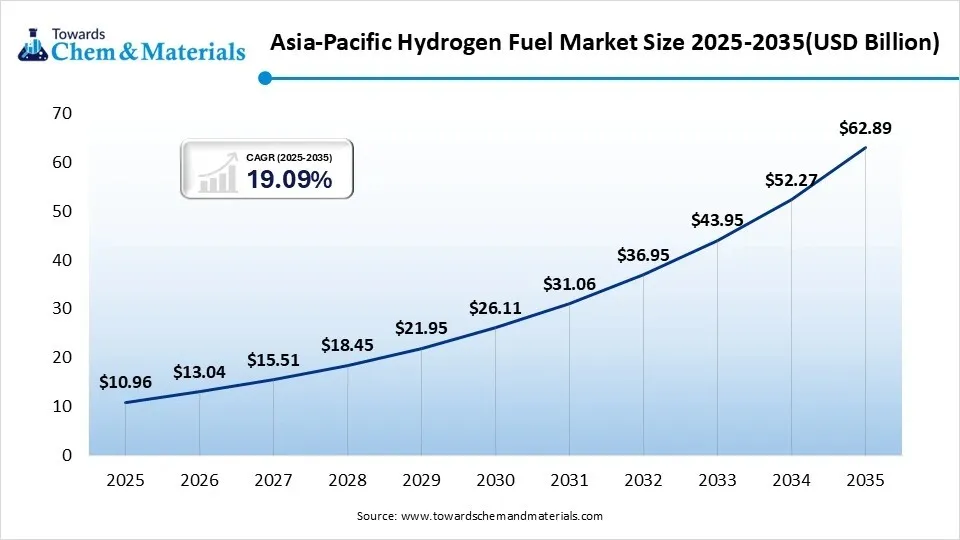
The global hydrogen fuel market size was valued at USD 24.92 billion in 2025, is estimated to reach USD 29.64 billion in 2026, and is projected to reach USD 141.32 billion by 2035, exhibiting a compound annual growth rate (CAGR) of 18.95% over the forecast period from 2026 to 2035.Asia Pacific dominated the hydrogen fuel market with the largest revenue share of 44% in 2025 and is expected to grow at the fastest CAGR of 19.09% during the forecast period. Ongoing technological developments continue to drive the commercial introduction of the technology and contribute toward wider decarbonisation goals in various end-use industries around the world. Growth in the market is being driven by growth in hydrogen production capacities, development of hydrogen storage solutions, and the growth of investments in clean energy infrastructure. 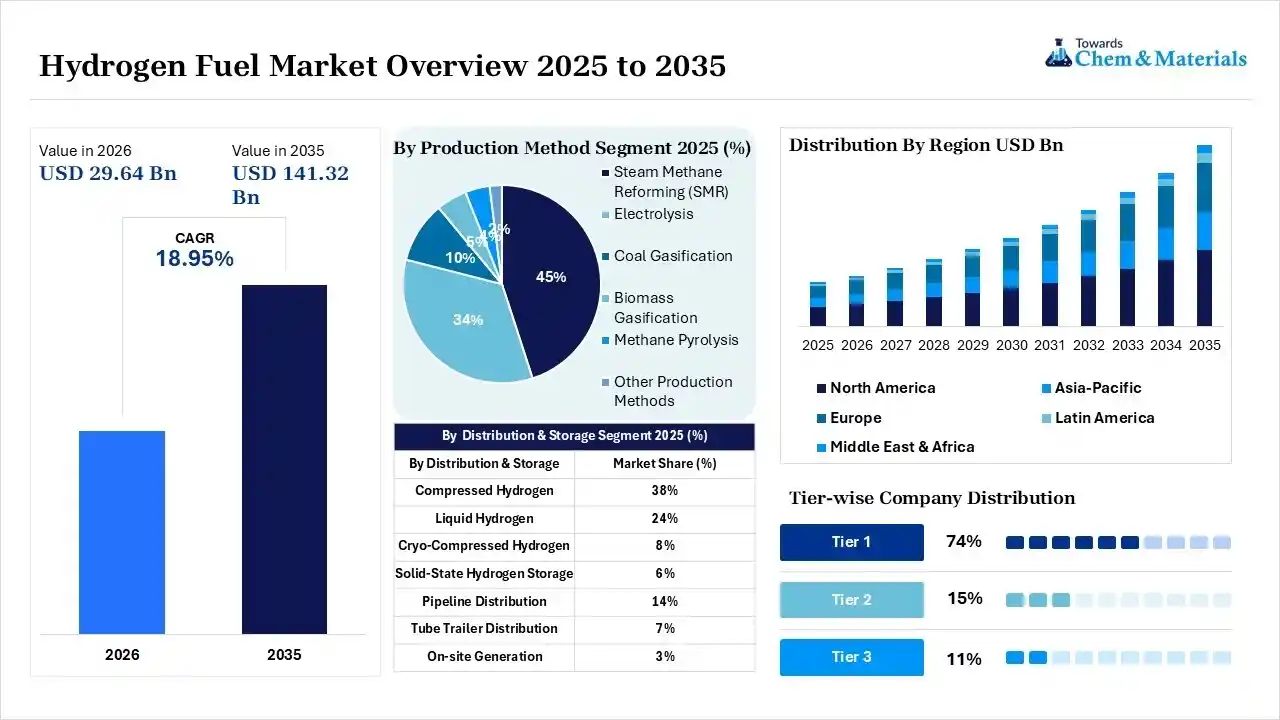
Market Highlights
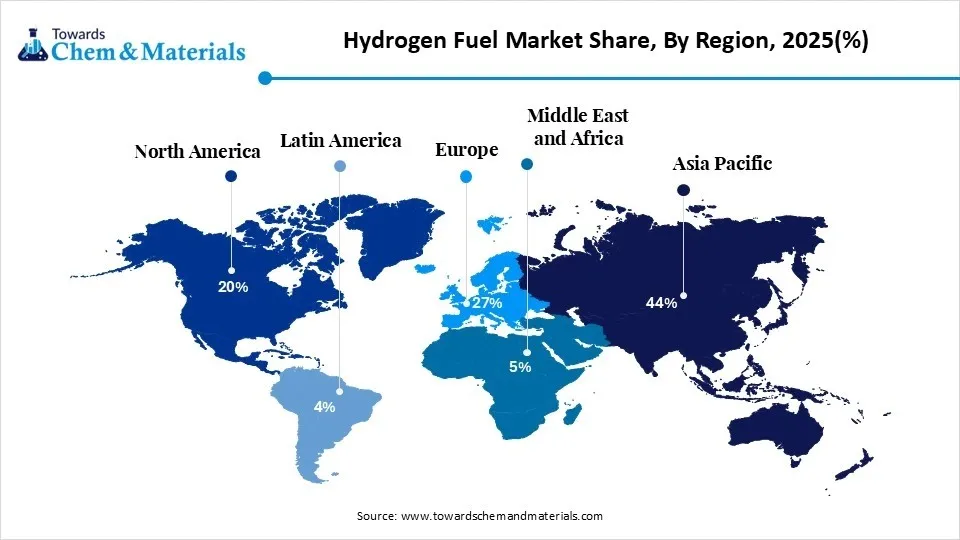
- By region, Asia Pacific dominated the hydrogen fuel market by holding 44% share in 2025 and is expected to grow at a CAGR of 20.7% during the forecast period.
- By region, North America held 20% market share in 2025 and is expected to grow at the fastest with a CAGR of 21.5% during the forecast period.
- By production method, the steam methane reforming (SMR) segment dominated the market with the largest share of 45% in 2025 and is expected to grow at a CAGR of 12.5% during the forecast period.
- By production method, the electrolysis segment held 34% market share in 2025 and is expected to grow at the fastest CAGR of 27.4% over the forecast period.
- By distribution & storage, the compressed hydrogen segment dominated the market with the largest share of 38% in 2025 and is expected to grow at a CAGR of 17.4% during the forecast period.
- By distribution & storage, the solid-state hydrogen storage segment held 6% market share in 2025 and is expected to grow at the fastest CAGR of 26.1% over the forecast period.
- By fuel form, the gaseous hydrogen segment dominated the market with the largest share of 71% in 2025 and is expected to grow at a CAGR of 17.8% during the forecast period.
- By fuel form, the liquid hydrogen segment held 29% market share in 2025 and is expected to grow at the fastest CAGR of 21.9% over the forecast period.
- By technology, the proton exchange membrane (PEM) segment dominated the market with the largest share of 42% in 2025 and is expected to grow at a CAGR of 20.6% during the forecast period.
- By technology, the solid oxide fuel cell (SOFC) segment held 22% market share in 2025 and is expected to grow at the fastest CAGR of 22.8% over the forecast period.
- By application, the transportation segment dominated the market with the largest share of 46% in 2025 and is expected to grow at a CAGR of 18.2% during the forecast period.
- By application, the power generation segment held 22% market share in 2025 and is expected to grow at the fastest CAGR of 22.7% over the forecast period.
- By end-use, the automotive segment dominated the market with the largest share of 34% in 2025 and is expected to grow at a CAGR of 13.5% during the forecast period.
- By end-use, the oil & gas segment held 9% market share in 2025 and is expected to grow at the fastest CAGR of 23.4% over the forecast period.
According to Towards Chemicals and Materials Analytics and Consulting, the global hydrogen fuel market volume was valued at 10.85 million metric tons in 2025 and is expected to surpass around 57.90 million metric tons by 2035, accelerating a compound annual growth rate (CAGR) of 18.23% over the forecast period from 2026 to 2035.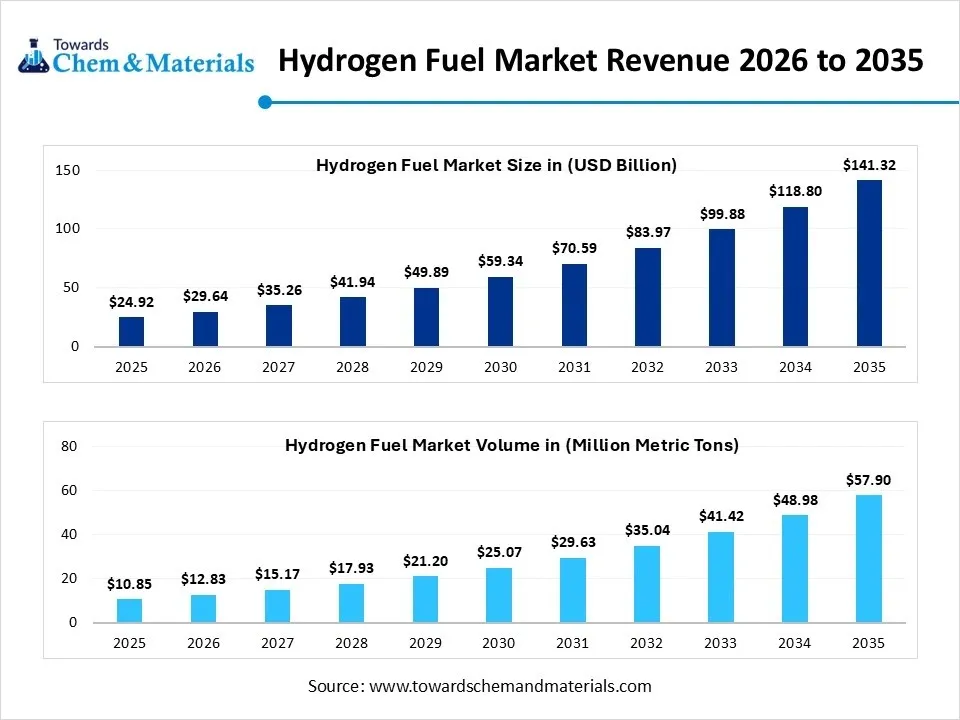
H2 Fuel Innovation Supporting Clean Energy Adoption
Prospective development of electrolysis technologies enhances the production efficiency and promotes their application in the expanding hydrogen production facilities. The hydrogen fuel market is growing steadily, with industries increasingly embracing cleaner energy in transportation and industrial applications. Increased hydrogen production technology investments drive commercialization and future development of global hydrogen energy infrastructure.
Steam methane reforming is a significant route to hydrogen production, which continues to provide a regular supply of hydrogen for a variety of industrial uses. Storage, compression, and liquefaction technology continue to evolve, enhancing transportation flexibility and boosting supply chain reliability. Industry partnerships lead to faster deployment of infrastructure and increase the widespread uptake of hydrogen in a range of end-use sectors.Together, these advancements enhance commercialization prospects and bolster the resolve behind the uptake of hydrogen fuel in rapidly changing global energy landscapes.
Report Scope
| Report Attributes | Details |
| Market Size in 2026 | USD 29.64 Billion/ 12.83 Million Metric Tons |
| Expected Size in 2035 | USD 141.32 Billion/ 57.90 Million Metric Tons |
| Growth Rate | CAGR of 18.95% |
| Base Year of Estimation | 2025 |
| Forecast Period | 2025-2035 |
| Dominant Region | Asia Pacific |
| Segment Covered | By Production Method, By Distribution & Storage, By Fuel Form, By Technology, By Application, By End-use Industry, By Region |
| Key Companies Profiled | Siemens Energy, Air Liquide, Air Products, ITM Power, Ballard Power Systems, Bloom Energy, Nel, Cummins Inc, FuelCell Energy, Hyundai Motor Group, Linde, Plug Power |
Global Investment Movement for the Hydrogen Fuel Market
Innovative electrolysis technologies and multi-faceted development of renewable energy infrastructure are increasingly supported by investments in renewable hydrogen production facilities.Companies are still investing in large-scale hydrogen production facilities to support the decarbonisation of industries, transport, and commercialisation.Strategic investments bolster hydrogen storage, liquefaction, transportation, and commercial distribution systems in global markets.Expansion of investments for hydrogen production via Renewable Energy (RE) further reinforces the momentum of market development and fuels the transition towards alternative clean industrial energy sources.
What is the Hydrogen Fuel?
Hydrogen fuel is a carrier of energy that is produced in different ways, and used in transportation, industry, and power generation. It promotes more environmentally friendly energy systems using efficient fuel conversion technologies and promotes commercial infrastructure.
Uses of the Hydrogen Fuel
- Hydrogen fuel can be used in a variety of new applications, including passenger and commercial vehicles, buses, rail systems, marine transportation, and aviation, instead of conventional transportation fuels.
- In stationary power generation applications, hydrogen can enhance the reliability of electricity infrastructure; in distributed electricity generation applications.
- It can be used to complement wind and solar power, and in backup power applications, it can serve as a reliable and efficient energy source.
- Various industrial applications use hydrogen for their manufacturing processes, energy needs, process optimization, and to support cleaner production in a variety of industrial facilities.
- Hydrogen is a means of long-duration energy storage for integrating renewable energy resources and energy system flexibility in commercial infrastructure developments.
- Hydrogen fuel is used in the steel, chemicals, oil & gas industries as well as other industrial applications, which are looking towards a cleaner fuel and operational efficiency.
Market Trends
- The production of hydrogen using renewable electricity for supporting cleaner fuel generation, as well as away from conventional manufacturing technologies, is gaining more and more relevance in the context of industries.
- Hydrogen storage technologies are still under development to enhance transportation flexibility, operation reliability, and commercialization of the hydrogen supply industry.
- The deployment of advanced fuel cell technologies contributes to more efficient operations and to applications in the field of transportation and distributed power generation that are better for the environment.
- Strategic partnerships help to enhance international hydrogen supply chains for efficient transportation, derivative trade, and to ensure reliable commercial hydrogen supply worldwide.
Key Technological Shifts and AI in the Hydrogen Fuel Market
Advancing Intelligent Hydrogen Production Through Artificial Intelligence
Predictive maintenance, process optimization, and continuous monitoring of operations around industrial facilities using AI drives increased production efficiency for hydrogen. Intelligent automation and operational analytics boost the performance of steam methane reforming, and digital solutions reinforce electrolysis management. AI also improves the management of infrastructure, ensuring optimal equipment performance, operations schedule, and long-term infrastructure maintenance. These technological developments increase the efficiency of hydrogen production, the use of the hydrogen infrastructure, the reliability of hydrogen operations, and the commercial scalability of hydrogen markets.
Supply Chain Analysis of the Hydrogen Fuel Market
Feedstock Procurement:
- Feedstock procurement is the process of obtaining raw water, natural gas or renewable electric power needed for effective hydrogen production at commercial production facilities.
- Ensuring reliable feedstock availability is crucial for continuous hydrogen production, optimizing hydrogen utilization in operations, providing stability in supply, and enhancing the competitiveness of hydrogen manufacturing in the long term around the world.
- L&T: L&T (Larsen & Toubro) builds renewable energy plants and water electrolysis plants that facilitate the efficient production of hydrogen for growing industrial applications.
- Other Key Players: Adani Green Energy, NTPC Ltd.
Chemical Synthesis and Processing
- Chemical synthesis produces hydrogen from feedstocks via water electrolysis or steam methane reforming in industrial facilities on a large scale.
- Efficient processing technologies can enhance hydrogen quality and provide reliable hydrogen production capacity for hydrogen transportation, industrial, and power applications.
- Linde: Industrial-scale steam methane reforming (SMR) and advanced electrolysis facilities, powered by Linde, enable a reliable hydrogen supply in global markets.
- Other Key Players: Air Liquide, Plug Power
Compound Formulation and Blending:
- Purification, compression, or blending with carrier compounds for efficient transportation, storage, and commercial distribution requirements of hydrogen.
- Advanced formulation processes contribute to hydrogen stability and to allow safer transportation, longer transport distances, and wider use in industry in various markets.
- Air Products: Air Products is a major player in the hydrogen liquefaction, purification, and multi-component fuel blending for efficient commercial hydrogen distribution globally.
- Other key players: Bloom Energy, Ballard Power Systems.
Sustainability Analysis of the Hydrogen Fuel
Hydrogen fuel can contribute to sustainability by decarbonising the transport, industrial production, and power generation sectors. Hydrogen storage and distribution systems are also improving, which further optimises integrated supply chains. The strategic partnerships between industrial players foster larger adoption of hydrogen technologies in line with long-term sustainability goals. Reduced hydrogen production methods improve energy diversification and help decarbonize the industry in various sectors. These developments will solidify the transformation towards sustainable energy and enhance the opportunities for hydrogen commercialization to promote future low-carbon economic growth.
Pricing Analysis for the Hydrogen Fuel Market
The price of hydrogen fuels will be determined mainly by how they are produced, the feedstocks, and the maturity of the infrastructure in the region. Fossil-based hydrogen is the least expensive, while blue hydrogen has extra carbon capture costs. Green hydrogen is the most expensive one due to the high investment costs associated with the renewable electricity and electrolyzers. Market pricing is figured based on the combined effect of capital expenditures, operating costs, and specialized storage, transportation, and distribution infrastructure.
Hydrogen Fuel Market: Global Trade Analysis
The international hydrogen fuel trade is constantly progressing, with industries pushing more and more for the cross-border transport of green hydrogen and related products.The government is promoting hydrogen use in a wide range of sectors and applications through decarbonization policies. RE regions improve the export potential, and industrial economies boost the demand for imports that can help green the energy transition.
Regulatory Framework: Hydrogen Fuel Market
| Country Region | Regulatory Body | Key Regulations | Focus Areas |
| Asia Pacific | Ministry of New and Renewable Energy | National Green Hydrogen Mission | Domestic green hydrogen production |
| North America | Department of Energy | Inflation Reduction Act (IRA) 45V Tax Credits | Production tax credits |
| European Union | European Commission | EU Hydrogen and Gas Market Directive | Guarantee of origin, 70% greenhouse gas savings |
Market Dynamics
Drivers: Expanding Clean Energy Adoption Across Industrial Applications
The hydrogen fuel demand in the transportation, industrial manufacturing, and power generation sectors continues to be met by the growing uptake of clean energy solutions. The growing investments in hydrogen production technologies boost commercialization and infrastructure development to enable wider industrial use. New electrolysis technologies enhance production efficiency and help more commercial facilities to generate hydrogen in a cleaner way. The addition of strategic industrial partnerships further reinforces the integrated hydrogen value chain that enables further market growth and cleaner energy transition in the long term.
Restraints : High Production and Infrastructure Development Costs
Hydrogen fuel commercialization is challenging due to the need for significant capital investment in advanced production technologies, specialized storage systems, and transportation infrastructure. The costs of the electrolysis equipment, hydrogen handling, and distribution systems do affect the overall production economics. Coordinated investments in industry are also necessary for the expansion of infrastructure for sustainable commercialization in a wide range of end applications. With the increasing interest in cleaner energy options, these factors remain in play and continue to impact adoption rates.
Opportunities : Renewable Hydrogen Production Technologies
The commercial production of renewables-based hydrogen offers great potential for the decarbonisation of industry and long-term energy diversification. Technology advances further improve the efficiency of electrolysis and promote the use of hydrogen in other sectors such as transport, industry, and power generation. Commercial hydrogen availability via integrated supply chains and cleaner industrial energy systems is further enhanced with strategic infrastructure investments. These developments remain to produce good prospects for the sustainable hydrogen markets development worldwide.
Segmental Insights
Production Method Insights
The steam methane reforming (SMR) segment dominated the market with the largest share of 45% in 2025 and is expected to grow at a CAGR of 12.5% over the forecast period, as existing production facilities were well developed, enabling the large-scale, consistent production of hydrogen for various industrial uses. Its presence is continuing to grow in transportation, manufacturing, chemicals, and energy markets, bolstered by the extensive commercialization, well-established processing technologies, and reliable production capabilities. Established hydrogen value chains are also complemented by existing industrial facilities that support reliable hydrogen availability and promote the future use of hydrogen within existing value chains.
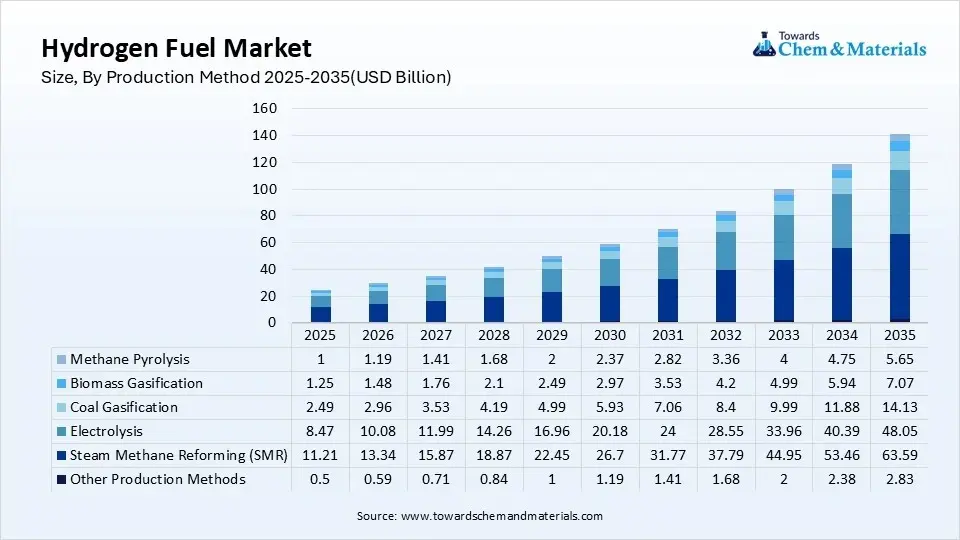
The electrolysis segment held the 34% market share in 2025 and is expected to grow at the fastest CAGR of 27.4% over the forecast period, as investments for renewable electricity-based hydrogen production keep strengthening the spread of the technology in commercial production sites. Technology improvements continue to improve operational efficiencies and promote cleaner hydrogen production throughout transportation, industrial manufacturing, and power generation applications. The increasing use of renewable electricity and continued infrastructure investment further drive the commercialisation of renewable energy in changing energy markets.
- For instance, in November 2026, Bosch installed its first electrolyzer with Hybrion PEM electrolysis stacks at the Bamberg site in November 2026. The system uses renewable electricity to split water into hydrogen and complies with the EU renewable hydrogen standards.(Source: www.bosch-presse.de)
Hydrogen Fuel Market Share, By Production Method, 2025(%)
| By Production Method | Market Share (%) |
| Steam Methane Reforming (SMR) | 45% |
| Electrolysis | 34% |
| Coal Gasification | 10% |
| Biomass Gasification | 5% |
| Methane Pyrolysis | 4% |
| Other Production Methods | 2% |
Distribution & Storage Insights
The compressed hydrogen segment dominated the market with the largest share of 38% in 2025 and is expected to grow at a CAGR of 17.4% over the forecast period, as storage infrastructure for compressed hydrogen is well established, enabling efficient storage, distribution, and commercialization of hydrogen across various industrial applications. Improved integration with existing hydrogen systems enhances flexibility in operations and ensures a reliable supply for transport, manufacturing, and energy applications. Its market dominance is being strengthened with ongoing infrastructure development and its increasing presence in industrial applications.
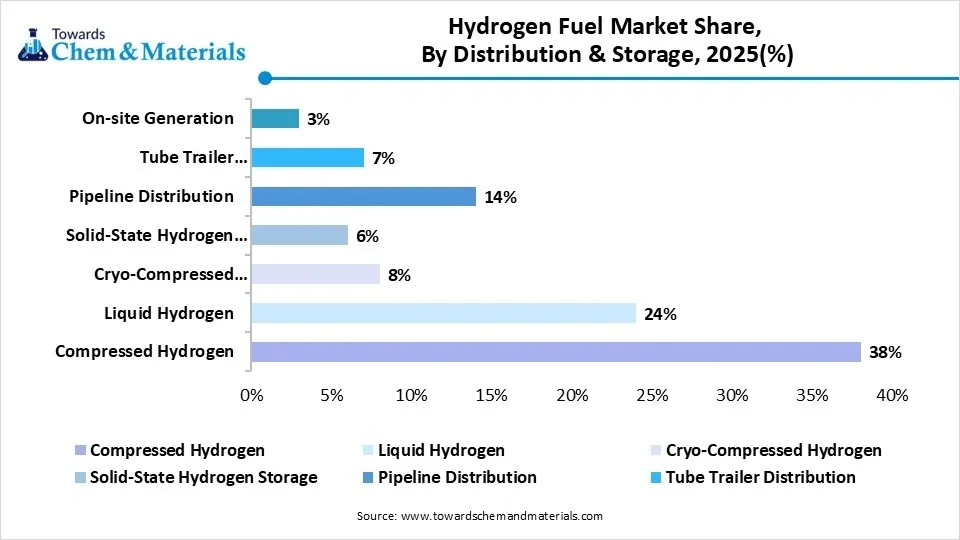
The solid-state hydrogen storage segment held the 6% market share in 2025 and is expected to grow at the fastest CAGR of 26.1% over the forecast period, due to the increasing interest in advanced storage technologies, which promote commercial use, increasing storage efficiency, and operational safety. Seamless innovation enhances long-term hydrogen handling capabilities and contributes to growing industrial applications and a cleaner energy infrastructure throughout the world.
Hydrogen Fuel Market Share, By Distribution & Storage, 2025(%)
| By Distribution & Storage | Market Share (%) |
| Compressed Hydrogen | 38% |
| Liquid Hydrogen | 24% |
| Cryo-Compressed Hydrogen | 8% |
| Solid-State Hydrogen Storage | 6% |
| Pipeline Distribution | 14% |
| Tube Trailer Distribution | 7% |
| On-site Generation | 3% |
Fuel Form Insights
The gaseous hydrogen segment dominated the market with the largest share of 71% in 2025 and is expected to grow at a CAGR of 17.8% over the forecast period, as it has widespread commercial applications in transportation, industrial manufacturing, and power generation. Favorable production, storage, and distribution infrastructure leads to efficient operation and guarantees a reliable hydrogen supply to various end-user sectors. Further to this, good integration with existing hydrogen systems further strengthens a continued commercial rollout in global markets.
The liquid hydrogen segment held the 29% market share in 2025 and is expected to grow at the fastest CAGR of 21.9% over the forecast period. Commercial use of industrial applications is continuing to strengthen with increasing investments in supporting long-distance transportation and large-scale storage. In addition, ongoing developments of liquefaction technologies and transport infrastructure boost operational efficiency and facilitate wider hydrogen commercialisation in global transport corridors.
- For instance, in October 2025, Daimler Truck AG, HHLA, and Kawasaki Heavy Industries Ltd. signed a memorandum in October 2025, which will support a green liquid hydrogen supply chain from the Port of Hamburg to the European hinterland.(Source: www.daimlertruck.com)
Hydrogen Fuel Market Share, By Fuel Form ,2025(%)
| By Fuel Form | Market Share (%) |
| Gaseous Hydrogen | 71% |
| Liquid Hydrogen | 29% |
Technology Insights
The proton exchange membrane (PEM) segment dominated the market with the largest share of 42% in 2025 and is expected to grow at a CAGR of 20.6% over the forecast period. Ongoing technology development creates benefits for more commercialization in growing hydrogen facilities and operational improvements. Further growth and expanding adoption ensure the segments position in the changing applications of clean energy continues to grow.
The solid oxide fuel cell (SOFC) segment held the 22% market share in 2025 and is expected to grow at the fastest CAGR of 22.8% over the forecast period. With increasing interest in efficient fuel conversion technologies, there is a growing interest in their broader adoption across power generation and energy applications. Ongoing technological advancements enhance operational efficiency and facilitate the growth of commercialization within a hydrogen energy system.
Hydrogen Fuel Market Share, By Technology,2025(%)
| By Technology | Market Share (%) |
| Proton Exchange Membrane (PEM) | 42% |
| Alkaline Fuel Cell (AFC) | 12% |
| Solid Oxide Fuel Cell (SOFC) | 22% |
| Phosphoric Acid Fuel Cell (PAFC) | 8% |
| Molten Carbonate Fuel Cell (MCFC) | 10% |
| Direct Methanol Fuel Cell (DMFC) | 6% |
Application Insights
The transportation segment dominated the market with the largest share of 46% in 2025 and is expected to grow at a CAGR of 18.2% over the forecast period, as hydrogen fuel is becoming a high priority for passenger vehicles, commercial vehicles, buses, rail systems, marine transportation, and aviation. The investment in hydrogen infrastructure is increasing, and the potential for hydrogen-powered mobility is growing across the vast transportation network. In global mobility, ongoing technological innovations enhance long-term adoption and operational efficiency.
The power generation segment held the 22% market share in 2025 and is expected to grow at the fastest CAGR of 22.7% over the forecast period. The growing use of hydrogen in stationary power, distributed generation, and back-up power applications is supporting the development of the energy infrastructure. Ongoing investments in hydrogen technologies boost operational reliability and promote cleaner electricity generation in commercial and industrial applications.
Hydrogen Fuel Market Share, By Application,2025(%)
| By Application | Market Share (%) |
| Transportation | 46% |
| Power Generation | 22% |
| Industrial Energy | 14% |
| Residential & Commercial Heating | 6% |
| Portable Power | 4% |
| Grid Energy Storage | 8% |
End-Use Insights
The automotive segment dominated the market with the largest share of 34% in 2025 and is expected to grow at a CAGR of 13.5% over the forecast period, as the penetration of hydrogen technologies in the transportation segment is driving clean transportation solutions in passenger and commercial vehicles. Growing hydrogen infrastructure and ongoing technology development help promote penetration of vehicles and boost long-term commercialization prospects. Increasing investments in the industry further strengthen hydrogen use in the changing automotive industry and mobility landscapes.
The oil & gas segment held the 9% market share in 2025 and is expected to grow at the fastest CAGR of 23.4% over the forecast period. Hydrogen enables a more sustainable way of operation for industrial processes and a diversification of energy sources in various refinery and processing plants. Ongoing investments in hydrogen production technologies further boost commercialisation and support the wider sector decarbonisation efforts.
Hydrogen Fuel Market Share, By End-use Industry, 2025(%)
| By End-use Industry | Market Share (%) |
| Automotive | 34% |
| Energy & Utilities | 22% |
| Chemicals | 15% |
| Oil & Gas | 9% |
| Steel & Metals | 8% |
| Aerospace & Defense | 4% |
| Marine | 4% |
| Electronics | 2% |
| Others | 2% |
Regional Insights
How Did the Asia Pacific Dominate the Hydrogen Fuel Market In 2025?
The Asia Pacific hydrogen fuel market size was estimated at USD 10.96 billion in 2025 and is projected to reach USD xx billion by 2035, growing at a CAGR of xx% from 2026 to 2035.Asia Pacific dominated the market with the largest share of 44% in 2025 and is expected to grow at a CAGR of 20.7% during the forecast period. with growing industrial potential, advanced manufacturing facilities, and robust clean energy initiatives. High investments in hydrogen production technologies are continuing to encourage broad commercialisation in these areas, including power generation, manufacturing, and transportation. Infrastructure continues to be expanded, enhancing hydrogen production, storage, and distribution throughout regional markets.
Advancing Chinas Hydrogen Production Ecosystem
China is still continually enhancing the hydrogen industry by developing hydrogen production capacity and expanding the use of hydrogen in industry in various commercial applications. Continuous investments in hydrogen infrastructure enable cleaner manufacturing processes and help accelerate adoption in other sectors, such as transport. Technology is continually evolving to boost production efficiency and reinforce integrated hydrogen value chains for long-term commercial development.
Accelerating Indias Green Hydrogen Development
India is actively pushing the development of hydrogen fuel, with a focus on increasing production capacity and investment in clean energy to facilitate commercialization. More industry involvement boosts hydrogen adoption throughout the nation for energy, industry, and transportation. The infrastructure that is being developed helps to ensure cleaner industrial processes and promotes long-term hydrogen commercialisation.
- For instance, in May 2025, IndianOil completed the Levelized Cost of Hydrogen (LCOH) for the project at Panipat, which will be the largest green hydrogen generation project in India, in May 2025 to meet Indias growing clean energy needs and support the countrys clean energy agenda by producing large-scale commercial hydrogen. (Source: iocl.com)
North America Hydrogen Fuel Market Trends
The North America hydrogen fuel market size was estimated at USD 4.98 billion in 2025 and is projected to reach USD 28.97 billion by 2035, growing at a CAGR of 19.25% from 2026 to 2035.North America held 20% market share in 2025 and is expected to grow at the fastest CAGR of 21.5% during the forecast period, with growing investment in production facilities, technology advancement, and growing investments in the industry for cleaner energy applications. As more and more commercial vehicles, industrial plants, and power plants utilize hydrogen in their operations, commercialization is spreading throughout the regional hydrogen value chain. Prolonged market growth is also reinforced through strategic industry partnerships, which contribute to sustainable energy transition goals.
Enabling Hydrogen Deployment Nationwide in the U.S.
The United States is continuing to roll out hydrogen commercialization by building up production capacity and improving industrial infrastructure for a wide range of commercial applications. The Department of Energys ongoing technological development efforts make hydrogen production more efficient and help to drive broader adoption of hydrogen in the transportation, manufacturing, and power generation markets. The continued investment in hydrogen infrastructure continues to strengthen the value chains for hydrogen and to reinforce hydrogens long-term clean energy development in domestic markets.
Shaping Canadas Hydrogen Development Initiatives
Canada remains committed to building hydrogen markets by expanding hydrogen production capacity and building industry engagement in lower-carbon applications. The increasing investments facilitate the wider use of hydrogen in transportation, manufacturing and industrial processes throughout the country. The continuous improvement of the infrastructure makes hydrogen commercialization stronger and enables long-term hydrogen market development and integrated clean energy development.
Europe Hydrogen Fuel Market Trends
The Europe hydrogen fuel market size was estimated at USD 6.73 billion in 2025 and is projected to reach USD 38.86 billion by 2035, growing at a CAGR of 19.17% from 2026 to 2035.Europe held 27% market share in 2025 and is expected to grow at a CAGR of 19.9% over the forecast period., and scaling up investments for the transition towards cleaner energy sources. Expanding hydrogen use in transportation, manufacturing and power generation helps diversify regional markets and competitiveness. Ongoing technological developments in the production, storage and distribution processes boost the efficiency of integrated hydrogen value chains. The strong sustainability programmes also promote long-term hydrogen use and help to meet regional decarbonisation targets.
Supporting the development of Germanys Hydrogen Technology Leadership
Germany has been progressing in hydrogen fuel by growing industry capacities and rising investments for advanced hydrogen production technologies. The partnerships between technology providers and industrial manufacturers are increasingly gaining strength, supporting hydrogen commercialization for transportation and manufacturing use cases. Reducing the fragmented nature of hydrogen supply chains through continuous development of infrastructure and fostering long-term innovation in clean energy across the country.
Contributing to the Hydrogen Energy Transition in France
France is also expanding hydrogen commercialization by further industrial investments and bolstering clean energy programs for more widespread commercialization. Insufficient infrastructure for hydrogen, encouraged by growing development, should facilitate the use of hydrogen in manufacturing, transport, and industrial (industry) activities across the country. Technology development is ongoing, and the hydrogen production capacity is enhanced while supporting sustainable industrial development and future market growth.
Latin America Hydrogen Fuel Market Trends
The Latin America hydrogen fuel market size was estimated at USD 1.00 billion in 2025 and is projected to reach USD 6.36 billion by 2035, growing at a CAGR of 20.32% from 2026 to 2035.Latin America held 4% market share in 2025 and is expected to grow at a CAGR of 18.3% over the forecast period. The abundance of renewable energy resources and growing industrial investment in cleaner energy development in Latin America are driving the expansion of the hydrogen market. Transportation, manufacturing, and industrial applications throughout the region are promoted through growing hydrogen production projects. Continuous infrastructure enhancements boost integrated hydrogen value chains and enable future export opportunities. It is made easier for the industry to collaborate with each other, further strengthening the development of the long-term market and sustainable economic growth.
Strengthening Brazils Hydrogen Production Capabilities
The Brazilian hydrogen production continues to grow with growing integration with renewable energy and upgrading of investments in industries for commercialization. Expanding infrastructure will continue to support the use of hydrogen in manufacturing, transportation, and industry throughout the nation. The continuous expansion of the project further solidifies the integrated hydrogen value chain and facilitates future clean energy opportunities.
Advancing Chiles Renewable Hydrogen Ecosystem
Chile remains stepping up on hydrogen commercialisation by deepening renewable energy development and boosting industry engagement to support clean energy applications. Commercial investments drive hydrogen production as well as the capabilities of integrated infrastructure. The development of projects is improved continuously, and this will certainly foster long-term commercialisation of hydrogen, as well as sustainable industrial and economic development.
Middle East & Africa Hydrogen Fuel Market Trends
The Middle East & Africa hydrogen fuel market size was estimated at USD 1.25 billion in 2025 and is projected to reach USD 7.77 billion by 2035, growing at a CAGR of 20.05% from 2026 to 2035.The Middle East & Africa held 5% market share in 2025 and is expected to grow at a CAGR of 20.6% over the forecast period. with continued growth of industrial investment and an abundance of renewable energy resources that facilitate hydrogen production as a cleaner fuel. Expanding infrastructure investment promotes increased hydrogen adoption in transportation, manufacturing, and industrial uses throughout the region. Technological developments continue to ensure that hydrogen production and supply is enhanced in relation to integrated commercial operation.
Expanding Saudi Arabias Hydrogen Production Leadership
Saudi Arabia has been continuing to strengthen its hydrogen production by now making more investments in hydrogen production industries and developing clean energy infrastructure that would enable commercial deployment of hydrogen. Developing projects will stimulate hydrogen use throughout the country in manufacturing, transport, and industry. Permanent infrastructure development boosts long-term hydrogen commercialization and facilitates regional energy diversification.
Supporting South Africa Commercialize Hydrogen
South Africa is still making strides in hydrogen market development through building up production capacity and growing industrial involvement to support commercialisation. The expansion of infrastructure supports hydrogen use throughout the country in transportation, manufacturing, and industrial uses. This allows for an integrated hydrogen value chain and sustainable market growth and clean energy transition.
Recent Developments
- In July 2026, Indian Railways began the operation of Indias first home-grown hydrogen fuel cell-powered train. The locomotive utilizes hydrogen fuel cells to produce electricity and promotes sustainable and cleaner transportation of the railways while contributing to the development of next-generation sustainable mobility on the countrys railways.(Source: www.pib.gov.in)
- In June 226, Everllence started the HydroMonia research project in June 2026, in collaboration with industry and academic partners. The project is for the development of power plant concepts that are based on hydrogen or ammonia-fuelled engines and thereby enable carbon-free electricity generation without direct carbon dioxide emissions.(Source: fuelcellsworks.com)
Competitive Analysis
The hydrogen fuel market is still highly competitive, with companies building up production capacity, developing hydrogen infrastructure, and speeding up the commercialization of hydrogen fuels in various transport and industrial sectors. New technologies for hydrogen production, hydrogen stations, and hydrogen supply chains are still being invested in by the market. Strategic partnerships, pilot programs, and production scale-up enhance competitive advantage and promote hydrogen use on a global scale. Businesses also emphasize technology innovation and infrastructure development for enhancing the efficiency of production, storage, and commercial distribution.
- In November 2025, JSW Energy Limited was the first and largest company to get approval from the government for the production of green hydrogen through the Production Linked Incentive Scheme in November 2025. The plant is also supplying green hydrogen to the JSW Steel plant, which helps reduce the carbon footprint of the steel manufacturing process and contributes to Indias efforts in clean energy transition.(Source: www.jsw.in)
- In March 2025, Tata Motors announced in March 2025 that India is embarking on its initial pilot projects for hydrogen-powered heavy-duty trucks, aiming to empower sustainable long-distance cargo transport. The program is designed to align with Indias initiatives for achieving Net Zero and promote the commercialization of hydrogen-powered mobility solutions in the transportation sector.(Source: www.tatamotors.com)
Top Players in the Market & Their Offerings
| Company | Company Type/Position | Major Headquarters | Geographic Presence | Hydrogen Fuel Offerings | Key Strength |
| Linde plc | Industrial Gas & Engineering Leader | Dublin, Ireland | Global | Scalable hydrogen plants | Worlds largest hydrogen refueling network |
| Plug Power | Vertically Integrated Clean Energy | Latham, New York, USA | North America, Europe | GenDrive fuel cells | End-to-end green hydrogen ecosystem |
| Air Products | Industrial Gas & Infrastructure Supplier | Allentown, Pennsylvania, USA | Global | SmartFuel hydrogen stations | Green/blue hydrogen projects |
Other Key Players
- Siemens Energy
- Air Liquide
- Air Products
- ITM Power
- Ballard Power Systems
- Bloom Energy
- Nel
- Cummins Inc
- FuelCell Energy
- Hyundai Motor Group
- Linde
- Plug Power
Segment Covered in the Report
By Production Method
- Steam Methane Reforming (SMR)
- Without Carbon Capture
- With Carbon Capture (Blue Hydrogen)
- Electrolysis
- Alkaline Electrolysis
- PEM Electrolysis
- Solid Oxide Electrolysis
- AEM Electrolysis
- Coal Gasification
- Biomass Gasification
- Methane Pyrolysis
- Other Production Methods
By Distribution & Storage
- Compressed Hydrogen
- Liquid Hydrogen
- Cryo-Compressed Hydrogen
- Solid-State Hydrogen Storage
- Pipeline Distribution
- Tube Trailer Distribution
- On-site Generation
By Fuel Form
- Gaseous Hydrogen
- Liquid Hydrogen
By Technology
- Proton Exchange Membrane (PEM)
- Alkaline Fuel Cell (AFC)
- Solid Oxide Fuel Cell (SOFC)
- Phosphoric Acid Fuel Cell (PAFC)
- Molten Carbonate Fuel Cell (MCFC)
- Direct Methanol Fuel Cell (DMFC)
By Application
- Transportation
- Passenger Vehicles
- Commercial Vehicles
- Heavy-Duty Trucks
- Buses
- Rail
- Marine
- Aviation
- Power Generation
- Stationary Power
- Backup Power
- Distributed Generation
- Industrial Energy
- Residential & Commercial Heating
- Portable Power
- Grid Energy Storage
By End-use Industry
- Automotive
- Energy & Utilities
- Chemicals
- Oil & Gas
- Steel & Metals
- Aerospace & Defense
- Marine
- Electronics
- Others
By Regions
- North America
- Europe
- Asia Pacific
- Middle East & Africa
- Latin America
FAQ's




Select User License to Buy
Figures (6)










 sales@towardschemandmaterials.com
 Download Sample
 Schedule a Meeting