
What is Nanomaterials Market Size and Share?
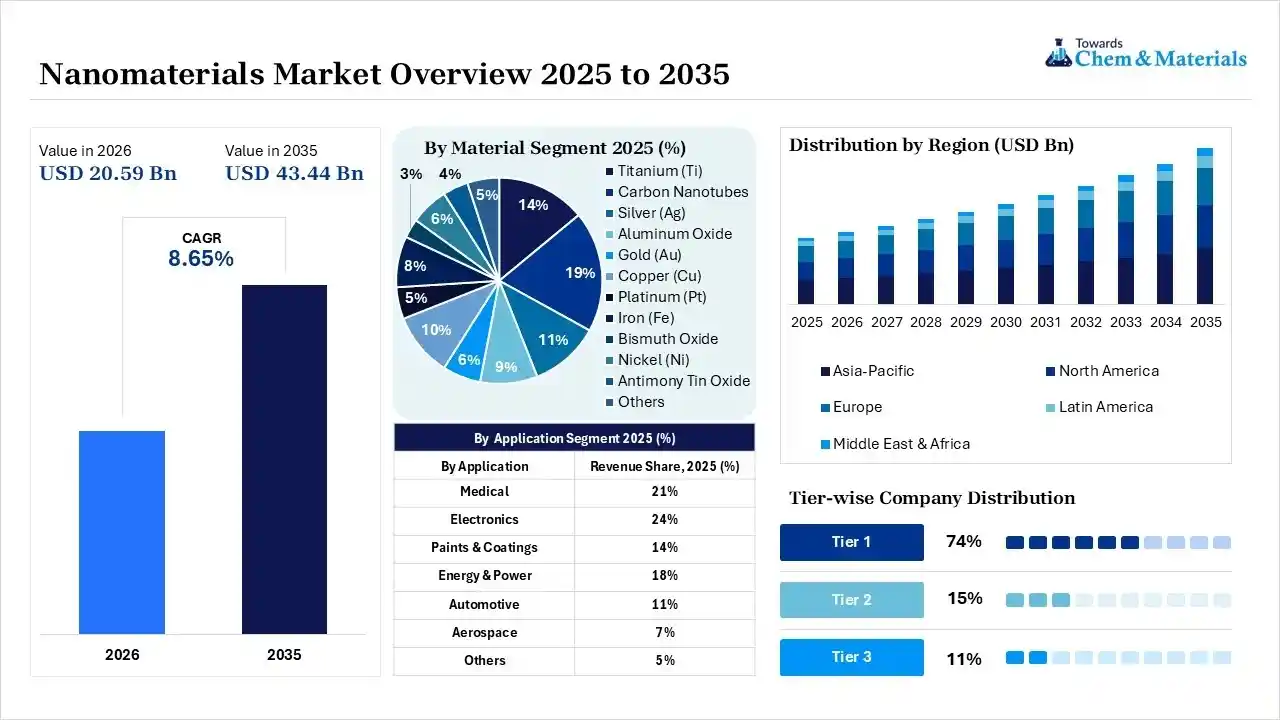
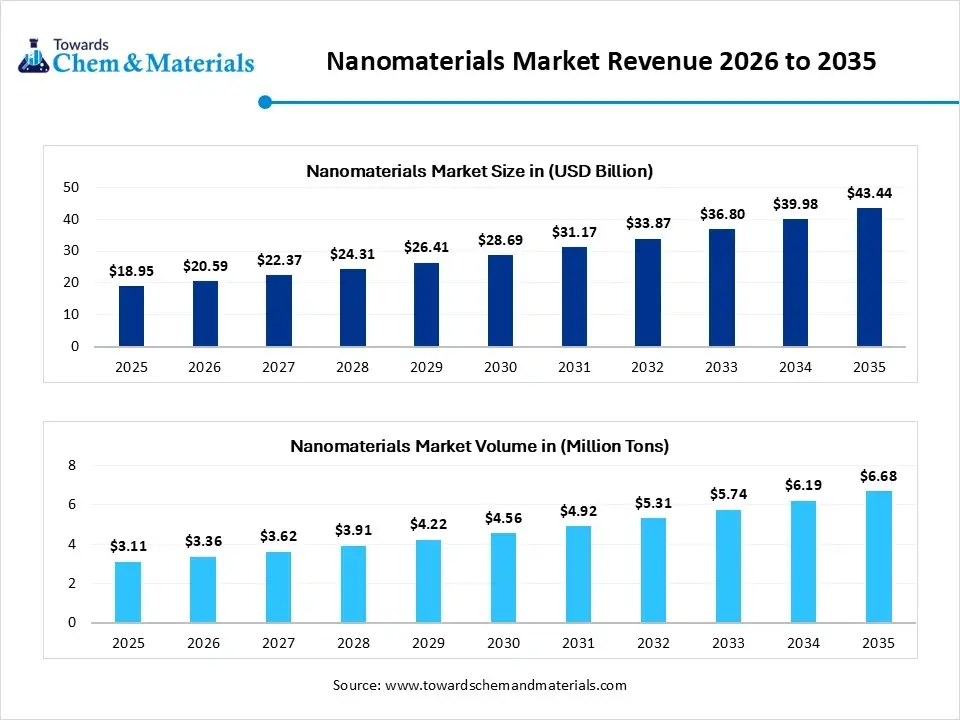
The global nanomaterials market size was valued at USD 18.95 billion in 2025, is estimated to reach USD 20.59 billion in 2026, and is projected to reach USD 43.44 billion by 2035, exhibiting a compound annual growth rate (CAGR) of 8.65% over the forecast period from 2026 to 2035.Asia Pacific dominated the nanomaterials market with the largest revenue share of 36% in 2025 and is expected to grow at the fastest CAGR of 8.83% during the forecast period. In terms of volume, the nanomaterials market is projected to grow from 3.11 million tons in 2025 to 6.68 million tons by 2035. growing at a CAGR of 7.95% from 2026 to 2035. The market expansion is accelerated by hydrogen economy investment, technological integration, and rising demand in industrial and consumer applications.
Market Highlights
- By region, Asia Pacific dominated the nanomaterials market by holding a 36% share in 2025 and is expected to grow at the fastest with a CAGR of 10.02% during the forecast period, driven by large-scale industrial demand and manufacturing infrastructure.
- By region, North America held the 28% market share in 2025 and expects notable growth in the market with 7.92% CAGR during the forecast period, fueled by R&D investment and government support for nanomaterial innovation.
- By material, the carbon nanotubes segment dominated the market with the largest share of 19% in 2025 and is expected to grow at the fastest CAGR of 10.82% over the forecast period, driven by its high mechanical strength utilized in EV batteries, conductive polymers, and flexible electronics.
- By application, the electronics segment dominated the market with the largest share of 24% in 2025 due to semiconductor miniaturization and advanced material utilization in consumer electronics.
- By application, the energy & power segment held 18% market share in 2025 and is expected to grow at the fastest CAGR of 10.41% over the forecast period, driven by fuel cell innovation and hydrogen economy investment.
Quick Stats at a Glance
- Market Estimated Size (2025): USD 18.95 Billion | CAGR (2026–2035): 8.65%
- Market Projected Size (2035): USD 43.44 Billion
- Asia-Pacific: Revenue Share of 36% in 2025 | USD 6.82 Billion
- Market Estimated Volume (2025): 3.11 Million Tons | Volume CAGR (2026–2035): 7.95%
- Market Projected Volume (2035): 6.68 Million Tons
- Market Pricing (2025):
- Average Manufacturing Price (2025): USD 5,830/Ton
- Average Selling Price (2025): USD 7,150/Ton
- Pricing CAGR (2026–2035): 2.49%
The nanomaterials is combination of chemical formulation and atomic-level structure that offer higher surface-to-volume reactivity, quantum confinement effects, and ballistic electron transport. The chemical safety classification infrastructure and stringent regulatory protocols associated with occupational nanotoxicity, environmental health, and lifecycle accumulation are driving the market expansion. This market is segmented into single-walled carbon nanotubes, functionalised graphene flakes, and chalcogenide quantum dots, which enables the growth and demand for nanomaterials.
Nanomaterials are key for the advanced manufacturing supply chain for advanced structural ceramics, cross-sector industrial coatings through their high-volume variants, such as zinc oxide, titanium dioxide, and nanosilica. The commercial adoption is fueled by systematic integration in the high-value energy-user sector. The major leading players are strategically investing in nanomaterials through joint ventures, corporate partnerships, and R&D funding. Nanoelectronics is key to sub-nanometer semiconductor node miniaturisation. And in biomedical nanomaterials, ensure superior genetic drug delivery and precise oncology therapeutics through its lipid-nanoparticle encapsulation matrices. The nanomaterials maintain high-CAPEX cleanroom manufacturing costs and batch-to-batch structural uniformity to achieve continuous-flow industrial scalability.
Nanotechnology continues to drive innovation in the chemistry of nanomaterials, crucial to greener processes, improved product efficiency, enhanced material performance, and enabling long-term market growth. The rising focus on energy transition is accelerating demand for silicon-nanowire anodes, solid-state electrolyte nanomaterials, and graphene-driven supercapacitors. Additionally, corporate sustainability goals are driving the green synthesis to integrate with technological advancement, accelerating the continuous growth of the nanomaterials market
Market Trends
- Strict Environmental Regulations: The key driver that shapes this trend is driven by occupational hazards, strict prohibition on nanoparticles, tracking of eco-toxicology impact to meet large-scale nanotoxicity profiles.
- Integration of CNT: The integration of CNTs advances electronic shielding and energy storage, positioning them as a significant driver of innovation in durable, high-performance nanomaterials.
Report Scope
| Report Attributes | Details |
| Market Size and Volume in 2026 | USD 20.59 Billion / 3.36 Million Tons |
| Revenue Forecast in 2035 | USD 43.44 Billion / 6.68 Million Tons |
| Growth Rate | CAGR 8.65% |
| Base Year of Estimation | 2025 |
| Forecast Period | 2025 - 2035 |
| High Impact Region | Asia Pacific |
| Segment Covered | By Material, By Application, By Region |
| Key Companies Profiled | Strem, ACS Material LLC, American Elements, Arkema S.A., BASF SE, Cabot Corporation, Daikin Industries Ltd., Jiangsu Cnano Technology Co. Ltd., US Research Nanomaterials, Inc., nanoComposix, Frontier Carbon Solutions, LLC., Nanoshel LLC, SkySpring Nanomaterials, Inc., Nanophase Technologies Corporation, Cytodiagnostics Inc., Quantum Materials Corporation |
Key Technological Shifts and AI in the Nanomaterials Market
The integration of advanced material engineering and artificial intelligence is key for nanomaterials market. The predictive machine learning algorithms and generative molecular modeling enables accuracy of atomic structure properties, surface energy, and crystal phase dynamics.
The closed-loop autonomous laboratories analyse real-time spectroscopy and nanomaterial defects by real-time monitoring. The AI-driven workflow is driving the R&D investment for optimizing continuous-flow synthesis scaling and molecular predictability for the high-value semiconductor and biopharmaceutical supply chain.
Supply Chain Analysis of the Nanomaterials Market
- Feedstock Procurement: It is the initial stage that involves sourcing high-purity raw materials, nanomaterials like graphene or metal oxides, and metals for synthesis. Procurement of advanced nanomanufacturing through an atomic layer deposition reactor.
- Key Players: Applied Materials, Americal Elements, Thermo Fisher Scientific, and Bruker Corporation
- Chemical Synthesis and Processing: It is a crucial stage where raw materials are transformed into functional nanoforms. The stage focuses on multi-walled and single-walled carbon nanotubes, functionalized graphene, metal oxides ad quantum dots into masterbatch and liquid slurries.
- Key Players: BASF SE, Cabot Corporation, Arkema, OCSiAI, Evonik Industries, and Nanosys
- Distribution and End-User Integration: the stage of functionalized nanomaterials into mass commercial manufacturing ensures stability and prevents agglomeration of the nanomaterials during transit to the end-user industry, with a focus on regulatory standards for safety and detection.
- Key Players: Taiwan Semiconductor Manufacturing Company, Moderna, LG Chem, Intel, Airbus, and Tesla
Regulatory Framework: Nanomaterials Market
| Region | Key Regulations | Regulatory Approach |
| North America | National Nanotechnology Initiative (NNI), Toxic Substances Control Act (TSCA), and FDA Nanotechnology Guidance | SNUR review protocols for existing materials scaled at the nanoscale and mandatory reporting of manufacturing volume and safety data. Nanotoxicity profiles for drug-delivery matrices. |
| European Union | EU Cosmetics Regulation, ECHA Nanoform Classification, REACH regulation for registration and safety data | Mandatory registration of specific nanoforms and enforces non-animal in vitro structure prohibition on nano-silver, nano-copper testing, |
| Asia Pacific | MEE Order 12, Chemical Substances Control Law, Standardization Administration of China (SAC), Canadian Environmental Protection ACT(CEPA) | Focus on domestic tracking of advanced nanomaterials. Structural evolution of workplace occupational hazards for airborne nanofibers, compliance for non-nano bulk structural equivalents. |
| Latin America | ANVISA Framework and national Environmental Act | Mandates tracking eco-toxicological impacts and focusing on pesticide encapsulation matrices and heavy-metal nanotoxicity leaching. |
| Middle East & Africa | SASO Standard and National Safety Codes | Integration of international testing into Vision 2030, focusing on structural integrity and stability for nanomaterials. |
Nanomaterials Market Dynamics
Driver
Innovation and R&D
R&D enabling the development of advanced materials with enhanced performance and cost-effectiveness through smart manufacturing practices. The innovation focuses on sustainable, eco-friendly, and biodegradable nanomaterials for a drug discovery system to minimize environmental impact. Continuous innovation in novel formulation and quantum dots, driven by optoelectronics the smaller firms and startups to enter into strategic partnerships and joint venture providing innovative solutions to manufacturers to meet stringent regulatory compliance.
Restraints
High Production Cost and Stringent Regulations
The nanomaterials market growth is restrained by high raw material and operation cost which impact the economics, while the stringent regulations for nanomaterials for safety, recycling, and environmental compliance limit the market adoption.
Opportunity
Incorporation of Functionalized Nanocomposites
The most promising opportunity is in integrating functionalized nanocomposites into green energy and electric mobility sectors to meet strict environmental compliance. The functionalized nanomaterials expands energy storage systems with high-capacity batteries and supercapacitors to enhance battery performance and durability, that capture growing markets' operational efficiency and decarbonization commitments.
Segmental Insights
Material Insights
The carbon nanotubes segment dominated the market with the largest share of 19% in 2025 and is expected to grow at the fastest CAGR of 10.82% over the forecast period, driven by their superior electrical conductivity, tensile strength, and higher thermal dissipation. Carbon nanotubes are categorized into single-walled, multi-walled, and functionalized carbon nanotubes that are utilized in the advanced manufacturing supply chain. The manufacturers focus on chemical vapor deposition scaling through advanced dispersion to meet airborne nanofibers compliance and occupational safety standards. The CNT is key in lithium-ion battery anodes, anti-static packaging, quantum electronics, and modern semiconductors.
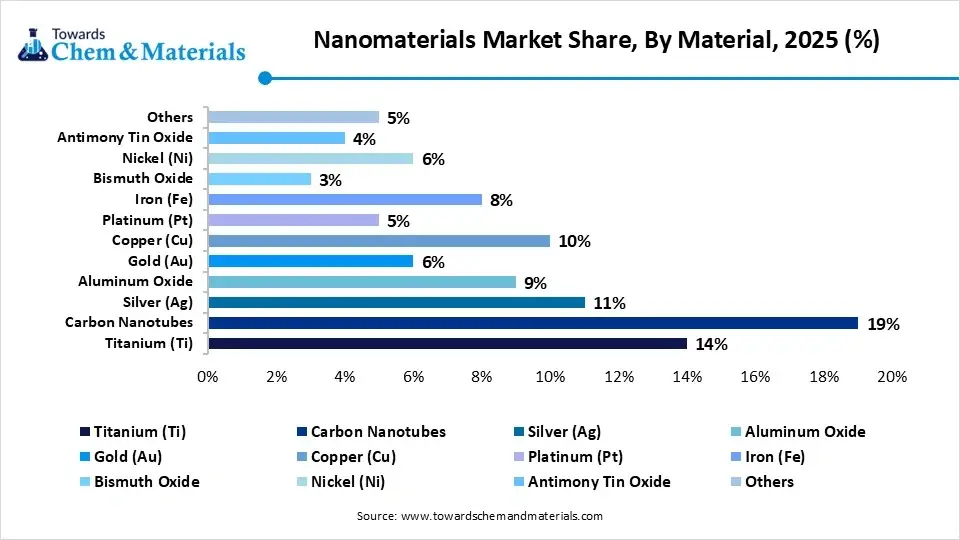
The titanium (Ti) segment held the 14% market share in 2025, represent as key for the construction and automotive sector by offering superior refractive index, photocatalytic stability ad ultraviolet protection. Nano-TiO2 is transparent and highly efficient, which is preferred in consumer goods. Titanium is a key component in self-cleaning building materials, scratch-resistant paints, biomedical and air-purifying coatings. The market focuses on inhalation nanotoxicity chemical classification that driving the adoption of green synthesis through slurry dispersion.
The silver (Ag) segment held the 11% market share in 2025. It functions as an antimicrobial nanomaterial that ensures superior oligodynamic effect, higher electrical conductivity, and localized surface plasmon resonance. The silver acts as a key agent in antimicrobial wound dressing, biosensing diagnosis, that make them key for the healthcare sector. The silver nanowires are utilized in flexible conductive inks and next-generation printed circuit boards. The rising focus on mastering colloidal stability to avoid particle precipitation to meet aquatic nanotoxicity and silver ion leaching regulations.
The copper (Cu) segment held 10% market share in 2025, due to rising demand for a cost-efficient substitute for precious metals in the advanced nanomaterials sector. The copper is a combination of superior electrical conductivity, higher thermal dissipation, and broad-spectrum antimicrobial efficacy. Nano-copper is key in sintering conductive pastes and antifouling marine coatings. The shift towards optimizing environmental heavy metal nanotoxicity and long-term colloidal stability is boosting the segment expansion.
Application Insights
The electronics segment dominated the market with the largest share of 24% in 2025. The nanomaterials are crucial in semiconductor components, flexible electronics, conductive inks, and display technologies. The electronics sector is integrating graphene, CNT, and nano-copper to achieve sub-nanometer node miniaturization. The nanomaterials provide higher processing speed, superior ballistic electron transport, and lower power consumption in next-generation microprocessors. The innovation focuses on defect-free large area substrate deposition into well-established complementary metal-oxide semiconductor fabrication lines.
The energy & power segment held the 18% market share in 2025 and is expected to grow at the fastest CAGR of 10.41% over the forecast period. The shift towards decarbonization is driving the adoption of nanomaterials in battery electrodes, fuel cells, solar cells, and supercapacitors. The carbon nanotubes, silicon-nanowire anodes, and graphene offer higher energy density and charging speed in modern solid-state electric vehicle battery chemistry. The energy & power sector focuses on continuous-flow industrial scalability by maintaining high efficiency and a stable raw material supply chain for green energy infrastructure.
The medical segment held the 21% market share in 2025, driven by nanomaterial therapeutic efficacy and patient care precision. The lipid nanoparticles, gold nanoparticles, and polymeric micelles for hyper-precise targeted drug delivery, antimicrobial coating, tissue engineering, imaging & diagnostics. The rising focus on in-vivo biocompatibility and sterile scalability makes nanomaterials key for clinical infrastructure. The biopharmaceutical demand for modern mRNA, siRNA therapeutics, quantum dot diagnostic bio-imaging, and gene-editing is driving innovation in nonmaterial technology.
The paints & coatings segment held 14% market share in 2025. The commercial demand for low-VOC and chemical safety practices is driving the adoption of nanomaterials for the transformation of passive chemical finishes into functional and smart coatings. The nanosilica, carbon nanotubes, and nano-titanium dioxide offer self-healing, UV-resistance, anti-corrosion properties, superior scratch resistance, and ultra-hydrophobic water repellence. Additionally, rising public awareness of aquatic ecotoxicity and achieving stable high-shear particle dispersion boost the application growth.
Regional Insights
How Did the Asia Pacific Dominated the Nanomaterials Market in 2025?
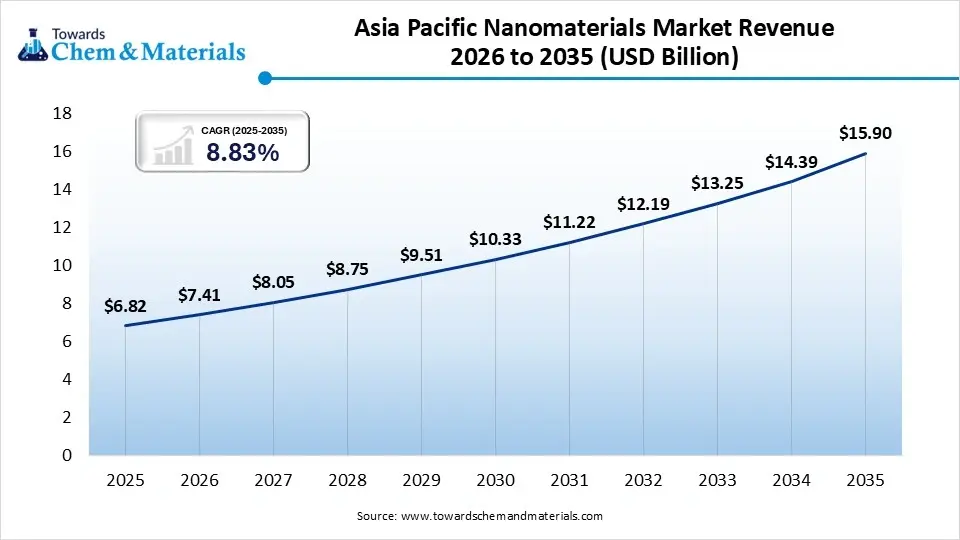
The Asia Pacific nanomaterials market size was estimated at USD 6.82 billion in 2025 and is projected to reach USD 15.90 billion by 2035, growing at a CAGR of 8.83% from 2026 to 2035. Asia Pacific dominated the market by holding 36% share in 2025 and is expected to grow at the fastest with a CAGR of 10.02% during the forecast period. The regional growth is driven by the integration of a semiconductor fabrication hub and electric vehicle battery infrastructure. Asia Pacific is a key advanced manufacturing hub and consumer of carbon nanotubes, quantum dots, and nano-titanium dioxide. The region has substantial investment in large-scale graphene synthesis infrastructure and lower operational costs. Additionally, Asia Pacific is securing a localized raw materials supply chain and maintaining its leadership in continuous-flow manufacturing to meet regional regulatory compliance.
China Nanomaterials Market Growth Trends
China market is witnessing continuous growth driven by its electric vehicle battery manufacturing and diversified electronics assembly framework. China consumer prefers the integration of graphene and CNT in a hyper-growth ecosystem. The strong government subsidies and high-volume corporate supply agreements are driving the scaling in nanomaterial manufacturing to meet domestic environmental compliance.
The North America nanomaterials market size was estimated at USD 5.31 billion in 2025 and is projected to reach USD 12.38 billion by 2035, growing at a CAGR of 8.83% from 2026 to 2035. North America held the 28% market share in 2025 and expects notable growth in the market with 7.92% CAGR during the forecast period. It is a key region for advanced nanomaterial innovation and higher joint venture capital investments. The commercial demand for single-walled carbon nanotubes and the integration of lipid nanoparticles are accelerating the domestic expansion. The stringent FDA regulatory clearance pathways and high-CAPEX operational cost strengthen North America's leadership in intellectual property generation.
U.S. Nanomaterials Market Growth Trends
The United States market is represented as an innovation-driven ecosystem. The domestic demand is driving the implementation of nanomaterials for defense, mRNA therapeutics, aerospace, and domestic semiconductor manufacturing. The competitive landscape is driving the shift toward high-value advanced materials through long-term corporate profitability and R&D funding.
Europe Nanomaterials Market Growth Trends
The Europe nanomaterials market size was estimated at USD 4.55 billion in 2025 and is projected to reach USD 10.64 billion by 2035, growing at a CAGR of 8.87% from 2026 to 2035. Europe held the 24% market share in 2025, serving as a key for green synthesis engineering and stringent chemical safety standards. The regional consumer demand for graphene-enhanced materials and the industrial demand for nano-silica are boosting the regional growth. The REACH registration guidelines and stringent occupational health infrastructure for nanotoxicity risk mitigation make Europe grow towards eco-friendly and low-carbon fabrication.
Germany Nanomaterials Market Growth Trends
The German market is a key industrial and technological leader in the European sector. The region dominates in automotive and precision manufacturing supply chains. The public-private research investment and competitive landscape align with precision synthesis, driving the regional innovation in eco-friendly green fabrication and domestic automated cleanrooms.
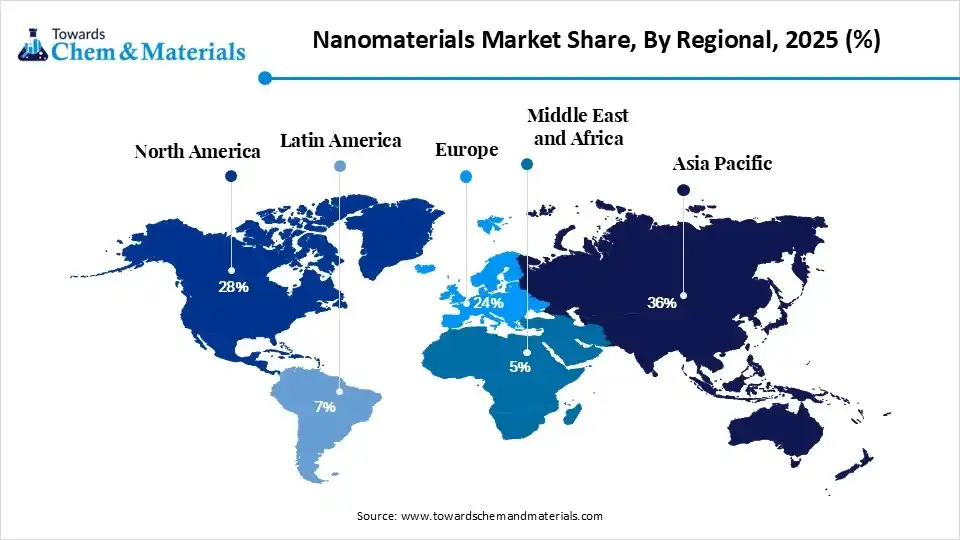
Nanomaterials Market Share, By Regional, 2025 (%)
| Regional | Revenue Share, 2025 (%) |
| North America | 28% |
| Europe | 24% |
| Asia-Pacific | 36% |
| Latin America | 7% |
| Middle East & Africa | 5% |
Latin America Nanomaterials Market Growth Trends
The Latin America nanomaterials market size was estimated at USD 1.33 billion in 2025 and is projected to reach USD 3.26 billion by 2035, growing at a CAGR of 9.38% from 2026 to 2035. Latin America held the 7% market share in 2025, driven by its heavy industrial efficiency and agricultural optimization. The region's growth is propelled by utilizing nano-encapsulated agrochemicals and nano-copper through regional extraction infrastructure. The urban industrial hub is integrating colloidal nano-silver. Additionally, Latin America's domestic manufacturing partnership and mineral reserves fueled the domestic growth.
Brazil Nanomaterials Market Growth Trends
The Brazilian market is advanced in agribusiness optimization and deepwater energy extraction technology. Brazil's federal research initiative and ANVISA safety compliances utilizing nano-encapsulated biopesticides and carbon nanotube composites through its mineral reserves and urban hubs.
Middle East & Africa Nanomaterials Market Growth Trends
The Middle East & Africa nanomaterials market size was estimated at USD 0.95 billion in 2025 and is projected to reach USD 2.39 billion by 2035, growing at a CAGR of 9.66% from 2026 to 2035. The Middle East & Africa held the 5% market share in 2025, the region is the leading localized center for industrial infrastructure flexibility and energy diversity. The regional environmental nanotoxicity compliances, competitive capital infusion make MEA a key for advanced nanomaterial manufacturing infrastructure. The high-value commercial momentum is transforming the MEA import-dependent zone.
Saudi Arabia Nanomaterials Market Growth Trends
Saudi Arabia's market is the fastest-growing technological pillar of MEA, driven by its Vision 2030 economic diversification. The Saudi Arabia mega project is driving the consumption of nano-engineered desalination membranes and solar cell nano-coatings. Saudi Arabia long term corporate contracts and zero-tax industrial zones are driving the domestic expansion.
Recent Developments
- In February 2026, Brenntag formed a land market partnership with Nanum to bring industrial-scale nanotechnology. The alliance focuses on scaling the distribution of nanomaterials include graphene nanoplatelets, graphene oxide, nano-silver, and reduced graphene oxide.(Source: indianchemicalnews)
- In September 2025, METiS Technologies launched NanoForge, which is recognized as the world's first AI-driven nano-delivery platform, built to accelerate the design and optimization of nanomaterials for drug delivery systems across various diseases.(Source: prnewswire)
Top Companies in the Nanomaterials Market
- Strem
- ACS Material LLC
- American Elements
- Arkema S.A.
- BASF SE
- Cabot Corporation
- Daikin Industries Ltd.
- Jiangsu Cnano Technology Co. Ltd.
- US Research Nanomaterials, Inc.
- nanoComposix
- Frontier Carbon Solutions, LLC.
- Nanoshel LLC
- SkySpring Nanomaterials, Inc.
- Nanophase Technologies Corporation
- Cytodiagnostics Inc
- Quantum Materials Corporation
Segment Covered in the Report
By Material
- Titanium (Ti)
- Titanium dioxide nanoparticles
- Nano titanium coatings
- Biomedical titanium nanomaterials
- Carbon Nanotubes
- Single-walled carbon nanotubes
- Multi-walled carbon nanotubes
- Functionalized carbon nanotubes
- Silver (Ag)
- Nano silver particles
- Conductive silver nanomaterials
- Antimicrobial silver nanomaterials
- Aluminum Oxide
- Nano alumina powders
- Ceramic reinforcement alumina
- Thermal insulation alumina nanoparticles
- Gold (Au)
- Gold nanoparticles
- Gold nanorods
- Gold nanoshells
- Copper (Cu)
- Copper nanoparticles
- Conductive copper inks
- Copper oxide nanomaterials
- Platinum (Pt)
- Platinum catalysts
- Fuel-cell platinum nanomaterials
- Biomedical platinum nanoparticles
- Iron (Fe)
- Iron oxide nanoparticles
- Magnetic iron nanomaterials
- Nano iron catalysts
- Bismuth Oxide
- Radiation shielding nanoparticles
- Optical bismuth nanomaterials
- Electronic-grade bismuth oxide
- Nickel (Ni)
- Nano nickel powders
- Battery-grade nickel nanomaterials
- Catalytic nickel nanoparticles
- Antimony Tin Oxide
- Conductive coatings
- Transparent conductive films
- Infrared absorbing nanoparticles
- Others
- Zinc oxide nanoparticles
- Silica nanoparticles
- Quantum dots
- Graphene nanomaterials
By Application
- Medical
- Drug delivery
- Imaging & diagnostics
- Antimicrobial coatings
- Tissue engineering
- Electronics
- Semiconductor components
- Conductive inks
- Flexible electronics
- Display technologies
- Paints & Coatings
- Anti-corrosion coatings
- UV-resistant coatings
- Self-cleaning coatings
- Antimicrobial coatings
- Energy & power
- Battery electrodes
- Solar cells
- Fuel cells
- Supercapacitors
- Automotive
- Lightweight composites
- EV batteries
- Nano coatings
- Tire reinforcement
- Aerospace
- Structural composites
- Thermal barrier coatings
- Conductive aerospace materials
- Lightweight nano alloys
- Others
- Water treatments
- Textiles
- Agriculture
- packaging
By Region
- North America
- U.S.
- Canada
- Europe
- Germany
- UK
- France
- Italy
- Spain
- Sweden
- Denmark
- Norway
- Asia Pacific
- China
- Japan
- India
- South Korea
- Thailand
- Latin America
- Brazil
- Mexico
- Argentina
- Middle East and Africa (MEA)
- South Africa
- UAE
- Saudi Arabia
- Kuwait



Comments
Share your thoughts, ask a question, or provide feedback about this report.