
What is Surface Disinfectant Products Market Size & Share?
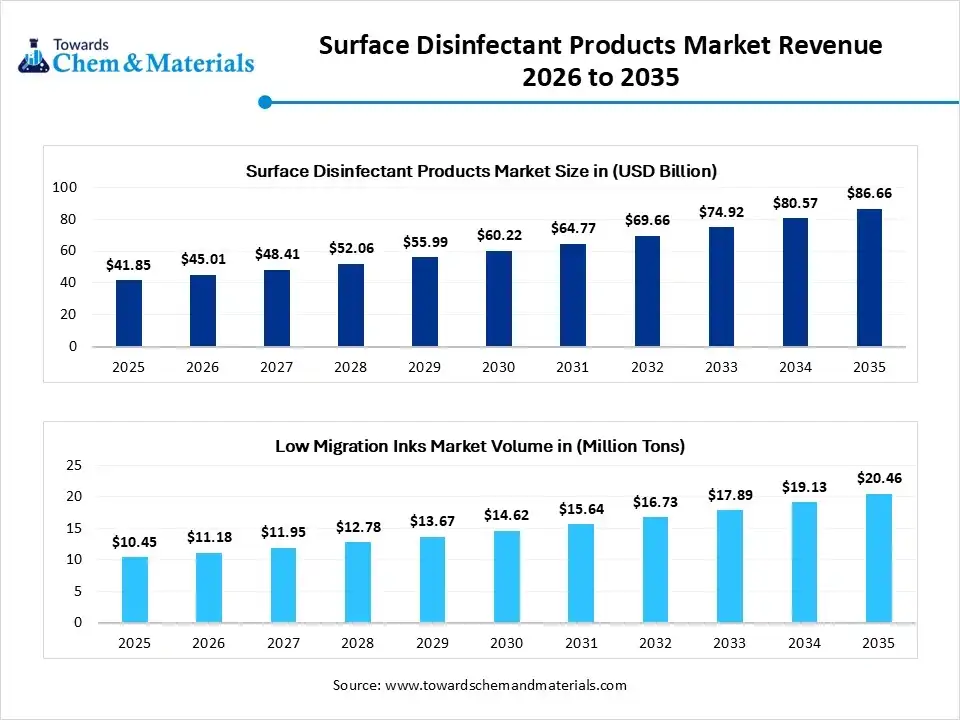
The surface disinfectant products market size was valued at USD 41.85 billion in 2025, is estimated to reach USD 45.01 billion in 2026, and is projected to reach USD 86.66 billion by 2035, exhibiting a compound annual growth rate (CAGR) of 7.55% over the forecast period from 2026 to 2035.North America dominated the surface disinfectant products market with the largest revenue share of 33% in 2025 and is expected to grow at the fastest CAGR of 7.71% during the forecast period. In terms of volume, the surface disinfectant products market is projected to grow from 10.45 million tons in 2025 to 20.46 million tons by 2035. growing at a CAGR of 6.95% from 2026 to 2035.The priority for cleanliness and safety in major sectors is accelerating the industry's potential nowadays.
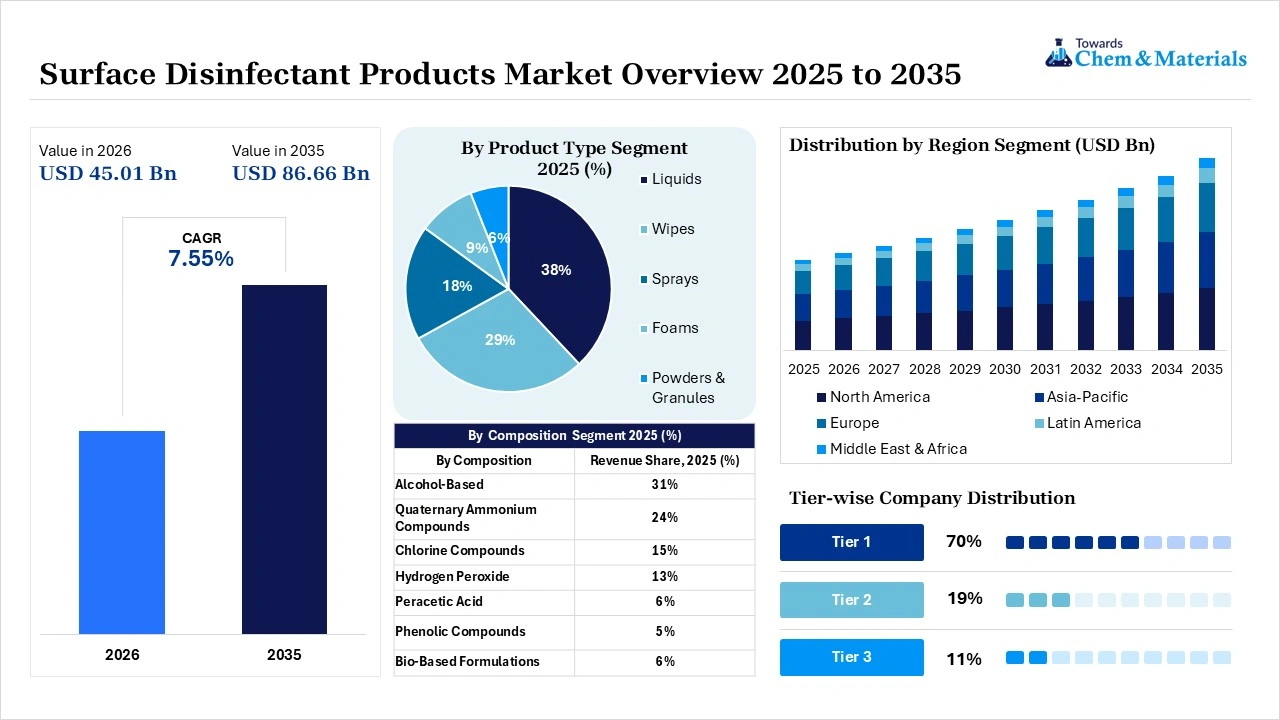
The specific cleaning solutions that are specifically designed for controlling harmful bacteria and germs from different surfaces are known as the as the surface disinfectants. Also, the availability of the product primarily in the form of sprays, wipes, liquids, and concentrates has been observed in recent years. Moreover, the better reduction of the risk of infections has gained the surface disinfectants major industry attention from the specific sectors such as the healthcare, chemical industries, and food industries in the past few years. The regions like North America and the Asia Pacific have been seen under the greater expansion of the industry nowadays.
Market Highlights
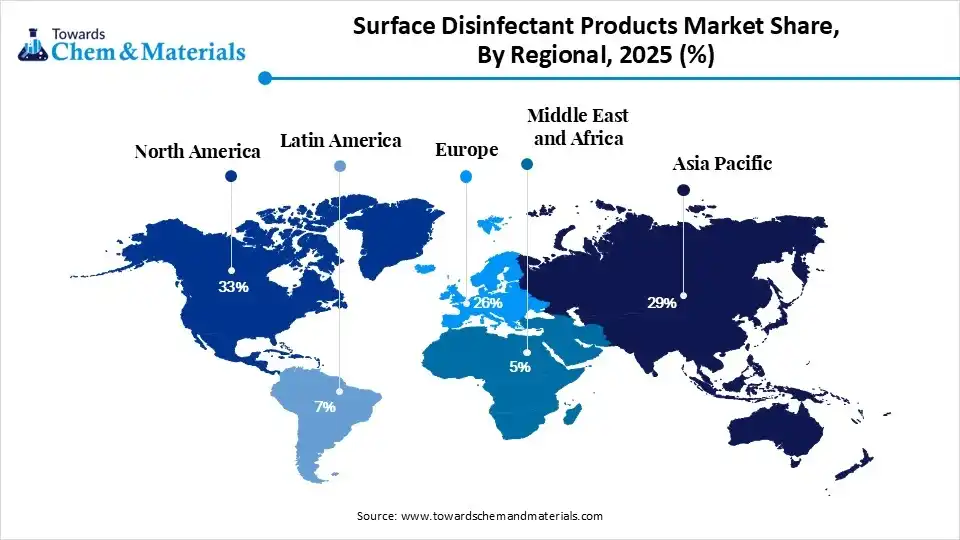
- By region, North America dominated the market with a share of 33% in 2025, due to the region having strong healthcare infrastructure, high hygiene awareness, and advanced cleaning practices.
- By region, Asia Pacific is notably growing with 29% market share in 2025 and is expected to be the fastest-growing region in the market, with a CAGR of 9.4% in the forecast period, owing to the region experiencing rapid urbanization, population growth, and healthcare expansion.
- By product type, the liquids segment dominated the market with 38% share in 2025, as liquid disinfectants are widely used across homes, hospitals, offices, and industrial facilities.
- By product type, the wipes segment held the 29% market share in 2025 and is expected to be the fastest-growing in the market, with a CAGR of 8.9% in the forecast period, owing to consumers are increasingly choosing convenient and ready-to-use cleaning products.
- By composition, the alcohol-based segment dominated the market with 31% share in 2025, as alcohol disinfectants provide fast and effective germ-killing performance.
- By composition, the hydrogen peroxide segment held the 13% market share in 2025 and is expected to be the fastest-growing segment in the market, with a CAGR of 9.1% in the forecast period, due to it offers strong cleaning performance with lower chemical residue.
- By application surface, the floors & walls segment dominated the market with 28% share in 2025, as these surfaces require frequent cleaning in hospitals, schools, offices, malls, and industrial buildings.
- By application surface, the high-touch surfaces segment held the 13% market share in 2025 and is expected to be the fastest-growing in the market, with a CAGR of 9.2% in the forecast period, owing to people are becoming more aware of infection risks from frequently touched areas
- By end user, the healthcare facilities segment dominated the market with 36% share in 2025, owing to the hospitals, clinics, laboratories, and healthcare centers require continuous disinfection to maintain patient safety and prevent infections.
- By end user, the residential consumers segment held the 14% market share in 2025 and is expected to be the fastest-growing in the market, with a CAGR of 8.7% in the forecast period in 2025, owing to households are becoming more focused on daily hygiene and cleanliness practices.
- By distribution channel, the distributors and wholesalers segment dominated the market with 30% share in 2025, owing to they help manufacturers supply disinfectant products in large quantities across hospitals, retail stores, offices, and industrial sectors.
- By distribution channel, the e-commerce segment held the 18% market share in 2025 and is expected to be the fastest-growing in the market, with a CAGR of 10.8% in the forecast period, as online shopping offers greater convenience, faster product comparison, and home delivery services.
- By formulation type, the ready-to-use segment dominated the market with 42% share in 2025, owing to these disinfectants are simple, convenient, and require no mixing before application.
- By formulation type, the waste-based formulations segment held the 13% market share in 2025 and is expected to be the fastest-growing in the market, with a CAGR of 8.9% in the forecast period, as industries are increasingly focusing on sustainable and environmentally friendly production methods.
- By packaging type, the bottles segment dominated the market with 34% share in 2025, owing to bottles are convenient, durable, and suitable for storing liquid disinfectants safely.
- By packaging type, the pouches segment held the 11% market share in 2025 and is expected to be the fastest-growing in the market, with a CAGR of 9.4% in the forecast period, as pouch packaging is lightweight, flexible, and more environmentally friendly compared to traditional rigid packaging.
Quick Stats at a Glance
- Market Estimated Size (2025): USD 41.85 Billion | CAGR (2026–2035): 7.55%
- Market Projected Size (2035): USD 86.66 Billion
- North America: Revenue Share of 33% in 2025|USD 13.81 Billion
- Market Estimated Volume (2025): 10.45 Million Tons | Volume CAGR (2026–2035): 6.95%
- Market Projected Volume (2035): 20.46 Million Tons
- Market Pricing (2025):
- Average Manufacturing Price (2025): USD 3.11/kg
- Average Selling Price (2025): USD 5.22/kg
- Pricing CAGR (2026–2035): 3.19%
The industry has grown strongly in recent years owing to the greater awareness of hygiene, safety, and disease prevention. After the pandemic period, both consumers and businesses started giving more importance to regular disinfection and cleaner environments. Moreover, healthcare facilities are increasing the use of advanced disinfectants to maintain patient safety and control infections.
 Also, in the current period, manufacturers are actively focusing on producing safer, eco-friendly, and fast-working disinfectants that are easy to use and less harmful to surfaces. Furthermore, companies are introducing innovative packaging formats such as ready-to-use wipes and spray bottles for convenience.
Market Trends:
- The converting preferences towards the eco-friendly surface disinfectants have enabled the high return ventures for the manufacturers in recent years. The consumers are actively demanding clean-label and more natural disinfectants.
- The heavy shift towards convenient cleaning formats has elevated earning potential for the producers in the current period. Several consumers are observed to be buying ready to use disinfectants wipes and spray products nowadays.
- The increase in hygiene standards in healthcare and the public sector is likely to drive better financial gains in the manufacturing sector during the forecast period. Also, several healthcare firms have been creating collaborations with hygiene product providers in recent years, where the manufacturers are targeting longer-term potential and sales safety nowadays.
Report Scope
| Report Attributes | Details |
| Market Size and Volume in 2026 | USD 45.01 Billion / 11.18 Million Tons |
| Revenue Forecast in 2035 | USD 86.66 Billion / 20.46 Million Tons |
| Growth Rate | CAGR 7.55% |
| Base Year of Estimation | 2025 |
| Forecast Period | 2025 - 2035 |
| High Impact Region | North America |
| Segment Covered | By Product Type, By Composition, By Application Surface, By End User, By Distribution Channel, By Formulation Type, By Packaging Type, By Region |
| Key Companies Profiled | Ecolab Inc., Procter & Gamble Co., Unilever plc, Diversey Holdings, Ltd., SC Johnson & Son, Inc., CarrollCLEAN, Steris plc, Reckitt Benckiser Group plc, The Clorox Company, 3M Company |
Automated Cleaning Technology Emergence
The industry has seen the development of advanced fast-acting and low-toxicity disinfectant solutions in recent years. Also, the manufacturers are focusing on creating products that provide strong germ protection while being safer for humans and surfaces. Moreover, touch-free dispensing systems and automated disinfecting machines are becoming more common in hospitals, airports, and commercial buildings.
Supply Chain Analysis of the Surface Disinfectant Products Market:
Distribution to Industrial Users
- Chemical manufacturers distribute industrial-grade surface disinfectants to commercial users through specialized business-to-business networks. This supply chain involves bulk chemical distributors, industrial logistics channels, and wholesale suppliers.
- They deliver high-volume containers directly to institutional environments, factory settings, food processing facilities, and manufacturing spaces to maintain strict sanitation standards.
- Key Players: Ecolab and 3M
Chemical Synthesis and Processing
- Chemical synthesis of surface disinfectants involves formulating active ingredients like quaternary ammonium compounds or hydrogen peroxide. Industry giants such as Dow, BASF, and Evonik synthesize these raw biocides.
- Companies like Stepis or specialized blenders then process and stabilize them into bulk liquid concentrates or ready-to-use industrial sanitizing products.
Regulatory Compliance and Safety Monitoring
- Manufacturing surface disinfectants requires strict compliance with protocols enforced by the EPA, FDA, and OSHA in the United States, alongside ECHA in Europe.
- These agencies mandate rigorous biocidal efficacy testing and precise chemical safety data sheets. Continuous monitoring ensures formulations meet strict toxicity thresholds, guaranteeing worker protection and public safety.
Surface Disinfectant Products Market Regulatory Landscape: Regulations
| Country Region | Regulatory Body | Key Regulations | Focus Areas |
| United States | U.S. Environmental Protection Agency (EPA) | Federal Insecticide, Fungicide, and Rodenticide Act (FIFRA) (7 U.S.C. § 136 et seq.). | Efficacy Testing Validation: Strict adherence to AOAC or ASTM testing protocols to prove explicit contact-time logs against target pathogens (e.g., List N for SARS-CoV-2). |
| Europe | European Chemicals Agency (ECHA) |
Biocidal Products Regulation (BPR, Regulation (EU) No 528/2012). | Two-Tiered Authorization: Active ingredients must first be approved at the EU level before formulated chemical products can gain individual Member State market authorization |
| China | National Health Commission (NHC) | WS 628-2018 (Rules for Hygiene and Safety Assessment of Disinfection Products): The mandatory ministerial standard detailing pre-market evaluation and testing specifications. | Hygiene & Safety Assessment Filing: Before commercial launch, a local Chinese-responsible entity must upload a comprehensive evaluation dossier containing localized lab test data, ingredient limits, and instructions. |
Market Dynamics
Driver
Hygiene Investments Supporting Industry Expansion
The growing awareness about hygiene and infection prevention has increased return on investment for manufacturers in the current period. Also, people have become more careful about cleanliness in homes, hospitals, schools, offices, and public places. Moreover, healthcare facilities are increasing the use of disinfectants to reduce the spread of harmful bacteria and viruses. Many businesses are also focusing on maintaining clean environments to improve customer trust and employee safety.
Restraint
Safety Issues Impacting Cleaning Product Demand
The concern about the harmful effects of strong chemical ingredients is expected to hinder the industry's growth in the coming years. Some disinfectants may cause skin irritation, breathing problems, or surface damage if used frequently or incorrectly. Moreover, consumers are becoming more aware of the environmental impact of chemical-based cleaning products. The high cost of premium disinfectants can also create challenges for low-income consumers and small businesses.
Opportunity
Smart Hygiene Technologies Shaping Future Demand
The rising demand for eco-friendly and advanced cleaning solutions is expected to create lucrative opportunities for manufacturers during the forecast period. Consumers are increasingly looking for safer disinfectants made with natural or biodegradable ingredients. Moreover, manufacturers have opportunities to develop innovative products such as long-lasting disinfectant coatings, smart cleaning systems, and touch-free dispensing technologies.
Segmental Insights
Product Type Insights
The liquids segment dominated the market with 38% share in 2025, as liquid disinfectants are widely used across homes, hospitals, offices, and industrial facilities. These products are easy to apply to large surfaces such as floors, walls, and medical equipment. Moreover, liquid disinfectants are available in different concentrations and packaging sizes, making them suitable for both household and commercial use.
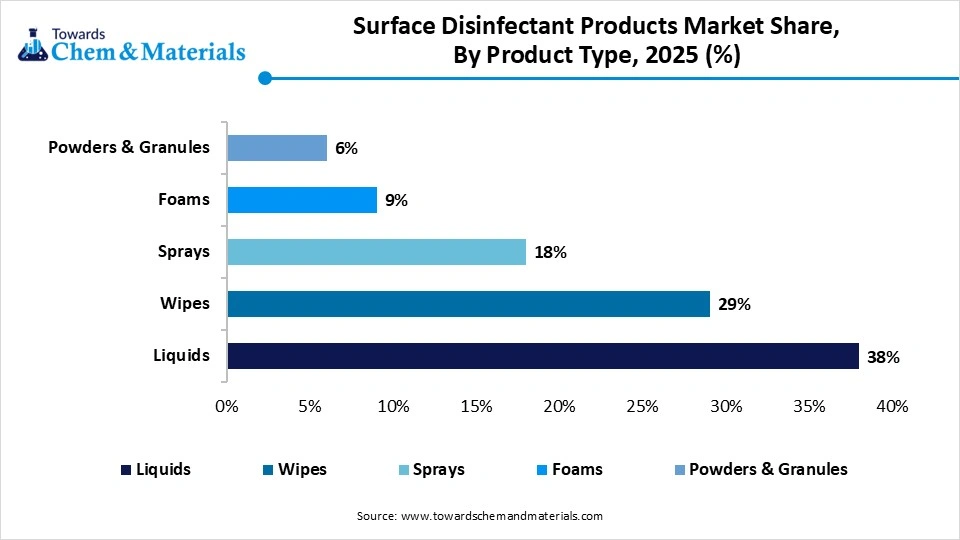
The wipes segment held the 29% market share in 2025 and is expected to be the fastest-growing in the market, with a CAGR of 8.9% in the forecast period, owing to consumers are increasingly choosing convenient and ready-to-use cleaning products. Disinfectant wipes are simple to carry, easy to use, and help reduce direct contact with contaminated surfaces. Moreover, wipes are becoming popular in offices, hospitals, schools, airports, and public transportation due to their fast cleaning ability.
Surface Disinfectant Products Market Share,By Product Type, 2025 (%)
| By Product Type | Revenue Share, 2025 (%) |
| Liquids | 38% |
| Wipes | 29% |
| Sprays | 18% |
| Foams | 9% |
| Powders & Granules | 6% |
Composition Insights
The alcohol-based segment dominated the market with 31% share in 2025, as alcohol disinfectants provide fast and effective germ-killing performance. These disinfectants are widely used in hospitals, clinics, laboratories, offices, and homes because they dry quickly and leave very little residue on surfaces.
The hydrogen peroxide segment held the 13% market share in 2025 and is expected to be the fastest-growing segment in the market, with a CAGR of 9.1% in the forecast period, due to it offers strong cleaning performance with lower chemical residue. Consumers and industries are increasingly searching for disinfectants that are safer for both human health and the environment. The hydrogen peroxide breaks down into water and oxygen and makes it more eco-friendly compared to some traditional chemical disinfectants.
Surface Disinfectant Products Market Share,By Composition, 2025 (%)
| By Composition | Revenue Share, 2025 (%) |
| Alcohol-Based | 31% |
| Quaternary Ammonium Compounds | 24% |
| Chlorine Compounds | 15% |
| Hydrogen Peroxide | 13% |
| Peracetic Acid | 6% |
| Phenolic Compounds | 5% |
| Bio-Based Formulations | 6% |
Application Surface Insights
The floors and walls segment dominated the market with 28% share in 2025, as these surfaces require frequent cleaning in hospitals, schools, offices, malls, and industrial buildings. Floors and walls can collect dust, germs, and harmful bacteria due to continuous human movement and daily activities. Moreover, maintaining clean floors and walls is important for improving hygiene standards and creating safer environments.
The high-touch surfaces segment held the 13% market share in 2025 and is expected to be the fastest-growing in the market, with a CAGR of 9.2% in the forecast period, owing to people are becoming more aware of infection risks from frequently touched areas. Surfaces such as door handles, elevator buttons, desks, mobile devices, shopping carts, and railings are cleaned more regularly to reduce germ transmission.
Surface Disinfectant Products Market Share,By Application Surface, 2025 (%)
| By Application Surface | Revenue Share, 2025 (%) |
| Floors & Walls | 28% |
| Medical Equipment Surfaces | 21% |
| Countertops & Workstations | 16% |
| Washrooms & Sanitary Areas | 14% |
| High-Touch Surfaces | 13% |
| Food Contact Surfaces | 8% |
End User Insights
The healthcare facilities segment dominated the market with 36% share in 2025, owing to the hospitals, clinics, laboratories, and healthcare centers require continuous disinfection to maintain patient safety and prevent infections. Medical environments face high exposure to bacteria, viruses, and other harmful microorganisms, which increases the need for strong disinfectant products.
The residential consumers segment held the 14% market share in 2025 and is expected to be the fastest-growing in the market, with a CAGR of 8.7% in the forecast period in 2025, owing to households are becoming more focused on daily hygiene and cleanliness practices. Consumers are increasingly using disinfectants for kitchens, bathrooms, furniture, electronic devices, and frequently touched household surfaces.
Surface Disinfectant Products Market Share,By End User, 2025 (%)
| By End User | Revenue Share, 2025 (%) |
| Healthcare Facilities | 36% |
| Commercial Facilities | 24% |
| Industrial Facilities | 16% |
| Residential Consumers | 14% |
| Transportation & Logistics | 10% |
Distribution Channel Insights
The distributors and wholesalers segment dominated the market with 30% share in 2025, owing to their help manufacturers supply disinfectant products in large quantities across hospitals, retail stores, offices, and industrial sectors. These channels have strong supply networks and long-term business relationships with commercial buyers.
The e-commerce segment held the 18% market share in 2025 and is expected to be the fastest-growing in the market, with a CAGR of 10.8% in the forecast period, as online shopping offers greater convenience, faster product comparison, and home delivery services. Consumers increasingly prefer buying disinfectant products through online platforms because it saves time and provides access to a wider variety of brands.
Formulation Type Insights
The ready-to-use segment dominated the market with 42% share in 2025, owing to these disinfectants are simple, convenient, and require no mixing before application. Consumers and businesses prefer ready-to-use products because they save time and reduce the risk of incorrect chemical dilution. Moreover, hospitals, schools, offices, and households use these products for quick and regular cleaning activities.
The waste-based formulations segment held the 13% market share in 2025 and is expected to be the fastest-growing in the market, with a CAGR of 8.9% in the forecast period, as industries are increasingly focusing on sustainable and environmentally friendly production methods. Waste-based disinfectants are developed using recycled or bio-based raw materials, helping reduce environmental pollution and chemical waste.
Packaging Type Insights
The bottles segment dominated the market with 34% share in 2025, owing to bottles are convenient, durable, and suitable for storing liquid disinfectants safely. Bottles are widely used for sprays, liquid concentrates, and ready-to-use disinfectants in homes, hospitals, and commercial facilities.
The pouches segment held the 11% market share in 2025 and is expected to be the fastest-growing in the market, with a CAGR of 9.4% in the forecast period, as pouch packaging is lightweight, flexible, and more environmentally friendly compared to traditional rigid packaging. Consumers are increasingly choosing refill pouches because they reduce plastic waste and are easier to store and transport. Moreover, manufacturers prefer pouches because they lower packaging and transportation costs.
Regional Insights
How will North America Dominate the Surface Disinfectant Products Market in 2025?
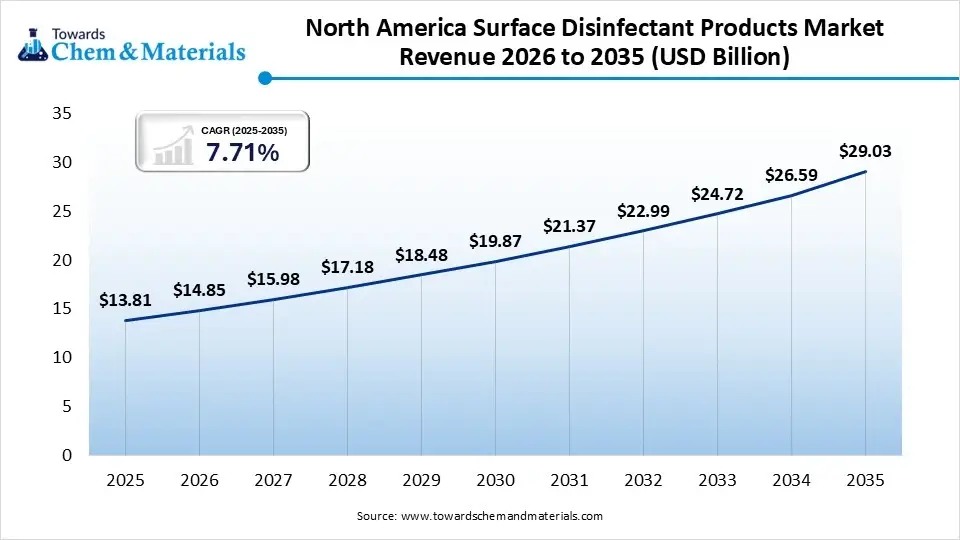
The North America surface disinfectant products market size was estimated at USD 13.81 billion in 2025 and is projected to reach USD 29.03 billion by 2035, growing at a CAGR of 7.71% from 2026 to 2035.North America dominated the market with a share of 33% in 2025, due to the region having a strong healthcare infrastructure, high hygiene awareness, and advanced cleaning practices. Hospitals, healthcare facilities, schools, offices, and commercial buildings regularly use disinfectants to maintain strict sanitation standards. Moreover, consumers in the region spend heavily on household cleaning and hygiene products.
The United States Advancing Surface Cleaning Solution
The United States maintained its dominance in the market, owing to its large healthcare sector and strong consumer awareness about hygiene. Hospitals, clinics, laboratories, schools, and public facilities use disinfectants regularly to maintain safety and infection control. Moreover, consumers in the United States prefer convenient products such as wipes, sprays, and ready-to-use disinfectants for household cleaning.
Surface Disinfectant Products Market Evaluation in the Asia Pacific
The Asia Pacific surface disinfectant products market size was estimated at USD 12.14 billion in 2025 and is projected to reach USD 25.56 billion by 2035, growing at a CAGR of 7.73% from 2026 to 2035.Asia Pacific is notably growing with 29% market share in 2025 and is expected to be the fastest-growing region in the market, with a CAGR of 9.4% in the forecast period, owing to the region experiencing rapid urbanization, population growth, and healthcare expansion. Countries across the region are increasing investments in hospitals, public sanitation, and industrial hygiene practices. Moreover, rising middle-class populations and improving living standards are increasing consumer spending on cleaning and disinfectant products.
China Powering the Future of Disinfection
China is expected to emerge as a prominent country for the surface disinfectant products market in the coming years, due to its large population, expanding healthcare system, and strong manufacturing industry. The country has seen growing awareness about public hygiene and infection prevention in recent years. Moreover, hospitals, public transportation systems, schools, and industrial facilities are increasing the use of disinfectants for daily sanitation activities.
Surface Disinfectant Products Market Share, By Regional, 2025 (%)
| Regional | Revenue Share, 2025 (%) |
| North America | 33% |
| Europe | 26% |
| Asia-Pacific | 29% |
| Latin America | 7% |
| Middle East & Africa | 5% |
Recent Development
- In April 2026, Wondercide plans to expand its household line. Also, in the household products, the company is likely to introduce pack-friendly disinfectants called Wonercide Multi-Surface Disinfectant, which has the capability to kill 99.99% of listed viruses and bacteria, as per the company's claim.(Source: prnewswire.com)
Top Vendors in the Surface Disinfectant Products Market & Their Offerings
- 3M Company: 3M Company is a global manufacturing conglomerate known for science-based innovation. In surface disinfection, it specializes in clinical-grade, specialized solutions for healthcare and commercial environments. Key products include highly concentrated quaternary ammonium cleaners, Scotch-Brite disinfecting wipes, and ready-to-use medical disinfectants engineered to kill persistent pathogens.
- The Clorox Company: The Clorox Company is a leading American consumer goods manufacturer famed for household cleaning and wellness. It dominates the consumer and professional disinfection markets through its signature EPA-registered bleach, household disinfecting wipes, and specialized healthcare germicides. Its formulations leverage chlorine bleach, hydrogen peroxide, and quaternary compounds for cross-contamination control.
- Reckitt Benckiser Group plc: Reckitt Benckiser Group plc is a prominent British multinational focusing on health, hygiene, and nutrition. It commands a massive share of the global surface disinfectant market via household powerhouses like Lysol and Dettol. Its popular aerosol sprays, liquid floor cleaners, and wipes are widely trusted to eradicate 99.9% of everyday household germs and viruses.
Other Key Players
- Ecolab Inc.
- Procter & Gamble Co.
- Unilever plc
- Diversey Holdings, Ltd.
- SC Johnson & Son, Inc.
- CarrollCLEAN
- Steris plc
Segments Covered in the Report
By Product Type
- Liquids
- Ready-to-Use Liquids
- Concentrated Liquids
- Wipes
- Alcohol-Based Wipes
- Quaternary Ammonium Wipes
- Hydrogen Peroxide Wipes
- Sprays
- Aerosol Sprays
- Trigger Sprays
- Foams
- Powders & Granules
By Composition
- Alcohol-Based
- Ethanol
- Isopropanol
- Quaternary Ammonium Compounds
- Benzalkonium Chloride
- Didecyldimethylammonium Chloride
- Chlorine Compounds
- Sodium Hypochlorite
- Chlorine Dioxide
- Hydrogen Peroxide
- Peracetic Acid
- Phenolic Compounds
- Bio-Based Formulations
By Application Surface
- Floors & Walls
- Medical Equipment Surfaces
- Countertops & Workstations
- Washrooms & Sanitary Areas
- High-Touch Surfaces
- Door Handles
- Elevator Buttons
- Railings
- Food Contact Surfaces
By End User
- Healthcare Facilities
- Hospitals
- Clinics
- Diagnostic Laboratories
- Ambulatory Surgical Centers
- Commercial Facilities
- Offices
- Retail Stores
- Hospitality
- Educational Institutions
- Industrial Facilities
- Food Processing Plants
- Pharmaceutical Manufacturing
- Warehouses
- Residential Consumers
- Transportation & Logistics
- Airports
- Railways
- Public Transit
By Distribution Channel
- Direct Sales
- Distributors & Wholesalers
- Retail Stores
- Supermarkets & Hypermarkets
- Pharmacies
- Convenience Stores
- E-Commerce
- Company-Owned Platforms
- Third-Party Marketplaces
By Formulation Type
- Ready-to-Use
- Concentrates
- Dilutable Solutions
- Water-Based Formulations
- Solvent-Based Formulations
By Packaging Type
- Bottles
- Canistera
- Buckets & Tuba
- Pouchea
- Drums & Bulk Containers
By Region
- North America
- U.S.
- Canada
- Europe
- Germany
- UK
- France
- Italy
- Spain
- Sweden
- Denmark
- Norway
- Asia Pacific
- China
- Japan
- India
- South Korea
- Thailand
- Latin America
- Brazil
- Mexico
- Argentina
- Middle East and Africa (MEA)
- South Africa
- UAE
- Saudi Arabia
- Kuwait



Comments
Share your thoughts, ask a question, or provide feedback about this report.