Find the Right Market Report
Search thousands of industry reports, market insights, and research studies in one place.
Not sure where to start? Try one of these:
The Japan specialty chemicals market size was valued at USD 76.8 billion in 2025 and is expected to reach USD 117 billion by 2035, growing at a CAGR of 4.3% during the forecast period of 2026-2035. The market in Japan includes specialty chemicals like electronic and semiconductor chemicals, specialty polymers, battery materials, coatings, adhesives, agrochemicals, and personal care ingredients. These chemicals cater to various industries such as electronics, automotive, construction, healthcare, agriculture, and industrial manufacturing. In 2025, electronic and semiconductor chemicals captured 24% of the market, particularly due to Japan's strengths in photoresists, semiconductor process chemicals, and lithography materials.
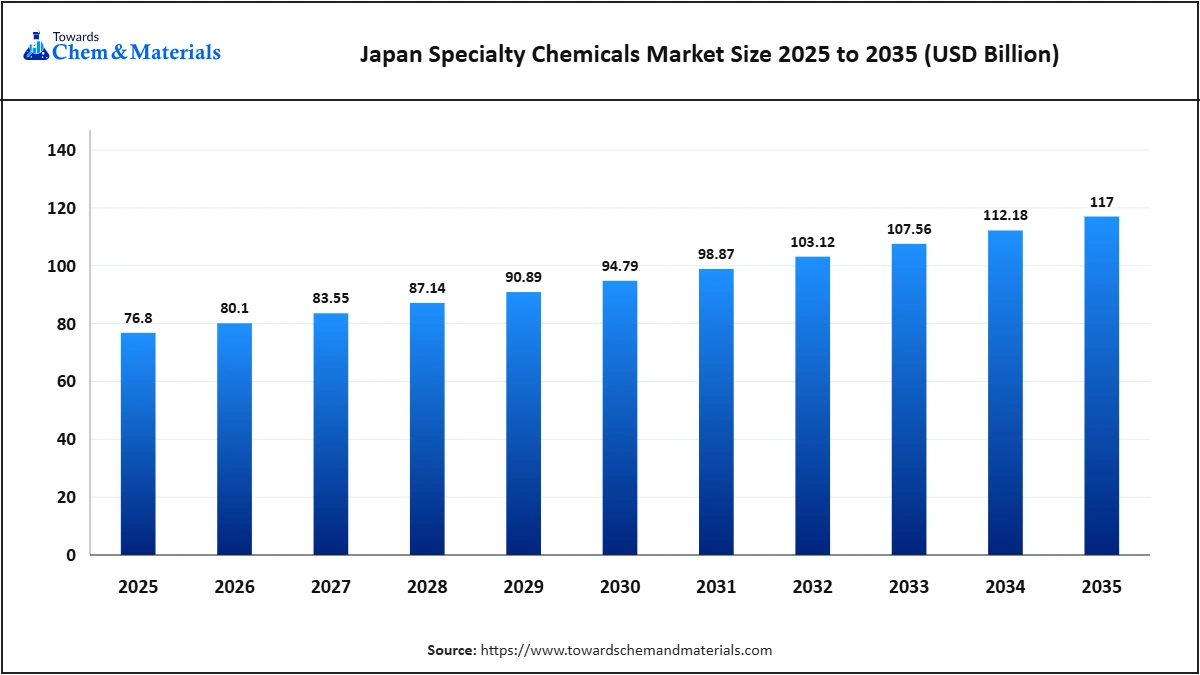
Note: 2025 is the base year; 2026-2035 values are forecasts.
Sources: Expert interviews, secondary sources, Towards Chemical and Materials database and Towards Chemical and Materials analysts.
The Kanto region led with a 33% revenue share, attributed to the density of chemical manufacturers and R&D centers in Tokyo, Chiba, Kanagawa, and Ibaraki. Market expansion in specialty chemicals is driven by investments in semiconductor fabrication, advanced packaging technologies, battery materials, and high-performance chemicals. Japan's robust chemical manufacturing ecosystem supports this growth, with new semiconductor facilities in Kumamoto and Hokkaido, alongside rising demand for sustainable chemical formulations. Furthermore, strategic consolidation among domestic manufacturers is reshaping the competitive landscape. For instance, in October 2025, Sumitomo Chemical agreed to make battery materials manufacturer Tanaka Chemical a wholly owned subsidiary through a share exchange, strengthening its position in the battery materials business.
The Japan specialty chemicals market is projected to grow from USD 76.80 billion in 2025 to USD 117.00 billion by 2035, supported by the country's established expertise in high-purity electronic materials, advanced polymers, performance chemicals, and specialty formulations. Investment in semiconductor manufacturing and related sectors is expected to increase demand in key chemical industries. Growth in domestic semiconductor capacity and next-gen material development supports this trend during the forecast period.
Japanese specialty chemical manufacturers utilize strong customer relationships and advanced technologies. Rising demand for specialty polymers, battery materials, and sustainable formulations further drives industry progress. The market is expected to reach USD 94.79 billion by 2030 and sustain a CAGR of 4.3% from 2026 to 2035. Meanwhile, material informatics, AI-assisted chemical discovery, and the restructuring of traditional petrochemical businesses toward higher-value specialty products are creating additional opportunities.
Analyst View: We estimated the market using specialty chemical shipment volumes, average selling prices, and demand across individual product categories and end-use industries in Japan. The assessment was cross-validated against domestic revenues of leading specialty chemical manufacturers, national chemical statistics, industry information, and published market estimates. Our market definition includes electronic and semiconductor materials and battery materials alongside conventional specialty chemical categories, providing a broader assessment of Japan's advanced materials ecosystem.
The Japan specialty chemicals market is fueled by the growth of semiconductor manufacturing and the rising demand for advanced electronic materials. Key suppliers in Japan provide essential materials like photoresists, semiconductor-grade process chemicals and lithography materials, and specialty gases. The trend towards advanced packaging technologies and sophisticated manufacturing processes is driving the need for high-performance chemical formulations, which present opportunities for established Japanese manufacturers due to their stringent purity, contamination-control and performance requirements.
Growing production of EVs and investments in battery manufacturing are driving demand for various battery components, including cathode and anode materials, electrolytes, and specialty polymers. The automotive sector's shift towards lightweight materials and functional coatings also enhances this demand. Japan's robust R&D infrastructure and advanced manufacturing capabilities are pivotal in promoting specialty chemical production and helping manufacturers create higher-value products for international markets.
The market faces challenges due to shrinking domestic demand, high energy costs, international competition, and an ageing workforce. Japan's declining population and mature manufacturing base limit growth in specialty chemical categories. Energy-intensive production is vulnerable to fluctuations in prices, which can impact manufacturers' profitability, especially in price-sensitive areas.
Competition from Chinese manufacturers is intensifying in selected battery materials and specialty polymer categories, as they boost capacity and leverage pricing and investment support. Additionally, an ageing workforce and a shortage of specialized technical personnel could hinder production efficiency and expansion, particularly affecting smaller and mid-sized manufacturers in the specialty chemicals sector.
The expansion of semiconductor manufacturing in Kumamoto and Hokkaido offers significant opportunities for specialty chemical suppliers, generating demand for various materials such as photoresists and advanced packaging. Additionally, growing demand for EVs and energy storage systems creates opportunities in battery materials, with manufacturers enhancing capabilities in advanced battery components benefiting from developments in the automotive and energy storage sectors.
The development of bio-based chemicals, recyclable specialty polymers, and low-carbon manufacturing processes presents opportunities for domestic producers. Additionally, AI-assisted materials discovery can enhance research productivity and speed up the commercialization of advanced chemical formulations. The demand for high-performance electronic materials and specialty chemical exports is anticipated to offer further growth opportunities for Japanese manufacturers.
| Driver | Impact | ≈ CAGR Contribution | Time Horizon | Key Regions |
| Semiconductor fabs grow | High | +1.68 pp | Short to long term | All covered regions, strongest in Kanto |
| Advanced packaging needs materials | Medium | +1.42 pp | Medium to long term | All covered regions, fastest uptake in Kyushu & Okinawa |
| EV batteries expand | Medium | +1.21 pp | Short to medium term | All covered regions |
| High-value exports | Low | +0.94 pp | Long term | Kanto and Kyushu & Okinawa |
Note: Contributions are indicative estimates of each factor's effect on annual growth.
Sources: Expert interviews, secondary sources, Towards Chemical and Materials database, and Towards Chemical and Materials analysts.
The expansion of semiconductor fabrication facilities, advanced packaging materials, battery manufacturing investments, and higher-value chemical exports contributes approximately 5.25 percentage points to annual market growth in Japan. The largest growth contributor is semiconductor fabrication, requiring specialized materials. Increasing complexity in semiconductor devices boosts demand for materials with enhanced properties. This trend, alongside battery materials expansion, is bolstering Japan's specialty chemical manufacturing, particularly in regions like Kanto and Kyushu & Okinawa.
| Restraint | Impact | ≈ Negative CAGR Contribution | Time Horizon | Key Regions |
| Shrinking domestic demand | High | -0.43 pp | Short to medium term | All covered regions |
| Energy costs | High | -0.31 pp | Medium term | Smaller and price-sensitive markets |
| Chinese competition | Medium | -0.21 pp | Short term | Kanto and other mature markets |
Note: Contributions are indicative estimates of each factor's effect on annual growth.
Sources: Expert interviews, secondary sources, Towards Chemical and Materials database and Towards Chemical and Materials analysts.
Annual market growth in Japan's chemical sector is anticipated to decline by about 0.95 percentage points due to shrinking domestic demand, high energy costs, and intensified competition from Chinese manufacturers. The mature industrial base and demographic trends limit consumption growth, while elevated energy costs impact manufacturing. The competition pressures prices in specific categories such as battery materials and polymers. Despite these challenges, Japan's technological expertise and quality assurance capabilities are expected to bolster domestic producers, leading to a projected CAGR of 4.3% from 2026 to 2035.
| Segments | 2025 Share | 2035 Share | CAGR 2026-2035 |
| Electronic & Semiconductor Chemicals | 24.00% | 26.15% | 5.20% |
| Specialty Polymers & Resins | 19.00% | 18.46% | 4.00% |
| Battery Materials | 10.00% | 9.72% | 4.00% |
| Coatings, Adhesives & Sealants | 17.00% | 16.52% | 4.00% |
| Agrochemicals | 8.00% | 7.78% | 4.00% |
| Personal Care Ingredients | 9.00% | 8.74% | 4.00% |
| Others | 13.00% | 12.63% | 4.00% |
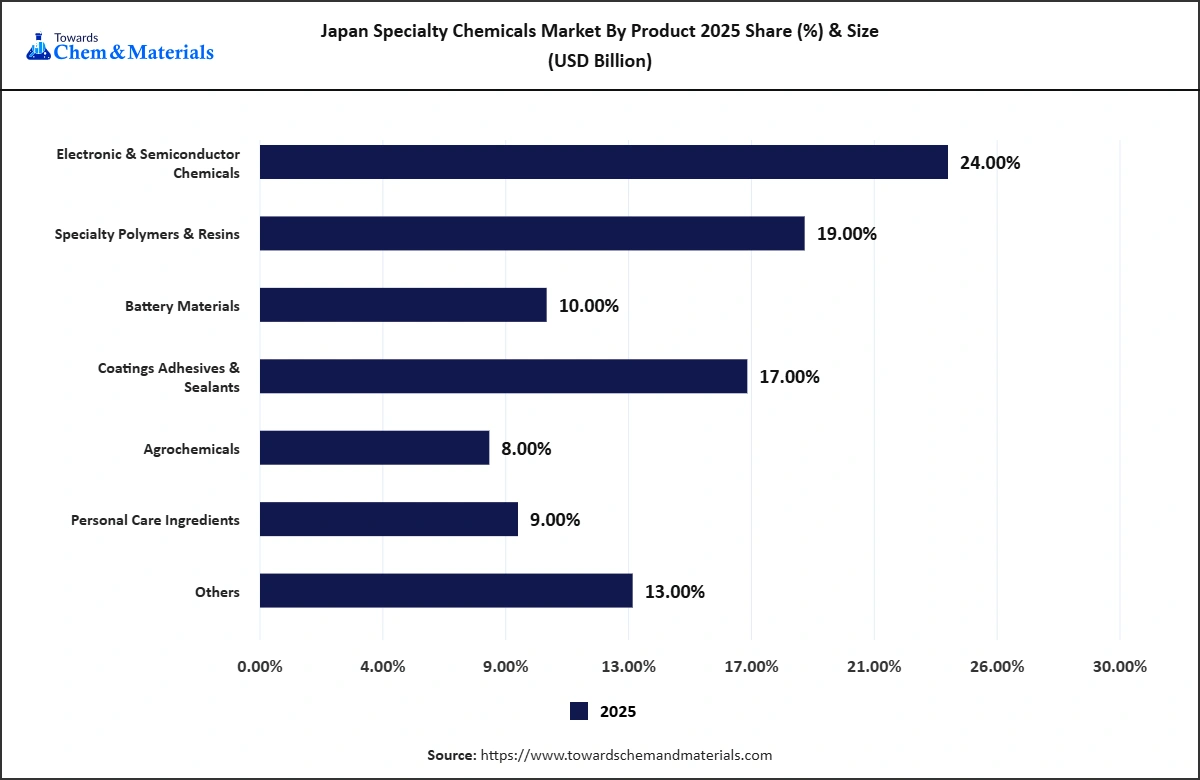
Note: 2025 is the base year; 2035 shares and CAGRs are forecasts.
Sources: Expert interviews, secondary sources, Towards Chemical and Materials database, and Towards Chemical and Materials analysts.
In 2025, electronic and semiconductor chemicals accounted for 24% of the Japan specialty chemicals market, followed by specialty polymers and resins at 19%, coatings, adhesives and sealants at 17%, and other specialty chemicals at 13%.
Battery materials represented 10%, personal care ingredients accounted for 9%, and agrochemicals captured 8%. Japanese manufacturers lead in electronic and semiconductor chemicals, particularly in semiconductor-grade materials, lithography chemicals, silicon wafers, and high-purity process chemicals, with this segment expected to achieve the fastest growth through 2035.
Electronic and semiconductor chemicals accounted for 24% of the market, equivalent to USD 18.432 billion in 2025, and are projected to register a CAGR of 5.2% from 2026 to 2035. The segment includes photoresists, silicon wafer materials, and high-purity process chemicals essential for semiconductor fabrication. Japan's robust position in semiconductor materials manufacturing and supplier relationships is enhancing growth. Rising investments in domestic facilities and advanced technologies, alongside the increasing complexity of manufacturing, are driving demand for materials with high purity and consistency. This segment is expected to grow faster than the overall market through 2035.
Specialty polymers and resins represented 19% of the market, worth USD 14.592 billion in 2025, with a projected CAGR of 4% from 2026 to 2035. This segment includes engineering plastics, high-performance resins, and thermoplastic materials, extensively used in automotive, electronics, and construction applications. The growth is driven by the demand for lightweight materials and high-performance engineering plastics.
Battery materials captured 10% of the market, valued at USD 7.680 billion in 2025, and are projected to expand at a CAGR of 4% from 2026 to 2035. The segment encompasses materials for rechargeable batteries, including cathode and anode materials, electrolytes, battery separators, and conductive additives. The increasing adoption of EVs and energy storage, along with investments in advanced battery technologies, is driving demand. Japanese chemical manufacturers are enhancing their portfolios through strategic investments and collaborations. The anticipated development of high-performance batteries with better energy density, safety, and durability is expected to broaden growth opportunities in the segment.
Coatings, adhesives, and sealants represented 17% of the market, valued at USD 13.056 billion in 2025, and are anticipated to record a CAGR of 4% through 2035. This segment includes protective coatings, industrial coatings, automotive paints, and specialty sealants, with demand driven by automotive manufacturing, construction, industrial equipment production, and electronics assembly. Increasing needs for corrosion resistance, thermal stability, and environmentally compatible products are fostering advanced formulations and broad market growth.
Agrochemicals captured 8% of the market, worth USD 6.144 billion in 2025, and are anticipated to register a CAGR of 4% from 2026 to 2035. The segment includes crop protection chemicals like herbicides, fungicides, insecticides, and plant growth regulators, driven by the need to boost crop productivity, manage pests, and maintain quality. Japan's agricultural sector requires specialized solutions due to its diverse cultivation systems. There is also an increasing emphasis on environmentally friendly products, which is fostering innovation and overall market growth through 2035.
Personal care ingredients accounted for 9% of the market, valued at USD 6.912 billion in 2025, and are projected to grow at a CAGR of 4% during the forecast period. The segment covers ingredients such as surfactants, emulsifiers, conditioning agents, and preservatives in skincare and personal care products. Japan's cosmetics industry drives demand for high-quality specialty ingredients, spurred by consumer interest in premium, functional, and sustainable products, prompting manufacturers to innovate.
Other specialty chemicals accounted for 13% of the market, worth USD 9.984 billion in 2025, and are expected to grow at a CAGR of 4% through 2035. This category encompasses catalysts, water treatment chemicals, industrial additives, specialty lubricants, process chemicals, and other performance-focused formulations. Demand is driven by industrial manufacturing, environmental management, and energy production, with increasing efficiency and compliance pushing the adoption of advanced chemical solutions.
Segment Outlook: Electronic and semiconductor chemicals are expected to retain their leading position through 2035, increasing their market share from 24% in 2025 to approximately 26.15% in 2035. The segment is also projected to record the highest product-level CAGR of 5.2%. Increasing semiconductor fabrication investments, advanced packaging requirements, and demand for high-purity electronic materials will continue to strengthen its position in the Japan specialty chemicals market.
| Segments | 2025 Share | 2035 Share | CAGR 2026-2035 |
| Electronics & Semiconductors | 30.00% | 32.45% | 5.13% |
| Automotive | 21.00% | 20.26% | 3.93% |
| Construction | 12.00% | 11.58% | 3.93% |
| Healthcare & Personal Care | 13.00% | 12.55% | 3.93% |
| Agriculture | 7.00% | 6.75% | 3.93% |
| Industrial & Others | 17.00% | 16.40% | 3.93% |
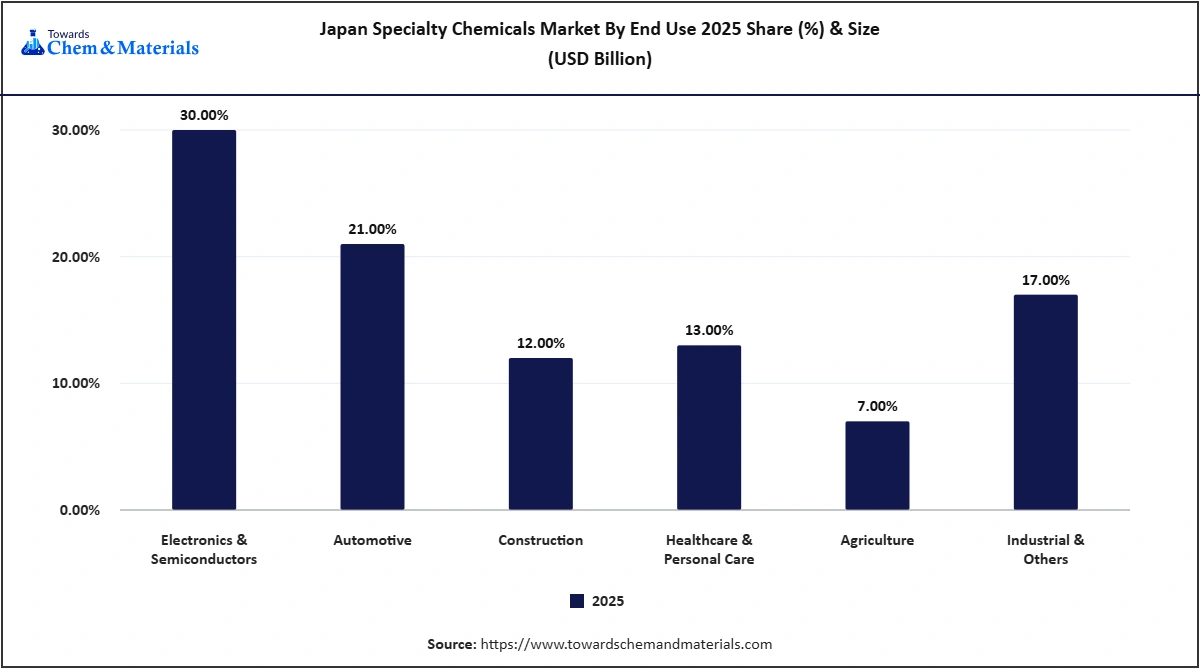
Note: 2025 is the base year; 2035 shares and CAGRs are forecasts.
Sources: Expert interviews, secondary sources, Towards Chemical and Materials database and Towards Chemical and Materials analysts.
In 2025, electronics and semiconductors accounted for 30% of the Japan specialty chemicals market, followed by automotive at 21%, industrial and other applications at 17%, and healthcare and personal care at 13%. Construction represented 12%, agriculture accounted for 7%, and electronics and semiconductors remained the largest and fastest-growing end-use category.
Electronics and semiconductors accounted for 30% of the market, equivalent to USD 23.040 billion in 2025, and are projected to expand at a CAGR of 5.13% from 2026 to 2035. The segment includes specialty chemicals used in semiconductor fabrication, integrated circuits, printed circuit boards, and advanced packaging. Japan's strong materials ecosystem and rising investments are driving growth, alongside increasing demands for photoresists and high-purity process chemicals. The complexity of manufacturing and next-generation devices will likely sustain demand for specialized formulations, expected to grow faster than the overall market during the forecast period.
Automotive held a 21% market share, worth USD 16.128 billion in 2025, and is projected to register a CAGR of 3.93% through 2035. This segment comprises specialty polymers, coatings, adhesives, sealants, battery materials, lightweight composites, and functional additives. Growth is bolstered by Japan's robust automotive industry and a rise in electric and hybrid vehicle adoption. The demand for lightweight materials, advanced coatings, thermal management, and battery components further enhances opportunities, though growth is anticipated to be slightly slower than the overall market.
Construction represented 12% of the market, valued at USD 9.216 billion in 2025, and is projected to expand at a CAGR of 3.93% during the forecast period. The segment includes construction chemicals, protective coatings, adhesives, sealants, waterproofing compounds, insulation materials, and specialty additives. Demand is fueled by infrastructure maintenance, commercial construction, residential improvements, and industrial development, emphasizing durability, corrosion resistance, energy efficiency, and environmentally compatible materials. Growth is expected to be slightly slower than the overall market.
Healthcare and personal care accounted for 13% of the market, equivalent to USD 9.984 billion in 2025, and are anticipated to expand at a CAGR of 3.93% from 2026 to 2035. The segment includes specialty chemicals and ingredients used in pharmaceutical manufacturing, medical materials, personal care, cosmetics and hygiene products, subject to the study's product-scope definition. It mentions a rising demand for high-quality cosmetic ingredients and advanced materials, with Japan's established industries serving as a robust customer base for specialty chemical manufacturers. Nevertheless, growth in this segment is projected to be somewhat slower than the overall market growth.
Agriculture captured 7% of the market, worth USD 5.376 billion in 2025, and is anticipated to grow at a CAGR of 3.93% through 2035. This segment includes crop protection chemicals, fertilizers, and specialty formulations, driven by the demand for higher crop yields and better pest management. A shift towards precision agriculture and eco-friendly products is fostering the development of specialized formulations, though growth is projected to be slightly slower than the overall market.
Industrial and other applications accounted for 17% of the market, equivalent to USD 13.056 billion in 2025, and are projected to expand at a CAGR of 3.93% from 2026 to 2035. This segment includes catalysts, water treatment chemicals, lubricants, additives, and performance chemicals, driven by needs in manufacturing, industrial processing, and environmental compliance. Although demand is increasing due to a focus on efficiency and reliability, growth in this segment is expected to be slightly slower than the overall market during the forecast period.
Segment Outlook: During the forecast period, electronics and semiconductors are expected to remain the largest end-use segment, increasing their share from 30% in 2025 to approximately 32.45% in 2035. The segment is also projected to record the highest end-use CAGR of 5.13%. Semiconductor fabrication expansion, advanced packaging technologies, and increasing demand for high-purity electronic materials will continue to strengthen its position.
Analyst View: In our analysis, segment estimates were developed by allocating market demand according to product applications, end-use consumption, pricing, and the presence of domestic specialty chemical manufacturers. Electronic and semiconductor chemicals and electronics and semiconductors lead their respective categories because they serve Japan's most technologically advanced industrial applications. However, battery materials, specialty polymers, and sustainable chemical formulations also offer opportunities as automotive electrification, industrial transformation, and environmental requirements evolve.
| Region | 2025 Share | 2035 Share | CAGR 2026-2035 |
| Kanto | 33.00% | 31.69% | 3.88% |
| Kansai | 21.00% | 20.96% | 4.28% |
| Chubu | 19.00% | 18.96% | 4.28% |
| Rest of Japan | 15.00% | 14.97% | 4.28% |
| Kyushu & Okinawa | 12.00% | 13.43% | 5.48% |
Note: 2025 is the base year; 2035 shares and CAGRs are forecasts.
Sources: Expert interviews, secondary sources, Towards Chemical and Materials database and Towards Chemical and Materials analysts.
Kanto held a 33% revenue share of the Japan specialty chemicals market in 2025, equating to USD 25.344 billion. Its leadership is attributed to the strategic concentration of its chemical manufacturing facilities, corporate headquarters, research centers, and suppliers related to semiconductors. Kyushu & Okinawa, which captured 12% of the total USD 76.8 billion, is anticipated to experience the fastest growth through 2035, driven by rising semiconductor investments and manufacturing expansion. Other regions include Kansai at 21% (USD 16.128 billion), Chubu at 19% (USD 14.592 billion), and the Rest of Japan at 15% (USD 11.520 billion).
Kanto accounted for 33% of the market, equivalent to USD 25.344 billion in 2025, and is projected to expand at a CAGR of 3.88% from 2026 to 2035. The region is central to Japan's specialty chemicals market, housing corporate headquarters and production facilities in Tokyo, Chiba, Kanagawa, and Ibaraki. Its advantages include strong chemical clusters, research capabilities, and closeness to crucial industries such as electronics and automotive. While demand will foster market growth, the region's growth rate is anticipated to be slightly lower than the overall market average.
Kansai captured 21% of the market, valued at USD 16.128 billion in 2025, and is projected to register a CAGR of 4.28% through 2035. The Kansai region, comprising Osaka, Hyogo, and Kyoto, has developed chemical and industrial clusters focused on specialty chemicals, polymers, and pharmaceuticals. Demand from diverse industrial customers and R&D institutions is driving growth, especially in functional materials and coatings. Market growth is anticipated to align with broader trends from 2026 to 2035.
Chubu represented 19% of the market, equivalent to USD 14.592 billion in 2025, and is expected to record a CAGR of 4.28% during the forecast period. The region is a key manufacturing hub for automotive, electronics, and industrial materials, driving demand for specialty chemicals like polymers and adhesives. The rise of vehicle electrification and the need for lightweight materials present growth opportunities for specialty chemical manufacturers, aligning the region's growth with overall market trends.
The rest of Japan captured 15% of the market, valued at USD 11.520 billion in 2025, and is anticipated to grow at a CAGR of 4.28% through 2035. This region encompasses several manufacturing clusters, including Yamaguchi, Okayama, Niigata, Tohoku, Shikoku, and Hokkaido. Demand is driven by chemical production, industrial processing, agricultural use, water treatment, and specialized materials. Additionally, opportunities exist in advanced materials manufacturing, industrial modernization, and low-carbon chemical production, aligning its growth with the overall market trend.
Kyushu & Okinawa accounted for 12% of the market, equivalent to USD 9.216 billion in 2025, and are projected to register the fastest regional CAGR of 5.48% from 2026 to 2035. The region gains strategic importance due to increased investments in semiconductor manufacturing, particularly in Kumamoto. This growth is boosting demand for high-purity chemicals, wafer materials, electronic-grade polymers, cleaning chemicals, and advanced packaging materials, which will likely elevate the need for specialty chemicals along with related infrastructure and industrial ecosystems. The region is projected to increase its market share to 13.43% by 2035.
Analyst View: Based on our analysis, regional estimates were developed by allocating market demand according to industrial activity, specialty chemical production capacity, end-use customer concentration, manufacturing investment, and supplier presence. Kanto leads because of its established manufacturing and research ecosystem. Kyushu & Okinawa receive the highest growth premium because of expanding semiconductor investments, particularly in Kumamoto, and increasing demand for advanced electronic materials.
| Rank | Company Name | 2025 Share (%) | Key Products / Business | Headquarters |
| 1 | Shin-Etsu Chemical | 7.81% | Silicon wafers, photoresists and silicones | Japan |
| 2 | Mitsubishi Chemical Group | 6.51% | Specialty materials and polymers | Japan |
| 3 | Sumitomo Chemical | 5.21% | Electronic materials, agrochemicals and battery materials | Japan |
| 4 | Resonac | 3.91% | Semiconductor materials | Japan |
| 5 | Asahi Kasei | 3.91% | Specialty polymers and battery separators | Japan |
| 6 | Toray Industries | 3.91% | Specialty films and resins | Japan |
| 7 | JSR | 2.60% | Photoresists and materials | Japan |
| 8 | Nippon Paint | 2.60% | Coatings | Japan |
| 9 | Fujifilm | 2.60% | Electronic materials | Japan |
| 10 | Kao | 2.60% | Personal care and chemical ingredients | Japan |
Note: Company shares are 2025 estimates.
Sources: Company press releases, expert interviews, secondary sources, Towards Chemical and Materials database and Towards Chemical and Materials analysts.
In 2025, the leading companies in the Japan specialty chemicals market included Shin-Etsu Chemical, Mitsubishi Chemical Group, Sumitomo Chemical, Resonac, Asahi Kasei, Toray Industries, JSR, Nippon Paint, Fujifilm, and Kao.
Shin-Etsu Chemical led the market with an estimated 7.81% share of 2025 revenue, followed by Mitsubishi Chemical Group at 6.51% and Sumitomo Chemical at 5.21%.
Shin-Etsu Chemical leads in silicon wafer materials, photoresists, and silicone products. Mitsubishi Chemical Group focuses on specialty materials, polymers, and advanced chemical solutions. Sumitomo Chemical has a diversified portfolio that includes electronic materials, agrochemicals, and battery materials.
Other prominent participants include Resonac, Asahi Kasei, Toray Industries, JSR, Nippon Paint, Fujifilm, and Kao. These companies compete through semiconductor materials, specialty polymers, battery separators, specialty films, resins, coatings, electronic materials, and personal care ingredients.
The top 10 companies collectively accounted for an estimated 41.67% of 2025 market revenue, while the remaining 58.33% was distributed among mid-sized manufacturers and specialized chemical producers.
The Japan specialty chemicals market is fragmented, featuring established manufacturers competing in high-value product categories. Key competitive factors include product purity, technological innovation, R&D capabilities, manufacturing consistency, customer qualification, global supply reliability, and sustainability.
Shin-Etsu Chemical: Headquartered in Japan, Shin-Etsu Chemical held an estimated 7.81% share of the Japan specialty chemicals market in 2025. Its relevant product portfolio includes silicon wafers, photoresists, silicones, and other advanced materials. Based on the Towards Chemical and Materials Companies Quadrant assessment, the company is positioned as a Leader.
Mitsubishi Chemical Group: Mitsubishi Chemical Group accounted for an estimated 6.51% share of the market in 2025. Its specialty chemicals portfolio encompasses advanced materials, specialty polymers, functional products, and performance chemicals, supported by a diversified manufacturing base and strong industry relationships. It is positioned as a Leader.
Sumitomo Chemical: Sumitomo Chemical held an estimated 5.21% share of the Japan specialty chemicals market in 2025. Its portfolio features electronic materials, agrochemicals, battery materials, and specialty chemicals, with strategic investments enhancing its battery materials capabilities. The company is classified as a Leader.
Resonac: Resonac accounted for an estimated 3.91% market share in 2025. Its product portfolio includes semiconductor materials, advanced packaging materials, and specialty chemical solutions, supporting demand from advanced electronics and semiconductor manufacturers. It is positioned as a Leader.
Asahi Kasei: Asahi Kasei held a 3.91% market share in 2025, offering specialty polymers, advanced materials, battery separators, and performance-oriented chemical products, leveraging diversified materials technologies and established relationships in the automotive and electronics sectors. It is positioned as a Leader.
Toray Industries: Toray Industries accounted for an estimated 3.91% market share in 2025. Its relevant portfolio includes specialty films, advanced polymers, resins, and high-performance materials used in automotive, electronics, and industrial applications. The company is classified as a Leader.
JSR: JSR held an estimated 2.60% share of the Japan specialty chemicals market in 2025. Its product portfolio encompasses photoresists and advanced materials for semiconductor manufacturing, leveraging specialized technology to meet the demand for high-performance electronic materials. It is positioned as an Innovator.
Nippon Paint: Nippon Paint accounted for an estimated 2.60% market share in 2025. Its relevant offerings include industrial coatings, automotive paints, protective coatings, and other specialty surface treatment products. The company is placed as an Innovator.
Fujifilm: Fujifilm held an estimated 2.60% share of the market in 2025. Its specialty chemicals portfolio encompasses electronic materials and advanced semiconductor-related materials, bolstered by technological expertise and materials development capabilities that enhance its competitive edge. It is classified as an Innovator.
Kao: Kao accounted for an estimated 2.60% share of the Japan specialty chemicals market in 2025. Its relevant product portfolio includes personal care ingredients, surfactants, specialty chemical ingredients, and functional materials. The company is positioned as an Innovator.
The Japan specialty chemicals ecosystem connects raw material suppliers, specialty chemical manufacturers, distributors and trading houses, end-use industries, and regulatory authorities. Each stage contributes to the development, production, distribution, and utilization of specialty chemical products.
| Ecosystem Stage | Role in the Market | Key Companies |
| Raw Material Suppliers | Supply petrochemicals and minerals | Refiners, crackers, importers |
| Specialty Chemical Makers | Make performance chemicals | Shin-Etsu, Mitsubishi Chemical, Sumitomo Chemical, Resonac, JSR |
| Distributors & Trading Houses | Distribute chemicals | Nagase, Inabata, trading houses |
| End Users | Use chemicals | Fabs, automakers, builders, cosmetics firms |
| Regulators | Set chemical rules | METI, CSCL, Ministry of the Environment |
Sources: Company press releases, expert interviews, secondary sources, Towards Chemical and Materials database and Towards Chemical and Materials analysts.
Raw Material Suppliers: Raw material suppliers are crucial in providing petrochemical feedstocks, minerals, and industrial gases for specialty chemical manufacturing. Key factors affecting production costs and consistency include pricing, availability, and quality. The sector comprises domestic refiners, petrochemical crackers, and international feedstock importers.
Specialty Chemical Makers: Specialty chemical manufacturers transform raw materials into high-performance products like electronic materials, polymers, and coatings, leveraging technological capabilities, research investments, and production quality for a competitive edge. Key industry players include Shin-Etsu Chemical, Mitsubishi Chemical Group, Sumitomo Chemical, Resonac, and JSR.
Distributors & Trading Houses: Distributors and trading houses connect chemical manufacturers with industrial customers by providing procurement, logistics, inventory management, and technical distribution services. They support international trade and supply chain coordination. Key participants include Nagase, Inabata, and other Japanese trading houses.
End Users: Specialty chemicals cater to multiple sectors, including semiconductor manufacturing, automotive, construction, healthcare, personal care, agriculture, and industrial manufacturing. The unique technological requirements and procurement criteria of these sectors influence product innovation and market demand, particularly affecting major companies in the semiconductor, automotive, construction, and cosmetics industries.
Regulators: Regulatory authorities establish requirements for chemical safety, environmental protection, industrial emissions, product registration, and manufacturing compliance, influencing production processes, chemical formulations, and market access. Important institutions include METI, the Chemical Substances Control Law (CSCL), and the Ministry of the Environment.
Value in the Japan specialty chemicals market flows from upstream feedstock suppliers to specialty chemical manufacturers, then through distribution partners to industrial and consumer end users. Companies that integrate advanced research, manufacturing capabilities, distribution networks, and long-term customer relationships can strengthen their competitive positions and capture a larger share of market value.
The Towards Chemical and Materials Companies Quadrant positions key participants in the Japan specialty chemicals market by market strength, reflecting revenue scale, market share, and geographic reach, and by innovation and growth strategy, reflecting product portfolio breadth, R&D intensity, and partnerships. Positions reflect each company's estimated 2025 share of the Japan specialty chemicals market and our assessment of its product innovation, portfolio breadth, and partnerships.
Sources: Company press releases, expert interviews, secondary sources, Towards Chemical and Materials database, and Towards Chemical and Materials analysts.
Leaders: Shin-Etsu Chemical, Mitsubishi Chemical Group, Sumitomo Chemical, Resonac, Asahi Kasei, and Toray Industries combine high market share with broad portfolios and strong innovation.
Innovators: JSR, Nippon Paint, Fujifilm, and Kao bring specialized technologies and application-specific product portfolios.
By Product
By End Use
By Region
The Japan specialty chemicals market was defined as the market for specialty chemicals produced and used in Japan, including electronic and semiconductor chemicals, specialty polymers and resins, battery materials, coatings, adhesives and sealants, agrochemicals, cosmetic and personal care ingredients, and other performance chemicals. The study covers specialty chemical applications across electronics and semiconductors, automotive, construction, healthcare and personal care, agriculture, and industrial manufacturing. The 2025 base-year market estimate for specialty chemicals was created using a bottom-up approach, analyzing shipment volumes, average prices, and demand in various product categories and industries, while also considering consumption patterns, manufacturing activity, domestic production, and supplier presence in Japan. The market estimates were validated through a combination of bottom-up and top-down assessments, including revenues from leading specialty chemical manufacturers and published industry statistics. Revenues were allocated across various product categories and regions, considering factors like demand patterns and manufacturing capacity. Company market shares were based on domestic revenue data and defined market scopes, while any unreconciled inputs were excluded from the analysis, which utilized a range of sources including company disclosures and expert interviews. All estimates for segments, regions, and companies align with a 2025 base year. The 2026-2035 forecast incorporates projected market growth, semiconductor investment, battery materials demand, automotive manufacturing, high-value chemical exports, and specialty chemical innovation. It addresses challenges such as decreasing domestic demand, rising energy costs, global competition, workforce issues, sustainability demands, and the shift toward higher-value specialty chemical products.
The Japan specialty chemicals market is positioned for steady expansion through 2035, supported by semiconductor manufacturing investments, growing demand for advanced electronic materials, and the development of high-performance specialty chemical products. Our analysis indicates that electronic and semiconductor chemicals will remain the most important growth category as semiconductor manufacturers increasingly require high-purity materials, advanced photoresists, wafer processing chemicals, and specialized packaging formulations. Battery materials and specialty polymers are also expected to benefit from automotive electrification and the growing importance of advanced energy storage technologies. The market forecast for specialty chemicals suggests growth is influenced by consumption, manufacturing capacity, end-use demand, and product pricing. Significant regional growth is expected in Kyushu & Okinawa, driven by semiconductor investments. Japanese manufacturers focusing on advanced materials, R&D, efficiency, sustainable practices, and high-value exports are likely to strengthen their competitiveness through 2035.
Reliable market intelligence and data-driven insights across the global chemicals and materials industry, helping businesses understand trends, competition, pricing, and emerging opportunities.
Schedule a Demo