
Flow Chemistry Market Size and Forecast 2026 to 2035
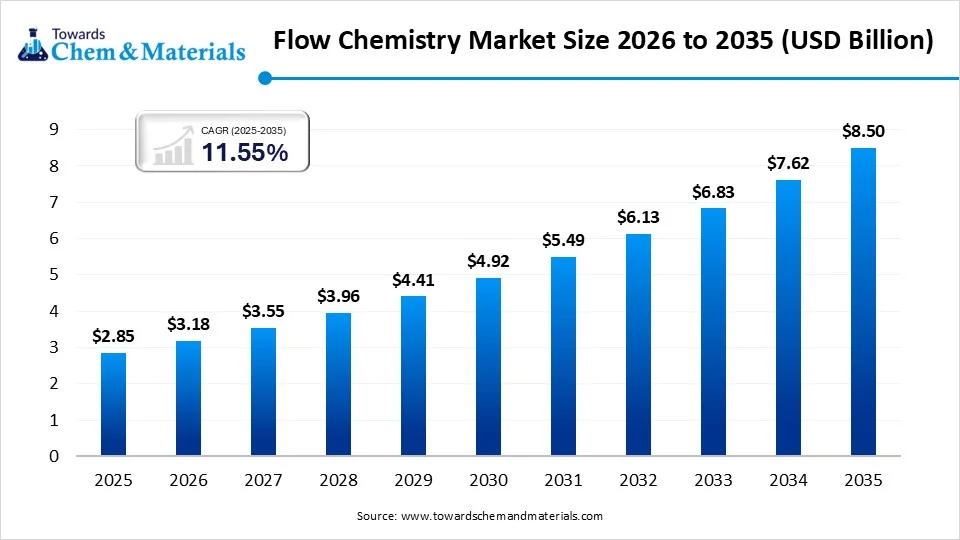
The global flow chemistry market size was estimated at USD 2.85 billion in 2025 and is expected to increase from USD 3.18 billion in 2026 to USD 8.50 billion by 2035, growing at a CAGR of 11.55% from 2026 to 2035. Asia Pacific dominated the flow chemistry market with the largest revenue share of 37.00% in 2025.The market is driven by sustainability manufacturing targets, collaborative partnerships, technological advancement and adoption in mission-critical applications. Flow chemistry is a modern chemical process using a continuous flow of reactive streams through pipes that is driven by the modification toward green chemistry and sustainability. It offers precise control, consistency, safety and reduces waste and energy utilization. Its growth is connected to increased adoption in pharmaceuticals for API synthesis and demand for specialty chemicals. The rising focus on sustainable processing that aligns with flow chemistry encourages the production of decarbonized products. The technological shift towards modular automation, real-time process technology, and microreactor techniques is boosting their adoption. Additionally, the vertical integration and collaboration for research and development are accelerating the market.
Market Highlights
- The Asia Pacific dominated flow chemistry market with the largest revenue share of 37.00% in 2025, due to industrial modernization and strong government support.
- By product, the plug flow reactor segment dominated the market and accounted for the largest revenue share of 38.00% in 2025. due to demand for continuous processing and large-scale manufacturing.
- By product, the microreactor segment is expected to grow at the fastest CAGR during the forecast period due to its utilization in high-efficiency reaction and precision.
- By application, the chemicals segment led the market with the largest revenue share of 39.00% in 2025, due to rising focus on operational productivity and product yield.
By application, the pharmaceuticals segment is anticipated to grow at the fastest CAGR in the market during the forecast period due to demand for API synthesis and medical processing.
Trade Analysis of the Flow Chemistry Market: Import and Export Statistics
- The United Kingdom exported 153 shipments of flow chemistry.
- China exported 76 shipments of flow chemistry.
- Switzerland exported 70 shipments of flow chemistry.
- From June 2024 to May 2025, the world exported 193 shipments of flow chemistry.
Key Technological Shifts and AI in the Flow Chemistry Market
Technological transformation in the flow chemistry market is a standard shift that enables smart manufacturing. The adoption of automated laboratories to avoid errors and where digitalization meets physical production. The incorporation of sensors and IoT for predictive control while process intensification for high-value chemical synthesis with accuracy. The market is scaling up novel materials discovery through technological innovation. Additionally, it promotes resource efficiency and sustainability, transforming chemical plants into eco-friendly ecosystems that align with automation.
Flow Chemistry Market Trends
- Shift Towards Continuous Manufacturing: The manufacturers are inclined towards continuous flow synthesis due to the requirement of operational superiority, volumetric productivity, and to reduce downtime.
- Focus on Sustainable Processing: The trend is driven by the adoption of green chemistry with flow chemistry at the lead of waste valorization and atom economy with minimal solvent and low energy consumption to meet decarbonization and sustainability targets.
- Industrial Vertical Integration: The growing focus on process intensification within the flow path to create a single continuous stream to lower their physical manufacturing footprint and save on facility overhead.
- Transition Towards Net-Zero Carbon On-Demand Production: The surge in mobile manufacturing modules bolsters distributed manufacturing that enable specialty chemical and medicines to be manufactured at a domestic scale, supported by supply chain resilience.
Report Scope
| Report Attribute | Details |
| Market Size in 2026 | USD 3.18 Billion |
| Revenue Forecast in 2035 | USD 8.50 Billion |
| Growth Rate | CAGR 11.55% |
| Forecast Period | 2026 - 2035 |
| Base Year | 2025 |
| Dominant Region | Asia Pacific |
| Segment Covered | By Product, By Application, By Region |
| Key companies profiled | Corning Incorporated, Vapourtec Ltd, ThaleNono, Am Technology, Agi Glassplant, HEL Limited, Uniqsis, Ehrfeld Mikrotechnik GmbH, Future Chemistry Holding BV, METTLER TOLEDO, Parr Instrument Company, Amar Equipment Pvt. Ltd., FABEX ENGINEERING PVT. LTD., Dalton Pharma Services, buchiglasuster |
Flow Chemistry Market: Supply Chain Analysis
- High Performance Material and Components: The initial stage of sourcing of silicon carbide, tantalum and hastelloy. The high-precision HPLC pumps, inline sensors and mass flow controllers focus on chemical inertness and mechanical integrity.
- Key Player: Idex Health & Science, Tantalum Solutions, Bronkhorst High-Tech, SMC Corporation and Hastelloy.
- Reactor Engineering and Digital Integration: The design and fabrication of microreactors and plug flow reactors. The integration of process analytical technology and AI-driven closed-loop control software.
- Key Players: Corning Inc. (AFR), Vapourtec, Ehrfeld Mikrotechnik, Chemtrix, ThalesNano, Syrris (Blacktrace).
- Continuous Synthesis End-Use Integration: The execution of a telescoped multistep reaction, adoption in API manufacturing, specialty polymers, Agrochemicals and CDMO flow-path development.
- Key Players: Lonza, Asymchem, Cambrex, Dr Reddy’s.Thermo Fisher Scientific (Patheon) and Bayer.
Regulatory Framework: Flow Chemistry Market
| Region | Key Regulation | Regulatory Focus |
| Global | ICH Q13 Harmonized Guidelines (Continuous Manufacturing of Drug Substance) | Regulatory submission of continuous manufacturing, validation and life-cycle management. |
| European Union | EMA Regulatory Science and REACH | Focus on green chemistry and the circular economy that reinforces the flow system to meet decarbonization and mandates for the E-factor. |
| North America | FDA Q13 and Manufacturing Guidance for Industry | Focus on process analytical technology and real-time testing. Standards focus on domestic supply chain resilience and onshoring API manufacturing |
| Asia Pacific | NMPA Drug Administration Law and Japan PMDA | Mandates for process intensification and industrial modernization. Standards for quality consistency due to continuous manufacturing. |
Segmental Insights
Product Insights
Why the Plug Flow Reactor Segment Dominates the Flow Chemistry Market?
The plug flow reactor segment dominated the market share 38.00% in 2025. It is a vital key for high-capacity continuous synthesis due to its well-established residence time, offering excellent product selectivity and scalability. Its cylindrical framework enables management for high-pressure and high-temperature operations. The segment optimising pipe diameter and length is preferred in petrochemical and specialty chemical industries by offering superior mechanical robustness and space-time yield.
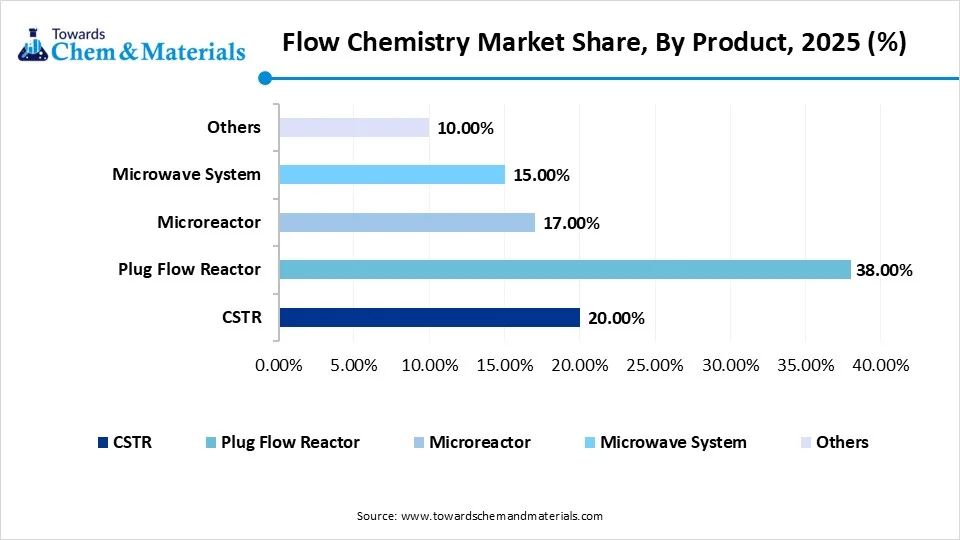
The microreactor segment is the fastest-growing in the market during the forecast period. It is a catalyst of precision for molecular intensification and transport efficiency of mass and energy. Its ability to handle unstable reagents and fast reactions safely in critical chemistry boosts its demand. The virtual elimination of thermal gradients enables producers to achieve high yields and purity of product. They enable agile, transition-ready manufacturing and AI-driven discovery, blending nanoscale precision with industrial commercial viability for specialty chemical synthesis.
Flow Chemistry Market Share, By Product, 2025 (%)
| By Product | Revenue Share, 2025 (%) |
| CSTR | 20.00% |
| Plug Flow Reactor | 38.00% |
| Microreactor | 17.00% |
| Microwave System | 15.00% |
| Others | 10.00% |
Application Insights
How did the Chemicals Segment hold the Largest Share in the Flow Chemistry Market?
The chemicals segment held the largest revenue share in the market share 39.00% in 2025. The segment drives industrial decarbonization. The molecular efficiency of continuous-stream synthesis reducing footprint and costs. The segment leadership is boosted by commercialisation for safety, especially in hazardous intermediates synthesis and high-energy reactions. Additionally chemical segment offers near-instantaneous scalability by the implementation of smart, modular, just-in-time production of high-purity chemicals with high reproducibility and sustainability in chemical manufacturing infrastructure.
The pharmaceuticals segment is experiencing the fastest growth in the market during the forecast period. Acts as the backbone of market expansion for accelerating drug development and API synthesis through continuous methods. It simplifies complex reactions, reduces impurities and intermediate isolation. The shift from lab to industrial mass-scale production by ensuring isothermal precision and safe handling of potent materials and hazardous materials is driving the utilization of flow chemistry in pharmaceuticals. The strict standards and GMP compliance support the adoption in modern pharmacy and personalized medicine with operational integrity and supply chain resilience.
Flow Chemistry Market Share, By Application, 2025 (%)
| By Application | Revenue Share, 2025 (%) |
| Pharmaceuticals | 28.00% |
| Chemicals | 39.00% |
| Academia & Research | 15.00% |
| Petrochemicals | 10.00% |
| Others | 8.00% |
Regional Insights
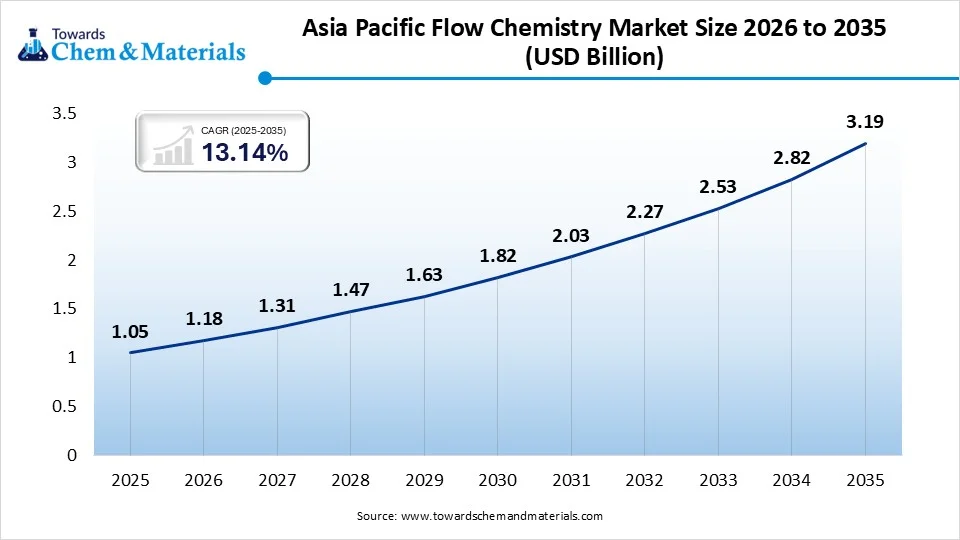
The Asia Pacific flow chemistry market size was valued at USD 1.05 billion in 2025 and is expected to be worth around USD 3.19 billion by 2035, exhibiting at a compound annual growth rate (CAGR) of 13.14% over the forecast period from 2026 to 2035.Asia Pacific dominated the market share 37.00% in 2025, known as a manufacturing hub that is driven by a shift towards advanced chemical synthesis. The region's dominance is supported by significant investments in pharmaceutical outsourcing and expanding specialty chemicals due to the requirement to improve efficiency and meet safety standards. The regional rapid industrialization and government support for green chemistry and chemical hubs accelerate the adoption of continuous manufacturing for industrial applications, positioning the Asia Pacific as a leader in technological innovation and modular reactor deployment.
China Flow Chemistry Market Growth Trends
The China market is the main driver of large-scale continuous manufacturing and process intensification. The region is a key hub for API and specialty chemical synthesis, driven by a move toward green manufacturing and stricter environmental standards. China's market economic scalability uses automated microreactors and plug flow systems to supply critical sectors like semiconductors, electric vehicles, and pharmaceuticals. It focuses on the implementation of Industry 4.0 automation, and modular scaling makes it a key region in chemical supply chain resilience and industry growth.
North America Flow Chemistry Market Growth Trends
North America flow chemistry market segment accounted for the major revenue share of 22.00% in 2025. North America is expected to grow at the fastest CAGR in the market during the forecast period, driven by technological innovation, especially in the pharmaceutical sector. The region integrates Industry 4.0 framework, such as AI and machine learning, into continuous flow processes to speed drug discovery. The region's transition towards onshoring manufacturing enhances supply chain resilience for APIs and chemicals in the domestic market. North America leads in real- time process analytical technology adoption, ensuring precise and GMP compliance. Overall, the region focuses on sustainable, modular plants makes it a carbon-efficient manufacturing hub.
U.S. Flow Chemistry Market Growth Trends
The United States market serves as a global innovation hub for AI-driven synthesis and autonomous discovery of chemicals. It emphasises pharmaceutical onshoring to secure the domestic drug supply through continuous manufacturing. The market dominance in real-time PAT deployment, ensuring precision and GMP standards. The U.S. modular process intensification and carbon-efficient plants promote sustainability and commercialization.

Europe Flow Chemistry Market Growth Trends
Europe flow chemistry market segment accounted for the major revenue share of 25.00% in 2025. Europe market shows notable growth, driven by regional stringent regulation and sustainability, focusing on green chemistry and low-carbon synthesis. Its region emphasize process intensification by its fine chemicals and pharmaceutical infrastructure, which uses automated microreactors for high purity and reproducibility. Europe focus on reducing industrial and municipal waste, advancing APIs and speciality intermediates, making them promoters in the circular economy and digitized production.
Flow Chemistry Market Share, By Regional, 2025 (%)
| Regional | Revenue Share, 2025 (%) |
| North America | 22.00% |
| Europe | 25.00% |
| Asia Pacific | 37.00% |
| Latin America | 9.00% |
| Middle East & Africa | 7.00% |
Germany Flow Chemistry Market Growth Trends
Germany market is known for high-precision engineering and advanced chemical manufacturing. It leads in process intensification, integrating Industry 4.0 automation and digital twin in continuous flow systems for domestic scaling. Additionally, Germany pushes towards green chemistry and carbon- neutral synthesis, accelerating the adoption of modular microreactors. The strategic partnerships maintain a leadership role of the region in sustainable and high- purity chemical production.
Recent Developments
- In October 2025, Evonik launched a next-generation Noblyst® F catalyst specifically designed for continuous flow applications to enhance selectivity and operational safety. The metal precious catalyst offers two distinct particle sizes and superior performance for customers.(Source: www.evonik.com)
- In September 2025, Hovione entered into a strategic partnership with Microinnova to advance modular flow and plug-and-play flow equipment for multipurpose pharmaceutical manufacturing. The collaboration focuses on faster process transfer and sustainable operations.(Source: www.hovione.com)
Top Companies in the Market
- Corning Incorporated: The global industrial scale-up leader in advanced flow reactors and lab reactor systems that offer thermal conductivity, chemical resistance and corrosive chemical processing.
- Vapourtec Ltd: The global player in innovation of R-series and E-series systems that feature UV-150 photochemical reactor and specialized peptide-builder modules for automated continuous peptide synthesis.
- ThaleNono: The global leader in benchtop hydrogenation rectors with integrated electrolytic hydrogen generation. They offer PhotoCube for multi-wavelength photochemistry and specialist in hazardous chemistry.
- Am Technology
- Agi Glassplant
- HEL Limited
- Uniqsis Ltd.
- Ehrfeld Mikrotechnik GmbH
- Future Chemistry Holding BV
- METTLER TOLEDO
- Parr Instrument Company
- Amar Equipment Pvt. Ltd.
- FABEX ENGINEERING PVT. LTD.
- Dalton Pharma Services
- buchiglasuster
Segment Covered in the Report
By Product
- CSTR
- Plug Flow Reactor
- Microreactor
- Microwave System
- Others
By Application
- Pharmaceuticals
- Chemicals
- Academia & Research
- Petrochemicals
- Others
By Region
- North America
- U.S.
- Canada
- Mexico
- Europe
- Germany
- UK
- France
- Italy
- Spain
- Asia Pacific
- China
- India
- Japan
- South Korea
- Latin America
- Brazil
- Argentina
- Middle East & Africa
- Saudi Arabia
- South Africa



Comments
Share your thoughts, ask a question, or provide feedback about this report.