
Ethanol E-Fuel Market Size Analysis Report 2035
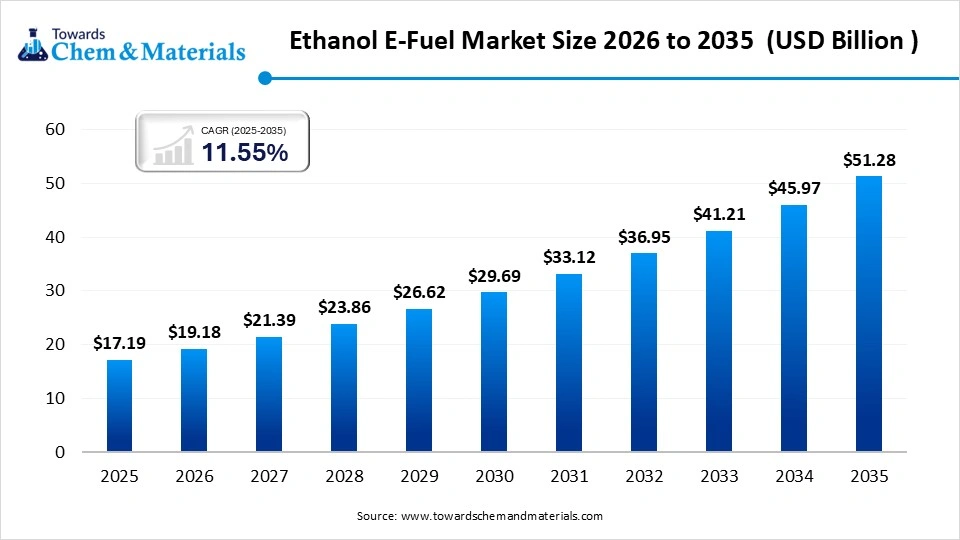
The global ethanol e-fuel market size was estimated at USD 17.19 billion in 2025 and is expected to increase from USD 19.18 billion in 2026 to USD 51.28 billion by 2035, growing at a CAGR of 11.55% from 2026 to 2035. Asia Pacific dominated the ethanol e-fuel market with the largest revenue share of 43.00% in 2025.The market is driven by a circular carbon economy, technological shift, strict regulation and demand in automotive and maritime. The Ethanol E-Fuel market is represented as a high-energy, synthetic alternative to fossil fuels, mainly for industries like aviation and shipping. The expansion driven by Power-to-Liquid technology uses green hydrogen and captured CO2 to synthesise a carbon-neutral, drop-in fuel that is compatible with present infrastructure. Growth is driven by decarbonization commitment and demand for sustainable aviation fuel (SAF) feedstocks. Additionally, the advancement of renewable electricity and energy-intensive Direct Air Capture (DAC) makes it a premium component for the global energy transition.
Market Highlights
- By region, Asia Pacific dominated the ethanol e-fuel market share 43.00% in 2025 due to its high renewable energy capacity and industrial collaboration.
- By region, North America is expected to grow at the fastest CAGR from 2026 to 2035 due to the regulatory framework and shift towards synthetic energy carriers.
- By renewable source, the on-site solar segment held the largest share in the market in 2025, driven by its direct decarbonization route and carbon-neutral integrity.
- By renewable source, the wind segment is expected to grow at the fastest CAGR during the forecast period due to demand for industrial electrolyzers and fossil-free ethanol.
- By technology, the Fischer-Tropsch segment dominated with approximately 39.00% share in the market, driven by its feedstock resilience and catalytic precision.
- By technology, the eRWGS segment is expected to grow at the fastest CAGR in the market during the forecast period due to its conversion of high-purity carbon monoxide and its decentralised production.
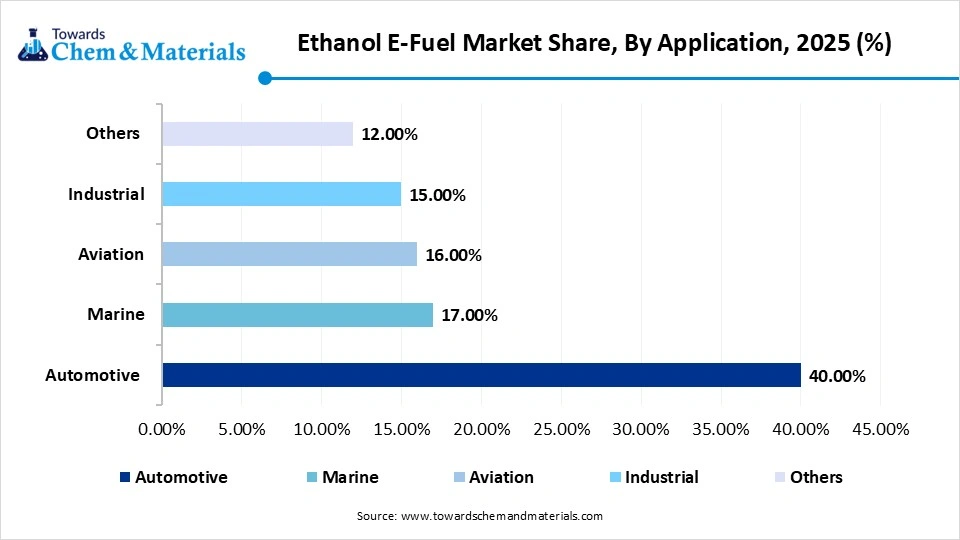
- By application, the automotive segment dominated the market and accounted for the largest revenue share of 40.00% in 2025.
- By application, the marine segment is anticipated to grow at the fastest CAGR in the market during the forecast period due to demand for low-carbon alternatives and well-established maritime infrastructure.
Key Technological Shifts and AI in the Ethanol E-Fuel Market
Artificial Intelligence and digital innovation are transforming the market into a data-driven industry. Machine learning enables catalyst discovery and identifies materials to reduce energy use in carbon conversion using the Fischer-Tropsch process. Predictive analytics and real-time monitoring help synchronise fuel manufacturing with renewable energy by boosting efficiency.
The integration of digital technologies, including blockchain, promotes transparency within the supply chain. Digital twin technology offers simulation and testing of Power-to-Liquid plants, refining thermal management and carbon cycling ecosystem. Additionally, digital tools and modular reactors are lowering the carbon footprint of synthetic ethanol, making it a resilient energy carrier.
What is Ethanol E-Fuel Market Used for?
- Fuel for Internal Combustion Engines: Ethanol E-Fuel is commonly blended with gasoline, just like regular ethanol fuel (e.g., E10 or E85). It can be used in standard gasoline engines found in cars, trucks, motorcycles, and small engines, offering a cleaner alternative to pure gasoline while reducing carbon emissions.
- Sustainable Aviation Fuel: Ethanol E-Fuel can be used in aviation as an alternative to jet fuel. It offers a more environmentally friendly option for aircraft engines, helping to reduce the aviation sector's reliance on fossil fuels and lower its carbon footprint.
- Alternative to Fossil Fuels: E-Fuel made from ethanol can be part of a broader push to reduce the world's reliance on fossil fuels. By using renewable ethanol as a base, E-Fuels contribute to cleaner energy solutions while still being compatible with existing engine technologies, avoiding the need for entirely new infrastructure.
- Energy Storage and Conversion: E-Fuels can be used as an energy storage solution, converting excess renewable electricity (such as from wind or solar) into a liquid form that can be easily stored and transported. This makes renewable energy more accessible and flexible, especially in areas without direct access to electricity grids.
- Reducing Carbon Emissions: The goal of ethanol E-Fuels is to reduce net carbon emissions in sectors like transportation and aviation. By capturing CO2 during the production process and using it to make ethanol, it can help achieve a more sustainable, low-carbon future.
Market Trends
- Focus on Drop-in-Solution: The manufacturers focus on ethanol-e-fuels due to their chemical identity and compatibility with existing internal combustion engines and storage tanks.
- Closed-Loop Ecosystem: The trend is shaped by the transition towards synthetic ethanol manufacturers from capturing CO2 with green hydrogen using electrolysis, which enables carbon-to-fuel circularity.
- Shift Towards Maritime: The ethanol e-fuels act as cleaner alternatives for ocean-going vessels to reduce sulfur and particulate matter emissions in shielded water.
- Collaboration and Strategic Partnership: Fuel producers, airlines, aircraft manufacturers, and governments' initiatives enable partnerships to secure supply chains, to scale up production, and to cross-sector collaboration.
Report Scope
| Report Attribute | Details |
| Market Size in 2026 | USD 19.18 Billion |
| Revenue Forecast in 2035 | USD 51.28 Billion |
| Growth Rate | CAGR 11.55% |
| Forecast Period | 2026 - 2035 |
| Base Year | 2025 |
| Dominant Region | Asia Pacific |
| Segment Covered | By Renewable Source, By Technology, By ApplicationBy Region |
| Key companies profiled | HIF Global, LanzaJet, Raízen S.A., POET LLC, BP Bioenergia, Valero Energy Corporation, Archer Daniels Midland Company (ADM), Green Plains Inc., COFCO Biochemical, CropEnergies AG, Tereos S.A., The Andersons Renewables, Alto Ingredients Inc., São Martinho S.A., Copersucar S.A., Marquis Energy LLC, KAAPA Ethanol Holdings LLC, Glacial Lakes Energy LLC |
Ethanol E-Fuel Market: Supply Chain Analysis
- Feedstock Sourcing and Molecular Procurement: The initial stage of sourcing carbon and hydrogen molecules for e-fuels and renewable power generation through biomass aggregation and carbon capture technologies.
- Key Players: Nel ASA, LanzaTech, Climeworks, Cargill and Siemens Energy
- Advanced Manufacturing and Biorefining: The stage of raw materials transformed into liquid ethanol through advanced power-to-liquid. The high-pressure catalytic reactors that combine hydrogen and CO2 into synthetic e-ethanol gasification technology and refineries.
- Key Players: POET, Raizen, Honeywell UOP, Praj Industries, Infinium and HIF Global
- Upcycling and End-Use Integration: The stage of refining, distribution and final consumption of ethanol e-fuel, where alcohol-to-jet conversion and ethanol into sustainable aviation fuel with standard logistics.
- Key Players: LanzaJet, Porsche, Maersk, Shell and BP
Regulatory Framework: Ethanol E-Fuel Market
| Region | Key Regulation | Regulatory Focus |
| European Union | RED III (Renewable Energy Directive), REACH, RFNBOs, FuelEU maritime | Mandates focus on decarbonization of aviation e-fuel and life-cycle greenhouse gas reduction in maritime shipping |
| United States | Renewable Fuel Standards, Environmental Protection Agency, Inflation Reduction Act | Mandates for renewable fuels and a clean fuel production credit for carbon intensity. The mandates for low-carbon ethanol-to-jet pathways. |
| India | National Policy on Biofuels, Ministry of Petroleum and Natural Gas, E20 mandate | Focus on ethanol blend and schemes on ethanol to scale domestic production capacity from sugarcane and grains. |
| China | National Ethanol Mandates | Mandates focus on low-carbon emissions through renewable energy and synthetic e-fuels for urban air quality. |
| Global | ASTM International | Fuel ethanol limits for high-blend automotive ignition engine and vehicle compatibility. |
Segmental Insights
Renewable Source Insights
Why the On-Site Solar Segment Dominates the Ethanol E-Fuel Market?
The on-site solar segment dominated the market share 65.00% in 2025, offering a direct decarbonization route by eliminating inefficiencies associated with long-distance power transmission. The industry achieves vertical integration by supplying low-cost green electricity essential for hydrogen electrolysis. The domestic model offers carbon-neutral integrity in scalable solar generation, serving as a synthetic fuel hub. Additionally, its operational stability and price decoupling from volatile grids make on-site solar an economically resilient segment for Power-to-Liquid ethanol.
The wind segment is the fastest-growing in the market during the forecast period, driven by a regulatory framework designed to meet the large power demands of industrial electrolyzers. Manufacturers leveraging onshore and offshore wind offer higher capacity factors, providing consistent, scalable energy for green hydrogen. Wind energy is ideal for maritime and aviation sectors, with an abundance of renewable sources in coastal zones aligning with shipping lanes and logistics hubs to achieve the levelized cost of fuel. Advanced grid technology integrated with wind's high energy density makes it a robust solution for large-scale, fossil-free ethanol.
Ethanol E-Fuel Market Share, By Renewable Source, 2025 (%)
| By Renewable Source | Revenue Share, 2025 (%) |
| On-Site solar | 65.00% |
| Wind | 35.00% |
- On-Site Solar – Dominating with a 65.00% share, abundant solar availability, declining installation costs, and ease of integration with e-fuel production facilities drive widespread adoption.
- Wind – With a 35.00% share, strong energy generation capacity and growing investments in wind infrastructure support significant contribution, though intermittency and location constraints limit dominance.
Technology Insights
How did the Fischer-Tropsch Segment hold the Largest Share in the Ethanol E-Fuel Market?
The Fischer-Tropsch segment held the largest revenue share 39.00% in the market in 2025. It serves as an industrial synthesis method that converts green hydrogen and captured CO2 into high-purity liquid hydrocarbons that rely on feedstock flexibility. Its technological shift and catalytic precision make it suitable for sectors like aviation and maritime. This segment integrates with existing infrastructure and enables a circular carbon economy. Overall, this segment remains the most reliable and commercially scalable way to produce liquid energy independent of fossil fuels.
The eRWGS segment is experiencing the fastest growth in the market during the forecast period. It acts as an efficient link in the synthesis process, converting captured CO2 into high-purity carbon monoxide using renewable electricity at minimal temperatures. Its modular design allows decentralized production with direct air capture and near emission sources, making it ideal for creating a circular carbon economy and producing carbon-neutral fuels with precision for the hard-to-abate transport market.
Ethanol E-Fuel Market Share, By Technology, 2025 (%)
| By Technology | Revenue Share, 2025 (%) |
| Fischer-Tropsch | 39.00% |
| eRWGS | 36.00% |
| Others | 25.00% |
- Fischer-Tropsch – Dominating with a 39.00% share, its proven large-scale conversion capability and established industrial adoption make it the leading technology for e-fuel production.
- eRWGS – With a 36.00% share, increasing focus on efficient COâ‚‚ utilization and integration with renewable hydrogen systems is driving strong growth momentum.
- Others – Holding a 25.00% share, emerging and alternative technologies offer innovation potential, but limited commercialization and scalability constrain broader market dominance.
Application Insights
Which Application Dominated the Ethanol E-Fuel Market?
The automotive segment dominated the market share 40.00% in 2025. Driven by its operational efficiency, which enables instantaneous decarbonization of ICE vehicles through drop-in e-ethanol that uses existing fuel delivery infrastructure by acting as a high-density energy carrier. This fast-acting solution that offers emission reduction and maximizes legacy assets, aligns with regulatory support that focuses on net-zero mobility in the automotive industry.
The marine segment is anticipated to grow fastest in the market during the forecast period. because it offers a low-carbon alternative for shipping with high energy density and compatibility with well-established maritime infrastructure. It reduces sulfur oxide and particulate emissions to achieve deep-sea decarbonization. Additionally, by complying with global maritime regulations and the circular economy mandate, it represents a scalable, drop-in solution for long-haul vessels, avoiding the safety constraints of hydrogen and battery infrastructure.
Ethanol E-Fuel Market Share, By Application, 2025 (%)
| By Application | Revenue Share, 2025 (%) |
| Automotive | 40.00% |
| Marine | 17.00% |
| Aviation | 16.00% |
| Industrial | 15.00% |
| Others | 12.00% |
- Automotive – Dominating with a 40.00% share, high fuel demand, existing vehicle compatibility, and increasing adoption of low-emission fuels drive large-scale usage.
- Marine – With a 17.00% share, growing pressure to reduce shipping emissions and adoption of cleaner fuels support steady market expansion.
- Aviation – Holding a 16.00% share, rising focus on sustainable aviation fuels and decarbonization goals is driving gradual adoption, though scalability remains a challenge.
- Industrial – With a 15.00% share, demand for cleaner energy sources in manufacturing and processing supports moderate usage across industries.
- Others – Making up 12.00% of the market, niche applications contribute limited demand due to lower scale and specialized use cases.
Regional Insights
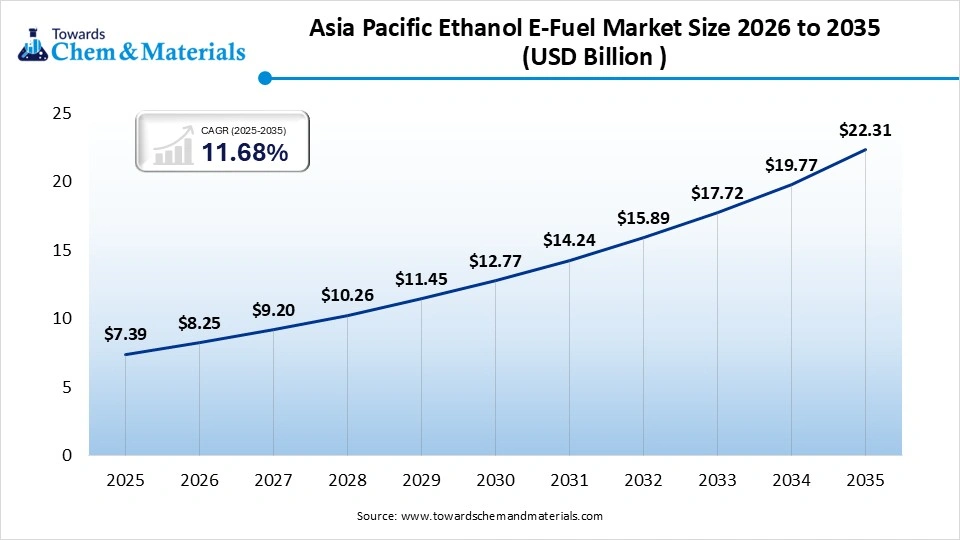
The Asia Pacific ethanol e-fuel market size was valued at USD 7.39 billion in 2025 and is expected to be worth around USD 22.31 billion by 2035, exhibiting at a compound annual growth rate (CAGR) of 11.68% over the forecast period from 2026 to 2035.Asia Pacific dominated the market in 2025, driven by high renewable energy capacity and industrial collaborations. The regional large scale Power-to- Liquid infrastructure, using renewable sources to produce green hydrogen and captured carbon, propelled by national decarbonization goals. The leadership is sustained by its adoption in maritime and automotive sectors, where e-ethanol is vital for shipping fleets and the legacy engines population. Asia Pacific leads in scaling sustainable aviation fuels and low-carbon chemicals promoted by a circular carbon economy.
China Ethanol E-Fuel Market Growth Trends
China's market is represented as a global industrial hub, utilising its electrolyzer capacity and renewable energy to produce Power-to-Liquid fuels. It transforms industrial carbon dioxide into synthetic fuel to meet carbon neutrality goals and energy mandates. China's integration of renewable sources and catalytic conversion that scales up production for SAF and maritime sectors makes it a technological driver in the circular carbon economy.
North America is expected to grow at the fastest CAGR in the market during the forecast period, defined by its technological advancement and regulatory framework, leading the shift to synthetic energy carriers. The regional clean fuel credits and tax incentives fueling extensive Power-to-Liquid infrastructure for green hydrogen and captured CO2. North America technological push utilized direct air capture and renewable energy, it fosters regional circular, land- use conflict- free carbon economy.
U.S. Ethanol E-Fuel Market Growth Trends
The U.S. market is a global leader in synthetic energy carriers, enabled by strong regulatory support and substantial investment. The U.S. is a key hub for power-to-liquid infrastructure vital for SAF and maritime sectors to achieve carbon-neutrality targets. Additionally, as regional implementing direct air capture and carbon-neutral integrity, fueling the market growth.
Europe Ethanol E-Fuel Market Growth Trends
Europe market is witnessing significant growth due to its stringent regulations and sustainability, driven by the RFNBO framework. The region focuses on the development of offshore wind and green hydrogen projects for decarbonization. The domestic market is fueled by the adoption of SAF, and the maritime sectors align with existing infrastructure. Europe emphasising circular carbon economies and strict low- carbon standards to decouple transportation from fossil extraction, which enables scaling of e-ethanol.
Germany Ethanol E-Fuel Market Growth Trends
Germany market, represented by its industrial innovation and regulatory landscape, is pushing carbon- neutral synthetic fuels for high- performance transport. The regional expansion supported by the national hydrogen strategy, it uses renewable sources for large scale Power-to-X processes, producing high- purity fuels for hard-to-abate sectors, especially automotive competitiveness and establishing global RFNBO standards.
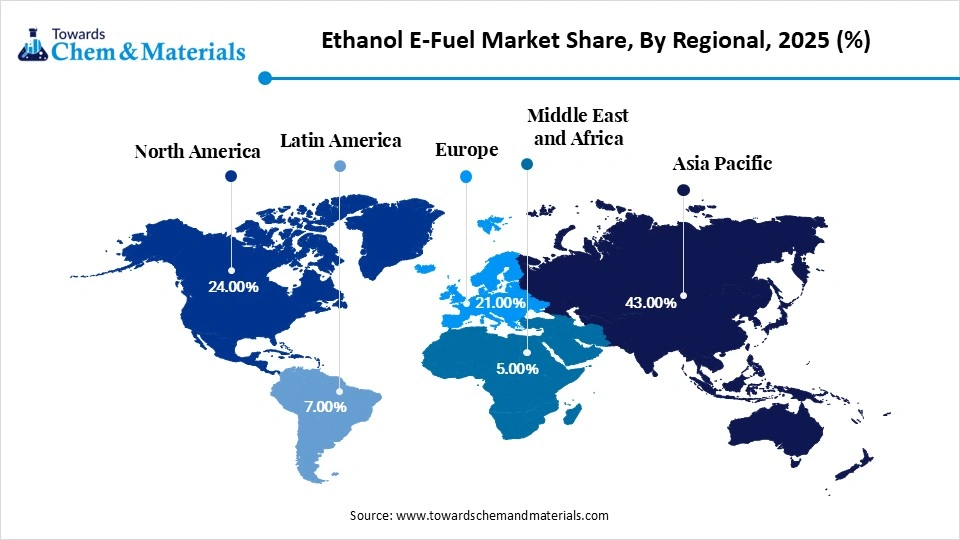
Ethanol E-Fuel Market Share, By Regional, 2025 (%)
| Regional | Revenue Share, 2025 (%) |
| North America | 24.00% |
| Europe | 21.00% |
| Asia Pacific | 43.00% |
| Latin America | 7.00% |
| Middle East & Africa | 5.00% |
- Asia Pacific – Dominating with a 43.00% share, rapid industrialization, growing energy demand, and increasing investments in renewable fuel technologies drive strong market expansion.
- North America – With a 24.00% share, advanced technological capabilities and supportive policies for clean fuels sustain significant adoption.
- Europe – Holding a 21.00% share, stringent decarbonization targets and strong regulatory support promote steady market growth.
- Latin America – With a 7.00% share, emerging renewable energy projects and biofuel expertise contribute to gradual market development.
- Middle East & Africa – Making up 5.00% of the market, early-stage adoption and limited infrastructure result in a smaller overall contribution.
Recent Developments
- In November 2025, LanzaJet announced its first revolution of jet fuel from ethanol at its LanzaJet Freedom Pines fuels facility as a next-generation fuel solution for aviation. It is the first commercial-scale production of a non-oil-based renewable solution in aircraft using ethanol as feedstock. (Source: www.lanzajet.com)
- In September 2025, the joint project by Numaligarh Refinery Limited (NRL), Fortum & Chempolis OY, launched India’s first bamboo-based bioethanol plant in Assam’s Golaghat, which aims to produce bioethanol from sustainable bamboo feedstock. The initiative encourages sustainable solutions and a reduction in greenhouse gas emissions.(Source: visionias.in)
Top Companies in the Market and Their Offerings
- HIF Global: The global innovator and operator in industrial e-fuel plants offers synthetic e-ethanol, which converts into carbon-neutral gasoline
- LanzaJet: The major player drives the adoption of alcohol-to-jet technology that offers the transformation of ethanol into sustainable aviation fuel.
- Raízen S.A.: The global producer of second-generation ethanol that offers ethanol that is synthesised from sugarcane bagasse.
- POET LLC: The largest bioethanol producer that is advancing sustainable ethanol and investing in carbon capture and renewable energy integration.
- BP Bioenergia: The major investor in the e-fuel production pathway combining renewable electricity and biogenic CO2 utilization.
- Valero Energy Corporation
- Archer Daniels Midland Company (ADM)
- Green Plains Inc.
- COFCO Biochemical
- CropEnergies AG
- Tereos S.A.
- The Andersons Renewables
- Alto Ingredients Inc.
- São Martinho S.A.
- Copersucar S.A.
- Marquis Energy LLC
- KAAPA Ethanol Holdings LLC
- Glacial Lakes Energy LLC
Segment Covered in the Report
By Renewable Source
- On-Site solar
- Wind
By Technology
- Fischer-Tropsch
- eRWGS
- Others
By Application
- Automotive
- Marine
- Aviation
- Industrial
- Others
By Region
- North America
- U.S.
- Canada
- Mexico
- Europe
- Germany
- UK
- France
- Italy
- Spain
- Asia Pacific
- China
- India
- Japan
- South Korea
- Latin America
- Brazil
- Argentina
- Middle East & Africa
- Saudi Arabia
- South Africa



Comments
Share your thoughts, ask a question, or provide feedback about this report.