
U.S. Ethanol Market Size, Competitive Landscape Analysis Report 2035
The U.S. ethanol market size was estimated at USD 28.85 billion in 2025 and is expected to increase from USD 30.45 billion in 2026 to USD 49.51 billion by 2035, growing at a CAGR of 5.55% from 2026 to 2035..Growing international export demand is the key factor driving market growth. Also, ongoing innovations in manufacturing efficiency, coupled with the extensive corn-based feedstock availability, can fuel market growth further. The market encompasses the manufacturing, distribution, and consumption of ethanol, mainly as a corn-based and renewable biofuel blended into >98% of U.S. gasoline (mostly E10) to act as an oxygenate. It is fuelled by the. It is driven by the Renewable Fuel Standard (RFS), beverage and industrial applications, with major manufacturing plants centered in the Midwest.
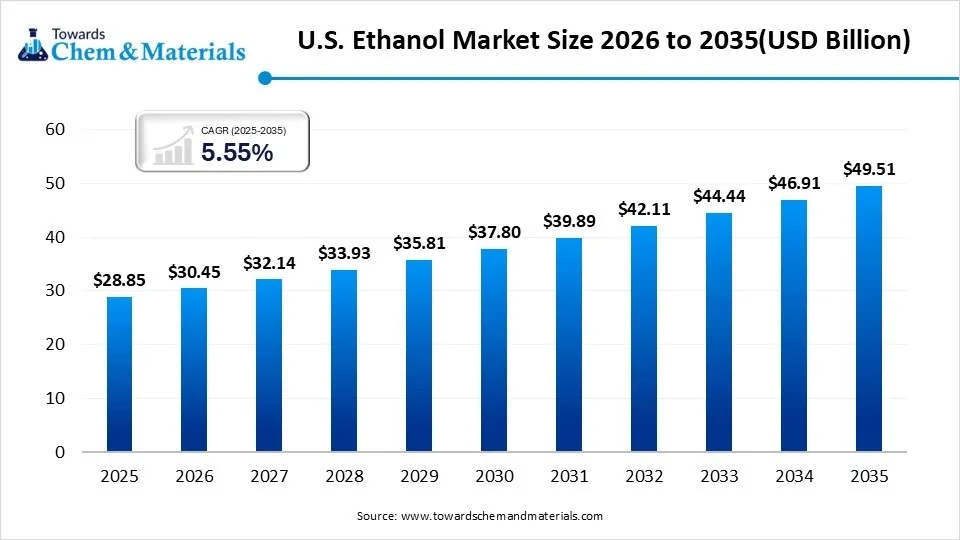
Market Highlights
- By feedstock, the corn-based ethanol segment dominated the market with the largest share 55.00% in 2025. The dominance of the segment can be attributed to the ongoing innovations in manufacturing technology.
- By feedstock, the cellulosic ethanol segment is expected to grow at the fastest CAGR over the forecast period. The growth of the segment can be credited to the growing demand to minimize greenhouse gases (GHG).
- By production process, the dry mill process segment held the largest market share 61.00% in 2025. The dominance of the segment can be linked to its better ethanol yield from corn.
- By production process, the wet mill process segment is expected to grow at the fastest CAGR over the forecast period. The growth of the segment can be driven by its superior efficiency.
- By application, the transportation fuel segment dominated the market with the largest share 49.00% in 2025. The dominance of the segment is owed to the ongoing transition towards lower carbon emissions.
- By application, the industrial feedstock segment is expected to grow at the fastest CAGR during the projected period. The growth of the segment is due to the growing need for bio-based chemicals.
Key Uses of U.S. Ethanol Market
- Transportation Fuel (Biofuels): Ethanol as a Gasoline Additive: The primary use of ethanol in the U.S. is as a fuel additive, blended with gasoline to create ethanol-gasoline mixtures like E10 (10% ethanol, 90% gasoline) and E85 (85% ethanol). These blends are used in millions of vehicles, helping reduce carbon emissions and increase fuel efficiency.
- Flex-Fuel Vehicles (FFVs): Ethanol is commonly used in flex-fuel vehicles that can run on high-ethanol mixtures (such as E85), which are more environmentally friendly than pure gasoline.
- Renewable Energy and Clean Fuel: Reduction in Greenhouse Gas Emissions: Ethanol is considered a cleaner, renewable alternative to gasoline because it burns cleaner and emits fewer pollutants, including greenhouse gases. Its use in transportation and other sectors helps in reducing the carbon footprint. Ethanol as a
- Replacement for Fossil Fuels: Ethanol is part of the broader push to reduce dependence on fossil fuels and increase the share of renewable energy in the transportation sector.
- Industrial and Chemical Applications: Solvent and Cleaning Agent: Ethanol is used as a solvent in various industrial processes, including in the production of chemicals, pharmaceuticals, cosmetics, and personal care products. It's also used for cleaning and degreasing purposes in manufacturing.
- Chemical Feedstock: It serves as a raw material for producing other chemicals like ethyl acetate, acetic acid, and other solvents used in industries ranging from food packaging to paint production.
- Alcoholic Beverages: Production of Alcoholic Drinks: U.S. ethanol is used as the base for making alcoholic beverages like beer, wine, and spirits. The production process involves fermentation of crops like corn, which is a major feedstock in the U.S.
- Livestock Feed: By-Products (Distiller's Dried Grains): After ethanol is produced from crops like corn, the remaining by-products (like distiller's dried grains with solubles or DDGS) are used as high-protein animal feed. This contributes to the U.S. agricultural economy.
- Aviation Fuel: Sustainable Aviation Fuel (SAF): Ethanol is being explored as a potential feedstock for sustainable aviation fuel. While not as widely adopted as other sources of biofuel, it is being researched for use in aviation to reduce carbon emissions from air travel.
- Energy Storage and Conversion: Ethanol as a Power Source: Ethanol is also used in power generation, both in combined heat and power plants and as an alternative energy source in some regions. It can be converted into electricity or used for heat generation.
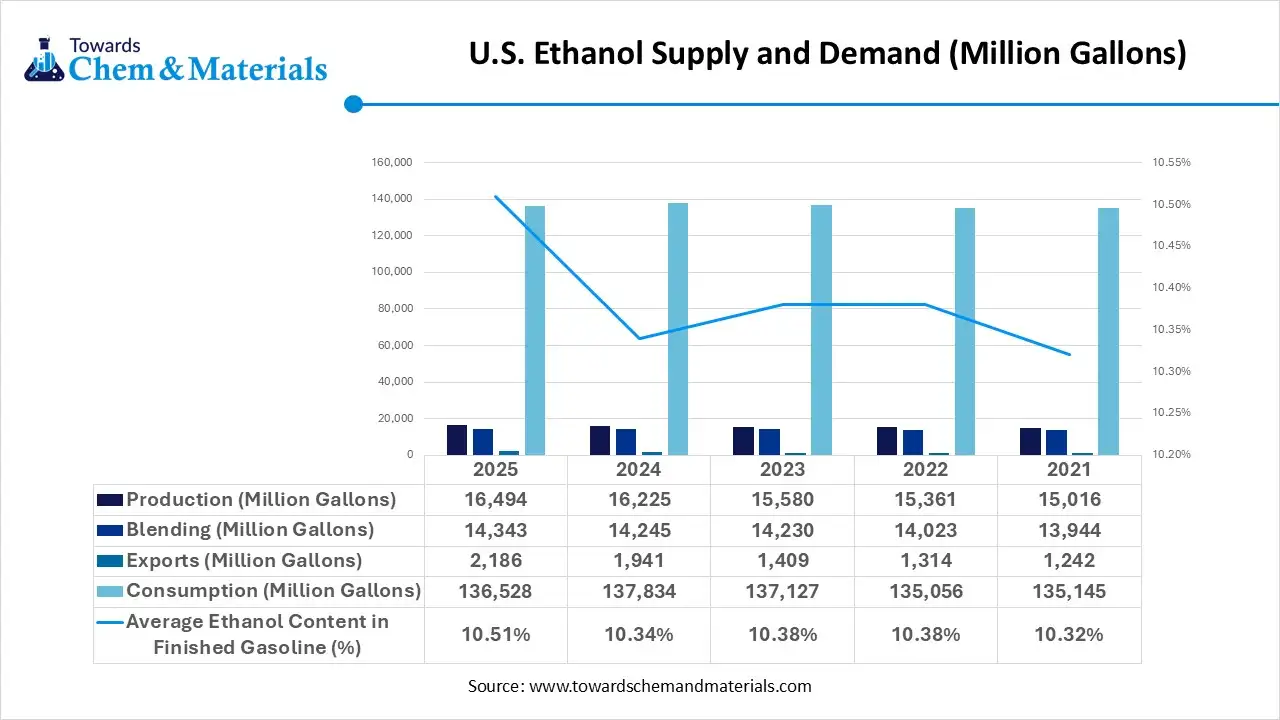
Key Statistical Insights:
- Production Growth: U.S. ethanol production is expected to grow steadily, reaching 16,494 million gallons by 2025.The production in 2025 is 9.8% higher than in 2021, showing consistent growth in production.
- Blending Consistency: The blending volume remains consistently high, with a slight increase from 13,944 million gallons in 2021 to 14,343 million gallons in 2025. The percentage of ethanol blended into finished gasoline is consistently around 10% throughout the years.
- Export Trends: Exports show some fluctuation, reaching 2,186 million gallons in 2025, which is the highest in the period. Exports in 2025 are 76.3% higher than in 2021, reflecting a growing share of U.S. ethanol exported abroad.
- Consumption: Consumption of ethanol in finished gasoline continues to increase gradually, with a peak of 137,834 million gallons in 2024. Despite fluctuations in the years, ethanol consumption remains over 135,000 million gallons annually.
- Average Ethanol Content: The ethanol content in finished gasoline has stayed steady, with a slight increase from 10.32% in 2021 to 10.51% in 2025.
Trade Analysis of Industrial U.S. Ethanol Market: Import & Export Statistics
- In 2025, U.S. ethanol exports reached a record-breaking 2.18 billion gallons. This milestone surpassed the 2024 record by over 200 million gallons, marking a 13% increase. During this period, American-produced ethanol reached more than 80 countries worldwide.
- In 2025, U.S. fuel ethanol imports remained stable at 4 million gallons, matching the 2024 level. These imports represented less than 0.1% of domestic consumption, allowing the United States to maintain its status as a net exporter for the 16th year in a row.
U.S. Ethanol Market Trends
- Increasing demand for bio-based inputs is the latest trend in the market, shaping positive market growth. The surge in emphasis on sustainability and carbon emissions reduction is boosting the product adoption across pharmaceuticals, personal care, chemicals, and industrial manufacturing sectors.
- Ongoing advancements in manufacturing technologies are revolutionizing the market. Improved fermentation processes and the use of a variety of feedstocks are enhancing efficiency and lowering overall production costs. Also, these innovations can make ethanol a more reliable energy source, appealing to more general consumers.
- The growth of ethanol infrastructure is another major trend driving market expansion. Investments in storage facilities, distribution networks, and fuelling stations are crucial to promote the increasing demand for ethanol. This growth is anticipated to increase the availability of ethanol-blended fuels.
Report Scope
| Report Attribute | Details |
| Market Size in 2026 | USD 30.45 Billion |
| Revenue Forecast in 2035 | USD 49.51 Billion |
| Growth Rate | CAGR 5.55% |
| Forecast Period | 2026 - 2035 |
| Base Year | 2025 |
| Segment Covered | By Feedstock / Type, By Production Process, By Application |
| Key companies profiled | POET, LL, Valero Renewable Fuels Company, Green Plains Inc. (GPRE), Flint Hills Resources, LP, Alto Ingredients, Inc. (formerly Pacific Ethanol, Inc.), Cargill, Incorporated, The Andersons, Inc., Big River Resources, LLC, Aemetis, Inc., Renewable Energy Group, Inc., Marquis Energy LLC, Sunoco LP, Gevo, Inc., Algenol Biotech LLC |
How Cutting Edge Technologies are revolutionizing the U.S. Ethanol Market?
Advanced technologies such as advanced membranes, AI, and genetically structured enzymes are transforming the market by minimizing production costs, propelling efficiency, and minimizing carbon footprints. Furthermore, advancements, including membrane-based separation, can save a significant amount of energy while facilitating smooth feedstock management and manufacturing.
U.S. Ethanol Market Supply Chain Analysis
Feedstock Procurement
- It is the process of acquiring essential raw materials, mainly corn, to produce fuel ethanol. It is a high-volume and highly localized endeavor in the supply chain.
- Major Players: POET LLC, Archer Daniels Midland Company (ADM)
Chemical Synthesis and Processing
- It includes the industrial manufacturing methods used to create high-grade ethanol for industrial, chemical, and beverage applications.
- Major Players: Green Plains Inc., Valero Energy Corporation
Packaging and Labelling
- It emphasizes the safe handling, transport, and labelling of specific grades for food/beverage, fuel, and pharmaceutical sectors governed by stringent federal safety regulations.
- Major Players: Alto Ingredients, Green Plains Inc.
Regulatory Compliance and Safety Monitoring
- It involves a strict framework designed to manage the flammable nature of ethanol, to ensure workplace safety, and to comply with food-safety standards.
- Major Players: Alto Ingredients, Marquis Energy
U.S. Ethanol Market's Regulatory Landscape: Regulations
| State/Region | Key Regulations |
| California | Implements a strict Low Carbon Fuel Standard (LCFS). While a major consumer, its regulations pressure producers nationwide to reduce the carbon intensity of their ethanol to gain market access. |
| Midwest Regional Approach | Several states in the region (including MN, IA, SD) often coordinate on E15 fueling infrastructure expansion to boost local demand. |
| Iowa | Holds the highest production capacity (approx. 27% of U.S. total). State policies focus on supporting production capacity and promoting E15 infrastructure. |
| Oregon/Washington | Similar to California, these states mandate gradual reductions in fuel carbon intensity, favoring ethanol blends. |
Segmental Insights
Feedstock Insights
How Much Share Did the Corn-Based Ethanol Segment Held in 2025?
The corn-based ethanol segment dominated the market with the largest share in 2025. The dominance of the segment can be attributed to the ongoing innovations in manufacturing technology and the surge in export demand. In addition, the government, via the Inflation Reduction Act, offers subsidies for infrastructure to increase the availability of biofuels and promote low-carbon emission goals.
The cellulosic ethanol segment is expected to grow at the fastest CAGR over the forecast period. The growth of the segment can be credited to the growing demand to minimize greenhouse gases (GHG), along with the ongoing innovations in enzyme optimization technology. Major automotive and energy companies are heavily investing in advanced biofuels to fulfil internal sustainability targets, leading to further segment growth.
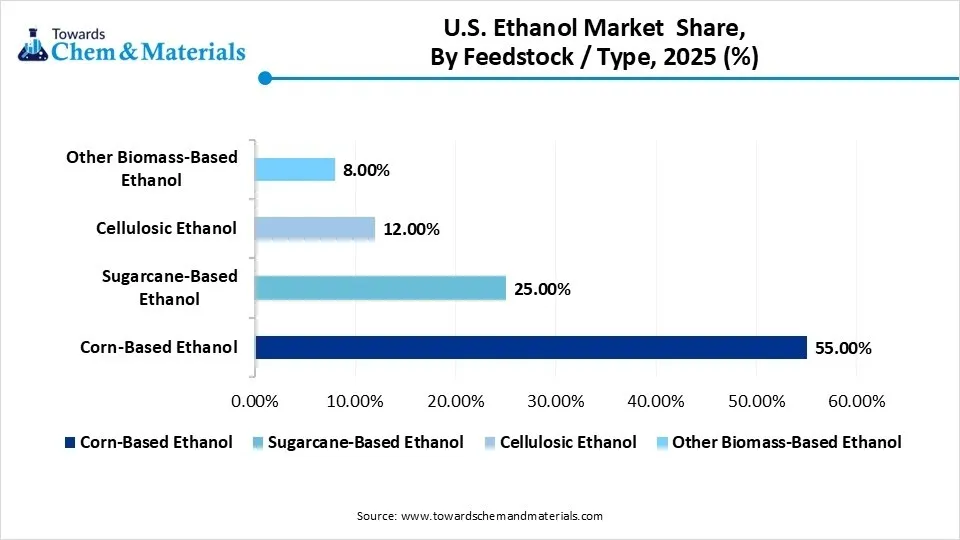
U.S. Ethanol Market Share, By Feedstock / Type, 2025 (%)
| By Feedstock / Type | Revenue Share, 2025 (%) |
| Corn-Based Ethanol | 55.00% |
| Sugarcane-Based Ethanol | 25.00% |
| Cellulosic Ethanol | 12.00% |
| Other Biomass-Based Ethanol | 8.00% |
- Corn-Based Ethanol – Dominating with a 55.00% share, abundant corn supply, well-established production infrastructure, and strong government support for biofuels drive its leading position.
- Sugarcane-Based Ethanol – With a 25.00% share, efficient conversion processes and higher yield per acre support demand, though limited domestic availability restricts wider dominance.
- Cellulosic Ethanol – Holding a 12.00% share, increasing focus on sustainable and non-food-based feedstocks is driving growth, but high production costs and technological challenges limit scale.
- Other Biomass-Based Ethanol – With an 8.00% share, diverse feedstock sources provide flexibility, but lower efficiency and limited commercialization constrain overall market contribution.
Production Process Insights
Which Production Process Dominated the U.S. Ethanol Market in 2025?
The dry mill process segment held the largest market share in 2025. The dominance of the segment can be linked to its better ethanol yield from corn and cost-effectiveness as compared to other production processes. Additionally, dry mill plants generally accomplish higher ethanol conversion rates. Advancements in refining and separating co-products offer a crucial secondary revenue stream.
The wet mill process segment is expected to grow at the fastest CAGR over the forecast period. The growth of the segment can be driven by its superior efficiency, multi-product abilities, and capability to produce high-grade co-products. Wet mills give convenient starch extraction and finer particle reduction, which enhances product quality and improves fermentation efficiency for fuel ethanol manufacturing.
U.S. Ethanol Market Share, By Production Process, 2025 (%)
| By Production Process | Revenue Share, 2025 (%) |
| Dry Mill Process | 61.00% |
| Wet Mill Process | 25.00% |
| Other Processes | 14.00% |
- Dry Mill Process – Dominating with a 61.00% share, its lower capital cost, higher efficiency, and widespread adoption for corn-based ethanol production make it the preferred processing method.
- Wet Mill Process – With a 25.00% share, it supports co-product generation like corn oil and sweeteners, but higher complexity and costs limit its broader adoption.
- Other Processes – Holding a 14.00% share, emerging and alternative technologies offer innovation potential, but limited commercialization and scalability restrict their market impact.
Application Insights
Which Application Dominated the U.S. Ethanol Market in 2025?
The transportation fuel segment dominated the market with the largest share in 2025. The dominance of the segment is owed to the ongoing transition towards lower carbon emissions and growing adoption of flexible-fuel vehicles (FFVs). Furthermore, ethanol acts as a cost-effective and high-performance octane enhancer, helping modern high-compression engines run more smoothly with cleaner combustion.
The industrial feedstock segment is expected to grow at the fastest CAGR during the projected period. The growth of the segment is due to the growing need for bio-based chemicals and strict environmental regulations focusing on sustainable industrial inputs. Major market players, including Shell and British Petroleum (BP), are heavily investing in ethanol-to-chemical pathways to fulfil corporate sustainability goals.
U.S. Ethanol Market Share, By Application, 2025 (%)
| By Application | Revenue Share, 2025 (%) |
| Transportation Fuel (gasoline blending such as E10, E15, E85) | 49.00% |
| Industrial Feedstock | 25.00% |
| Alcoholic Beverages | 15.00% |
| Pharmaceuticals & Personal Care | 11.00% |
- Transportation Fuel (gasoline blending such as E10, E15, E85) – Dominating with a 49.00% share, strong government mandates, widespread fuel blending practices, and the push for cleaner-burning fuels drive its leading position.
- Industrial Feedstock – With a 25.00% share, extensive use in chemical manufacturing and solvents supports significant demand across multiple industrial applications.
- Alcoholic Beverages – Holding a 15.00% share, steady consumption and established production of spirits and beverages maintain consistent demand, though growth is moderate.
- Pharmaceuticals & Personal Care – With an 11.00% share, its use in sanitizers, disinfectants, and formulations supports stable demand, but limited volume applications restrict higher market share.
Country Insights
The growth of the market in the country can be driven by a growing industrial demand for pharmaceuticals, beverages, and personal care products. Furthermore, innovations in dry mill, fermentation technology, and the use of second-generation feedstocks are enhancing yield quality. The push towards lower-carbon fuels in transportation boosts the adoption of ethanol-blended fuels, leading to market growth soon.
Recent Developments
- In February 2026, BASF launched Circalo™: Low Carbon Intensity Crops, a unified platform that connects farmers, agronomists, and ethanol producers. The tool helps these groups manage and track agricultural carbon intensity (CI) to meet changing regulatory standards.(Source: www.basf.com)
- In December 2025, the American Biofuels Maritime Initiative (ABMI), co-chaired by the American Biogas Council (ABC) and the Renewable Fuels Association (RFA), was launched to advance the use of American-made energy in the global shipping sector.(Source: biofuels-news.com)
U.S. Ethanol Market Companies
- POET, LL: POET, LLC is the world's largest producer of ethanol, operating as a major force in the U.S. biofuels market with a production capacity of approximately 3 billion gallons per year.
- Valero Renewable Fuels Company: Valero Renewable Fuels is one of the world's largest corn ethanol producers, operating 12 plants in the U.S. Midwest with a combined production capacity of approximately 1.7 billion gallons per year.
- Green Plains Inc. (GPRE): It is a major U.S. ethanol producer and innovator, operating 17 biorefineries (as of early 2025) with ~1.2 billion gallons of annual capacity, positioning it among the top producers.
- Flint Hills Resources, LP
- Alto Ingredients, Inc. (formerly Pacific Ethanol, Inc.)
- Cargill, Incorporated
- The Andersons, Inc.
- Big River Resources, LLC
- Aemetis, Inc.
- Renewable Energy Group, Inc.
- Marquis Energy LLC
- Sunoco LP
- Gevo, Inc.
- Algenol Biotech LLC
Segments Covered in the Report
By Feedstock / Type
- Corn-Based Ethanol
- Sugarcane-Based Ethanol
- Cellulosic Ethanol
- Other Biomass-Based Ethanol
By Production Process
- Dry Mill Process
- Wet Mill Process
- Other Processes
By Application
- Transportation Fuel (gasoline blending such as E10, E15, E85)
- Industrial Feedstock
- Alcoholic Beverages
- Pharmaceuticals & Personal Care



Comments
Share your thoughts, ask a question, or provide feedback about this report.