
Ethanol E-Fuel Market Size, Competitive Landscape Analysis Report 2035
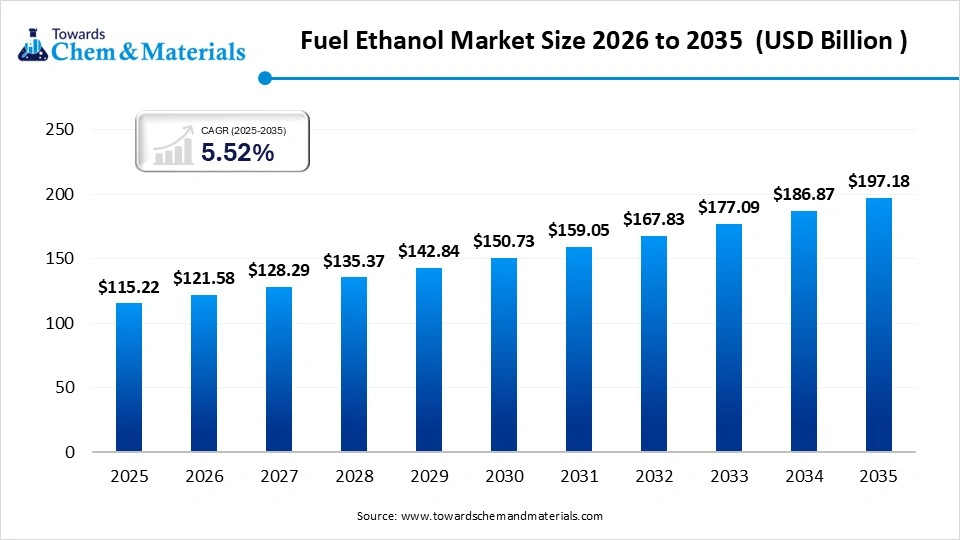
The global fuel ethanol market size was estimated at USD 115.22 billion in 2025 and is expected to increase from USD 121.58 billion in 2026 to USD 197.18 billion by 2035, growing at a CAGR of 5.52% from 2026 to 2035. Asia Pacific dominated the fuel ethanol market with the largest revenue share of 57.00% in 2025. Rapid innovations in manufacturing efficiency are the key factor driving market growth. Also, growing demand for cleaner energy, coupled with the growing adoption of high-blend fuels, can propel market growth further. The market encompasses the manufacturing, distribution, and sale of alcohol derived from biomass for use as a cleaner, renewable burning fuel additive to minimize greenhouse gases. It emphasises mixing ethanol with gasoline to increase fuel octane, enhance engine efficiency, and fulfil environmental regulations. Ethanol is manufactured through the fermentation of agricultural feedstocks, such as sugar-based and starch-based sources.
Market Highlights
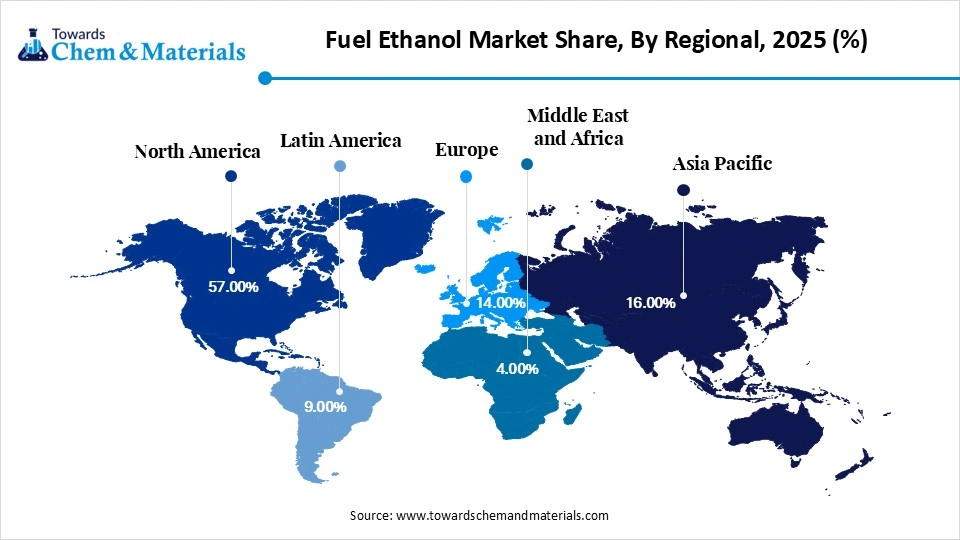
- The North America dominated fuel ethanol market with the largest revenue share of 57.00% in 2025. The dominance of the region can be attributed to the growing adoption of flex fuel vehicles (FFVs).
- By region, Asia Pacific is expected to grow at the fastest CAGR over the forecast period. The growth of the region can be credited to the surge in vehicle ownership.
- By region, Europe is expected to grow at a notable CAGR over the forecast period. The growth of the region can be driven by increasing demand for low-carbon, sustainable transport fuels.
- By product, the starch-based segment dominated the market and accounted for the largest revenue share in 2025. The dominance of the segment can be attributed to the surge in investments in manufacturing capacity.
- By product, the cellulosic segment is expected to grow at the fastest CAGR over the forecast period. The growth of the segment can be credited to its better sustainability.
- By technology, the wet mill segment led the market with the largest revenue share of 75.00% in 2025, The dominance of the segment can be linked to its capability to manufacture a wide range of high-value co-products.
- By technology, the dry mill segment is expected to grow at the fastest CAGR over the forecast period. The growth of the segment can be driven by the growing demand for gasoline blending.
- By application, the conventional fuel vehicles segment dominated the market and accounted for the largest revenue share of 65.00% in 2025,The dominance of the segment is owed to the surge in octane needs in high-performance engines.
- By application, the flexible fuel vehicles segment is expected to grow at the fastest CAGR over the projected period. The growth of the segment is due to stringent emissions regulations.
How Cutting-Edge Technologies Are Revolutionizing the Fuel Ethanol Market?
Advanced technologies are revolutionizing the market from a conventional food-based, first-generation sector into an efficient, sustainable, and diversified industry. Furthermore, innovative water treatment, like anaerobic digestion (AD), is used to treat waste, enabling the water to be reused and minimizing the environmental footprint of distilleries. These innovations enable the production of ethanol with substantially less carbon intensity.
Fuel Ethanol Market Key Statistical Insights:
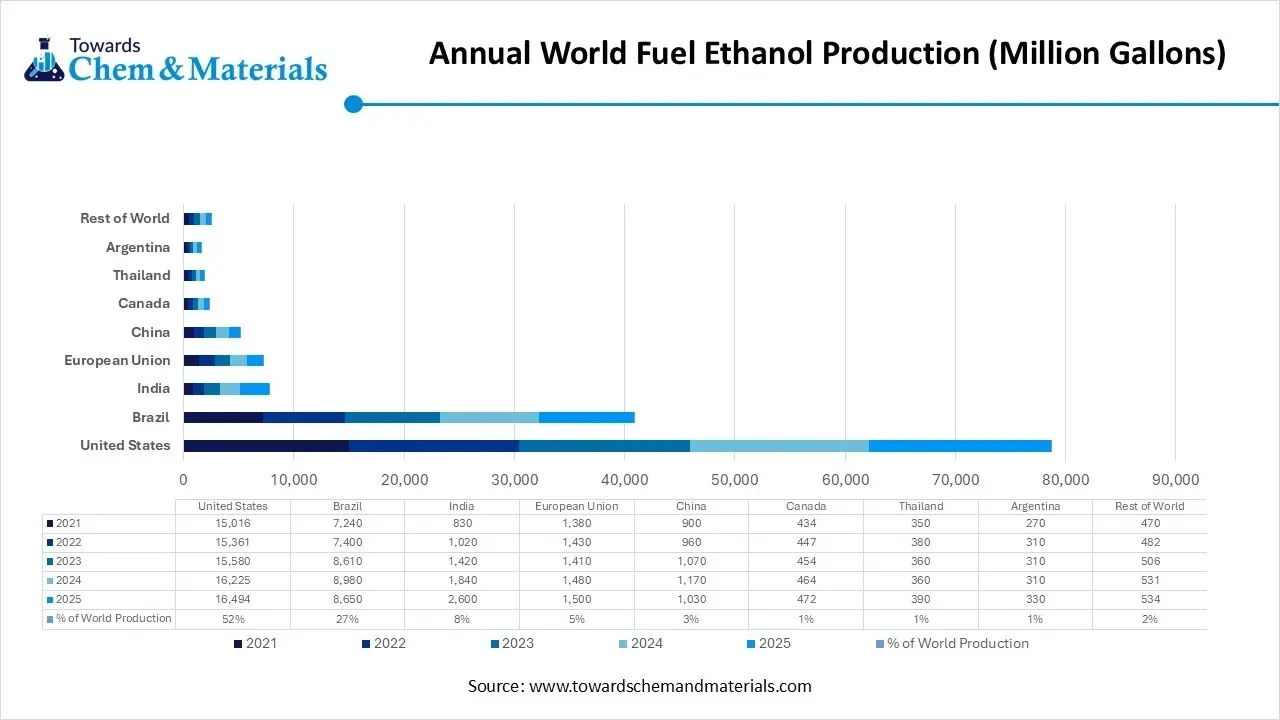
- Dominance of the U.S. : The United States leads the world in ethanol production, consistently producing around 52% of global ethanol by 2025. U.S. production grows steadily from 15,016 million gallons in 2021 to 16,494 million gallons in 2025, reflecting an increase of 9.8% over this period.
- Brazil's Steady Production: Brazil holds the second-largest share, contributing 27% of global production in 2025. ,Brazil's production rises slightly from 7,240 million gallons in 2021 to 8,650 million gallons in 2025, showing an increase of 19.4% over the period.
- India's Rapid Growth: India's production is expected to see a dramatic increase, rising from 830 million gallons in 2021 to 2,600 million gallons in 2025, a rise of 213%. This rapid growth indicates India's increasing adoption of ethanol production, likely due to rising demand for biofuels.
- European Union's Consistent Output: The European Union maintains a steady production, contributing 5% of world ethanol production by 2025. Production in the EU increases by 8.7% from 1,380 million gallons in 2021 to 1,500 million gallons in 2025.
- China's Modest Increase: China's production rises from 900 million gallons in 2021 to 1,030 million gallons in 2025, an increase of 14.4%. China’s share of world production remains around 3%, with relatively slow growth compared to other countries.
- Canada, Thailand, and Argentina's Smaller Contributions: Canada increases production from 434 million gallons in 2021 to 472 million gallons in 2025 (an 8.8% increase). Thailand and Argentina show minor production increases, with Thailand's contribution growing by 11.4% and Argentina's by 22.2%.
- Rest of the World: The Rest of the World group (which includes many smaller producers) accounts for 2% of global production by 2025, with an increase from 470 million gallons in 2021 to 534 million gallons in 2025, a growth of 13.6%.
What is Fuel Ethanol Used for?
- Transportation Fuel: The most common use of fuel ethanol is as a biofuel for vehicles. It is blended with gasoline to create ethanol-gasoline mixtures like E10 (10% ethanol, 90% gasoline), E15 (15% ethanol), and E85 (85% ethanol), which can be used in flexible-fuel vehicles (FFVs) or standard cars. This helps lower greenhouse gas emissions compared to pure gasoline.
- Alternative to Gasoline: In regions or industries aiming for more sustainable energy, ethanol can replace or supplement gasoline. It burns cleaner and emits less carbon dioxide and other harmful pollutants, making it a key part of efforts to reduce environmental impact.
- Boosting Octane in Gasoline: Ethanol has a high octane rating, meaning it helps improve the performance of gasoline engines. The addition of ethanol to gasoline increases fuel efficiency and can enhance the engine’s performance while reducing engine knocking.
- Renewable Energy Source: Fuel ethanol is considered renewable because it is produced from plant materials, which can be replenished each year. It is a cleaner alternative to fossil fuels, helping reduce the overall carbon footprint of energy consumption.
- Energy Independence: By producing ethanol locally from agricultural products, countries can reduce their dependence on imported oil. This can help enhance national energy security and support local economies, particularly those that are heavily involved in agriculture.
- Chemical Production: Beyond being used as fuel, ethanol is also a base material for producing various chemicals. It is used in the manufacture of solvents, industrial chemicals, and even in the pharmaceutical industry.
Trade Analysis of the Fuel Ethanol Market Import & Export Statistics
- Canada solidified its position as the leading ethanol destination, receiving over one-third of all exports. By November, shipments hit a record-breaking 726 million gallons, setting a new annual high for this critical market.
- In September 2025, China's exports of unmodified ethanol reached 1,362.50 tons at an average price of $820.30 per ton.
- During September 2025, China imported 27.31 tons of unmodified ethanol. These shipments arrived at an average cost of $7,116.05 per ton.
- According to India Ethanol import data, 929 shipments were recorded between June 2024 and May 2025 (TTM), reflecting a 41% year-on-year growth. Facilitated by 66 exporters and acquired by 89 verified global buyers, this surge highlights rapidly expanding market activity in the ethanol sector.
- Vietnam, the United States, and Germany emerged as the top three ethanol importers, while the U.S., Germany, and the UK led in exports.
Market Trends
- Increasing demand for renewable energy sources is the latest trend in the market, shaping positive market growth. This trend is mainly impacted by global initiatives focused on minimizing carbon emissions and supporting sustainable practices.
- Technological innovations are playing a significant role in the expansion of the market. Advancements in manufacturing methods, like enhanced fermentation techniques and improved feedstock processing, are anticipated to minimize overall costs and improve efficiency.
- The growing adoption of fuel in the automotive sector is another major trend driving market growth. The automotive industry has expanded significantly over the last few years and has faced many hurdles in controlling air pollution. The usage of fuel ethanol offers major benefits in terms of enhanced fuel economy and thermal efficiency.
Report Scope
| Report Attribute | Details |
| Market Size in 2026 | USD 121.58 Billion |
| Revenue Forecast in 2035 | USD 197.18 Billion |
| Growth Rate | CAGR 5.52% |
| Forecast Period | 2026 - 2035 |
| Base Year | 2025 |
| Dominant Region | Asia Pacific |
| Segment Covered | By Product, By Technology, By Application, By Region |
| Key companies profiled | Braskem S.A., BP Plc, Cargill Incorporated, INEOS Group Limited, HPCL Biofuels Limited, LyondellBasell Industries Holdings BV, Mitsubishi Chemical Corporation, SABIC, Sasol Limited, Solvay SA, |
Fuel Ethanol Market Supply Chain Analysis
Feedstock Procurement
- It involves the sourcing, purchasing, and logistical management of essential raw materials like sugarcane, corn, molasses, and wheat to be processed into fuel-grade ethanol.
- Major Players: POET LLC, Archer Daniels Midland Company (ADM)
Chemical Synthesis and Processing
- It refers to the industrial techniques utilized to manufacture or refine ethanol using catalysts, high temperature, and pressure, instead of depending on conventional biological fermentation.
- Major Players: Iogen Corporation, GranBio
Packaging and Labelling
- It involves stringent regulatory standards to ensure safe logistics, storage, and identification of this highly flammable liquid.
- Major Players: Green Plains Inc., Raízen Energia S.A.
Regulatory Compliance and Safety Monitoring
- It includes adhering to stringent environmental, safety, and quality regulations and standards enforced by government bodies, such as the EPA and REACH.
- Major Players: Valero Energy Corporation, Cargill
Fuel Ethanol Market's Regulatory Landscape: Global Regulations
| Country/Region | Key Regulations |
| United States | The U.S. is the largest producer, driven by the Renewable Fuel Standard (RFS) program, which mandates that transportation fuel contain a minimum volume of renewable fuel. The EPA has expanded allowable blends, with E15 now permitted for year-round sale in many areas. |
| Brazil | Brazil is a global leader in ethanol, with regulations mandating a blend of 18% to 27.5% anhydrous ethanol in gasoline (E18-E27). The country has a massive fleet of flex-fuel vehicles capable of running on up to 100% hydrous ethanol (E100). |
| India | India is aggressively pursuing an Ethanol Blended Petrol (EBP) Programme, with a target of 20% ethanol blending (E20) by 2025–26, brought forward from 2030. |
Segmental Insights
Product Insights
How Much Share Did Starch-Based Segment Held in Fuel Ethanol Market in 2025?
The starch-based segment dominated the market with the largest share 55.00% in 2025. The dominance of the segment can be attributed to the surge in investments in manufacturing capacity and significant reductions in greenhouse gas emissions. In addition, starch-based production, especially through dry-mill processing, is a highly cost-effective, mature, and convenient method, driving segment growth further.
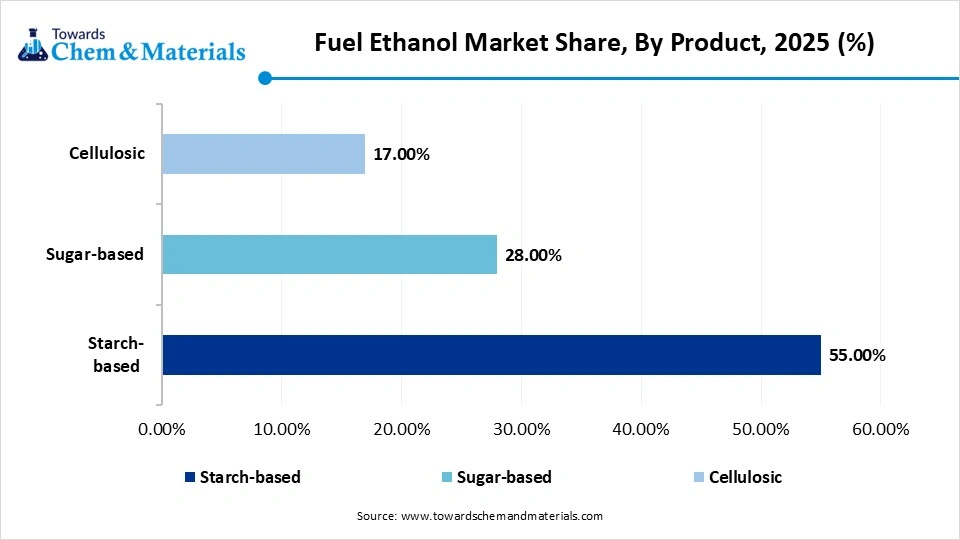
The cellulosic segment is expected to grow at the fastest CAGR over the forecast period. The growth of the segment can be credited to its better sustainability, using non-food feedstocks such as municipal waste and agricultural residues. Additionally, innovations in hydrolysis, pretreatment, and fermentation technologies are improving the economic viability and overall process efficiency.
Fuel Ethanol Market Share, By Product, 2025 (%)
| By Product | Revenue Share, 2025 (%) |
| Starch-based | 55.00% |
| Sugar-based | 28.00% |
| Cellulosic | 17.00% |
- Starch-based – Dominating with a 55.00% share, abundant feedstock availability (especially corn), established production technologies, and cost efficiency drive widespread adoption.
- Sugar-based – With a 28.00% share, higher conversion efficiency and strong presence in sugarcane-rich regions support significant market contribution, though limited geographic availability restricts dominance.
- Cellulosic – Holding a 17.00% share, increasing focus on sustainable, non-food-based feedstocks is driving growth, but high production costs and technological barriers limit large-scale adoption.
Technology Insights
Which Technology Dominated the Fuel Ethanol Market in 2025?
The wet mill segment held the largest market share 75.00% in 2025. The dominance of the segment can be linked to its capability to manufacture a wide range of high-value co-products and the increasing demand for ethanol across the globe. Additionally, wet mills are rapidly being incorporated into carbon capture projects to fulfil stringent greenhouse gas reduction goals.
The dry mill segment is expected to grow at the fastest CAGR over the forecast period. The growth of the segment can be driven by growing demand for gasoline blending and a surge in emphasis on carbon emission reductions. Dry mills need substantially lower capital investment and operating costs as compared to wet mills, which makes them more convenient for rapid capacity expansion.
Fuel Ethanol Market Share, By Technology, 2025 (%)
| By Technology | Revenue Share, 2025 (%) |
| Wet Mill | 75.00% |
| Dry Mill | 25.00% |
- Wet Mill – Dominating with a 75.00% share, its ability to produce multiple high-value co-products along with ethanol and higher processing efficiency drives strong industrial preference.
- Dry Mill – With a 25.00% share, lower capital investment and simpler processing support steady adoption, but limited co-product output restricts its overall market share.
Application Insights
Which Application Dominated the Fuel Ethanol Market in 2025?
The conventional fuel vehicles segment dominated the market with a large share 65.00% in 2025. The dominance of the segment is owed to the surge in octane needs in high-performance engines, coupled with the growth of the fuel infrastructure. Furthermore, governments across the globe are increasingly enforcing stringent regulations that require fuel suppliers to mix certain percentages of ethanol into standard gasoline.
The flexible fuel vehicles segment is expected to grow at the fastest CAGR over the projected period. The growth of the segment is due to stringent emissions regulations and supportive government policies and incentives supporting cleaner-burning ethanol over gasoline. Surge in need for ethanol directly fuels the growth of the rural economies by offering a stable market for corn, sugarcane, and maize.
Fuel Ethanol Market Share, By Application, 2025 (%)
| By Application | Revenue Share, 2025 (%) |
| Conventional Fuel Vehicles | 65.00% |
| Flexible Fuel Vehicles | 24.00% |
| Others | 11.00% |
Regional Insights
The North America fuel ethanol market size was valued at USD 65.68 billion in 2025 and is expected to be worth around USD 113.38 billion by 2035, exhibiting at a compound annual growth rate (CAGR) of 5.61% over the forecast period from 2026 to 2035. North America dominated the market with the largest share in 2025. The dominance of the region can be attributed to the growing adoption of Flex Fuel Vehicles (FFVs) and ongoing infrastructure growth. In addition, growing awareness regarding carbon footprints and the push towards sustainable energy sources fuel the demand for ethanol, which provides lower emissions as compared to traditional fossil fuels.
U.S. Fuel Ethanol Market Trends
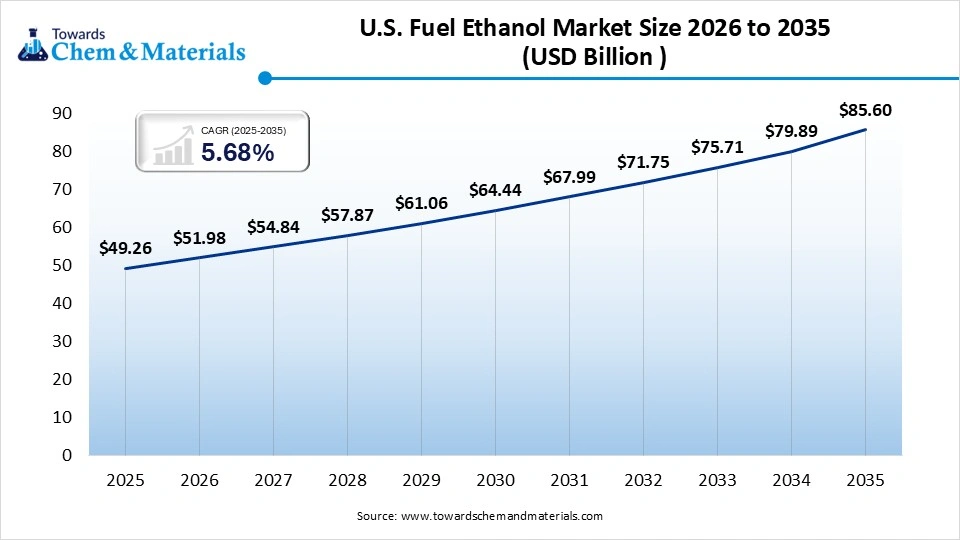
The U.S. ethanol e-fuel market size was valued at USD 49.26 billion in 2025 and is expected to be worth around USD 85.60 billion by 2035, exhibiting at a compound annual growth rate (CAGR) of 5.68% over the forecast period from 2026 to 2035.In North America, the U.S. led the market due to the increasing emphasis on minimizing greenhouse gas emissions, along with the growing demand for cutting-edge ethanol blends. Also, the country benefits from an extensive agricultural base, especially in the Midwest, offering a constant supply of corn for ethanol production.
Asia Pacific is expected to grow at the fastest CAGR over the forecast period. The growth of the region can be credited to the surge in vehicle ownership and the growing need for cleaner transportation fuels, with a substantial investment in feedstock manufacturing. Additionally, emerging economies such as India and China are increasingly adopting ethanol to minimize heavy reliance on imported crude oil, leading to further regional growth.
China Fuel Ethanol Market Trends
In the Asia Pacific, China dominated the market owing to the increasing carbon neutrality goals, rise in vehicle ownership, and growth of the biorefineries. Moreover, there is a substantial increase in industrial flue gas-based and coal-based synthetic ethanol production to prevent competing with other food supplies.
Europe Fuel Ethanol Market Trends
Europe is expected to grow at a notable CAGR over the forecast period. The growth of the region can be driven by increasing demand for low-carbon sustainable transport fuels, along with the growing use of agricultural residues to create advanced ethanol. Furthermore, major airlines in the region are stepping into long-term contracts for renewable products to fulfil aviation decarbonization targets.
Germany Fuel Ethanol Market Trends
The growth of the market in the country is due to ongoing technological innovations in manufacturing efficiency, coupled with the extensive availability of agricultural feedstocks. Germany has a robust industrial base, with innovations in both dry and wet milling technologies enhancing efficiency. There is also a rapid transition towards second-generation ethanol production, which will impact positive market growth soon.
Fuel Ethanol Market Share, By Regional, 2025 (%)
| Regional | Revenue Share, 2025 (%) |
| North America | 57.00% |
| Europe | 14.00% |
| Asia Pacific | 16.00% |
| Latin America | 9.00% |
| Middle East & Africa | 4.00% |
- Conventional Fuel Vehicles – Dominating with a 65.00% share, widespread compatibility with standard gasoline blends (such as E10) and a large existing vehicle fleet drive high consumption.
- Flexible Fuel Vehicles – With a 24.00% share, the ability to run on higher ethanol blends (such as E85) supports growing adoption, though limited vehicle availability restricts dominance.
- Others – Making up 11.00% of the market, niche applications contribute limited demand due to lower scale and specialized usage.
Recent Developments
- In October 2025, True Green Bio Energy Limited launched its 300 KLPD grain-based ethanol facility in Ahmedabad, Gujarat. The plant has commenced commercial production and established supply agreements with major energy companies, including Reliance Industries, Nayara Energy, HPCL, IOCL, and BPCL.(Source : scanx.trade)
- In August 2025, Mahindra is developing flex-fuel engines to align with India's goal of reaching a 30% ethanol blend (E30) by 2030. This initiative ensures their next generation of SUVs will be fully compatible with higher ethanol levels as the government pushes for greener fuel alternatives.(Source: www.autocarindia.com)
Market Companies
- Braskem S.A.: Braskem S.A. is a major player in the global petrochemical market, distinguished as the world's leading producer of biopolymers, specifically by converting sugarcane ethanol into green ethylene and subsequently polyethylene (PE).
- BP Plc: BP p.l.c. is a major global player in the fuel ethanol and broader biofuels market, focusing on increasing its production capacity to meet rising demand for lower-carbon fuels.
- Cargill Incorporated: Cargill Incorporated is a major player in the global fuel ethanol market, producing 96% and 99% ethanol for industrial and fuel applications, with a strong presence in North America and Europe.
- INEOS Group Limited
- HPCL Biofuels Limited
- LyondellBasell Industries Holdings BV
- Mitsubishi Chemical Corporation
- SABIC
- Sasol Limited
- Solvay SA
Segments Covered in the Report
By Product
- Starch-based
- Sugar-based
- Cellulosic
By Technology
- Wet Mill
- Dry Mill
By Application
- Conventional Fuel Vehicles
- Flexible Fuel Vehicles
- Others
By Region
- North America
- U.S.
- Canada
- Mexico
- Europe
- Germany
- UK
- France
- Italy
- Spain
- Asia Pacific
- China
- India
- Japan
- South Korea
- Latin America
- Brazil
- Argentina
- Middle East & Africa
- Saudi Arabia
- South Africa



Comments
Share your thoughts, ask a question, or provide feedback about this report.