
What is the Current Biocomposites Market Size and Share?
The global biocomposites market size was valued at USD 42.75 billion in 2025, is estimated to reach USD 48.24 billion in 2026, and is projected to reach USD 143.20 billion by 2035, exhibiting a compound annual growth rate (CAGR) of 12.85% over the forecast period from 2026 to 2035. In terms of volume, the biocomposites market is projected to grow from 9.18 million tons in 2025 to 28.38 million tons by 2035. growing at a CAGR of 11.95% from 2026 to 2035. The increased attention through the implementation of the sustainability standards has created benefits for the industry's potential in recent years.
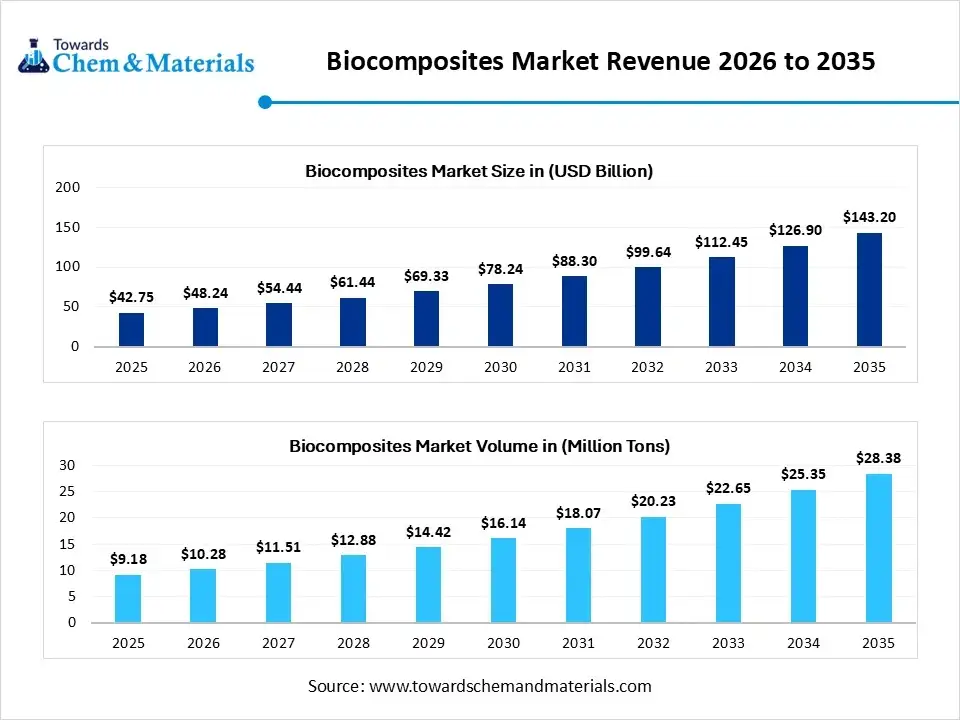
The advanced materials, which is primarily made from natural fibers, include hemp, wood, flax, and jute is called biocomposites. Also, the greater demand for lightweight, durable, and sustainable materials has led to biocomposites gaining major industry attention in recent years, where the global governments have seen a reduction in the usage of heavy, chemical-inclusive materials. Furthermore, the larger manufacturing regions such as the Asia Pacific and Europe have emerged as prominent producers of the biocomposites in the current period, as per the recent survey.
Governments in many countries are supporting green manufacturing practices and encouraging the use of renewable materials. Furthermore, rising awareness about plastic waste and environmental pollution has encouraged manufacturers to invest in biodegradable and recyclable products. The automotive sector is one of the major users of biocomposites because these materials help reduce vehicle weight and improve fuel efficiency. In recent years, the construction industry has also increased the use of biocomposites for decking, panels, insulation, and decorative applications due to their durability and sustainable nature.
Market Highlights
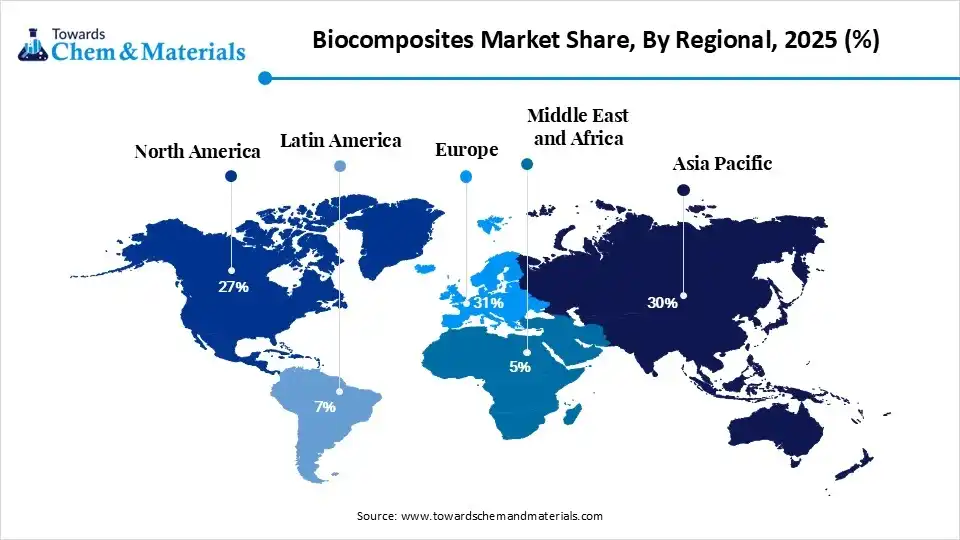
- By region, Europe dominated the market with a share of 31% in 2025, due to the region having strong environmental regulations, advanced manufacturing industries, and high consumer awareness about sustainability.
- By region, Asia Pacific is notably growing with 30% market share in 2025 and is expected to be the fastest-growing region in the market, with a CAGR of 14.92% in the forecast period, owing to rapid industrialization, rising manufacturing activities, and increasing environmental awareness.
- By fiber type, the wood fibers segment dominated the market with 61% share in 2025, as wood-based materials are widely available, cost-effective, and easy to process.
- By fiber type, the non-wood fibers segment held the 39% market share in 2025 and is expected to be the fastest-growing in the market, with a CAGR of 14.22% in the forecast period, owing to industries are increasingly adopting high-performance natural fibers such as hemp, flax, jute, and kenaf.
- By product, the wood plastic composites segment dominated the market with 46% share in 2025, as plastic-based biocomposites offer better durability, flexibility, and moisture resistance compared to several traditional materials.
- By product, the hybrid biocomposites segment held the 20.00% market share in 2025 and is expected to be the fastest-growing in the market, with a CAGR of 15.74% in the forecast period, owing to its combination of the advantages of natural fibers and synthetic materials in a single product.
- By technology, the extrusion segment dominated the market with 27% share in 2025, as extrusion technology is highly efficient for large-scale and continuous production.
- By technology, the thermoforming segment held the 8.00% market share in 2025 and is expected to be the fastest-growing segment in the market, with a CAGR of 14.91% in the forecast period, due to industries are increasingly demanding lightweight and customized composite products.
- By polymer type, the synthetic polymer segment dominated the market with 49.00% share in 2025, as synthetic polymers provide strong durability, flexibility, and moisture resistance for industrial applications.
- By polymer type, the biodegradable polymer segment held the 31% market share in 2025 and is expected to be the fastest-growing segment in the market, with a CAGR of 15.12% in the forecast period, due to industries are increasingly focusing on reducing plastic pollution and environmental impact.
- By end use, the automotive and transportation segment dominated the market with 32.00% share in 2025, as manufacturers are increasingly focusing on lightweight and fuel-efficient vehicles.
- By end use, the aerospace segment held the 9.00% market share in 2025 and is expected to be the fastest-growing segment in the market, with a CAGR of 15.86% in the forecast period, due to aircraft manufacturers increasingly searching for lightweight and high-performance materials.
Quick Stats at a Glance
- Market Estimated Size (2025): USD 42.75 Billion | CAGR (2026–2035): 5.85%
- Market Projected Size (2035): USD 143.20 Billion
- Europe: Revenue Share of 46% in 2025 | USD 13.25 Billion
- Market Estimated Volume (2025): 9.18 Million Tons | Volume CAGR (2026–2035): 11.95%
- Market Projected Volume (2035): 28.38 Million Tons
- Market Pricing (2025):
- Average Manufacturing Price: USD 3,190 per Ton
- Average Selling Price: USD 4,270 per Ton
- Pricing CAGR (2026–2035): 4.87%
Biocomposites Market Trends:
- The increased shift toward sustainable automotive materials has supported stronger cash flows for the manufacturing enterprises. Also, several vehicle manufacturers have observed under the heavy usage of fiber-based materials in different parts of the vehicles, such as seat backs, door panels, and dashboards, in recent years.
- The emergence of green buildings and sustainable construction materials needs has attracted increased capital and investment in biocomposites manufacturing in recent years. The manufacturers are investing in totally eco-friendly building materials nowadays.
- The turn toward biodegradable packaging is likely to elevate earning potential for the producers in the coming years. Moreover, several companies are seen reducing plastic waste by integrating biodegradable materials which has strength like plastics.
Report Scope
| Report Attribute | Details |
| Market Size and Volume in 2026 | USD 48.24 Billion / 10.28 Million Tons |
| Revenue Forecast in 2035 | USD 143.20 Billion / 28.38 Million Tons |
| Growth Rate | CAGR 12.85% |
| Forecast Period | 2026 - 2035 |
| Base Year | 2025 |
| Dominant Region | Asia Pacific |
| Segment Covered |
By Fiber Type,By Product,By Technology,By Polymer Type, By End Use |
| Key companies profiled | UPM-Kymmene Corporation / UPM Biocomposites, Bcomp Ltd., Trex Company, Inc, Stora Enso Oyj, Fiberon LLC, Toray Industries, Inc., FlexForm Technologies, UFP Industries, Inc., Mitsubishi Chemical Group Corporation, Teijin Limited, Tecnaro GmbH |
Innovative Fiber Technologies Enhancing Material Strength
The industry is witnessing a greater shift towards the development of advanced bio-based resins and improved natural fiber treatment technologies. Furthermore, manufacturers have focused on improving the strength, durability, moisture resistance, and thermal stability of biocomposites to expand their industrial applications. Moreover, new processing technologies are helping companies produce lightweight and high-performance materials more efficiently.
Supply Chain Analysis of the Biocomposites Market:
Distribution to Industrial Users
- Industrial biocomposites are distributed directly to manufacturers in the automotive, construction, and consumer goods sectors. Suppliers utilize specialized B2B logistics networks to deliver bulk materials like pellets and sheets.
- By establishing long-term supply contracts and technical partnerships, distributors ensure raw material consistency, helping factories seamlessly replace petroleum plastics with eco-friendly alternatives.
- Key Players: Bcomp Ltd and Tecnaro GmbH
Chemical Synthesis and Processing
- Chemical synthesis and processing of biocomposites involves compounding natural fibers like flax, hemp, or cellulose with bio-based or synthetic polymers.
- Using techniques like extrusion, injection molding, and compression molding, manufacturers apply precise heat and pressure to bond the matrix and reinforcement, ensuring structural integrity for high-performance industrial applications.
- Key Players: KraussMaffei and Coperion
Regulatory Compliance and Safety Monitoring
- Regulatory compliance and safety monitoring of biocomposites ensure structural reliability, environmental safety, and chemical nontoxicity.
- Standardized testing evaluates flame retardancy, biodegradation rates, mechanical stress durability, and emissions of volatile organic compounds (VOCs).
- Key Agencies: ISO and ASTM International
Biocomposites Market Regulatory Landscape: Regulations
| Country Region | Regulatory Body | Key Regulations | Focus Areas |
| United States | Environmental Protection Agency (EPA) | TSCA (Toxic Substances Control Act - 15 U.S.C. §2601): Section 5 (Pre-manufacture Notice) requires chemical evaluation of novel bio-resins or modified natural polymers before commercial scale-up. | Quantifying renewable component thresholds via ASTM D6866 protocols. |
| Europe | ECHA (European Chemicals Agency) |
REACH Regulation (EC No 1907/2006): Annex XVII (Restrictions on Dangerous Substances) governs the deployment of intentionally added microplastics or hazardous coupling agents within fiber-matrices. Title II (Registration) mandates tracking natural fibers if chemically modified during manufacturing. | Strict life-cycle circularity, chemical traceability of matrices, and strict limits on volatile organic compounds (VOCs) |
| China | SAMR (State Administration for Market Regulation) | GB/T 39514-2020 (Terminology, Definition, and Identification of Biobased Materials): Standardized framework defining the precise classification, naming protocols, and structural boundaries of bio-based composites | Standardizing national terminology and marking schemes for environmental bio-materials |
Biocomposites Market Dynamics
Driver
Sustainable Alternatives Replacing Traditional Materials
The rising global focus on sustainability and environmentally friendly materials is actively providing greater benefits to the industry. In the current period, industries are increasingly replacing traditional plastic and glass fiber materials with renewable and lightweight alternatives. Automotive, construction, and packaging companies are using biocomposites to reduce carbon emissions and improve product sustainability.
Restraint
Cost Challenges Affecting the Industry Growth
The high production cost compared to conventional composite materials is expected to hamper the industry's growth in the coming years. In recent years, manufacturers have faced challenges related to expensive bio-based resins, fiber treatment technologies, and processing methods. Moreover, natural fibers sometimes absorb moisture easily, which can affect durability and long-term performance in certain applications.
Opportunity
Green Mobility Supporting Biocomposites Expansion
The heavy demand for biodegradable packaging and electric vehicles is expected to create lucrative advantages for the manufacturers during the projected period. In the current period, packaging companies are actively searching for sustainable alternatives to single-use plastics because of rising environmental concerns and government restrictions. Moreover, electric vehicle manufacturers are increasingly using lightweight biocomposite materials to improve energy efficiency and battery performance.
Segmental Insights
Fiber Type Insights
The wood fibers segment dominated the market with 61% share in 2025, as wood-based materials are widely available, cost-effective, and easy to process. In recent years, industries such as construction, automotive, and furniture have increasingly used wood fibre composites for lightweight and durable applications. Moreover, wood fibres provide good mechanical strength and better compatibility with plastic polymers, making them suitable for large-scale manufacturing.
The non-wood fibers segment held the 39% market share in 2025 and is expected to be the fastest-growing in the market, with a CAGR of 14.22% in the forecast period, owing to industries increasingly adopting high-performance natural fibers such as hemp, flax, jute, and kenaf. In the current period, these fibers are gaining attention due to their lightweight structure, better strength-to-weight ratio, and improved sustainability profile. Moreover, automotive and aerospace manufacturers are investing in non-wood fibre composites to reduce vehicle and aircraft weight while improving fuel efficiency.
Biocomposites Market Share, By Fiber Type, 2025 (%)
| By Fiber Type | Revenue Share, 2025 (%) |
| Wood Fibers | 61% |
| Non-wood Fibers | 39% |
Product Insights
The wood plastic composites segment dominated the market with 46% share in 2025, as plastic-based biocomposites offer better durability, flexibility, and moisture resistance compared to several traditional materials. In recent years, industries such as automotive, packaging, consumer goods, and construction have increased the use of plastic composites for lightweight and long-lasting applications. Moreover, these composites are easier to manufacture using existing industrial equipment, reducing production complexity and costs.
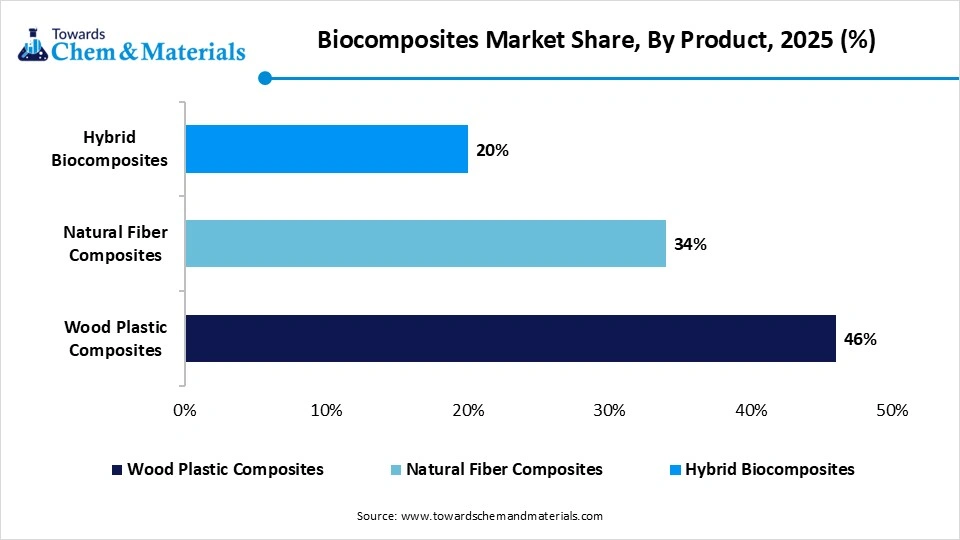
The hybrid biocomposites segment held the 20.00% market share in 2025 and is expected to be the fastest-growing in the market, with a CAGR of 15.74% in the forecast period, owing to its combination of the advantages of natural fibers and synthetic materials in a single product. In the current period, industries are focusing on materials that provide higher strength, lightweight performance, and better durability for demanding applications. Moreover, hybrid composites offer improved thermal stability and mechanical properties compared to standard biocomposites.
Biocomposites Market Share, By Product, 2025 (%)
| By Product | Revenue Share, 2025 (%) |
| Wood Plastic Composites | 46% |
| Natural Fiber Composites | 34% |
| Hybrid Biocomposites | 20% |
Technology Insights
The extrusion segment dominated the market with 27% share in 2025, as extrusion technology is highly efficient for large-scale and continuous production. In recent years, manufacturers have widely used extrusion processes to produce decking, panels, pipes, automotive parts, and construction materials. Moreover, extrusion technology provides better production speed, lower material waste, and consistent product quality, making it suitable for industrial manufacturing.
The thermoforming segment held the 8.00% market share in 2025 and is expected to be the fastest-growing segment in the market, with a CAGR of 14.91% in the forecast period, due to industries are increasingly demanding lightweight and customized composite products. In the current period, thermoforming technology is gaining popularity in packaging, automotive interiors, consumer goods, and medical applications due to its design flexibility and fast production process. Moreover, the technology allows manufacturers to create complex shapes with lower energy consumption and reduced material waste.
Biocomposites Market Share, By Technology, 2025 (%)
| By Technology | Revenue Share, 2025 (%) |
| Compression Molding | 24% |
| Injection Molding | 21% |
| Extrusion | 27% |
| Resin Transfer Molding | 9% |
| Pultrusion | 7% |
| Thermoforming | 8% |
| Others | 4% |
Polymer Type Insights
The synthetic polymer segment dominated the market with 49.00% share in 2025, as synthetic polymers provide strong durability, flexibility, and moisture resistance for industrial applications. In recent years, industries such as automotive, construction, and packaging have widely used polypropylene and polyethylene-based composites due to their reliable performance and cost efficiency. Moreover, synthetic polymers are compatible with different natural fibers, allowing manufacturers to produce lightweight and durable products.
The biodegradable polymer segment held the 31% market share in 2025 and is expected to be the fastest-growing segment in the market, with a CAGR of 15.12% in the forecast period, due to industries are increasingly focusing on reducing plastic pollution and environmental impact. In the current period, governments worldwide are introducing strict regulations against single-use plastics, encouraging companies to adopt biodegradable alternatives. Moreover, consumer demand for eco-friendly packaging and sustainable products is rapidly increasing across the food, healthcare, and consumer goods industries.
Biocomposites Market Share, By Polymer Type, 2025 (%)
| By Polymer Type | Revenue Share, 2025 (%) |
| Biodegradable Polymer | 31% |
| Synthetic Polymer | 49% |
| Hybrid Polymer | 14% |
| Others | 6% |
End Use Insights
The automotive and transportation segment dominated the market with 32.00% share in 2025, as manufacturers are increasingly focusing on lightweight and fuel-efficient vehicles. In recent years, biocomposites have been widely used in dashboards, door panels, seat backs, and interior components to reduce vehicle weight and improve sustainability. Moreover, governments across different countries are introducing stricter emission regulations, encouraging automotive companies to adopt eco-friendly materials.
The aerospace segment held the 9.00% market share in 2025 and is expected to be the fastest-growing segment in the market, with a CAGR of 15.86% in the forecast period, due to aircraft manufacturers increasingly searching for lightweight and high-performance materials. In the current period, biocomposites are gaining attention in aerospace applications due to their ability to reduce aircraft weight and improve fuel efficiency. Moreover, airlines and aerospace companies are focusing on reducing carbon emissions and operating costs, which is encouraging the use of sustainable composite materials.
Biocomposites Market Share, By End Use, 2025 (%)
| By End Use | Revenue Share, 2025 (%) |
| Automotive and Transportation | 32% |
| Building and Construction | 28% |
| Consumer Goods | 18% |
| Aerospace | 9% |
| Medical | 6% |
| Others | 7% |
Regional Insights
How will Europe Dominate the Biocomposites Market in 2025?
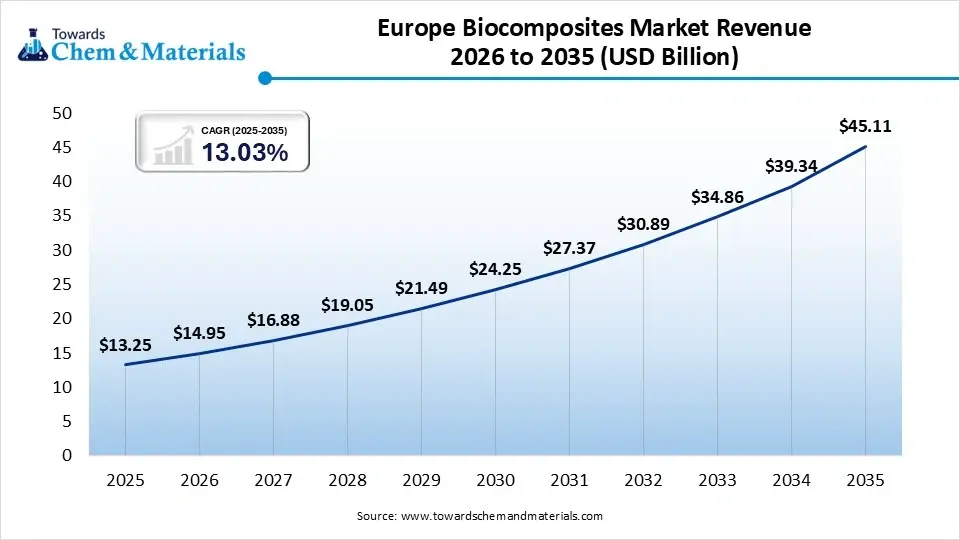
The Europe biocomposites market size was estimated at USD 13.25 billion in 2025 and is projected to reach USD 45.11 billion by 2035, growing at a CAGR of 13.03% from 2026 to 2035.Europe dominated the market with a share of 31% in 2025, due to the region having strong environmental regulations, advanced manufacturing industries, and high consumer awareness about sustainability. In recent years, the automotive, packaging, and construction industries across Europe have significantly increased the use of renewable and recyclable materials.
Germany
- German automotive companies are increasingly using natural fiber composites in electric vehicles to reduce weight and improve fuel efficiency.
- Also, Germany has strong technological expertise and advanced manufacturing infrastructure.
France
- The packaging and construction industries in the country have increased the use of biodegradable and recyclable materials to reduce plastic waste and carbon emissions.
- Also, rising consumer awareness regarding eco-friendly products is supporting the demand.
Biocomposites Market Evaluation in the Asia Pacific
The Asia Pacific biocomposites market size was estimated at USD 12.83 billion in 2025 and is projected to reach USD 43.68 billion by 2035, growing at a CAGR of 13.04% from 2026 to 2035.Asia Pacific is notably growing with 30% market share in 2025 and is expected to be the fastest-growing region in the market, with a CAGR of 14.92% in the forecast period, owing to rapid industrialization, rising manufacturing activities, and increasing environmental awareness. In the current period, countries such as China, India, Japan, and South Korea are investing heavily in sustainable materials and green industrial technologies. Moreover, the region has abundant agricultural resources, which support the availability of natural fibers like jute, bamboo, and hemp for biocomposite production.
China
- The strict government regulations against plastic waste are encouraging industries to adopt renewable and recyclable materials.
- Furthermore, rising research investments and government support for green technologies.
India
- The availability of natural fibers like jute, bamboo, and hemp is supporting domestic biocomposite manufacturing in the country.
- Also, India’s rapidly growing infrastructure and packaging sectors are increasing the demand for biodegradable and recyclable materials.
North America Biocomposites Industry Conditions
The North America biocomposites market size was estimated at USD 11.54 billion in 2025 and is projected to reach USD 39.38 billion by 2035, growing at a CAGR of 13.06% from 2026 to 2035.North America held the 27% market share in 2025, owing to industries that are increasingly focusing on sustainable manufacturing and lightweight material technologies. In recent years, automotive, aerospace, and packaging companies across the region have increased investments in renewable and recyclable materials. Moreover, rising environmental concerns and stricter regulations regarding carbon emissions and plastic waste are encouraging companies to adopt biocomposites.
United States
- The automotive and aerospace companies are investing heavily in advanced biocomposites to improve fuel efficiency and reduce emissions.
- The increasing consumer demand for sustainable packaging and eco-friendly products is supporting market expansion.
Canada
- The construction, packaging, and automotive industries have expanded the use of renewable and recyclable composite materials across various applications.
- Also, the country’s focus on reducing carbon emissions and promoting green infrastructure projects is supporting the demand for bio-based products.
Biocomposites Market Survey in Latin America
The Latin America biocomposites market size was estimated at USD 2.99 billion in 2025 and is projected to reach USD 10.74 billion by 2035, growing at a CAGR of 13.64% from 2026 to 2035.Latin America held the 7% market share in 2025 due to increasing awareness about sustainable materials and expanding industrial activities. In recent years, the automotive, packaging, and construction industries in the region have shown rising interest in renewable and eco-friendly composite materials. Moreover, Latin America has strong agricultural resources, which support the availability of natural fibers for biocomposite manufacturing.
Brazil
- The companies are heavily using natural fibers from coconut, sugarcane, and agricultural waste for eco-friendly composite production.
- The rising awareness about plastic pollution & sustainable products is encouraging manufacturers to adopt bio-based alternatives.
Argentina
- The country’s agricultural sector provides access to natural fibers and biomass resources that can be used in biocomposite manufacturing.
- Industries are focusing on reducing dependence on traditional petroleum-based plastics and adopting greener production practices.
Middle East & Africa’s Biocomposites Sector Observation
The Middle East & Africa biocomposites market size was estimated at USD 2.14 billion in 2025 and is projected to reach USD 7.88 billion by 2035, growing at a CAGR of 13.92% from 2026 to 2035.The Middle East and Africa held a market share of 5% in 2025. The rising sustainability initiatives drives the market growth. In recent years, construction, packaging, and automotive sectors across the region have shown rising demand for lightweight and environmentally friendly materials. Moreover, investments in green infrastructure projects and renewable technologies are supporting market development.
Saudi Arabia
- The government is promoting renewable energy projects and sustainable industrial practices to reduce dependence on traditional oil-based industries.
- Rising investments in advanced manufacturing and smart infrastructure are also creating demand for innovative composite materials.
UAE
- Industries such as construction, packaging, and consumer goods have increased the use of recyclable and eco-friendly materials.
- Also, the UAE is investing heavily in advanced manufacturing technologies, circular economy programs, and environmentally responsible industrial practices.
Recent Developments
- In December 2025, the UBE corporation received the certification for its latest products, which are under the brand called U-BE-INFINITY. Also, one of the included products is biomass compositions nylon, which has been added to environmental products as per the company's claim. Moreover, the aim behind this initiative is to promote and increase the usage of green and sustainable products.(Source: www.indianchemicalnews.com)
- In December 2025, MYNUSCo has expanded its product line from automotive to eco-friendly. Also, the company’s newly introduced biocomposites are specifically made from rice husk, straw, and bamboo waste, as per the published reports.(Source: economictimes.indiatimes.com)
Top Companies for the Biocomposites Market and Their Offerings
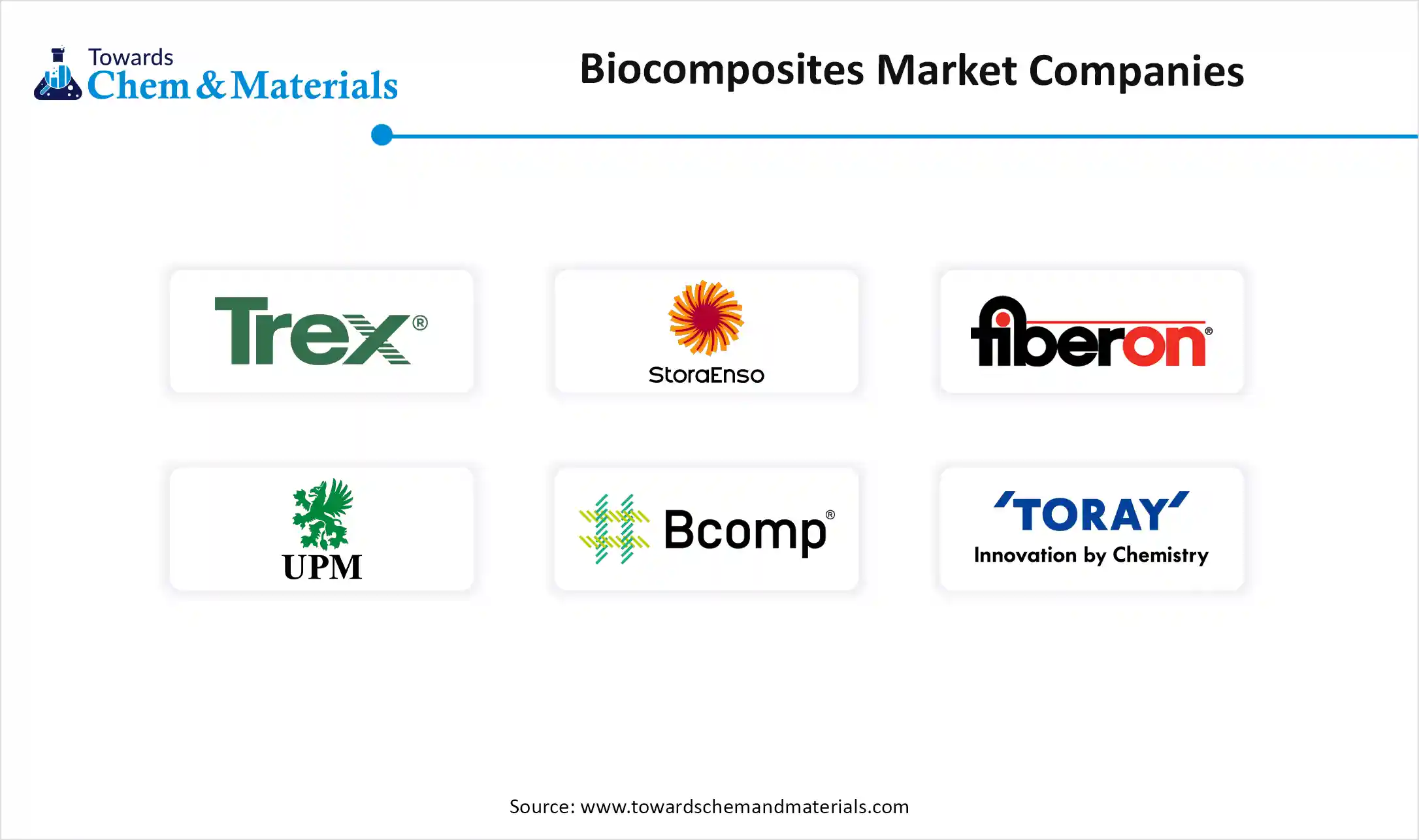
- Trex Company, Inc.: Trex Company, Inc. is a global leader in biocomposites, specializing in eco-friendly, wood-alternative outdoor living products. Headquartered in Virginia, USA, it processes billions of pounds of recycled plastic and wood waste annually.
- Stora Enso Oyj: Stora Enso Oyj is a leading European renewable materials provider based in Helsinki, Finland. The company manufactures highly innovative wood-fiber biocomposites, bio-based chemicals, and low-carbon packaging solutions.
- Fiberon LLC: Fiberon LLC is a prominent North American manufacturer of high-performance composite decking, railing, and cladding. Utilizing advanced biocomposite technology, its products feature multi-sided protective caps engineered from recycled plastics and wood fibers.
Other Key Players
- UPM-Kymmene Corporation / UPM Biocomposites
- Bcomp Ltd.
- Toray Industries, Inc.
- FlexForm Technologies
- UFP Industries, Inc.
- Mitsubishi Chemical Group Corporation
- Teijin Limited
- Tecnaro GmbH
Segments covered in the report
By Fiber Type
- Wood Fibers
- Softwood Fibers
- Hardwood Fibers
- Recycled Wood Fibers
- Non-wood Fibers
- Hemp Fiber
- Flax Fiber
- Jute Fiber
- Kenaf Fiber
- Bamboo Fiber
- Sisal Fiber
- Coir Fiber
- Others
By Product
- Wood Plastic Composites
- Polyethylene-based WPC
- Polypropylene-based WPC
- PVC-based WPC
- Natural Fiber Composites
- Thermoplastic NFC
- Thermoset NFC
- Hybrid Biocomposites
- Natural-Synthetic Hybrid
- Multi-fiber Hybrid
- Bio-based Hybrid Systems
By Technology
- Compression Molding
- Sheet Molding Compression
- Bulk Molding Compression
- Injection Molding
- Short Fiber Injection
- Long Fiber Injection
- Extrusion
- Profile Extrusion
- Sheet Extrusion
- Resin Transfer Molding
- Vacuum-assisted RTM
- High-pressure RTM
- Pultrusion
- Continuous Pultrusion
- Customized Pultrusion
- Thermoforming
- Vacuum Thermoforming
- Pressure Thermoforming
- Others
- Filament Winding
- Hand Lay-up
- 3D Composite Printing
By Polymer Type
- Biodegradable Polymer
- PLA
- PHA
- PBS
- Starch Blends
- Synthetic Polymer
- Polypropylene
- Polyethylene
- PVC
- Polyester
- Hybrid Polymer
- Bio-synthetic Blends
- Reinforced Hybrid Resin
- Others
- Epoxy Bio-resins
- Polyamide Blends
By End Use
- Automotive and Transportation
- Interior Components
- Exterior Components
- Structural Parts
- Building and Construction
- Decking
- Cladding
- Insulation Panels
- Roofing
- Consumer Goods
- Furniture
- Packaging
- Electronics Housing
- Aerospace
- Cabin Interiors
- Lightweight Structural Panels
- Medical
- Prosthetics
- Orthopedic Devices
- Medical Packaging
- Others
- Marine
- Sports Equipment
- Agriculture
By Geography
- North America
- Europe
- Asia-Pacific
- Latin America
- Middle East & Africa (MEA)



Comments
Share your thoughts, ask a question, or provide feedback about this report.