
Water Recycle and Reuse Market Size Analysis Report 2035
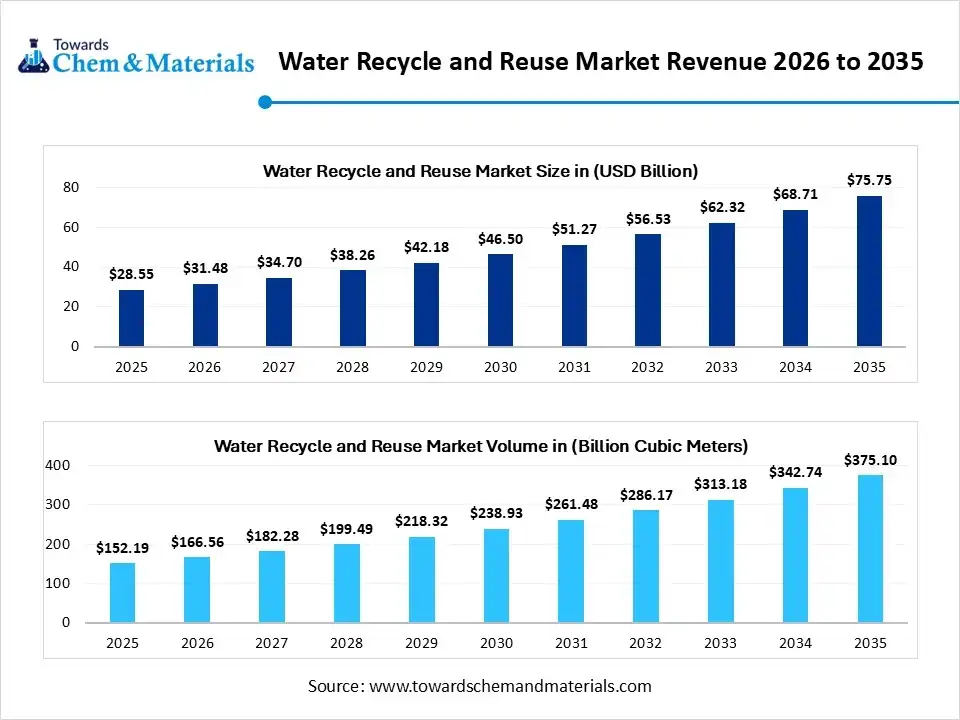
The global Water Recycle and Reuse market was valued at USD 28.55 billion in 2025, is estimated to reach USD 31.48 billion in 2026, and is projected to reach USD 75.75 billion by 2035, growing at a CAGR of 10.25% from 2026 to 2035. In terms of volume, the Water Recycle and Reuse market is projected to grow from 152.19 billion cubic meter in 2025 to 375.10 billion cubic meter by 2035. growing at a CAGR of 9.44% from 2026 to 2035. The need for clear and better water management has accelerated the industry's growth in recent years.
Market Highlights
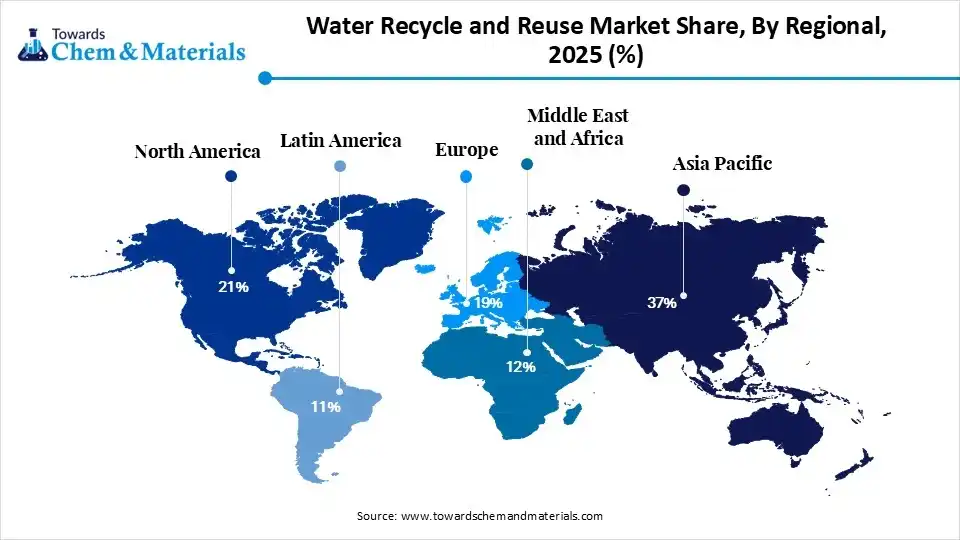
- By region, Asia Pacific dominated the market with a share of 37% in 2025 and is expected to be the fastest-growing region in the market, with a CAGR of 11.60% in the forecast period.
- By region, North America is notably growing with 21% market share in 2025.
- By technology, the membrane filtration segment dominated the market with 36% share in 2025 and is expected to be the fastest-growing in the market, with a CAGR of 11.20% in the forecast period.
- By source, the municipal wastewater segment dominated the market with 48% share in 2025.
- By source, the industrial wastewater segment held the 32% market share in 2025 and is expected to be the fastest-growing in the market, with a CAGR of 10.90% in the forecast period.
- By application, the agriculture irrigation segment dominated the market with 34% share in 2025.
- By application, the industrial reuse segment held the 28% market share in 2025 and is expected to be the fastest-growing in the market, with a CAGR of 10.70% in the forecast period.
- By end-user, the municipal authorities segment dominated the market with 46% share in 2025.
- By end-user, the industrial sector segment held the 38% market share in 2025 and is expected to be the fastest-growing in the market, with a CAGR of 10.80% in the forecast period in 2025.
- By system type, the centralized systems segment dominated the market with 58% share in 2025.
- By system type, the decentralized systems segment held the 42% market share in 2025and is expected to be the fastest-growing in the market, with a CAGR of 10.90% in the forecast period.
- By capacity, the large-scale (>100,000 m³/day) segment dominated the market with 43% share in 2025.
- By capacity, the medium scale (10,000–100,000 m³/day) segment held the 33% market share in 2025and is expected to be the fastest-growing in the market, with a CAGR of 10.80% in the forecast period.
Cost Savings Through Water Recycling Innovation
The use of water again after it has already been used once through advanced equipment and technologies is known as water recycling and reuse. Also, this trend has gained major attention from the major industries where a large amount of water has been used for years. Also, the savings in major costs of fresh water, the recycling technologies have generated value-added opportunities for the industry participants in recent years.
Recent Market Trends:
- The rising concerns of water shortages have unlocked new business opportunities for the industry participants in the past few years. Also, the rapid increase in population, weather changes, and pollution is heavily contributing to the industry's growth.
- The emergence of smarter and better technologies is enabling high-return ventures for manufacturers in the current period. Also, these new technologies are seen in cleaning chemicals, dirt, and harmful germs efficiently.
- The greater demand from the major manufacturing industries is expected to offer substantial growth prospects for the manufacturing firms in the coming years. Also, the heavy factories and manufacturing firms are actively installing recycling plants to save freshwater intakes, which is costly.
Smarter Systems Improving Water Purification
The greater movement from basic cleaning methods to more advanced and efficient systems in the current period. Also, earlier, water-treatment was simple and not always very effective. Now, modern systems can clean water much better by removing very small impurities and harmful substances. These new technologies are faster, safer, and more reliable.
Supply Chain Analysis of the Water Recycle and Reuse Market:
Distribution to Industrial Users
- Industrial users receive recycled water through dedicated closed-loop systems or purple-pipe networks designed for non-potable needs.
- Distributed treated effluent supports cooling towers, boiler feeds, and manufacturing processes. By integrating advanced filtration, facilities reduce freshwater reliance, lowering operational costs while ensuring a sustainable, consistent supply for high-demand production environments.
Chemical Synthesis and Processing
- Chemical synthesis in water reuse involves applying advanced oxidation and precise coagulants to break down complex industrial pollutants. Processing centers utilize these chemical stages to neutralize toxins and stabilize pH levels.
- This transformation ensures that wastewater meets rigorous purity standards, turning hazardous effluent into a valuable resource for manufacturing.
Regulatory Compliance and Safety Monitoring
- Strict regulatory frameworks govern water reuse to ensure public health and environmental safety. Monitoring protocols involve real-time sensors and rigorous laboratory testing to detect pathogens or chemical residuals.
- By maintaining transparent compliance logs and adhering to government standards, facilities guarantee that recycled water remains safe for its intended industrial application.
Water Recycle and Reuse Market Regulatory Landscape: Regulations
| Country Region | Regulatory Body | Key Regulations | Focus Areas |
| United States | Environmental Protection Agency (EPA) | Water Reuse Action Plan (WRAP) 2.0 (Released April 2026) | Scaling up recycling across industrial, technology, and energy sectors, including water for AI data centers and critical mineral extraction |
| Europe | European Commission (EC) |
Regulation (EU) 2020/741 on minimum requirements for water reuse (Effective June 2023). | Harmonizing water quality classes (A–D) primarily for agricultural irrigation, while also promoting circular economy goals in industrial processes. |
| China | Ministry of Ecology and Environment (MEE) | Regulations on Water Conservation (Effective May 2024) is the first national-level framework of its kind. | Targeting 25% wastewater reuse in water-scarce cities by 2025 and mandating water-saving technological upgrades for high-intensity industrial enterprises |
Market Dynamics
Driver
Water Stress Accelerating Market Growth
The need for clean enough water for daily needs is driving the industry growth in the current period. Moreover, the population growth is increasing demand, while pollution is reducing the available supply. Governments are also making strict rules to save water and reduce waste. Industries are under pressure to use water responsibly.
Restraint
Cost Barriers Challenge Water Reuse Adoption
The high cost of setting up water recycling systems is likely to hinder the industry's growth during the forecast period. Also, many small businesses and communities cannot afford these systems. Also, maintaining and operating them needs skilled people, which is not always easy to find.
Opportunity
Cheaper Solution Driving Water Recycling Growth
New technology is making water recycling cheaper and easier, which can help more people use it is anticipated to create significant opportunities for the industry players in the coming years. Also, developing countries have a big chance to grow because they face water shortages and need better solutions.
Segmental Insights
Technology Insights
The Membrane Filtration Segment Dominated the Water Recycle and Reuse Market with 36% Market Share in 2025.
The membrane filtration segment dominated the market with 36% share in 2025 and is expected to be the fastest-growing in the market, with a CAGR of 11.20% in the forecast period, as it is very effective at cleaning water. It can remove very small particles, harmful chemicals, and even tiny germs. This makes the water safe for many uses. It is also flexible and can be used in homes, industries, and large plants. Many systems prefer this method because it gives high-quality results.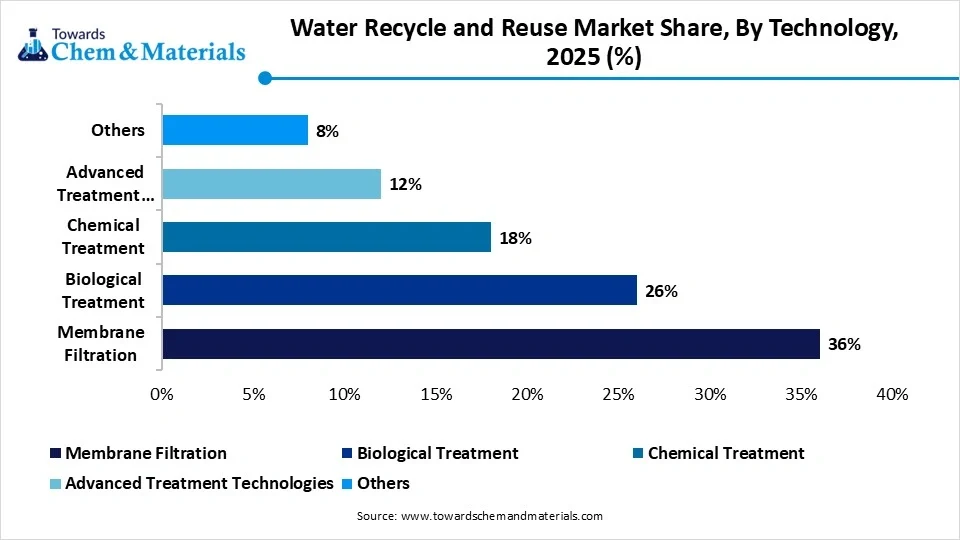
The biological treatment segment held the 26% market share in 2025, owing to its natural and eco-friendly nature. It uses bacteria and microorganisms to break down waste in water. This method needs less energy and produces fewer harmful by-products. As people focus more on sustainable and green solutions, this method is becoming more attractive.
Source Insights
The Municipal Wastewater Segment Dominated the Market with 48% Market Share in 2025
The municipal wastewater segment dominated the market with 48% share in 2025, as cities produce a huge amount of wastewater every day. This includes water from homes, schools, hospitals, and offices. Managing this water is very important to avoid pollution and health problems. Governments have been focusing more on treating and reusing this water.
The industrial wastewater segment held the 32% market share in 2025 and is expected to be the fastest-growing in the market, with a CAGR of 10.90% in the forecast period, due to industries are expanding rapidly. Factories use a lot of water and produce wastewater with chemicals and waste materials. Governments are making strict rules to control pollution, so industries must treat and reuse their water. Also, industries want to reduce costs by reusing water instead of buying fresh water again and again.
Application Insights
The Agriculture Irrigation Segment Dominated the Water Recycle and Reuse Market with 34% Market Share in 2025
The agriculture irrigation segment dominated the market with 34% share in 2025, as farming needs a large amount of water. Crops require regular watering, and in many places, fresh water is not available. Farmers are using recycled water to meet their needs. This helps them continue farming even in dry conditions.
The industrial reuse segment held the 28% market share in 2025 and is expected to be the fastest-growing in the market, with a CAGR of 10.70% in the forecast period, owing to the industry's use of a very large amount of water every day. Factories need water for cooling, cleaning, processing, and many other activities. Instead of using fresh water again and again, many industries choose to recycle and reuse their own wastewater. This helps them save money and reduce their dependence on limited water sources.
End-User Insights
The Municipal Authorities Segment Dominated the Market with 46% Market Share in 2025
The municipal authorities segment dominated the market with 46% share in 2025, owing to they are responsible for managing water in cities and towns. They handle water supply, wastewater treatment, and recycling systems. Governments invest heavily in these systems to ensure public health and cleanliness.
The industrial sector segment held the 38% market share in 2025 and is expected to be the fastest-growing in the market, with a CAGR of 10.80% in the forecast period in 2025, owing to the increasing industries everywhere. Factories are under pressure to reduce water use and pollution. Recycling water helps them save money and meet environmental rules. Many companies are now focusing on sustainable practices.
System Type Insights
The Centralized Systems Segment Dominated the Market with 58% Market Share in 2025
The centralized systems segment dominated the market with 58% share in 2025, owing to they can handle large amounts of wastewater in one place. These systems are usually set up by governments and serve entire cities or large areas. They are efficient for managing large populations and are easier to monitor and control. Many countries have already invested in such systems for years.
The decentralized systems segment held the 42% market share in 2025and is expected to be the fastest-growing in the market, with a CAGR of 10.90% in the forecast period, owing to they are smaller and more flexible. They can be set up close to where water is used, like in buildings or small communities. This reduces the need for long pipelines and saves energy. They are also easier to install in rural or remote areas.
Capacity Insights
The Large Scale (>100,000 m³/day) Segment Dominated the Market with 43% Market Share in 2025
The large scale (>100,000 m³/day) segment dominated the market with 43% share in 2025, owing to they can treat huge amounts of water at once. Cities and big industries need systems that can handle large volumes daily. These systems are more suitable for meeting high demand. Governments prefer large plants for urban areas because they are efficient for mass treatment.
The medium scale (10,000–100,000 m³/day) segment held the 33% market share in 2025and is expected to be the fastest-growing in the market, with a CAGR of 10.80% in the forecast period, as they offer a balance between size and cost. They are not as expensive as large systems and can still handle a good amount of water. Small towns, industries, and communities find them more practical. They are easier to manage and require less space.
Regional Insights:
How will Asia Pacific Dominate the Water Recycle and Reuse Market in 2025?
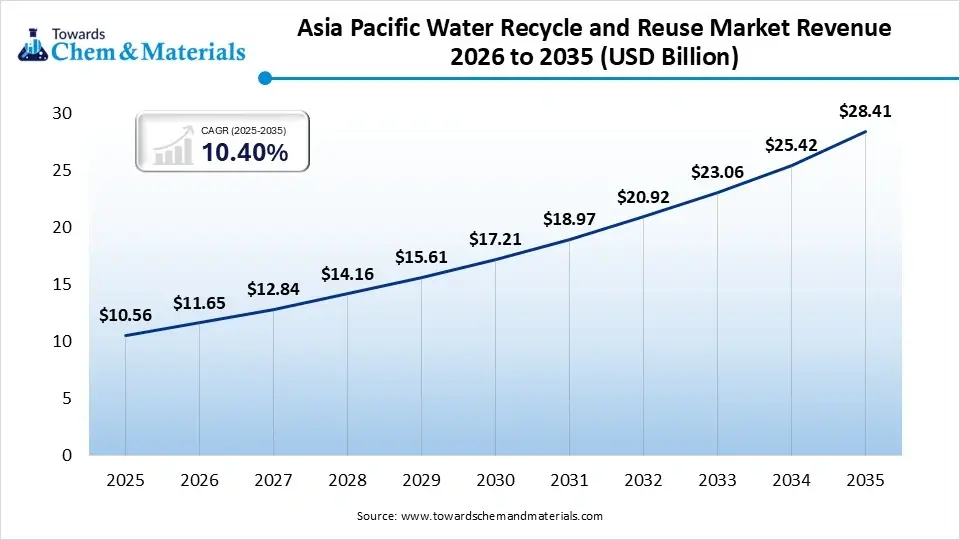
The Asia Pacific Water Recycle and Reuse market size was estimated at USD 10.56 billion in 2025 and is projected to reach USD 28.41 billion by 2035, growing at a CAGR of 10.40% from 2026 to 2035.Asia Pacific dominated the market with a share of 37% in 2025 and is expected to be the fastest-growing region in the market, with a CAGR of 11.60% in the forecast period, due to it has a large population and fast-growing cities. Countries in this region face serious water shortages and pollution problems. This creates a strong need for water recycling systems. Governments are investing heavily in water management projects.
China Tackling Water Challenges Through Reuse
China maintained its dominance in the market, owing to its huge population and strong industrial base. Water pollution and shortage are major challenges there. The government is taking strong actions by setting strict rules and investing in water treatment projects. Many cities are building advanced recycling systems.
Water Recycle and Reuse Market Evaluation in North America
North America is notably growing with 21% market share in 2025, owing to strong awareness about environmental protection. People and companies are focusing on saving water and reducing waste. Governments have clear rules and support for water recycling. Advanced technology is widely used in this region. There is also a focus on sustainable living. Because of these factors, the market is expanding steadily in the region nowadays.
Future of Water Recycling in the United States
The United States is expected to emerge as a prominent country for the water recycle and reuse market in the coming years, due to its advanced technology and strong policies. Many areas face water stress, especially in dry regions. The country is investing in modern water recycling systems. Industries and cities are adopting reuse practices to save costs and resources. There is also strong research and innovation happening in this field.
Recent Development
- In April 2026, SUEX and Salinity Solutions are likely to launch a major combined project called the Hybrid Batch Reverse Osmosis pilot. Also, the companies are going to use municipal wastewater for reuse in southern France. Moreover, in this project, the Hy Batch TM technology is being used, which is from Salinity Solutions, as per the published report.(Source: www.suez.com)
Top Vendors in the Water Recycle and Reuse Market & Their Offerings:
- Veolia Environnement S.A.: Veolia Environnement S.A., as a global benchmark for ecological transformation, Veolia manages extensive water recovery networks for municipal and industrial clients. The company integrates cutting-edge ultrafiltration and biological treatment to convert wastewater into high-quality process water.
- Xylem Inc.: Xylem is a leading water technology provider dedicated to solving global water challenges through smart infrastructure and advanced analytics. By combining high-efficiency pumping systems with sophisticated treatment solutions like UV disinfection and membrane bioreactors, they enable seamless water reuse.
- Ecolab Inc.: Ecolab Inc operating primarily through its Nalco Water division, Ecolab specializes in industrial water management and hygiene. The company provides integrated chemical and digital solutions that allow businesses to reduce, reuse, and recycle water within their operations.
- DuPont de Nemours, Inc.
- SUEZ Water Technologies & Solutions
- Hitachi Ltd.
- Kubota Corporation
Segments Covered in the Report
By Technology
- Membrane Filtration
- Ultrafiltration (UF)
- Reverse Osmosis (RO)
- Nanofiltration (NF)
- Biological Treatment
- Activated Sludge Process
- Membrane Bioreactors (MBR)
- Moving Bed Biofilm Reactor (MBBR)
- Chemical Treatment
- Coagulation & Flocculation
- Disinfection
- Chlorination
- UV Treatment
- Ozonation
- Advanced Treatment Technologies
- Advanced Oxidation Processes (AOP)
- Ion Exchange
- Others
By Source
- Municipal Wastewater
- Industrial Wastewater
- Power Generation
- Oil & Gas
- Chemicals
- Food & Beverage
- Textiles
- Stormwater
- Greywater
By Application
- Agricultural Irrigation
- Industrial Reuse
- Cooling
- Boiler Feed
- Process Water
- Municipal Reuse
- Potable Reuse
- Non-potable Reuse
- Environmental Reuse
- Others
By End-User
- Municipal Authorities
- Industrial Sector
- Commercial Sector
- Residential Sector
By System Type
- Centralized Systems
- Decentralized Systems
- On-site Systems
- Community Systems
By Capacity
- Small Scale (<10,000 m³/day)
- Medium Scale (10,000–100,000 m³/day)
- Large Scale (>100,000 m³/day)
By Region
- North America
- U.S.
- Canada
- Mexico
- Europe
- Germany
- UK
- France
- Italy
- Spain
- Asia Pacific
- China
- India
- Japan
- South Korea
- Latin America
- Brazil
- Argentina
- Middle East & Africa
- Saudi Arabia
- South Africa
A Seven-Phase Framework
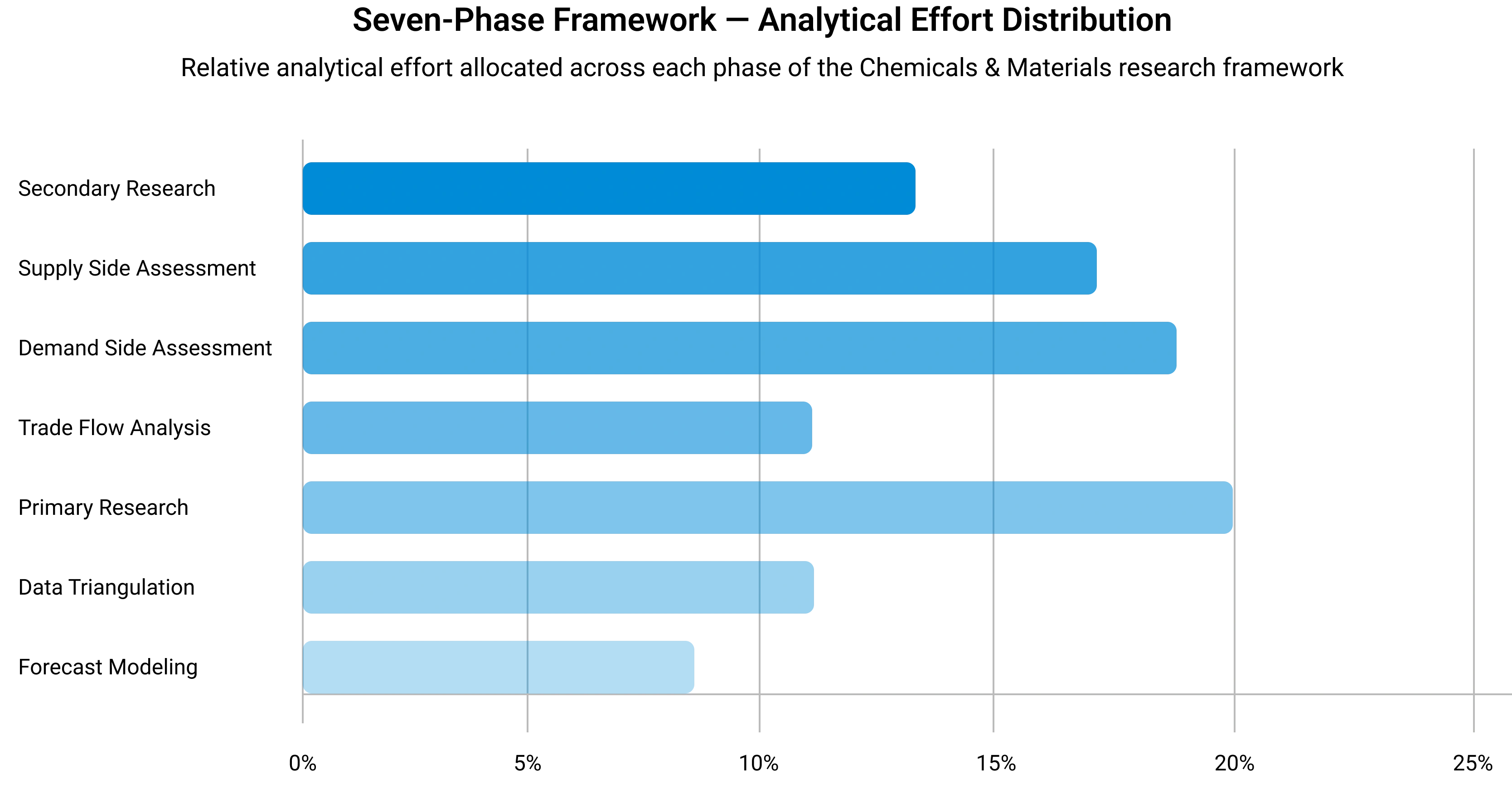
Our methodology is designed to be universally applicable across commodity chemicals, specialty chemicals, petrochemicals, construction chemicals, coatings, electronic chemicals, industrial gases, agrochemicals, water treatment chemicals, and performance materials. Each phase builds upon the last, creating a layered validation structure that minimizes estimation error and maximizes analytical confidence.
The framework ensures comprehensive market coverage, robust cross-validation, and reliable long-term forecasting — producing market estimates that withstand scrutiny from investors, regulators, and corporate strategy teams.

Seven-Phase Framework — Analytical Effort Distribution
Relative analytical effort allocated across each phase of the Chemicals & Materials research framework
Phase 1 - Secondary Research: Establishing the Foundation
Secondary research collects and evaluates publicly available information from authoritative sources, establishing the foundational understanding of market structure, value chain dynamics, competitive landscape, and end-use demand patterns. Every source is evaluated for credibility, recency, geographic relevance, and methodological soundness before inclusion.
Industry Associations
Sources include ACC, CEFIC, ICCA, JCIA, CPCIF, and SOCMA providing production volumes, consumption trends, capacity developments, and sustainability initiatives.
Company Disclosures
Annual reports, investor presentations, earnings transcripts, and regulatory filings reveal product portfolios, manufacturing footprints, capacity expansions, and revenue segmentation.
Government Databases
National statistical offices, customs authorities, environmental agencies, and industrial production databases provide verified statistics on output, trade flows, and regulatory compliance.
Trade Databases
UN Comtrade, ITC, Eurostat, and national customs authorities enable assessment of global product movement, import dependency, and export competitiveness across regions.
Our Secondary Research Sources
- Ministry of Chemicals and Fertilizers
- European Chemicals Agency
- United States Department of Energy
- Ministry of Industry and Information Technology
- Ministry of Economy Trade and Industry
- Ministry of Trade Industry and Energy
- National Institute of Standards and Technology
- Council of Scientific and Industrial Research
- Fraunhofer Society
- National Institute for Materials Science
Phase 2 — Supply-Side Assessment: Mapping Production Capabilities
Production Capacity Analysis
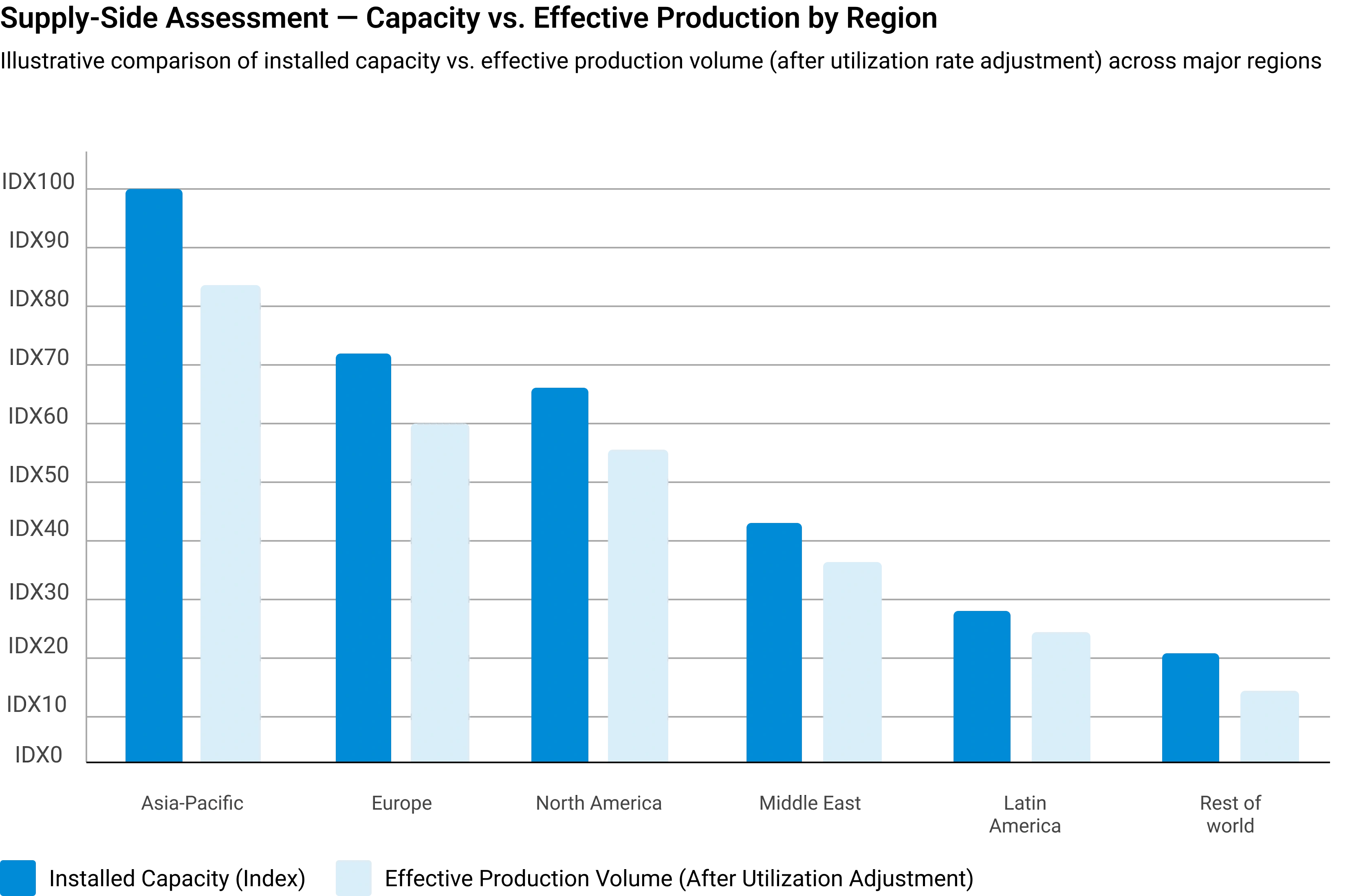
All major manufacturers are assessed for existing installed capacity, planned additions, expansions, new plant announcements, and technology adoption — mapped at global, regional, and country levels.
Capacity Utilization Adjustment
Installed capacity is adjusted using utilization rates based on demand conditions, feedstock availability, plant operating rates, maintenance schedules, and regulatory restrictions.
Manufacturer Revenue Analysis
Product-specific revenues, segment-level performance, regional distribution, average selling prices, and margin trends are evaluated to establish market value estimates.
Supply-Side Assessment — Capacity vs. Effective Production by Region
Illustrative comparison of installed capacity vs. effective production volume (after utilization rate adjustment) across major regions
Phase 3 — Demand-Side Assessment: Quantifying Chemical Consumption
Demand-side analysis quantifies chemical consumption across industries, applications, and geographies — identifying where and how chemicals are consumed throughout the value chain with precision.
End-Use Industry Analysis
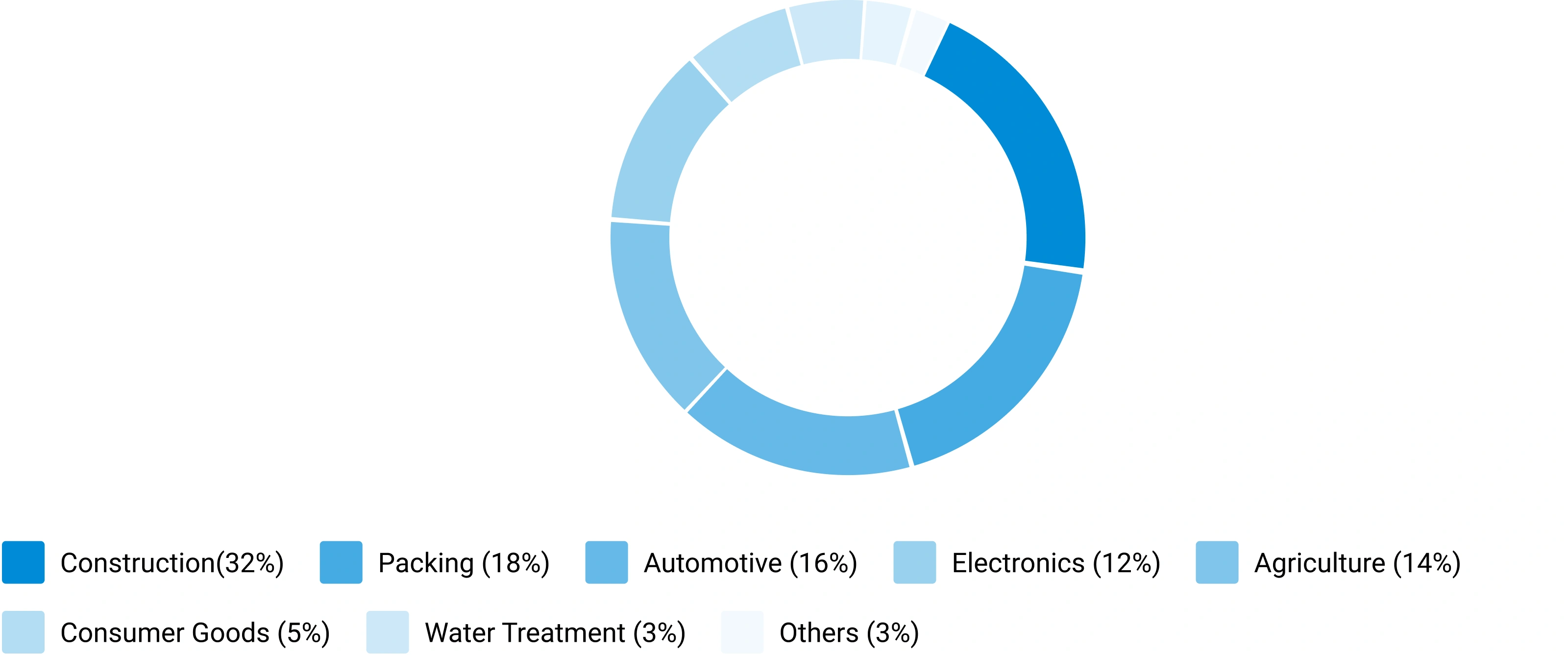
Chemical demand is evaluated across automotive, construction, packaging, electronics, agriculture, healthcare, consumer goods, industrial manufacturing, energy and utilities, and water treatment. Industry output, production trends, and consumption intensity are analyzed to determine demand patterns.
Consumption Modeling
Demand is estimated using measurable indicators: kilograms per vehicle, kilograms per square meter of construction, dosage per cubic meter of water treated, kilograms per hectare of agricultural land, and kilograms per ton of manufactured products. Consumption factors are validated through industry publications and primary interviews.
Application Analysis
The market is segmented by application area to understand product performance requirements, formulation trends, technology adoption, customer preferences, and regulatory requirements improving demand accuracy and segmentation granularity.
Demand-Side Assessment — End-Use Industry Demand Distribution
Illustrative distribution of chemical & materials demand across key end-use industries
Phase 4 - Trade Flow Analysis: Balancing Regional Supply and Demand
Trade flow analysis reconciles regional supply and demand estimates through import and export data, identifying net supply positions, regional dependencies, and market imbalances. It serves as an independent validation layer that tests the consistency of supply-side and demand-side estimates.
Import Analysis
Import data is evaluated to determine volumes, source countries, product dependency, regional supply gaps, and pricing trends — identifying markets that rely heavily on external supply and where domestic production is insufficient to meet demand.
Export Analysis
Export assessments reveal production surplus, export competitiveness, regional manufacturing strength, and global market participation. Export patterns also help validate domestic production estimates and identify net exporting regions.
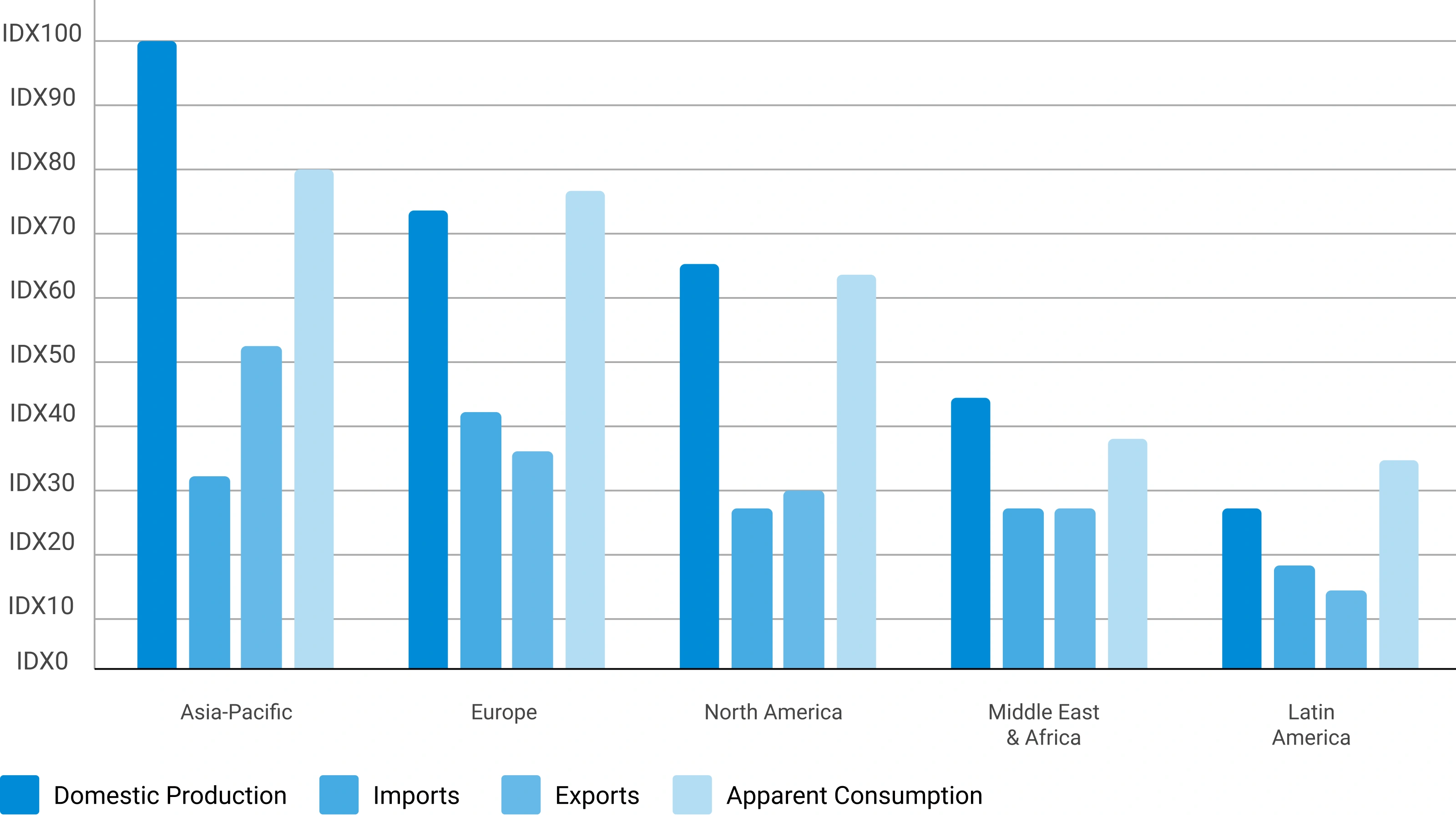
Apparent Consumption Model
Regional consumption is assessed using the standard apparent consumption formula:
Results identify net importing regions, net exporting regions, regional deficits, and surpluses — serving as an independent validation of supply and demand estimates.
Trade Flow Analysis — Net Supply Position by Region
Illustrative apparent consumption vs. domestic production across major regions — positive gap indicates net import dependency
Phase 5 — Primary Research: The Critical Validation Layer
Primary research tests and refines findings from secondary research through direct engagement with industry participants across the supply chain, demand side, and expert community. It captures intelligence that no database or published report can provide — the real-world experience of manufacturers, buyers, and specialists operating in the market.

Supply-Side Interviews
Conversations with chemical manufacturers, raw material suppliers, contract manufacturers, technology providers, and plant operators cover production trends, capacity utilization, pricing developments, technology shifts, and competitive dynamics.

Demand-Side Interviews
Engagement with OEMs, industrial consumers, procurement managers, distributors, formulators, and end-use manufacturers focuses on consumption trends, purchasing behavior, product substitution, demand outlook, and emerging applications.

Industry Expert Consultations
Additional interviews with industry consultants, independent experts, regulatory specialists, technical professionals, and research institutions provide deeper market context and validate key analytical assumptions.
Focus Areas of Primary Research:
Market Size & Forecast Validation
Revenue estimates, volume consumption, growth rates, forecast assumptions, regional demand.Supply Chain & Value Chain Assessment
Raw material sourcing, supply chain challenges, distribution networks, procurement practices.Production & Capacity Analysis
Manufacturing capacity, utilization rates, expansion projects, plant investments.Pricing & Cost Structure Analysis
Product pricing trends, feedstock costs, energy costs, margin pressures, pricing outlook.Competitive Landscape Assessment
Volume and value estimates confirmed to be fully consistent with one another before publicationInterview Volume by Market Scope
| Study Scope | Number of Interviews |
|---|---|
| Niche Market | 20 – 30 |
| Mid-Sized Market | 30 – 50 |
| Global Market | 50 – 80 |
| Highly Fragmented Market | 80 – 120 |
Interview Details:
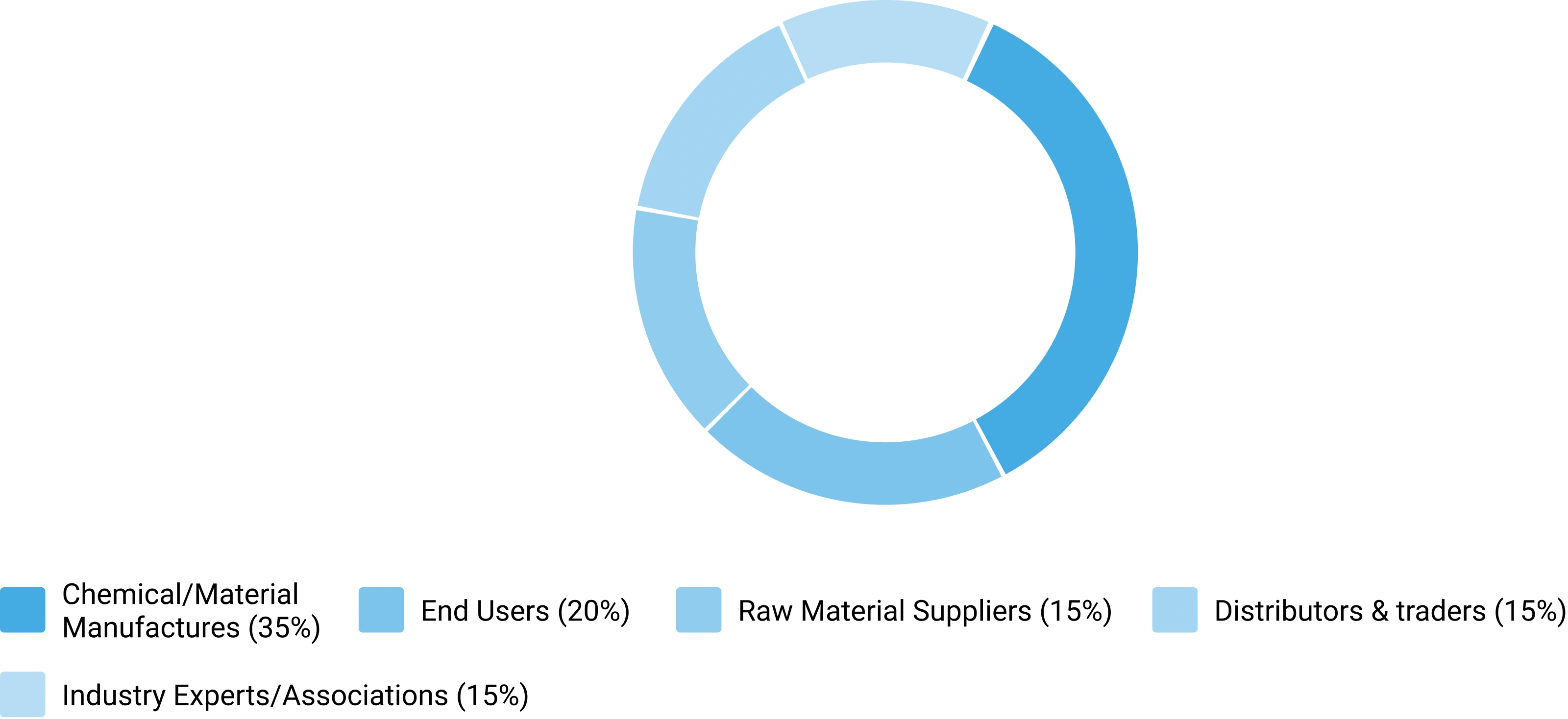
Category : Manufacturers, Suppliers, Distributors, End Users, Experts/Associations
Average Duration : 30–60 Minutes
Interview Mode : Video calls, telephonic interviews, expert consultations
Interview Format : Structured / Semi-Structured questionnaire
Focus Areas of Primary Research:
Market Size & Forecast Validation :
Revenue estimates, volume consumption, growth rates, forecast assumptions, regional demand.
Supply Chain & Value Chain Assessment :
Raw material sourcing, supply chain challenges, distribution networks, procurement practices.
Production & Capacity Analysis :
Manufacturing capacity, utilization rates, expansion projects, plant investments.
Pricing & Cost Structure Analysis :
Product pricing trends, feedstock costs, energy costs, margin pressures, pricing outlook.
Competitive Landscape Assessment :
Market share, competitor positioning, strategic initiatives, partnerships, acquisitions.
Primary Research — Stakeholder Coverage by Category
Distribution of interview respondents across stakeholder categories (% share from PPT data)
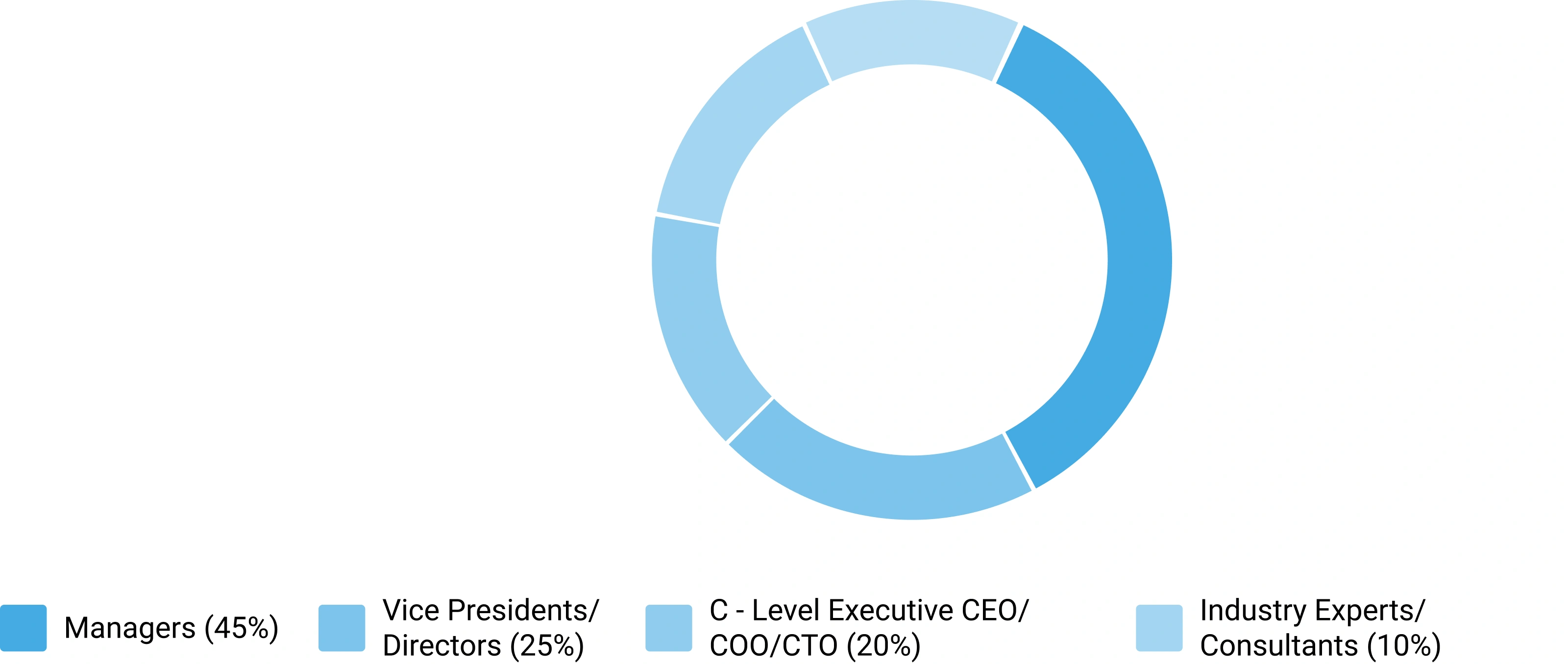
Primary Research — Respondent Designation Profile
Seniority breakdown of interview respondents (% share from PPT data)
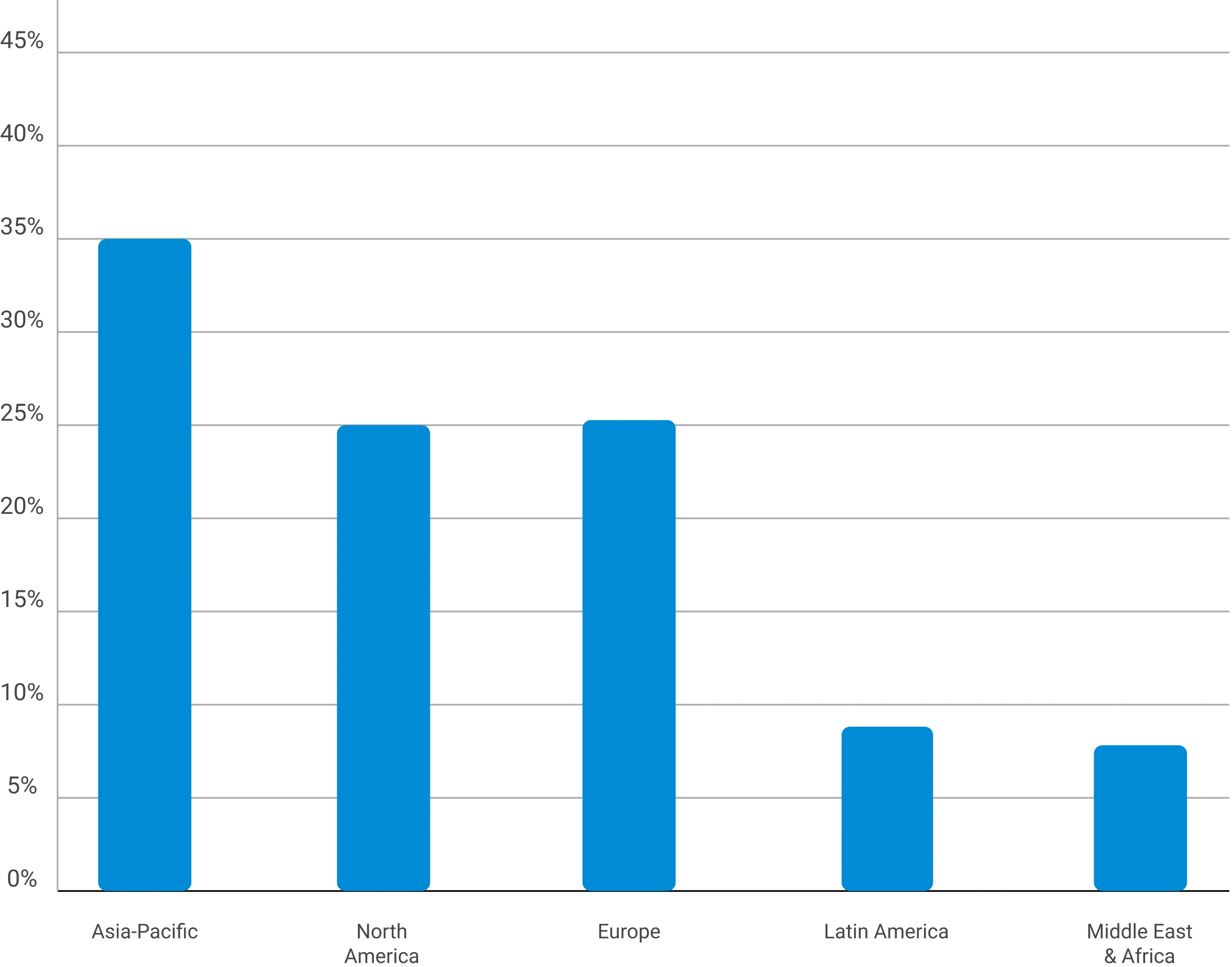
Primary Research — Geographic Coverage of Interviews
Regional distribution of primary research engagement (% share from PPT data)
Phase 6 — Data Triangulation and Market Validation
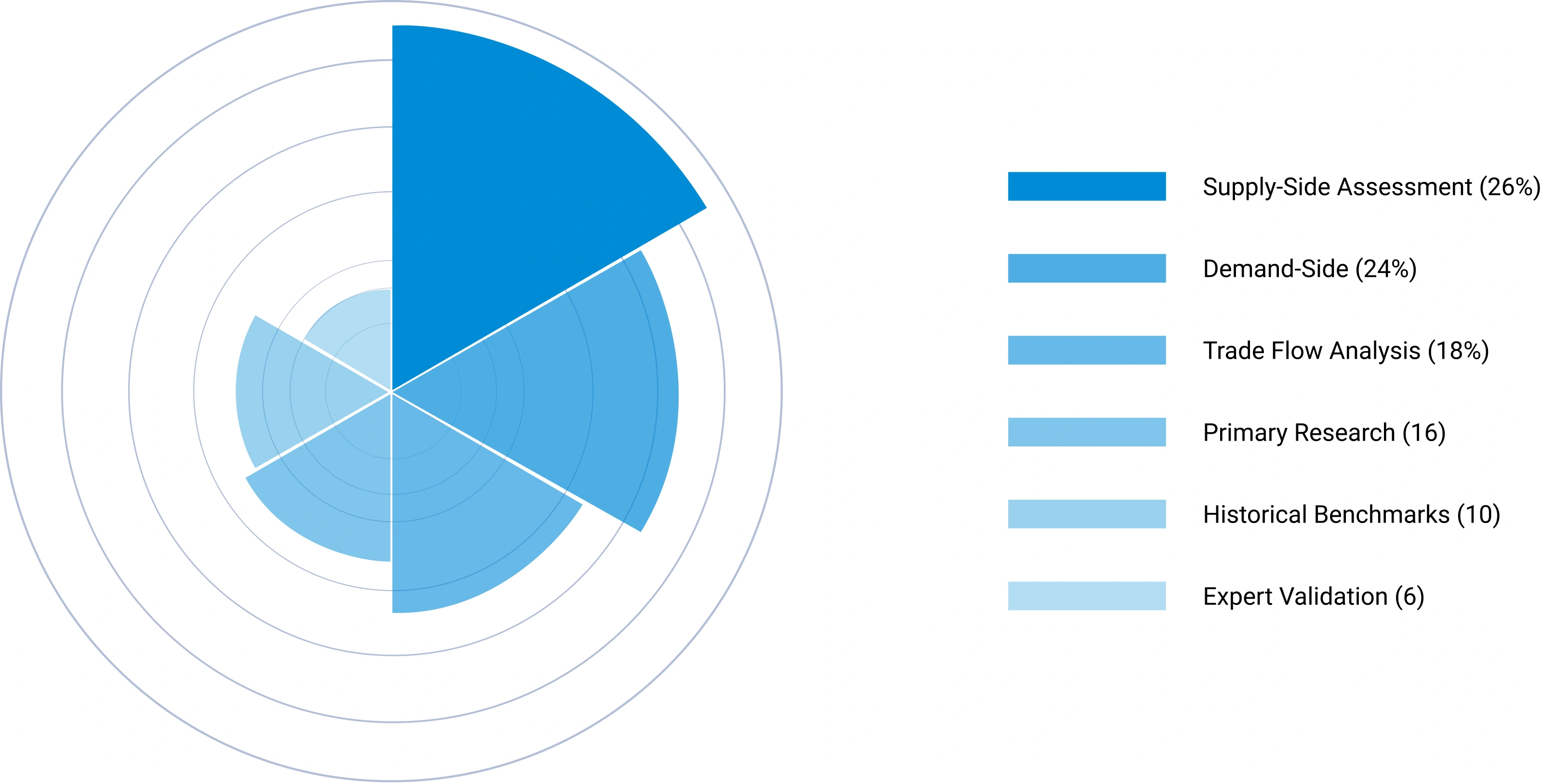
No single methodology is relied upon in isolation. Multiple independent estimation approaches are combined and reconciled to ensure consistency, accuracy, and analytical defensibility. Any material deviations between approaches are investigated and adjusted through additional validation cycles.
The final market size is derived through weighted triangulation of all validated methodologies. Any material deviations between approaches are investigated and adjusted through additional validation cycles. The outcome represents the most realistic assessment of the market based on available evidence and expert confirmation ensuring that volume and value estimates are fully consistent with one another.
Triangulation Framework — Input Contribution Weight
Relative weight each sizing input contributes to the final reconciled market estimate
Phase 7 — Forecast Modeling: Projecting Future Market Evolution
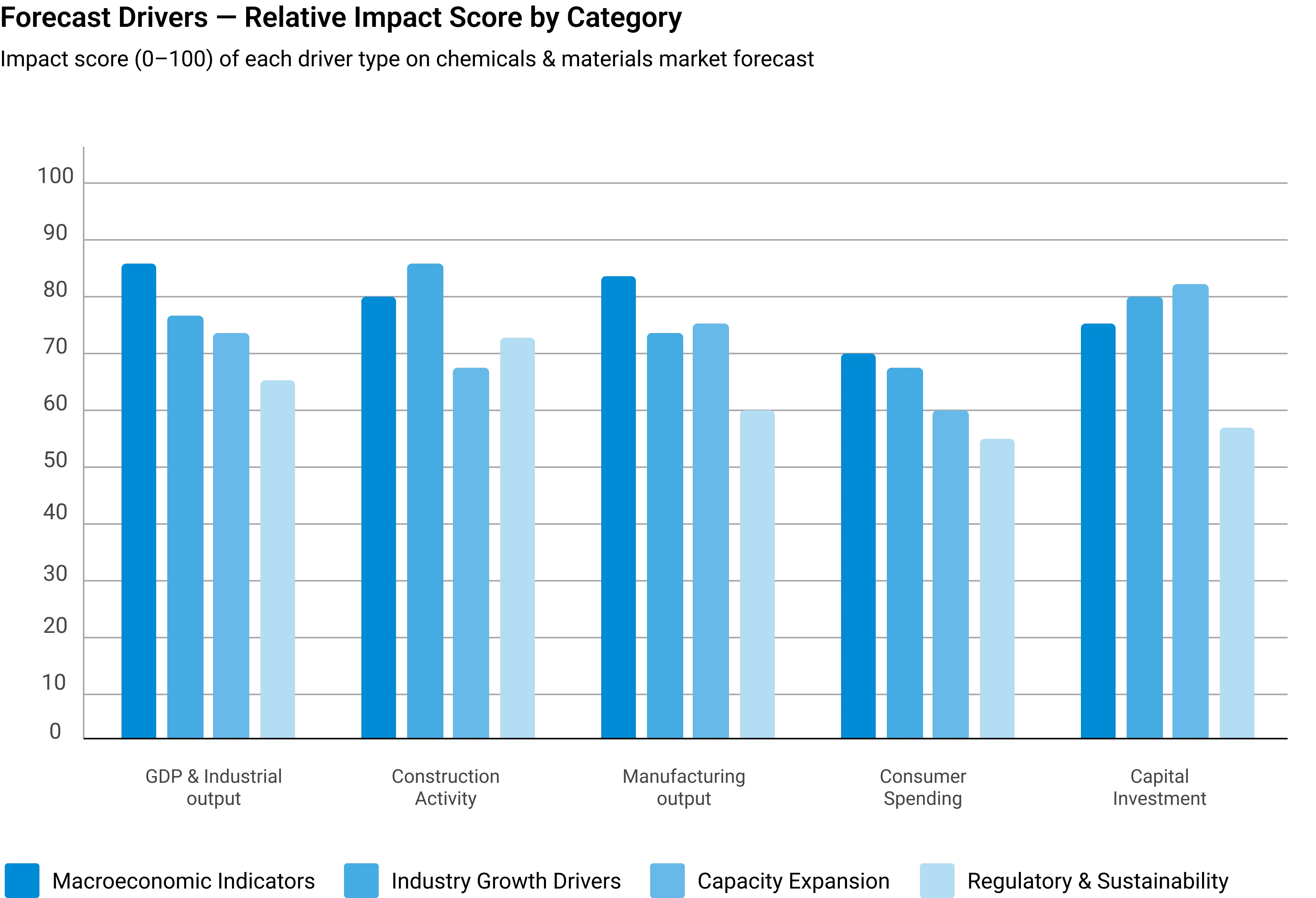
Forecasting evaluates the future trajectory of the market using a combination of quantitative indicators and qualitative assessments across economic, industry, and regulatory dimensions. Rather than simple extrapolation, each driver is independently modeled and integrated into a composite forecast.
Macroeconomic Indicators
GDP growth, industrial production, manufacturing output, construction activity, consumer spending, and capital investment form the quantitative foundation of long-term demand projections. These are applied at country, regional, and global levels.
Industry Growth Drivers
Urbanization, infrastructure development, industrialization, technological innovation, sustainability initiatives, and evolving product performance requirements are assessed at regional and industry levels — capturing both structural and cyclical demand drivers.
Capacity Expansion Analysis
Announced plant expansions, new manufacturing facilities, technology upgrades, and strategic investments are evaluated to determine future supply-demand dynamics and potential market tightness or oversupply situations.
Regulatory & Sustainability
Environmental regulations, chemical safety standards, emission reduction targets, circular economy initiatives, and sustainability requirements are incorporated as they often influence product adoption rates and market growth trajectories.
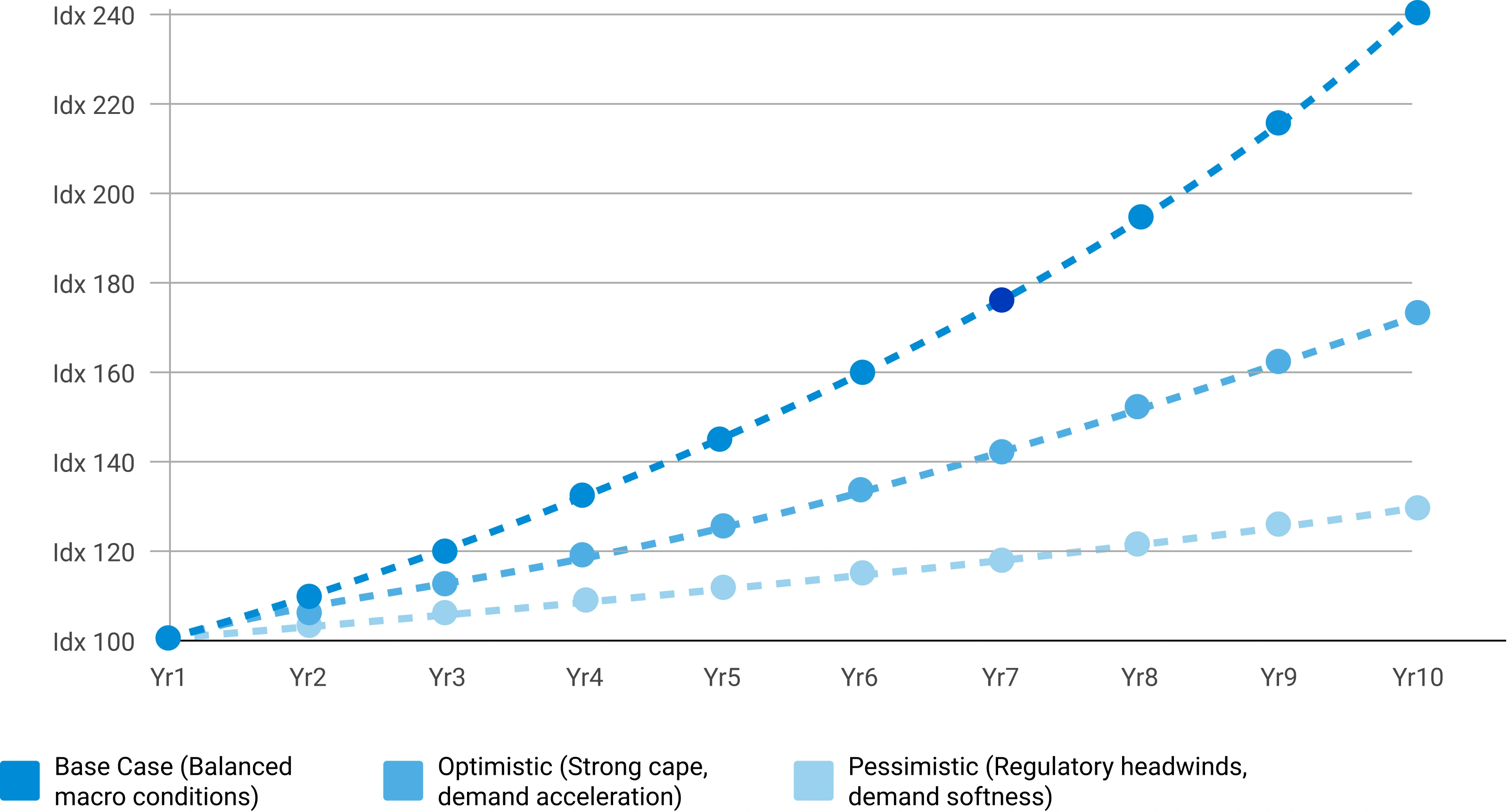
Scenario Forecast Range — Indexed Market Growth (Year 1–10)
Illustrative indexed growth trajectories across Base, Optimistic, and Pessimistic scenarios over a 10-year forecast horizon
Forecast Drivers — Relative Impact Score by Category
Impact score (0–100) of each driver type on chemicals & materials market forecast



Comments
Share your thoughts, ask a question, or provide feedback about this report.