Content


What is the Asia Pacific acrylic emulsion market share and size?
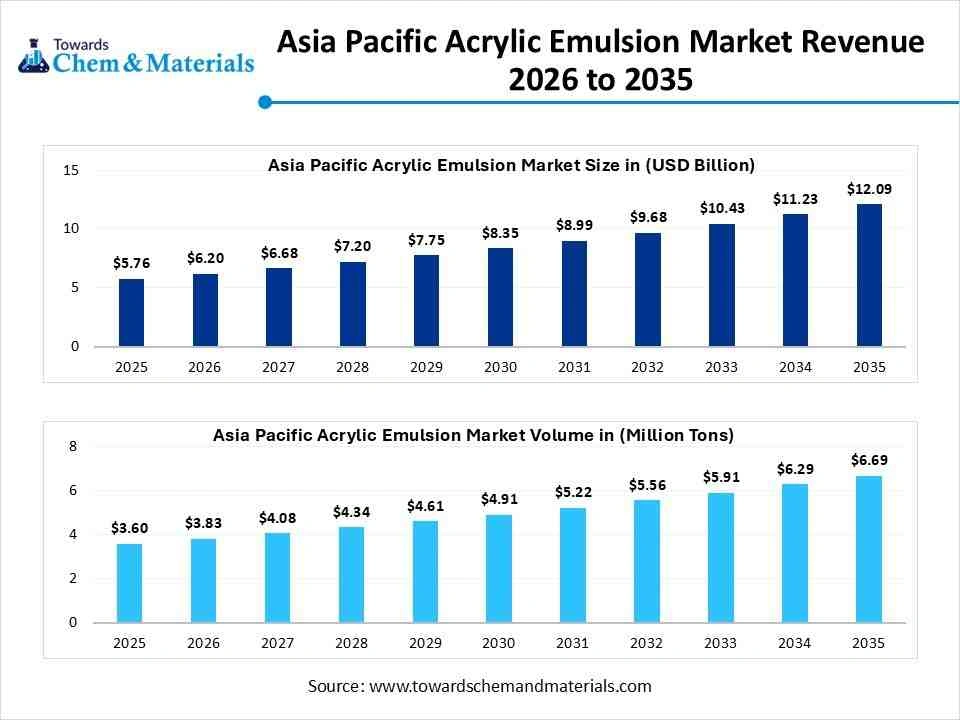
The Asia Pacific acrylic emulsion market size was valued at USD 5.76 billion in 2025 and is projected to grow from USD 6.20 billion in 2026 to USD 12.09 billion by 2035, exhibiting a CAGR of 7.70% during the forecast period. China dominated the acrylic emulsion industry with a 48% share in 2025. Increasing adoption of water-based coatings and environmental regulations is encouraging manufacturers toward low-VOC formulations. Technological progress, such as bio-based monomers, hybrid emulsions, and digital manufacturing, is also helping to advance the market. The region's consumption is being further bolstered by an increasing demand for paints, coatings, adhesives, packaging, and construction activities.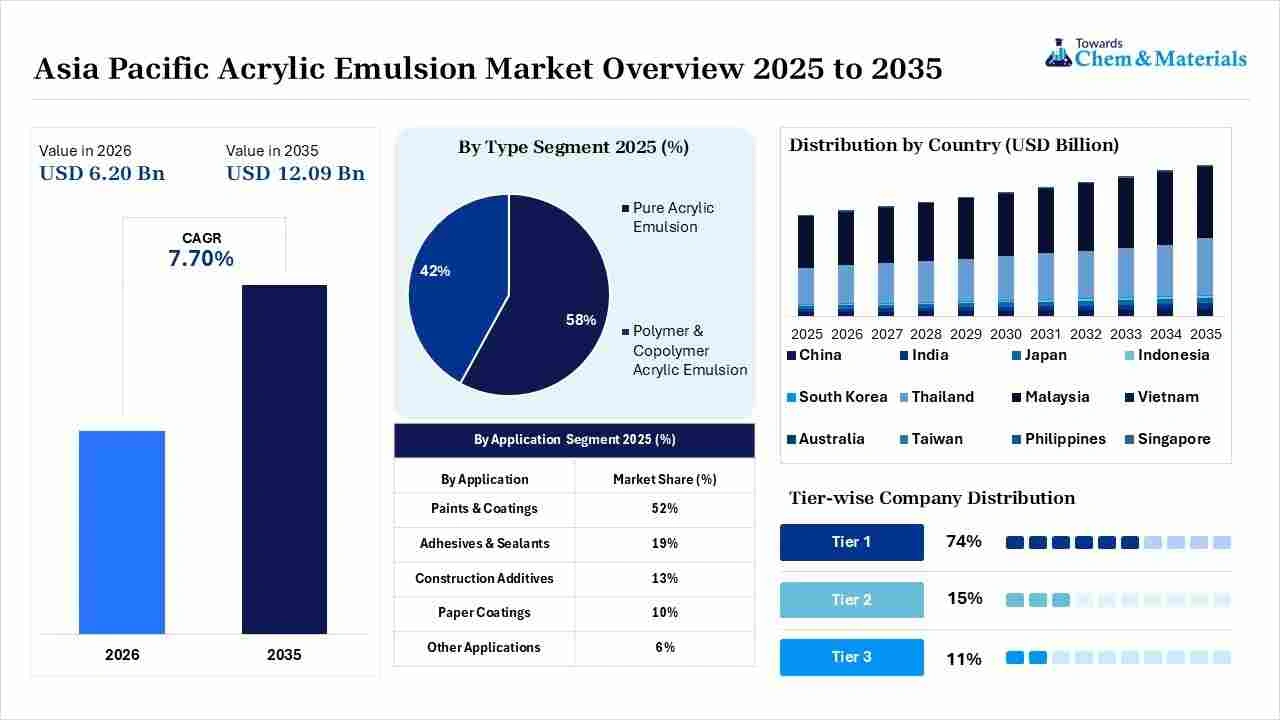
Market Highlights
- China dominated the Asia Pacific acrylic emulsion market by holding a 48% share in 2025.
- India held a 15% market share in 2025 and is expected to grow at the fastest CAGR in the coming years.
- By product, the pure acrylic emulsion segment dominated the market with the largest share of 58% in 2025 and is expected to grow at a CAGR of 7.4% during the forecast period.
- By product, the polymer & copolymer acrylic emulsion segment held 42% market share in 2025 and is expected to grow at the fastest CAGR of 8.1% over the forecast period.
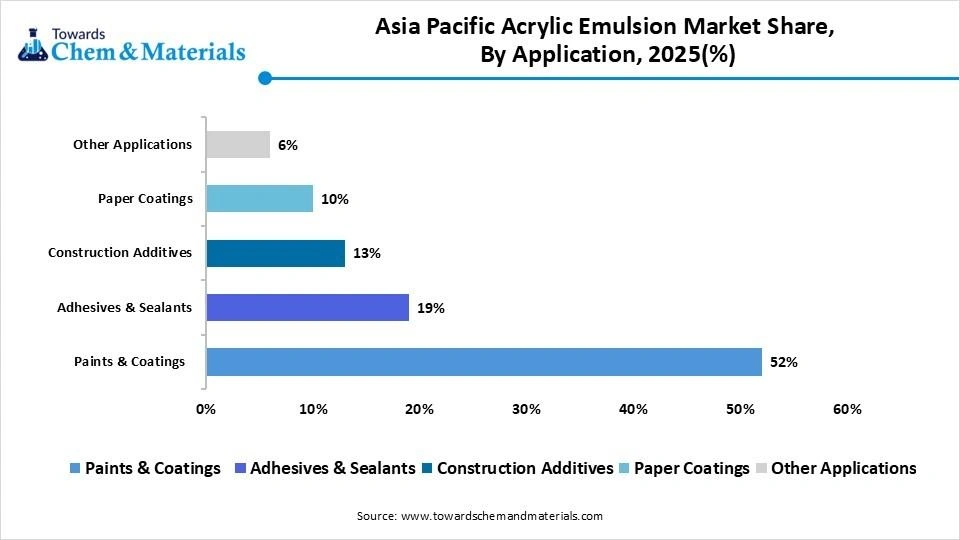
- By application, the paints & coatings segment dominated the market with the largest share of 52% in 2025 and is expected to grow at a CAGR of 7.5% during the forecast period.
- By application, the adhesives & sealants segment held a 19% market share in 2025 and is expected to grow at the fastest CAGR of 8.5% over the forecast period.
Market Overview
According to Towards Chemicals and Materials Analytics and Consulting, the Asia Pacific acrylic emulsion market volume was valued at 3.6 million tons in 2025 and is expected to surpass around 6.69 million tons by 2035, accelerating a compound annual growth rate (CAGR) of 6.40% over the forecast period from 2026 to 2035.
Asia Pacific is expected to be the leading region in the global acrylic emulsion market as the demand for water-based coatings is increasing in the region, and the urbanization rate and infrastructure development are continually increasing in the area. The need for decorative and protective paints increases with the construction of mass buildings and houses. More stringent environmental regulations push industries towards cleaner, more eco-friendly water-borne formulations, which have lower emissions. Acrylics have excellent weatherability, UV stability, and adhesion, both pure and copolymer.
Investment Movement for the Asia Pacific Acrylic Emulsion Market
- Large chemical companies are expanding their domestic production bases in China and India and improving the speed of their supply chains.
- Integrated Verbund sites are being developed by companies to supply acrylic acid and butyl acrylate locally, ensuring stable feedstock supplies.
- There has been a growing trend toward investing in low VOC, low odor, water-based, bio-based, and hybrid products that meet environmental requirements and customer preferences.
- High-performance acrylic emulsions for flexible packaging, cool roof coatings, industrial adhesives, and waterproofing are all gaining traction in applications that demand sustainability, with a growing number of capital supporting these uses.
Report Scope
| Report Attributes | Details |
| Market Size in 2026 | USD 6.20 Billion/3.83 Million Tons |
| Expected Size in 2035 | USD 12.09 Billion/6.69 Million Tons |
| Growth Rate | CAGR of 7.70% |
| Base Year of Estimation | 2025 |
| Forecast Period | 2025-2035 |
| Segment Covered | By Type, By Application |
| Key Companies Profiled | BASF SE, Arkema, Dow Inc., AkzoNobel N.V., Nippon Paint Holdings Co., Ltd., Asian Paints Ltd., DIC Corporation, Mitsui Chemicals, Sumitomo Chemical Co., Ltd., Clariant, Celanese Corporation, Evonik Industries AG, Kansai Paint, PPG Industries |
Market Trends
- The presence of environmental consciousness and the new regulations have led manufacturers to switch from solvent-based systems to water-based acrylic emulsions with lower VOC emissions.
- Chemical suppliers now increasingly create bio-based monomers and latex polymers for renewable materials to meet lower-carbon coatings and adhesives and meet sustainability requirements.
- Demand for architectural paints, waterproofing membranes, and concrete additives is also on the rise in developing Asian economies for residential construction, highways, and metro projects.
- Key producers are investing in expanding manufacturing facilities and upgrading dispersion reactors in regional hubs to boost local supply security and decrease reliance on the supply chain.
Key Technological Shifts and AI in the Asia Pacific Acrylic Emulsion Market
The push for sustainable chemistry, laboratory automation, digital manufacturing, and artificial intelligence is becoming more prevalent in acrylic emulsion development across regions. Bio-based and low VOC formulations are becoming increasingly significant due to the new regulations for cleaner waterborne systems. The broad range of formulation data can be analyzed using AI to help develop polymer structures and optimize bio-based latex formulations. Automated weighing and mixing systems ensure consistency of experiments and provide accurate digital data.
Supply Chain Analysis of the Asia Pacific Acrylic Emulsion Market
Feedstock Procurement
- The procurement of all the raw materials, such as acrylic acid, butyl acrylate, methyl methacrylate, and styrene monomers, is necessary to ensure continuous production of acrylic emulsion downstream.
- Satellite Chemical has set up integrated chemical complexes in China for the regional production and supply of acrylic acid and butyl acrylate monomers.
- Other Key Players: Nippon Shokubai, Sumitomo Chemical, and Formosa Plastics Corporation.
Chemical Synthesis and Processing
- Pure acrylic or styrene-acrylic polymer dispersions are manufactured by a controlled emulsion polymerization process that takes place in water with the acrylic monomers.
- BASF SE maintains expanded regional polymer dispersion manufacturing sites like Dahej, with the production of Acronal® pure acrylic and styrene-acrylic binders.
- Other Key Players: Dow, the Arkema Group, and DIC Corporation.
Compound Formulation and Blending
- Compound formulation is the process of combining polymer emulsions with performance additives, pigments, and water to create paints, coatings, adhesives, and sealants.
- The Asian Paints localized processing operations enable the company to create bulk acrylic emulsions for its consumer products, which are used in the architectural coatings business in South Asia.
- Other Key Players: Nippon Paint, AkzoNobel N.V., and Kamsons Chemicals Pvt. Ltd.
Sustainability Analysis:
The sustainability focus is on water-borne acrylic-based systems replacing traditional solvent-based systems in regional applications. Water-based emulsions usually have lower VOC emissions during application and drying than their solvent-based counterparts. The rising use of architectural coatings reflects a demand for green building that focuses on the need for good indoor air quality and fewer chemical emissions. Acrylic emulsions are also weather-, UV-, and moisture-resistant, which may help increase the longevity of the coating and lessen the need for reapplication.
What is acrylic emulsion?
Acrylic emulsion is a polymer dispersion produced by controlling the polymerization of acrylic monomers using water as the solvent. It is used mostly as a binder and acts as an adhesive; it has good adhesion, durability, flexibility, weather resistance, and film-forming properties in coatings and adhesive formulations.
Uses of Acrylic Emulsion
- Acrylic emulsions serve as durable architectural interior and exterior paint binders that enable durable adhesion, weatherability, scrub resistance, color retention, and low-VOC content in a paint's requirements for construction applications.
- Industrial products are acrylic emulsions formulated to provide adhesion, durability, resistance to abrasion, corrosion protection, and weather resistance on the increasingly demanding metal, concrete, wood, and infrastructure surfaces.
- The pressure-sensitive adhesives, flooring adhesives, labels, tapes, construction adhesives, and sealants that must meet the requirements of adhesion, tack, flexibility, water resistance, and formulation versatility are supported by acrylic emulsions.
Pricing Analysis for the Asia Pacific Acrylic Emulsion Market
The price of acrylic emulsion in Asia Pacific is dependent on the feedstock price, production capacity, product quality, and competition. The price movements of acrylic acid affect production economics and pricing further downstream. Competition from local and foreign producers can ensure stable commodity prices or competitive discounting. Formulations that are premium, low in odor and low in VOCs, and environmentally friendly often come with differentiated pricing.
Asia Pacific Acrylic Emulsion Market: Global Trade Analysis
The Asia Pacific acrylic emulsion market is a key production and consumption center in the region owing to the growth of the construction industry, urbanization, and industrialization. However, China and India continue to be key drivers of growth as the demand for infrastructure and real estate is holding. Fluctuations in raw materials, such as benzene, propylene, and ethylene derivatives, periodically put pressure on the margins of producers.
Segmental Insights
Type Insights
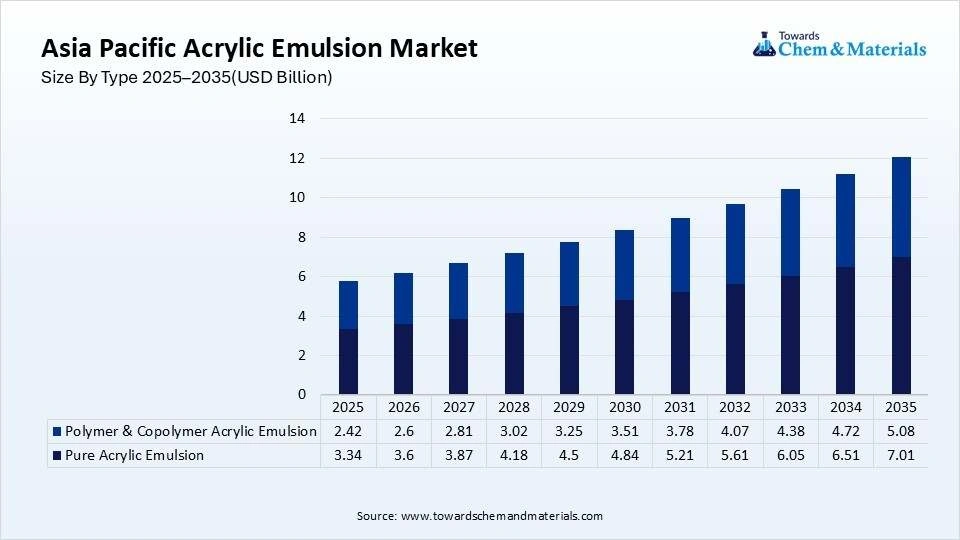
The pure acrylic emulsion segment dominated the market with the largest share of 58% in 2025 and is expected to grow at a CAGR of 7.4% over the forecast period, as the coatings used in the architecture and industrial applications demand excellent weatherability, UV stability, adhesion, and durability. Its water-based formulation also helps drive environmental preferences in Asia Pacific. Pure acrylic emulsions are still finding applications in the coatings industry, in decorative coatings, and in residential construction and commercial infrastructure.
- In July 2026, Walplast Products launched HomeSure Mastertouch Vivid Shine 2-in-1 Emulsion for interior/exterior walls. (Source: www.constructionworld.in)
The polymer & copolymer acrylic emulsion segment held a 42% market share in 2025 and is expected to grow at the fastest CAGR of 8.1% over the forecast period, as the customized formulations have become applicable in coatings, adhesives, construction materials, and industrial applications. Styrene-acrylic, vinyl-acrylic, and similar copolymers allow manufacturers to customize adhesion, durability, chemical resistance, and film characteristics. The pressure to meet specific performance and sustainable water-based systems continues to drive innovation throughout regional acrylic emulsion use.
Asia Pacific Acrylic Emulsion Market Share, By Type, 2025 (%)
| By Type | Market Share (%) |
| Pure Acrylic Emulsion | 58% |
| Polymer & Copolymer Acrylic Emulsion | 42% |
Application Insights
The paints & coatings segment dominated the market with the largest share of 52% in 2025 and is expected to grow at a CAGR of 7.5% over the forecast period due to the rising growth of residential construction, infrastructure, and commercial projects, which demand durable finishes and decorative and protective coatings. Because of the regulations for reducing emissions, water-based acrylic formulations are replacing solvent-based products. Due to these characteristics, continued growth is expected in the use of these coatings in building applications as well as industrial applications.
- In July 2026, PureSil Paints released PureSil Interior-Exterior Mineral Paint, featuring Silicification Technology, which is a zero-VOC alternative to conventional acrylic paints.
(Source: mediabrief.com)
The adhesives & sealants segment held a 19% market share in 2025 and is expected to grow at the fastest CAGR of 8.5% over the forecast period, owing to various application areas such as packaging, construction, labels and tapes, flooring, and industrial applications that demand strong bonding solutions. Pressure-sensitive adhesive demand is further bolstered by the growth of e-commerce and flexible packaging activities, as well as new types of formulations developed for specific applications that improve performance and sustainability.
Asia Pacific Acrylic Emulsion Market Share, By Application, 2025 (%)
| By Application | Market Share (%) |
| Paints & Coatings | 52% |
| Adhesives & Sealants | 19% |
| Construction Additives | 13% |
| Paper Coatings | 10% |
| Other Applications | 6% |
Country Insights
How Did China Dominate the Asia Pacific Acrylic Emulsion Market in 2025?
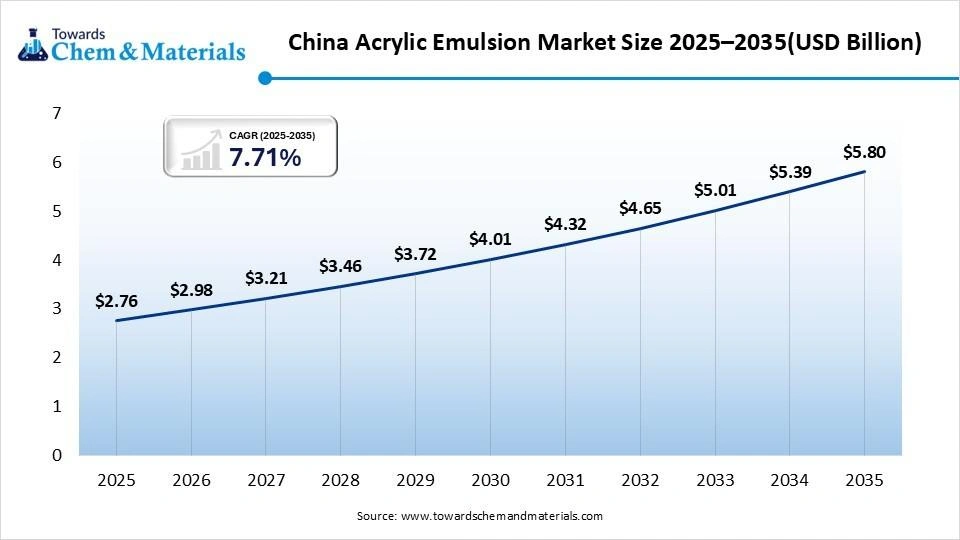
The China acrylic emulsion market size was estimated at USD 2.76 billion in 2025 and is projected to reach USD 5.80 billion by 2035, growing at a CAGR of 7.71% from 2026 to 2035. China dominated the market with the largest share of 48% in 2025. China is the top regional market for acrylic emulsion, as its large construction, infrastructure development, manufacturing base, and demand for acrylic emulsion in the construction sector maintain its presence. It has a well-developed chemical manufacturing infrastructure that enables the availability of feedstocks and the ability to manufacture downstream products. As environmental demands continue to rise, manufacturers are moving towards water-based, low VOC, and sustainable products.
The India acrylic emulsion market size was estimated at USD 0.86 billion in 2025 and is projected to reach USD 1.87 billion by 2035, growing at a CAGR of 8.08% from 2026 to 2035. India held a 15% market share in 2025. The acrylic emulsion demand is still bolstered in India by residential construction projects, growth in infrastructure, industrial expansion, and increasing use of acrylic coatings in decorative applications. Water-based and environmentally friendly technologies are now becoming more and more a focus of the manufacturers because of the changing preferences of their customers. Domestic production capabilities can contribute to improving supply-chain efficiency and to application-specific innovation.
- In July 2026, Zydex Paints tied up with Germany-based Keimfarben GmbH to take a good offer of silicate mineral paint products with a warranty of 20 years. (Source: www.constructionweekonline.in)
The Japan acrylic emulsion market size was estimated at USD 0.52 billion in 2025 and is projected to reach USD 1.15 billion by 2035, growing at a CAGR of 8.26% from 2026 to 2035. Japan held a 9% market share in 2025. Japan has well-developed chemical manufacturing facilities, advanced industrial applications, and a market for high-quality coating technologies. Acrylic emulsions have a broad range of applications in the architecture, industry, and specialty sectors where durability, adhesion, weather resistance, and formulation consistency are desired. Water-based and specialized acrylic systems are finding their way into the known end-use sectors due to the increased focus by manufacturers on water-related aspects in addition to technical features.
The South Korea acrylic emulsion market size was estimated at USD 0.35 billion in 2025 and is projected to reach USD 0.79 billion by 2035, growing at a CAGR of 8.48% from 2026 to 2035. South Korea held a 6% market share in 2025. In South Korea, the country enjoys highly developed chemical manufacturing technology and industries based on the same technology for acrylic emulsion applications in coatings and industrial materials. Research that considers sustainability is generating new avenues for bio-based chemical technologies. Manufacturers can take advantage of their technological expertise and create special formulations that meet the higher performance standards of the changing regional coatings and materials markets. While providing greater environmental safety, durability, and application efficiency.
- In June 2026, a new project by South Korea's NOROO Holdings to commercialize 3-hydroxypropionic acid (3-HP) was selected as the lead organization. (Source: worldbiomarketinsights.com)
The Indonesia acrylic emulsion market size was estimated at USD 0.29 billion in 2025 and is projected to reach USD 0.66 billion by 2035, growing at a CAGR of 8.57% from 2026 to 2035. Indonesia held a 5% market share in 2025. Acrylic emulsion demand continues to grow in Indonesia with the impact of urbanization, residential construction and infrastructure activity, and decorative paint consumption. Manufacturers are offering products with multiple application functions to make consumers' lives more convenient and efficient. Water-based formulations are also growing in popularity as a result of increased environmental consciousness. Industrial and packaging uses of acrylic emulsion are growing in a variety of products, including adhesives, coatings, and building materials.
- In April 2025, PT ICI Paints Indonesia introduced Dulux Professional Interior Express 2-in-1, a sealer/paint.
(Source: observerid.com)
The Thailand acrylic emulsion market size was estimated at USD 0.23 billion in 2025 and is projected to reach USD 0.54 billion by 2035, growing at a CAGR of 8.91% from 2026 to 2035. Thailand held a 3.5% market share in 2025. The construction activity, infrastructure development, architectural coatings, and industrial manufacturing are contributing factors to the growth of the acrylic emulsion market in Thailand. New opportunities are emerging for water-based coatings, which is a result of manufacturers' responses to environmental demands and changing customer preferences. Acrylic emulsion applications in residential, commercial, and industrial projects are driven by the demand for durable decorative and protective finishes, thereby stimulating the formulation and development of new products.
The Malaysia acrylic emulsion market size was estimated at USD 0.17 billion in 2025 and is projected to reach USD 0.42 billion by 2035, growing at a CAGR of 9.47% from 2026 to 2035. Malaysia held a 3% market share in 2025. Industrial manufacturing, construction, packaging, and adhesive applications all contribute to the growth in the acrylic emulsion market in Malaysia. Regional manufacturing capabilities and trade connectivity support demand for application-specific water-based formulations. Upsurging sustainability demand spurs manufacturers to enhance products' performance while cutting emissions. Acrylic emulsions continue to be useful for coatings, adhesives, packaging, and other applications that demand reliable adhesion and durability.
The Vietnam acrylic emulsion market size was estimated at USD 0.17 billion in 2025 and is projected to reach USD 0.42 billion by 2035, growing at a CAGR of 9.47% from 2026 to 2035. Vietnam held a 2.8% market share in 2025. Acrylic emulsion usage is encouraged by the development of the industrial and manufacturing sectors, construction growth, and the packaging industry in Vietnam. Capacity expansion and market integration can increase domestic value chains and incentivize manufacturers to produce products tailored to applications that have high performance and sustainability standards.
- In September 2026, GB Bond Holdings Bhd announced its initial public offering (IPO) prospectus to support expansion of its adhesive capacity and entry into the Vietnamese market. (Source: www.theborneopost.com)
The Australia acrylic emulsion market size was estimated at USD 0.17 billion in 2025 and is projected to reach USD 0.43 billion by 2035, growing at a CAGR of 9.72% from 2026 to 2035. Australia held a 2.5% market share in 2025. Demand for acrylic emulsion is bolstered by the demand for architectural coatings, infrastructure maintenance, construction, and niche industrial uses in Australia. Customers appreciate the longevity of the formulations with resistance to weather, adhesion, and environmental performance. With sustainability expectations driving product decisions, water-based technologies offer opportunities. Manufacturers can specify an application that demands reliable performance under extreme climatic or industrial conditions.
The Taiwan acrylic emulsion market size was estimated at USD 0.12 billion in 2025 and is projected to reach USD 0.30 billion by 2035, growing at a CAGR of 9.60% from 2026 to 2035. Taiwan held a 2% market share in 2025. The advanced manufacturing infrastructure in Taiwan facilitates acrylic emulsion use in industrial coatings, construction materials, and other specialized products. The characteristics that are increasingly demanded are consistent performance, adhesion, chemical resistance, and environmental properties. Technological capabilities allow the production of specific formulations for water-based use and to meet the special requirements in industry.
Asia Pacific Acrylic Emulsion Market Share, By Country, 2025 (%)
| By Country | Market Share (%) |
| China | 48% |
| India | 15% |
| Japan | 9% |
| South Korea | 6% |
| Indonesia | 5% |
| Thailand | 4% |
| Malaysia | 3% |
| Vietnam | 3% |
| Australia | 3% |
| Taiwan | 2% |
| Philippines | 1.7% |
| Singapore | 2% |
The Philippine acrylic emulsion market size was estimated at USD 0.10 billion in 2025 and is projected to reach USD 0.23 billion by 2035, growing at a CAGR of 8.69% from 2026 to 2035. The Philippines held a 1.7% market share in 2025. The Philippines has potential for the acrylic emulsion industry due to the continued demand for acrylic emulsion in urbanization, residential construction, infrastructure, and packaging. Water-based coatings and adhesives are becoming more relevant as the sustainability factor becomes a driving force in product design. As the markets for consumers and industries expand, so do the applications for acrylic emulsions in architectural paints, packaging adhesives, construction materials, and more.
The Singapore acrylic emulsion market size was estimated at USD 0.12 billion in 2025 and is projected to reach USD 0.26 billion by 2035, growing at a CAGR of 8.04% from 2026 to 2035. Singapore held a 1.5% market share in 2025. Manufacturers have water-based, low VOC, and performance-based options to meet demand for water-based, low VOC, and performance formulations for industrial and architectural applications. The emphasis on sustainability aspects also propels product innovations, and the regional connectivity of Singapore enables distribution and development of the applications in larger Asia Pacific markets.
Recent Developments
- In January 2025, Arkema launched its ENCOR® bio-based waterborne dispersions with up to 30% bio content that enable lower carbon footprints in performance textiles.
(Source: www.arkema.com)
Competitive Analysis
The Asia Pacific acrylic emulsion market comprises global chemical companies and local companies that are competing based on capacity, product performance, sustainability, and application-specific innovation. BASF, Dow, and Arkema have wide acrylic dispersion businesses encompassing coatings, adhesives, construction, packaging, and industrial applications. Low-VOC solutions, bio-based chemistry, localized manufacturing, and performance attributes are increasingly becoming the focus of competition. In addition, regional manufacturers are reinforcing their market presence by product launches, investments in capacity, and application-specific solutions to meet the shifting customer needs throughout Asia Pacific.
- In May 2026, Indicus Paints presented Indicus Neote luxury interior emulsion, an amalgamation of advanced paint technology and the artistic and cultural design heritage of Tamil Nadu.
(Source: www.indianchemicalnews.com ) - In February 2026, BASF unveiled a new Mangalore production line, which has increased its dispersion capacity for the architectural paint business and is also available for the construction chemicals and paper industries.
(Source: www.indianchemicalnews.com )
Top Players in the Market & Their Offerings
| Company | Company Type/Position | Major Headquarters | Geographic Presence | Asia Pacific Acrylic Emulsion Offerings | Key Strength |
| DIC Corporation | Regional & Global Player | Tokyo, Japan | Global | Burnock®, Vondic | Deep local market penetration |
| Asian Paints Ltd. | Consumer Paint & Coatings | Mumbai, India | Heavy penetration across South & SE Asia | Apex Ultima, Royale Luxury Acrylic Emulsion | Unmatched B2C retail footprint (50,000+ outlets) |
Other Key Players
- BASF SE
- Arkema
- Dow Inc.
- AkzoNobel N.V.
- Nippon Paint Holdings Co., Ltd.
- Asian Paints Ltd.
- DIC Corporation
- Mitsui Chemicals
- Sumitomo Chemical Co., Ltd.
- Clariant
- Celanese Corporation
- Evonik Industries AG
- Kansai Paint
- PPG Industries
Segment Covered in the Report
By Type
- Pure Acrylic Emulsion
- Exterior Architectural Coatings
- Interior Architectural Coatings
- Industrial Coatings
- High-Performance Coatings
- Polymer & Copolymer Acrylic Emulsion
- Styrene-Acrylic Emulsion
- Vinyl-Acrylic Emulsion
- Acrylic-Vinyl Acetate Emulsion
- Other Copolymer Emulsions
By Application
- Paints & Coatings
- Architectural & Decorative Paints
- Industrial Coatings
- Automotive Coatings
- Protective Coatings
- Wood & Furniture Coatings
- Adhesives & Sealants
- Pressure-Sensitive Adhesives
- Packaging Adhesives
- Construction Adhesives
- Textile Adhesives
- General-Purpose Adhesives
- Construction Additives
- Mortar & Concrete Modification
- Waterproofing
- Cementitious Coatings
- Tile Adhesives
- Flooring Systems
- Paper Coatings
- Coated Paper
- Coated Paperboard
- Packaging Paper
- Specialty Paper
- Other Applications
- Textile Finishing
- Leather Finishing
- Printing Inks
- Nonwoven Binders
- Other Industrial Applications
Tags
FAQ's




Select User License to Buy
Figures (5)









 sales@towardschemandmaterials.com
 Download Sample
 Schedule a Meeting