 Request Consultation
Isocyanates: Essential Chemical Building Blocks for Polyurethane Applications
The isocyanates are experiencing steady growth due to increasing demand for polyurethane materials across industries such as construction, automotive, furniture, electronics, and packaging. Isocyanates are highly reactive chemical compounds used primarily as key raw materials in the production of polyurethanes, which are widely used in foams, coatings, adhesives and sealants, and elastomers. Their versatility and performance characteristics make them essential components in modern manufacturing and infrastructure development.
The most widely used types of isocyanates include methylene diphenyl diisocyanate (MDI) and toluene diisocyanate (TDI). These compounds play a crucial role in producing rigid and flexible polyurethane foams that offer durability, insulation efficiency, and lightweight properties. Major chemical manufacturers such as BASF SE, Covestro AG, Dow Inc., and Huntsman Corporation are actively expanding their production capacities to meet the rising demand for polyurethane materials.
The growth of the isocyanates is also supported by expanding industrial production, increasing construction activities, and rising demand for energy-efficient insulation materials worldwide.
Expanding Application in Industries
Increasing Demand from the Construction Industry
- The construction sector represents one of the largest end users of isocyanates, primarily due to their role in manufacturing rigid polyurethane foams used for insulation. These materials provide excellent thermal insulation and moisture resistance, making them ideal for use in walls, roofs, refrigeration systems, and building panels.
- Governments across many regions are promoting energy-efficient buildings to reduce carbon emissions and energy consumption. As a result, demand for polyurethane insulation materials produced from isocyanates is expected to increase significantly in residential and commercial construction projects.
Expanding Applications in the Automotive Industry
- The automotive industry is another key driver of isocyanate demand. Polyurethane foams produced using isocyanates are widely used in automotive seating, interior panels, insulation components, and coatings. These materials help reduce vehicle weight while improving comfort and durability.
- With the growing focus on fuel efficiency and electric vehicle production, automotive manufacturers are increasingly adopting lightweight materials such as polyurethane. This trend is expected to further strengthen the demand for isocyanates in automotive manufacturing.
Technological Advancements in Polyurethane Production
- Technological innovations in polyurethane chemistry are improving the efficiency and sustainability of isocyanate-based materials. Manufacturers are developing advanced formulations such as low-VOC polyurethane coatings, water-based systems, and high-performance elastomers to meet evolving industrial requirements.
- Leading chemical companies, including BASF SE and Covestro AG, are investing heavily in research and development to create more sustainable and high-performance polyurethane solutions.
What is the Current Value of the Isocyanates Market?
The global isocyanates market size was estimated at USD 32.85 billion in 2025 and is expected to increase from USD 34.33 billion in 2026 to USD 51.11 billion by 2035, growing at a CAGR of 4.52% from 2026 to 2035. North America dominated the isocyanates market with the largest revenue share of 49.00% in 2025.The growth of the market is driven by the surging demand for polyurethane-based products, including rigid and flexible foams, coatings, and adhesives in the construction, automotive, and furniture industries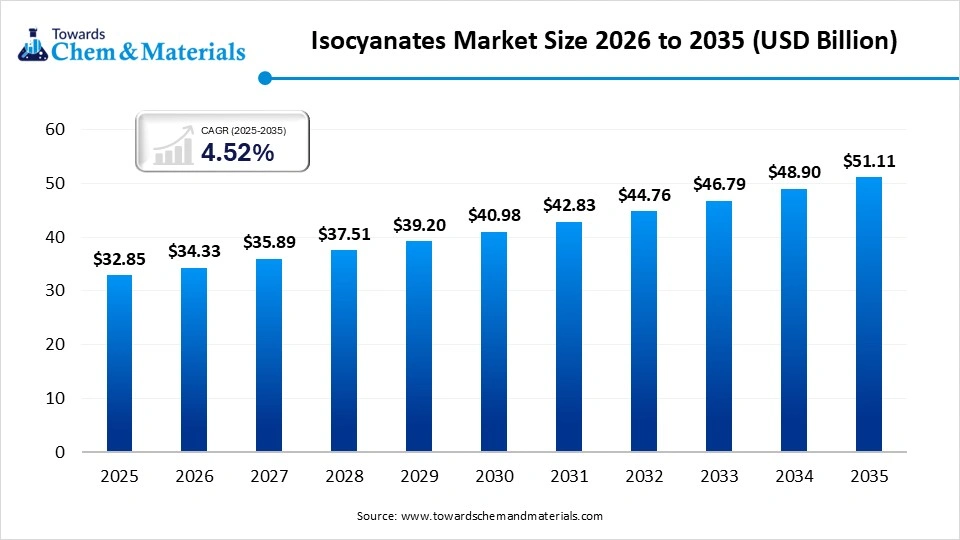
Government Programs, Plans, and Initiatives Supporting Isocyanates Production and Use
Government policies related to chemical manufacturing, industrial development, environmental safety, and construction materials play a major role in influencing the production and use of isocyanates. Various regulatory frameworks and industrial programs support the development of chemical manufacturing while ensuring safe handling of these chemicals.
1 . Chemical Safety Regulations and Occupational Protection
Governments have implemented strict regulations to ensure the safe handling and use of isocyanates in industrial environments. For example, the European Chemicals Agency has introduced regulations under the REACH Regulation that require mandatory training for workers who handle diisocyanates in industrial and professional applications. These regulations aim to reduce occupational exposure and improve chemical safety practices in polyurethane manufacturing.
2. National Chemical Manufacturing Initiatives
Many countries have launched initiatives to strengthen domestic chemical production. In India, programs such as the Production Linked Incentive (PLI) Scheme encourage investment in chemical manufacturing and specialty chemicals. These initiatives help expand local production capacity for raw materials used in polyurethane and isocyanate-based products.
3. Environmental Protection and Emission Standards
Environmental policies are also influencing the isocyanate industry by regulating emissions from chemical plants and manufacturing facilities. Regulatory bodies such as the United States Environmental Protection Agency implement emission control standards and chemical management rules to ensure safe production and environmental protection in the chemical industry.
4. Construction and Energy Efficiency Programs
Government initiatives promoting energy-efficient buildings and infrastructure development indirectly support the demand for polyurethane insulation materials produced using isocyanates. Programs promoting sustainable construction and thermal insulation materials have increased the adoption of polyurethane foams in residential and commercial buildings.
- For instance : Energy efficiency initiatives in the European Union under the European Green Deal encourage the use of advanced insulation materials to reduce energy consumption in buildings, which increases demand for polyurethane products derived from isocyanates.
5. Automotive and Industrial Development Policies
Industrial development programs supporting automotive manufacturing also contribute to the growth of isocyanate usage. Polyurethane components produced using isocyanates are widely used in automotive seating, interior panels, insulation, and lightweight components. Countries promoting electric vehicle production and advanced manufacturing technologies are indirectly supporting polyurethane demand, which strengthens the isocyanates supply chain.
Future Outlook of the Isocyanates
The future outlook for isocyanates remains positive due to their critical role in producing polyurethane materials used in construction, automotive, furniture, electronics, and industrial applications.
Steady Growth Driven by Polyurethane Demand
- The growth of polyurethane-based materials is expected to significantly boost the demand for isocyanates in the coming years. Polyurethane is widely used in foams, coatings, sealants, and adhesives across multiple industries due to its durability and insulation properties. As a result, the industry is reflecting steady industry expansion.
Shift Toward Sustainable and Bio-Based Isocyanates
- Environmental regulations and sustainability goals are encouraging manufacturers to develop eco-friendly alternatives, such as bio-based and low-VOC isocyanates. Research and development efforts are focused on producing safer chemical formulations and improving manufacturing efficiency to reduce environmental impact.
Technological Innovations and Advanced Applications
- Advancements in material science are also shaping the future of the isocyanate industry. Innovations such as nano-enhanced polyurethane foams, water-based polyurethane coatings, and smart material technologies are expanding the application range of isocyanates across electronics, aerospace, and industrial manufacturing sectors.
Sustainability Trends in the Isocyanates
Development of Bio-Based Isocyanates
A major sustainability trend in the isocyanates industry is the development of bio-based isocyanates derived from renewable feedstocks such as vegetable oils and plant-based raw materials. These alternatives help reduce dependence on fossil-based chemicals and support lower carbon emissions in polyurethane production.
- Instance: Covestro AG has introduced partially bio-based MDI products under its Desmodur product line, using renewable raw materials through a mass-balance approach to reduce the carbon footprint of polyurethane materials.
Adoption of Low-VOC and Low-Emission Polyurethane Systems
Manufacturers are increasingly developing low-VOC polyurethane coatings and adhesives based on isocyanates to minimize environmental and health impacts. These formulations help industries comply with strict emission regulations and improve indoor air quality.
- Instance: BASF SE has developed low-VOC polyurethane coating systems that utilize advanced isocyanate chemistry to reduce emissions while maintaining coating durability and performance.
Energy-Efficient Production Technologies
Chemical producers are investing in more energy-efficient manufacturing processes to reduce emissions and energy consumption during isocyanate production.
- Instance: Covestro AG has implemented gas-phase phosgenation technology in MDI production, which significantly reduces solvent consumption and improves energy efficiency compared with traditional production methods.
Increasing Use of Energy-Efficient Building Insulation
Isocyanates are essential in producing polyurethane insulation foams, which help reduce energy consumption in buildings. As governments promote green buildings and energy-efficient construction, the demand for these insulation materials is increasing.
- Instance: Huntsman Corporation produces polyurethane systems used in high-performance building insulation panels, helping improve thermal efficiency in residential and commercial buildings.
Integration of Circular Economy and Polyurethane Recycling
Another sustainability trend is the development of recycling technologies for polyurethane products produced using isocyanates. These technologies help reduce waste and promote circular material usage.
- Instance: BASF SE launched the ChemCycling initiative, which aims to convert plastic waste—including polyurethane materials into feedstock for new chemical products, supporting circular economy goals.
Use of Renewable Feedstocks Through Mass-Balance Approach
Manufacturers are also integrating renewable feedstocks into conventional chemical production using a mass-balance method. This allows companies to produce partially renewable isocyanates without changing existing manufacturing infrastructure.
- Instance: Dow Inc. has introduced isocyanate products manufactured using renewable feedstocks through mass-balance certification, helping reduce the overall carbon footprint of polyurethane materials.
Regional Expansion of Isocyanates
Asia-Pacific Isocyanates Expansion
Asia-Pacific has a growing demand for isocyanates due to rapid industrialization, infrastructure development, and expanding manufacturing sectors in countries such as China and India. The region already accounts for more than half of global consumption, driven by construction activity, automotive production, and rising demand for consumer goods.
Domestic producers such as Wanhua Chemical Group are investing heavily in large-scale MDI and TDI production facilities to meet domestic and export demand.
- Instance: Covestro AG expanded its MDI production plant in Shanghai, China, increasing capacity to support rising polyurethane demand in construction and appliances across Asia.
North America
North America is expected to witness steady growth supported by strong demand from the construction, automotive, and refrigeration industries. Polyurethane materials produced using isocyanates are widely used in building insulation, automotive seating, and packaging materials. The region also benefits from shale-based feedstocks that support competitive chemical production.
The United States remains one of the largest producers of isocyanates due to its advanced chemical industry and strong demand from the construction and automotive sectors.
- Instance: BASF SE is expanding its MDI production facility in Geismar, Louisiana, which is expected to increase regional supply capacity for polyurethane raw materials used in insulation and automotive applications.
Europe
Europe is expected to experience moderate growth as the region focuses on sustainability and advanced chemical technologies. Strict environmental regulations and energy efficiency initiatives are encouraging the development of bio-based and low-emission isocyanates. European producers are also focusing on high-value specialty polyurethane applications.
Germany remains a major hub for polyurethane innovation and advanced chemical manufacturing due to the presence of leading producers and strong research infrastructure.
- Instance: Covestro AG and BASF SE are developing bio-based and low-monomer isocyanate products to comply with sustainability regulations in the European Union.
Middle East & Africa
The Middle East and Africa region is expected to emerge as a high-growth region due to increasing petrochemical investments and large infrastructure development projects. Countries in the Gulf Cooperation Council are focusing on expanding chemical manufacturing capacity to diversify their economies beyond crude oil.
Saudi Arabia is investing in petrochemical infrastructure and downstream chemical manufacturing, supporting the growth of polyurethane and isocyanate production.
- Instance: Sadara Chemical Company (a joint venture between Dow and Saudi Aramco) operates large integrated petrochemical complexes producing polyurethane raw materials for regional and export.
About the Experts

Aditi Shivarkar
Aditi serves as Vice President at Towards Chemical and Material and brings over 15 years of experience in research, strategy, and industry analysis. She focuses on sectors such as specialty chemicals, advanced materials, and sustainable solutions. She studies how regulations, raw materials, and industrial demand shape the market, and she uses that understanding to guide businesses in the right direction. Aditi helps companies stay prepared for change, improve their market position, and make well-informed decisions.



Aman Singh
Aman Singh has more than 13 years of experience in research and consulting, with a strong focus on the global chemicals and materials space. He tracks developments in areas like green chemistry, high-performance materials, and industrial innovation. At Towards Chemical and Material, he leads the research team and ensures every report is clear, accurate, and useful. Aman breaks down complex industry changes and helps businesses understand what they mean in practical terms.