
What is the Bioethanol Yeast Market Size and Share?
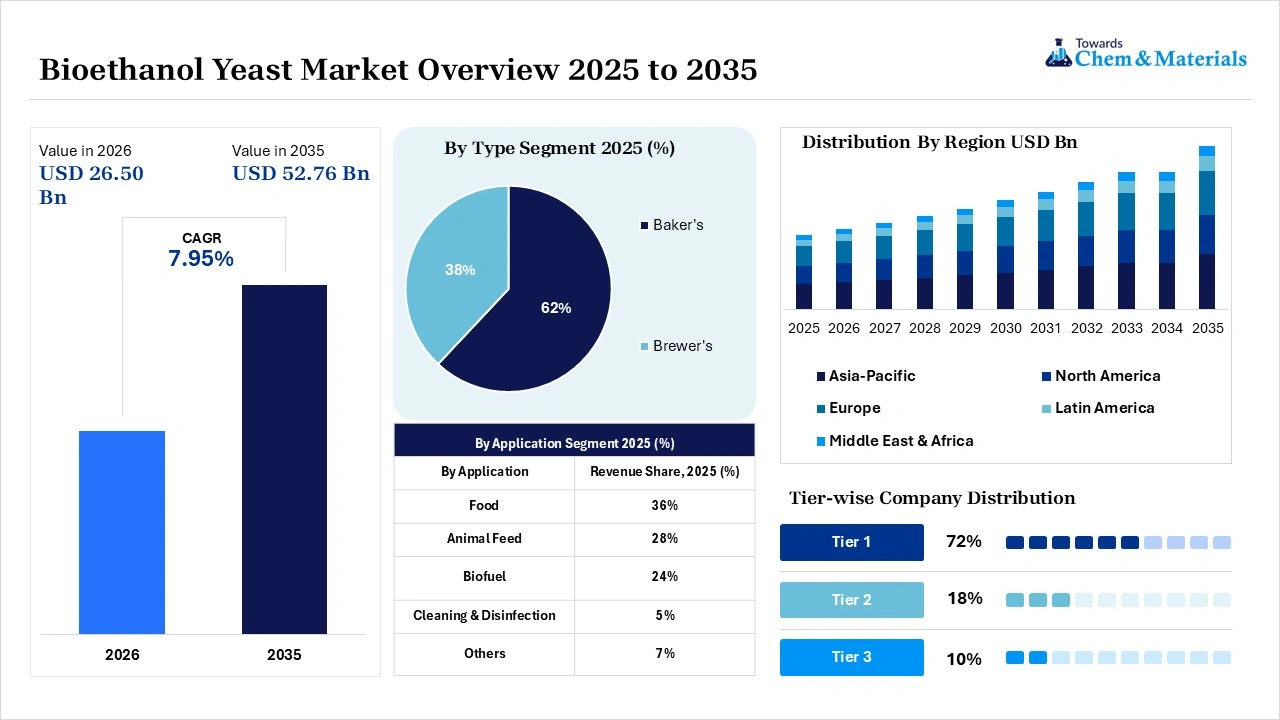
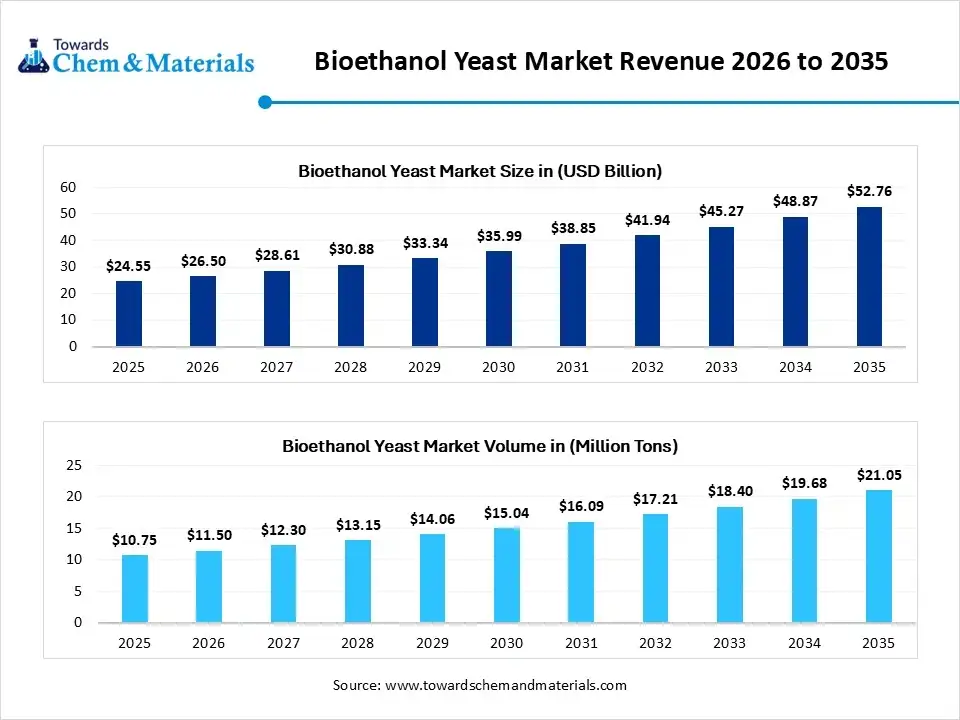
The bioethanol yeast market size was valued at USD 24.55 billion in 2025, is estimated to reach USD 26.50 billion in 2026, and is projected to reach USD 52.76 billion by 2035, exhibiting a compound annual growth rate (CAGR) of 7.95% over the forecast period from 2026 to 2035.Asia Pacific dominated the bioethanol yeast market with the largest revenue share of 34% in 2025 and is expected to grow at the fastest CAGR of 8.10% during the forecast period. In terms of volume, the bioethanol yeast industry is projected to grow from 10.75 million tons in 2025 to 21.05 million tons by 2035. growing at a CAGR of 6.95% from 2026 to 2035.The market growth is propelled by the investment in baker's and brewer's yeast. The implementation of specialized bioethanol yeast strains in biorefineries enables operation and economic advantages to improve ethanol productivity. The integration of very-high-gravity fermentation technology is supported by strict emission limits and energy security needs. Additionally, the market is driven by large-scale corn refining in North America, sugarcane milling in Latin America, and capacity expansion across the Asia Pacific.
Market Highlights
- By region, Asia Pacific dominated the bioethanol yeast market by holding a 34% share in 2025 and is expected to grow at the fastest with a CAGR of 8.20% during the forecast period, driven by ethanol capacity expansion and domestic demand in the food processing sector.
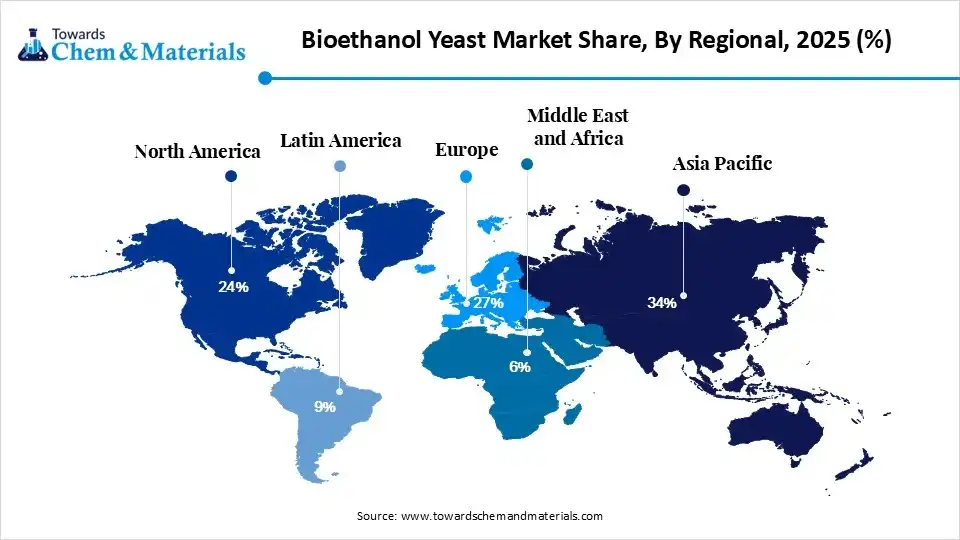
- By region, Europe held the 27% market share in 2025 and expects notable growth in the market with 6.10% CAGR during the forecast period, accelerated by sustainability compliances and strong bioeconomy initiatives.
- By type, the baker’s segment dominated the market with the largest share of 62% in 2025 due to significant investment in commercial baking and high-volume consumer demand for packaged food.
- By type, the brewer’s segment held 38% market share in 2025 and is expected to grow at the fastest CAGR of 7.80% over the forecast period, driven by industrial biotechnological usage and application of ethanol fermentation.
- By application, the food segment dominated the market with the largest share of 36% in 2025, accelerated by increasing demand for food processing and yeast-derived ingredients.
- By application, the biofuel segment held 24% market share in 2025 and is expected to grow at the fastest CAGR of 8.50% over the forecast period due to government support for renewable fuel and technological development in fermentation.
Quick Stats at a Glance
- Market Estimated Size (2025): USD 24.55 Billion | CAGR (2026–2035): 7.95%
- Market Projected Size (2035): USD 52.76 Billion
- Asia Pacific: largest Market Revenue Share of 34% in 2025 | USD 3.10 Billion
- Market Estimated Volume (2025): 10.75 Million Tons | Volume CAGR (2026–2035): 6.95%
- Market Projected Volume (2035): 21.05 Million Tons
- Market Pricing (2025):
- Average Manufacturing Price: USD 610/Ton
- Average Selling Price: USD 790/Ton
- Pricing CAGR (2026–2035): 2.35%
Leading industries towards the advancement of metabolic and genetic strain engineering into commercial yeast. Stringent emissions limits and energy security needs push chemical companies to use more renewable ethanol in fuel to improve efficiency. Market players are investing in the R&D of specialized biocatalysts for large-scale bioreactors. The global market is transforming the competitive edge with partnership, developing customized ad site-driven yeast strains for domestic feedstock. Growth is determined by government initiatives to support decarbonization goals and consumer demand for sustainable biofuels.
- In November 2025, Angel Yeast launched a brand new, 11,000-ton industrial high-purity yeast protein production line at the Baiyang Biotechnology Park in Yichang, Hubei, to meet the circular economy goals in bioethanol plants. The shift towards co-product scaling for biorefineries.
The global bioethanol yeast market is a key high-value industrial resource for the circular economy, providing low-carbon alternatives. Biotechnology companies are using CRISPR-Cas9 tools to restructure pathways, redirecting carbon flux to maximize ethanol yield. Industrial fermentation exposes organisms to osmotic pressure, temperature variations, and alcohol toxicity. The surge in demand for yeast strains optimized for very-high-gravity (VHG) fermentation and thermoresistance reduced cooling costs and water use.
Developments in cellular strength align with the transition to second-generation lignocellulosic biomass. In recent years, manufacturers have been breaking down agricultural residues, discharging pentose sugars like xylose to replace conventional yeast. The adoption of recombinant yeast strains with heterologous pathways enables the co-fermentation of glucose and xylose, altering all biomass sugars into bioethanol.
Bioethanol yeast ferments sugar and converts it into ethanol. Bioethanol yeast provides various benefits such as robust fermentation, ease of genetic manipulation, and a sustainable source of energy. Saccharomyces cerevisiae is the most widely used yeast in the industrial sector. The bioethanol yeast market is growing due to the growing environmental concerns and increasing demand for renewable energy sources. Globally governments are implementing rules and regulations to promote the usage of biofuel that increases demand for bioethanol yeast.
Global Investment Movement for Bioethanol Yeast Market
The growth is supported by the government support and major biofuel companies through a strategic partnership and performance-driven R&D agreements. The R&D firms focus on bioethanol feedstock and a hybrid model derived from microbial activities and plant metabolism.
For instance, in January 2025, ADVANTA and Baidyanath Biofuels formed a strategic partnership to support India's ethanol blending targets. They signed an MOU to use maize hybrids as bioethanol feedstock, focusing on producing high-yield ethanol in line with India's National Policy on Biofuels.(Source: krishijagran.com)
The infrastructure investment in biotechnology and national technical support for biofuel policies, renewable energy, and biomass cultivation enables the commercialization of recombinant yeast strains.
A top domestic vendor across Asia Pacific, Europe, and North America concentrates on developing new strains to provide tailored processing of yeast and biocatalysts.
Market Trends
- Market Modification Beyond Fuel: High-purity bioethanol is increasingly utilized as a sustainable solvent integrated with yeast technology in the pharmaceutical and genetic transformation to support decarbonization targets.
- Widespread Adoption of Pentose-Fermenting Strains: The modern fermentation hubs are advancing recombinant strains to ferment pentose. Commercial demand enables simultaneous saccharification and co-fermentation of pentoses.
- Alliance Through Strategic Biotechnology Associations: The leading companies & specialized genetic engineering businesses partner in agreements that focus on application-friendly yeast formulation.
Bioethanol Yeast Market Report Scope
| Report Attributes | Details |
| Market Size and Volume in 2026 | USD 26.50 Billion / 11.50 Million Tons |
| Revenue Forecast in 2035 | USD 52.76 Billion / 21.05 Million Tons |
| Growth Rate | CAGR 7.95% |
| Base Year of Estimation | 2025 |
| Forecast Period | 2025 - 2035 |
| High Impact Region | Asia Pacific |
| Segment Covered | By Type, By Application, By Regional |
| Key Companies Profiled | Novozymes, Associated British Foods plc, DSM, AB Mauri, Cargill, Inc., LALLEMAND Inc., Leiber GmbH, Lesaffre, AngelYeast Co., Ltd, Foodchem International Corporation, Omega Yeast Labs, LLC., Pacific Ethanol, Inc., Oriental Yeast Co., Ltd |
Smart Biorefineries: Transforming the Basic Yeast Market into an Advanced Technological Solution
The integration of metabolic engineering and AI is renovating the bioethanol yeast market. AI enables rapid predictive modeling and scans genetic arrangements to identify carbon content in ethanol. Machine learning models analyze large datasets to simulate cellular pathways to ensure yeast properties under industrial settings. AI merged with CRISPR-Cas9 enables the design of heat-resistant, toxin-tolerant yeast strains by redirecting carbon flux toward bioethanol.
Digital intelligence is transforming bioethanol yeast experimentation by replacing slow lab trials with speedy predictive modeling. Technological shift improves yeast processing through real-time cell metabolism monitoring and smart sensor in continuous yeast fermentation assembly to optimize nutrient delivery with high fermentation efficiency and lower bioethanol operational cost.
Technological advancement creates wide opportunities in the production of bioethanol yeast. Genetic engineering technology creates more efficient yeast strains and enhances tolerance of ethanol. The advanced fermentation techniques improve ethanol yield production. Technologies are working on developing a process to convert lignocellulosic biomass into ethanol. Advancements help to produce higher ethanol yields and coverts a wider range of sugar and starch into ethanol. In the manufacturing process combination of different varieties of yeast strains utilizes hexose and pentose sugar that raises ethanol production. Technological innovations reduce the cost of production and will increase the adaption of bioethanol fuel.
Supply Chain Analysis of the Bioethanol Yeast Market
- R&D Integration and Strain Trade: The specialized biotechnology and genetic engineering facilities using CRISPR-Cas9 gene editing through R&D experimentation. By using xylose co-fermentation, thermotolerance, and multi-stress resistance offer a high-yield, stable strain.
- Lesaffre: Provide specialized bioethanol liquefaction and prebiotic nutrient formulation. Its specialized enzyme-yeast platform optimized yeast viscosity.
- Key Players: Lallemand Inc., Novozymes A/S, Associated British Foods, Lesaffre, and specialized synthetic biology innovators
- Yeast Manufacturing and Invention: The stage of volume scaling and chemical formulation of the engineered yeast strain. Manufacturers focus on higher longevity and cost-effectiveness through active dry yeast and liquid yeast formulation.
- Lallemand Inc.: The manufacturing lines advance glucoamylase enzymes into yeast cells and supply improved Saccharomyces cerevisiae strains selected for high thermotolerance.
- Key Players: Lallemand Inc., Associated British Foods plc, Angel Yeast Co., Ltd., Lesaffre Oriental Yeast Co., Ltd., and Kalyani Foods.
- Quality Testing and Certification: The bioethanol yeast industry complies with laboratory regulations for quality checks of soluble sugars, cell counts, moisture levels, visual clarity, and kinetic tracking.
- ASTM Standards: standard test methods to detect the solid content of ethanol-soluble extractives for counting yeast and mold colonies in the industrial processing framework.
- Key Players: ISCC schemes, ASTM Standards, NREL Laboratory analytical procedures, Bonsucro certification
- Industrial Fermentation and Bioethanol Integration: The stage of distribution, domestic procurement, and end-user application of cutting-edge yeast at commercial biorefineries involves ethanol conversion yield and second-generation lignocellulosic biomass to meet biofuel blending mandates.
- Valero Energy Corporation: Known as a corn ethanol manufacturer and a petroleum refiner in industrial processing and end-user integration.
- Key Players: Archer Daniels Midland Company (ADM), POET, LLC, Green Plains Inc., refinery corrosion inhibitors, Valero Energy Corporation, Raízen, Tereos, and Alto Ingredients, Inc.
Regulatory Framework: Bioethanol Yeast Market
| Region | Key Regulation | Regulatory Focus |
| Europe | Renewable Energy Directives, GMO Regulations, REACH Regulation, EFSA Biosafety Guidelines | Stringent sustainability goals for bioethanol and standards focus on the approval of GM yeast strains, preferred non-GM optimized wild-type yeasts, and optimization. |
| Asia Pacific | National Biofuel Policy, ASEAN Guidelines on Biofuels and Ethanol Blending Mandates | Strict import and distribution of foreign yeast strains. Shift towards approved yeast processes non-food feedstock to prevent food security. |
| North America | FIFRA, U.S. Renewable Fuel Standards, EPA Clean Air Act, and TSCA Standards | Mandates blending goals to reduce greenhouse gas emissions. Focus on yeast strains and biosafety for GM yeast and yield optimization during yeast fermentation. |
| Latin America | Ministry of Economy, CTNBio, Brazil Biosafety law | Focus on strain variants to meet carbon-neutrality targets. Standards for commercialization of advanced GM strains. |
Bioethanol Yeast Market Dynamics
Driver
Strict Government Biofuel Blending Mandates
The bioethanol yeast market expansion is driven by global government directives for biofuel blending. The stringent standards focus on lowering greenhouse gas emissions and meeting decarbonization commitments. Strong government support boosts energy independence by using renewable ethanol as a fuel feedstock. The biofuel blending targets ensure long-term demand for yeast by protecting the industry from the fossil fuel market. The regulatory framework is pushing investors to expand facilities and biorefineries to maximize energy efficiency and to progress high-efficiency yeast strains for advanced biocatalysts that enable faster fermentation.
Restraint
High Pre-Treatment Charges and Inhibitor Generation of Lignocellulosic Feedstocks
The main restraints to large-scale bioethanol manufacturing are the high volatility of feedstocks and the high cost of pretreatment. Agricultural residues and energy crops have a complex lignocellulosic structure that requires costly treatments and purity techniques to minimize toxic compounds. Additionally, bioethanol yeast is limited in batch lines.
Opportunity
Growing Commercialization of Very-High-Gravity (VHG) Fermentation
The development of industrial Very-High-Gravity (VHG) fermentation technology functions as the chief opportunity for biotechnology companies. VHG used highly concentrated mash substrates with high dissolved xylose & pentose sugars, allowing biorefineries to attain excellent alcohol concentrations in well-established infrastructure. The surge towards the commercialization of VHG fermentation for downstream processes to develop stress-resistant, thermotolerant yeast blends by enhancing market expansion.
Segmental Insights
Type Insights
The baker’s segment dominated the market with the largest share of 62% in 2025. Defined mainly as Saccharomyces cerevisiae, it is crucial in baking and the bioethanol sector. Its main benefits include greater global versatility, lower cost, and reliable supply, especially in emerging economies and small facilities integrated with advanced genetic modifications. Baker's strains efficiently ferment simple sugars from first-generation feedstocks derived from corn starch and sugarcane juice. The standard baker's yeast functions as a genetic starting point for lab improvements. The major companies are adopting active dry, instant, and fresh baker's yeast through strategic partnerships and substantial investment.
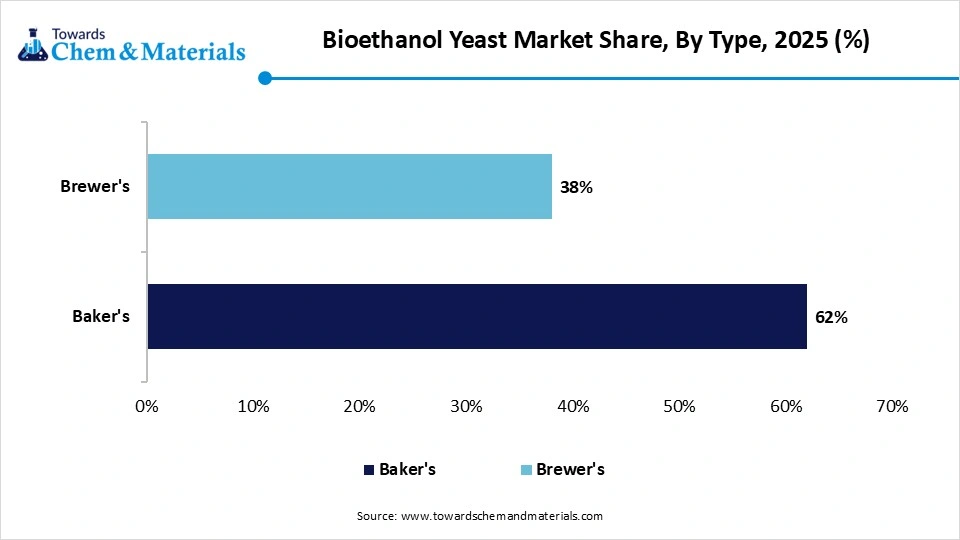
The brewer’s segment held the 38% market share in 2025 and was expected to grow at the fastest CAGR of 7.80% over the forecast period. Brewer’s yeast is prized for its operational resilience during late-stage processing and ethanol tolerance. It contains natural ethanol tolerance, allowing concentrated fermentations to align with well-established synthetic biocatalysts. Brewers enable active, inactive, & specialty fermentation with durable cellular membranes that provide osmotic shock resistance & maintain yeast activity, making it ideal for bioethanol manufacturing. Overall, brewer's yeast is a durable and cost-effective solution in high-sugar atmospheres, essential for starch and molasses fermentation.
Bioethanol Yeast Market Share,By Type, 2025 (%)
| By Type | Revenue Share, 2025 (%) |
| Baker's | 62% |
| Brewer's | 38% |
Application Insights
The food segment dominated the market with the largest share of 36% in 2025.These applications maintain market dominance through high-volume utilization, producing distilled bioethanol through a high-value, regulated process that needs precise biological control. The food sector requires extensive purification to remove contaminants, congeners, and oils to meet consumer safety and hygiene. The ultra-pure ethanol acts as a solvent for botanicals, functional foods, and the base for nutritional supplements. Food manufacturers use yeast strains with clean metabolic profiles to reduce secondary metabolites during fermentation, especially in bakery products, ensuring compliance with food safety regulations.
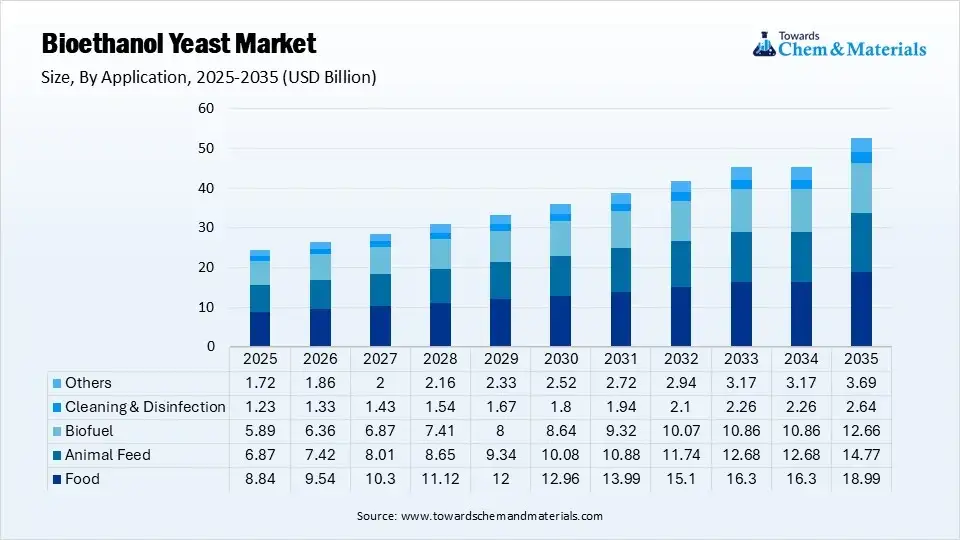
The biofuel segment held the 24% market share in 2025 and is expected to grow at the fastest CAGR of 8.50% over the forecast period. Represented as a fast-growing application for bioethanol yeast, using large-scale industrial yeast to meet the energy transition. The market expansion is driven by rising support for decarbonization goals and biofuel blending mandates. The biofuel sector leads in advanced metabolic engineering that prefers fuel ethanol production lines for sustainable transportation. Biorefineries demand specialized yeast strains to maximize energy extraction from starches and lignocellulosic biomass. Additionally, the continuous modification with gene editing to enhance xylose use, speed fermentation, driving market growth. These applications focus on resisting toxic inhibitors and reducing the costs of renewable energy production, enabling continuous growth.
Bioethanol Yeast Market Share,By Application, 2025 (%)
| By Application | Revenue Share, 2025 (%) |
| Food | 36% |
| Animal Feed | 28% |
| Biofuel | 24% |
| Cleaning & Disinfection | 5% |
| Others | 7% |
Regional Insights
How Did the Asia Pacific Dominated the Bioethanol Yeast Market in 2025?
Asia Pacific dominated the market by holding 34% share in 2025 and is expected to grow at the fastest with a CAGR of 8.20% during the forecast period. The regional industrial manufacturers are transforming into a high-growth hub for cutting-edge fermentation technologies. The government's biofuel policies focus on urban air pollution, reducing crude oil imports, and utilizing agricultural residue in bioethanol production. Asia Pacific moves towards advanced recombinant strains capable of processing domestic feedstocks due to its regional land versatility. The local biorefineries convert non-food grains and crop residues into bioethanol, which increases demand for active dry yeast (ADY) for long-distance shipping and stable logistics. The Asia Pacific is implementing biosecurity laws that enable biotechnology collaborations with domestic suppliers for the innovation of novel biocatalysts.
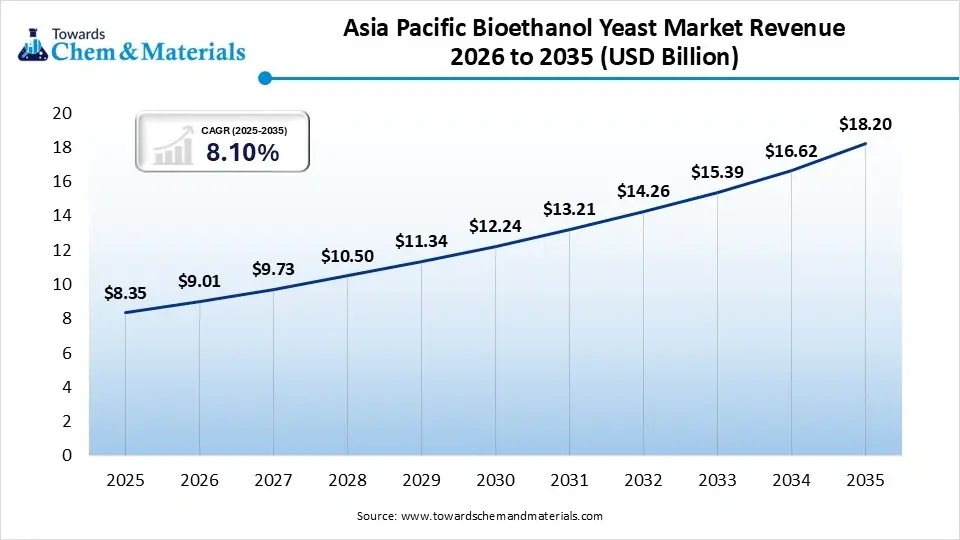
China
- The country is focusing on the expansion of advanced second-generation cellulosic ethanol plants. The stringent regional biosafety law and clean-air environmental compliance are fueling commercial demand for recombinant yeast strains.
- The domestic biotechnology research institute focuses on transforming agricultural waste into sustainable and clean liquid fuels to meet carbon-neutral goals.
India
- The India demand for active dry yeast variants and scaling of bioethanol production through substantial investment in new biorefineries.
- The local agricultural processing hubs and distributors are inclined towards higher shelf-life stability and sourcing of high-efficiency biocatalysts to meet environmental and climate compliance
Europe held the 27% market share in 2025. The region is witnessing the continuous growth that is driven by stringent environmental standards and decarbonization policies to reduce reliance on fossil fuels. The regional transition toward second-generation lignocellulosic biomass, such as forestry residues, organic waste, and wheat straw. Europe's R&D players focus on innovation in specialized recombinant yeast strains designed for xylose co-fermentation. The emerging trend towards biocatalyst implementation enables viable cellulosic ethanol in domestic scaling. Additionally, the European-based biotechnology company continues to collaborate with global players for genetic stability testing of yeast to achieve higher performance efficiency.
Germany
- The country has extended its lignocellulosic and wood-waste processing yeast infrastructure. Germany's biorefineries rely on improved manufacturing processes and the use of genetically modified microorganisms.
- The national regulatory framework boosts yeast suppliers to modernize to second-generation technologies and incorporate non-food biomass feedstocks.
North America held the 24% market share in 2025, accelerated by its technological infrastructure and large-scale ethanol production, aligns with extensive corn-refining networks. The regional momentum is sustained by stringent regulatory compliance and low-carbon standards, which ensure modernized biorefineries. The major manufacturers in North America adopt genetically modified yeast strains and maintain their leadership in testing CRISPR-Cas9 tools. The region commercializing thermotolerant, stress-resistant biocatalysts that allow production facilities to run high-gravity fermentation cycles, process hyper-concentrated mash, decrease water and energy consumption, and maintain global industry efficiency.
United States
The country is focusing strongly on the transition towards advanced engineering of yeast strains and gene-edited strains to verify that industrial and environmental safety complies with microbial commercial activity
The U.S. based biorefineries are implementing very-high-gravity fermentation processes and premium yeast strains to achieve higher operational output and processing time.
Canada
- Industrial and domestic bioethanol producers are increasingly adopting cold-tolerant and lignocellulosic yeast strains to improve ethanol yields and meet carbon neutrality goals.
- Canada's evolution is further maintained by clean fuel regulations and demanding risk assessments, which facilitate the commercialization process and allow optimization of second-generation cellulosic ethanol manufacturing.
Latin America held the 9% market share in 2025, defined by its cost-effective, high-volume biofuel global hub, is maintained by high-volume sugarcane milling and expanding corn-ethanol infrastructure. The region focuses on industrial fermentations by minimizing osmotic pressure and ethanol toxicity. Regional upgrade regulations of gene-edited organisms, enabling the quick release of high-performance yeast strains and recombinant yeast strains for industrial applications. Additionally, Latin America's biorefineries focus on maximizing ethanol output through national carbon-credit programs and low-emission facilities.
Brazil
A recent survey indicates that Brazil has stable progress in developing highly specialized and dual-feedstock yeast strains and is furthermore expanding corn-ethanol mashing lines.
There is a commercial shift towards consuming recombinant thermotolerant yeasts and achieving higher ethanol conversion efficiencies in biorefineries to meet greenhouse gas reduction and biosafety standards.
Argentina
- Argentina is emerging in growing fermentation technology, developing toward starch-liquefying yeast blends.
- The domestic regulatory compliance, tax incentives, and fuel blending mandates are operating innovation in gene-edited strains and premium dry yeast for modern biorefineries.
The Middle East & Africa held the 6% market share in 2025, emerging with steady growth, driven by industrial diversification, sustainable waste management infrastructure, and fuel-blending targets. The region moves towards active dry yeast (ADY) formulations, especially vacuum-packed, dehydrated principles, which are vital for local infrastructure development. MEA utilized agricultural waste, such as molasses and crop residues, for the manufacturing of high-value bioethanol through a fermentation solution. Additionally, growing clean-energy partnerships and green investments are encouraging domestic usage of advanced yeast strains across the region.
South Africa
- The regional logistical network supports bioethanol manufacturers by utilizing inhibitor-tolerant yeast strains and foreign-developed recombinant strains.
- The deployment of engineering of biological catalyst and vacuum-packed active dry yeast formulation for commercial industrial fermentation lines.
Bioethanol Yeast Market Share, By Regional, 2025 (%)
| Regional | Revenue Share, 2025 (%) |
| North America | 24% |
| Europe | 27% |
| Asia-Pacific | 34% |
| Latin America | 9% |
| Middle East & Africa | 6% |
Competitive Analysis
- The competitive landscape is transforming the bioethanol yeast industry towards commercialization, microbial feedstock sourcing, and partnerships with bioethanol manufacturers for stable revenue streams.
- The main industry leaders, such as Novozymes, Angel Yeast Co., Ltd., and Associated British Foods plc., which improved strain engineering and yield optimization by utilizing co-products. This competitive edge helps maintain industrial stability and develop platforms that achieve cost leadership and optimized yields.
- Lesaffre is progressing in its feedstock versatility and has established a standard in red ethanol for the bioethanol yeast industry. Their focus is on second-generation bioethanol and the engineering of pentose and hexose sugars.
Top Companies in the Bioethanol Yeast Market & Their Offerings
- Novozymes: The dominant company that launches and specializes in the engineering of products to eliminate fermentation and handle high solid content, various organic acid inhibitors. This company partnered with other companies for specialized genetic strains.
- Associated British Foods plc:The major companies focus on operational reliability and industrial scaling. Focus on highly stable active dry yeast formulations and support deep application in continuous fermentation facilities.
Other Key Players
- DSM
- AB Mauri
- Cargill, Inc.
- LALLEMAND Inc.
- Leiber GmbH
- Lesaffre
- AngelYeast Co., Ltd
- Foodchem International Corporation
- Omega Yeast Labs, LLC.
- Pacific Ethanol, Inc.
- Oriental Yeast Co., Ltd
Segments Covered In The Report
By Type
- Baker’s
- Active Dry Baker’s yeast
- Instant Baker’s Yeast
- Fresh Baker’s Yeast
- Brewer’s
- Active Brewer’s Yeast
- Inactive Brewer’s Yeast
- Specialty Fermentation Yeast
By Application
- Food
- Bakery Products
- Functional Foods
- Nutritional Supplements
- Animal Feed
- Poultry Feed
- Swine Feed
- Ruminant Feed
- Aquaculture Feed
- Biofuel
- Fuel Ethanol Production
- Industrial Fermentation
- Cleaning & Disinfection
- Bio-Based Cleaning Agents
- Industrial Sanitation Products
- Others
- Pharmaceuticals
- Cosmetics
- Biotechnology Research
By Regional
- North America
- Asia Pacific
- Europe
- Latin America
- Middle East & Africa



Comments
Share your thoughts, ask a question, or provide feedback about this report.