Content
Sustainable Coatings Market Size Analysis Report 2035
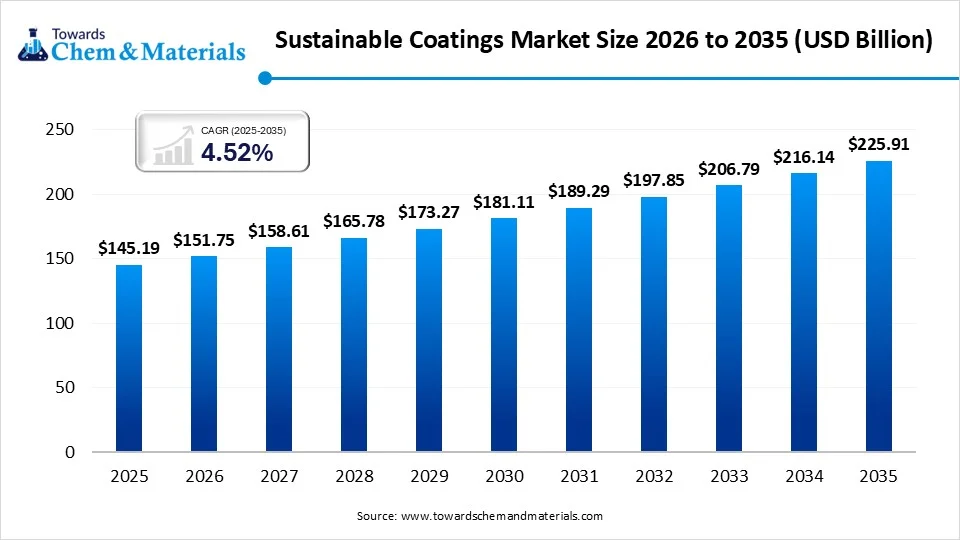
The global sustainable coatings market size was estimated at USD 145.19 billion in 2025 and is expected to increase from USD 151.75 billion in 2026 to USD 225.91 billion by 2035, growing at a CAGR of 4.52% from 2026 to 2035. Europe dominated the sustainable coatings market with the largest revenue share of 37.00% in 2025.The implementation of sustainable manufacturing practices has accelerated the market growth in recent years.The protective paint, which is designed to reduce environmental impact while providing efficient protection to surfaces such as wood, metal, plastics, and concrete are called sustainable coatings. Moreover, by reducing the harmful emissions while improving the indoor air quality and supporting the ecologically friendly manufacturing practices, the major players have heavily shifted towards sustainable coatings in recent years.
Market Highlights
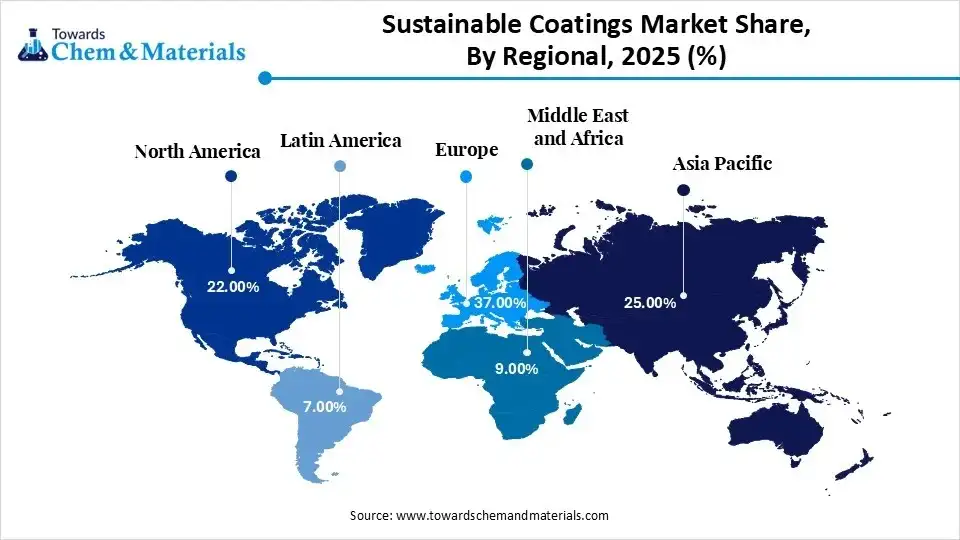
- By region, Europe dominated the sustainable coatings market share 37.00% in 2025, due to stronger sustainability practices and their precise implementation.
- By technology, the waterborne coatings segment dominated the market and accounted for the largest revenue share of 35.00% in 2025, owing to electronic devices containing significant amounts of valuable metals.
- By technology, the powder coatings segment is expected to grow during the forecast period, due to they create almost no chemical waste.
Next Generation Smart Coatings Drive Innovation
The industry is heavily shifting towards smart coatings, which are expected to present a new business model in the coming years. These coatings can react to the environment. Some can repair small scratches automatically, while others can prevent bacterial growth or resist extreme weather conditions. Scientists are also developing coatings that change temperature behavior or improve surface protection. These innovations combine sustainability with advanced performance. Instead of just covering the surface, coatings are becoming active protective systems nowadays.
What are the Different Materials Used for Making Coatings Sustainable ?
- Bio-based Resins: These are derived from renewable resources like plants. Instead of relying on petroleum, which is finite and harmful, bio-based resins (like soy or vegetable oils) are used to make coatings. They're biodegradable and produce fewer emissions during production.
- Water-based Coatings: Unlike traditional solvent-based coatings that release harmful volatile organic compounds (VOCs), water-based coatings use water as the main solvent, reducing air pollution and making them safer to use.
- Recycled Materials: Coatings can also incorporate recycled materials, like recycled glass, metal, or plastic, which helps reduce waste and the need for virgin resources.
- Powder Coatings: These are free of solvents and use a powder that is applied to surfaces. The coating is then heated to create a durable layer. Since there's no liquid involved, there's less waste and fewer harmful chemicals released.
- Natural Pigments and Dyes: Instead of synthetic, often toxic pigments, some sustainable coatings use natural dyes derived from plants or minerals. These are less harmful to the environment and can be biodegradable.
- Low or No-VOC Formulations: Many coatings are formulated to minimize or eliminate VOCs (volatile organic compounds) which are harmful to both human health and the environment. These low-VOC or zero-VOC coatings help reduce air pollution.
- Recyclable Coatings: Some coatings are designed with their end life in mind. They are easily recyclable, meaning they can be reused or repurposed after they’ve served their function, reducing waste in landfills.
- Mineral-based Coatings: These use natural minerals like clay, chalk, or sand. They are non-toxic and tend to have a much lower environmental impact during production compared to synthetic alternatives.
Trade Analysis of the Sustainable Coatings Market:
Import, Export, Consumption, and Production Statistics
- The whole world has seen heavy export of the green coating through 411buyers and 342 exporters with 2,245 shipments as per the latest survey.
- Austria has emerged as the leading exporter of green coatings with 1,146 shipments, while Germany (618 shipments) and Vietnam (825 shipments) are actively following Austria in the current period.
- Also, Kazakhstan has observed in the sophisticated imports of green coatings with 1,468 shipments, while Vietnam (1,352) and the United States (578) are following in recent years.
Recent Market Trends:
- The trend towards energy saving in the construction sector has driven substantial financial gains in the manufacturing sector in recent years. Also, the sustainable coatings have been seen in reflecting sunlight while reducing heat absorption in recent years.
- The emergence of the biobased coatings, which are primarily developed from plants, has attracted increased capital and investment in manufacturing in the current period. The major players have observed the heavy replacement of petroleum-based chemicals with renewable materials nowadays.
- Growing need for long-life coating is likely to increase return on investment for manufacturers during the forecast period. Also, the major firms are trying to reduce the monthly or yearly maintenance by installing longer-life coatings in their manufacturing area as per the recent industry survey.
Report Scope
| Report Attribute | Details |
| Market Size in 2026 | USD 151.75 Billion |
| Revenue Forecast in 2035 | USD 225.91 Billion |
| Growth Rate | CAGR 4.52% |
| Forecast Period | 2026 - 2035 |
| Base Year | 2025 |
| Dominant Region | Europe |
| Segment Covered | By Technology, By Region |
| Key companies profiled | PPG Industries, Sherwin-Williams, BASF SE, Axalta Coating Systems, Arkema, Covestro, Evonik Industries, Kansai Paint, Hempel A/S, AkzoNobel |
Supply Chain Analysis of the Sustainable Coatings Market:
Distribution to Industrial Users
- Sustainable coatings distribution to industrial users centers on direct-to-plant logistics and specialized technical partnerships.
- Distributors provide low-VOC, bio-based, and recyclable formulations to sectors like automotive and aerospace. Success relies on specialized handling and expert guidance to ensure these eco-friendly alternatives meet rigorous performance standards while reducing carbon footprints.
Chemical Synthesis and Processing
- Chemical synthesis of sustainable coatings focuses on replacing petroleum-based resins with renewable feedstocks like plant oils, lignin, or recycled polymers.
- Processing utilizes green chemistry principles, such as water-borne dispersion or UV-curing, to eliminate toxic solvents. These methods ensure high-performance finishes while significantly reducing VOC emissions and energy consumption.
Regulatory Compliance and Safety Monitoring
- Regulatory compliance for sustainable coatings involves adhering to REACH, VOC limits, and eco-label certifications. Safety monitoring utilizes Real-Time Sensing and IoT to track air quality and chemical exposure during application.
- These frameworks ensure that bio-based formulations meet strict occupational health standards while maintaining environmental safety and transparency.
Sustainable Coatings Market Regulatory Landscape: Global Regulations
| Country Region | Regulatory Body | Key Regulations | Focus Areas |
| United States | Environmental Protection Agency (EPA) | 40 CFR Part 59 (National Volatile Organic Compound Emission Standards). | Reducing ground-level ozone and smog formation and mandating Method 24 for quantifying VOC content in formulations. |
| European Union | ECHA | REACH (EC No 1907/2006) and CLP (EC No 1272/2008). | Identifying Substances of Very High Concern (SVHC) for phase-out. Regulating PFAS and Endocrine Disruptors. |
| China | Ministry of Natural Resources (MNR) | GB 30981 Series (Mandatory National Standards). |
Strict limits on Benzene, Heavy Metals, and Formaldehyde. Transitioning the industry toward water-based and high-solid content coatings |
Segmental Insights
Technology Insights
How did the Waterborne Coatings Segment Dominate the Sustainable Coatings Market in 2025?
The waterborne coatings segment dominated the market share 35.00% in 2025, due to unique factors, such as it can replace many solvent-based coatings, which heavily reduce harmful fumes. Also, it carries the water instead of the chemical solvent, which has received regional government appreciation and recommendations for the major industry uses in recent years. Also, the manufacturers such as the furniture, construction, and automotive are actively seeking these coatings as a global shift towards heavy sustainable manufacturing practices in the current period.
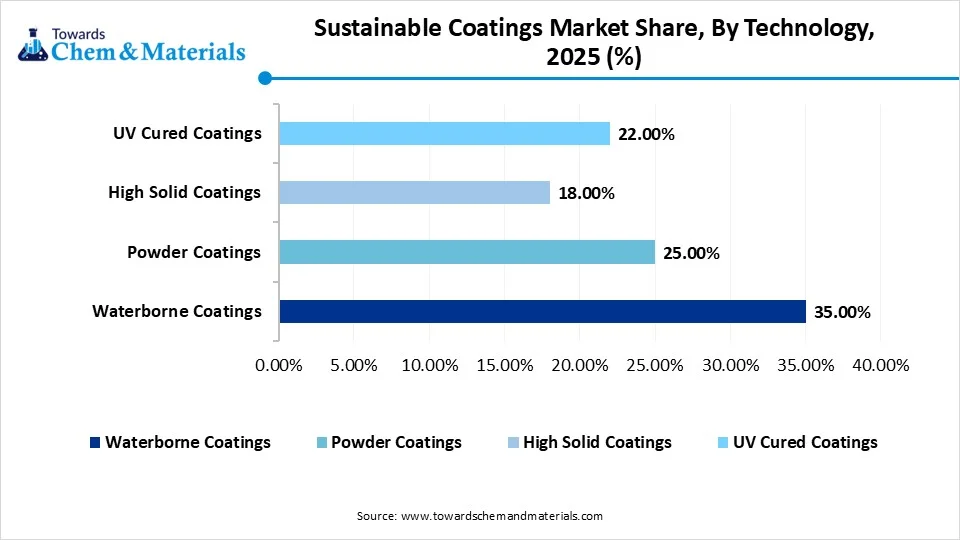
The powder coatings segment is expected to grow with a rapid CAGR, owing to they create almost no chemical waste. Also, instead of liquid paint, powder particles are sprayed onto a surface and then heated to form a solid protective layer. Any unused powder can often be collected and reused, which reduces material waste. Powder coatings also create very durable finishes that resist scratches and corrosion.
Sustainable Coatings Market Share, By Technology , 2025 (%)
| By Technology | Revenue Share, 2025 (%) |
| Waterborne Coatings | 35.00% |
| Powder Coatings | 25.00% |
| High Solid Coatings | 18.00% |
| UV Cured Coatings | 22.00% |
Regional Insights
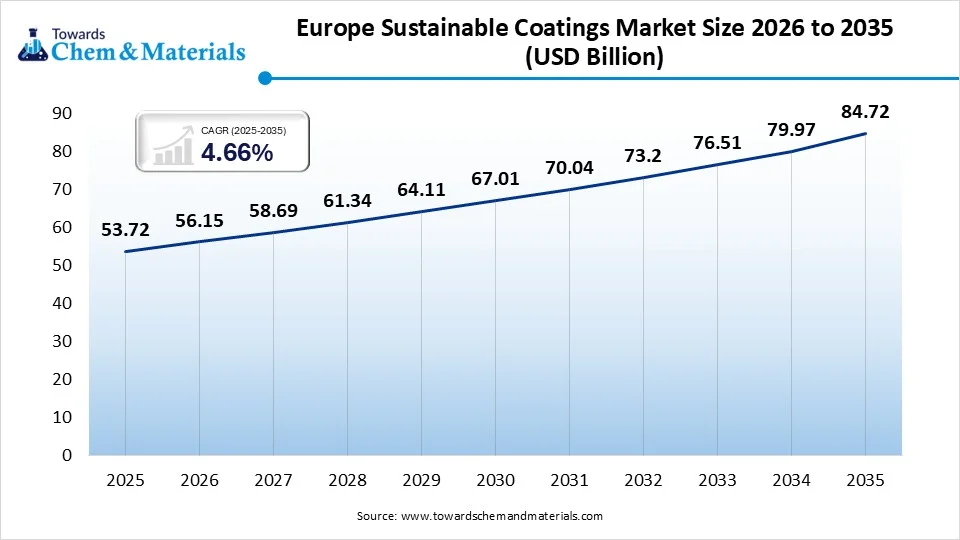
The Europe sustainable coatings market size was valued at USD 53.72 billion in 2025 and is expected to be worth around USD 84.72 billion by 2035, exhibiting at a compound annual growth rate (CAGR) of 4.66% over the forecast period from 2026 to 2035. Europe dominated the sustainable coatings market share 37.00% in 2025, due to stronger sustainability practices and their precise implementation. Moreover, the European government has implemented stricter eco-friendly regulations while providing attractive benefits to the manufacturers who practice eco-friendly manufacturing these days. Also, the major brands in Europe have been seen investing heavily in innovative activities, which is actively leading the industry’s growth in the current period.
Germany Advances Sustainable Industrial Coating Adoption
Germany maintained its dominance in the market, owing to its strong industry and automotive sectors. German companies focus heavily on engineering quality and environmental responsibility. Many factories are trying to reduce emissions and improve production efficiency, which increases demand for sustainable coatings. The automotive industry in Germany also uses advanced coatings that protect vehicles while meeting environmental standards.
Sustainable Coatings Market Evaluation in the Asia Pacific
Asia Pacifc sustainable coatings market segment accounted for the major revenue share of 25.00% in 2025. Asia Pacific is expected to capture a major share of the sustainable coatings market with a rapid CAGR, owing to massive construction and industrial growth. Furthermore, the cities in this region are expanding rapidly, creating huge demand for buildings, factories, transportation infrastructure, and housing. Al these projects require large amounts of coatings. At the same time, governments are starting to introduce environmental rules that encourage cleaner materials.
India Emerging Hub for Sustainable Coatings
India is expected to emerge as a prominent country for the sustainable coatings market in the coming years, due to rapid urban development and infrastructure expansion. Also, new housing projects, commercial buildings, and transportation systems require large quantities of coatings. At the same time, environmental awareness in India is gradually increasing. Builders and manufacturers are starting to consider products that produce fewer emissions and improve indoor air quality.
Middle East and Africa Sustainable Coatings Market Examination
Middle East and Africa sustainable coatings market segment accounted for the major revenue share of 9.00% in 2025. The Middle East and Africa are growing in industry, owing to increasing infrastructure development. Moreover, many countries are building new cities, industrial zones, and large commercial projects. These projects need coatings that can handle extreme heat, sand, and harsh weather conditions. Sustainable coatings are attractive because they provide strong protection while reducing environmental impact.
Sustainable Coatings Market Share, By Regional, 2025 (%)
| Regional | Revenue Share, 2025 (%) |
| North America | 22.00% |
| Europe | 37.00% |
| Asia Pacific | 25.00% |
| Latin America | 7.00% |
| Middle East & Africa | 9.00% |
Sustainability Trends Reshape Saudi Arabia Coatings Sector
Saudi Arabia is expected to gain a significant industry share owing to expanding construction and manufacturing sectors. The country has a large housing market and growing infrastructure projects that require protective coatings. Also, industries in Saudi Arabia are gradually adopting environmentally friendly materials to meet global sustainability standards. The automotive and appliance manufacturing sectors are important drivers of coating demand.
Recent Developments
- In February 2026, the Akzonobel Powder Coatings unveiled the latest portfolio of sustainable powder coatings. Also, the newly launched product line called ECO+, and these coatings are likely to deliver clear performance benefits with greater sustainability targets, as per the company's claim.(Source: www.specialchem.com)
- In November 2025, BASF established the advanced plant of automation OEM coatings in Germany. Moreover, the motive behind these efficient plant establishments is to lead more sustainable operations and production of high-value products in the coming years as per the published report. (Source: www.basf-coatings.com)
Top Vendors in the Sustainable Coatings Market & Their Offerings:
- PPG Industries: Headquartered in the US, PPG integrates sustainability through its "Enviro-Prime" and "Eco-Cool" lines. They focus on reducing waste and energy during application, offering PFAS-free formulations and coatings that contain recycled materials. Their R&D emphasizes high-solids and waterborne technologies for the automotive, aerospace, and packaging industries to minimize VOC emissions.
- Sherwin-Williams: A global giant in retail and industrial coatings, Sherwin-Williams focuses on low-to-zero VOC formulations like the Emerald and Harmony lines. They utilize bio-renewable raw materials and have established rigorous "Sustainability by Design" protocols. Their efforts extend to "Cool Roof" technology, which reduces building energy consumption through heat-reflective properties.
- BASF SE: The German chemical powerhouse leads through its "Biomass Balance" approach, replacing fossil fuels with renewable feedstocks in coating production. BASF specializes in eco-friendly automotive finishes and functional coatings that provide high durability with lower material usage. Their innovations in UV-curing and water-based dispersion technologies significantly lower the industry's environmental footprint.
- Axalta Coating Systems
- Arkema
- Covestro
- Evonik Industries
- Kansai Paint
- Hempel A/S
- AkzoNobel
Segments Covered in the Report
By Technology
- Waterborne Coatings
- Architectural
- Industrial
- High Performance
- Automotive
- Wood Coating
- Packaging
- Others
- Powder Coatings
- Consumer Goods
- Architectural
- Automotive
- General Industries
- Furniture
- Others
- High Solid Coatings
- Industrial
- Automotive
- Aerospace
- Packaging
- Others
- UV Cured Coatings
- Industrial
- Automotive
- Wood Coating
- Packaging
- Others
By Region
- North America
- U.S.
- Canada
- Mexico
- Europe
- Germany
- UK
- France
- Italy
- Spain
- Asia Pacific
- China
- India
- Japan
- South Korea
- Latin America
- Brazil
- Argentina
- Middle East & Africa
- Saudi Arabia
- South Africa
FAQ's




Select User License to Buy
Figures (4)








 sales@towardschemandmaterials.com
 Download Sample
 Schedule a Meeting