Find the Right Market Report
Search thousands of industry reports, market insights, and research studies in one place.
Not sure where to start? Try one of these:
The global coal-to-chemical market size was estimated at USD 15.86 billion in 2025 and is predicted to increase from USD 16.52 billion in 2026 to approximately USD 23.61 billion by 2035, and is expected to grow at a CAGR of 4.10% during 2025-2035, driven by the innovation in manufacturing process with technological shift as market is shifting towards chloride process rather than traditional sulfate route due as it offers higher yield and improve efficiency and also reduced waste which drives growth.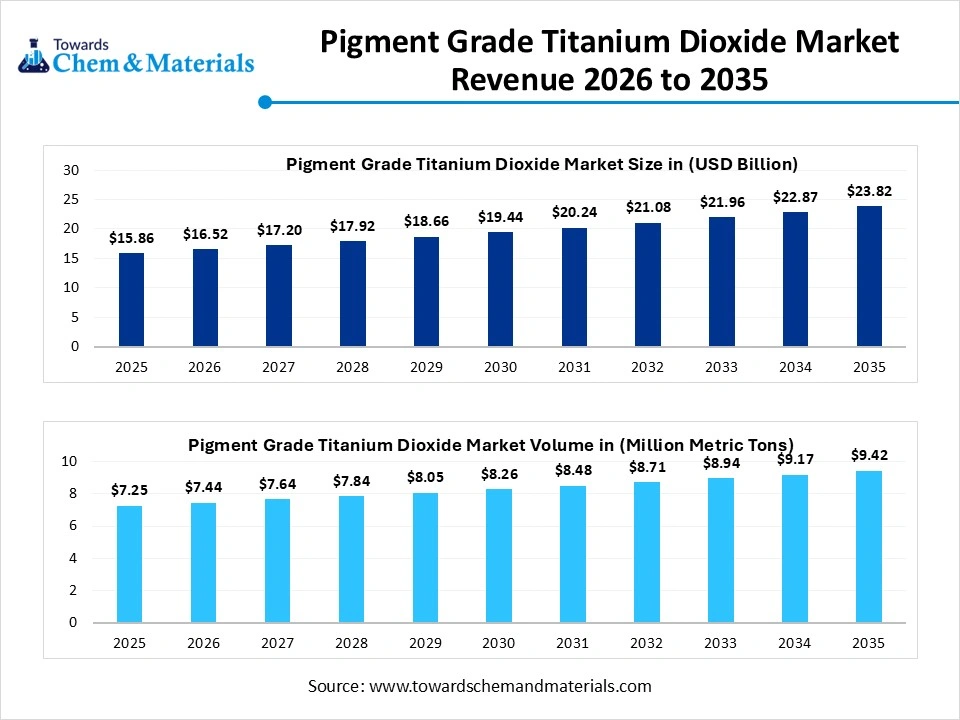
The presence of key players who are dominating the market, which are large multinational chemical producers and regional market leaders like Chemours Company, Tronox Holdings plc, LB Group, Venator Materials PLC, and KRONOS Worldwide, Inc., plays a major role in the growth and expansion of the market.
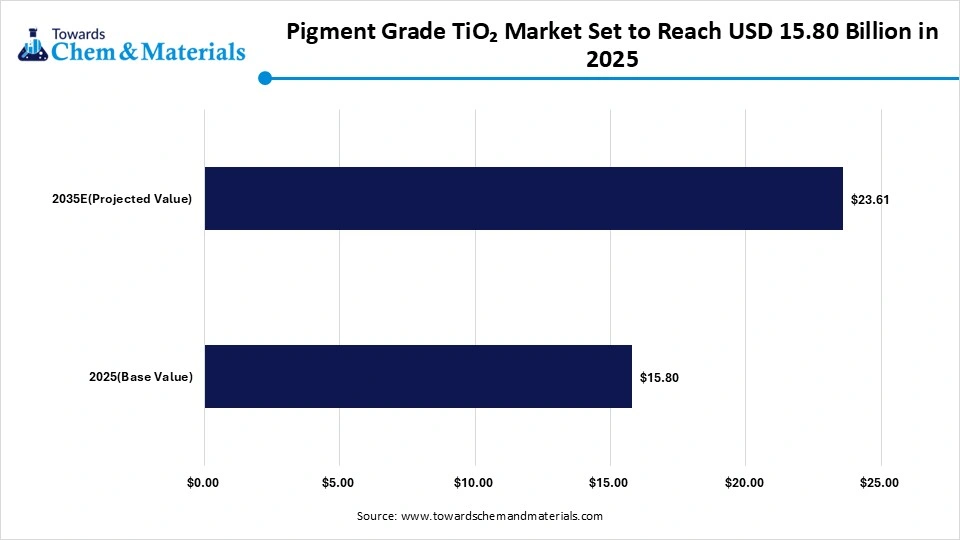
According to the research performed, the pigment-grade titanium dioxide market is experiencing growth, driven by growing demand from sectors such as construction, automotive, plastics, coatings, and infrastructure development plans in the region, which demand pigment-grade titanium dioxide. The pigment-grade titanium dioxide market is valued at USD 15.80 billion in 2025 and is projected to reach USD 23.61 billion by 2035, expanding at a steady 4.10% CAGR during the forecast period. This growth reflects the market position within the specialty chemical industry, which is extensively supported by the growing demand from paints and coatings, plastic, printing inks, construction materials, and other application sectors, which support the growth. Rising construction and high-performance material demand further boost the growth.
Source: Towards Chemical and Materials
According to the research performed, the pigment-grade titanium dioxide market is projected to grow steadily from USD 15.80 billion in 2025 to USD 23.61 billion by 2035, registering a 4.10% CAGR during the forecast period. This upward growth indicates that the market is expanding maturely, broadly driven by industrial production, construction activity, paint and coating demand, and plastic consumption rather than experiencing rapid structural expansion of the market. Continuous use of titanium dioxide due to its superior properties and applications in end-use applications is expected to support market growth through 2035.
According to the research performed, the pigment-grade titanium dioxide market is expected to reach a volume of 7.25 million metric tons in 2025. This growth highlights the scale of global production requirements, which are to meet the global demand across sectors for industrial applications. The market's high physical output shows that the market is positioned as a major volume specialty pigment, which is widely supported by the widespread use and demand for finished products. By 2035, the market volume is projected to reach 9.37 million metric tons, indicating continued expansion in line with growing industrial and end-use demand.
According to my research, the pigment-grade titanium dioxide market is expected to record volume growth of approximately 2.6% CAGR from 2025 to 2035, compared with revenue growth of around 4.1% CAGR over the period. The faster growth in revenue indicates that the market is influenced by not only increasing unit demand but also by pricing, product mix, and high-performance grade titanium dioxide demand. The divergence in the graph represents the gradual shift towards value-added and specialty-grade products, which help generate stronger revenue growth.
According to my research, the graph shows that the pigment-grade titanium dioxide market has an average manufacturing price of approximately USD 1,650 per metric ton in 2025, reflecting the capital- and energy-intensive nature of TiO₂ production through chloride and sulfate processes. Compared with the average selling price of USD 2,180 per metric ton, the difference indicates the gross value margin available to producers before accounting for additional operating, distribution, and commercial expenses. The pricing structure highlights the importance of production efficiency, energy costs, raw material management, and product positioning in determining profitability across the TiO₂ value chain.
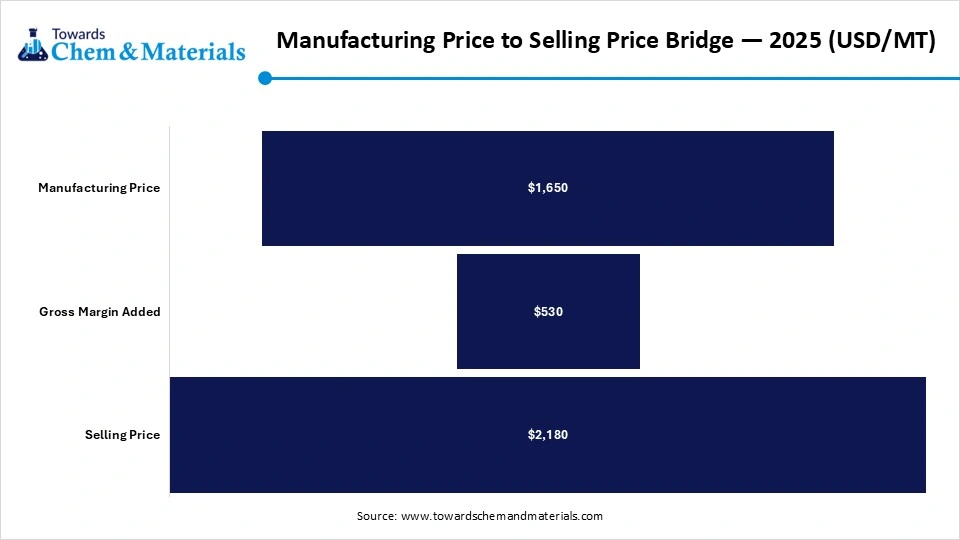
According to the research and through graph prediction, the pigment-grade titanium dioxide market records an average selling price of USD 2,180 per metric ton in 2025, compared with an average manufacturing price of USD 1,650 per metric ton. This creates an implied gross margin of USD 530 per metric ton, equivalent to approximately 32.1% of the selling price, highlighting the pricing power retained by TiO₂ producers. The gap between manufacturing and selling prices reflects the value added through processing, product quality, brand positioning, and market distribution, while allowing producers to maintain margins despite fluctuations in feedstock and energy costs.
According to the research and through graph prediction, the pigment-grade titanium dioxide market is projected to record a pricing CAGR of approximately 1.5% from 2025 to 2035, compared with 2.6% volume CAGR and 4.1% revenue CAGR over the same period. The relatively slower pricing growth indicates that market expansion is being driven more by increasing consumption volumes and a shift toward higher-value product grades and a favorable product mix than by price inflation alone. This suggests that rising demand from paints and coatings, plastics, paper, and other end-use industries will remain the primary contributor to revenue growth, while pricing is expected to increase at a more modest pace.
According to the research and graph prediction, the pigment-grade titanium dioxide market shows a clear divergence between market value and physical volume growth from 2025 to 2035. Market value is projected to expand at a 4.1% CAGR, while market volume grows at a comparatively slower 2.6% CAGR, indicating that revenue is increasing faster than physical shipments. This gap suggests that market expansion is being supported not only by higher consumption but also by pricing and product-mix improvements, including greater demand for higher-value TiO₂ grades. Overall, the market is expected to experience steady, moderate growth, with value expansion outpacing volume growth over the forecast period.
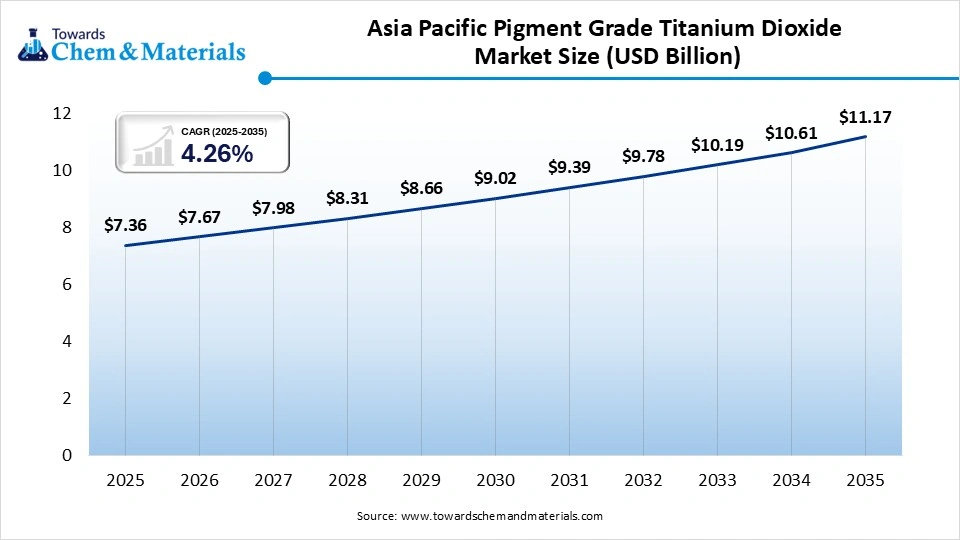
According to Research, The Asia Pacific pigment grade titanium dioxide market size was estimated at USD 7.36 billion in 2025 and is projected to reach USD 11.17 billion by 2035, growing at a CAGR of 4.26% from 2026 to 2035.Asia Pacific dominated the pigment grade titanium dioxide market with a share of 46.4% in 2025 and is expected to grow at a CAGR of 4.50% over the forecast period, driven by growing production and downstream coating and plastic manufacturing and increasing demand for the market. Large-scale pigment capacity and construction activity in the region due to rapid infrastructure development projects support the growth of the market. The expanding manufacturing sectors and coating and plastics demand further fuel the growth. China is the largest and leading producer and consumer of the pigment, largely driven by the rapid infrastructure development projects.
Europe Holds 21% Share Amid Regulatory and Trade Realignment.
According to Research, The Europe pigment grade titanium dioxide market size was estimated at USD 3.33 billion in 2025 and is projected to reach USD 5.12 billion by 2035, growing at a CAGR of 4.40% from 2026 to 2035.Europe held a 21% market share in the pigment-grade titanium dioxide market in 2025, driven by growing environmental regulations which shifts and demand to cleaner production and higher-efficiency pigment technologies, which drives growth. The presence of a mature coatings and plastics industry provides a strong base in the region, supporting expansion of the market. The regional supply chain is reshaping the market, and higher-efficiency pigment technologies are further supporting the growth and expansion of the market. In the UK, growing environmental regulations and demand for high-performance chemicals and coating materials drive demand for the market, along with manufacturing operations requiring the materials.
According to Research, The North America pigment grade titanium dioxide market size was estimated at USD 2.85 billion in 2025 and is projected to reach USD 4.41 billion by 2035, growing at a CAGR of 4.46% from 2026 to 2035.North America held an 18% market share in the pigment-grade titanium dioxide market in 2025, driven by high value anchored in premium rutile-grade consumption, which is due to growing demand from construction and automotive coatings, supporting growth. The presence of domestic production facilities of pigments and import diversification supports supply chain security, supporting growth. The demand for high-performance and premium rutile grade consumption supports the growth and demand for the materials in the region. In the United States, there is rapid growth due to domestic demand, as its high performance and focus on supply chain security fuel the growth of the market in the country. Wide consumer demand and explosive volume growth further fuel growth. In Canada, there is growing demand for the export of the material, which makes it a large exporter of pigments prepared through titanium dioxide, increasing demand for production facilities and boosting the growth of the market.
According to Research, The Latin America pigment grade titanium dioxide market size was estimated at USD 1.27 billion in 2025 and is projected to reach USD 2.02 billion by 2035, growing at a CAGR of 4.75% from 2026 to 2035.Latin America held 8% market share in the pigment-grade titanium dioxide market in 2025 and is expected to experience the fastest growth with a CAGR of 5.20% in the forecast period, driven by rapid urbanization and infrastructure development projects in the region, with growing investments increasing the consumption of coating materials, resulting in expansion of the market. Growing construction and industrial production, such as packaging, paints, and plastics, drive the growth of the market in the region. In Brazil, there is rising demand for domestic manufacturing, and urban construction growth drives the growth of the market. Brazil functions as a primary consumption hub, relying on both domestic activity and imported feedstock to sustain industrial output.
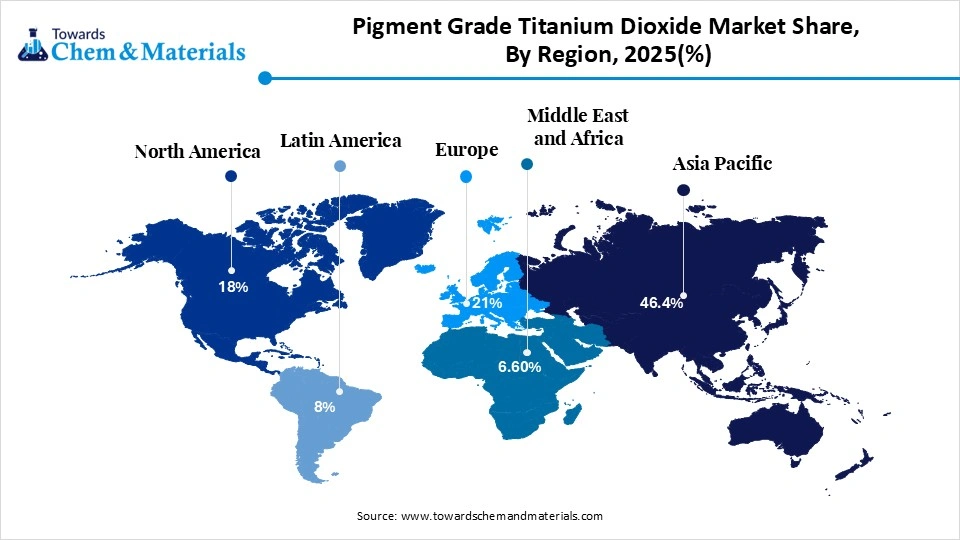
According to Research, The Middle East & Africa pigment grade titanium dioxide market size was estimated at USD 1.05 billion in 2025 and is projected to reach USD 1.69 billion by 2035, growing at a CAGR of 4.87% from 2026 to 2035.the Middle East and Africa held a 5% market share in the pigment-grade titanium dioxide market in 2025, driven by growing industrialization, especially in African markets, and rapid construction activities such as infrastructure development projects, renovation which drive demand for coating and paint materials, resulting in the growth of the market. The rapid urbanization and demand for durable architectural and protective coatings are expanding the specialty pigment applications in the region, further fueling the growth of the market. In the UAE, the market is experiencing growth due to a continuous real estate, infrastructure, and urban development boom in the region, which drives demand for coatings and paint materials, supporting the growth of the market.
The rutile segment dominated the market with a 72% share in 2025 and is expected to grow at a CAGR of 4.20% over the forecast period, driven by the growing demand for superior material properties, as it offers opacity, superior resistance, exceptional UV stability, and a higher refractive index for better brightness, which drives the growth of the market. The growing use of high-performance plastics in sectors like automotive and packaging drives the growth of rutile consumption, supporting expansion of the market.
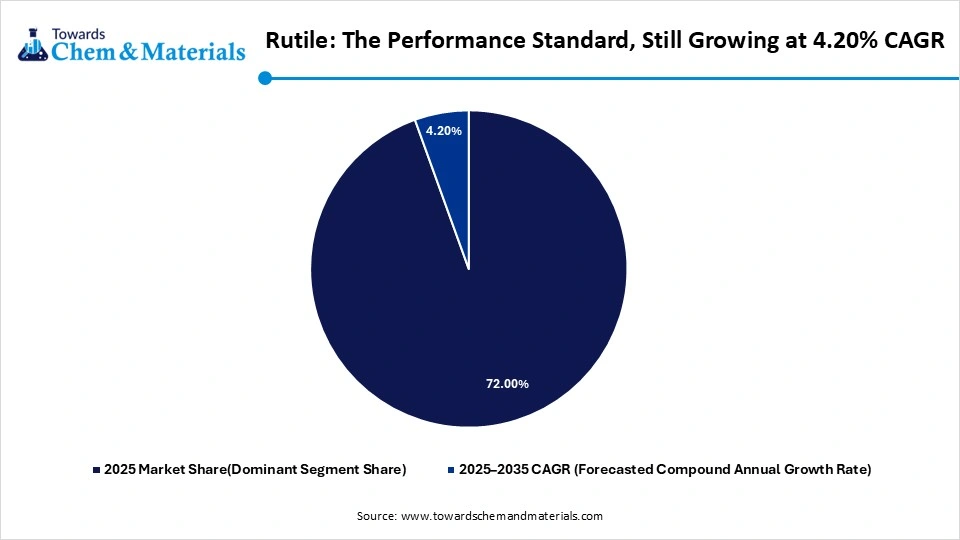
The anatase segment held 28% market share in 2025 and is expected to have the fastest growth with a CAGR of 4.80% in the forecast period, driven by the growing consumption in applications such as cosmetics and speciality applications, as manufacturers use it where there is demand for brightness, dispersion, and formulation, which drives the growth of the market. It helps in providing exceptional whiteness and cost efficiency for applications and is used as a machine-friendly choice for paper production, fueling further growth of the market.
The chloride segment dominated the market with a 53.4% share in 2025 and is expected to grow at a CAGR of 3.70% over the forecast period, driven by the demand for high-performance materials as compared to traditional systems, which increases the demand for chloride pathways, especially due to its strong optical properties. The growing investments by producers in lower-energy reactors increase the demand for premium pigments, supporting the growth of chloride route expansion. The chloride process also yields high-purity rutile pigments, which are used extensively due to their properties, including uniformity, resistance, and brightness, further supporting growth and expansion of the market, aligning with environmental efficiency.
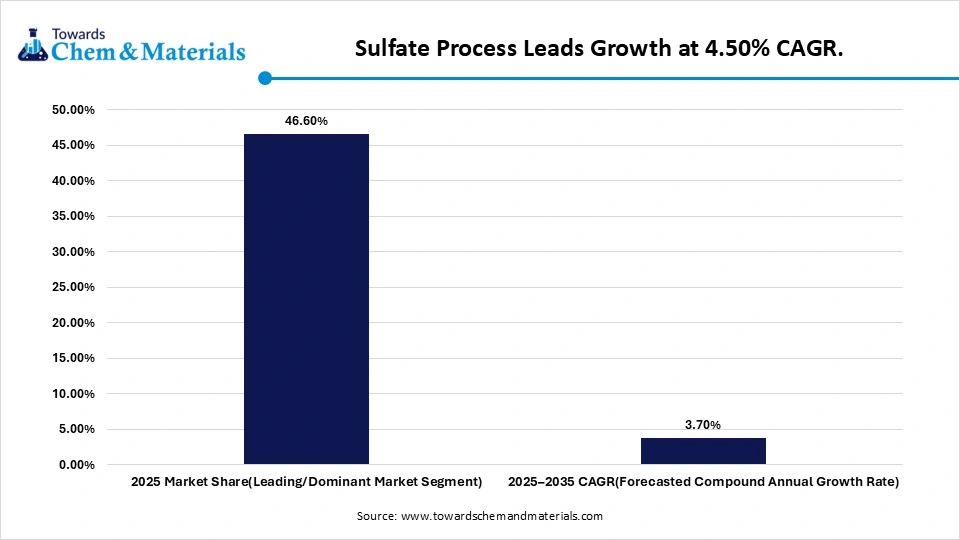
The sulfate segment held 46.6% market share in 2025 and is expected to have the fastest growth with a CAGR of 4.50% in the forecast period, driven by the presence of feedstock facilities and established sulfate plants, which helps in the availability of feedstock and capacity as per the requirement, which fuels the growth. The growing need for wastewater treatment, energy efficiency, and optimisation of acid consumption, as well as cost-effective production methods, also fuels the growth. Lower equipment and raw material costs and budget-conscious regional producers further fuel the growth and expansion of the market.
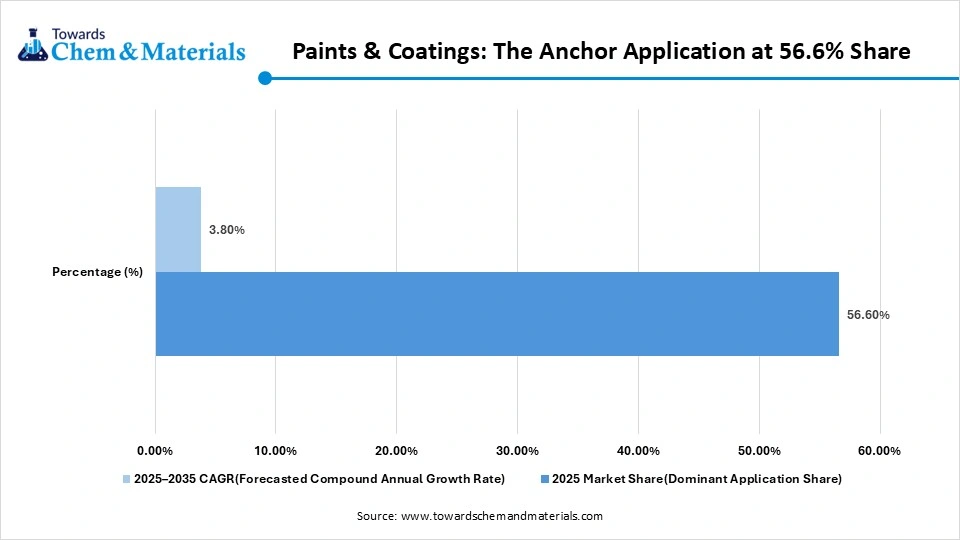
The paints and coatings segment held 56.6% market share in 2025 and is expected to grow at a CAGR of 3.80% over the forecast period, driven by the growing demand from industrial and architectural coating industries, as they are the largest consumers of pigment-grade titanium dioxide due to its applications in the sectors. Other major sectors like construction, automotive, infrastructure, and renovation also demand the product as it is a core ingredient. Its properties like high opacity, whiteness, UV resistance, and durability for weather, which are major requirements by the formulators, drive further demand for the market.
The cosmetics segment dominated the market with a 3.8% share in 2025 and is expected to have the fastest growth with a CAGR of 6.80% in the forecast period, driven by the growing demand from the cosmetic industries for formulation of premium skincare and sunscreen due to its properties, which drives growth. The demand for specialised TiO2 grades from personal care manufacturers, as they demand high purity, accuracy, and controlled particle characteristics, further fuels the growth. The growing demand for premium skincare products among consumers increases the demand for speciality and premium pigments from the producers, supporting expansion.
According to my research and assessment, the market is shifting towards chloride process manufacturing due to its high purity and low waste footprint compared to traditional sulfate methods, and a shift towards advanced materials that have properties like UV stability and blue-toned tint strengths. The industrial growth and anchored manufacturing in regions is a major factor for forecast growth.
Videsh Swar led the research based on primary market research, analysis, and optimisation of market trends, segmental and regional trends, methodology, growth opportunities, competitive analysis, volume and market growth, pricing and manufacturing analysis, and optimising product performance for the forecast period.
Aman is responsible for providing and analysing company insights, regulations, statistical analysis and optimisation, partnership and collaboration between companies, and the quantitative data that helps in strengthening the market expansion.
Aditi reviewed the entire research document, performed quality checks, validated findings, refined content, corrected inconsistencies, and finalised the report to ensure accuracy, clarity, credibility, and readiness for publication.
By Grade
By Process Material
By Application
By Regions
Source: Towards Chemical and Materials
Reliable market intelligence and data-driven insights across the global chemicals and materials industry, helping businesses understand trends, competition, pricing, and emerging opportunities.
Schedule a Demo