
What is Oil and Gas Logistics Market Size and Share?
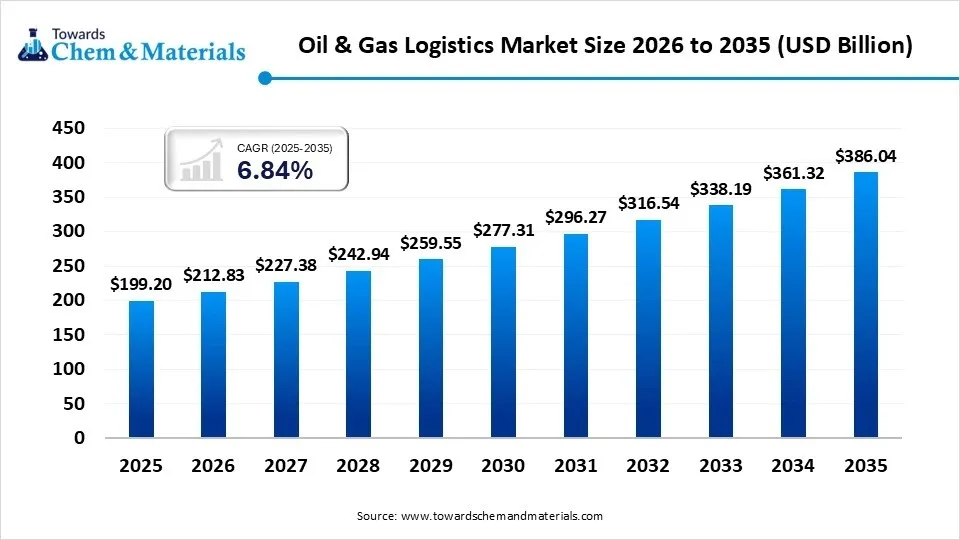
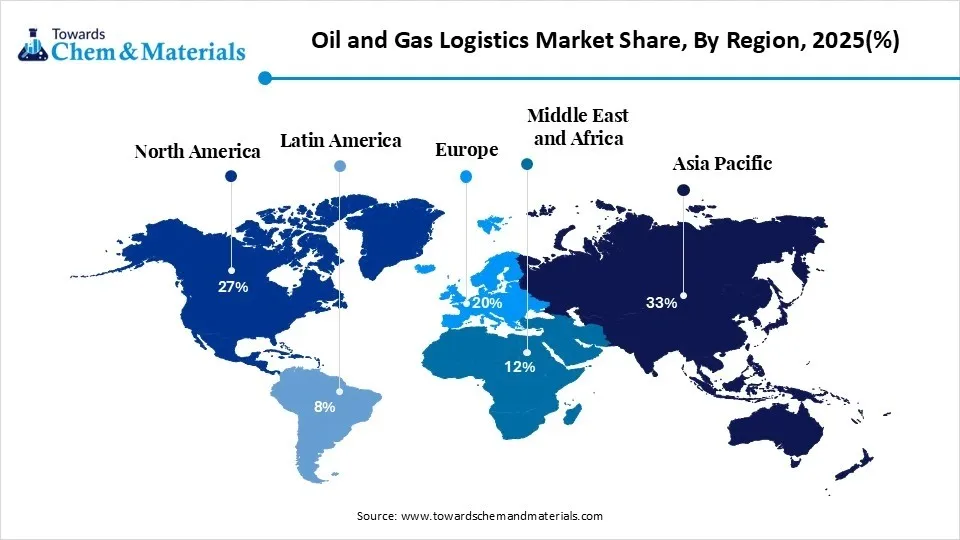
The global oil and gas logistics market size was valued at USD 199.20 billion in 2025, is estimated to reach USD 212.83 billion in 2026, and is projected to reach USD 386.04 billion by 2035, exhibiting a compound annual growth rate (CAGR) of 6.84% over the forecast period from 2026 to 2035.Asia Pacific dominated the oil and gas logistics market with the largest revenue share of 33% in 2025 and is expected to grow at the fastest CAGR of 7.00% during the forecast period. 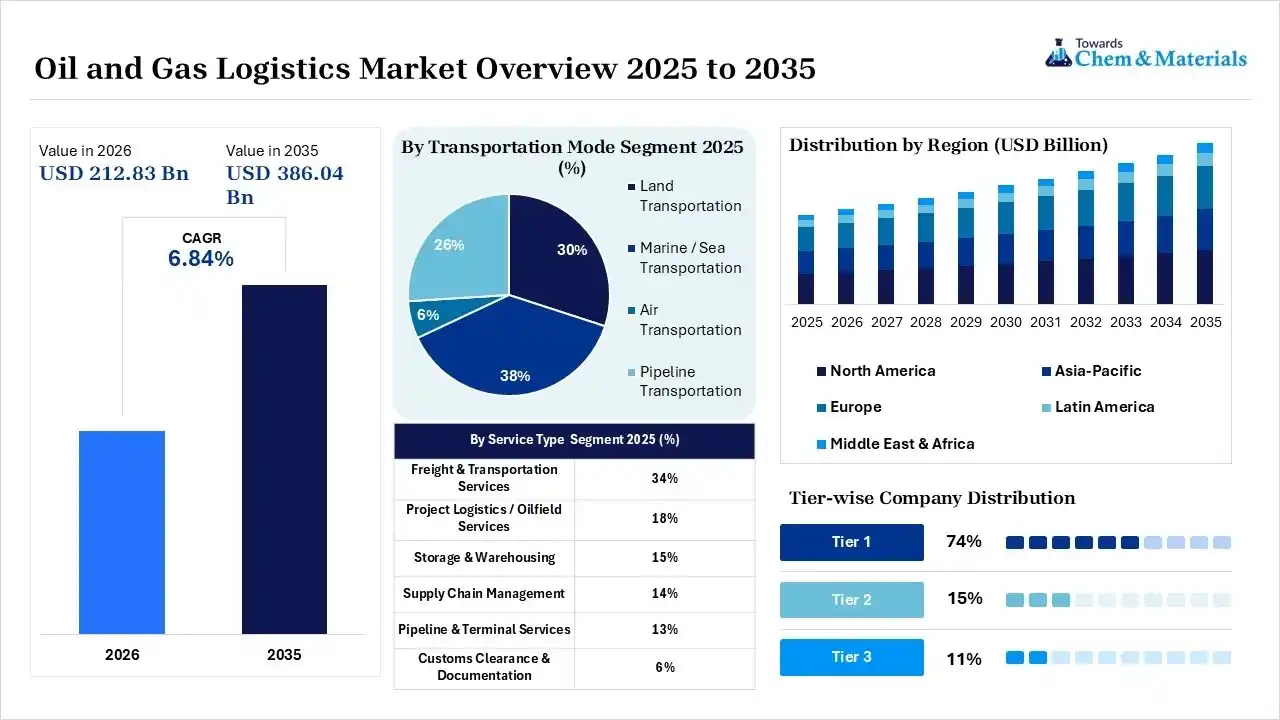 The demand across regions for crude oil, natural gas, heavy equipment, and refined products drives demand for oil and gas logistics across the supply chain. The safe handling of hazardous materials, cost efficiency across upstream, midstream, and downstream sectors, and strict regulatory compliance are some of the major factors in the market. Collaboration between the supermajors, regional operators, and logistics companies like Adani Logistics, Reliance Industries, ONGC, and APM plays a major role in the growth of the market. and will continue to grow in the coming years.
Market Highlights
- By region, Asia Pacific dominated the oil and gas logistics market with a share of 33% in 2025 and is expected to grow at a CAGR of 5.80% over the forecast period.
- By region, North America held 27% of the oil and gas logistics market share in 2025 and is expected to experience the fastest growth with a CAGR of 7.20% in the forecast period.
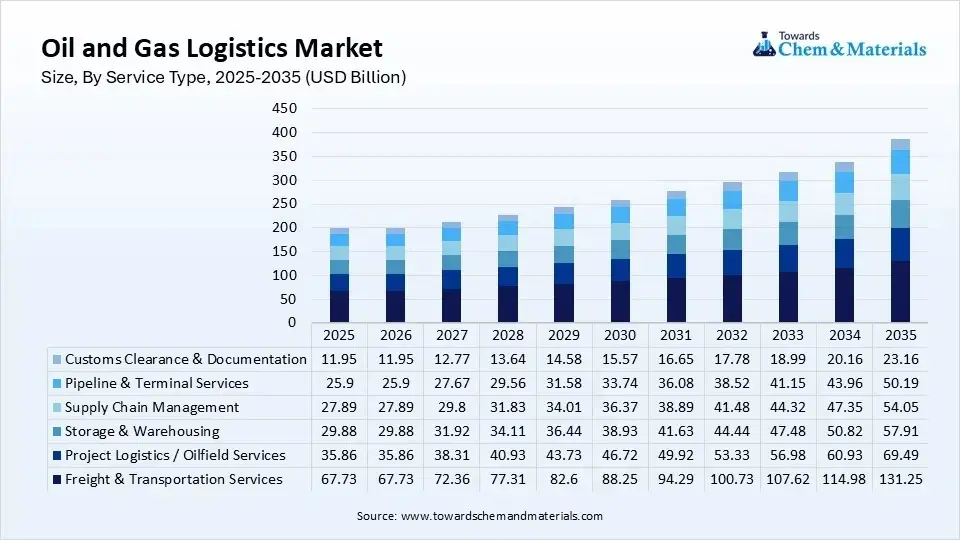
- By service type, the freight and transportation services segment dominated the market with a 34% share in 2025 and is expected to grow at a CAGR of 6.10% over the forecast period.
- By service type, the project logistics/ oilfield services segment held 18% market share in 2025 and is expected to have the fastest growth with a CAGR of 7.50% in the forecast period.
- By transportation mode, the marine/ sea transportation segment dominated the market with a 38% share in 2025 and is expected to grow at a CAGR of 6.20% over the forecast period.
By transportation mode, the air transportation segment held 6% market share in 2025 and is expected to have the fastest growth with a CAGR of 7.80% in the forecast period. - By end user, the upstream segment dominated the market with a 36% share in 2025 and is expected to grow at a CAGR of 6.20% over the forecast period.
- By end user, the petrochemicals segment held 13% market share in 2025 and is expected to have the fastest growth with a CAGR of 7.10% in the forecast period.
- By cargo type, the crude oil segment dominated the market with a 37% share in 2025 and is expected to grow at a CAGR of 5.80% over the forecast period
- By cargo type, the LNG segment held 13% market share in 2025 and is expected to have the fastest growth with a CAGR of 8.40% in the forecast period.
Oil and gas logistics involves the global transportation, storage, and inventory management of natural gas, crude oil, and specialized drilling equipment. It comprises three main sectors: upstream, midstream, and downstream. Upstream consists of exploration and extraction, midstream has pipeline and marine transport, and downstream is refining and consumer distribution. The industry relies on a complex web of logistics services to minimize costly operational delays and comply with strict environmental and safety regulations.
The oil and gas logistics market is a major factor and critical point in the global fuel supply, including global energy security, timely, thorough, cost-effective transport, governing safety and natural gas, along with heavy equipment, which is a major growth factor. Regulatory compliance and digital transformation of oil and gas products, as they are hazardous and require safety compliance in line with the stringent environmental regulations. The integration of IoT fleet tracking, predictive analytics, and blockchain is vastly improving supply chain visibility and risk management.
- For instance, in March 2026, Algeria, Nigeria, and Niger have broken ground on the $13 billion to $20 billion Trans-Saharan Gas Pipeline (TSGP), a 4,128-kilometer project aimed at delivering up to 30 bcm of gas annually to Europe by 2029. The initiative, led by Sonatrach, NNPC, and SONIDEP, establishes a strategic, land-based energy corridor designed to reduce European reliance on alternative supplies.(Source: www.agbi.com)
- For instance, in March 2026, Zanzibar has launched the construction of the $300 million Mangapwani Integrated Port in North Unguja to replace Malindi Port and transform the archipelago into an East and Central African logistics gateway. (Source: www.logupdateafrica.com)
Global Investment Flow for Oil and Gas Logistics Market 2026
The growing investment in the supply chain to push energy security, and massive investments from the government and major public sector undertakings, and also invest in supply operations to track bulk hydrocarbon distribution overseas.
Major domestic entities leading bulk material transportation and logistics include Aegis Logistics Ltd, Petronet LNG Ltd, and Confidence Petroleum India Ltd.
- In July 2026, Welspun Corp has secured fresh oil and gas export pipe orders worth approximately ₹1,400 crore. The new wins expand the companys consolidated global order book to ₹23,650 crore (around $2.5 billion), providing solid revenue visibility through FY28.(Source: infra.economictimes.indiatimes.com)
Oil and Gas Logistics Market Growth Trends
- Digitalization and decarbonization, that is, the adoption of AI-based route optimization to track real-time optimization and to enhance operational efficiency, is a growing trend in the market supporting the growth.
- The transportation mode for delivery of heavy equipment, crude oils, and other major crude and gas deliveries through pipeline transportation, due to its efficiency and safety, supports the growing trend in the market.
- The infrastructure development for fulfilling the global demand for oil and gas from the growing regions is a major growth trend in the market.
Report Scope
| Report Attributes | Details |
| Market Size in 2026 | USD 212.83 Billion |
| Expected Size in 2035 | USD 386.04 Billion |
| Growth Rate | CAGR of 6.84% |
| Base Year of Estimation | 2025 |
| Forecast Period | 2025-2035 |
| Dominant Region | Asia Pacific |
| Segment Covered | By Service Type, By Transportation Mode, By End-User, By Cargo Type, By Region |
| Key Companies Profiled | DB Schenker (Germany), C.H. Robinson (United States), Expeditors International (United States), Agility Logistics (Kuwait), BDP International (United States), Ryder System, Inc. (United States), A.P. Moller - Maersk (Denmark), COSCO Shipping Lines (China), ASCO Group (United Kingdom), GAC Group (Gulf Agency Company) (United Arab Emirates), Mammoet (Netherlands), ADNOC Logistics & Services (United Arab Emirates), Seros (India / Middle East), Halcon Primo Logistics (Singapore), Noatum Holdings (Spain), ACI Cargo (United Arab Emirates) |
Oil and Gas Logistics Market: AI Integration Optimizing Supply Chain
The integration of AI in the transformation of oil and gas logistics to process and maintain the automated supply chain by tracking records. This also helps in optimizing the routing, streamlining the global delivery network, and ensuring equipment uptime. The predictive maintenance for logistics assets, AI-powered supply chain control towers, dynamic routing and dispatch optimization, and autonomous logistics and robotics are the major technological shifts in the growth of the market.
Supply Chain Analysis of Oil and Gas Logistics Market:
Logistics Services & Transportation Operations
- Oil and gas logistics involves the transportation, storage, warehousing, inventory management, and supply chain coordination of crude oil, natural gas, refined petroleum products, drilling equipment, and industrial materials through pipelines, marine vessels, rail, road, and air transport.
- Kuehne+Nagel provides integrated logistics solutions for the oil and gas industry, including project logistics, offshore supply chain management, freight forwarding, warehousing, and transportation services that support upstream, midstream, and downstream operations.
- Key Players: DHL, Kuehne+Nagel, DB Schenker, Halliburton.
Quality Testing & Certification
- Oil and gas logistics services must comply with standards for transportation safety, hazardous material handling, supply chain security, environmental protection, and quality management.
- DHL delivers specialized logistics services for the oil and gas sector, including compliant transportation of hazardous materials, inventory management, and multimodal supply chain solutions aligned with international safety and quality standards.
- Key Authorities & Standards: International Organization for Standardization, American Petroleum Institute, International Maritime Organization, International Air Transport Association.
Distribution to End-Use Industries
- Oil and gas logistics services are provided to upstream exploration and production companies, midstream pipeline operators, refineries, petrochemical manufacturers, offshore platforms, and LNG facilities to ensure efficient movement of equipment, materials, and energy products.
- DB Schenker offers end-to-end logistics services for oil and gas projects, including heavy-lift transportation, project cargo management, customs clearance, and warehousing, helping energy companies optimize complex global supply chains.
- Key Suppliers: DHL, Kuehne+Nagel, DB Schenker.
Oil and Gas Logistics Regulatory Landscape
| Country / Region | Regulatory Body | Key Regulations | Focus Areas | Notable Notes |
| United States | Pipeline and Hazardous Materials Safety Administration (PHMSA); Department of Transportation (DOT); Environmental Protection Agency (EPA) | Hazardous Materials Regulations (HMR); Pipeline Safety Regulations | Pipeline safety, hazardous material transport | The U.S. regulates oil and gas logistics across pipelines, railways, roads, and marine transportation with stringent safety and environmental standards. |
| European Union | European Commission; European Maritime Safety Agency (EMSA) | ADR Agreement; Seveso III Directive | Cross-border transport, hazardous cargo safety | The EU promotes safe and efficient transportation of petroleum products while strengthening environmental protection and supply chain resilience. |
| China | Ministry of Transport (MOT); National Energy Administration (NEA) | Dangerous Goods Transport Regulations; Pipeline Protection Regulations | Energy transportation, logistics infrastructure | China is expanding its pipeline network, ports, and storage facilities to support increasing oil and gas demand. |
| India | Petroleum and Natural Gas Regulatory Board (PNGRB); Ministry of Petroleum and Natural Gas | PNGRB Act; Petroleum Rules | Pipeline expansion, fuel distribution | India is investing in pipeline infrastructure, LNG terminals, and multimodal logistics to improve energy distribution efficiency. |
| Saudi Arabia | Ministry of Energy; Saudi Ports Authority (Mawani) | National Transport and Logistics Strategy; Petroleum Transport Regulations | Crude oil exports, logistics modernization | Saudi Arabia is strengthening integrated logistics infrastructure to enhance crude oil exports and downstream petroleum distribution. |
| Norway | Norwegian Offshore Directorate (NOD); Norwegian Maritime Authority (NMA) | Petroleum Act; Maritime Safety Regulations | Offshore logistics, marine transport | Norway maintains strict regulations for offshore logistics operations to ensure safe and efficient transportation from North Sea oil and gas fields. |
The Key Product Types of Oil and Gas Logistics
The oil and gas logistics products are categorized based on the supply chain sectors that are upstream, midstream, and downstream processing. The logistical focus dictates the type of product: heavy equipment/machinery for upstream, large-volume raw hydrocarbons for midstream, and consumer-ready refined fuels/petrochemicals for downstream.
Upstream (Exploration & Production)
- Logistics in this phase focuses on moving heavy, specialized industrial equipment and personnel to remote or offshore drilling sites.
- Drilling Rigs & Equipment: Heavy machinery like blowout preventers, derricks, and drill pipes.
- Bulk Fluids: Logistics for drilling muds, hydraulic fracturing sand, and water.
- Project Cargo: Oversized materials required to build oil platforms and processing facilities.
Midstream (Transportation & Storage)
- These fuels or oils are raw materials that are then further processed and formed into finished products. They are extracted from the fields in raw form and then given to refineries and storage terminals. The chemicals or oils include:
- Crude Oil: Unrefined petroleum transported via pipelines, rail, or massive Very Large Crude Carriers (VLCCs) at sea.
- Natural Gas: Transported via pipelines or as Liquefied Natural Gas (LNG) in specially designed cryogenic marine tankers.
- Natural Gas Liquids (NGLs): Separated gas byproducts like ethane, propane, and butane.
Downstream (Refining & Distribution)
In these, the final and processed fuels are categorised, which are filtered from the raw and crude materials into refined products that can be hazardous and temperature-sensitive, and are now directly distributed to consumers as they are ready to be distributed to the end users without further processing. The fuels that are used or final process fuels include:
- Transportation Fuels: which are finished goods such as gasoline, diesel, and jet fuel.
- Petrochemicals are the Feedstocks and reagents used to manufacture plastics, synthetic rubber, and fertilizers.
- Specialty Products: Lubricants, bitumen (asphalt), and paraffin wax.
- Operational/Safety Equipment: Logistical management of necessary facility supplies like spill containment kits and QHSSE (Quality, Health, Safety, Security, and Environment) gear.
Market Dynamics
Digital Transformation Tailoring Global Demand
The oil and gas logistics market growth is driven by the rising energy demand, remote and offshore exploration, digital transformation, infrastructure expansion, and supply chain outsourcing, which further propels the growth of the market. The expansion of the upstream and downstream operations and increased shale production also contribute to the growth. Furthermore, the integration of advanced digital technologies and the necessity for energy security are driving significant supply chain transformation.
Environmental Regulation: Hindering Global Transition
The major and key growth challenges that hinder the growth and expansion of the market are remote locations, infrastructure bottlenecks, strict environmental and safety regulations, geopolitical and market volatility, global energy transition, and supply chain digitalization. Volatile commodity prices, stringent HSSE (Health, Safety, Security, and Environment) compliance, and the global energy transition. Together, these factors force supply chains to adapt continuously.
Renewable Energy Infrastructure: A Step Towards Environmental Development
The oil and gas logistics market is experiencing growth driven by regional expansion and market consolidation through infrastructure development in regions to increase production capacities and expand on a large scale, supporting the growth of the market. The other key growth drivers are digitalization and AI route optimization, which reduce transportation costs and also improve material handling. Development of LNG and renewable energy infrastructure, and intermodal transportation are major opportunities in the market. These advancements help operators manage fluctuating fuel demand and navigate complex, hazardous supply chains.
Segmental Insights
Service Type Insights
The freight and transportation services segment dominated the market with a 34% share in 2025 and is expected to grow at a CAGR of 6.10% over the forecast period increased deep water and offshore drilling activities and demand for specialized services. The companies are also outsourcing to third-party logistics providers to manage the complex and remote supply chain. Digital optimization through the integration of real-time tracking, AI-driven routes, and cloud-based workshops helps improve the supply chain.
- For instance, In June 2026, Qatar Airways Cargo has launched EnergyLift, a specialized airport-to-airport air freight product for the global energy sector. The rollout marks the industrys first fully dedicated, end-to-end air cargo solution tailored for time-critical energy infrastructure.(Source: www.stattimes.com)
The project logistics/ oilfield services segment held 18% market share in 2025 and is expected to have the fastest growth with a CAGR of 7.50% in the forecast period. This growth is driven by a surge in offshore developments, remote exploration activities, and the need to transport oversized drilling and heavy-lift equipment to complex, large-scale energy projects. The upstream infrastructure expansion, heavy lift and oversized cargos, and digital transformation support growth.
Oil & Gas Logistics Market Share, By Service Type, 2025(%)
| By Service Type | Market Share (%) |
| Freight & Transportation Services | 34% |
| Project Logistics / Oilfield Services | 18% |
| Storage & Warehousing | 15% |
| Supply Chain Management | 14% |
| Pipeline & Terminal Services | 13% |
| Customs Clearance & Documentation | 6% |
Transportation Mode Insights
the marine/ sea transportation segment dominated the market with a 38% share in 2025 and is expected to grow at a CAGR of 6.20% over the forecast period, driven by the rising trade of LNG cross borders due to growing demand from industries from various region, increased offshore exploration, and geopolitical shifts that force energy carriers to take longer transoceanic routes, boosting overall shipping demand, contributes to the growth and expansion of the market.
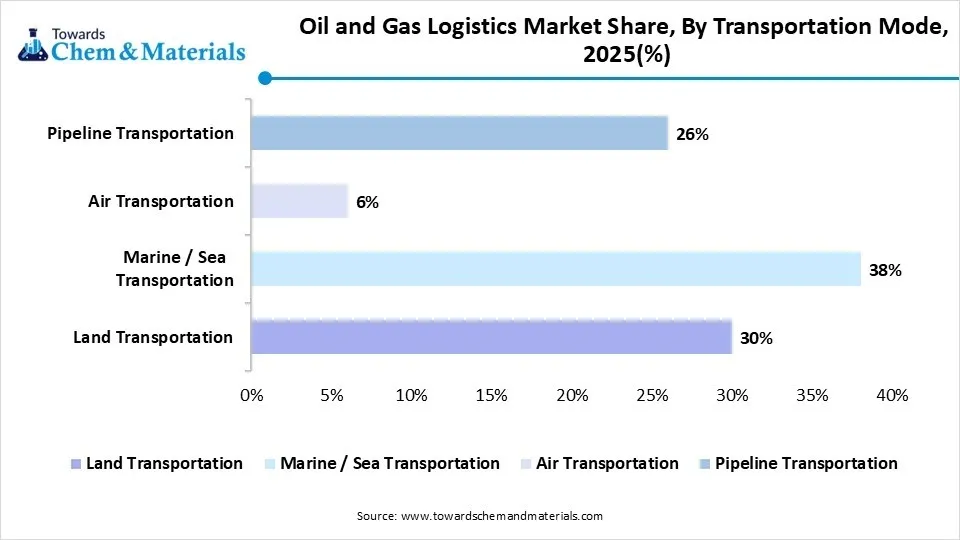
The air transportation segment held 6% market share in 2025 and is expected to have the fastest growth with a CAGR of 7.80% in the forecast period, driven by the high demand for specialized air transportation to minimize costly operational downtimes and to be accessible to inaccessible regions through specialized fuel transfer, which supports the growth. The urgent delivery or transfer of high-end value replacement parts to remote drilling sites requires air transportation, contributing to the growth.
Oil & Gas Logistics Market Share, By Transportation Mode, 2025(%)
| By Transportation Mode | Market Share (%) |
| Land Transportation | 30% |
| Marine / Sea Transportation | 38% |
| Air Transportation | 6% |
| Pipeline Transportation | 26% |
End User Insights
The upstream segment dominated the market with a 36% share in 2025 and is expected to grow at a CAGR of 6.20% over the forecast period, driven by heavy lift transport, supply chain management, and material field enhancement, supporting market expansion. The adoption of automated inventory tracking through technological integration with real-time freight monitoring is expected to increase and improve safety in the exploration and production supply chain.
The petrochemicals segment held 13% market share in 2025 and is expected to have the fastest growth with a CAGR of 7.10% in the forecast period. The growing population and demand for transportational need results in the surge of oil and gas demand, especially petrochemicals. The green energy use and advanced petrochemical production through shifting towards cleaner fuels amid rising environmental concerns increase the demand from the industries, contributing to their growth.
Oil & Gas Logistics Market Share,By End-User , 2025(%)
| By End-User | Market Share (%) |
| Upstream | 36.00% |
| Midstream | 27.00% |
| Downstream | 24.00% |
| Petrochemicals | 13.00% |
Cargo Type Insights
The crude oil segment dominated the market with a 37% share in 2025 and is expected to grow at a CAGR of 5.80% over the forecast period. The growing demand from regions and countries to fulfil the energy demand for respective countries for different sectors contributes to the growth of the market. The high-end investment in infrastructure development to export crude oil to regions with high demand due to its use in various sectors contributes to the growth of the market.
The LNG segment held 13% market share in 2025 and is expected to have the fastest growth with a CAGR of 8.40% in the forecast period. The growing demand for clean fuels, aligning with environmental awareness, and regional collaborations for power supply, industrial fuel switching, long-term supply agreements, and strengthening the LNG position as a strategic energy resource fuel the growth of the market. The expanding LNG capacity across borders through floating storage units and terminals is a major growth driver.
- For instance, in March 2026, Saudi Arabia has launched the Logistics Corridors Initiative to reroute commercial cargo away from the Arabian Gulf directly to its west coast Red Sea ports. The emergency logistics framework bypasses severe maritime shipping disruptions caused by the ongoing war in Iran and military restrictions throttling the Strait of Hormuz.(Source: www.arabnews.com)
Oil & Gas Logistics Market Share, By Cargo Type, 2025(%)
| By Cargo Type | Market Share (%) |
| Crude Oil | 37.00% |
| Refined Products | 22.00% |
| LNG | 13.00% |
| NGL | 8.00% |
| Drilling Equipment | 9.00% |
| Chemicals & Additives | 7.00% |
| Other MRO | 4.00% |
The Greater Benefits of Oil and Gas Logistics
Oil and gas logistics help in streamlining the global export and import of natural gas, crude oil, and heavy equipment, due to growing demand from various regions to fulfill the demand and need from various industrial sectors for energy efficiency. The key benefits offered are cost savings by optimizing routes and processes through integration of AI or process optimization, enhanced supply chain reliability to prevent costly downtime through infrastructure development, strict safety and compliance measures for handling hazardous materials, and end-to-end visibility utilizing real-time tracking.
The Other Advantages are As Follow:
- Cost Savings and Efficiency: By optimizing transport routes, managing bulk tanks efficiently, and reducing idle round trips, logistics mitigate fuel and labor waste. Integrating advanced software and predictive analytics keeps operational expenditures low.
- Supply Chain Reliability: In a volatile sector, well-managed logistics prevent disruptions, ensuring timely delivery of equipment to project sites and steady distribution of raw materials and refined goods.
- Enhanced Safety and Compliance: Transporting petroleum and heavy machinery carries significant risks. Logistics strategies prioritize specialized equipment, highly trained personnel, and strict adherence to environmental and local transit regulations.
- Real-Time Visibility: With modern IoT sensors and integrated tracking systems, companies benefit from end-to-end visibility monitoring pipeline pressure, temperature, and fleet locations in real-time.
- Specialized Project Handling: Logistics services cater to oversized and heavy-lift cargo like turbines and drill pipes through multimodal transport, route surveys, and customs clearance, ensuring safe delivery to even remote locations.
Regional Analysis
How did Asia Pacific dominate the Oil and Gas Logistics Market in 2025?
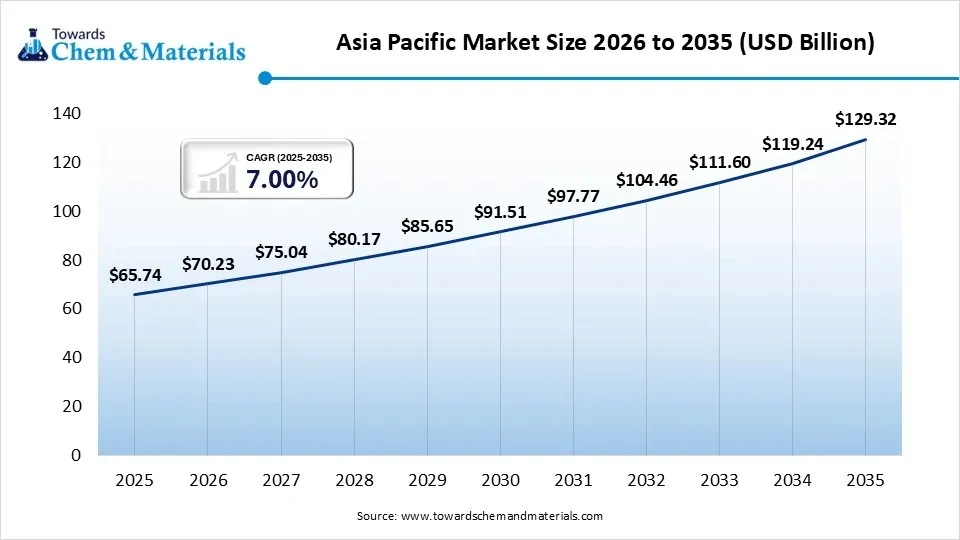
The Asia Pacific oil and gas logistics market size was estimated at USD 65.74 billion in 2025 and is projected to reach USD 129.32 billion by 2035, growing at a CAGR of 7.00% from 2026 to 2035. Asia Pacific dominated the oil and gas logistics market with a share of 33% in 2025 and is expected to grow at a CAGR of 5.80% over the forecast period due to massive infrastructure CAPEX in countries like India and China, aligning with the digital transformation through modernizing the pipeline network, storage capacity, and LNG supply chain, which contributes to the growth of the market. Rapid industrialization and urbanization in the region increase the energy demand, which in turn demands uninterrupted transport of products like oil and gas across the region and refined product distribution. The massive infrastructure development and investment for onshore projects create a robust distribution network supporting growth in the region.
- For instance, Kabal has opened a new office and a dedicated support team in Kuala Lumpur, Malaysia, to scale its logistics management software footprint across the Asia-Pacific (APAC) region. The platform operates as a localized industry standard in the North Sea, the Gulf of Mexico, and Newfoundland, managing a global user base of 7,000 companies and 55,000 individual users.(Source: kabal.com)
Indias Presence of Major Hub and Domestic Production
The oil and gas logistics market in India is expanding due to the expansion of city gas distribution across geographic areas, transported via pipelines, while localized cascades and cryogenic tankers supply. The presence of major hubs in a country like Jamnagar and domestic diesel demand further propels the growth. The providers, such as Seashell Group and leading operators like Aegis Logistics, handle millions of metric tons of LPG annually through ports such as Haldia, Mumbai, and Pipavav, Indias domestic production coastal facilities. The global players in the country offer comprehensive programs to tailor energy compliance, disrupted supply chain, and hazardous cargo, which are major contributors to the market growth.
- For Instance, in July 2026, ONGC has approved a project to add 1.75 million tons of strategic crude oil reserve capacity in Mangalore, Karnataka. The strategic driver is strengthening domestic energy resilience following international supply shocks from the Iran war, which severely impacted traffic through the Strait of Hormuz.(Source: www.energyconnects.com)
China National Champions Presence for Integrated Supply Chain
The China oil and gas logistics market is experiencing growth in the state-directed network that integrates overland pipelines, large-scale underground rock caverns to bypass strategic maritime chokepoints, and ensure energy security, supporting growth. The presence of national champions like SINOPEC and CNPC supports the management of integrated supply chains operating pipelines to feed major refining and petrochemical centers, which supports the growth of the market. China is advancing storage facilities, shifting from traditional infrastructure or storage facilities to store emergency petroleum reserves safely and efficiently, supporting the growth and expansion of the market.
- For instance, in April 2026, China launched the Celsius Georgetown, one of its largest domestically built liquefied natural gas (LNG) carriers, to secure its energy supply routes amid the ongoing blockade of the Strait of Hormuz.(Source: timesofindia.indiatimes.com)
North America Oil and Gas Logistics Market Growth Factor
The North America oil and gas logistics market size was estimated at USD 53.78 billion in 2025 and is projected to reach USD 106.16 billion by 2035, growing at a CAGR of 7.04% from 2026 to 2035. North America held 27% market share in 2025 and is expected to experience the fastest growth with a CAGR of 7.20% in the forecast period driven by the massive shale production and soaring LNG export capacity with integrated AI data enter presence in region which helps in smooth supply chain and for fulfilling the demand from Suez and Hormuz with massive infrastructure investment by firms like Enbridge and Kinder Morgan supporting the growth of the market. The surge in domestic gas demand and digital optimization by leveraging intelligent tracking, pipeline automation, and AI-based route optimization helps in safety and streamlines the transport of resources across the countries in the region like Mexico, the US, and Canada, supporting the growth and expansion of the market.
- For Instance, in July 2026, Sempra Infrastructure has loaded and shipped its first cargo of liquefied natural gas (LNG) from the Energía Costa Azul (ECA) LNG Phase 1 project in Ensenada, Baja California. This marks the first-ever LNG export shipment from Mexicos Pacific Coast.(Source: mexicobusiness.news)
United States Production of Large Natural Gas and Export
The United States oil and gas logistics market is driven by the presence of domestic shale production, and exports 13.6 million barrels of crude and 109 billion cubic feet of natural gas per day, aligning with the infrastructure development of storage and coast development. The expansion of projects in the country, like Sabine Pass in Louisiana, to meet the surging global energy demand and increase export capacity, supports the growth of the market.
- For Instance, in May 2026, UTC Overseas and Transoceanic Development have launched a joint venture named UTC Transoceanic (UTC Transo) to support energy, power, and industrial infrastructure projects along the U.S. Gulf Coast. Positioned to handle a massive surge in local investments, backed by nearly $100 billion in recently announced capital expenditures (CAPEX) and another $100 billion in Louisianas pipeline.(Source: www.oedigital.com)
Canada Innovation and Federal Support Across the Country
The oil and gas logistics market in Canada is experiencing expansion, with major growth, along with the presence of major projects like the Trans Mountain pipeline expansion and the shipment-based LNG Canada terminal in Kitimat, British Columbia, which supports the growth of the market. The massive infrastructure development plans and projects, with Canadas strong funds and investments, accelerate energy export and market access, supporting the growth of the market. The development and focus on streamlining operations through LNG Canada launch, pipeline expansion, innovative rail logistics, and federal support are the major factors propelling growth.
- For Instance, LNG Canada has launched its first-ever liquefied natural gas (LNG) export shipment from Canadas Pacific Coast to Asia. The inaugural cargo was loaded aboard the vessel Gaslog Glasgow at the newly operational facility in Kitimat, British Columbia.(Source: www.oilandgasadvancement.com)
Europe Oil and Gas Logistics Market Growth Factor
The Europe oil and gas logistics market size was estimated at USD 39.84 billion in 2025 and is projected to reach USD 79.14 billion by 2035, growing at a CAGR of 7.10% from 2026 to 2035. Europe held a market share of 20% in 2025, driven by the presence of a facility which is designed to support drilling companies and operators across the regions, positioned for direct access to the port and airport of Aberdeen. Key infrastructure developments of the vertical corridor, TAP capacity updates, and offshore project cargo, such as Equinors Rosebank and Lochnagar in the UK, will help in the growth of the market in the coming years. The growing application and energy demand in the region increase the demand and supply of oil and gas across the region, supporting growth.
- For Instance, in May 2026, Norway is reviving three long-dormant North Sea gas fields, Albuskjell, Vest Ekofisk, and Tommeliten Gamma, to help ease Europes industrial energy supply squeeze. Most of the gas output will be piped directly to Germany to supply its core industrial buyers, while a smaller condensate stream will be routed to the UK.(Source: enterpriseam.com)
United Kingdom Joint Ventures Expanding Growth
UK oil and gas logistics market is experiencing growth due to growing investment by major players and investment by the players to build new oil and gas companies in the country with joint ventures, which supports the growth of the market. The growing energy demand and demand for domestic production like Rosebank and Jackdaw, and the security of the energy supply in the country, further support the expansion of the market. The midstream expansion due to strong investment by the companies in carbon capture and hydrogen transport infrastructure further propels the growth.
- For instance, earlier, Shell and Equinor are merging their UK offshore oil and gas assets to form the UK North Seas largest independent energy producer. The new corporate joint venture will operate as a standalone, agile business to sustain falling domestic production.(Source: oilandgaspress.com)
Germanys Massive Development and Import Facilities
The oil and gas logistics market in Germany is heavily driven by the countrys shift towards diversifying supply sources and also expanding infrastructure development, which boosts import flexibility across the country. The key developments include the startup of Stade floating storage, Algerian Sonatrach supply, SOCAR agreement, hydrogen superhighway, and conventional logistics. As natural gas is pipelined, management of traditional crude oil, additives, and petroleum products will take place through these developments, contributing to the expansion of the market in
Germany.
- For instance, in January 2026, SOCAR has started supplying natural gas to Austria and Germany via Italy, expanding its European market footprint to 16 purchasing nations. SOCAR locked in a 10-year agreement with the German state-secured energy firm SEFE. The contract covers 1.5 billion cubic metres (bcm) of gas annually. This expansion marks a major step forward in Azerbaijans broader push to market its domestic gas resources deeper into the European Union and the Middle East.(Source: ceenergynews.com)
- For instance, in June 2026, Germany will launch its final approved floating LNG import terminal in Stade this September after a two-year delay. The project concludes that Germanys rapid emergency gas infrastructure expansion was triggered by the Russian gas price shock.(Source: www.upstreamonline.com)
Latin America Oil and Gas Logistics Market Growth Factor
The Latin America oil and gas logistics market size was estimated at USD 15.94 billion in 2025 and is projected to reach USD 32.81 billion by 2035, growing at a CAGR of 7.49% from 2026 to 2035. Latin America held a market share of 8% in 2025, driven by the surge in cross-border operations and LNG export infrastructure, with the presence of major regional giants shaping the growth of the market in the region. The major regional milestones that will support the growth are the Brazil and Mexico collaboration, which boosts crude oil production; Argentinas LNG Boom; Colombias LNG terminal; and remote heavy lift projects. The presence and expansion of the deepwater and unconventional plays in the region are expanding the market significantly.
- For Instance, in June 2026, Colombias first Pacific coast LNG import facility is on track to begin operations on November 1, 2026. The project will help secure the regional fuel supply amid a deepening domestic gas deficit and severe hydropower fluctuations.(Source: www.bnamericas.com )
Brazils Massive Investments and Production Facility Presence
The Brazilian oil and gas logistics market is experiencing growth driven by the offshore pre-salt output and massive infrastructure investments supporting the growth of the market. The robust growth is transforming Brazil into a global energy powerhouse. The projects and ongoing infrastructure development, like Petrobras & Transpetro Fleet Expansion, Port of Açu Transshipment Hub, NITROLOG Base, and Aliseo Logistics Base, are the major supporting factors in the growth of the market. The export expansion and HGAS network build-out drive the massive growth in the market.
- For Instance, in April 2026, ExxonMobil has completed its first-ever crude oil transshipment operation in Brazil, marking a historical operational milestone after 110 years of business presence in the country. The process involved transferring 1 million barrels of crude oil destined for the international market.(Source: www.upstreamonline.com)
Argentina Midstream Expansion and Transforming Projects
The Argentine oil and gas logistics market is experiencing growth driven by rapid expansion with major investments in infrastructure and services. The crude production, midstream expansion, and major projects are transforming the nation from an energy importer to a major global exporter, which is a major driver of the growth of the market. The strategic shifts in the country, such as the Vaca Muerta Sur (VMOS) Oil Pipeline, Floating LNG (FLNG) Export Facilities, Logistical Integration, and Regional Reversal Pipelines, contribute to the growth of the market.
- For instance, in June 2026, Argentina government has approved two major infrastructure projects totaling $1.8 billion in investments under its Large Investment Incentive Regime (RIGI). The approvals fast-track the 473-kilometre San Matias natural gas pipeline and POSCOs Sal de Oro lithium expansion project.(Source: www.industrialinfo.com)
Middle East and Africa Oil and Gas Logistics Market Growth Factor
The Middle East and Africa oil and gas logistics market size was estimated at USD 23.90 billion in 2025 and is projected to reach USD 48.26 billion by 2035, growing at a CAGR of 7.28% from 2026 to 2035. The Middle East and Africa held a market share of 12% in 2025, driven by Red Sea shipping disruptions and Gulf tanker security tensions. Operators are aggressively launching new fleets and alternative regional supply chain routes to bypass traditional chokepoints like the Strait of Hormuz. Massive infrastructure projects in Saudi Arabia and the UAE focus on handling large hydrocarbon exports. Specifically, the Port of Fujairah in the UAE has seen expanding access and storage use, providing greater sales flexibility for regional crude and refined products supporting growth.
- For instance, in July 2026, ADNOC Logistics & Services (ADNOC L&S) has placed a $900 million order for four next-generation LNG carriers from Chinas Jiangnan Shipyard. The strategic investment accelerates the Abu Dhabi national energy companys push to secure control over its global supply chain.(Source: www.oilandgasmiddleeast.com)
Saudi Arabia: Large Production Hub and Exporter
The oil and gas logistics market in Saudi Arabia is experiencing massive growth driven by Ara, cos upstream capital expansion and massive build-out, with key infrastructure and mega projects like master gas system Phase 3, Yanbu and Red Sea logistics, upstream specifying and economic diversification through national industrial development logistics program in the country, supporting the growth of the market. The logistics grants and logistics chains are also the main factors for industrial expansion.
- For instance, in July 2026, Mohammed Hadi Al Rasheed & Partners has agreed to acquire a 50% stake in Taif Shipping for SAR 92.5 million. The transaction marks a major vertical integration move for the Saudi industrial silica sand mining firm.(Source: enterpriseam.com)
UAE Enhancing and Development of Technology
The oil and gas logistics market is experiencing growth due to a growing focus on expanding global reach, supply chain diversification, and enhancing integrated shipping, such as ADNOC Logistics and Services Expansion, Etihad Energy Holding Launch, Bypassing Hormuz with New Pipelines, and Borouge Rail Corridor, enhancing major logistics and infrastructure in the country, contributing to the growth of the market.
For instance, in August 2025, ADNOC recently finalized framework agreements worth $1.64 billion with 12 UAE-based companies to manufacture critical equipment locally, supporting the Make it in the Emirates initiative.(Source: www.google.com)
Competitive Analysis
The massive growth in key players collaboration, like ONGC and Mitsui O.S.K. Lines, to strengthen the supply chain and energy logistics across borders, helps in the growth of the market. Major recent joint ventures and partnerships across maritime shipping, port infrastructure, and clean energy distribution are actively reshaping the industry.
- ONGC has partnered with Japans Mitsui OSK Lines to enter the specialized ethane shipping market through two new joint ventures registered in GIFT City, Gujarat. The strategic alliance secures a dedicated supply chain for raw industrial materials imported from North America.
(Source: infrastructuretoday.co.in ) - GreenLine Mobility Solutions has partnered with Mondelez International (India) to deploy LNG-powered trucks for sustainable product distribution across India. The clean-energy shipping fleet was officially rolled out at Mondelez’s manufacturing plant in Alwar, Rajasthan.(Source: energy.economictimes.indiatimes.com)
- Indian Strategic Petroleum Reserves Limited (ISPRL) and the Abu Dhabi National Oil Company (ADNOC) have signed a Memorandum of Understanding (MoU) for a strategic energy storage partnership. This bilateral collaboration enables the potential storage of up to 30 million barrels of crude oil by ADNOC within Indias strategic petroleum reserve (SPR) network.(Source: indianinfrastructure.com)
Recent Developments
- In April 2026, Indian Railways and Bharat Petroleum Corporation Limited (BPCL) signed an agreement to develop a Gati Shakti multi-modal cargo terminal at Bajalta, near Jammu city. The project strengthens fuel logistics, providing a stable, year-round energy supply chain to the strategic regions of Jammu & Kashmir and Ladakh.(Source: economictimes.indiatimes)
- In May 2026, an Egyptian-Chinese consortium launched a $71 million residential and logistics complex project in Iraq to support the countrys oil production infrastructure. The logistics project aligns with broader expansion efforts, including a significant discovery in Najaf province by Qurnain Petroleum Limited.(Source: www.zawya.com)
Top players in the Oil and Gas Logistics Market & Their Offerings:
| Company | Company Type/Position | Major Headquarters | Geographic Presence | Oil & Gas Logistics Offerings |
| DHL Supply Chain | Global logistics and supply chain provider | Bonn, Germany | Europe, North America, Asia Pacific, Middle East, Africa | End-to-end oil & gas logistics, warehousing, freight forwarding, inventory management, and project logistics |
| Kuehne+Nagel International AG | Global freight forwarding and logistics company | Schindellegi, Switzerland | Europe, North America, Asia Pacific, Middle East, Latin America | Offshore logistics, heavy-lift transportation, customs brokerage, and supply chain management |
| DSV A/S | International transport and logistics provider | Hedehusene, Denmark | Europe, North America, Asia Pacific, Middle East, Africa | Multimodal transportation, oilfield equipment logistics, warehousing, and freight management |
| CEVA Logistics | Global logistics and supply chain management company | Marseille, France | Europe, North America, Asia Pacific, Middle East, Africa | Project logistics, offshore support logistics, freight forwarding, and warehousing for oil & gas operations |
| Bolloré Logistics | International freight forwarding and logistics provider | Puteaux, France | Europe, Africa, Asia Pacific, Middle East, North America | Project cargo, offshore logistics, heavy equipment transportation, customs clearance, and supply chain solutions |
Other Top Players Are
- DB Schenker (Germany)
- C.H. Robinson (United States)
- Expeditors International (United States)
- Agility Logistics (Kuwait)
- BDP International (United States)
- Ryder System, Inc. (United States)
- A.P. Moller - Maersk (Denmark)
- COSCO Shipping Lines (China)
- ASCO Group (United Kingdom)
- GAC Group (Gulf Agency Company) (United Arab Emirates)
- Mammoet (Netherlands)
- ADNOC Logistics & Services (United Arab Emirates)
- Seros (India / Middle East)
- Halcon Primo Logistics (Singapore)
- Noatum Holdings (Spain)
- ACI Cargo (United Arab Emirates)
Segments Covered:
By Service Type
- Freight & Transportation Services
- Road Freight
- Rail Freight
- Heavy Haul Transportation
- Project Logistics / Oilfield Services
- Rig Mobilization
- Heavy Lift & Oversized Cargo
- EPC Logistics Support
- Storage & Warehousing
- Tank Storage
- Bonded Warehousing
- Equipment Storage
- Supply Chain Management
- Inventory Management
- Procurement Logistics
- Digital Supply Chain Services
- Pipeline & Terminal Services
- Pipeline Logistics
- Terminal Operations
- Loading & Unloading Services
- Customs Clearance & Documentation
- Import Documentation
- Export Documentation
- Trade Compliance Services
By Transportation Mode
- Land Transportation
- Truck
- Rail
- Marine / Sea Transportation
- Tankers
- Offshore Supply Vessels
- Barges
- Air Transportation
- Cargo Aircraft
- Charter Services
- Pipeline Transportation
- Crude Oil Pipelines
- Natural Gas Pipelines
- Multi-product Pipelines
By End-User
- Upstream
- Exploration
- Drilling
- Production
- Midstream
- Transportation
- Storage
- Terminals
- Downstream
- Refining
- Distribution
- Fuel Marketing
- Petrochemicals
- Basic Chemicals
- Specialty Chemicals
- Polymers
By Cargo Type
- Crude Oil
- Refined Products
- LNG
- NGL
- Drilling Equipment
- Chemicals & Additives
- Other MRO
- Spare Parts
- Industrial Consumables
- Maintenance Equipment
By Regions
- North America
- Europe
- Asia Pacific
- Middle East & Africa
- Latin America
A Seven-Phase Framework
Our methodology is designed to be universally applicable across commodity chemicals, specialty chemicals, petrochemicals, construction chemicals, coatings, electronic chemicals, industrial gases, agrochemicals, water treatment chemicals, and performance materials. Each phase builds upon the last, creating a layered validation structure that minimizes estimation error and maximizes analytical confidence.
The framework ensures comprehensive market coverage, robust cross-validation, and reliable long-term forecasting — producing market estimates that withstand scrutiny from investors, regulators, and corporate strategy teams.

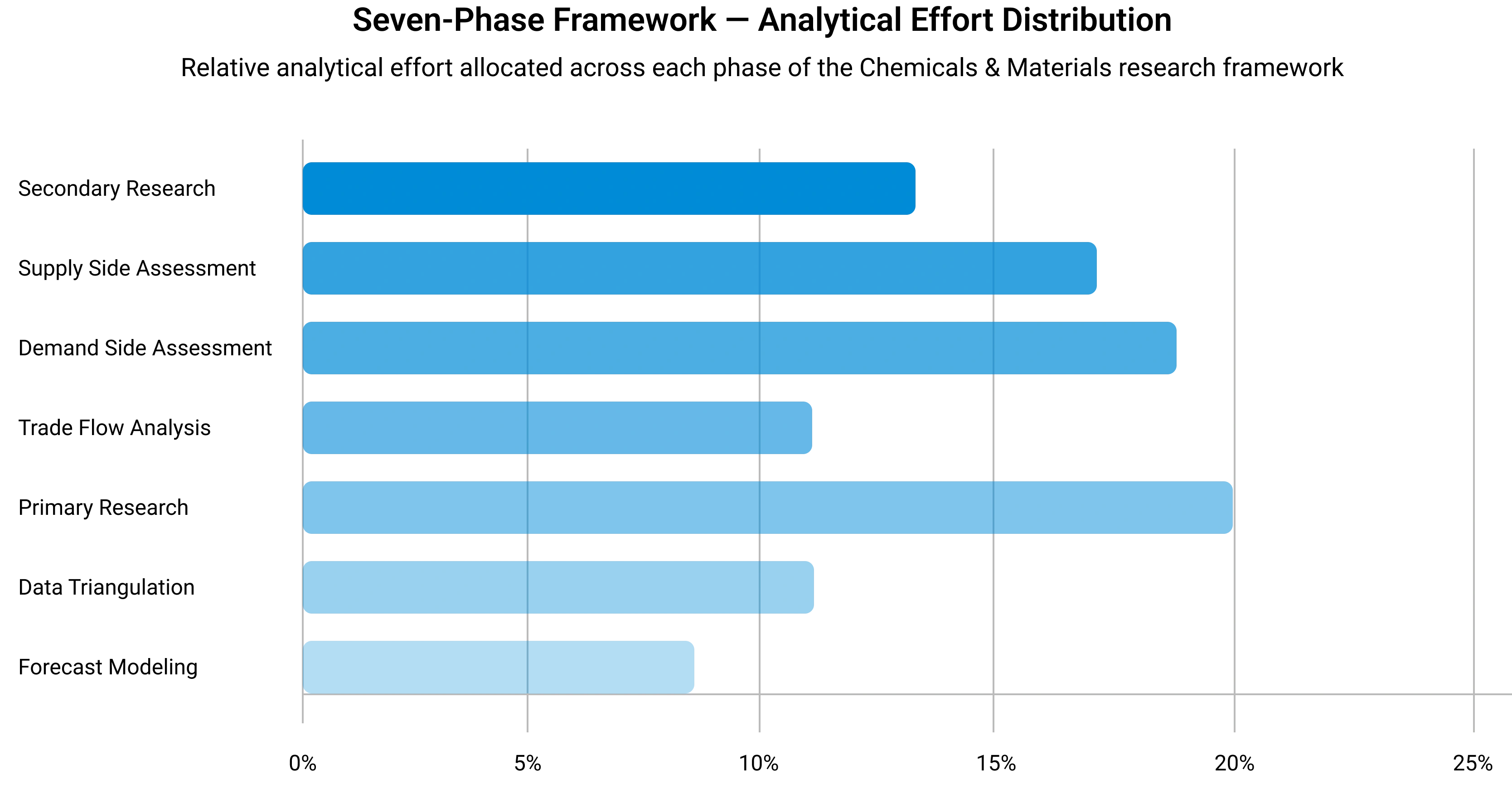
Seven-Phase Framework — Analytical Effort Distribution
Relative analytical effort allocated across each phase of the Chemicals & Materials research framework
Phase 1 - Secondary Research: Establishing the Foundation
Secondary research collects and evaluates publicly available information from authoritative sources, establishing the foundational understanding of market structure, value chain dynamics, competitive landscape, and end-use demand patterns. Every source is evaluated for credibility, recency, geographic relevance, and methodological soundness before inclusion.
Industry Associations
Sources include ACC, CEFIC, ICCA, JCIA, CPCIF, and SOCMA providing production volumes, consumption trends, capacity developments, and sustainability initiatives.
Company Disclosures
Annual reports, investor presentations, earnings transcripts, and regulatory filings reveal product portfolios, manufacturing footprints, capacity expansions, and revenue segmentation.
Government Databases
National statistical offices, customs authorities, environmental agencies, and industrial production databases provide verified statistics on output, trade flows, and regulatory compliance.
Trade Databases
UN Comtrade, ITC, Eurostat, and national customs authorities enable assessment of global product movement, import dependency, and export competitiveness across regions.
Our Secondary Research Sources
- Ministry of Chemicals and Fertilizers
- European Chemicals Agency
- United States Department of Energy
- Ministry of Industry and Information Technology
- Ministry of Economy Trade and Industry
- Ministry of Trade Industry and Energy
- National Institute of Standards and Technology
- Council of Scientific and Industrial Research
- Fraunhofer Society
- National Institute for Materials Science
Phase 2 — Supply-Side Assessment: Mapping Production Capabilities
Production Capacity Analysis
All major manufacturers are assessed for existing installed capacity, planned additions, expansions, new plant announcements, and technology adoption — mapped at global, regional, and country levels.
Capacity Utilization Adjustment
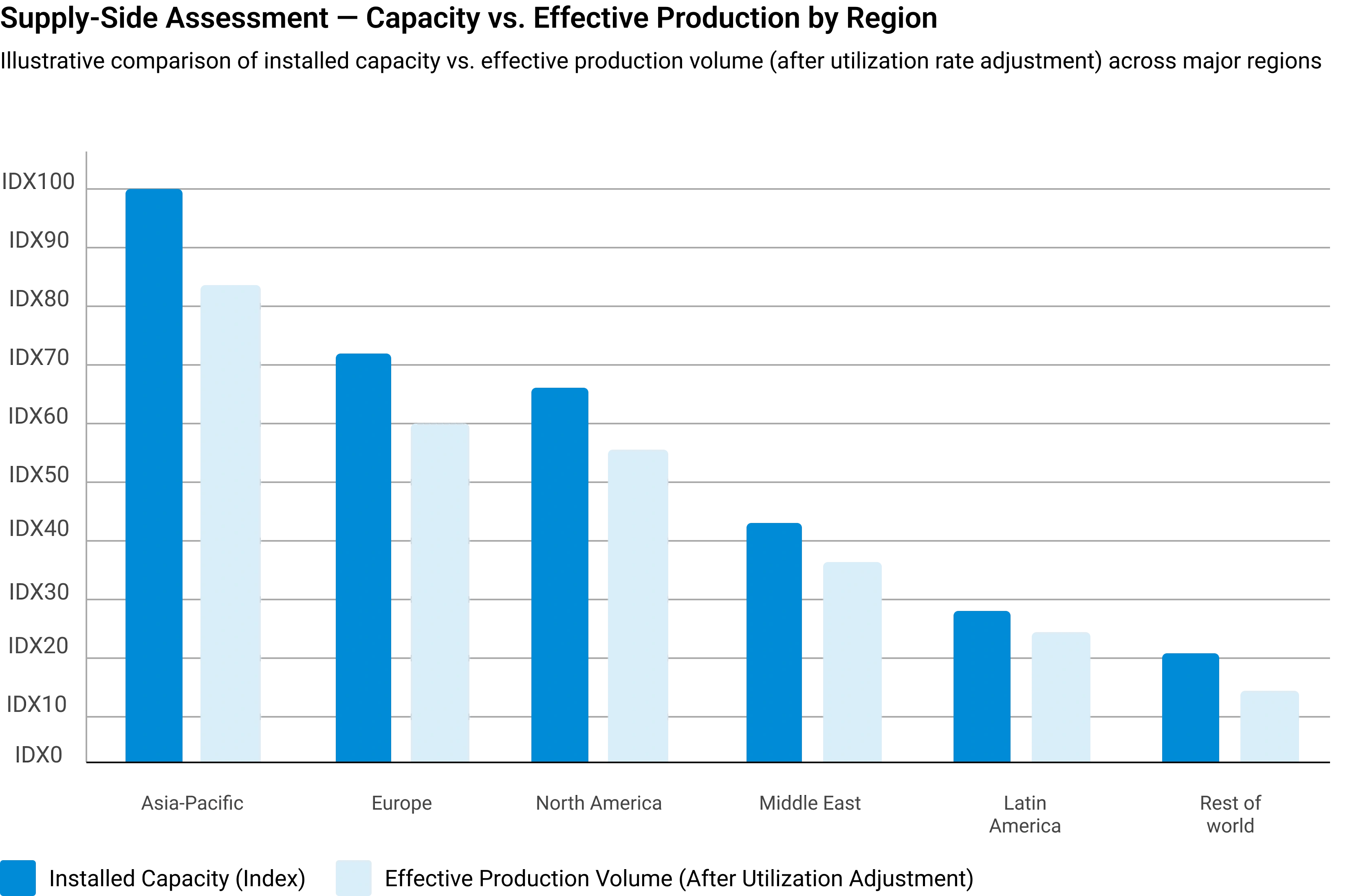
Installed capacity is adjusted using utilization rates based on demand conditions, feedstock availability, plant operating rates, maintenance schedules, and regulatory restrictions.
Manufacturer Revenue Analysis
Product-specific revenues, segment-level performance, regional distribution, average selling prices, and margin trends are evaluated to establish market value estimates.
Supply-Side Assessment — Capacity vs. Effective Production by Region
Illustrative comparison of installed capacity vs. effective production volume (after utilization rate adjustment) across major regions
Phase 3 — Demand-Side Assessment: Quantifying Chemical Consumption
Demand-side analysis quantifies chemical consumption across industries, applications, and geographies — identifying where and how chemicals are consumed throughout the value chain with precision.
End-Use Industry Analysis
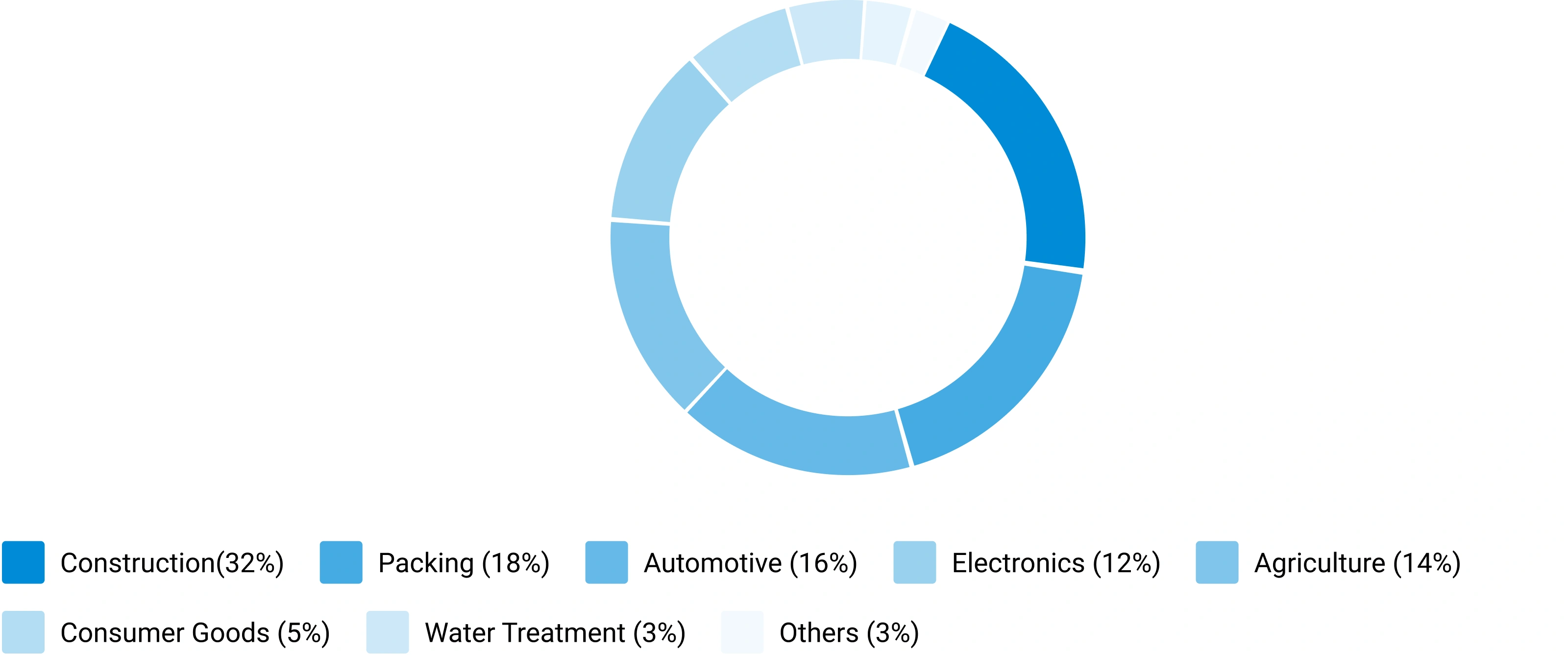
Chemical demand is evaluated across automotive, construction, packaging, electronics, agriculture, healthcare, consumer goods, industrial manufacturing, energy and utilities, and water treatment. Industry output, production trends, and consumption intensity are analyzed to determine demand patterns.
Consumption Modeling
Demand is estimated using measurable indicators: kilograms per vehicle, kilograms per square meter of construction, dosage per cubic meter of water treated, kilograms per hectare of agricultural land, and kilograms per ton of manufactured products. Consumption factors are validated through industry publications and primary interviews.
Application Analysis
The market is segmented by application area to understand product performance requirements, formulation trends, technology adoption, customer preferences, and regulatory requirements improving demand accuracy and segmentation granularity.
Demand-Side Assessment — End-Use Industry Demand Distribution
Illustrative distribution of chemical & materials demand across key end-use industries
Phase 4 - Trade Flow Analysis: Balancing Regional Supply and Demand
Trade flow analysis reconciles regional supply and demand estimates through import and export data, identifying net supply positions, regional dependencies, and market imbalances. It serves as an independent validation layer that tests the consistency of supply-side and demand-side estimates.
Import Analysis
Import data is evaluated to determine volumes, source countries, product dependency, regional supply gaps, and pricing trends — identifying markets that rely heavily on external supply and where domestic production is insufficient to meet demand.
Export Analysis
Export assessments reveal production surplus, export competitiveness, regional manufacturing strength, and global market participation. Export patterns also help validate domestic production estimates and identify net exporting regions.
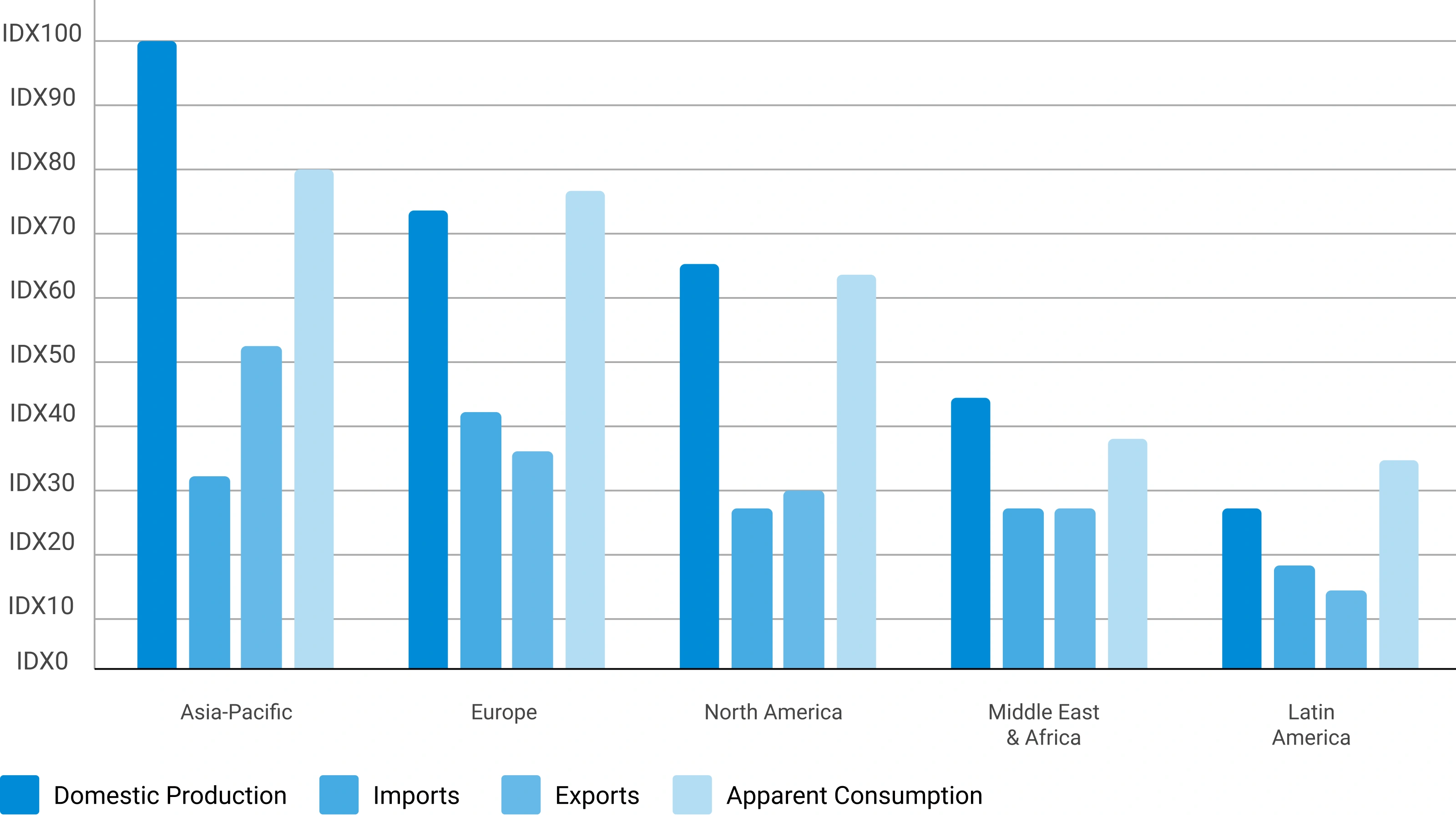
Apparent Consumption Model
Regional consumption is assessed using the standard apparent consumption formula:
Results identify net importing regions, net exporting regions, regional deficits, and surpluses — serving as an independent validation of supply and demand estimates.
Trade Flow Analysis — Net Supply Position by Region
Illustrative apparent consumption vs. domestic production across major regions — positive gap indicates net import dependency
Phase 5 — Primary Research: The Critical Validation Layer
Primary research tests and refines findings from secondary research through direct engagement with industry participants across the supply chain, demand side, and expert community. It captures intelligence that no database or published report can provide — the real-world experience of manufacturers, buyers, and specialists operating in the market.

Supply-Side Interviews
Conversations with chemical manufacturers, raw material suppliers, contract manufacturers, technology providers, and plant operators cover production trends, capacity utilization, pricing developments, technology shifts, and competitive dynamics.

Demand-Side Interviews
Engagement with OEMs, industrial consumers, procurement managers, distributors, formulators, and end-use manufacturers focuses on consumption trends, purchasing behavior, product substitution, demand outlook, and emerging applications.

Industry Expert Consultations
Additional interviews with industry consultants, independent experts, regulatory specialists, technical professionals, and research institutions provide deeper market context and validate key analytical assumptions.
Focus Areas of Primary Research:
Market Size & Forecast Validation
Revenue estimates, volume consumption, growth rates, forecast assumptions, regional demand.Supply Chain & Value Chain Assessment
Raw material sourcing, supply chain challenges, distribution networks, procurement practices.Production & Capacity Analysis
Manufacturing capacity, utilization rates, expansion projects, plant investments.Pricing & Cost Structure Analysis
Product pricing trends, feedstock costs, energy costs, margin pressures, pricing outlook.Competitive Landscape Assessment
Volume and value estimates confirmed to be fully consistent with one another before publicationInterview Volume by Market Scope
| Study Scope | Number of Interviews |
|---|---|
| Niche Market | 20 – 30 |
| Mid-Sized Market | 30 – 50 |
| Global Market | 50 – 80 |
| Highly Fragmented Market | 80 – 120 |
Interview Details:
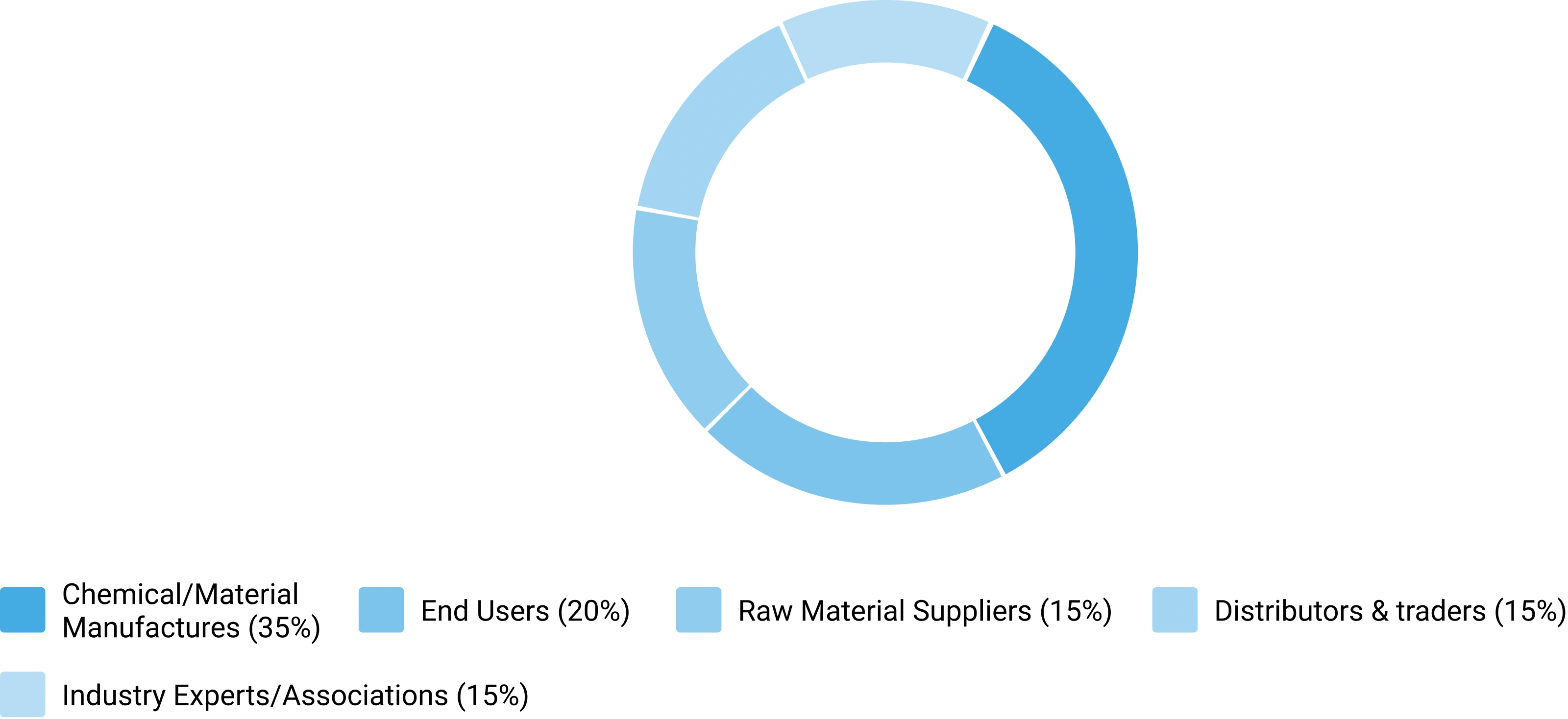
Category : Manufacturers, Suppliers, Distributors, End Users, Experts/Associations
Average Duration : 30–60 Minutes
Interview Mode : Video calls, telephonic interviews, expert consultations
Interview Format : Structured / Semi-Structured questionnaire
Focus Areas of Primary Research:
Market Size & Forecast Validation :
Revenue estimates, volume consumption, growth rates, forecast assumptions, regional demand.
Supply Chain & Value Chain Assessment :
Raw material sourcing, supply chain challenges, distribution networks, procurement practices.
Production & Capacity Analysis :
Manufacturing capacity, utilization rates, expansion projects, plant investments.
Pricing & Cost Structure Analysis :
Product pricing trends, feedstock costs, energy costs, margin pressures, pricing outlook.
Competitive Landscape Assessment :
Market share, competitor positioning, strategic initiatives, partnerships, acquisitions.
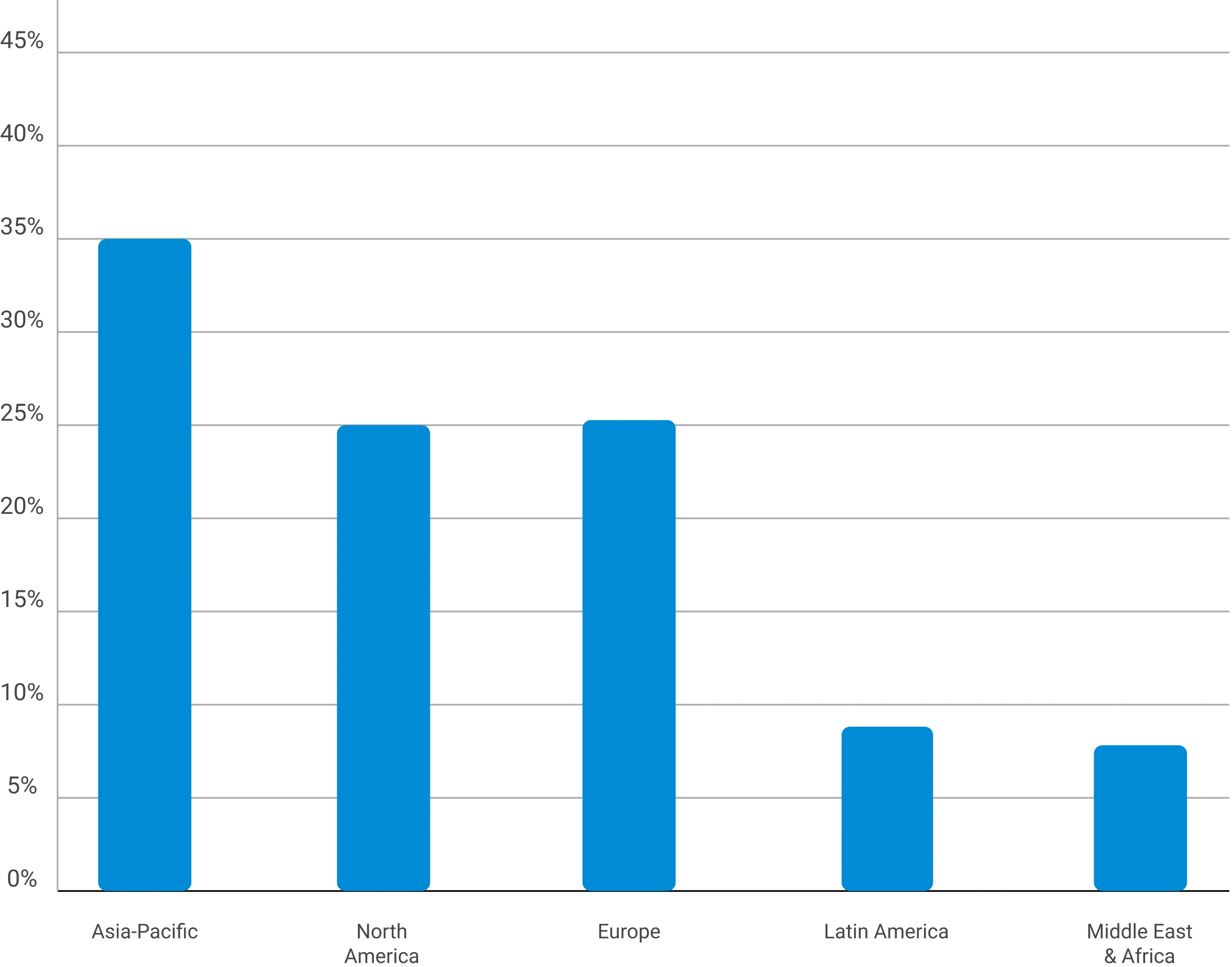
Primary Research — Stakeholder Coverage by Category
Distribution of interview respondents across stakeholder categories (% share from PPT data)
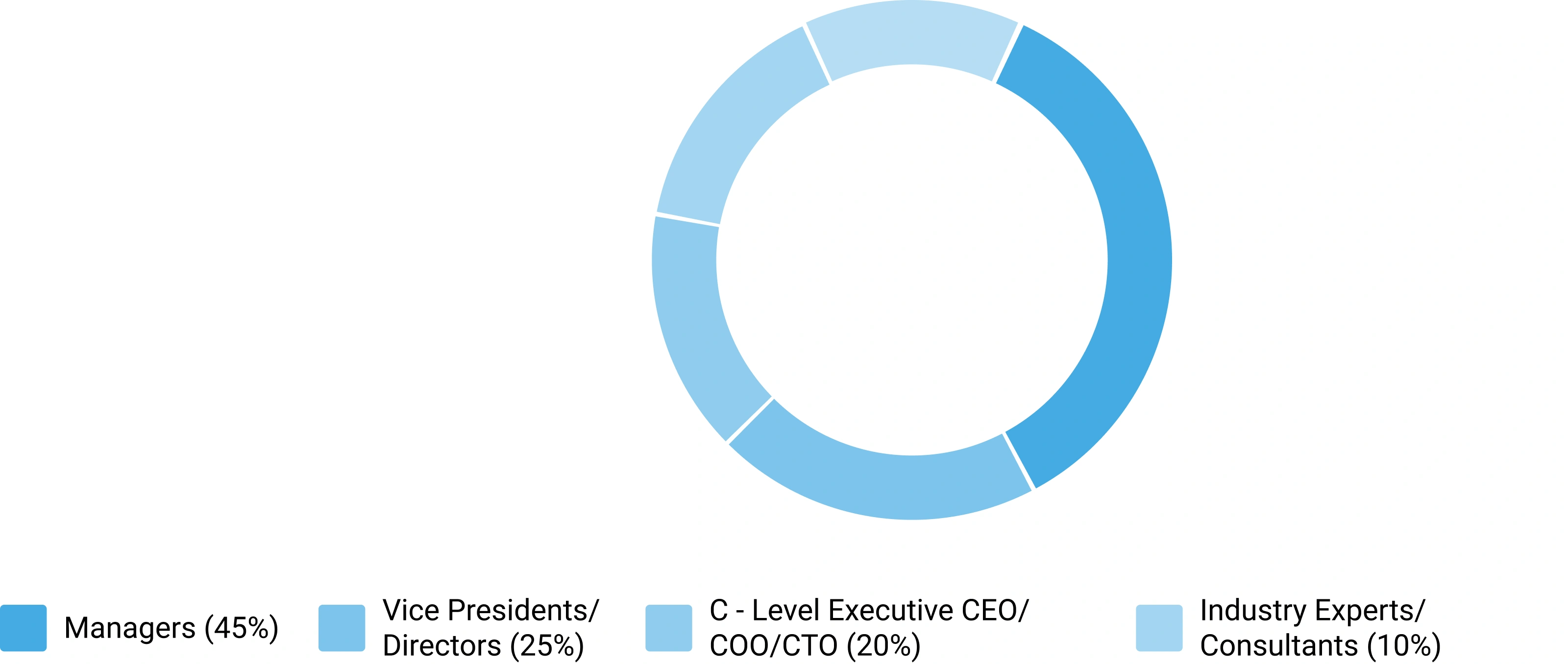
Primary Research — Respondent Designation Profile
Seniority breakdown of interview respondents (% share from PPT data)
Primary Research — Geographic Coverage of Interviews
Regional distribution of primary research engagement (% share from PPT data)
Phase 6 — Data Triangulation and Market Validation
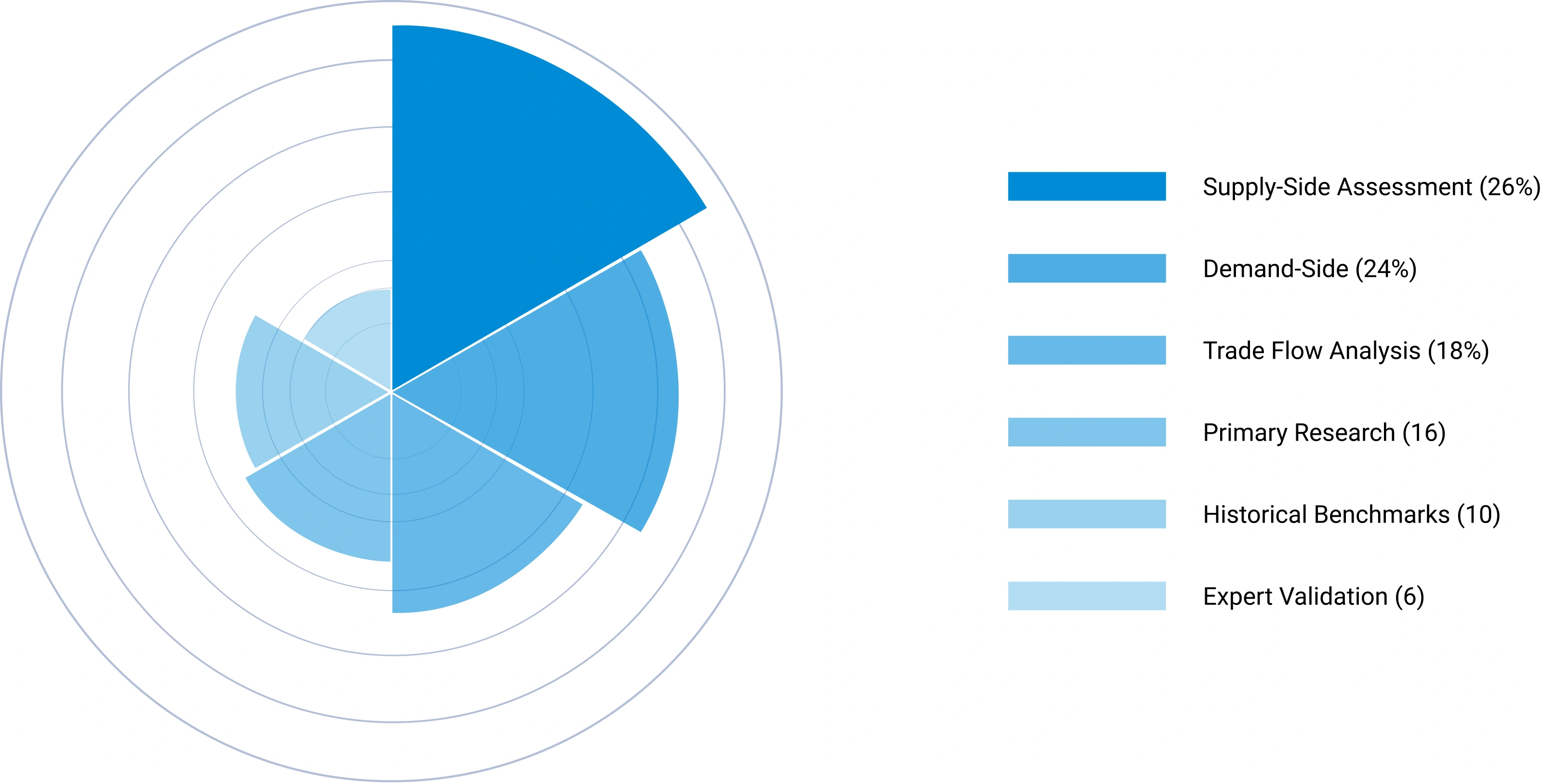
No single methodology is relied upon in isolation. Multiple independent estimation approaches are combined and reconciled to ensure consistency, accuracy, and analytical defensibility. Any material deviations between approaches are investigated and adjusted through additional validation cycles.
The final market size is derived through weighted triangulation of all validated methodologies. Any material deviations between approaches are investigated and adjusted through additional validation cycles. The outcome represents the most realistic assessment of the market based on available evidence and expert confirmation ensuring that volume and value estimates are fully consistent with one another.
Triangulation Framework — Input Contribution Weight
Relative weight each sizing input contributes to the final reconciled market estimate
Phase 7 — Forecast Modeling: Projecting Future Market Evolution
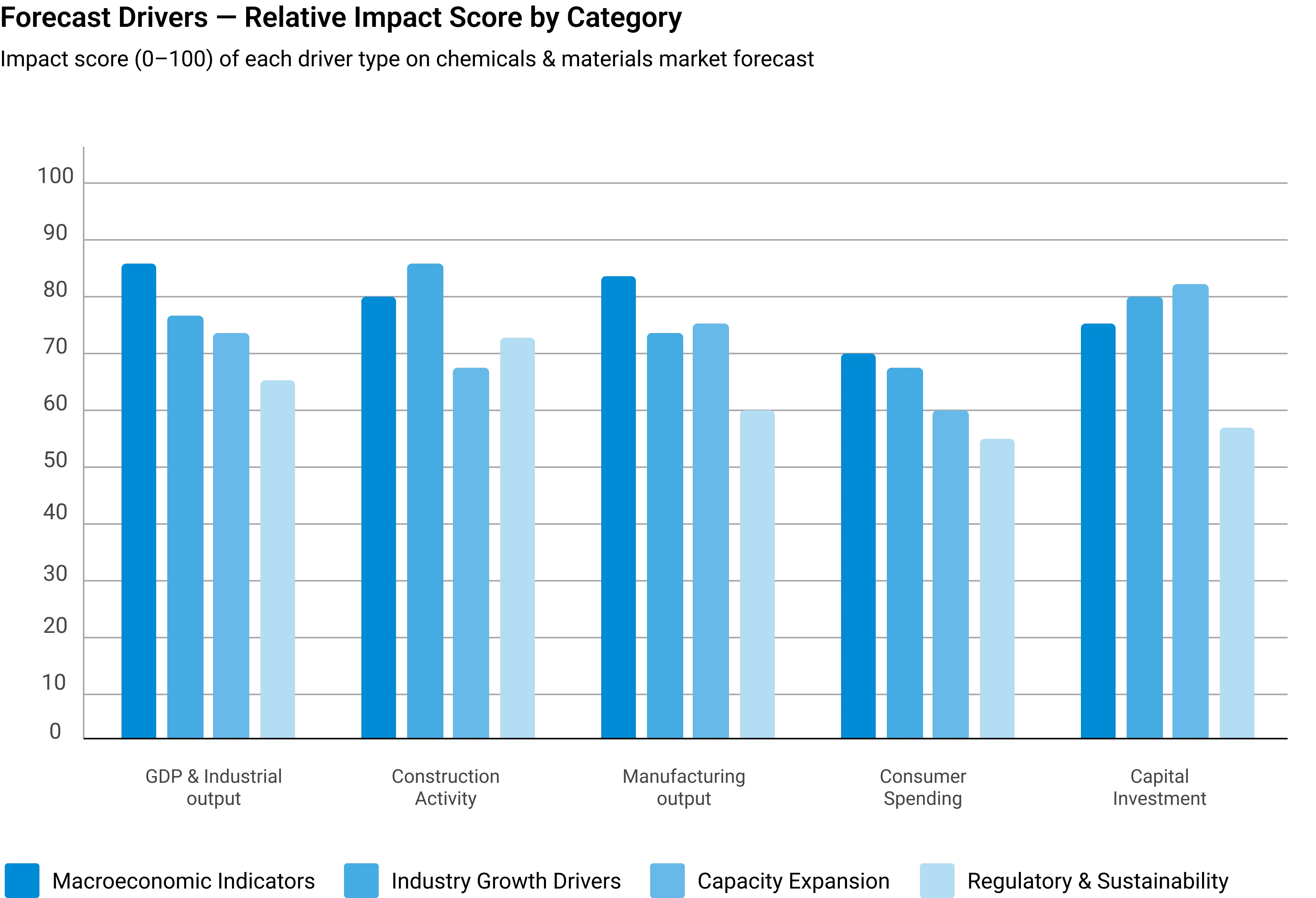
Forecasting evaluates the future trajectory of the market using a combination of quantitative indicators and qualitative assessments across economic, industry, and regulatory dimensions. Rather than simple extrapolation, each driver is independently modeled and integrated into a composite forecast.
Macroeconomic Indicators
GDP growth, industrial production, manufacturing output, construction activity, consumer spending, and capital investment form the quantitative foundation of long-term demand projections. These are applied at country, regional, and global levels.
Industry Growth Drivers
Urbanization, infrastructure development, industrialization, technological innovation, sustainability initiatives, and evolving product performance requirements are assessed at regional and industry levels — capturing both structural and cyclical demand drivers.
Capacity Expansion Analysis
Announced plant expansions, new manufacturing facilities, technology upgrades, and strategic investments are evaluated to determine future supply-demand dynamics and potential market tightness or oversupply situations.
Regulatory & Sustainability
Environmental regulations, chemical safety standards, emission reduction targets, circular economy initiatives, and sustainability requirements are incorporated as they often influence product adoption rates and market growth trajectories.
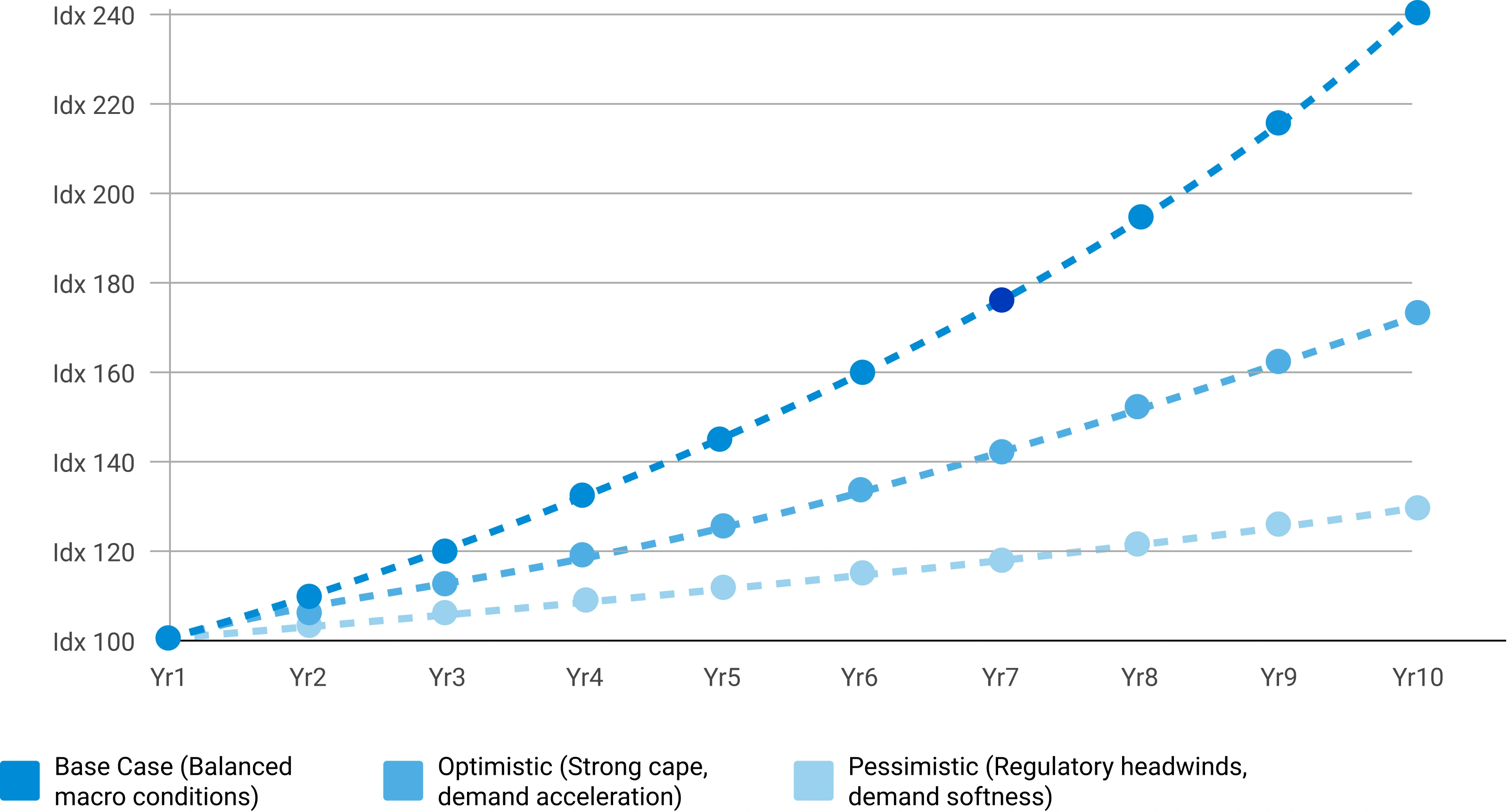
Scenario Forecast Range — Indexed Market Growth (Year 1–10)
Illustrative indexed growth trajectories across Base, Optimistic, and Pessimistic scenarios over a 10-year forecast horizon
Forecast Drivers — Relative Impact Score by Category
Impact score (0–100) of each driver type on chemicals & materials market forecast



Comments
Share your thoughts, ask a question, or provide feedback about this report.