Find the Right Market Report
Search thousands of industry reports, market insights, and research studies in one place.
Not sure where to start? Try one of these:
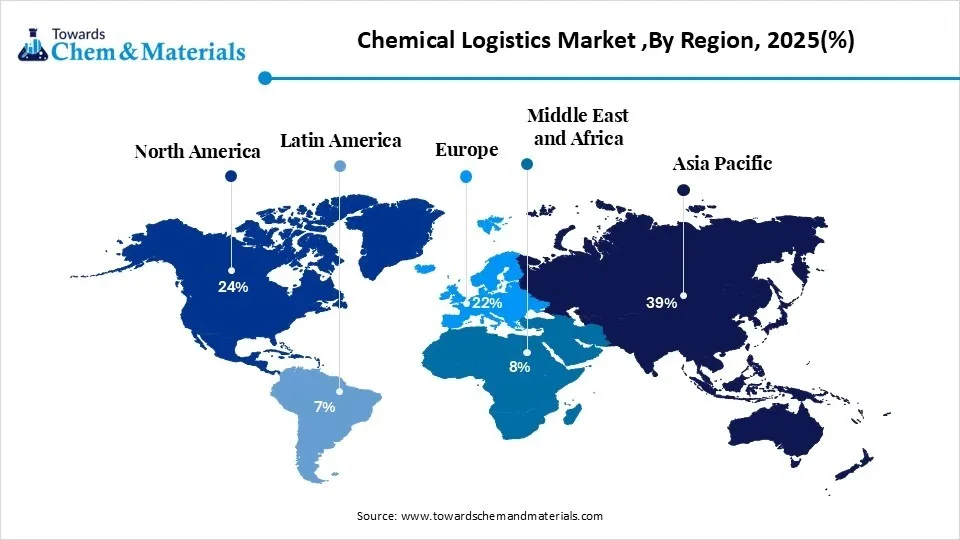
The global chemical logistics market size was valued at USD 343.10 billion in 2025, is estimated to reach USD 367.22 billion in 2026, and is projected to reach USD 676.82 billion by 2035, exhibiting a compound annual growth rate (CAGR) of 7.03% over the forecast period from 2026 to 2035.Asia Pacific dominated the chemical logistics market with the largest revenue share of 39% in 2025 and is expected to grow at the fastest CAGR of 7.17% during the forecast period.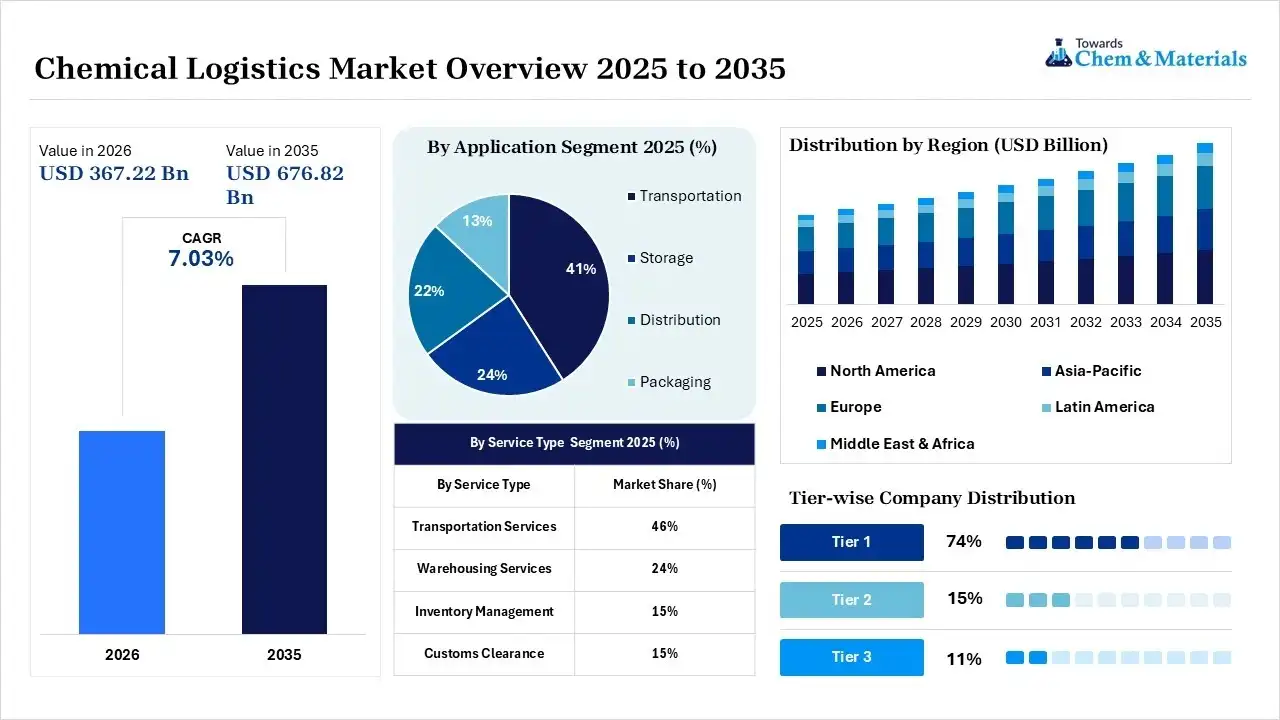
Digital technologies, such as IoT and automation, enhance operational efficiencies, and sustainability measures promote more sustainable transportation and warehousing practices throughout the global supply chain. The growth of the market is driven by the surge in chemical production, growth in international trade, and the need for specialized transportation solutions. Compliant logistics infrastructure is encouraged by strict regulatory requirements. Pharmaceutical and specialty chemical manufacturing industries drive up demand for temperature-controlled distribution.
According to Towards Chemicals and Materials Analytics and Consulting, the global chemical logistics market volume was valued at 5.70 billion metric tons in 2025 and is expected to surpass around 10.24 billion metric tons by 2035, accelerating a compound annual growth rate (CAGR) of 6.03% over the forecast period from 2026 to 2035.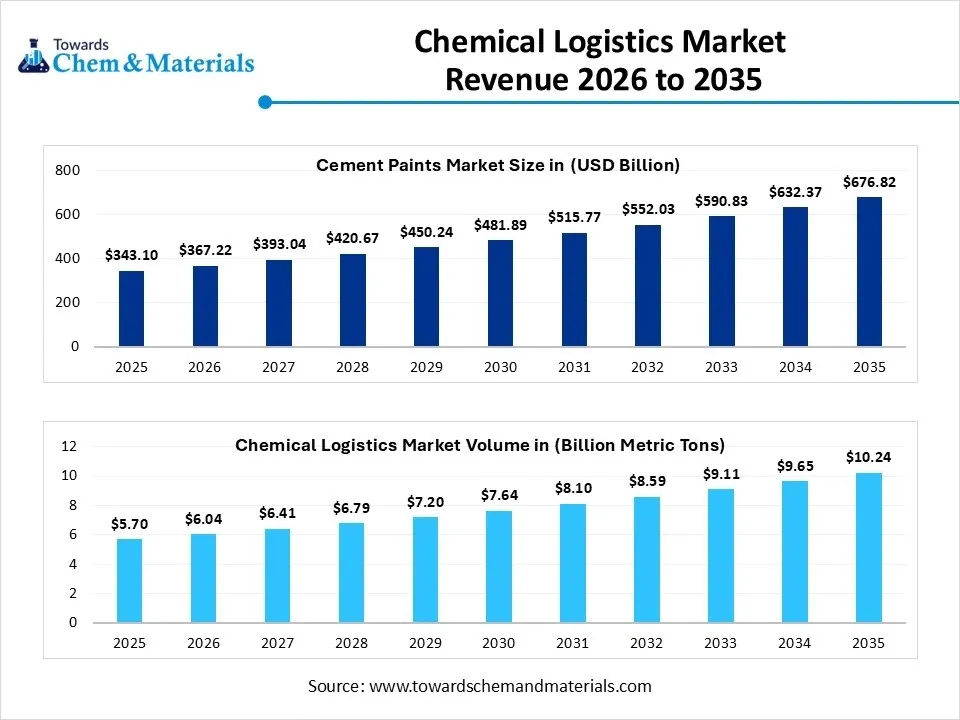
Various safety standards ensure that companies work together with logistics providers who are equipped with certified infrastructure and handling hazardous materials. Chemical logistics is a growing market due to the demand from chemical manufacturers, who need transportation, storage, and distribution services on a reliable basis throughout a more complicated global logistics chain. Specialty chemicals, pharmaceuticals, and high-dollar industrial products will continue to expand, driving up the market for temperature-controlled transportation and secure warehousing. Increased international trade boosts multimodal logistics of road, rail, sea, and air transportation. Digital technologies, such as Internet of Things sensors, radio frequency identification systems, telematics, and automated warehouses, enhance shipment visibility, operational safety, and stock accuracy. In addition, sustainability measures promote investments in sustainable transport, reusable packaging, and energy-efficient logistics facilities.
Diversification of supply chains in key manufacturing areas also drives the need for flexible routing, contingency planning, and regional warehousing facilities, which increase the ability to withstand and adapt to geopolitical events and changing international trade needs.
The growth of digital logistics platforms provides chemical transportation companies with increased visibility of their shipments, better operational efficiency, and regulatory compliance in hazardous material supply chains. Companies keep increasing their deployment of IoT sensors, AI-powered route optimization, telematics, and advanced monitoring tools in chemical transportation operations for safer transportation.
Increased investments in capital equipment such as temperature-controlled warehouses, stainless-steel chemical tankers, standardized ISO shipping containers, and multimodal transportation terminals for sensitive and hazardous chemical products, along international trade routes.
The pace of sustainability investments is still gathering momentum in chemical logistics, with solar-powered warehouses, packaging solutions that can be reused, flue gas cleaning projects, and investments in the decarbonisation of transportation fleets continuing to be of growing importance for ensuring a companys long-term environmental goals and regulatory compliance.
| Report Attributes | Details |
| Market Size in 2026 | USD 367.22 Billion/ 6.04 Billion Metric Tons |
| Expected Size in 2035 | USD 676.82 Billion/ 10.24 Billion Metric Tons |
| Growth Rate | CAGR of 7.03% |
| Base Year of Estimation | 2025 |
| Forecast Period | 2025-2035 |
| Dominant Region | Asia Pacific |
| Segment Covered | By Logistics Function, By Service Type, By Chemical Type, By End Use Industry, By Mode of Transport, By Region |
| Key Companies Profiled | DHL Supply Chain, Kuehne + Nagel, DSV, HOYER Group, C.H. Robinson, BDP International, CEVA Logistics, Bertschi AG, Suttons Group, Den Hartogh Logistics, Leschaco, Rhenus Group, Al-Futtaim Logistics, Sinotrans Logistics, Quantix, Allcargo Logistics, Transport Corporation of India (TCI), Aegis Logistics |
The chemical logistics market has an ever-growing focus on integrated digital technologies, which help to shift the logistics landscape from a traditional one to an intelligent, connected, and highly responsive supply chain network. The IoT sensors track cargo temperature, pressure, and other tank conditions every minute of the journey, providing greater transparency in the process. A digital twin can simulate transportation scenarios, assess weather impacts, and optimize routing prior to operational issues. Sustainability efforts also drive circular logistics models that focus on optimal load sizes for transport and recyclable packaging systems.
| Country Region | Regulatory Body | Key Regulations | Focus Areas |
| India | Ministry of Environment, Forest & Climate Change (MoEF&CC) | Draft Chemicals (Management and Safety) Rules (CMSR) | Mandatory chemical registration, detailed Safety Data Sheet (SDS) provision |
| North America | Environmental Protection Agency (EPA) | Toxic Substances Control Act (TSCA); OSHA Hazard Communication Standard | Strict reporting of chemical inventories, workplace exposure limits |
| European Union | European Chemicals Agency (ECHA) | EU REACH, CLP Regulation | Strict hazardous materials segregation, digital supply chain traceability |
The rising demand for specialty chemicals, agricultural chemicals, pharmaceutical ingredients, and performance materials is bolstering the need for advanced chemical logistics services across the globe. With soaring requirements from manufacturers for certified transportation, temperature-controlled storage, and regulatory-compliant distribution, product quality and safety are more important than ever. The growth of international trade will only further drive up demand for specialized cargo logistics providers with the ability to efficiently handle hazardous and sensitive goods.
The shortage of qualified commercial drivers to transport dangerous goods has remained a constraint on capacity in the region in a number of key markets. Not enough hazmat-trained professionals lead to higher logistical transportation costs, longer delivery times, and lower logistics flexibility of the logistics provider. Companies are also feeling increased pressure on wages, and are expected to meet compliance with strict safety standards for transporting hazardous materials. Skilled labor is one of the significant bottlenecks in the continuous expansion of the market because of such workforce-related challenges that impact the efficiency of the supply chain, especially in times of increased market demand for chemicals.
Chemical logistics companies are seeing more warehouse automation and smart supply chain technologies being adopted, offering great potential to increase efficiency. AI, IoT sensors, blockchain platforms, and sophisticated analytics optimize routes, automate inventory control, and keep a check on the shipments as they move through the transportation network. These technologies create visibility, mitigate operational risks, ensure regulatory compliance, and provide customers with better service. Enhanced investments in smart logistical facilities also provide the opportunity to safely handle temperature-sensitive and hazardous chemical products and enhance the productivity of chemical distribution networks globally.
The transportation segment dominated the market with the largest share of 41% in 2025 and is expected to grow at a CAGR of 6.9% over the forecast period, owing to the rising production of chemicals, transportation of hazardous materials, and demand for a safe transportation network. The global expansion in trade, the markets strict safety standards, and the growing use of multimodal logistics solutions are all advantageous in the segment. Chemical manufacturers are increasingly relying on specialized transportation services to ensure the safe transport of bulk, hazardous, and temperature-sensitive chemical products in domestic and international supply chains.
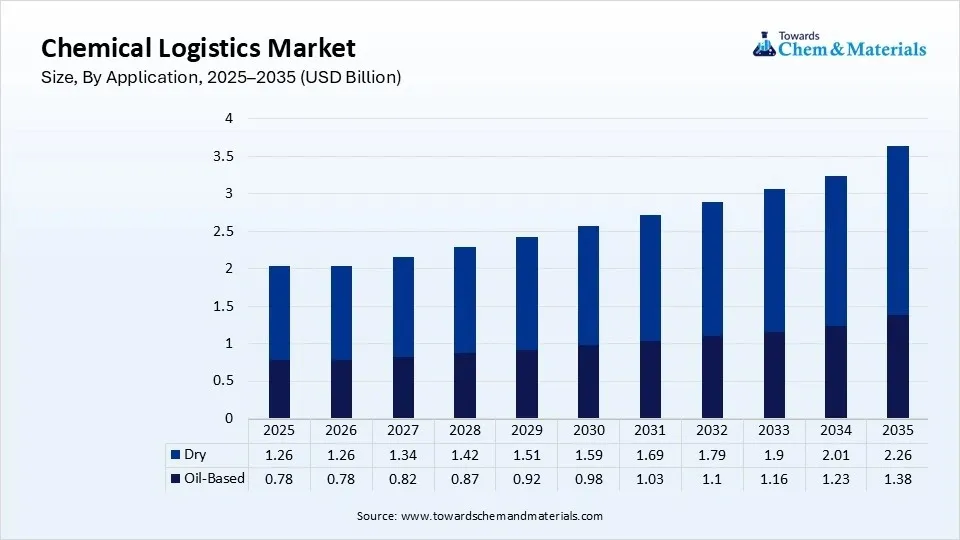
The distribution segment held a 22% market share in 2025 and is expected to grow at the fastest CAGR of 7.2% over the forecast period, owing to the growth of the chemical trade, growing distribution networks in the region, and the need for efficient product delivery systems. Industrial applications are expanding, and demand for faster and safer channels of chemical distribution and advanced logistics infrastructure. Integrated distribution solutions are gaining traction across organisations in order to manage inventories better, cut down on delivery times, and gain visibility on the supply chain from one geographic market to another.
Chemical Logistics Market ,By Application , 2025(%)
| By Application | Market Share (%) |
| Transportation | 41% |
| Storage | 24% |
| Distribution | 22% |
| Packaging | 13% |
The transportation services segment dominated the market with the largest share of 46% in 2025 and is expected to grow at a CAGR of 6.8% over the forecast period, driven by the rising demand for specialized chemical transportation solutions, regulatory compliance, and secure cargo handling solutions. The segment enjoys an increasing flow of hazardous chemicals, specialty chemicals, and industrial materials that are shipped by certified logistics providers. The expansion of chemical transportation services worldwide is further enhanced by the growing use of road, rail, sea, and air transportation networks.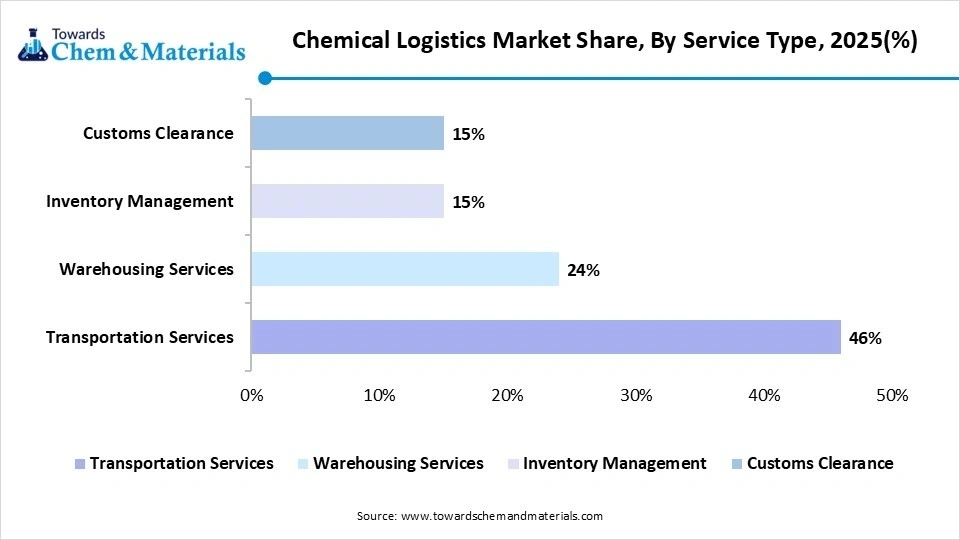 The inventory management segment held the 15% market share in 2025 and is expected to grow at the fastest CAGR of 7.8% over the forecast period, as the adoption of digital monitoring systems, automation technologies, and real-time inventory tracking solutions is set to rise. Chemical firms are concentrating on warehouse efficiency, decreased storage dangers, and correct merchandise availability. The advanced inventory management platforms assist logistics providers in optimizing stock levels, ensuring traceability, and helping them meet compliance standards in complex chemical supply chain operations.
Chemical Logistics Market, By Service Type, 2025(%)
| By Service Type | Market Share (%) |
| Transportation Services | 46% |
| Warehousing Services | 24% |
| Inventory Management | 15% |
| Customs Clearance | 15% |
The hazardous chemicals segment dominated the market with the largest share of 36% in 2025 and is expected to grow at a CAGR of 6.6% over the forecast period, owing to the strict safety regulations, growing consumption of chemicals in industries, and rising demand for specialized handling services. To ensure the safe transportation of hazardous chemicals, certified transportation systems, trained professionals, and advanced monitoring technologies are required. Regulatory attention on dangerous goods transport remains strong, and investment in safe chemical distribution systems and logistics infrastructure continues.
The specialty chemicals segment held the 19% market share in 2025 and is expected to grow at the fastest CAGR of 8.1% over the forecast period, because the market is driven by pharmaceutical production, development of advanced materials, and the demand for high-value chemical products. Specialty chemicals need to be transported in controlled environments, stored in secure premises, and logistics delivered in a more tailored manner. There are indications that the market for materials for batteries and healthcare applications, as well as performance chemicals, is expanding, which is driving opportunities for specialised logistics providers for sensitive and technologically advanced chemical supply chains.
Chemical Logistics Market , By Chemical Type, 2025(%)
| By Chemical Type | Market Share (%) |
| Hazardous Chemicals | 36.00% |
| Non-Hazardous Chemicals | 27.00% |
| Specialty Chemicals | 19.00% |
| Bulk Chemicals | 18.00% |
The chemical manufacturing segment dominated the market with the largest share of 45% in 2025 and is expected to grow at a CAGR of 6.7% over the forecast period, due to increasing chemical production, the growing use of chemicals in industries, and the need for efficient supply chain management. Chemical companies rely on dependable transportation and distribution services to ensure continuous operations as well as storage. The continued growth in investments in manufacturing facilities, combined with the rise in international chemical trade, further boosts demand for dedicated logistics solutions to facilitate the movement of chemicals within industries.
The pharmaceutical segment held the 23% market share in 2025 and is expected to grow at the fastest CAGR of 7.9% over the forecast period, due to demand for biologics, active pharmaceutical ingredients, and temperature-sensitive healthcare products. The pharmaceutical logistics industry demands high-tech cold-chain facilities, compliance, and expertise in handling. Demand for dependable transportation solutions that maintain quality, safety, and timely delivery to regulated pharmaceutical markets is further strengthened by the globalisation of healthcare supply chains.
Chemical Logistics Market ,By End Use Industry , 2025(%)
| By End Use Industry | Market Share (%) |
| Pharmaceutical | 23.00% |
| Agriculture | 18.00% |
| Chemical Manufacturing | 45.00% |
| Food and Beverage | 14.00% |
The road segment dominated the market with the largest share of 42% in 2025 and is expected to grow at a CAGR of 6.6% over the forecast period, as it offers flexible transportation, has the widest connectivity, and has efficient road networks in the region. Road transportation is popular for chemical transport as it allows for direct access between customers, warehouses, and manufacturing sites. With a growing requirement for the transport of hazardous chemicals, investments in dedicated tanker fleets and road logistics that meet the required safety standards are further promoted.
The air segment held the 6% market share in 2025 and is expected to grow at the fastest CAGR of 8.2% over the forecast period, because of the growing demand for quick transportation of high-value chemicals, specialty materials, and pharmaceutical products. For time-sensitive shipments that need advanced security and controlled environments, air logistics offers quicker delivery options. The expansion of international trade of chemical products that are sensitive to air transport continues to stimulate investments in specialized air freight handling and advanced handling systems in the global chemical supply chain.
Chemical Logistics Market , By Mode of Transport, 2025(%)
| By Mode of Transport | Market Share (%) |
| Road | 42.00% |
| Rail | 17.00% |
| Air | 6.00% |
| Sea | 35.00% |
How Did the Asia Pacific Dominate the Chemical Logistics Market In 2025?
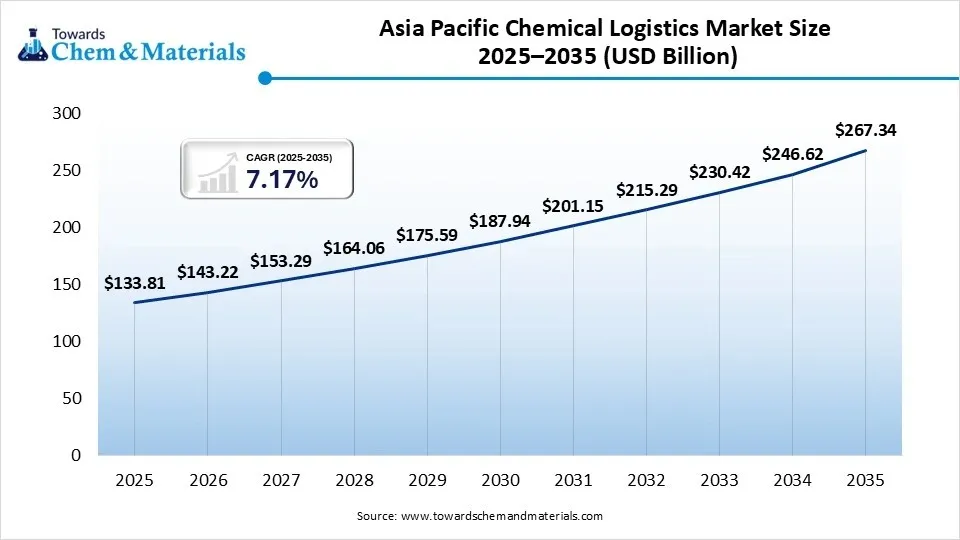
The Asia Pacific chemical logistics market size was estimated at USD 133.81 billion in 2025 and is projected to reach USD 267.34 billion by 2035, growing at a CAGR of 7.17% from 2026 to 2035. Asia Pacific dominated the market with the largest share of 39% in 2025 and is expected to grow at a CAGR of 6.2% during the forecast period. The region has strong chemical manufacturing activities, growing industrial development, and trade of chemicals across the borders. Transportation infrastructure and multimodal networks continue to be good investment fields, in addition to the increasingly digital logistics solutions, which continue to enhance supply chain efficiencies. The growth in specialty chemical production, pharmaceutical manufacturing, and industrial development further bolsters demand for safe and compliant chemical logistics services in the regional markets.
 Strengthening Chinas Chemical Logistics Through Industrial Expansion
China is a significant chemical logistics market owing to its huge chemical manufacturing base, huge industrial production capacity, and robust export activities. The country has a high demand for transportation, storage, and distribution services along chemical supply chains. The growth of multimodal transportation networks enhances logistics efficiency and connectivity among the production centers and consumption centers. Market development continues to be driven by the escalating demands for handling hazardous chemicals, regulation, and sophisticated tracking technologies. Chinas growing industrial landscape continues to be a key driver of chemical logistics growth in the region.
Advancing Indias Chemical Supply Chains Through Infrastructure Development
The growing production of specialty chemicals, pharmaceuticals, and industrial development is driving India to become a key chemical logistics market. An increase in domestic consumption and global trade activities generates demand for effective transportation and distribution systems.
North America
The North America chemical logistics market size was estimated at USD 82.34 billion in 2025 and is projected to reach USD 165.82 billion by 2035, growing at a CAGR of 7.25% from 2026 to 2035.North America held 24% market share in 2025 and is expected to grow at the fastest CAGR of 7.6% during the forecast period. It has a high level of transport infrastructure, a developed chemical industry, and is advancing its digital logistics technologies. The regions expansion is bolstered by increasing demand for the transport of hazardous materials, specialty chemicals, and sustainable logistics solutions. To optimize efficiency in chemical transportation and storage operations throughout North American markets, companies are increasingly turning to supply chain optimization, automation, and regulatory compliance.
Expanding United States Chemical Logistics Capabilities
The United States is one of the key chemical logistics markets, owing to its well-developed transportation network, large chemical manufacturing industry, and well-established industrial infrastructure. Specialty chemical, pharmaceutical, and industrial material production is growing, and logistics solutions are required to be efficient. Government is also continuing to embrace more digital, automated warehouses and compliant transport to enhance supply chain performance.
Supporting Canadas Chemical Distribution Through Efficient Logistics Networks
Canada is a contributor to the North American chemical logistics market in two ways: industrial operation and transportation infrastructure, and the increasing need for safe chemical handling solutions. The country has well-developed road, rail, and maritime transport links between industrial areas and domestic and international markets that enable the movement of chemicals. The shift towards greater regulatory compliance and sustainable logistics operations spurs firms to embrace modern transportation and storage solutions.
Europe
The Europe chemical logistics market size was estimated at USD 75.48 billion in 2025 and is projected to reach USD 152.28 billion by 2035, growing at a CAGR of 7.27% from 2026 to 2035.Europe held 22% market share in 2025 and is expected to grow at a CAGR of 6% over the forecast period. The region is well-equipped for chemical safety regulations, modern logistics, and growing sustainability efforts. The regions advantages include robust chemical safety measures, evolving sustainability initiatives, and advanced logistics systems. Chemical companies are prioritizing effective supply chain movements, digital monitoring solutions, and sustainable operations. The need for specialty chemicals, pharmaceutical products, and industrial materials continues to exacerbate the need for dependable logistics services.
Driving Germanys Chemical Logistics Through Industrial Strength
Germany is a major chemical logistics market because of the high-level of chemical manufacturing, a sophisticated industrial infrastructure, and advanced transportation structures. Effective logistics solutions are needed for the transport of industrial chemicals, specialty products, and manufactured goods in the country. In recent years, the focus has been shifting towards safety regulations, digital supply chain management, and sustainable transportation, thereby prompting businesses to enhance their logistics processes.
Enhancing Frances Chemical Supply Chains Through Logistics Development
France plays a significant role in the European chemical logistics market due to its industrial manufacturing, chemical production capacity, and well-developed transportation infrastructure. Specialized logistics services are needed in the country for the safe transportation of hazardous chemicals, industrial materials, and special products. The growing emphasis on sustainability and compliance with environmental regulations spurs the implementation of cutting-edge logistics technologies and streamlined supply chain systems.
Latin America
The Latin America chemical logistics market size was estimated at USD 24.02 billion in 2025 and is projected to reach USD 50.76 billion by 2035, growing at a CAGR of 7.77% from 2026 to 2035.Latin America held 7% market share in 2025 and is expected to grow at a CAGR of 6.5% over the forecast period. The region enjoys the expansion of industrial activities, chemical consumption, and transportation needs. Expansion of logistics infrastructure and distribution systems opens up opportunities for chemical logistics providers. The growth of agriculture, manufacturing, and industrial sectors enhances markets. Businesses are targeting regional chemical markets for improved transport efficiencies, storage, and supply chain reliability.
Supporting Brazils Chemical Logistics Through Industrial and Agricultural Demand
Brazil is a significant chemical logistics market in Latin America as a result of its sizeable agriculture industry, industrial manufacturing, and rising consumption of chemicals. Efficient transport and distribution systems for agricultural chemicals, industrial materials, and specialty products are needed throughout the country. The expansion of infrastructure is conducive to the development of logistics connections between production bases and end users.
Developing Chiles Chemical Distribution Through Regional Connectivity
Industrial operations, sectors related to the use of resources, and growing demand for reliable transportation services are all factors that make Chile a contributor to the Latin American chemical logistics market. The country needs effective logistics networks to facilitate the domestic and international movement of chemical products. Industrial uses promote improvements in storage, transportation, and distribution capacities.
Middle East & Africa
The Middle East & Africa chemical logistics market size was estimated at USD 27.45 billion in 2025 and is projected to reach USD 57.53 billion by 2035, growing at a CAGR of 7.68% from 2026 to 2035.The Middle East & Africa held 8% market share in 2025 and is expected to grow at a CAGR of 6.9% over the forecast period. The area has a positive contribution from the petrochemical industry, industrial diversification, and further investments in logistics. As the number of chemical production facilities grows, so do the needs for specialized vehicles for transporting, storing, and distributing chemicals. The growing focus on safe chemical handling, digital logistics platforms, and supply chain optimisation continues to support regional market development.
Expanding Saudi Arabias Chemical Logistics Through Petrochemical Growth
Saudi Arabia is a significant chemical logistics market because of its robust petrochemical sector, industrial development, and growing chemical production activities. The country needs an efficient logistics system for bulk chemicals, hazardous chemicals, and industrial products. Investments in industrial diversification promote the demand for advanced transportation, storage, and distribution solutions. Chemical logistics services continue to expand in Saudi Arabias industrial sectors, driven by increasing concerns about supply chain efficiency, safety compliance, and the development of logistics infrastructure.
 Strengthening South Africas Chemical Distribution Through Industrial Activities
South Africa has a role to play in the Middle East & Africa chemical logistics market in the manufacturing, industrial operation, and development of transportation networks. The country has a demand for a dependable distribution system of chemicals for different industrial uses. Market opportunities are available as the demand for safe handling, regulatory compliance, and effective supply chain management grows. As industrial areas grow, logistics companies are incentivized to enhance road, rail, and storage infrastructure and distribution systems to support chemical manufacturers and end users in South African markets.
Chemical logistics is a market thats very competitive, and companies around the world are using special transportation, digital solutions, regulatory compliance, and sustainable supply chain operations. Key players are enhancing their market position by investing in infrastructure development, strategic partnerships, and cutting-edge logistics systems. To meet the increased demand from the chemical manufacturing and pharmaceutical industries, companies are investing in temperature-controlled facilities, hazardous material handling, and integrated transportation networks.
| Company Type/Position | Major Headquarters | Geographic Presence | Chemical Logistics Offerings | Key Strength |
| SABIC | Riyadh, Saudi Arabia | Global (Americas, Europe, Asia-Pacific, MEA) | TRUCIRCLE-certified circular polymers | Unmatched global feedstock integration |
| Reliance Industries (RIL) | Mumbai, India | Global | CircuRepol™ (Polypropylene) and CircuRelene™ (Polyethylene) | Direct access to Indias largest integrated O2C supply chain |
| LyondellBasell | Houston, US & Geleen, Netherlands | North America and Europe | Premium polymers utilizing advanced technologies | Combines SUEZs advanced waste sorting logistics |
By Application
By Service Type
By Chemical Type
By End Use Industry
By Mode of Transport
By Regions
Reliable market intelligence and data-driven insights across the global chemicals and materials industry, helping businesses understand trends, competition, pricing, and emerging opportunities.
Schedule a Demo