Find the Right Market Report
Search thousands of industry reports, market insights, and research studies in one place.
Not sure where to start? Try one of these:
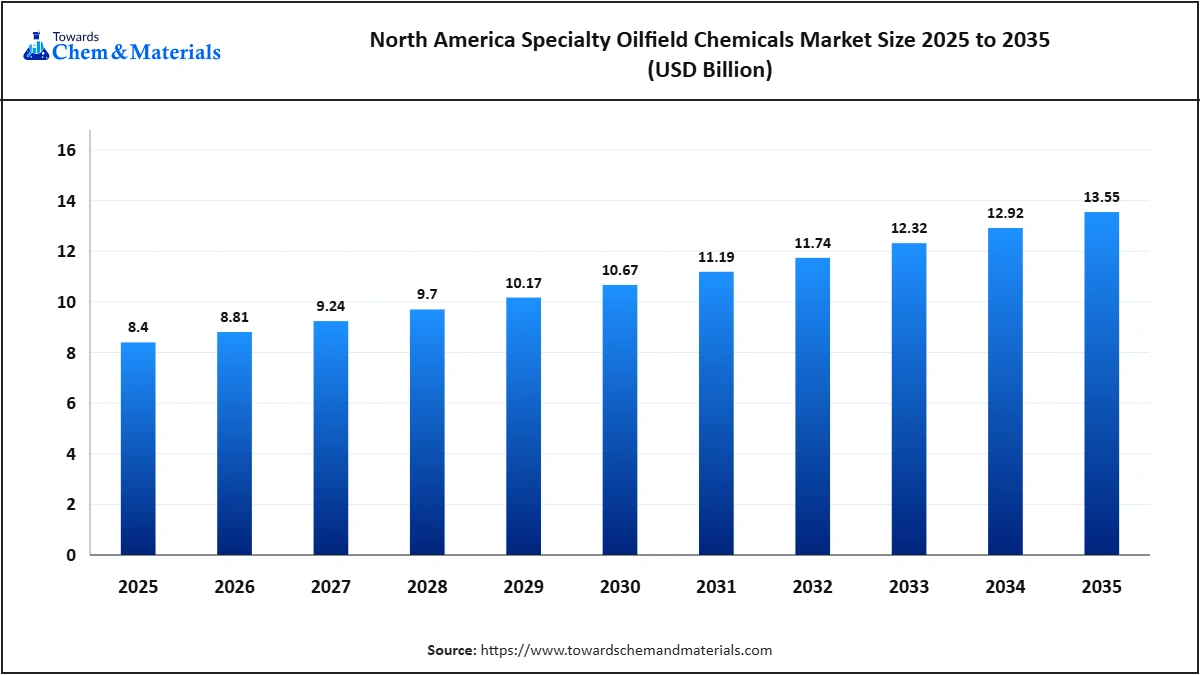
The North America specialty oilfield chemicals market size was valued at USD 8.4 billion in 2025 and is expected to reach USD 13.55 billion by 2035, growing at a CAGR of 4.9% during the forecast period of 2026-2035. The market comprises specialty chemicals used in oil and gas operations across the United States, Canada, and Mexico. It includes corrosion and scale inhibitors, demulsifiers, biocides, polymers and friction reducers, surfactants, and other specialty additives used in production, well stimulation, drilling and cementing, and enhanced oil recovery. In 2025, corrosion and scale inhibitors held the largest market share at 26%, crucial for protecting wells and ensuring efficiency.
Note: 2025 is the base year; 2026-2035 values are forecasts.
Sources: Expert interviews, secondary sources, Towards Chemical and Materials database and Towards Chemical and Materials analysts.
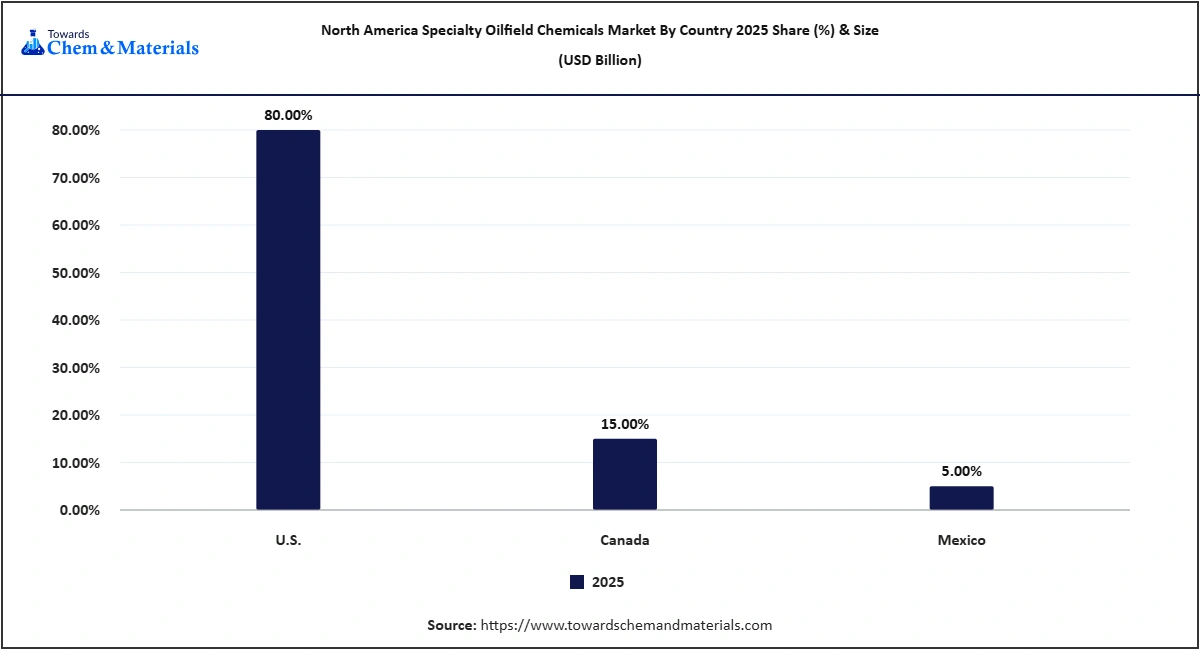
The U.S. led the market with an 80% revenue share, fueled by significant shale production, mature oilfield infrastructure, and steady demand for production chemicals. High oil and gas production, increasing treatment requirements in mature wells, oil sands production, and produced water reuse are supporting market expansion. The demand for enhanced oil recovery chemicals, lower-toxicity formulations, digital chemical monitoring, and automated injection systems is creating additional opportunities. For instance, in November 2025, Brenntag acquired Permian production chemicals supplier Chem Tech Services, strengthening its North American specialty oilfield chemicals platform through Coastal Chemical.
The North America specialty oilfield chemicals market is projected to grow from USD 8.40 billion in 2025 to USD 13.55 billion by 2035, driven by continued dependence on specialty chemical formulations to maintain well productivity, prevent corrosion and scale formation, and facilitate oil-water separation. High production levels, mature well treatment requirements, oil sands operations, and produced water reuse are supporting consistent demand across the region.
The market is expected to reach USD 10.67 billion by 2030 and sustain a CAGR of 4.9% from 2026 to 2035. Specialty oilfield chemicals incorporate alpha olefin and polyolefin derivatives, alongside specialized formulations designed for production optimization, stimulation, drilling, and enhanced recovery. Adoption of AI in chemical management and automated dosing systems is helping operators optimize chemical consumption and operational performance.
Analyst View: We estimated the market using well counts, production volumes, and specialty chemical consumption per well across individual countries, cross-validated against North American specialty chemical revenues of leading suppliers. Our assessment incorporates chemical type, application, regional demand, and supplier positioning. Our value sits just above published comparable estimates.
The North America specialty oilfield chemicals market is supported by sustained shale production and the treatment requirements of mature oil and gas wells. High production activity across the Permian and other U.S. basins creates recurring demand for corrosion inhibitors, scale inhibitors, demulsifiers, biocides, and other production chemicals. These formulations help operators maintain production efficiency, prevent equipment degradation, and improve the reliability of oilfield operations.
Mature oil wells encounter operational issues necessitating chemical treatments for corrosion and water production, with increased demand for demulsifiers driven by oil sands production in Canada. Additionally, opportunities arise for specialty chemical suppliers in North America through the reuse of produced water and redevelopment of mature fields in Mexico.
The market faces challenges from oil price volatility, increasing operational efficiency, environmental regulations, and customer consolidation. Fluctuations in crude oil prices can influence exploration and production expenditure, affecting demand for specialty chemicals. Operators may reduce chemical consumption or defer treatment investments during periods of lower oil prices.
Improvements in production efficiency can lead to reduced chemical intensity per output unit, which may constrain volume growth despite elevated production. Environmental regulations and heightened scrutiny on chemical toxicity and disposal can raise formulation and compliance costs. Additionally, consolidation in the oil and gas sector may enhance purchasing power, putting pricing pressure on specialty chemical suppliers.
The growing adoption of enhanced oil recovery techniques represents an opportunity for specialty chemical manufacturers, particularly suppliers of advanced surfactants and other recovery-enhancing formulations. Chemical-based enhanced oil recovery can improve recovery efficiency from mature reservoirs and support the extension of productive well life.
Mature field redevelopment in Mexico offers opportunities alongside rising demand for specialized production treatments. Innovations such as green chemistries, low-toxicity biocides, environmentally friendly formulations, and digital monitoring technologies can enhance product differentiation. Additionally, growing needs for produced water treatment and reuse will boost demand for specialized chemical solutions.
| Driver | Impact | ≈ CAGR Contribution | Time Horizon | Key Regions |
| Shale output remains high | High | +1.91 pp | Short to long term | North America-wide, strongest in U.S. |
| Mature wells need more treatment | Medium | +1.61 pp | Medium to long term | North America-wide, fastest uptake in Mexico |
| Oil sands production | Medium | +1.37 pp | Short to medium term | North America-wide |
| Produced water reuse | Low | +1.08 pp | Long term | U.S. and Mexico |
Note: Contributions are indicative estimates of each factor's effect on annual growth.
Sources: Expert interviews, secondary sources, Towards Chemical and Materials database and Towards Chemical and Materials analysts.
High shale production, along with increased requirements for mature well treatments, oil sands operations, and produced water reuse, is projected to add about 5.98 percentage points to annual market growth. The principal driver is ongoing shale output in major U.S. basins, fostering steady demand for production chemicals. Mature wells necessitate more chemical treatment for flow assurance and equipment performance, while oil sands operations and produced water management enhance specialty chemical consumption across North America.
| Restraint | Impact | ≈ Negative CAGR Contribution | Time Horizon | Key Regions |
| Oil price swings | High | -0.49 pp | Short to medium term | North America-wide |
| Efficiency reduces chemical intensity | High | -0.36 pp | Medium term | Smaller and price-sensitive markets |
| Environmental rules | Medium | -0.24 pp | Short term | U.S. and other mature markets |
Note: Contributions are indicative estimates of each factor's effect on annual growth.
Sources: Expert interviews, secondary sources, Towards Chemical and Materials database and Towards Chemical and Materials analysts.
Oil price volatility, declining chemical intensity through operational efficiency, and environmental regulations are estimated to reduce annual market growth by approximately 1.08 percentage points. Oil price fluctuations can influence production budgets and chemical procurement decisions, while improvements in well productivity and treatment efficiency can reduce chemical requirements per unit of production. Environmental regulations may increase compliance costs and encourage reformulation of existing products. Nevertheless, continued production activity and increasing treatment requirements are expected to support market expansion, resulting in a projected CAGR of 4.9% from 2026 to 2035.
| Segments | 2025 Share | 2035 Share | CAGR 2026-2035 |
| Corrosion & Scale Inhibitors | 26.00% | 24.87% | 4.43% |
| Polymers & Friction Reducers | 22.00% | 21.85% | 4.83% |
| Demulsifiers | 12.00% | 11.88% | 4.83% |
| Biocides | 10.00% | 9.96% | 4.83% |
| Surfactants | 14.00% | 15.57% | 6.03% |
| Others | 16.00% | 15.87% | 4.83% |
Note: 2025 is the base year; 2035 shares and CAGRs are forecasts.
Sources: Expert interviews, secondary sources, Towards Chemical and Materials database and Towards Chemical and Materials analysts.
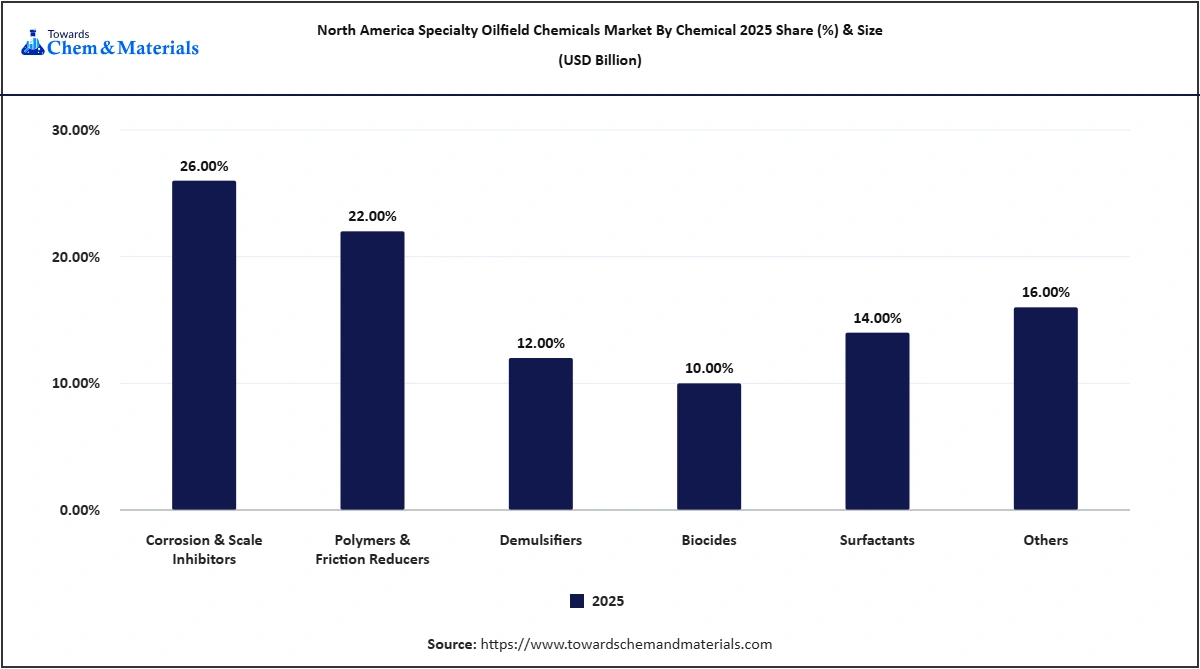
In 2025, corrosion and scale inhibitors accounted for 26% of the North America specialty oilfield chemicals market, followed by polymers and friction reducers at 22%, others at 16%, surfactants at 14%, demulsifiers at 12%, and biocides at 10%. Corrosion and scale inhibitors are the dominant chemical segment in producing wells, while surfactants are projected to grow fastest through 2035 due to their increasing use in enhanced oil recovery.
Corrosion and scale inhibitors accounted for 26% of the market in 2025 and are projected to expand at a CAGR of 4.43% from 2026 to 2035. These chemicals inhibit corrosion and mineral accumulation in production equipment and well infrastructure, enhancing their market leadership in producing wells. However, the segment is expected to grow slower than the overall market over the forecast period.
Polymers and friction reducers held 22% of the market in 2025 and are anticipated to record a CAGR of 4.83% by 2035. Polymers and friction reducers are essential in hydraulic fracturing, enhancing fluid performance and reducing friction. This drives continued demand in major shale-producing areas, with expected growth in line with the overall market.
Demulsifiers accounted for 12% of the market in 2025 and are expected to register a CAGR of 4.83% during the forecast period. These chemicals are essential for oil-water separation in oil sands and heavy oil production, facilitating complex emulsions. Their continued application in Canadian oil sands and conventional facilities supports steady demand, with expected growth in line with market trends.
Biocides represented 10% of the market in 2025 and are expected to expand at a CAGR of 4.83% through 2035. These formulations control microbial growth and help prevent reservoir souring, microbiologically influenced corrosion, and other operational problems. Increasing attention to water management and microbial control supports their continued use. The segment is expected to grow broadly in line with the overall market.
Surfactants captured 14% of the market in 2025 and are projected to register a CAGR of 6.03% from 2026 to 2035. Their applications include enhanced oil recovery, interfacial tension reduction, and improved fluid behavior in oilfield operations. Increasing interest in chemical-based recovery techniques and improved extraction from mature reservoirs is supporting segment growth. Surfactants are expected to grow faster than the overall market.
Other specialty oilfield chemicals accounted for 16% of the market in 2025 and are expected to register a CAGR of 4.83% from 2026 to 2035. This category includes specialty additives such as paraffin inhibitors and hydrate inhibitors, designed to tackle specific production and flow assurance issues. The demand for these additives is driven by the necessity for operational reliability across various reservoir conditions, with the segment anticipated to grow in alignment with the overall market.
Segment Outlook: Corrosion and scale inhibitors are expected to retain their position as the largest chemical-type segment through 2035, although their market share is projected to decline from 26% in 2025 to approximately 24.87% in 2035. Surfactants are expected to record the highest chemical-type CAGR of 6.03%, increasing their share to 15.57%. Their growing application in enhanced oil recovery and reservoir optimization is expected to support this shift in the North America specialty oilfield chemicals market.
| Segments | 2025 Share | 2035 Share | CAGR 2026-2035 |
| Production | 40.00% | 38.38% | 4.47% |
| Well Stimulation | 30.00% | 29.89% | 4.87% |
| Drilling & Cementing | 18.00% | 17.93% | 4.87% |
| Enhanced Oil Recovery | 12.00% | 13.80% | 6.37% |
Note: 2025 is the base year; 2035 shares and CAGRs are forecasts.
Sources: Expert interviews, secondary sources, Towards Chemical and Materials database and Towards Chemical and Materials analysts.
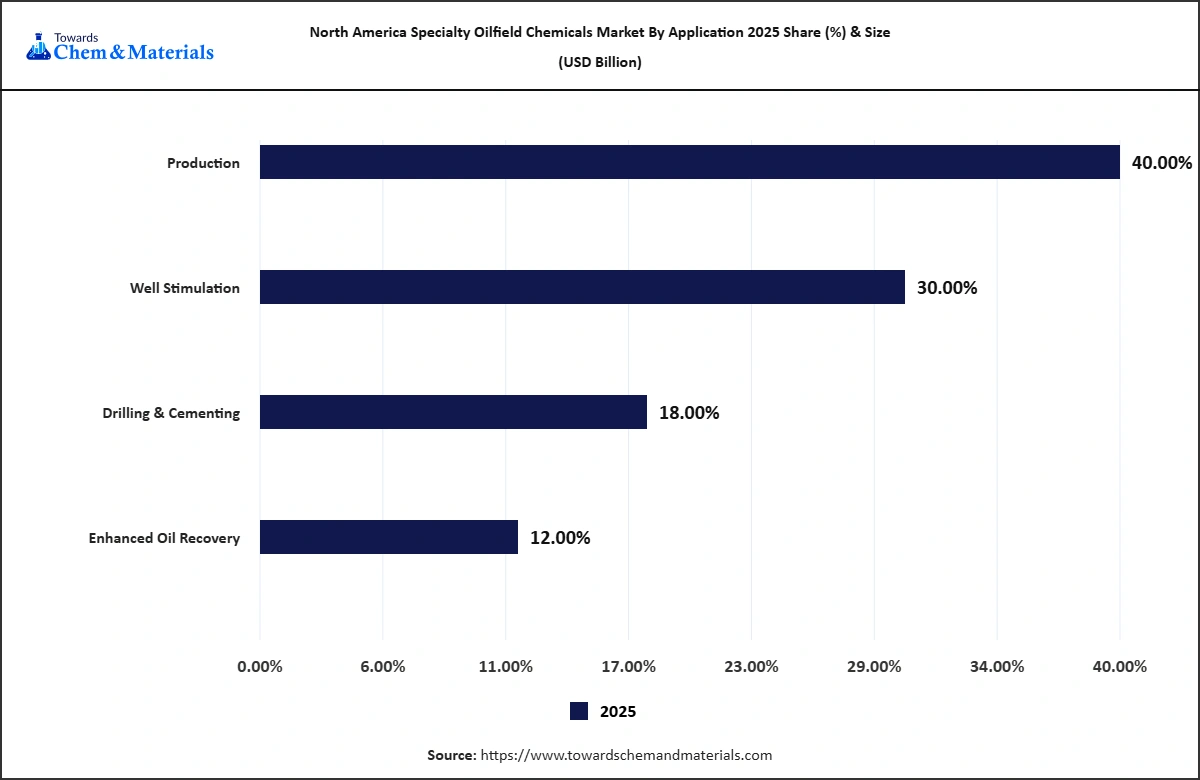
In 2025, production accounted for 40% of the North America specialty oilfield chemicals market, followed by well stimulation at 30%, drilling and cementing at 18%, and enhanced oil recovery at 12%. Production is the main application segment for specialty chemicals, essential for the operation of producing wells. Enhanced oil recovery is expected to grow the fastest until 2035, driven by the focus on improving yields from existing reservoirs.
Production accounted for 40% of the market in 2025 and is anticipated to expand at a CAGR of 4.47% from 2026 to 2035. Production chemicals are essential for maintaining well performance and managing production challenges, including corrosion and scale control. While this segment is crucial and consistently utilized, its growth is predicted to be slower than that of the overall market.
Well stimulation captured 30% of the market in 2025 and is projected to expand at a CAGR of 4.87% through 2035. Specialty additives enhance fluid performance in hydraulic fracturing and other stimulation processes, with demand driven by shale production and ongoing well development in North America. The segment is expected to grow alongside the overall market.
Drilling and Cementing held 18% of the market in 2025 and is projected to expand at a CAGR of 4.87% through 2035. Specialty drilling and cementing chemicals enhance fluid stability, operational performance, and well construction. Growing drilling activity and the demand for specialized formulations for various geological conditions are driving this market segment's expected growth in line with overall market trends.
Enhanced oil recovery accounted for 12% of the market in 2025 and is anticipated to register a CAGR of 6.37% from 2026 to 2035. The segment focuses on specialty chemical formulations, especially surfactants, that enhance reservoir recovery and extraction efficiency. The increasing interest in maximizing output from mature reservoirs is driving adoption, leading to expected growth that surpasses the overall market.
Segment Outlook: Through 2035, production is expected to remain the largest application segment, although its share is projected to decline from 40% in 2025 to approximately 38.38% in 2035. Enhanced oil recovery is expected to increase its share to 13.80%, recording the highest application-level CAGR of 6.37%. Interest in chemical-based recovery and reservoir optimization is expected to support this change in application demand.
Analyst View: In our analysis, segment estimates were developed by allocating market demand according to chemical consumption, product portfolios, application requirements, pricing, and country-level production activity. Corrosion and scale inhibitors and production remain the leading segments because they address essential operational requirements. However, surfactants and enhanced oil recovery are expected to gain share as advanced recovery techniques and specialized chemical applications expand.
| Country | 2025 Share | 2035 Share | CAGR 2026-2035 |
| U.S. | 80.00% | 78.89% | 4.75% |
| Canada | 15.00% | 15.35% | 5.15% |
| Mexico | 5.00% | 5.76% | 6.35% |
Note: 2025 is the base year; 2035 shares and CAGRs are forecasts.
Sources: Expert interviews, secondary sources, Towards Chemical and Materials database and Towards Chemical and Materials analysts.
The United States dominated the North America specialty oilfield chemicals market with an 80% revenue share in 2025, followed by Canada at 15% and Mexico at 5%. The U.S. maintains its leading position because of substantial shale production across the Permian and other basins, established oilfield infrastructure, and significant demand for production chemicals. Mexico is projected to record the fastest growth over the forecast period.
The U.S. accounted for 80% of the market in 2025 and is set to register a CAGR of 4.75% through 2035. The country leads regional demand due to its significant shale production, developed oilfield infrastructure, and robust network of specialty chemical suppliers. Activity in the Permian and other basins creates ongoing needs for various chemical additives. The U.S. is projected to grow slightly below the overall market rate.
Canada represented 15% of the market in 2025 and is anticipated to expand at a CAGR of 5.15% by 2035. Demand is supported by oil sands production, heavy oil operations, and natural gas activity across regions such as Montney. Oil sands operators require specialized demulsifiers and production chemicals to support oil-water separation and operational efficiency. The country is expected to grow slightly faster than the overall market.
Mexico accounted for 5% of the market in 2025 and is projected to record the fastest CAGR of 6.35% from 2026 to 2035. Market growth is supported by mature field redevelopment, production optimization, and demand for specialized treatment chemicals. Pemex and private operators are creating demand for corrosion and scale inhibitors, demulsifiers, and other production chemicals. Mexico is expected to increase its regional market share to 5.76% by 2035.
Analyst View: Country-level estimates were developed using oil and gas production activity, well counts, chemical consumption, installed infrastructure, supplier presence, and spending patterns across the U.S., Canada, and Mexico. The United States maintains its leadership through its large shale production base and established specialty chemical ecosystem. Mexico receives the highest growth premium because of increasing mature field treatment requirements and redevelopment activity.
| Rank | Company Name | 2025 Share (%) | Key Products / Business | Headquarters |
| 1 | SLB (ChampionX) | 20.00% | Production chemicals | United States |
| 2 | Baker Hughes | 11.00% | Specialty production chemicals | United States |
| 3 | Halliburton | 10.00% | Stimulation and drilling chemicals | United States |
| 4 | Clariant | 6.00% | Oil services specialty chemicals | Switzerland |
| 5 | Ecolab (Nalco) | 5.00% | Water and production chemistry | United States |
| 6 | SNF | 4.00% | Polymers and friction reducers | France |
| 7 | Innospec | 3.00% | Oilfield specialty chemicals | United States |
| 8 | Dorf Ketal | 3.00% | Specialty additives | India |
| 9 | Coastal Chemical (Brenntag) | 3.00% | Production chemicals distribution | United States |
| 10 | Croda | 2.00% | Oilfield surfactants | United Kingdom |
Note: Company shares are 2025 estimates.
Sources: Company press releases, expert interviews, secondary sources, Towards Chemical and Materials database and Towards Chemical and Materials analysts.
In 2025, the leading companies in the North America specialty oilfield chemicals market included SLB (ChampionX), Baker Hughes, Halliburton, Clariant, Ecolab (Nalco), SNF, Innospec, Dorf Ketal, Coastal Chemical (Brenntag), and Croda.
SLB (ChampionX) led the market with an estimated 20% share of 2025 revenue, followed by Baker Hughes at 11% and Halliburton at 10%. SLB (ChampionX) maintains a strong position through its production chemicals portfolio, while Baker Hughes competes through specialty production chemical solutions. Halliburton offers stimulation and drilling chemicals for oilfield operations.
Other prominent participants include Clariant, Ecolab (Nalco), SNF, Innospec, Dorf Ketal, Coastal Chemical (Brenntag), and Croda. These companies compete through oil services specialty chemicals, water and production chemistry, polymers and friction reducers, oilfield additives, production chemical distribution, and surfactant formulations.
The top 10 companies accounted for an estimated 67.02% of 2025 revenue, while the remaining 32.98% was shared among regional and specialized chemical service providers. The market includes large integrated suppliers, specialist formulators, and regional chemical-service providers, with competition based on product performance, technical service, basin expertise, supply logistics, environmental characteristics, and long-term operator relationships.
SLB (ChampionX): SLB (ChampionX), headquartered in the United States, held an estimated 20.00% share of the North America specialty oilfield chemicals market in 2025. Its offering centres on production chemicals and specialized solutions supporting oilfield productivity and operational reliability. Based on the Towards Chemical and Materials Companies Quadrant assessment, the company is positioned as a Leader.
Baker Hughes: Baker Hughes is headquartered in the United States and held an estimated 11.00% market share in 2025. Its portfolio includes specialty production chemicals used to support oil and gas production, flow assurance, and operational performance. The company is positioned as a Leader in the Towards Chemical and Materials Companies Quadrant.
Halliburton: Halliburton, based in the United States, accounted for an estimated 10.00% share of the market in 2025. Its offerings include stimulation and drilling chemicals supporting well construction and production-related operations. In the Towards Chemical and Materials Companies Quadrant, the company is classified as a Leader.
Clariant: Clariant, based in Switzerland, held an estimated 6.00% share of the market in 2025. Its oil services specialty chemicals portfolio supports production optimization and oilfield treatment requirements. According to the Towards Chemical and Materials Companies Quadrant, the company is positioned as a Leader.
Ecolab (Nalco): Ecolab (Nalco), headquartered in the United States, accounted for an estimated 5.00% share of the market in 2025. Its offering focuses on water and production chemistry, supporting treatment and operational requirements across oilfield applications. The company is positioned as a Leader in the Towards Chemical and Materials Companies Quadrant.
SNF: SNF, headquartered in France, held an estimated 4.00% share of the market in 2025. Its portfolio includes polymers and friction reducers used in stimulation and other oilfield operations. According to the Towards Chemical and Materials Companies Quadrant, the company is classified as a Leader.
Innospec: Innospec, based in the United States, accounted for an estimated 3.00% share of the market in 2025. Its portfolio includes specialized oilfield chemical products and additives for production and operational applications. The company is positioned as an Innovator in the Towards Chemical and Materials Companies Quadrant.
Dorf Ketal: Dorf Ketal, headquartered in India, held an estimated 3.00% market share in 2025. Its offering includes specialty additives designed for oilfield and industrial chemical applications. In the Towards Chemical and Materials Companies Quadrant, the company is classified as an Innovator.
Coastal Chemical (Brenntag): Coastal Chemical (Brenntag), based in the United States, accounted for an estimated 3.00% share of the market in 2025. Its business focuses on chemical production, distribution, and specialized oilfield chemical solutions. The company is positioned as an Innovator according to the Towards Chemical and Materials Companies Quadrant.
Croda: Croda, headquartered in the United Kingdom, held an estimated 2.00% share of the market in 2025. Its oilfield offering includes specialty surfactants used in production and enhanced recovery applications. The company is classified as an Innovator in the Towards Chemical and Materials Companies Quadrant.
The North America specialty oilfield chemicals ecosystem connects raw material suppliers, specialty formulators, service and distribution providers, oil and gas operators, and regulatory authorities. Each stage contributes to the development, manufacturing, delivery, application, and oversight of specialty chemical products used across oilfield operations.
| Ecosystem Stage | Role in the Market | Key Companies |
| Raw Material Suppliers | Supply intermediates | Petrochemical producers |
| Specialty Formulators | Formulate chemicals | SLB (ChampionX), Baker Hughes, Clariant, Innospec |
| Service & Distribution | Apply and deliver chemicals | Halliburton, Brenntag |
| Operators | Use chemicals | Shale, oil sands and offshore operators |
| Regulators | Set rules | EPA, Alberta Energy Regulator, CNH Mexico |
Sources: Company press releases, expert interviews, secondary sources, Towards Chemical and Materials database and Towards Chemical and Materials analysts.
Raw Material Suppliers: Raw material suppliers offer chemical intermediates and feedstocks for specialty oilfield formulations, while petrochemical producers supply critical materials for manufacturing corrosion inhibitors, polymers, surfactants, and various specialty additives.
Specialty Formulators: Specialty formulators develop customized chemical solutions for oil and gas processes, such as drilling and enhanced oil recovery. Key players in this stage include SLB (ChampionX), Baker Hughes, Clariant, and Innospec, noted for their formulation expertise and product customization.
Service & Distribution: Service providers and distributors facilitate the management and application of specialty chemicals in oilfields, with Halliburton and Brenntag playing crucial roles by connecting chemical products to operators through field services and distribution networks.
Operators: Oil and gas operators are the primary users of specialty oilfield chemicals. These include shale producers, oil sands companies, and offshore operators that purchase chemical solutions to maintain production efficiency, control corrosion, manage water, and improve recovery.
Regulators: Regulatory authorities establish environmental, chemical safety, and operational requirements governing specialty oilfield chemical use. Key institutions include the U.S. Environmental Protection Agency, Alberta Energy Regulator, and Mexico's CNH.
Value in the North America specialty oilfield chemicals market flows from upstream material suppliers to specialty formulators and service providers, followed by distributors and oil and gas operators. Companies that integrate formulation capabilities, technical services, distribution, and long-term customer relationships can strengthen their competitive positions and capture a larger share of market value.
The Towards Chemical and Materials Companies Quadrant positions key participants in the North America specialty oilfield chemicals market by market strength, reflecting revenue scale, market share, and geographic reach, and by innovation and growth strategy, reflecting product portfolio breadth, R&D intensity, and partnerships. Positions reflect each company's estimated 2025 share of the North America specialty oilfield chemicals market and our assessment of its product innovation, portfolio breadth, and partnerships.
Sources: Company press releases, expert interviews, secondary sources, Towards Chemical and Materials database, and Towards Chemical and Materials analysts.
Leaders: SLB (ChampionX), Baker Hughes, Halliburton, Clariant, Ecolab (Nalco), and SNF combine high market share with broad portfolios and strong innovation.
Innovators: Innospec, Dorf Ketal, Coastal Chemical (Brenntag), and Croda bring newer technologies and specialised products.
By Chemical Type
By Application
By Country
The North America specialty oilfield chemicals market was estimated using a bottom-up model of chemical-product demand across the United States, Canada and Mexico. The assessment considers production and well activity, well type, operating basin, treatment frequency, chemical dosage, average selling prices and application-specific consumption. Demand is differentiated across production, well stimulation, drilling and cementing, and enhanced oil recovery to reflect variations in formulation requirements and treatment intensity. The market estimate includes revenue from the defined specialty chemical product categories and excludes unrelated equipment, general oilfield services and broad industrial chemical sales. Where suppliers provide integrated chemical-management services, only the attributable chemical-product revenue is included. Products used across multiple applications are allocated according to their primary use to prevent double counting.
Company positioning is assessed using relevant North American specialty oilfield chemical revenues, qualifying product portfolios, regional manufacturing and distribution capabilities, and operator relationships. The forecast incorporates assumptions for production activity, mature-well treatment requirements, oil sands operations, produced-water management, EOR adoption, chemical pricing and operational efficiency. Estimates are cross-checked against supplier disclosures, acquisition information, expert interviews and relevant industry benchmarks.
The North America specialty oilfield chemicals market is expected to expand steadily through 2035, supported by high oil and gas production, mature well treatment, oil sands operations, and increasing produced water reuse. Corrosion and scale inhibitors will continue to represent essential chemical requirements, while production will remain the largest application segment. Growth opportunities are expected to emerge in enhanced oil recovery surfactants, Mexico's mature field redevelopment, lower-toxicity formulations, and digital chemical management. However, oil price volatility, environmental regulations, and declining chemical intensity may limit growth. Suppliers focusing on technical service, formulation innovation, operational efficiency, and long-term operator relationships are expected to strengthen their competitive positions.
Reliable market intelligence and data-driven insights across the global chemicals and materials industry, helping businesses understand trends, competition, pricing, and emerging opportunities.
Schedule a Demo