
Titanium Market Size, Competitive Landscape Analysis Report 2035
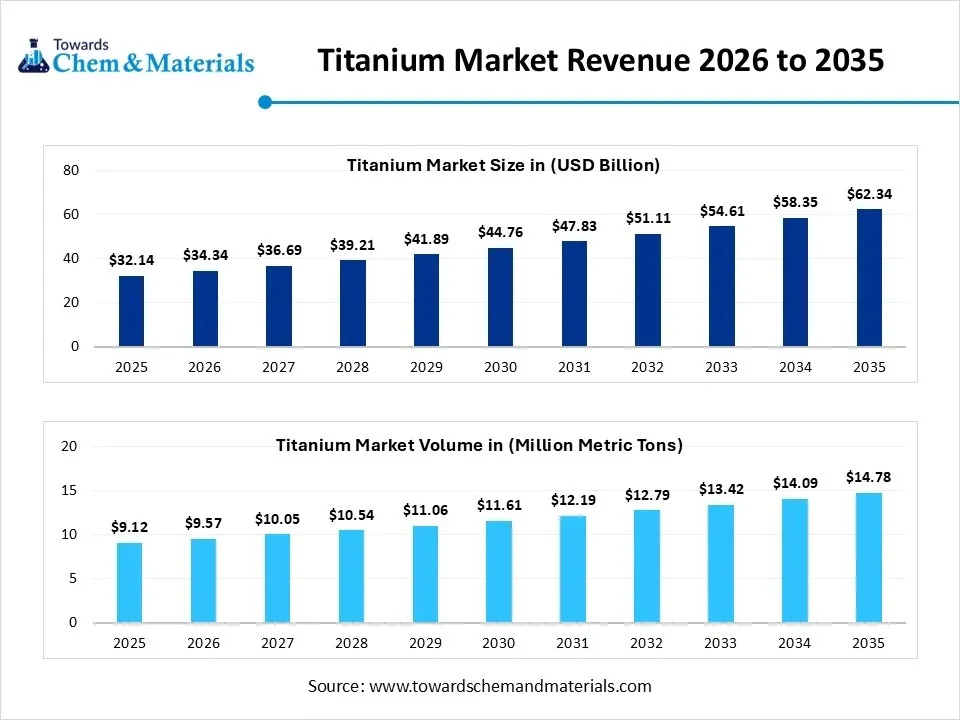
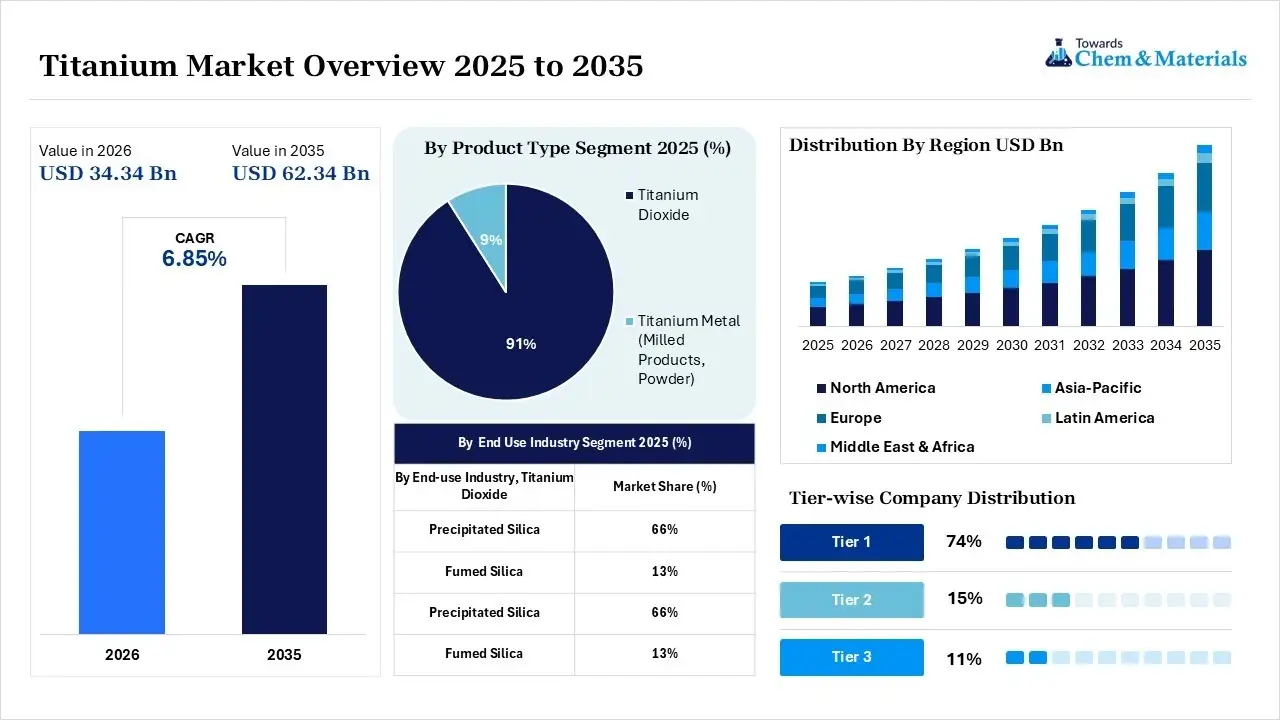
The titanium market size was valued at USD 32.14 billion in 2025, is estimated to reach USD 34.34 billion in 2026, and is projected to reach USD 62.34 billion by 2035, exhibiting a compound annual growth rate (CAGR) of 6.85% over the forecast period from 2026 to 2035.Asia Pacific dominated the titanium market with the largest revenue share of 49% in 2025 and is expected to grow at the fastest CAGR of 6.96% during the forecast period. Titanium demand is growing as the aerospace industry continues to expand, electric vehicles become lighter, demand for medical implants is rising, demand for titanium dioxide continues to rise in coatings, and the use of additive manufacturing grows. Further optimising production processes, sustainable extraction technologies, and recycling initiatives are also advancing the adoption of the wider industrial sector in terms of transportation, healthcare, construction, and electronics.
Market Highlights
- By region, Asia Pacific dominated the titanium market by holding 49% share in 2025, driven by industrial expansion and infrastructure investments, which continue to drive regional demand.
- By region, North America held 19% market share in 2025 and is expected to grow at the fastest, with a CAGR of 7.5% during the forecast period robust aerospace, defense, and coatings industries sustain steady demand.
- By product type, the titanium dioxide segment dominated the market with the largest share of 91% in 2025 as demand from the coatings and plastics industries remains strong.
- By product type, the titanium metal (milled products, powder) segment held 9% market share in 2025 and is expected to grow at the fastest CAGR of 9.3% over the forecast period due to the high-strength lightweight materials gaining wider adoption.
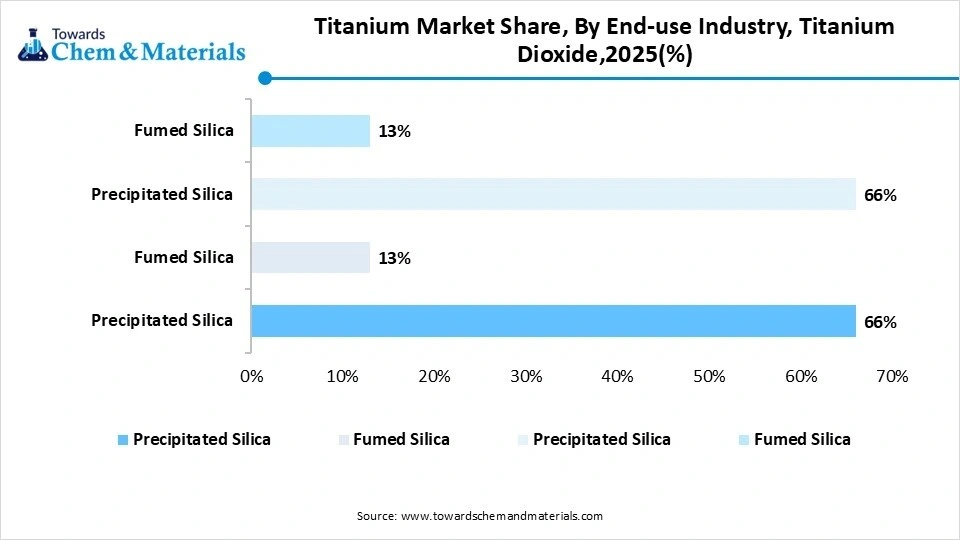
- By end-use industry (Titanium Dioxide), the paints & coatings segment dominated the market with the largest share of 57% in 2025, as automotive refinishing supports premium pigment consumption.
- By end-use industry (Titanium Dioxide), the plastics & rubber segment held 22% market share in 2025 and is expected to grow at the fastest CAGR of 7.3% over the forecast period, as titanium dioxide improves UV stability and appearance.
- By end-use industry (Titanium metal), the aerospace & defense segment dominated the market with the largest share of 44% in 2025, as defense modernization programs stimulate procurement.
- By end-use industry (Titanium metal), the desalination segment held 8% market share in 2025 and is expected to grow at the fastest CAGR of 9.6% over the forecast period, as water scarcity accelerates desalination plant construction.
According to Towards Chemicals and Materials Analytics and Consulting, the global titanium market volume was valued at 9.12 million metric tons in 2025 and is expected to surpass around 14.78 million metric tons by 2035, accelerating a compound annual growth rate (CAGR) of 4.95% over the forecast period from 2026 to 2035.
 The titanium industry is gaining momentum due to its high strength-to-weight ratio, corrosion resistance, and biocompatibility, which are suitable for various industries such as aerospace, medical, automotive, and industrial. Aerospace is still the biggest application for aircraft structures and jet engines, and titanium dioxide (TiO₂) has still been winning the battle in paints and coatings, plastics, and paper.
The growing implementation of lightweight components in EVs and the increasing renewable energy grid is opening up great growth prospects. The development of technologies such as additive manufacturing, powder metallurgy, the design of implants with the support of artificial intelligence, and sustainable chloride-route extraction is improving manufacturing efficiency while simultaneously lowering its costs.
- In June 2026, ASUS unveiled the VivoWatch 6 Plus with a titanium alloy casing, with the materials qualities of lightweight durability, corrosion-proof, and high-end aesthetic making it a key material for high-end wearable devices. (Source: www.notebookcheck.net)
Market trends
- Technological advancements in medical sciences like 3D printing, the use of titanium alloy in implants due to their durability and biocompatibility, drive the growth.
- The growing shift towards sustainability amid rising environmental concerns, titanium recycling is a growing trend that aligns with environmental sustainability.
- The increasing demand for durable and lightweight materials from premium brands fuels the growth of the market.
- The growing demand for titanium from various industries like aerospace, medical, and automotive drives the growth of the market.
Report Scope
| Report Attributes | Details |
| Market Size in 2026 | USD 34.34 Billion/ 9.57 Million Metric Tons |
| Market Size by 2035 | USD 62.34 Biliiion/ 14.78 Million Metric Tons |
| Growth Rate from 2025 to 2035 | CAGR 6.85% |
| Base Year of Estimation | 2025 |
| Forecast Period | 2025 - 2035 |
| High Impact Region | Asia Pacific |
| Segment Covered | By End Use, By Region |
| Key Companies Profiled | ATI, TiFast s.r.l., Titanium Metals Corporation, Toho Titanium Co., Ltd., UST-KAMENOGORSK TITANIUM AND, MAGNESIUM PLANT JSC (UKTMP), Hermith GmbH, Baoji Titanium Co. Ltd., Western Superconducting Technologies, Co, Ltd. (WST), Kobe Steel, Ltd.,Western Metal Materials Co. Ltd. (WMM),Precision Castparts Corp. (PCC),Howmet Aerospace Inc., Mishra Dhatu Nigam Limited (MIDHANI), ERAMET Group, Xinjiang Xiangsheng New Material, Technology Co., Ltd., Oric Italiana S.r.l., L.C.M.A. S.A., ZTMC Ltd. |
Supply Chain Analysis of the Titanium Market
Feedstock Procurement
- This stage includes mining and processing the mineral(s) that contain titanium, like ilmenite and rutile, to make titanium slag (the raw material for titanium metal) and titanium dioxide feeds (used to make pigments).
- Tronox Holdings: An integrated mining and mineral processing company that provides titanium feedstocks to the world.
- Other Key Players: Rio Tinto, Iluka Resources.
Chemical Synthesis and Processing
- The feedstocks are chlorinated and reduced to produce titanium sponge, which is melted to produce billets, ingots, slabs, or titanium dioxide pigments for the industrial sectors.
- VSMPO-AVISMA: Advanced metallurgical processing technologies are used for the production of aerospace-grade titanium sponge, ingots, forgings, and mill products.
- Other Key Players: Toho Titanium, Osaka Titanium Technologies.
Compound Formulation and Blending
- Titanium is blended with other metals to create aerospace alloys, and titanium dioxide is coated to provide other applications.
- ATI Inc.: Creates bespoke titanium alloy solutions for the aerospace, defense, medical, and industrial sectors.
- Other Key Players: Howmet Aerospace, Baoji Titanium Industry.
Market Opportunity
What is the Key Growth Opportunity Responsible for the Growth of the Market?
The key growth opportunity responsible for the growth of the titanium market is the growing demand for titanium alloy in aerospace and aeronautics for fabrication. The titanium is used in fabrications due to its high specific mechanical properties, low thermal conductivity, and its corrosion resistance at low temperatures. Titanium alloys are used in applications in airframes as they provide strength and durability by reducing the weight, in engines where high temperature resistance and strength are essential, in spacecraft to improve mechanical strength and improve longevity, and in rockets to withstand high stress and high temperature. These applications in the aerospace industry contribute to the growth and support expansion of the market.
Market Challenge
High Extraction and Production Costs of Titanium
Titanium extraction is a complex process that requires high energy for refining and processing, Titanium is not found in pure form, which requires multiple steps requiring high energy, which also requires high cost, which is a challenge for growth. Titanium is highly reactive, especially at high temperature, which also lead to impurities, which leads to generation of waste during process which lead to loss of the original product and lead to generation of low quantity of final product which affects the product cost which adds up to the cost of extraction and production, as a result it affects market expansion and hinders the growth of the market.
Regional Insights
How did the Asia Pacific dominate the Titanium Market in 2025?
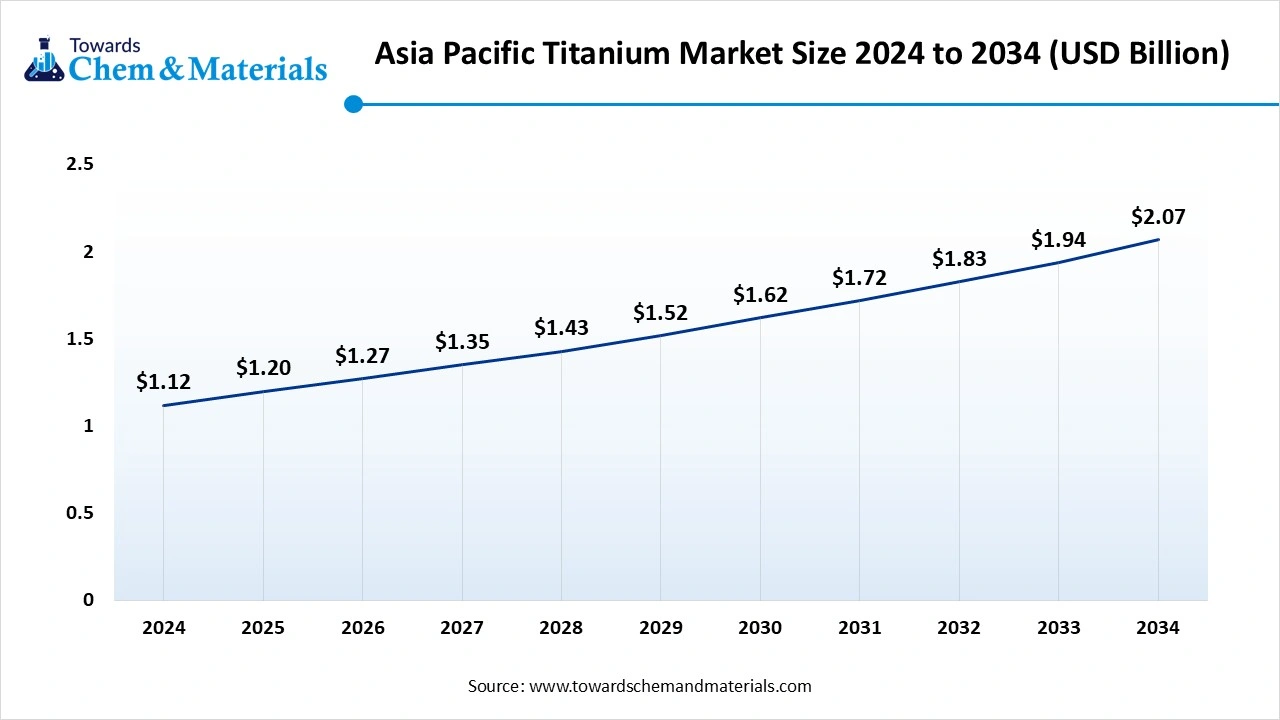
The Asia Pacific titanium market size was estimated at USD 15.75 billion in 2025 and is projected to reach USD 30.86 billion by 2035, growing at a CAGR of 6.96% from 2026 to 2035.Asia Pacific dominated the market with the largest share of 49% in 2025. The region has experienced significant investments in titanium dioxide production, high aerospace manufacturing activity, growth in the automotive industry, and increased investment in infrastructure. The titanium value chain in the region remains strong and continues to gain momentum from rapid industrialization, the production of medical devices, and the demand for high-performance coatings and lightweight alloys.
China
- Worlds largest producer of titanium dioxide, which is used to coat various products, including in the plastics, paper, and construction sectors, where high-purity pigments and specialty titanium products are supplied.
The widespread adoption of titanium alloys in manufacturing various components of aircraft structures, engines, and defense equipment resulted in substantial growth in the demand for titanium alloys in the aerospace sector. - As electric vehicle production ramped up, use of lightweight titanium parts for greater efficiency, durability, and corrosion resistance also increased.
India
- Increased production of aircraft and defense products drove the growth in the consumption of titanium alloys for domestic use in various sectors such as naval, strategic, and aviation applications.
- The growth of healthcare investments drove growth in demand for titanium orthopedic implants, dental implants, and sophisticated medical devices across the country.
- Expansion in infrastructure and an increase in the paints industry helped drive the consumption of titanium dioxide in construction and industrial coatings.
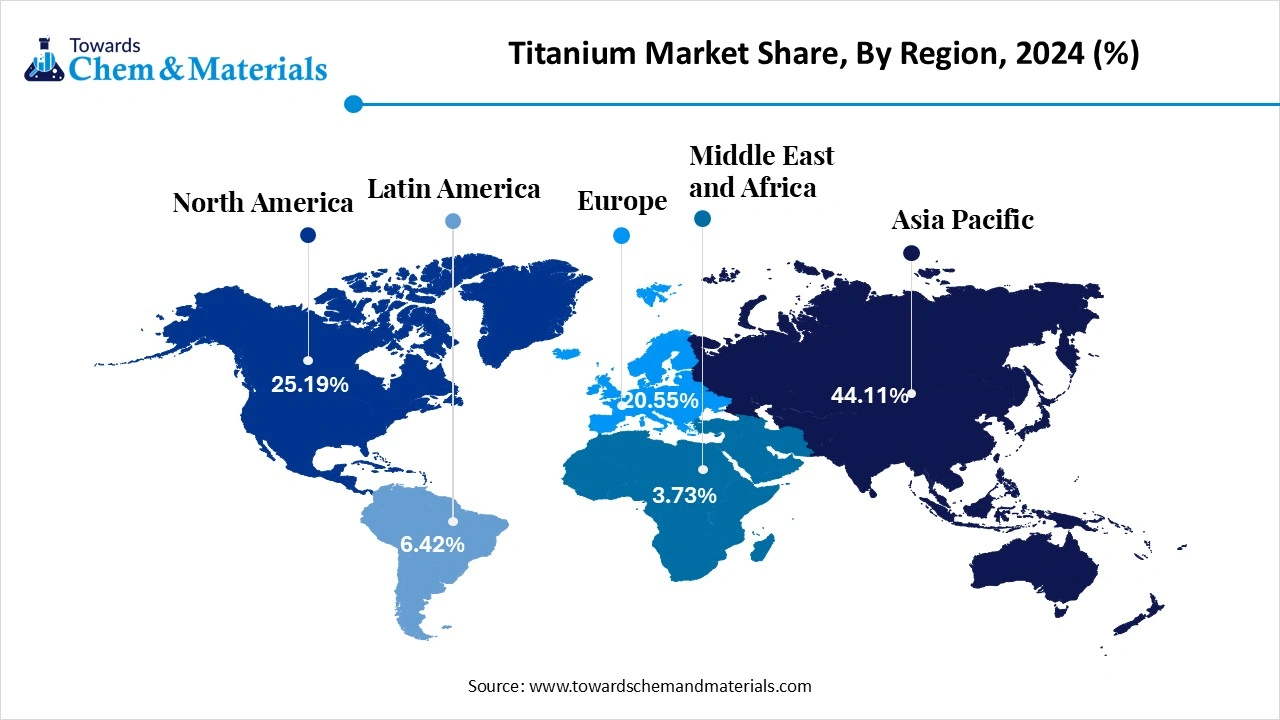
North America held 19% market share in 2025 and is expected to grow at the fastest CAGR of 7.5% during the forecast period, due to the growing medical technology industries and defense modernization, along with the advanced aerospace manufacturing. The development of electric vehicle production, additive manufacturing, and domestic titanium processing investments is bolstering the competitiveness of the region. There are also initiatives for diversifying the supply chain, which promote local industry development of titanium and strategic raw material sourcing.
United States
- The most significant end user of titanium alloys continued to be the aerospace industry for commercial aircraft, military aircraft, and advanced space exploration programs.
- Medical device manufacturers ramped up manufacturing of titanium orthopedic implants, precision dental implant systems, and spinal devices.
- Defense modernization drives, especially for naval, aerospace, and missile applications, spurred procurement of high-performance titanium parts.
Canada
- Domestic processing and export markets in North America were guaranteed because of the mining operations of titanium.
- Titanium structural parts for commercial aircraft manufacturing and maintenance expanded usage in the aerospace industry.
- Investments in advanced metallurgy increased the efficiency of production of titanium alloys and capabilities for the manufacture of high-value industrial products.
Europe held 22% market share in 2025, owing to the aircraft sector, the high-end vehicle industry, and sustainable industrial development. The use of recycled titanium is promoted by strict environmental regulations and the use of energy-saving processing technologies. Key long-term drivers of regional demand for titanium are continued investment in medical technologies, renewable energy, and advanced engineering.
Germany
- Titanium components are becoming more common in premium automotive applications, where car weight reduction and fuel/battery efficiency are important.
- Industrial machinery, chemical, and precision manufacturing applications saw advanced engineering industries increase usage of titanium alloys.
- As healthcare demand increased, the medical technology firms boosted manufacturing of titanium implants and high-tech surgical devices.
France
- The aircraft fuselage structure, engines, and advanced defense aerospace systems continued to be major areas of procurement by aerospace manufacturers.
- The government defence investments helped to increase the use of titanium alloys in military aviation and naval modernization.
Latin America held 6% market share in 2025, with the ongoing development of mineral resources, construction projects, and growing industrial manufacturing. Titanium dioxide use is increasing in paints, plastics, and infrastructure. The Governments investment in the modernization of the mines and industrial diversification continues to give impetus to the growth of the markets in the region in the long term.
Brazil
- Global feedstock supply to the titanium dioxide and titanium metal manufacturing industry improved, due to the rich mineral resources of titanium.
- In the decorative and protective coatings for architecture, the demand for titanium dioxide pigments grew due to the expansion of construction activity.
Chile
- Investments in the mining sector bolstered the extraction and processing of the minerals, supporting regional industrial development projects, particularly those related to titanium.
- Modernization of infrastructure led to a rise in demand for durable titanium dioxide pigments in protective coating applications.
The Middle East & Africa held 4% market share in 2025, owing to industrial diversification, desalination infrastructure, and investments in the energy sector. The operating conditions are becoming more extreme, and Ti equipment and parts are still needed to withstand corrosion. Future titanium use in the region is expected to be supported by government-led infrastructure development, as well as mining activities.
Saudi Arabia
- Titanium heat exchangers, heat recovery condensers, and processing equipment were used at large-scale desalination plants, and were widely used due to their high corrosion resistance and long service life.
- The increase in titanium demand was driven by the industrial diversification efforts that extended demand for titanium to petrochemical processing, manufacturing, and advanced engineering industries.
South Africa
- The regions large mineral resources with good titanium content boosted the local mining industry and helped supply the worlds titanium production industry.
- The industrial manufacturing sector increasingly switched to titanium alloys with high corrosion resistance and durability in service
Segmental Insights
End-Use Insights
How Did the Aerospace and Defense Segment Dominate the Titanium Market In 2025?
The aerospace & defense segment dominated the titanium market share 44% in 2025. The aerospace and defense industry used titanium for its frames, landing gear, and fuselages because of its lightweight properties. Defense engines need and demand materials which is highly resistant to changing temperatures to withstand pressure and stress, which increases the demand for titanium alloys for blades, discs, and casings. The titanium is used for the construction of missiles and armor because of its high strength and weight ratio, mechanical properties, and thermal properties,Titanium is most commonly the material of choice for engine parts that operate up to 1100 degrees F. The high strength and low density, which gives aero-engine manufacturers high performance, increases the demand for the market and helps in expansion.
 The industrial segment expects significant growth in the titanium market during the forecast period.Titanium’s key properties, like corrosion resistance from various chemicals which make it a popular choice in various industrial uses like marine, paper, chemical processing, and desalination plants, which drives the growth of the market. Titanium is used in industries because of its benefits, offered as high strength and low weight, corrosion resistance, biocompatibility, high temperature performance, and longer lifespan because of thermal stability and durability. Industrial use requires materials with high resistance to temperature and corrosion, so titanium plays a crucial role in the industrial segment. In the chemical industry and power generation industry, titanium is used extensively due to its applications and properties. These factors contribute to the growth and support expansion of the market.
Titanium Market Share, By End-use Industry, Titanium Metal,2025(%)
| By End-use Industry | Market Share (%) |
| Aerospace & Defense | 44% |
| Chemical & Process Industry | 19% |
| Energy & Power | 16% |
| Desalination | 8% |
| Other End-use Industries | 13% |
Recent Developments
- In June 2026, Efinix introduced the Titanium Edge FPGA family for edge AI applications. The new devices were designed to meet the increasing demand for AI-powered embedded computing systems, offering a range of key benefits such as low power consumption, compact size, improved security, and reliability.
(Source: www.embedded.com) - In June 2026, Corbion Ingredients launched its titanium dioxide-free bakery icings solution LUMI Set. The product allowed manufacturers to keep their products looking as good as possible while complying with growing regulatory regulations and consumer concerns about the use of titanium dioxide in food formulations in North America. (Source: www.preparedfoods.com)
Top Companies List
- ATI
- TiFast s.r.l.
- Titanium Metals Corporation
- Toho Titanium Co., Ltd.
- UST-KAMENOGORSK TITANIUM AND MAGNESIUM PLANT JSC (UKTMP)
- Hermith GmbH
- Baoji Titanium Co. Ltd.
- Western Superconducting Technologies Co, Ltd. (WST)
- Kobe Steel, Ltd.
- Western Metal Materials Co. Ltd. (WMM)
- Precision Castparts Corp. (PCC)
- Howmet Aerospace Inc.
- Mishra Dhatu Nigam Limited (MIDHANI)
- ERAMET Group
- Xinjiang Xiangsheng New Material Technology Co., Ltd.
- Oric Italiana S.r.l.
- L.C.M.A. S.A.
- ZTMC Ltd.
Segments Covered in the Report
By Product Type
- Titanium Dioxide
- Sulfate Process Grade
- Chloride Process Grade
- Titanium Metal (Milled Products, Powder)
- Milled Products
- Plate
- Sheet
- Bar & Rod
- Tube & Pipe
- Powder
- Spherical Powder
- Irregular Powder
- Milled Products
By End-use Industry, Titanium Dioxide
- Paints & Coatings
- Architectural Coatings
- Industrial Coatings
- Automotive Coatings
- Plastics & Rubber
- Engineering Plastics
- PVC
- Rubber Compounds
- Paper
- Printing Paper
- Packaging Paper
- Specialty Paper
- Other End-use Industries
- Cosmetics
- Food
- Inks
- Textiles
By End-use Industry, Titanium Metal
- Aerospace & Defense
- Commercial Aircraft
- Military Aircraft
- Space Systems
- Chemical & Process Industry
- Heat Exchangers
- Reactors
- Process Equipment
- Energy & Power
- Nuclear Power
- Thermal Power
- Renewable Energy
- Desalination
- Reverse Osmosis Plants
- Multi-stage Flash Plants
- Other End-use Industries
- Medical
- Marine
- Automotive
- Industrial Equipment
By Region
- North America
- U.S.
- Canada
- Europe
- Germany
- UK
- France
- Italy
- Spain
- Sweden
- Denmark
- Norway
- Asia Pacific
- China
- Japan
- India
- South Korea
- Thailand
- Latin America
- Brazil
- Mexico
- Argentina
- Middle East and Africa (MEA)
- South Africa
- UAE
- Saudi Arabia
- Kuwait



Comments
Share your thoughts, ask a question, or provide feedback about this report.