
Martensitic Stainless Steels Market Size Analysis Report 2035
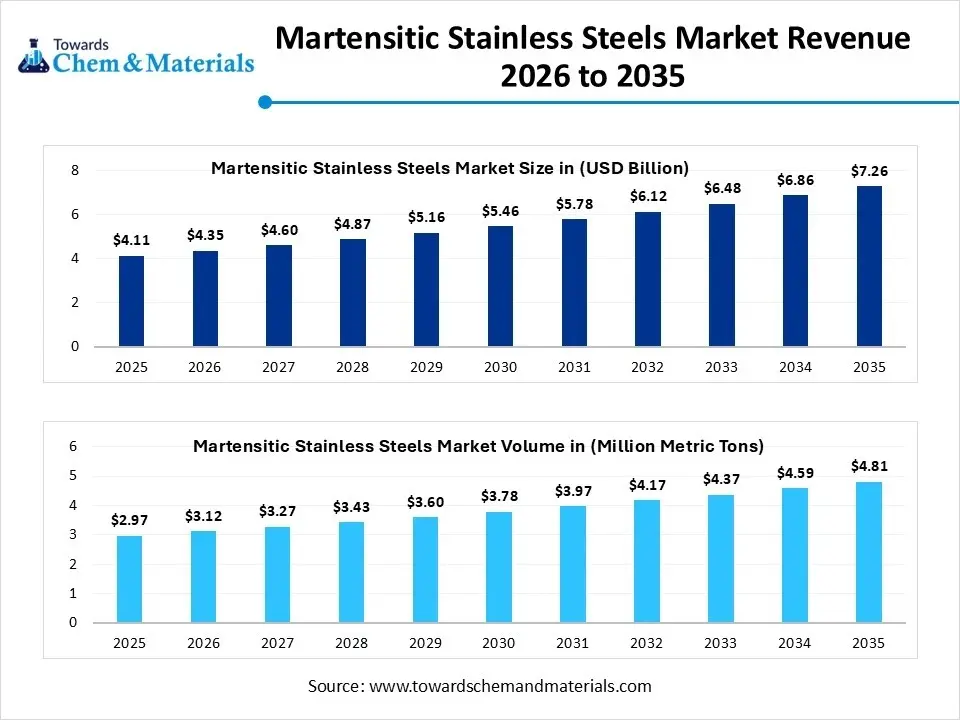
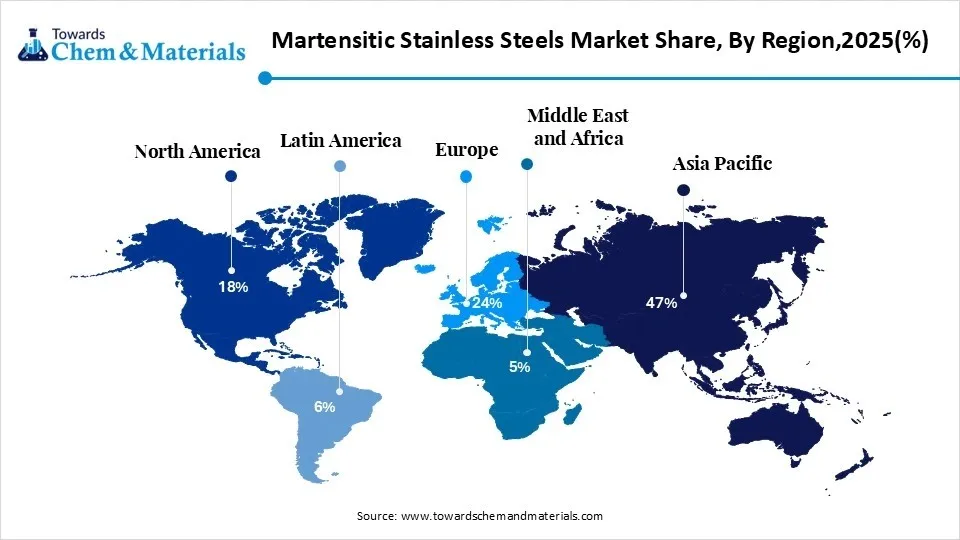
The global martensitic stainless steels market size was valued at USD 4.11 billion in 2025, is estimated to reach USD 4.35 billion in 2026, and is projected to reach USD 7.26 billion by 2035, exhibiting a compound annual growth rate (CAGR) of 5.85% over the forecast period from 2026 to 2035.Asia Pacific dominated the martensitic stainless steels market with the largest revenue share of 47% in 2025 and is expected to grow at the fastest CAGR of 5.98%during the forecast period. In terms of volume, the martensitic stainless steels market is projected to grow from 2.97 million metric tons in 2025 to 4.81 million metric tons by 2035, registering a CAGR of approximately 4.94% from 2025 to 2035. The applications in automotive, oil and gas, architecture, building and construction, and aerospace, due to its high mechanical and corrosion resistance, are the core advantages of this product. The key collaborations between companies such as JFE Steel and local partners, POSCO and Nippon Steel, are primarily aimed at developing advanced recycled steel for its applications. This expansion and development are expected to create a strong presence of the product in the upcoming time.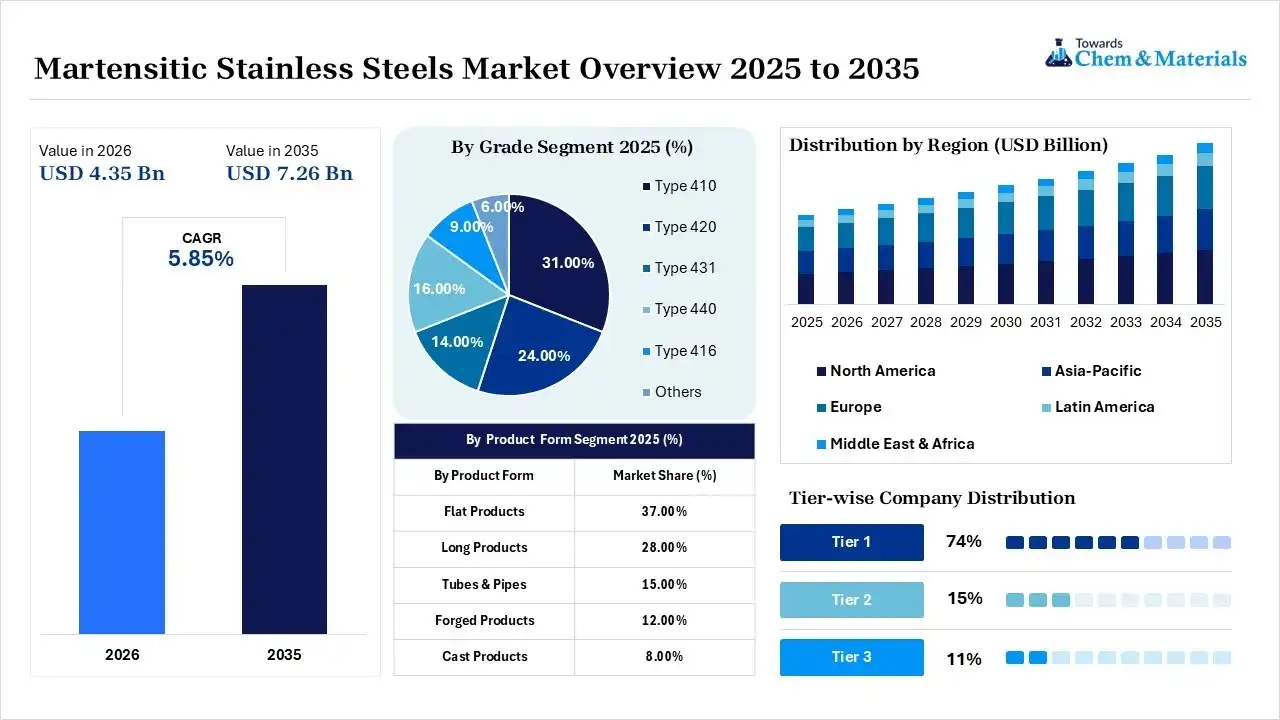
Market Highlights
- By region, Asia Pacific dominated the market with a share of 47% in 2025, due to expanding manufacturing hubs in the region.
- By region, North America held 18% market share in 2025 and is expected to experience the fastest growth with a CAGR of 6.5% in the forecast period. The growing oil and gas investment in the region drives growth.
- By grade, the type 410 segment dominated the market with a 31% share in 2025. Widely used across industrial machinery.
- By grade, the type 420 segment held 24% market share in 2025 and is expected to have the fastest growth with a CAGR of 6.60% in the forecast period. Demand rises for surgical instruments.
- By product form, the flat products segment dominated the market with a 37% share in 2025. Strong demand from fabrication industries.
- By product form, the tubes and pipes segment held 15% market share in 2025 and is expected to have the fastest growth with a CAGR of 6.4% in the forecast period. Oil & gas investments increase.
- By heat treatment, the Hardened & Tempered segment dominated the market with a 39% share in 2025. Provides balanced toughness and hardness.
- By heat treatment, the Quenched & Tempered segment held 21% market share in 2025 and is expected to have the fastest growth with a CAGR of 6.3% in the forecast period. Heavy-duty equipment adoption rises.
- By manufacturing process, the hot-rolled segment dominated the market with a 35% share in 2025. Cost-efficient production supports volume demand.
- By manufacturing process, the cold-rolled segment held 26% market share in 2025 and is expected to have the fastest growth with a CAGR of 6.4% in the forecast period. Precision industries require a superior finish.
- By end use industry, the automotive segment dominated the market with a 27% share in 2025. Engine efficiency improvements drive adoption
- By end use industry, the aerospace segment held 11% market share in 2025 and is expected to have the fastest growth with a CAGR of 6.8% in the forecast period. Aircraft production expands globally.
- By distribution channel, the direct sales segment dominated the market with a 46% share in 2025. Large industrial contracts drive procurement.
- By distribution channel, the online sales segment held 6% market share in 2025 and is expected to have the fastest growth with a CAGR of 8.2% in the forecast period. Digital procurement platforms expand.
The martensitic stainless steels are magnetic steels that primarily consist of 11.5% to 18% chromium and 0.1 to 1.2% carbon, which helps make hardenable steel. The chromium and carbon contents help in balancing the structure of the stainless steel. It is preferred by most of the sectors due to its advantageous properties, such as its exceptional tensile strength, wear resistance, and durability, which are used and helpful in making materials for turbine parts, tools, and surgical instruments. Commonly used grades are type 410, type 420, type 431, type 440A, type 440B, and type 440C. The application of martensitic stainless steels depends on the carbon content and is used for its corrosion resistance, wear resistance, and high-strength properties.
- For instance, the recent launch of the UGIMA®-X third-generation high-performance machinable stainless steels by the Swiss Steel Group introduces newly optimized martensitic grades designed for demanding industrial applications. The key martensitic grades launched include UGIMA-X 4021 and UGIMA-X 4028
(Source: swisssteel-group.com)
They are used for their mechanical properties, up to about 0.4% C in applications such as valves, shafts, and pumps, and above 0.4 C, it is used for their wear resistance in surgical blades, nozzles, cutlery, and plastic injection molds, which increases the demand for the product, helping in expanding the business. Martensitic stainless steels help in providing a low-maintenance product life, which helps manufacturers due to their profitable recycling rate, which aligns with sustainability initiatives due to rising environmental concerns, which attracts manufacturers due to growing awareness.
The main application lies in 3 major sectors, that is, aerospace, power generation, and oil and gas recovery, due to its application, which propels the growth and expansion of the market. In aerospace, it is used for its high strength, reliability, stiffness, and corrosion resistance. In power generation, creep-resistant materials in the martensitic stainless steels allow steam power to operate at 650°C, which is important in electricity produced by steam. In oil and gas recovery, used for moderate temperatures and CO2 and H2S pressure, new grades are more resistant to stress corrosion cracking and sulfide stress cracking, which help bridge the gap between martensitic and the expensive high corrosion-resistant duplex grades.
Global Investment Flow for Martensitic Stainless Steels Market 2026
The growing investments by major companies like Outokumpu (Finland), Sandvik (Sweden), and Carpenter Technology (US), and the governments domestic production and expansion through policies like the Production-Linked Incentive (PLI) Scheme are key investors and promising leads in the manufacturing of products.
- Indias leading stainless-steel manufacturer, Jindal Stainless, operates 16 stainless steel manufacturing and production units in India, Spain, and Indonesia. The companys product line makes it’s a largest facility in India. The sustainability and green energy focus of the company makes it a valuable asset.(Source: www.jindalstainless.com)
- Shyam Metalics and Energy plans to pledge an additional ₹2,700-crore investment focusing heavily on specialty and value-added steel products, aimed at driving import substitution by 2029.(Source: infra.economictimes.indiatimes.com)
- Jindal Stainless Limited is planning a massive ₹40,000-crore investment to set up a new facility in Maharashtra. Supported by the state government, this facility will focus on specialized grades including martensitic stainless steels for critical applications like defense, mobility, and nuclear energy.(Source: www.manufacturingtodayindia.com)
Recent Market Growth Trends:
- The growing demand from the automotive sector due to its lightweight application, which helps in maintaining fuel efficiency, and demand for martensitic stainless steels in battery and powertrain components due to the rapid shift towards electric vehicles is a growing trend.
- The need for components capable of undergoing and handling extreme stress and temperature in the aerospace and defence sector, especially in the major hubs like Japan and the US demand for heat resistant and precipitation-hardened martensitic grade steels.
- The growing industrial and medical expansion due to its applications and properties, which are ideal for precision tools, turbine blades, and cutting instruments due to its efficient hardness, which makes it ideal for use.
Martensitic Stainless Steels Through AI: Reactive Manufacturing To Data-Driven Manufacturing
The integration of AI in the production of martensitic stainless steels is a very efficient and productive way for the manufacturing of steel, which shifts production from reactive and traditional manufacturing to data-driven and precision engineering. This key technological shift, which includes AI, is microstructure and property prediction, digital twins for heat treatment, AI-enabled defect detection, predictive maintenance, and optimized additive manufacturing, which helps in increasing the yield and also helps in efficiently lowering the carbon emissions in high-end and high-performance applications in major sectors, which propels the growth and demand for the market, supporting expansion.
Supply Chain Analysis of Martensitic Stainless Steels Market
Production and Processing
- The martensitic stainless steels are produced through melting and casting, and the primary process includes hot working and cold working.
- Signature core processing that includes heat treatment includes austenitizing, quenching, and tempering. These techniques help in the production of high-strength and hard products.
- Nippon Steel Corporation is the largest steel producer in Japan, supplying high-performance steel and advanced metals for various sectors like energy, automotive, and electronics. They supply steel like Prostruct building materials for industrial plants.
- Key players: Nippon Steel Corporation, POSCO, ArcelorMittal, JFE Steel Corporation, Baosteel Group, and Outokumpu.
Quality Testing and Certification
- The martensitic stainless steels require standards to verify specific mechanical strength, which are evaluated through various testing standards as per ASTM E112 and ASTM E8. Certifications and standards that are mandatory are material test certification, industrial standards, issued per EN 10204.
- POSCO produces martensitic stainless steels, which are high carbon and chromium, as per the grade and standards, and have superior hardness, wear and tear resistance, and corrosion resistance. It is known for manufacturing durable and high-end products, which increases the demand.
- Key players: ASTM International and UL Solutions, AEME, ISO, BIS Certification
Distribution to Industrial Users
- Martensitic stainless steels are extensively used due to their properties of high strength, wear resistance, and hardness in industries like aerospace, automotive, medical, oil and gas, power generation, and food processing for components.
- Outokumpu supplies martensitic and precipitation-hardening (PH) stainless steels primarily under its Dura product range. Outokumpu provides these materials in various flat-rolled and long product forms, optimized for different heat-treatment conditions and machinability requirements.
- Key players: SAIL, Ambica Steels Limited, and Dipti Metal Industries.
Martensitic stainless steels Regulatory Landscape
| Country / Region | Regulatory Body | Key Regulations | Focus Areas | Notable Notes |
| United States | American Society for Testing and Materials; Occupational Safety and Health Administration | ASTM Stainless Steel Standards; OSHA Workplace Safety Standards | Material quality, industrial safety | The U.S. promotes the use of martensitic stainless steels in aerospace, automotive, medical, and energy applications requiring high strength and wear resistance. |
| European Union | European Committee for Standardization; European Chemicals Agency | EN Stainless Steel Standards; REACH Regulation | Product quality, sustainable manufacturing | Europe emphasizes high-performance stainless steels for engineering, tooling, and industrial equipment while ensuring environmental compliance. |
| China | Ministry of Industry and Information Technology; State Administration for Market Regulation | GB/T Stainless Steel Standards; Environmental Protection Law | Advanced steel production, industrial modernization | China is expanding martensitic stainless steel production to support automotive, machinery, and infrastructure industries. |
| India | Bureau of Indian Standards, Ministry of Steel | IS Stainless Steel Standards; National Steel Policy | Specialty steel production, manufacturing quality | India is strengthening domestic production of martensitic stainless steels for engineering, defense, and industrial applications. |
| Japan | Japanese Industrial Standards Committee; Ministry of Economy, Trade and Industry | JIS Stainless Steel Standards | High-performance alloys, precision manufacturing | Japan focuses on premium martensitic stainless steels for automotive, aerospace, and precision engineering applications. |
| Germany | German Institute for Standardization; Federal Ministry for Economic Affairs and Energy | DIN Stainless Steel Standards; REACH Compliance | Advanced metallurgy, lightweight engineering | Germany is a leading producer of high-quality martensitic stainless steels for automotive, industrial machinery, and aerospace sectors. |
What are the Key Product Types of Martensitic stainless steels?
The martensitic stainless steels are magnetic alloys and highly hardenable products that are known for their exceptional strength and wear resistance. The products offered are made up of martensitic stainless steels are iron-chromium alloys whose properties can be modified through carbon content and heat treatment; commonly used grades include 410, 420, 431, and 440-series grades, creep-resisting grades, nickel-bearing grades, and precipitation-hardening steels. The key product grades offered are:
Iron-Chromium-Carbon (Fe-Cr-C) Steels: Type 410, Type 420, Type 440 (ABC), used for fasteners, pins, and machine parts, surgical tools, dental instruments, cutlery, knife blades, ball bearings, and valve components. They are the most widely used martensitic steels due to their offering of great strength and wear resistance, which relies on the carbon content, making them hard during heat treatment.
Nickel-Bearing Grades: Type 431, Type 248SV (EN 1.4418) used in e hardware, shafts, and aircraft fasteners for its metal toughness, which absorbs energy without breaking, corrosion resistance, and also the manufacturers substitute the carbon and nickel and add molybdenum, which is a major factor in the production.
Precipitation Hardening (PH) Steels: 17-4 PH (Type 630) is used in aerospace hardware, turbine blades, and nuclear components. They generally use copper, aluminum, or titanium; the precipitate is formed by heating and forms a microscopic precipitate which intact the structure, matching strength and toughness.
Creep-Resisting Grades: use in gas turbines and jet engines. They are made of niobium, cobalt, boron, and vanadium, which makes them rigid and strong, which stays intact also in pressure environments like stretching or deforming of metal under stress and high temperature.(Source: worldstainless.org)
Market Dynamics
Driver
What Are the Key Growth Drivers in the Martensitic Stainless Steels Market?
Martensitic stainless steels market growth is driven by the growing shift of consumers towards EVs and the industrial shift to improve fuel efficiency and lower emissions, which increases the demand for lightweight materials from the automotive sectors is, a major factor responsible for growth. Other key growth drivers include demand from aerospace and defence, advanced manufacturing techniques, and demand from the health and medical device industry due to its properties and applications, which expand the market growth.
Restraint
What Are the Key Growth Challenges in the Martensitic Stainless Steels Market?
The market is experiencing extensive challenges due to high volatility of raw material costs, especially chromium, nickel, and molybdenum; stringent environmental regulations due to growing awareness, and growing competition, which hinders the growth of the market. Other key growth restraints are corrosion resistance limitations, intense competition from alternatives, hindrance in the supply chain, and ESG and regulatory pressures, which face increasing compliance, challenging the growth and expansion of the market.
Opportunity
What Are the Key Growth Opportunities in the Martensitic Stainless Steels Market?
The martensitic stainless steels market is experiencing growth driven by key opportunities like key technological innovation, including ongoing metallurgical advancements, which include advanced heat treatment processes, which help in improving previous challenges like brittleness. This factor and innovation increase and broaden the scope of material use in the manufacturing of equipment and heavy machinery. This is a major growth factor that will help the market to grow in the coming time and also play a significant role in the advancement of the market.
Segmental Insights
Grade Insights
The Type 410 Segment Dominated the Martensitic stainless steels Market With 31% Market Share In 2025.
The Type 410 segment dominated the market with a 31% share in 2025, due to advanced manufacturing and advanced technology like heat treatment processing and increased demand for components from sectors like automotive and mechanical engineering applications. The cost efficiency of 410 as it is processed through carbon content and thermal processing rather than tradition method propels the growth of the market.
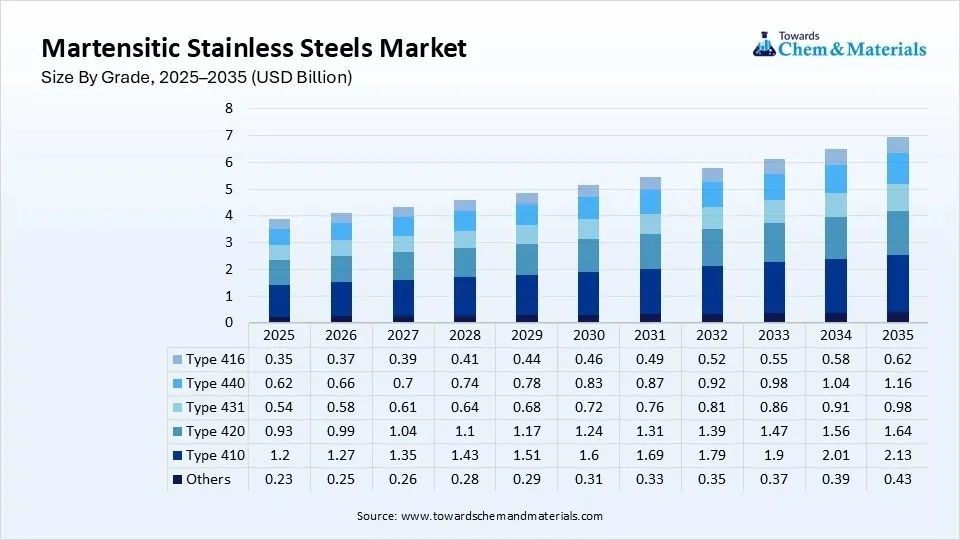
The Type 420 segment held 24% market share in 2025 and is expected to have the fastest growth with a CAGR of 6.60% in the forecast period, due to its high hardness, precision manufacturing, and excellent edge, which increases demand. The manufacturing advancements in metal processing, such as metal injection molding, help manufacturers to produce the complex 420 stainless steel. The consumer food and cutlery industrys demand for medical and surgical instruments is a major factor that supports the growth of the market.
Martensitic Stainless Steels Market Share, By Grade, 2025(%)
| By Grade | Market Share (%) |
| Type 410 | 31% |
| Type 420 | 24.00% |
| Type 431 | 14.00% |
| Type 440 | 16.00% |
| Type 416 | 9.00% |
| Others | 6.00% |
Product Form Insights
The Flat Products segment dominated the market with a 37% share in 2025, due to its properties like high strength, magnetic properties of materials, and wear resistance, which are widely used in various sectors like industrial applications, automotive, and cutlery. The research, development, and innovation in the designing and production of products to improve toughness, corrosion resistance, and wearability, while keeping the traditional strength, increase the demand and help in promoting the product in the market.
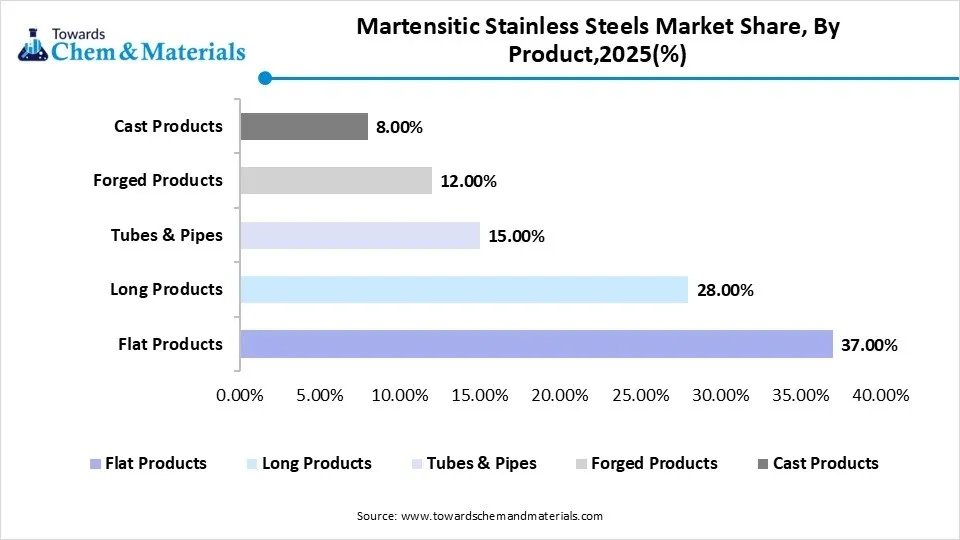
The Tubes and Pipes segment held 15% market share in 2025 and is expected to have the fastest growth with a CAGR of 6.4% in the forecast period, due to the exceptional mechanical properties, which increase demand and are ideal for high-pressure and corrosive environments, especially in industries such as aerospace and automotive, where high-strength components are used. The other major and key drivers include oil and gas sector dominance, seamless tube manufacturing innovation, and the rise of super martensitic grades. The continuous production and processing by major companies for high alloy pipes and tubes boosts the market supply.
Martensitic Stainless Steels Market Share, By Product,2025(%)
| By Product Form | Market Share (%) |
| Flat Products | 37.00% |
| Long Products | 28.00% |
| Tubes & Pipes | 15.00% |
| Forged Products | 12.00% |
| Cast Products | 8.00% |
Heat Treatment Insights
The hardened & tempered segment dominated the market with a 39% share in 2025, due to its demand for wear resistance and structural durability, balancing the high hardness of the materials for high-stress applications. The hardened and tempered are extensively used to withstand corrosive environments and mechanical wear, supporting growth. This also helps in strengthening the manufacturing and heat treatment through advanced processing, supporting the growth of the market.
The quenched & tempered segment held 21% market share in 2025 and is expected to have the fastest growth with a CAGR of 6.3% in the forecast period, due to growing demand for steel in the broader specialty stainless steel sector. Rapid cooling and then tempering it is a foundational processing route for martensitic stainless steel. Energy sector applications, industrial tooling, cutlery, advanced heating treatment, and regional dominance for heat-treated steel plates and specialty grades, especially in India and China, further propel the expansion of the market.
Manufacturing Process Insights
The hot-rolled segment dominated the market with a 35% share in 2025 due to robust and exceptional demand from industrial manufacturing, rapid infrastructure development, and the need for high-strength and wear-resistant components due to their properties and applications. The other key growth drivers are industrial machinery dominance, application in heavy-duty components, infrastructure, and shipbuilding, which create industrial dominance and support the growth of the market.
The cold-rolled segment held 26% market share in 2025 and is expected to have the fastest growth with a CAGR of 6.4% in the forecast period, due to exceptional demand from the industry for blades, shafts and valves, which increases the consumption of cold-rolled martensitic flats. The advanced processing through integrating continuous lines, tempering the tight tolerance, and improving weldability also meets the market demand. The hardness level over HRC 55, which his achieved by the cold rolling, makes it a preferred choice for surgical instruments and premium cutlery, which further increases the demand.
Martensitic Stainless Steels Market Share, By Heat Treatment,2025(%)
| By Heat Treatment | Market Share (%) |
| Annealed | 19.00% |
| Hardened | 21.00% |
| Hardened & Tempered | 39.00% |
| Quenched & Tempered | 21.00% |
End Use Industry Insights
The automotive segment dominated the market with a 27% share in 2025, due to its exceptional and superior strength, wear resistance, and high hardness, as it is used in disc brakes and powertrain components, due to its high hardness and moderate corrosion resistance, which expands its application and demand. The push for better fuel efficiency and longer EV ranges increases the demand for lightweight materials, maintaining structural lightweighting without compromising crash safety, expanding the growth of the market.
The aerospace segment held 11% market share in 2025 and is expected to have the fastest growth with a CAGR of 6.8% in the forecast period, due to rising demand for materials offering exceptional strength-to-weight ratios, high tensile strength, and corrosion resistance under extreme operating conditions. It is a vital material for critical aircraft parts, including turbine blades, engine components, and landing gear. The expanding forgings market, which is driven by the aerospace and commercial aviation needs, drives growth.
Martensitic Stainless Steels Market Share, By End-use Industry, 2025(%)
| By End-use Industry | Market Share (%) |
| Automotive | 27% |
| Oil & Gas | 18.00% |
| Aerospace | 11.00% |
| Power Generation | 12.00% |
| Industrial Machinery | 17.00% |
| Medical | 6.00% |
| Consumer Goods | 6.00% |
| Others | 3% |
Distribution Channel Insights
The Direct Sales Segment Dominated the Martensitic Stainless Steels Market With 46% Market Share In 2025
The direct sales segment dominated the market with a 46% share in 2025. It is largely driven by original equipment manufacturers (OEMs) in aerospace, automotive, and heavy industry bypassing distributors to establish long-term supply contracts for high-strength, lightweight, and heat-resistant components. Martensitic steels offer an exceptional strength-to-weight ratio. Direct sales to automotive OEMs are surging as the shift toward electric vehicles (EVs) requires highly durable, crash-resistant chassis parts and battery enclosures.
The online sales segment held 6% market share in 2025 and is expected to have the fastest growth with a CAGR of 8.2% in the forecast period, driven by the broader B2B shift toward digital procurement and e-commerce. B2B metal marketplaces allow buyers to instantly compare grades, prices, and delivery terms, replacing traditional, time-intensive RFQ processes. Platforms like Metalbook App on Google Play, OfBusiness, and SteelonCall facilitate transparent price discovery, instant quotations, and logistics for industrial metals.
Martensitic Stainless Steels Market Share, By Distribution Channel,2025(%)
| By Distribution Channel | Market Share (%) |
| Direct Sales | 46.00% |
| Distributors & Service Centers | 33.00% |
| Online Sales | 6.00% |
| OEM Supply Contracts | 15.00% |
Regional Analysis
How did Asia Pacific dominate the Martensitic Stainless Steels Market in 2025?
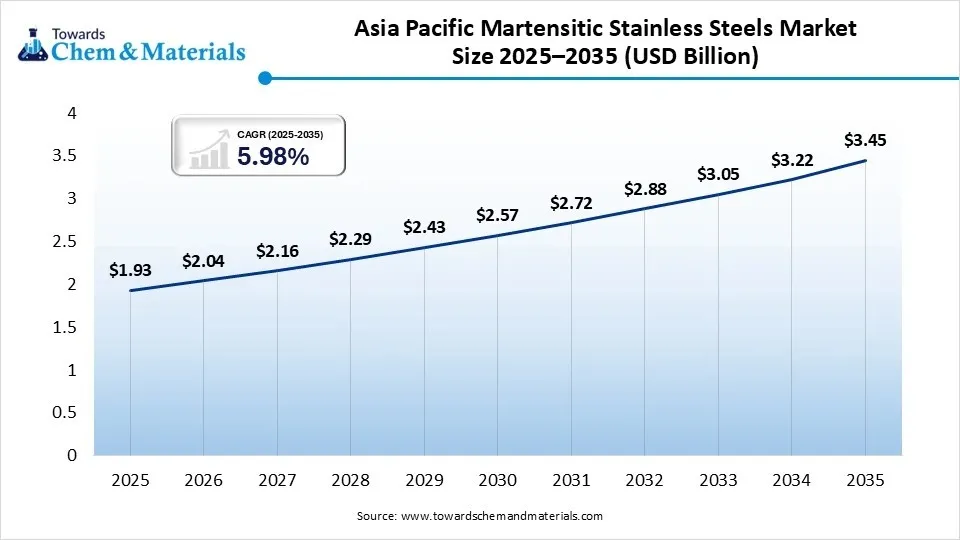
The Asia Pacific martensitic stainless steels market size was estimated at USD 1.93 billion in 2025 and is projected to reach USD 3.45 billion by 2035, growing at a CAGR of 5.98% from 2026 to 2035. Asia Pacific dominated the market with a share of 47% in 2025, due to massive government initiatives for development of infrastructure development, rising production from major industry players like Baosteel and Tsingshan, and rapid urbanization, which supports the growth in the region. Policies such as Indias national stainless-steel policy and massive regional smart city projects increase the consumption and further expand the market growth. The cost-effective local production and energy and power generation are the reasons for the dominance of the market in the region.
 India
India
Indias martensitic stainless steels market is driven by booming demand for high-strength, wear-resistant materials in the automotive, aerospace, and healthcare industries. Government initiatives like Make in India and rapid infrastructure development are propelling overall consumption, making the Asia-Pacific region the fastest-growing hub for specialty steels.
China
Chinas martensitic stainless-steel market is primarily driven by expanding automotive manufacturing, large-scale infrastructure and energy projects, and rising demand for industrial machinery. Technological advancements enhancing material wear and corrosion resistance are further boosting adoption in critical, high-strength applications.
North America Martensitic Stainless Steels Market Growth Factor
North America martensitic stainless steels market size was estimated at USD 0.74 billion in 2025 and is projected to reach USD 1.34 billion by 2035, growing at a CAGR of 6.12% from 2026 to 2035. North America held the market share of 18% in 2025 and is expected to have the fastest growth with a CAGR of 6.5% in the forecast period, due to growing hubs of aerospace, automotive, and energy sectors, which increase demand and sale strengthen the production and manufacturing in the region. The regional infrastructure development, increased medical device production, and heavy investment in the region propel the growth further. The heavy investment in the development of bridges, highways, and public transportation supports and adds to the growth of the market.
United States
The US Martensitic stainless steels market is rapidly expanding, driven by the aerospace, automotive, and medical device sectors. Growth is fueled by the materials high strength-to-weight ratio and exceptional wear resistance. Upgrading aging infrastructure and expanding renewable energy facilities which rely heavily on these corrosion-resistant and highly durable alloys are major catalysts.
Canada
Canadas martensitic stainless-steel market This growth is primarily fueled by infrastructure upgrades, an expanding domestic energy sector, robust automotive manufacturing, and high-demand applications like industrial machinery and surgical instruments. Canadian automotive supply chains rely on martensitic grades for gears, shafts, and exhaust lines. The push for durable, lightweight materials to improve fuel efficiency directly accelerates local demand.
Europe Martensitic Stainless Steels Market Growth Factor
The Europe martensitic stainless steels market size was estimated at USD 0.99 billion in 2025 and is projected to reach USD 1.78 billion by 2035, growing at a CAGR of 6.04% from 2026 to 2035. Europe held a market share of 24% in 2025, due to regional shift towards adoption of Ev which increases the demand for lightweight materials to increase the fuel efficiency especially in countries like Germany, France, and the U.K. the major growth driver in the regions market is stringent regional eco-friendly manufacturing mandates like EUs carbon Border Adjustment Mechanism pushes the manufacturers to adopt more cleaner and greener production practice with the help of key players in the region like Outokumpu and Acerinox, accelerating the shift toward recycled scrap usage.
Germany
Germanys martensitic stainless steels market is driven by robust demand from the automotive sector, especially exhaust lines and engine components and the manufacturing of surgical tools, kitchen knives, and industrial blades. The regional market is supported by advanced engineering and green steel initiatives. Germany is a global hub for high-precision medical devices. The exceptional hardenability and corrosion resistance of martensitic stainless steel make it the gold standard for surgical instruments.
Italy
The market for martensitic stainless steels in Italy is primarily driven by strong demand from domestic manufacturing and export-oriented sectors like automotive like Ferrari, Lamborghini, and Fiat components, aerospace, and high-end kitchenware. Because these alloys are prized for their high strength, wear resistance, and hardness, they are frequently utilized in critical components such as engine valves, turbine blades, bearings, and cutting tools.
Latin America Martensitic Stainless Steels Market Growth Factor
The Latin America martensitic stainless steels market size was estimated at USD 0.25 billion in 2025 and is projected to reach USD 0.47 billion by 2035, growing at a CAGR of 6.52% from 2026 to 2035. Latin America held a market share of 6% in 2025, driven by infrastructure development in heavy industry, booming automotive manufacturing in countries like Mexico and Brazil, and rising demand for corrosion-resistant materials in the regional energy sector. The region, particularly Brazil, is seeing heavy adoption of high-strength martensitic stainless steel for lightweight, durable components like gears, shafts, and cutting tools, which helps automakers improve fuel efficiency.
Brazil
The Brazilian martensitic stainless-steel market is primarily driven by expanding automotive manufacturing, localized heavy industrial operations, and the energy/oil & gas sectors. This specific material is highly valued for its superior hardness, wear resistance, and ability to withstand extreme conditions. Rapid urbanization and infrastructure projects require durable construction equipment and industrial machinery. Martensitic steel is uniquely suited for tools, blades, valves, and mining equipment that demand exceptional wear resistance.
Argentina
Argentinas martensitic stainless-steel market is primarily driven by expanding oil and gas operations (Vaca Muerta), automotive manufacturing, and infrastructure upgrades. These sectors rely on the materials exceptional hardness, wear resistance, and high-temperature durability.
Middle East and Africa Martensitic Stainless Steels Market Growth Factor
The Middle East and Africa martensitic stainless steels market size was estimated at USD 0.21 billion in 2025 and is projected to reach USD 0.40 billion by 2035, growing at a CAGR of 6.66% from 2026 to 2035. The Middle East and Africa held a market share of 5% in 2025, primarily driven by expanding oil and gas infrastructure, automotive manufacturing, and large-scale industrial projects within the GCC region and South Africa. Its high strength, hardness, and wear resistance make it essential for engineering applications such as turbine blades, shafts, and valves. Extensive upstream and downstream development in energy hubs, particularly in Saudi Arabia and the UAE, requires martensitic stainless steel for its resistance to corrosion and high-stress environments.
Saudi Arabia
Saudi Arabias martensitic stainless-steel market is predominantly within the 400 Series Market and is driven by government Vision 2030 initiatives, investments in petrochemical and oil and gas infrastructure, and high-tech manufacturing localization. Key growth factors include high-stress industrial applications requiring superior wear resistance, corrosion defense, and high tensile strength.
UAE
The UAEs martensitic stainless steels market is expanding due to heavy investments in the oil & gas sector, petrochemical processing, and rapid infrastructure development. High-strength and wear-resistant martensitic grades like 410 and 420 are highly sought after for equipment requiring extreme durability in harsh environments.
Competitive Analysis
The martensitic stainless-steel production is heavily focused on by domestic and major players due to high demand for agile production from automotive, aerospace, and medical industries, from players like Nippon Steel Corporation, POSCO, Acerinox, and Jindal Stainless.
- EcoACX® is a highly sustainable grade of stainless steel manufactured by Acerinox Europa. It is designed to help industrial clients directly and verifiably reduce their Scope 3 supply chain emissions without sacrificing material quality, performance, or corrosion resistance.(Source: www.acerinox.com)
- At Blechexpo 2025, thyssenkrupp Steel showcased five distinct material lines under its "Material of Mobility" banner and broader industrial portfolio. The core materials include MBW, CH-W, bluemint® Steel, ZM Ecoprotect® Solar, and High-Strength Cut-to-Length Sheet.(Source: www.thyssenkrupp-steel.com)
Recent Developments
- In April 2026, Jindal Stainless, a top stainless-steel producer in India, introduced its stainless steel rebars, called ‘Jindal Infinity’, in retail outlets in Punjab. This move aims to make advanced construction materials more accessible to end consumers. ‘Jindal Infinity’ rebars are known for their enhanced durability, resistance to corrosion, and long-term value.(Source: www.jindalstainless.com)
- In June 2026, JFE Holdings is expanding its global supply footprint by targeting joint ventures in the United States, JSW JFE Steel Limited, an integrated steelworks venture with local partner JSW Steel. and doubling its steel production capacity in India by 2030.(Source: www.vibetrader.com)
Top players in the Martensitic stainless steels market & Their Offerings
| Company | Company Type/Position | Major Headquarters | Geographic Presence | Martensitic stainless steels: Offerings | Key Offering/Strength of Martensitic stainless steels |
| Nippon Steel Corporation | Publicly traded, multinational manufacturing company | Tokyo, Japan | Asia, North America, and Europe | Nippon Steels Martensitic Stainless Series includes custom-engineered solutions for high-stress environments like NSSC 550, NSSC WR-1, and NSSC HT980. | Key strengths offered include superior quench hardening, corrosion resistance, and magnetic properties. |
| POSCO | Public Company (Traded on the KRX and NYSE as POSCO Holdings Inc.) | Pohang, South Korea | Asia, the Americas, Europe, and Africa | POSCO manufactures several distinct martensitic stainless-steel grades tailored for industrial and consumer use, like grade 410/ 410B and Grade 450 | Core strength and advantages like tunable strength and hardness, high wear resistance, and integrated manufacturing |
| ArcelorMittal | The worlds leading steel and mining company. It operates as a global public corporation. | Luxembourg | Europe, the Americas, Africa, and Asia | Key strength in martensitic steels lies in its martINsite® and Industeel product lines. Ultra-high strength, super weldability, and toughness | Offers a diverse range of martensitic steels, SOLEIL C5, VIRGO 39, and VIRGO 17.4 PH |
| Acerinox | Publicly traded multinational holding company. Leading stainless steel and high-performance alloy producer | Madrid, Spain | Pacific, Europe, North America, Africa | Premium martensitic stainless steels, ACX 390, ACX 360 | Provides outstanding mechanical strength and high hardness levels of stainless steel |
| JFE Steel Corporation | The largest steel manufacturer is a publicly traded, multinational corporation. | Chiyoda, Tokyo, Japan. | Europe, North America, Asia Pacific | Oil & Gas (OCTG) Pipes, JFE410DB-ER for motorcycle, JFE410RW for coal and iron | advanced proprietary grades like UHP TM-15CR-125 and HP13Cr for deep, high-pressure wells |
- Tata Steel Group
- China Baowu Steel Group
- ThyssenKrupp
- Outokumpu
- Jindal Stainless
- Aperam
- ATI (Allegheny Technologies)
- Sandvik AB
- Cleveland-Cliffs (AK Steel)
- Valbruna
- Tsingshan Holding Group
- Dongkuk Steel Mill
- HBIS Group
- Gerdau
- Voestalpine
Market Segments
By Grade
- Type 410
- Standard 410
- Modified 410
- Type 420
- 420A
- 420B
- 420C
- Type 431
- Type 440
- 440A
- 440B
- 440C
- Type 416
- Others
- Type 403
- Type 414
- Proprietary Martensitic Grades
By Product Form
- Flat Products
- Plates
- Sheets
- Coils
- Long Products
- Bars
- Rods
- Wire Rods
- Tubes & Pipes
- Seamless
- Welded
- Forged Products
- Cast Products
By Heat Treatment
- Annealed
- Hardened
- Hardened & Tempered
- Quenched & Tempered
By Manufacturing Process
- Hot Rolled
- Cold Rolled
- Forged
- Cast
- Powder Metallurgy
By End-use Industry
- Automotive
- Engine Components
- Exhaust Components
- Transmission Parts
- Oil & Gas
- Valves
- Pumps
- Downhole Equipment
- Aerospace
- Structural Components
- Landing Gear Components
- Power Generation
- Steam Turbine Parts
- Gas Turbine Components
- Industrial Machinery
- Bearings
- Shafts
- Gears
- Medical
- Surgical Instruments
- Dental Instruments
- Consumer Goods
- Knives
- Scissors
- Hand Tools
- Others
- Defense
- Marine
- Mining
By Distribution Channel
- Direct Sales
- Distributors & Service Centers
- Online Sales
- OEM Supply Contracts
By Regions
- North America
- U.S.
- Canada
- Europe
- Germany
- UK
- France
- Italy
- Spain
- Sweden
- Denmark
- Norway
- Asia Pacific
- China
- Japan
- India
- South Korea
- Thailand
- Latin America
- Brazil
- Mexico
- Argentina
- Middle East & Africa
- South Africa
- UAE
- Saudi Arabia
- Kuwait
A Seven-Phase Framework
Our methodology is designed to be universally applicable across commodity chemicals, specialty chemicals, petrochemicals, construction chemicals, coatings, electronic chemicals, industrial gases, agrochemicals, water treatment chemicals, and performance materials. Each phase builds upon the last, creating a layered validation structure that minimizes estimation error and maximizes analytical confidence.
The framework ensures comprehensive market coverage, robust cross-validation, and reliable long-term forecasting — producing market estimates that withstand scrutiny from investors, regulators, and corporate strategy teams.

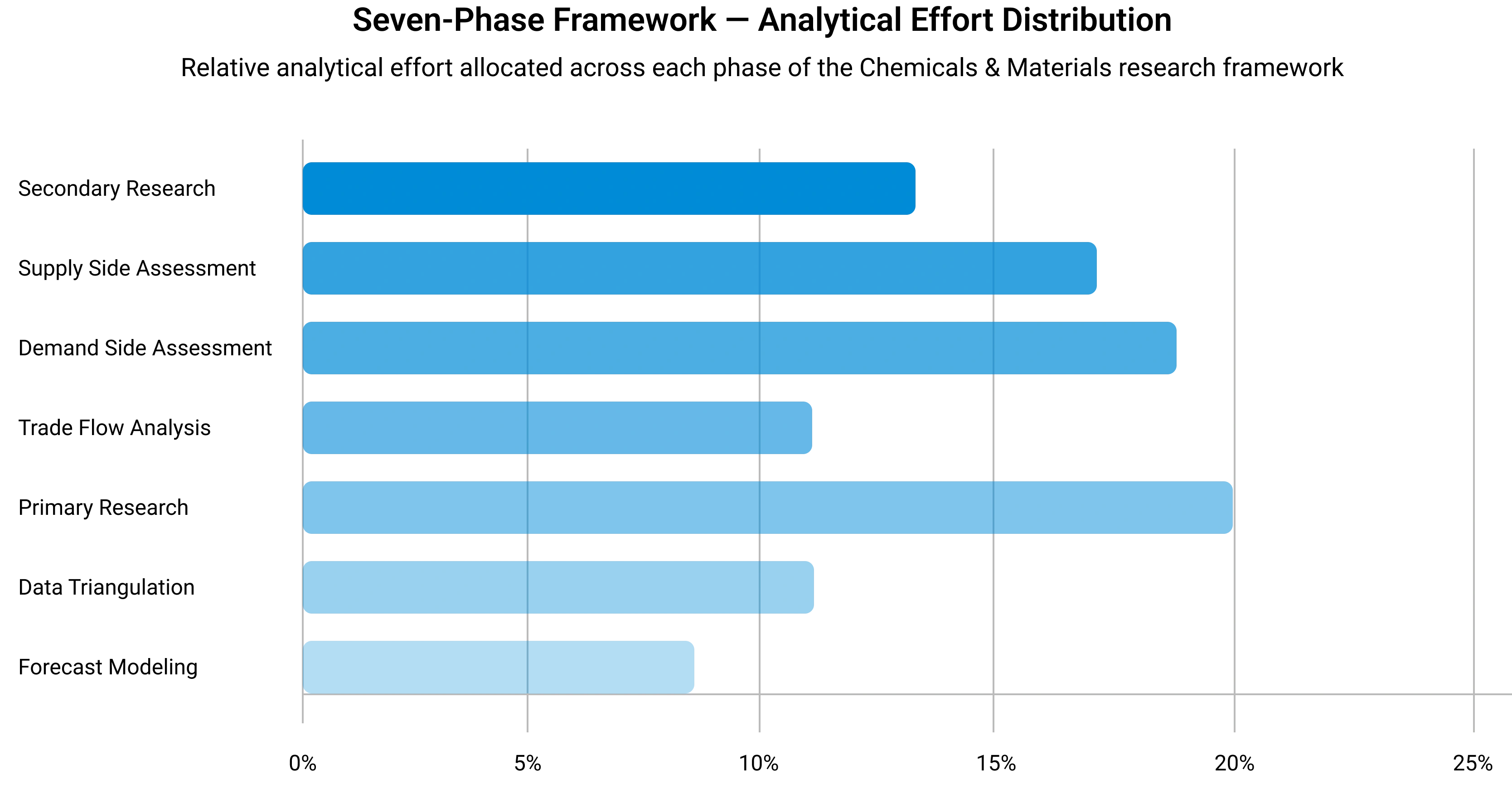
Seven-Phase Framework — Analytical Effort Distribution
Relative analytical effort allocated across each phase of the Chemicals & Materials research framework
Phase 1 - Secondary Research: Establishing the Foundation
Secondary research collects and evaluates publicly available information from authoritative sources, establishing the foundational understanding of market structure, value chain dynamics, competitive landscape, and end-use demand patterns. Every source is evaluated for credibility, recency, geographic relevance, and methodological soundness before inclusion.
Industry Associations
Sources include ACC, CEFIC, ICCA, JCIA, CPCIF, and SOCMA providing production volumes, consumption trends, capacity developments, and sustainability initiatives.
Company Disclosures
Annual reports, investor presentations, earnings transcripts, and regulatory filings reveal product portfolios, manufacturing footprints, capacity expansions, and revenue segmentation.
Government Databases
National statistical offices, customs authorities, environmental agencies, and industrial production databases provide verified statistics on output, trade flows, and regulatory compliance.
Trade Databases
UN Comtrade, ITC, Eurostat, and national customs authorities enable assessment of global product movement, import dependency, and export competitiveness across regions.
Our Secondary Research Sources
- Ministry of Chemicals and Fertilizers
- European Chemicals Agency
- United States Department of Energy
- Ministry of Industry and Information Technology
- Ministry of Economy Trade and Industry
- Ministry of Trade Industry and Energy
- National Institute of Standards and Technology
- Council of Scientific and Industrial Research
- Fraunhofer Society
- National Institute for Materials Science
Phase 2 — Supply-Side Assessment: Mapping Production Capabilities
Production Capacity Analysis
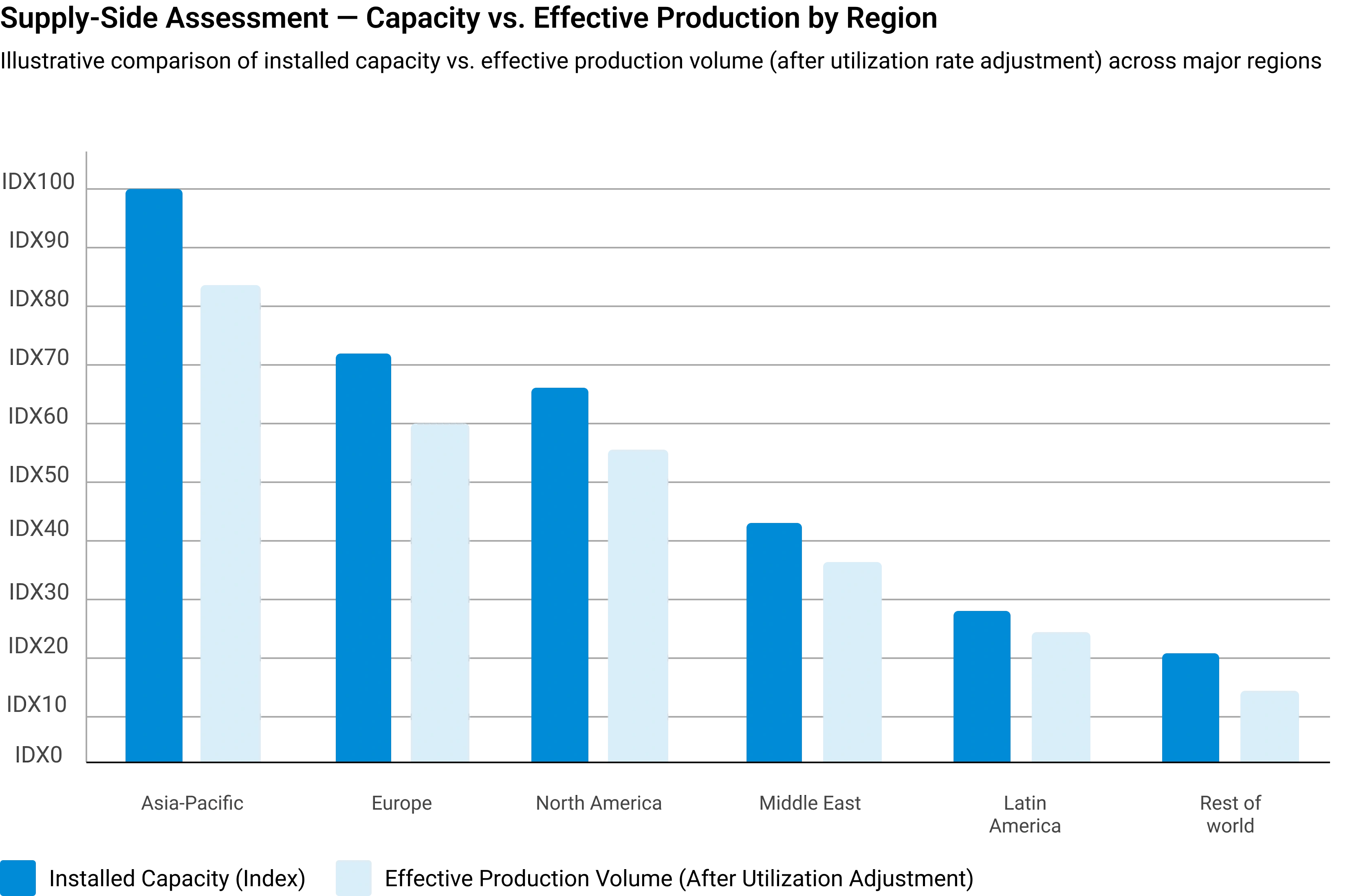
All major manufacturers are assessed for existing installed capacity, planned additions, expansions, new plant announcements, and technology adoption — mapped at global, regional, and country levels.
Capacity Utilization Adjustment
Installed capacity is adjusted using utilization rates based on demand conditions, feedstock availability, plant operating rates, maintenance schedules, and regulatory restrictions.
Manufacturer Revenue Analysis
Product-specific revenues, segment-level performance, regional distribution, average selling prices, and margin trends are evaluated to establish market value estimates.
Supply-Side Assessment — Capacity vs. Effective Production by Region
Illustrative comparison of installed capacity vs. effective production volume (after utilization rate adjustment) across major regions
Phase 3 — Demand-Side Assessment: Quantifying Chemical Consumption
Demand-side analysis quantifies chemical consumption across industries, applications, and geographies — identifying where and how chemicals are consumed throughout the value chain with precision.
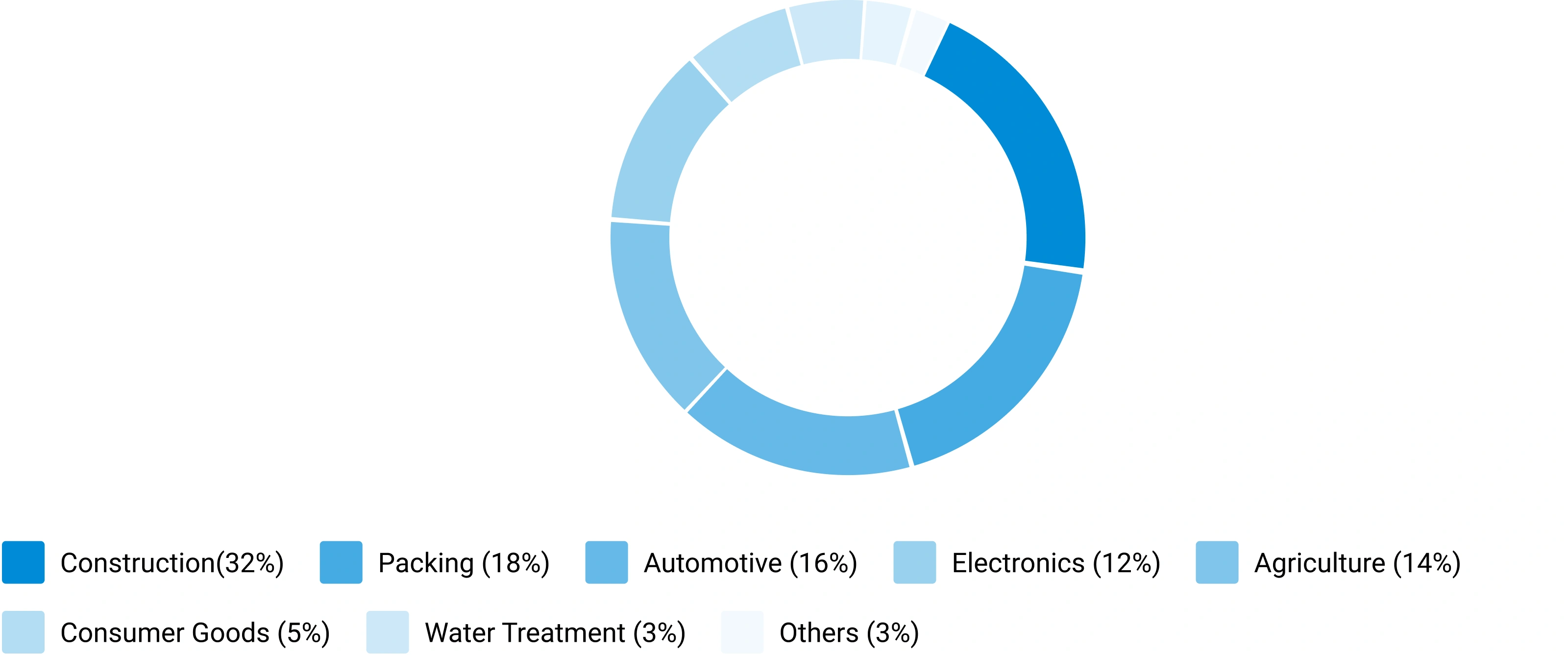
End-Use Industry Analysis
Chemical demand is evaluated across automotive, construction, packaging, electronics, agriculture, healthcare, consumer goods, industrial manufacturing, energy and utilities, and water treatment. Industry output, production trends, and consumption intensity are analyzed to determine demand patterns.
Consumption Modeling
Demand is estimated using measurable indicators: kilograms per vehicle, kilograms per square meter of construction, dosage per cubic meter of water treated, kilograms per hectare of agricultural land, and kilograms per ton of manufactured products. Consumption factors are validated through industry publications and primary interviews.
Application Analysis
The market is segmented by application area to understand product performance requirements, formulation trends, technology adoption, customer preferences, and regulatory requirements improving demand accuracy and segmentation granularity.
Demand-Side Assessment — End-Use Industry Demand Distribution
Illustrative distribution of chemical & materials demand across key end-use industries
Phase 4 - Trade Flow Analysis: Balancing Regional Supply and Demand
Trade flow analysis reconciles regional supply and demand estimates through import and export data, identifying net supply positions, regional dependencies, and market imbalances. It serves as an independent validation layer that tests the consistency of supply-side and demand-side estimates.
Import Analysis
Import data is evaluated to determine volumes, source countries, product dependency, regional supply gaps, and pricing trends — identifying markets that rely heavily on external supply and where domestic production is insufficient to meet demand.
Export Analysis
Export assessments reveal production surplus, export competitiveness, regional manufacturing strength, and global market participation. Export patterns also help validate domestic production estimates and identify net exporting regions.
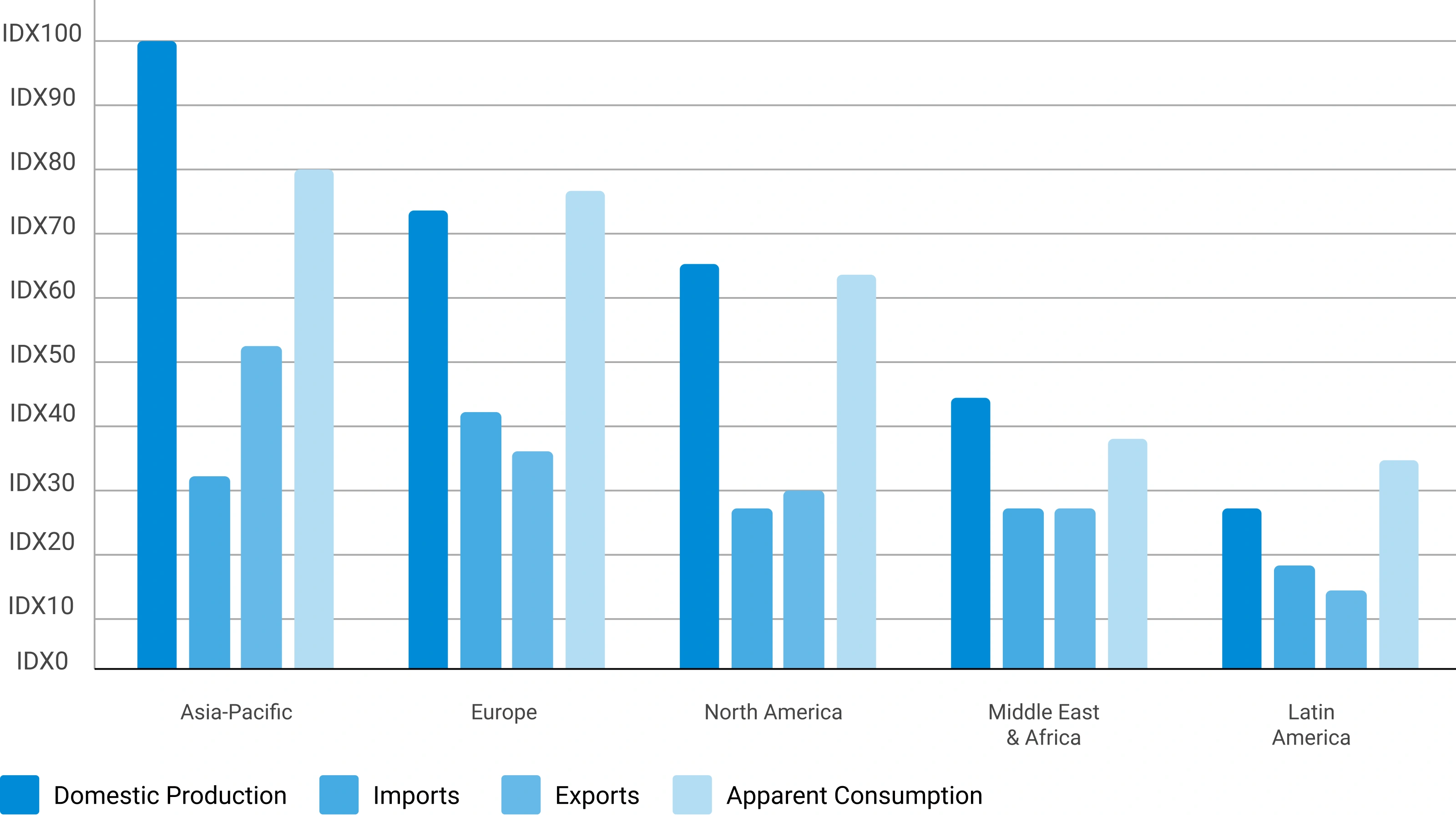
Apparent Consumption Model
Regional consumption is assessed using the standard apparent consumption formula:
Results identify net importing regions, net exporting regions, regional deficits, and surpluses — serving as an independent validation of supply and demand estimates.
Trade Flow Analysis — Net Supply Position by Region
Illustrative apparent consumption vs. domestic production across major regions — positive gap indicates net import dependency
Phase 5 — Primary Research: The Critical Validation Layer
Primary research tests and refines findings from secondary research through direct engagement with industry participants across the supply chain, demand side, and expert community. It captures intelligence that no database or published report can provide — the real-world experience of manufacturers, buyers, and specialists operating in the market.

Supply-Side Interviews
Conversations with chemical manufacturers, raw material suppliers, contract manufacturers, technology providers, and plant operators cover production trends, capacity utilization, pricing developments, technology shifts, and competitive dynamics.

Demand-Side Interviews
Engagement with OEMs, industrial consumers, procurement managers, distributors, formulators, and end-use manufacturers focuses on consumption trends, purchasing behavior, product substitution, demand outlook, and emerging applications.

Industry Expert Consultations
Additional interviews with industry consultants, independent experts, regulatory specialists, technical professionals, and research institutions provide deeper market context and validate key analytical assumptions.
Focus Areas of Primary Research:
Market Size & Forecast Validation
Revenue estimates, volume consumption, growth rates, forecast assumptions, regional demand.Supply Chain & Value Chain Assessment
Raw material sourcing, supply chain challenges, distribution networks, procurement practices.Production & Capacity Analysis
Manufacturing capacity, utilization rates, expansion projects, plant investments.Pricing & Cost Structure Analysis
Product pricing trends, feedstock costs, energy costs, margin pressures, pricing outlook.Competitive Landscape Assessment
Volume and value estimates confirmed to be fully consistent with one another before publicationInterview Volume by Market Scope
| Study Scope | Number of Interviews |
|---|---|
| Niche Market | 20 – 30 |
| Mid-Sized Market | 30 – 50 |
| Global Market | 50 – 80 |
| Highly Fragmented Market | 80 – 120 |
Interview Details:
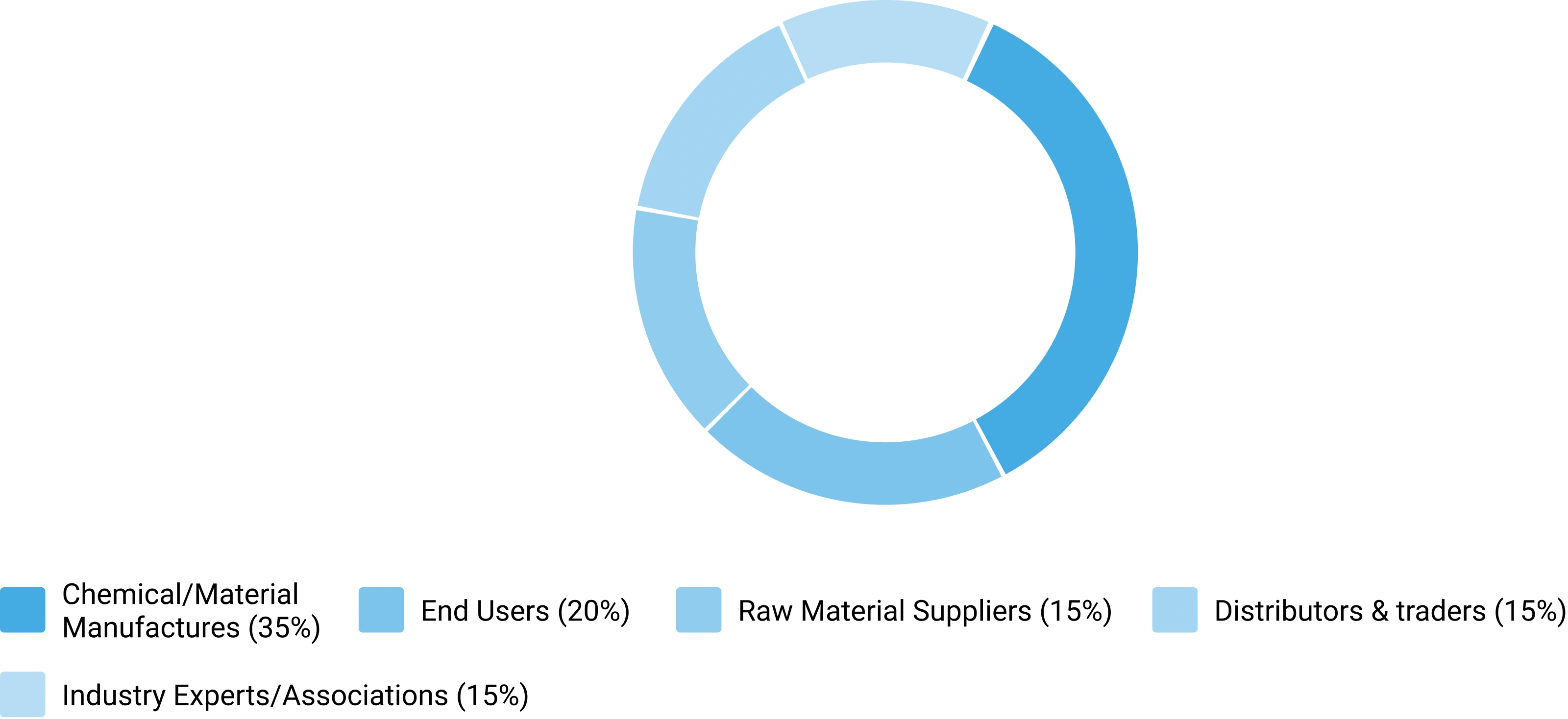
Category : Manufacturers, Suppliers, Distributors, End Users, Experts/Associations
Average Duration : 30–60 Minutes
Interview Mode : Video calls, telephonic interviews, expert consultations
Interview Format : Structured / Semi-Structured questionnaire
Focus Areas of Primary Research:
Market Size & Forecast Validation :
Revenue estimates, volume consumption, growth rates, forecast assumptions, regional demand.
Supply Chain & Value Chain Assessment :
Raw material sourcing, supply chain challenges, distribution networks, procurement practices.
Production & Capacity Analysis :
Manufacturing capacity, utilization rates, expansion projects, plant investments.
Pricing & Cost Structure Analysis :
Product pricing trends, feedstock costs, energy costs, margin pressures, pricing outlook.
Competitive Landscape Assessment :
Market share, competitor positioning, strategic initiatives, partnerships, acquisitions.
Primary Research — Stakeholder Coverage by Category
Distribution of interview respondents across stakeholder categories (% share from PPT data)
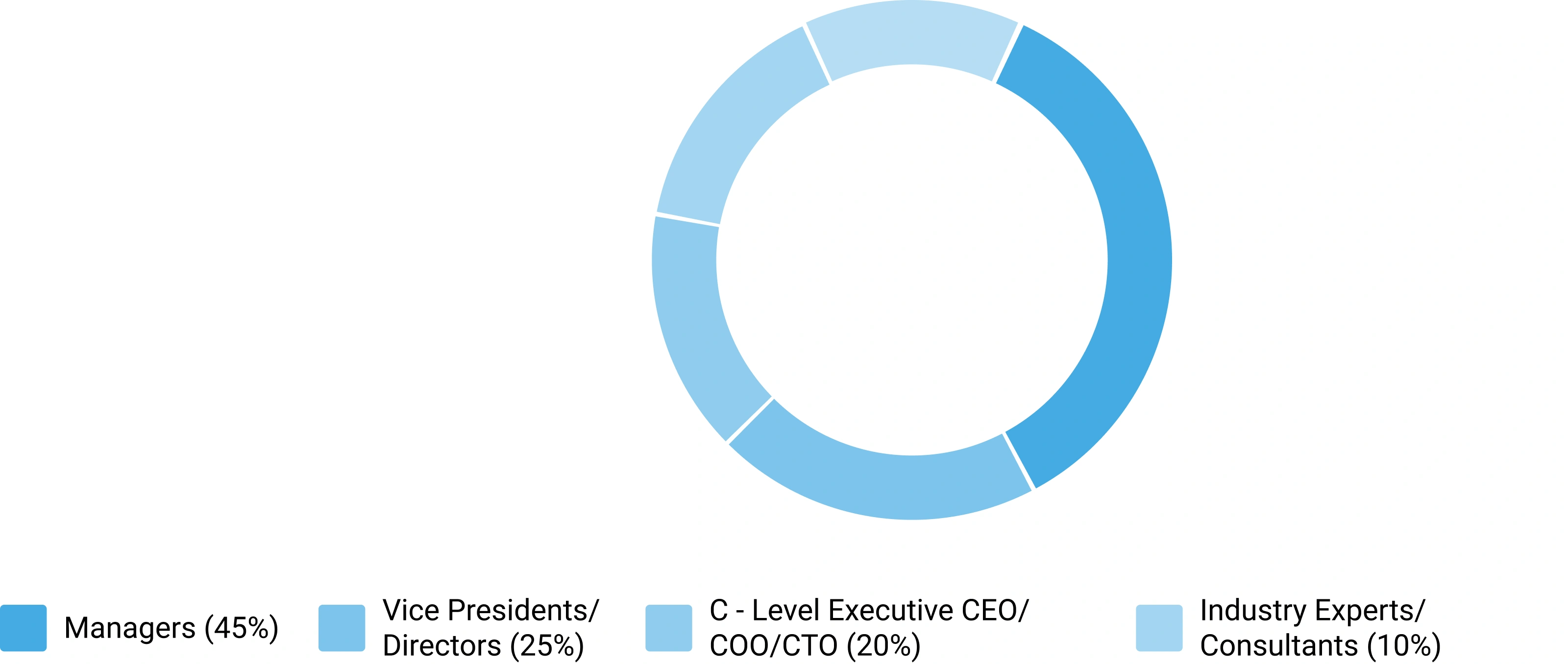
Primary Research — Respondent Designation Profile
Seniority breakdown of interview respondents (% share from PPT data)
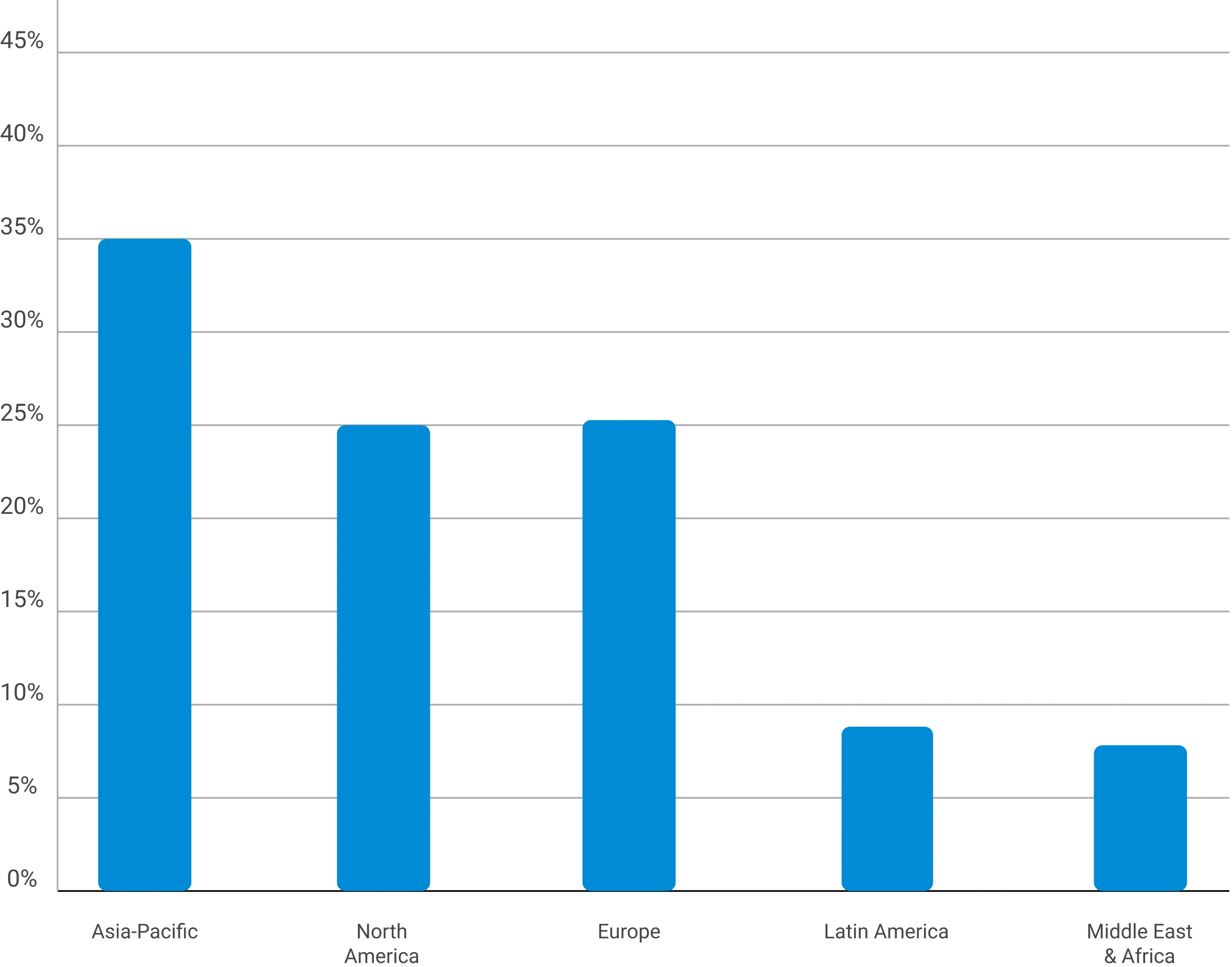
Primary Research — Geographic Coverage of Interviews
Regional distribution of primary research engagement (% share from PPT data)
Phase 6 — Data Triangulation and Market Validation
No single methodology is relied upon in isolation. Multiple independent estimation approaches are combined and reconciled to ensure consistency, accuracy, and analytical defensibility. Any material deviations between approaches are investigated and adjusted through additional validation cycles.
The final market size is derived through weighted triangulation of all validated methodologies. Any material deviations between approaches are investigated and adjusted through additional validation cycles. The outcome represents the most realistic assessment of the market based on available evidence and expert confirmation ensuring that volume and value estimates are fully consistent with one another.
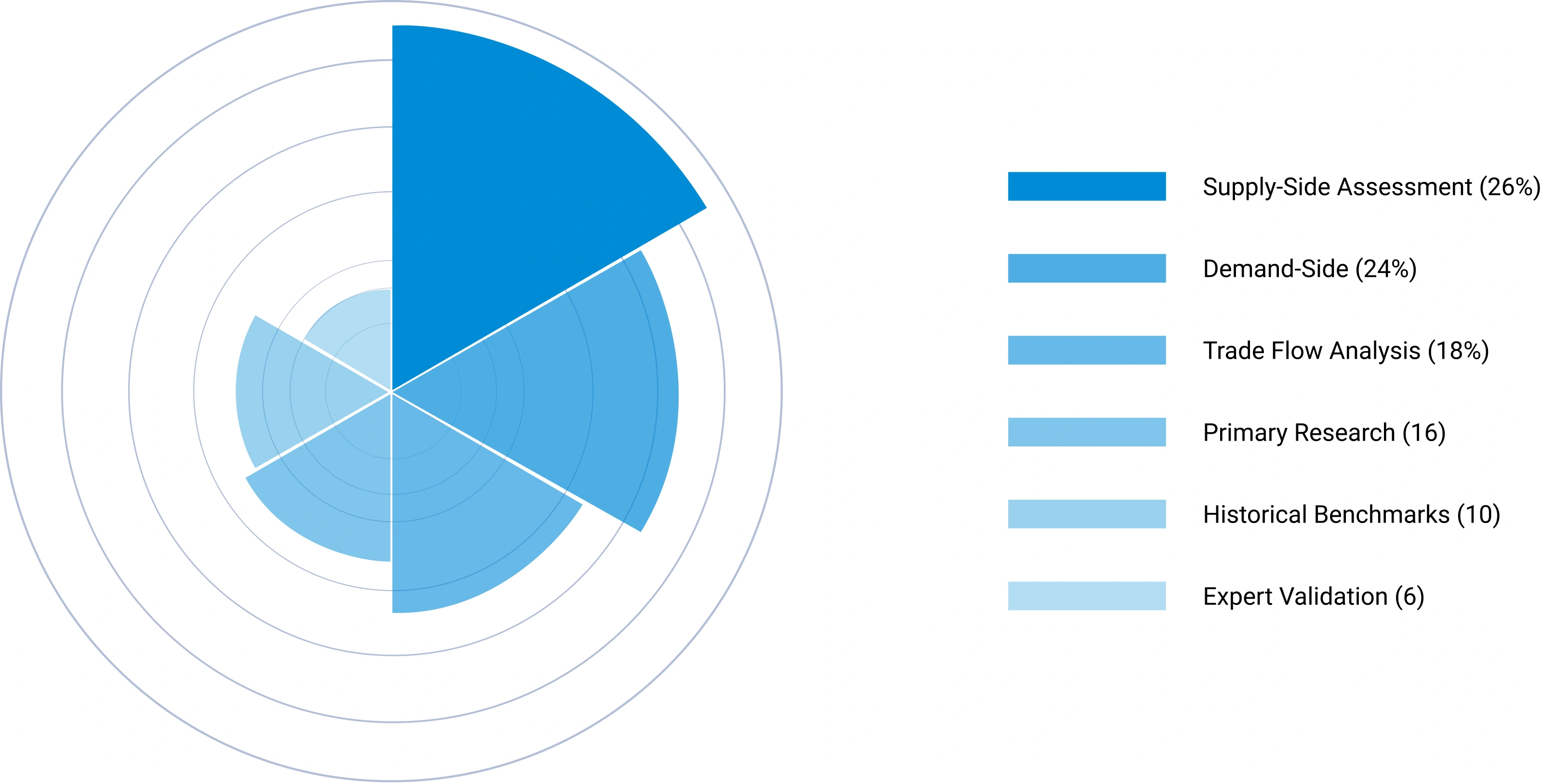
Triangulation Framework — Input Contribution Weight
Relative weight each sizing input contributes to the final reconciled market estimate
Phase 7 — Forecast Modeling: Projecting Future Market Evolution
Forecasting evaluates the future trajectory of the market using a combination of quantitative indicators and qualitative assessments across economic, industry, and regulatory dimensions. Rather than simple extrapolation, each driver is independently modeled and integrated into a composite forecast.
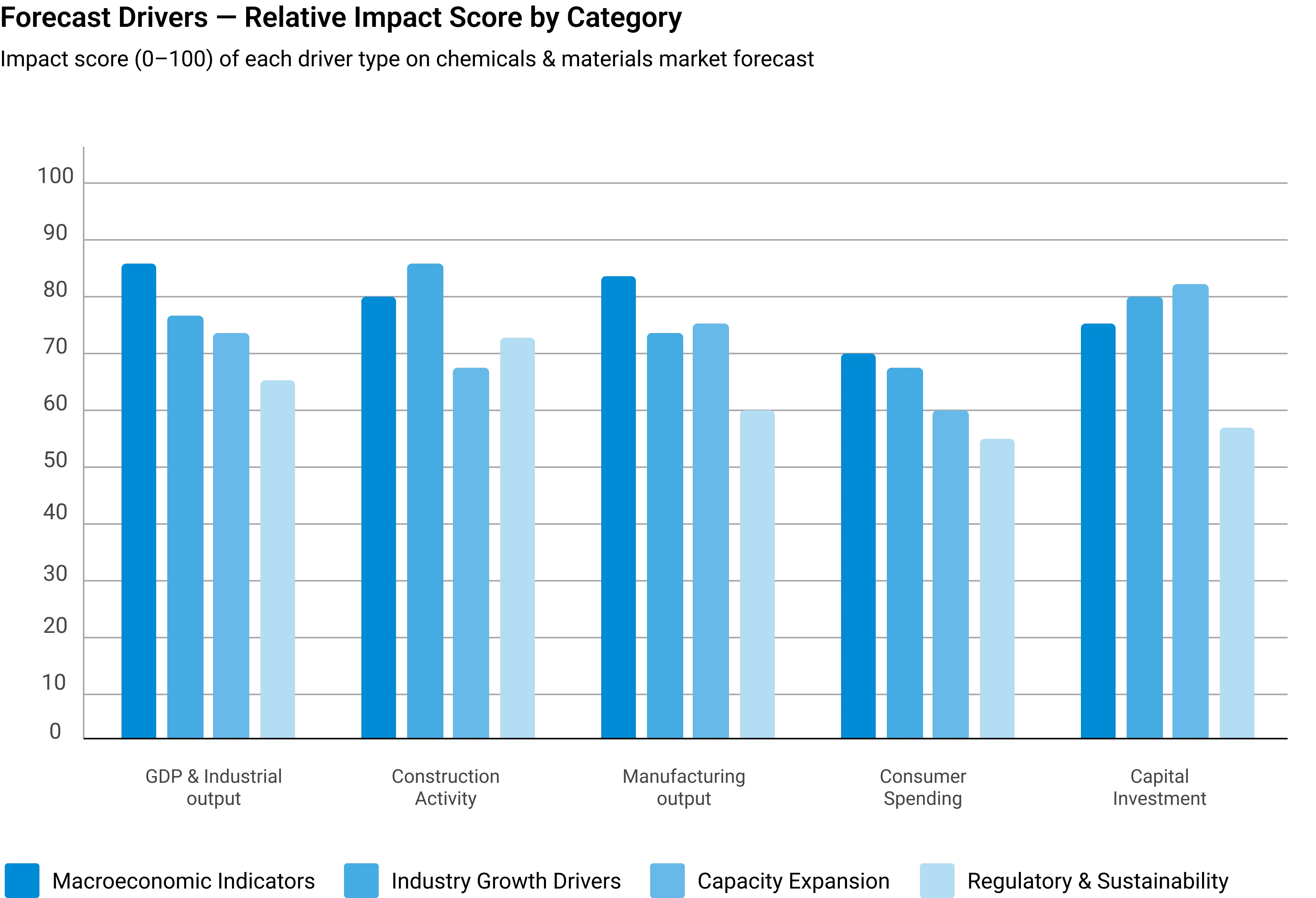
Macroeconomic Indicators
GDP growth, industrial production, manufacturing output, construction activity, consumer spending, and capital investment form the quantitative foundation of long-term demand projections. These are applied at country, regional, and global levels.
Industry Growth Drivers
Urbanization, infrastructure development, industrialization, technological innovation, sustainability initiatives, and evolving product performance requirements are assessed at regional and industry levels — capturing both structural and cyclical demand drivers.
Capacity Expansion Analysis
Announced plant expansions, new manufacturing facilities, technology upgrades, and strategic investments are evaluated to determine future supply-demand dynamics and potential market tightness or oversupply situations.
Regulatory & Sustainability
Environmental regulations, chemical safety standards, emission reduction targets, circular economy initiatives, and sustainability requirements are incorporated as they often influence product adoption rates and market growth trajectories.
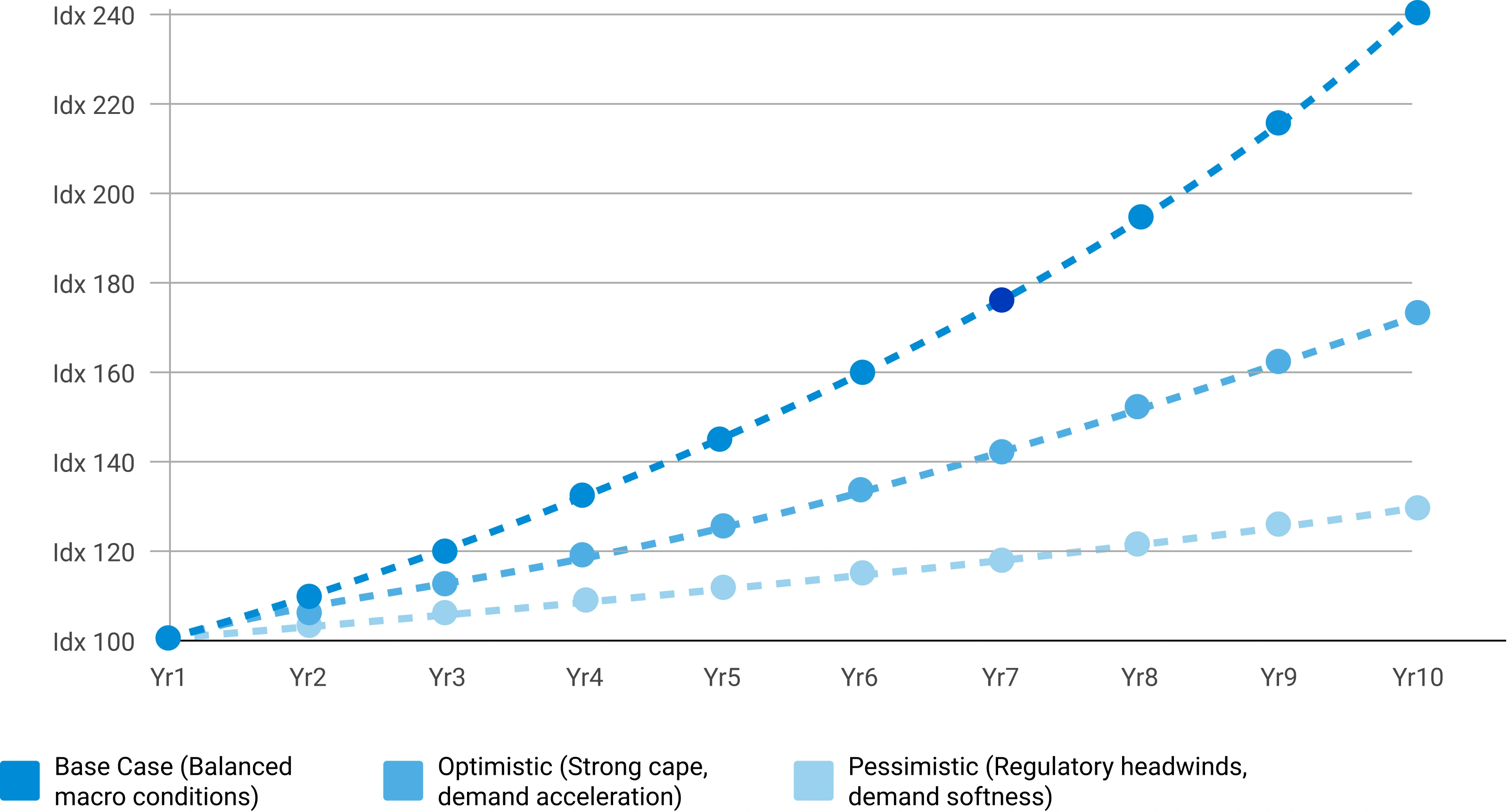
Scenario Forecast Range — Indexed Market Growth (Year 1–10)
Illustrative indexed growth trajectories across Base, Optimistic, and Pessimistic scenarios over a 10-year forecast horizon
Forecast Drivers — Relative Impact Score by Category
Impact score (0–100) of each driver type on chemicals & materials market forecast



Comments
Share your thoughts, ask a question, or provide feedback about this report.