
Liquid Ammonia Market Size and Forecast 2026 to 2035
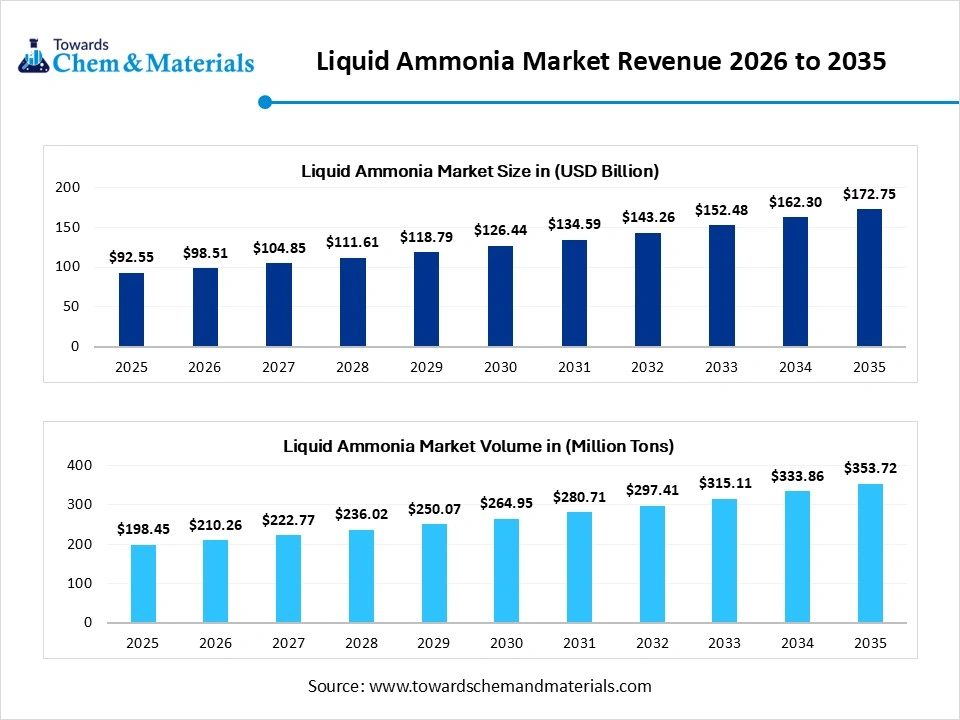
The global liquid ammonia market was valued at USD 92.55 billion in 2025, is estimated to reach USD 98.51 billion in 2026, and is projected to reach USD 172.75 billion by 2035, growing at a CAGR of 6.44% from 2026 to 2035. In terms of volume, the liquid ammonia market is projected to grow from 198.45 million tons in 2025 to 353.72 million tons by 2035. growing at a CAGR of 5.95% from 2026 to 2035.
Key Takeaways
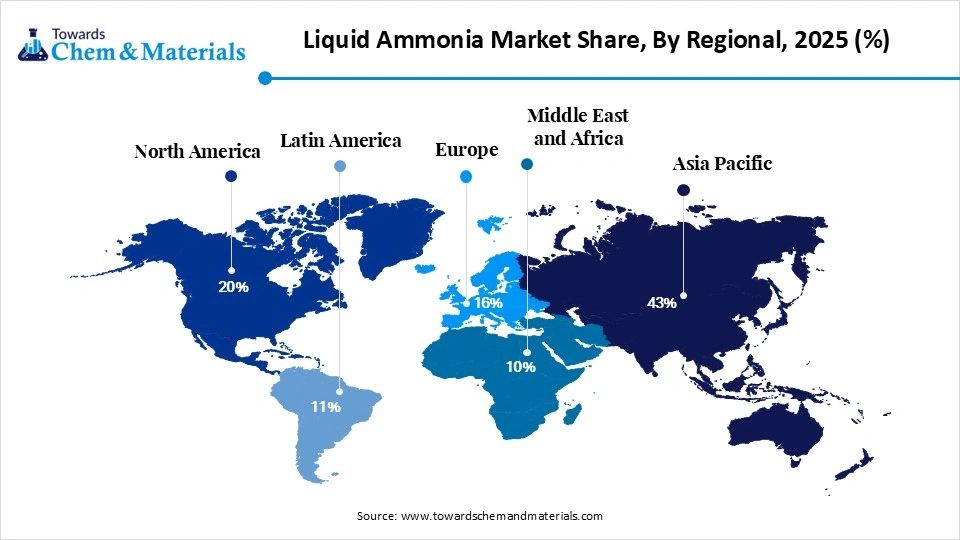
- By region, Asia Pacific dominated the liquid ammonia market in 2025, with 43% share, and is expected to be the fastest-growing in the market, with a CAGR of 7.1% in the forecast period.
- By region, North America is notably growing with 20% market share in 2025.
- By production method, the steam methane reforming (SMR) segment dominated the market with 62% share in 2025.
- By production method, the electrolysis-based (green ammonia) segment held the 20% market share in 2025 and is expected to be the fastest-growing in the market, with a CAGR of 9.8% in the forecast period.
- By application, the fertilizers segment dominated the market with 72% share in 2025.
- By application, the energy carrier segment held the 6% market share in 2025 and is expected to be the fastest-growing in the market with the CAGR of 10.1% during the forecast period.
- By end-use industry, the agriculture segment dominated the market with 66% share in 2025.
- By end-use industry, the energy and power segment held the 5% market share in 2025 and is expected to be the fastest-growing in the market, with a CAGR of 9.6% in the forecast period.
- By distribution channel, the direct sales segment dominated the market with 58% share in 2025.
- By distribution channel, pipeline distribution segment held the 15% market share in 2025 and is expected to be the fastest-growing in the market, with a CAGR of 6.5% in the forecast period.
- By storage and transportation, the refrigerated storage segment dominated the market with 38% share in 2025.
- By storage and transportation, the ISO Tank Containers segment held the 18% market share in 2025 and is expected to be the fastest-growing in the market with the CAGR of 6.4% during the forecast period.
- By purity level, the industrial grade segment dominated the market with 64% share in 2025.
- By purity level, the electronic grade segment held the 14% market share in 2025 and is expected to be the fastest-growing in the market, with a CAGR of 7.2% in the forecast period.
Investment Rising in the Liquid Ammonia Sector
The specific form of the ammonia gas, which has been pressurized or cooled and turns into a liquid, is called liquid ammonia. Also, the greater demand from the agriculture and major manufacturing industries has attracted increased capital and investment in manufacturing in recent years. Moreover, this liquid form of ammonia has been seen in very easy to transport and store, which has led to its growth.
Liquid Ammonia Market Trends:
- The greater shift toward green ammonia has driven the sectoral scalability and strategic transformation of the industry in recent years. Moreover, the global shift towards the reduction of carbon emissions and sustainability has seen green ammonia emerge as the ideal option for industries.
- Having the ability to store and transport easily for the long term, liquid ammonia has gained major industry attention in recent years. Also, renewable energies like solar and others cannot be stored or transported easily, while liquid ammonia has enabled the sector to explore untapped potential.
- The increased need for liquid ammonia from the agricultural sector has allowed stakeholders to capitalize on growth opportunities in the coming years. Also, farmers are actively using them as fertilizers in the current period.
Green Electrolysis Transforming Ammonia Industry Future
Supply Chain Analysis of the Liquid Ammonia Market
Distribution to Industrial Users
- Industrial distribution of liquid ammonia is dominated by the fertilizer industry for direct soil application or downstream production of ammonium nitrate.
- Other major users include the refrigeration sector, where it serves as a sustainable coolant, and the chemical industry, which utilizes it for manufacturing plastics, explosives, and textiles
Ammonia Production and Downstream Processing
- Liquid ammonia is synthesized primarily via the Haber-Bosch process, reacting nitrogen and hydrogen under high pressure and temperature with iron catalysts.
- In industrial processing, it serves as a versatile solvent and building block for synthesizing nitrogen-based compounds, including urea, nitric acid, and various high-performance polymers and pharmaceuticals.
Regulatory Compliance and Safety Monitoring
- Regulatory compliance for liquid ammonia is governed by strict mandates, such as OSHA’s PSM and EPA’s RMP, due to its toxicity and pressure.
- Safety monitoring relies on continuous gas detectors, automated shut-off valves, and emergency relief systems to prevent leaks, ensuring worker protection and environmental safety during storage and transport.
Liquid Ammonia Market Regulatory Landscape: Regulations
| Country Region | Regulatory Body | Key Regulations | Focus Areas |
| United States | Environmental Protection Agency (EPA), | 29 CFR 1910.111: Dedicated specifically to the "Storage and Handling of Anhydrous Ammonia". Section (b)(10) mandates stationary storage must have two full-face respirators and a 50-gallon drum of water for emergencies | Preventing accidental releases, mandatory operator training, mechanical integrity of pressure vessels, and immediate 15-minute reporting for releases over 100 lbs. |
| Europe | European Commission - Environment | Seveso III Directive (2012/18/EU): The primary law for major-accident hazards. Annex I, Part 2 specifically lists anhydrous ammonia with a lower-tier threshold of 50 tonnes and an upper-tier of 200 tonnes | Public information and participation, transboundary effects of accidents, and the "Safety Report" requirement for upper-tier facilities to demonstrate risk mitigation. |
| China | Ministry of Ecology and Environment (MEE) | Decree 591: The "Regulations on the Control over Safety of Hazardous Chemicals". Chapter 2 (Articles 12-27) details safety management for manufacture and storage. | Strengthening safety controls across the entire supply chain, mandatory safety assessments every three years (Article 22 of Decree 591), and strict licensing for production and operation |
Market Dynamics
Driver
Ammonia Demand Surges Across Key Industries
The increased need for more clean energy and industrial chemicals is driving the industry growth nowadays. Also, farmers use ammonia to make fertilizers that increase crop production. At the same time, countries are searching for cleaner fuels, and ammonia is being tested as an energy carrier and fuel.
Restraint
Costly Green Ammonia Slows Market Expansion
Producing ammonia in the traditional way releases a lot of carbon emissions, which is likely to hinder the industry's growth in the coming years. Also, the green ammonia is cleaner, but it is still expensive to produce.
Opportunity
Ammonia Emerging as Future Clean Fuel
Segmental Insights
Production Method Insights
The Steam Methane Reforming (SMR) Segment Dominated the Liquid Ammonia Market With 62% Market Share in 2025
The steam methane reforming (SMR) segment dominated the market with 62% share in 2025, owing to its being the most established and widely used method. It uses natural gas, which is easily available in many countries, making production cheaper and more reliable. Industries have been using this process for decades, so the technology is well understood and efficient.
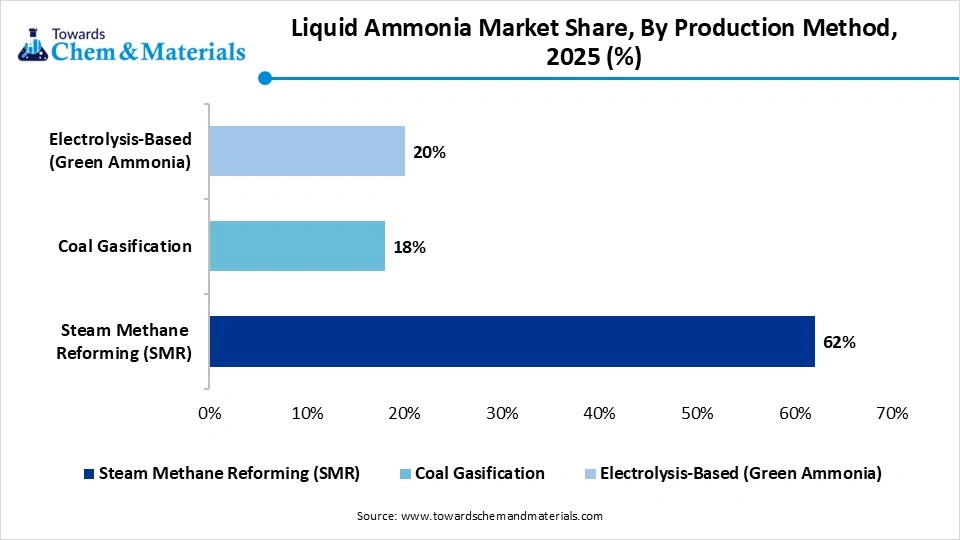
The coal gasification segment held 18% market share in 2025, as it is growing mainly in countries that have large coal reserves but limited natural gas. It allows these countries to produce ammonia using their own resources, reducing dependence on imports. This method is especially popular in developing regions where energy security is important.
Electrolysis-based ammonia can reduce production emissions when powered by low-carbon electricity; its lifecycle emissions depend on the energy source and production process. It uses renewable electricity to produce hydrogen, which is then converted into ammonia. This method produces almost zero carbon emissions, which makes it very attractive as countries try to fight climate change.
Application Insights
The Fertilizers Segment Dominated the Market with 72% Market Share in 2025
The fertilizers segment dominated the market with 72% share in 2025, owing to ammonia is a key ingredient in nitrogen-based fertilizers, which are essential for farming. As the global population grows, food demand increases, and farmers need better fertilizers to improve crop yield.
The industrial chemicals segment held the 15% market share in 2025, owing to ammonia is used to make many important products like plastics, textiles, cleaning agents, and explosives. As industries expand, especially in developing countries, the demand for these chemicals increases.
The energy carrier segment held the 6% market share in 2025 and is expected to be the fastest-growing in the market, with a CAGR of 10.1% in the forecast period due to ammonia can store and transport hydrogen safely. Hydrogen is hard to store, but ammonia makes it easier and cheaper to move across long distances. As countries shift to clean energy, ammonia is being tested as a fuel for ships, power plants, and heavy industries.
End-Use Industry Insights
The Agriculture Segment Dominated the Liquid Ammonia Market with 66% Market Share in 2025
The agriculture segment dominated the market with 66% share in 2025, owing to ammonia is essential for producing fertilizers that improve crop yield. Farmers rely on ammonia-based fertilizers to grow enough food for a growing population. It is widely used across both developed and developing countries.
The chemical manufacturing segment held 17% industry share in 2025, as ammonia is used to produce many everyday products such as plastics, fibers, and cleaning chemicals. As urbanization increases, demand for these products rises, which increases ammonia usage.
The energy and power segment held the 5% market share in 2025 and is expected to be the fastest-growing in the market, with a CAGR of 9.6% in the forecast period, as ammonia is being explored as a clean fuel. It can be burned in power plants or used in engines without producing carbon emissions if made from green sources. This makes it attractive for countries trying to reduce pollution.
Distribution Channel Insights
The Direct Sales Segment Dominated the Market with 58% Market Share in 2025
The direct sales segment dominated the market with 58% share in 2025 because large buyers like fertilizer companies and industrial plants prefer to purchase ammonia directly from producers. This reduces cost and ensures a stable supply. Long-term contracts are common in this market, which builds strong relationships between producers and buyers.
The distributors and traders segment held the 27% market share in 2025, owing to they help smaller buyers who cannot purchase directly from large producers. They break bulk quantities into smaller amounts and supply to different regions. This makes ammonia accessible to more customers.
The pipeline distribution segment held the 15% market share in 2025 and is expected to be the fastest-growing in the market, with a CAGR of 6.5% in the forecast period, as it offers a safe, cost-effective, and continuous supply of ammonia. Pipelines reduce the need for trucks or ships, lowering transportation risks and costs. They are especially useful for connecting large production plants with industrial zones.
Storage and Transportation Insights
The Refrigerated Storage Segment Dominated the Market with 38% Market Share in 2025
The refrigerated storage segment dominated the market with 38% share in 2025 because it is the most reliable way to store large volumes of liquid ammonia. By keeping ammonia at low temperatures, it remains stable and safe for long periods. This method is widely used in ports and large industrial facilities.
The pressurised storage segment held the 28% market share in 2025, owing to it allows ammonia to be stored at higher temperatures but under pressure. This makes it suitable for smaller storage facilities and local distribution. It is often used in industries that need moderate quantities of ammonia.
The ISO Tank Containers segment held the 18% market share in 2025 and is expected to be the fastest-growing in the market, with a CAGR of 6.4% in the forecast period, as they offer safe and flexible transportation. These containers can be used across ships, trucks, and trains without transferring the ammonia, reducing risk and cost. They are ideal for global trade and long-distance transport.
Purity Level Insights
The Industrial Grade Segment Dominated the Market with 64% Market Share in 2025
The industrial grade segment dominated the market with 64% share in 2025 because it is widely used in fertilizers and large-scale chemical production, where ultra-high purity is not required. It is cheaper to produce and meets the needs of most industries.
The refrigeration grade segment held the 22% market share in 2025, owing to it is used in cooling systems for food storage, cold chains, and industrial refrigeration. As the demand for frozen and processed food increases, the need for efficient refrigeration systems also grows.
The electronic grade segment held the 14% market share in 2025 and is expected to be the fastest-growing in the market, with a CAGR of 7.2% in the forecast period, as it is used in high-tech industries like semiconductors and electronics. These industries require extremely pure chemicals. As technology advances, demand for chips, displays, and electronic devices is rising rapidly.
Regional Insights
What Was Asia Pacific’s Share of the Liquid Ammonia Market in 2025?
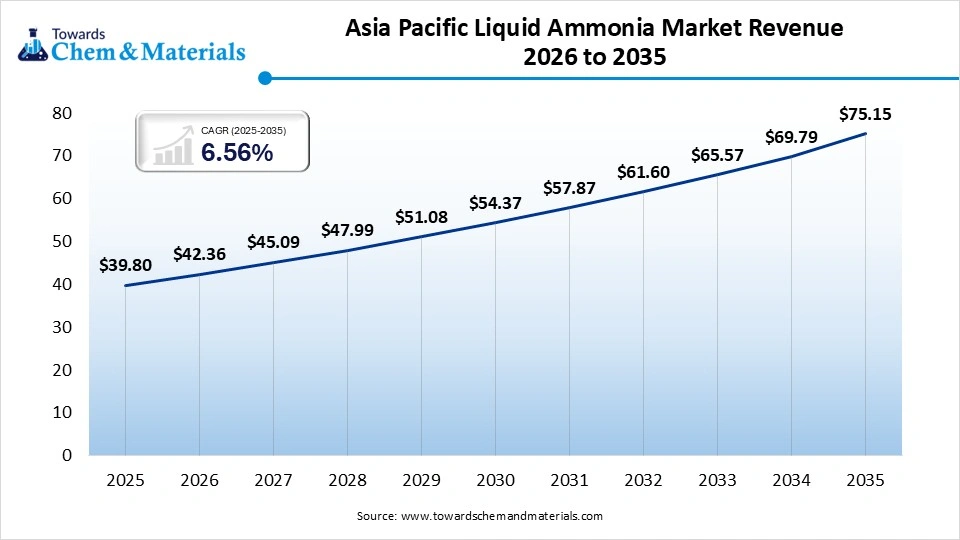
The Asia Pacific liquid ammonia market size was estimated at USD 39.80 billion in 2025 and is projected to reach USD 75.15 billion by 2035, growing at a CAGR of 6.56% from 2026 to 2035 Countries in this region have high demand for fertilizers to support food production. Rapid industrialization also increases the need for ammonia in chemicals and manufacturing.
China at the Centre of Ammonia Demand
Countries in this region have high demand for fertilizers to support food production. Rapid industrialization also increases the need for ammonia in chemicals and manufacturing.
Liquid Ammonia Market Evaluation in North America
North America is notably growing with 20% market share in 2025, owing to its focus on clean energy and advanced technology. The region has strong investments in green ammonia and hydrogen projects. Availability of natural gas also supports current production. Governments are encouraging low-carbon solutions, which boosts innovation.
United States Leading Future Ammonia Growth
The United States is expected to emerge as a prominent country for the liquid ammonia market in the coming years, due to its advanced production facilities and strong energy sector. It has abundant natural gas, which supports ammonia production. The country is also investing heavily in green ammonia and hydrogen technologies.
Recent Development
- In November 2025, Air Liquide announced the successful start-up of an industrial-scale ammonia-cracking pilot unit at the Port of Antwerp-Bruges, Belgium, with a capacity to convert 30 tonnes of ammonia into hydrogen per day
Liquid Ammonia Market Competitive Landscape Analysis
Tier 1 Companies
|
Rank
|
Company Name | Headquarters | Country | Why Relevant to This Market | Key Products / Material Portfolio |
| 1 | CF Industries Holdings, Inc. | Northbrook, Illinois | United States | One of the world's largest ammonia producers with extensive production and export capabilities | Liquid ammonia, anhydrous ammonia, urea, ammonium nitrate |
| 2 | Yara International ASA | Oslo | Norway | Yara is a Norwegian global leader in nitrogen-based fertilizers and industrial applications” with “Yara International is a Norway-based producer and supplier of nitrogen-based fertilizers and ammonia-related products. | Liquid ammonia, ammonia solutions, nitrate fertilizers |
| 3 | Nutrien Ltd. | Saskatoon, Saskatchewan | Canada | Major global supplier of ammonia and nitrogen-based products | Liquid ammonia, nitrogen fertilizers, industrial ammonia |
| 4 | OCI Global | Amsterdam, North Holland | Netherlands | Significant producer of ammonia serving industrial and fertilizer markets worldwide | Liquid ammonia, methanol, nitrogen chemicals |
Tier 2 Companies
|
Rank
|
Company Name | Headquarters | Country | Why Relevant to This Market | Key Products / Material Portfolio |
| 1 | QAFCO (Qatar Fertiliser Company) | Mesaieed | Qatar | One of the world's largest ammonia exporters with large-scale production facilities | Liquid ammonia, ammonia, urea |
| 2 | Saudi Basic Industries Corporation (SABIC) | Riyadh | Saudi Arabia | Major producer of ammonia and nitrogen-based chemicals in the Middle East | Liquid ammonia, ammonia derivatives, fertilizers |
| 3 | Mitsui Chemicals, Inc. | Tokyo | Japan | Producer of ammonia-derived chemicals and industrial products | Liquid ammonia, ammonia derivatives, specialty chemicals |
| 4 | Koch Fertilizer LLC | Wichita, Kansas | United States | Significant ammonia producer with strong North American distribution network | Liquid ammonia, nitrogen fertilizers, industrial ammonia |
Tier 3 Companies
|
Rank
|
Company Name | Headquarters | Country | Why Relevant to This Market | Key Products / Material Portfolio |
| 1 | Rashtriya Chemicals and Fertilizers Limited | Mumbai, Maharashtra | India | Major Indian producer of ammonia and nitrogen-based products | Liquid ammonia, fertilizers, industrial chemicals |
| 2 | National Fertilizers Limited | Noida, Uttar Pradesh | India | Important producer and consumer of liquid ammonia in India | Liquid ammonia, urea, nitrogen fertilizers |
| 3 | Dyno Nobel Limited | Brisbane, Queensland | Australia | Significant ammonia user and supplier for mining and industrial applications | Liquid ammonia, ammonium nitrate, mining chemicals |
| 4 | EuroChem Group AG | Zug | Switzerland | Growing global ammonia and fertilizer producer with expanding export footprint | Liquid ammonia, urea, nitrogen fertilizers |
| 5 | Fertiglobe plc | Abu Dhabi | United Arab Emirates | Major ammonia exporter and investor in low-carbon ammonia projects | Liquid ammonia, blue ammonia, nitrogen fertilizers |
Top Vendors in the Liquid Ammonia Market & Their Offerings:
- Yara International ASA: Yara is a Norwegian global leader in nitrogen-based fertilizers and industrial applications. The company operates one of the world's largest ammonia networks, focusing on sustainable food production and environmental solutions. Yara is currently a pioneer in "green ammonia" technology, investing heavily in carbon-free production to decarbonize shipping and agriculture.
- CF Industries Holdings, Inc.: Based in the United States, CF Industries is a premier global manufacturer of hydrogen and nitrogen products. As one of the world's largest ammonia producers, they operate massive integrated manufacturing complexes. The company is aggressively pivoting toward clean energy, leveraging its infrastructure to produce blue and green ammonia.
- Nutrien Ltd.: Nutrien is a Canadian integrated agriculture company and the world's largest provider of crop inputs and services. It maintains a significant liquid ammonia production footprint to support its vast retail distribution network. Nutrien focuses on enhancing global food security while implementing low-carbon ammonia production technologies across its nitrogen operations.
- OCP Group
- EuroChem Group
- SABIC (Saudi Basic Industries Corporation)
- OCI Global
- Koch Fertilizer, LLC
- Mitsubishi Chemical Corporation
Liquid Ammonia Market Segments List
By Production Method
- Steam Methane Reforming (SMR)
- Conventional SMR
- Advanced SMR with Carbon Capture (Blue Ammonia)
- Coal Gasification
- Electrolysis-Based (Green Ammonia)
- Alkaline Electrolysis
- PEM Electrolysis
- Solid Oxide Electrolysis
By Technology
- Fertilizers
- Urea
- Ammonium Nitrate
- Ammonium Sulfate
- Industrial Chemicals
- Nitric Acid
- Explosives
- Caprolactam
- Refrigeration
- Industrial Refrigeration Systems
- Energy Carrier
- Hydrogen Storage
- Power Generation Fuel
- Others
- Water Treatment
- Pharmaceuticals
By End-Use Industry
- Agriculture
- Chemical Manufacturing
- Mining
- Energy & Power
- Food & Beverage
- Pharmaceuticals
By Distribution Channel
- Direct Sales (Bulk Supply)
- Distributors & Traders
- Pipeline Distribution
By Storage and Transportation
- Refrigerated Storage
- Pressurized Storage
- ISO Tank Containers
- Pipeline Transport
By Purity Level
- Industrial Grade
- Refrigeration Grade
- Electronic Grade
By Region
- North America:
- U.S.
- Canada
- Mexico
- Rest of North America
- Latin America:
- Brazil
- Argentina
- Rest of Latin America
- Europe:
- Western Europe
- Germany
- Italy
- France
- Netherlands
- Spain
- Portugal
- Belgium
- Ireland
- UK
- Iceland
- Switzerland
- Poland
- Rest of Western Europe
- Eastern Europe
- Austria
- Russia & Belarus
- Türkiye
- Albania
- Rest of Eastern Europe
- Asia Pacific:
- China
- Taiwan
- India
- Japan
- Australia and New Zealand,
- ASEAN Countries (Singapore, Malaysia)
- South Korea
- Rest of APAC
- MEA:
- GCC Countries
- Saudi Arabia
- United Arab Emirates (UAE)
- Qatar
- Kuwait
- Oman
- Bahrain
- South Africa
- Egypt
- Rest of MEA
- GCC Countries
A Seven-Phase Framework
Our methodology is designed to be universally applicable across commodity chemicals, specialty chemicals, petrochemicals, construction chemicals, coatings, electronic chemicals, industrial gases, agrochemicals, water treatment chemicals, and performance materials. Each phase builds upon the last, creating a layered validation structure that minimizes estimation error and maximizes analytical confidence.
The framework ensures comprehensive market coverage, robust cross-validation, and reliable long-term forecasting — producing market estimates that withstand scrutiny from investors, regulators, and corporate strategy teams.

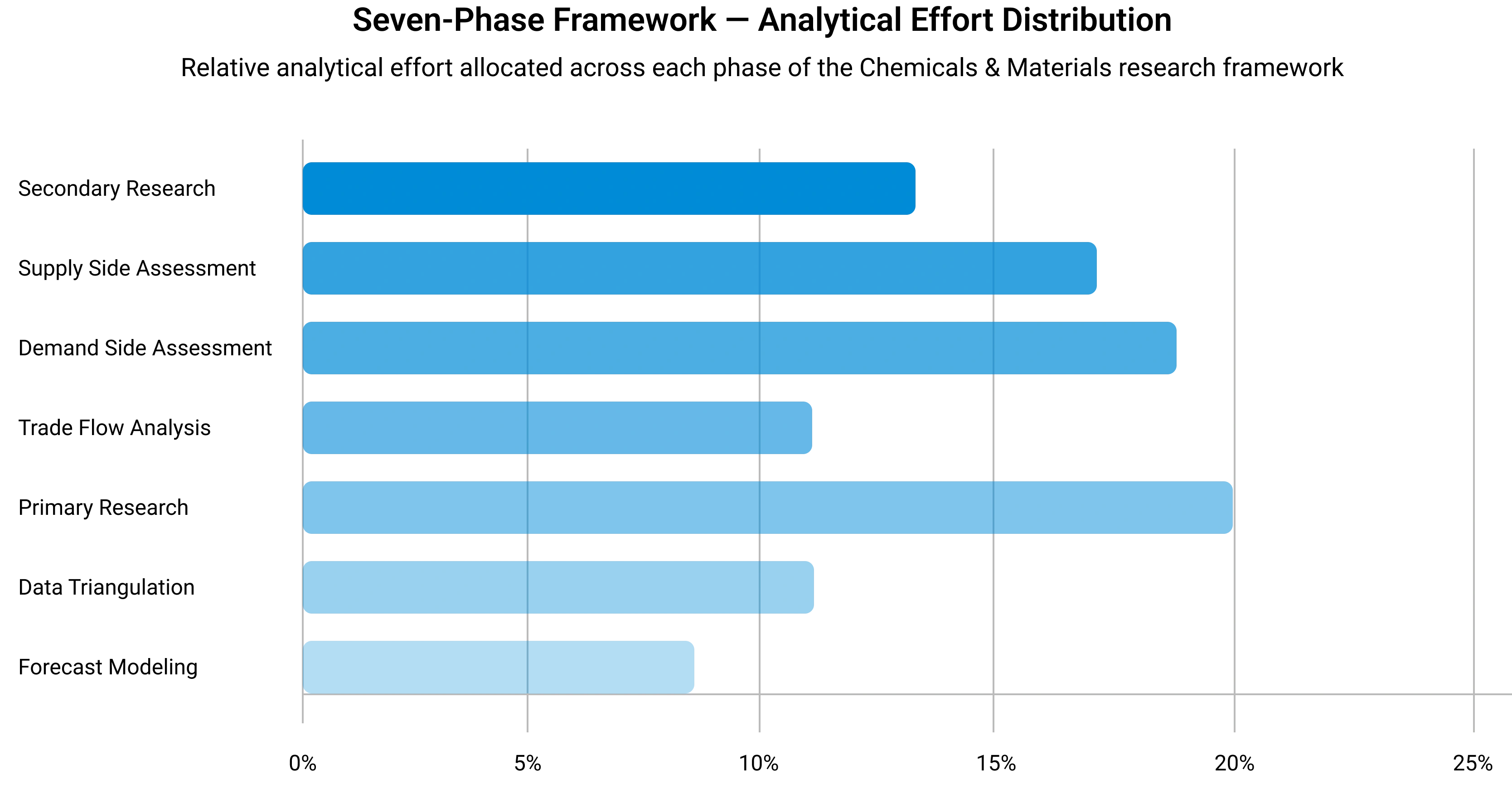
Seven-Phase Framework — Analytical Effort Distribution
Relative analytical effort allocated across each phase of the Chemicals & Materials research framework
Phase 1 - Secondary Research: Establishing the Foundation
Secondary research collects and evaluates publicly available information from authoritative sources, establishing the foundational understanding of market structure, value chain dynamics, competitive landscape, and end-use demand patterns. Every source is evaluated for credibility, recency, geographic relevance, and methodological soundness before inclusion.
Industry Associations
Sources include ACC, CEFIC, ICCA, JCIA, CPCIF, and SOCMA providing production volumes, consumption trends, capacity developments, and sustainability initiatives.
Company Disclosures
Annual reports, investor presentations, earnings transcripts, and regulatory filings reveal product portfolios, manufacturing footprints, capacity expansions, and revenue segmentation.
Government Databases
National statistical offices, customs authorities, environmental agencies, and industrial production databases provide verified statistics on output, trade flows, and regulatory compliance.
Trade Databases
UN Comtrade, ITC, Eurostat, and national customs authorities enable assessment of global product movement, import dependency, and export competitiveness across regions.
Our Secondary Research Sources
- Ministry of Chemicals and Fertilizers
- European Chemicals Agency
- United States Department of Energy
- Ministry of Industry and Information Technology
- Ministry of Economy Trade and Industry
- Ministry of Trade Industry and Energy
- National Institute of Standards and Technology
- Council of Scientific and Industrial Research
- Fraunhofer Society
- National Institute for Materials Science
Phase 2 — Supply-Side Assessment: Mapping Production Capabilities
Production Capacity Analysis
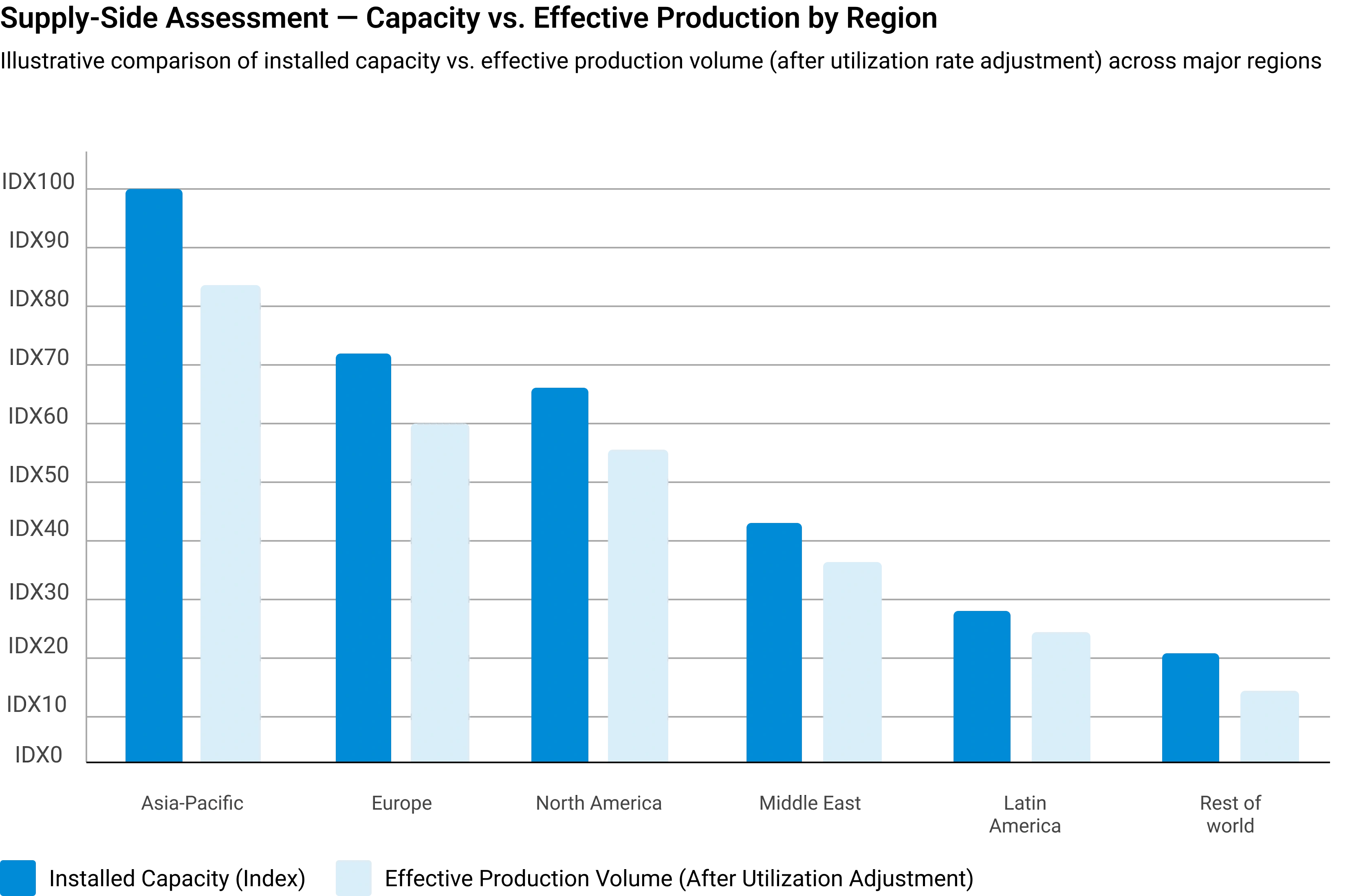
All major manufacturers are assessed for existing installed capacity, planned additions, expansions, new plant announcements, and technology adoption — mapped at global, regional, and country levels.
Capacity Utilization Adjustment
Installed capacity is adjusted using utilization rates based on demand conditions, feedstock availability, plant operating rates, maintenance schedules, and regulatory restrictions.
Manufacturer Revenue Analysis
Product-specific revenues, segment-level performance, regional distribution, average selling prices, and margin trends are evaluated to establish market value estimates.
Supply-Side Assessment — Capacity vs. Effective Production by Region
Illustrative comparison of installed capacity vs. effective production volume (after utilization rate adjustment) across major regions
Phase 3 — Demand-Side Assessment: Quantifying Chemical Consumption
Demand-side analysis quantifies chemical consumption across industries, applications, and geographies — identifying where and how chemicals are consumed throughout the value chain with precision.
End-Use Industry Analysis
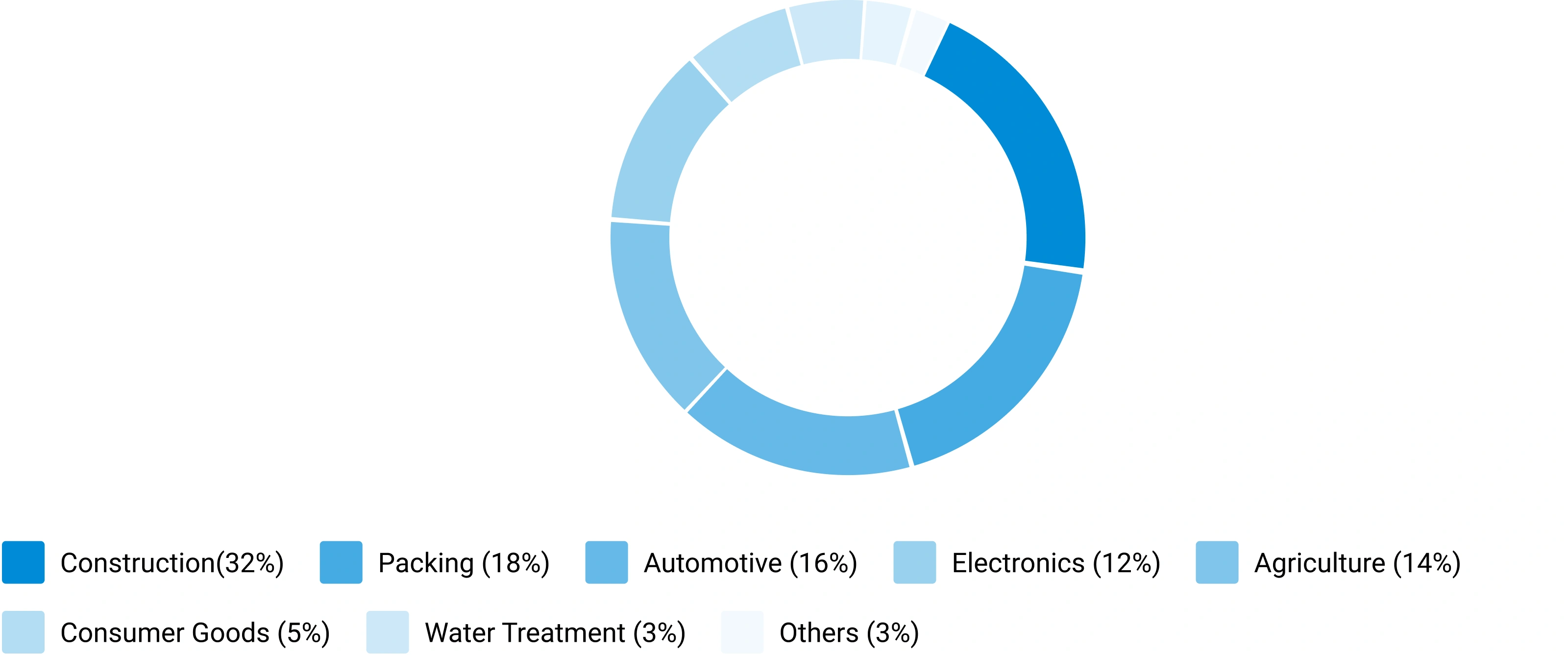
Chemical demand is evaluated across automotive, construction, packaging, electronics, agriculture, healthcare, consumer goods, industrial manufacturing, energy and utilities, and water treatment. Industry output, production trends, and consumption intensity are analyzed to determine demand patterns.
Consumption Modeling
Demand is estimated using measurable indicators: kilograms per vehicle, kilograms per square meter of construction, dosage per cubic meter of water treated, kilograms per hectare of agricultural land, and kilograms per ton of manufactured products. Consumption factors are validated through industry publications and primary interviews.
Application Analysis
The market is segmented by application area to understand product performance requirements, formulation trends, technology adoption, customer preferences, and regulatory requirements improving demand accuracy and segmentation granularity.
Demand-Side Assessment — End-Use Industry Demand Distribution
Illustrative distribution of chemical & materials demand across key end-use industries
Phase 4 - Trade Flow Analysis: Balancing Regional Supply and Demand
Trade flow analysis reconciles regional supply and demand estimates through import and export data, identifying net supply positions, regional dependencies, and market imbalances. It serves as an independent validation layer that tests the consistency of supply-side and demand-side estimates.
Import Analysis
Import data is evaluated to determine volumes, source countries, product dependency, regional supply gaps, and pricing trends — identifying markets that rely heavily on external supply and where domestic production is insufficient to meet demand.
Export Analysis
Export assessments reveal production surplus, export competitiveness, regional manufacturing strength, and global market participation. Export patterns also help validate domestic production estimates and identify net exporting regions.
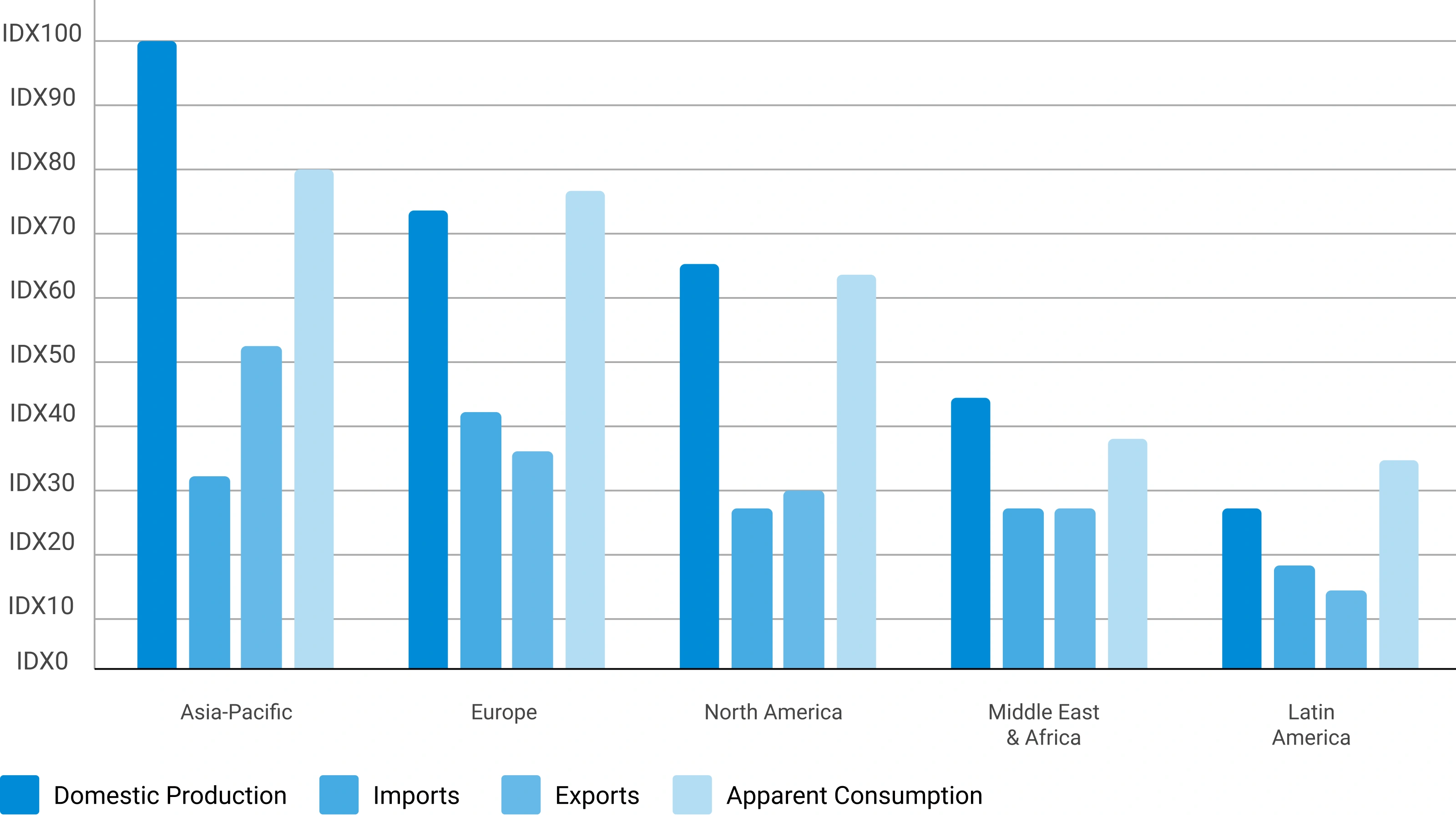
Apparent Consumption Model
Regional consumption is assessed using the standard apparent consumption formula:
Results identify net importing regions, net exporting regions, regional deficits, and surpluses — serving as an independent validation of supply and demand estimates.
Trade Flow Analysis — Net Supply Position by Region
Illustrative apparent consumption vs. domestic production across major regions — positive gap indicates net import dependency
Phase 5 — Primary Research: The Critical Validation Layer
Primary research tests and refines findings from secondary research through direct engagement with industry participants across the supply chain, demand side, and expert community. It captures intelligence that no database or published report can provide — the real-world experience of manufacturers, buyers, and specialists operating in the market.

Supply-Side Interviews
Conversations with chemical manufacturers, raw material suppliers, contract manufacturers, technology providers, and plant operators cover production trends, capacity utilization, pricing developments, technology shifts, and competitive dynamics.

Demand-Side Interviews
Engagement with OEMs, industrial consumers, procurement managers, distributors, formulators, and end-use manufacturers focuses on consumption trends, purchasing behavior, product substitution, demand outlook, and emerging applications.

Industry Expert Consultations
Additional interviews with industry consultants, independent experts, regulatory specialists, technical professionals, and research institutions provide deeper market context and validate key analytical assumptions.
Focus Areas of Primary Research:
Market Size & Forecast Validation
Revenue estimates, volume consumption, growth rates, forecast assumptions, regional demand.Supply Chain & Value Chain Assessment
Raw material sourcing, supply chain challenges, distribution networks, procurement practices.Production & Capacity Analysis
Manufacturing capacity, utilization rates, expansion projects, plant investments.Pricing & Cost Structure Analysis
Product pricing trends, feedstock costs, energy costs, margin pressures, pricing outlook.Competitive Landscape Assessment
Volume and value estimates confirmed to be fully consistent with one another before publicationInterview Volume by Market Scope
| Study Scope | Number of Interviews |
|---|---|
| Niche Market | 20 – 30 |
| Mid-Sized Market | 30 – 50 |
| Global Market | 50 – 80 |
| Highly Fragmented Market | 80 – 120 |
Interview Details:
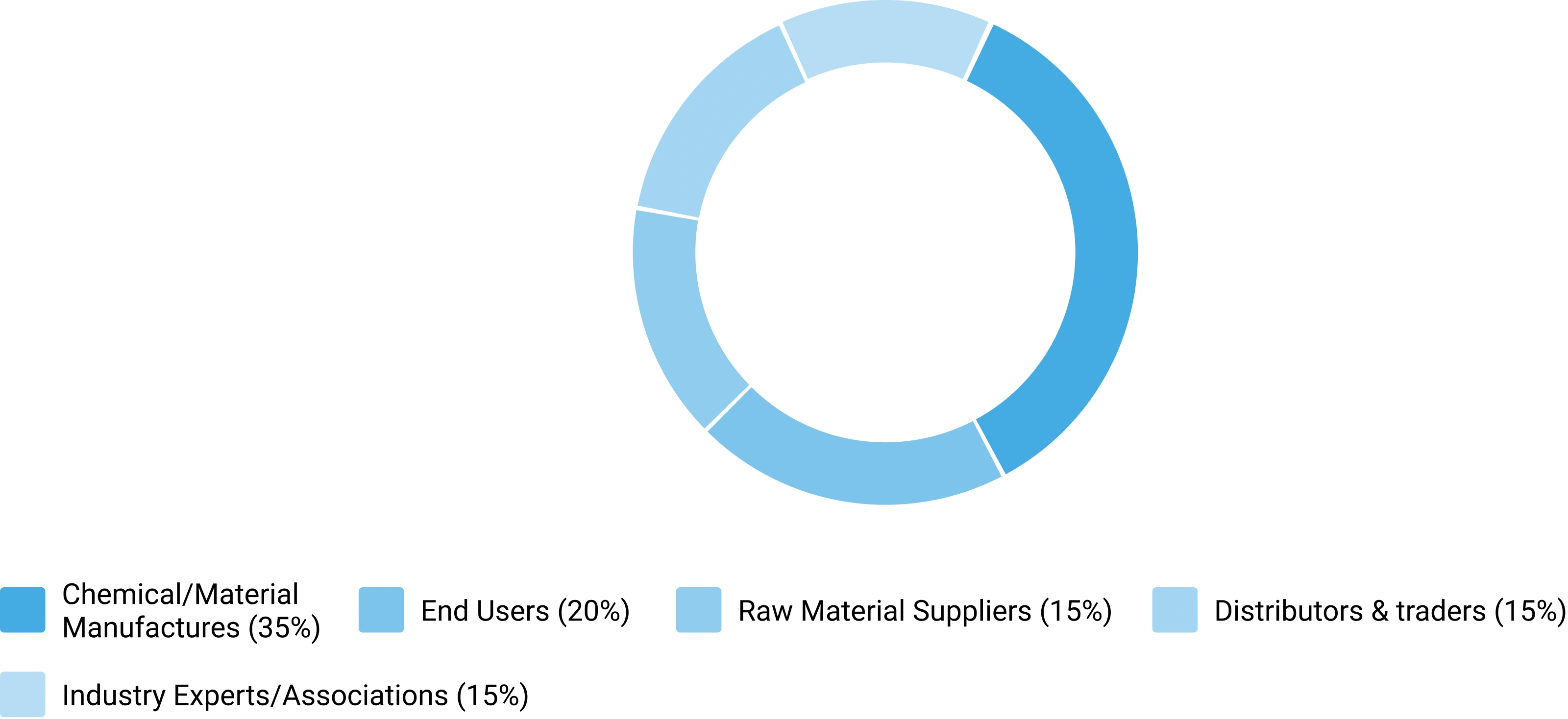
Category : Manufacturers, Suppliers, Distributors, End Users, Experts/Associations
Average Duration : 30–60 Minutes
Interview Mode : Video calls, telephonic interviews, expert consultations
Interview Format : Structured / Semi-Structured questionnaire
Focus Areas of Primary Research:
Market Size & Forecast Validation :
Revenue estimates, volume consumption, growth rates, forecast assumptions, regional demand.
Supply Chain & Value Chain Assessment :
Raw material sourcing, supply chain challenges, distribution networks, procurement practices.
Production & Capacity Analysis :
Manufacturing capacity, utilization rates, expansion projects, plant investments.
Pricing & Cost Structure Analysis :
Product pricing trends, feedstock costs, energy costs, margin pressures, pricing outlook.
Competitive Landscape Assessment :
Market share, competitor positioning, strategic initiatives, partnerships, acquisitions.
Primary Research — Stakeholder Coverage by Category
Distribution of interview respondents across stakeholder categories (% share from PPT data)
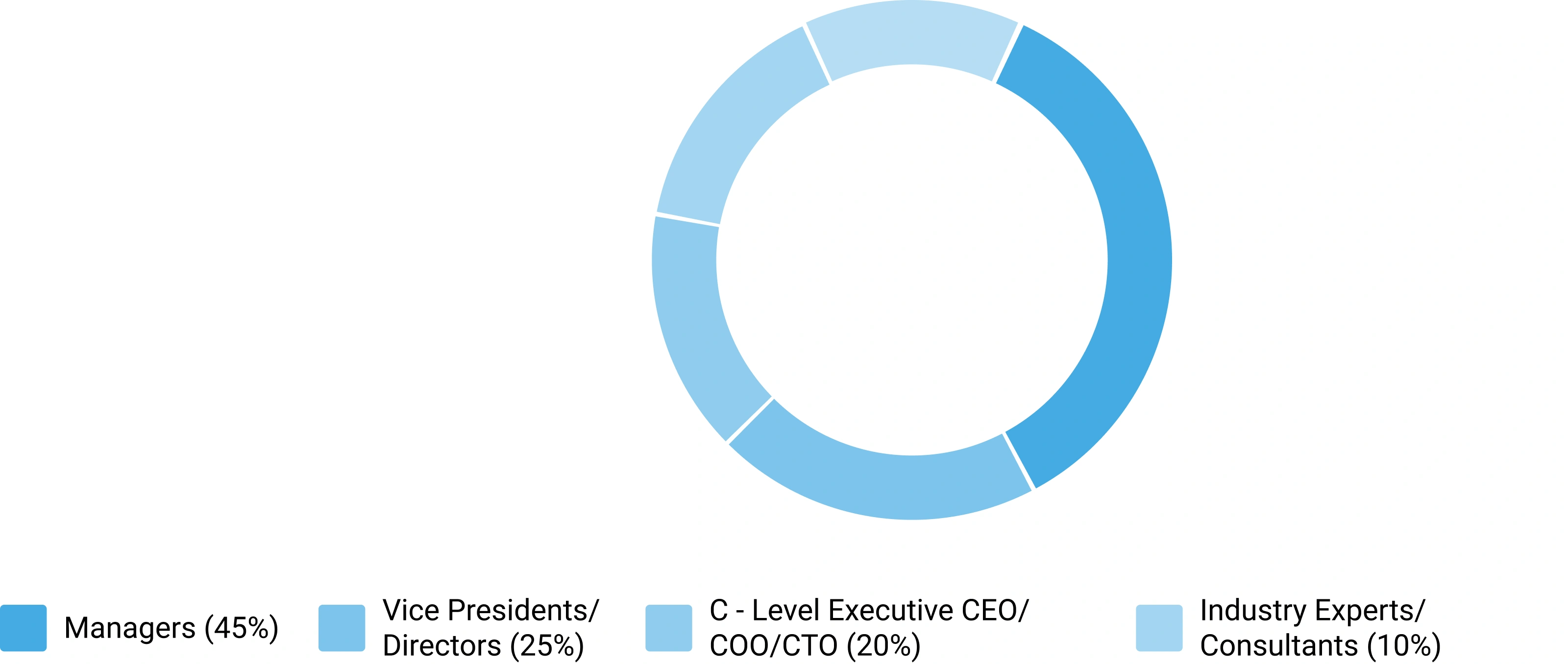
Primary Research — Respondent Designation Profile
Seniority breakdown of interview respondents (% share from PPT data)
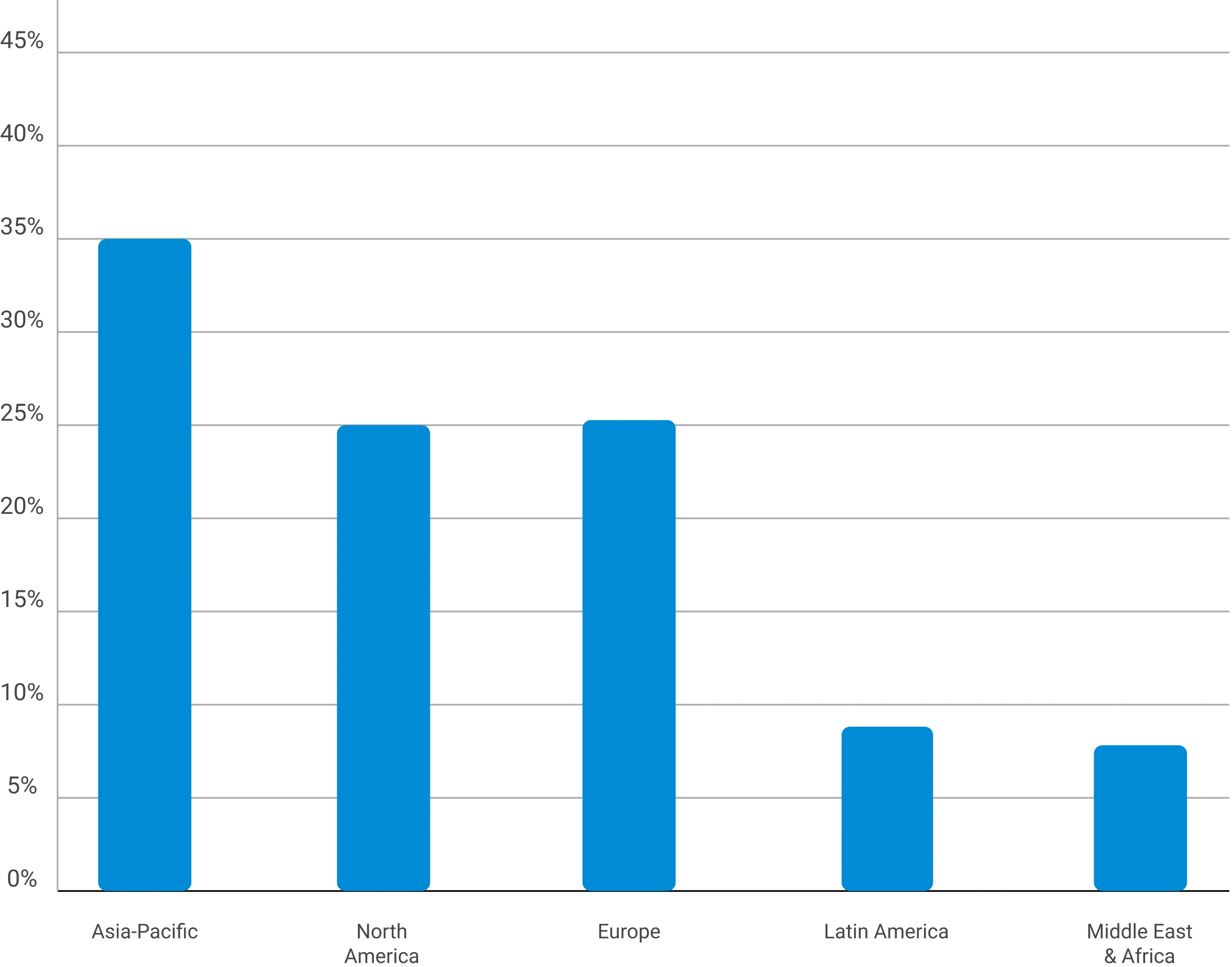
Primary Research — Geographic Coverage of Interviews
Regional distribution of primary research engagement (% share from PPT data)
Phase 6 — Data Triangulation and Market Validation
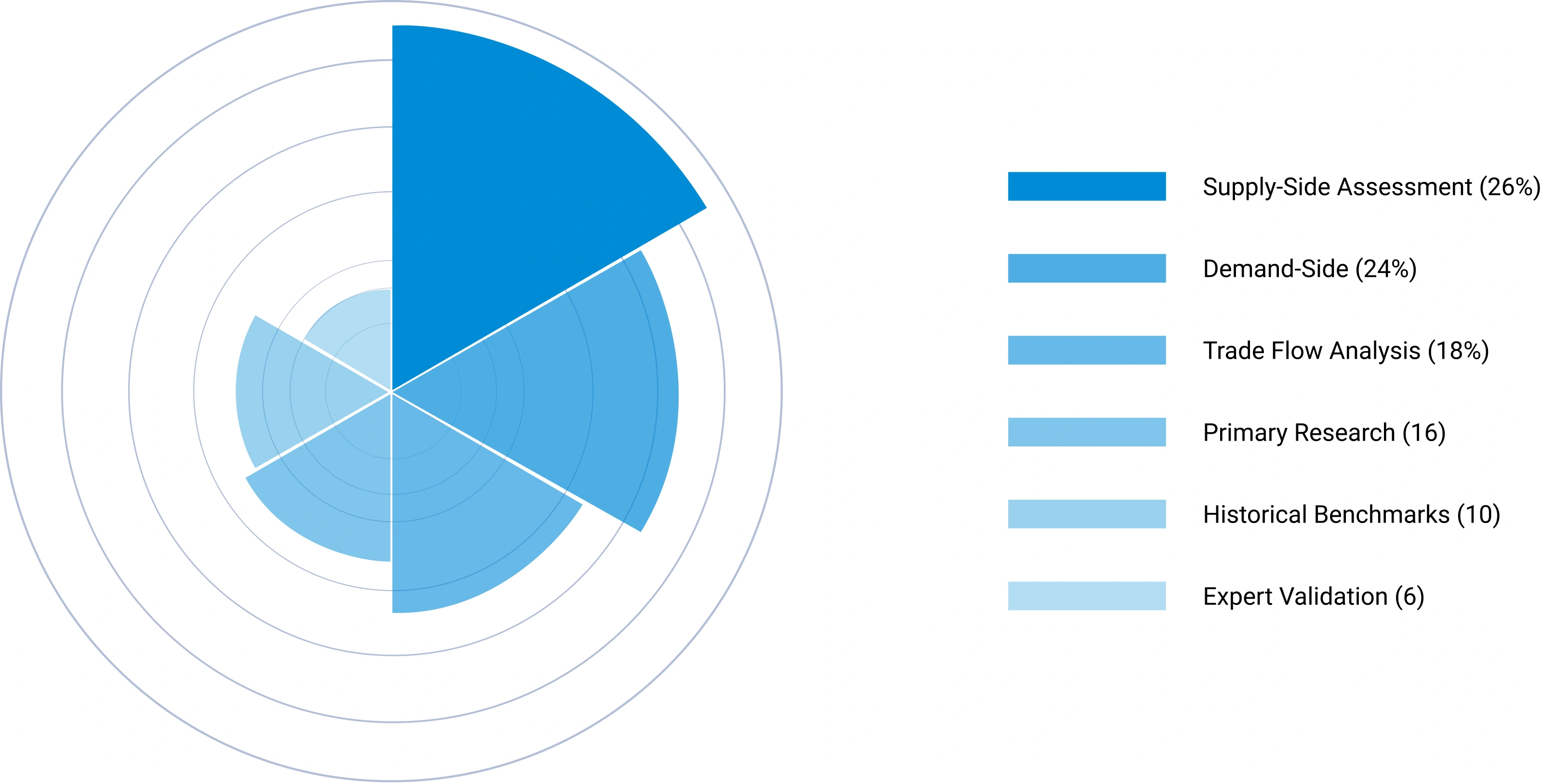
No single methodology is relied upon in isolation. Multiple independent estimation approaches are combined and reconciled to ensure consistency, accuracy, and analytical defensibility. Any material deviations between approaches are investigated and adjusted through additional validation cycles.
The final market size is derived through weighted triangulation of all validated methodologies. Any material deviations between approaches are investigated and adjusted through additional validation cycles. The outcome represents the most realistic assessment of the market based on available evidence and expert confirmation ensuring that volume and value estimates are fully consistent with one another.
Triangulation Framework — Input Contribution Weight
Relative weight each sizing input contributes to the final reconciled market estimate
Phase 7 — Forecast Modeling: Projecting Future Market Evolution
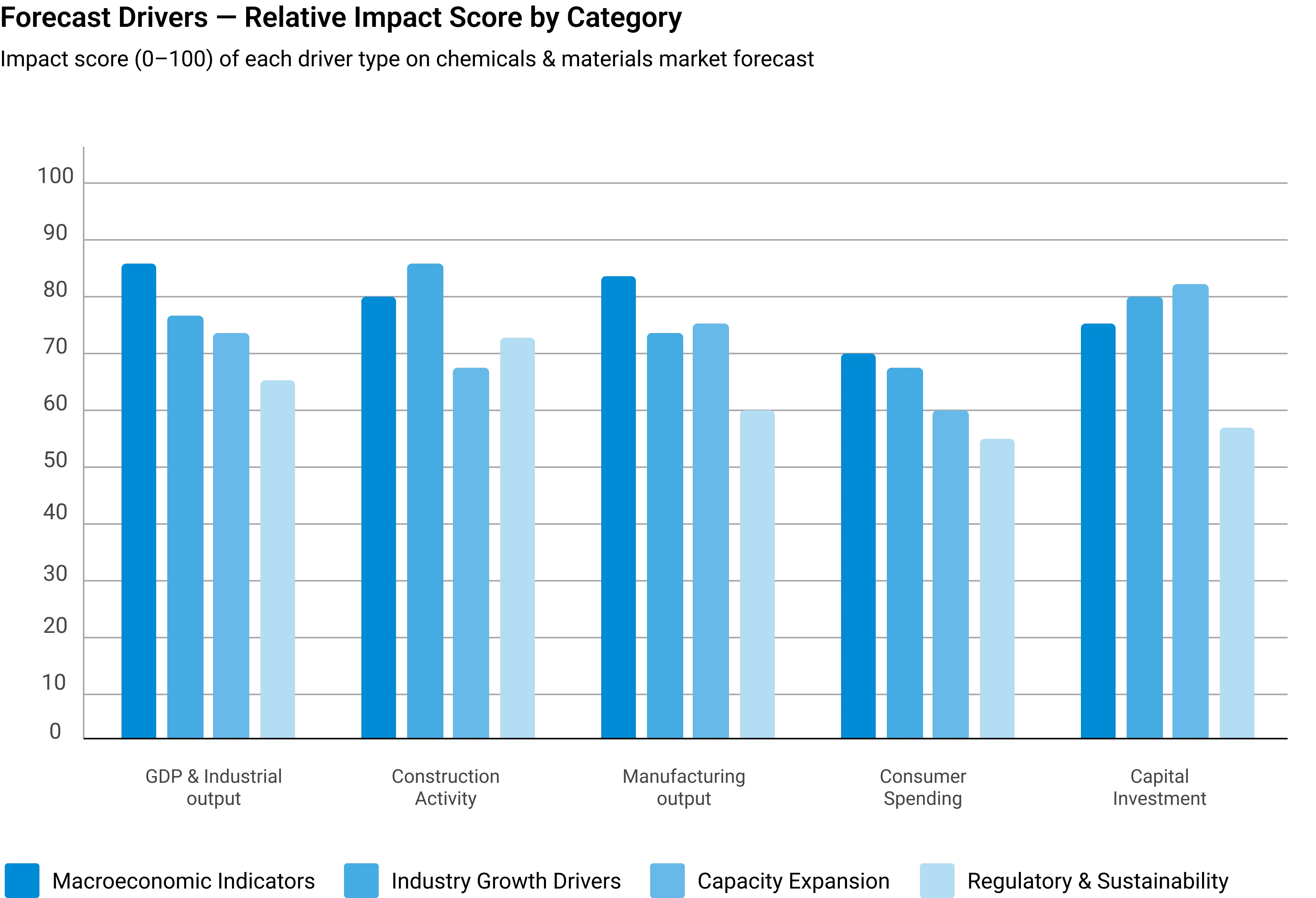
Forecasting evaluates the future trajectory of the market using a combination of quantitative indicators and qualitative assessments across economic, industry, and regulatory dimensions. Rather than simple extrapolation, each driver is independently modeled and integrated into a composite forecast.
Macroeconomic Indicators
GDP growth, industrial production, manufacturing output, construction activity, consumer spending, and capital investment form the quantitative foundation of long-term demand projections. These are applied at country, regional, and global levels.
Industry Growth Drivers
Urbanization, infrastructure development, industrialization, technological innovation, sustainability initiatives, and evolving product performance requirements are assessed at regional and industry levels — capturing both structural and cyclical demand drivers.
Capacity Expansion Analysis
Announced plant expansions, new manufacturing facilities, technology upgrades, and strategic investments are evaluated to determine future supply-demand dynamics and potential market tightness or oversupply situations.
Regulatory & Sustainability
Environmental regulations, chemical safety standards, emission reduction targets, circular economy initiatives, and sustainability requirements are incorporated as they often influence product adoption rates and market growth trajectories.
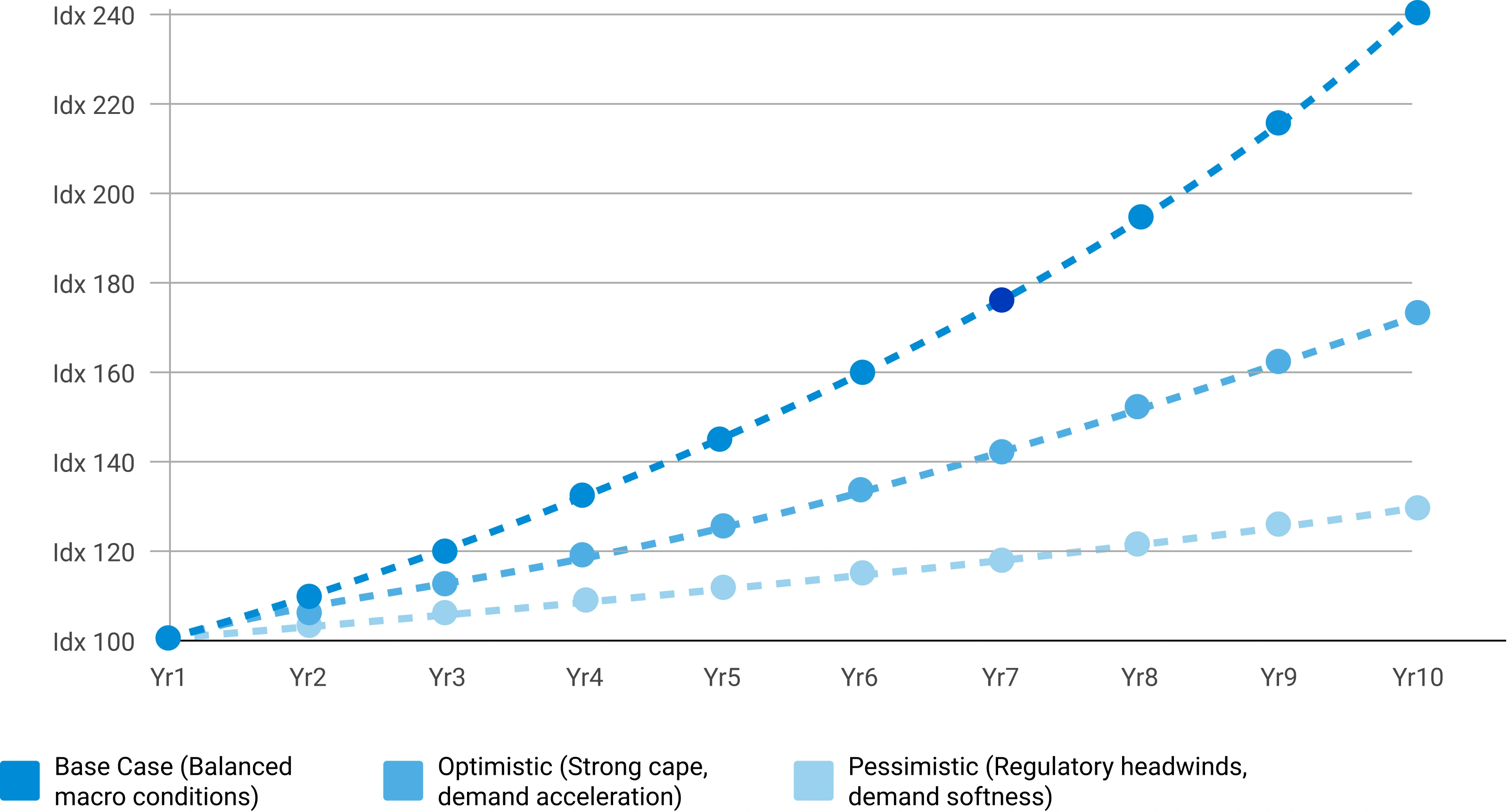
Scenario Forecast Range — Indexed Market Growth (Year 1–10)
Illustrative indexed growth trajectories across Base, Optimistic, and Pessimistic scenarios over a 10-year forecast horizon
Forecast Drivers — Relative Impact Score by Category
Impact score (0–100) of each driver type on chemicals & materials market forecast



Comments
Share your thoughts, ask a question, or provide feedback about this report.