Find the Right Market Report
Search thousands of industry reports, market insights, and research studies in one place.
Not sure where to start? Try one of these:
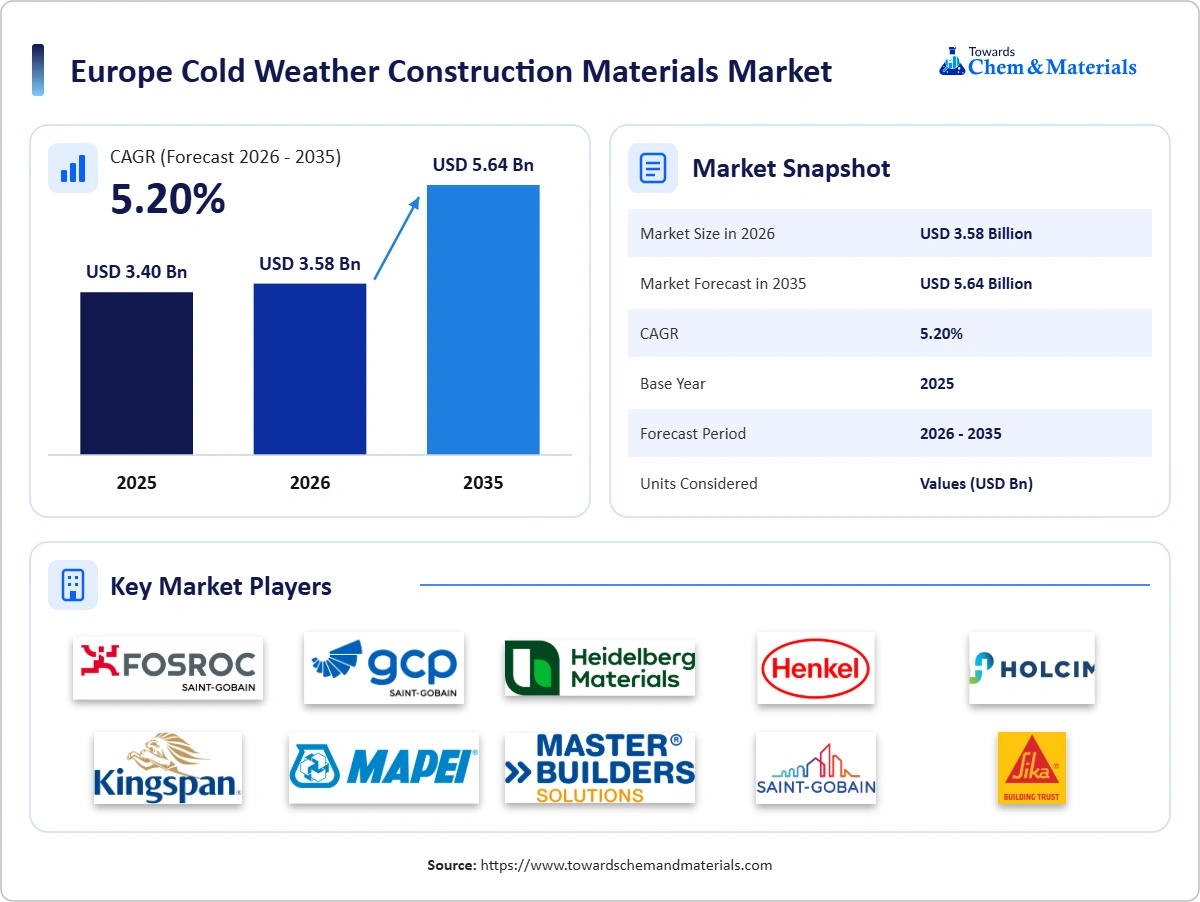
The Europe cold weather construction materials market size is valued at USD 3.58 billion in 2026 and is projected to reach USD 5.64 billion by 2035, expanding at a CAGR of 5.20% from 2026 to 2035. The market covers construction materials designed for use or curing under low-temperature conditions in Europe. The market also includes accelerating and anti-freeze concrete admixtures, frost-resistant and winter-grade mortars and renders, curing blankets and insulated formwork, low-temperature adhesives and sealants, and de-icing and protective products, used in residential, commercial, and infrastructure construction.
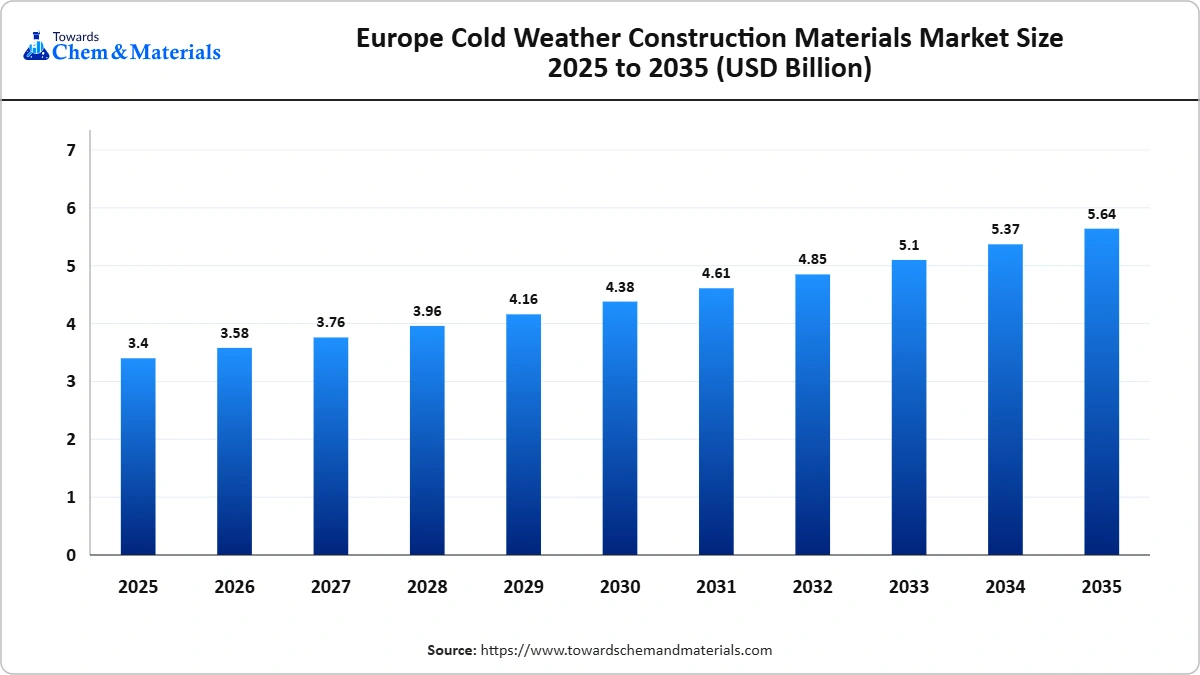
Note: 2025 is the base year; 2026-2035 values are forecasts.
Sources: Expert interviews, secondary sources, the Towards Chemical and Materials database, and Towards Chemical and Materials analysts.
Concrete Admixtures led the product segment with a 41.00% share in 2025, because accelerators that keep strength gain going below 5 degrees Celsius are important for concreting in cold weather in the Nordics, Germany, Poland, and the Baltics. Germany accounted for 22.00% of revenue in 2025, owing to significant construction activity and the fact that the country has long and cold winters. The market demand is being driven by year-round construction schedules, significant infrastructure spending, housing programs, and low-carbon concrete needs. Large suppliers are adding local brands, with Sika agreeing to acquire Swedish mortar maker Finja in January 2026.
The market is expected to grow from USD 3.40 billion in 2025 to USD 5.64 billion by the end of the forecast period because contractors want to continue their construction work even in winter to meet deadlines, and low-carbon cements need accelerators to gain strength in the cold. Year-round construction activities and significant infrastructure spending fuel market growth. The market is expected to reach USD 4.38 billion by 2030 and sustain a CAGR of 5.20% over the forecast period.
Analyst View: We developed the estimate based on construction output by country, the share of work done in cold months, and spending per cubic meter on admixtures, mortars, and protection, cross-checked against supplier sales.
The market demand is supported by year-round construction activities in a region where winters slow concrete curing and mortar setting. The need for accelerators and protection is increasing as low-carbon elements gain strength slowly in cold weather, and mild winters in some regions of Europe change demand patterns.
Market Drivers Impact & CAGR Contribution (2026-2035)
| Driver | Impact | ≈ CAGR Contribution | Time Horizon | Key Regions |
| Year-round construction | High | +2.03 pp | Short- to long-term | Europe-wide, strongest in Germany |
| Infrastructure spending | Medium | +1.71 pp | Medium- to long-term | Europe-wide, the fastest uptake in the Nordics |
| Low-carbon cements | Medium | +1.46 pp | Short- to medium-term | Europe-wide |
| Housing demand | Low | +1.14 pp | Long-term | Germany and the Nordics |
Note: Contributions are indicative estimates of each factor's effect on annual growth.
Sources: Expert interviews, secondary sources, the Towards Chemical and Materials database, and Towards Chemical and Materials analysts.
Year-round construction activities, significant infrastructure spending, and growing adoption of low-carbon cements are the strongest growth drivers in the market.
Market Restraints Impact & Negative CAGR Contribution (2026-2035)
| Restraint | Impact | ≈ Negative CAGR Contribution | Time Horizon | Key Regions |
| Construction cycles | High | -0.51 pp | Short- to medium-term | Europe-wide |
| Milder winters | High | -0.38 pp | Medium term | Smaller and price-sensitive markets |
| Cost sensitivity | Medium | -0.25 pp | Short term | Germany and other mature markets |
Note: Contributions are indicative estimates of each factor's effect on annual growth.
Sources: Expert interviews, secondary sources, the Towards Chemical and Materials database, and Towards Chemical and Materials analysts.
Construction cycles are the main restraint, with a negative CAGR contribution of 0.51 percentage points. Milder winters and cost sensitivity rank second and third with negative CAGR contributions of 0.38 percentage points and 0.25 percentage points, respectively.
| Segments | 2025 Share | 2035 Share | CAGR 2026-2035 |
| Concrete Admixtures | 41.00% | 39.18% | 4.73% |
| Mortars & Renders | 24.00% | 23.94% | 5.13% |
| Curing & Insulation Products | 17.00% | 16.84% | 5.13% |
| Adhesives & Sealants | 18.00% | 20.04% | 6.33% |
Concrete admixtures led the market in 2025 because winter concreting in the Nordics, Germany, Poland, and the Baltics is dependent on accelerators that keep strength gain going below 5 degrees Celsius. Low-temperature adhesives and sealants are growing at the fastest rate as facade and window installation activities continue through winter.
Concrete Admixtures: Accelerators and anti-freeze admixtures held 41.00% of revenue in 2025. Products such as Master Builders' Master X-Seed and Sika's antifreeze range let ready-mix plants pour in cold weather and remove formwork sooner.
Mortars & Renders: Winter-grade mortars and renders accounted for a 24.00% share in the base year. Sika's planned purchase of Finja in Sweden shows the importance of regional mortar brands in cold weather.
Curing & Insulation Products: In 2025, curing blankets, insulated formwork, and heated enclosures made up 17.00% of the market, protecting fresh concrete from frost.
Adhesives & Sealants: Low-temperature adhesives and sealants are projected to exhibit a CAGR of 6.33% over the forecast period, as they enable contractors to install windows, roofing, and facades in sub-zero temperatures.
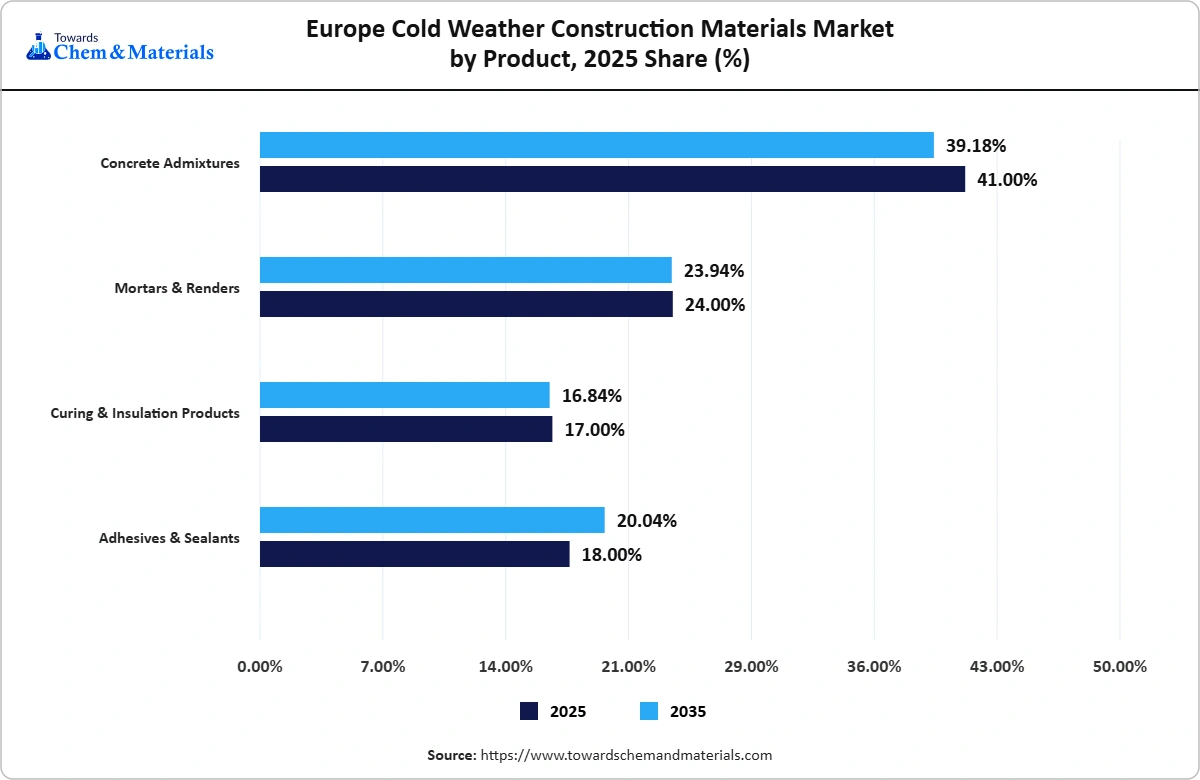
Note: 2025 is the base year; 2035 shares and CAGRs are forecasts.
Sources: Expert interviews, secondary sources, the Towards Chemical and Materials database, and Towards Chemical and Materials analysts.
| Segments | 2025 Share | 2035 Share | CAGR 2026-2035 |
| Infrastructure | 42.00% | 39.89% | 4.68% |
| Commercial | 31.00% | 30.67% | 5.08% |
| Residential | 27.00% | 29.43% | 6.08% |
Note: 2025 is the base year; 2035 shares and CAGRs are forecasts.
Sources: Expert interviews, secondary sources, the Towards Chemical and Materials database, and Towards Chemical and Materials analysts.
In 2025, infrastructure dominated the market because roads, bridges, and tunnel construction and energy projects run through winter to meet deadlines. Residential construction is expanding at the highest rate due to a significant number of housing programs, and increased modular building activity contributes to winter construction activities in winter.
Infrastructure: Infrastructure projects used 42.00% of products in 2025, driven by high demand from Nordic Road, rail projects, and wind farm foundations.
Commercial: In 2025, commercial buildings accounted for a market share of 31.00%, where developers want year-round progress.
Residential: Residential construction is expected to grow at a rate of 6.08% from 2026 to 2035 because of housing targets in the U.K., Germany, and Poland.
Analyst View: Adhesives and sealants and residential work gain share fastest, while concrete admixtures and infrastructure remain the largest parts of the Europe cold weather construction materials market.
| Country | 2025 Share | 2035 Share | CAGR 2026-2035 |
| Germany | 22.00% | 20.57% | 4.62% |
| Nordics | 21.00% | 23.23% | 6.22% |
| Rest of Europe | 16.00% | 15.78% | 5.02% |
| Poland | 12.00% | 11.88% | 5.02% |
| U.K. | 11.00% | 10.82% | 5.02% |
| France | 9.00% | 8.87% | 5.02% |
| Austria & Switzerland | 9.00% | 8.87% | 5.02% |
Note: 2025 is the base year; 2035 shares and CAGRs are forecasts.
Sources: Expert interviews, secondary sources, Towards Chemical and Materials database and Towards Chemical and Materials analysts.
Germany and the Nordics hold the largest and the second-largest shares, respectively, because of large construction volumes in these regions along with the presence of long, cold winters. The Nordics are growing at the fastest pace as infrastructure and energy projects continue through the year.
| Rank | Company Name | 2025 Share (%) | Key Products / Business | Headquarters |
| 1 | Sika | 22.00% | admixtures, mortars and sealants | Switzerland |
| 2 | Saint-Gobain (Weber, GCP) | 12.00% | mortars, admixtures and insulation | France |
| 3 | Master Builders Solutions (Sika) | 10.00% | Master X-Seed accelerators | Germany |
| 4 | Holcim | 6.00% | cements and building solutions | Switzerland |
| 5 | MAPEI | 6.00% | admixtures, mortars and adhesives | Italy |
| 6 | Heidelberg Materials | 5.00% | Cements and ready-mix | Germany |
| 7 | Henkel (Ceresit) | 5.00% | winter-grade mortars and adhesives | Germany |
| 8 | Rockwool | 4.00% | insulation products | Denmark |
| 9 | Fosroc | 3.00% | construction chemicals | United Kingdom |
| 10 | Kingspan | 3.00% | insulation boards | Ireland |
Note: Company shares are 2025 estimates.
Sources: Company press releases, expert interviews, secondary sources, Towards Chemical and Materials database and Towards Chemical and Materials analysts.
Sika led the market with a 22.00% share in 2025, followed by Saint-Gobain (Weber, GCP) at 12.00% share and Master Builders Solutions (Sika) at 10.00% share. Sika maintains a strong market position through its broad portfolio of admixtures, mortars and sealants; Saint-Gobain (Weber, GCP) stays competitive with its extensive range of mortars, admixtures and insulation, and Master Builders Solutions (Sika) offers master X-Seed accelerators. Holcim, MAPEI, Heidelberg Materials, Henkel (Ceresit), Rockwool, Fosroc and Kingspan compete through cements and building solutions, admixtures, mortars and adhesives, cements and ready-mix, winter-grade mortars and adhesives, insulation products, construction chemicals and insulation boards.
In 2025, the top 10 companies held a 75.88% share, while the remaining 24.12% was shared among many regional admixture, mortar and insulation suppliers. The market is concentrated, and competition centres on technical performance at low temperatures, compliance with EN standards, local production and distribution, and support for ready-mix and contractor customers.
The Europe cold weather construction materials ecosystem connects raw material suppliers, construction chemical makers, Ready-Mix & precast producers, contractors & standards bodies, and each stage contributes value before products reach end users. Suppliers use material informatics and AI in chemicals to design accelerators, and kilns use aluminum refractory materials.
| Ecosystem Stage | Role in the Market | Key Companies |
| Raw Material Suppliers | Supply cement, polymers, and chemicals | Cement producers, polymer makers |
| Construction Chemical Makers | Formulate admixtures and mortars | Sika, Saint-Gobain, MAPEI |
| Ready-Mix & Precast Producers | Produce concrete | Heidelberg Materials, Holcim |
| Contractors | Build projects | Skanska, NCC, Strabag |
| Standards Bodies | Set rules | CEN, national standards |
Sources: Company press releases, expert interviews, secondary sources, Towards Chemical and Materials database and Towards Chemical and Materials analysts.
Raw Material Suppliers: Supply calcium nitrate and other salts used in accelerator formulations.
Construction Chemical Makers: Develop and adapt products to meet regional climate requirements.
Ready-Mix & Precast Producers: Adjust concrete mixes according to daily temperature changes.
Contractors: Select suitable curing and protection methods for cold-weather construction.
Standards Bodies: Establish EN standards for concrete and mortar performance.
Market value follows the following route: upstream material and technology suppliers -> manufacturers and service providers -> distribution partners -> end users. Companies that integrate their operations and focus on building long-term relationships with end users will be well-positioned to capture a large share of this value.
The Towards Chemical and Materials Companies Quadrant evaluates key participants in the market based on market strength, innovation, and growth strategies. Market strength takes into consideration revenue scale, market share, and geographic reach. Innovation and growth strategies reflect product portfolio breadth, R&D intensity, and partnerships. Company positioning is based on its respective market share in 2025 and our assessment of its product innovation, portfolio breadth, and partnerships.
Sources: Company press releases, expert interviews, secondary sources, Towards Chemical and Materials database and Towards Chemical and Materials analysts.
Leaders: Sika, Saint-Gobain (Weber, GCP), Master Builders Solutions (Sika), Holcim, MAPEI and Heidelberg Materials hold strong market positions because of their broad portfolios and strong innovation pipelines.
Innovators: Henkel (Ceresit), Rockwool, Fosroc and Kingspan place significant emphasis on innovation as they offer newer technologies and specialised products.
The market is defined as construction materials that have been developed specifically for use or curing at low temperatures in Europe. These materials include accelerating and anti-freeze concrete admixtures, frost-resistant and winter-grade mortars and renders, curing blankets and insulated formwork, low-temperature adhesives and sealants, and de-icing and protective products, used in residential, commercial, and infrastructure construction. The 2025 base year was developed using a bottom-up approach based on demand volumes and average prices across product categories, prices, and countries. This estimate was cross-checked top-down based on market-specific revenues of leading companies and public industry data. Segment, country, and company values were allocated from product and application and country demand. Key estimates were verified by cross-checking company disclosures, regulatory and industry data, and published third-party estimates, and inputs that could not be reconciled were excluded. All segments, regional and company figures were reconciled to the same 2025 base year, and the 2026-2035 forecast, which applies a constant CAGR from the 2025 base, was recalculated and validated.
We expect the market to exhibit a steady pace of growth. Low-carbon cements gain strength more slowly, especially in winter, and hence they will need more accelerators. Construction slowdowns and mild winters can reduce demand in some years.
Reliable market intelligence and data-driven insights across the global chemicals and materials industry, helping businesses understand trends, competition, pricing, and emerging opportunities.
Schedule a Demo