Find the Right Market Report
Search thousands of industry reports, market insights, and research studies in one place.
Not sure where to start? Try one of these:
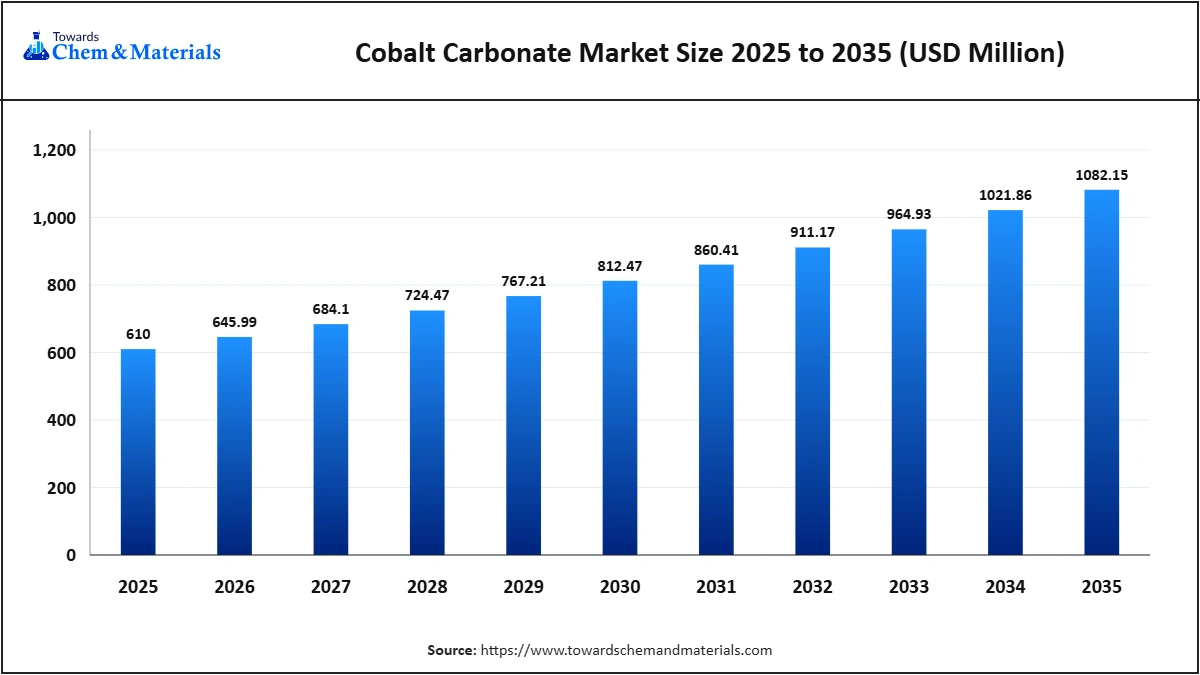
The global cobalt carbonate market size was valued at USD 610 million in 2025 and is expected to reach USD 1082.15 million by 2035, growing at a CAGR of 5.9% during the forecast period of 2026-2035. Cobalt carbonate, including basic cobalt carbonate, is a specialty inorganic cobalt compound supplied in battery, industrial, and feed grades. It is primarily used as a precursor for cobalt oxide and lithium-ion battery cathode materials, as well as in industrial catalysts, ceramic pigments and glazes, animal feed additives, and specialty chemical manufacturing.
In 2025, battery-grade cobalt carbonate dominated the market with a 48% share, primarily due to its role in cobalt oxide production and battery cathodes. Battery materials represented 45% of applications, underscoring the persistent demand for cobalt in consumer electronics and certain EV batteries. According to our analysis, Asia Pacific dominated the global market with a 66% revenue share in 2025, supported by China's extensive cobalt refining infrastructure, battery cathode manufacturing capacity, and established specialty chemical industry.
Note: 2025 is the base year; 2026-2035 values are forecasts.
Sources: Expert interviews, secondary sources, Towards Chemical and Materials database, and Towards Chemical and Materials analysts.
Market demand is influenced by the expansion of lithium-ion battery production, industrial catalysts, ceramic pigments, and animal nutrition. Moreover, increasing recycled cobalt usage and the demand for traceable raw materials present opportunities for market participants. The DRC's introduction of an annual cobalt export quota of 96,600 tonnes for 2026 and 2027 has increased attention to raw material availability, sourcing diversification, and supply chain resilience.
The cobalt carbonate market is projected to grow from USD 610.00 million in 2025 to USD 1,082.15 million by 2035, supported by rising demand for cobalt-based battery materials, industrial catalysts, ceramic pigments, and specialty chemical applications. Battery-grade cobalt carbonate remains crucial for lithium-ion battery supply chains, especially in Asia Pacific, driven by rising consumer electronics and EV production. Its use extends to industrial applications and animal feed, supporting stable demand.
Growing battery recycling and interest in traceable sourcing will shape procurement strategies, though factors like cobalt price volatility, export restrictions, and shifts to cobalt-free chemistries may limit market growth. These factors are anticipated to increase market revenue to USD 812.47 million by 2030, sustaining a CAGR of 5.9% from 2026 to 2035.
Analyst View: We estimated the cobalt carbonate market by analyzing consumption volumes across various applications and regions, multiplied by average selling prices. This includes uses in battery precursor production, catalysts, ceramics, animal feed, and specialty chemicals. Our estimates were validated through cross-checking with leading producers and trade data. The analysis indicates that battery materials and manufacturing growth in Asia Pacific will drive market expansion, while factors like supply concentration and price fluctuations will impact its long-term development.
The cobalt carbonate market is driven by increasing demand for lithium-ion battery materials, expanding consumer electronics production, and continued use of cobalt in selected EV cathode chemistries. Cobalt carbonate serves as an important precursor for producing cobalt oxide and other cobalt-containing materials used in battery manufacturing. The expansion of battery production capacity in China and other Asian manufacturing hubs is therefore supporting consumption of battery-grade cobalt carbonate.
Industrial catalyst manufacturing and cobalt-containing catalysts play a crucial role in hydrodesulfurization, hydroprocessing, and certain chemical synthesis applications. Additional demand arises from ceramics and glass industries due to cobalt compounds used in pigments and glazes. Moreover, cobalt's role in animal feed, particularly in supporting microbial vitamin B12 synthesis in ruminants, adds to its consumption base. These factors are anticipated to drive market expansion during the forecast period.
Volatile cobalt prices create major challenges because production costs are closely linked to cobalt metal, hydroxide, and intermediates. Since most cobalt is produced in the Democratic Republic of Congo, manufacturers face significant risks from geopolitical instability, export restrictions, and supply disruptions. Recent export quotas further emphasize the need for careful procurement planning and diversified sourcing.
The shift towards low-cobalt and cobalt-free battery technologies poses a long-term challenge, as LFP batteries are increasingly used in EVs and energy storage. Ethical sourcing requirements, environmental regulations, and occupational safety standards can increase production and compliance costs. These challenges may limit the profitability and growth potential of manufacturers that depend heavily on conventional cobalt feedstock and battery-related demand.
Investment in battery recycling and secondary cobalt recovery is creating opportunities for cobalt carbonate producers to diversify feedstock sources and reduce dependence on newly mined cobalt. Recovered cobalt can potentially be processed into suitable chemical intermediates and specialty salts, subject to purity requirements and customer qualification.
The emergence of regional battery supply chains in Europe and North America is generating opportunities for suppliers that provide traceable, high-purity cobalt chemicals. Additional prospects lie in advanced catalysts, specialty ceramic pigments, and industrial-grade cobalt compounds. Manufacturers can enhance their competitiveness by securing long-term feedstock agreements, refining efficiency, specialized product grades, recycling partnerships, and collaborating closely with battery precursor and catalyst producers.
| Driver | Impact | ≈ CAGR Contribution | Time Horizon | Key Regions |
| Electronics batteries need LCO | High | +2.30 pp | Short to long term | Global, strongest in Asia Pacific |
| EV cathodes still use cobalt | Medium | +1.94 pp | Medium to long term | Global, fastest uptake in Asia Pacific |
| Catalysts grow | Medium | +1.66 pp | Short to medium term | Global |
| Ceramics use pigments | Low | +1.30 pp | Long term | Developed and emerging markets |
Note: Contributions are indicative estimates of each factor's effect on annual growth.
Sources: Expert interviews, secondary sources, Towards Chemical and Materials database and Towards Chemical and Materials analysts.
The identified growth drivers contribute an estimated 7.20 percentage points to annual market growth before accounting for restraints, primarily driven by the demand for lithium cobalt oxide (LCO) for battery materials. Increased cobalt use in electric vehicle cathode chemistries, especially in Asia Pacific, further boosts demand due to the region's battery manufacturing and refining infrastructure. Additionally, industrial hydroprocessing and chemical manufacturing catalyst applications, along with established ceramic pigment demand, collectively support the growth of cobalt carbonate consumption across various sectors.
| Restraint | Impact | ≈ Negative CAGR Contribution | Time Horizon | Key Regions |
| Cobalt price volatility | High | -0.58 pp | Short to medium term | Global |
| Supply concentration in DRC | High | -0.43 pp | Medium term | Price-sensitive and emerging markets |
| Low-cobalt and LFP batteries | Medium | -0.29 pp | Short term | Asia Pacific and other mature markets |
Note: Contributions are indicative estimates of each factor's effect on annual growth.
Sources: Expert interviews, secondary sources, Towards Chemical and Materials database and Towards Chemical and Materials analysts.
The identified restraints are estimated to reduce annual market growth by approximately 1.30 percentage points due to price volatility, concentrated supply, and increased adoption of low-cobalt battery technologies. Cobalt price fluctuations impact manufacturing costs and pricing strategies. The Democratic Republic of Congo's supply concentration adds geopolitical risk. However, battery recycling, diversification in sourcing, and steady demand for catalysts and pigments are expected to mitigate these challenges, leading to a net CAGR of 5.9% from 2026 to 2035.
| Segments | 2025 Share | 2035 Share | CAGR 2026-2035 |
| Battery Grade | 48.00% | 49.41% | 6.21% |
| Industrial Grade | 38.00% | 36.97% | 5.61% |
| Feed Grade | 14.00% | 13.62% | 5.61% |
Note: 2025 is the base year; 2035 shares and CAGRs are forecasts.
Sources: Expert interviews, secondary sources, Towards Chemical and Materials database and Towards Chemical and Materials analysts.
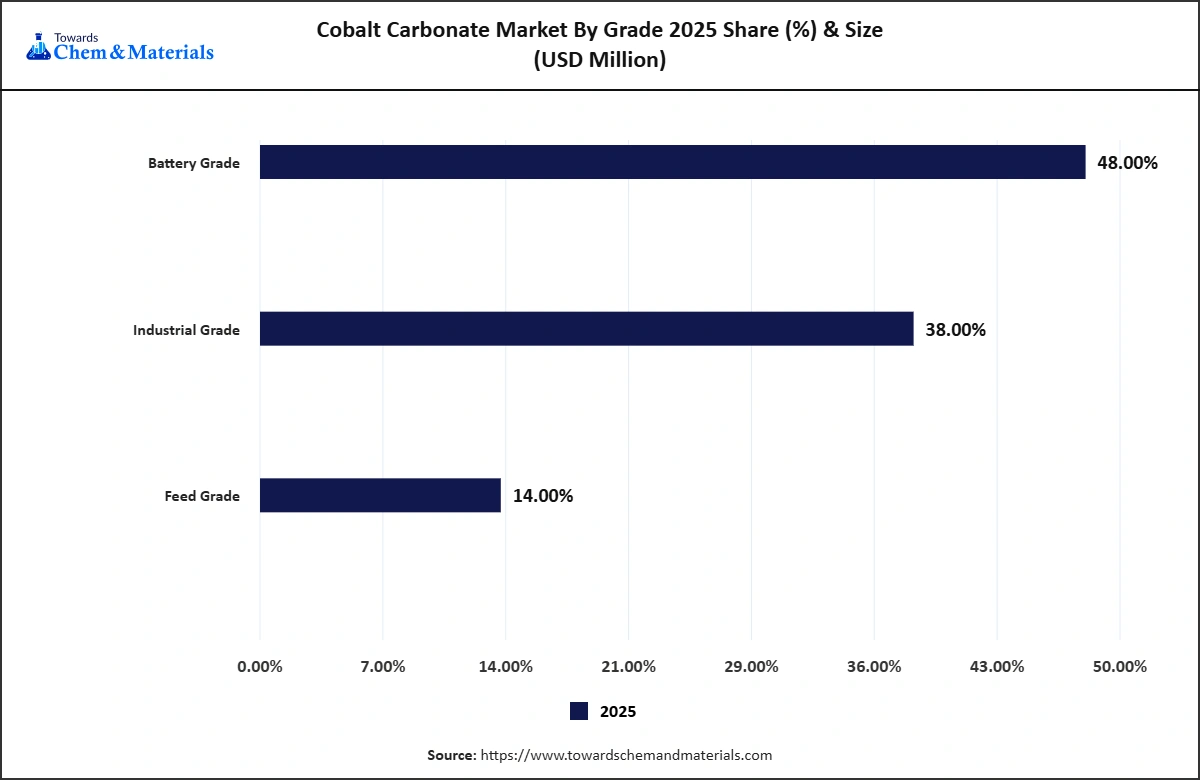
In 2025, battery-grade cobalt carbonate dominated the market with a 48% share, valued at USD 292.80 million. Industrial grade followed with a 38% share, equivalent to USD 231.80 million, while feed grade accounted for the remaining 14%, valued at USD 85.40 million. Battery grade maintains its leading position because of its role as a precursor for cobalt oxide and selected lithium-ion battery cathode materials.
Battery-grade cobalt carbonate is projected to expand at a CAGR of 6.21% from 2026 to 2035. Demand for battery-grade cobalt is driven by the production of cobalt oxide and battery precursor materials, necessitating controlled impurity levels and consistent quality for manufacturers. The ongoing production of lithium cobalt oxide batteries for consumer electronics and specific cathode chemistries is anticipated to fuel above-average growth in this segment.
Industrial-grade cobalt carbonate is expected to record a CAGR of 5.61% from 2026 to 2035. It is used in the production of industrial catalysts, ceramic pigments, glazes, and other specialty cobalt chemicals. Demand is supported by established industrial applications, particularly hydrodesulfurization catalysts and cobalt-based ceramic colors. The segment is expected to maintain steady growth through the forecast period as industrial chemical production and specialty material consumption increase.
Feed-grade cobalt carbonate is anticipated to register a CAGR of 5.61% from 2026 to 2035. It provides cobalt for animal nutrition, especially in ruminant feed formulations where cobalt aids in microbial vitamin B12 synthesis. Demand is anticipated to remain strong due to livestock production needs and balanced nutrition. Growth will also rely on feed safety standards, additive specifications, and regional regulations.
Segment Outlook: Battery grade is expected to retain its leading position through 2035, accounting for approximately 49.41% of the market, while registering the fastest growth at a CAGR of 6.21%. Expanding battery precursor production and demand for high-quality cobalt compounds are expected to strengthen the segment's position. Industrial and feed grades will continue to provide diversified demand from established downstream applications.
| Segments | 2025 Share | 2035 Share | CAGR 2026-2035 |
| Battery Materials | 45.00% | 47.35% | 6.44% |
| Catalysts | 17.00% | 16.28% | 5.44% |
| Pigments & Ceramics | 18.00% | 17.23% | 5.44% |
| Animal Feed | 12.00% | 11.49% | 5.44% |
| Others | 8.00% | 7.66% | 5.44% |
Note: 2025 is the base year; 2035 shares and CAGRs are forecasts.
Sources: Expert interviews, secondary sources, Towards Chemical and Materials database, and Towards Chemical and Materials analysts.
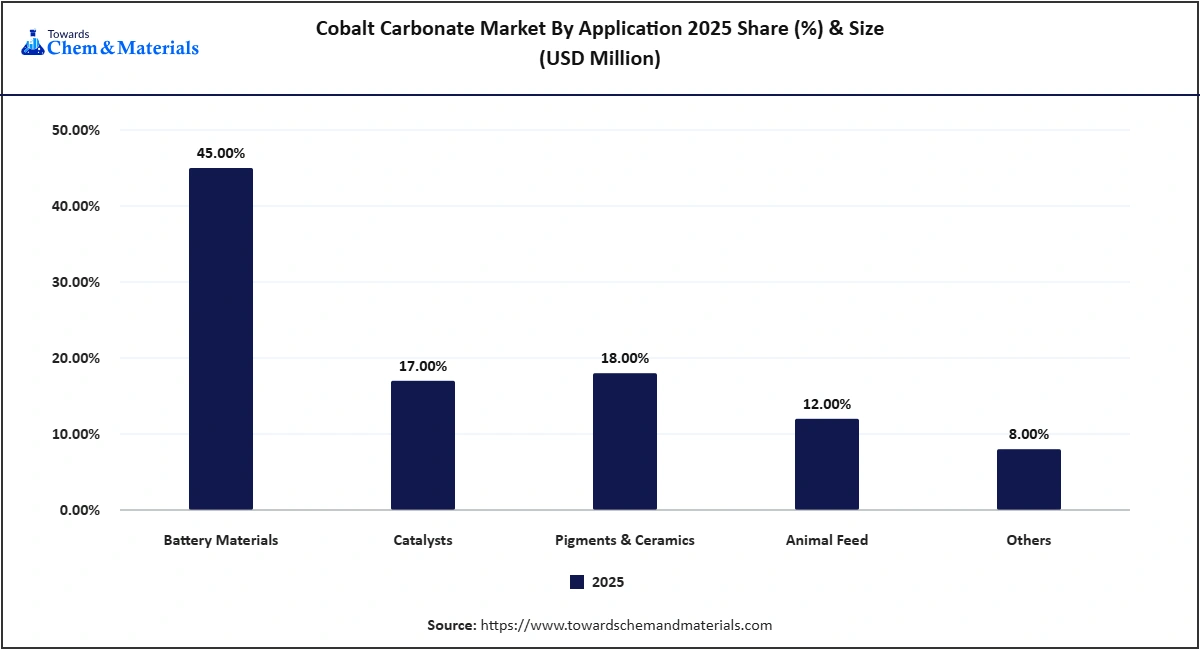
In 2025, battery materials represented the largest application segment, accounting for 45% of the cobalt carbonate market, valued at USD 274.50 million. Pigments and ceramics followed with an 18% share, equivalent to USD 109.80 million, while catalysts captured 17%, valued at USD 103.70 million. Animal feed represented 12%, worth USD 73.20 million, and other applications accounted for the remaining 8%, valued at USD 48.80 million. Battery materials, particularly cobalt carbonate, are crucial for producing cobalt oxide and cathode materials, dominating the market.
Battery materials are projected to reach USD 512.56 million by 2035, registering a CAGR of 6.44% from 2026 to 2035. Cobalt carbonate serves as a precursor for cobalt oxide and lithium cobalt oxide in consumer electronics. Its consumption is supported by the growth in battery manufacturing and demand for portable electronics and electric vehicle batteries. Nonetheless, the rise of low-cobalt battery chemistries, like LFP, may temper long-term demand growth.
The catalysts segment is anticipated to reach an indicative USD 176.13 million by 2035, expanding at a CAGR of 5.44%. Cobalt-based compounds are utilized in hydrodesulfurization, hydroprocessing, and certain chemical synthesis applications. The growing need for cleaner fuels and refinery upgrades is anticipated to drive the demand for cobalt-containing catalysts, which will be influenced by catalyst replacement cycles, industrial capacity utilization, and advancements in alternative catalyst formulations.
Pigments and Ceramics is projected to reach USD 186.04 million by 2035, registering a CAGR of 5.44%. Cobalt carbonate is used as a raw material for producing cobalt-based pigments, including cobalt blue, which provides color stability and high-temperature performance in ceramic glazes, glass, and specialty decorative applications. Demand for ceramic tiles, sanitaryware, decorative ceramics, and specialty glass products is expected to sustain market consumption.
The animal feed segment is expected to reach USD 124.03 million by 2035, expanding at a CAGR of 5.44%. Cobalt is an essential trace element for ruminants because it supports microbial synthesis of vitamin B12 in the digestive system. Cobalt carbonate is used in selected animal nutrition formulations as a cobalt source. Increasing livestock production and demand for balanced mineral supplementation are expected to support the segment, subject to applicable feed safety and regulatory requirements.
The other segment is projected to reach USD 83.39 million by 2035, registering a CAGR of 5.44%. This category includes specialty cobalt chemicals, chemical intermediates, driers, and other industrial applications. Demand is supported by specialty chemical manufacturing, laboratory applications, and selected industrial formulations. Product diversification and the development of high-purity cobalt compounds may create additional opportunities for manufacturers.
Segment Outlook: Throughout the forecast period, battery materials are expected to remain the largest application, accounting for approximately 47.35% of the global market. The segment is also projected to register the fastest growth, with a CAGR of 6.44%. Battery manufacturing will continue to provide the strongest demand contribution, while catalysts, pigments, ceramics, and animal feed will support market diversification and consumption stability.
Analyst View: Based on our analysis, segment values were allocated using corresponding cobalt carbonate consumption volumes and average selling prices across grades and applications. Battery grade and battery materials dominate the market because of their importance in cobalt oxide and cathode precursor manufacturing. However, industrial catalysts, ceramic pigments, and animal feed remain essential sources of diversified demand. Battery-related applications are expected to gain relative importance through 2035, although the rate of growth will depend on battery chemistry adoption, cobalt intensity, and recycled material availability.
| Region | 2025 Share | 2035 Share | CAGR 2026-2035 |
| Asia Pacific | 66.00% | 68.50% | 6.29% |
| Europe | 19.00% | 17.60% | 5.09% |
| North America | 10.00% | 9.26% | 5.09% |
| Middle East & Africa | 3.00% | 2.78% | 5.09% |
| Latin America | 2.00% | 1.85% | 5.09% |
Note: 2025 is the base year; 2035 shares and CAGRs are forecasts.
Sources: Expert interviews, secondary sources, Towards Chemical and Materials database, and Towards Chemical and Materials analysts.
Asia Pacific dominated the cobalt carbonate market with a 66% revenue share in 2025, valued at USD 402.60 million. Europe followed with a 19% share, equivalent to USD 115.90 million, while North America represented 10%, valued at USD 61.00 million. Middle East and Africa accounted for 3%, worth USD 18.30 million, and Latin America represented the remaining 2%, valued at USD 12.20 million.
Asia Pacific: The Asia Pacific cobalt carbonate market is projected to grow at a CAGR of 6.29% from 2026 to 2035, with China as the dominant manufacturing and consumption hub due to its robust cobalt refining infrastructure. Other contributors include India, Japan, South Korea, and Southeast Asian nations through their battery and electronics sectors. The development of Indonesian nickel-cobalt processing and regional battery investments is anticipated to enhance supply chain integration, leading to faster growth in the region compared to the overall market.
Europe: The European cobalt carbonate market is projected to expand at a CAGR of 5.09% from 2026 to 2035, driven by demand in battery manufacturing, industrial catalysts, specialty chemicals, and ceramics. The EU's focus on responsible sourcing and recycling offers opportunities for recycled and traceable cobalt products. Key countries such as Germany and Belgium show significant downstream demand, but reliance on imported intermediates and competition from Asia may affect costs and growth.
North America: The North American cobalt carbonate market is projected to grow at a CAGR of 5.09% through 2035, driven by demand from specialty chemical manufacturing, catalysts, animal feed additives, ceramics, and battery materials. Investments in battery supply chains and recycling are providing opportunities for suppliers. The U.S. is expected to be the leading market, with Canada contributing through mining and battery development, and Mexico presenting opportunities via industrial manufacturing and supply chain integration.
Middle East & Africa: The cobalt carbonate market in the Middle East and Africa is expected to record a CAGR of 5.09% from 2026 to 2035, driven by the Democratic Republic of Congo's significant role in cobalt mining. The DRC's export policies impact cobalt availability and pricing globally. Opportunities in Middle Eastern markets arise from applications in industrial catalysts and specialty chemicals. Growth will depend on investments in refining, industrial diversification, and enhancements in supply chain infrastructure.
Latin America: The cobalt carbonate market in Latin America is expected to record a CAGR of 5.09% from 2026 to 2035, driven by demand across animal feed, ceramics, specialty chemicals, and certain industrial applications. Brazil is a key market due to its agricultural and industrial sectors, while Argentina and other economies present manufacturing and chemical consumption opportunities. Growth in the region will rely on downstream industrial investments, trade relationships, and the availability of competitively priced cobalt compounds.
Analyst View: Based on our analysis, in 2025, Asia Pacific leads in cobalt refining and battery manufacturing, bolstered by industrial demand and investments. The region will benefit from downstream processing and cobalt chemical production. Europe and North America will see steady growth through battery recycling and established applications, while the Middle East and Africa will be significant due to the DRC's cobalt supply. Latin America presents additional opportunities driven by agricultural and industrial demand.
| Rank | Company Name | 2025 Share (%) | Key Products / Business | Headquarters |
| 1 | Huayou Cobalt | 2.95% | Cobalt salts and battery precursors | China |
| 2 | GEM Co. | 2.30% | Cobalt carbonate and recycled cobalt | China |
| 3 | Umicore | 1.48% | Cobalt chemicals and cathode materials | Belgium |
| 4 | Jinchuan Group | 1.15% | Cobalt salts | China |
| 5 | Nanjing Hanrui Cobalt | 0.98% | Cobalt salts and oxides | China |
| 6 | Ganzhou Tengyuan Cobalt | 0.82% | Cobalt carbonate and salts | China |
| 7 | Glencore | 0.66% | Cobalt hydroxide and refined cobalt supply | Switzerland |
| 8 | Shepherd Chemical | 0.66% | Cobalt carbonate and specialty salts | United States |
| 9 | Sumitomo Metal Mining | 0.66% | Cobalt products | Japan |
| 10 | American Elements | 0.33% | High-purity cobalt carbonate | United States |
Note: Company shares are 2025 estimates.
Sources: Company press releases, expert interviews, secondary sources, Towards Chemical and Materials database and Towards Chemical and Materials analysts.
In 2025, Huayou Cobalt led the global cobalt carbonate market with an estimated 2.95% revenue share, followed by GEM Co. at 2.30% and Umicore at 1.48%. Huayou Cobalt is an integrated participant in the cobalt supply chain via cobalt salt manufacturing and battery precursor activities in China. GEM Co. focuses on cobalt carbonate production, recycling, and battery materials, while Umicore operates in cobalt chemicals and cathode materials.
Other significant participants include Jinchuan Group, Nanjing Hanrui Cobalt, Ganzhou Tengyuan Cobalt, Glencore, Shepherd Chemical, Sumitomo Metal Mining, and American Elements. These companies compete through cobalt salts, refined cobalt intermediates, cobalt oxides, specialty cobalt compounds, and high-purity cobalt carbonate products. Their competitive strategies emphasize feedstock availability, production efficiency, product purity, battery qualification, customer relationships, and responsible sourcing.
The top 10 companies collectively accounted for an estimated 11.97% of global market revenue in 2025, while the remaining 88.03% was distributed among other Chinese refiners and Indian, European, and international specialty cobalt salt manufacturers. The market remains fragmented at the product-specific level despite the presence of major integrated cobalt companies. Competition is shaped by access to cobalt feedstock, manufacturing costs, product consistency, technical specifications, recycling capabilities, and the ability to meet customer qualification requirements.
The concentration of cobalt refining and battery precursor manufacturing in China offers supply chain advantages for domestic producers. However, the rise of diversified sourcing, recycled cobalt, and regional battery supply chains creates opportunities for international specialty chemical suppliers, particularly those that ensure reliable raw material procurement, consistent quality, traceability, and specialized technical support.
Huayou Cobalt: Headquartered in China, Huayou Cobalt, part of Zhejiang Huayou Cobalt Co., Ltd., held an estimated 2.95% share of the cobalt carbonate market in 2025. Its offering centers on cobalt salts and battery precursors, supported by its integrated cobalt processing and downstream battery material operations. In the Towards Chemical and Materials Companies Quadrant, the company is positioned as a Leader.
GEM Co.: Based in China, GEM Co. held an estimated 2.30% share of the cobalt carbonate market in 2025. Its portfolio includes cobalt carbonate, recycled cobalt materials, and battery-related chemical products. Its recycling and cobalt processing capabilities support its position in the specialty cobalt chemicals supply chain. In the Towards Chemical and Materials Companies Quadrant, the company is placed as a Leader.
Umicore: Based in Belgium, Umicore captured approximately 1.48% of the cobalt carbonate market in 2025, providing cobalt chemicals and cathode materials underpinned by its materials technology and recycling capabilities. It is recognized as a Leader in the Towards Chemical and Materials Companies Quadrant.
Jinchuan Group: Headquartered in China, Jinchuan Group held an estimated 1.15% share of the cobalt carbonate market in 2025. Its portfolio centers on cobalt salts and nonferrous metal processing, bolstered by integrated metals production capabilities, positioning the company as a Leader in the Towards Chemical and Materials Companies Quadrant.
Nanjing Hanrui Cobalt: Headquartered in China, Nanjing Hanrui Cobalt held an estimated 0.98% share of the cobalt carbonate market in 2025. Its offering includes cobalt salts and cobalt oxides, serving specialty chemical and industrial material applications. In the Towards Chemical and Materials Companies Quadrant, the company is identified as a Leader.
Ganzhou Tengyuan Cobalt: Headquartered in China, Ganzhou Tengyuan Cobalt held an estimated 0.82% share of the cobalt carbonate market in 2025. Its portfolio features cobalt carbonate and related salts, with involvement in China's cobalt chemical manufacturing industry. The company is recognized as a Leader in the Towards Chemical and Materials Companies Quadrant.
Glencore: Based in Switzerland, Glencore held an estimated 0.66% share of the cobalt carbonate market in 2025, focusing on cobalt hydroxide and refined cobalt supply. The company supports upstream cobalt intermediates for downstream chemical manufacturers and is recognized as an Innovator in the Towards Chemical and Materials Companies Quadrant.
Shepherd Chemical: Shepherd Chemical, headquartered in the United States, held an estimated 0.66% share of the cobalt carbonate market in 2025. Its portfolio includes cobalt carbonate and specialty cobalt salts, supported by its expertise in specialty inorganic and organic metal compounds. In the Towards Chemical and Materials Companies Quadrant, the company is positioned as an Innovator.
Sumitomo Metal Mining: Headquartered in Japan, Sumitomo Metal Mining held an estimated 0.66% share of the cobalt carbonate market in 2025. Its offering includes cobalt products and related metal materials, supported by its established nonferrous metals and battery material operations. In the Towards Chemical and Materials Companies Quadrant, the company is placed as an Innovator.
American Elements: Based in the United States, American Elements accounted for a 0.33% share of the cobalt carbonate market in 2025, offering high-purity cobalt carbonate and specialty cobalt compounds for various applications. The company is recognized as an Innovator in the Towards Chemical and Materials Companies Quadrant.
The cobalt carbonate ecosystem connects upstream cobalt miners and refiners with specialty salt producers, battery material manufacturers, industrial consumers, recyclers, and regulatory bodies. Each stage contributes to the availability, processing, quality assurance, and distribution of cobalt carbonate across its end-use industries.
| Ecosystem Stage | Role in the Market | Key Companies |
| Miners | Mine cobalt with copper and nickel | DRC copper-cobalt mines, Indonesian nickel |
| Refiners | Refine cobalt hydroxide | Huayou, GEM, Jinchuan, Umicore |
| Salt Producers | Make cobalt carbonate | Huayou, GEM, Shepherd, Hanrui |
| End Users | Use in batteries, catalysts, ceramics and feed | Cathode makers, catalyst makers, ceramic and feed firms |
| Recyclers & Regulators | Recover cobalt and set rules | Battery recyclers, DRC regulator ARECOMS, EU Battery Regulation |
Sources: Company press releases, expert interviews, secondary sources, Towards Chemical and Materials database and Towards Chemical and Materials analysts.
Miners: Miners primarily extract cobalt as a by-product of copper and nickel mining, particularly in the Democratic Republic of Congo. Indonesian nickel-cobalt projects also contribute to diversifying supply. The availability and quality of cobalt-bearing intermediates influence production costs and sourcing strategies for downstream manufacturers.
Refiners: Refiners like Huayou Cobalt, GEM Co., Jinchuan Group, and Umicore process cobalt hydroxide and intermediates into refined materials for specialty chemical manufacturing, supplying cobalt feedstock to produce cobalt carbonate, oxides, and specialty salts.
Salt Producers: Salt producers transform refined cobalt materials into cobalt carbonate and other compounds for industrial and battery applications. Key players include Huayou Cobalt, GEM Co., Shepherd Chemical, and Nanjing Hanrui Cobalt. Competitive factors include product purity, particle characteristics, chemical consistency, and application-specific specifications.
End Users: End users of cobalt carbonate include industries involved in battery material manufacturing, industrial catalysts, ceramic pigments, glazes, and animal feed additives. Major customer groups are cathode material producers, cobalt oxide manufacturers, catalyst manufacturers, ceramic producers, and animal nutrition companies.
Recyclers and Regulators: Battery recyclers recover cobalt from both manufacturing scrap and end-of-life lithium-ion batteries, providing secondary feedstock for producers. Regulatory frameworks shape mining, exports, chemical safety, and responsible sourcing, with key participants including the DRC regulator ARECOMS and the EU's battery regulations.
The global cobalt carbonate value chain begins with cobalt extraction and secondary material recovery, followed by refining and specialty salt production. Manufacturers then supply cobalt carbonate to battery material producers, industrial chemical companies, catalyst manufacturers, ceramic producers, and animal feed suppliers. Companies that integrate multiple stages of the supply chain, establish reliable feedstock relationships, and maintain long-term customer partnerships are better positioned to capture value across the market.
The Towards Chemical and Materials Companies Quadrant positions key participants in the cobalt carbonate market by market strength, reflecting revenue scale, market share and geographic reach, and by innovation and growth strategy, reflecting product portfolio breadth, R&D intensity and partnerships. Positions reflect each company's estimated 2025 share of the cobalt carbonate market and our assessment of its product innovation, portfolio breadth and partnerships.
Sources: Company press releases, expert interviews, secondary sources, Towards Chemical and Materials database and Towards Chemical and Materials analysts.
Leaders: Huayou Cobalt, GEM Co., Umicore, Jinchuan Group, Nanjing Hanrui Cobalt, and Ganzhou Tengyuan Cobalt combine high market share with broad portfolios and strong innovation.
Innovators: Glencore, Shepherd Chemical, Sumitomo Metal Mining, and American Elements bring specialty cobalt compounds and application-specific product portfolios.
By Grade
By Application
By Region
The 2025 cobalt carbonate market estimate is based on a detailed bottom-up analysis of consumption across sectors including battery materials, industrial catalysts, ceramic pigments, animal feed additives, and specialty chemicals. The estimate incorporates application-specific consumption volumes, regional demand, product grades, and average selling prices. Demand for batteries was evaluated through cobalt oxide and cathode precursor requirements, while industrial applications focused on catalysts, pigments, and specialty chemicals. Animal feed demand analysis considered cobalt needs in ruminant nutrition with approved feed additives. Regional market estimates incorporated cobalt refining capacity, battery manufacturing, industrial chemical usage, downstream demand, and supplier presence. Company analyses focused on product portfolios and cobalt processing activities. The market estimate was validated against leading company disclosures, industry reports, trade data, regulatory changes, and third-party assessments. Forecasts accounted for application growth, battery material needs, industrial catalyst demand, and price fluctuations, aligning all estimates to a 2025 base year for projections from 2026 to 2035.
The cobalt carbonate market is a vital segment of the cobalt chemicals industry, driven by lithium-ion battery production, industrial catalysts, ceramic pigments, and animal nutrition. Its growth is linked to the expansion of battery materials, where cobalt carbonate is a key precursor for cobalt oxide and cathode materials. The Asia Pacific region, especially China, leads in cobalt refining and battery manufacturing. Key opportunities include battery recycling, high-purity cobalt carbonate, diversified supply chains, and increased demand for catalysts and ceramics, with secondary cobalt feedstock development helping mitigate risks associated with mining and export restrictions.
Reliable market intelligence and data-driven insights across the global chemicals and materials industry, helping businesses understand trends, competition, pricing, and emerging opportunities.
Schedule a Demo