Content
Coating Materials Market Size Analysis Report 2035
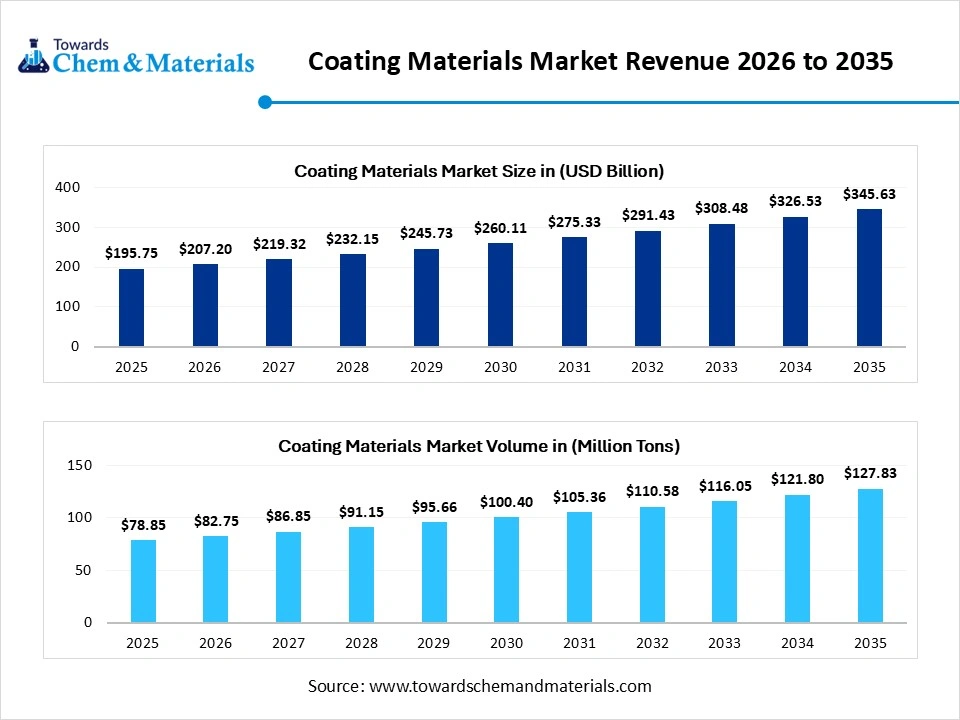
The global coating materials market was valued at USD 195.75 billion in 2025, is estimated to reach USD 207.2 billion in 2026, and is projected to reach USD 345.63 billion by 2035, growing at a CAGR of 5.85% from 2026 to 2035. In terms of volume, the coating materials market is projected to grow from 78.85 million tons in 2025 to 127.83 million tons by 2035. growing at a CAGR of 4.95% from 2026 to 2035. The growth of the market is driven by demand for corrosion protection, industrial durability, and aesthetic enhancements in the construction and automotive sectors.
Key Takeaways
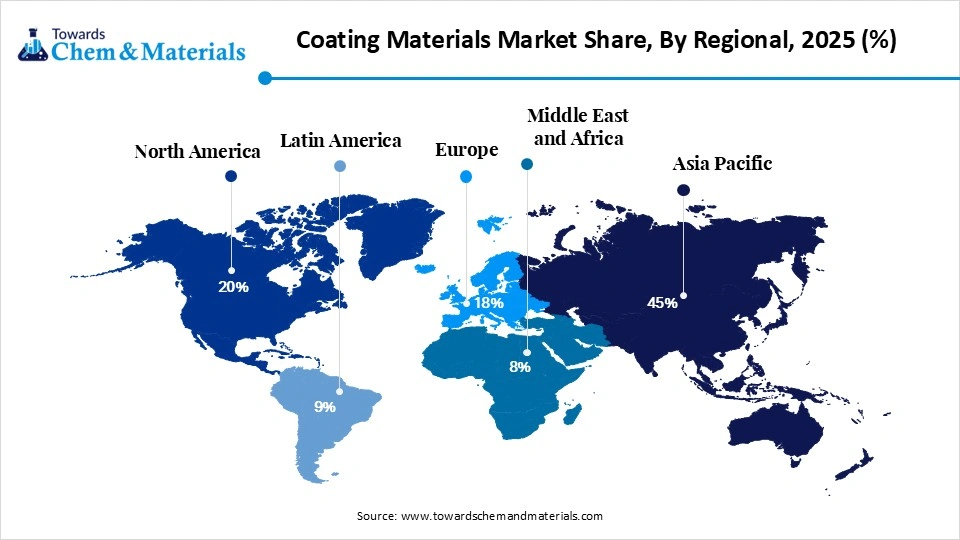
- By region, Asia Pacific dominated the market with a share of 45% in 2025 and is expected to sustain its position while growing with a CAGR of 6.8% in the forecast period.
- By region, North America held the market share of 20% in 2025.
- By product type, the waterborne coatings segment dominated the market with 42% share in 2025.
- By product type, the powder coatings segment held 18% market share in 2025 and is expected to have the fastest growth with a CAGR of 6.8% in the forecast period.
- By resin type, the acrylic resin segment dominated the market with 30% share in 2025.
- By resin type, the polyurethane resin segment held 16% market share in 2025 and is expected to have the fastest growth with a CAGR of 6.7% in the forecast period.
- By application, the architectural coatings segment dominated the market with 48% share in 2025.
- By application, the industrial coatings segment held 52% market share in 2025 and is expected to have the fastest growth with a CAGR of 5.7% in the forecast period.
- By end-use industry, the building & construction segment dominated the market with 33% share in 2025.
- By end-use industry, the packaging segment held 10% market share in 2025 and is expected to have the fastest growth with a CAGR of 6.6% in the forecast period.
- By technology, the waterborne technology segment dominated the market with 45% share in 2025.
- By technology, the power technology segment held 20% market share in 2025 and is expected to have the fastest growth with a CAGR of 6.9% in the forecast period.
Market Size and Volume Forecast
- Market Estimated Size (2025): USD 3.85 Billion | CAGR (2026–2035): 5.65%
- Market Projected Size (2035): USD 6.67 Billion
- Market Volume (2025): 6.25 Million Tons (MT) | Volume CAGR (2026–2035): 4.95%
- Market Projected Volume (2035): 10.13 Million Tons (MT)
- Market Pricing (2025):
- Average Manufacturing Price: USD 789/ton
- Average Selling Price: USD 1,059/ton
- Pricing CAGR (2025–2035): 3.5%
Market Overview
What Is The Significance Of The Coating Materials Market?
The coating materials market is highly significant for protecting surfaces from corrosion, enhancing durability, and offering decorative finishes. It drives value by extending the lifespan of infrastructure (bridges, buildings), improving automotive performance, and providing essential functional coatings in aerospace and packaging. Key trends include a strong shift toward environmentally friendly waterborne coatings and high-performance, durable, and sustainable solutions.
Coating Materials Market Growth Trends:
- Sustainability & Green Chemistry: Regulatory pressures are accelerating the shift from solvent-borne to water-borne coatings, UV-curable, and bio-based alternatives to minimize environmental impact.
- Sustainability & Green Chemistry: Regulatory pressures are accelerating the shift from solvent-borne to water-borne coatings, UV-curable, and bio-based alternatives to minimize environmental impact.
- Smart & Intelligent Coatings: Development in nanotechnology and multifunctional coatings is accelerating, offering features like self-healing, self-cleaning, and energy-efficient properties.
Report Scope
| Report Attribute | Details |
| Market Size and Volume in 2026 | USD 207.2 Billion / 82.75 Million Tons |
| Expected Size and Volume by 2035 | USD 345.63 Billion / 127.83 Million Tons |
| Growth Rate from 2026 to 2035 | CAGR 5.85% |
| Forecast Period | 2026 - 2035 |
| Dominant Region | Asia-Pacific |
| Segment Covered | By Product Type, By Resin Type, By Application, By End-Use Industry, By Technology and By Region |
| Key companies profiled | KANSAI PAINT CO., LTD, Nippon Paint Holdings Co. Ltd., JOTUN, RPM International Inc., Tiger Drylac U.S.A, Asian Paints, Hempel, Masco Corporation, Sika AG, Berger Paints, Beckers Group, Benjamin Moore, Tikkurila, Chugoku Marine Paints, Teknos Group, DAW SE. |
Key Technological Shifts In The Coating Materials Market:
The coating materials market is experiencing a significant technological transformation, driven by the need for sustainability, higher performance, and regulatory compliance. Key shifts include the transition from solvent-borne to low-VOC (volatile organic compound) waterborne and powder technologies, the adoption of "smart" functionalities like self-healing, and the integration of digital tools.
Supply Chain Analysis of Coating Materials Market:
Material Production & Formulation
Coating materials are produced through the formulation of resins, pigments, solvents, and additives to create paints, varnishes, and protective coatings for industrial and decorative applications.
- Key players: PPG Industries, AkzoNobel, Sherwin-Williams, BASF
Quality Testing and Certification
Coating materials must meet standards for adhesion, durability, corrosion resistance, environmental compliance, and safety regulations before application.
- Key players: International Organization for Standardization, ASTM International, European Chemicals Agency, U.S. Environmental Protection Agency.
Distribution to Industrial Users
Coating materials are supplied to construction companies, automotive manufacturers, aerospace industries, marine applications, and industrial equipment producers.
- Key players: PPG Industries, AkzoNobel, Sherwin-Williams
Coating Materials Regulatory Landscape: Global Regulations
| Country / Region | Regulatory Body | Key Regulations | Focus Areas | Notable Notes |
| United States | Environmental Protection Agency (EPA); Occupational Safety and Health Administration (OSHA); Food and Drug Administration (FDA) | Clean Air Act; Toxic Substances Control Act (TSCA); OSHA Hazard Communication Standard | VOC emissions, chemical safety, workplace exposure | The U.S. enforces strict VOC limits and chemical safety standards, accelerating the shift toward waterborne and low-emission coatings. |
| European Union | European Chemicals Agency (ECHA); European Commission | REACH Regulation; CLP Regulation; Industrial Emissions Directive (IED) | Chemical registration, hazardous substance control, and sustainability | The EU has stringent environmental regulations, pushing the adoption of eco-friendly coatings such as powder and waterborne systems. |
| China | Ministry of Ecology and Environment (MEE); Ministry of Industry and Information Technology (MIIT) | Environmental Protection Law; China RoHS | Emission control, industrial compliance | China is tightening VOC emission norms and promoting green coatings in the manufacturing and construction sectors. |
| India | Ministry of Environment, Forest and Climate Change (MoEFCC); Central Pollution Control Board (CPCB) | Environment Protection Act; Air (Prevention and Control of Pollution) Act | Emission standards, industrial pollution control | India is increasingly regulating VOC emissions and encouraging eco-friendly coatings in infrastructure and industrial applications. |
| Japan | Ministry of Economy, Trade and Industry (METI); Ministry of the Environment | Chemical Substances Control Law (CSCL); Air Pollution Control Act | Chemical risk management, air quality | Japan enforces strict standards on hazardous substances and promotes low-VOC and high-performance coatings. |
| South Korea | Ministry of Environment (MoE); Ministry of Trade, Industry and Energy (MOTIE) | K-REACH; Clean Air Conservation Act | Chemical registration, emissions control | South Korea regulates coating materials through comprehensive chemical safety laws and air pollution standards. |
Market Dynamics
Drivers
What are the Key Growth Drivers of the Coating Materials Market?
The coating materials market is primarily driven by rising demand for protective and decorative coatings in construction, automotive, and industrial applications. Key growth catalysts include rapid urbanization, shifting towards eco-friendly waterborne/low-VOC formulations, technological advancements in nanotechnology, and increased demand for anticorrosive coatings in infrastructure projects.
Restrains
What are the Key Growth Restraints of the Coating Materials Market?
Key growth restraints for the coating materials market include volatile raw material costs (resins, solvents), stringent environmental regulations on VOC emissions, and supply chain disruptions. Difficulties in scaling up production and maintaining consistent quality. High initial investments for advanced coating technologies and technical complexities in developing eco-friendly formulations also hinder growth.
Opportunities
What are the Key Growth Opportunities of the Coating Materials Market?
Key growth opportunities in the coating materials market center on sustainable, high-performance solutions driven by rapid urbanization, particularly in the Asia-Pacific. Key areas include waterborne coatings for low VOC emissions, smart/self-healing coatings, and protective coatings for renewable energy infrastructure. Specialised coatings for wind turbines (offshore), solar panels, and power generation components offer high growth potential.
Segmental Insights
Product Type Insights
The Waterborne Coatings Segment Dominated The Market With 42% Market Share In 2025
The waterborne coatings segment dominated the market with 42% share in 2025, driven primarily by stringent environmental regulations limiting Volatile Organic Compound (VOC) emissions, advancements in resin technology that improve performance, and rising demand in the construction and automotive sectors. The market is shifting to waterborne systems because they provide a safer, low-odor, and sustainable alternative for both architectural and industrial applications.
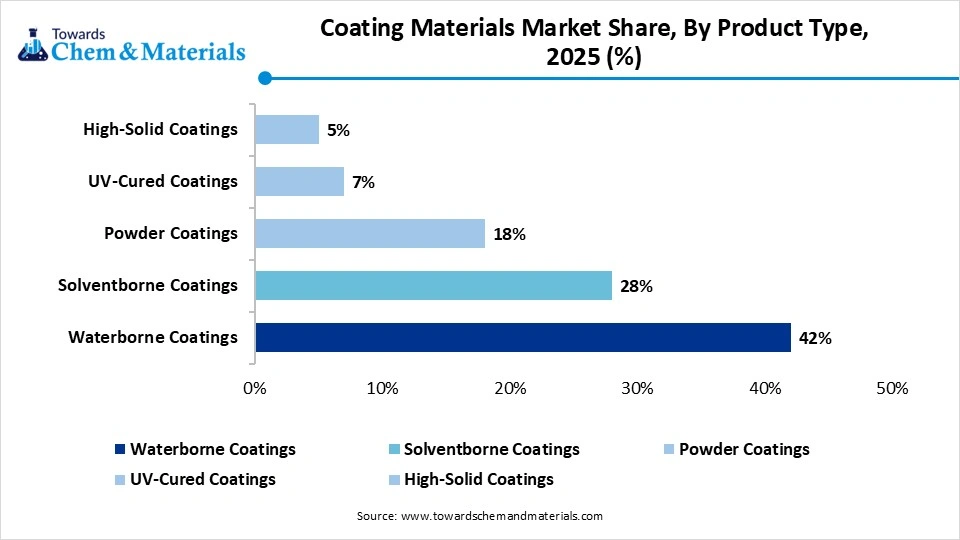
The solventborne coatings segment held 28% market share in 2025 due to superior performance in demanding applications, including high durability, excellent adhesion, rapid drying, and functionality in high humidity/low temperature conditions. It is used in automotive, marine, and heavy-duty industrial coatings, with new high-solid formulations meeting environmental VOC regulations.
The powder coatings segment held 18% market share in 2025 and is expected to have the fastest growth with a CAGR of 6.8% in the forecast period, driven by its eco-friendly, zero-VOC nature, superior durability, and cost-effective application. Stringent regulations on Volatile Organic Compounds (VOCs) and hazardous air pollutants are driving industries away from traditional liquid paints toward VOC-free powder coatings.
The UV-cured coatings segment held 7% market share in 2025 due to rapid, instant curing times, high-performance durability, and eco-friendly, low/zero VOC emissions. Driven by strict environmental regulations and efficiency needs, this market is expanding across automotive, electronics, and packaging sectors. UV coatings cure instantly upon exposure to UV light, enabling higher production speeds, reduced energy consumption, and lower manufacturing costs.
Resin Type Insights
The Acrylic Resin Segment Dominated The Coating Materials Market With 30% Market Share In 2025
The acrylic resin segment dominated the market with 30% share in 2025, driven by high demand for durable, weather-resistant coatings in the construction and automotive sectors. Increasing regulations on volatile organic compounds (VOCs) are boosting demand for water-based acrylic resins, which are becoming the standard for eco-friendly coating solutions. The construction industry is a primary growth driver, with extensive use in residential and commercial coatings.
The epoxy resin segment held 18% market share in 2025, driven by high demand for superior corrosion resistance, durability, and adhesion in construction, automotive, and industrial applications. Growth is fueled by rapid infrastructure development, urbanization in the Asia-Pacific, and a shift toward eco-friendly, low-VOC (volatile organic compounds) coatings. Stricter environmental regulations are driving the shift toward low-VOC and waterborne epoxy coatings.
Coating Materials Market Share, By Resin Type, 2025 (%)
| By Resin Type | Revenue Share, 2025 (%) |
| Acrylic Resin | 30% |
| Epoxy Resin | 18% |
| Polyurethane Resin | 16% |
| Polyester Resin | 12% |
| Alkyd Resin | 10% |
| Fluoropolymer Resin | 6% |
| Vinyl Resin | 5% |
| Others | 3% |
The polyurethane resin segment held 16% market share in 2025 and is expected to have the fastest growth with a CAGR of 6.7% in the forecast period, due to rising demand for durable, eco-friendly, and high-performance coatings in construction, automotive, and furniture industries. Innovations such as nanotechnology and enhanced additives are increasing the longevity of PU coatings, providing superior protection and enhancing market appeal.
The polyester resin segment held 12% market share in 2025, driven by high demand for durable, eco-friendly powder coatings in automotive, construction, and industrial applications. Polyester resins are essential in rapidly growing and in-demand, driven by demand for excellent corrosion resistance and finish durability in automotive and industrial uses. Growth is further propelled by construction and automotive applications, fueling expansion.
Application Insights
The Architectural Coatings Segment Dominated The Market With 48% Market Share In 2025
The architectural coatings segment dominated the market with 48% share in 2025, driven by rapid urbanization, increased residential construction, and a strong shift toward sustainable, low-VOC (volatile organic compound) water-based products. Key drivers include rising demand for durable, heat-reflective coatings and increasing home renovation activities globally. Increased environmental awareness and strict regulations on emissions are driving a massive shift toward water-based, eco-friendly, and VOC-free coatings.
Coating Materials Market Share, By Application, 2025 (%)
| By Application | Revenue Share, 2025 (%) |
| Building & Construction | 33% |
| Automotive | 18% |
| Aerospace | 8% |
| Marine | 6% |
| Packaging | 10% |
| Furniture & Wood | 9% |
| Electronics | 7% |
| Energy | 5% |
| Others | 4% |
The industrial coatings segment held 52% market share in 2025 and is expected to have the fastest growth with a CAGR of 5.7% in the forecast period, driven by booming infrastructure development, rising automobile production, and high demand for corrosion protection in manufacturing. Key growth factors include the transition toward eco-friendly water-borne and powder technologies, high performance against harsh conditions, and rapid industrialization in the Asia Pacific.
End-Use Industry Insights
The Building & Construction Segment Dominated The Market With 33% Market Share In 2025
The building & construction segment dominated the market with 33% share in 2025, driven by urbanization, infrastructure expansion, and renovation booms. Growth is propelled by demand for protective coatings against harsh weather, UV radiation, and corrosion, alongside high demand for sustainable water-borne, eco-friendly, and energy-efficient heat-reflective coatings. A surge in the renovation of existing residential and commercial buildings requires high-performance paints and coatings for protection and aesthetic improvements.
The automotive segment held 18% market share in 2025, driven by rising vehicle production, electric vehicle (EV) adoption, and demand for durable, eco-friendly finishes. Key growth factors include high-performance needs for EV components, increased consumer demand for premium aesthetic customization, and stricter regulations favoring low-VOC waterborne, UV-curable, and powder coatings.
The packaging segment held 10% market share in 2025 and is expected to have the fastest growth with a CAGR of 6.6% in the forecast period, driven by surging demand for sustainable, high-performance packaging in food, beverage, and e-commerce. The rapid growth of online shopping, coupled with urban expansion, has increased the need for protective coatings in both corrugated containers and consumer goods packaging.
The furniture & wood segment held 9% market share in 2025. This surge is driven by rising urbanization, booming residential construction, and a strong preference for high-quality, aesthetic home furnishings. Increasing consumer demand for eco-friendly, low-VOC (volatile organic compounds) and UV-cured coatings also drives innovation in durable protective finishes.
Technology Insights
The Waterborne Technology Segment Dominated The Market With 45% Market Share In 2025
The waterborne technology segment dominated the market with 45% share in 2025. This growth is primarily driven by stricter environmental regulations on Volatile Organic Compounds (VOCs), advancements in resin technology that improve performance, and increasing demand for sustainable solutions in the automotive and construction sectors. Technological advances in dispersion chemistry have narrowed the performance gap, providing durability, adhesion, and corrosion protection that rivals solvent-borne alternatives.
The solventborne technology segment held 27% market share in 2025, due to its unmatched performance in durability, adhesion, and resistance to harsh environments, making it essential for automotive, industrial, and marine applications. Despite stricter VOC regulations, the technology thrives through the development of high-solids formulations, which maintain high performance while reducing emissions.
Coating Materials Market Share, By Technology, 2025 (%)
| By Technology | Revenue Share, 2025 (%) |
| Waterborne Technology | 45% |
| Solventborne Technology | 27% |
| Powder Technology | 20% |
| Radiation Cure Technology | 8% |
The powder technology segment held 20% market share in 2025 and is expected to have the fastest growth with a CAGR of 6.9% in the forecast period, driven by its favorable environmental profile (low/zero VOCs), superior durability, and long-term cost efficiency. This growth is heavily supported by the shift from liquid coatings to powder solutions across the automotive, architectural, and appliance industries.
The radiation cure technology segment held 8% market share in 2025, driven by a strong shift toward sustainable manufacturing, superior performance, and unmatched operational efficiency. Tightening global environmental regulations like REACH in Europe and GB standards in China are driving the shift from solvent-borne to VOC-free radiation-curable coatings. The shift toward UV LED curing systems provides energy savings and allows for coating heat-sensitive substrates, further expanding the technology's application range
Regional Insights
How did Asia Pacific Dominate the Coating Materials Market in 2025?
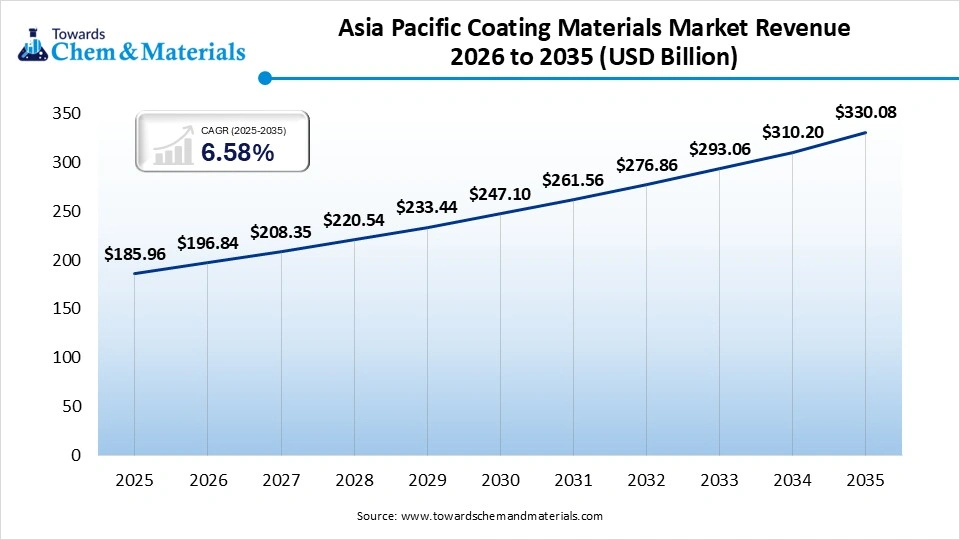
The Asia Pacific coating materials market size was estimated at USD 185.96 billion in 2025 and is projected to reach USD 330.08 billion by 2035, growing at a CAGR of 6.58% from 2026 to 2035. Growing automotive manufacturing and a surge in consumer demand for vehicles (OEM and refinish) propel the industrial coatings sector. Increased manufacturing activity in electronics, furniture, and marine sectors boosts demand for protective wood, marine, and conformal coatings.
India Coating Materials Market Growth Factor
The Indian coating materials market is driven by rapid urbanization, massive infrastructure development, and a booming automotive/manufacturing sector, with a notable shift toward eco-friendly waterborne and high-performance powder coatings. The market is further propelled by rising disposable incomes, increasing decorative paint demand, and growing specialty coating needs for industrial durability. Government initiatives in infrastructure development increase the demand for protective coatings on steel and concrete structures.
North America Coating Materials Market Growth Factor
North America held the market share of 20% in 2025, driven primarily by robust construction activity, high automotive production/refinishing demand, and strict environmental regulations favoring low-VOC and waterborne technologies. Growth is further propelled by investments in industrial infrastructure, rising DIY renovation trends, and innovation in specialty, powder, and protective coatings. Rising investments in residential, commercial, and green building projects, especially in the U.S., heavily drive demand for architectural coatings.
U.S. Coating Materials Market Growth Factor
The U.S. coating materials market is driven by robust demand in automotive, construction, and infrastructure sectors. Increased investment in public projects such as bridges, highways, and residential/commercial buildings drives significant demand for architectural and protective coatings. Stringent regulations on VOC emissions are pushing manufacturers toward sustainable, water-borne, and powder-based technologies.
Recent Developments
- In February 2026, Freudenberg Medical launched LUBRITEQ, a high-performance, UV-curable, hydrophilic coating designed to enhance navigability and reduce friction on medical devices. Offering up to 99% friction reduction and high durability, this single-step coating is available through a new commercial model that eliminates royalties, fixed fees, and regulatory costs.
- In April 2026, BIOGRUND and Seprify partnered to launch a plant-based, mineral-free tablet-coating system that utilizes SilvaAlba™ microcrystalline cellulose as a clean-label alternative to titanium dioxide. The new, ready-to-use coating provides high-opacity whitening and improved pH stability for the nutraceutical and pharmaceutical industries.
Coating Materials Market Competitive Landscape Analysis
Tier 1 Companies
|
Rank
|
Company Name | Headquarters | Country | Why Relevant to This Market | Key Products / Material Portfolio |
| 1 | BASF SE | Ludwigshafen, Rhineland-Palatinate | Germany | Leading supplier of coating raw materials, resins, pigments, and additives | Acrylic resins, polyurethane resins, pigments, dispersions, additives |
| 2 | Akzo Nobel N.V. | Amsterdam, North Holland | Netherlands | Global coatings leader with strong raw material and formulation expertise | Decorative coatings, industrial coatings, powder coatings |
| 3 | PPG Industries, Inc. | Pittsburgh, Pennsylvania | United States | Major producer of coatings and coating materials for industrial and automotive markets | Automotive coatings, industrial coatings, specialty coating materials |
| 4 | Sherwin-Williams Company | Cleveland, Ohio | United States | One of the world's largest coatings companies with extensive materials demand and development capabilities | Architectural coatings, protective coatings, industrial coatings |
| 5 | Arkema S.A. | Colombes, Île-de-France | France | Leading supplier of coating resins, additives, and specialty materials | Acrylic resins, coating additives, waterborne resins, specialty polymers |
Tier 2 Companies
|
Rank
|
Company Name | Headquarters | Country | Why Relevant to This Market | Key Products / Material Portfolio |
| 1 | Covestro AG | Leverkusen, North Rhine-Westphalia | Germany | Major supplier of polyurethane and coating raw materials | Polyurethane resins, coating binders, crosslinkers |
| 2 | Allnex GmbH | Frankfurt am Main, Hesse | Germany | One of the world's largest dedicated coating resin manufacturers | Acrylic resins, polyester resins, powder coating resins |
| 3 | Evonik Industries AG | Essen, North Rhine-Westphalia | Germany | Leading supplier of additives and specialty materials for coatings | Coating additives, silica products, specialty polymers |
| 4 | Eastman Chemical Company | Kingsport, Tennessee | United States | Important supplier of coating additives and specialty resins | Coalescents, additives, polyester resins |
| 5 | Wacker Chemie AG | Munich, Bavaria | Germany | Strong producer of binders and specialty materials for coatings | Polymer dispersions, silicone additives, binders |
Tier 3 Companies
|
Rank
|
Company Name | Headquarters | Country | Why Relevant to This Market | Key Products / Material Portfolio |
| 1 | Synthomer plc | London, England | United Kingdom | Strong supplier of water-based polymers and coating binders | Acrylic dispersions, styrene-acrylic binders |
| 2 | Lubrizol Corporation | Wickliffe, Ohio | United States | Specialized coating resins and performance additives supplier | Acrylic resins, polyurethane dispersions, additives |
| 3 | DIC Corporation | Tokyo | Japan | Significant supplier of coating resins and pigment technologies | Coating resins, pigments, specialty chemicals |
| 5 | Nippon Paint Holdings Co., Ltd. | Tokyo | Japan | Large coatings producer influencing demand and innovation in coating materials | Decorative coatings, industrial coatings, automotive coatings |
Top players in the Coating Materials Market & Their Offerings:
- PPG Industries, Inc.: PPG is one of the largest global suppliers of coating materials, offering architectural, industrial, automotive, and aerospace coatings. The company focuses on high-performance coatings with durability, corrosion resistance, and sustainability.
- Akzo Nobel N.V.: AkzoNobel provides decorative paints and specialty coatings for construction, marine, and industrial sectors. The company emphasizes eco-friendly formulations and advanced coating technologies.
- The Sherwin-Williams Company: Sherwin-Williams offers a broad portfolio of coating materials, including paints, protective coatings, and industrial finishes. It is known for strong distribution networks and innovative product development.
- BASF SE: BASF supplies coating materials such as resins, additives, and pigments, along with finished coatings for automotive and industrial applications. The company focuses on sustainable and high-performance material solutions.
Axalta Coating Systems: Axalta specializes in automotive and industrial coatings, providing high-performance solutions for vehicle OEMs, refinish markets, and industrial applications.
Coating Materials Market Top Players
- KANSAI PAINT CO., LTD
- Nippon Paint Holdings Co. Ltd.
- JOTUN
- RPM International Inc.
- Tiger Drylac U.S.A
- Asian Paints
- Hempel
- Masco Corporation
- Sika AG
- Berger Paints
- Beckers Group
- Benjamin Moore
- Tikkurila
- Chugoku Marine Paints
- Teknos Group
- DAW SE.
Coating Materials Market Segments Covered:
By Product Type
- Waterborne Coatings
- Acrylic
- Epoxy
- Polyurethane
- Solventborne Coatings
- Alkyd
- Epoxy
- Polyurethane
- Powder Coatings
- Thermoset
- Epoxy
- Polyester
- Hybrid
- Thermoplastic
- Thermoset
- UV-Cured Coatings
- Radical Cure
- Cationic Cure
- High-Solid Coatings
By Resin Type
- Acrylic Resin
- Epoxy Resin
- Polyurethane Resin
- Polyester Resin
- Alkyd Resin
- Fluoropolymer Resin
- Vinyl Resin
- Others
By Application
- Architectural Coatings
- Residential
- Commercial
- Industrial Coatings
- General Industrial
- Automotive OEM
- Automotive Refinish
- Marine
- Protective Coatings
- Coil Coatings
- Wood Coatings
- Packaging Coatings
By End-Use Industry
- Building & Construction
- Automotive
- Aerospace
- Marine
- Packaging
- Furniture & Wood
- Electronics
- Energy (Oil & Gas, Power)
- Others
By Technology
- Waterborne Technology
- Solventborne Technology
- Powder Technology
- Radiation Cure Technology
By Region
- North America:
- U.S.
- Canada
- Mexico
- Rest of North America
- Latin America:
- Brazil
- Argentina
- Rest of Latin America
- Europe:
- Western Europe 
- Germany
- Italy
- France
- Netherlands
- Spain
- Portugal
- Belgium
- Ireland
- UK
- Iceland
- Switzerland
- Poland
- Rest of Western Europe
- Eastern Europe
- Austria
- Russia & Belarus
- Türkiye
- Albania
- Rest of Eastern Europe
-  Asia Pacific:
- China
- Taiwan
- India
- Japan
- Australia and New Zealand,
- ASEAN Countries (Singapore, Malaysia)
- South Korea
- Rest of APAC
- MEA:
- GCC Countries
- Saudi Arabia
- United Arab Emirates (UAE)
- Qatar
- Kuwait
- Oman
- Bahrain
- South Africa
- Egypt
- Rest of MEA
- GCC Countries
FAQ's




Select User License to Buy
Figures (4)






 sales@towardschemandmaterials.com
 Download Sample
 Schedule a Meeting