Content
What is the Asia Pacific Water and Wastewater Treatment Market Size and Share?
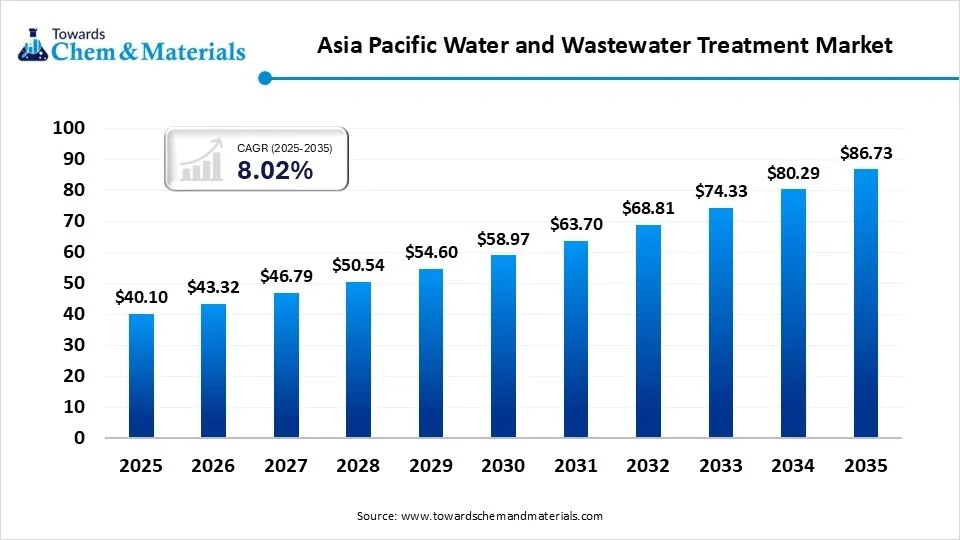
The Asia Pacific water and wastewater treatment market size was valued at USD 40.10 billion in 2025, is estimated to reach USD 43.32billion in 2026, and is projected to reach USD 86.73billion by 2035, exhibiting a compound annual growth rate (CAGR) of 8.02%over the forecast period from 2026 to 2035.The greater awareness and a shift towards safer and technologically advanced water treatments where the government and private venture are throwing attention in the current period. Also, the industry is likely to create significant advantages in the coming years, akin to factors like water pollution and hazardous industrialization.
Market Highlights
- By offering, the equipment segment dominated the market with a 58% share in 2025 and is expected to grow at a CAGR of 7.20% in the forecast period.
- By offering, the services segment held a 18% market share in 2025 and is expected to be the fastest-growing in the market, with a CAGR of 8.60% in the forecast period.
- By technology, the membrane filtration segment dominated the market with a 34% share in 2025 and is expected to grow at a CAGR of 6.80% in the forecast period.
- By technology, the chemical treatment segment held a 18% market share in 2025 and is expected to be the fastest-growing in the market, with a CAGR of 9.10% in the forecast period.
- By application, the water treatment segment dominated the market with a 46% share in 2025 and is expected to grow at a CAGR of 7% in the forecast period.
- By application, the water reuse and recycling segment held a 15% market share in 2025 and is expected to be the fastest-growing in the market, with a CAGR of 10.30% in the forecast period.
- By end use, the municipal segment dominated the market with a 31% share in 2025 and is expected to grow at a CAGR of 7.10 in the forecast period.
- By end use, the semiconductor and electronics segment held a 4% market share in 2025 and is expected to be the fastest-growing in the market, with a CAGR of 10.60% in the forecast period.
Awareness with Technology
Technology advancements and public awareness have become major pillars of the waste and wastewater treatment industry nowadays. Moreover, regions like Asia Pacific has been seen under the heavy investment from their countries as global competition and product developments are its peak. Moreover, the heavy industrialization and their need for water and waste recycling over the dump yards have allowed stakeholders to capitalize on growth opportunities in the past few years, as per the latest survey by industry experts.
- For instance, in April 2026, Bw Water won a contract for wastewater treatment for semiconductor development in India. Also, the company’s technology has the ability to process wastewater with a flow rate of 1,600 cubic metres per hour, as per the published report.(Source: asianwater.com.my )
The countries are focusing on improving water infrastructure in both urban and rural areas. Municipal authorities are replacing aging water networks with smart systems that reduce leakage and improve operational efficiency. At the same time, industries are increasingly treating wastewater for reuse instead of discharging it, helping lower operating costs and reduce environmental impact. Membrane filtration, ultraviolet disinfection, biological treatment, reverse osmosis, and digital monitoring technologies are becoming more common throughout the region.
Report Scope
| Report Attributes | Details |
| Market Size in 2026 | USD 43.32 Billion |
| Expected Size in 2035 | USD 86.73 Billion |
| Growth Rate | CAGR of 8.02% |
| Base Year of Estimation | 2025 |
| Forecast Period | 2025-2035 |
| Segment Covered | By Product, By Technology, By Application, By End Use, By Region |
| Key Companies Profiled | Thermax Limited, Ion Exchange (India) Ltd., Veolia Water Technologies, SUEZ Group, Xylem Inc., Ecolab (Nalco Water), Aquatech International LLC |
Investment Flow for the Asia Pacific Water and Wastewater Treatment Market 2026
Governments across Asia Pacific are significantly increasing investments in water supply networks, wastewater treatment plants, and water recycling facilities to strengthen long-term water security. National development programs are funding new treatment facilities, pipeline modernization, desalination plants, and smart water management systems.
Global financial institutions and development banks continue investing heavily in Asia Pacific water infrastructure projects. Organizations such as the Asian Development Bank, World Bank, and Asian Infrastructure Investment Bank provide financial support for wastewater treatment plants, rural water supply systems, climate-resilient infrastructure, and flood management programs.
Private companies are investing in advanced treatment technologies, digital water management platforms, industrial wastewater recycling, and desalination facilities throughout Asia Pacific.
- For instance, earlier, Veolia announced the expansion of advanced water recycling projects in Australia to improve water reuse and strengthen sustainable water management for municipalities and industries.(Source: www.veolia.com)
Recent Market Trends:
- The greater adoption of water recycling and its reuse has presented new business models for forward-thinking treatment makers in recent years. Moreover, the industry is actively seeking reliable waste resources, which has pushed the industrys potential in recent years.
- The introduction of smart water infrastructure is opening profitable avenues for manufacturing in the region nowadays. Also, the treatment equipment manufacturers are seen using digital meters, smart sensors, and cloud-based monitoring platforms as per recent regional observation.
- The heavy shift towards heavy industrial wastewater treatment is expected to enable high return ventures for the manufacturers during the projected time. Moreover, in this huge integration, the major manufacturers from the region, such as pharmaceuticals, food processing, and semiconductors, are involved as per the recent info.
Artificial Intelligence Integration and Applications
Artificial intelligence is heavily transforming the Asia Pacific water and wastewater treatment industry by making treatment plants more efficient and reliable. AI analyzes data collected from sensors to predict equipment failures, optimize chemical dosing, monitor water quality, detect leaks, and reduce energy consumption. Utilities can identify operational problems before they become serious, lowering maintenance costs and minimizing service interruptions. AI also supports automated decision-making by continuously adjusting treatment processes based on changing water conditions.
Supply Chain Analysis of the Asia Pacific Water and Wastewater Treatment Market
Production & Processing
- The Asia-Pacific water and wastewater treatment market relies on advanced physical, chemical, and biological processing to counter severe regional water scarcity. Production facilities rapidly scale membrane bioreactors, reverse osmosis systems, and thermal desalination units. These treatment plants integrate smart digital monitoring and energy-efficient automation to process massive volumes of industrial effluent and municipal sewage safely.
- Kurita Water Industries Ltd.: Headquartered in Tokyo, Japan, this global innovator develops advanced water treatment chemicals, functional materials, and high-efficiency filtration systems optimized for heavy manufacturing and industrial processing plants.
- Key Players: Beijing Enterprises Water Group (BEWG), VA Tech Wabag, and Eastman Chemical Company
Quality Testing and Certification
- Rigorous testing ensures Asia-Pacific treated water satisfies stringent municipal safety and industrial purity metrics. Independent facilities utilize atomic absorption spectroscopy and microbial assays to verify the removal of heavy metals, microplastics, and pathogenic agents.
- These evaluations confirm absolute alignment with regional environmental mandates, including Chinas comprehensive Action Plan for Prevention and Control of Water Pollution.
- ALS Limited: Headquartered in Australia, this premium environmental testing organization operates an extensive network of accredited laboratories across Asia to provide precise trace metal, microbiological, and organic pollutant analysis for water infrastructure.
- Key Agencies: TÜV SÜD Asia Pacific, SGS Asia Pacific, and Eurofins Environment Testing Asia
Distribution to Industrial Users
- Distribution networks seamlessly supply advanced water treatment machinery, membranes, and specialty purification chemicals to heavy industrial sectors across Asia-Pacific.
- Regional distributors manage technical logistics to deliver these components to electronics, textile, chemical, and power plants. These entities provide critical technical onboarding, localized warehousing, and maintenance support to ensure continuous industrial water recycling.
- Ecolab (Asia Pacific Operations): Deploys localized technical distribution hubs and digital monitoring systems to supply tailored water conditioning chemistry and filtration equipment to regional industrial manufacturing plants.
- Key players: Marubeni Corporation and Samco Technologies (Asia)
Sustainability Analysis of the Asia Pacific Water and Wastewater Treatment Market
Sustainability has become a major priority in the regional industry as governments and industries work to conserve freshwater resources and reduce environmental pollution, as per recent reports. Also, water recycling, energy-efficient treatment technologies, renewable energy integration, sludge recovery, nutrient recycling, and resource-efficient operations are helping lower environmental impacts. Many treatment facilities are adopting circular economy principles by recovering reusable water, valuable minerals, and biogas from wastewater.
The Specialty Chemicals: Water and wastewater treatment refers to the process of removing physical, chemical, and biological contaminants from water so it becomes safe for drinking, industrial use, agriculture, or safe discharge into the environment. Water treatment focuses on making raw water clean and suitable for consumption or industrial applications, while wastewater treatment cleans used water generated by households, industries, and commercial facilities before it is reused or released.
The Detailed Water Treatment Services : Water treatment includes several methods depending on water quality and its final use. Conventional treatment uses coagulation, flocculation, sedimentation, filtration, and disinfection to remove impurities. Reverse osmosis is widely used to remove dissolved salts and contaminants from seawater and groundwater. Activated carbon filtration removes odor, taste, and organic compounds. Ultraviolet treatment destroys microorganisms without adding chemicals. Membrane filtration separates suspended particles and bacteria with high efficiency. Ion exchange softens hard water by removing minerals.
Asia Pacific Water and Wastewater Treatment Market Regulatory Landscape: Regulations
| Country Region | Regulatory Body | Key Regulations | Focus Areas |
| China | Ministry of Ecology and Environment (MEE) | Water Pollution Prevention and Control Law | Pollutant Discharge Licensing & Source Separation Imposes a mandatory pollutant discharge permit system for factories. Strictly prohibits the dilution of toxic or hazardous wastewater. |
| India | Central Pollution Control Board (CPCB) | The Water Act, 1974 | National Parameter Standardization & Inspection Formulates baseline permissible parameters for biological oxygen demand (BOD), chemical oxygen demand (COD), and total suspended solids (TSS). |
Market Dynamics
Driver : Clean Water Scarcity and Urbanization
Growing demand for clean and safe water is actively and primarily driving industry potential. Rapid urbanization, industrial expansion, and population growth have increased pressure on existing water resources. Governments are investing heavily in new treatment plants, pipeline upgrades, desalination facilities, and wastewater recycling projects to improve water security. At the same time, industries such as semiconductors, pharmaceuticals, food processing, chemicals, and power generation require high-quality treated water for manufacturing.
Restraint : High-Cost Installations
The high cost of installing and maintaining advanced treatment systems is likely to hinder industry growth during the forecast period. Also, technologies such as reverse osmosis, membrane filtration, and smart monitoring require significant investment, making them difficult for small municipalities and industries to adopt. In several developing countries, aging infrastructure and limited financial resources slow the modernization of water facilities.
Opportunity : Recyclability Will Turn the Tables
The greater expansion of water reuse and recycling projects is anticipated to create lucrative opportunities during the forecast period. Also, many countries are experiencing increasing water scarcity, encouraging governments and industries to treat wastewater as a valuable resource instead of waste. Growing investment in smart cities, industrial parks, semiconductor manufacturing, and sustainable infrastructure is creating demand for advanced recycling technologies. Public-private partnerships are also increasing funding for modern treatment facilities.
Segmental Insights
Offering Insights
The equipment segment dominated the market with a 58% share in 2025 and is expected to grow at a CAGR of 7.20% in the forecast period, as every treatment facility depends on physical systems such as pumps, membranes, filters, valves, blowers, aerators, clarifiers, and disinfection units. Governments and industries have invested heavily in constructing new treatment plants and upgrading older facilities, increasing demand for these essential components. Equipment also requires periodic replacement and modernization to improve operational efficiency and comply with changing environmental standards.
- In April 2026, Kirloskar Brothers Limited unveiled its latest wastewater pump, which is submersible. Moreover, the newly launched pump is called iNSx, as per the published report.(Source: www.eawater.com)
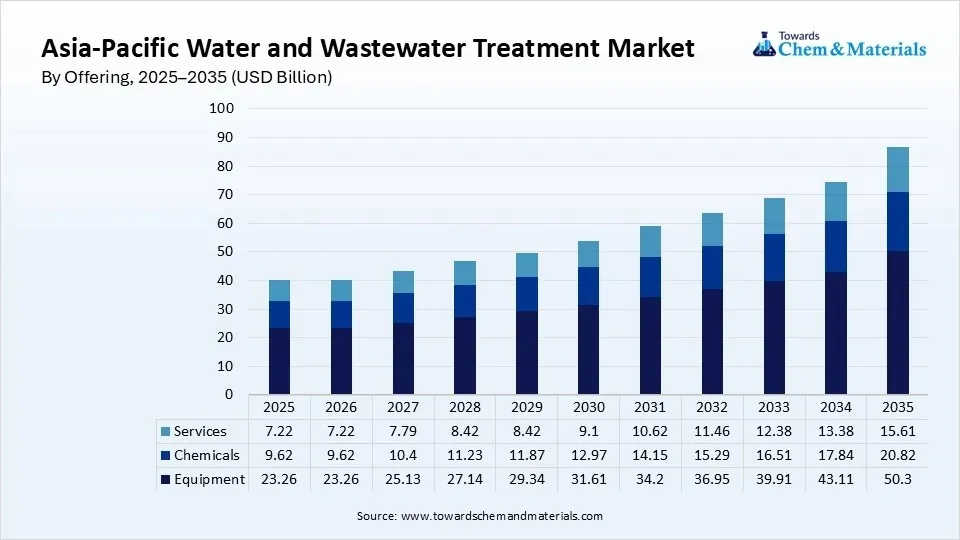 The services segment held a 18% market share in 2025 and is expected to be the fastest-growing in the market, with a CAGR of 8.60% in the forecast period, because modern treatment plants require continuous maintenance, monitoring, repair, digital support, and operational optimization. Many utilities and industries are outsourcing plant operations to specialized service providers to reduce costs and improve efficiency. Digital monitoring, predictive maintenance, equipment upgrades, and performance optimization services are becoming increasingly important as treatment systems become more advanced.
Asia-Pacific Water and Wastewater Treatment Equipment Market Share, By Offering, 2025 (%)
| By Offering | Market Share (%) |
| Equipment | 58% |
| Chemicals | 24% |
| Services | 18% |
Technology Insights
The membrane filtration segment dominated the market with a 34% share in 2025 and is expected to grow at a CAGR of 6.80% in the forecast period, owing to it provides highly effective removal of suspended particles, bacteria, viruses, dissolved contaminants, and other impurities while producing high-quality treated water. The technology is widely used in municipal drinking water plants, industrial processing, desalination, pharmaceutical manufacturing, and semiconductor production where water purity is essential.
- For instance, in April 2026, CERAFILTEC introduced a ceramic membrane water filter initiative. Also, the main motive of the company is to make wastewater treatment simpler, as per the report.(Source: www.cerafiltec.com)
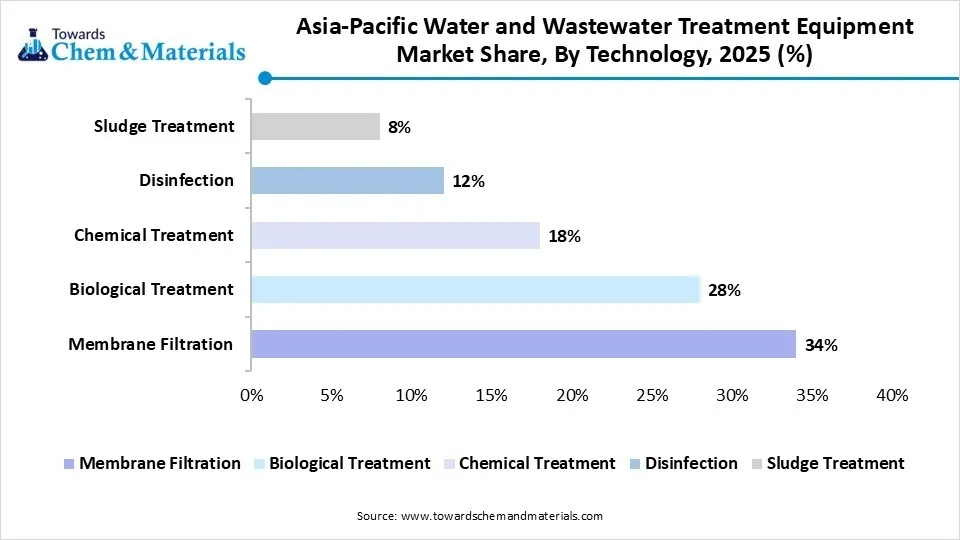 The chemical treatment segment held a 18% market share in 2025 and is expected to be the fastest-growing in the market, with a CAGR of 9.10% in the forecast period, owing to industries and municipalities continuing to face increasingly complex water contamination challenges. Chemical treatment effectively removes heavy metals, nutrients, microorganisms, odors, and difficult organic pollutants that cannot always be eliminated through physical processes alone. Growing industrial wastewater generation and stricter discharge standards are encouraging greater use of coagulants, disinfectants, pH control chemicals, and advanced oxidation technologies.
Asia-Pacific Water and Wastewater Treatment Equipment Market Share, By Technology, 2025 (%)
| By Technology | Market Share (%) |
| Membrane Filtration | 34% |
| Biological Treatment | 28% |
| Chemical Treatment | 18% |
| Disinfection | 12% |
| Sludge Treatment | 8% |
Application Insights
The water treatment segment dominated the market with a 46% share in 2025 and is expected to grow at a CAGR of 7% in the forecast period, owing to providing clean and safe water remains the highest priority for governments, industries, and communities. Rapid urban development, population growth, and industrial expansion have significantly increased demand for treated drinking water and process water. Large investments in municipal water supply systems, industrial water purification, desalination, and infrastructure modernization have further strengthened this segment.
The water reuse and recycling segment held a 15% market share in 2025 and is expected to be the fastest-growing in the market, with a CAGR of 10.30% in the forecast period, owing to freshwater availability becoming increasingly limited across many Asia Pacific countries. Governments and industries are investing in advanced recycling systems that allow treated wastewater to be reused for manufacturing, cooling, irrigation, landscaping, and municipal applications. Water reuse reduces pressure on natural water sources while lowering operating costs and improving sustainability.
Asia-Pacific Water and Wastewater Treatment Equipment Market Share, By Application, 2025 (%)
| By Application | Market Share (%) |
| Water Treatment | 46% |
| Wastewater Treatment | 39% |
| Water Reuse & Recycling | 15% |
End Use Industry Channel
The municipal segment dominated the market with a 31% share in 2025 and is expected to grow at a CAGR of 7.10 in the forecast period, owing to local governments being responsible for supplying safe drinking water and treating wastewater generated by growing urban populations. Large public investments have been directed toward expanding treatment plants, replacing aging pipelines, improving sanitation systems, and increasing wastewater recycling capacity. Municipal utilities also serve millions of households, making them the largest consumers of treatment technologies and equipment.
- In 2025, the state government of Maharashtra india has released funding for sewage treatment for the city called Pune and its area. Also, the funding is around Rs. 842.85 crore, and it is provided by the Japan International Cooperation Agency (JICA) as per the published report. (Source: indianexpress.com)
The semiconductor and electronics segment held a 4% market share in 2025 and is expected to be the fastest-growing in the market, with a CAGR of 10.60% in the forecast period, owing to chip manufacturing requires extremely pure water throughout the production process. Asia Pacific continues to attract major investments in semiconductor manufacturing, particularly in countries such as Taiwan, South Korea, Japan, China, Singapore, and India. New fabrication facilities require advanced purification, ultrapure water systems, and wastewater recycling technologies to maintain product quality.
Asia-Pacific Water and Wastewater Treatment Equipment Market Share, By End-use Industry, 2025 (%)
| By End-use Industry | Market Share (%) |
| Municipal | 31% |
| Industrial | 18% |
| Power Generation | 8% |
| Chemicals & Petrochemicals | 8% |
| Food & Beverage | 7% |
| Oil & Gas | 5% |
| Pharmaceutical | 5% |
| Mining & Metals | 5% |
| Pulp & Paper | 4% |
| Semiconductor & Electronics | 4% |
| Textile | 3% |
| Other Industries | 2% |
Countries
How did China dominate the Asia Pacific water and wastewater treatment market in 2025?
Smart Government Policies in China
Asia-Pacific water and wastewater treatment equipment market in China is experiencing growth driven by the presence of major domestic and international networks like Beijing Enterprises Water Group and China Engineering Group, which have massive and extensive build-operate-transfer municipal projects that contribute towards the improvement of water and wastewater treatment. The advanced equipment’s presence due to heavy demand for advanced materials for water treatment and for smart operations through AI integration.
- For instance, in September 2025, the Food and Agriculture Organization (FAO) and Chinas Ministry of Agriculture and Rural Affairs (MARA) launched a Technical Cooperation Programme (TCP) project to promote the sustainable management and recycling of agricultural waste along the Yangtze River Economic Belt in Hubei Province.
FAO and MARA Launch New Project on Sustainable Management of Agricultural Waste in Hubei
India Acts as a Major Player in Participation
Asia-Pacific water and wastewater treatment equipment market in India is experiencing growth driven by industrial applications and municipal dominance in the country, as government-led sanitisation and clean water initiatives drive the growth. The presence of major players in the country, like Veolia Group, Xylem, Inc., and Indias own Thermax Limited, is a major contributor to the growth. The growing investments in advanced technology and desalination and recycling processing across India are a major growth contributor.
- For instance, in February 2026, the 13th Asia-Pacific Forum on Sustainable Development in Bangkok focuses on accelerating progress toward the 2030 Sustainable Development Goals amidst rising regional, geopolitical, and developmental challenges. Discussions prioritize rapid action on clean water, energy, and sustainable cities, emphasizing the regions role as a technological and financial hub.
Asia-Pacific leaders meet to fast-track action on water, energy, cities and development partnership…
Recent Development
- In July 2026, The Veralto Corp. plans to expand its services line of ultraviolet wastewater treatment in Asia Pacific. Moreover, the company has purchased Alfaa UV, which is a leading provider of wastewater treatment solutions, as per the published report. Furthermore, the company is trying to focus on commercial and major industrial sectors in the region, as per the companys claim. (Source: www.watertechonline.com)
- In June 2026, SUEZ secured three new water projects in Asia at the event called Singapore International Water Week (SIWW). Also, the company has ultra fosus on the adoption of climate impact with better water solutions, as per the published report.
(Source: www.watertechonline.com )
Competitive Analysis
The industry is highly competitive, with both international and regional companies expanding their presence through technology innovation, strategic partnerships, acquisitions, digital water management, and sustainability-focused solutions. Companies are increasingly investing in membrane technologies, smart monitoring platforms, wastewater recycling, desalination, and energy-efficient treatment systems.
- Veolia continues expanding its water business across the Asia Pacific region by focusing on advanced wastewater recycling, desalination, industrial water management, and digital treatment solutions, especially in India. The company is actively partnering with municipalities and industrial customers to improve water reuse and resource efficiency while supporting sustainability goals.
- Xylem is strengthening its position through smart water technologies that combine digital monitoring, leak detection, analytics, and intelligent treatment solutions. The company is helping utilities modernize water infrastructure by improving operational efficiency and reducing water losses.(Source: www.veolia.com)https://www.veolia.com/en/our-media/press-releases/veolia-strengthens-its-presence-india-two-unprecedent-mumbai-water(Source: www.xylem.com), (Source: usplasticspact.org), (Source: www.ashland.com )
Top Vendors in the Asia Pacific Water and Wastewater treatment market & Their Offerings:
| Company | Company Type/Position | Major Headquarters | Geographic Presence | Offerings | Key Strength |
| Kurita Water Industries Ltd. | Publicly Traded Industrial Solutions Leader | Tokyo, Nakano-ku, Japan | Highly concentrated across East Asia, Southeast Asia, and recently expanded via strategic JVs in South Asia (India). | Ultrapure water systems, specialty process chemicals, advanced wastewater recycling, and automated biological filtration. | Unmatched dominance in supplying hyper-purified water and recycling infrastructure to the burgeoning regional semiconductor and electronics manufacturing hubs. |
| VA Tech Wabag | Multinational Engineering Contractor & Utility Operator | Chennai, Tamil Nadu, India | Pervasive across the Indian subcontinent, Southeast Asian emerging economies, and North Africa / Middle East corridors. | Design-Build-Operate (DBO) municipal sewage plants, industrial zero liquid discharge (ZLD) infrastructure, and desalination turnkey setups. | Highly cost-efficient project execution of massive municipal sewage networks and industrial water recycling projects under strict performance guarantees. |
| Mitsubishi Chemical Aqua Solutions | Advanced Technology & Engineering Specialist. |
Tokyo, Japan | Dominant in advanced industrial belts across Japan, South Korea, Taiwan, and coastal industrial zones in China. | High-performance Membrane Bioreactors (MBR), hollow-fiber ultrafiltration systems, automated process control engineering, and greywater recycling units. | Cutting-edge engineering of composite polymer membrane systems optimized for micro-pollutant removal and high-efficiency chemical oxygen demand treatment. |
Other Key Players
- Thermax Limited
- Ion Exchange (India) Ltd.
- Veolia Water Technologies
- SUEZ Group
- Xylem Inc.
- Ecolab (Nalco Water)
- Aquatech International LLC
Segments Covered in the Report
By Product
- Equipment
- Filtration Equipment
- Membrane Systems
- Clarifiers
- Disinfection Equipment
- Sludge Treatment Equipment
- Pumps & Valves
- Chemicals
- Coagulants
- Flocculants
- Biocides & Disinfectants
- pH Adjusters
- Corrosion & Scale Inhibitors
- Activated Carbon
- Services
- Engineering & Consulting
- Installation & Commissioning
- Operation & Maintenance
- Monitoring & Analytics
- Asset Management
By Technology
- Membrane Filtration
- Reverse Osmosis (RO)
- Ultrafiltration (UF)
- Nanofiltration (NF)
- Microfiltration (MF)
- Biological Treatment
- Activated Sludge
- Membrane Bioreactor (MBR)
- Moving Bed Biofilm Reactor (MBBR)
- Sequencing Batch Reactor (SBR)
- Chemical Treatment
- Coagulation & Flocculation
- Neutralization
- Oxidation
- Ion Exchange
- Disinfection
- Chlorination
- Ultraviolet (UV)
- Ozonation
- Sludge Treatment
- Thickening
- Dewatering
- Digestion
- Drying
By Application
- Water Treatment
- Drinking Water
- Process Water
- Desalination
- Wastewater Treatment
- Municipal Wastewater
- Industrial Wastewater
- Water Reuse & Recycling
By End Use
- Municipal
- Industrial
- Power Generation
- Oil & Gas
- Chemicals & Petrochemicals
- Food & Beverage
- Pharmaceuticals
- Pulp & Paper
- Mining & Metals
- Semiconductor & Electronics
- Textile
- Other Industries
FAQ's




Select User License to Buy
Figures (3)







 sales@towardschemandmaterials.com
 Download Sample
 Schedule a Meeting